 Скачать презентацию Marketing for Nonprofit Managers Presentation by Dottie Schindlinger
932385ea7a651029f9a6dd557a5dec38.ppt
- Количество слайдов: 46



Marketing for Nonprofit Managers Presentation by Dottie Schindlinger Director of Account Services Verve Internet Solutions
Contact Information Dottie Schindlinger, Director of Account Services Verve Internet Solutions 228 Krams Avenue, Suite 300 Philadelphia, PA 19127 Phone: 215. 508. 4920 ext. 14 Toll free 866. 672. 2666 Fax: 215. 508. 4590 dschindlinger@verveinternet. com http: //www. verveinternet. com Marketing for Nonprofit Managers Page 2
Today’s Agenda l l What Is Marketing and Why Does It Matter? Marketing Research l Segmentation and Target Marketing § l Segmentation Exercise Competition, Positioning & Branding l l Sizing up Competition What Is Positioning? l l Positioning Charts Exercise Branding Considerations Marketing for Nonprofit Managers Page 3
Today’s Agenda (cont. ) l The Marketing Mix l l l Products (Programs) l Portfolio Analysis l Product Life Cycle l Adoption & Diffusion Pricing l Non-financial Cost Considerations l Pricing Objectives Place (Marketing Channels) Promotion (Communications) Marketing Assessment Review Marketing for Nonprofit Managers Page 4
What Is Marketing? l When you hear the word marketing, what comes to mind? Part 1: What Is Marketing? Page 5
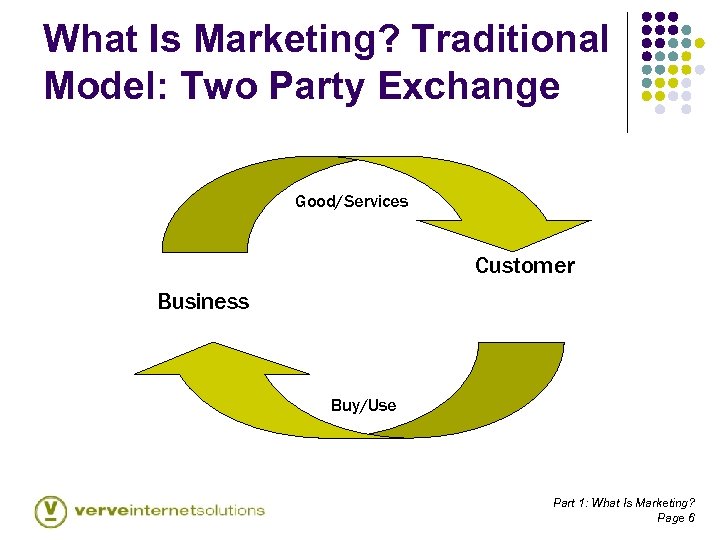
What Is Marketing? Traditional Model: Two Party Exchange Good/Services Customer Business Buy/Use Part 1: What Is Marketing? Page 6
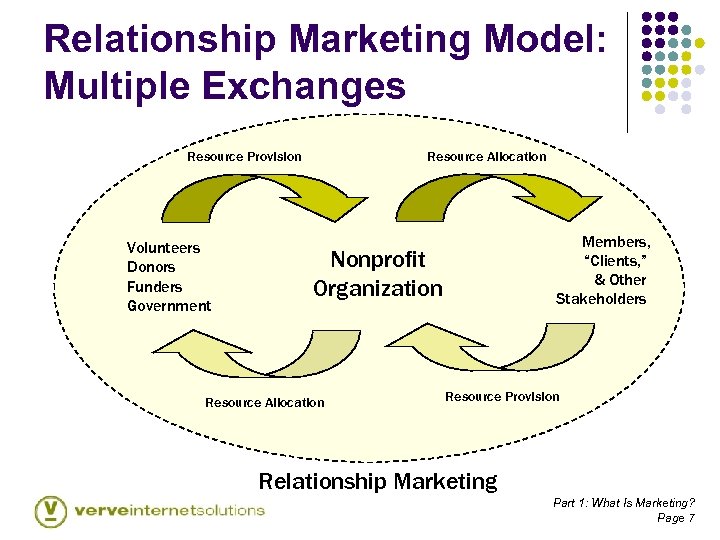
Relationship Marketing Model: Multiple Exchanges Resource Provision Volunteers Donors Funders Government Resource Allocation Members, “Clients, ” & Other Stakeholders Nonprofit Organization Resource Allocation Resource Provision Relationship Marketing Part 1: What Is Marketing? Page 7
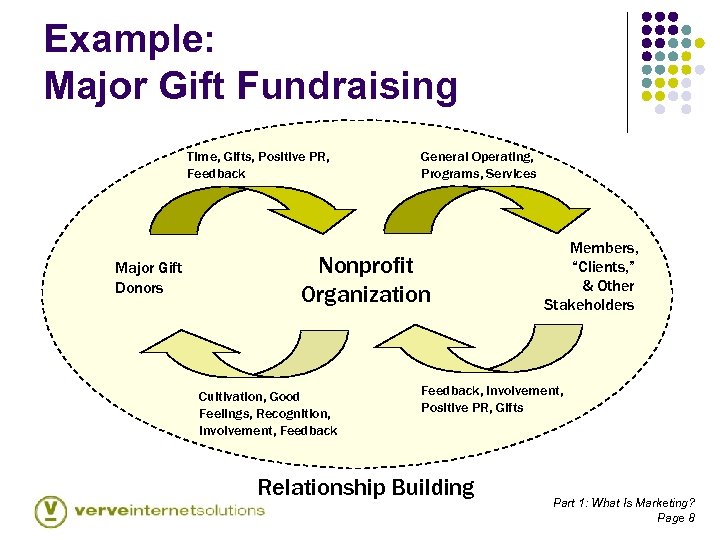
Example: Major Gift Fundraising Time, Gifts, Positive PR, Feedback Major Gift Donors General Operating, Programs, Services Nonprofit Organization Cultivation, Good Feelings, Recognition, Involvement, Feedback Members, “Clients, ” & Other Stakeholders Feedback, Involvement, Positive PR, Gifts Relationship Building Part 1: What Is Marketing? Page 8
Why does marketing matter? l Research shows a direct correlation between a nonprofit’s “marketing orientation” and it’s long-term sustainability: l l l Finances – ability to raise & manage money Standing in “the community” Degree of stakeholder satisfaction Part 1: What Is Marketing? Page 9
Overview of a Marketing Plan l l l Set goals Research/Positioning Create your strategy (marketing mix) Implement the strategy Evaluate results Part 1: What Is Marketing? Page 10
Part 2: Marketing Research “Would you tell me, please, which way I ought to go from here? ” “That depends a good deal on where you want to get to, ” said the Cat. “I don’t much care where—” said Alice. “Then it doesn’t matter which way you go, ” said the Cat. “—as long as I get somewhere, ” Alice added as an explanation. “Oh, you’re sure to do that, ” said the Cat, “if you only walk long enough. ” —Alice’s Adventures in Wonderland, Lewis Carroll Part 2: Marketing Research Page 11
Why marketing research? l l l Helps you position your organization Provides the information needed to create your marketing plan Enables you to make strategic marketing decisions (avoid wasting money) Ensures you will have the best possible chance for success Allows you to evaluate your marketing efforts Part 2: Marketing Research Page 12
Using the Marketing Mix to Guide Research l You’re going to need to know more about your l l l Product (Program) Price Place Promotion You will also need to learn about your l l l Public Competition Production capacity Part 2: Marketing Research Page 13
Collecting & Organizing Data l Create a knowledgebase of information you are already collecting that is relevant to marketing l Develop reports to help inform marketing decisions Part 2: Marketing Research Page 14
Target Marketing l Deciding which groups (markets) to serve and how to serve them l l Identify potential markets that could be served Select markets that best fit the organization’s mission, capabilities, and aspirations Tailor approach to fit the needs and interests of the target market Market Segmentation = Dividing the total potential market into meaningful groups Part 2: Marketing Research Page 15
Choosing Target Markets l l How well does the market segment fit the mission of the organization? Does the organization have the capability to reach this market segment? Is the market segment sufficiently large to justify a special marketing treatment? How easily can the market segment be measured and accessed? Part 2: Marketing Research Page 16
Market Research Exercise l l l Divide into 3 groups Review the case scenario Determine how you would segment the market and what research would be needed Part 2: Marketing Research Page 17
Part 3: Competition, Positioning & Branding l Sizing Up Your Competition l l For what are you competing? With whom/what are you competing? Part 3: Competition, Positioning, Branding Page 18
What Is Positioning? l l “Positioning refers to the place that an agency or its services or ideas occupy in the minds of the individuals in its target market. ” (p. 286) In other words, your “niche”: l l l “They are the people who…” “That’s the program that provides…” “They want to be seen as…” Part 3: Competition, Positioning, Branding Page 19
Positioning Relative to Competition l What dimensions do your stakeholders use to measure their options? l l l l Size Cost Availability Benefits Quality Reputation Other Part 3: Competition, Positioning, Branding Page 20
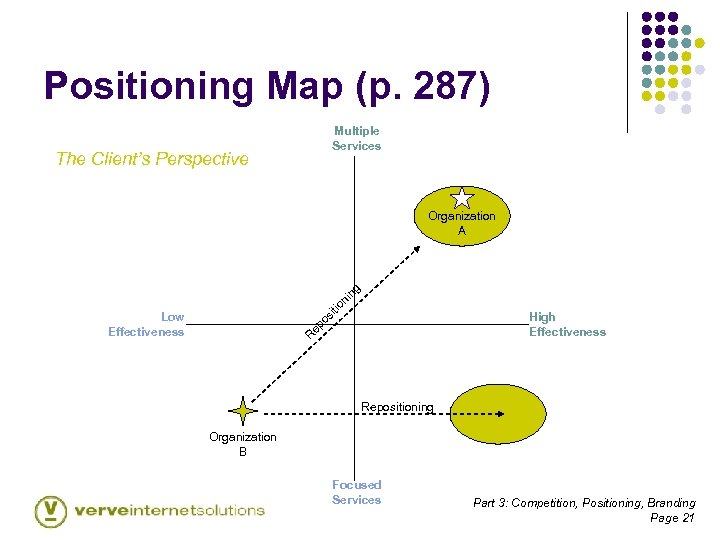
Positioning Map (p. 287) Multiple Services The Client’s Perspective iti o ni ng Organization A High Effectiveness R ep os Low Effectiveness Repositioning Organization B Focused Services Part 3: Competition, Positioning, Branding Page 21
Positioning Exercise l l Think about your organization, or a specific program/service of your organization. Do a competitive analysis, and answer the questions: l l What are we competing for? Who/what are we competing with? Part 3: Competition, Positioning, Branding Page 22
Positioning Exercise (cont. ) l Plot your Positioning Map l l Select a group of your stakeholders to focus on Determine two criteria they might use to evaluate your organization/program l l Mark one criteria as the X axis, and the other as the Y Left/bottom are “low, ” Right/top are “high” Plot where you think your organization/program falls on the map Plot where your top competitor falls on this map Part 3: Competition, Positioning, Branding Page 23
Branding l “A shortcut means of identifying an organization, program, or cause in a way that differentiates it from alternatives. ” (p. 289) l l How does your organization/program make people “feel” Conveys the organization/program’s position in the market Builds relationships with stakeholders that grow in value over time Provides some insulation from competition l If all options are equal, brand could be the deciding factor Part 3: Competition, Positioning, Branding Page 24
Branding Considerations l l Cost Buy-in – board/staff/volunteers at every functional level need to be invested in the brand for it to succeed Coordination/Internal Resources Time Part 3: Competition, Positioning, Branding Page 25
Part 4: The Marketing Mix l l Product – this could be a program, service, or an actual “product” Place (Distribution Channels) Price Promotion (Communications) Part 4: The Marketing Mix Page 26
Prioritizing Programs l The process of: l l l Reviewing all the programs being offered Determining which programs to focus on Portfolio Analysis l l l Review the main programs (products) being offered by an organization Determine criteria for judging their relative importance Evaluate each program against this criteria Part 4: The Marketing Mix Page 27
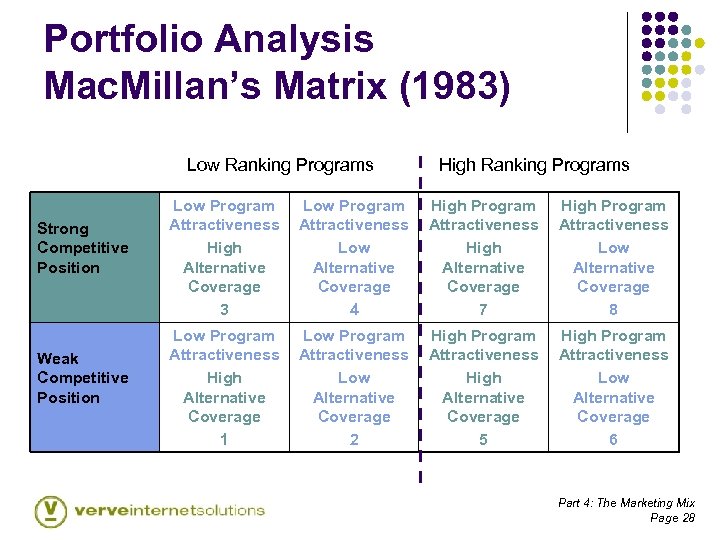
Portfolio Analysis Mac. Millan’s Matrix (1983) Low Ranking Programs Strong Competitive Position Weak Competitive Position High Ranking Programs Low Program Attractiveness High Alternative Coverage 3 Low Program Attractiveness Low Alternative Coverage 4 High Program Attractiveness High Alternative Coverage 7 High Program Attractiveness Low Alternative Coverage 8 Low Program Attractiveness High Alternative Coverage 1 Low Program Attractiveness Low Alternative Coverage 2 High Program Attractiveness High Alternative Coverage 5 High Program Attractiveness Low Alternative Coverage 6 Part 4: The Marketing Mix Page 28
Portfolio Analysis Recap l l Signals whether your program is strong or weak, well-positioned or in danger The way programs “cluster” in the matrix can indicate the need for expansion or elimination of programs l l Example: if programs cluster in areas of great attractiveness, but dense alternative coverage, you may be experiencing “mission creep” Suggests what strategies are appropriate for individual programs Part 4: The Marketing Mix Page 29
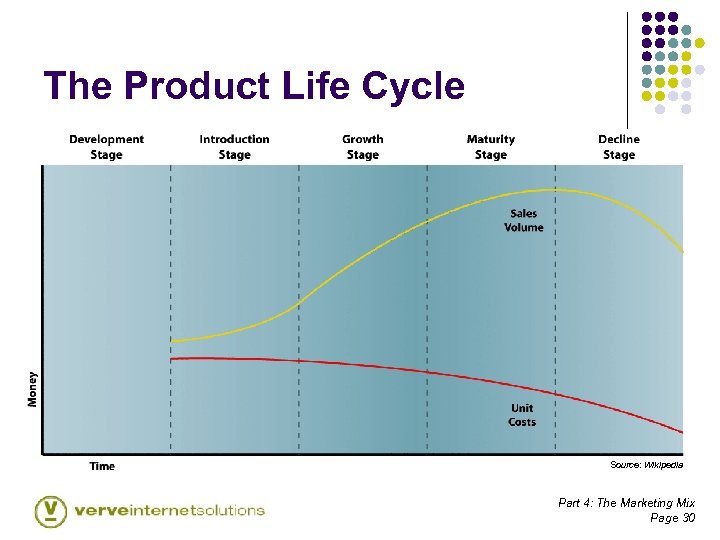
The Product Life Cycle Source: Wikipedia Part 4: The Marketing Mix Page 30
Program Adoption & Diffusion l How new ways of thinking and acting are accepted l l l Innovations are “adopted” by a group/individual Ideas spread to other groups through “diffusion” For marketers the goal is to identify those who have influence (trend leaders) and encourage them to become “early adopters” Part 4: The Marketing Mix Page 31
Pricing, Costs & Value l How does your nonprofit set pricing on its programs? l l l Do you feel your stakeholders cannot afford to pay for your programs/services? Do you believe that your services should be free or cost very little because you are a nonprofit? Are these two questions the only ones involved when you set pricing? Part 4: The Marketing Mix Page 32
Non-financial Costs l Barriers to meeting your goals that are not financial in nature l l Social costs Psychological costs Time costs Take a “value” approach to pricing l Reduce barriers so your stakeholder receives the greatest possible benefit for the price Part 4: The Marketing Mix Page 33
Pricing Objectives l The goals you have for the money you will collect from the program/service l l l You may have more than one pricing objective Pricing objectives may conflict, so prioritize Once the objectives have been identified, set the strategy to achieve them l Remember to consider your costs, potential demand, and the competition’s pricing Part 4: The Marketing Mix Page 34
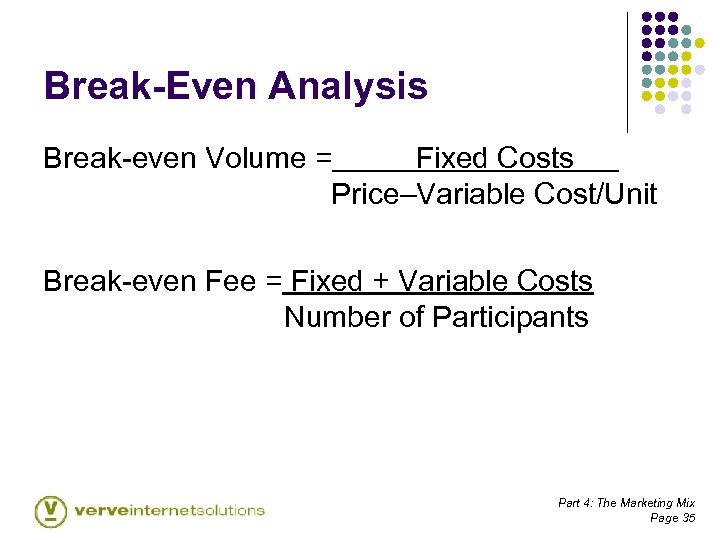
Break-Even Analysis Break-even Volume = Fixed Costs Price–Variable Cost/Unit Break-even Fee = Fixed + Variable Costs Number of Participants Part 4: The Marketing Mix Page 35
Other Pricing Considerations l l Price elasticity – responsiveness of demand to changes in price Keep an eye on competition l l Helps identify price ceiling Reveals ways to offer better products at lower prices Part 4: The Marketing Mix Page 36
Place: Marketing Channels l “Marketing channel” refers to the logistics of distributing the product l l When, where, how a particular product (program) will be made available Ex: marriage counseling services are offered in a local church during evenings and weekends to accommodate working couples. Start by analyzing the needs of your end user Review your own capacity/capabilities Part 4: The Marketing Mix Page 37
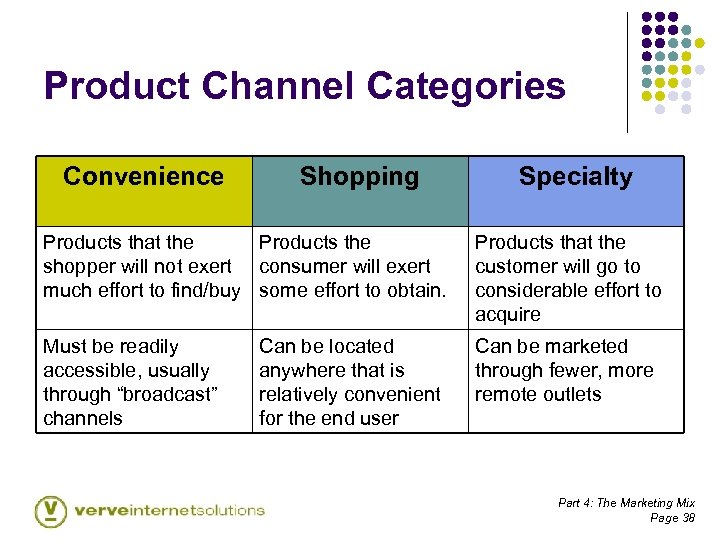
Product Channel Categories Convenience Shopping Specialty Products that the Products the shopper will not exert consumer will exert much effort to find/buy some effort to obtain. Products that the customer will go to considerable effort to acquire Must be readily accessible, usually through “broadcast” channels Can be marketed through fewer, more remote outlets Can be located anywhere that is relatively convenient for the end user Part 4: The Marketing Mix Page 38
Balancing the Trade-Off The need to meet the desires of customers vs. the need to operate efficiently Options to consider: l l l Decentralize customer contact, centralize operations Offer limited services at branches Collaborate with other agencies Part 4: The Marketing Mix Page 39
Location, location l “Location” refers to physical placement, as well as the kind of experience the program will offer the customer l l Is the site accessible? Does it provide the right atmosphere? Part 4: The Marketing Mix Page 40
Promotion l l The final step in the marketing cycle Promotion is reliant on: l Goals l l Market research l l SMART goals: specific, measurable, attainable, reasonable, time-limited Target market, market segment, positioning Portfolio l Product, placement, pricing Part 4: The Marketing Mix Page 41
The Readiness Factor In the sales cycle, audiences move through stages: l Aware – the audience has heard of your program, but doesn’t know very much about it l Informed – the audience has heard of your program, knows the basic details, but isn’t yet ready to buy. l Persuaded – the audience knows about the program and is ready to buy.
Promotional Campaigns l Let the audience, message, goal and budget dictate the most appropriate means l l l Promotion is not “one size fits all” – a brochure is not always the answer Consider all the methods at your disposal that will reach your audience and your goals, then look for cost-savings Evaluate your efforts, and learn from mistakes
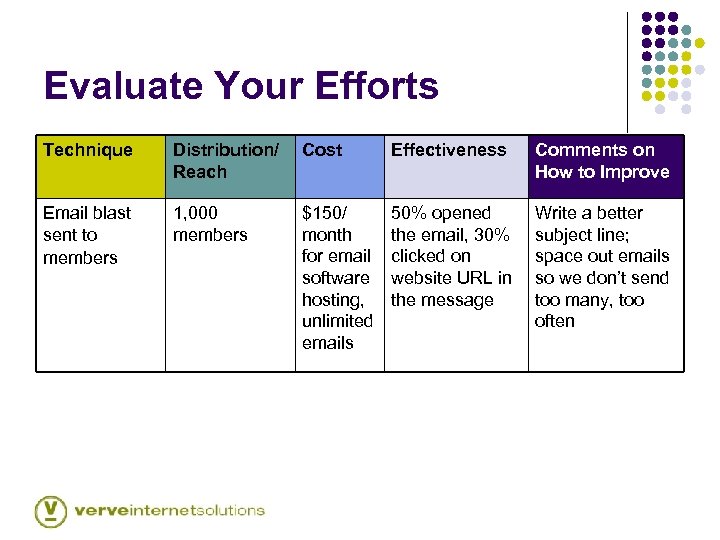
Evaluate Your Efforts Technique Distribution/ Reach Cost Effectiveness Comments on How to Improve Email blast sent to members 1, 000 members $150/ month for email software hosting, unlimited emails 50% opened the email, 30% clicked on website URL in the message Write a better subject line; space out emails so we don’t send too many, too often
Marketing Assessment Review l The SVP Organizational Capacity Assessment l l l Communications & Outreach Effectiveness Communications Strategy PR/Marketing Presence & Involvement in Local Community Development & Nurturing of Partnerships Influence on Policy-making
Additional Resources l l l Stern, Gary. Marketing Workbook for Nonprofit Organizations, Volume I Brinckerhoff, Peter. Mission-Based Marketing: Positioning Your Not-for-Profit in an Increasingly Competitive World , 2 nd Edition Edmunds, Holly. The AMA Complete Guide to Marketing Research for Small Business, Holly Edmunds. Management Assistant Program for Nonprofits http: //www. managementhelp. org/ General resource for nonprofits http: //www. nonprofits. org The Guerilla Marketing website http: //gmarketing. com/
Скачать презентацию Marketing for Nonprofit Managers Presentation by Dottie Schindlinger
932385ea7a651029f9a6dd557a5dec38.ppt