 Скачать презентацию Marketing e branding della città uno sguardo critico
8c6d3c9ccc1e2d010ec60fa549e97c35.ppt
- Количество слайдов: 15



Marketing e branding della città, uno sguardo critico
il marketing urbano • • Cos’è? City boosterism In Europa dagli anni ’ 80 in poi Dal managerialism del welfare state all’entrepreneurialism della governance • Problemi della sua applicazione alla città
Premessa - Globalizzazione e competizione urbana • la città come entità che compete a livello internazionale per attrarre risorse • lo sviluppo dipende da fattori esogeni • La capacità di inserirsi fruttuosamente in particolari reti • La competizione
City-branding • Il concetto di branding – Product branding e la sua evoluzione – City marketing and branding • La città acquisisce una immagine di successo • La città di successo prospera di conseguenza • Una esperienza storica di branding : I NY campaign (Greenberg 2008)
A successful image: innovation & creativity • The role of the cultural industries in the new urban economy; the focus is on • Knowledge production • The connection between innovation and creativity and the urban context in cultural production, presentation and consumption →creative quarters • Creative, innovative, talented workers as drivers of local economic development
The turn from a technology-centered narrative to a creativity-centered narrative • Barcelona, the telematics city • Amsterdam, the information city • Mancester, the wired city • Osaka, intelligent city • Barcelona, the Gaudi city • Amsterdam, Creative city • Bohemian Helsinki: 24 hours no-nonsense • Basel, culture unlimited
Quali narrazioni? • Narrazioni selettive • La politica del “dimenticare” • Ancoraggio all’identità locale
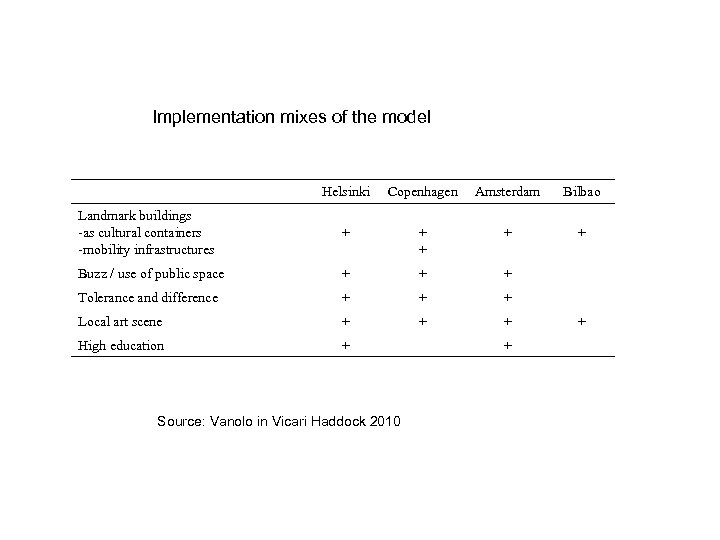
Implementation mixes of the model Helsinki Copenhagen Amsterdam Bilbao Landmark buildings -as cultural containers -mobility infrastructures + + + Buzz / use of public space + + + Tolerance and difference + + + Local art scene + + + High education + Source: Vanolo in Vicari Haddock 2010 + +
• Soft-branding vs hard-branding • Unesco e il programma delle città creative – http: //www. unesco. it/cni/index. php/cultura/citta -creative – Campi di eccellenza: Letteratura (Mantova), Film, Musica (Bologna), Artigianato e arte popolare (Fabriano), Design (Torino), Cinema (Roma), Media e Gastronomia (Parma).
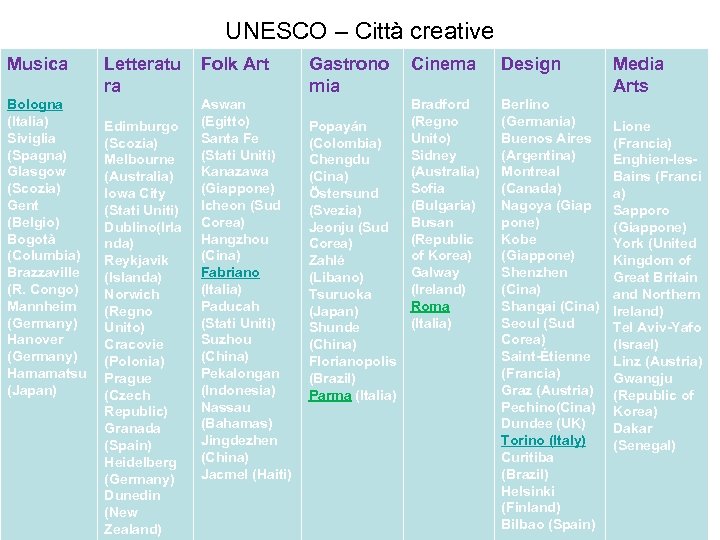
UNESCO – Città creative Musica Bologna (Italia) Siviglia (Spagna) Glasgow (Scozia) Gent (Belgio) Bogotà (Columbia) Brazzaville (R. Congo) Mannheim (Germany) Hanover (Germany) Hamamatsu (Japan) Letteratu ra Edimburgo (Scozia) Melbourne (Australia) Iowa City (Stati Uniti) Dublino(Irla nda) Reykjavik (Islanda) Norwich (Regno Unito) Cracovie (Polonia) Prague (Czech Republic) Granada (Spain) Heidelberg (Germany) Dunedin (New Zealand) Folk Art Aswan (Egitto) Santa Fe (Stati Uniti) Kanazawa (Giappone) Icheon (Sud Corea) Hangzhou (Cina) Fabriano (Italia) Paducah (Stati Uniti) Suzhou (China) Pekalongan (Indonesia) Nassau (Bahamas) Jingdezhen (China) Jacmel (Haiti) Gastrono mia Popayán (Colombia) Chengdu (Cina) Östersund (Svezia) Jeonju (Sud Corea) Zahlé (Libano) Tsuruoka (Japan) Shunde (China) Florianopolis (Brazil) Parma (Italia) Cinema Design Bradford (Regno Unito) Sidney (Australia) Sofia (Bulgaria) Busan (Republic of Korea) Galway (Ireland) Roma (Italia) Berlino (Germania) Buenos Aires (Argentina) Montreal (Canada) Nagoya (Giap pone) Kobe (Giappone) Shenzhen (Cina) Shangai (Cina) Seoul (Sud Corea) Saint-Étienne (Francia) Graz (Austria) Pechino(Cina) Dundee (UK) Torino (Italy) Curitiba (Brazil) Helsinki (Finland) Bilbao (Spain) Media Arts Lione (Francia) Enghien-les. Bains (Franci a) Sapporo (Giappone) York (United Kingdom of Great Britain and Northern Ireland) Tel Aviv-Yafo (Israel) Linz (Austria) Gwangju (Republic of Korea) Dakar (Senegal)
Effective policy interventions? 1 The assumption: creativity and innovation will automatically develop through interaction in cultural quarters. But: • The role of institutions and human capital in the formation of specific creative communities. • Context specificity of the historical development trajectory • Cultural production or consumption ?
Effective policy interventions? 2 • Searching for the “Guggenheim effect” • Sustainability • Democracy: – Top-down policy – Weak link with local identities
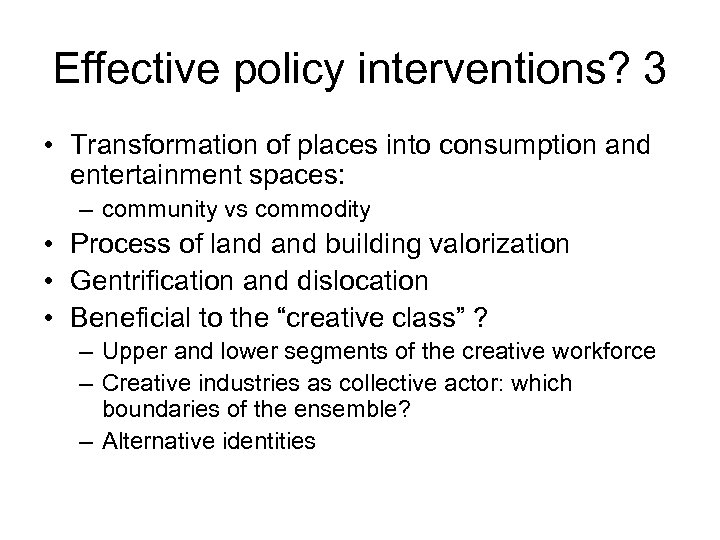
Effective policy interventions? 3 • Transformation of places into consumption and entertainment spaces: – community vs commodity • Process of land building valorization • Gentrification and dislocation • Beneficial to the “creative class” ? – Upper and lower segments of the creative workforce – Creative industries as collective actor: which boundaries of the ensemble? – Alternative identities
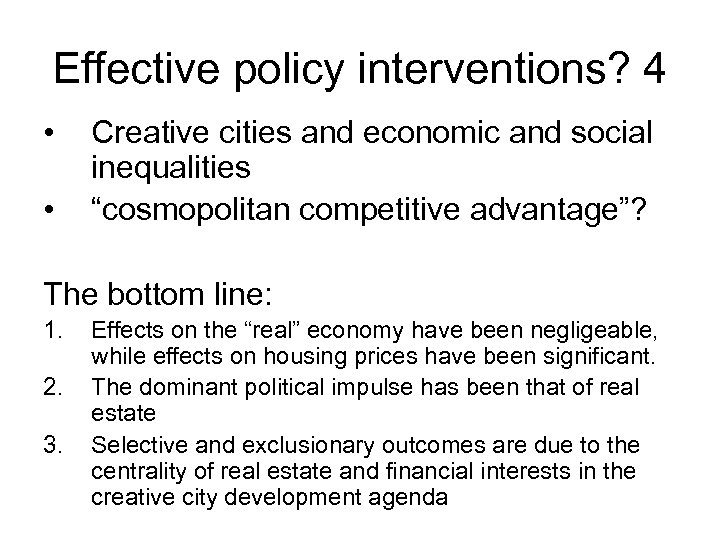
Effective policy interventions? 4 • • Creative cities and economic and social inequalities “cosmopolitan competitive advantage”? The bottom line: 1. 2. 3. Effects on the “real” economy have been negligeable, while effects on housing prices have been significant. The dominant political impulse has been that of real estate Selective and exclusionary outcomes are due to the centrality of real estate and financial interests in the creative city development agenda
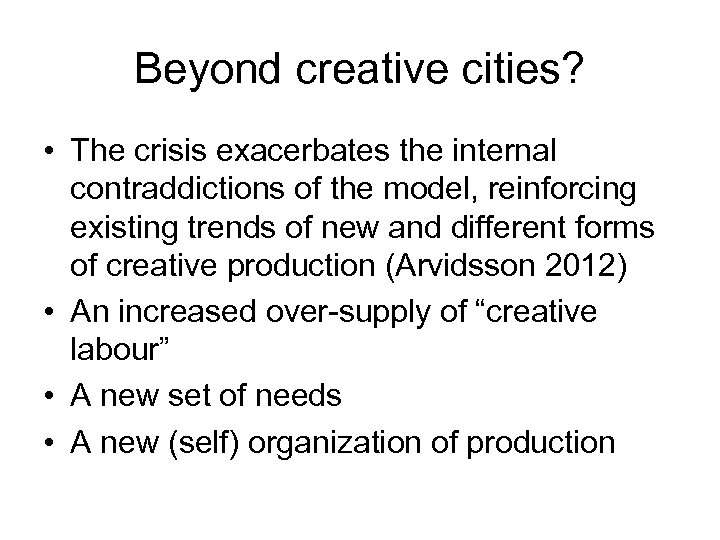
Beyond creative cities? • The crisis exacerbates the internal contraddictions of the model, reinforcing existing trends of new and different forms of creative production (Arvidsson 2012) • An increased over-supply of “creative labour” • A new set of needs • A new (self) organization of production
Скачать презентацию Marketing e branding della città uno sguardo critico
8c6d3c9ccc1e2d010ec60fa549e97c35.ppt