


 Скачать презентацию Marketing communications SECTION 18 1 Display Features
Marketing communications Session 2.pptx
- Количество слайдов: 40
 Marketing communications
 SECTION 18. 1 Display Features What You'll Learn = The concepts of visual merchandising and display = Important display features that contribute to a store's image = The various types of displays
 SECTION 18. 1 Display Features Why It's Important Since visual merchandising helps to sell products and build store image, you will need to know about the different types of store displays and how to create them.
 SECTION 18. 1 Display Features Key Terms = visual merchandising = display = storefront = marquee = store layout = fixtures
 The Concept of the Promotional Mix Promotion is any form of communication a business or organization uses to inform, persuade, or remind people about its products. Promotional mix is a combination of the different types of promotion. A business decides on the promotional mix that will be most effective in persuading potential customers to purchase its products.
 Types of Promotion There are four basic types of promotion: = personal selling = advertising = sales promotion = public relations
 Visual Merchandising and Displays Visual merchandising refers to the coordination of all physical elements in a place of business so that it projects the right image to its customers. = a type of consumer sales promotion The "right" image invites interest in the merchandise or services, encourages purchasing, and makes customers feel good about where they are doing business. Displays refer to the visual and artistic aspects of presenting a product to a target group of customers.
 Elements of Visual Merchandising Visual merchandising is used to create a positive shopping experience that makes customers want to return. To achieve this, stores consider four key elements: = storefront = store layout = store interior = interior displays
 Storefront The total exterior of a business is known as the storefront. It includes the store's sign, marquee, outdoor lighting, banners, windows, and the building itself (its design and setting). Signs The store sign offers the first impression and therefore should make a statement about the business. It should be easily recognizable and help create the store's image. Marquee A marquee is an architectural canopy that extends over a store's entrance. Marquees can be found over most theater entrances.
 Storefront Entrances are usually designed with customer convenience and store security in mind. They can also contribute to a store's image. Window Displays A display window begins the selling process before a customer enters the store. There are two types of window displays: promotional (promotes products) and institutional (promotes the store as a whole).
 Store layout is the way floor space is used to facilitate sales and serve the customer. There are four kinds of space: = Selling space for interior displays, sales demonstrations, and sales transactions = Merchandising space for inventory = Personnel space for employee lockers, lunch breaks, and restrooms = Customer space for restrooms, a cafe, or dressing rooms
 Store interior = The selection of floor and wall coverings, lighting, colors, and store fixtures can powerfully affect the store image. = Example: Thick carpeting can portray a luxurious image. Fixtures are permanent or movable store furnishings, such as display cases, counters, shelving, racks, and benches.
 Interior displays Retailers use interior displays to show merchandise, provide customers with product information, get customers to stop and shop at the store, reinforce advertising, and promote the store's image. There are five main types: = open displays = closed displays = architectural displays = point-of-purchase displays = store decorations
 Interior displays Open Displays allow customers to handle and examine merchandise without the help of a salesperson. = Example: Hanging racks for suits and dresses or countertop displays Closed Displays allow customers to see but not handle merchandise. = Example: Jewelry cases
 Interior displays Architectural displays consist of model rooms that show customers how merchandise such as rugs and furniture might look in their homes. Point-of-purchase displays are designed to promote impulse purchases. They are effective at supporting new products. Point-of-purchase displays are usually supplied by a product manufacturer for use at or near the cash register. Store decorations are displays such as banners, signs, and props used to evoke the mood of seasons or holidays.
 Reviewing Key Terms and Concepts 1. What is visual merchandising? 2. Why is display considered part of visual merchandising? 3. How do exterior and interior features help a store's image? 4. List two different types of window displays. 5. Describe the five different types of interior displays used by retailers.
 Thinking Critically Is it necessary for staff members who work with visual merchandising to know basic sales promotion techniques? Justify your response.
 SECTION 18. 2 Artistic Design What You'll Learn = The steps used in designing and preparing displays = The artistic considerations involved in display preparation = The maintenance considerations for displays
 SECTION 17. 2 Artistic Design Why It's Important Visual merchandisers must know the rules for artistic design for displays that attract customers and keep them coming back.
 SECTION 17. 2 Artistic Design Key Terms = complementary colors = adjacent colors = proportion = formal balance = informal balance
 Display and Design Preparation In the retail environment, a display has about three to eight seconds to attract a customer's attention, create a desire, and sell a product. A business must target its displays carefully to appeal to its customers. Display design and selection involves five steps: 1. 2. 3. 4. 5. Selecting merchandise for display. Selecting the display. Choosing a setting. Manipulating artistic elements. Evaluating completed displays.
 Step 1: Selecting Merchandise for Display Merchandise selected for display must have sales appeal, be visually appealing, and be appropriate for the season and the store's location. New, popular, and best-selling products are often selected.
 Step 2: Selecting the Display The merchandise selected largely determines the type of display that is used. There are four kinds of displays: = A one-item display shows a single item. = A line-of-goods display shows one kind of product but features several brands, sizes, or models. = A related-merchandise display features items that are meant to be used together. = An assortment display features a collection of unrelated items.
 Step 3: Choosing a Setting Displays can be presented in a number of different types of settings. = A realistic setting depicts a room or recognizable locale. = A semi-realistic setting suggests a room or locale but leaves the details to the viewer's imagination. = An abstract setting does not imitate (or even try to imitate) reality. It focuses on form and color rather than on reproducing actual objects.
 Step 4: Manipulating Artistic Elements The artistic elements of a display influence your perception of a display in ways that you are probably not aware of. = line = texture = color = proportion = shape = motion = direction = lighting
 Line Various types of lines create different impressions. = Example: Straight lines suggest stiffness and control; curved lines suggest freedom and movement; diagonal lines give the impression of action.
 Color can make or break a display. Display colors should contrast with those used on the walls, floors, and fixtures around them. Complementary colors (opposite each other on the color wheel) provide the greatest contrast. Adjacent colors (next to each other on the color wheel) blend well with each other.
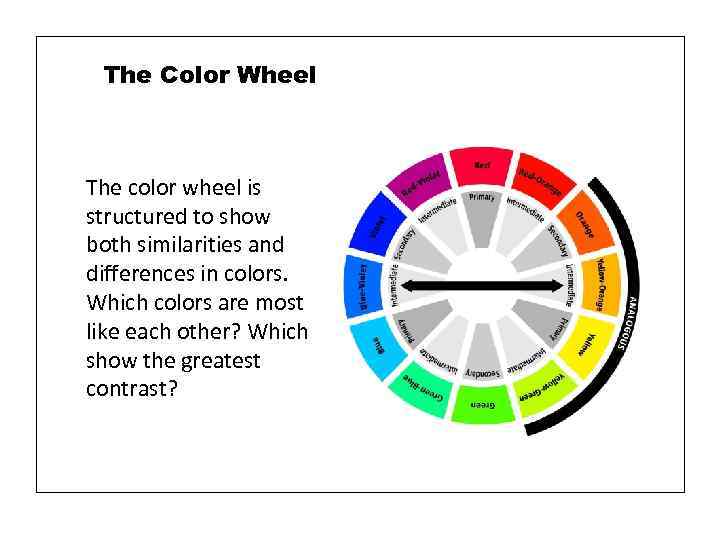 The Color Wheel The color wheel is structured to show both similarities and differences in colors. Which colors are most like each other? Which show the greatest contrast?
 Shape refers to the physical appearance, or outline, of a display. Shape is determined by the props, fixtures, and merchandise used in the display. Displays that have little or no distinct shape are called mass displays. They are used to display large quantities and to convey a message of low price.
 Direction A good display has direction; it smoothly guides the viewer's eye over all the merchandise. Displays should have a focal point, which can be created by building the display around an imaginary triangle to keep the eyes moving up and center.
 Texture refers to the way the surfaces in a display look together. The contrast between textures creates visual interest.
 Proportion is the relationship between and among objects in a display. The merchandise should always be the primary focus of a display.
 Balance Placing large items with large items and small items with small items in a display is called formal balance. Balancing a large item with several small ones is called informal balance.
 Motion can be added to a display through the use of motorized fixtures and props. Motion should be used sparingly or it can become distracting.
 Lighting Proper lighting makes merchandise appear more attractive in displays. It is recommended that display lighting be two to five times stronger than a store's general lighting.
 Step 5: Evaluating Completed Displays Visual merchandisers should evaluate completed displays by checking to see if they enhance the store's image, appeal to customers, and promote the product in the best possible way.
 Display maintenance Once a display has been constructed, it needs to be maintained and eventually dismantled. Proper display maintenance can keep the merchandise fresh and attractive to customers. Poor maintenance can create a negative image of the merchandise and the store.
 Reviewing Key Terms and Concepts 1. What decisions must be made before displays are prepared? 2. Name the five steps involved with display preparation. 3. How does a business select the display setting it desires? 4. Describe five of the artistic elements used in displays. 5. How should displays be evaluated?
 Thinking Critically Manufacturers often provide point-of-purchase displays to retailers. If you were a retailer, what criteria would you use in deciding whether or not to accept such a display?
 Questions?