 Скачать презентацию Market Timing with De Mark Indicators on Bloomberg
1afab15eddfa42b06f8869af286dd828.ppt
- Количество слайдов: 75



Market Timing with De. Mark Indicators on Bloomberg ™ Presented by Tom De. Mark & Lindsay Glass February 2003 De. Mark Indicators™ on Bloomberg 1
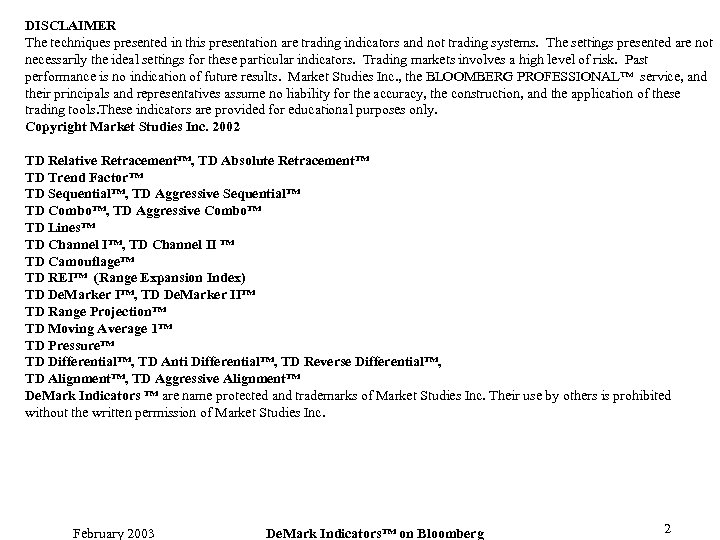
DISCLAIMER The techniques presented in this presentation are trading indicators and not trading systems. The settings presented are not necessarily the ideal settings for these particular indicators. Trading markets involves a high level of risk. Past performance is no indication of future results. Market Studies Inc. , the BLOOMBERG PROFESSIONAL™ service, and their principals and representatives assume no liability for the accuracy, the construction, and the application of these trading tools. These indicators are provided for educational purposes only. Copyright Market Studies Inc. 2002 TD Relative Retracement™, TD Absolute Retracement™ TD Trend Factor™ TD Sequential™, TD Aggressive Sequential™ TD Combo™, TD Aggressive Combo™ TD Lines™ TD Channel I™, TD Channel II ™ TD Camouflage™ TD REI™ (Range Expansion Index) TD De. Marker I™, TD De. Marker II™ TD Range Projection™ TD Moving Average 1™ TD Pressure™ TD Differential™, TD Anti Differential™, TD Reverse Differential™, TD Alignment™, TD Aggressive Alignment™ De. Mark Indicators ™ are name protected and trademarks of Market Studies Inc. Their use by others is prohibited without the written permission of Market Studies Inc. February 2003 De. Mark Indicators™ on Bloomberg 2
Benefits OBJECTIVELY GENERATE TRADE IDEAS and identify Price Levels to IMPROVE TRADE EXECUTION February 2003 De. Mark Indicators™ on Bloomberg 3
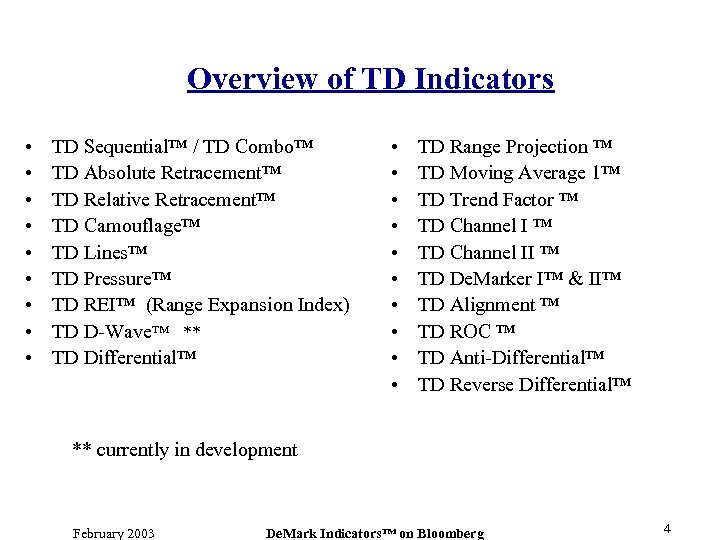
Overview of TD Indicators • • • TD Sequential™ / TD Combo™ TD Absolute Retracement™ TD Relative Retracement™ TD Camouflage™ TD Lines™ TD Pressure™ TD REI™ (Range Expansion Index) TD D-Wave™ ** TD Differential™ • • • TD Range Projection ™ TD Moving Average 1™ TD Trend Factor ™ TD Channel II ™ TD De. Marker I™ & II™ TD Alignment ™ TD ROC ™ TD Anti-Differential™ TD Reverse Differential™ ** currently in development February 2003 De. Mark Indicators™ on Bloomberg 4
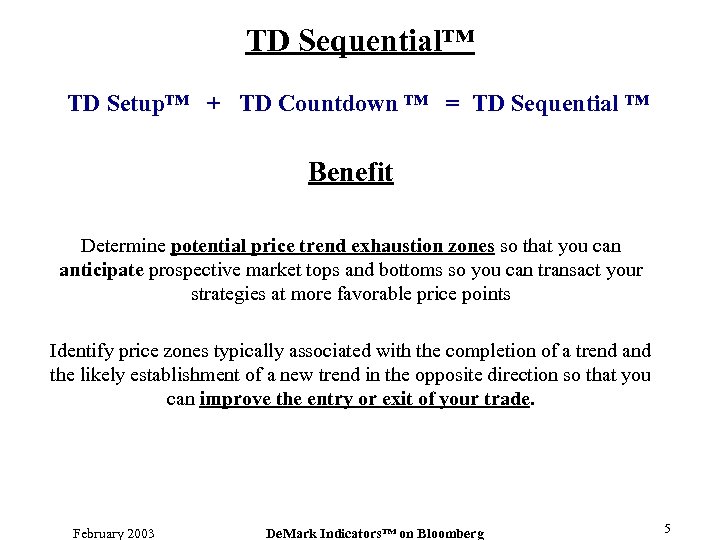
TD Sequential™ TD Setup™ + TD Countdown ™ = TD Sequential ™ Benefit Determine potential price trend exhaustion zones so that you can anticipate prospective market tops and bottoms so you can transact your strategies at more favorable price points Identify price zones typically associated with the completion of a trend and the likely establishment of a new trend in the opposite direction so that you can improve the entry or exit of your trade. February 2003 De. Mark Indicators™ on Bloomberg 5
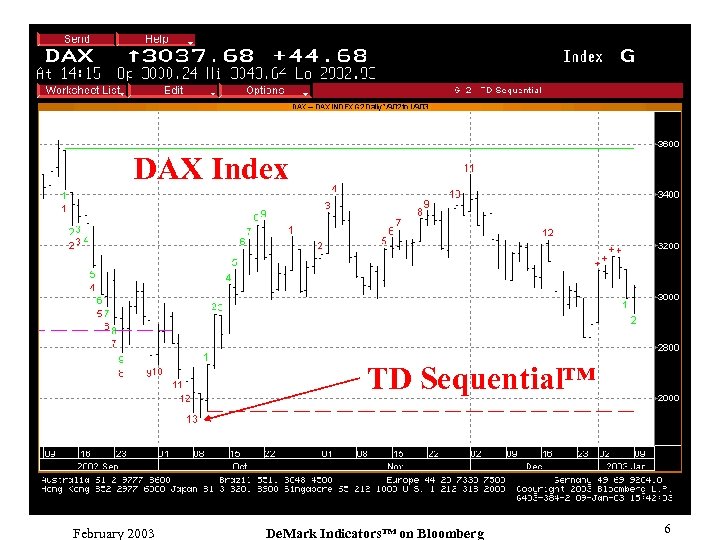
DAX Index TD Sequential™ February 2003 De. Mark Indicators™ on Bloomberg 6
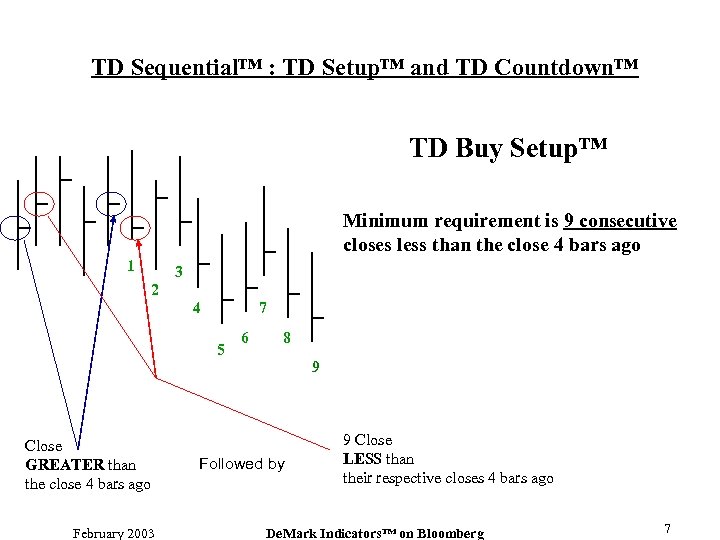
TD Sequential™ : TD Setup™ and TD Countdown™ TD Buy Setup™ Minimum requirement is 9 consecutive closes less than the close 4 bars ago 1 3 2 4 7 5 Close GREATER than the close 4 bars ago February 2003 6 8 9 Followed by 9 Close LESS than their respective closes 4 bars ago De. Mark Indicators™ on Bloomberg 7
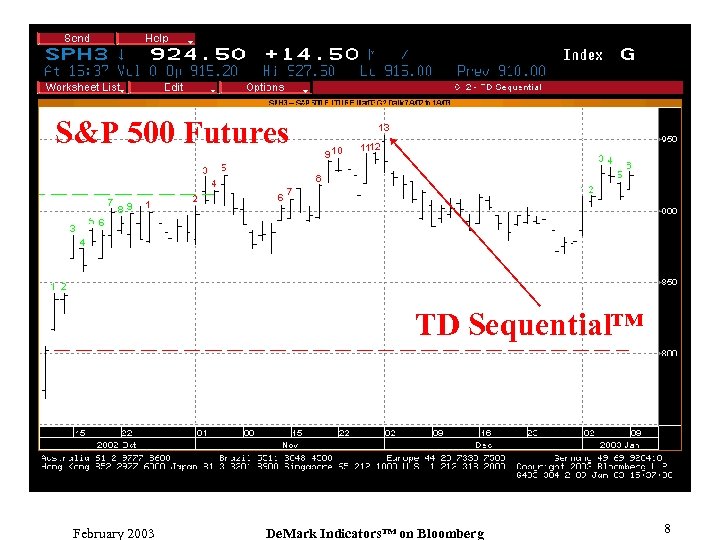
S&P 500 Futures TD Sequential™ February 2003 De. Mark Indicators™ on Bloomberg 8
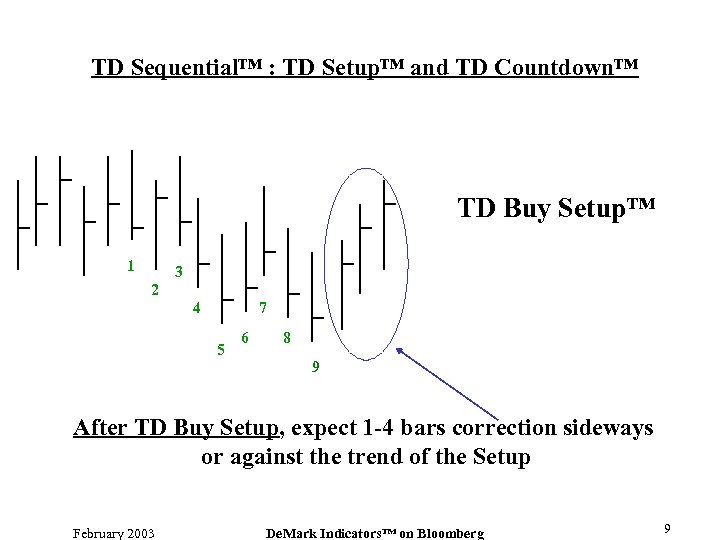
TD Sequential™ : TD Setup™ and TD Countdown™ TD Buy Setup™ 1 3 2 4 7 5 6 8 9 After TD Buy Setup, expect 1 -4 bars correction sideways or against the trend of the Setup February 2003 De. Mark Indicators™ on Bloomberg 9
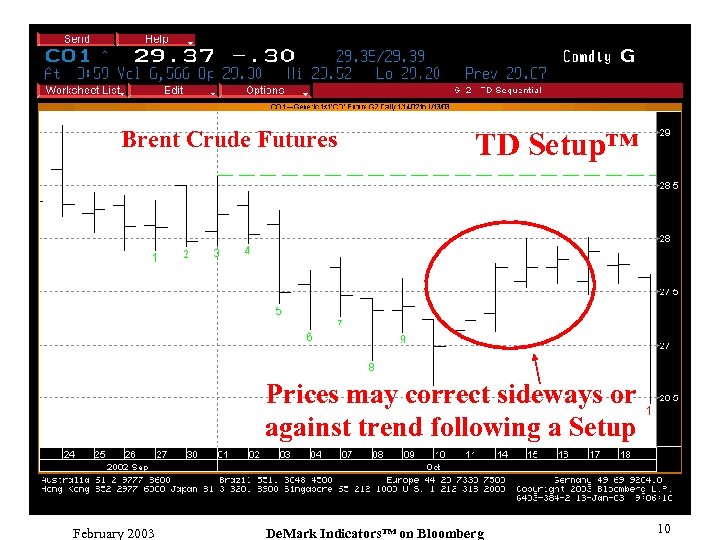
Brent Crude Futures TD Setup™ Prices may correct sideways or against trend following a Setup February 2003 De. Mark Indicators™ on Bloomberg 10
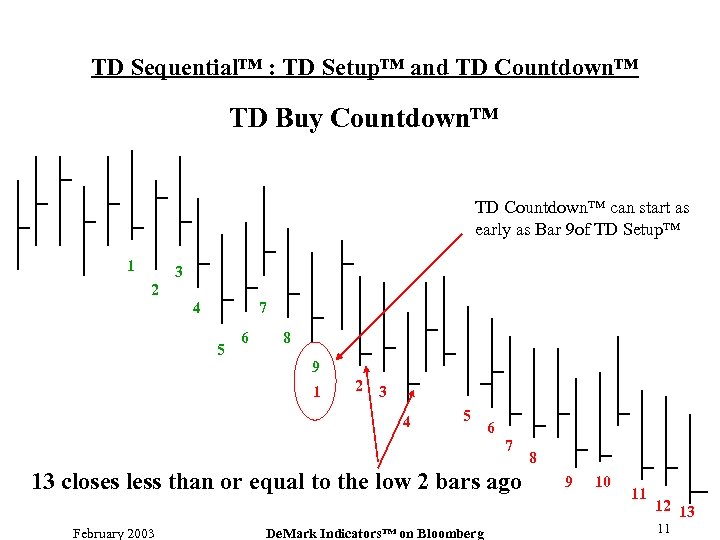
TD Sequential™ : TD Setup™ and TD Countdown™ TD Buy Countdown™ TD Countdown™ can start as early as Bar 9 of TD Setup™ 1 3 2 4 7 5 6 8 9 1 2 3 4 5 6 7 13 closes less than or equal to the low 2 bars ago February 2003 De. Mark Indicators™ on Bloomberg 8 9 10 11 12 13 11
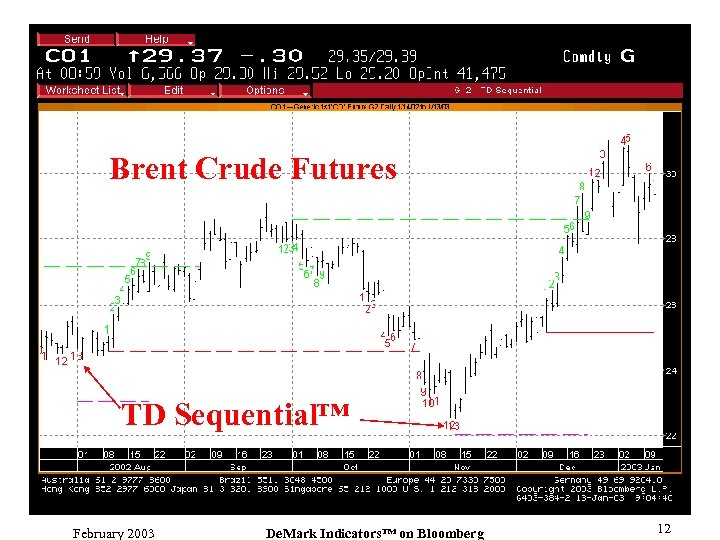
Brent Crude Futures TD Sequential™ February 2003 De. Mark Indicators™ on Bloomberg 12
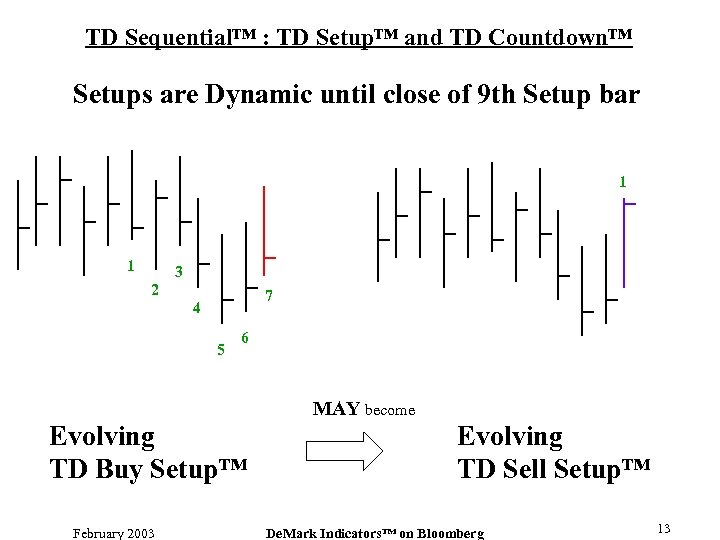
TD Sequential™ : TD Setup™ and TD Countdown™ Setups are Dynamic until close of 9 th Setup bar 1 1 3 2 7 4 5 6 MAY become Evolving TD Buy Setup™ February 2003 Evolving TD Sell Setup™ De. Mark Indicators™ on Bloomberg 13
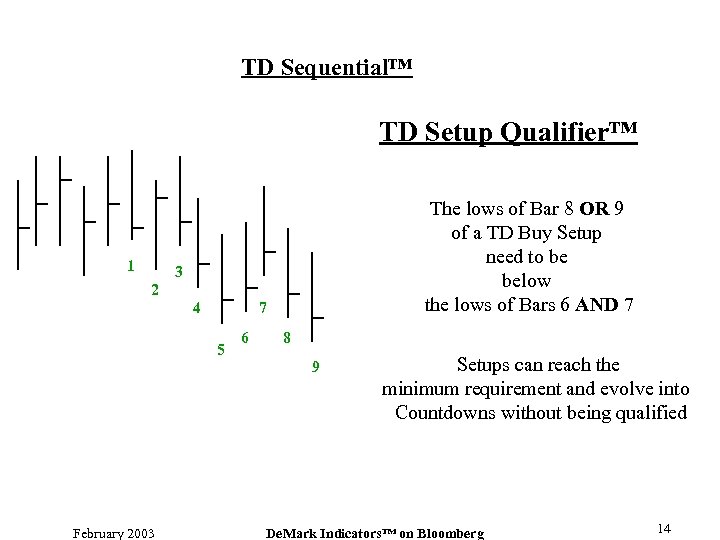
TD Sequential™ TD Setup Qualifier™ 1 The lows of Bar 8 OR 9 of a TD Buy Setup need to be below the lows of Bars 6 AND 7 3 2 4 7 5 February 2003 6 8 9 Setups can reach the minimum requirement and evolve into Countdowns without being qualified De. Mark Indicators™ on Bloomberg 14
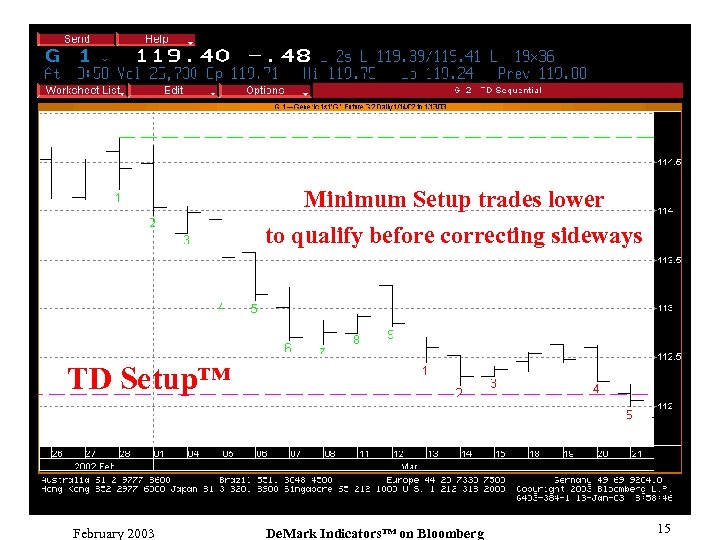
Minimum Setup trades lower to qualify before correcting sideways TD Setup™ February 2003 De. Mark Indicators™ on Bloomberg 15
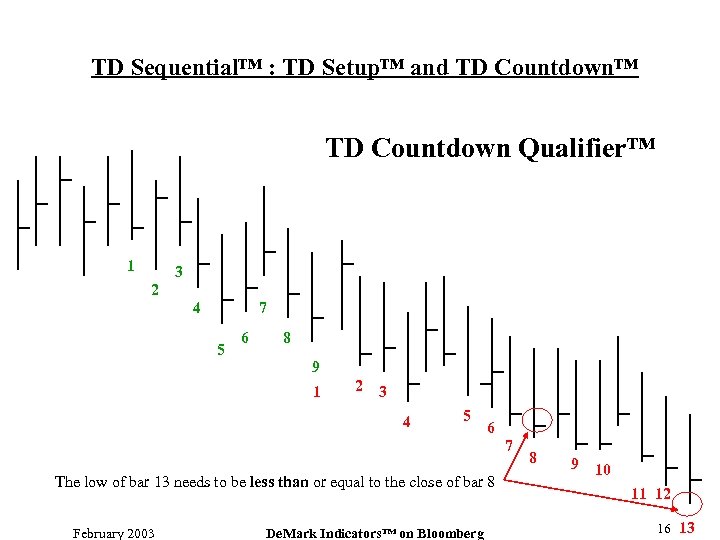
TD Sequential™ : TD Setup™ and TD Countdown™ TD Countdown Qualifier™ 1 3 2 4 7 5 6 8 9 1 2 3 4 5 6 7 The low of bar 13 needs to be less than or equal to the close of bar 8 February 2003 De. Mark Indicators™ on Bloomberg 8 9 10 11 12 16 13
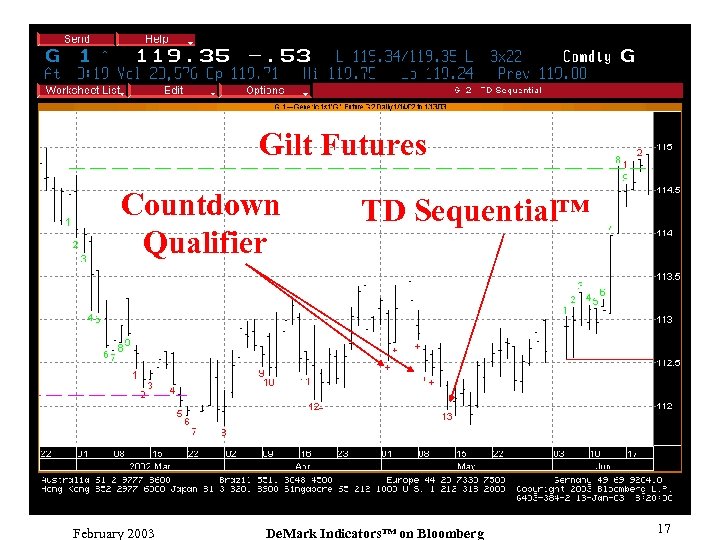
Gilt Futures Countdown Qualifier February 2003 TD Sequential™ De. Mark Indicators™ on Bloomberg 17
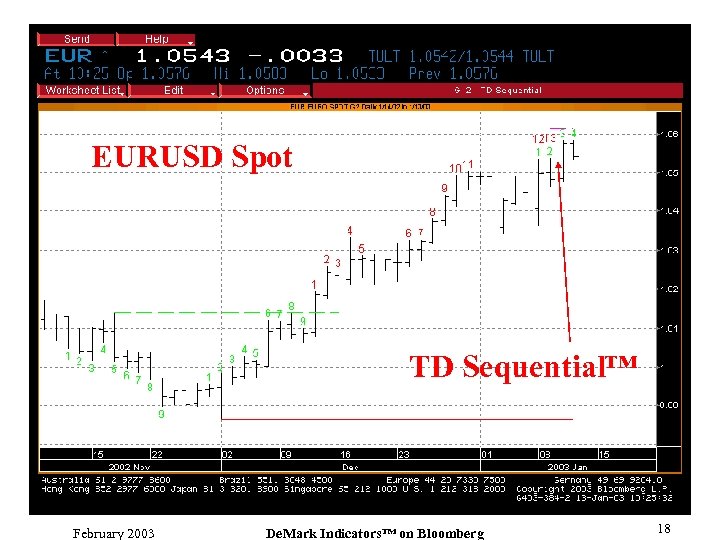
EURUSD Spot TD Sequential™ February 2003 De. Mark Indicators™ on Bloomberg 18
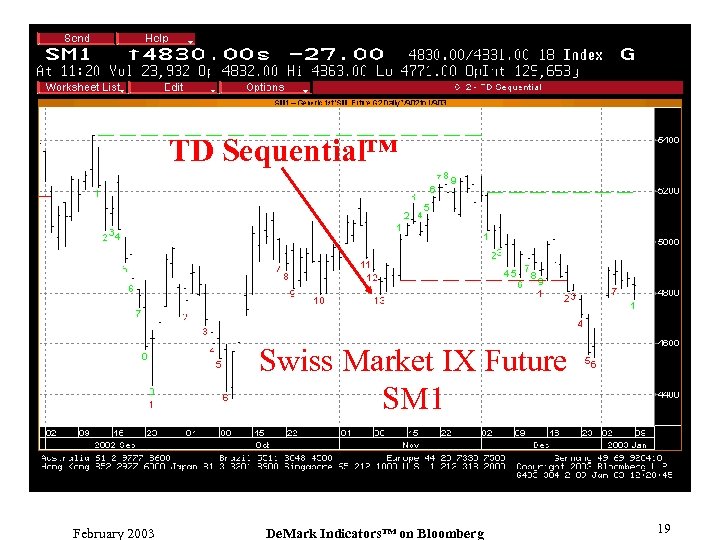
TD Sequential™ Swiss Market IX Future SM 1 February 2003 De. Mark Indicators™ on Bloomberg 19
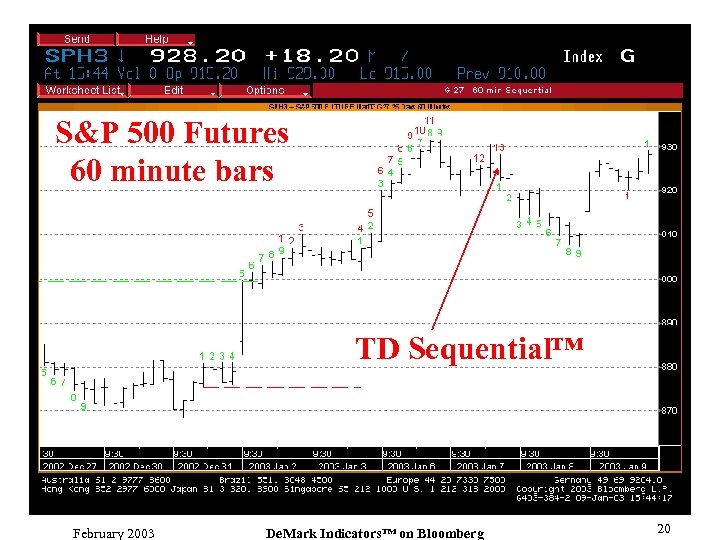
S&P 500 Futures 60 minute bars TD Sequential™ February 2003 De. Mark Indicators™ on Bloomberg 20
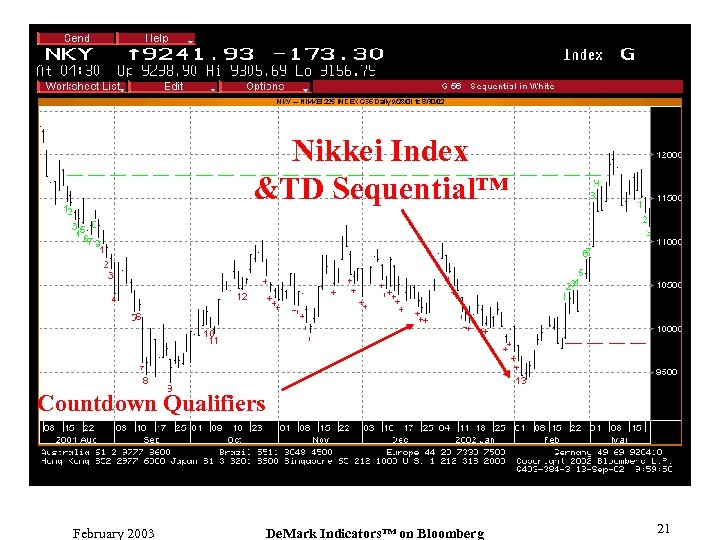
Nikkei Index &TD Sequential™ Countdown Qualifiers February 2003 De. Mark Indicators™ on Bloomberg 21
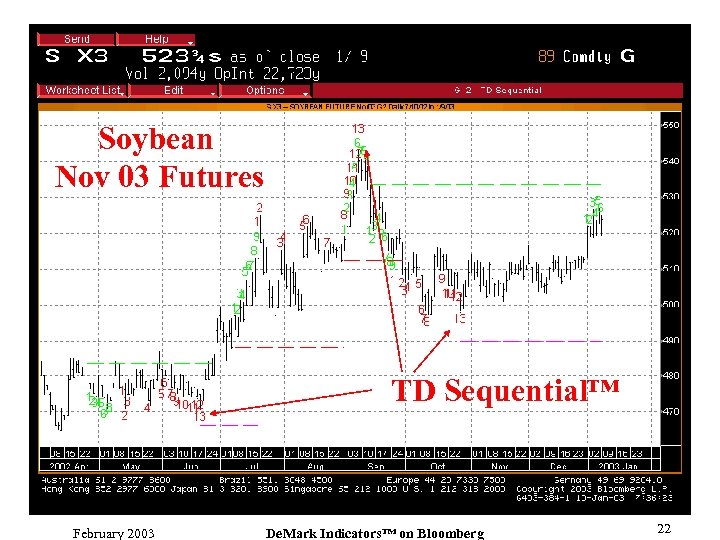
Soybean Nov 03 Futures TD Sequential™ February 2003 De. Mark Indicators™ on Bloomberg 22
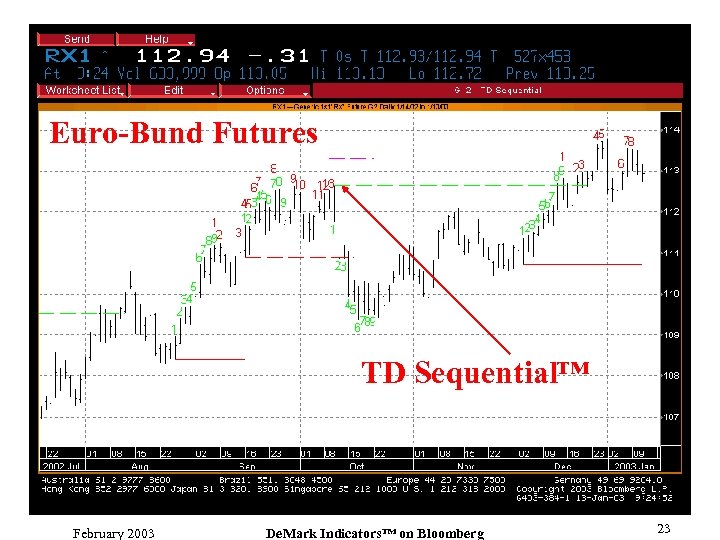
Euro-Bund Futures TD Sequential™ February 2003 De. Mark Indicators™ on Bloomberg 23
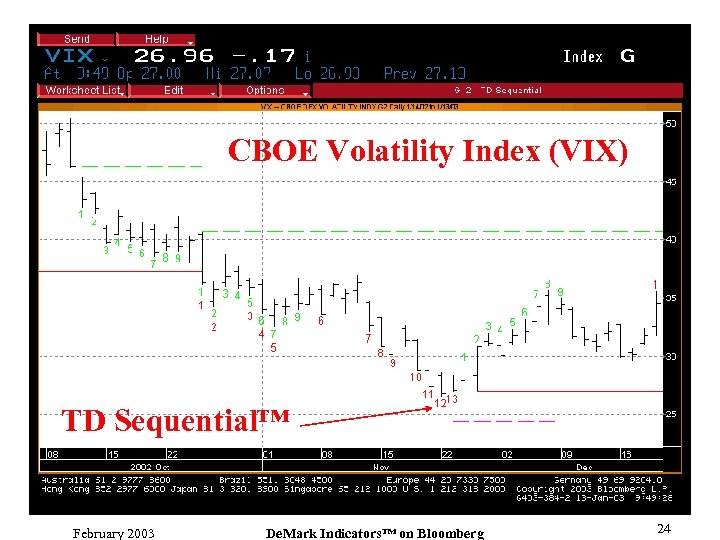
CBOE Volatility Index (VIX) TD Sequential™ February 2003 De. Mark Indicators™ on Bloomberg 24
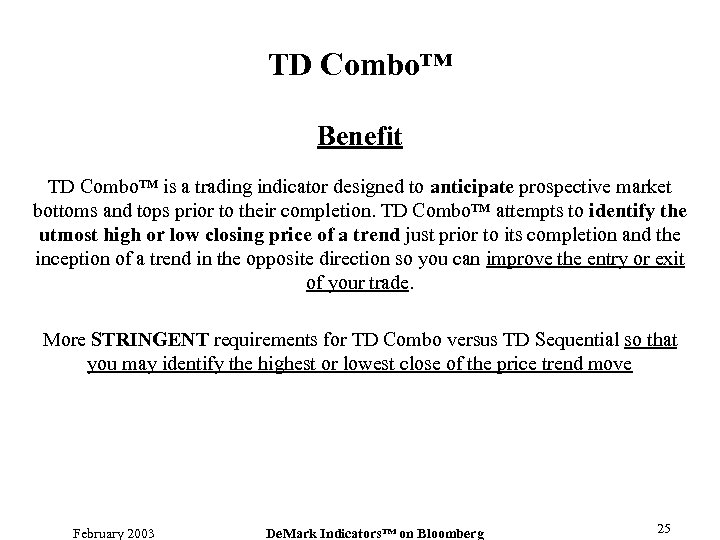
TD Combo™ Benefit TD Combo™ is a trading indicator designed to anticipate prospective market bottoms and tops prior to their completion. TD Combo™ attempts to identify the utmost high or low closing price of a trend just prior to its completion and the inception of a trend in the opposite direction so you can improve the entry or exit of your trade. More STRINGENT requirements for TD Combo versus TD Sequential so that you may identify the highest or lowest close of the price trend move February 2003 De. Mark Indicators™ on Bloomberg 25
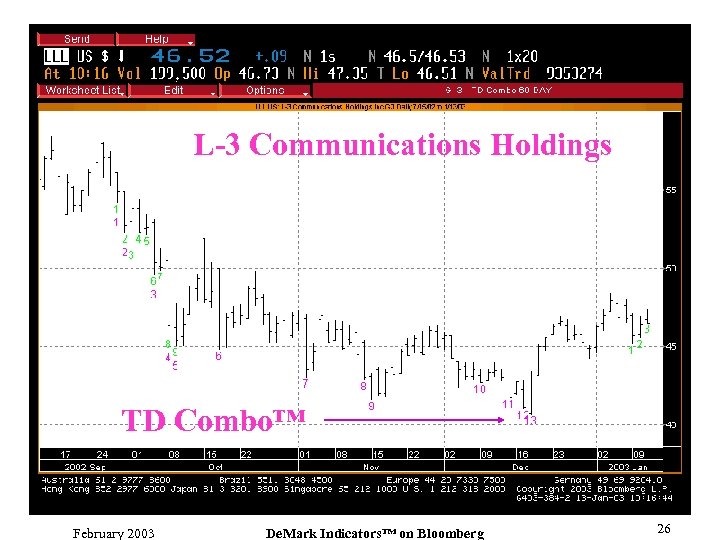
L-3 Communications Holdings TD Combo™ February 2003 De. Mark Indicators™ on Bloomberg 26
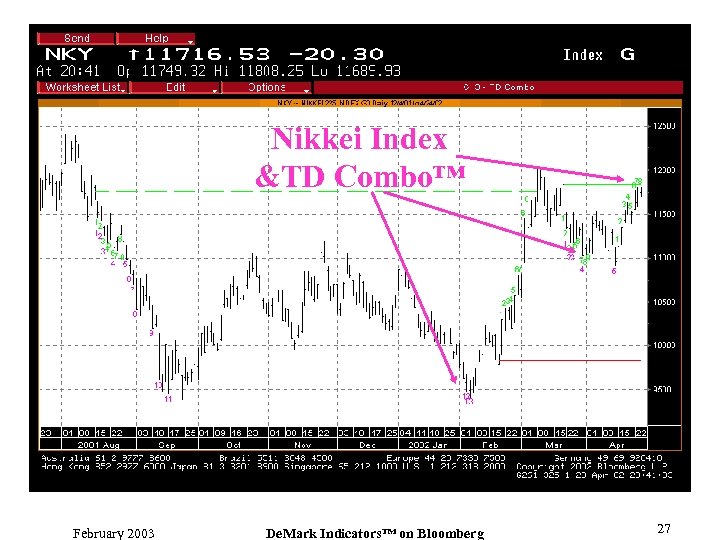
Nikkei Index &TD Combo™ February 2003 De. Mark Indicators™ on Bloomberg 27
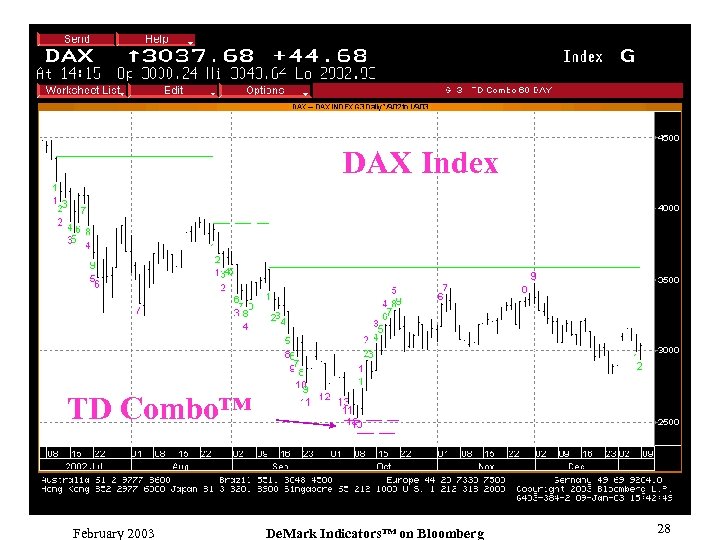
DAX Index TD Combo™ February 2003 De. Mark Indicators™ on Bloomberg 28
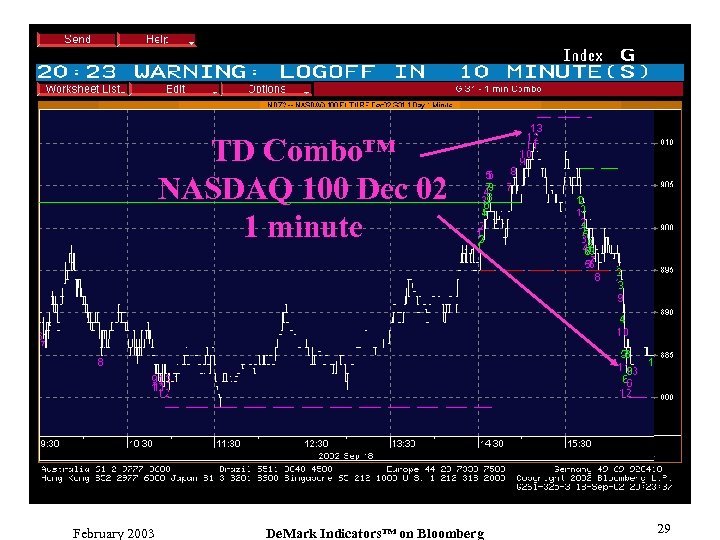
TD Combo™ NASDAQ 100 Dec 02 1 minute February 2003 De. Mark Indicators™ on Bloomberg 29
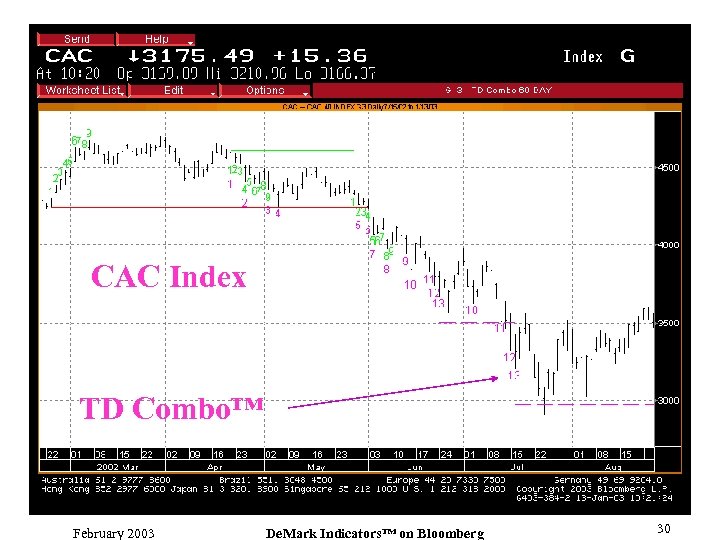
CAC Index TD Combo™ February 2003 De. Mark Indicators™ on Bloomberg 30
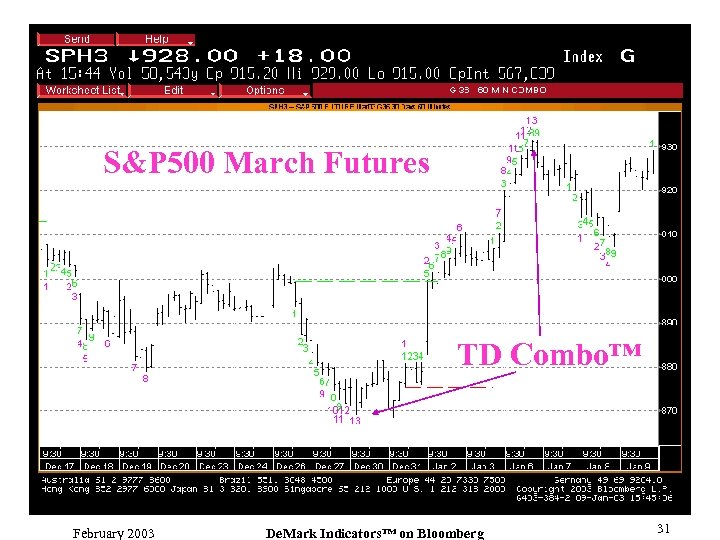
S&P 500 March Futures TD Combo™ February 2003 De. Mark Indicators™ on Bloomberg 31
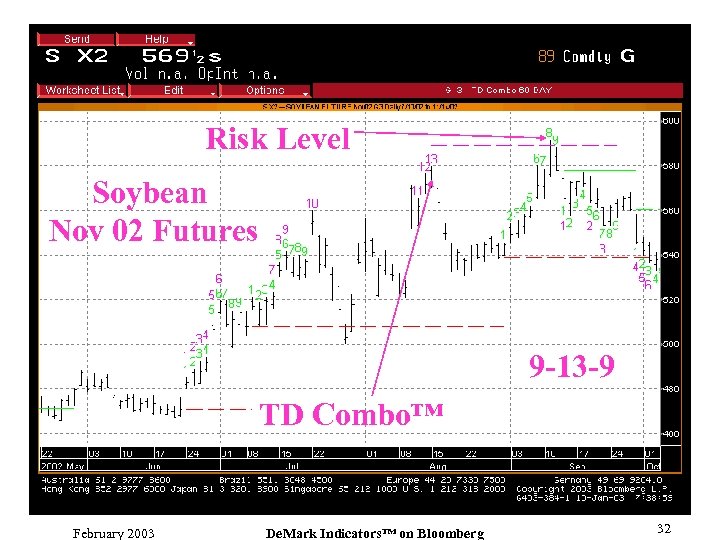
Risk Level Soybean Nov 02 Futures 9 -13 -9 TD Combo™ February 2003 De. Mark Indicators™ on Bloomberg 32
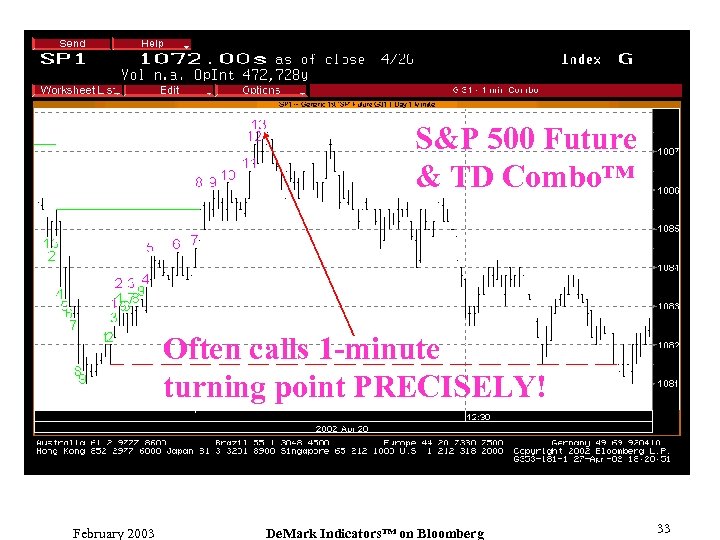
S&P 500 Future & TD Combo™ Often calls 1 -minute turning point PRECISELY! February 2003 De. Mark Indicators™ on Bloomberg 33
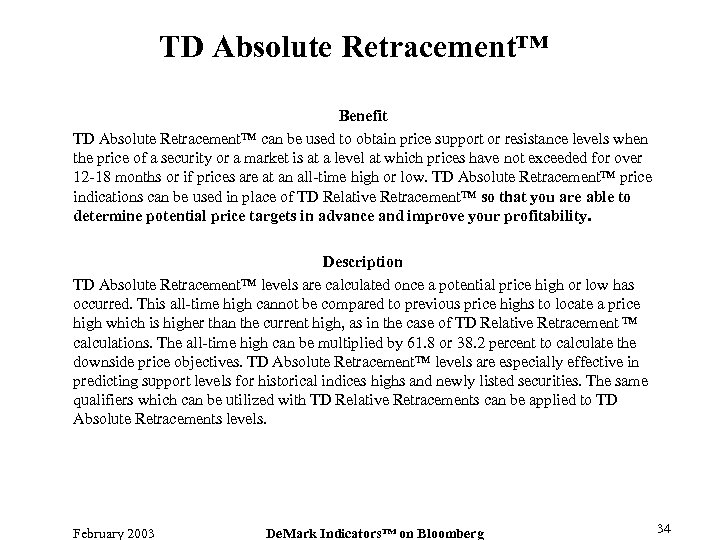
TD Absolute Retracement™ Benefit TD Absolute Retracement™ can be used to obtain price support or resistance levels when the price of a security or a market is at a level at which prices have not exceeded for over 12 -18 months or if prices are at an all-time high or low. TD Absolute Retracement™ price indications can be used in place of TD Relative Retracement™ so that you are able to determine potential price targets in advance and improve your profitability. Description TD Absolute Retracement™ levels are calculated once a potential price high or low has occurred. This all-time high cannot be compared to previous price highs to locate a price high which is higher than the current high, as in the case of TD Relative Retracement ™ calculations. The all-time high can be multiplied by 61. 8 or 38. 2 percent to calculate the downside price objectives. TD Absolute Retracement™ levels are especially effective in predicting support levels for historical indices highs and newly listed securities. The same qualifiers which can be utilized with TD Relative Retracements can be applied to TD Absolute Retracements levels. February 2003 De. Mark Indicators™ on Bloomberg 34
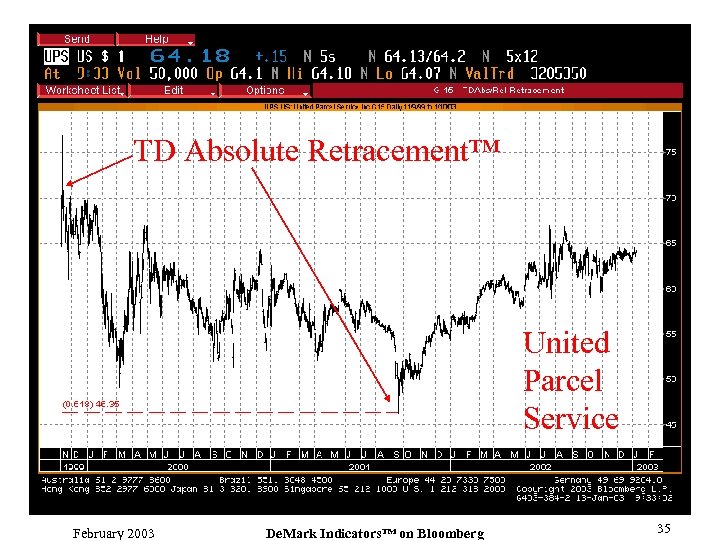
TD Absolute Retracement™ United Parcel Service February 2003 De. Mark Indicators™ on Bloomberg 35
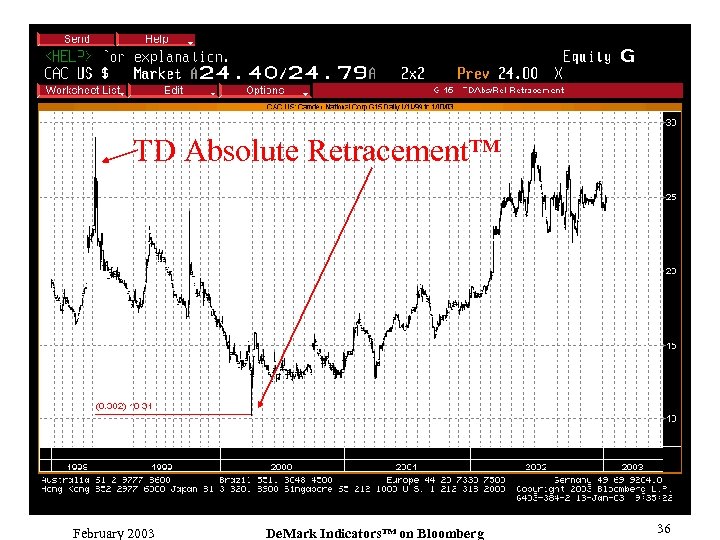
TD Absolute Retracement™ February 2003 De. Mark Indicators™ on Bloomberg 36
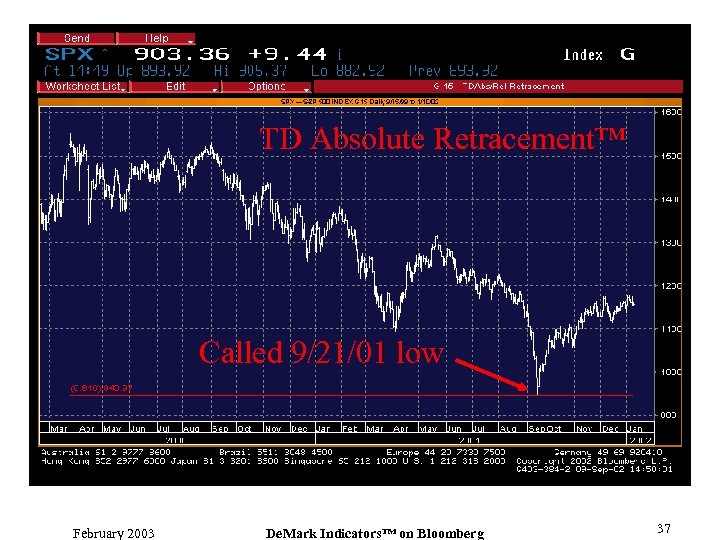
TD Absolute Retracement™ Called 9/21/01 low February 2003 De. Mark Indicators™ on Bloomberg 37
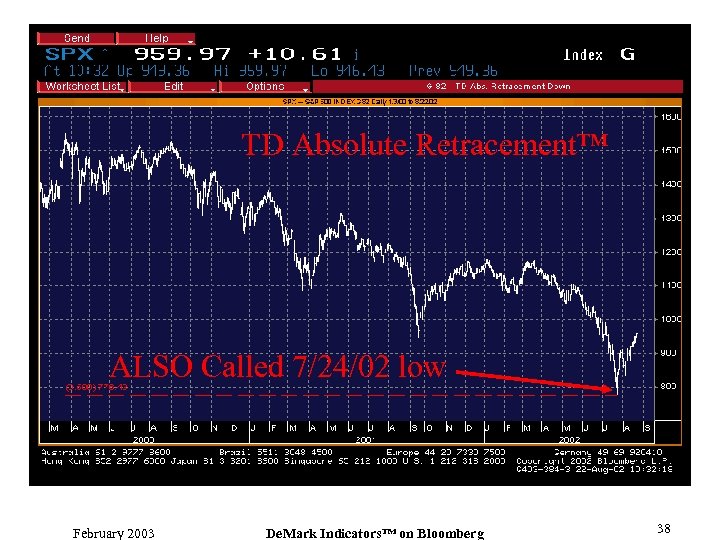
TD Absolute Retracement™ ALSO Called 7/24/02 low February 2003 De. Mark Indicators™ on Bloomberg 38
TD Pressure™ An indicator, shown as an oscillator, with more precision and consistency than Money Flow and On-Balance Volume. It allows you to determine the critical buying and selling levels so that you can enhance profitability with better trade location. February 2003 De. Mark Indicators™ on Bloomberg 39
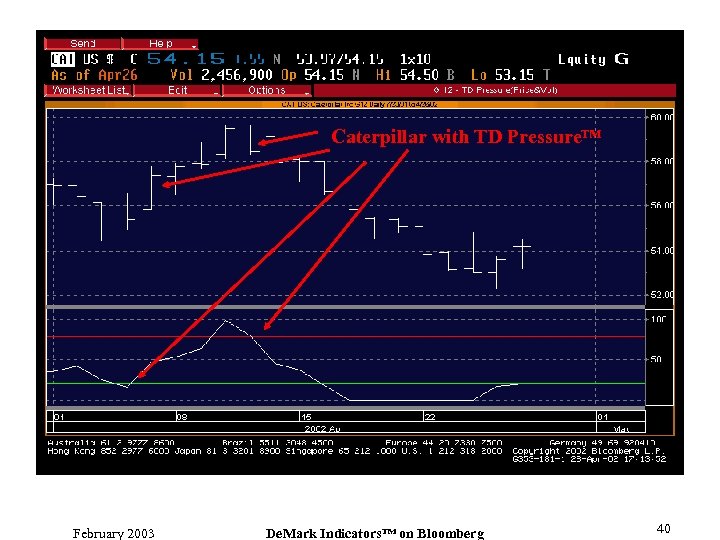
Caterpillar with TD Pressure™ February 2003 De. Mark Indicators™ on Bloomberg 40
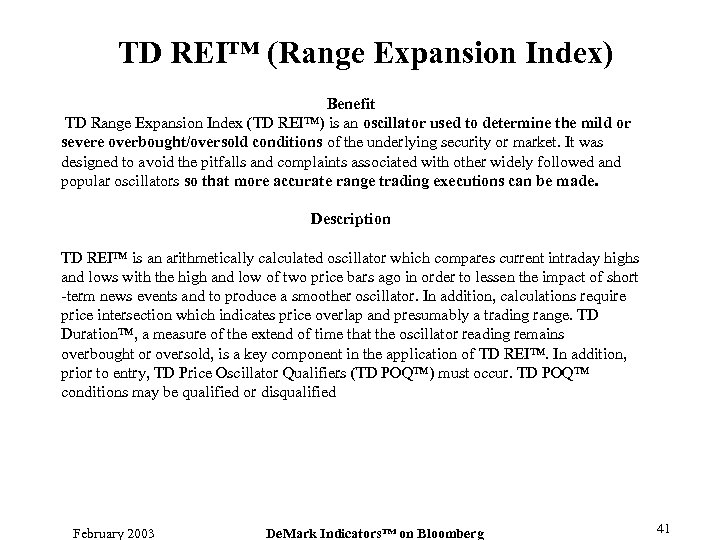
TD REI™ (Range Expansion Index) Benefit TD Range Expansion Index (TD REI™) is an oscillator used to determine the mild or severe overbought/oversold conditions of the underlying security or market. It was designed to avoid the pitfalls and complaints associated with other widely followed and popular oscillators so that more accurate range trading executions can be made. Description TD REI™ is an arithmetically calculated oscillator which compares current intraday highs and lows with the high and low of two price bars ago in order to lessen the impact of short -term news events and to produce a smoother oscillator. In addition, calculations require price intersection which indicates price overlap and presumably a trading range. TD Duration™, a measure of the extend of time that the oscillator reading remains overbought or oversold, is a key component in the application of TD REI™. In addition, prior to entry, TD Price Oscillator Qualifiers (TD POQ™) must occur. TD POQ™ conditions may be qualified or disqualified February 2003 De. Mark Indicators™ on Bloomberg 41
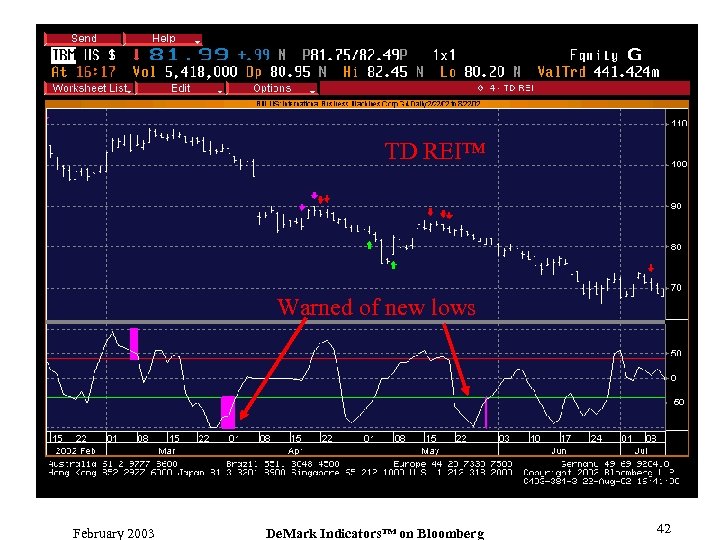
TD REI™ Warned of new lows February 2003 De. Mark Indicators™ on Bloomberg 42
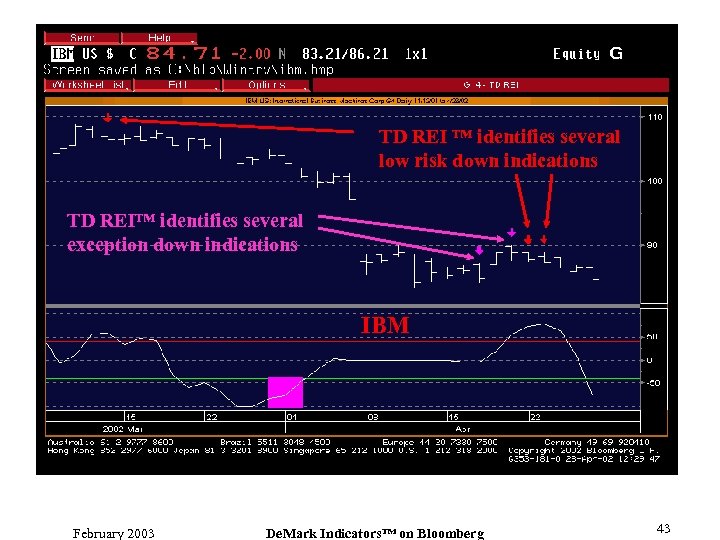
TD REI ™ identifies several low risk down indications TD REI™ identifies several exception down indications IBM February 2003 De. Mark Indicators™ on Bloomberg 43
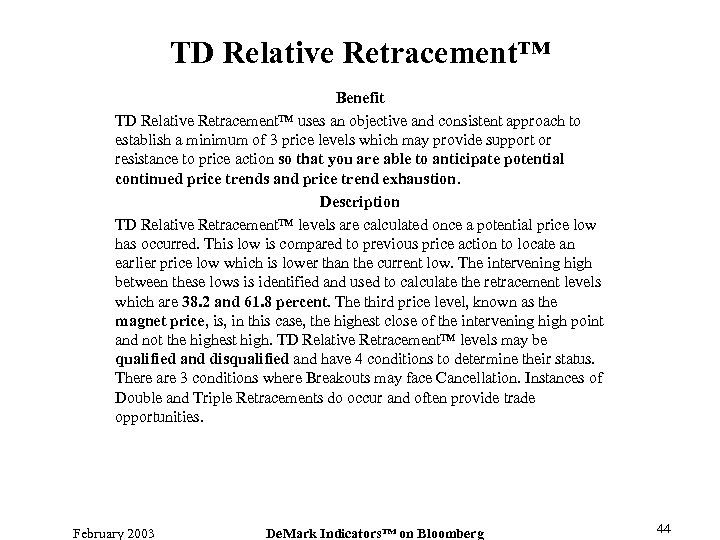
TD Relative Retracement™ Benefit TD Relative Retracement™ uses an objective and consistent approach to establish a minimum of 3 price levels which may provide support or resistance to price action so that you are able to anticipate potential continued price trends and price trend exhaustion. Description TD Relative Retracement™ levels are calculated once a potential price low has occurred. This low is compared to previous price action to locate an earlier price low which is lower than the current low. The intervening high between these lows is identified and used to calculate the retracement levels which are 38. 2 and 61. 8 percent. The third price level, known as the magnet price, is, in this case, the highest close of the intervening high point and not the highest high. TD Relative Retracement™ levels may be qualified and disqualified and have 4 conditions to determine their status. There are 3 conditions where Breakouts may face Cancellation. Instances of Double and Triple Retracements do occur and often provide trade opportunities. February 2003 De. Mark Indicators™ on Bloomberg 44
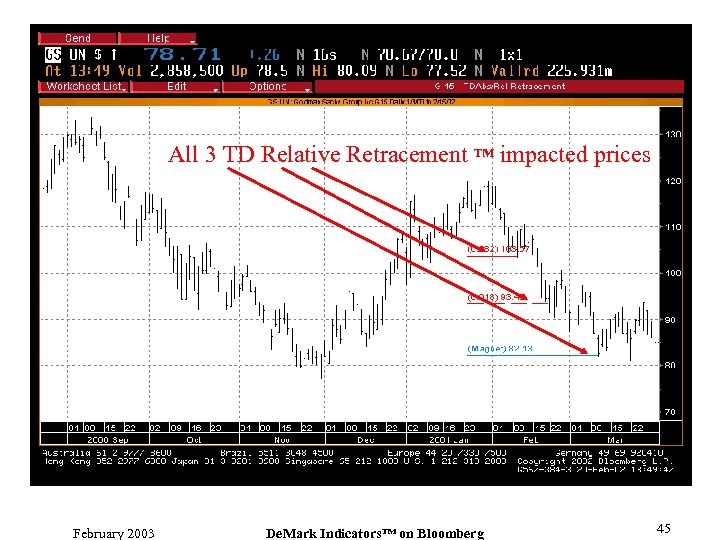
All 3 TD Relative Retracement ™ impacted prices February 2003 De. Mark Indicators™ on Bloomberg 45
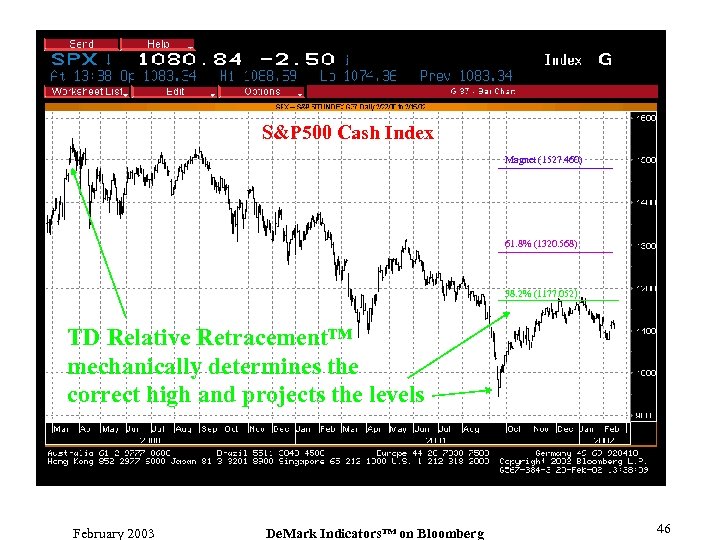
S&P 500 Cash Index Magnet (1527. 460) 61. 8% (1320. 568) 38. 2% (1177. 052) TD Relative Retracement™ mechanically determines the correct high and projects the levels February 2003 De. Mark Indicators™ on Bloomberg 46

TD Camouflage™ Benefit Utilizes the often overlooked open price to gauge the next day’s price action prior to the end of the current day so that you can trade at more favorable price levels and/or hold positions overnight. February 2003 De. Mark Indicators™ on Bloomberg 47
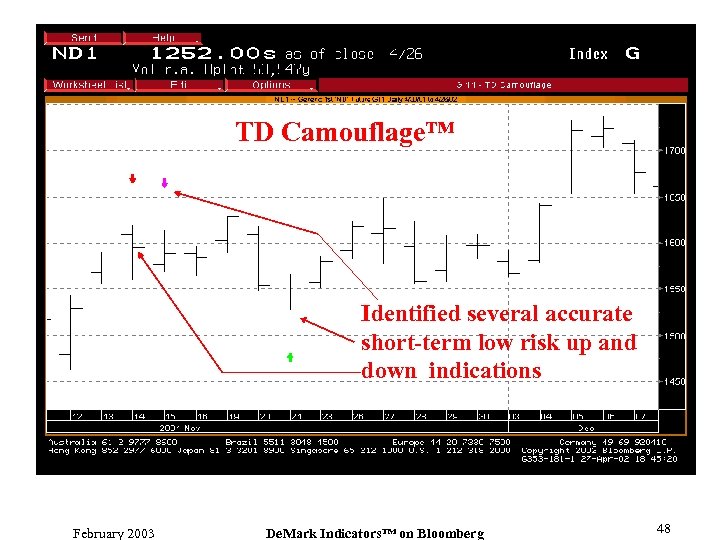
TD Camouflage™ Identified several accurate short-term low risk up and down indications February 2003 De. Mark Indicators™ on Bloomberg 48
TD Lines™ Benefit TD Lines™ was developed to establish a standard for trendline construction, as well as to anticipate and to identify qualified and disqualified breakout opportunities. A by-product of TD Line ™ construction and analysis is the ability to estimate upside and downside break out price projections so you are able aware of price targets in advance and can plan your strategies accordingly. Description TD Lines™ are drawn by connecting two TD Points™ and can be a TD Demand™ Line (an up sloping trendline) or a TD Supply™ (a down sloping trendline). TD Lines™ can be either qualified or disqualified and there are 4 conditions which determine their status. Both upside and downside Breakouts may be cancelled and there 3 conditions for cancellation. TD Lines™ also provide important price objectives for qualified upside or downside breakouts. February 2003 De. Mark Indicators™ on Bloomberg 49
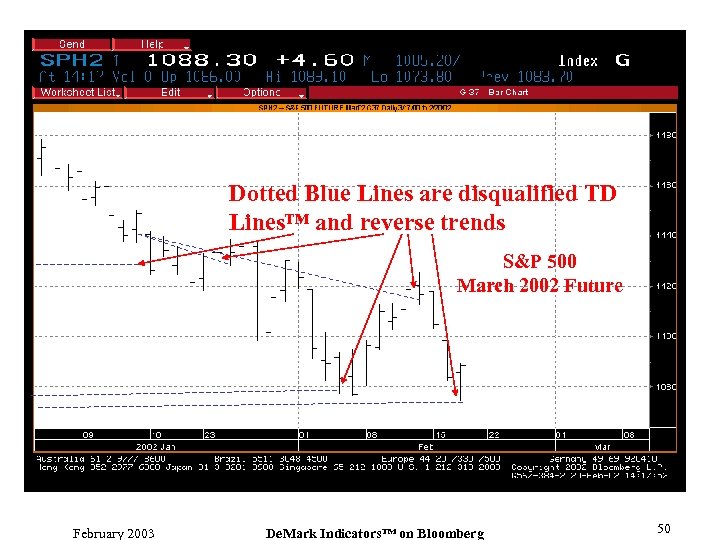
Dotted Blue Lines are disqualified TD Lines™ and reverse trends S&P 500 March 2002 Future February 2003 De. Mark Indicators™ on Bloomberg 50
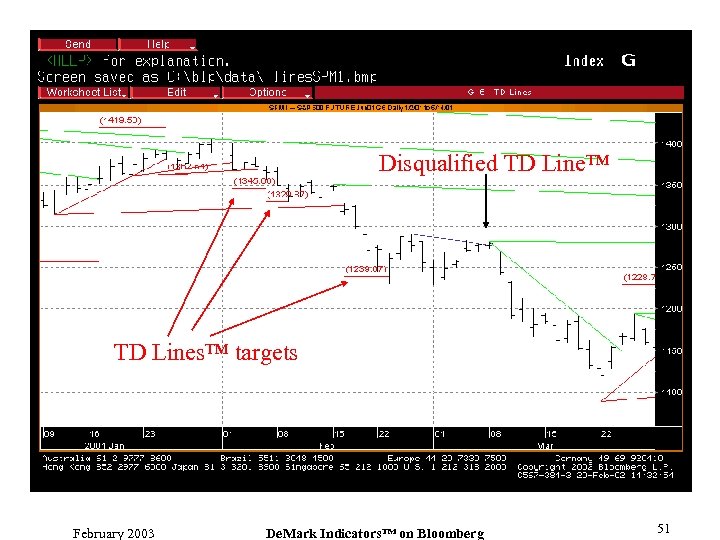
Disqualified TD Line™ TD Lines™ targets S&P 500 June 2001 Future February 2003 De. Mark Indicators™ on Bloomberg 51
TD Differential™ (TD Diff ™) February 2003 De. Mark Indicators™ on Bloomberg 52
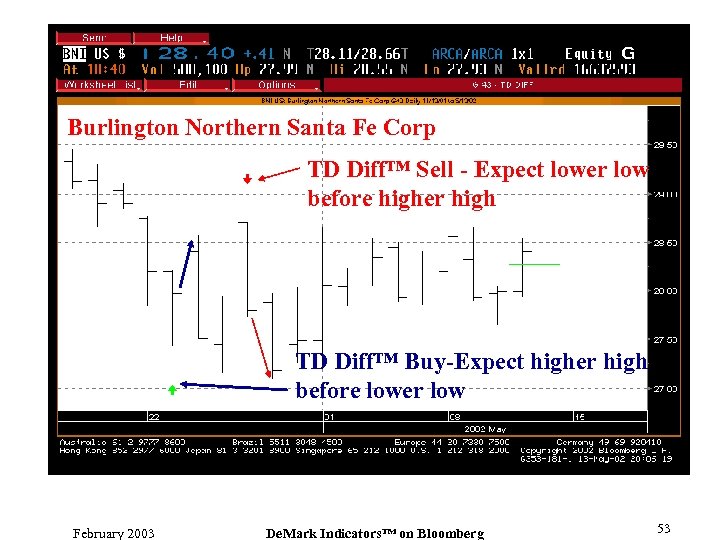
Burlington Northern Santa Fe Corp TD Diff™ Sell - Expect lower low before higher high TD Diff™ Buy-Expect higher high before lower low February 2003 De. Mark Indicators™ on Bloomberg 53
TD Reverse Differential™ (TD Reverse Diff ™) February 2003 De. Mark Indicators™ on Bloomberg 54
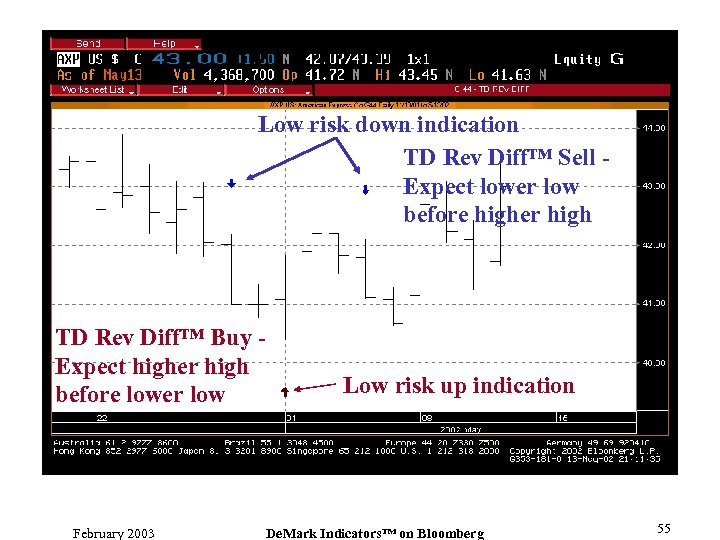
Low risk down indication TD Rev Diff™ Sell Expect lower low before higher high TD Rev Diff™ Buy Expect higher high before lower low February 2003 Low risk up indication De. Mark Indicators™ on Bloomberg 55
TD Anti-Differential™ (TD Anti-Diff ™) February 2003 De. Mark Indicators™ on Bloomberg 56
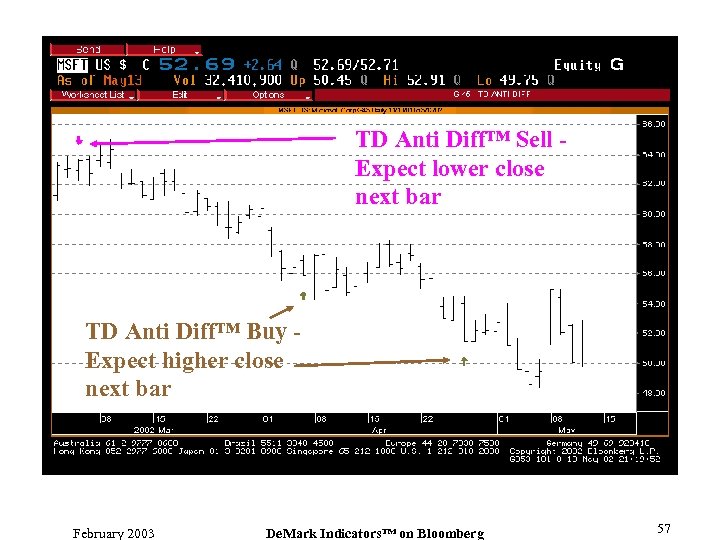
TD Anti Diff™ Sell Expect lower close next bar TD Anti Diff™ Buy Expect higher close next bar February 2003 De. Mark Indicators™ on Bloomberg 57
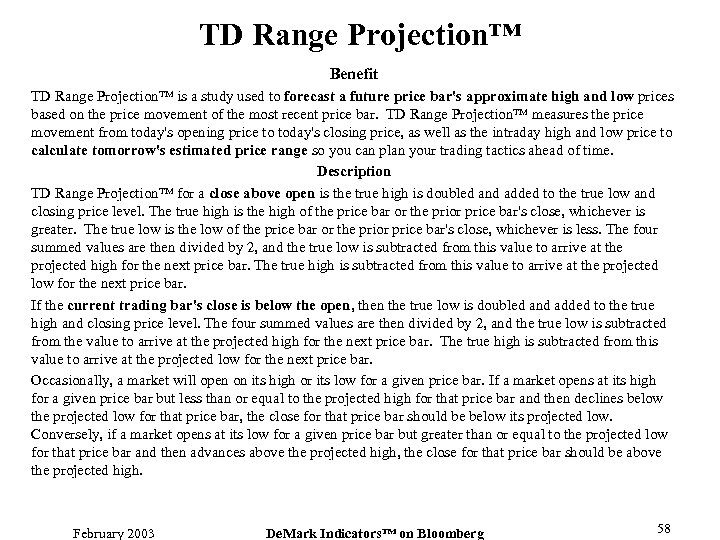
TD Range Projection™ Benefit TD Range Projection™ is a study used to forecast a future price bar's approximate high and low prices based on the price movement of the most recent price bar. TD Range Projection™ measures the price movement from today's opening price to today's closing price, as well as the intraday high and low price to calculate tomorrow's estimated price range so you can plan your trading tactics ahead of time. Description TD Range Projection™ for a close above open is the true high is doubled and added to the true low and closing price level. The true high is the high of the price bar or the prior price bar's close, whichever is greater. The true low is the low of the price bar or the prior price bar's close, whichever is less. The four summed values are then divided by 2, and the true low is subtracted from this value to arrive at the projected high for the next price bar. The true high is subtracted from this value to arrive at the projected low for the next price bar. If the current trading bar's close is below the open, then the true low is doubled and added to the true high and closing price level. The four summed values are then divided by 2, and the true low is subtracted from the value to arrive at the projected high for the next price bar. The true high is subtracted from this value to arrive at the projected low for the next price bar. Occasionally, a market will open on its high or its low for a given price bar. If a market opens at its high for a given price bar but less than or equal to the projected high for that price bar and then declines below the projected low for that price bar, the close for that price bar should be below its projected low. Conversely, if a market opens at its low for a given price bar but greater than or equal to the projected low for that price bar and then advances above the projected high, the close for that price bar should be above the projected high. February 2003 De. Mark Indicators™ on Bloomberg 58
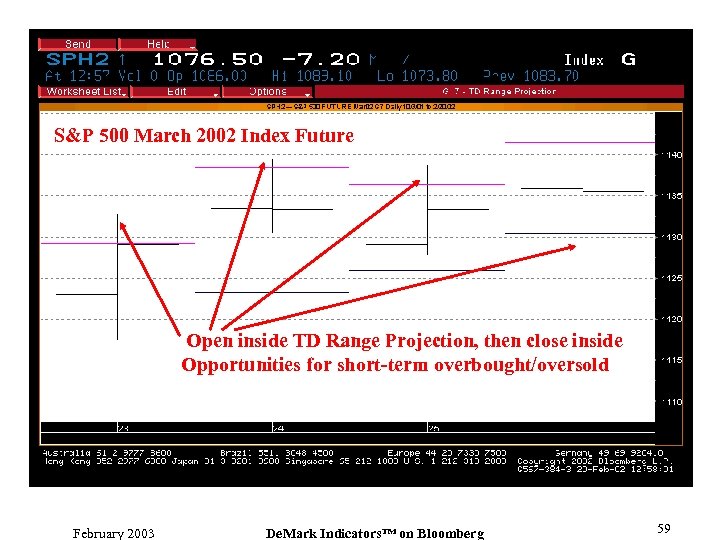
S&P 500 March 2002 Index Future Open inside TD Range Projection, then close inside Opportunities for short-term overbought/oversold February 2003 De. Mark Indicators™ on Bloomberg 59
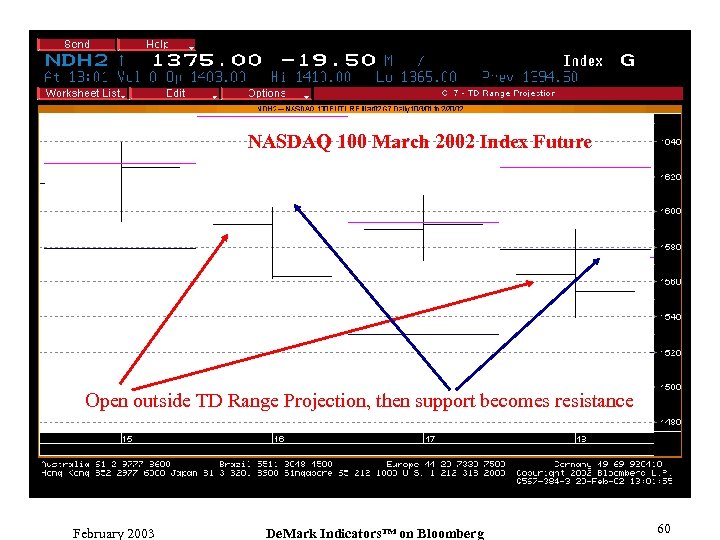
NASDAQ 100 March 2002 Index Future Open outside TD Range Projection, then support becomes resistance February 2003 De. Mark Indicators™ on Bloomberg 60
TD Moving Average I™ Benefit TD Moving Average 1™ is a study used to identify trend reversals before and as they occur so you can plan your entry and, in particular, exit strategies. Description CALCULATION OF TD MOVING AVERAGE 1™ To identify potential upside breakouts, an upper moving average is calculated and plotted as follows: (1) The lowest true high recorded within the last 13 price bars (including the current price bar) activates the moving average selection process. The true high is the high of a price bar or the prior price bar's close, whichever is greater. (2) That particular price bar's true high is then added together with the true highs of the previous 4 price bars, then averaged, and finally the calculated value is plotted above the high of the current price bar (the lowest true high price bar). (3) This calculation is continued for an additional 3 price bars and then is extinguished UNLESS a subsequent true high price bar has been recorded which is less than ALL previous 12 price bar highs. If this occurs, this calculation is once again continued for an additional 3 price bars. (4) Once a closing price bar is recorded above TD Moving Average 1™, this indicates a potential breakout. This breakout needs to be confirmed by the next trading bar opening above the breakout close AND the high of the trading bar must be above that same price bar's open. When these criteria are met, a legitimate upside breakout occurs. Any outstanding short positions should be liquidated, since it is recommended that TD Moving Average 1™ be used as an exit method or as a trend validation indicator, not necessarily as a low risk entry indicator. 5) If no moving average plot appears on the chart, the moving average is not active and the suggested decision rules can be ignored. February 2003 De. Mark Indicators™ on Bloomberg 61
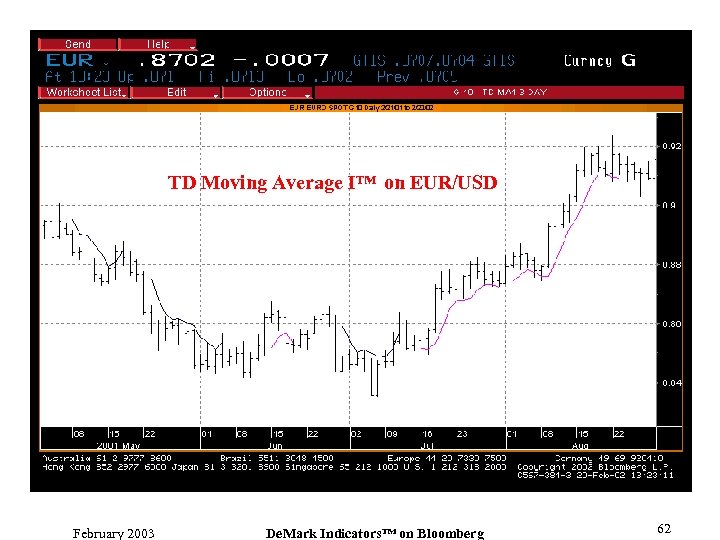
TD Moving Average I™ on EUR/USD February 2003 De. Mark Indicators™ on Bloomberg 62
TD Trend Factor™ Benefit TD Trend Factor™ uses an objective and consistent approach to project price levels which may provide support or resistance to price action so that you are able to anticipate potential continued price trends and price trend exhaustion. Description TD Trend Factor™ levels are calculated using a 5. 556 percent factor and applying it to the extremes of price movements. In a downtrend, where the price change from a previous high has been at least 5. 556% of the underlying price and displayed some reversal action, TD Trend Factor™ can be applied to the low of the price bar. This process projects price targets above the current low which can be used to gauge subsequent price action. Typically, 5 horizontal price levels are drawn and labeled with their respective prices. The same characteristics apply to markets in uptrend, which have moved up at least 5. 56% and may have shown some reversal action to the downside, such as a high surrounded by lower highs with one lower close from the absolute high. . February 2003 De. Mark Indicators™ on Bloomberg 63
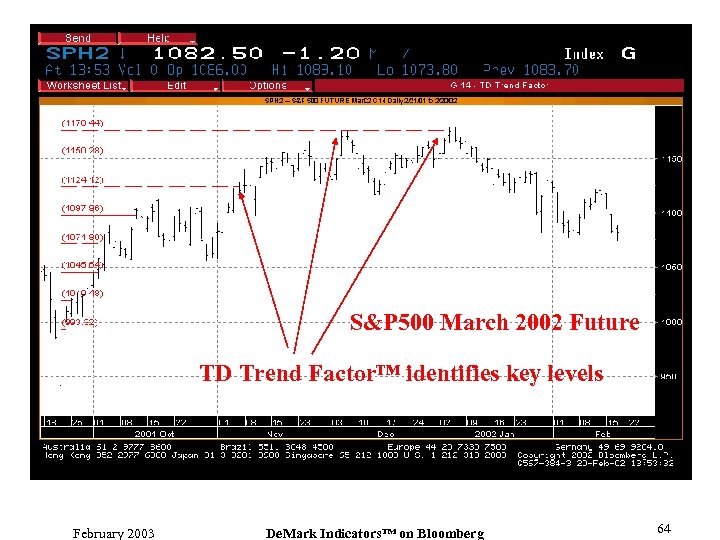
S&P 500 March 2002 Future TD Trend Factor™ identifies key levels February 2003 De. Mark Indicators™ on Bloomberg 64
TD Channel I™ Benefit TD Channel I™ was developed to anticipate prospective long term support and resistance levels, as well as likely trend reversal opportunities so that you are aware of price targets in advance and you can enhance your trading strategy. Description TD Channel I™ is calculated using a three-day moving average of daily true lows and true highs. A true high is the high of a price bar or the prior price bar's close, whichever is greater. A true low is the low of the price bar or the prior price bar's close, whichever is less. The three-day moving average includes the current trading day's true high and true low, as well as the prior two trading day's true highs and true lows. TD Channel I ™ requires that the larger percentage (103 pct) be multiplied by a three-day average of the true lows and the smaller percentage (97 pct) be multiplied by a three-day moving average of the true highs. As a result, real time intraday recording of lower daily lows and higher daily highs does not continuously change the channel placement, as they do with traditional channels. The percentages suggested are for S&P and bond futures contracts and 111 pct and 89 pct are recommended for lower priced securities with typically less volatility. February 2003 De. Mark Indicators™ on Bloomberg 65
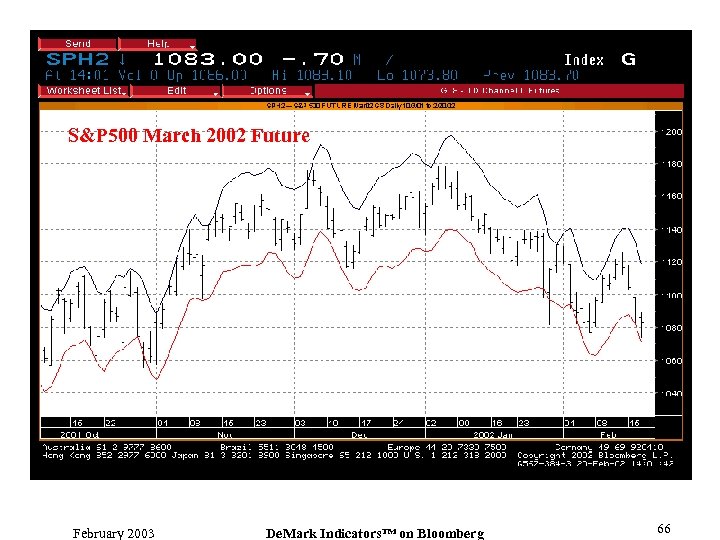
S&P 500 March 2002 Future February 2003 De. Mark Indicators™ on Bloomberg 66
TD Channel II™ Benefit TD Channel II™ was developed to anticipate prospective short term support and resistance levels, as well as likely trend reversal opportunities so that you are aware of price targets in advance and you can enhance your trading strategy. Description TD Channel II™ is calculated using a three-day moving average of daily true lows and true highs. A true high is the high of a price bar or the prior price bar's close, whichever is greater. A true low is the low of the price bar or the prior price bar's close, whichever is less. The three-day moving average includes the current trading day's true high and true low, as well as the prior two trading day's true highs and true lows. TD Channel II™ requires that the larger percentage (100. 5 pct) be multiplied by a three-day average of the true highs and the smaller percentage (99. 5 pct) be multiplied by a three-day moving average of the true lows. The percentages suggested are for S&P and bond futures contracts and 107 pct and 93 pct are recommended for most stocks. Once price movements exceed the boundaries defined by these channels, they are expected to retreat. Any two consecutive closes outside the channel is indicative of price exhaustion and pending price reversal. February 2003 De. Mark Indicators™ on Bloomberg 67
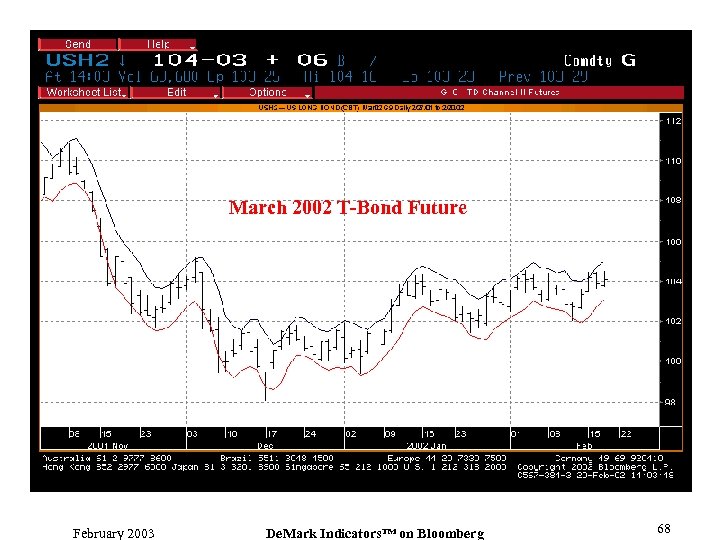
March 2002 T-Bond Future February 2003 De. Mark Indicators™ on Bloomberg 68
TD De. Marker I™ Benefit TD De. Marker I™ is an oscillator used to identify potential overbought and oversold conditions within a market. TD De. Marker I™ defines prospective support and resistance levels as well as likely trend reversal opportunities so you can enter or exit your position closer to the beginning of a trend reversal and improve your trading results. Description TD De. Marker I™ is arithmetically constructed so that it is not artificially affected by any extraneous, non-market related factors which would exist until the security was delisted or replaced. TD De. Marker I™ is calculated by comparing the current high with the previous high and the current low with previous low. As with other De. Mark oscillators, TD Duration™, a measure of the extent of time that the oscillator reading remains overbought or oversold, is a key component in the application of TD De. Marker I™. In addition, prior to entry, TD Price Oscillator Qualifiers (TD POQ™) should occur. TD POQ™ conditions may be qualified or disqualified. February 2003 De. Mark Indicators™ on Bloomberg 69
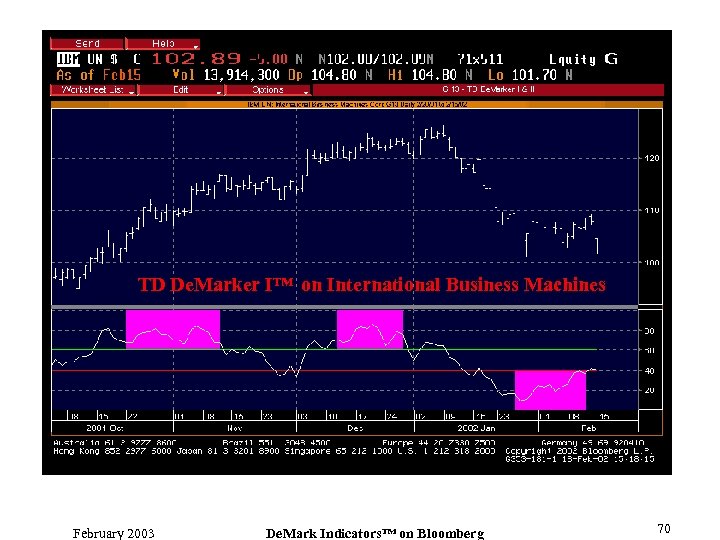
TD De. Marker I™ on International Business Machines February 2003 De. Mark Indicators™ on Bloomberg 70
TD De. Marker II™ Benefit TD De. Marker II™ is an oscillator used to identify potential overbought and oversold conditions within a market. TD De. Marker II™ defines prospective support and resistance levels as well as likely trend reversal opportunities so you can enter/exit a position closer to the beginning of a trend reversal and enhance the results of your trading. Description TD De. Marker II™ is calculated by taking the difference between the current high with the previous close over a series of consecutive days plus the difference between the current close and the current low over a the identical series of days. . As with other De. Mark oscillators, TD Duration™, a measure of the extent of time that the oscillator reading remains overbought or oversold, is a key component in the application of TD De. Marker II™. In addition, prior to entry, TD Price Oscillator Qualifiers (TD POQ™) should occur. TD POQ™ conditions may be qualified or disqualified. February 2003 De. Mark Indicators™ on Bloomberg 71
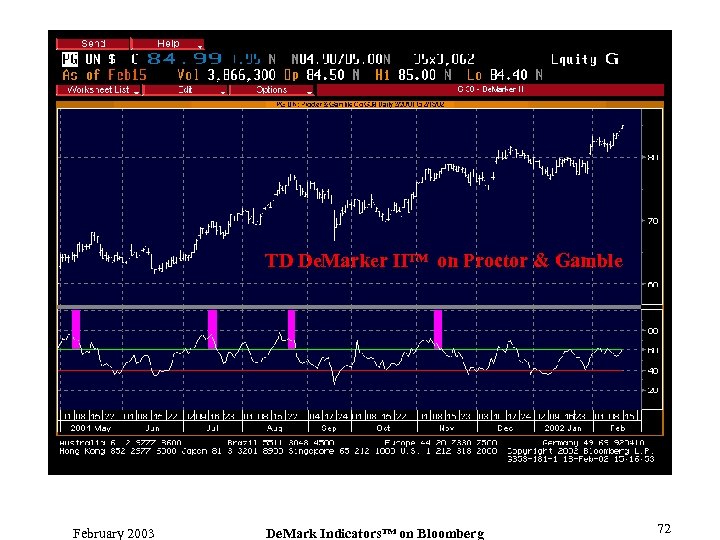
TD De. Marker II™ on Proctor & Gamble February 2003 De. Mark Indicators™ on Bloomberg 72
TD Alignment™ Description TD Alignment™ is a study provided by Market Studies Inc. It is a diffusion index, or an amalgam, of various TD Oscillators ™. Typically, these oscillators include the following TD Indicators ™ : TD REI ™, TD ROC ™, TD De. Marker II ™, and TD Pressure ™ (TD Pressure Ratio ™). Although this group of TD Indicators ™ is recommended, the combination and setting preferences of TD Indicators ™ are selected by the user. Ideally, the combination of indicators produces a composite indicator, TD Alignment ™, that collectively identifies price exhaustion zones better than the indicators individually. February 2003 De. Mark Indicators™ on Bloomberg 73
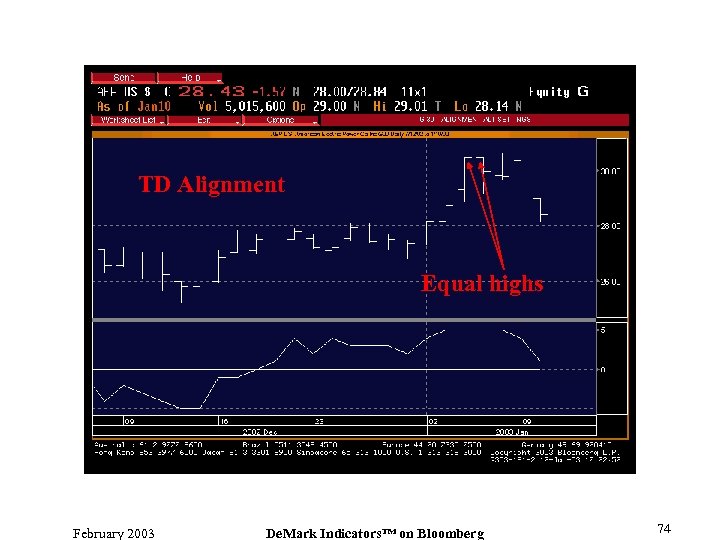
TD Alignment Equal highs February 2003 De. Mark Indicators™ on Bloomberg 74
Summary De. Mark Indicators™ on Bloomberg provide Market Timing Tools that enable you to generate ideas & improve trade execution Contacts: Lindsay Glass (New York) - - lglass@bloomberg. net Hoa Quach (London) - - hquach@bloomberg. net February 2003 De. Mark Indicators™ on Bloomberg 75
Скачать презентацию Market Timing with De Mark Indicators on Bloomberg
1afab15eddfa42b06f8869af286dd828.ppt