 Скачать презентацию MARKET STRUCTURE Market structure is best
Market structure2222.pptx
- Количество слайдов: 6




MARKET STRUCTURE
Market structure is best defined as the organisational and other characteristics of a market. We focus on those characteristics which affect the nature of competition and pricing – but it is important not to place too much emphasis simply on the market share of the existing firms in an industry.
Traditionally, the most important features of market structure are: The number of firms (including the scale and extent of foreign competition) The market share of the largest firms (measured by the concentration ratio – see below) The nature of costs (including the potential for firms to exploit economies of scale and also the presence of sunk costs which affects market contestability in the long term) The degree to which the industry is vertically integrated vertical integration explains the process by which different stages in production and distribution of a product are under the ownership and control of a single enterprise. A good example of vertical integration is the oil industry, where the major oil companies own the rights to extract from oilfields, they run a fleet of tankers, operate refineries and have control of sales at their own filling stations. The extent of product differentiation (which affects cross-price elasticity of demand) The structure of buyers in the industry (including the possibility of monopsony power) The turnover of customers (sometimes known as “market churn”) – i. e. how many customers are prepared to switch their supplier over a given time period when market conditions change. The rate of customer churn is affected by the degree of consumer or brand loyalty and the influence of persuasive advertising and marketing
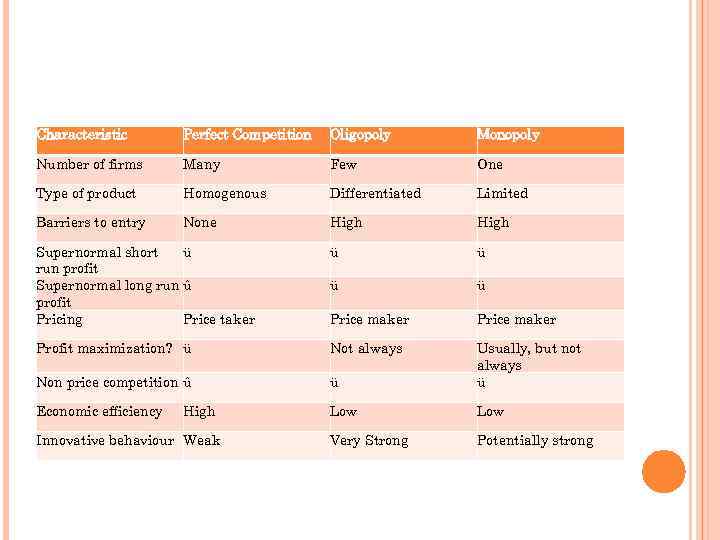
Characteristic Perfect Competition Oligopoly Monopoly Number of firms Many Few One Type of product Homogenous Differentiated Limited Barriers to entry None High Supernormal short ü run profit Supernormal long run û profit Pricing Price taker ü ü Price maker Profit maximization? ü Not always Non price competition û ü Usually, but not always ü Economic efficiency Low Very Strong Potentially strong High Innovative behaviour Weak
Market structure and innovation Which market conditions are optimal for effective and sustained innovation to occur? This is a question that has vexed economists and business academics for many years. High levels of research and development spending are frequently observed in oligopolistic markets, although this does not always translate itself into a fast pace of innovation. The recent work of William Baumol (2002) provides support for oligopoly as market structure best suited for innovative behaviour. Innovation is perceived as being “mandatory” for businesses that need to establish a cost-advantage or a significant lead in product quality over their rivals. “As soon as quality competition and sales effort are admitted into the sacred precincts of theory, the price variable is ousted from its dominant position…. . But in capitalist reality as distinguished from its textbook picture, it is not that kind of competition which counts but the competition which commands a decisive cost or quality advantage and which strikes not at the margins of profits and the outputs of the existing firms but at their foundations and their very lives. This kind of competition is as much more effective than the other as a bombardment is in comparison with forcing a door”
Important developments: Increasingly most innovation is done by smaller firms – indeed multinational corporations are now out-sourcing their research and development spending to small businesses at home and overseas – much is being shifted to cheaper locations “offshore”—in India and Russia Innovation is now a continuous process – in part because the length of the product cycle is getting shorter as innovations are rapidly copied by competitors, pushing down profit margins and (according to a recent article in the economist) “transforming today's consumer sensation into tomorrow's commonplace commodity” – a good example of this is the introduction of two major competitors to the anti-impotence drug Viagra Innovation is not something left to chance – the most successful firms are those that pursue innovation in a systematic fashion Demand innovation is becoming more important: In many markets, demand is either stable or in long-run decline. The response is to go for “demand innovation” - discovering new forms of demand from consumers and adapting an existing product to meet them – the toy industry is a classic example of this Globalisation is driving innovation and not just in manufactured goods but across a vast range of household and business services and in particular in high -value knowledge industries
Скачать презентацию MARKET STRUCTURE Market structure is best
Market structure2222.pptx