


 Скачать презентацию Market Structure In the Healthcare Industry Professor Vivian
f000dd04d97fff65cff794840bbf38c1.ppt
- Количество слайдов: 45
 Market Structure In the Healthcare Industry Professor Vivian Ho Health Economics Fall 2009 These notes draw from material in Santerre & Neun, Health Economics, Theories, Insights and Industry Studies. Southwestern Cengate 2010
 Outline l Defining perfect competition l The market structure continuum u Monopoly u Monopolistic competition u Oligopoly l The market for organs 2
 Characteristics of Perfect Competition l Consumers pay the full price of the product u Consumers will respond to differences in prices among sellers l All firms maximize profits u Firms have incentives to satisfy consumer wants and produce efficiently 3
 Characteristics of Perfect Competition (cont. ) l There is a large number of buyers and sellers, each of which is small relative to the total market u No one buyer or seller is powerful enough to influence or manipulate the market price of a product l All firms in the same industry produce a homogeneous product u. A consumer can easily find substitutes for the product of any given firm 4
 Characteristics of Perfect Competition (cont. ) l No barriers to entry or exit exist u New l firms can enter the industry All economic agents possess perfect information u Consumers and firms can make informed choices l All firms face nondecreasing average costs of production u Rules out a “natural monopoly” 5
 Monopoly Model l In contrast to perfect competition, a monopoly market has the following features: u One seller u Homogeneous or differentiated product u Complete barriers to entry l Because there is only one firm, that firm faces the market demand curve, which is downward sloping 6
 Monopoly Model (cont. ) l What is the profit-maximizing price and quantity for a monopolist? u Recall that all firms will maximize profits where MR=MC u We have already seen that the marginal cost curve for a firm depends on its production function and input prices u What does the firm’s MR curve look like? 7
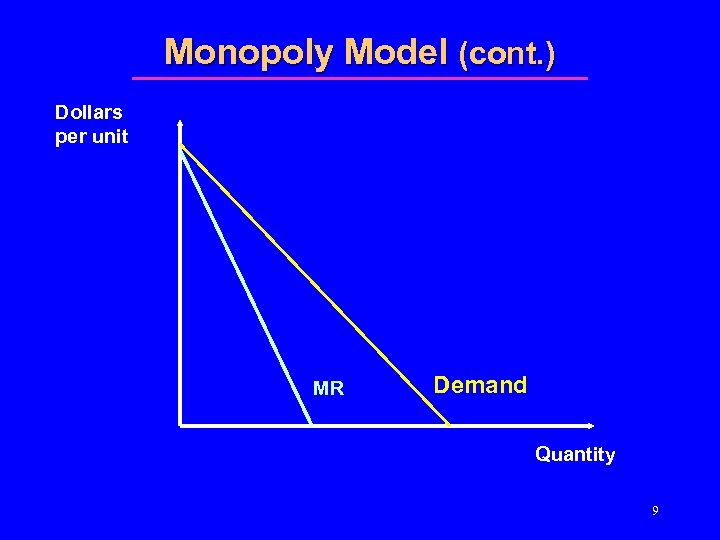
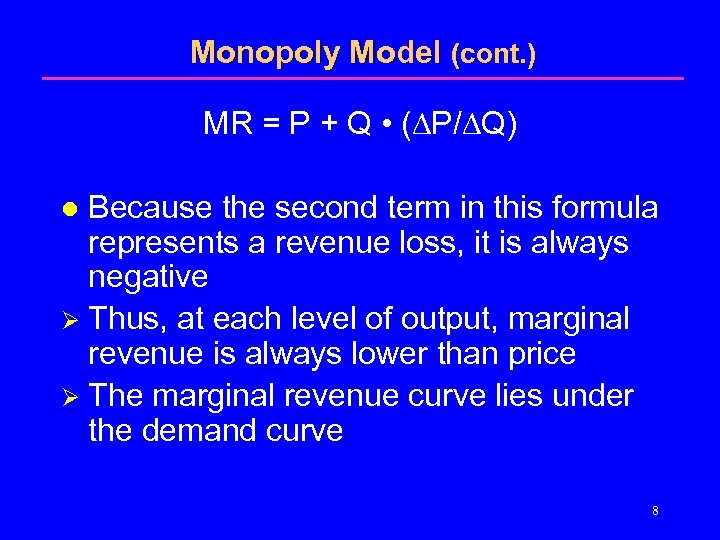 Monopoly Model (cont. ) MR = P + Q • ( P/ Q) Because the second term in this formula represents a revenue loss, it is always negative Ø Thus, at each level of output, marginal revenue is always lower than price Ø The marginal revenue curve lies under the demand curve l 8
 Monopoly Model (cont. ) Dollars per unit MR Demand Quantity 9
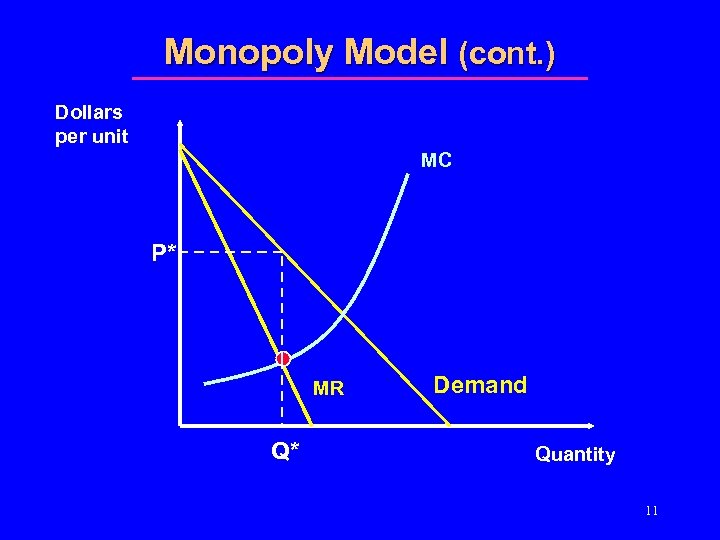
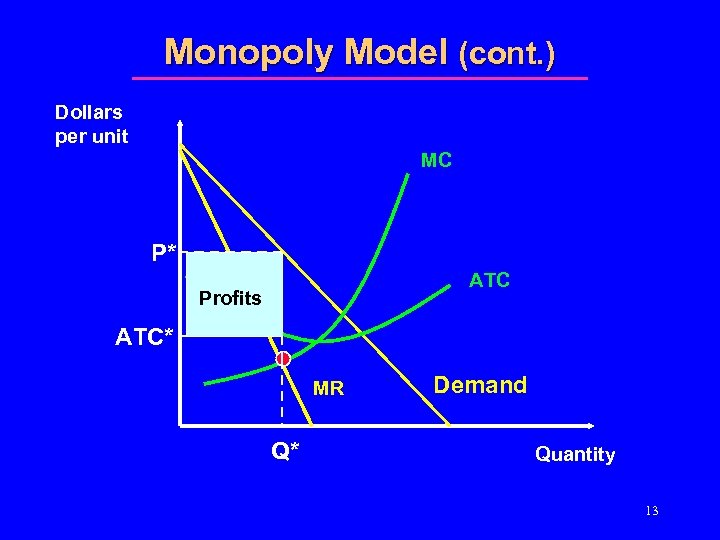
 Monopoly Model (cont. ) We are now ready to find the profitmaximizing output for a monopolist l The monopolist sets output at a level where MR=MC l u On a graph, find the level of Q where the MR and MC curves intersect l To determine the price the monopolist will charge, locate the price on the demand curve at this same output level 10
 Monopoly Model (cont. ) Dollars per unit MC P* MR Q* Demand Quantity 11
 Monopoly Model (cont. ) l The monopolist’s level of profits can then be determined by adding its average total cost curve to the graph l Profits will be the difference between P* and ATC, multiplied by Q* 12
 Monopoly Model (cont. ) Dollars per unit MC P* ATC Profits ATC* MR Q* Demand Quantity 13
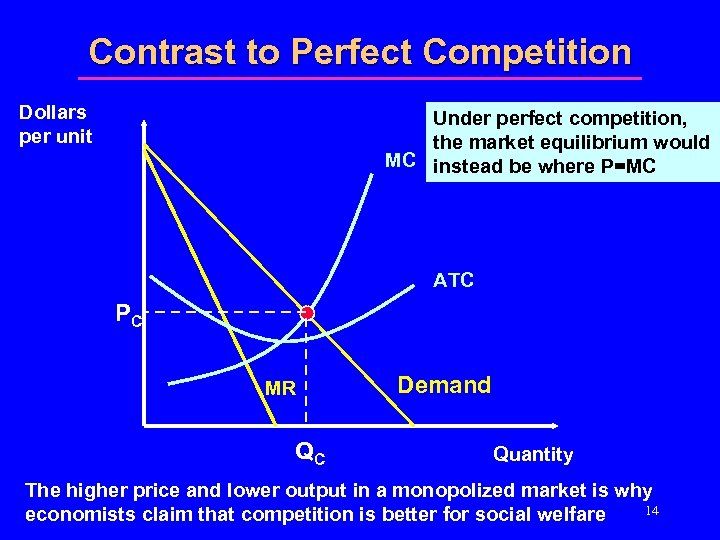 Contrast to Perfect Competition Dollars per unit Under perfect competition, the market equilibrium would MC instead be where P=MC ATC PC MR QC Demand Quantity The higher price and lower output in a monopolized market is why 14 economists claim that competition is better for social welfare
 Monopoly Model (cont. ) l A monopoly only maintains its status if there are no substitutes for the product it sells u There must be barriers to entry, so that other firms cannot enter the market to compete u The two most common barriers to entry: Economies of scale l Legal restrictions l 15
 Monopoly Model (cont. ) l Economies of scale u If a monopoly is producing output at a level where long run average costs are declining, then new firms cannot compete on a cost basis u A monopoly hospital in a small town may have substantial economies of scale if it can meet demand with only 40 -50 beds l Unless a new hospital could take away a substantial share of the existing hospital’s patients, it could not match the existing hospital in costs (and therefore profits as well) 16
 Monopoly Model (cont. ) l Legal restrictions u Physicians require a license to practice medicine u Many states require that providers obtain a Certificate of Need to offer a new service u Drug companies obtain patents for new pharmaceutical products 17
 The Market Structure Continuum l We have talked about 2 extremes of the market structure continuum u Perfect Competition u Pure Monopoly l Along this continuum, there are 2 more levels of competitiveness that we will encounter in the health care sector 18
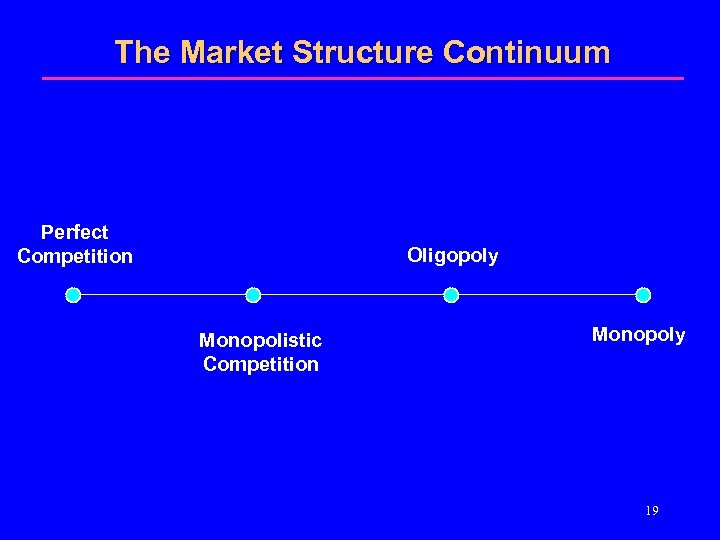 The Market Structure Continuum Perfect Competition Oligopoly Monopolistic Competition Monopoly 19
 Monopolistic Competition Many sellers l Differentiated product l No barriers to entry l l Examples u Breakfast cereals u Ibuprofen (Advil, Motrin, etc. ) u Cigarettes 20
 Monopolistic Competition (cont. ) l Because products are differentiated across firms, each seller has some ability to control price u Each seller faces a slightly downward sloping demand curve l Sellers have an incentive to “differentiate” their product from competitors u Doing so is likely to raise demand for their product 21
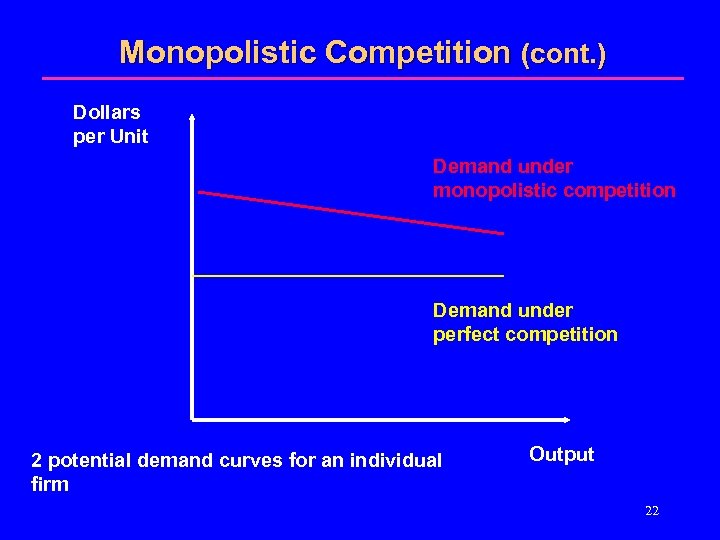 Monopolistic Competition (cont. ) Dollars per Unit Demand under monopolistic competition Demand under perfect competition 2 potential demand curves for an individual firm Output 22
 Monopolistic Competition (cont. ) l How do sellers differentiate their product? u Advertising l Is advertising bad for consumers? u Creates imaginary or artificial wants u Persuasive, not informative u Business stealing, w/ no benefits to consumer u Habit buying is a barrier to entry 23
 Monopolistic Competition (cont. ) l Benefits of advertising u May convey important info on value of a good or service People benefit from real diversity & choice l Cheap info to customers to distinguish b/w products l u May l promote quality competition Firms willing to invest in creating a brand name reputation will work to keep it u May inform the consumer of good or service they weren’t aware of l Shift the D curve out 24
 DTC Drug Advertising l August 1997, FDA permitted brandspecific direct-to-consumer (DTC) advertising w/o “brief summary” of drug effectiveness, side effects, and contraindications l DTC advertising rose from $800 m in 1996 to $2. 5 b in 2000 u What were the consequences? (Iizuka & Jin, 2003) 25
 DTC Drug Advertising l Iizuka & Jin track monthly expenditures on DTC advertising for 1994 -2000 l They also track monthly visits to the doctor in a recurring national survey for 1994 -2000 u Survey indicates whether a drug was prescribed during the visit, and for what class 26
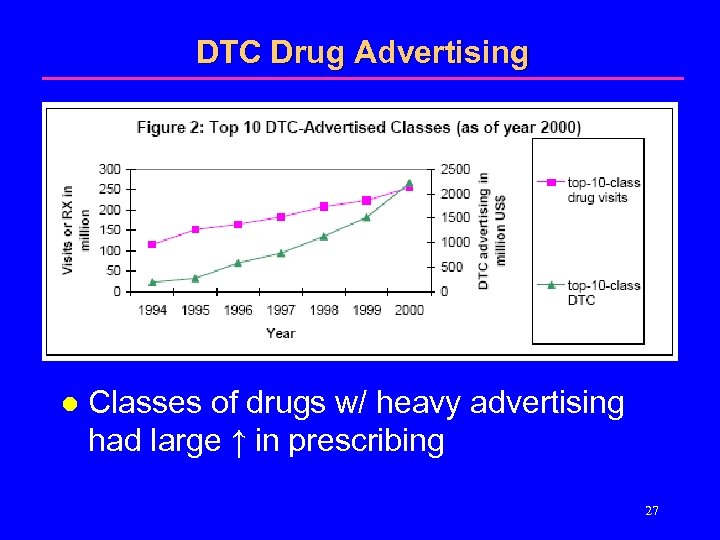 DTC Drug Advertising l Classes of drugs w/ heavy advertising had large ↑ in prescribing 27
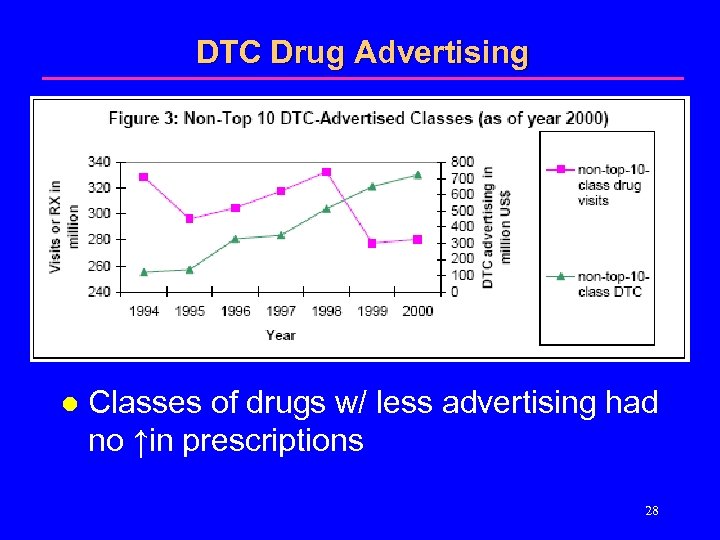 DTC Drug Advertising l Classes of drugs w/ less advertising had no ↑in prescriptions 28
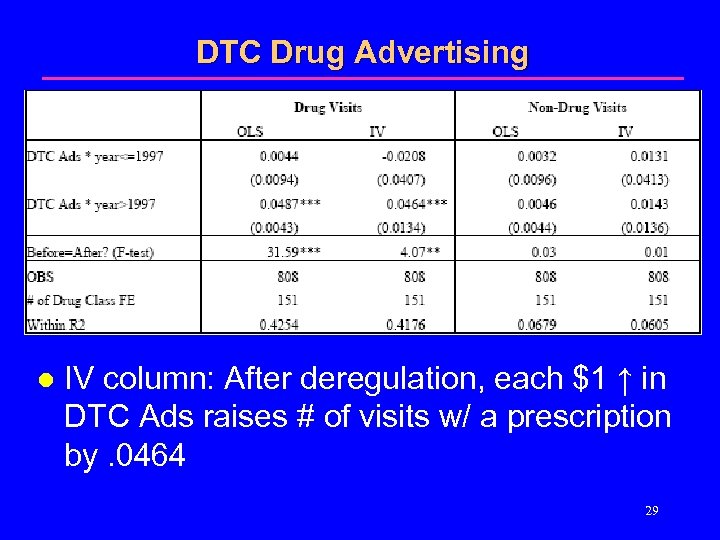 DTC Drug Advertising l IV column: After deregulation, each $1 ↑ in DTC Ads raises # of visits w/ a prescription by. 0464 29
 DTC Drug Advertising l IV column: After deregulation, each $1 ↑ in DTC Ads raises # of visits w/ a prescription by. 0464 l How much ad spending is needed to get one extra prescription? u 1/. 0464=$21. 55 l Does DTC advertising look profitable to drug companies? 30
 Oligopoly Few, dominant sellers l Homogeneous or differentiated product l Substantial barriers to entry l l Examples u Tertiary services at teaching hospitals u Many prescription drugs 31
 Oligopoly l Because there are only a few dominant sellers, actions of any one firm can change the overall market price l Like monopoly, oligopoly will lead to lower output and higher prices than would be observed under perfect competition Ø Regulators are concerned about consumer welfare in oligopolistic markets 32
 Markets for Organs Should we allow markets for organs for transplant surgery? l Payment to donors of organs is currently forbidden in developed countries. l Yet there is persistent excess demand for organ transplants (Becker and Elias, JEP 2007) l 33
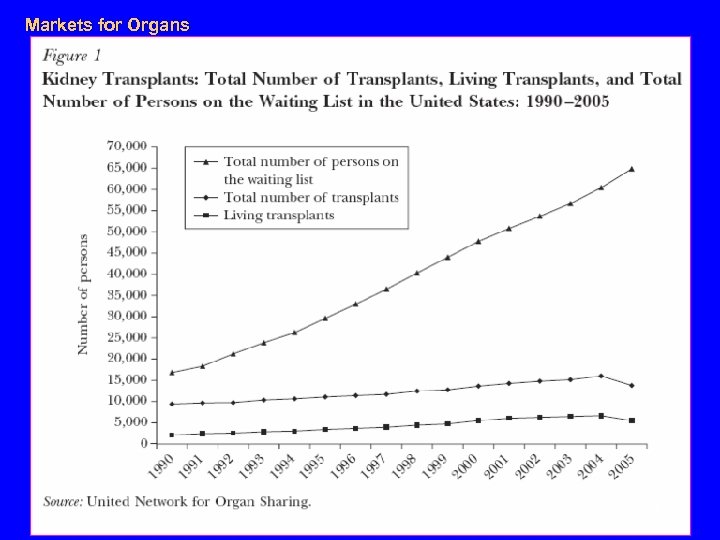 Markets for Organs 34
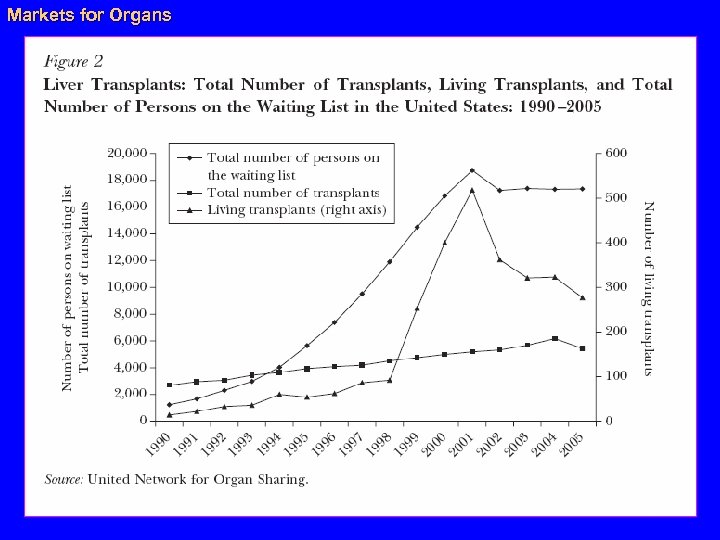 Markets for Organs 35
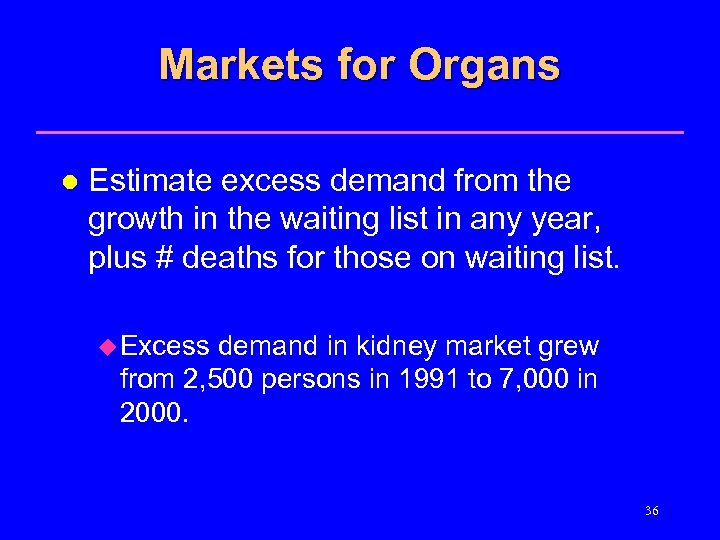 Markets for Organs l Estimate excess demand from the growth in the waiting list in any year, plus # deaths for those on waiting list. u Excess demand in kidney market grew from 2, 500 persons in 1991 to 7, 000 in 2000. 36
 The Price of an Organ How much pay is required to induce an individual to sell an organ? l Compensate individual for: l - Risk of death Time lost during recovery Risk of reduced quality of life 37
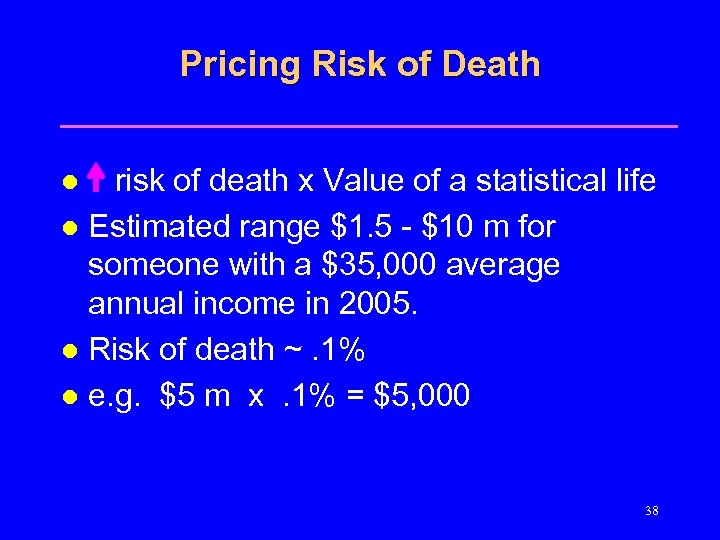 Pricing Risk of Death risk of death x Value of a statistical life l Estimated range $1. 5 - $10 m for someone with a $35, 000 average annual income in 2005. l Risk of death ~. 1% l e. g. $5 m x. 1% = $5, 000 l 38
 Time Lost During Recovery l Assume donor earns $35, 000 / year l Loses 4 weeks of work while in recovery l $35, 000 x 4 weeks => $2, 700 39
 Risk of Quality of Life No comprehensive data on how kidney donation affects QOL. l Some studies suggest kidney donors can live normal lives, unless high physical contact (e. g. athletes). l But other studies find kidney donors at high risk of high blood pressure. l Could arbitrarily assume $7, 500. l 40
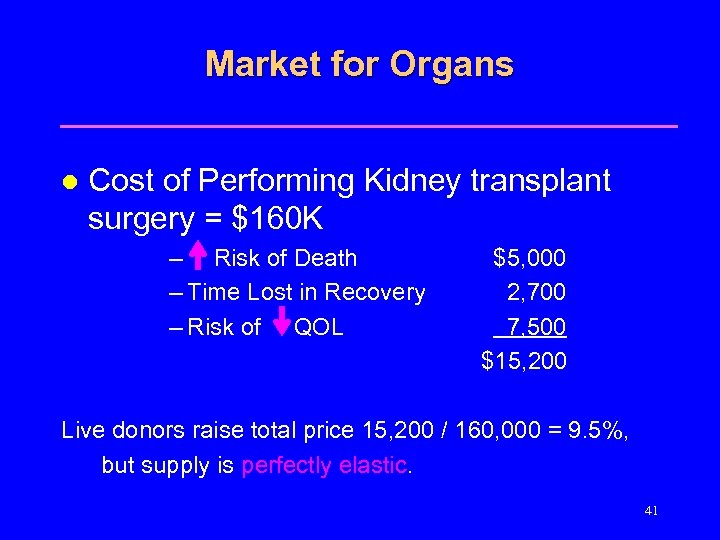 Market for Organs l Cost of Performing Kidney transplant surgery = $160 K – Risk of Death – Time Lost in Recovery – Risk of QOL $5, 000 2, 700 7, 500 $15, 200 Live donors raise total price 15, 200 / 160, 000 = 9. 5%, but supply is perfectly elastic. 41
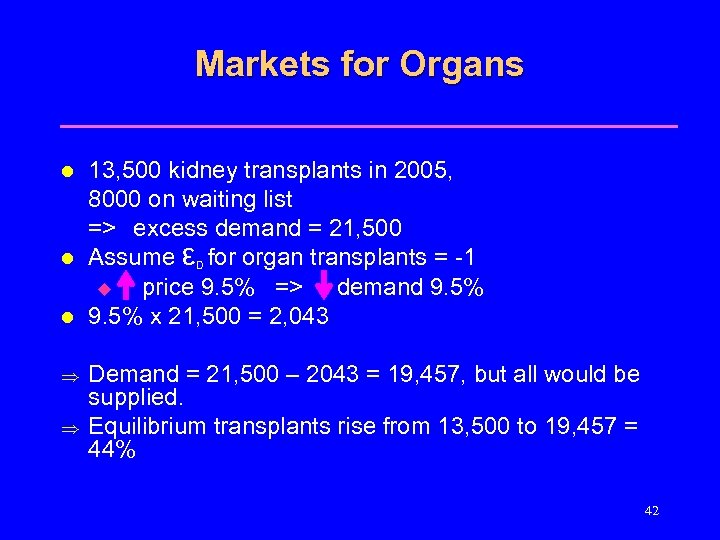 Markets for Organs l l l Þ Þ 13, 500 kidney transplants in 2005, 8000 on waiting list => excess demand = 21, 500 Assume εD for organ transplants = -1 u price 9. 5% => demand 9. 5% x 21, 500 = 2, 043 Demand = 21, 500 – 2043 = 19, 457, but all would be supplied. Equilibrium transplants rise from 13, 500 to 19, 457 = 44% 42
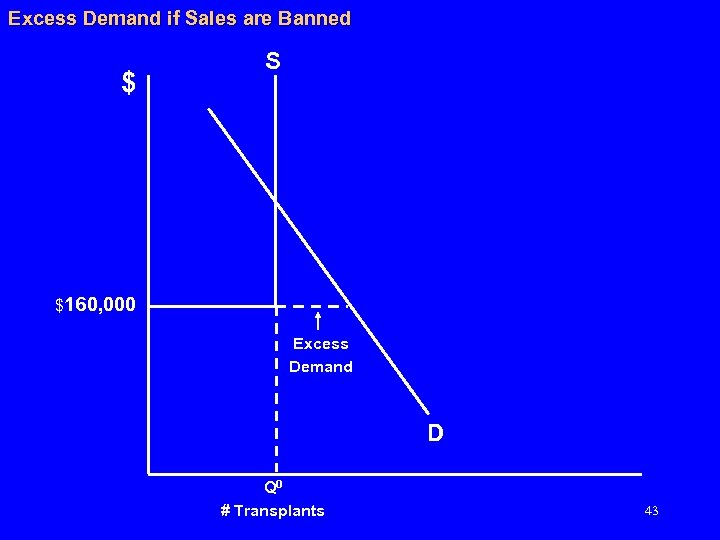 Excess Demand if Sales are Banned $ S $160, 000 Excess Demand D Q 0 # Transplants 43
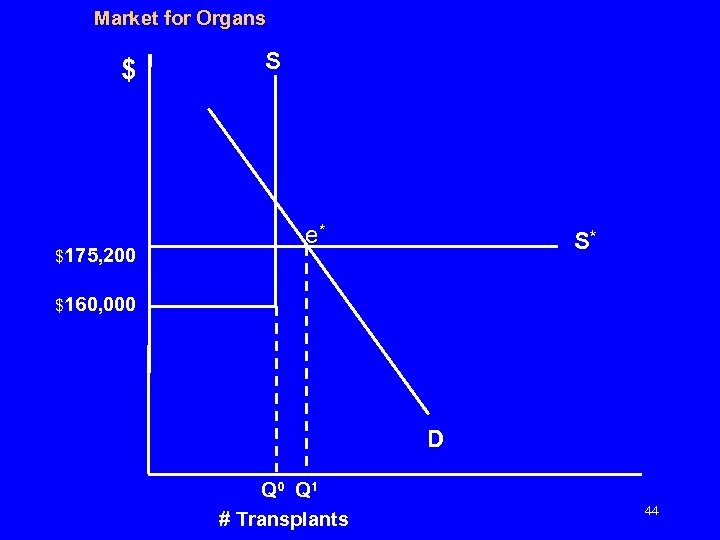 Market for Organs $ $175, 200 S e* S* $160, 000 D Q 0 Q 1 # Transplants 44
 Markets for Organs l Under a range of assumptions, allowing the sale of live donor organs substantially raises the # of transplants. l See Table 3, Becker. 45