


 Скачать презентацию Market Power Market power and competition are
Chapter 13.ppt
- Количество слайдов: 29
 Market Power – Market power and competition are the two forces that operate in most markets. – Market power is the ability to influence the market, and in particular the market price, by influencing the total quantity offered for sale. – A monopoly is an industry that produces a good or service for which no close substitute exists and in which there is one supplier that is protected from competition by a barrier preventing the entry of new firms. 1
 Market Power • How Monopoly Arises A monopoly has two key features: • No close substitutes • Barriers to entry – Legal or natural constraints that protect a firm from potential competitors are called barriers to entry. 2
 Market Power –There are two types of barriers to entry: legal and natural. –Legal barriers to entry create a legal monopoly, a market in which competition and entry are restricted by the granting of a: • Public franchise (like the U. S. Postal Service public franchise to deliver first-class mail). • Government license (like a license to practice law or medicine) • Patent and copyright –Natural barriers to entry create a natural monopoly, which is an industry in which one firm can supply the entire market at a lower price than two or more firms can. 3
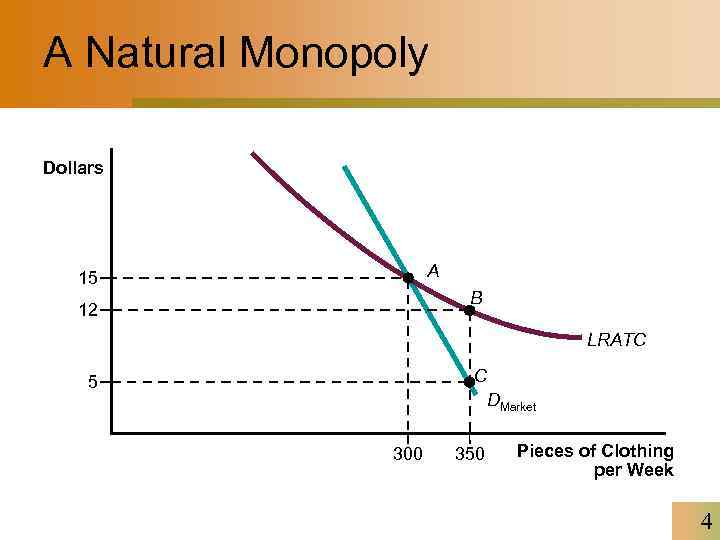 A Natural Monopoly Dollars A 15 B 12 LRATC C 5 DMarket 300 350 Pieces of Clothing per Week 4
 Example Consider the market for a statewide lottery. Suppose the government has licensed itself as the only entity allowed to sell tickets for this lottery. It is impossible for any private firm to start up a competitive lottery without a government license to do so. A monopolist, unlike a perfectly competitive firm, has some market power. It can raise its price, within limits, without the quantity demanded falling to zero. The main way it retains its market power is through barriers to entry. That is, other companies cannot enter the market to create competition in that particular industry. Which of the following best explains the barriers to entry that exist in the above scenario? • Legal barriers • Economies of scale 5
 Monopoly Price or Output Decision • Monopolies do not make two separate decisions about price and quantity – Once firm determines its output level, it has also determined its price • When any firm—including a monopoly—faces a downward sloping demand curve, marginal revenue is less than price of output – marginal revenue curve will lie below demand curve 6
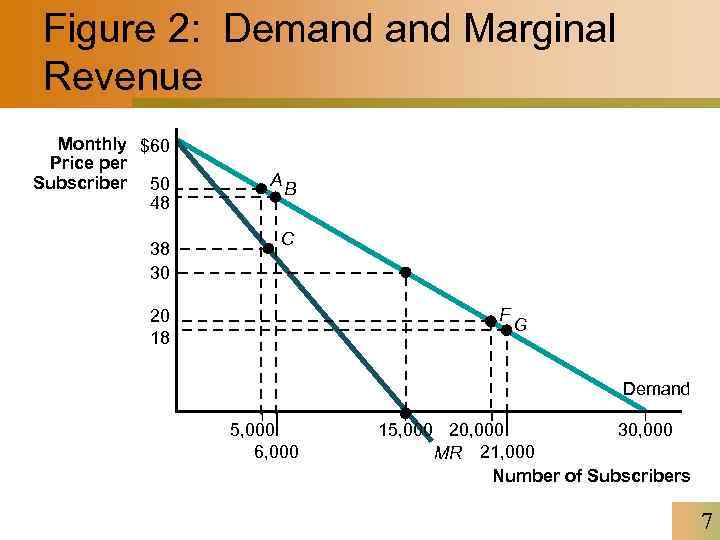 Figure 2: Demand Marginal Revenue Monthly $60 Price per Subscriber 50 48 38 30 A B C F 20 18 G Demand 5, 000 6, 000 15, 000 20, 000 30, 000 MR 21, 000 Number of Subscribers 7
 Market Power There are two types of monopoly price-setting strategies: – Price discrimination is the practice of selling different units of a good or service for different prices. Many firms price discriminate, but not all of them are monopoly firms. – A single-price monopoly is a firm that must sell each unit of its output for the same price to all its customers. 8
 A Single-Price Monopoly’s Output and Price Decision • To maximize profit, the firm should produce level of output where MC = MR and – MC curve crosses MR curve from below 9
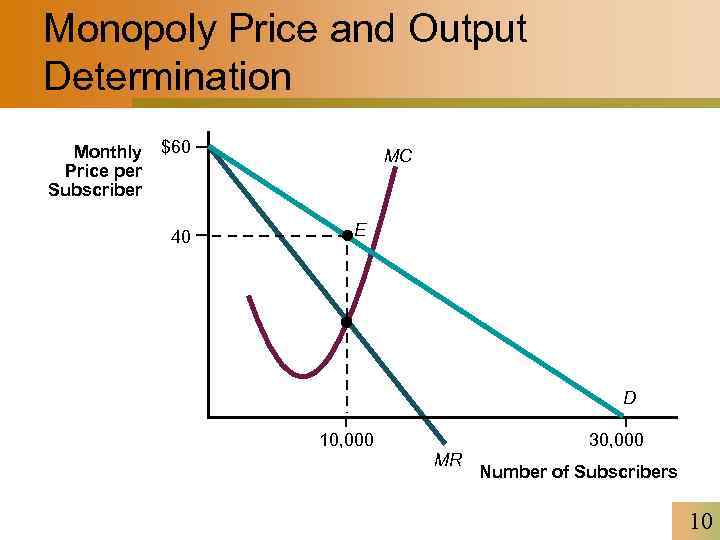 Monopoly Price and Output Determination Monthly Price per Subscriber $60 40 MC E D 10, 000 MR 30, 000 Number of Subscribers 10
 Profit And Loss • A monopoly earns a profit whenever P > ATC – Its total profit at best output level equals area of a rectangle • Height equal to distance between P and ATC • Width equal to level of output • A monopoly suffers a loss whenever P < ATC – Its total loss at best output level equals area of a rectangle • Height equal to distance between ATC and P • Width equal to level of output 11
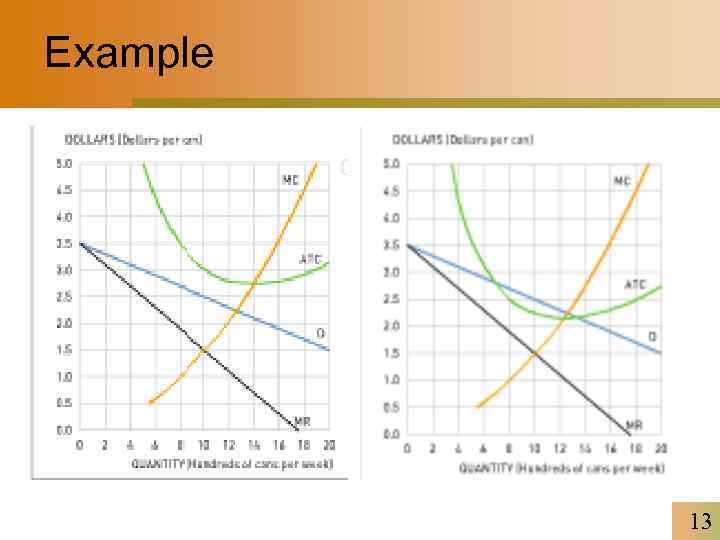
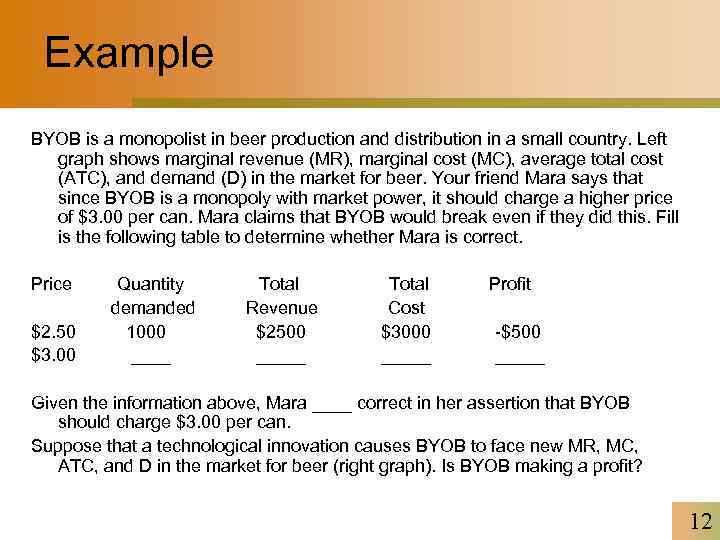 Example BYOB is a monopolist in beer production and distribution in a small country. Left graph shows marginal revenue (MR), marginal cost (MC), average total cost (ATC), and demand (D) in the market for beer. Your friend Mara says that since BYOB is a monopoly with market power, it should charge a higher price of $3. 00 per can. Mara claims that BYOB would break even if they did this. Fill is the following table to determine whether Mara is correct. Price $2. 50 $3. 00 Quantity demanded 1000 ____ Total Revenue $2500 _____ Total Cost $3000 _____ Profit -$500 _____ Given the information above, Mara ____ correct in her assertion that BYOB should charge $3. 00 per can. Suppose that a technological innovation causes BYOB to face new MR, MC, ATC, and D in the market for beer (right graph). Is BYOB making a profit? 12
 Example 13
 Short-Run Equilibrium • What if a monopoly suffers a loss in short-run? – Any firm should shut down if P < AVC at output level where MR = MC • If monopoly suddenly finds that P < AVC, government will usually not allow it to shut down, – Instead use tax revenue to make up for firm’s losses 14
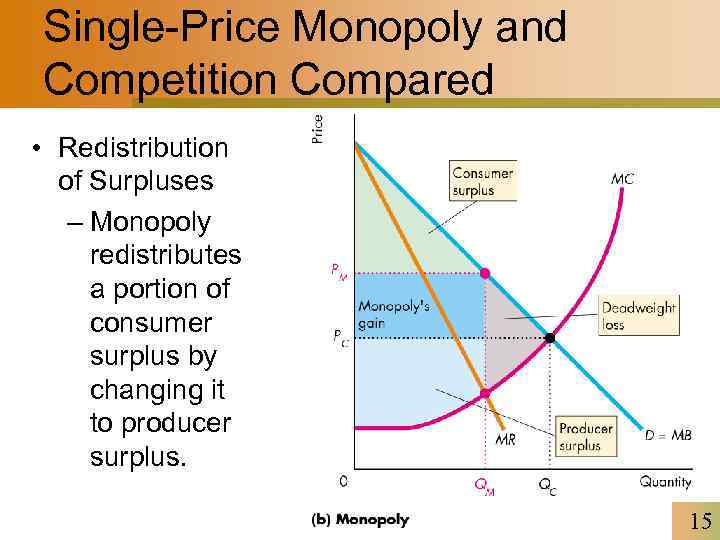 Single-Price Monopoly and Competition Compared • Redistribution of Surpluses – Monopoly redistributes a portion of consumer surplus by changing it to producer surplus. 15
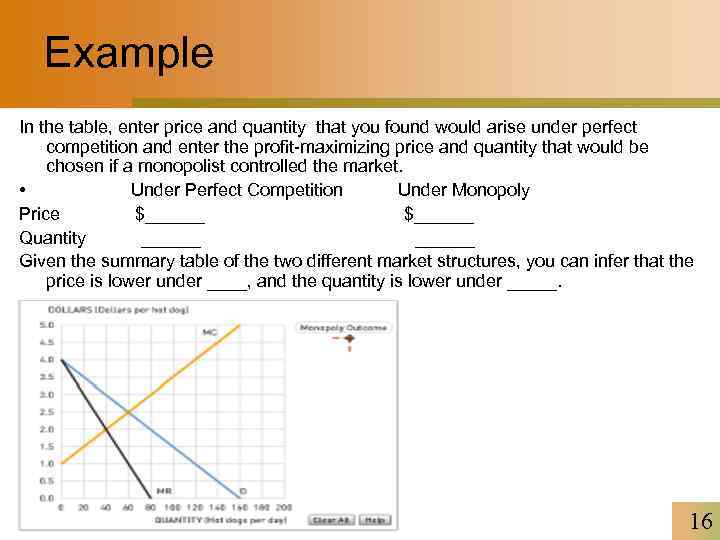 Example In the table, enter price and quantity that you found would arise under perfect competition and enter the profit-maximizing price and quantity that would be chosen if a monopolist controlled the market. • Under Perfect Competition Under Monopoly Price $______ Quantity ______ Given the summary table of the two different market structures, you can infer that the price is lower under ____, and the quantity is lower under _____. 16
 Price Discrimination • Price discrimination is the practice of selling different units of a good or service for different prices. • To be able to price discriminate, a monopoly must: – Identify and separate different buyer types – Sell a product that cannot be resold – Price differences that arise from cost differences are not price discrimination. 17
 Price Discrimination and Consumer Surplus • Price discrimination converts consumer surplus into economic profit. • A monopoly can discriminate – Among units of a good. Quantity discounts are an example. (But quantity discounts that reflect lower costs at higher volumes are not price discrimination. ) – Among groups of buyers. (Advance purchase and other restrictions on airline tickets are an example. ) 18
 Example Price discrimination is the practice of selling the same good at more than one price when the price differences are not justified by cost differences. Evaluate the following statement: “Price discrimination requires market segregation. ” • • True, because the monopolist wants to make sure consumers can’t resell the good. False, because the monopolist can never charge anyone their maximum willingness to pay anyway True, because the monopolist needs to know the willingness to pay of different groups of consumers. False, because the monopolist does not need to know people’s willingness to pay for its goods. 19
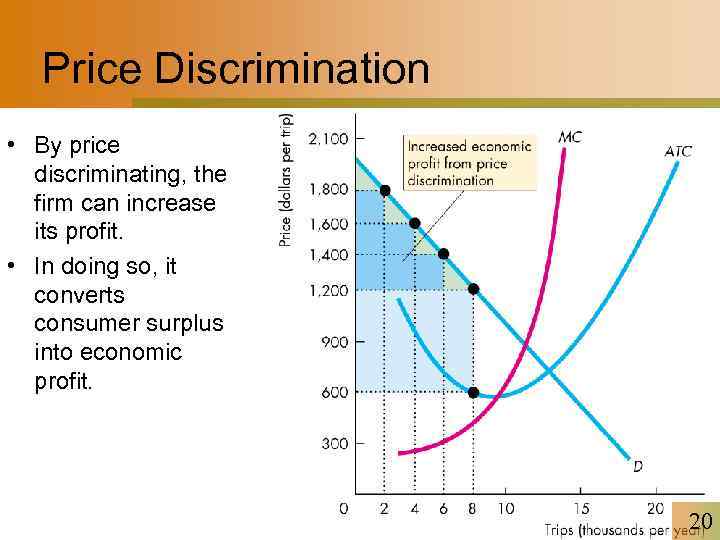 Price Discrimination • By price discriminating, the firm can increase its profit. • In doing so, it converts consumer surplus into economic profit. 20
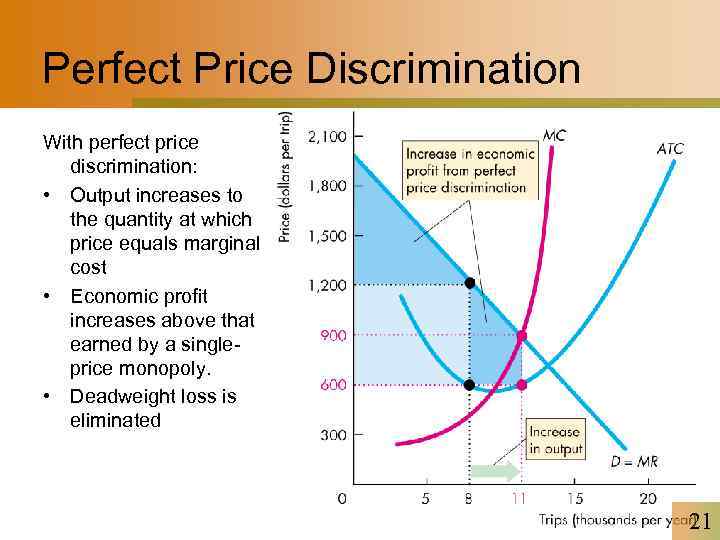 Perfect Price Discrimination With perfect price discrimination: • Output increases to the quantity at which price equals marginal cost • Economic profit increases above that earned by a singleprice monopoly. • Deadweight loss is eliminated 21
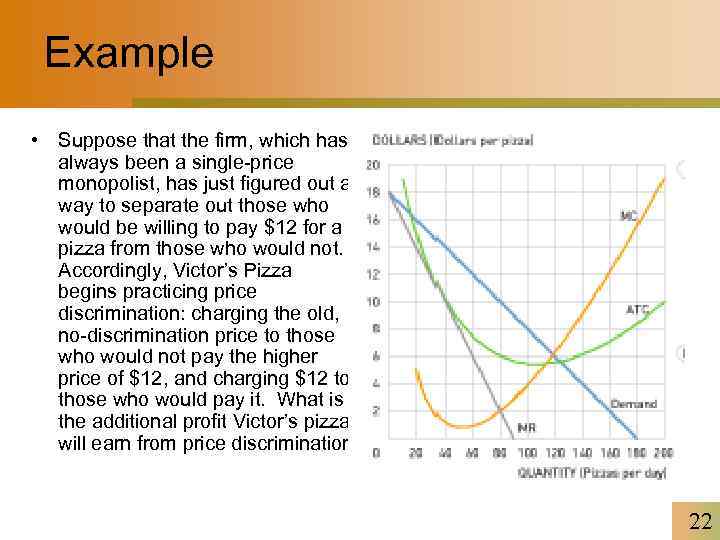 Example • Suppose that the firm, which has always been a single-price monopolist, has just figured out a way to separate out those who would be willing to pay $12 for a pizza from those who would not. Accordingly, Victor’s Pizza begins practicing price discrimination: charging the old, no-discrimination price to those who would not pay the higher price of $12, and charging $12 to those who would pay it. What is the additional profit Victor’s pizza will earn from price discrimination. 22
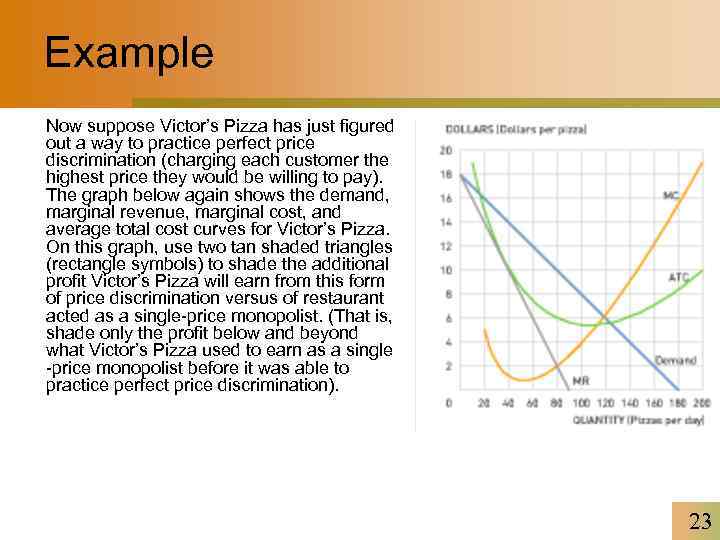 Example Now suppose Victor’s Pizza has just figured out a way to practice perfect price discrimination (charging each customer the highest price they would be willing to pay). The graph below again shows the demand, marginal revenue, marginal cost, and average total cost curves for Victor’s Pizza. On this graph, use two tan shaded triangles (rectangle symbols) to shade the additional profit Victor’s Pizza will earn from this form of price discrimination versus of restaurant acted as a single-price monopolist. (That is, shade only the profit below and beyond what Victor’s Pizza used to earn as a single -price monopolist before it was able to practice perfect price discrimination). 23
 Monopoly Policy Issues • Gains from Monopoly – A single-price monopoly creates inefficiency and price discriminating monopoly captures consumer surplus and converts it into producer surplus and economic profit. – But monopoly brings benefits. 24
 Monopoly Policy Issues • Product innovation – Patents and copyrights provide protection from competition and let the monopoly enjoy the profits stemming from innovation for a longer period of time. • Economies of scale and scope – Where economies of scale or scope exist, a monopoly can produce at a lower average total cost than what a large number of competitive firms could achieve. 25
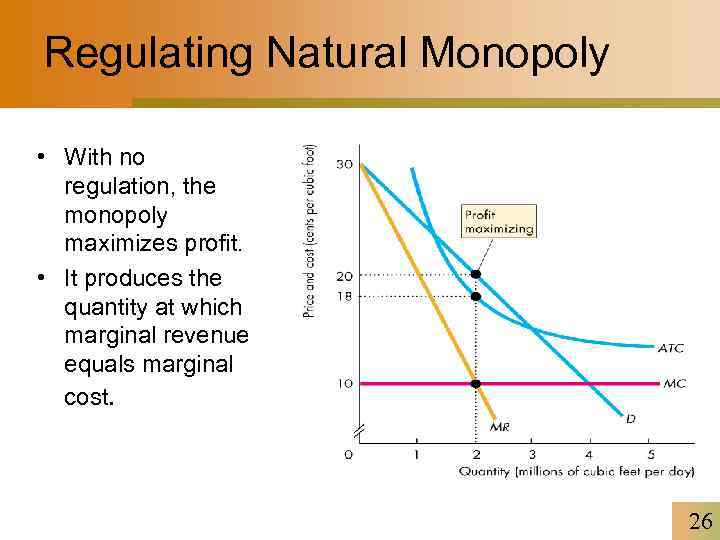 Regulating Natural Monopoly • With no regulation, the monopoly maximizes profit. • It produces the quantity at which marginal revenue equals marginal cost. 26
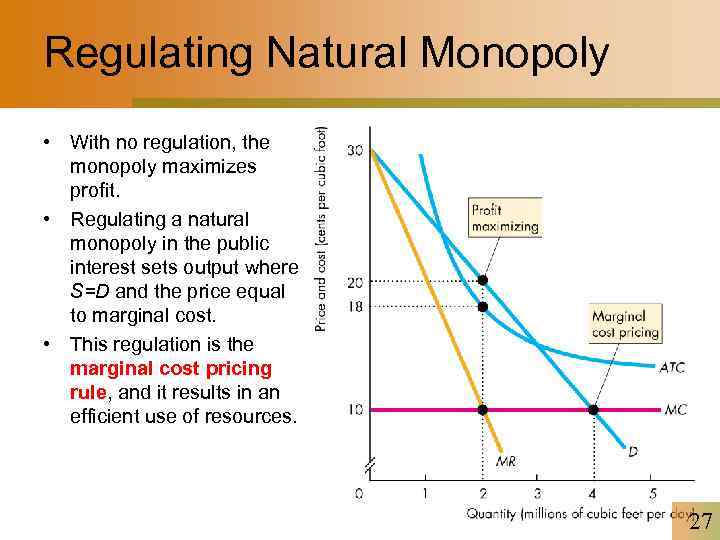 Regulating Natural Monopoly • With no regulation, the monopoly maximizes profit. • Regulating a natural monopoly in the public interest sets output where S=D and the price equal to marginal cost. • This regulation is the marginal cost pricing rule, and it results in an efficient use of resources. 27
 Regulating Natural Monopoly • With price equal to marginal cost, ATC exceeds price and the monopoly incurs an economic loss. • If the monopoly receives a subsidy to cover its loss, taxes must be imposed on other economic activity, which create deadweight loss • Where possible, a regulated natural monopoly might be permitted to price discriminate to cover the loss from marginal cost pricing. • Another alternative is to produce the quantity at which price equals average total cost and to set the price equal to average total cost—the average cost pricing rule. 28
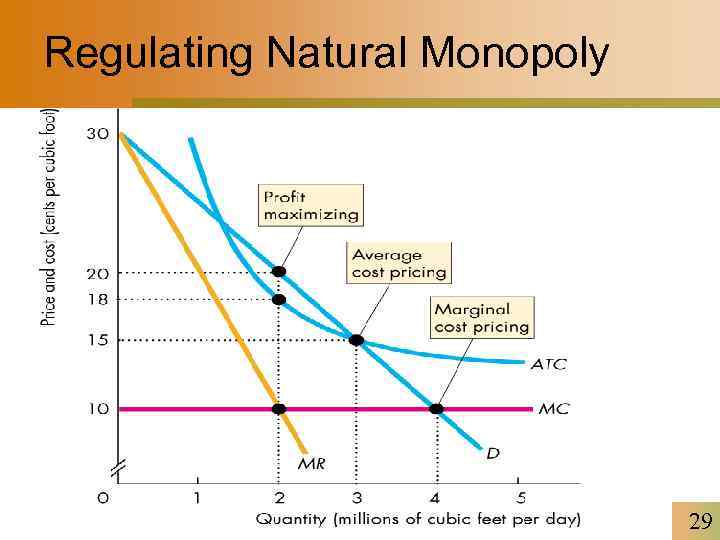 Regulating Natural Monopoly 29