


 Скачать презентацию Market Power Evaluation in Power Systems with Congestion
9e426b764ea331a4347c5a6cb1c7f83d.ppt
- Количество слайдов: 50
 Market Power Evaluation in Power Systems with Congestion Tom Overbye, George Gross, Peter Sauer Department of Electrical and Computer Engineering University of Illinois at Urbana-Champaign Urbana, IL Mark Laufenberg, Jamie Weber Power. World Corporation Urbana, IL
 Introduction • Power industry is rapidly restructuring • Key goal of restructuring is to reap benefits of competitive marketplaces • Significant concerns benefits could be lost through development of horizontal market power
 Horizontal Market Power • Market power is antithesis of competition – ability of a particular group of sellers to maintain prices above competitive levels • An extreme case is a single supplier of a • product, i. e. a monopoly. In the short run, Price monopolistic producer can charge depends upon price elasticity of the demand.
 Horizontal Market Power • Market power can sometimes lead to decreased prices in the long run – Accompanying higher prices can result in a quickening of the entry of new players and technological innovation • Some market power abuses are actually selfinflicted by consumers by their reluctance to respond to favorable prices offered by new vendors in deregulated markets
 Symptoms of Market Power • Economic theory tells us that in a market with • perfect competition, prices should be equal to the marginal cost to supply the product Therefore prices above marginal cost can indicate market power
 Market Power Analysis • Market power analysis requires 3 steps – identify relevant product/services – identify relevant geographic market – evaluate market concentration
 Relevant Product • FERC defines at least three distinct products – non-firm energy – short-term capacity (firm energy) – long-term capacity • Emphasis shifting to short-term energy • • markets Presentation considers short-term Challenge in electricity markets is demand varies over time
 Relevant Geographic Market • Most difficult step in electricity market due to • impact of transmission system Size of market is dependent on – competitive prices of generators – impacts of charges from transporting energy in transmission network – physical/operational characteristics of transmission network
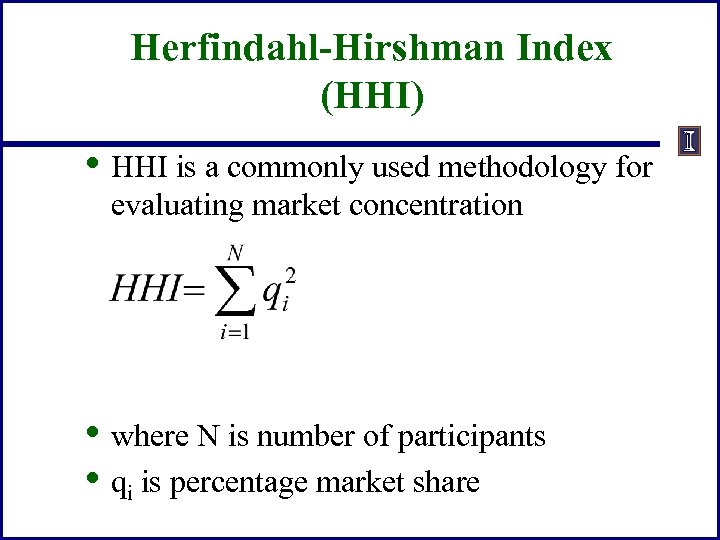 Herfindahl-Hirshman Index (HHI) • HHI is a commonly used methodology for evaluating market concentration • where N is number of participants • qi is percentage market share
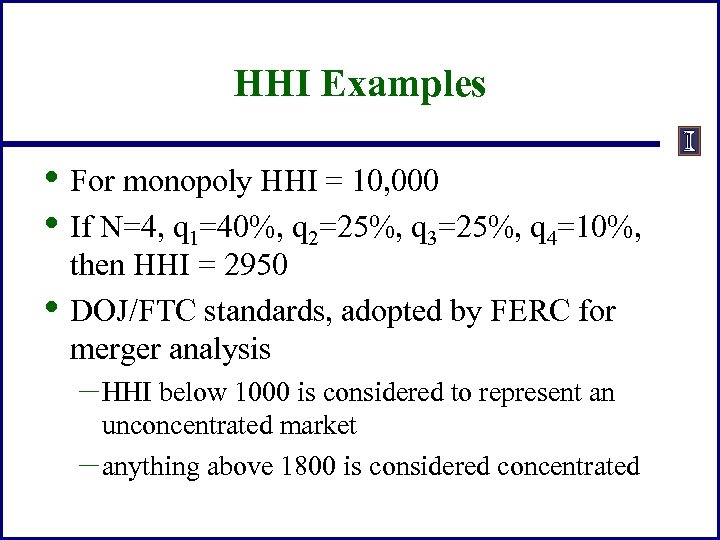 HHI Examples • For monopoly HHI = 10, 000 • If N=4, q 1=40%, q 2=25%, q 3=25%, q 4=10%, • then HHI = 2950 DOJ/FTC standards, adopted by FERC for merger analysis – HHI below 1000 is considered to represent an unconcentrated market – anything above 1800 is considered concentrated
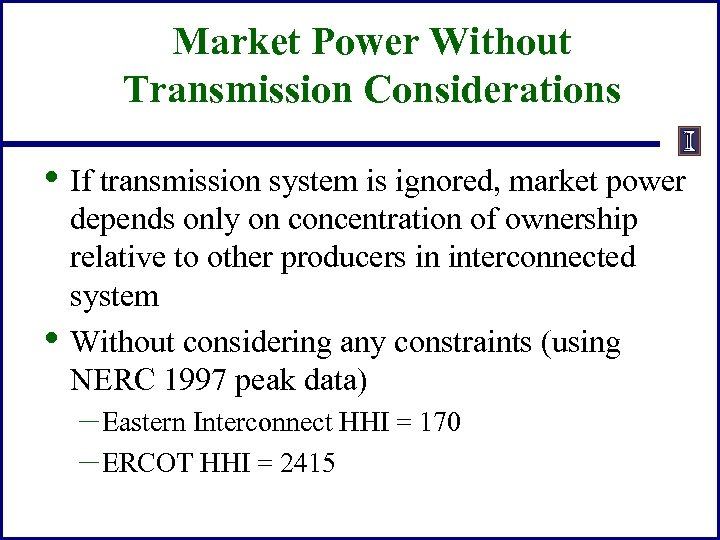 Market Power Without Transmission Considerations • If transmission system is ignored, market power • depends only on concentration of ownership relative to other producers in interconnected system Without considering any constraints (using NERC 1997 peak data) – Eastern Interconnect HHI = 170 – ERCOT HHI = 2415
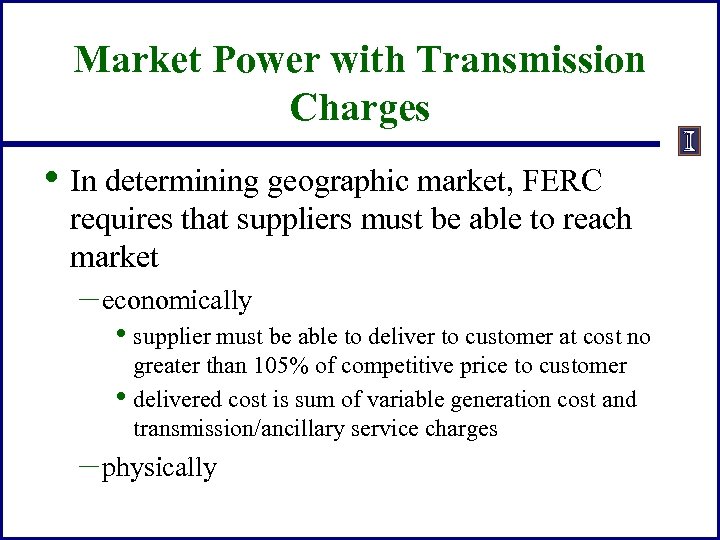 Market Power with Transmission Charges • In determining geographic market, FERC requires that suppliers must be able to reach market – economically • supplier must be able to deliver to customer at cost no greater than 105% of competitive price to customer • delivered cost is sum of variable generation cost and transmission/ancillary service charges – physically
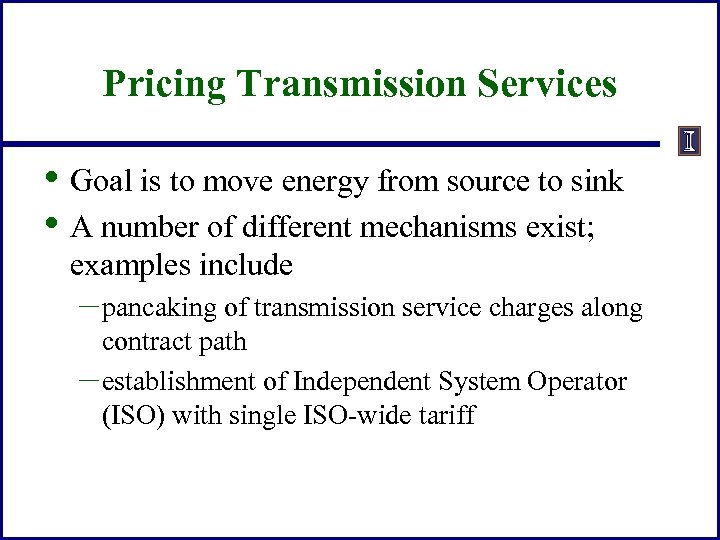 Pricing Transmission Services • Goal is to move energy from source to sink • A number of different mechanisms exist; examples include – pancaking of transmission service charges along contract path – establishment of Independent System Operator (ISO) with single ISO-wide tariff
 Market Power with Transmission Constraints • Market size can be limited by physical ability to • • delivery electricity Whenever physical or operational constraints become active, system is said to be in state of congestion Congestion arises through number of mechanisms – transmission line/transformer thermal limits – bus voltage limits – voltage, transient or oscillatory stability
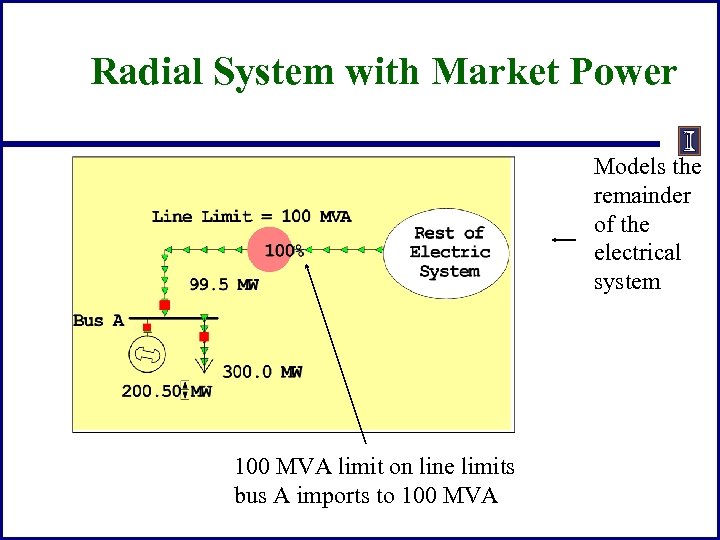 Radial System with Market Power Models the remainder of the electrical system 100 MVA limit on line limits bus A imports to 100 MVA
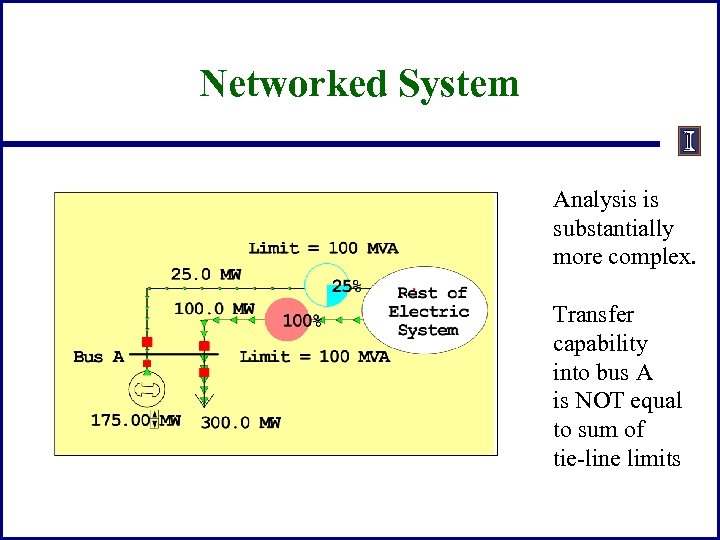 Networked System Analysis is substantially more complex. Transfer capability into bus A is NOT equal to sum of tie-line limits
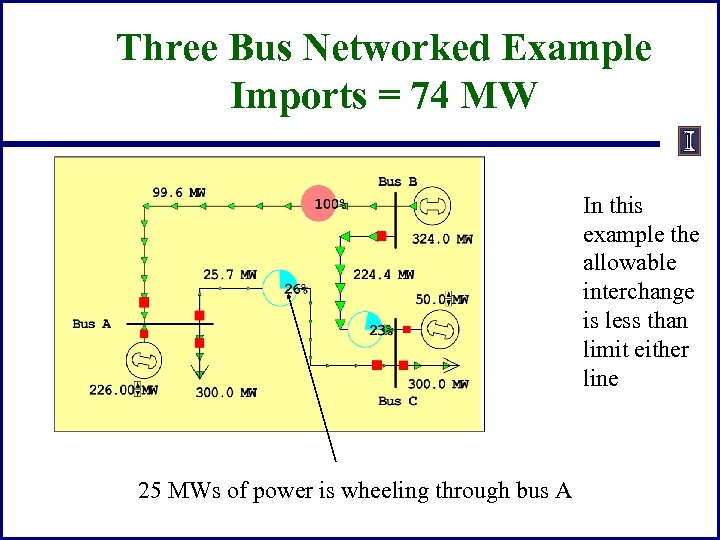 Three Bus Networked Example Imports = 74 MW In this example the allowable interchange is less than limit either line 25 MWs of power is wheeling through bus A
 Congestion in Networks • Need to introduce several definitions concerning network power transfers – source: set of buses increasing their injection of power into network – sink: set of buses decreasing their injection of power into network – direction: source/sink pair • Power transfer is then associated with a particular direction
 Congestion in Networks • To understand impact of congestion in networks, need to consider two interrelated issues – power transfer in a particular direction may impact line flows in large portion of system • this impact is commonly defined as the power transfer distribution factor (PTDF) – once a line is congested, any new power transfers with a PTDF on the congested line above 5% can not take place
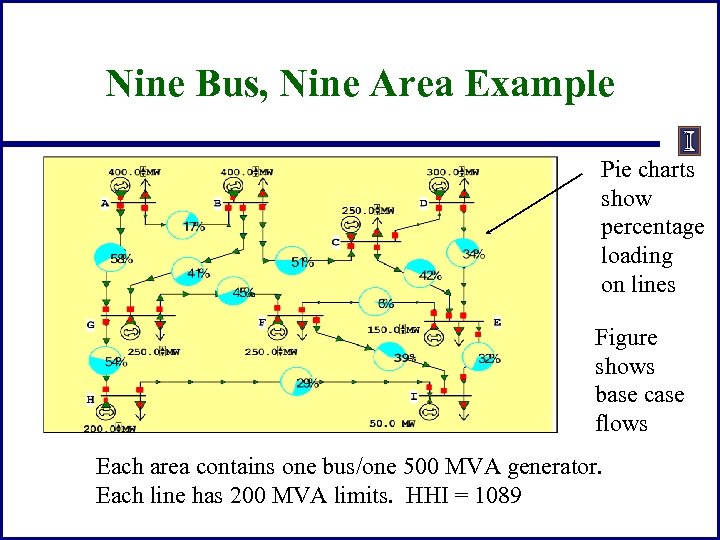 Nine Bus, Nine Area Example Pie charts show percentage loading on lines Figure shows base case flows Each area contains one bus/one 500 MVA generator. Each line has 200 MVA limits. HHI = 1089
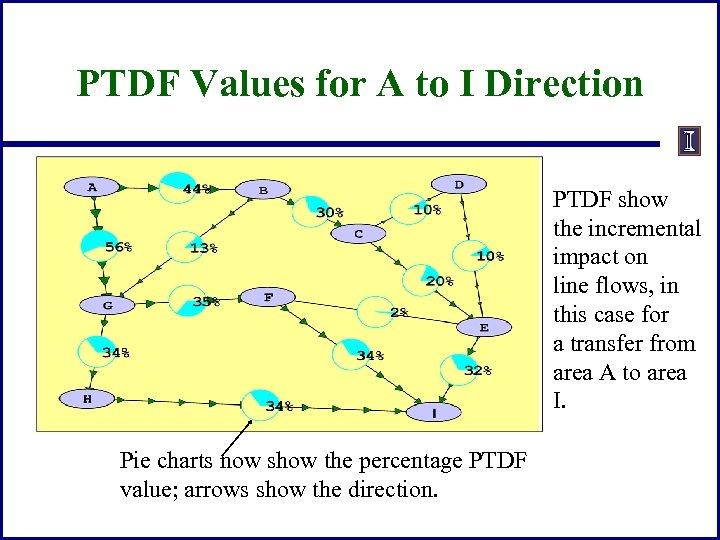 PTDF Values for A to I Direction PTDF show the incremental impact on line flows, in this case for a transfer from area A to area I. Pie charts now show the percentage PTDF value; arrows show the direction.
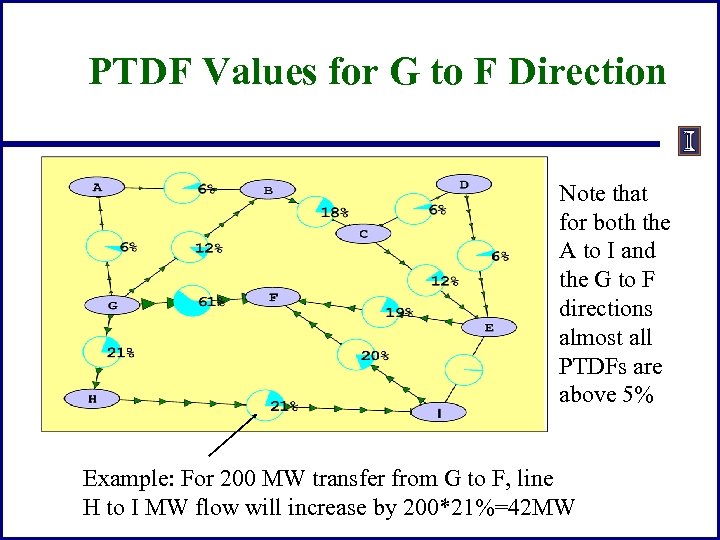 PTDF Values for G to F Direction Note that for both the A to I and the G to F directions almost all PTDFs are above 5% Example: For 200 MW transfer from G to F, line H to I MW flow will increase by 200*21%=42 MW
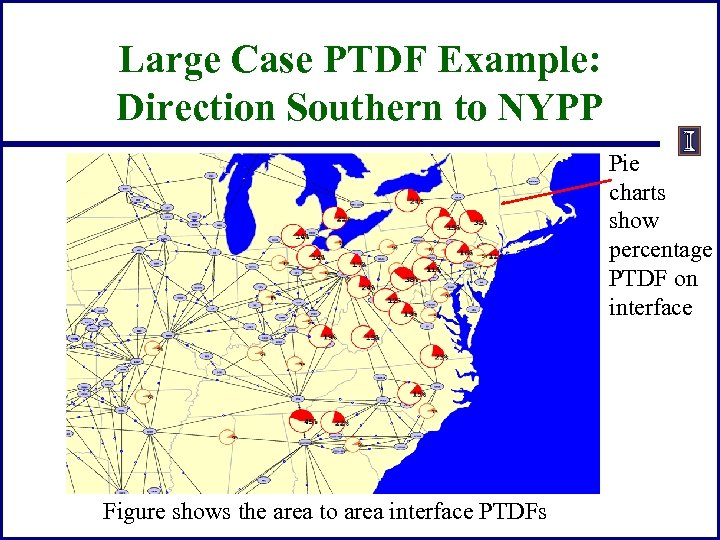 Large Case PTDF Example: Direction Southern to NYPP Pie charts show percentage PTDF on interface Figure shows the area to area interface PTDFs
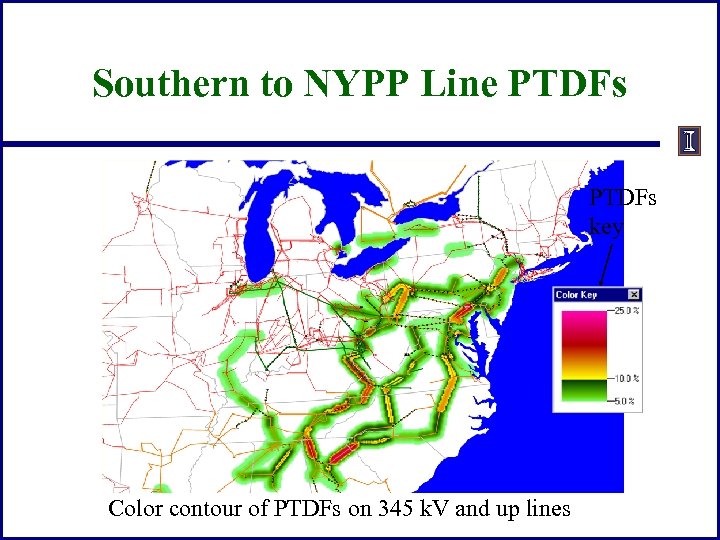 Southern to NYPP Line PTDFs key Color contour of PTDFs on 345 k. V and up lines
 PTDF Implications on Market Power • Once congestion is present on line, any power • transfer with PTDF above 5% on congested line, in direction such that line loading would be increased, is not allowed Congestion on a single line can constrain many different directions
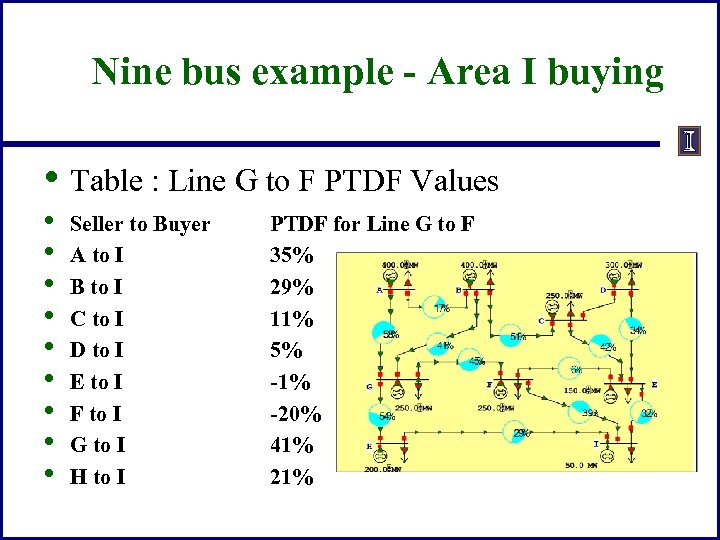 Nine bus example - Area I buying • Table : Line G to F PTDF Values • • • Seller to Buyer A to I B to I C to I D to I E to I F to I G to I H to I PTDF for Line G to F 35% 29% 11% 5% -1% -20% 41% 21%
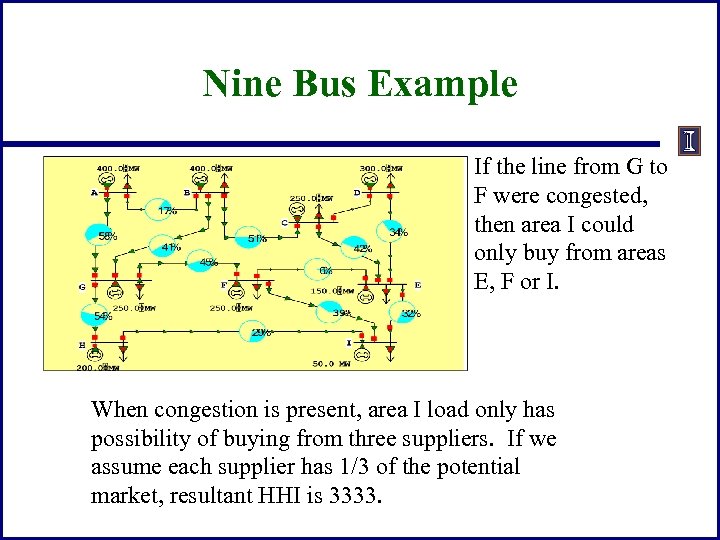 Nine Bus Example If the line from G to F were congested, then area I could only buy from areas E, F or I. When congestion is present, area I load only has possibility of buying from three suppliers. If we assume each supplier has 1/3 of the potential market, resultant HHI is 3333.
 Strategic Market Power • Characteristic that congestion can limit market size allows possibility that generator portfolio owner may unilaterally dispatch generator to deliberately induce congestion – this results in market power – allows charging of higher prices • Ability to induce congestion depends on generator portfolio and transmission system loading
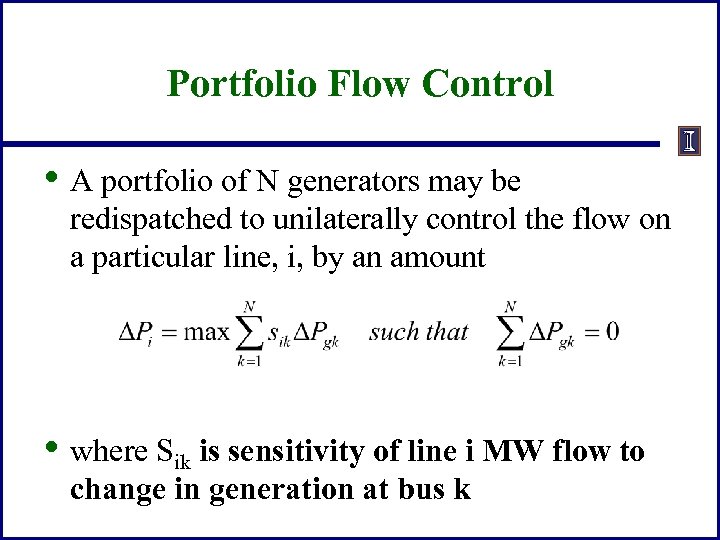 Portfolio Flow Control • A portfolio of N generators may be redispatched to unilaterally control the flow on a particular line, i, by an amount • where Sik is sensitivity of line i MW flow to change in generation at bus k
 Portfolio Flow Control • Once a line is congested, any generators with a • PTDF to a particular load pocket that would increase loading on the congested line are prevented from selling to that market. Likewise affected loads are prevented from buying from the “blocked” generators.
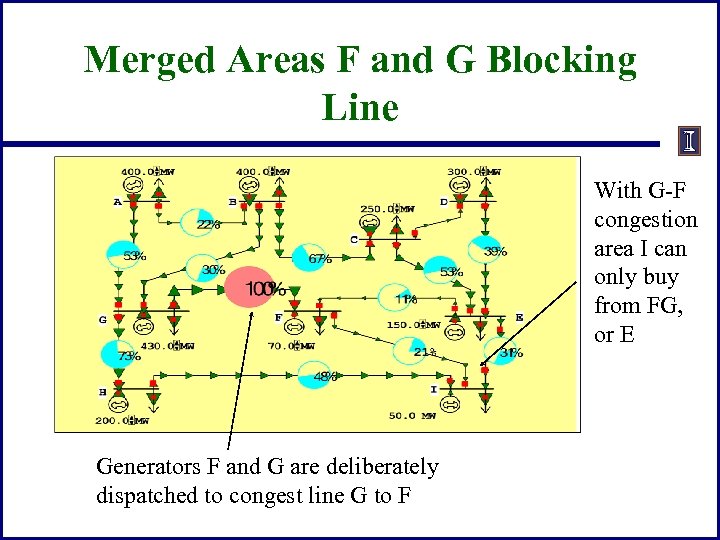 Merged Areas F and G Blocking Line With G-F congestion area I can only buy from FG, or E Generators F and G are deliberately dispatched to congest line G to F
 Cost to the Congestors • Such a strategy of deliberate congestion could • certainly involve additional costs to congestors (since they presumably would have to move away from an economic dispatch) Congestors need to balance costs versus benefits from higher prices
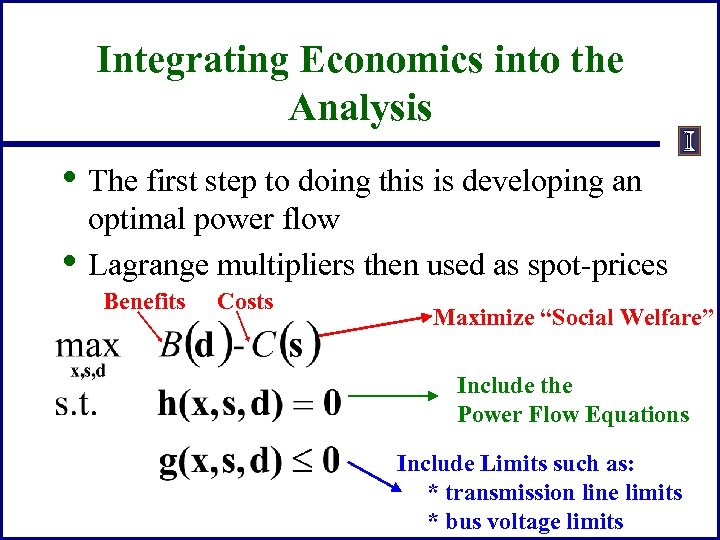 Integrating Economics into the Analysis • The first step to doing this is developing an • optimal power flow Lagrange multipliers then used as spot-prices Benefits Costs Maximize “Social Welfare” Include the Power Flow Equations Include Limits such as: * transmission line limits * bus voltage limits
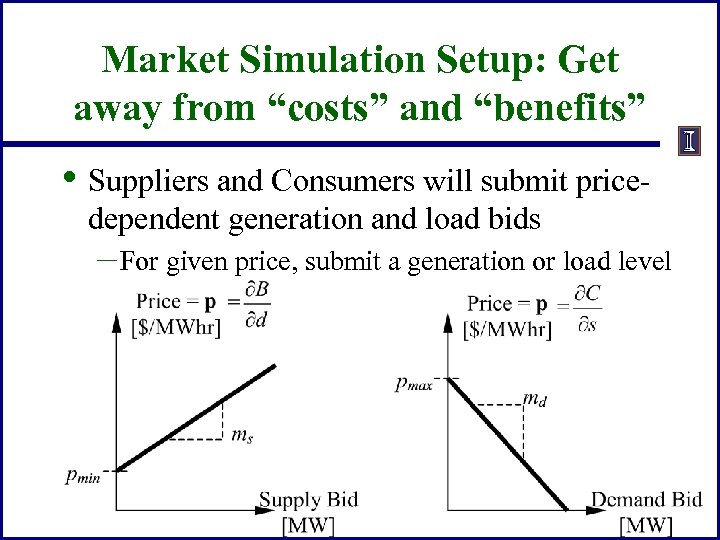 Market Simulation Setup: Get away from “costs” and “benefits” • Suppliers and Consumers will submit pricedependent generation and load bids – For given price, submit a generation or load level
 Market Simulation Setup • Consumers and suppliers submit bid curves. • Using the bids, an OPF with the objective of maximization of social welfare is solved – This will determine the MW dispatch as well as Lagrange multipliers which will determine the spot price at each bus. – The consumers and suppliers are paid a price according to their bid, but their bid will effect the amount at which they are dispatched.
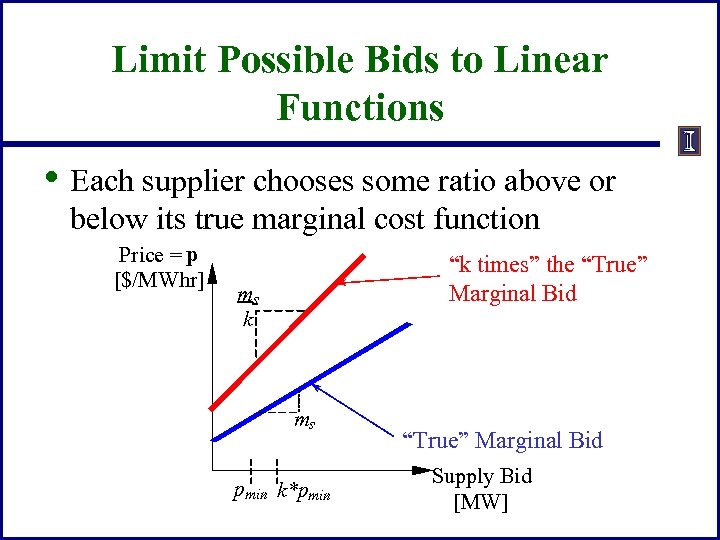 Limit Possible Bids to Linear Functions • Each supplier chooses some ratio above or below its true marginal cost function Price = p [$/MWhr] “k times” the “True” Marginal Bid ms k ms pmin k*pmin “True” Marginal Bid Supply Bid [MW]
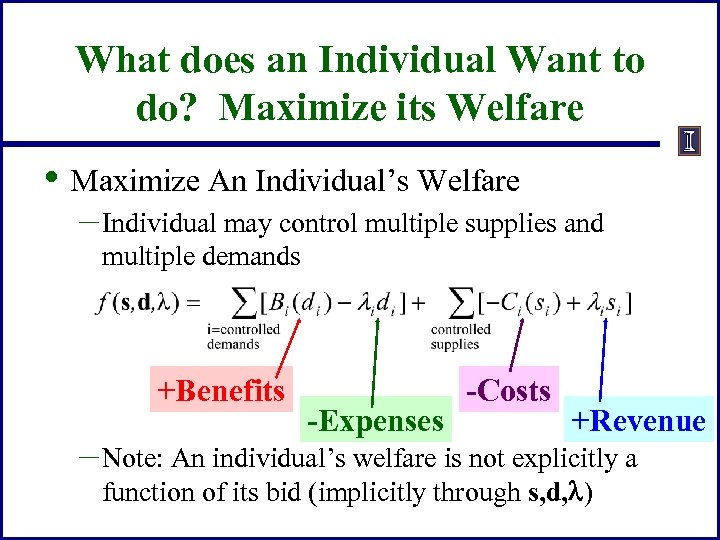 What does an Individual Want to do? Maximize its Welfare • Maximize An Individual’s Welfare – Individual may control multiple supplies and multiple demands +Benefits -Expenses -Costs +Revenue – Note: An individual’s welfare is not explicitly a function of its bid (implicitly through s, d, l)
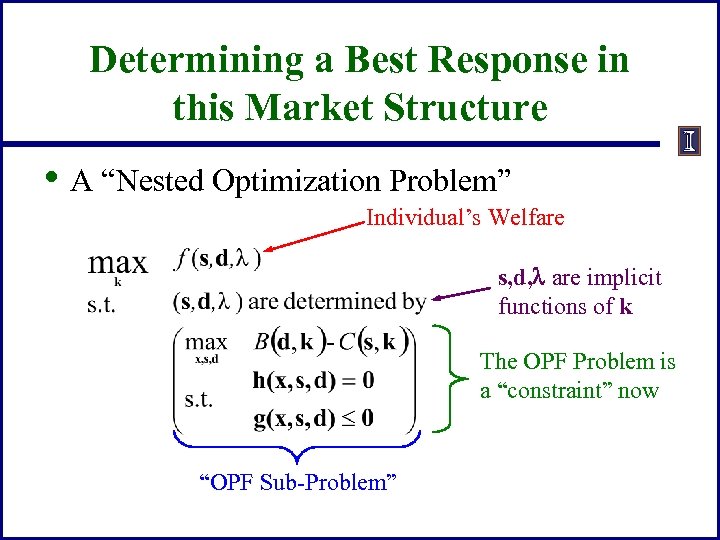 Determining a Best Response in this Market Structure • A “Nested Optimization Problem” Individual’s Welfare s, d, l are implicit functions of k The OPF Problem is a “constraint” now “OPF Sub-Problem”
 Economic Market Equilibriums: The Nash Equilibrium • Definition of a Nash Equilibrium – An individual looks at what its opponents are presently doing – The individual’s best response to opponents behavior is to continue its present behavior – This is true for ALL individuals in the market • This is a Nash Equilibrium • Nash Equilibrium be found by iteratively solving to individual welfare maximization
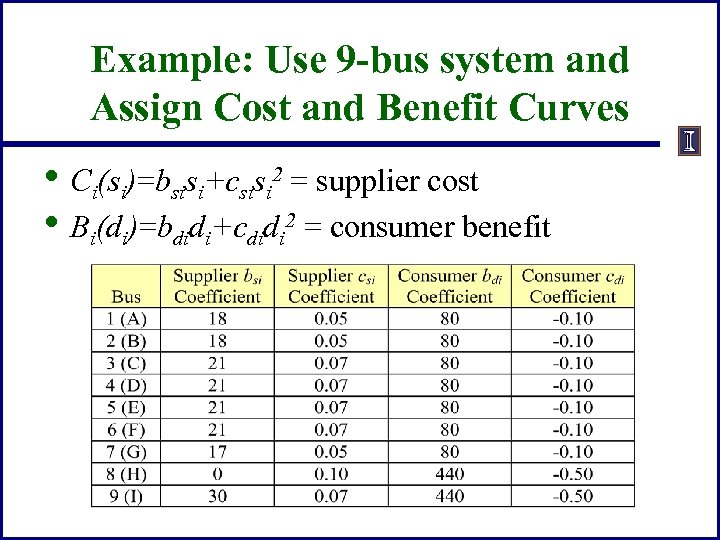 Example: Use 9 -bus system and Assign Cost and Benefit Curves • Ci(si)=bsisi+csisi 2 = supplier cost • Bi(di)=bdidi+cdidi 2 = consumer benefit
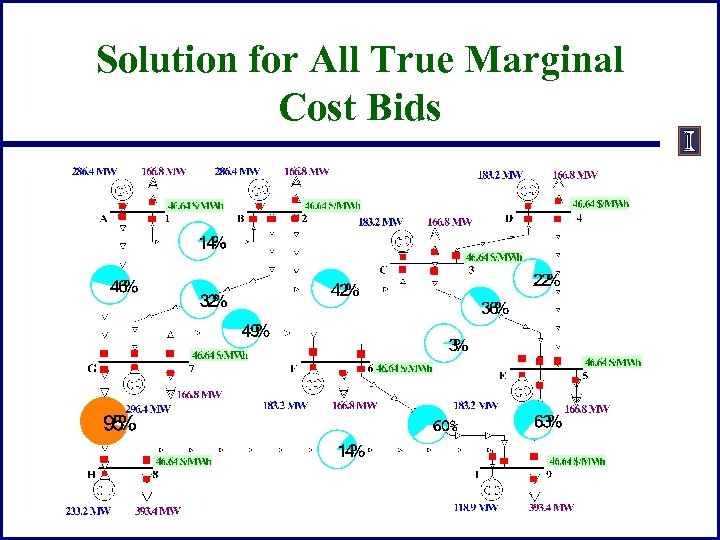 Solution for All True Marginal Cost Bids
 Market Behavior • Assume all consumers always submit bids • • corresponding to true marginal benefit (k=1) Assume supplier A-F and I all act alone to maximize their profit Assume suppliers G and H collude (or merge) together – G and H now make bid decisions together
 What are General Strategies for G and H? • G and H could act to raise their prices hoping • to increase profit Also could act to take advantage of the transmission constraint between them – G lowers price hoping that overload on the line between G-H will result in increased profit by H • Nash Equilibria are found for each of these two general strategies by iteratively solving the individual welfare maximum
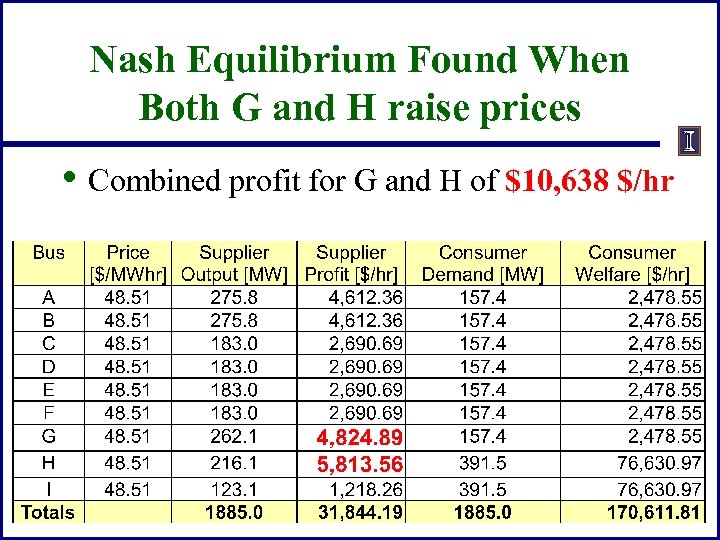 Nash Equilibrium Found When Both G and H raise prices • Combined profit for G and H of $10, 638 $/hr
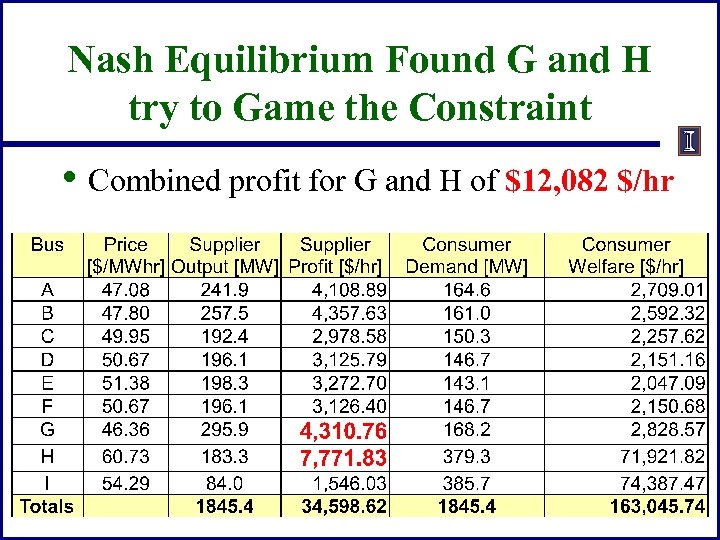 Nash Equilibrium Found G and H try to Game the Constraint • Combined profit for G and H of $12, 082 $/hr
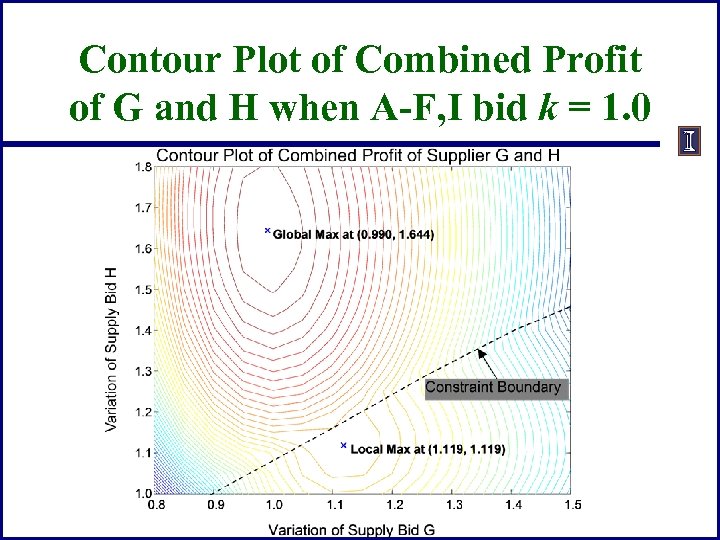 Contour Plot of Combined Profit of G and H when A-F, I bid k = 1. 0
 3 -D Plot of Combined Profit of G and H when A-F, I bid k = 1. 0
 Results • G and H acting together can increase their • • profit by gaming around the transmission constraint Transmission Analysis MUST be included in Market Power Analysis Engineering Analysis and Economic Analysis can be integrated together
 Conclusions • Market power abuses in a large power system • • need to be assessed. Regulators need to be cognizant of ability of market participants to act strategically Portfolio owners need to be cognizant of their own, and their competitors potential for strategic behavior
 Conclusions • Rules of the game can make it more difficult to • • act strategically, but it would be difficult to eliminate possibility completely. Load’s ability to respond to market power is an important consideration. Slides and free 12 bus version of the Power. World Simulator software available at www. powerworld. com