


 Скачать презентацию Market Opportunity Analysis Part 1 CPS 181
0ec451020560e2d4cff408dd49ed43d7.ppt
- Количество слайдов: 29
 Market Opportunity & Analysis Part 1 CPS 181 s Jan 16, 2003
 Questions What is the framework for market-opportunity analysis? Is market-opportunity analysis different in e. Commerce? What are two generic “value types”? How do we identify unmet and/or under-served needs? What determines the specific customers that the company is to pursue?
 Questions Who provides the resources to deliver the benefits of the offering? How do we assess the attractiveness of the opportunity? How do we prepare a “go/no-go” assessment?
 Where Will the Business Compete? Ideally: t. Where customer needs are not fully met t. Few or no competitors t. Large financial opportunities t. Company well positioned to meet needs on its own or thru partners Very difficult to accomplish - 80% failure rate for startups
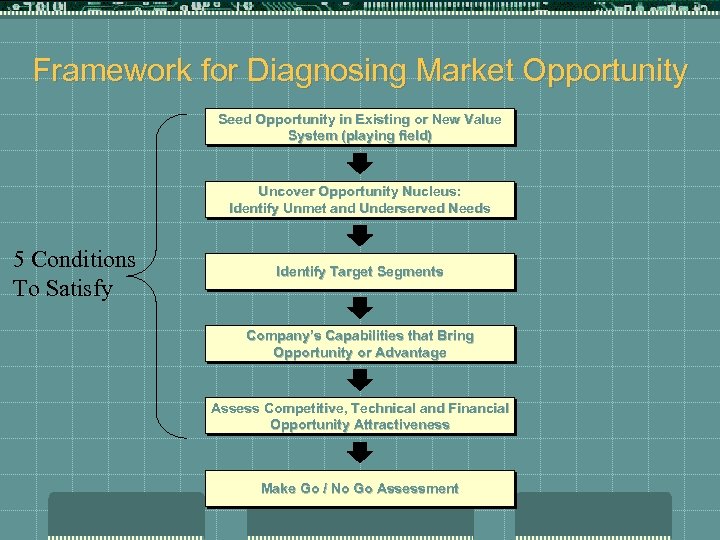 Framework for Diagnosing Market Opportunity Seed Opportunity in Existing or New Value System (playing field) Uncover Opportunity Nucleus: Identify Unmet and Underserved Needs 5 Conditions To Satisfy Identify Target Segments Company’s Capabilities that Bring Opportunity or Advantage Assess Competitive, Technical and Financial Opportunity Attractiveness Make Go / No Go Assessment
 Seed Opportunity t Value system - entire chain of suppliers t Value beliefs can be reinvented or transformed t Economic activities can be harnessed, redirected, or created
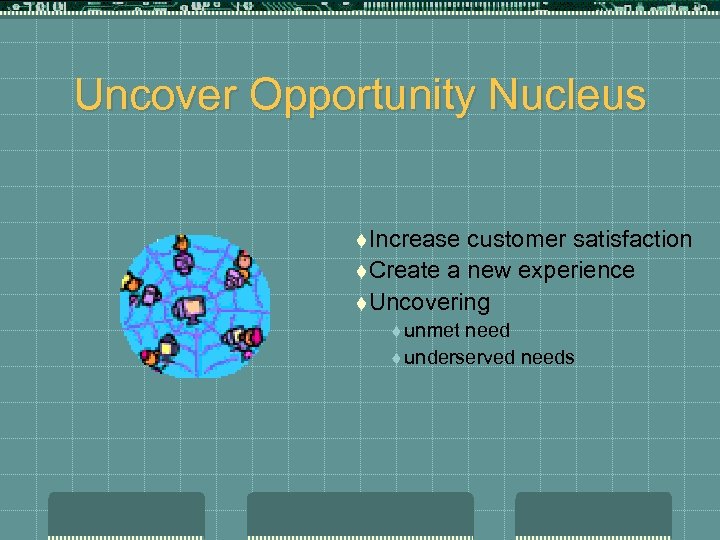 Uncover Opportunity Nucleus t Increase customer satisfaction t Create a new experience t Uncovering t unmet need t underserved needs
 Identify Target Customers t Identifying and choosing priority customers leads to understanding of why customers are attracted t What experiences do they seek? t What can be offered?
 Declare the Company’s Resource-Based Opportunity t Examine distinct capabilities and activities needed t Identify distinct resources needed
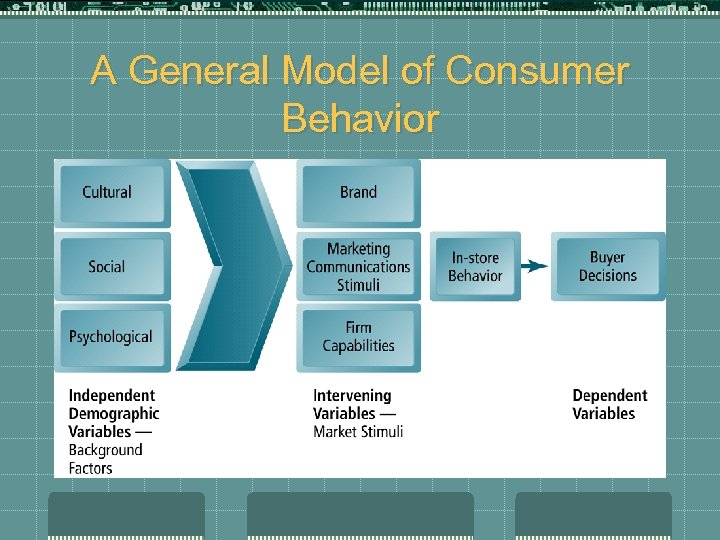 A General Model of Consumer Behavior
 Is Market-Opportunity Different in e. Commerce? t Competition occurs across industry boundaries t at an unprecedented speed t between alliances of companies t t Customer behavior easy to influence and change because e. Commerce is so new t Value chains rapidly being reconfigured
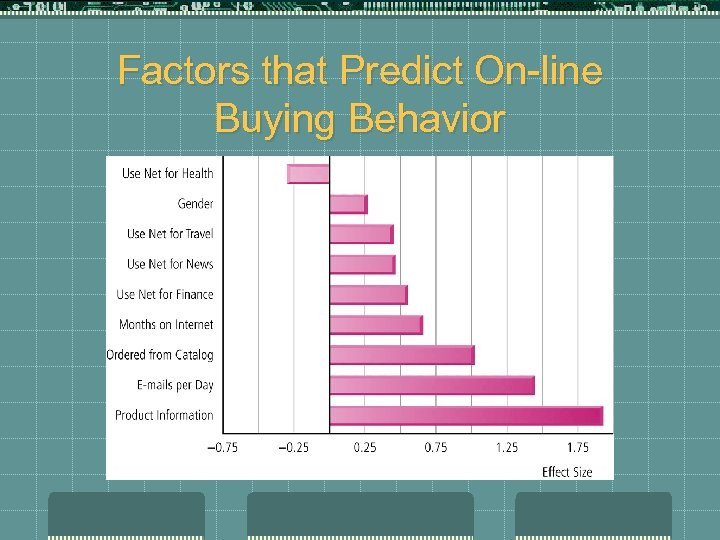 Factors that Predict On-line Buying Behavior
 Two Generic “Value types” t Trapped Value t New-To-The-World Value Heidi Roizen
 Guiding Questions for Finding Trapped Value t High degree of asymmetric information between buyers and sellers that traps value? t Significant time and resources consumed in making the transaction? t Activities becoming more collapsed? t Able to collaborate effectively and efficiently? t Advice and information to maximize their effectiveness or benefits? t Forgoing opportunities because of privacy issues?
 Identify Unmet and/or Underserved Needs t Examine t Steps customer decision process the customer goes through? t Who is involved and in what role? t Different paths customers go through? t Where does the process take place? t Time the overall process will take? t Categories and competitors are considered? t Choices not considered? Aware of? t Which customers are not participating?
 Revealing Unmet or Underserved Needs t Series of activities or steps of the Customer Decision Process ? t The nature of the ideal experience (functionally & emotionally) t How close is the actual customer experience to the ideal? t What are the key frustration points? t Compensating behaviors? t Customer success? t Underserved needs? (customer awareness) Avie Tevanian
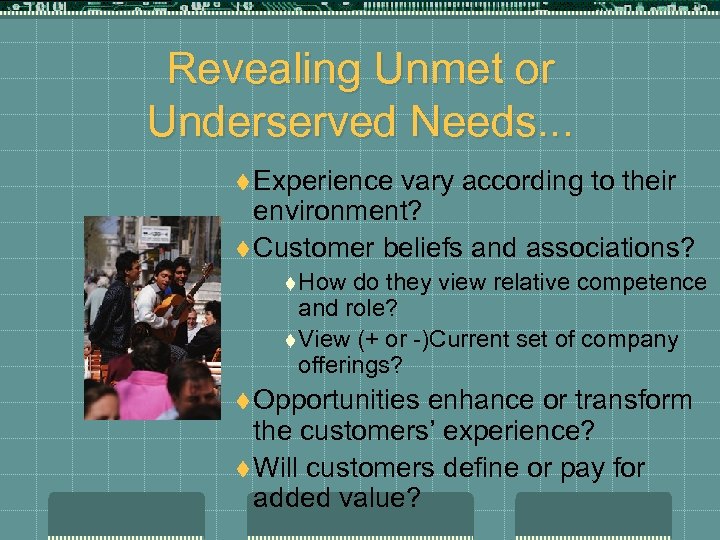 Revealing Unmet or Underserved Needs. . . t Experience vary according to their environment? t Customer beliefs and associations? t How do they view relative competence and role? t View (+ or -)Current set of company offerings? t Opportunities enhance or transform the customers’ experience? t Will customers define or pay for added value?
 Market Segmentation t. Demographics (or Firmographics) t. Geographics t. Behavioral t. Occasion (or Situational) t. Pyschographics (lifestyles, personality) t. Benefits (convenience, quality, ease of use t. Beliefs and attitudes
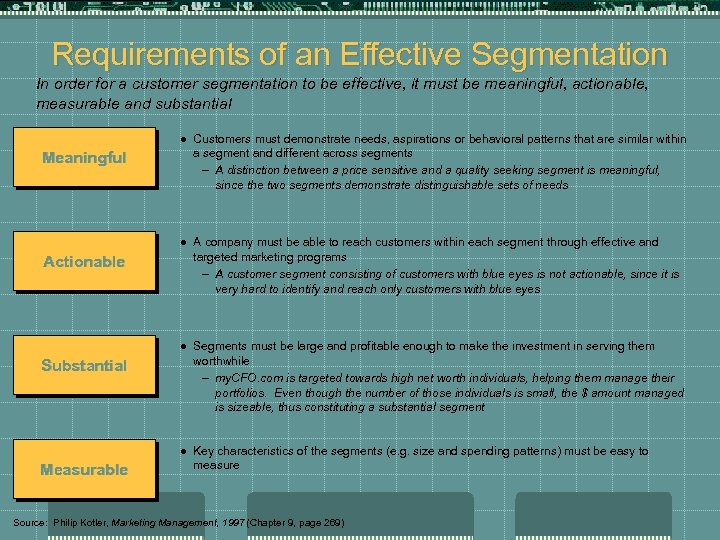 Requirements of an Effective Segmentation In order for a customer segmentation to be effective, it must be meaningful, actionable, measurable and substantial Customers must demonstrate needs, aspirations or behavioral patterns that are similar within a segment and different across segments – A distinction between a price sensitive and a quality seeking segment is meaningful, since the two segments demonstrate distinguishable sets of needs A company must be able to reach customers within each segment through effective and targeted marketing programs – A customer segment consisting of customers with blue eyes is not actionable, since it is very hard to identify and reach only customers with blue eyes Segments must be large and profitable enough to make the investment in serving them worthwhile – my. CFO. com is targeted towards high net worth individuals, helping them manage their portfolios. Even though the number of those individuals is small, the $ amount managed is sizeable, thus constituting a substantial segment Key characteristics of the segments (e. g. size and spending patterns) must be easy to measure Meaningful Actionable Substantial Measurable Source: Philip Kotler, Marketing Management, 1997 (Chapter 9, page 269)
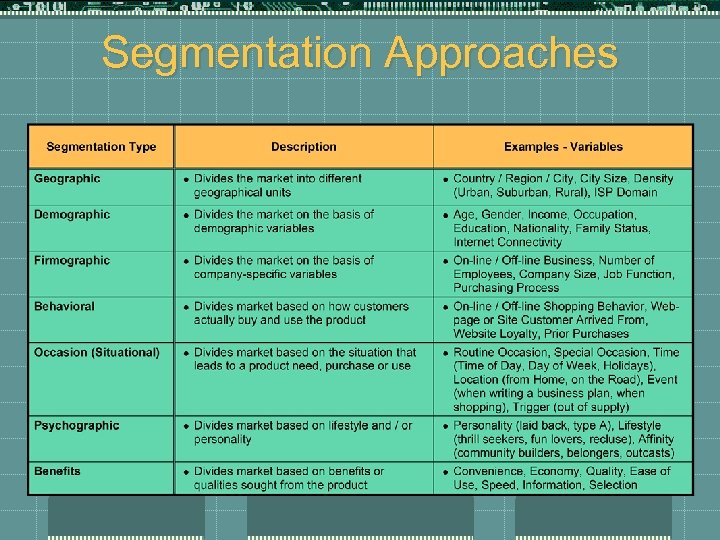 Segmentation Approaches
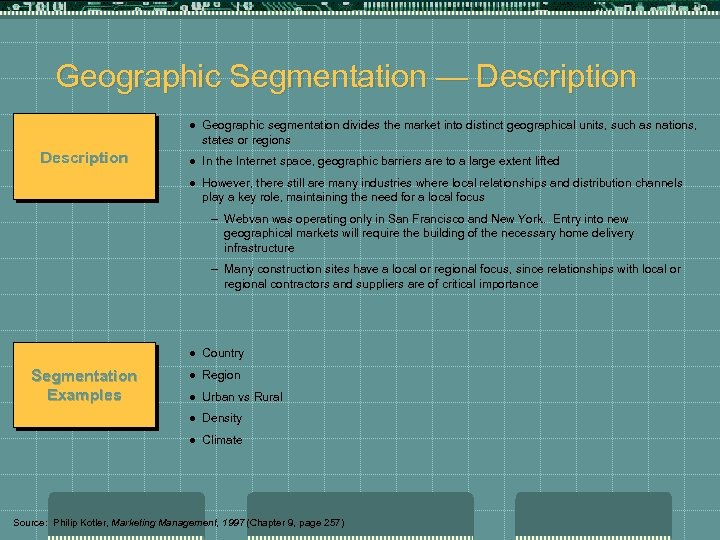 Geographic Segmentation — Description In the Internet space, geographic barriers are to a large extent lifted Description Geographic segmentation divides the market into distinct geographical units, such as nations, states or regions However, there still are many industries where local relationships and distribution channels play a key role, maintaining the need for a local focus – Webvan was operating only in San Francisco and New York. Entry into new geographical markets will require the building of the necessary home delivery infrastructure – Many construction sites have a local or regional focus, since relationships with local or regional contractors and suppliers are of critical importance Region Urban vs Rural Density Segmentation Examples Country Climate Source: Philip Kotler, Marketing Management, 1997 (Chapter 9, page 257)
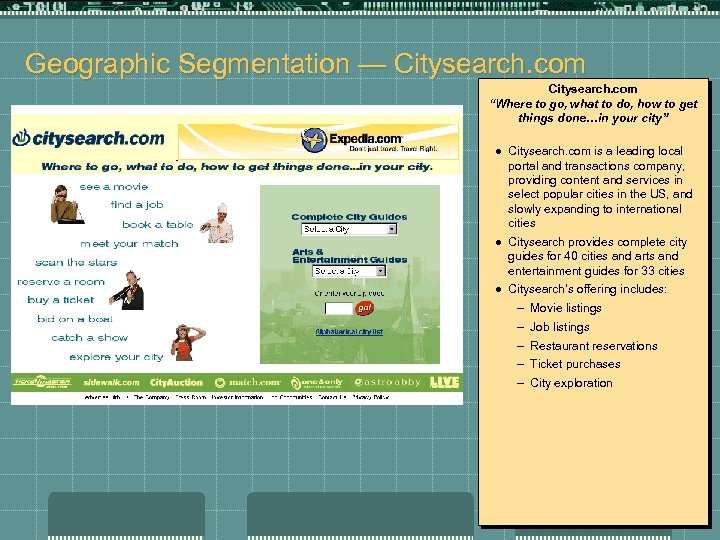 Geographic Segmentation — Citysearch. com “Where to go, what to do, how to get things done…in your city” Citysearch. com is a leading local portal and transactions company, providing content and services in select popular cities in the US, and slowly expanding to international cities Citysearch provides complete city guides for 40 cities and arts and entertainment guides for 33 cities Citysearch’s offering includes: – – – Movie listings Job listings Restaurant reservations Ticket purchases City exploration
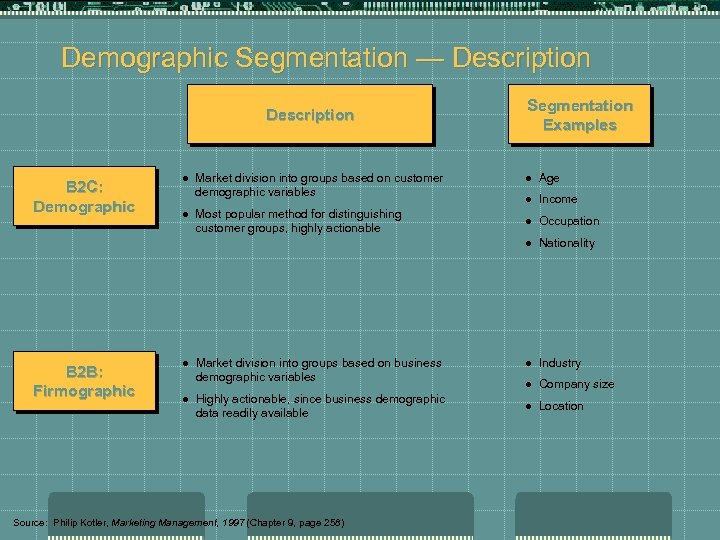 Demographic Segmentation — Description Market division into groups based on customer demographic variables Segmentation Examples B 2 B: Firmographic Most popular method for distinguishing customer groups, highly actionable Market division into groups based on business demographic variables Highly actionable, since business demographic data readily available Source: Philip Kotler, Marketing Management, 1997 (Chapter 9, page 258) Age Income Occupation B 2 C: Demographic Nationality Industry Company size Location
 Needs-Based Segmentation t With actionable and meaningful dimensions identified……. . t Management can begin identifying how to satisfying customer needs t Needs based segmentation seeks to understand t why a purchase is made (i. e. , what needs are being satisfied) t divide the market up into groups of buyers t Segment’s t Particularly size, growth rate, financial attractiveness compelling for technology companies
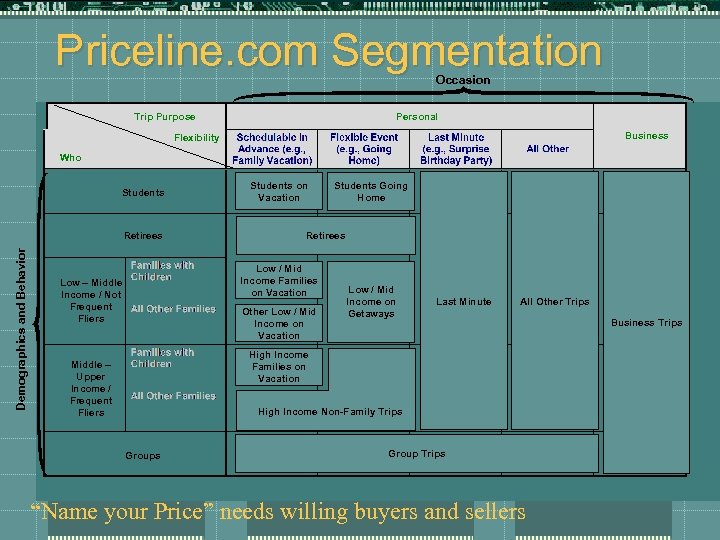 Priceline. com Segmentation Occasion Trip Purpose Personal Business Flexibility Who Students Demographics and Behavior Retirees Students on Vacation Retirees Low / Mid Income Families on Vacation Low – Middle Income / Not Frequent Fliers Students Going Home Other Low / Mid Income on Vacation Low / Mid Income on Getaways Last Minute All Other Trips High Income Families on Vacation Middle – Upper Income / Frequent Fliers High Income Non-Family Trips Group Trips “Name your Price” needs willing buyers and sellers Business Trips
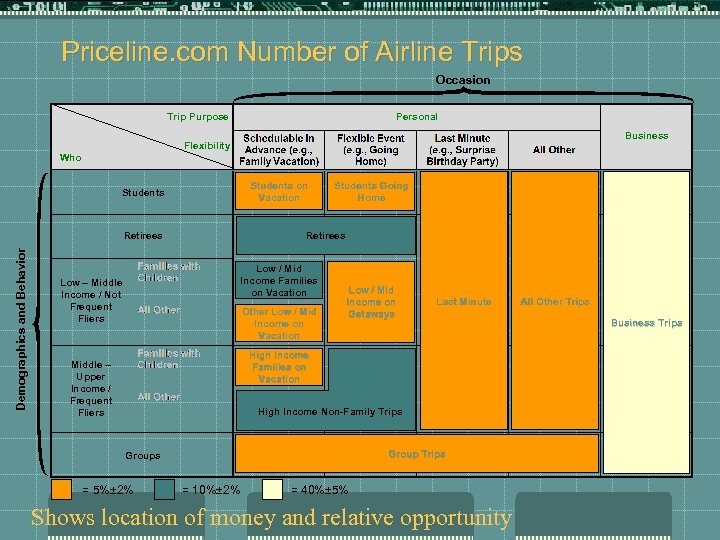 Priceline. com Number of Airline Trips Occasion Trip Purpose Personal Business Flexibility Who Students on Vacation Students Demographics and Behavior Retirees Low / Mid Income Families on Vacation Low – Middle Income / Not Frequent Fliers Students Going Home Other Low / Mid Income on Vacation Low / Mid Income on Getaways Last Minute High Income Families on Vacation Middle – Upper Income / Frequent Fliers High Income Non-Family Trips Groups = 5%± 2% = 10%± 2% = 40%± 5% Shows location of money and relative opportunity All Other Trips Business Trips
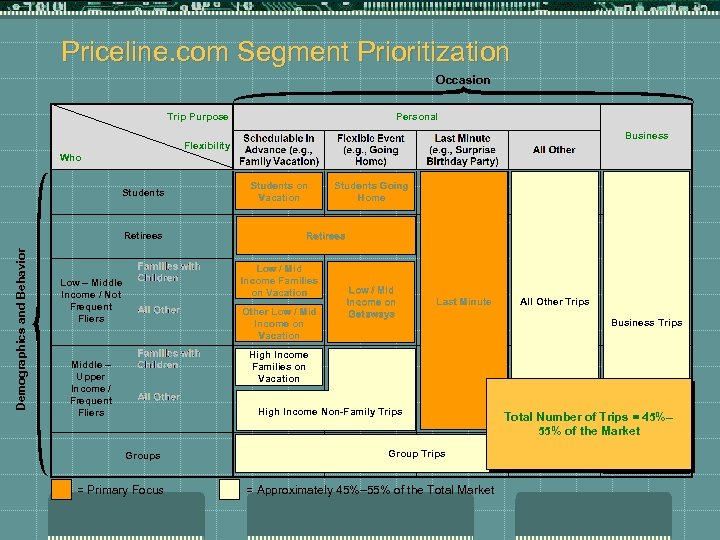 Priceline. com Segment Prioritization Occasion Trip Purpose Personal Business Flexibility Who Students Demographics and Behavior Retirees Students on Vacation Retirees Low / Mid Income Families on Vacation Low – Middle Income / Not Frequent Fliers Students Going Home Other Low / Mid Income on Vacation Low / Mid Income on Getaways Last Minute All Other Trips Business Trips High Income Families on Vacation Middle – Upper Income / Frequent Fliers High Income Non-Family Trips Groups = Primary Focus Group Trips = Approximately 45%– 55% of the Total Market Total Number of Trips = 45%– 55% of the Market
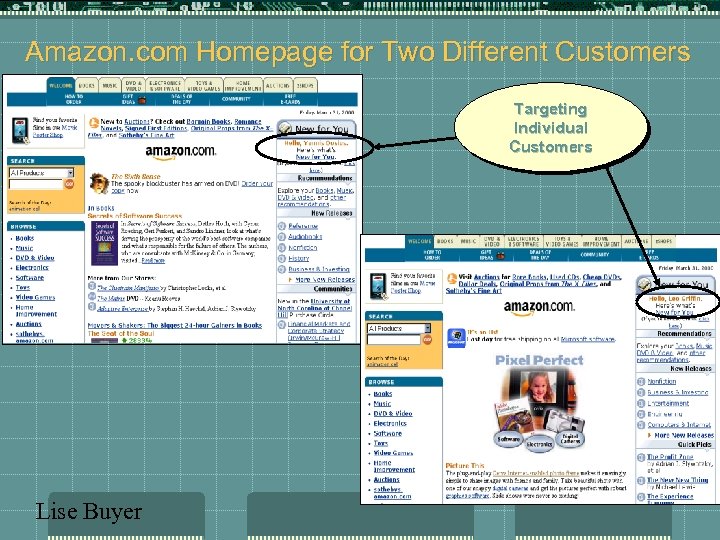 Amazon. com Homepage for Two Different Customers Targeting Individual Customers Lise Buyer
 Journal Grading t Observe, critically analyze, question, point out contradiction, discuss something you found fascinating, propose new areas of inquiry t Consideration also given to responses t Pluses t Additional Research t Case site interaction t Consideration of proposed questions t Minuses t Too Short (500 words) t Reiterating the case pass out t Grammar/Spelling (only if its blatant)