


 Скачать презентацию Market Environment Market Environment The market environment
Л2. СРЕДА.ppt
- Количество слайдов: 23
 Market Environment
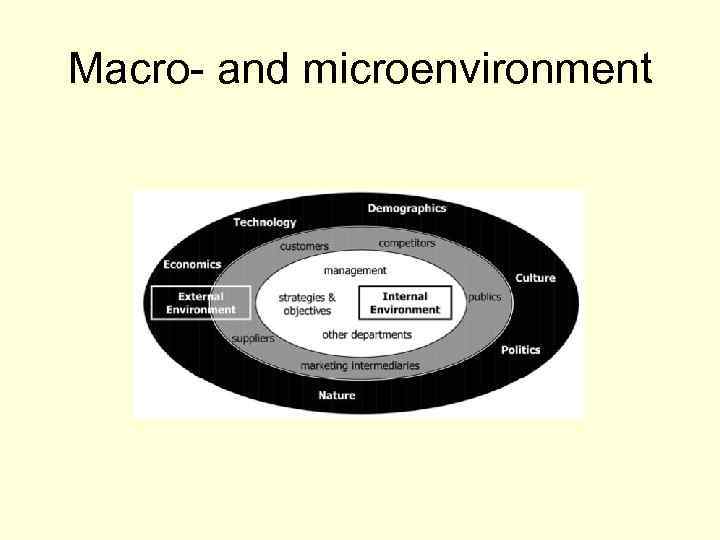
 Market Environment The market environment is a marketing term and refers to all of the forces outside of marketing that affect marketing management’s ability to build and maintain successful relationships with target customers. The market environment consists of both the macroenvironment and the microenvironment.
 Macro- and microenvironment
 Macro- and microenvironment • The microenvironment refers to the forces that are close to the company and affect its ability to serve its customers. • The macroenvironment refers to all forces that are part of the larger society and affect the microenvironment.
 The microenvironment • Internal environment • External environment
 Internal environment The internal environment consists of the firm‘s own management structure, the organization's strategies and objectives, and the departments (finance, research and development, purchasing, accounting, etc. ) within the company. It reflects: • Marketing capabilities, • Finance capabilities, • Manufacturing capabilities, • Organizational capabilities.
 External environment The external environment comprises: • Suppliers • Marketing intermediaries • Customers • Competitors • Publics
 Suppliers provide the raw materials, services and resources needed to operate. Changes in the supply environment can affect a firm considerably, perhaps even critically. Problems may arise where there are shortages of supply, where the supplier is larger and more powerful than the organisation itself, or where the supplier’s brand is very well known and in demand from the organisation’s customers. Marketers must therefore monitor the supplier environment very closely, seeking where possible to establish mutually beneficial interdependent relationships.
 Marketing intermediaries: Ø resellers; Ø physical distribution firms; Ø marketing services agencies; Ø financial intemediaries.
 Marketing intermediaries Resellers are those that hold and sell the company’s product. Physical distribution firms are places such as warehouses that store and transport the company’s product from its origin to its destination. Marketing services agencies are companies that offer services such as conducting marketing research, advertising, and consulting. Financial intermediaries are institutions such as banks, credit companies and insurance companies.
 Customers There are different types of customer markets including: Ø consumer markets; Ø business markets; Ø government markets; Ø international markets; Ø reseller markets.
 Customers The consumer market is made up of individuals who buy goods and services for their own personal use or use in their household. Business markets include those that buy goods and services for use in producing their own products to sell. This is different from the reseller market which includes businesses that purchase goods in order to resell with a profit. These are the same companies mentioned as market intermediaries. The government market consists of government agencies that buy goods to produce public services or transfer goods to others who need them. International markets include buyers in other countries and includes customers from the previous categories.
 Competitors include companies with similar offerings for goods and services. To remain competitive a company must consider who their biggest competitors are while considering its own size and position in the industry. The company should develop a strategic advantage over their competitors. Competitors come in many shapes and forms, some common examples including: 1. Direct Competitors: Those who produce strongly similar products or services, usually operating through similar distribution outlets (e. g. Coca-Cola vs Pepsi, etc).
 Competitors 2. 3. Substitutes: Sometimes, the form of the product or service may be quite different but, in essence, still satisfies the same customer need. A customer can cover a wall with either paint or wallpaper, for instance, or receive distributed music via either a CD or the Internet – normally quite separate industries, but each meeting the same needs. New Market Entrants: Potential new competitors come in all shapes and sizes. They may be firms seeking to expand their range of products or services into new sectors (e. g. supermarkets providing financial services), or else they may be organisations within a sector seeking to gain control over new areas (paper mills now often own paper merchants too). Sound product differentiation and customer loyalty can serve as effective barriers to entry, but dissatisfied customers can leave the door wide open for new competitors to enter the market.
 Publics are any group that has an interest in or impact on the organization’s ability to meet its goals: 1. Financial publics can hinder a company’s ability to obtain funds affecting the level of credit a company has. 2. Media publics include newspapers and magazines that can publish articles of interest regarding the company and editorials that may influence customers’ opinions. 3. Government publics can affect the company by passing legislation and laws that put restrictions on the company’s actions.
 Publics 4. Citizen-action publics include environmental groups and minority groups and can question the actions of a company and put them in the public spotlight. 5. Local publics are neighborhood and community organizations and will also question a company’s impact on the local area and the level of responsibility of their actions. 6. The general public can greatly affect the company as any change in their attitude, whether positive or negative, can cause sales to go up or down because the general public is often the company’s customer base. 7. Internal publics include all those who are employed within the company and deal with the organization and construction of the company’s product.
 Macroenvironment – Demographic environment, – Economic environment, – Natural environment, – Technological environment, – Political-legal environment, – Social-cultural environment.
 Demographic factors • population growth; • changes in age, ethnic composition, and educational levels; • the rise of nontraditional households; • geographic population shifts.
 Economic factors • income distribution and savings, • debt, • credit availability.
 Natural environment factors • • raw-materials shortages, energy costs, anti-pollution pressures, the changing role of governments in environmental protection.
 Technological environment factors • the faster pace of technological change, • opportunities for innovation, • increased governmental regulation.
 Political-legal environment factors • laws regulating business practices, • the influence of special-interest groups.
 Social-cultural environment factors • how people view themselves, others, organizations, society, nature, and the universe; • how products fit with core and secondary cultural values; • how to address the needs of different subcultures.