 Скачать презентацию Maritime Information Exchange Model MIEM September 29 2008
feb5882272a4c92d45e68bc1e8f4e299.ppt
- Количество слайдов: 53



Maritime Information Exchange Model (MIEM) September 29, 2008 Rick Hayes-Roth hayes-roth@nps. edu David Reading reading@kingcrab. nrl. navy. mil 1
Sections • • What is MIEM and why? Model technical description How to use it Program overview & status 2
How do we… …share actionable intelligence in the maritime domain (or air, or ground, …) Ø across agencies, services and nations Ø so we can Ø Quickly exchange and update intelligence products Ø Detect threats and take quick appropriate actions Ø Detect anomalies and investigate them Ø Support and improve collaboration Ø Document and justify inferences and actions ? 3
Effective Sharing Requirements Ø Humans and machines will read, edit & write data Ø Over the next decade, data volumes will soar, so machines will play increasingly important roles Ø Threats will come from people, vessels, cargo, organizations & facilities that can act over long times with complex histories and interactions Ø Actors, events & linkages among them accumulate, as inferences, hypotheses & evidence support them Ø Partners exchange much of this information Ø Recipients understand this information Ø How it’s represented & what it means 4
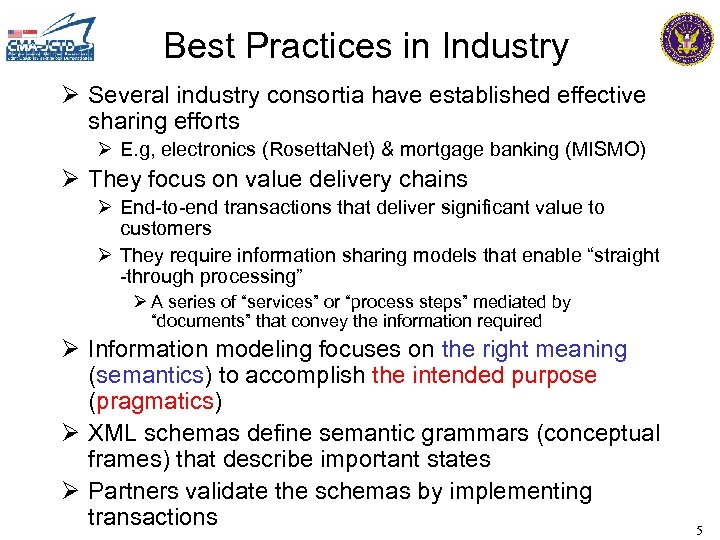
Best Practices in Industry Ø Several industry consortia have established effective sharing efforts Ø E. g, electronics (Rosetta. Net) & mortgage banking (MISMO) Ø They focus on value delivery chains Ø End-to-end transactions that deliver significant value to customers Ø They require information sharing models that enable “straight -through processing” Ø A series of “services” or “process steps” mediated by “documents” that convey the information required Ø Information modeling focuses on the right meaning (semantics) to accomplish the intended purpose (pragmatics) Ø XML schemas define semantic grammars (conceptual frames) that describe important states Ø Partners validate the schemas by implementing transactions 5
What Kinds of Transactions? Describing dynamic situations so collaborators can intervene or interdict in a timely way Hence, we need a “language” of situations that warrant intervention 6
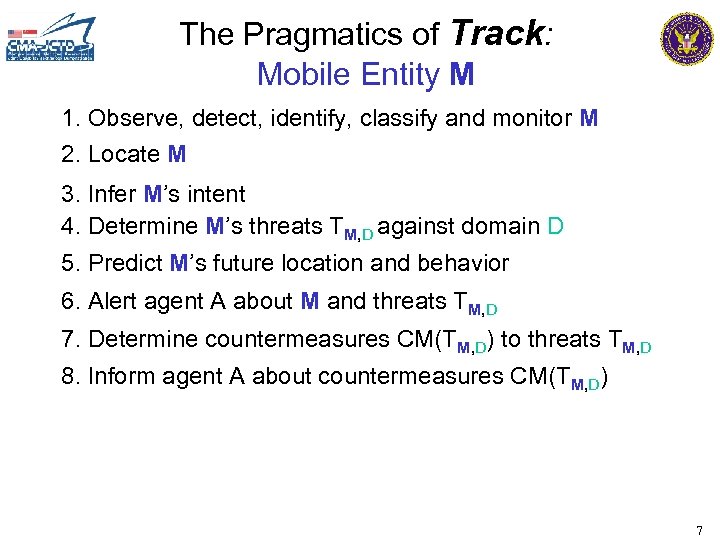
The Pragmatics of Track: Mobile Entity M 1. Observe, detect, identify, classify and monitor M 2. Locate M 3. Infer M’s intent 4. Determine M’s threats TM, D against domain D 5. Predict M’s future location and behavior 6. Alert agent A about M and threats TM, D 7. Determine countermeasures CM(TM, D) to threats TM, D 8. Inform agent A about countermeasures CM(TM, D) 7
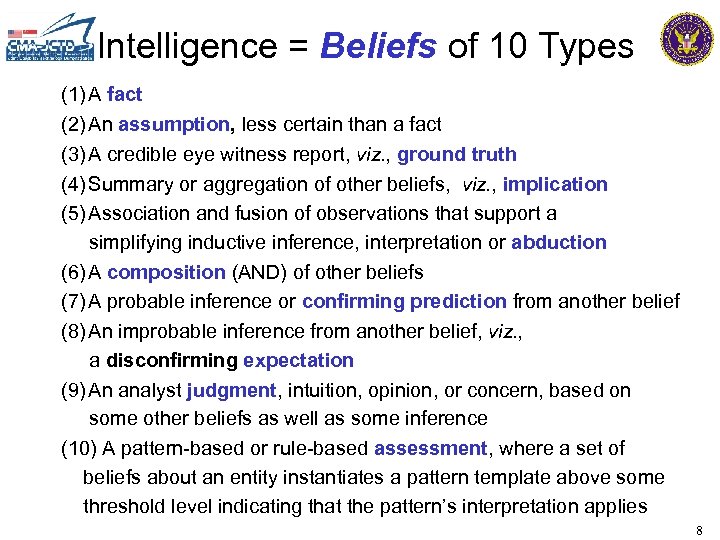
Intelligence = Beliefs of 10 Types (1) A fact (2) An assumption, less certain than a fact (3) A credible eye witness report, viz. , ground truth (4) Summary or aggregation of other beliefs, viz. , implication (5) Association and fusion of observations that support a simplifying inductive inference, interpretation or abduction (6) A composition (AND) of other beliefs (7) A probable inference or confirming prediction from another belief (8) An improbable inference from another belief, viz. , a disconfirming expectation (9) An analyst judgment, intuition, opinion, or concern, based on some other beliefs as well as some inference (10) A pattern-based or rule-based assessment, where a set of beliefs about an entity instantiates a pattern template above some threshold level indicating that the pattern’s interpretation applies 8
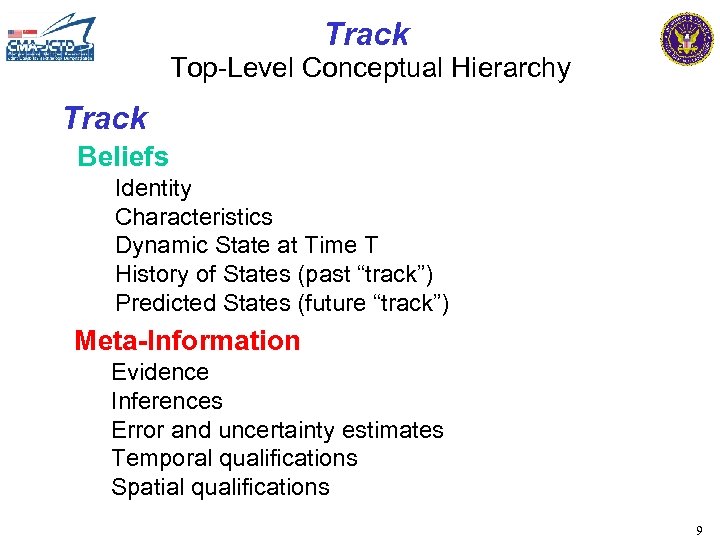
Track Top-Level Conceptual Hierarchy Track Beliefs Identity Characteristics Dynamic State at Time T History of States (past “track”) Predicted States (future “track”) Meta-Information Evidence Inferences Error and uncertainty estimates Temporal qualifications Spatial qualifications 9
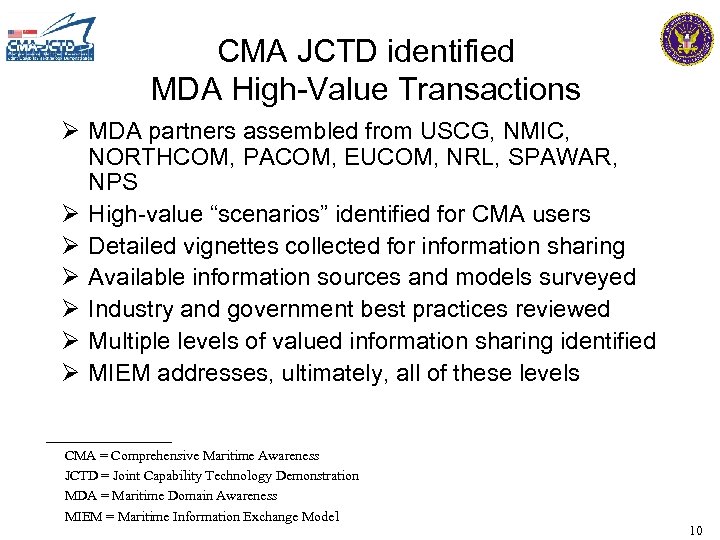
CMA JCTD identified MDA High-Value Transactions Ø MDA partners assembled from USCG, NMIC, NORTHCOM, PACOM, EUCOM, NRL, SPAWAR, NPS Ø High-value “scenarios” identified for CMA users Ø Detailed vignettes collected for information sharing Ø Available information sources and models surveyed Ø Industry and government best practices reviewed Ø Multiple levels of valued information sharing identified Ø MIEM addresses, ultimately, all of these levels _________ CMA = Comprehensive Maritime Awareness JCTD = Joint Capability Technology Demonstration MDA = Maritime Domain Awareness MIEM = Maritime Information Exchange Model 10
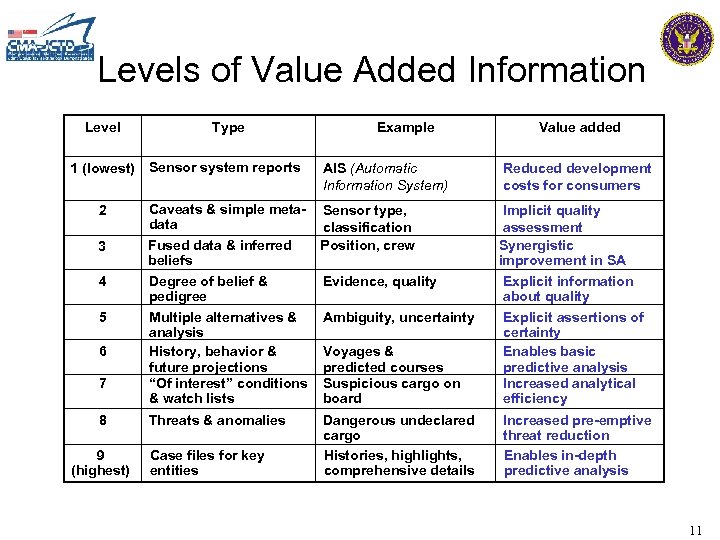
Levels of Value Added Information Level Type 1 (lowest) Sensor system reports 2 3 4 5 6 7 8 9 (highest) Example AIS (Automatic Information System) Value added Reduced development costs for consumers Caveats & simple metadata Fused data & inferred beliefs Sensor type, classification Position, crew Degree of belief & pedigree Multiple alternatives & analysis History, behavior & future projections “Of interest” conditions & watch lists Evidence, quality Voyages & predicted courses Suspicious cargo on board Explicit information about quality Explicit assertions of certainty Enables basic predictive analysis Increased analytical efficiency Threats & anomalies Dangerous undeclared cargo Histories, highlights, comprehensive details Increased pre-emptive threat reduction Enables in-depth predictive analysis Case files for key entities Ambiguity, uncertainty Implicit quality assessment Synergistic improvement in SA 11
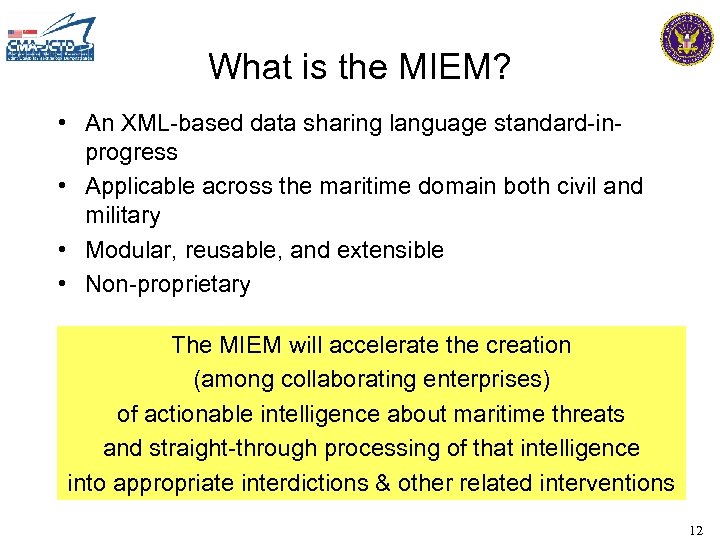
What is the MIEM? • An XML-based data sharing language standard-inprogress • Applicable across the maritime domain both civil and military • Modular, reusable, and extensible • Non-proprietary The MIEM will accelerate the creation (among collaborating enterprises) of actionable intelligence about maritime threats and straight-through processing of that intelligence into appropriate interdictions & other related interventions 12
What MIEM is not • Database technology • Just XML – it is a set of conceptual entities and their definitions • Only Do. D • A programming language • A silver bullet • A replacement for exchanges and interagency agreements • A definition of interoperability (messages, etc. ) 13
MIEM Quality Attributes • Expressiveness – – – – – Express details about maritime entities Qualify, amplify, and annotate data with Metadata Describe relationships between maritime objects. Degrees of “belief”, inequalities, and relative values. Ability to express the pedigree and line of reasoning supporting a belief Allow multiple alternatives & analysis assertions (conclusions, opinions) Multiple object states & behaviors (history) Characterize behaviors Associate multiple entities, history, analysis, prediction etc (case file) 14
MIEM Quality Attributes • Flexibility – – – Specialized sub-schemas will align Managing schema evolution will be easy Applications can enrich semantics easily Configuration management will be easy Different lines of evolution supported • Understandability – – Ability of users to interpret the model correctly Meaning and intent well documented Style of use defined & well documented User can read/understand documents 15
MIEM Quality Attributes • Correctness – No redundancies within the model – Definitions are consistent across maritime community • Efficiency – Does not result in excessively verbose messages (Message brevity) • Interoperability – Path to NIEM harmonization prepared via NDR – Path to UCore 2. 0 harmonization prepared – Model incorporates a focal object for the purposes of providing context for the reader. 16
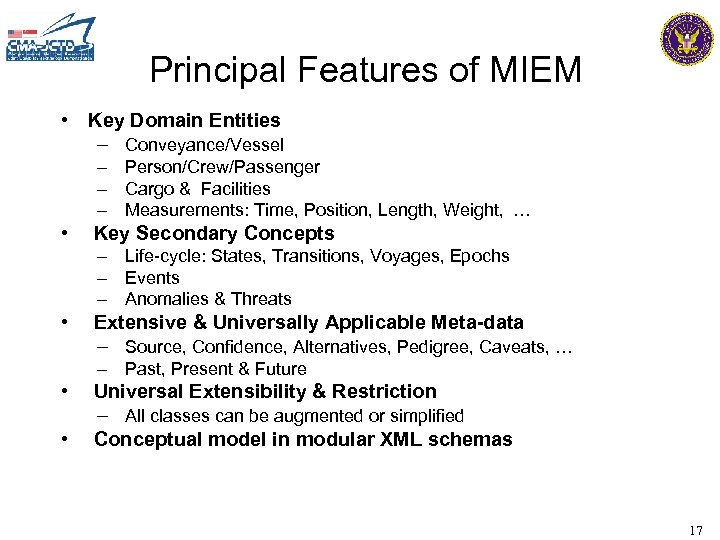
Principal Features of MIEM • Key Domain Entities – Conveyance/Vessel – Person/Crew/Passenger – Cargo & Facilities – Measurements: Time, Position, Length, Weight, … • Key Secondary Concepts – Life-cycle: States, Transitions, Voyages, Epochs – Events – Anomalies & Threats • Extensive & Universally Applicable Meta-data – Source, Confidence, Alternatives, Pedigree, Caveats, … – Past, Present & Future • Universal Extensibility & Restriction – All classes can be augmented or simplified • Conceptual model in modular XML schemas 17
Conclusions: What MIEM Is & Why Ø To make intelligence actionable, we should employ best industry practices for sharing information to accomplish high-value work quickly & effectively Ø This will require the definition of “documents” that carry information among partners & processes Ø The rich semantic Track is an obvious first focus Ø The MIEM aims to define these Track semantics for shared MDA intelligence documents 18
MIEM Technical Details 19
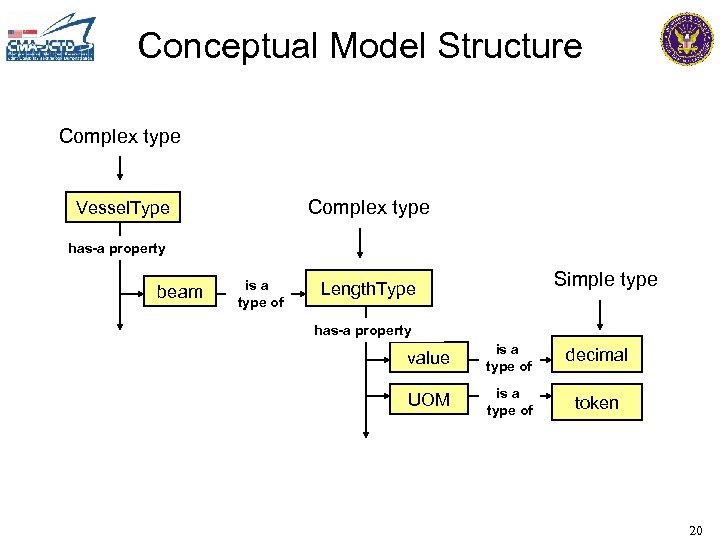
Conceptual Model Structure Complex type Vessel. Type has-a property beam is a type of Simple type Length. Type has-a property value is a type of decimal UOM is a type of token 20
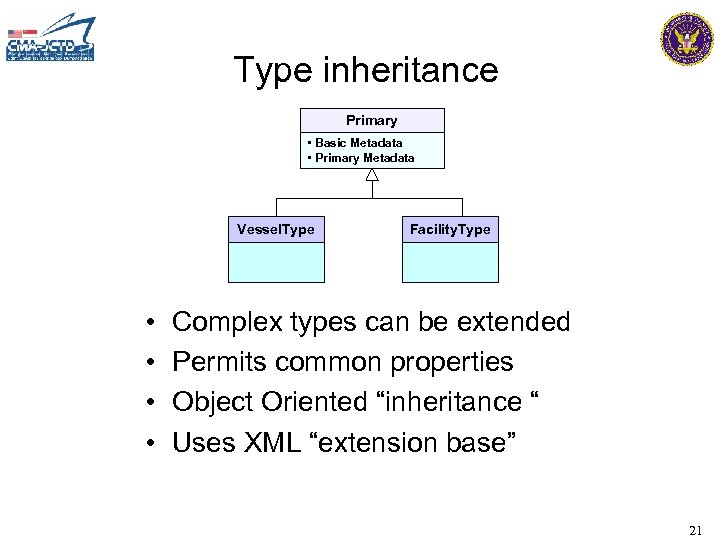
Type inheritance Primary • Basic Metadata • Primary Metadata Vessel. Type • • Facility. Type Complex types can be extended Permits common properties Object Oriented “inheritance “ Uses XML “extension base” 21
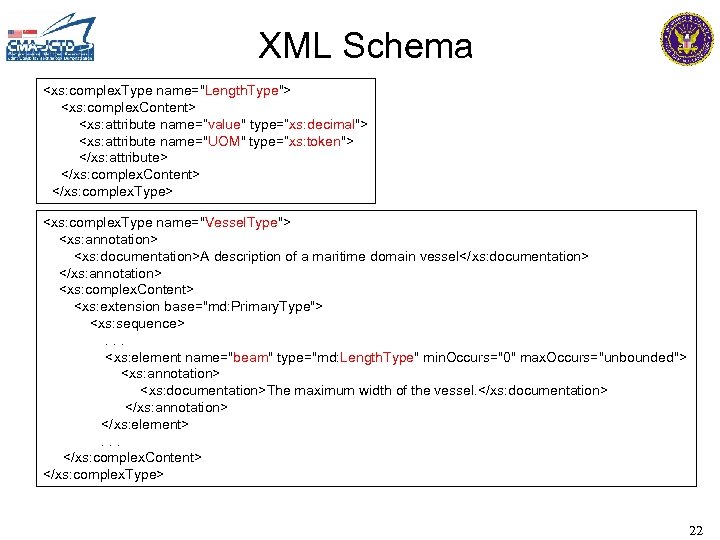
XML Schema <xs: complex. Type name="Length. Type"> <xs: complex. Content> <xs: attribute name=“value" type=“xs: decimal"> <xs: attribute name="UOM" type=“xs: token"> </xs: attribute> </xs: complex. Content> </xs: complex. Type> <xs: complex. Type name="Vessel. Type"> <xs: annotation> <xs: documentation>A description of a maritime domain vessel</xs: documentation> </xs: annotation> <xs: complex. Content> <xs: extension base="md: Primary. Type"> <xs: sequence> . . . <xs: element name="beam" type="md: Length. Type" min. Occurs="0" max. Occurs="unbounded"> <xs: annotation> <xs: documentation>The maximum width of the vessel. </xs: documentation> </xs: annotation> </xs: element> . . . </xs: complex. Content> </xs: complex. Type> 22
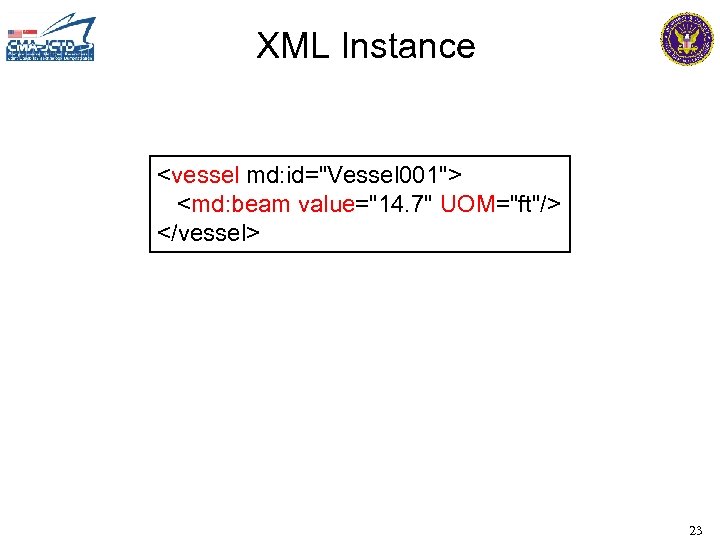
XML Instance <vessel md: id="Vessel 001"> <md: beam value="14. 7" UOM="ft"/> </vessel> 23
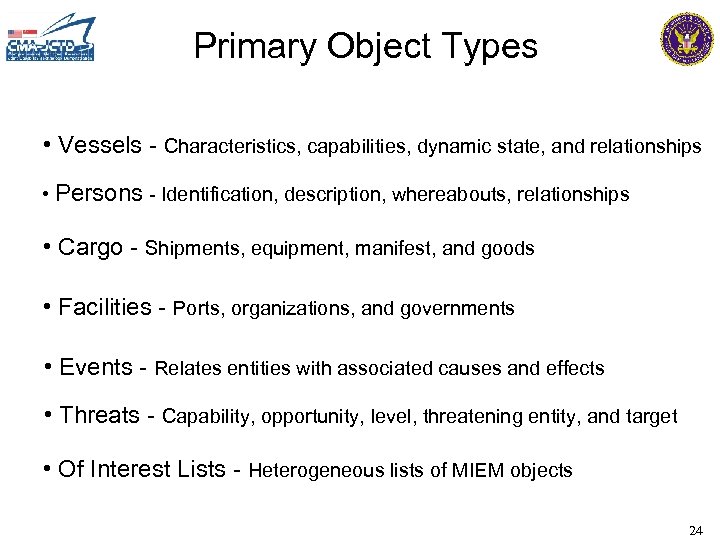
Primary Object Types • Vessels - Characteristics, capabilities, dynamic state, and relationships • Persons - Identification, description, whereabouts, relationships • Cargo - Shipments, equipment, manifest, and goods • Facilities - Ports, organizations, and governments • Events - Relates entities with associated causes and effects • Threats - Capability, opportunity, level, threatening entity, and target • Of Interest Lists - Heterogeneous lists of MIEM objects 24
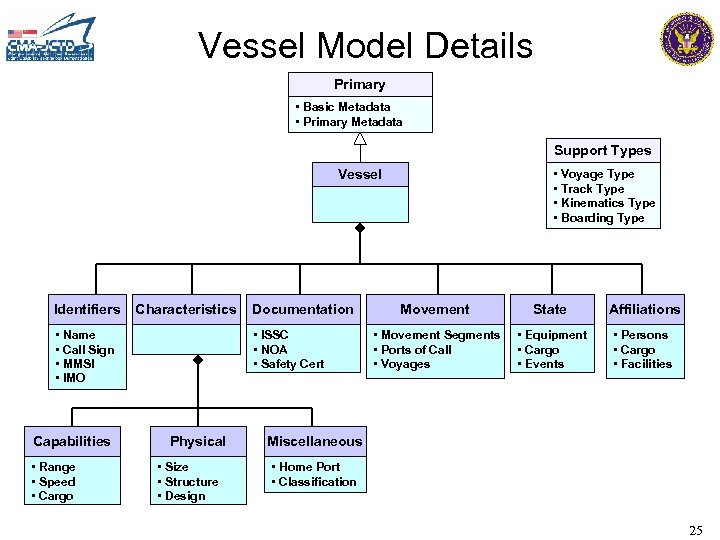
Vessel Model Details Primary • Basic Metadata • Primary Metadata Support Types Vessel Identifiers Characteristics • Name • Call Sign • MMSI • IMO Capabilities • Range • Speed • Cargo Documentation • ISSC • NOA • Safety Cert Physical • Size • Structure • Design • Voyage Type • Track Type • Kinematics Type • Boarding Type Movement State Affiliations • Movement Segments • Ports of Call • Voyages • Equipment • Cargo • Events • Persons • Cargo • Facilities Miscellaneous • Home Port • Classification 25
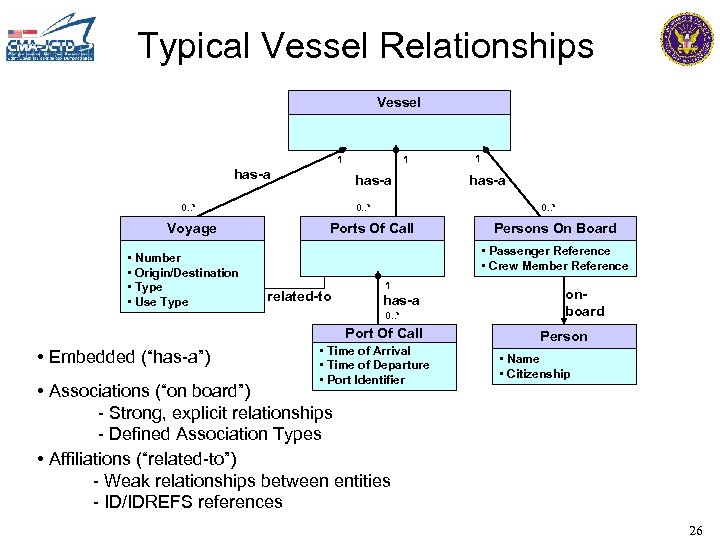
Typical Vessel Relationships Vessel 1 has-a 0. . * Voyage • Number • Origin/Destination • Type • Use Type 1 0. . * has-a 0. . * Ports Of Call Persons On Board • Passenger Reference • Crew Member Reference related-to 1 has-a 0. . * Port Of Call • Embedded (“has-a”) 1 • Time of Arrival • Time of Departure • Port Identifier onboard Person • Name • Citizenship • Associations (“on board”) - Strong, explicit relationships - Defined Association Types • Affiliations (“related-to”) - Weak relationships between entities - ID/IDREFS references 26
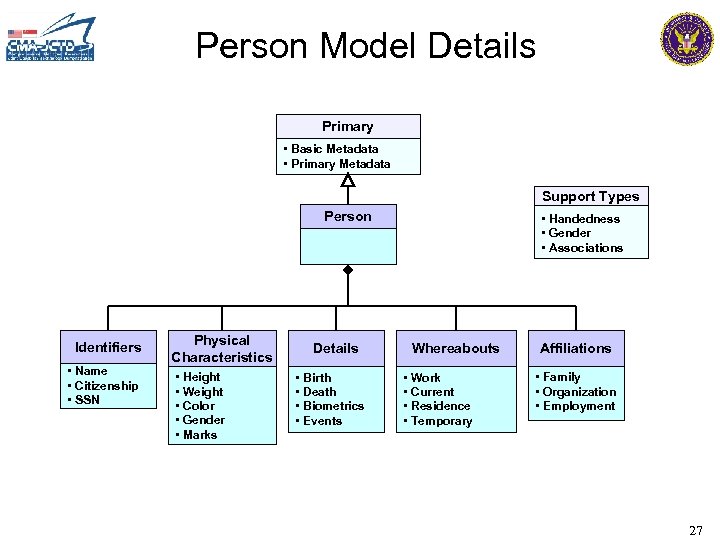
Person Model Details Primary • Basic Metadata • Primary Metadata Support Types Person Identifiers • Name • Citizenship • SSN Physical Characteristics • Height • Weight • Color • Gender • Marks Details • Birth • Death • Biometrics • Events • Handedness • Gender • Associations Whereabouts • Work • Current • Residence • Temporary Affiliations • Family • Organization • Employment 27
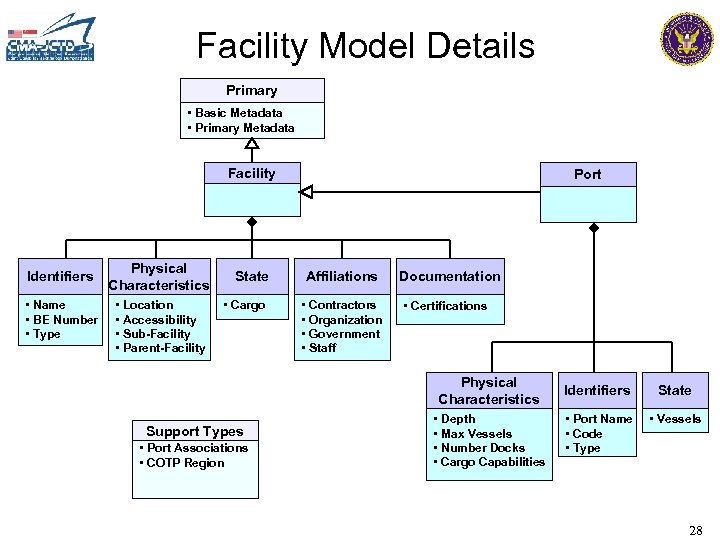
Facility Model Details Primary • Basic Metadata • Primary Metadata Facility Identifiers • Name • BE Number • Type Physical Characteristics • Location • Accessibility • Sub-Facility • Parent-Facility State • Cargo Port Affiliations • Contractors • Organization • Government • Staff Documentation • Certifications Physical Characteristics Support Types • Port Associations • COTP Region • Depth • Max Vessels • Number Docks • Cargo Capabilities Identifiers State • Port Name • Code • Type • Vessels 28
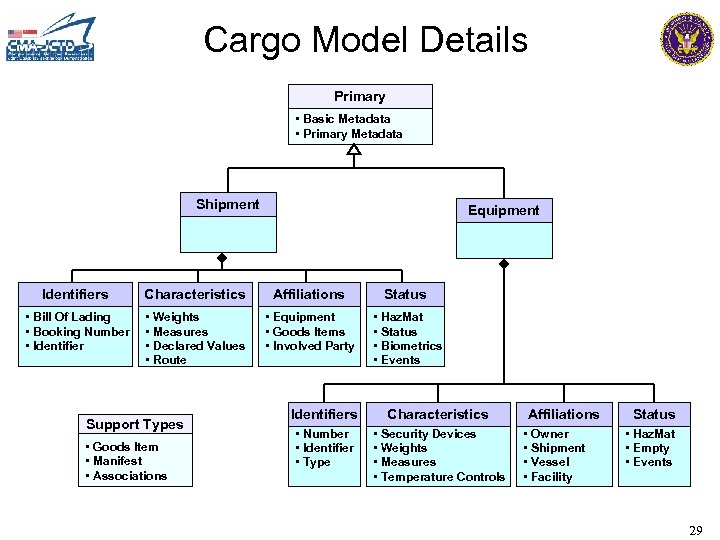
Cargo Model Details Primary • Basic Metadata • Primary Metadata Shipment Equipment Identifiers Characteristics Affiliations Status • Bill Of Lading • Booking Number • Identifier • Weights • Measures • Declared Values • Route • Equipment • Goods Items • Involved Party • Haz. Mat • Status • Biometrics • Events Support Types • Goods Item • Manifest • Associations Identifiers Characteristics • Number • Identifier • Type • Security Devices • Weights • Measures • Temperature Controls Affiliations • Owner • Shipment • Vessel • Facility Status • Haz. Mat • Empty • Events 29
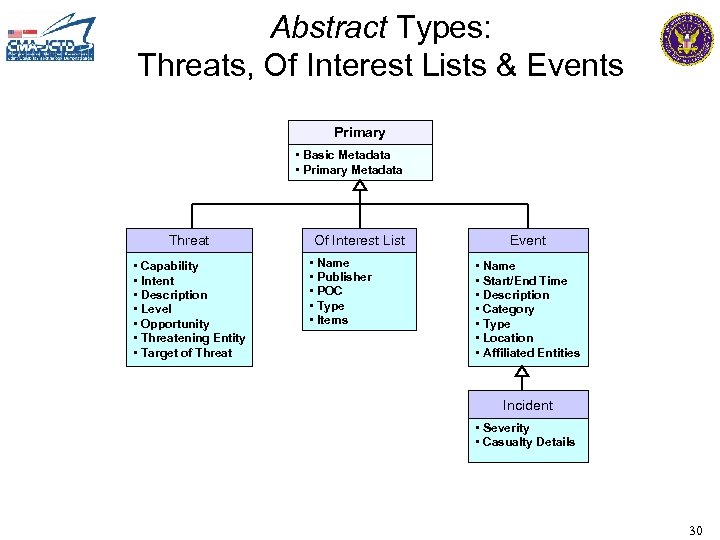
Abstract Types: Threats, Of Interest Lists & Events Primary • Basic Metadata • Primary Metadata Threat • Capability • Intent • Description • Level • Opportunity • Threatening Entity • Target of Threat Of Interest List • Name • Publisher • POC • Type • Items Event • Name • Start/End Time • Description • Category • Type • Location • Affiliated Entities Incident • Severity • Casualty Details 30
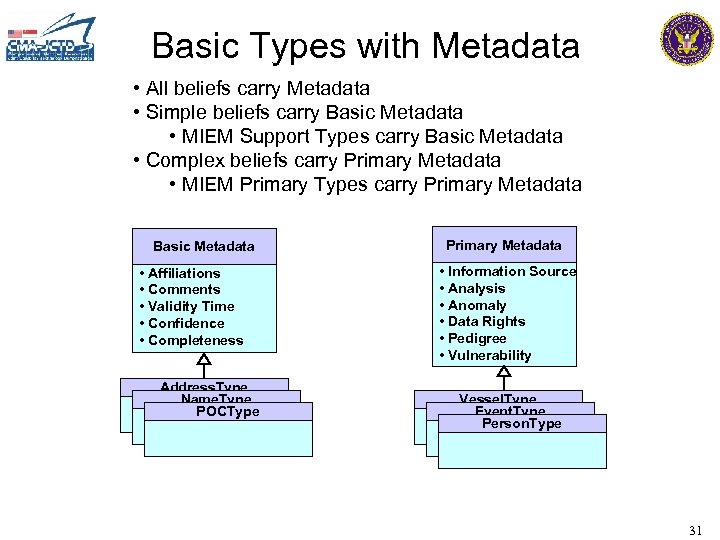
Basic Types with Metadata • All beliefs carry Metadata • Simple beliefs carry Basic Metadata • MIEM Support Types carry Basic Metadata • Complex beliefs carry Primary Metadata • MIEM Primary Types carry Primary Metadata Basic Metadata • Affiliations • Comments • Validity Time • Confidence • Completeness Address. Type Name. Type POCType Primary Metadata • Information Source • Analysis • Anomaly • Data Rights • Pedigree • Vulnerability Vessel. Type Event. Type Person. Type 31
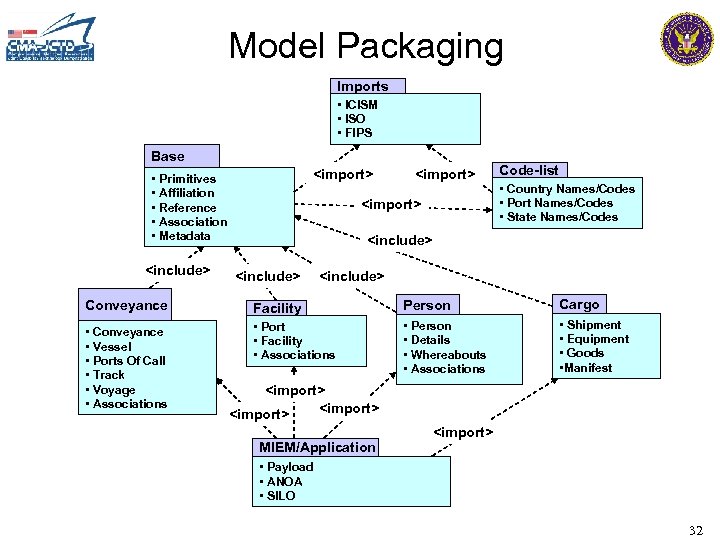
Model Packaging Imports • ICISM • ISO • FIPS Base <import> • Primitives • Affiliation • Reference • Association • Metadata <include> <import> Code-list • Country Names/Codes • Port Names/Codes • State Names/Codes <include> Conveyance Facility Person Cargo • Conveyance • Vessel • Ports Of Call • Track • Voyage • Associations • Port • Facility • Associations • Person • Details • Whereabouts • Associations • Shipment • Equipment • Goods • Manifest <import> MIEM/Application <import> • Payload • ANOA • SILO 32
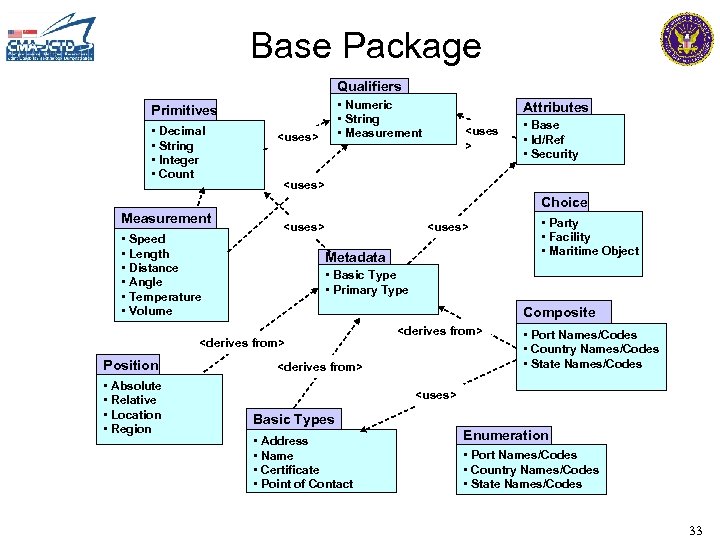
Base Package Qualifiers • Numeric • String • Measurement Primitives • Decimal • String • Integer • Count <uses> Attributes <uses > • Base • Id/Ref • Security <uses> Choice Measurement • Speed • Length • Distance • Angle • Temperature • Volume <uses> Metadata • Basic Type • Primary Type Composite <derives from> Position • Absolute • Relative • Location • Region • Party • Facility • Maritime Object <derives from> • Port Names/Codes • Country Names/Codes • State Names/Codes <uses> Basic Types • Address • Name • Certificate • Point of Contact Enumeration • Port Names/Codes • Country Names/Codes • State Names/Codes 33
How do we Use the MIEM to Describe Situations? An Illustration of Vessel State and Entity Relationships As of February 2008, the ship was sold to an Iranian company, IC 2, and was reflagged as a Panamanian. It sailed from Portland, ME to Abu Dhabi where it had some new equipment EQ 1, EQ 2 added to it by organization ORG 3. Then it made a new voyage to South Africa, with stops at Djibouti and Dar es Salaam before arriving at Cape Town with a filed crew and passenger manifest. We have good track observations on the first leg of this voyage only. 34
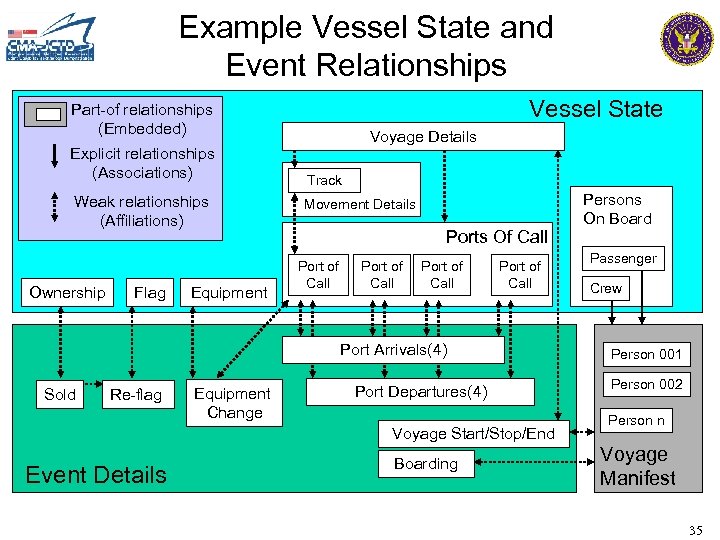
Example Vessel State and Event Relationships Vessel State Part-of relationships (Embedded) Explicit relationships (Associations) Weak relationships (Affiliations) Ownership Flag Equipment Voyage Details Track Movement Details Ports Of Call Port of Call Port Arrivals(4) Sold Re-flag Equipment Change Port Departures(4) Voyage Start/Stop/End Event Details Boarding Persons On Board Passenger Crew Person 001 Person 002 Person n Voyage Manifest 35
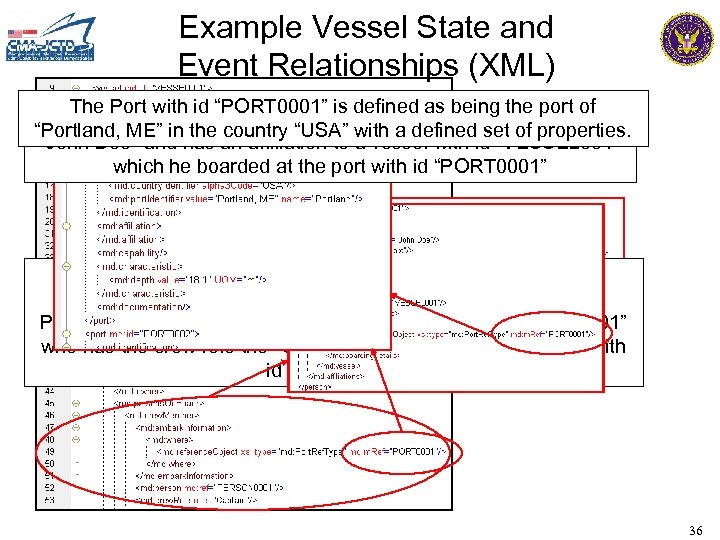
Example Vessel State and Event Relationships (XML) The Port with id “PORT 0001” is defined as being the port of The person with id “PERSON 0001” is defined as having the name “Portland, ME” in the country “USA” with a defined set of properties. Relate entities to the underlying Events that cause them: “John Doe” and has an affiliation to a vessel with id “VESSEL 001” Change of Ownership causes the state of the “owner” to change Capture simple concepts simply – vessel name is “MV 1” which he boarded at the port with id “PORT 0001” Describe complex relationships between many entities: Persons On Board include a crew member with id “PERSON 0001” who has the crew role the “Captain”. He embarked at the Port with id “PORT 0001” 36
Final Technical Observations • Powerful language for expressing actionable intelligence documents • Extensible – Model can be extended to produce application-specific schemas Next section will illustrate some real-world examples 37
Using the MIEM 38
How do we use the MIEM… …as the basis of information sharing via interoperable Web Services in a Maritime Domain Service Oriented Architecture (SOA)? …as a payload in an existing message exchange (e. g. , UCore)? …as the basis of a case management tool? …to shape the R&D direction for other exchange models (e. g. , NIEM Core)? 39
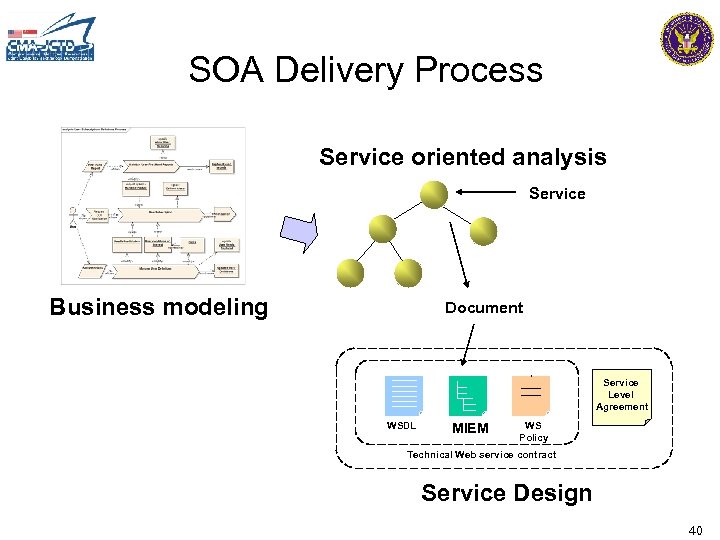
SOA Delivery Process Service oriented analysis Service Business modeling Document Service Level Agreement WSDL MIEM WS Policy Technical Web service contract Service Design 40
Advance Notice of Arrival (ANOA) • Title 33, Code of Federal Regulation (CFR) requires foreign-flagged vessels and all commercial vessels (foreign or domestic) entering a U. S. port or place from a foreign port to give a 96 -hour Advance Notice of Arrival (ANOA) • Form is filed with the National Vessel Movement Center (NVMC) and can be filed online, faxed or emailed • Frequent changes and updates: ~ 12, 000 vessels ~ 138, 000 ANOAs filed in 2007 • MDA DS COI Data Management WG reconciled to MIEM representation of ANOA 41
Single Integrated Lookout List • SILO is part of the Global Maritime Intelligence Integration (GMII) Plan • SILO will provide: – Access to a single integrated lookout list of all vessels of domestic and global intelligence interest, in coordination with cognizant authorities and centers. • ONI and Coast Guard directed as coleads • Initial release per MIEM 0. 90 • Will migrate to MIEM 1. 0. 42
What is the Universal Core (UCore)? • A strategy for lightweight semantic tagging for a wide variety of documents • Tagging provides a simple way to express “coordinates”: Who, What, When, Where • Documents can be semantically rich domain specific intelligence reports • For example, MDA actionable intelligence fully encoded using the MIEM 43
UCore & MIEM: Sea. Hawk • Sea. Hawk multi-agency intermodal task force develops Vessel Activity Report through inputs received from Port of Charleston; VAR is sent to the Sea. Hawk server for publication • Sea. Hawk server transforms VAR into a UCorecompliant message with Maritime Information Exchange Model (MIEM) extensions • Sea. Hawk publishes the resulting message over NCES Messaging Service • NCES messaging service distributes UCore message to authorized subscribers 44
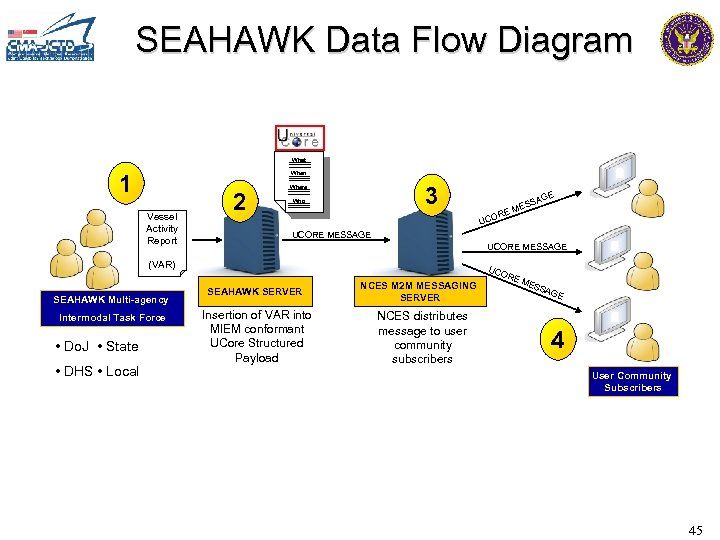
SEAHAWK Data Flow Diagram What When 1 Vessel Activity Report 2 3 Where Who Intermodal Task Force • Do. J • State • DHS • Local E AG O UC UCORE MESSAGE (VAR) SEAHAWK Multi-agency SS ME RE SEAHAWK SERVER Insertion of VAR into MIEM conformant UCore Structured Payload NCES M 2 M MESSAGING SERVER NCES distributes message to user community subscribers UC OR E M E SSA GE 4 User Community Subscribers 45
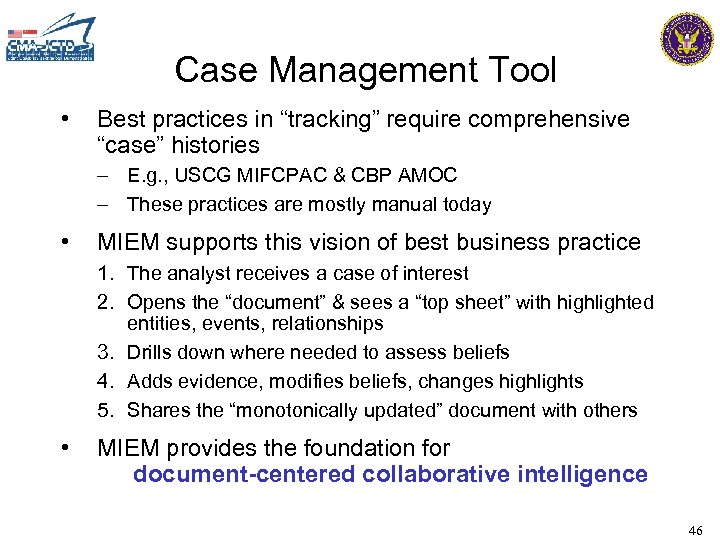
Case Management Tool • Best practices in “tracking” require comprehensive “case” histories – E. g. , USCG MIFCPAC & CBP AMOC – These practices are mostly manual today • MIEM supports this vision of best business practice 1. The analyst receives a case of interest 2. Opens the “document” & sees a “top sheet” with highlighted entities, events, relationships 3. Drills down where needed to assess beliefs 4. Adds evidence, modifies beliefs, changes highlights 5. Shares the “monotonically updated” document with others • MIEM provides the foundation for document-centered collaborative intelligence 46
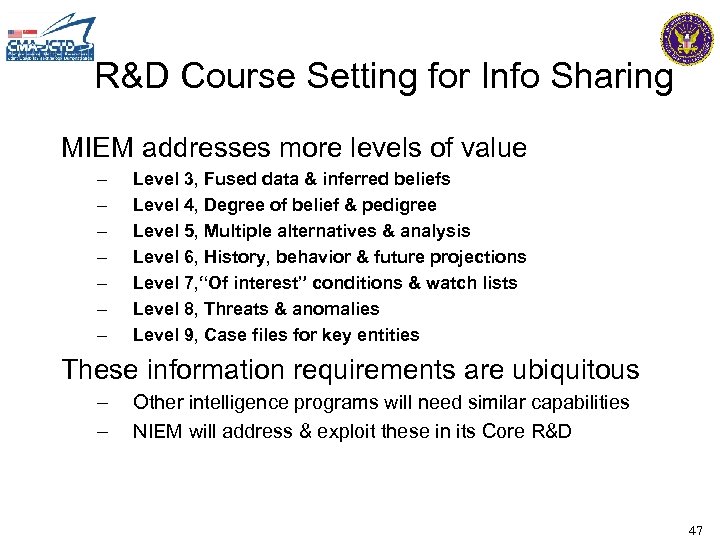
R&D Course Setting for Info Sharing MIEM addresses more levels of value – – – – Level 3, Fused data & inferred beliefs Level 4, Degree of belief & pedigree Level 5, Multiple alternatives & analysis Level 6, History, behavior & future projections Level 7, “Of interest” conditions & watch lists Level 8, Threats & anomalies Level 9, Case files for key entities These information requirements are ubiquitous – – Other intelligence programs will need similar capabilities NIEM will address & exploit these in its Core R&D 47
MIEM Program Status 48
MIEM Program Overview Developed in partnership by Comprehensive Maritime Awareness Joint Concept Technology Demonstration (CMA JCTD) and Maritime Domain Awareness Data Sharing Community of Interest Data Management Working Group (MDA DS COI DMWG) 49
Status • Beta test version released February 8, 2008 • Incremental Design review held June 10 -11, 2008 • Version 1. 0 product release scheduled September 19, 2008 – XML Schema – User Guide – Training guide 50
Beta Testers • • CMA JCTD -Cargo MASTER JCTD MDA DS COI MAGNET/MIFCPAC CMA – Singapore Seahawk NSA - RTRG NAVAIR - Tampa Bay Maritime Domain Awareness System (MDAS) • TTCP – Maritime AG 8 International MDA • SPAWAR Charleston - MDA Non Classified Enclave 51
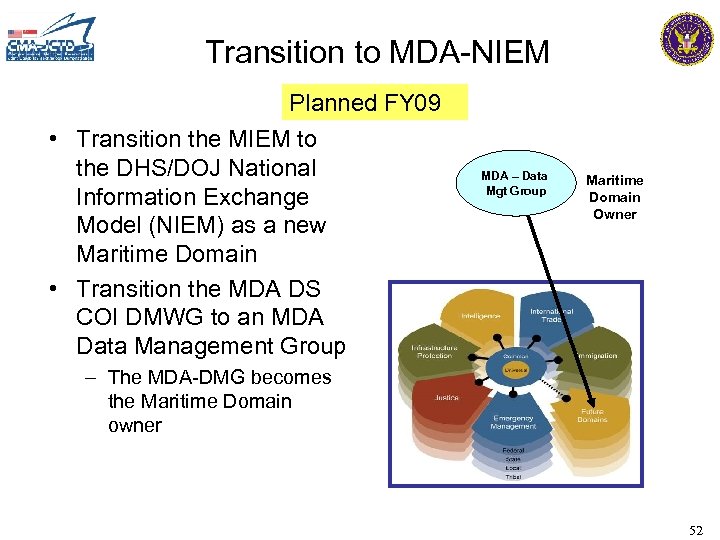
Transition to MDA-NIEM Planned FY 09 • Transition the MIEM to the DHS/DOJ National Information Exchange Model (NIEM) as a new Maritime Domain • Transition the MDA DS COI DMWG to an MDA Data Management Group MDA – Data Mgt Group Maritime Domain Owner – The MDA-DMG becomes the Maritime Domain owner 52
Summary & Conclusion • MIEM provides a language for expressing actionable intelligence – Rich semantics for pragmatics of “tracking” – Supports higher-levels of analysis – Directly supports resource cueing & interdiction • MIEM’s focus on document sharing supports a vital vision of collaborative intelligence • The NIEM will incorporate the MIEM directly & as a guide for higher-levels of Core value • MIEM elements and approach should benefit many intelligence suppliers and consumers 53
Скачать презентацию Maritime Information Exchange Model MIEM September 29 2008
feb5882272a4c92d45e68bc1e8f4e299.ppt