


 Скачать презентацию Marion County LID Program LID Case Study The
f8c1719fafa33f4d86b93c3984987817.ppt
- Количество слайдов: 29
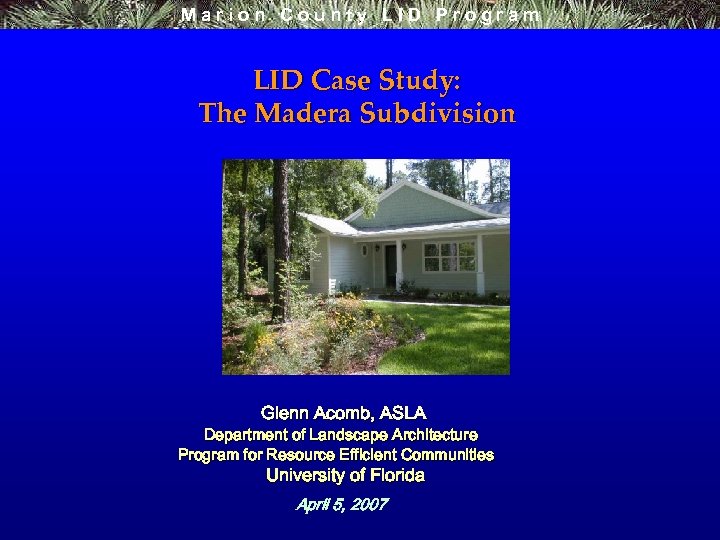 Marion County LID Program LID Case Study: The Madera Subdivision Glenn Acomb, ASLA Department of Landscape Architecture Program for Resource Efficient Communities University of Florida April 5, 2007
 Marion County LID Program Overview § § § Introduction Land Development Practices LID Principles Triple Bottom Line Case Study: Madera Community Q&A
 Marion County LID Program “What is the use of a house if you haven’t got a tolerable planet to put it on? ” Henry David Thoreau The client says: “I’ve got this great piece of land…. . it’s incredible, high and dry, rolling land, majestic oaks, and on. Then he wants to apply a development program of extensive horizontal development, virtually destroying all that which is seen as precious” The typical development scenario
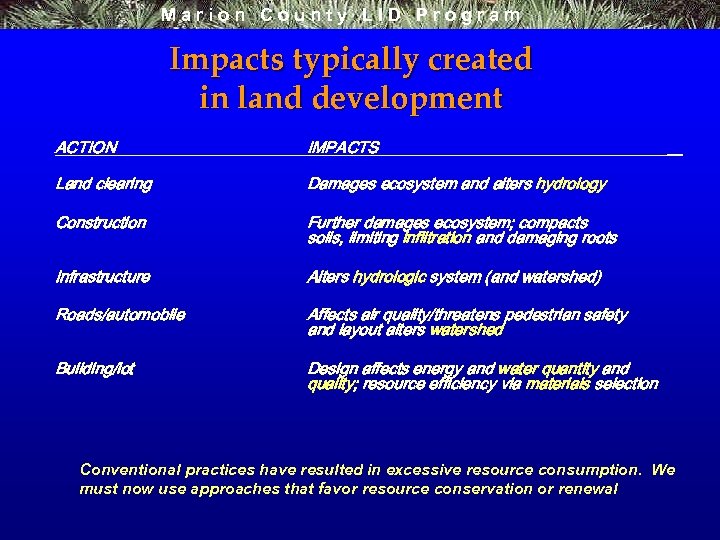 Marion County LID Program Impacts typically created in land development ACTION IMPACTS Land clearing Damages ecosystem and alters hydrology Construction Further damages ecosystem; compacts soils, limiting infiltration and damaging roots Infrastructure Alters hydrologic system (and watershed) Roads/automobile Affects air quality/threatens pedestrian safety and layout alters watershed Building/lot Design affects energy and water quantity and quality; resource efficiency via materials selection Conventional practices have resulted in excessive resource consumption. We must now use approaches that favor resource conservation or renewal
 Marion County LID Program LID “Big View” When you impact less = multiple benefits § § § Do less harm (esp. clearing & grading) Respect hydrologic functions Design a low impact landscape
 Marion County LID Program LID Design Considerations § § § § Limit site disturbances; small footprint Mimic hydrologic function Limit impervious surfaces Utilize bioremediation Use native plants Limit use of irrigation and processed water Limit use of fertilizers and pesticides
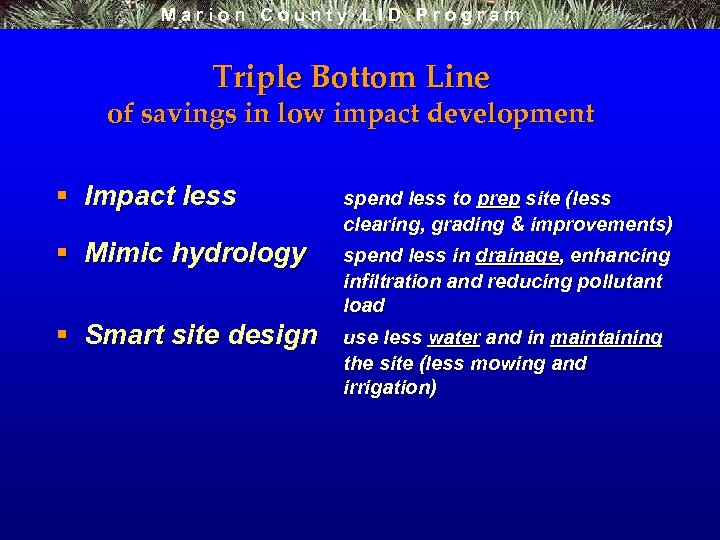 Marion County LID Program Triple Bottom Line of savings in low impact development § Impact less spend less to prep site (less clearing, grading & improvements) § Mimic hydrology spend less in drainage, enhancing infiltration and reducing pollutant load § Smart site design use less water and in maintaining the site (less mowing and irrigation)
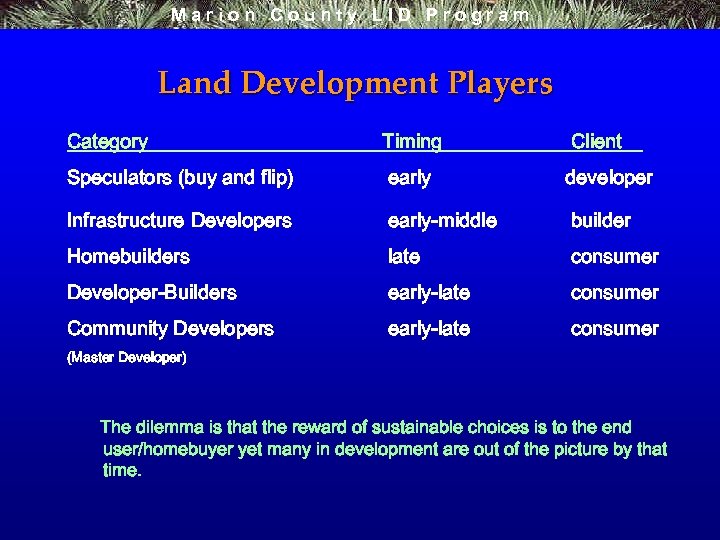 Marion County LID Program Land Development Players Category Timing Client Speculators (buy and flip) early developer Infrastructure Developers early-middle builder Homebuilders late consumer Developer-Builders early-late consumer Community Developers early-late consumer (Master Developer) The dilemma is that the reward of sustainable choices is to the end user/homebuyer yet many in development are out of the picture by that time.
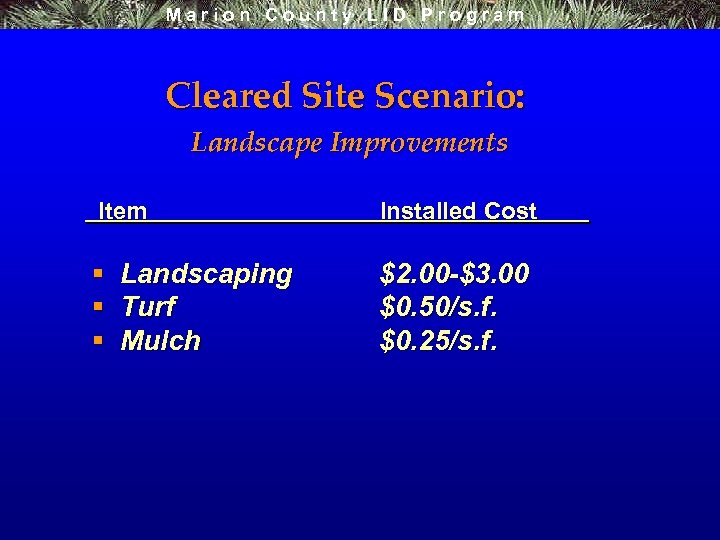 Marion County LID Program Cleared Site Scenario: Landscape Improvements Item § Landscaping § Turf § Mulch Installed Cost $2. 00 -$3. 00 $0. 50/s. f. $0. 25/s. f.
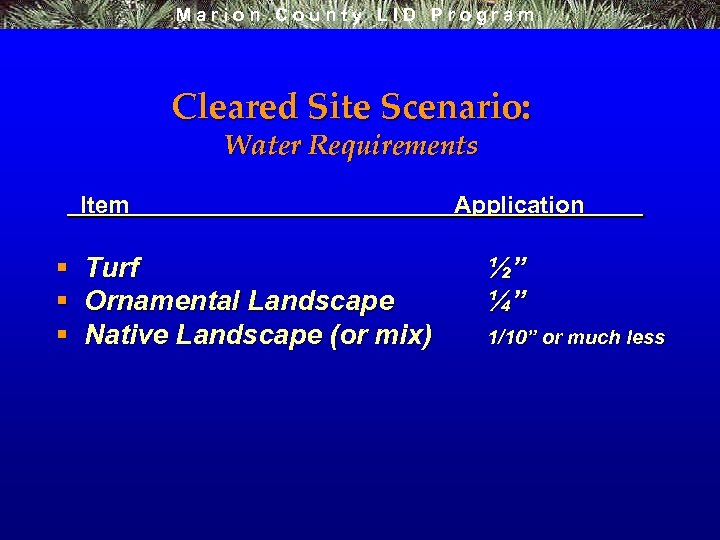 Marion County LID Program Cleared Site Scenario: Water Requirements Item § Turf § Ornamental Landscape § Native Landscape (or mix) Application ½” ¼” 1/10” or much less
 Marion County LID Program Case Study: Madera A Model Subdivision of LID Design Techniques
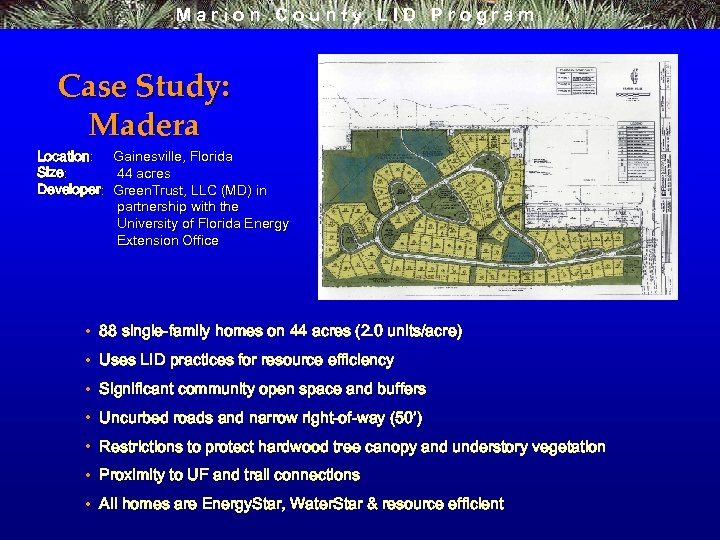 Marion County LID Program Case Study: Madera Location: Gainesville, Florida Size: 44 acres Developer: Green. Trust, LLC (MD) in partnership with the University of Florida Energy Extension Office • 88 single-family homes on 44 acres (2. 0 units/acre) • Uses LID practices for resource efficiency • Significant community open space and buffers • Uncurbed roads and narrow right-of-way (50’) • Restrictions to protect hardwood tree canopy and understory vegetation • Proximity to UF and trail connections • All homes are Energy. Star, Water. Star & resource efficient
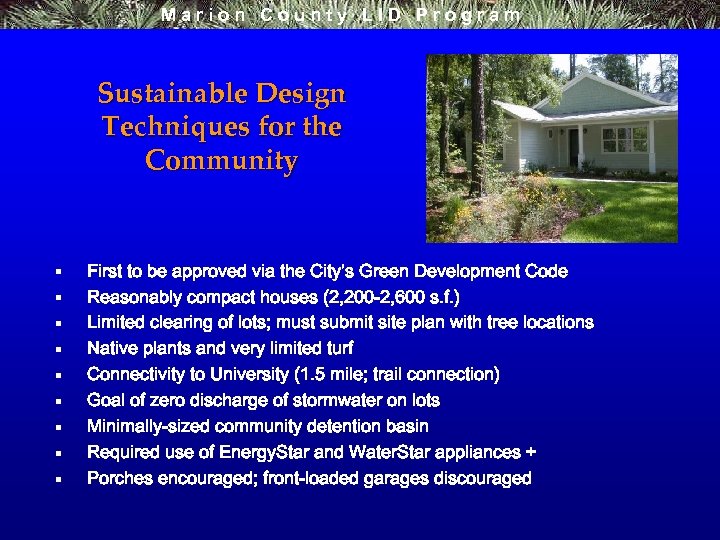 Marion County LID Program Sustainable Design Techniques for the Community § § § § § First to be approved via the City’s Green Development Code Reasonably compact houses (2, 200 -2, 600 s. f. ) Limited clearing of lots; must submit site plan with tree locations Native plants and very limited turf Connectivity to University (1. 5 mile; trail connection) Goal of zero discharge of stormwater on lots Minimally-sized community detention basin Required use of Energy. Star and Water. Star appliances + Porches encouraged; front-loaded garages discouraged
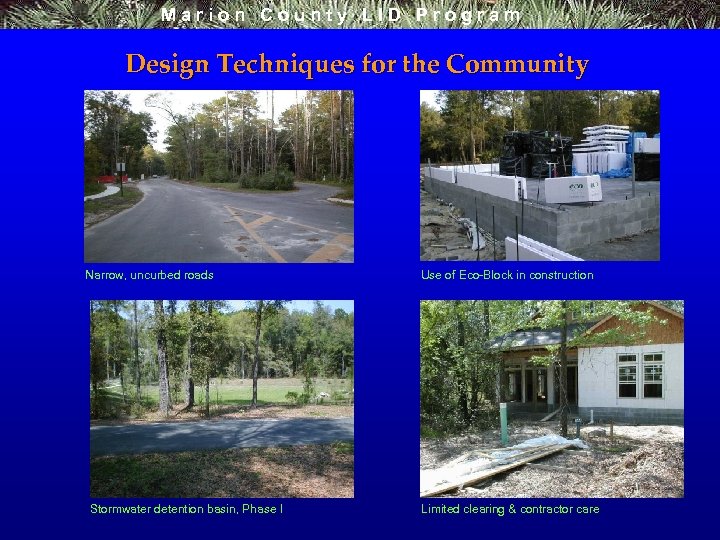 Marion County LID Program Design Techniques for the Community Narrow, uncurbed roads Stormwater detention basin, Phase I Use of Eco-Block in construction Limited clearing & contractor care
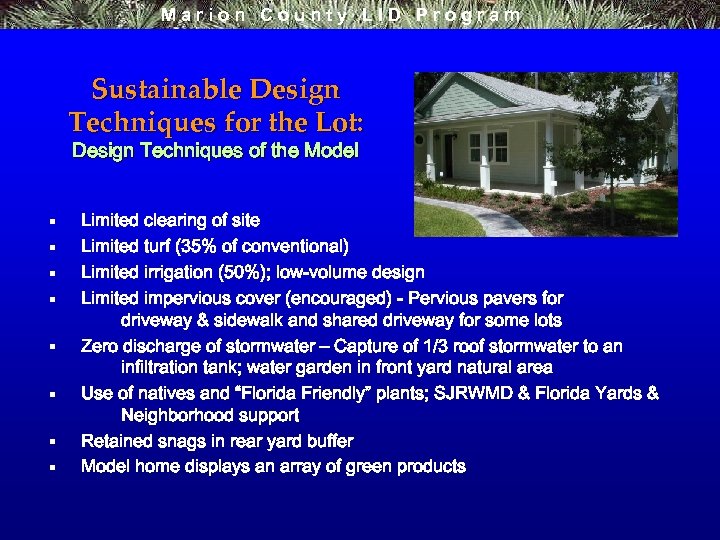 Marion County LID Program Sustainable Design Techniques for the Lot: Design Techniques of the Model § § § § Limited clearing of site Limited turf (35% of conventional) Limited irrigation (50%); low-volume design Limited impervious cover (encouraged) - Pervious pavers for driveway & sidewalk and shared driveway for some lots Zero discharge of stormwater – Capture of 1/3 roof stormwater to an infiltration tank; water garden in front yard natural area Use of natives and “Florida Friendly” plants; SJRWMD & Florida Yards & Neighborhood support Retained snags in rear yard buffer Model home displays an array of green products
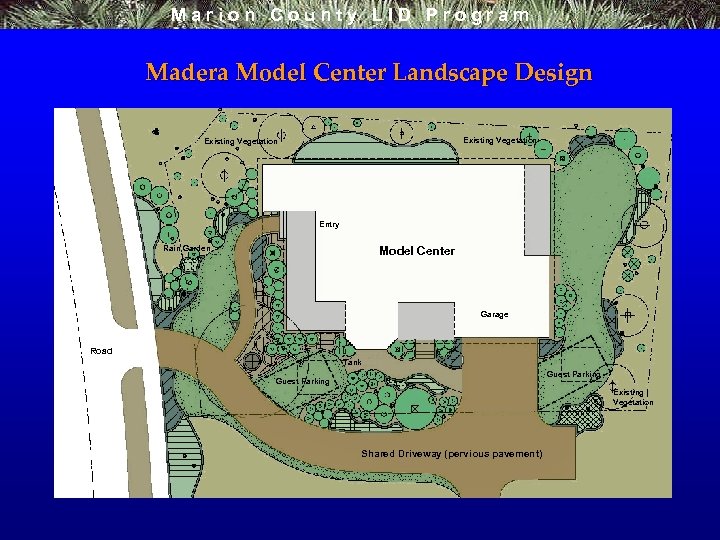 Marion County LID Program Madera Model Center Landscape Design Existing Vegetation Entry Rain Garden Model Center Garage Road Tank Guest Parking Existing Vegetation Shared Driveway (pervious pavement)
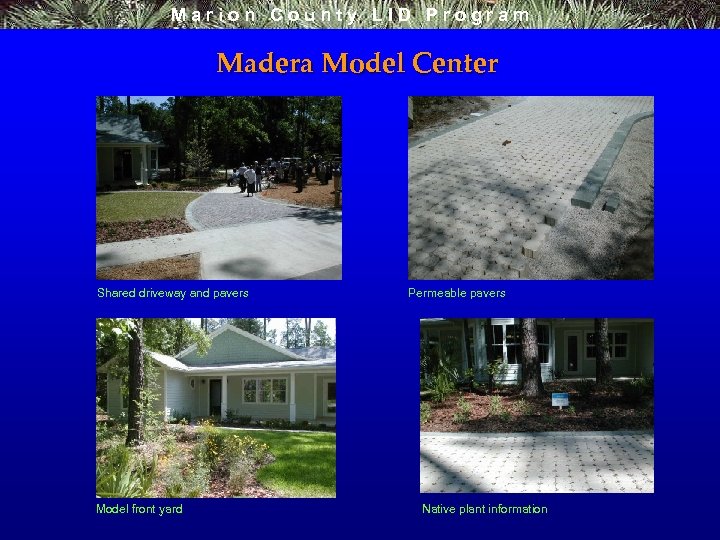 Marion County LID Program Madera Model Center Shared driveway and pavers Model front yard Permeable pavers Native plant information
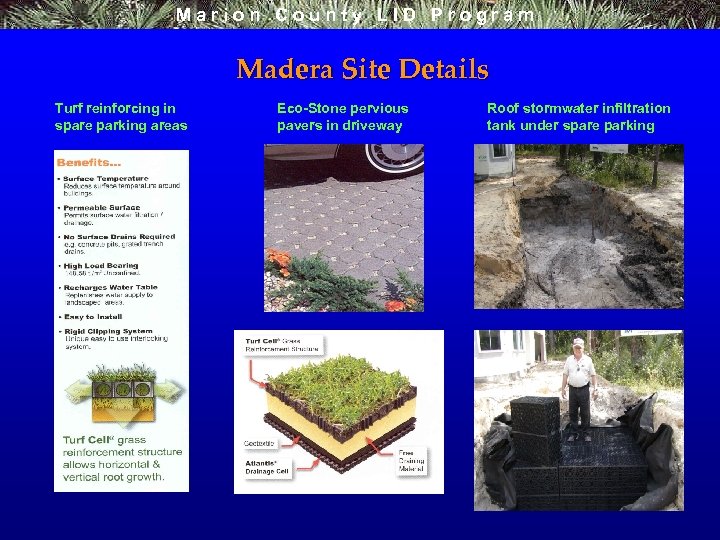 Marion County LID Program Madera Site Details Turf reinforcing in spare parking areas Eco-Stone pervious pavers in driveway Roof stormwater infiltration tank under spare parking
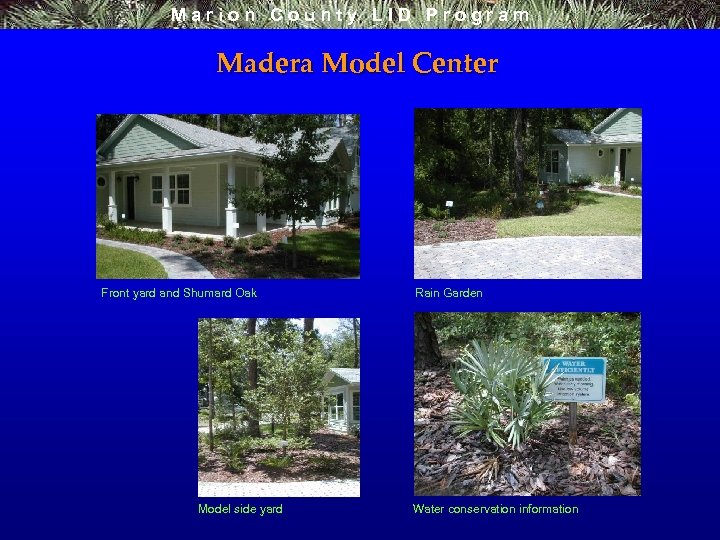 Marion County LID Program Madera Model Center Front yard and Shumard Oak Model side yard Rain Garden Water conservation information
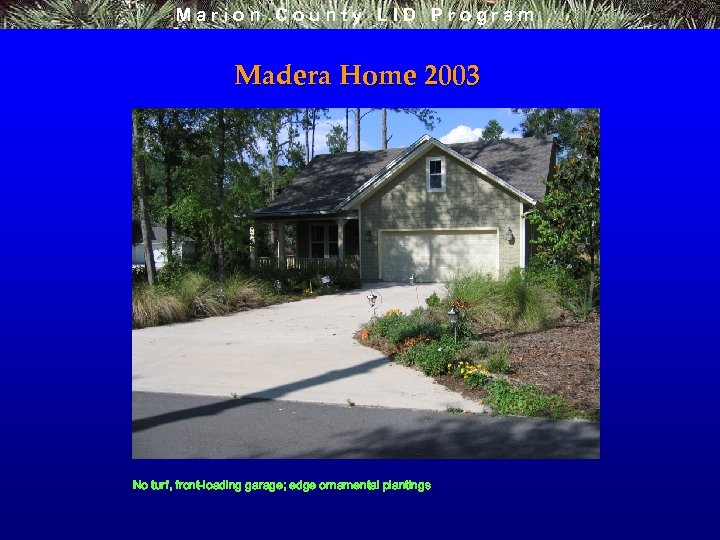 Marion County LID Program Madera Home 2003 No turf, front-loading garage; edge ornamental plantings
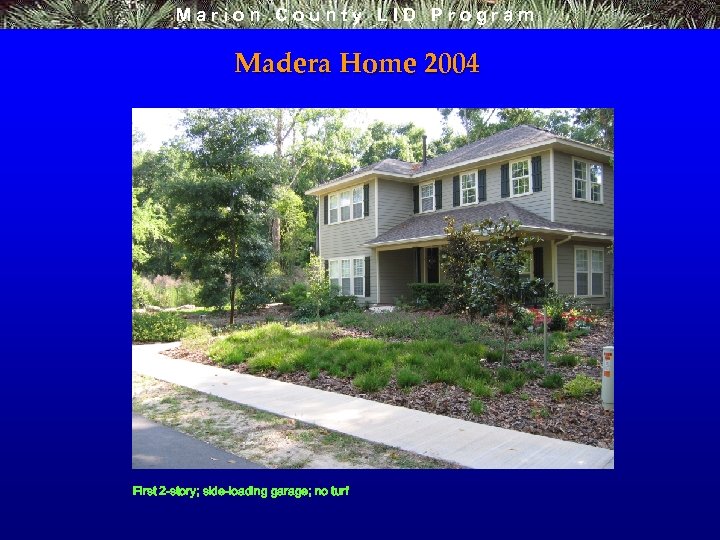 Marion County LID Program Madera Home 2004 First 2 -story; side-loading garage; no turf
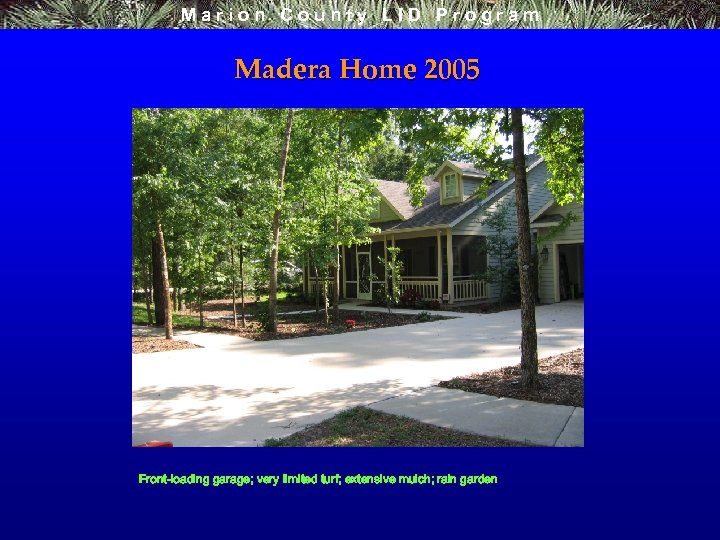 Marion County LID Program Madera Home 2005 Front-loading garage; very limited turf; extensive mulch; rain garden
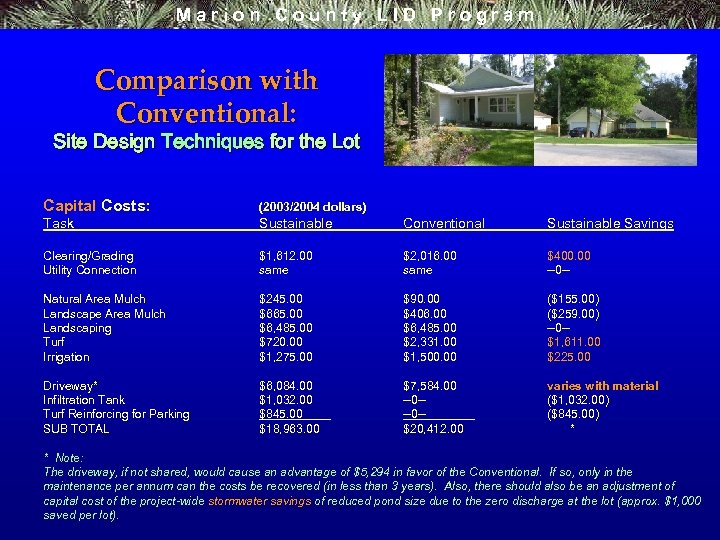 Marion County LID Program Comparison with Conventional: Site Design Techniques for the Lot Capital Costs: (2003/2004 dollars) Task Sustainable Conventional Sustainable Savings Clearing/Grading Utility Connection $1, 612. 00 same $2, 016. 00 same $400. 00 --0 -- Natural Area Mulch Landscape Area Mulch Landscaping Turf Irrigation $245. 00 $665. 00 $6, 485. 00 $720. 00 $1, 275. 00 $90. 00 $406. 00 $6, 485. 00 $2, 331. 00 $1, 500. 00 ($155. 00) ($259. 00) --0 -$1, 611. 00 $225. 00 Driveway* Infiltration Tank Turf Reinforcing for Parking SUB TOTAL $6, 084. 00 $1, 032. 00 $845. 00 $18, 963. 00 $7, 584. 00 --0 -$20, 412. 00 varies with material ($1, 032. 00) ($845. 00) * * Note: The driveway, if not shared, would cause an advantage of $5, 294 in favor of the Conventional. If so, only in the maintenance per annum can the costs be recovered (in less than 3 years). Also, there should also be an adjustment of capital cost of the project-wide stormwater savings of reduced pond size due to the zero discharge at the lot (approx. $1, 000 saved per lot).
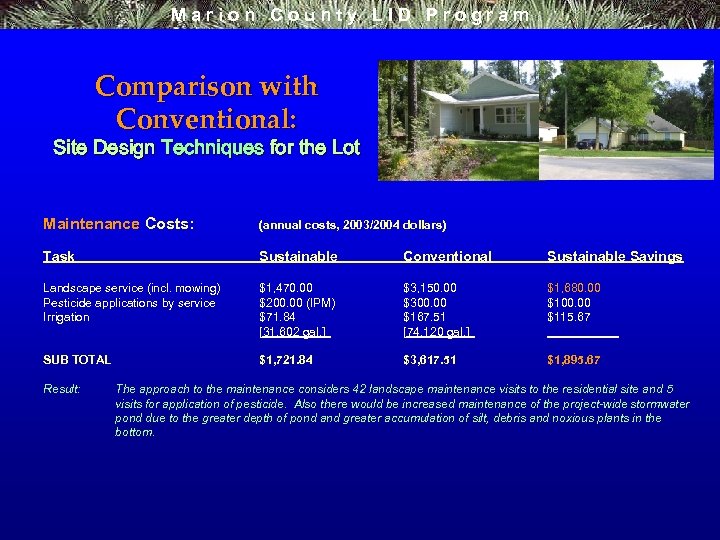 Marion County LID Program Comparison with Conventional: Site Design Techniques for the Lot Maintenance Costs: (annual costs, 2003/2004 dollars) Task Sustainable Conventional Sustainable Savings Landscape service (incl. mowing) Pesticide applications by service Irrigation $1, 470. 00 $200. 00 (IPM) $71. 84 [31, 602 gal. ] $3, 150. 00 $300. 00 $167. 51 [74, 120 gal. ] $1, 680. 00 $100. 00 $115. 67 SUB TOTAL $1, 721. 84 $3, 617. 51 $1, 895. 67 Result: The approach to the maintenance considers 42 landscape maintenance visits to the residential site and 5 visits for application of pesticide. Also there would be increased maintenance of the project-wide stormwater pond due to the greater depth of pond and greater accumulation of silt, debris and noxious plants in the bottom.
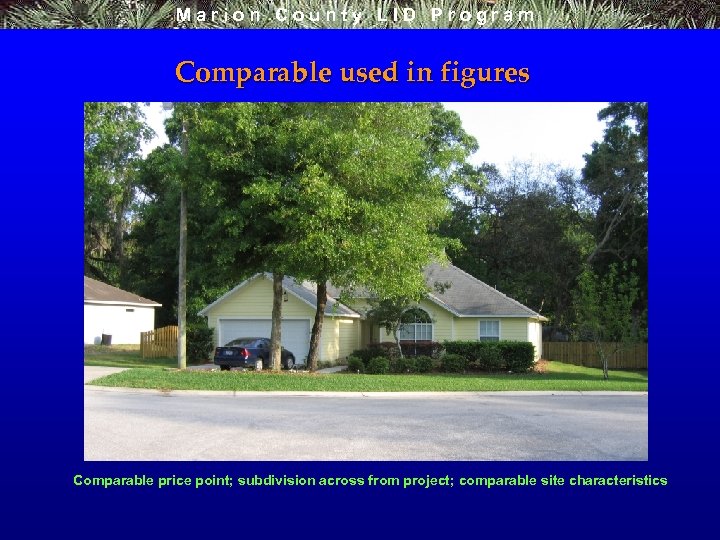 Marion County LID Program Comparable used in figures Comparable price point; subdivision across from project; comparable site characteristics
 Marion County LID Program Issues to address Cleared sites – higher landscape costs for visual affect; natives growing in acceptance but are not as well known; return takes a bit longer Problem soils – Low infiltration rates limit easy bioremediation; water harvesting is easier; water as an amenity Smaller lots – Result in less space to remediate but surface runoff becomes critical Turf – Limit amount due to high water consumption, pollutant runoff, cultural preferences; and human intervention, etc.
 Marion County LID Program Trends offering promise Native plants – attractive natives are more known; designs that are attractive are more common Water harvesting –roof capture/wet detention is possible; we can capture some of landscape need through harvesting; reuse is more available Shared open space – Open space to convey surface water is possible if integrated into the community plan (e. g. Village Homes) Turf – Alternatives are becoming available Irrigation - Soil moisture sensing controllers are becoming affordable
 Marion County LID Program Email Contact acomb@ufl. edu Web Sites Program for Resource Efficient Communities: www. energy. ufl. edu UF Department of Landscape Architecture: www. dcp. ufl. edu/landscape
 Marion County LID Program Bibliography Arendt, Randall. Conservation Design for Subdivisions. Island Press, 1996. EPA. Our Built and Natural Environments: A Technical Review of the Interactions between Land Use, Transportation and Environmental Quality. 2001. Florida Green Building Coalition. “Green Development Design Standards. ” FGBC, 2003. NAHB Research Center. The Practice of Low Impact Development. Prepared for the U. S. Department of Housing & Urban Development, 2003 Rocky Mountain Institute. Green Development. John Wiley & Sons, 1998. Sustainable Industries Building Council. “Green Design Guidelines, ” SIBC, 2004. Thompson, William and Sorvig, Kim. Sustainable Landscape Construction. Island Press, 2000.