


 Скачать презентацию Marine Current Modelling For Energy Production Group 4
0a2af4e8db6f4b378d48c55258eda7fd.ppt
- Количество слайдов: 37
 Marine Current Modelling For Energy Production Group 4 – Marine Energy James Glynn Kirsten Hamilton Tom Mc. Combes Malcolm Mac. Donald
 To Recap …
 Project Definition • Investigate the characteristics of the tidal resources in Scotland demonstrate how to match those resources with the appropriate Marine current technology
 Plan Stage 1 - Investigation • Resources • Technology Stage 2 - Analysis • Methodology to match technology with resource • Case study
 Stage 1 - Investigation A. Resource Investigation Ø Ø Ø Identify current weaknesses in available resource data Obtain ocean topography charts Select sites in the west of Scotland based on current research, specific criteria, and surface velocity Calculate shear profiles according to bathymetry of selected sites Correlate shear data with surface velocity to derive velocity distributions B. Technology assessment Ø Ø Generic Modelling of three tidal technologies: horizontal axis, vertical axis and oscillating hydrofoil devices Oceanographic & Hydrodynamic Suitability of each type Potential packing densities Define suitable conditions for each technology in terms of depth, velocity, surface roughness etc
 Stage 2 - Analysis A. Methodology Ø Ø Develop a frame work to assess each technology suitability for each resource characteristic Define rules to match technology with particular resource characteristic B. Case study Ø Ø Demonstrate the implementation of this methodology for at least one Scottish West Coast site, most likely Hebridean Sounds Prove robustness of work and further qualify methodology
 Literature Review • There a number of relevant research projects that have been undertaken in marine energy • We are going to briefly discuss some sources of information, highlight the conclusions, relevant information and differentiation between past research and our proposal • Information Sources discussed in following section: Ø Past projects Ø Tidal Resource Stream Ø DTi Work Ø Carbon Trust Ø Baraj et al
 Past Projects 03/04 “Base-load Supply Strategy” • Area of concern: Ø Ø Ø To investigate the potential of marine current energy to meet a proportion of Scotland's base-load energy supply. Review current research, existing technology & Engineering Challenges. Environmental impact, Planning requirements, grid connection, marine current resource availability, and economics and policy issues. • Conclusion: Ø Ø Primary advantage of tidal stream technology is its predictability, renewable status and abundance. Marine current technology has proven base-load potential, dependant on large scale energy storage • (e. g. Cruachan is limited operating at 400 MW for 22 hours). • Important points: Ø Resolution of Tidal Calculations Grid>1 km 2 • Assumed non varying bulk tidal velocities within grid elements Ø Idealised general tidal calculation & validation using sinusoidal assumptions, port tidal charts & ignoring bathymetrical effects
 Past Projects 04/05 “Developing and Growing a Scottish Marine Current Turbine Industry " • Area of concern: Ø Ø Mainly an overview of MCT’s and their commercialisation potential. Main thrust of technical investigation aimed at blockage effects in a channel. • Conclusion: Ø After uncovering blockage effects, group stated this limit would not be reached anyway due to economic and technical limitations • Important points: Ø Ø Discussion of potential for further work such as 3 d modelling, and including bathymetry in calculations, which we aim to do. Takes steps towards the much-requested, site specific resource quantification.
 Early Tidal Stream Studies • Most other studies refer back to these reports: 1)‘UK Tidal Stream Energy Review. 1992 -1993’ • • • DTI, Binnie & Partners, Sir Robert Mc. Alpine & Sons Ltd. & IT Power First official attempt to evaluate the UK’s tidal resources Identified a 25 sites in UK waters, combined annual output of 58 TWh/yr Sites can be collected into 7 main locations; 3 of them in Scotland Report excludes sites where the depth < 20 m, speed <2 m/s, area <2 km 2 Report concluded that although UK resource was large, the unit cost of energy would be relatively high 2)‘The Exploitation Of Tidal /Marine Currents, 1994 -1996’ • • EC Joule Programme Report identified a total of 42 sites, combined annual output 31 TWh/yr. Included a number of such sites at depths of <20 m, speeds >1 m/s At most locations the output is generally between 40% and 70% of that from the 1993 report. The West Coast of Scotland output is significantly increased by the inclusion of shallow water sites
 DTI Commercial Tidal Research 3)“Development, Installation And Testing Of A Large-scale Tidal Current Turbine”, Oct 2005 • • IT Power Marine Current Turbines, Seacore, Bendalls Engineering, Corus Aim: Seaflow was a project to develop and test a commercially-sized marine current turbine. Objectives were to test the feasibility of constructing and operating such a machine, and to evaluate the likely longer-term economics of using such tidal turbines to generate electricity. Conclusion: The Seaflow turbine was successfully installed and operated. It proved the basic physics of power extraction from tidal flows, and showed that useful electrical power can be generated from horizontal-axis turbines. Relevance: Useful data acquired for site selection and for technology review 4)“The Commercial Prospects for Tidal Stream Power”, 2000 -1 • • • Binnie, Black & Veatch, IT Power Ltd Aim: Study based on a conceptual design of 1 MW and examined the cost and energy outputs for schemes with different numbers of units located in various water depths, peak flow velocities and tidal ranges Conclusion: the proposed scheme was practical, robust and capable after development of delivering unit costs in the range of 4 -6 p/k. Wh Ø Ø • Assumption in 1993 report led to considerable lower energy output estimates and higher energy costs than found for this report The problems associated with constructing installing and operating the system are suggested as the next appropriate step Relevance: The size of and cost of extracting the UK resource
 Bahaj et al 5)‘Fundamentals applicable to the utilisation of marine current turbines for energy production, 2003’ • • Bahaj A. S. ; Myers L. E. , Aim: This paper reviews the fundamental issues that are likely to play a major role in implementation of MCT systems. The paper reports issues such as the harsh marine environment, the phenomenon of cavitation, and the high stresses encountered by such structures are likely to play a major role on the work currently being undertaken in this field. Conclusion: The need to exploit marine energy is increasingly recognised and the engineering capability to do so is now here following experience with offshore structures and new developments in offshore piling. However, there is limited technical knowledge of how to optimise the design of kinetic energy turbine rotors for use in water; there also various important factors unique to the marine current resource that need to be investigated through a process of model testing, and technical analysis. Relevance: Fundamental principles relating to turbine devices 6)‘Initial evaluation of tidal stream energy resources at Portland Bill, UK, February, 2006’ • • Blunden, L. S. Bahaj, A. S. , Aim: To better estimate available energy resources at the Portland Bill, a two-dimensional tidally driven hydrodynamic numerical model of Portland Bill was developed using the TÉLÉMAC system, with validation using tidal elevation measurements and tidal stream diamonds from Admiralty charts. Conclusion: The results of the model were used to produce a time series of the tidal stream velocity over the simulation period and may be used in future work to optimise the location of turbine arrays at the site. Relevance: The methodology used in this research can be adapted
 Recent Tidal Stream Research 7) ‘Atlas of UK Marine Renewable Energy Resources, Dec 2004’ • • • Produced By: Garrad Hassan Area of concern: aim to present an accessible overview for the potential renewable energy resource in the UK. Covers wind, wave and tidal predominantly • Important points: Ø Ø Ø Fairly encompassing, though the tidal resource model resolution is sufficient only for initial identification purposes, and would not help calculating potential energy yield to a high degree. Carbon trust state: “The tidal stream resource is highly site specific”, thus intimating the potential for discrepancies in an overall resource characterization. There is scope therefore for the development of site specific methodologies and models. The GH report for the Scottish executive also has a number of assumptions, which we feel facilitates something of an over-optimistic quantification of resource availability. B&V and RGU feel a flux method will aid in a greater understanding of environmental and economic factors, relative to resource flow, capture and packing arrangements
 8) Carbon Trust • The Carbon Trust is presently responsible for an initiative known as the Marine Energy Challenge. • Programme has the aim to ‘assess the potential for marine energy devices to achieve a competitive cost of electricity generation against other renewables and fossil fuelled power generation’ (Carbon Trust, 2004). • Area of concern: Resource and technology assessment on a grand scale. Big consultancy collaboration. • Conclusion: Previous estimates poor. . Probably represents best approach so far. 12 -13 TWh available. Economic assessment of predominant technology types. • Important points: Ø Mean spring peak velocity taken at 5 m depth. . Ø Previous data sources as primary input, +/-30 resource estimate uncertainty. Also use a depth averaged flow: rule of 7 ths Ø Advocate further modelling to clarify resource for specific sites Ø The Carbon Trust in conjunction with B&V are attempting to evaluate benefits of different approaches and in particular understand the linkages between resource potential and device development. • CT would like flux assessments for individual UK sites
 Other Sources • Marine Energy Group & Meeting the 2020 Target reports for S. E • Various articles on tidal flows/sediment transport/fluid mechanics and calculating wind resource for possible cross over data etc • World Energy Organization- various • House of Commons: Energy Report white paper. • Bowditch, N The American Practical Navigator Chapter 9: Tides and Tidal Currents, and Nautical Charts. • Scottish Enterprise (2005): Marine Renewable (Wave and Tidal) Opportunity Review • Scott J. Couch & Ian G. Bryden (of RGU) The Impact of Energy Extraction on Tidal Flow Development. [Flux method referred to by B&V in Carbon Trust consultation]
 Stage 1: Part A. Resource Investigation Work undertaken
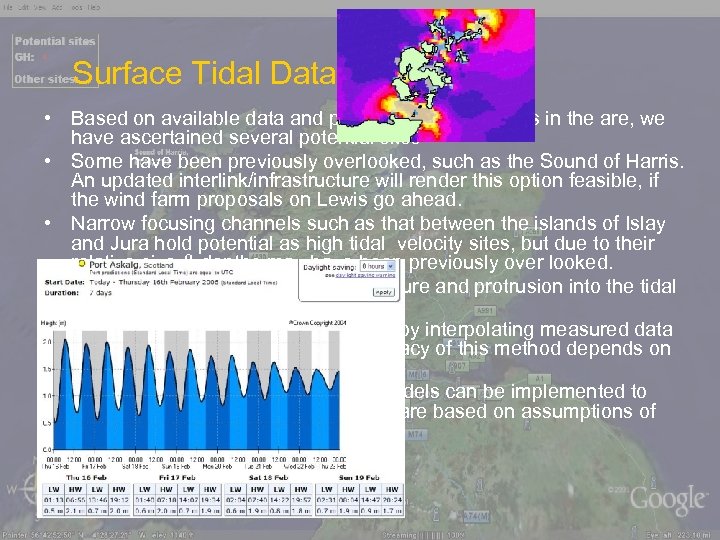 Surface Tidal Data • Based on available data and previous work by others in the are, we have ascertained several potential sites • Some have been previously overlooked, such as the Sound of Harris. An updated interlink/infrastructure will render this option feasible, if the wind farm proposals on Lewis go ahead. • Narrow focusing channels such as that between the islands of Islay and Jura hold potential as high tidal velocity sites, but due to their relative size & depths may have been previously over looked. • Several Headlands with gentle curvature and protrusion into the tidal flow also hold potential for sites • Tidal Profiles are typically calculated by interpolating measured data from ports around the site. The accuracy of this method depends on the proximity of the site to the ports. • Further sinusoidal theoretical tidal models can be implemented to ascertain surface flow velocities. But are based on assumptions of tidal frequency and sinusoidal nature.
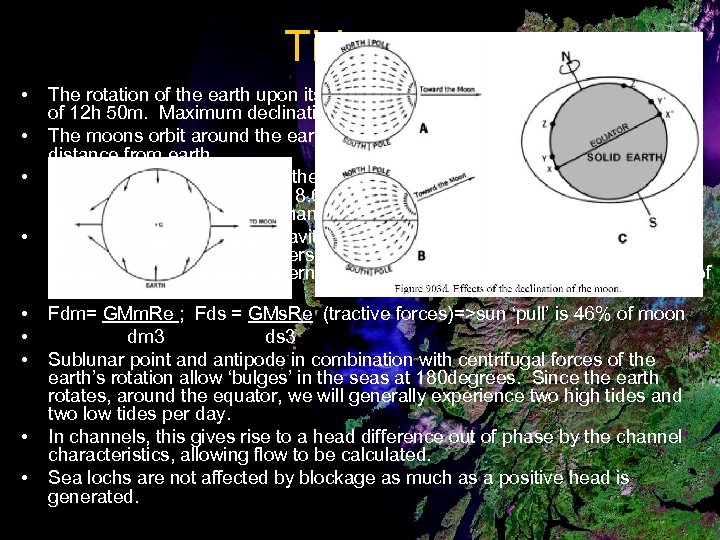 Tides • • • The rotation of the earth upon its axis gives rise to a transit period of the moon of 12 h 50 m. Maximum declination about 23. 5 degrees. The moons orbit around the earth takes 27. 3 days. 384403 km average distance from earth The equatorial declination of the moon varies between north and south, and the orbit paths repeat every 18. 6 years. Thus tides are highly predictable, though pressure, surge resonant effects and thermal currents all play a part. Primarily, Newton’s law of gravitation allows the gravitational pull of the sun and moon on the earth’s waters to be resolved into vectors, at any point, and represents the main tide governing effect, in conjunction with the second law of motion: Fdm= GMm. Re ; Fds = GMs. Re (tractive forces)=>sun ‘pull’ is 46% of moon dm 3 ds 3 Sublunar point and antipode in combination with centrifugal forces of the earth’s rotation allow ‘bulges’ in the seas at 180 degrees. Since the earth rotates, around the equator, we will generally experience two high tides and two low tides per day. In channels, this gives rise to a head difference out of phase by the channel characteristics, allowing flow to be calculated. Sea lochs are not affected by blockage as much as a positive head is generated.
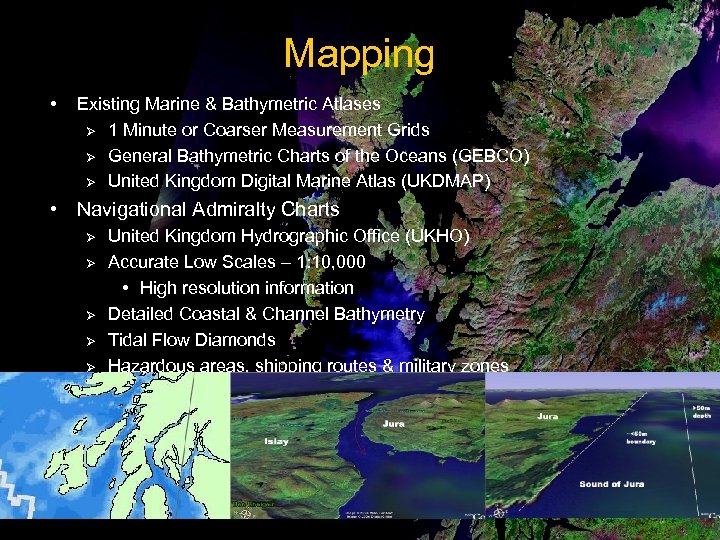 Mapping • Existing Marine & Bathymetric Atlases Ø 1 Minute or Coarser Measurement Grids Ø General Bathymetric Charts of the Oceans (GEBCO) Ø United Kingdom Digital Marine Atlas (UKDMAP) • Navigational Admiralty Charts Ø Ø Ø United Kingdom Hydrographic Office (UKHO) Accurate Low Scales – 1: 10, 000 • High resolution information Detailed Coastal & Channel Bathymetry Tidal Flow Diamonds Hazardous areas, shipping routes & military zones Costly – Licence Required
 Mapping General Site Selection Principles (DTI 2005) • Higher currents are only found around certain features, such as: Ø Ø • • • Channels or constrictions between islands - fast and rectilinear flow Headlands in the path of moderate flows - best when the headlands are large and do not protrude too sharply into the flow, otherwise the flows are fast but turbulent, and the high currents may be in different places on ebb and flood Estuaries or other resonant water volumes - good sites with rectilinear flow Narrow entrances to enclosed tidal lakes - can have very high currents, but only over a small area. ‘Using these observations, large-scale maps can be used to predict possible sites, but in many places there is insufficient published data to verify whether an actual site is suitable. As marine current exploitation develops, there will be a need for a detailed inventory of potential sites. On small-scale maps, areas that do have high currents appear very small, though in reality each one may be several kilometres long in the direction of flow, and have space for many turbines, potentially generating tens or even hundreds of megawatts. Many suitable areas are several kilometres from the shore, and would be suitable for development as tidal farms, though they would be prohibitively expensive for a single, isolated turbine. ’ We used the above principles to select a number sites for analysis in addition to sites already proposed by the DTI
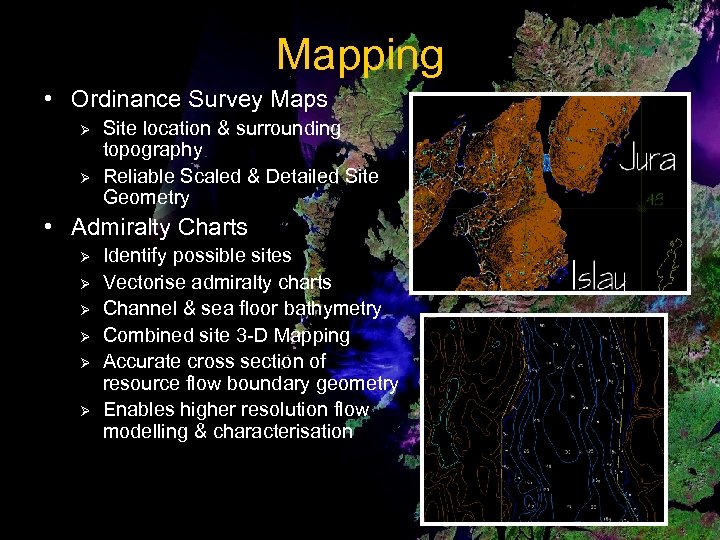 Mapping • Ordinance Survey Maps Ø Ø Site location & surrounding topography Reliable Scaled & Detailed Site Geometry • Admiralty Charts Ø Ø Ø Identify possible sites Vectorise admiralty charts Channel & sea floor bathymetry Combined site 3 -D Mapping Accurate cross section of resource flow boundary geometry Enables higher resolution flow modelling & characterisation
 Investigating flow characteristics Shear Distribution Methodology
 Rationale • Requirements exist for some means of identifying key flow characteristics in sections of interest • If shear profile is known for a channel section, velocity, pressure, flow rates and fluxes may be determined • Ideally a model for arbitrary channel sections will be developed
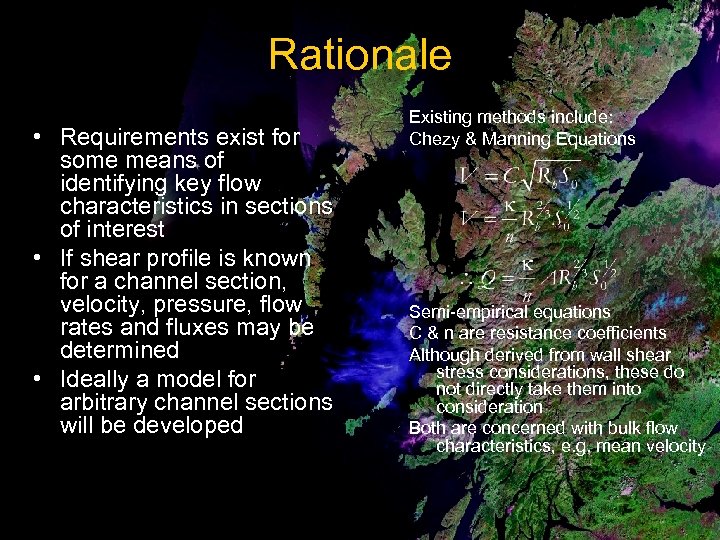 Rationale • Requirements exist for some means of identifying key flow characteristics in sections of interest • If shear profile is known for a channel section, velocity, pressure, flow rates and fluxes may be determined • Ideally a model for arbitrary channel sections will be developed Existing methods include: Chezy & Manning Equations Semi-empirical equations C & n are resistance coefficients Although derived from wall shear stress considerations, these do not directly take them into consideration Both are concerned with bulk flow characteristics, e. g. mean velocity
 Rationale • Bulk characteristics assumes uniform flow • Valid only as first order analysis tool • However can provide useful insight • Will form a basis of our method alongside: Algorithm to resolve arbitrary geometry, roughness and velocity for free surface flow
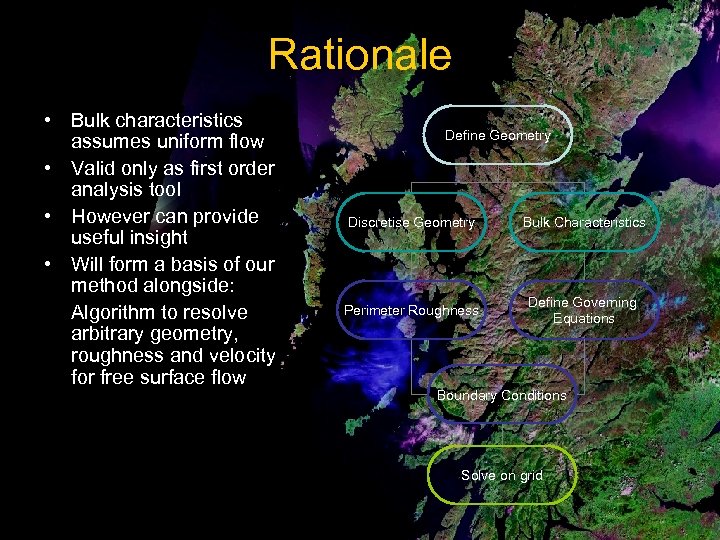 Rationale • Bulk characteristics assumes uniform flow • Valid only as first order analysis tool • However can provide useful insight • Will form a basis of our method alongside: Algorithm to resolve arbitrary geometry, roughness and velocity for free surface flow Define Geometry Discretise Geometry Bulk Characteristics Perimeter Roughness Define Governing Equations Boundary Conditions Solve on grid
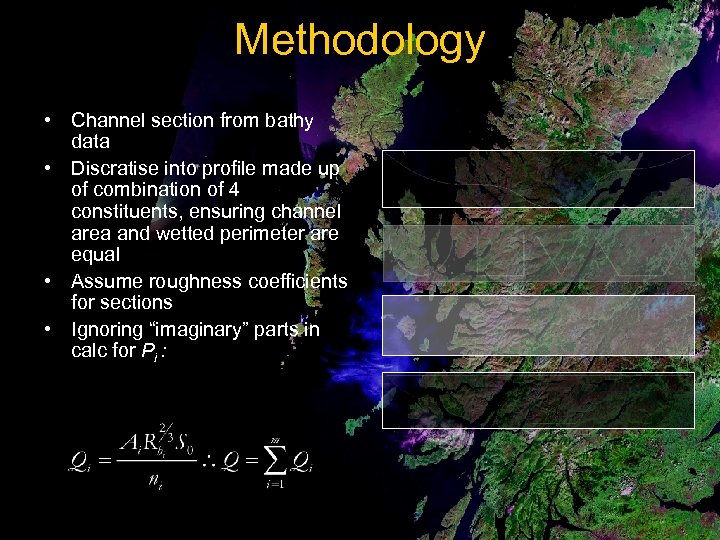 Methodology • Channel section from bathy data • Discratise into profile made up of combination of 4 constituents, ensuring channel area and wetted perimeter are equal • Assume roughness coefficients for sections • Ignoring “imaginary” parts in calc for Pi :
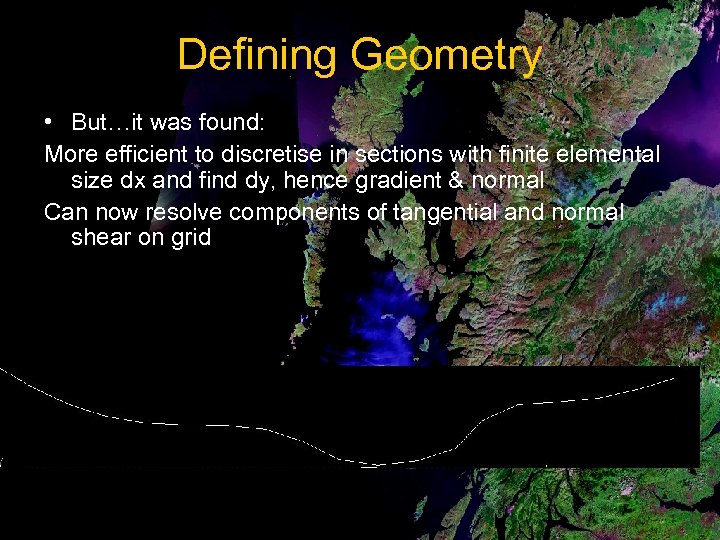 Defining Geometry • But…it was found: More efficient to discretise in sections with finite elemental size dx and find dy, hence gradient & normal Can now resolve components of tangential and normal shear on grid
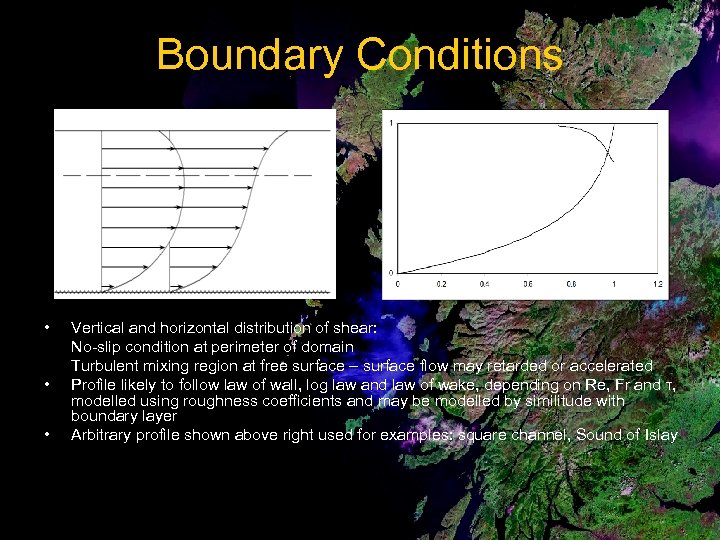 Boundary Conditions • • • Vertical and horizontal distribution of shear: No-slip condition at perimeter of domain Turbulent mixing region at free surface – surface flow may retarded or accelerated Profile likely to follow law of wall, log law and law of wake, depending on Re, Fr and τ, modelled using roughness coefficients and may be modelled by similitude with boundary layer Arbitrary profile shown above right used for examples: square channel, Sound of Islay
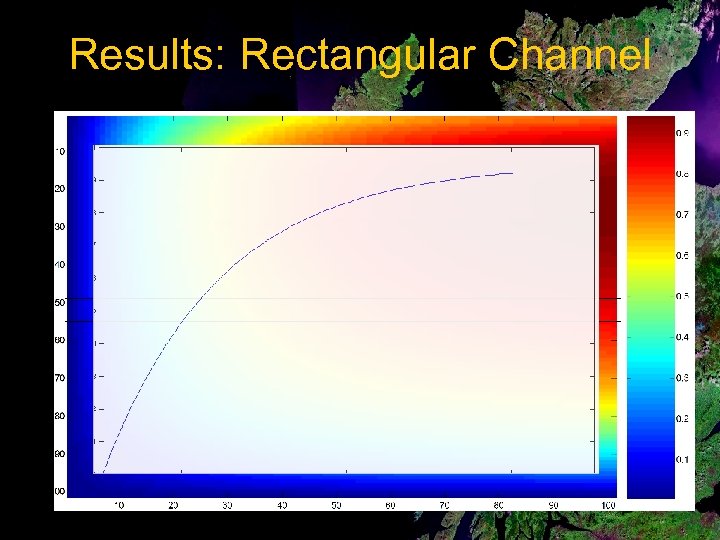 Results: Rectangular Channel
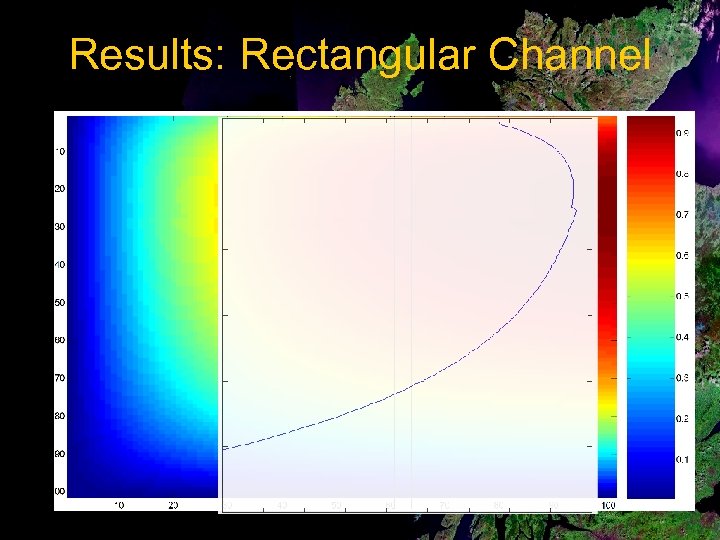 Results: Rectangular Channel
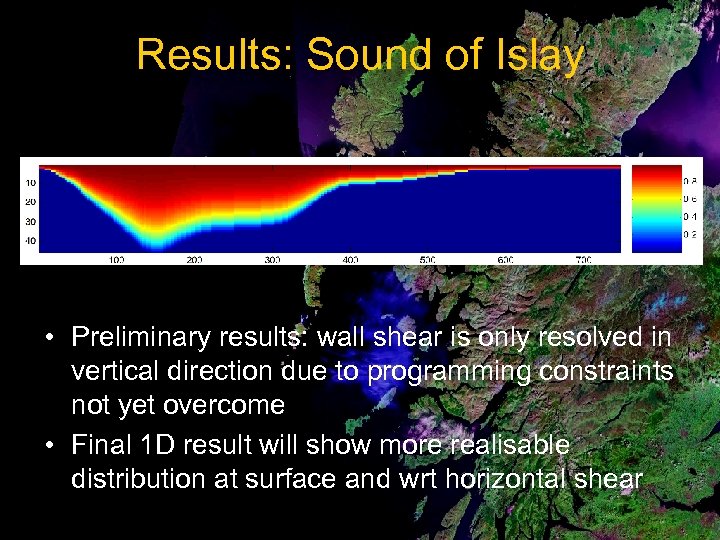 Results: Sound of Islay • Preliminary results: wall shear is only resolved in vertical direction due to programming constraints not yet overcome • Final 1 D result will show more realisable distribution at surface and wrt horizontal shear
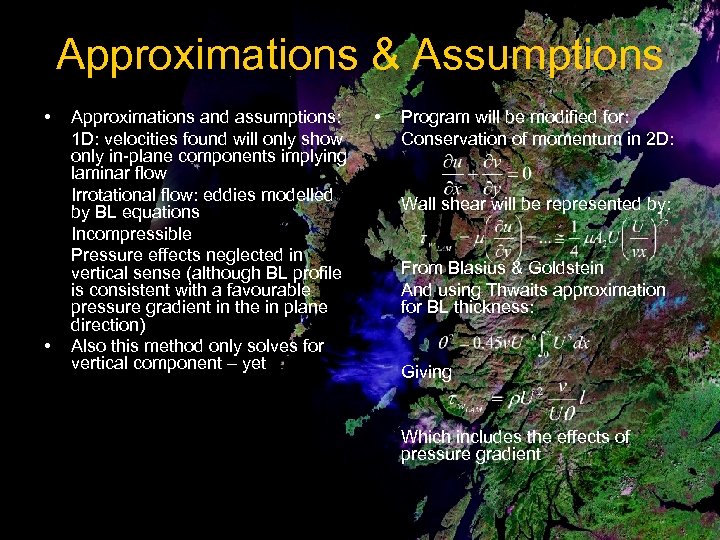 Approximations & Assumptions • • Approximations and assumptions: 1 D: velocities found will only show only in-plane components implying laminar flow Irrotational flow: eddies modelled by BL equations Incompressible Pressure effects neglected in vertical sense (although BL profile is consistent with a favourable pressure gradient in the in plane direction) Also this method only solves for vertical component – yet • Program will be modified for: Conservation of momentum in 2 D: Wall shear will be represented by: From Blasius & Goldstein And using Thwaits approximation for BL thickness: Giving Which includes the effects of pressure gradient
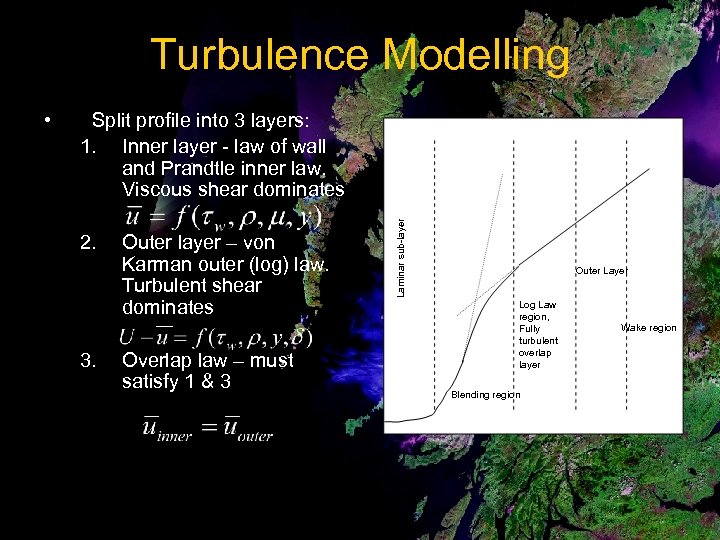 Turbulence Modelling Split profile into 3 layers: 1. Inner layer - law of wall and Prandtle inner law. Viscous shear dominates 2. 3. Outer layer – von Karman outer (log) law. Turbulent shear dominates Overlap law – must satisfy 1 & 3 Laminar sub-layer • Outer Layer Log Law region, Fully turbulent overlap layer Blending region Wake region
 Outcome • Bathymetric profiles (channel cross-sections) from mapping data will be inserted into TOMS software, ‘Topological Oceanographic Modelling for Shear’. • This will provide shear profiles of flow having inserted values for surface flow and roughness coupled with Manning’s equation. • The shear profiles will enable the velocity profiles for sites of varying cross-section to be calculated • A simple tool to quickly asses the effect the topography of a sites affects the velocity of the flow • Results can generate Reynolds numbers, Froude numbers, etc. , and inlet velocities for use with BEM calculations for turbines, and also allow velocity distribution to be reckoned for, say, out of plane load distributions on turbine areas
 Next Stage: Part A. Finish TOMS code & verify the results Part B. Technology Investigation…
 Marine Current Modelling For Energy Production Group 4 – Marine Energy James Glynn Kirsten Hamilton Tom Mc. Combes Malcolm Mac. Donald