


 Скачать презентацию Marine Communications Safety at Sea Seminar Your
eebbbc093baf019c56c0790e4595951c.ppt
- Количество слайдов: 62
 Marine Communications Safety at Sea Seminar
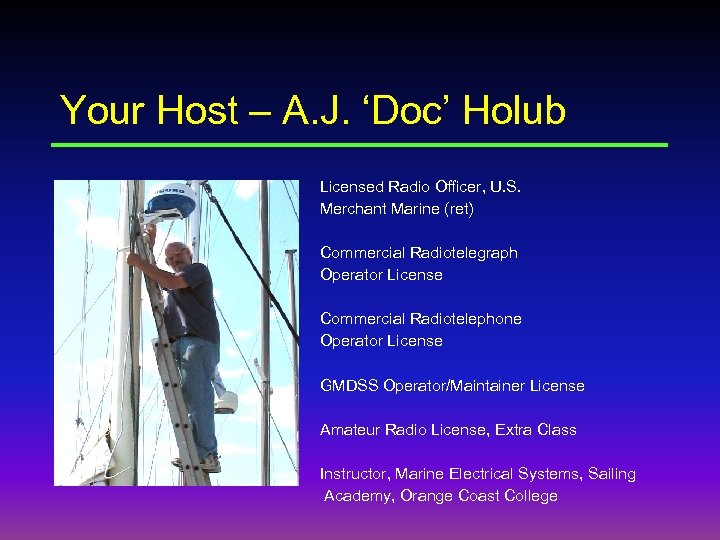 Your Host – A. J. ‘Doc’ Holub Licensed Radio Officer, U. S. Merchant Marine (ret) Commercial Radiotelegraph Operator License Commercial Radiotelephone Operator License GMDSS Operator/Maintainer License Amateur Radio License, Extra Class Instructor, Marine Electrical Systems, Sailing Academy, Orange Coast College
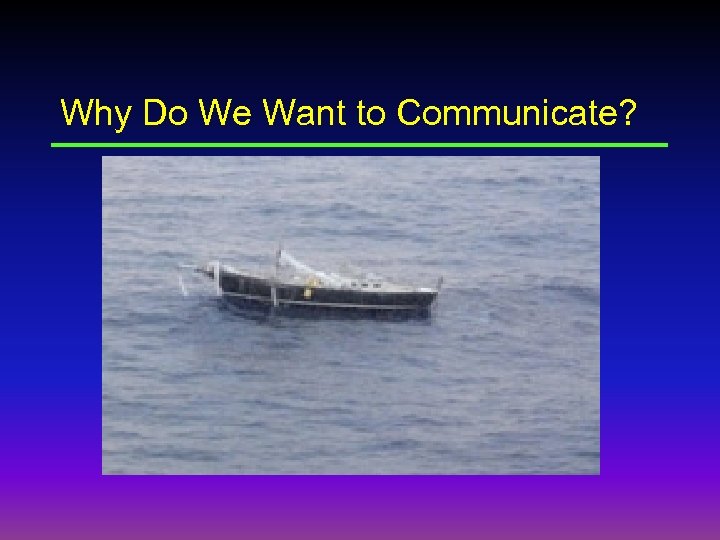 Why Do We Want to Communicate?
 What Types of Communications? • Emergency • Personal • Business
 ISAF Required Equipment VHF radio VHF hand held SSB transceiver or satellite phone
 Suggestions Before You Depart Locate communications equipment Find out how to activate Determine if there is a communications protocol Be prepared for an emergency
 If You Have Iridium Satellite Phone Iridium does not have Operator Assistance. Before departing, program into your Iridium critical telephone numbers: Coast Guard station at point of departure; Coast Guard in any intermediate points; Coast Guard at destination point; medical assistance numbers if you have assistance contracts; other medical emergency numbers you might require.
 A Few Other Words Before We Start On February 1, 1999 all merchant vessels worldwide were required to have GMDSS (Global Marine Distress Safety System) installed aboard. This system Automatically monitors VHF DSC (Digital Selective Calling) channel 70 plus high frequency DSC channels. Many private vessels also have installed at least VHF DSC equipped radios. This is important in case of emergency
 GMDSS Continued: • You must register your vessel and receive a free MMSI (Maritime Mobile Service Identifier) number. • Register on-line at Boat US or FCC. • Follow setup instructions for your DSC VHF. • More information later in this presentation.
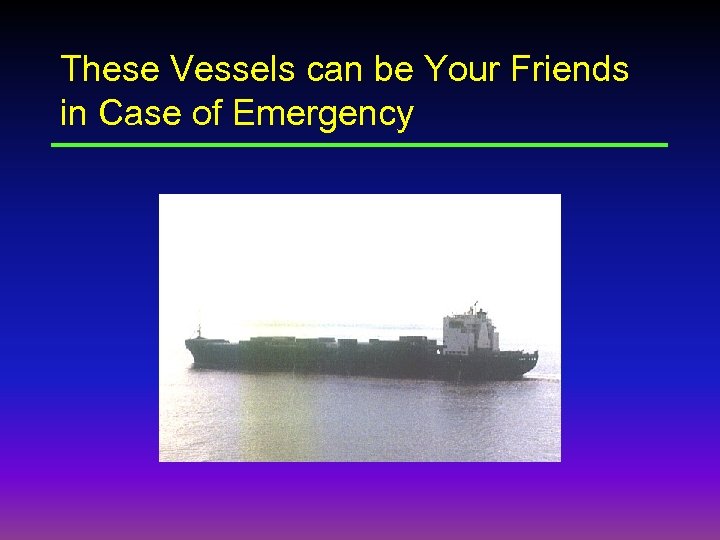 These Vessels can be Your Friends in Case of Emergency
 Let’s Talk Emergencies MAYDAY… Life, limb or ship in imminent danger. PAN PAN… Houston, I’ve got a problem. SECURITE… Anyone around me, I’m going to do something.
 Communications Options VHF…. . Close by SSB/HAM…. . World wide (maybe) SATELLITE…. . World wide, instant
 O. K. , We Have a Medical Emergency • • • It’s 0300 and there is a medical emergency on board. If in race, and doctor close by, try VHF. Otherwise, Iridium or other satellite telephone. Be able to describe the problem. Follow their advice.
 Ship Emergency – Imminent Disaster • If you think there is help nearby, initiate VHF DSC call (press the red button). It should wake up the watch at the other end. Standby on Channel 16. • If no reply, pick up microphone and call Mayday on Channel 16. • If still no reply, use Iridium or use EPIRB.
 How Do You Broadcast a VHF Mayday? Set your vhf radio to Channel 16. “Mayday, Mayday” “This is the sailing vessel Morning Light, Morning Light” “Any vessel, please answer channel one-six” (Listen for answer, repeat if necessary – but not too long) (Watch your adrenalin!)
 When/If You Receive an Answer “Vessel Name” (answering vessel) “Mayday, Mayday” “This is the sailing vessel Morning Light, Morning Light” “We are taking on water and we’re unable to stop it. ” “We are located at 24 degrees 15 point 45 minutes north, 151 degrees 56 point 80 minutes west. ” “Morning Light is a 52 foot sailboat with a tan deck and blue hull. ” “There are 15 persons on board. We have an EPIRB and three life rafts. ” “This is the sailing vessel Morning Light, standing by on Channel one-six. ”
 If You Acknowledge a Mayday Call • • • Listen carefully to see if other vessels answer. Do not cause interference. If no other vessel answers: Acknowledge that you are prepared to render assistance. If unable to render assistance, be prepared to relay information to other vessels or appropriate authorities. Relay this information to the Mayday calling vessel. You temporarily are in charge of the situation until you are able to pass it off to another vessel or authority. You may be the relay vessel until assistance arrives.
 Satellite GMDSS Procedure • If you have not received an answer on your VHF calls: • If you are equipped with a satellite GMDSS certified system (Inmarsat C), activate the red button. • Stand by for answer.
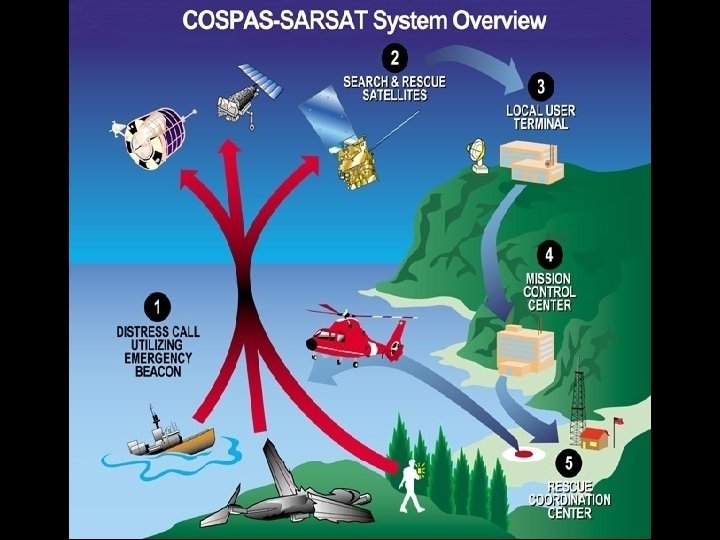
 If No GMDSS Response • • GMDSS satellite system is worldwide but it could be possible that you do not receive a response because your own equipment is inoperative. If you have an Iridium telephone, call preprogrammed emergency numbers (USCG, etc) Activate your 406 mhz EPIRB, hopefully equipped with GPS. Wait patiently.
 Enough Emergencies Already… On to Part Two:
 Routine Personal Communications • We’ve been out for a week and I want to let my family know our location and condition. • I want to check in with the daily ham radio network and give location, weather and condition. • I just want to yack with other sailors. • I want to check in to a ship-to-ship network.
 Business Communications • We need some replacement parts when we get ashore. • Something has broken down and I have to speak with a shore side technician. • Be aware of restrictions on business communications.
 So, How Do We Do This?
 Before We Talk Equipment… In case you are in charge of communications or equipping a vessel, there are some questions:
 Qualifying Questions • • • How far do you want to communicate? With whom? How often will you use it? How important is the message? How much skill is reasonable to expect of the operator?
 How Far Do You Want to Communicate? • • Effective transmission distances range from line of sight to worldwide. What is propagation? Communicating with more powerful devices may interfere with other communications. High power equipment will affect battery life.
 What Kind of Communications? • • • Voice Data (e-mail) Fax Internet Access Emergency
 Portable or Fixed Mounted? • Portables: Independent from ship’s systems Convenient • Fixed mounted units: May have better antenna installations Higher power
 With Whom Do You Want to Communicate? • • Coast Guard or other rescue agencies Other vessels Recreational Commercial • • Telephone network Internet E-mail Web Browsing • Land stations (bridge tenders, YCs)
 How often Will You Use It? • Will impact total cost of operation Battery sizes, generators, fuel • • Monthly charges Familiarity, ease of operation
 How Much Skill is Reasonable to Expect of the Operator? • Ham, in particular, is difficult for non-Hams to operate (and illegal) • SSBs have a lesser but still challenging operating system. • Other systems are as familiar as a portable phone
 Now Let’s Communicate • • VHF Single Side Band (a misnomer) Ham Radio Email (commercial – ham) Portable Satellite (Iridium) Fixed Satellite (Inmarsat C - M) EPIRB
 A Word About Licensing • • • VHF U. S. coastwise, no license. VHF foreign – ship/operator license (ROP). SSB worldwide – ship/operator license (MROP). Ham – U. S. license and permission if foreign. Satellite – no license but contract. Contact www. fcc. gov for information and forms Restricted Radiotelephone Operator Permit Marine Radio Operator Permit (OCC classes) Ship Radio Station License
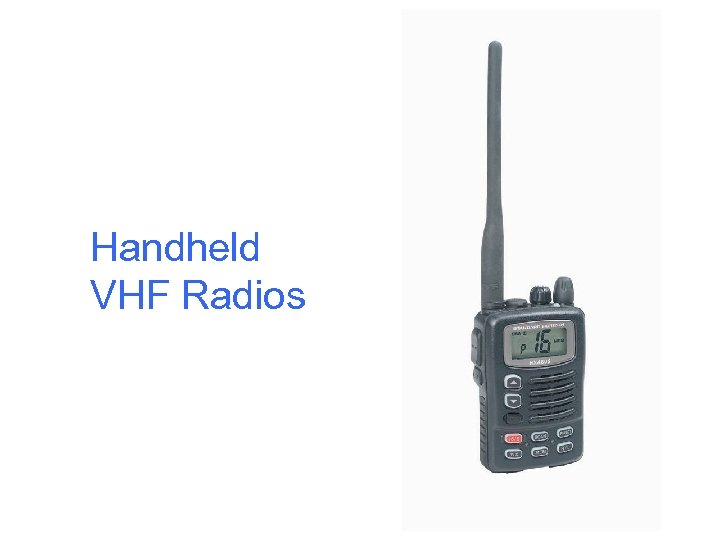 Handheld VHF Radios
 Handheld VHF Range: Cost: Best Uses: Limitations: 3 miles (another boat) to 20 miles (CG tower) $100 to $300 Cockpit safety, ship to dinghy, small boats (inflatables, kayaks) Some uses are illegal but handy, short range, few channels
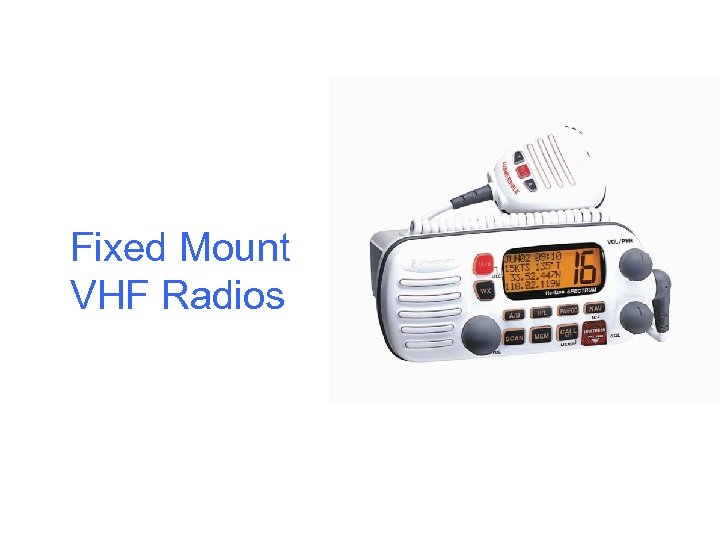 Fixed Mount VHF Radios
 Fixed Mount VHF Range: Cost: Best Uses: Limitations: 20 -60 miles (1. 2 x sqrt H in feet) $100 to $500 General boat to boat communications Coast Guard; most cost-effective safety item on board if within range Probably Digital Selective Calling Marine only, line of sight range
 ISAF Special Regs for VHF • • • Radio shall have 25 W output Masthead antenna No more than 40% power loss due to cable <50’ 50 -90’ 90 -140’ 140 -230’ • RG-8 X RG-8 U 9913 F LMR 600 Handheld VHF in addition to fixed mount
 VHF Antenna Considerations • • Antenna height largely controls transmit range Higher gain antennas can focus signal to increase punch or power Boats which roll require a wider transmission angle to avoid “clipping” Use the largest lead-in wire (coax) that can be used ORC Regulations • Use coax connectors for all terminations
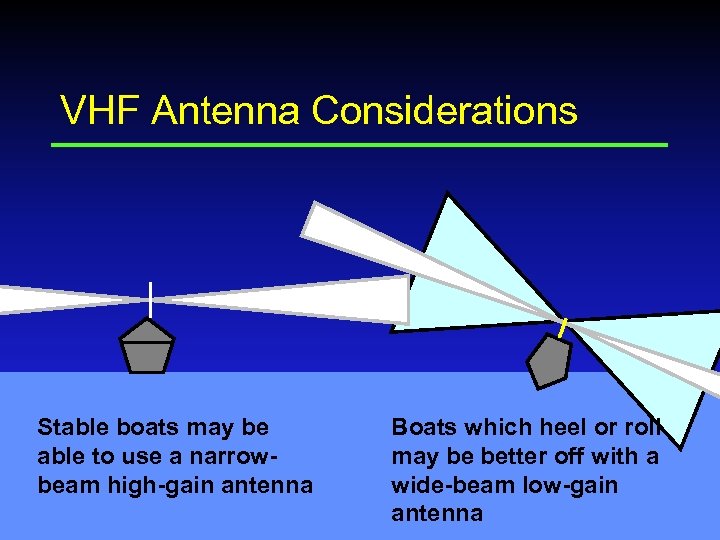 VHF Antenna Considerations Stable boats may be able to use a narrowbeam high-gain antenna Boats which heel or roll may be better off with a wide-beam low-gain antenna
 A Word About Digital Selective Calling • • • New safety requirement Free registration Unique vessel identifier Part of GMDSS (Global Marine Distress Safety System) Currently supplied on fixed VHF and some other communications equipment Not yet monitored by Coast Guard
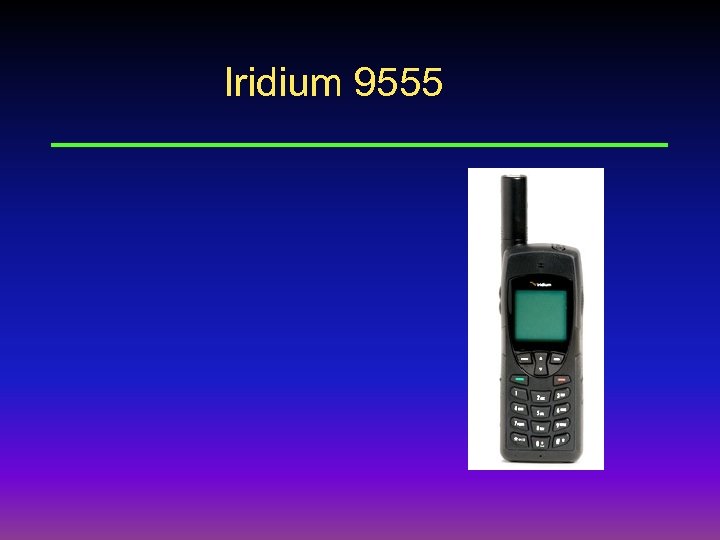 Iridium 9555
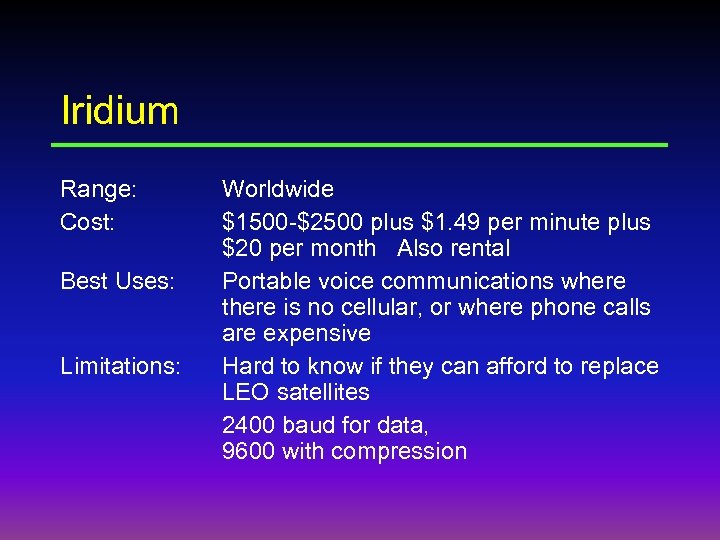 Iridium Range: Cost: Best Uses: Limitations: Worldwide $1500 -$2500 plus $1. 49 per minute plus $20 per month Also rental Portable voice communications where there is no cellular, or where phone calls are expensive Hard to know if they can afford to replace LEO satellites 2400 baud for data, 9600 with compression
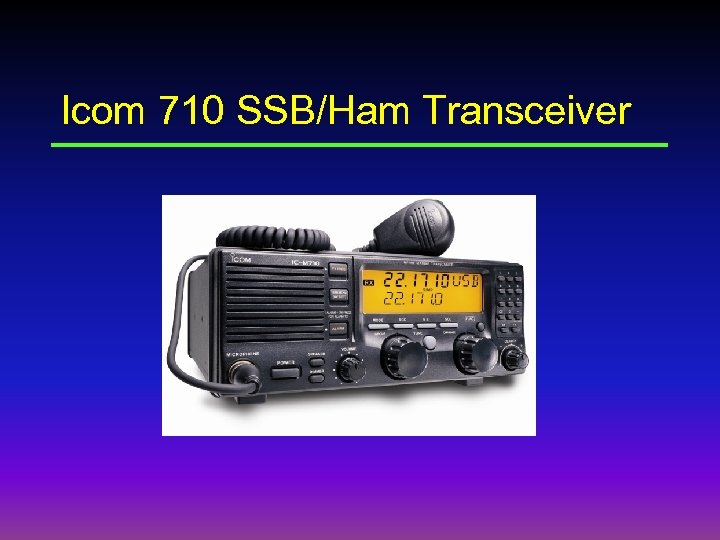 Icom 710 SSB/Ham Transceiver
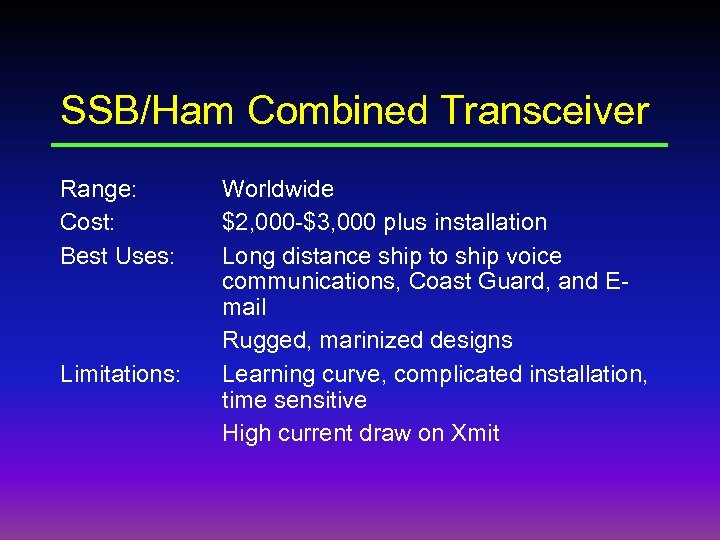 SSB/Ham Combined Transceiver Range: Cost: Best Uses: Limitations: Worldwide $2, 000 -$3, 000 plus installation Long distance ship to ship voice communications, Coast Guard, and Email Rugged, marinized designs Learning curve, complicated installation, time sensitive High current draw on Xmit
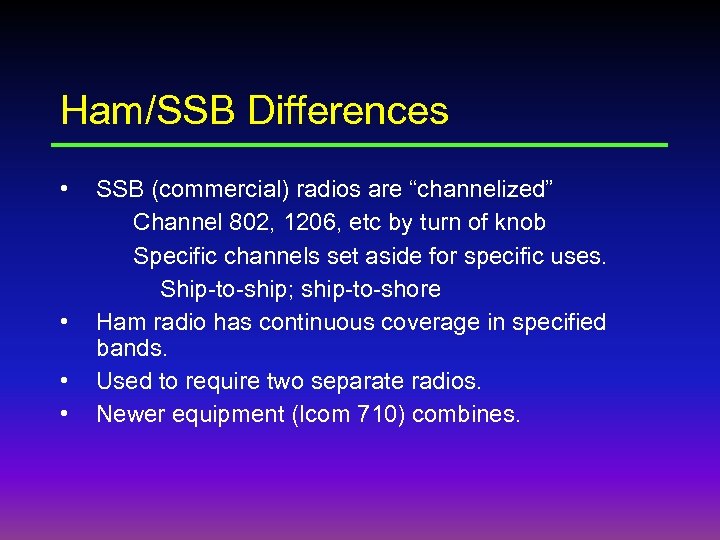 Ham/SSB Differences • • SSB (commercial) radios are “channelized” Channel 802, 1206, etc by turn of knob Specific channels set aside for specific uses. Ship-to-ship; ship-to-shore Ham radio has continuous coverage in specified bands. Used to require two separate radios. Newer equipment (Icom 710) combines.
 HF Antenna Considerations • Two general types 23’ fiberglass whip antennas Insulated wire antennas • • Requires an antenna tuner to match frequency to wire length Requires a “counterpoise” in contact with water or coupled to water
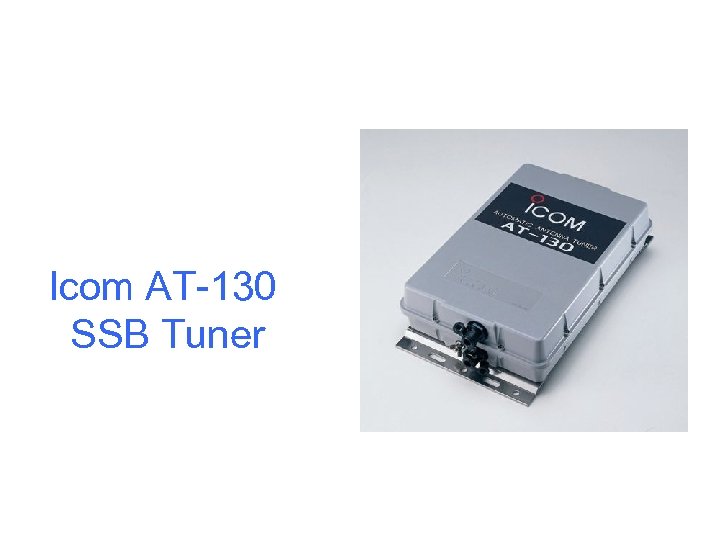 Icom AT-130 SSB Tuner
 E-mail via SSB or Ham • • Requires a radio, laptop, and TNC (Terminal Node Controller, $650) Slow transmission rates Several non-profit services (Sailmail and Win. Link) Commercial WLO Radio (www. wloradio. com) 10 minute per day limit (Sailmail) Very inexpensive compared to other options HAM transmissions limited by non-commercial rules
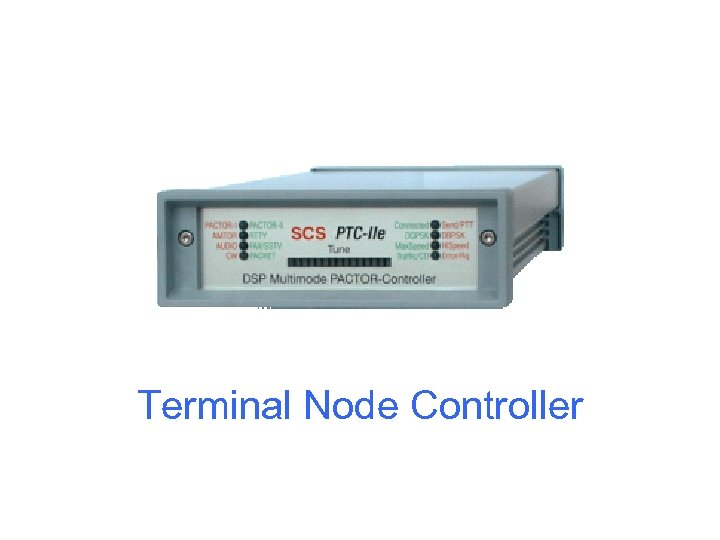 Terminal Node Controller
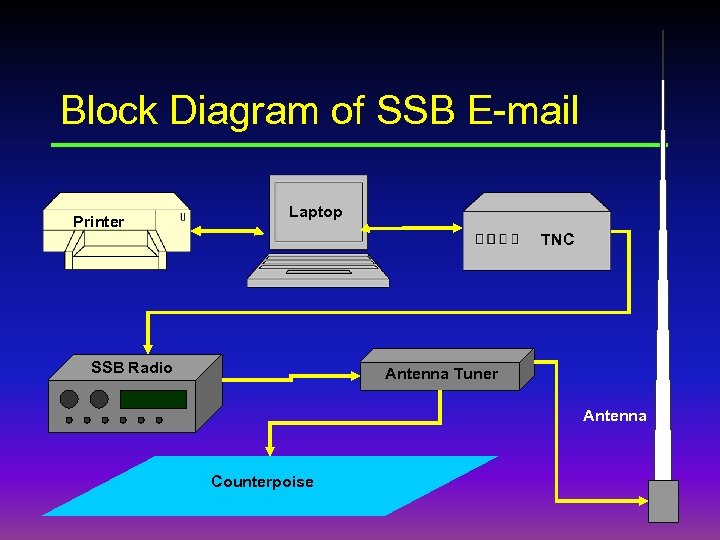 Block Diagram of SSB E-mail Printer Laptop TNC SSB Radio Antenna Tuner Antenna Counterpoise
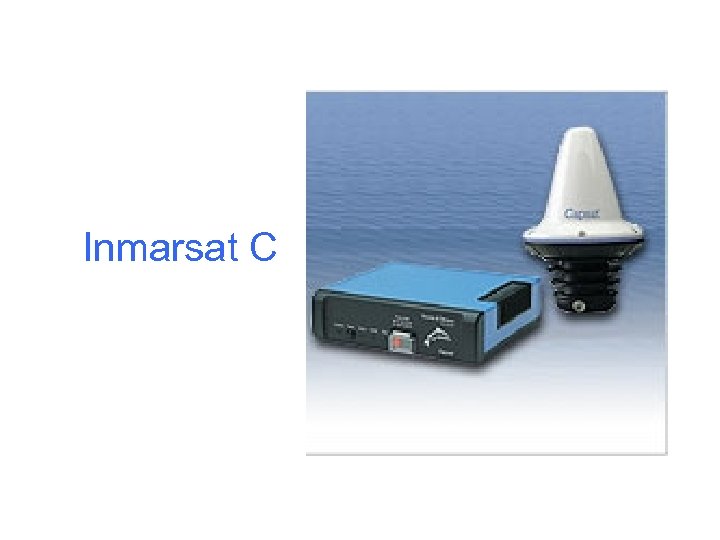 Inmarsat C
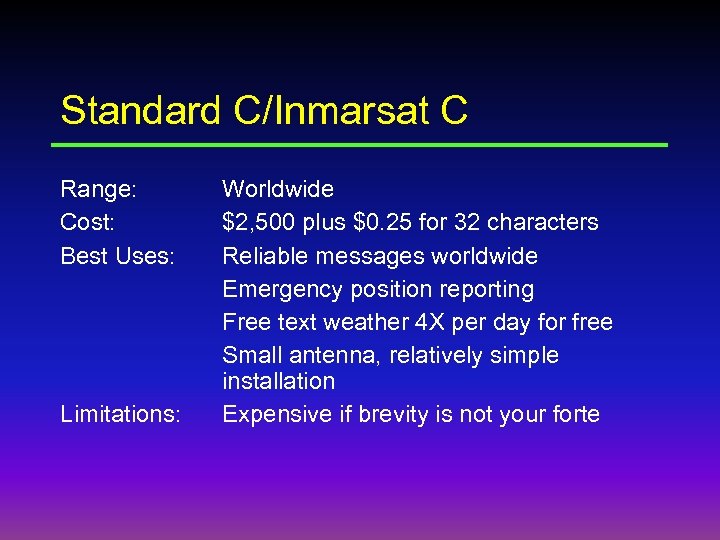 Standard C/Inmarsat C Range: Cost: Best Uses: Limitations: Worldwide $2, 500 plus $0. 25 for 32 characters Reliable messages worldwide Emergency position reporting Free text weather 4 X per day for free Small antenna, relatively simple installation Expensive if brevity is not your forte
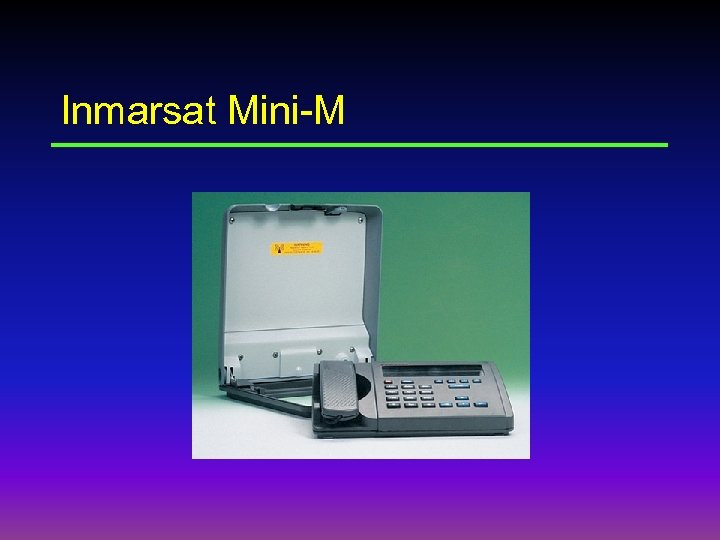 Inmarsat Mini-M
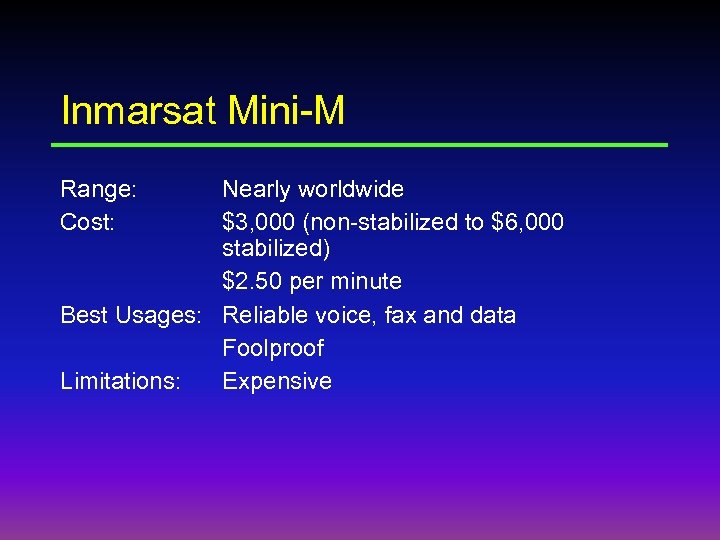 Inmarsat Mini-M Range: Cost: Nearly worldwide $3, 000 (non-stabilized to $6, 000 stabilized) $2. 50 per minute Best Usages: Reliable voice, fax and data Foolproof Limitations: Expensive
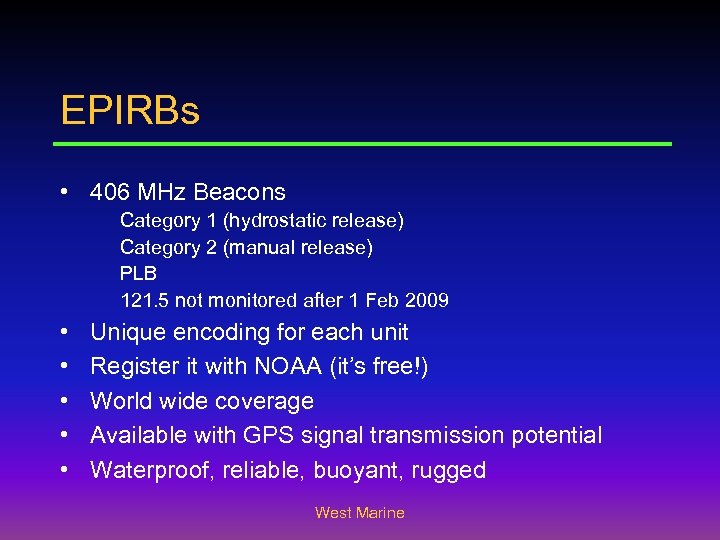 EPIRBs • 406 MHz Beacons Category 1 (hydrostatic release) Category 2 (manual release) PLB 121. 5 not monitored after 1 Feb 2009 • • • Unique encoding for each unit Register it with NOAA (it’s free!) World wide coverage Available with GPS signal transmission potential Waterproof, reliable, buoyant, rugged West Marine
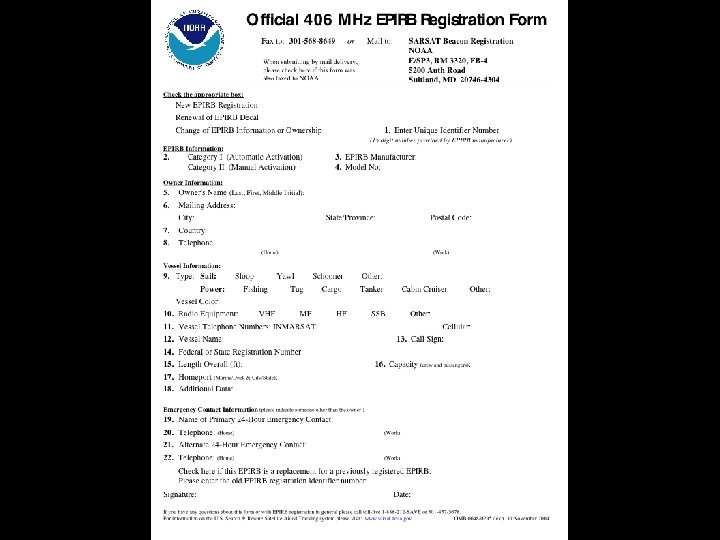
 Keep Your Info Current It’s free West Marine
 GMDSS Global Marine Distress & Safety System • • • Evolved from 1979 meeting of IMO (International Maritime Organization) Satellite- and terrestrial radio-based Changed from ship-to-ship to ship-to-shore Uses Rescue Coordination Centers End of Morse Code Enables automatic transmissions Reduces need to monitor emergency frequencies • • Applies to ships over 300 gross tons Cost me my job….
 Additional Notes • National Distress Response System (NDRS) VHF based system, coastal and 30 miles out. Digitally based system plus voice Direction finding ability by Coast Guard using multiple towers or GPS input Automated broadcasts Up to six emergency channels RCCs connected to NDRS Completion by end of 2007 or 2008 (hopefully)
 The End • Thank you for your attention • This presentation available at www. arholub. com