 Скачать презентацию Mardi Gras and Neighbor s day Mardi Gras
Mardi Gras and Neighbor`s day.pptx
- Количество слайдов: 15



Mardi Gras and Neighbor’s day
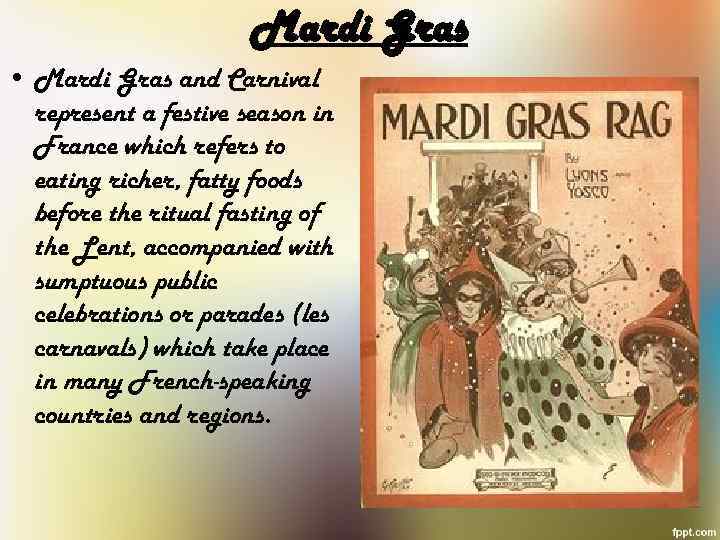
Mardi Gras • Mardi Gras and Carnival represent a festive season in France which refers to eating richer, fatty foods before the ritual fasting of the Lent, accompanied with sumptuous public celebrations or parades (les carnavals) which take place in many French-speaking countries and regions.

• Mardi Gras (literally from French “Fat Tuesday”) is originally a catholic event which marks the end of the “week of the seven fat days” which were known as “jours charnels” (meaning carnival) in the old days. Before Ash Wednesday*, the start of the fasting period of Lent, people celebrated in many diverse ways as it was their last chance until Easter to eat meat. *Ash Wednesday - the first day of Lent in Catholic, Anglican and some Lutheran countries, which takes place for 46 days (1. 5 months) before the Easter holiday. In Catholicism, strict fasting is prescribed on this day. In CIS countries this holliday matches with Clean Monday.

• The word “carnival” derives from the Latin “carnelevare” meaning “to take out the meat”. Indeed, meat was banished from the table during the whole period of Lent, as was sugar, ingredients containing fat, eggs and dairy products.
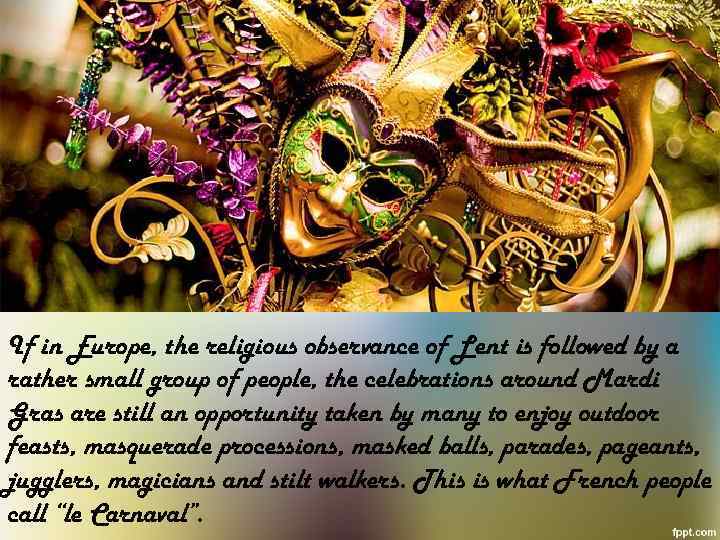
If in Europe, the religious observance of Lent is followed by a rather small group of people, the celebrations around Mardi Gras are still an opportunity taken by many to enjoy outdoor feasts, masquerade processions, masked balls, parades, pageants, jugglers, magicians and stilt walkers. This is what French people call “le Carnaval”.

Mardi Gras in USA • Many historians believe that the first American Mardi Gras took place on March 3, 1699, when the French explorers Iberville and Bienville landed in what is now Louisiana, just south of the holiday’s future epicenter: New Orleans. They held a small celebration and dubbed the spot Point du Mardi Gras. In the decades that followed, New Orleans and other French settlements began marking the holiday with street parties, masked balls and lavish dinners. When the Spanish took control of New Orleans, however, they abolished these rowdy rituals, and the bans remained in force until Louisiana became a U. S. state in 1812.
• Louisiana is the only state in which Mardi Gras is a legal holiday. However, elaborate carnival festivities draw crowds in other parts of the United States during the Mardi Gras season as well, including Alabama and Mississippi. Each region has its own events and traditions.
Around the world • Across the globe, pre-Lenten festivals continue to take place in many countries with significant Roman Catholic populations. Brazil’s weeklong Carnival festivities feature a vibrant amalgam of European, African and native traditions. In Canada, Quebec City hosts the giant Quebec Winter Carnival. In Italy, tourists flock to Venice’s Carnevale, which dates back to the 13 th century and is famous for its masquerade balls. Known as Karneval, Fastnacht or Fasching, the German celebration includes parades, costume balls and a tradition that empowers women to cut off men’s ties. For Denmark’s Fastevlan, children dress up and gather candy in a similar manner to Halloween–although the parallel ends when they ritually flog their parents on Easter Sunday morning.

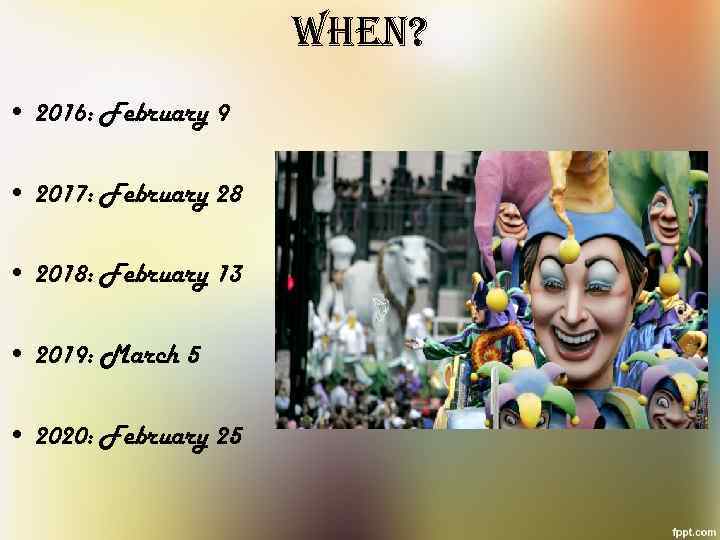
When? • 2016: February 9 • 2017: February 28 • 2018: February 13 • 2019: March 5 • 2020: February 25
Neighbor’s day (or une fête des voisins) • Neighbor day had been invented in 1999. • It is celebrated on the last Sunday in March every year with the aim of fostering strong personal connections that last the whole year round. Every day can be neighbor day.
• In 2017, Neighbor Day falls on Sunday 26 March, 2017. • Nowadays, 42 countries celebrate Neighbor day to break the anonymity and isolation that often prevail in our cities.
• The principal aim of Neighbour Day is to build better relationships with the people who live around us, especially the elderly and vulnerable. Neighbours are important because good relationships with others can and do change communities.
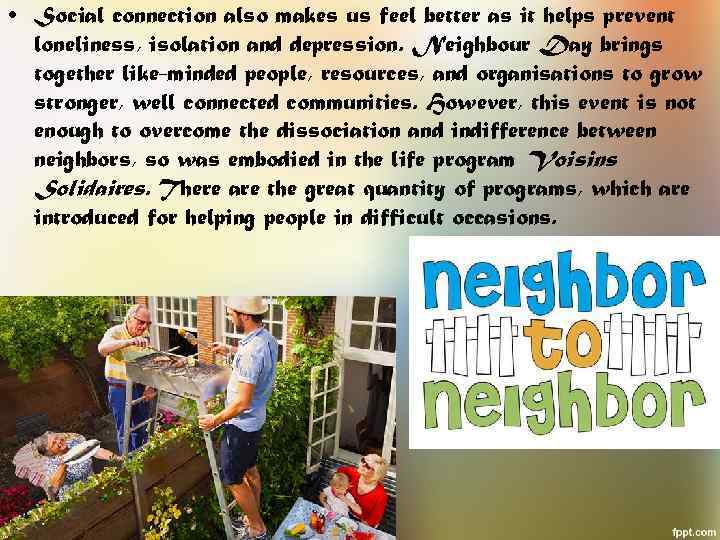
• Social connection also makes us feel better as it helps prevent loneliness, isolation and depression. Neighbour Day brings together like-minded people, resources, and organisations to grow stronger, well connected communities. However, this event is not enough to overcome the dissociation and indifference between neighbors, so was embodied in the life program Voisins Solidaires. There are the great quantity of programs, which are introduced for helping people in difficult occasions.

th. An. K You For Attent. Ion!!!
Скачать презентацию Mardi Gras and Neighbor s day Mardi Gras
Mardi Gras and Neighbor`s day.pptx