


 Скачать презентацию March 2012 doc IEEE 802 11 -12 0244
39da30638f852c9b919709ca0ca11494.ppt
- Количество слайдов: 12
 March 2012 doc. : IEEE 802. 11 -12/0244 r 0 Experimental results of indoor path-loss in actual European houses Authors: Submission Date: 2012 -03 -12 Slide 1 Panasonic
 March 2012 doc. : IEEE 802. 11 -12/0244 r 0 Abstract l Experimental results of indoor path-loss in actual European houses. l Suggestion of link budget value, especially for down link, for HEMS (Home Energy Management System), based on the measurement results. l Consideration of TX output power requirement Submission Slide 2 Panasonic
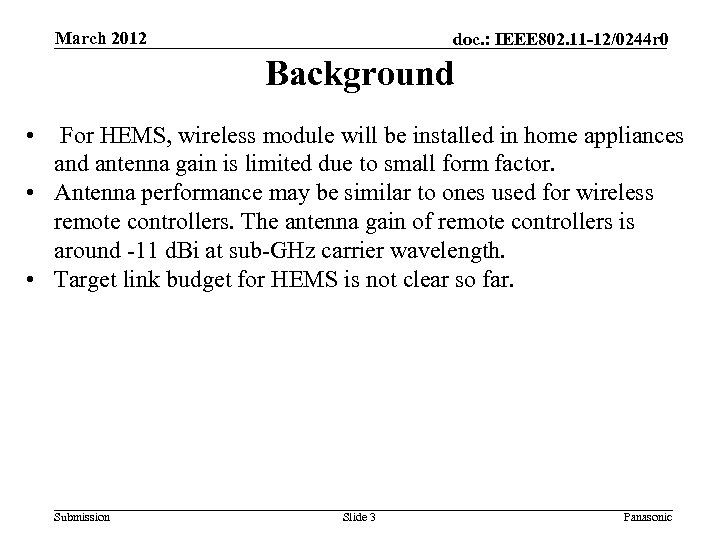 March 2012 doc. : IEEE 802. 11 -12/0244 r 0 Background • For HEMS, wireless module will be installed in home appliances and antenna gain is limited due to small form factor. • Antenna performance may be similar to ones used for wireless remote controllers. The antenna gain of remote controllers is around -11 d. Bi at sub-GHz carrier wavelength. • Target link budget for HEMS is not clear so far. Submission Slide 3 Panasonic
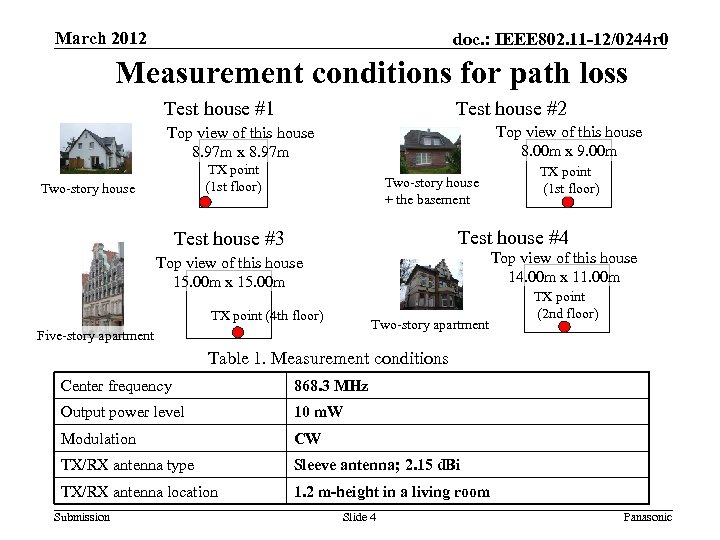 March 2012 doc. : IEEE 802. 11 -12/0244 r 0 Measurement conditions for path loss Test house #1 Test house #2 Top view of this house 8. 00 m x 9. 00 m Top view of this house 8. 97 m x 8. 97 m TX point (1 st floor) Two-story house + the basement Test house #4 Test house #3 Top view of this house 14. 00 m x 11. 00 m Top view of this house 15. 00 m x 15. 00 m TX point (4 th floor) Two-story apartment Five-story apartment TX point (2 nd floor) Table 1. Measurement conditions Center frequency 868. 3 MHz Output power level 10 m. W Modulation CW TX/RX antenna type Sleeve antenna; 2. 15 d. Bi TX/RX antenna location 1. 2 m-height in a living room Submission Slide 4 Panasonic
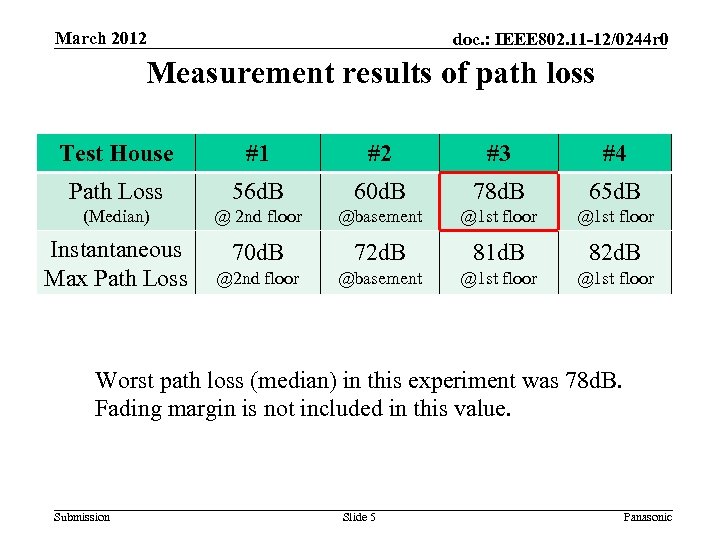 March 2012 doc. : IEEE 802. 11 -12/0244 r 0 Measurement results of path loss Test House #1 #2 #3 #4 Path Loss 56 d. B 60 d. B 78 d. B 65 d. B (Median) @ 2 nd floor @basement @1 st floor Instantaneous Max Path Loss 70 d. B 72 d. B 81 d. B 82 d. B @2 nd floor @basement @1 st floor Worst path loss (median) in this experiment was 78 d. B. Fading margin is not included in this value. Submission Slide 5 Panasonic
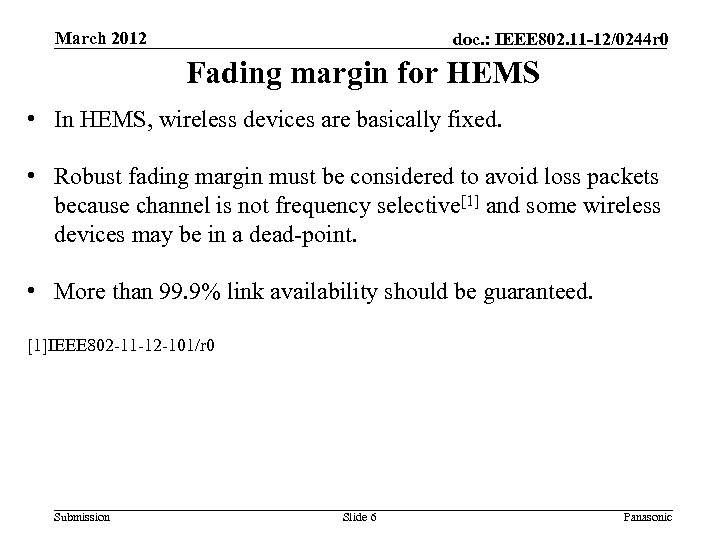 March 2012 doc. : IEEE 802. 11 -12/0244 r 0 Fading margin for HEMS • In HEMS, wireless devices are basically fixed. • Robust fading margin must be considered to avoid loss packets because channel is not frequency selective[1] and some wireless devices may be in a dead-point. • More than 99. 9% link availability should be guaranteed. [1]IEEE 802 -11 -12 -101/r 0 Submission Slide 6 Panasonic
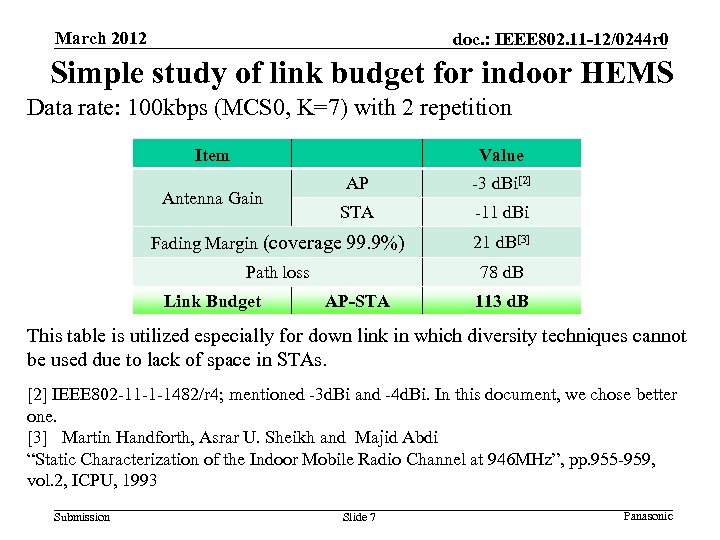 March 2012 doc. : IEEE 802. 11 -12/0244 r 0 Simple study of link budget for indoor HEMS Data rate: 100 kbps (MCS 0, K=7) with 2 repetition Item Value Antenna Gain AP -3 d. Bi[2] STA -11 d. Bi Fading Margin (coverage 99. 9%) 21 d. B[3] Path loss 78 d. B Link Budget AP-STA 113 d. B This table is utilized especially for down link in which diversity techniques cannot be used due to lack of space in STAs. [2] IEEE 802 -11 -1 -1482/r 4; mentioned -3 d. Bi and -4 d. Bi. In this document, we chose better one. [3] Martin Handforth, Asrar U. Sheikh and Majid Abdi “Static Characterization of the Indoor Mobile Radio Channel at 946 MHz”, pp. 955 -959, vol. 2, ICPU, 1993 Submission Slide 7 Panasonic
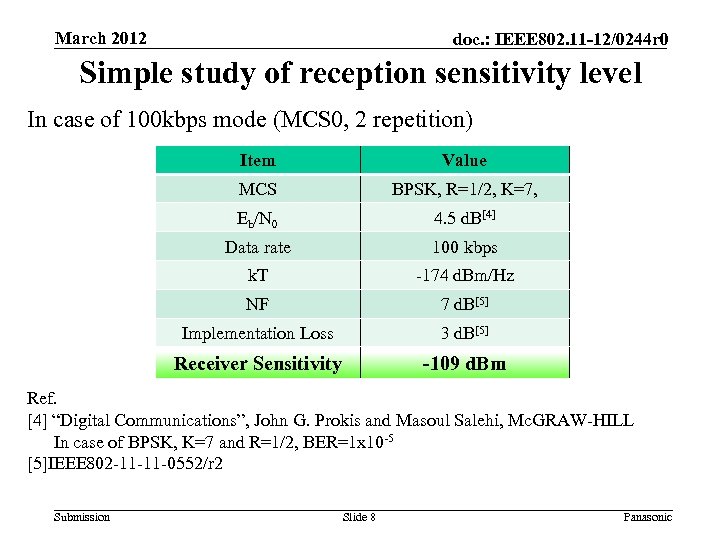 March 2012 doc. : IEEE 802. 11 -12/0244 r 0 Simple study of reception sensitivity level In case of 100 kbps mode (MCS 0, 2 repetition) Item Value MCS BPSK, R=1/2, K=7, Eb/N 0 4. 5 d. B[4] Data rate 100 kbps k. T -174 d. Bm/Hz NF 7 d. B[5] Implementation Loss 3 d. B[5] Receiver Sensitivity -109 d. Bm Ref. [4] “Digital Communications”, John G. Prokis and Masoul Salehi, Mc. GRAW-HILL In case of BPSK, K=7 and R=1/2, BER=1 x 10 -5 [5]IEEE 802 -11 -11 -0552/r 2 Submission Slide 8 Panasonic
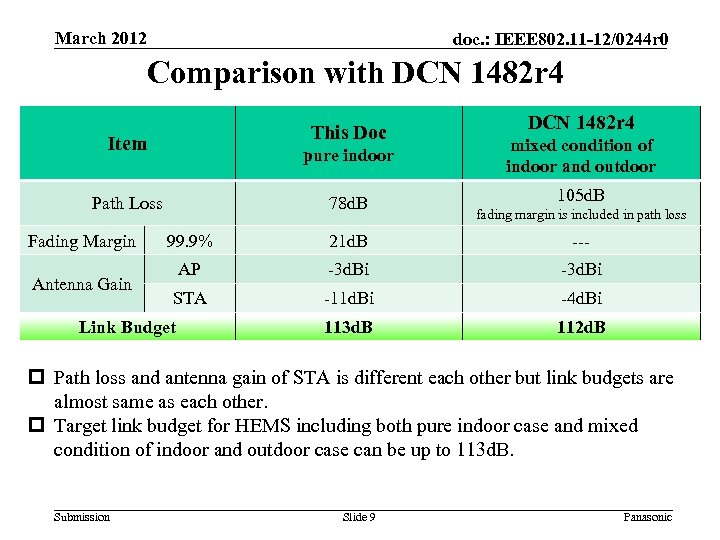 March 2012 doc. : IEEE 802. 11 -12/0244 r 0 Comparison with DCN 1482 r 4 This Doc Item pure indoor Antenna Gain mixed condition of indoor and outdoor 78 d. B Path Loss Fading Margin DCN 1482 r 4 105 d. B fading margin is included in path loss 99. 9% 21 d. B --- AP -3 d. Bi STA -11 d. Bi -4 d. Bi 113 d. B 112 d. B Link Budget p Path loss and antenna gain of STA is different each other but link budgets are almost same as each other. p Target link budget for HEMS including both pure indoor case and mixed condition of indoor and outdoor case can be up to 113 d. B. Submission Slide 9 Panasonic
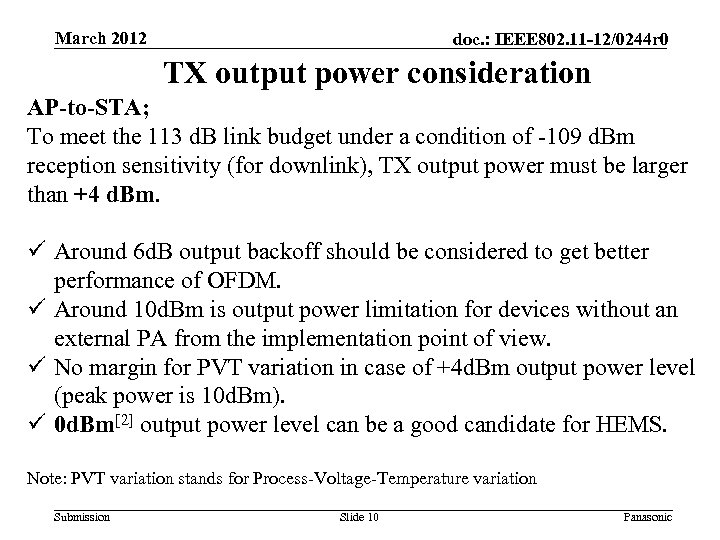 March 2012 doc. : IEEE 802. 11 -12/0244 r 0 TX output power consideration AP-to-STA; To meet the 113 d. B link budget under a condition of -109 d. Bm reception sensitivity (for downlink), TX output power must be larger than +4 d. Bm. ü Around 6 d. B output backoff should be considered to get better performance of OFDM. ü Around 10 d. Bm is output power limitation for devices without an external PA from the implementation point of view. ü No margin for PVT variation in case of +4 d. Bm output power level (peak power is 10 d. Bm). ü 0 d. Bm[2] output power level can be a good candidate for HEMS. Note: PVT variation stands for Process-Voltage-Temperature variation Submission Slide 10 Panasonic
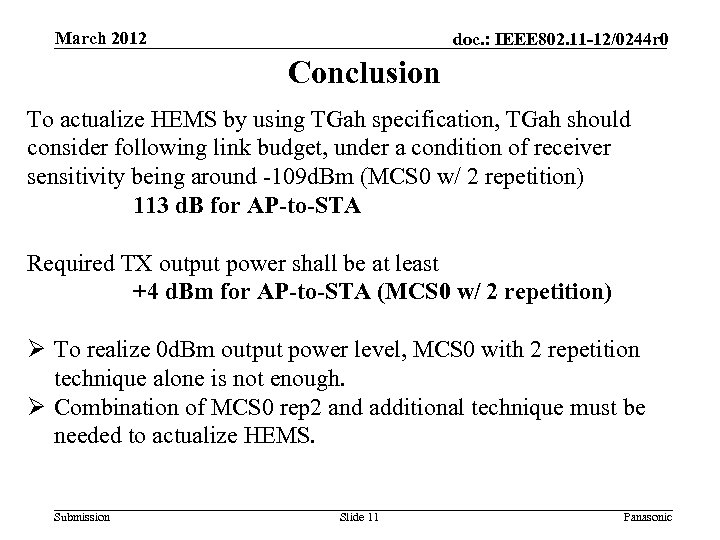 March 2012 doc. : IEEE 802. 11 -12/0244 r 0 Conclusion To actualize HEMS by using TGah specification, TGah should consider following link budget, under a condition of receiver sensitivity being around -109 d. Bm (MCS 0 w/ 2 repetition) 113 d. B for AP-to-STA Required TX output power shall be at least +4 d. Bm for AP-to-STA (MCS 0 w/ 2 repetition) Ø To realize 0 d. Bm output power level, MCS 0 with 2 repetition technique alone is not enough. Ø Combination of MCS 0 rep 2 and additional technique must be needed to actualize HEMS. Submission Slide 11 Panasonic
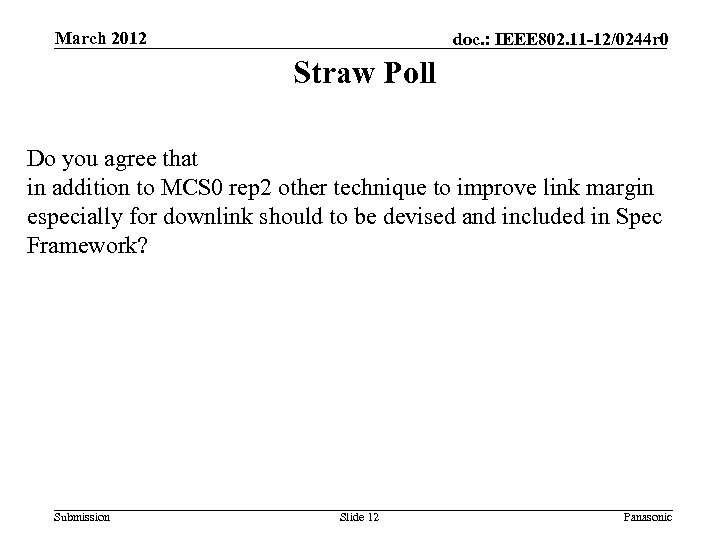 March 2012 doc. : IEEE 802. 11 -12/0244 r 0 Straw Poll Do you agree that in addition to MCS 0 rep 2 other technique to improve link margin especially for downlink should to be devised and included in Spec Framework? Submission Slide 12 Panasonic