 Project: IEEE P 802. 15 Working Group for Wireless Personal Area Networks (WPANs) Submission Title: [Smart Grid: Faulted Circuit Indicator] Date Submitted: [March 7, 2011] Source: [David A. Howard, John Geiger] Company [On-Ramp Wireless, GE Energy Services] Address [10920 Via Frontera Suite 200, San Diego, CA 92129 USA] Voice: [+1(858)592 -6008], FAX: [+1(858)592 -6009], E-Mail: [david. a. howard@ieee. org, john. geiger@ge. com] Re: [January 2011, IEEE 802. 15. 4 k LECIM Task Group Call For Applications DCN: 0105] Abstract: [Wireless Faulted Circuit Indicator application] Purpose: [Response to 802. 15. 4 k CFA, for use in generating application requirements] Notice: This document has been prepared to assist the IEEE P 802. 15. It is offered as a basis for discussion and is not binding on the contributing individual(s) or organization(s). The material in this document is subject to change in form and content after further study. The contributor(s) reserve(s) the right to add, amend or withdraw material contained herein. Release: The contributor acknowledges and accepts that this contribution becomes the property of IEEE and may be made publicly available by P 802. 15. Submission Slide 1
 Faulted Circuit Indicator (FCI) • Faulted circuit indicators were introduced in Germany in 1946. Since that time FCIs have been used to locate problems on medium voltage electrical distribution circuits throughout the world. • Also known as ground fault indicators, earth fault indicators, short-circuit indicators, or simply fault indicators • Used to improve power system reliability • Can help identify problem areas of distribution system (fault localization) Submission Slide 2
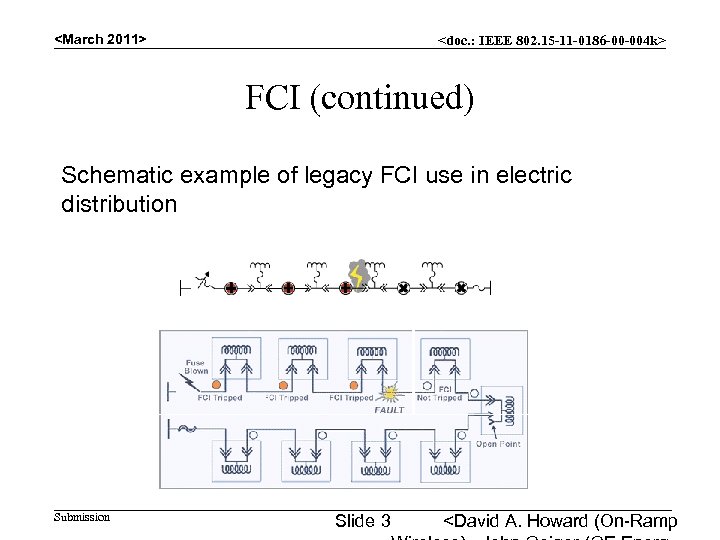 FCI (continued) Schematic example of legacy FCI use in electric distribution Submission Slide 3
 FCI Benefits (traditional) • Reduction of outage duration – Enables service crews to rapidly identify location of fault by patrolling area • Improve system reliability • Reduction of operating costs Submission Slide 4
 FCI Benefits (wireless) • New functionality possible with wireless solutions – – Enable crews to be dispatch directly to the fault area Locate momentary/transient faults Coordinate automated reclosing schemes Monitor load current, voltage, temperature, and events • improved modeling of grid events, and reliability metrics – Change fault thresholds – Improved planning based on load data – Safety, e. g. Fire prevention Submission Slide 5
 FCI Benefits (wireless with Time Sync) • New functionality possible with single digit u. S timing accuracy – – Determine location of fault with ~100 meter accuracy Pin-point location of momentary/transient faults Increase distance between FCI in rural areas Synchronized monitoring load current, voltage, temperature, and events – Improved modeling of grid events, and reliability metrics Submission , Services)>
 FCI Data Model Up. Link • Periodic/scheduled – Once per day – <100 octets – Average load, temperature, transient/momentary events statistics, battery status • Event/asynchronous/unscheduled/alarm – 50 (? ) per FCI per year – <100 octets – Average load, temperature, transient/momentary events statistics, battery status Submission Slide 7
 FCI Data Model (continued) • Downlink – Reliable transmission feedback (e. g. ACK) • <10 octets; infrequent (see uplink) – Parameter changes (thresholds, etc. ) • <10 octets; infrequent – Firmware update • Potentially 100’s of Kbytes; extremely rare • Latency – 10’s of seconds Submission Slide 8
 Deployment Scenarios • FCI – Above ground • Elevated • Pad mount cabinet – Below ground • Access Point/Aggregator – Tower/shared space Submission Slide 9
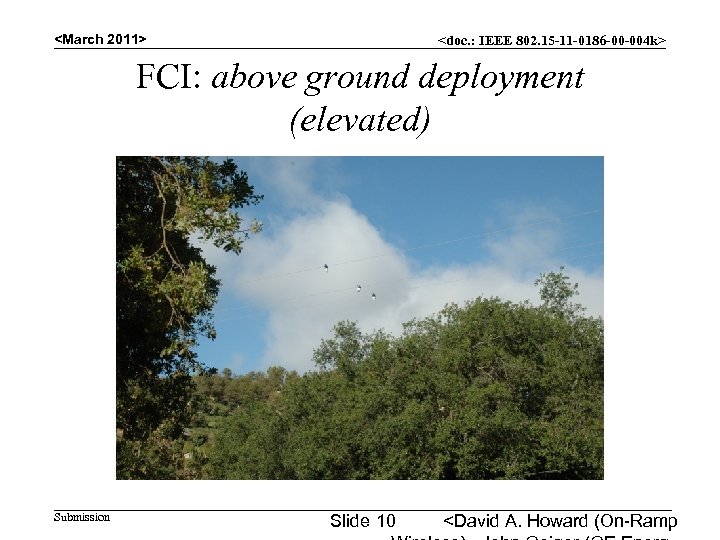 FCI: above ground deployment (elevated) Submission Slide 10
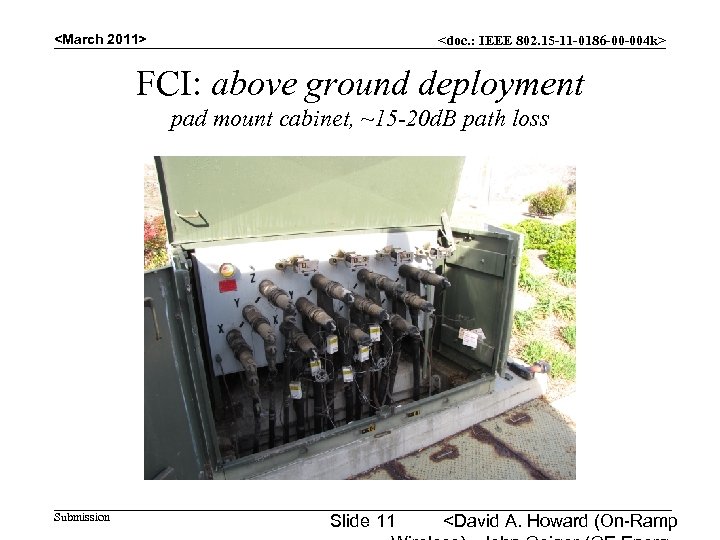 FCI: above ground deployment pad mount cabinet, ~15 -20 d. B path loss Submission Slide 11
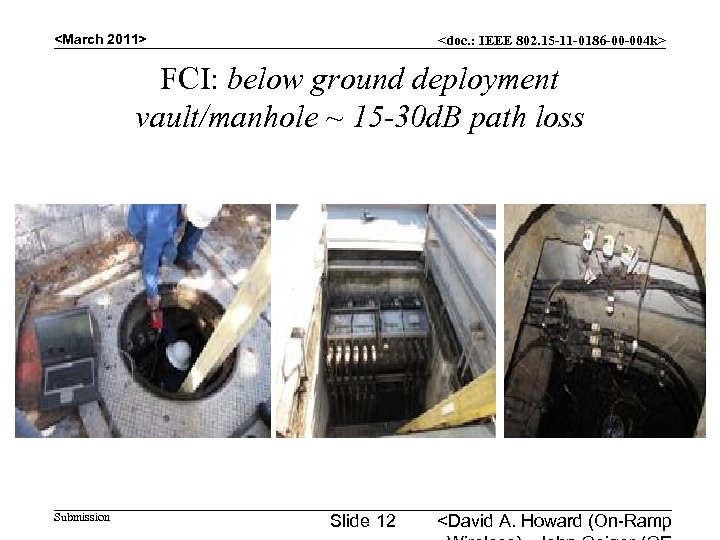 FCI: below ground deployment vault/manhole ~ 15 -30 d. B path loss Submission Slide 12
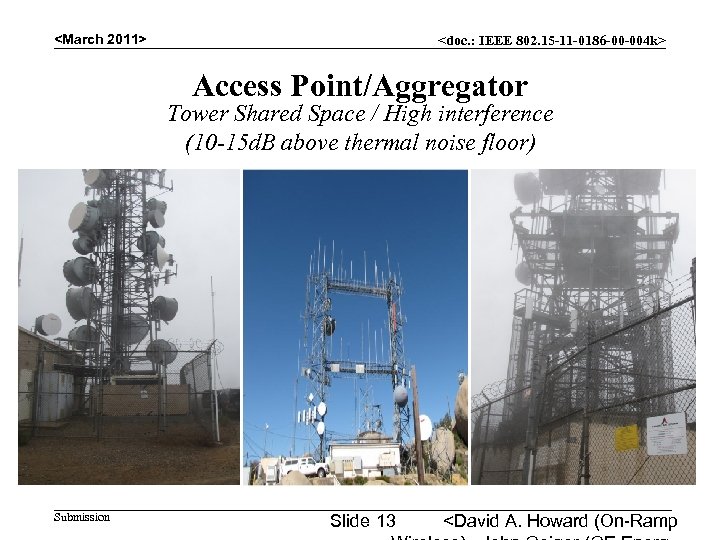 Access Point/Aggregator Tower Shared Space / High interference (10 -15 d. B above thermal noise floor) Submission Slide 13
 Power requirements • Faulted Circuit Indicator (10 -20 yr service life) – Battery (e. g. Lithium Thionyl Chloride Li. SOCl 2) – Power scavenging (e. g. inductive + super capacitor) • Access Point/Aggregator – Mains powered, UPS/Generator backup Submission Slide 14
 Market Size (distribution, estimate) • • USA 3 M EU 3 M Japan 614 K World 10 M • Based on number of customers, customers per transformer (~10 -15), and transformers per FCI (~5 -10) Submission Slide 15
 Application Requirements • Low infrastructure costs – Point to multi-thousands of point communications – Address spectrum availability/cost issues • Easily deployable – Minimal network complexity and number of active nodes – Access point/Standard network interface – IP – Standard device interface – Serial or IP • Able to communicate to underground/enclosed assets • Endpoint able to operate without primary power for many years – Small payload per day – Latency in seconds – Event time accurate to single digit u. S • Available embedded through OEM’s Submission Slide 16
 Скачать презентацию March 2011 doc IEEE 802 15 -11


