


 Скачать презентацию March 2009 doc IEEE 802 15 -09
104163ab6f678d7bdf5a93390efe2600.ppt
- Количество слайдов: 9
 March 2009 doc. : IEEE 802. 15 -09 -0149 -02 -0006 Project: IEEE P 802. 15 Working Group for Wireless Personal Area Networks (WPANs) Submission Title: Opening Report for the TG 6 Session in March 2009 Date Submitted: March 9, 2009 Source: Arthur Astrin Contact: Arthur Astrin, Astrin Radio Voice: +1 (650) 704 2517, E-Mail: astrin@ieee. org Re: TG 6 Opening Report for March 2009 Session Abstract: Opening report for the TG 6 Session. Purpose: To focus activities during the meeting Notice: This document has been prepared to assist the IEEE P 802. 15. It is offered as a basis for discussion and is not binding on the contributing individual(s) or organization(s). The material in this document is subject to change in form and content after further study. The contributor(s) reserve(s) the right to add, amend or withdraw material contained herein. Release: The contributor acknowledges and accepts that this contribution becomes the property of IEEE and maybe made publicly available by P 802. 15. Submission Slide 1 Arthur Astrin
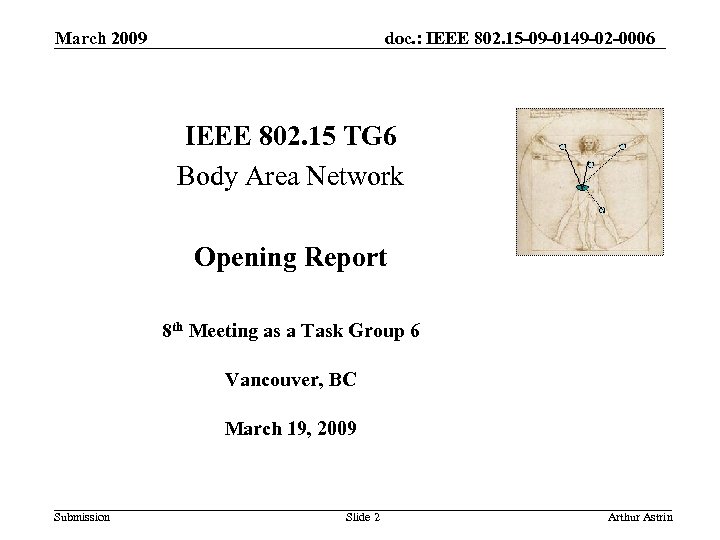 March 2009 doc. : IEEE 802. 15 -09 -0149 -02 -0006 IEEE 802. 15 TG 6 Body Area Network Opening Report 8 th Meeting as a Task Group 6 Vancouver, BC March 19, 2009 Submission Slide 2 Arthur Astrin
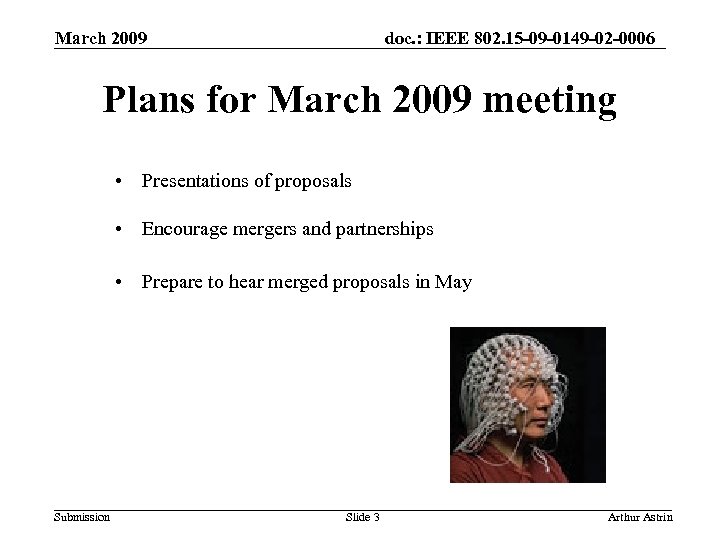 March 2009 doc. : IEEE 802. 15 -09 -0149 -02 -0006 Plans for March 2009 meeting • Presentations of proposals • Encourage mergers and partnerships • Prepare to hear merged proposals in May Submission Slide 3 Arthur Astrin
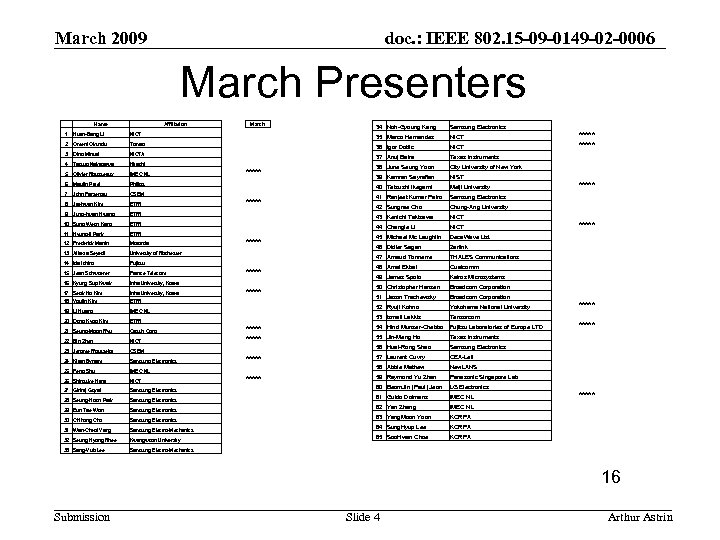 March 2009 doc. : IEEE 802. 15 -09 -0149 -02 -0006 March Presenters Name Affiliation March 34 Noh-Gyoung Kang Samsung Electronics 1 Huan-Bang Li NICT 35 Marco Hernandez NICT 2 Omeni Okundu Tomaz 36 Igor Dotlic NICT 3 Dino Minutti NICTA 37 Anuj Batra Texas Instruments 4 Tatsuo Nakagawa Hitachi 38 June Seung Yoon City University of New York 5 Olivier Rousseaux IMEC NL 39 Kamran Sayrafian NIST 6 Maulin Patel Philips 40 Tetsushi Ikegami Meiji University 7 John Farserotu CSEM 41 Ranjeet Kumar Patro Samsung Electronics 8 Jaehwan Kim ETRI 42 Sungrae Cho Chung-Ang University 9 Jung-hwan Hwang ETRI 43 Kenichi Takizawa NICT 10 Sung Weon Kang ETRI 44 Changle Li NICT 11 Hyung-il Park ETRI 45 Michael Mc Laughlin Deca. Wave Ltd. 12 Frederick Martin Motorola 46 Didier Sagan Zarlink 13 Alireza Seyedi University of Rochester 47 Arnaud Tonnerre THALES Communications 14 Ida Ichiro Fujitsu 48 Amal Ekbal Qualcomm 15 Jean Schwoerer France Telecom 49 James Spoto Kairos Microsystems 16 Kyung Sup Kwak Inha University, Korea 50 Christopher Hansen Broadcom Corporation 17 Seok Ho Kim Inha University, Korea 18 Youjin Kim ETRI 51 Jason Trachewsky Broadcom Corporation 19 Li Huang IMEC NL 52 Ryuji Kohno Yokohama National University 20 Dong Kyoo Kim ETRI 53 Ismail Lakkis Tensorcom 21 Seung-Moon Ryu Casuh Corp 22 Bin Zhen NICT 23 Jerome Rousselot CSEM 24 Kiran Bynam Samsung Electronics 25 Feng Shu IMEC NL 26 Shinsuke Hara NICT 27 Giriraj Goyal Samsung Electronics 28 Seung-Hoon Park Samsung Electronics 29 Eun Tae Won Samsung Electronics 30 Chihong Cho Samsung Electronics 31 Wan-Cheol Yang Samsung Electro-Mechanics 32 Seung Hyong Rhee Kwangwoon University 33 Sang-Yub Lee Samsung Electro-Mechanics ***** ***** 54 Hind Munzer-Chebbo Fujitsu Laboratories of Europe LTD ***** 55 Jin-Meng Ho ***** New. LANS 59 Raymond Yu Zhan ***** CEA-Leti 58 Abbie Mathew ***** Samsung Electronics 57 Laurent Ouvry ***** Texas Instruments 56 Huai-Rong Shao ***** Panasonic Singapore Lab 60 Beom. Jin (Paul) Jeon LG Electronics 61 Guido Dolmans IMEC NL 62 Yan Zhang 63 Yang. Moon Yoon KORPA 64 Sung. Hyup Lee KORPA 65 Soo. Hwan Choe ***** IMEC NL KORPA 16 Submission Slide 4 Arthur Astrin
 March 2009 doc. : IEEE 802. 15 -09 -0149 -02 -0006 Objectives for next few sessions • Presentations of proposals • Form partnerships, merge proposals • Select proposals that accommodate the requirements closest. • Drive towards comprehensive Baseline Draft Document (>5/09) • Appoint Technical Editors (5/09) Submission Slide 5 Arthur Astrin
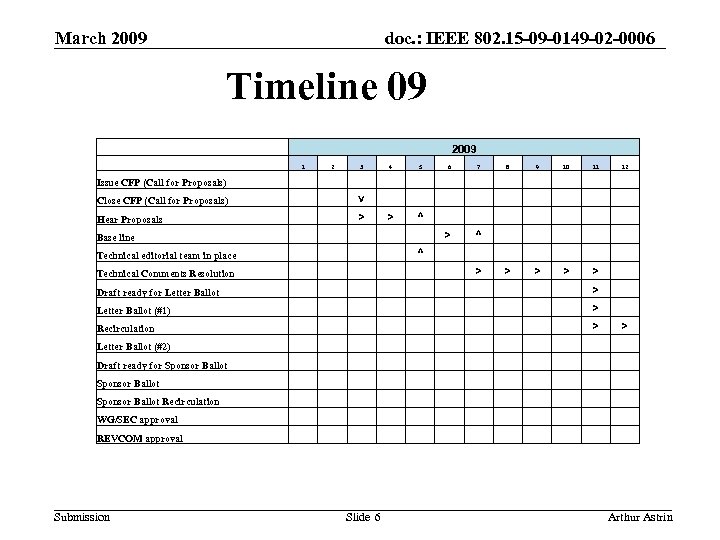 March 2009 doc. : IEEE 802. 15 -09 -0149 -02 -0006 Timeline 09 2009 1 2 3 4 5 6 7 8 9 10 11 12 Issue CFP (Call for Proposals) Close CFP (Call for Proposals) v Hear Proposals > > ^ Base line > ^ > > > Technical editorial team in place Technical Comments Resolution Draft ready for Letter Ballot > Letter Ballot (#1) > Recirculation > > Letter Ballot (#2) Draft ready for Sponsor Ballot Sponsor Ballot Recirculation WG/SEC approval REVCOM approval Submission Slide 6 Arthur Astrin
 March 2009 doc. : IEEE 802. 15 -09 -0149 -02 -0006 Thank You ! Any Questions ? Submission Slide 7 Arthur Astrin
 November 2008 doc. : IEEE 802. 15 -09 -0149 -02 -0006 Purpose of Proposed Standard (PAR 07 -0575) The purpose of the proposed standard it to provide an international standard for a short range (ie about human body range), low power and highly reliable wireless communication for use in close proximity to, or inside, a human body. Data rates, typically up to 10 Mbps, will be offered to satisfy an evolutionary set of entertainment and healthcare services. Current PANs do not meet the medical (proximity to human tissue) and relevant communication regulations for some application environments. They also do not support the combination of reliability (Qo. S), low power, data rate and noninterference required to broadly address the breadth of body area network applications. Submission Slide 8 Arthur Astrin
 November 2008 doc. : IEEE 802. 15 -09 -0149 -02 -0006 Need for the Project (PAR 07 -0575) There is a need for a standard optimized for ultra low power devices and operation on, in or around the human body to serve a variety of applications including medical and personal entertainment. Examples of the applications served by the proposed standard are: EEG, ECG, EMG, vital signals monitoring (temperature (wearable thermometer), respiratory, wearable heart rate monitor, wearable pulse oximeter, wearable blood pressure monitor, oxygen, p. H value , wearable glucose sensor, implanted glucose sensor, cardiac arrhythmia), wireless capsule endoscope (gastrointestinal), wireless capsule for drug delivery, deep brain stimulator, cortical stimulator (visual neuro-stimulator, audio neuro stimulator, Parkinson’s disease, etc…), remote control of medical devices such as pacemaker, actuators, insulin pump, hearing aid (wearable and implanted), retina implants, disability assistance, such as muscle tension sensing and stimulation, wearable weighing scale, fall detection, aiding sport training. This will include body-centric solutions for future wearable computers. In a similar vein, the same technology can provide effective solutions for personal entertainment as well. The existence of a body area network standard will provide opportunities to expand these product features, better healthcare and well being for the users. It will therefore result in economic opportunity for technology component suppliers and equipment manufacturers. Submission Slide 9 Arthur Astrin