


 Скачать презентацию March 2006 doc IEEE 802 22 -06 0030
f9b2df6cc0e6e759f265d7d935588478.ppt
- Количество слайдов: 192
 March 2006 doc. : IEEE 802. 22 -06/0030 r 1 IEEE 802. 22 WRAN Merger Framework IEEE P 802. 22 Wireless RANs Date: 2006 -03 -07 Authors: Notice: This document has been prepared to assist IEEE 802. 22. It is offered as a basis for discussion and is not binding on the contributing individual(s) or organization(s). The material in this document is subject to change in form and content after further study. The contributor(s) reserve(s) the right to add, amend or withdraw material contained herein. Release: The contributor grants a free, irrevocable license to the IEEE to incorporate material contained in this contribution, and any modifications thereof, in the creation of an IEEE Standards publication; to copyright in the IEEE’s name any IEEE Standards publication even though it may include portions of this contribution; and at the IEEE’s sole discretion to permit others to reproduce in whole or in part the resulting IEEE Standards publication. The contributor also acknowledges and accepts that this contribution may be made public by IEEE 802. 22. Patent Policy and Procedures: The contributor is familiar with the IEEE 802 Patent Policy and Procedures http: //standards. ieee. org/guides/bylaws/sb-bylaws. pdf including the statement "IEEE standards may include the known use of patent(s), including patent applications, provided the IEEE receives assurance from the patent holder or applicant with respect to patents essential for compliance with both mandatory and optional portions of the standard. " Early disclosure to the Working Group of patent information that might be relevant to the standard is essential to reduce the possibility for delays in the development process and increase the likelihood that the draft publication will be approved for publication. Please notify the Chair Carl R. Stevenson as early as possible, in written or electronic form, if patented technology (or technology under patent application) might be incorporated into a draft standard being developed within the IEEE 802. 22 Working Group. If you have questions, contact the IEEE Patent Committee Administrator at patcom@iee. org. > Submission Huawei, Next. Wave, Runcom, STMicroelectronics 1
 March 2006 doc. : IEEE 802. 22 -06/0030 r 1 Co-Authors Name Company Paul Piggin Cygnus Jianwei Zhang Phone No. 98, Lane 91, Eshan Road, Pudong Lujiazui Software Park, Huawei Address 86 -21 - Shanghai, China 200127 6864480824638 email zhangjianwei@huawei. com Eli Plotnik Paragon Israel +972 542 332 255 eli_p@paragon-communications. com Zion Hadad Runcom Israel +972544 560 655 Zionh@runcom. co. il STMicroelectronics 1060 E. Brokaw Rd. San Jose, CA 95131 USA 408 -467 -8436 Liwen. chu@st. com 408 -451 -8137 Kyeongsoo. kim@st. com 408 -451 -8109 george. vlantis@st. com Liwen Chu Kyeongsoo Kim STMicroelectronics 1060 E. Brokaw Rd. San Jose, CA 95131, USA George Vlantis STMicroelectronics 1060 E. Brokaw Rd. San Jose, CA 95131, USA Submission Huawei, Next. Wave, Runcom, STMicroelectronics 2
 March 2006 doc. : IEEE 802. 22 -06/0030 r 1 Abstract In this presentation, we provide a technical overview of a full proposal for the Physical (PHY) layer and the Medium Access Control (MAC) layer of the IEEE 802. 22 and Sensing solution for Wireless Regional Networks (WRAN) Standard. Submission Huawei, Next. Wave, Runcom, STMicroelectronics 3
 March 2006 doc. : IEEE 802. 22 -06/0030 r 1 PHY proposal Submission Huawei, Next. Wave, Runcom, STMicroelectronics 4
 March 2006 doc. : IEEE 802. 22 -06/0030 r 1 What we have Proposed Meeting Incumbents and SP`s Expectations Submission Huawei, Next. Wave, Runcom, STMicroelectronics 5
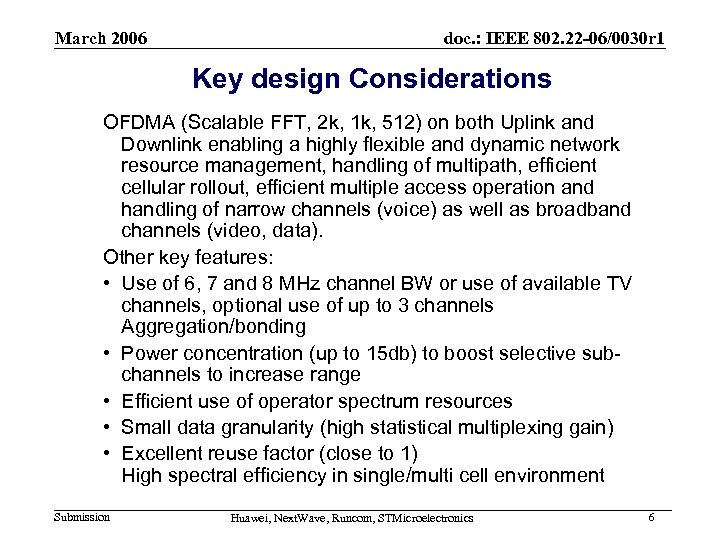 March 2006 doc. : IEEE 802. 22 -06/0030 r 1 Key design Considerations OFDMA (Scalable FFT, 2 k, 1 k, 512) on both Uplink and Downlink enabling a highly flexible and dynamic network resource management, handling of multipath, efficient cellular rollout, efficient multiple access operation and handling of narrow channels (voice) as well as broadband channels (video, data). Other key features: • Use of 6, 7 and 8 MHz channel BW or use of available TV channels, optional use of up to 3 channels Aggregation/bonding • Power concentration (up to 15 db) to boost selective subchannels to increase range • Efficient use of operator spectrum resources • Small data granularity (high statistical multiplexing gain) • Excellent reuse factor (close to 1) High spectral efficiency in single/multi cell environment Submission Huawei, Next. Wave, Runcom, STMicroelectronics 6
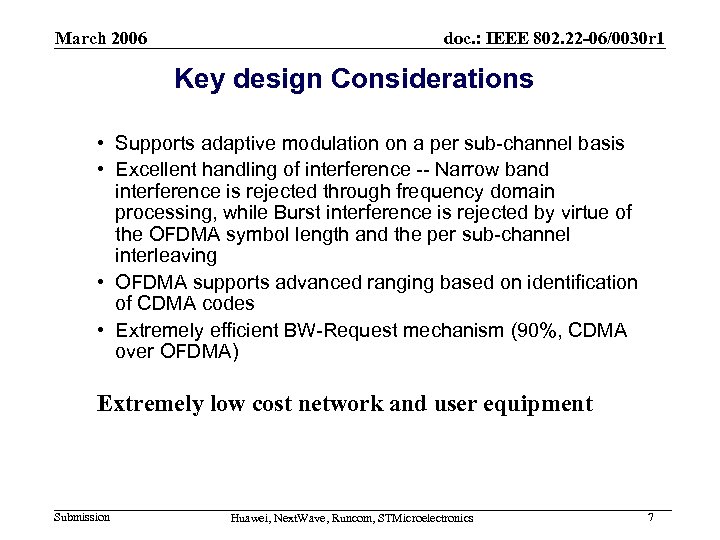 March 2006 doc. : IEEE 802. 22 -06/0030 r 1 Key design Considerations • Supports adaptive modulation on a per sub-channel basis • Excellent handling of interference -- Narrow band interference is rejected through frequency domain processing, while Burst interference is rejected by virtue of the OFDMA symbol length and the per sub-channel interleaving • OFDMA supports advanced ranging based on identification of CDMA codes • Extremely efficient BW-Request mechanism (90%, CDMA over OFDMA) Extremely low cost network and user equipment Submission Huawei, Next. Wave, Runcom, STMicroelectronics 7
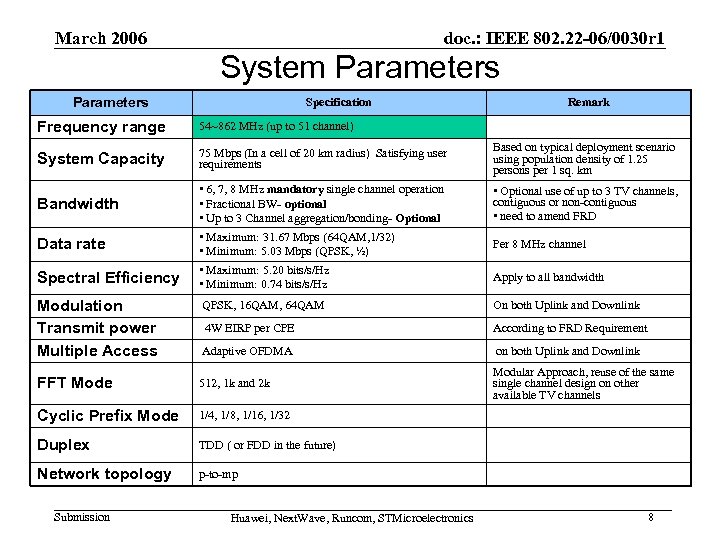 March 2006 doc. : IEEE 802. 22 -06/0030 r 1 System Parameters Specification Remark Frequency range 54~862 MHz (up to 51 channel) System Capacity 75 Mbps (In a cell of 20 km radius) Satisfying user requirements Based on typical deployment scenario using population density of 1. 25 persons per 1 sq. km Bandwidth • 6, 7, 8 MHz mandatory single channel operation • Fractional BW- optional • Up to 3 Channel aggregation/bonding- Optional • Optional use of up to 3 TV channels, contiguous or non-contiguous • need to amend FRD Data rate • Maximum: 31. 67 Mbps (64 QAM, 1/32) • Minimum: 5. 03 Mbps (QPSK, ½) Per 8 MHz channel Spectral Efficiency • Maximum: 5. 20 bits/s/Hz • Minimum: 0. 74 bits/s/Hz Apply to all bandwidth Modulation Transmit power Multiple Access QPSK, 16 QAM, 64 QAM On both Uplink and Downlink 4 W EIRP per CPE According to FRD Requirement Adaptive OFDMA on both Uplink and Downlink FFT Mode 512, 1 k and 2 k Modular Approach, reuse of the same single channel design on other available TV channels Cyclic Prefix Mode 1/4, 1/8, 1/16, 1/32 Duplex TDD ( or FDD in the future) Network topology p-to-mp Submission Huawei, Next. Wave, Runcom, STMicroelectronics 8
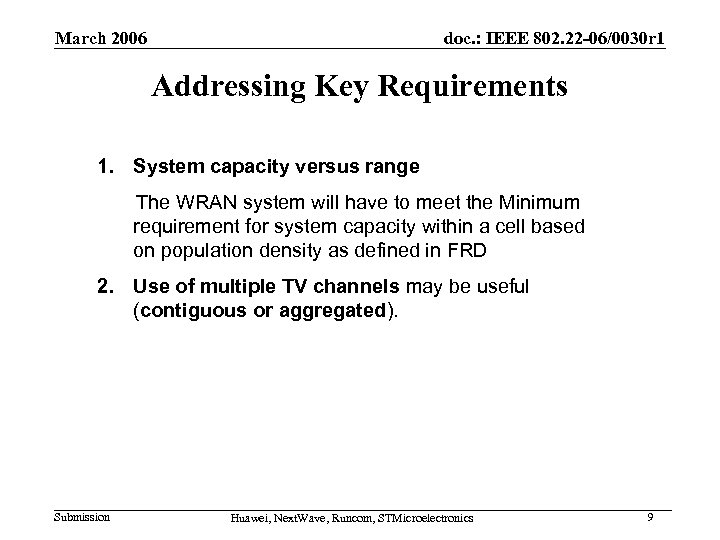 March 2006 doc. : IEEE 802. 22 -06/0030 r 1 Addressing Key Requirements 1. System capacity versus range The WRAN system will have to meet the Minimum requirement for system capacity within a cell based on population density as defined in FRD 2. Use of multiple TV channels may be useful (contiguous or aggregated). Submission Huawei, Next. Wave, Runcom, STMicroelectronics 9
 March 2006 doc. : IEEE 802. 22 -06/0030 r 1 Part 1 • Scalability • Low cost CPE • Reuse of the spectrum • Computational Complexity • deployment in Large cells • Macro Diversity Part 2 • OFDMA based Proposal Submission Huawei, Next. Wave, Runcom, STMicroelectronics 10
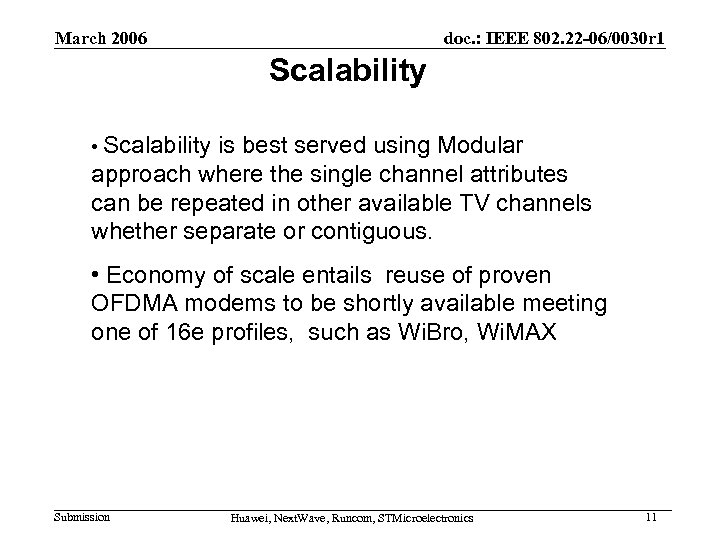 March 2006 doc. : IEEE 802. 22 -06/0030 r 1 Scalability • Scalability is best served using Modular approach where the single channel attributes can be repeated in other available TV channels whether separate or contiguous. • Economy of scale entails reuse of proven OFDMA modems to be shortly available meeting one of 16 e profiles, such as Wi. Bro, Wi. MAX Submission Huawei, Next. Wave, Runcom, STMicroelectronics 11
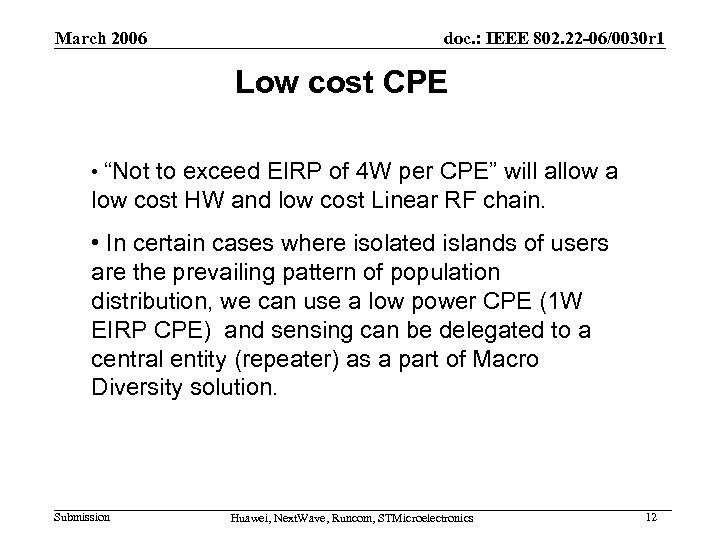 March 2006 doc. : IEEE 802. 22 -06/0030 r 1 Low cost CPE • “Not to exceed EIRP of 4 W per CPE” will allow a low cost HW and low cost Linear RF chain. • In certain cases where isolated islands of users are the prevailing pattern of population distribution, we can use a low power CPE (1 W EIRP CPE) and sensing can be delegated to a central entity (repeater) as a part of Macro Diversity solution. Submission Huawei, Next. Wave, Runcom, STMicroelectronics 12
 March 2006 doc. : IEEE 802. 22 -06/0030 r 1 Power Amplifier Efficiency PAPR Reduction Submission Huawei, Next. Wave, Runcom, STMicroelectronics 13
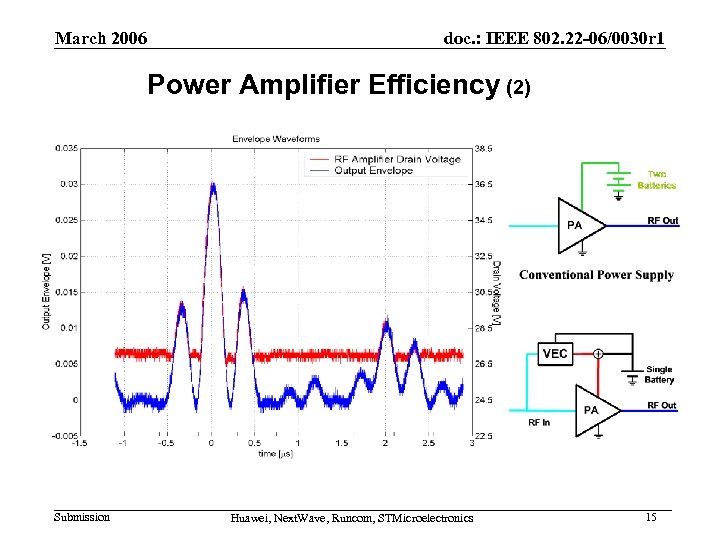
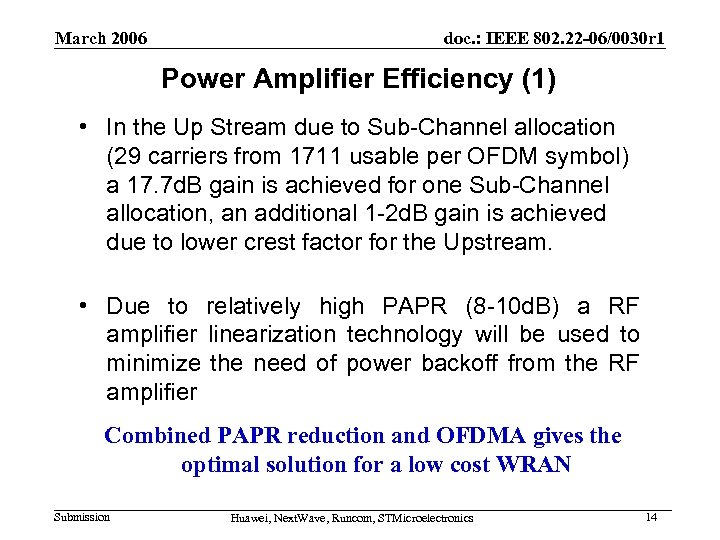 March 2006 doc. : IEEE 802. 22 -06/0030 r 1 Power Amplifier Efficiency (1) • In the Up Stream due to Sub-Channel allocation (29 carriers from 1711 usable per OFDM symbol) a 17. 7 d. B gain is achieved for one Sub-Channel allocation, an additional 1 -2 d. B gain is achieved due to lower crest factor for the Upstream. • Due to relatively high PAPR (8 -10 d. B) a RF amplifier linearization technology will be used to minimize the need of power backoff from the RF amplifier Combined PAPR reduction and OFDMA gives the optimal solution for a low cost WRAN Submission Huawei, Next. Wave, Runcom, STMicroelectronics 14
 March 2006 doc. : IEEE 802. 22 -06/0030 r 1 Power Amplifier Efficiency (2) Submission Huawei, Next. Wave, Runcom, STMicroelectronics 15
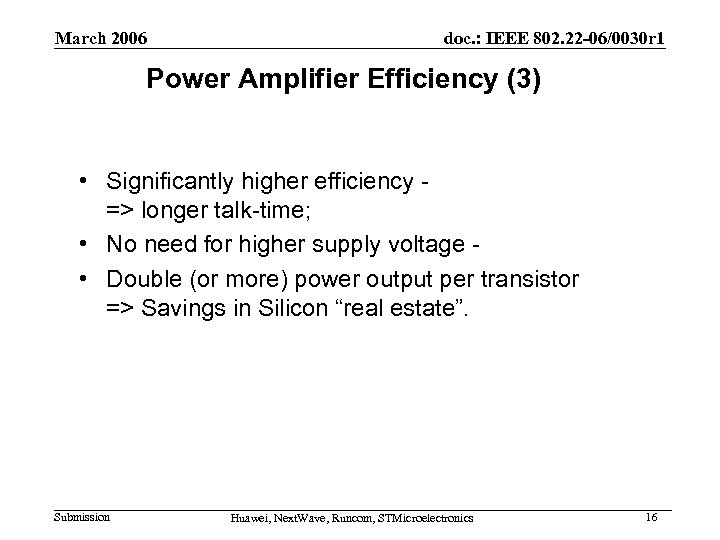 March 2006 doc. : IEEE 802. 22 -06/0030 r 1 Power Amplifier Efficiency (3) • Significantly higher efficiency => longer talk-time; • No need for higher supply voltage • Double (or more) power output per transistor => Savings in Silicon “real estate”. Submission Huawei, Next. Wave, Runcom, STMicroelectronics 16
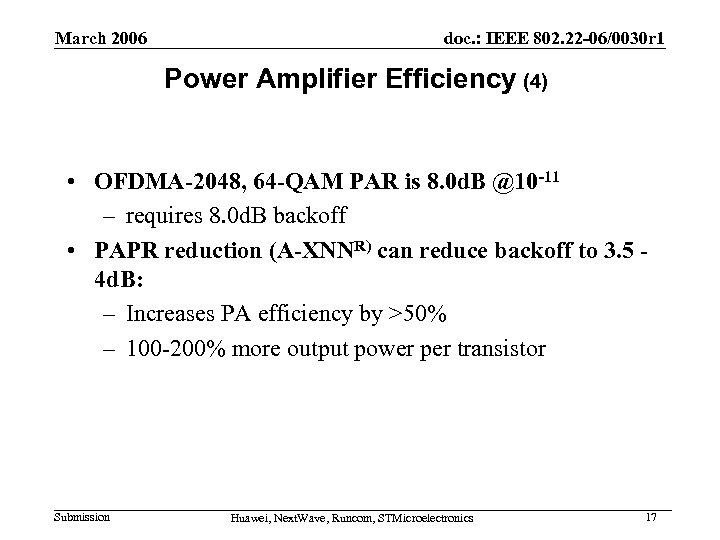 March 2006 doc. : IEEE 802. 22 -06/0030 r 1 Power Amplifier Efficiency (4) • OFDMA-2048, 64 -QAM PAR is 8. 0 d. B @10 -11 – requires 8. 0 d. B backoff • PAPR reduction (A-XNNR) can reduce backoff to 3. 5 4 d. B: – Increases PA efficiency by >50% – 100 -200% more output power per transistor Submission Huawei, Next. Wave, Runcom, STMicroelectronics 17
 March 2006 doc. : IEEE 802. 22 -06/0030 r 1 Deployment in large cells • From the standpoint of Service Provider it is imperative to offer continuous service with the needed capacity within the cell with the use of only one TV channel, user satisfaction is important, sustainable service is important • Cell size is determined by traffic volume generated by users and expected growth potential • WRAN may also be deployed in semi-urban areas where more populated areas are expected, hence more cell capacity is needed. Submission Huawei, Next. Wave, Runcom, STMicroelectronics 18
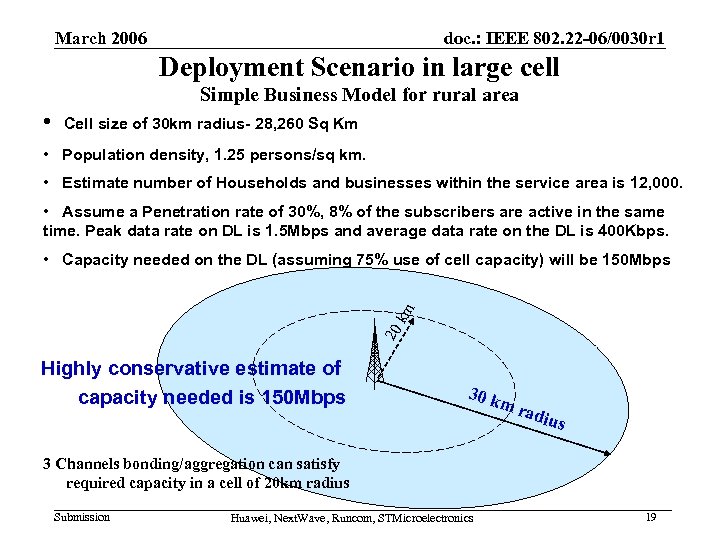 March 2006 doc. : IEEE 802. 22 -06/0030 r 1 Deployment Scenario in large cell Simple Business Model for rural area • Cell size of 30 km radius- 28, 260 Sq Km • Population density, 1. 25 persons/sq km. • Estimate number of Households and businesses within the service area is 12, 000. • Assume a Penetration rate of 30%, 8% of the subscribers are active in the same time. Peak data rate on DL is 1. 5 Mbps and average data rate on the DL is 400 Kbps. 20 km • Capacity needed on the DL (assuming 75% use of cell capacity) will be 150 Mbps Highly conservative estimate of capacity needed is 150 Mbps 30 k m ra dius 3 Channels bonding/aggregation can satisfy required capacity in a cell of 20 km radius Submission Huawei, Next. Wave, Runcom, STMicroelectronics 19
 March 2006 doc. : IEEE 802. 22 -06/0030 r 1 Channels aggregation Submission Huawei, Next. Wave, Runcom, STMicroelectronics 20
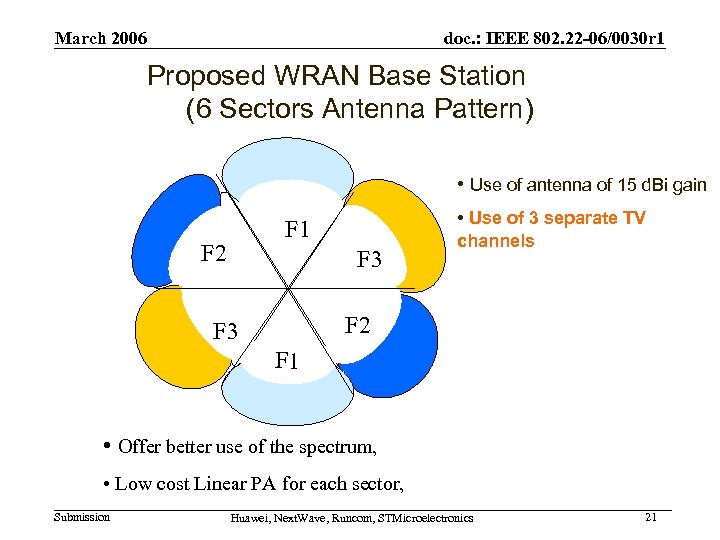 March 2006 doc. : IEEE 802. 22 -06/0030 r 1 Proposed WRAN Base Station (6 Sectors Antenna Pattern) • Use of antenna of 15 d. Bi gain F 1 F 2 F 3 • Use of 3 separate TV channels F 2 F 3 F 1 • Offer better use of the spectrum, • Low cost Linear PA for each sector, Submission Huawei, Next. Wave, Runcom, STMicroelectronics 21
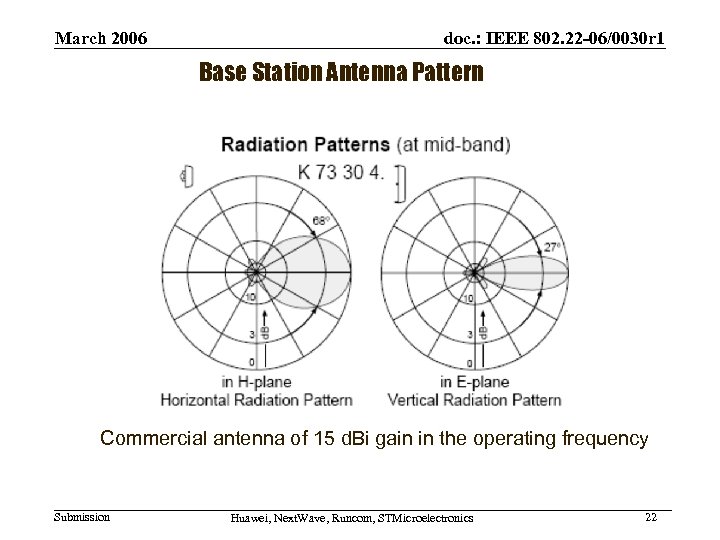 March 2006 doc. : IEEE 802. 22 -06/0030 r 1 Base Station Antenna Pattern Commercial antenna of 15 d. Bi gain in the operating frequency Submission Huawei, Next. Wave, Runcom, STMicroelectronics 22
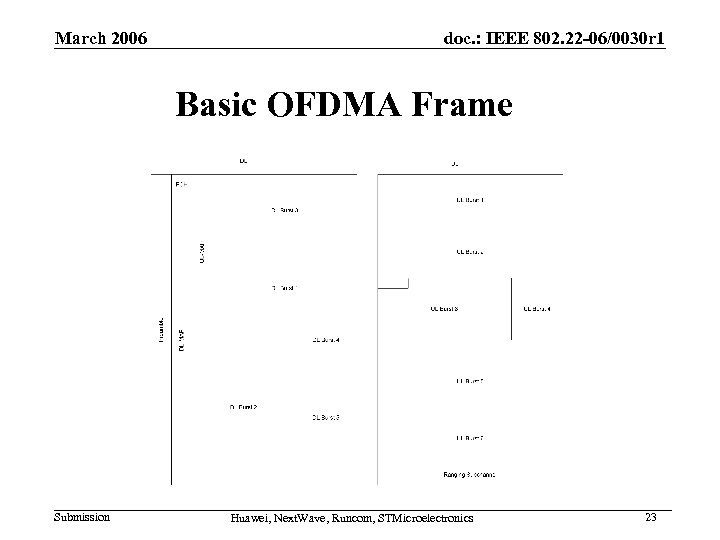 March 2006 doc. : IEEE 802. 22 -06/0030 r 1 Basic OFDMA Frame Submission Huawei, Next. Wave, Runcom, STMicroelectronics 23
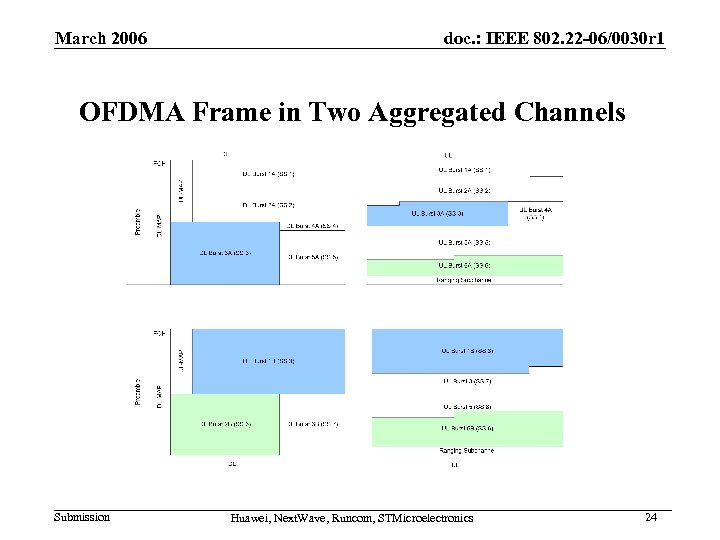 March 2006 doc. : IEEE 802. 22 -06/0030 r 1 OFDMA Frame in Two Aggregated Channels Submission Huawei, Next. Wave, Runcom, STMicroelectronics 24
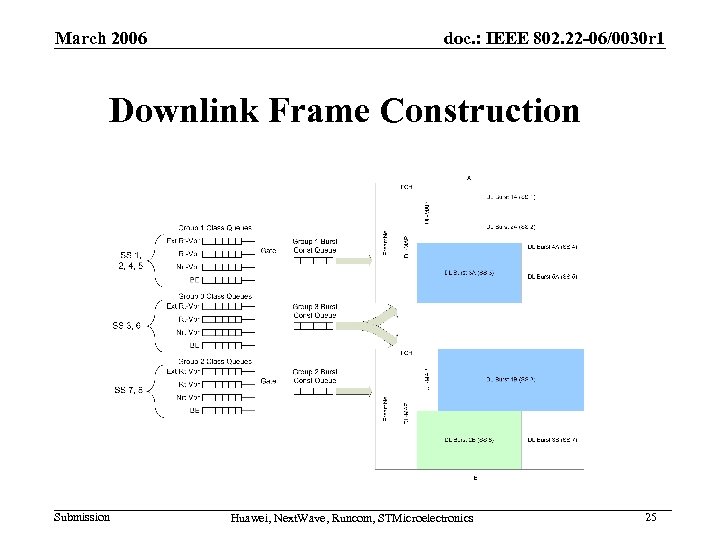 March 2006 doc. : IEEE 802. 22 -06/0030 r 1 Downlink Frame Construction Submission Huawei, Next. Wave, Runcom, STMicroelectronics 25
 March 2006 doc. : IEEE 802. 22 -06/0030 r 1 Low Interference Configuration Macro Diversity Submission Huawei, Next. Wave, Runcom, STMicroelectronics 26
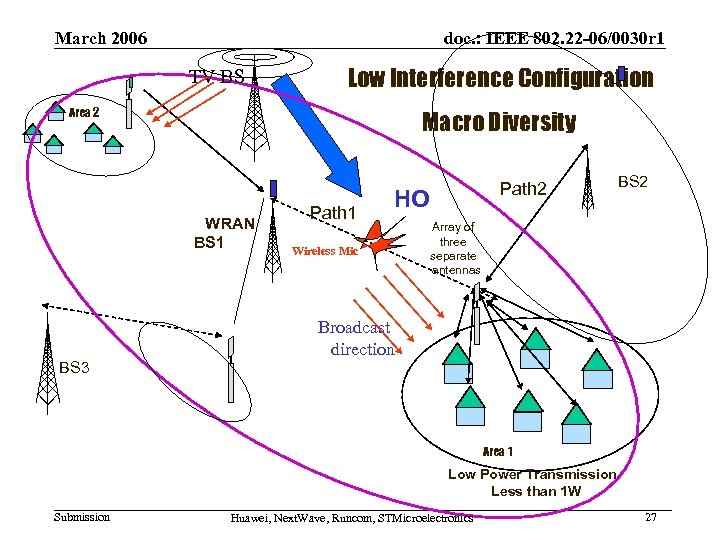 March 2006 doc. : IEEE 802. 22 -06/0030 r 1 TV BS Low Interference Configuration Area 2 Macro Diversity WRAN BS 1 Path 2 HO Wireless Mic BS 2 Array of three separate antennas Broadcast direction BS 3 Area 1 Low Power Transmission Less than 1 W Submission Huawei, Next. Wave, Runcom, STMicroelectronics 27
 March 2006 doc. : IEEE 802. 22 -06/0030 r 1 Part 2, Base Line Outline: PHY • • • Requirements & OFDMA basic Features PHY preliminary proposal Base-Band processing chain Down-Link Up-Link Hybrid ARQ Diversity Schemes PAPR reduction Simulation Results Submission Huawei, Next. Wave, Runcom, STMicroelectronics 28
 March 2006 doc. : IEEE 802. 22 -06/0030 r 1 OFDMA basic features Submission Huawei, Next. Wave, Runcom, STMicroelectronics 29
 March 2006 doc. : IEEE 802. 22 -06/0030 r 1 Basics Duplexing Technique • TDD Multiple Access Method • TDMA/OFDMA OFDM Symbols allocated by TDMA Sub-Carriers within an OFDM Symbol allocated by OFDMA Diversity • Frequency, Time, Code, Space Submission Huawei, Next. Wave, Runcom, STMicroelectronics 30
 March 2006 doc. : IEEE 802. 22 -06/0030 r 1 Frame Structure § Allowing Flexibility in DL/UL segmentation § 3 possible Preamble structure § FCH and MAP transmitted in PUSC (for better coverage) § Flexible Subchannels allocation per sector on a frame by frame basis § All zones are flexible to produce any scenario needed (reuse =1, reuse < 1, STC/AAS) § Zone may be used as broadcast [SFN] with permutation adjustment § STC/AAS may be combined with regular mode of operation Submission Huawei, Next. Wave, Runcom, STMicroelectronics 31
 March 2006 doc. : IEEE 802. 22 -06/0030 r 1 Preambles § 3 possible Preamble structure, more than 114 preambles over all § Preambles are designed for low PAPR (about 5 d. B or less) § Preambles are boosted due to low PAPR § Preambles are used for channel estimation, frequency estimation, timing estimation and cell monitoring Submission Huawei, Next. Wave, Runcom, STMicroelectronics 32
 March 2006 doc. : IEEE 802. 22 -06/0030 r 1 Base-Band Processing Chain Submission Huawei, Next. Wave, Runcom, STMicroelectronics 33
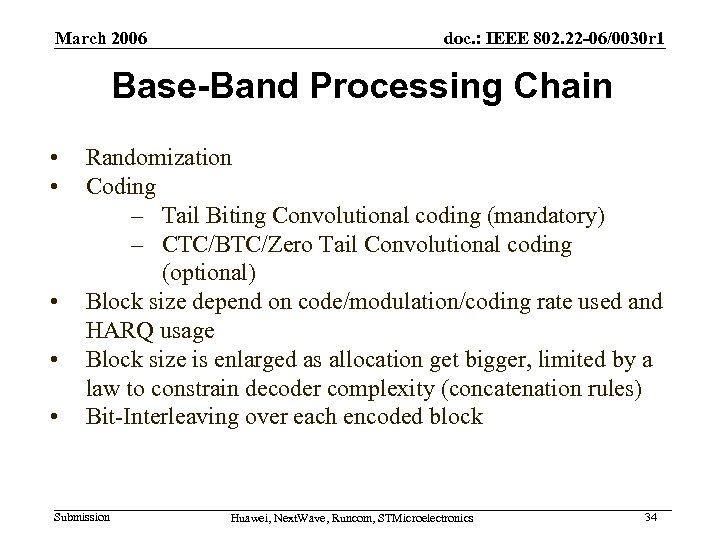 March 2006 doc. : IEEE 802. 22 -06/0030 r 1 Base-Band Processing Chain • • • Randomization Coding – Tail Biting Convolutional coding (mandatory) – CTC/BTC/Zero Tail Convolutional coding (optional) Block size depend on code/modulation/coding rate used and HARQ usage Block size is enlarged as allocation get bigger, limited by a law to constrain decoder complexity (concatenation rules) Bit-Interleaving over each encoded block Submission Huawei, Next. Wave, Runcom, STMicroelectronics 34
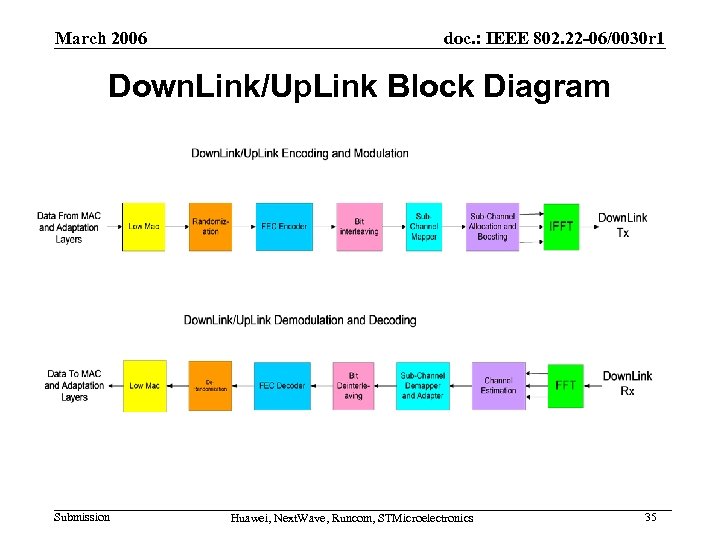 March 2006 doc. : IEEE 802. 22 -06/0030 r 1 Down. Link/Up. Link Block Diagram Submission Huawei, Next. Wave, Runcom, STMicroelectronics 35
 March 2006 doc. : IEEE 802. 22 -06/0030 r 1 Down-Link Submission Huawei, Next. Wave, Runcom, STMicroelectronics 36
 March 2006 doc. : IEEE 802. 22 -06/0030 r 1 Reuse There are two basic modes of operation: • Reuse smaller than 1: Sub-Channels (SC) are divided up to 3 Logical-Bands PUSC (Partial use of SC), the structure enables each Logical-Band to have the frequency diversity properties of the full channel, but using only a part of the frequency carriers. The splitting will enable to boost the transmitted carriers on the expense of the un-transmitted carriers ~(4. 8 d. B) • Reuse Of 1: Using PUSC or FUSC (Full use of SC) where all subchannels are used. Cell configuration differ by different permutation enabling a reuse of 1. Submission Huawei, Next. Wave, Runcom, STMicroelectronics 37
 March 2006 doc. : IEEE 802. 22 -06/0030 r 1 Using Special Permutations for carrier allocation • The Carriers of each Sub-Channel are spread all over the usable frequency for best frequency diversity. • The allocation by permutation gives an excellent Reuse factor - almost 1. • The allocation by permutation give an excellent interference spreading and averaging. Submission Huawei, Next. Wave, Runcom, STMicroelectronics 38
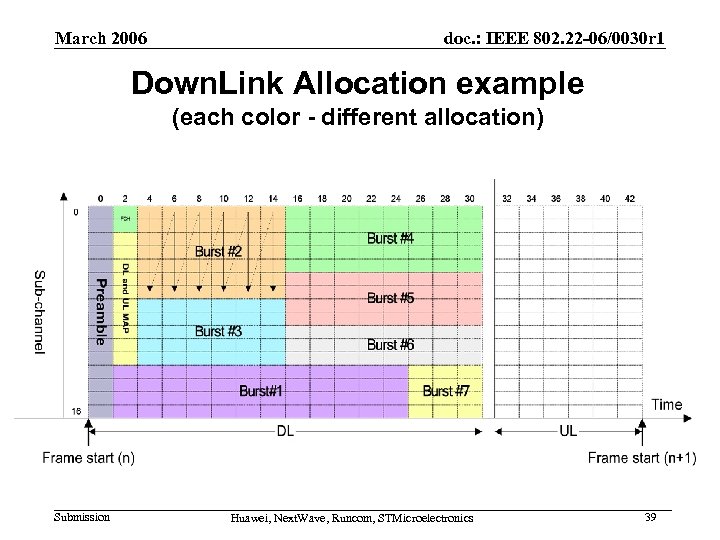 March 2006 doc. : IEEE 802. 22 -06/0030 r 1 Down. Link Allocation example (each color - different allocation) Submission Huawei, Next. Wave, Runcom, STMicroelectronics 39
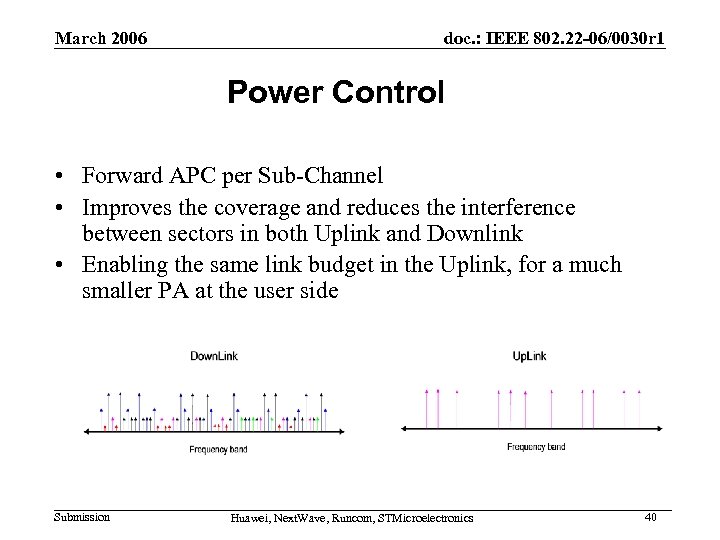 March 2006 doc. : IEEE 802. 22 -06/0030 r 1 Power Control • Forward APC per Sub-Channel • Improves the coverage and reduces the interference between sectors in both Uplink and Downlink • Enabling the same link budget in the Uplink, for a much smaller PA at the user side Submission Huawei, Next. Wave, Runcom, STMicroelectronics 40
 March 2006 doc. : IEEE 802. 22 -06/0030 r 1 Down. Link Specification Submission Huawei, Next. Wave, Runcom, STMicroelectronics 41
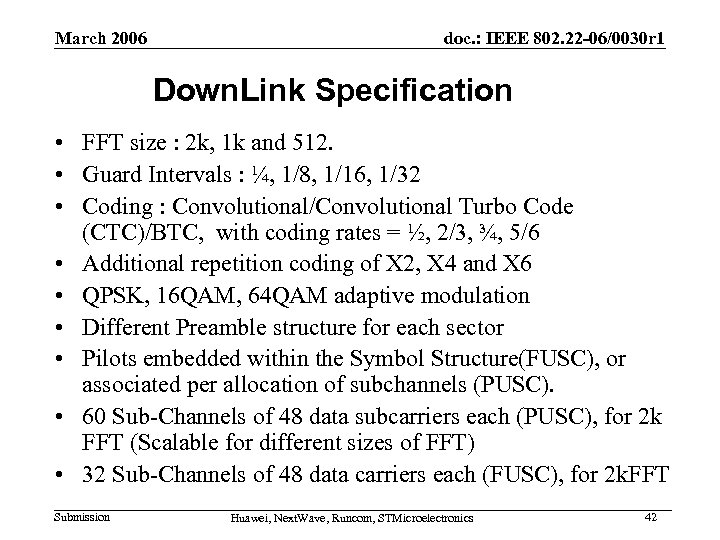 March 2006 doc. : IEEE 802. 22 -06/0030 r 1 Down. Link Specification • FFT size : 2 k, 1 k and 512. • Guard Intervals : ¼, 1/8, 1/16, 1/32 • Coding : Convolutional/Convolutional Turbo Code (CTC)/BTC, with coding rates = ½, 2/3, ¾, 5/6 • Additional repetition coding of X 2, X 4 and X 6 • QPSK, 16 QAM, 64 QAM adaptive modulation • Different Preamble structure for each sector • Pilots embedded within the Symbol Structure(FUSC), or associated per allocation of subchannels (PUSC). • 60 Sub-Channels of 48 data subcarriers each (PUSC), for 2 k FFT (Scalable for different sizes of FFT) • 32 Sub-Channels of 48 data carriers each (FUSC), for 2 k. FFT Submission Huawei, Next. Wave, Runcom, STMicroelectronics 42
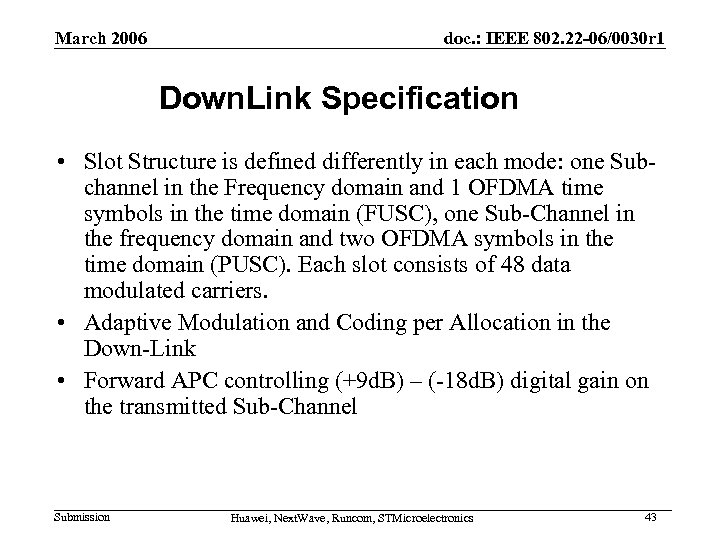 March 2006 doc. : IEEE 802. 22 -06/0030 r 1 Down. Link Specification • Slot Structure is defined differently in each mode: one Subchannel in the Frequency domain and 1 OFDMA time symbols in the time domain (FUSC), one Sub-Channel in the frequency domain and two OFDMA symbols in the time domain (PUSC). Each slot consists of 48 data modulated carriers. • Adaptive Modulation and Coding per Allocation in the Down-Link • Forward APC controlling (+9 d. B) – (-18 d. B) digital gain on the transmitted Sub-Channel Submission Huawei, Next. Wave, Runcom, STMicroelectronics 43
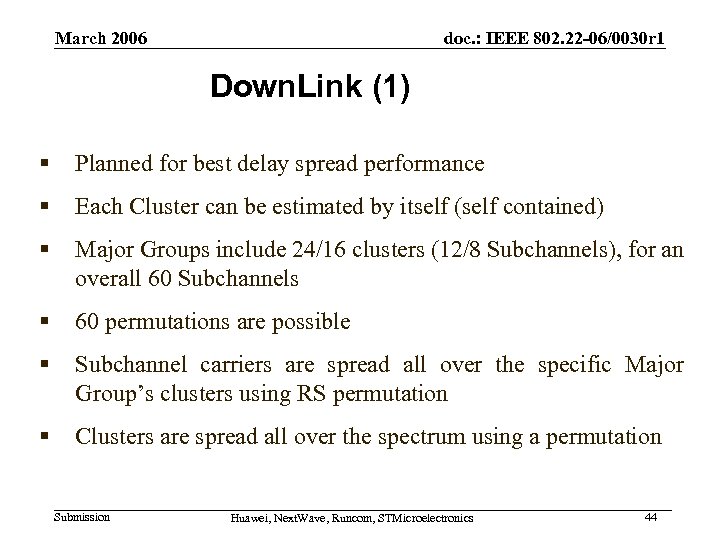 March 2006 doc. : IEEE 802. 22 -06/0030 r 1 Down. Link (1) § Planned for best delay spread performance § Each Cluster can be estimated by itself (self contained) § Major Groups include 24/16 clusters (12/8 Subchannels), for an overall 60 Subchannels § 60 permutations are possible § Subchannel carriers are spread all over the specific Major Group’s clusters using RS permutation § Clusters are spread all over the spectrum using a permutation Submission Huawei, Next. Wave, Runcom, STMicroelectronics 44
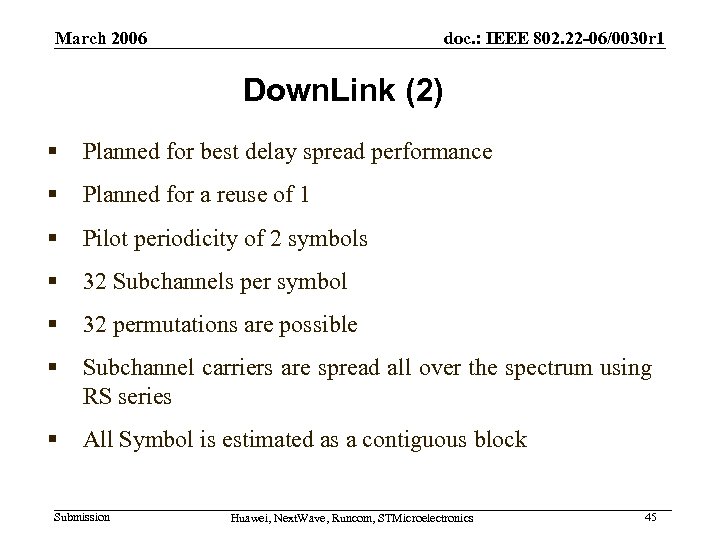 March 2006 doc. : IEEE 802. 22 -06/0030 r 1 Down. Link (2) § Planned for best delay spread performance § Planned for a reuse of 1 § Pilot periodicity of 2 symbols § 32 Subchannels per symbol § 32 permutations are possible § Subchannel carriers are spread all over the spectrum using RS series § All Symbol is estimated as a contiguous block Submission Huawei, Next. Wave, Runcom, STMicroelectronics 45
 March 2006 doc. : IEEE 802. 22 -06/0030 r 1 Up-Link Submission Huawei, Next. Wave, Runcom, STMicroelectronics 46
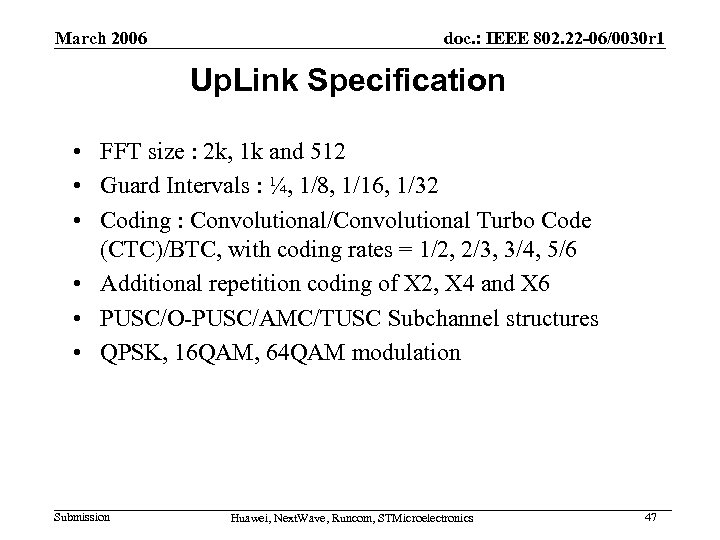 March 2006 doc. : IEEE 802. 22 -06/0030 r 1 Up. Link Specification • FFT size : 2 k, 1 k and 512 • Guard Intervals : ¼, 1/8, 1/16, 1/32 • Coding : Convolutional/Convolutional Turbo Code (CTC)/BTC, with coding rates = 1/2, 2/3, 3/4, 5/6 • Additional repetition coding of X 2, X 4 and X 6 • PUSC/O-PUSC/AMC/TUSC Subchannel structures • QPSK, 16 QAM, 64 QAM modulation Submission Huawei, Next. Wave, Runcom, STMicroelectronics 47
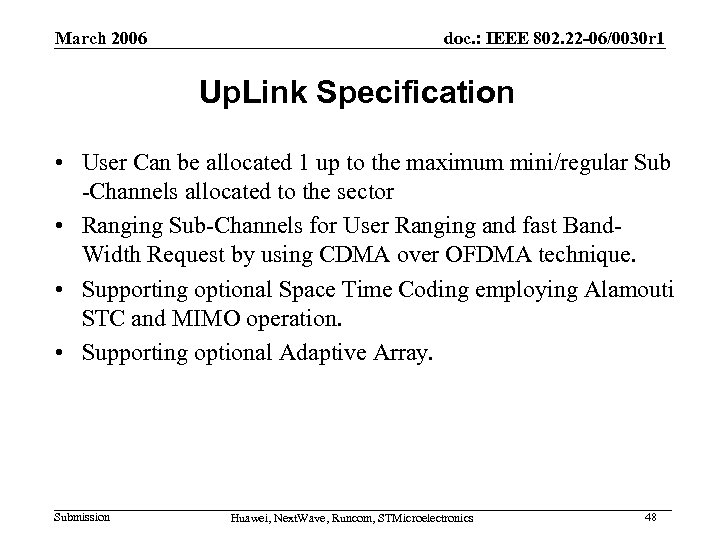 March 2006 doc. : IEEE 802. 22 -06/0030 r 1 Up. Link Specification • User Can be allocated 1 up to the maximum mini/regular Sub -Channels allocated to the sector • Ranging Sub-Channels for User Ranging and fast Band. Width Request by using CDMA over OFDMA technique. • Supporting optional Space Time Coding employing Alamouti STC and MIMO operation. • Supporting optional Adaptive Array. Submission Huawei, Next. Wave, Runcom, STMicroelectronics 48
 March 2006 doc. : IEEE 802. 22 -06/0030 r 1 Up. Link Data Mapping § Mapping is performed in time axis first, per allocation, for the length of the UL relevant zone § Mapping needs only one axis of description (saves signaling overhead) § Mapping takes advantage of the power concentration as much as possible Submission Huawei, Next. Wave, Runcom, STMicroelectronics 49
 March 2006 doc. : IEEE 802. 22 -06/0030 r 1 Up-Link CDMA on OFDMA Ranging and Bandwidth request Submission Huawei, Next. Wave, Runcom, STMicroelectronics 50
 March 2006 doc. : IEEE 802. 22 -06/0030 r 1 Using Special Permutations for carrier allocation • The Carriers of each Sub-Channel are spread all over the usable frequency for best frequency diversity • The allocation by permutation gives an excellent Reuse factor - almost 1. • The allocation by permutation give an excellent interference spreading and averaging. Submission Huawei, Next. Wave, Runcom, STMicroelectronics 51
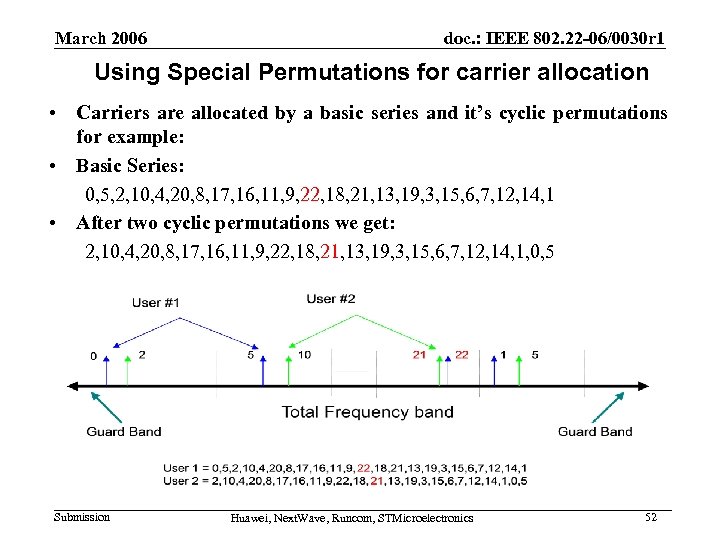 March 2006 doc. : IEEE 802. 22 -06/0030 r 1 Using Special Permutations for carrier allocation • Carriers are allocated by a basic series and it’s cyclic permutations for example: • Basic Series: 0, 5, 2, 10, 4, 20, 8, 17, 16, 11, 9, 22, 18, 21, 13, 19, 3, 15, 6, 7, 12, 14, 1 • After two cyclic permutations we get: 2, 10, 4, 20, 8, 17, 16, 11, 9, 22, 18, 21, 13, 19, 3, 15, 6, 7, 12, 14, 1, 0, 5 Submission Huawei, Next. Wave, Runcom, STMicroelectronics 52
 March 2006 doc. : IEEE 802. 22 -06/0030 r 1 Ranging using CDMA like modulation Submission Huawei, Next. Wave, Runcom, STMicroelectronics 53
 March 2006 doc. : IEEE 802. 22 -06/0030 r 1 Using CDMA like modulation for Ranging • The CDMA like synchronization is achieved by allocating several of the usable Sub-Channels for the Ranging process, the logic unit they consist is called a Ranging Sub-Channel. • Onto the Ranging Sub-Channel users modulate a Pseudo Noise (PN) sequence using BPSK modulation • The Base Station detects the different sequences and uses the CIR that he derives from the sequences for: – Time and power synchronization – Decide on the user modulation and coding Submission Huawei, Next. Wave, Runcom, STMicroelectronics 54
 March 2006 doc. : IEEE 802. 22 -06/0030 r 1 Ranging Signals • • Using CDMA over OFDMA modulation ranging designed for Reuse of 1 and Reuse <1 Short ranging is used for BW request and periodic ranging Amount of Codes for each purpose is set by the MAC Each sector has its own ranging codes Using 144 Subcarriers as the basic transmission block (6 data Subchannels of the mandatory UL mode) BPSK modulation onto used carriers Submission Huawei, Next. Wave, Runcom, STMicroelectronics 55
 March 2006 doc. : IEEE 802. 22 -06/0030 r 1 Hybrid ARQ (HARQ) Submission Huawei, Next. Wave, Runcom, STMicroelectronics 56
 March 2006 doc. : IEEE 802. 22 -06/0030 r 1 HARQ Operation • To be used to overcome unknown channel conditions. • Whenever the first transmitted block fails to decode, the decoder use the ACK/NACK protocol to request additional portion of the encoded block. • Second transmission of the block may be a repetition of the first one and/or additional parity bits. • The decoder combines the sum of all transmission and attempts to decode. This scheme is repeated until successful or dropped by the MAC layer. • Incremental Redundancy (IR) and Chase combining HARQ schemes. Submission Huawei, Next. Wave, Runcom, STMicroelectronics 57
 March 2006 doc. : IEEE 802. 22 -06/0030 r 1 Diversity Schemes Submission Huawei, Next. Wave, Runcom, STMicroelectronics 58
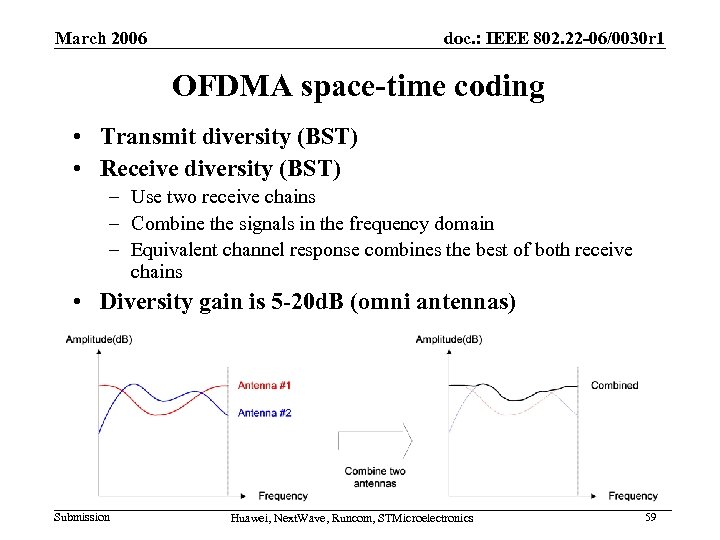 March 2006 doc. : IEEE 802. 22 -06/0030 r 1 OFDMA space-time coding • Transmit diversity (BST) • Receive diversity (BST) – Use two receive chains – Combine the signals in the frequency domain – Equivalent channel response combines the best of both receive chains • Diversity gain is 5 -20 d. B (omni antennas) Submission Huawei, Next. Wave, Runcom, STMicroelectronics 59
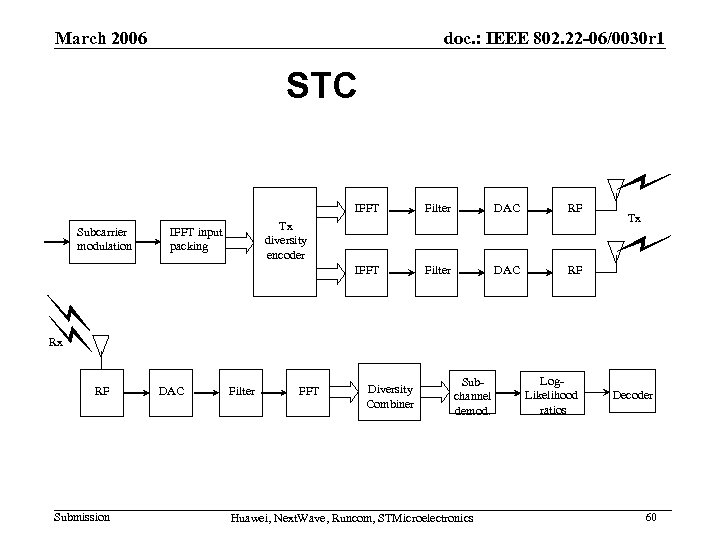 March 2006 doc. : IEEE 802. 22 -06/0030 r 1 STC IFFT DAC RF IFFT Subcarrier modulation Filter DAC RF Tx diversity encoder IFFT input packing Tx Rx RF Submission DAC Filter FFT Diversity Combiner Subchannel demod. Huawei, Next. Wave, Runcom, STMicroelectronics Log. Likelihood ratios Decoder 60
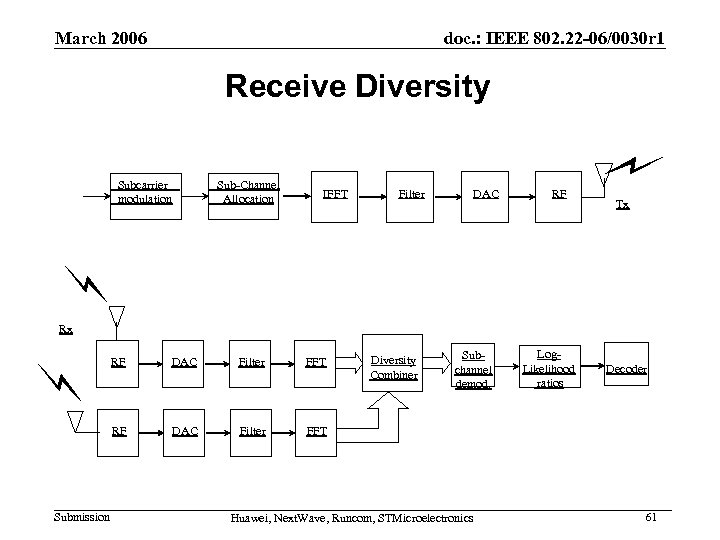 March 2006 doc. : IEEE 802. 22 -06/0030 r 1 Receive Diversity Sub-Channel Allocation Subcarrier modulation IFFT Filter DAC RF Tx Rx RF Filter FFT RF Submission DAC Filter Diversity Combiner Subchannel demod. Log. Likelihood ratios FFT Huawei, Next. Wave, Runcom, STMicroelectronics Decoder 61
 March 2006 doc. : IEEE 802. 22 -06/0030 r 1 Simulation Results Submission Huawei, Next. Wave, Runcom, STMicroelectronics 62
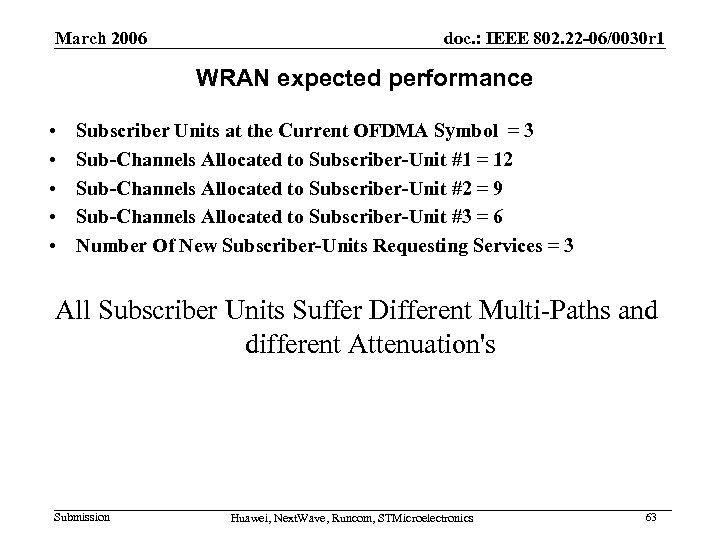 March 2006 doc. : IEEE 802. 22 -06/0030 r 1 WRAN expected performance • • • Subscriber Units at the Current OFDMA Symbol = 3 Sub-Channels Allocated to Subscriber-Unit #1 = 12 Sub-Channels Allocated to Subscriber-Unit #2 = 9 Sub-Channels Allocated to Subscriber-Unit #3 = 6 Number Of New Subscriber-Units Requesting Services = 3 All Subscriber Units Suffer Different Multi-Paths and different Attenuation's Submission Huawei, Next. Wave, Runcom, STMicroelectronics 63
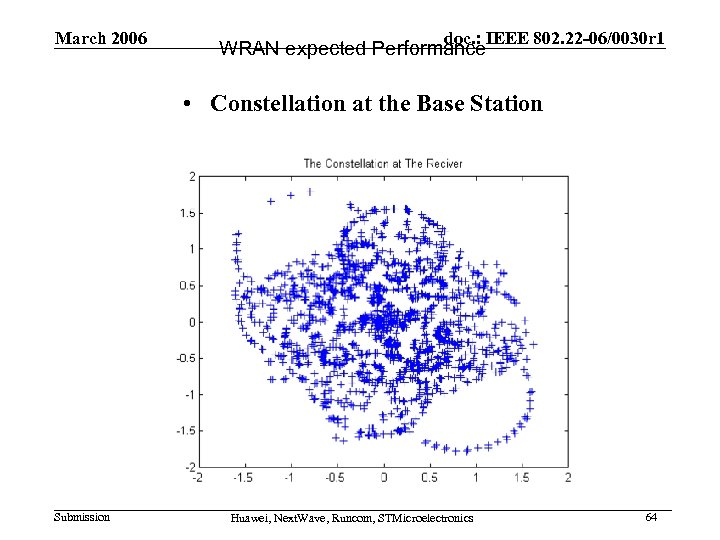 March 2006 doc. : IEEE 802. 22 -06/0030 r 1 WRAN expected Performance • Constellation at the Base Station Submission Huawei, Next. Wave, Runcom, STMicroelectronics 64
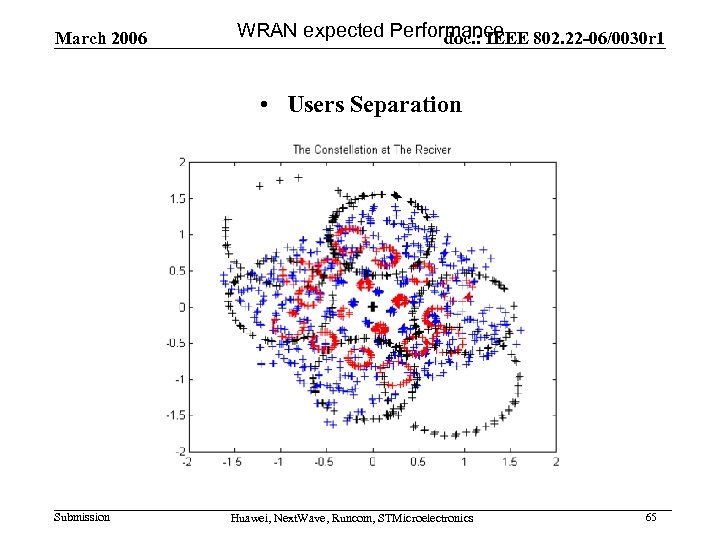 March 2006 WRAN expected Performance 802. 22 -06/0030 r 1 doc. : IEEE • Users Separation Submission Huawei, Next. Wave, Runcom, STMicroelectronics 65
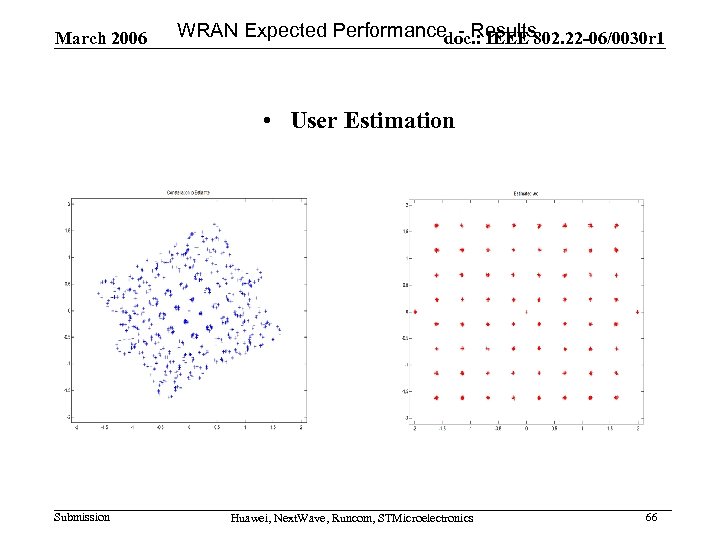 March 2006 WRAN Expected Performancedoc. : IEEE 802. 22 -06/0030 r 1 - Results • User Estimation Submission Huawei, Next. Wave, Runcom, STMicroelectronics 66
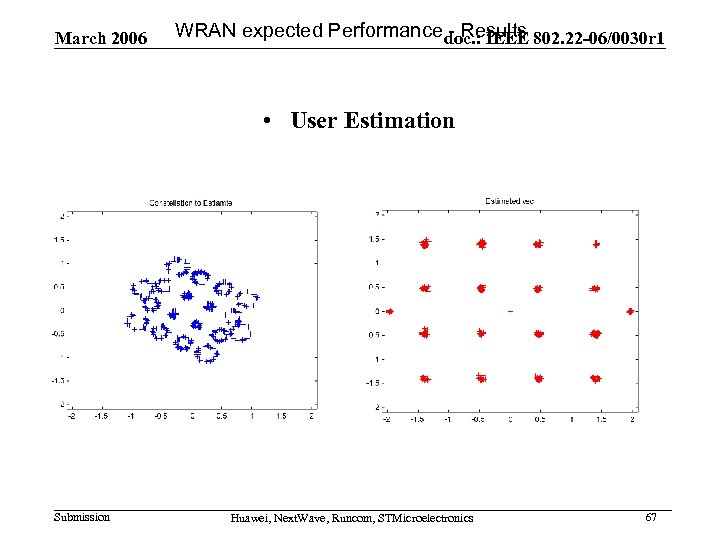 March 2006 WRAN expected Performance doc. : IEEE 802. 22 -06/0030 r 1 - Results • User Estimation Submission Huawei, Next. Wave, Runcom, STMicroelectronics 67
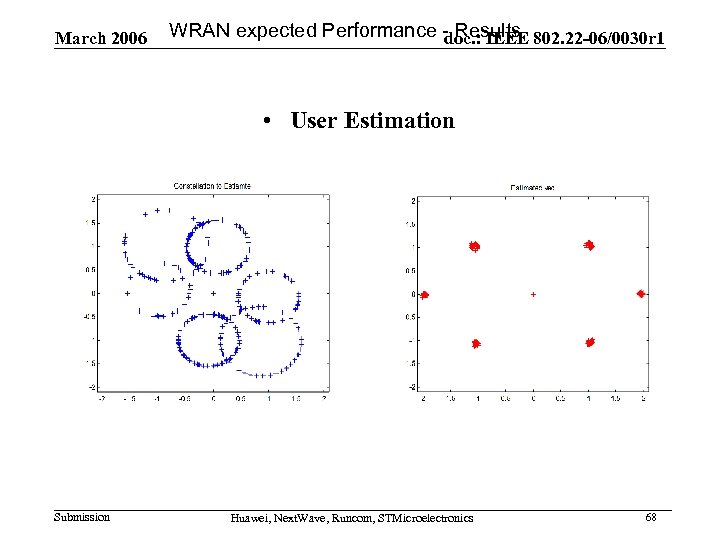 March 2006 WRAN expected Performance - Results 802. 22 -06/0030 r 1 doc. : IEEE • User Estimation Submission Huawei, Next. Wave, Runcom, STMicroelectronics 68
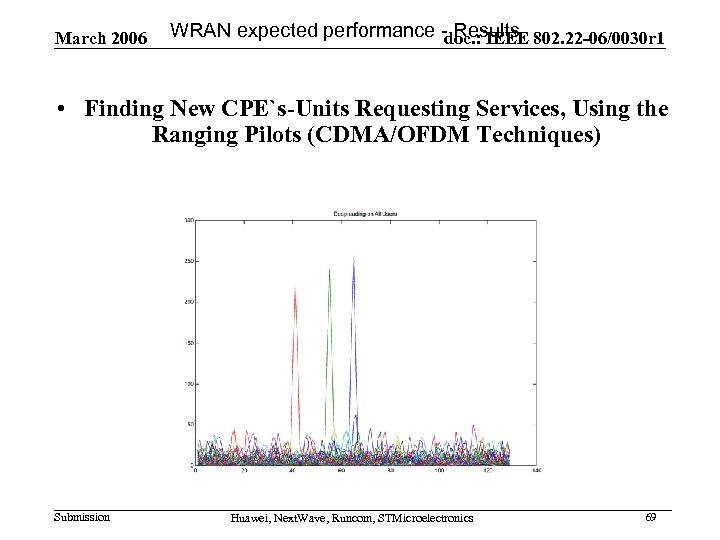 March 2006 WRAN expected performance -doc. : IEEE 802. 22 -06/0030 r 1 Results • Finding New CPE`s-Units Requesting Services, Using the Ranging Pilots (CDMA/OFDM Techniques) Submission Huawei, Next. Wave, Runcom, STMicroelectronics 69
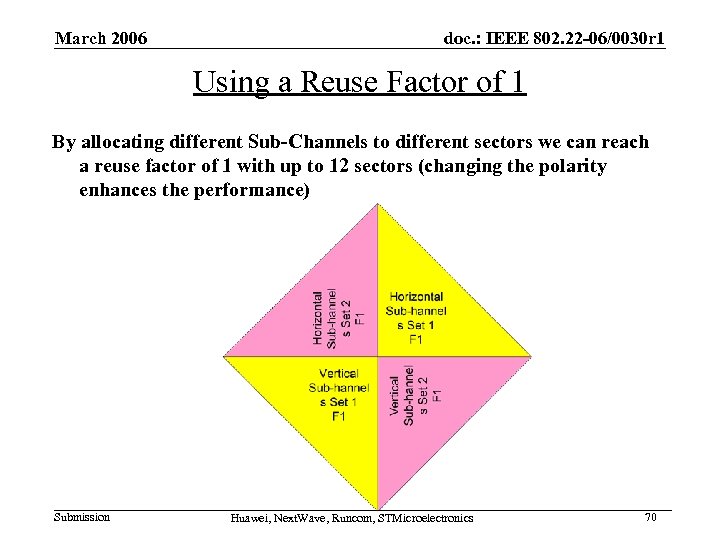 March 2006 doc. : IEEE 802. 22 -06/0030 r 1 Using a Reuse Factor of 1 By allocating different Sub-Channels to different sectors we can reach a reuse factor of 1 with up to 12 sectors (changing the polarity enhances the performance) Submission Huawei, Next. Wave, Runcom, STMicroelectronics 70
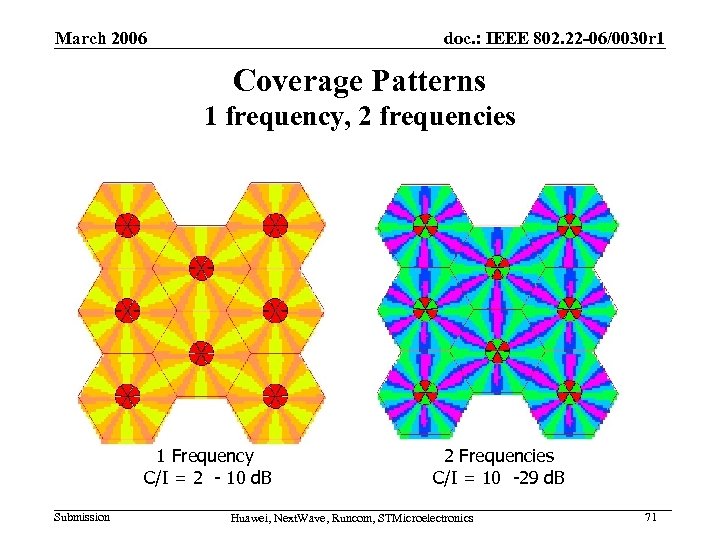 March 2006 doc. : IEEE 802. 22 -06/0030 r 1 Coverage Patterns 1 frequency, 2 frequencies 1 Frequency C/I = 2 - 10 d. B Submission 2 Frequencies C/I = 10 -29 d. B Huawei, Next. Wave, Runcom, STMicroelectronics 71
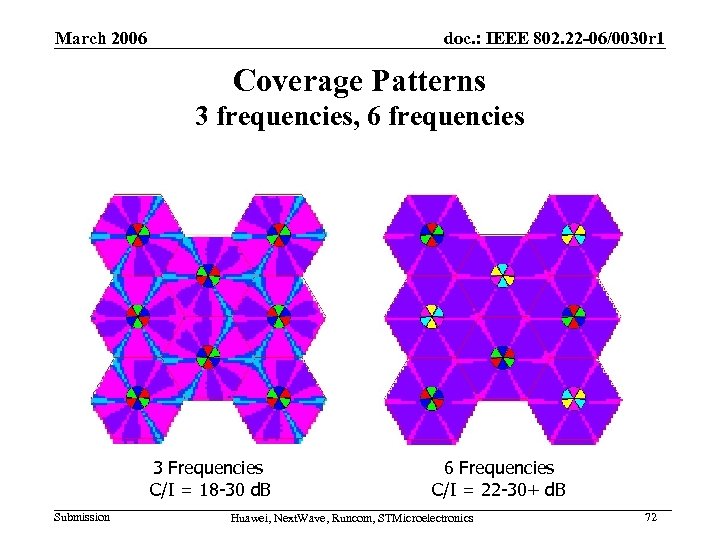 March 2006 doc. : IEEE 802. 22 -06/0030 r 1 Coverage Patterns 3 frequencies, 6 frequencies 3 Frequencies C/I = 18 -30 d. B Submission 6 Frequencies C/I = 22 -30+ d. B Huawei, Next. Wave, Runcom, STMicroelectronics 72
 March 2006 doc. : IEEE 802. 22 -06/0030 r 1 RF Sensing Proposal Submission Huawei, Next. Wave, Runcom, STMicroelectronics 73
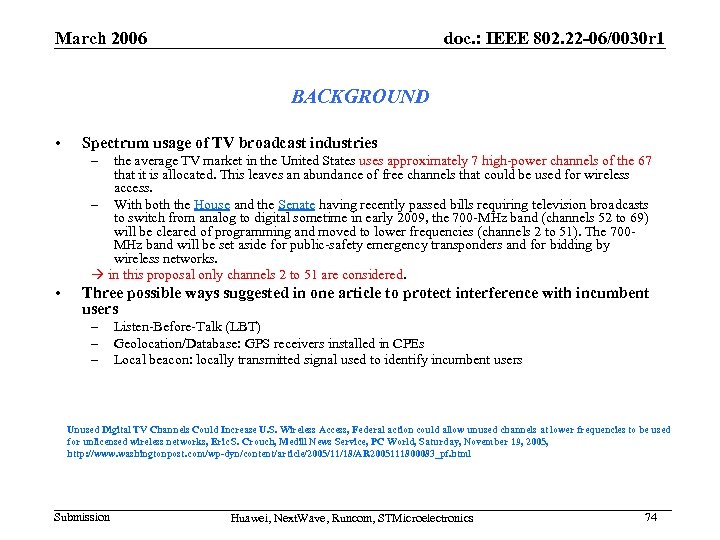 March 2006 doc. : IEEE 802. 22 -06/0030 r 1 BACKGROUND • Spectrum usage of TV broadcast industries – the average TV market in the United States uses approximately 7 high-power channels of the 67 that it is allocated. This leaves an abundance of free channels that could be used for wireless access. – With both the House and the Senate having recently passed bills requiring television broadcasts to switch from analog to digital sometime in early 2009, the 700 -MHz band (channels 52 to 69) will be cleared of programming and moved to lower frequencies (channels 2 to 51). The 700 MHz band will be set aside for public-safety emergency transponders and for bidding by wireless networks. in this proposal only channels 2 to 51 are considered. • Three possible ways suggested in one article to protect interference with incumbent users – – – Listen-Before-Talk (LBT) Geolocation/Database: GPS receivers installed in CPEs Local beacon: locally transmitted signal used to identify incumbent users Unused Digital TV Channels Could Increase U. S. Wireless Access, Federal action could allow unused channels at lower frequencies to be used for unlicensed wireless networks, Eric S. Crouch, Medill News Service, PC World, Saturday, November 19, 2005, http: //www. washingtonpost. com/wp-dyn/content/article/2005/11/18/AR 2005111800083_pf. html Submission Huawei, Next. Wave, Runcom, STMicroelectronics 74
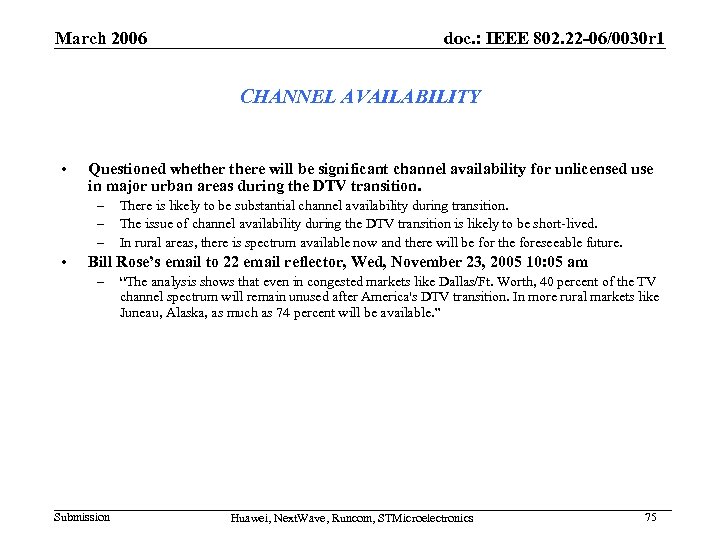 March 2006 doc. : IEEE 802. 22 -06/0030 r 1 CHANNEL AVAILABILITY • Questioned whethere will be significant channel availability for unlicensed use in major urban areas during the DTV transition. – – – • There is likely to be substantial channel availability during transition. The issue of channel availability during the DTV transition is likely to be short-lived. In rural areas, there is spectrum available now and there will be for the foreseeable future. Bill Rose’s email to 22 email reflector, Wed, November 23, 2005 10: 05 am – Submission “The analysis shows that even in congested markets like Dallas/Ft. Worth, 40 percent of the TV channel spectrum will remain unused after America's DTV transition. In more rural markets like Juneau, Alaska, as much as 74 percent will be available. ” Huawei, Next. Wave, Runcom, STMicroelectronics 75
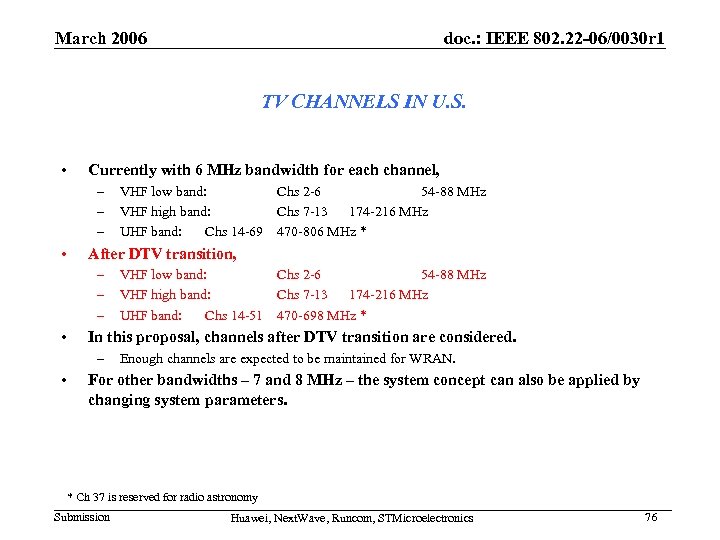 March 2006 doc. : IEEE 802. 22 -06/0030 r 1 TV CHANNELS IN U. S. • Currently with 6 MHz bandwidth for each channel, – – – • VHF low band: VHF high band: UHF band: Chs 14 -51 Chs 2 -6 54 -88 MHz Chs 7 -13 174 -216 MHz 470 -698 MHz * In this proposal, channels after DTV transition are considered. – • Chs 2 -6 54 -88 MHz Chs 7 -13 174 -216 MHz 470 -806 MHz * After DTV transition, – – – • VHF low band: VHF high band: UHF band: Chs 14 -69 Enough channels are expected to be maintained for WRAN. For other bandwidths – 7 and 8 MHz – the system concept can also be applied by changing system parameters. * Ch 37 is reserved for radio astronomy Submission Huawei, Next. Wave, Runcom, STMicroelectronics 76
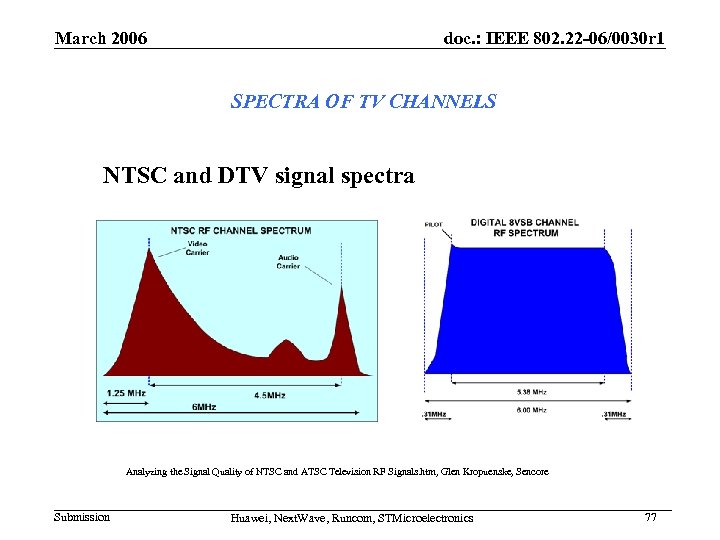 March 2006 doc. : IEEE 802. 22 -06/0030 r 1 SPECTRA OF TV CHANNELS NTSC and DTV signal spectra Analyzing the Signal Quality of NTSC and ATSC Television RF Signals. htm, Glen Kropuenske, Sencore Submission Huawei, Next. Wave, Runcom, STMicroelectronics 77
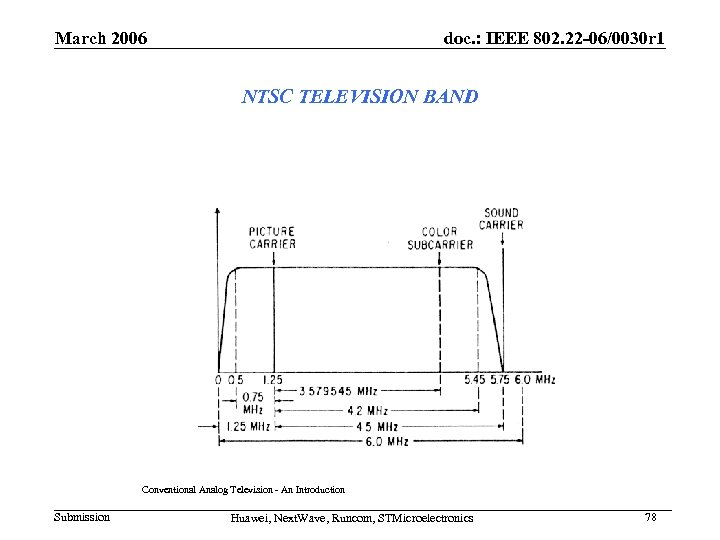 March 2006 doc. : IEEE 802. 22 -06/0030 r 1 NTSC TELEVISION BAND Conventional Analog Television - An Introduction Submission Huawei, Next. Wave, Runcom, STMicroelectronics 78
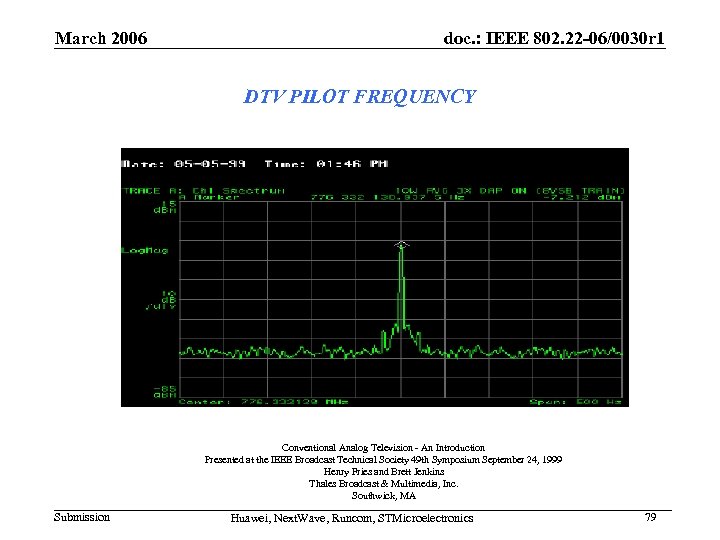 March 2006 doc. : IEEE 802. 22 -06/0030 r 1 DTV PILOT FREQUENCY Conventional Analog Television - An Introduction Presented at the IEEE Broadcast Technical Society 49 th Symposium September 24, 1999 Henry Fries and Brett Jenkins Thales Broadcast & Multimedia, Inc. Southwick, MA Submission Huawei, Next. Wave, Runcom, STMicroelectronics 79
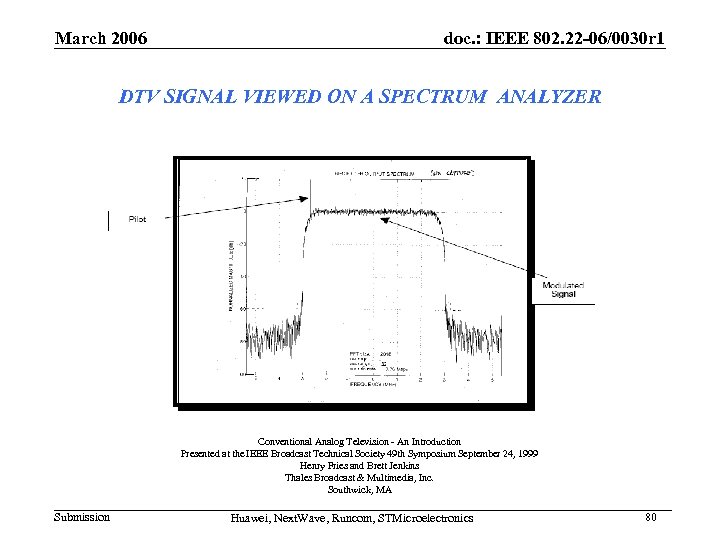 March 2006 doc. : IEEE 802. 22 -06/0030 r 1 DTV SIGNAL VIEWED ON A SPECTRUM ANALYZER Conventional Analog Television - An Introduction Presented at the IEEE Broadcast Technical Society 49 th Symposium September 24, 1999 Henry Fries and Brett Jenkins Thales Broadcast & Multimedia, Inc. Southwick, MA Submission Huawei, Next. Wave, Runcom, STMicroelectronics 80
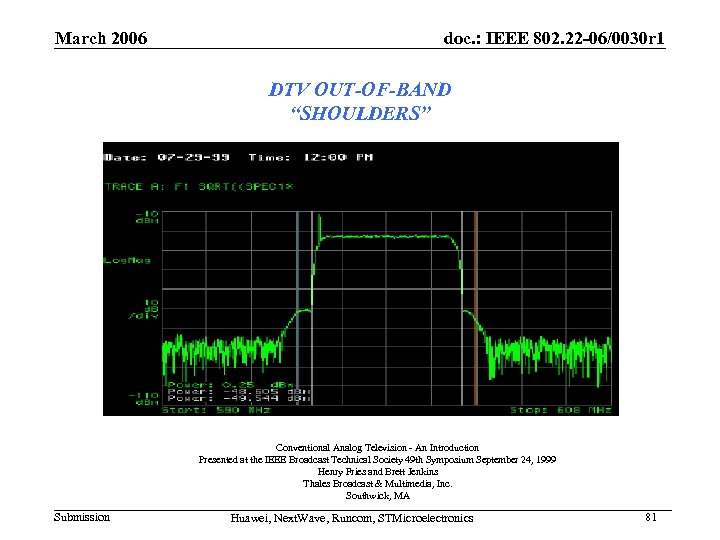 March 2006 doc. : IEEE 802. 22 -06/0030 r 1 DTV OUT-OF-BAND “SHOULDERS” Conventional Analog Television - An Introduction Presented at the IEEE Broadcast Technical Society 49 th Symposium September 24, 1999 Henry Fries and Brett Jenkins Thales Broadcast & Multimedia, Inc. Southwick, MA Submission Huawei, Next. Wave, Runcom, STMicroelectronics 81
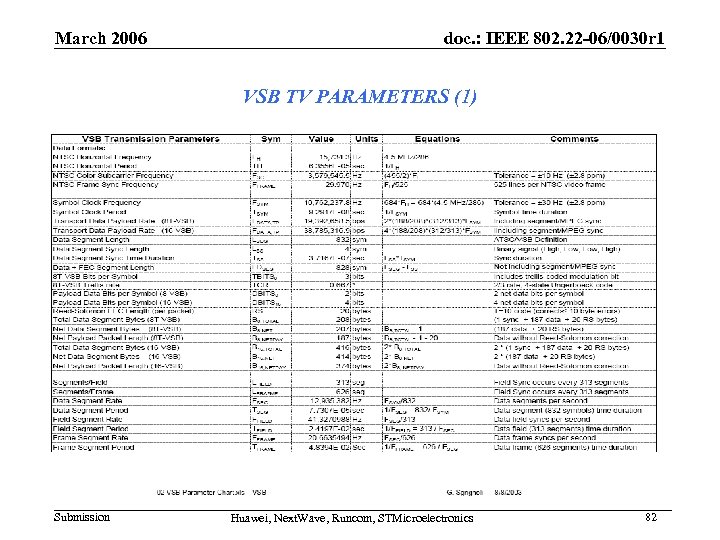 March 2006 doc. : IEEE 802. 22 -06/0030 r 1 VSB TV PARAMETERS (1) Submission Huawei, Next. Wave, Runcom, STMicroelectronics 82
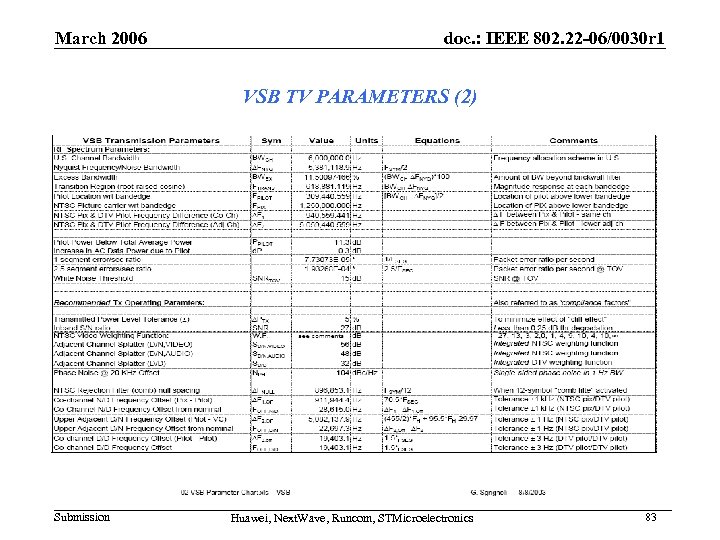 March 2006 doc. : IEEE 802. 22 -06/0030 r 1 VSB TV PARAMETERS (2) Submission Huawei, Next. Wave, Runcom, STMicroelectronics 83
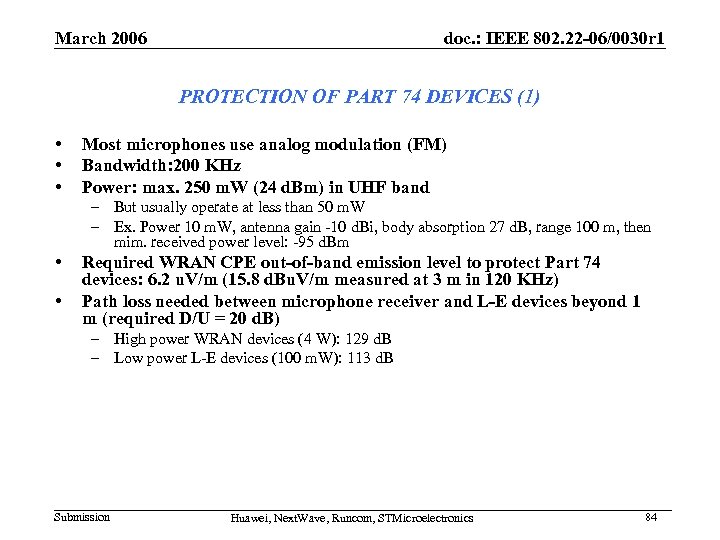 March 2006 doc. : IEEE 802. 22 -06/0030 r 1 PROTECTION OF PART 74 DEVICES (1) • • • Most microphones use analog modulation (FM) Bandwidth: 200 KHz Power: max. 250 m. W (24 d. Bm) in UHF band – But usually operate at less than 50 m. W – Ex. Power 10 m. W, antenna gain -10 d. Bi, body absorption 27 d. B, range 100 m, then mim. received power level: -95 d. Bm • • Required WRAN CPE out-of-band emission level to protect Part 74 devices: 6. 2 u. V/m (15. 8 d. Bu. V/m measured at 3 m in 120 KHz) Path loss needed between microphone receiver and L-E devices beyond 1 m (required D/U = 20 d. B) – High power WRAN devices (4 W): 129 d. B – Low power L-E devices (100 m. W): 113 d. B Submission Huawei, Next. Wave, Runcom, STMicroelectronics 84
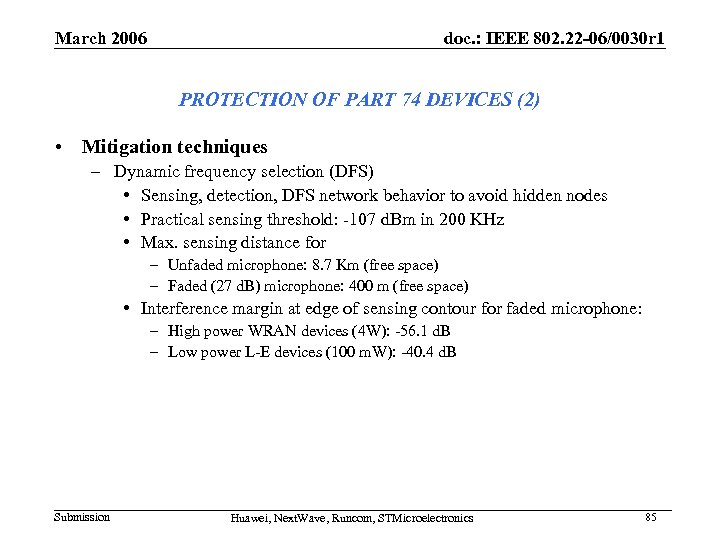 March 2006 doc. : IEEE 802. 22 -06/0030 r 1 PROTECTION OF PART 74 DEVICES (2) • Mitigation techniques – Dynamic frequency selection (DFS) • Sensing, detection, DFS network behavior to avoid hidden nodes • Practical sensing threshold: -107 d. Bm in 200 KHz • Max. sensing distance for – Unfaded microphone: 8. 7 Km (free space) – Faded (27 d. B) microphone: 400 m (free space) • Interference margin at edge of sensing contour for faded microphone: – High power WRAN devices (4 W): -56. 1 d. B – Low power L-E devices (100 m. W): -40. 4 d. B Submission Huawei, Next. Wave, Runcom, STMicroelectronics 85
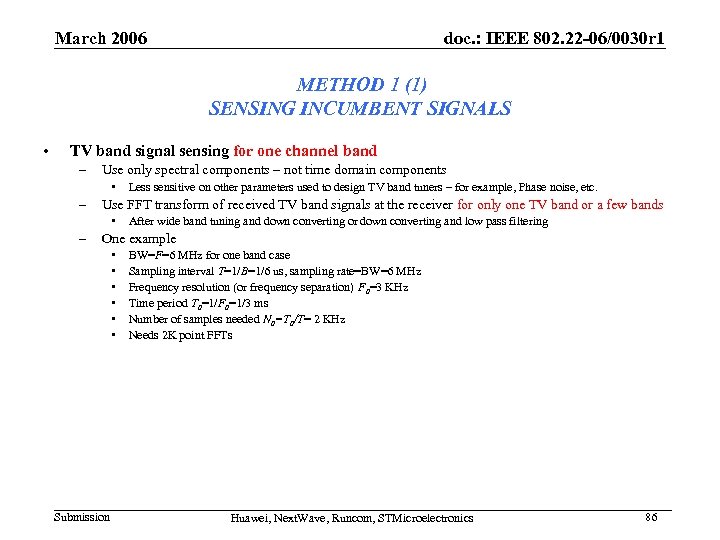 March 2006 doc. : IEEE 802. 22 -06/0030 r 1 METHOD 1 (1) SENSING INCUMBENT SIGNALS • TV band signal sensing for one channel band – Use only spectral components – not time domain components • – Use FFT transform of received TV band signals at the receiver for only one TV band or a few bands • – Less sensitive on other parameters used to design TV band tuners – for example, Phase noise, etc. After wide band tuning and down converting or down converting and low pass filtering One example • • • Submission BW=F=6 MHz for one band case Sampling interval T=1/B=1/6 us, sampling rate=BW=6 MHz Frequency resolution (or frequency separation) F 0=3 KHz Time period T 0=1/F 0=1/3 ms Number of samples needed N 0=T 0/T= 2 KHz Needs 2 K point FFTs Huawei, Next. Wave, Runcom, STMicroelectronics 86
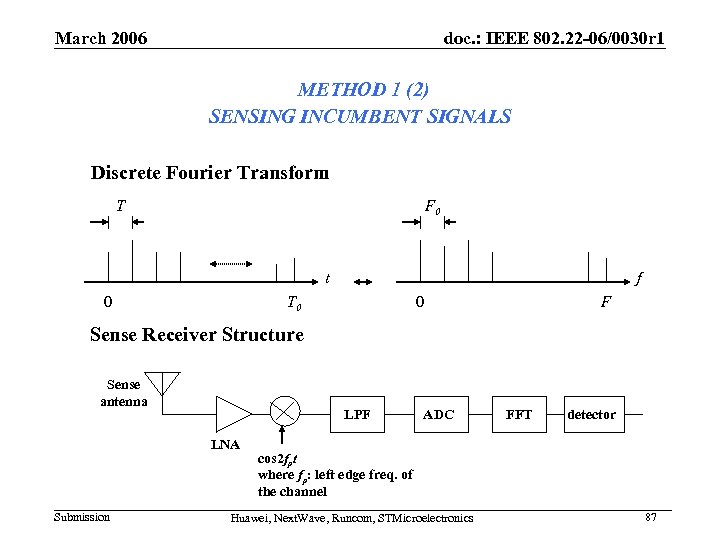 March 2006 doc. : IEEE 802. 22 -06/0030 r 1 METHOD 1 (2) SENSING INCUMBENT SIGNALS Discrete Fourier Transform T F 0 t 0 f T 0 0 F Sense Receiver Structure Sense antenna LPF LNA Submission ADC FFT detector cos 2 fpt where fp: left edge freq. of the channel Huawei, Next. Wave, Runcom, STMicroelectronics 87
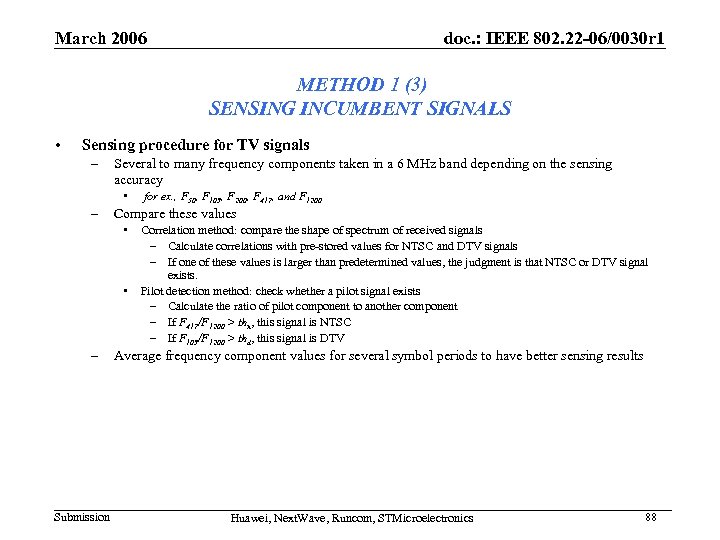 March 2006 doc. : IEEE 802. 22 -06/0030 r 1 METHOD 1 (3) SENSING INCUMBENT SIGNALS • Sensing procedure for TV signals – Several to many frequency components taken in a 6 MHz band depending on the sensing accuracy • – Compare these values • • – Submission for ex. , F 50, F 103, F 200, F 417, and F 1200 Correlation method: compare the shape of spectrum of received signals – Calculate correlations with pre-stored values for NTSC and DTV signals – If one of these values is larger than predetermined values, the judgment is that NTSC or DTV signal exists. Pilot detection method: check whether a pilot signal exists – Calculate the ratio of pilot component to another component – If F 417/F 1200 > thn, this signal is NTSC – If F 103/F 1200 > thd, this signal is DTV Average frequency component values for several symbol periods to have better sensing results Huawei, Next. Wave, Runcom, STMicroelectronics 88
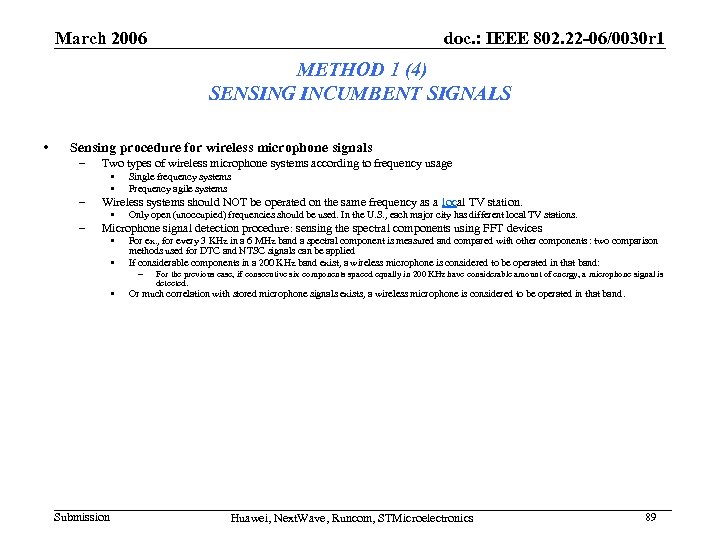 March 2006 doc. : IEEE 802. 22 -06/0030 r 1 METHOD 1 (4) SENSING INCUMBENT SIGNALS • Sensing procedure for wireless microphone signals – Two types of wireless microphone systems according to frequency usage • • – Wireless systems should NOT be operated on the same frequency as a local TV station. • – Single frequency systems Frequency agile systems Only open (unoccupied) frequencies should be used. In the U. S. , each major city has different local TV stations. Microphone signal detection procedure: sensing the spectral components using FFT devices • • For ex. , for every 3 KHz in a 6 MHz band a spectral component is measured and compared with other components : two comparison methods used for DTC and NTSC signals can be applied If considerable components in a 200 KHz band exist, a wireless microphone is considered to be operated in that band: – • Submission For the previous case, if consecutive six components spaced equally in 200 KHz have considerable amount of energy, a microphone signal is detected. Or much correlation with stored microphone signals exists, a wireless microphone is considered to be operated in that band. Huawei, Next. Wave, Runcom, STMicroelectronics 89
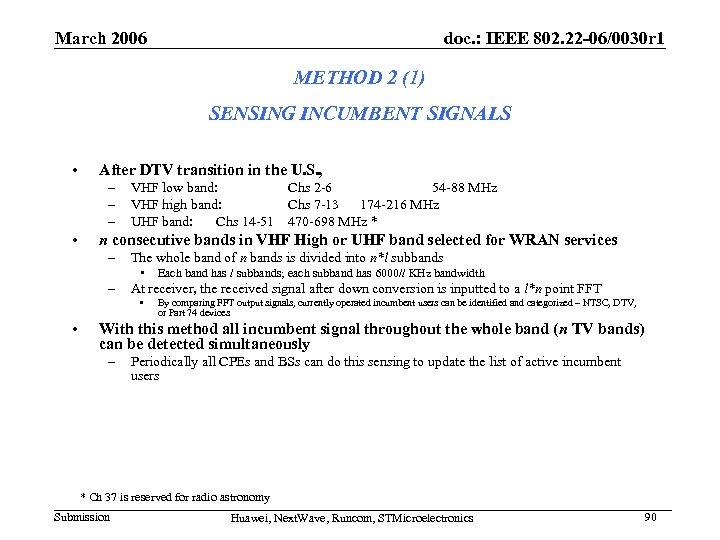 March 2006 doc. : IEEE 802. 22 -06/0030 r 1 METHOD 2 (1) SENSING INCUMBENT SIGNALS • After DTV transition in the U. S. , – – – • VHF low band: VHF high band: UHF band: Chs 14 -51 n consecutive bands in VHF High or UHF band selected for WRAN services – The whole band of n bands is divided into n*l subbands • – Each band has l subbands; each subband has 6000/l KHz bandwidth At receiver, the received signal after down conversion is inputted to a l*n point FFT • • Chs 2 -6 54 -88 MHz Chs 7 -13 174 -216 MHz 470 -698 MHz * By comparing FFT output signals, currently operated incumbent users can be identified and categorized – NTSC, DTV, or Part 74 devices With this method all incumbent signal throughout the whole band (n TV bands) can be detected simultaneously – Periodically all CPEs and BSs can do this sensing to update the list of active incumbent users * Ch 37 is reserved for radio astronomy Submission Huawei, Next. Wave, Runcom, STMicroelectronics 90
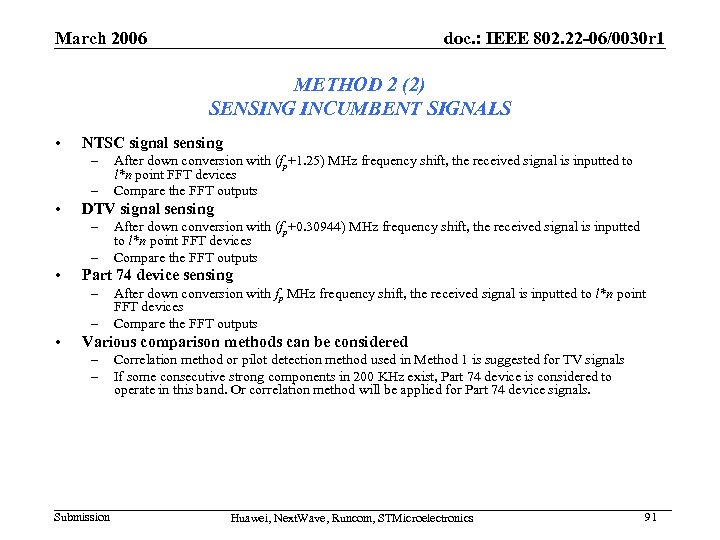 March 2006 doc. : IEEE 802. 22 -06/0030 r 1 METHOD 2 (2) SENSING INCUMBENT SIGNALS • NTSC signal sensing – – • DTV signal sensing – – • After down conversion with (fp+0. 30944) MHz frequency shift, the received signal is inputted to l*n point FFT devices Compare the FFT outputs Part 74 device sensing – – • After down conversion with (fp+1. 25) MHz frequency shift, the received signal is inputted to l*n point FFT devices Compare the FFT outputs After down conversion with fp MHz frequency shift, the received signal is inputted to l*n point FFT devices Compare the FFT outputs Various comparison methods can be considered – – Submission Correlation method or pilot detection method used in Method 1 is suggested for TV signals If some consecutive strong components in 200 KHz exist, Part 74 device is considered to operate in this band. Or correlation method will be applied for Part 74 device signals. Huawei, Next. Wave, Runcom, STMicroelectronics 91
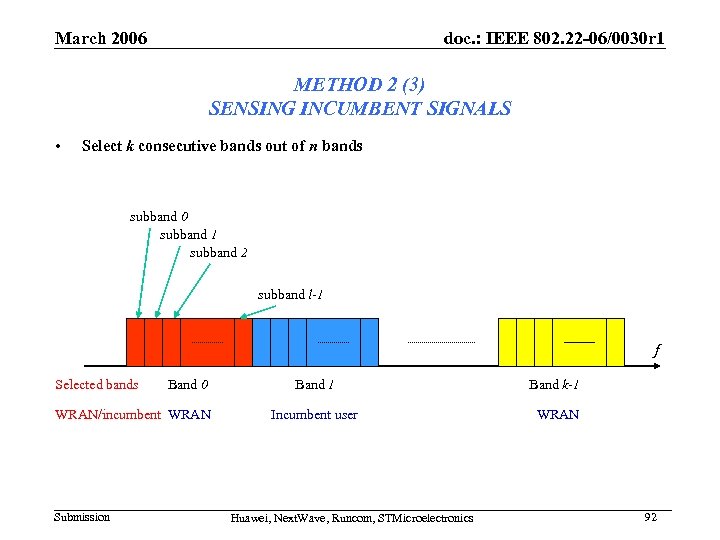 March 2006 doc. : IEEE 802. 22 -06/0030 r 1 METHOD 2 (3) SENSING INCUMBENT SIGNALS • Select k consecutive bands out of n bands subband 0 subband 1 subband 2 subband l-1 f Selected bands Band 0 WRAN/incumbent WRAN Submission Band 1 Band k-1 Incumbent user WRAN Huawei, Next. Wave, Runcom, STMicroelectronics 92
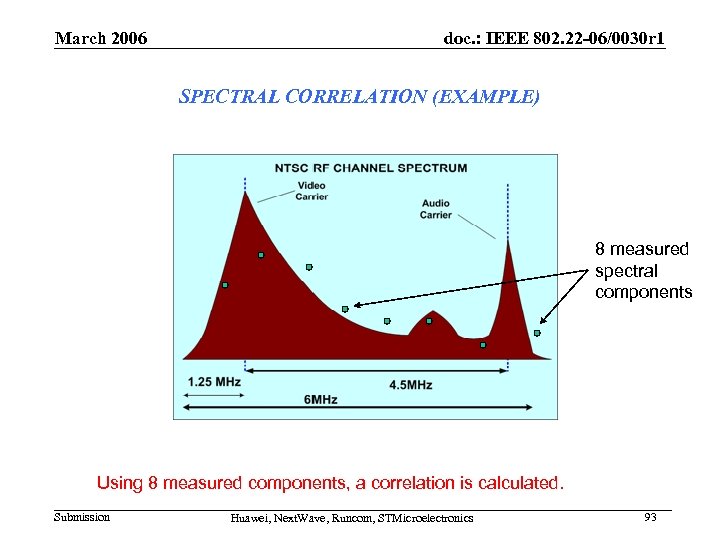 March 2006 doc. : IEEE 802. 22 -06/0030 r 1 SPECTRAL CORRELATION (EXAMPLE) 8 measured spectral components Using 8 measured components, a correlation is calculated. Submission Huawei, Next. Wave, Runcom, STMicroelectronics 93
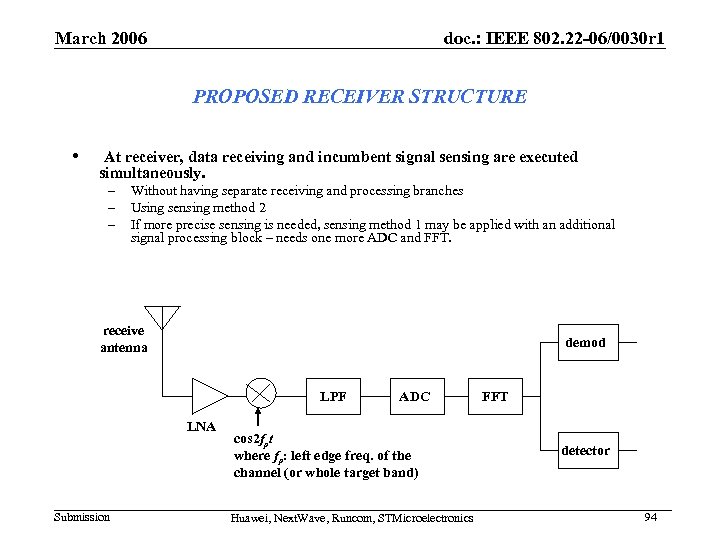 March 2006 doc. : IEEE 802. 22 -06/0030 r 1 PROPOSED RECEIVER STRUCTURE • At receiver, data receiving and incumbent signal sensing are executed simultaneously. – – – Without having separate receiving and processing branches Using sensing method 2 If more precise sensing is needed, sensing method 1 may be applied with an additional signal processing block – needs one more ADC and FFT. receive antenna demod LPF LNA Submission ADC cos 2 fpt where fp: left edge freq. of the channel (or whole target band) Huawei, Next. Wave, Runcom, STMicroelectronics FFT detector 94
 March 2006 doc. : IEEE 802. 22 -06/0030 r 1 ADVANTEGES OVER OTHER PROPOSED SCHEMES • Advantage over energy detection including MRSS – At one measurement, all frequency components can be extracted: whole frequency band can be covered for one FFT symbol duration : faster than MRSS which uses sweep oscillators. – Correlation detection not energy detection : more intelligent sensing than MRSS • Advantage over cyclostationary feature sensing – Can detect Part 74 device signals while cyclostationary sensors can not detect them while NTSC and DTV signals can be detected relatively much easier than Part 74 signals. • Advantage over other proposed schemes – Need not more hardware to sense: can use OFDM receiving blocks: only a detector should be added for sensing – Faster and simpler than other proposed schemes Submission Huawei, Next. Wave, Runcom, STMicroelectronics 95
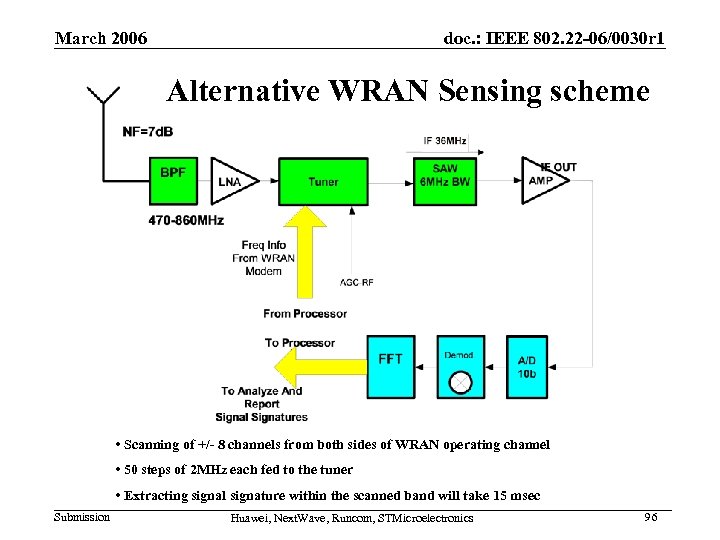 March 2006 doc. : IEEE 802. 22 -06/0030 r 1 Alternative WRAN Sensing scheme • Scanning of +/- 8 channels from both sides of WRAN operating channel • 50 steps of 2 MHz each fed to the tuner • Extracting signal signature within the scanned band will take 15 msec Submission Huawei, Next. Wave, Runcom, STMicroelectronics 96
 March 2006 doc. : IEEE 802. 22 -06/0030 r 1 MAC Proposal Submission Huawei, Next. Wave, Runcom, STMicroelectronics 97
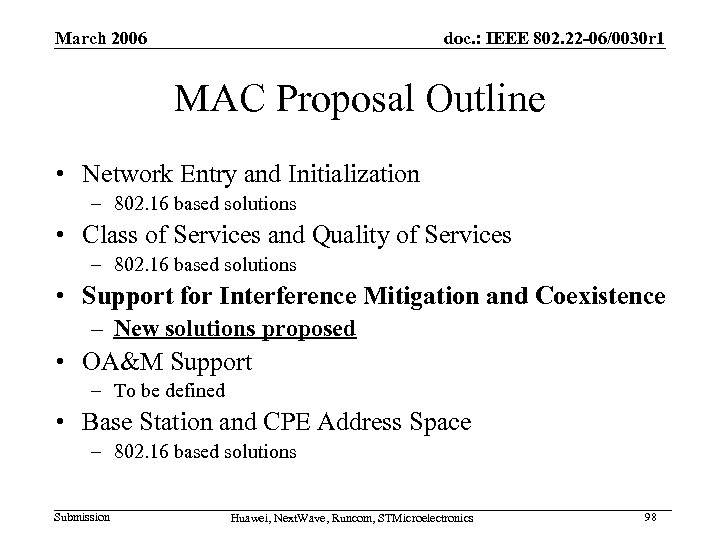 March 2006 doc. : IEEE 802. 22 -06/0030 r 1 MAC Proposal Outline • Network Entry and Initialization – 802. 16 based solutions • Class of Services and Quality of Services – 802. 16 based solutions • Support for Interference Mitigation and Coexistence – New solutions proposed • OA&M Support – To be defined • Base Station and CPE Address Space – 802. 16 based solutions Submission Huawei, Next. Wave, Runcom, STMicroelectronics 98
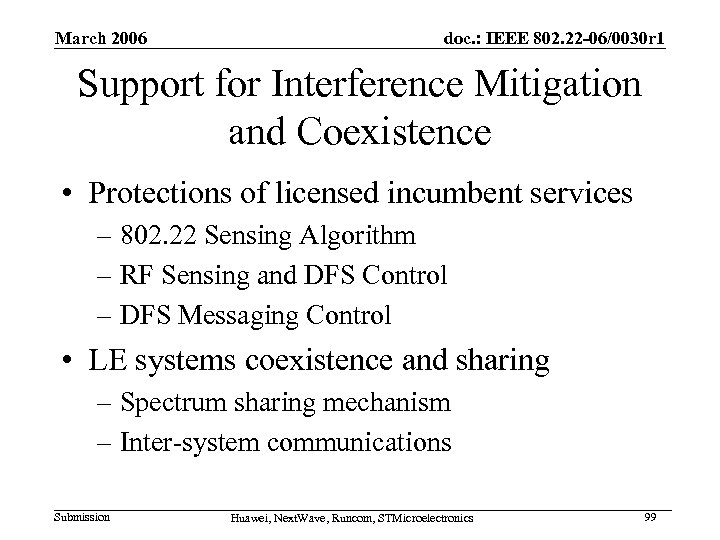 March 2006 doc. : IEEE 802. 22 -06/0030 r 1 Support for Interference Mitigation and Coexistence • Protections of licensed incumbent services – 802. 22 Sensing Algorithm – RF Sensing and DFS Control – DFS Messaging Control • LE systems coexistence and sharing – Spectrum sharing mechanism – Inter-system communications Submission Huawei, Next. Wave, Runcom, STMicroelectronics 99
 March 2006 doc. : IEEE 802. 22 -06/0030 r 1 Protections of Licensed Incumbent Services Submission Huawei, Next. Wave, Runcom, STMicroelectronics 100
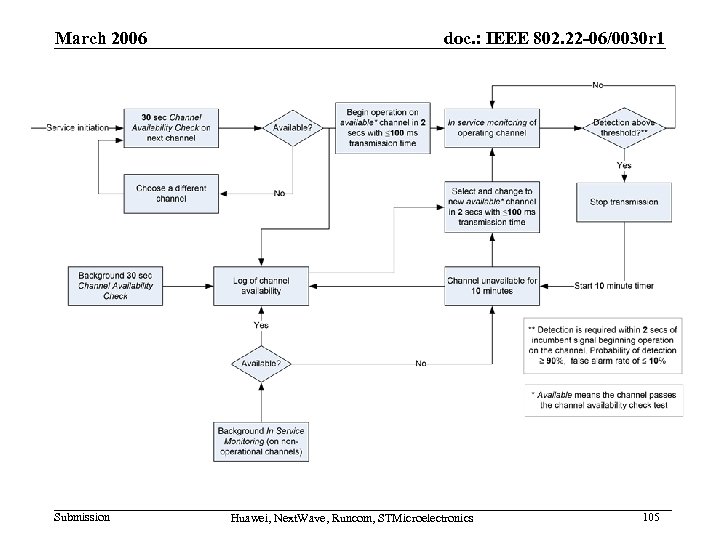
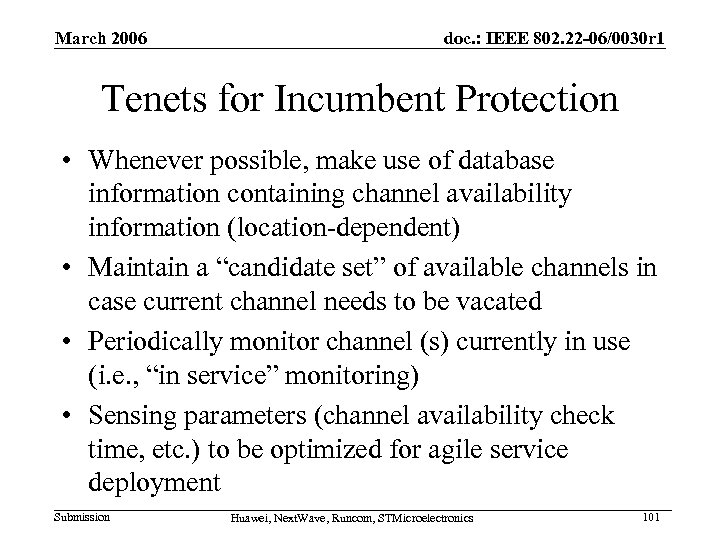 March 2006 doc. : IEEE 802. 22 -06/0030 r 1 Tenets for Incumbent Protection • Whenever possible, make use of database information containing channel availability information (location-dependent) • Maintain a “candidate set” of available channels in case current channel needs to be vacated • Periodically monitor channel (s) currently in use (i. e. , “in service” monitoring) • Sensing parameters (channel availability check time, etc. ) to be optimized for agile service deployment Submission Huawei, Next. Wave, Runcom, STMicroelectronics 101
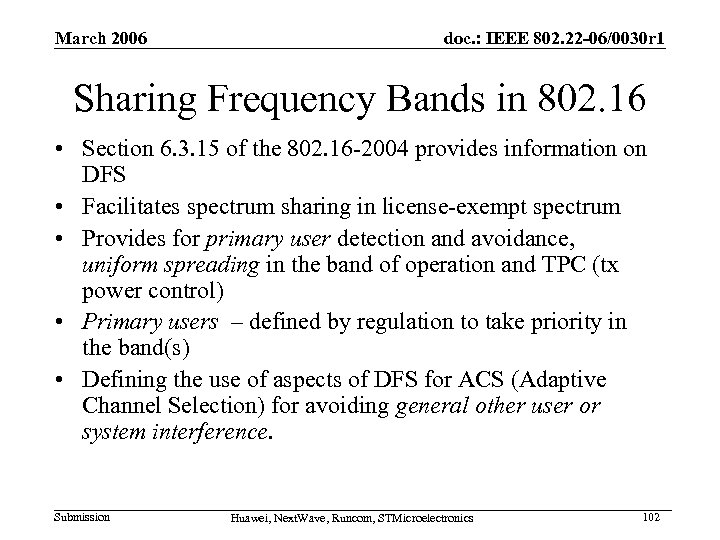 March 2006 doc. : IEEE 802. 22 -06/0030 r 1 Sharing Frequency Bands in 802. 16 • Section 6. 3. 15 of the 802. 16 -2004 provides information on DFS • Facilitates spectrum sharing in license-exempt spectrum • Provides for primary user detection and avoidance, uniform spreading in the band of operation and TPC (tx power control) • Primary users – defined by regulation to take priority in the band(s) • Defining the use of aspects of DFS for ACS (Adaptive Channel Selection) for avoiding general other user or system interference. Submission Huawei, Next. Wave, Runcom, STMicroelectronics 102
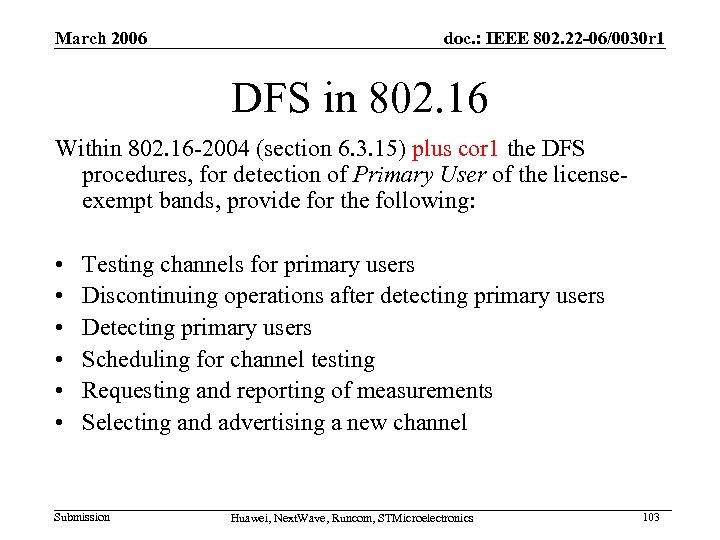 March 2006 doc. : IEEE 802. 22 -06/0030 r 1 DFS in 802. 16 Within 802. 16 -2004 (section 6. 3. 15) plus cor 1 the DFS procedures, for detection of Primary User of the licenseexempt bands, provide for the following: • • • Testing channels for primary users Discontinuing operations after detecting primary users Detecting primary users Scheduling for channel testing Requesting and reporting of measurements Selecting and advertising a new channel Submission Huawei, Next. Wave, Runcom, STMicroelectronics 103
 March 2006 doc. : IEEE 802. 22 -06/0030 r 1 802. 22 Sensing Algorithm Submission Huawei, Next. Wave, Runcom, STMicroelectronics 104
 March 2006 Submission doc. : IEEE 802. 22 -06/0030 r 1 Huawei, Next. Wave, Runcom, STMicroelectronics 105
 March 2006 doc. : IEEE 802. 22 -06/0030 r 1 RF Sensing and DFS Control Submission Huawei, Next. Wave, Runcom, STMicroelectronics 106
 March 2006 doc. : IEEE 802. 22 -06/0030 r 1 Dynamic Frequency Hopping - A Flexible Framework for RF Sensing Control and DFS Control Submission Huawei, Next. Wave, Runcom, STMicroelectronics 107
 March 2006 doc. : IEEE 802. 22 -06/0030 r 1 RF Sensing and DFS Control • Objectives – Licensed incumbent protection guarantee – Satisfactory/High Qo. S for 802. 22 systems • Possible Solutions – Simultaneous RF sensing and data transmissions – Sequential RF sensing and data transmissions Submission Huawei, Next. Wave, Runcom, STMicroelectronics 108
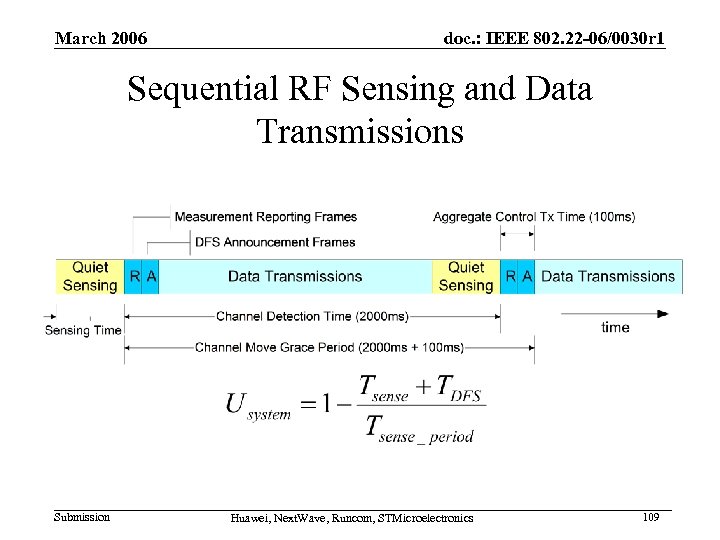 March 2006 doc. : IEEE 802. 22 -06/0030 r 1 Sequential RF Sensing and Data Transmissions Submission Huawei, Next. Wave, Runcom, STMicroelectronics 109
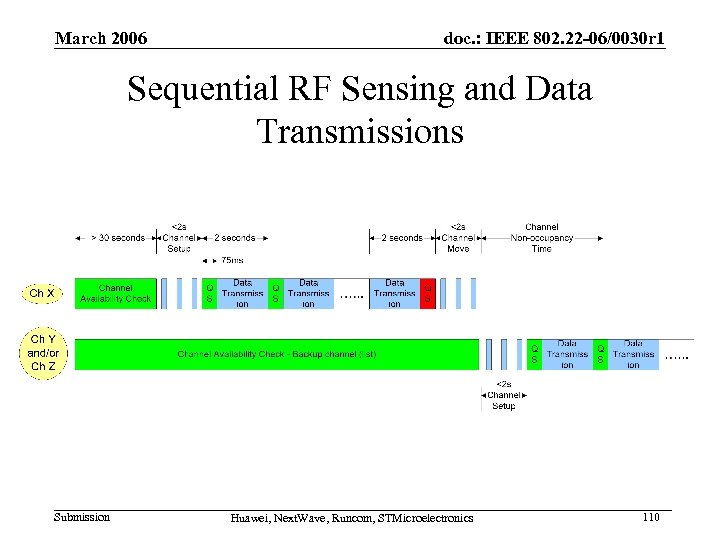 March 2006 doc. : IEEE 802. 22 -06/0030 r 1 Sequential RF Sensing and Data Transmissions Submission Huawei, Next. Wave, Runcom, STMicroelectronics 110
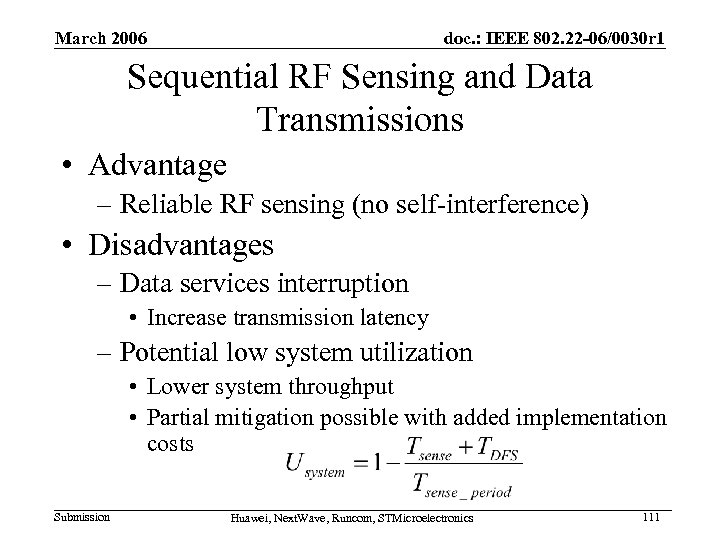 March 2006 doc. : IEEE 802. 22 -06/0030 r 1 Sequential RF Sensing and Data Transmissions • Advantage – Reliable RF sensing (no self-interference) • Disadvantages – Data services interruption • Increase transmission latency – Potential low system utilization • Lower system throughput • Partial mitigation possible with added implementation costs Submission Huawei, Next. Wave, Runcom, STMicroelectronics 111
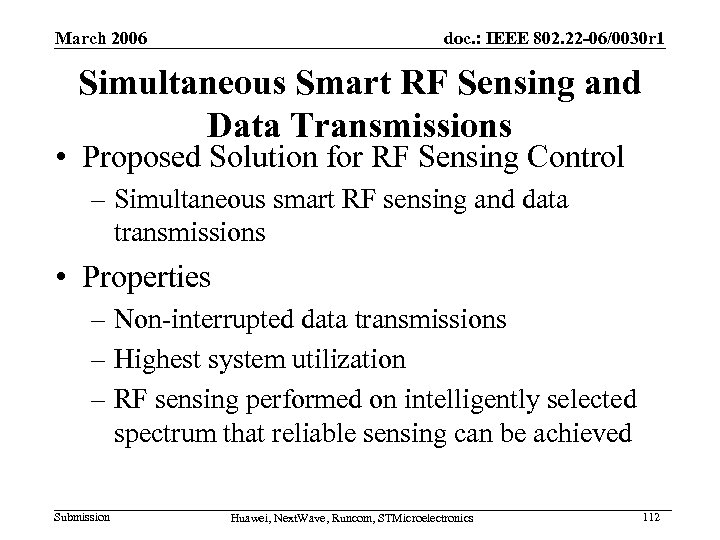 March 2006 doc. : IEEE 802. 22 -06/0030 r 1 Simultaneous Smart RF Sensing and Data Transmissions • Proposed Solution for RF Sensing Control – Simultaneous smart RF sensing and data transmissions • Properties – Non-interrupted data transmissions – Highest system utilization – RF sensing performed on intelligently selected spectrum that reliable sensing can be achieved Submission Huawei, Next. Wave, Runcom, STMicroelectronics 112
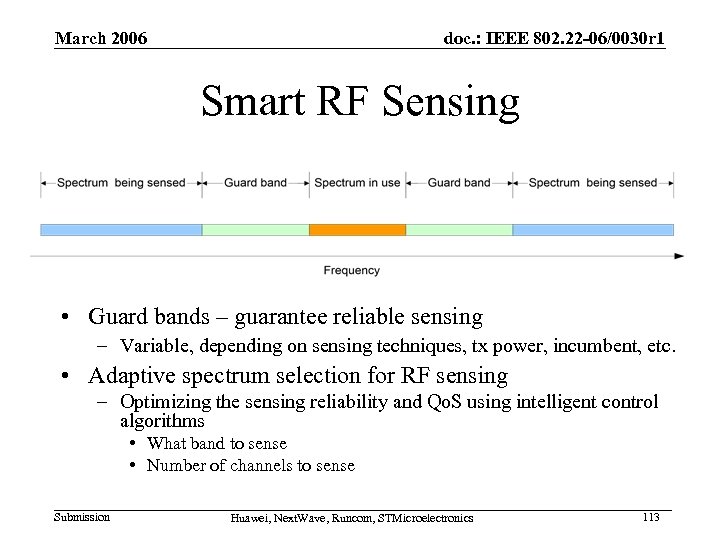 March 2006 doc. : IEEE 802. 22 -06/0030 r 1 Smart RF Sensing • Guard bands – guarantee reliable sensing – Variable, depending on sensing techniques, tx power, incumbent, etc. • Adaptive spectrum selection for RF sensing – Optimizing the sensing reliability and Qo. S using intelligent control algorithms • What band to sense • Number of channels to sense Submission Huawei, Next. Wave, Runcom, STMicroelectronics 113
 March 2006 doc. : IEEE 802. 22 -06/0030 r 1 Smart RF Sensing • Provide flexibility of strategic channel selection for RF sensing, optimizing: – RF sensing performance – Qo. S of 802. 22 systems • Flexibility of channel selection – Channels to be sensed • Channels with less probability of incumbent occupancy – Number of channels to be sensed – Size of the Guard band • Positive, negative, infinite Submission Huawei, Next. Wave, Runcom, STMicroelectronics 114
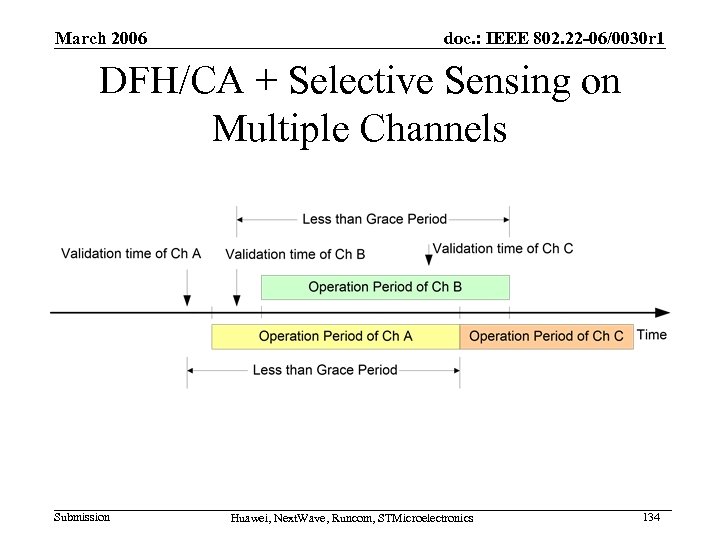
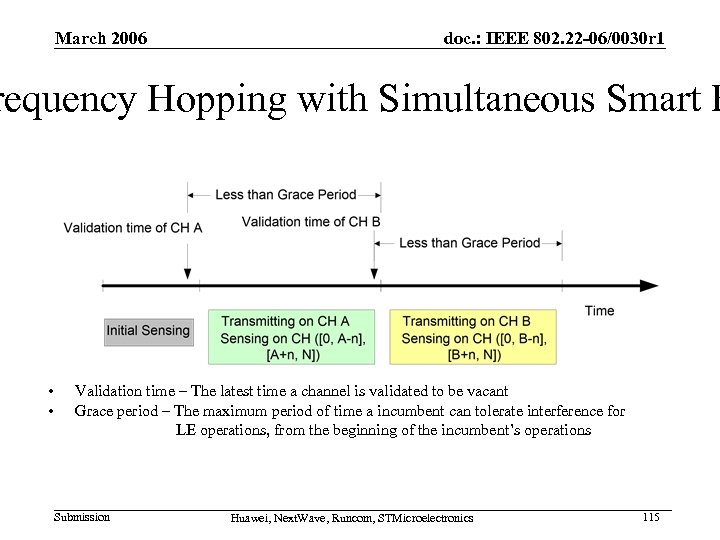 March 2006 doc. : IEEE 802. 22 -06/0030 r 1 requency Hopping with Simultaneous Smart R • • Validation time – The latest time a channel is validated to be vacant Grace period – The maximum period of time a incumbent can tolerate interference for LE operations, from the beginning of the incumbent’s operations Submission Huawei, Next. Wave, Runcom, STMicroelectronics 115
 March 2006 doc. : IEEE 802. 22 -06/0030 r 1 Dynamic Frequency Hopping • A 802. 22 system cognitively and continuously switches operation frequencies for data transmissions. • Both frequency selections and the length of an operation period on a channel are determined dynamically in runtime by a cognitive engine. • A 802. 22 system transmits data on a frequency for an operation period (DFH Operation Period) whose length is varied and shall not exceed the grace period. Submission Huawei, Next. Wave, Runcom, STMicroelectronics 116
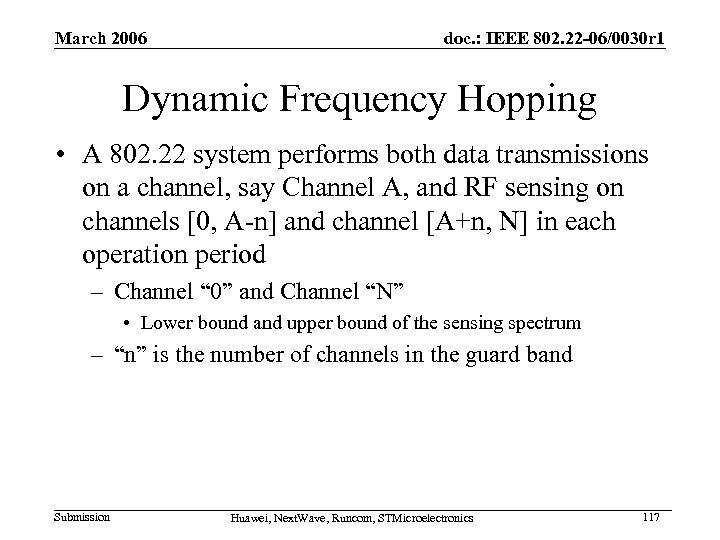 March 2006 doc. : IEEE 802. 22 -06/0030 r 1 Dynamic Frequency Hopping • A 802. 22 system performs both data transmissions on a channel, say Channel A, and RF sensing on channels [0, A-n] and channel [A+n, N] in each operation period – Channel “ 0” and Channel “N” • Lower bound and upper bound of the sensing spectrum – “n” is the number of channels in the guard band Submission Huawei, Next. Wave, Runcom, STMicroelectronics 117
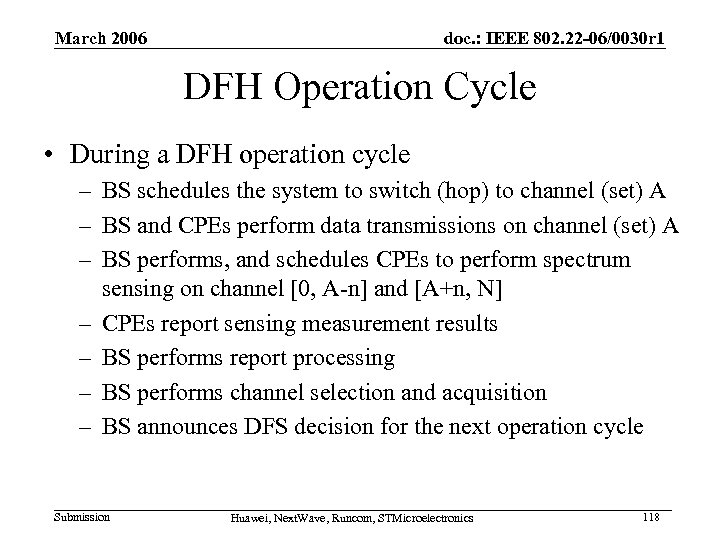 March 2006 doc. : IEEE 802. 22 -06/0030 r 1 DFH Operation Cycle • During a DFH operation cycle – BS schedules the system to switch (hop) to channel (set) A – BS and CPEs perform data transmissions on channel (set) A – BS performs, and schedules CPEs to perform spectrum sensing on channel [0, A-n] and [A+n, N] – CPEs report sensing measurement results – BS performs report processing – BS performs channel selection and acquisition – BS announces DFS decision for the next operation cycle Submission Huawei, Next. Wave, Runcom, STMicroelectronics 118
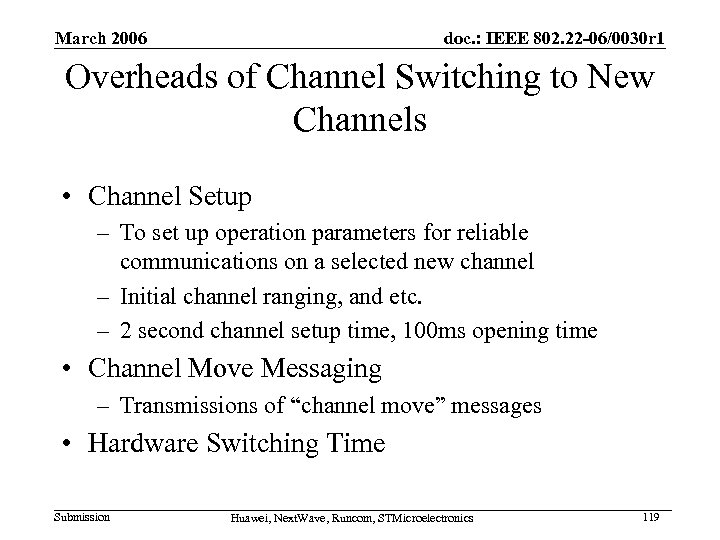 March 2006 doc. : IEEE 802. 22 -06/0030 r 1 Overheads of Channel Switching to New Channels • Channel Setup – To set up operation parameters for reliable communications on a selected new channel – Initial channel ranging, and etc. – 2 second channel setup time, 100 ms opening time • Channel Move Messaging – Transmissions of “channel move” messages • Hardware Switching Time Submission Huawei, Next. Wave, Runcom, STMicroelectronics 119
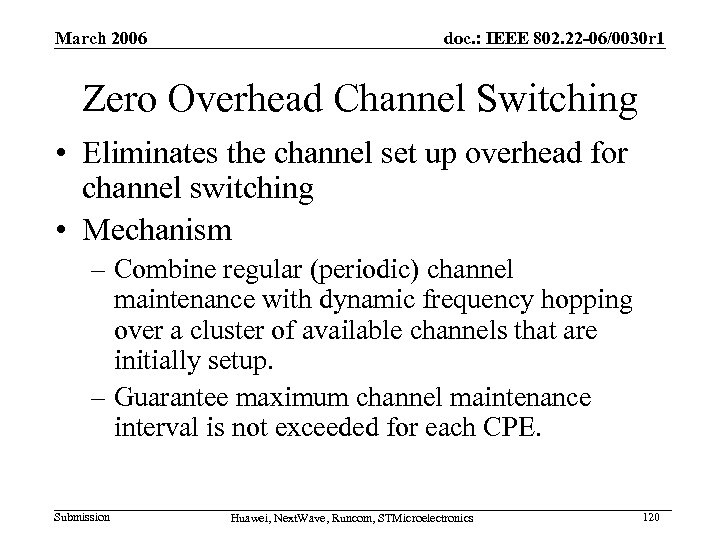 March 2006 doc. : IEEE 802. 22 -06/0030 r 1 Zero Overhead Channel Switching • Eliminates the channel set up overhead for channel switching • Mechanism – Combine regular (periodic) channel maintenance with dynamic frequency hopping over a cluster of available channels that are initially setup. – Guarantee maximum channel maintenance interval is not exceeded for each CPE. Submission Huawei, Next. Wave, Runcom, STMicroelectronics 120
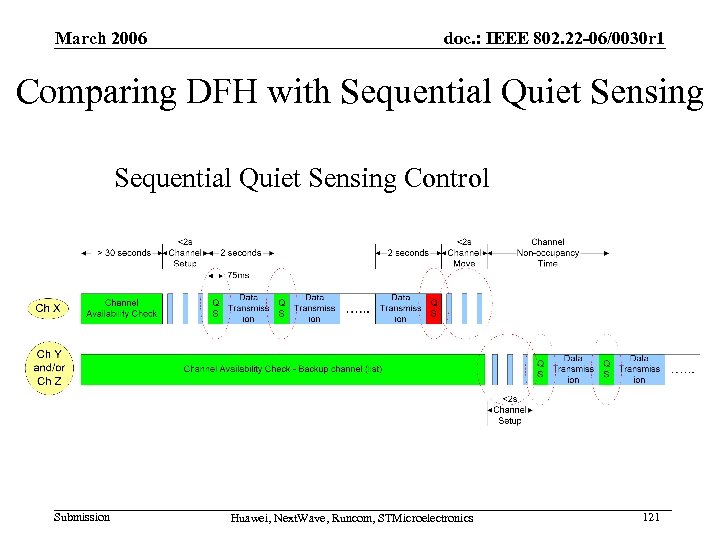 March 2006 doc. : IEEE 802. 22 -06/0030 r 1 Comparing DFH with Sequential Quiet Sensing Control Submission Huawei, Next. Wave, Runcom, STMicroelectronics 121
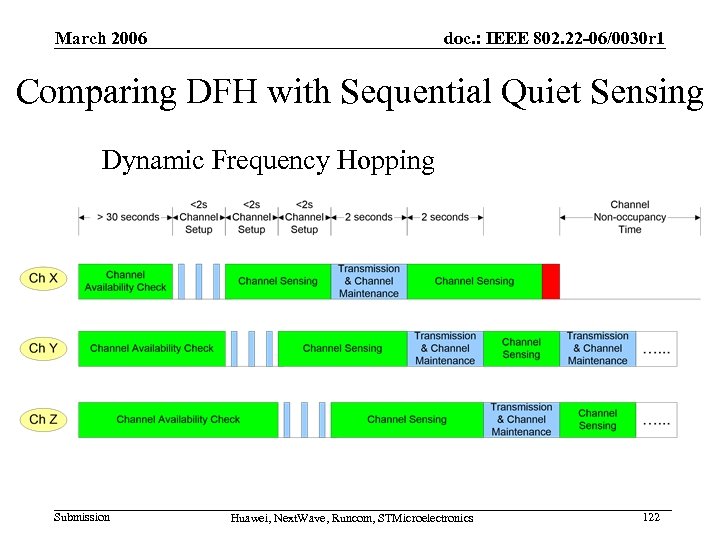 March 2006 doc. : IEEE 802. 22 -06/0030 r 1 Comparing DFH with Sequential Quiet Sensing Dynamic Frequency Hopping Submission Huawei, Next. Wave, Runcom, STMicroelectronics 122
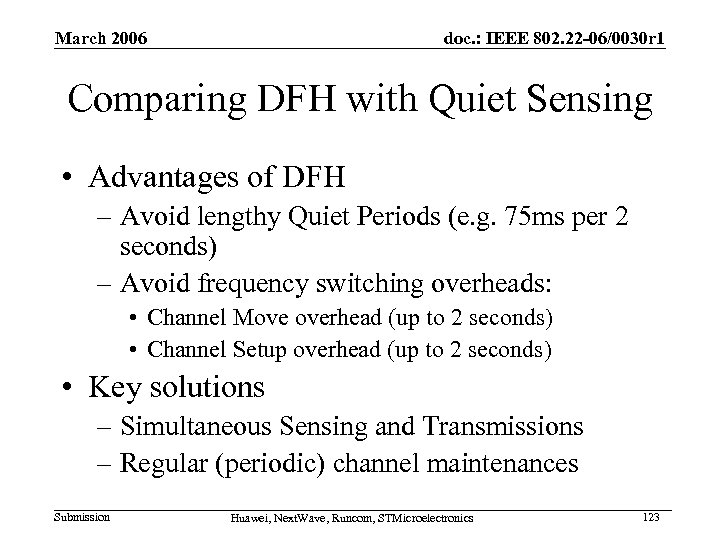 March 2006 doc. : IEEE 802. 22 -06/0030 r 1 Comparing DFH with Quiet Sensing • Advantages of DFH – Avoid lengthy Quiet Periods (e. g. 75 ms per 2 seconds) – Avoid frequency switching overheads: • Channel Move overhead (up to 2 seconds) • Channel Setup overhead (up to 2 seconds) • Key solutions – Simultaneous Sensing and Transmissions – Regular (periodic) channel maintenances Submission Huawei, Next. Wave, Runcom, STMicroelectronics 123
 March 2006 doc. : IEEE 802. 22 -06/0030 r 1 Clean Sensing for Dynamic Frequency Hopping • Could be solved by – MAC techniques – PHY techniques – Sensing techniques • MAC solutions are suggested here – Next slides Submission Huawei, Next. Wave, Runcom, STMicroelectronics 124
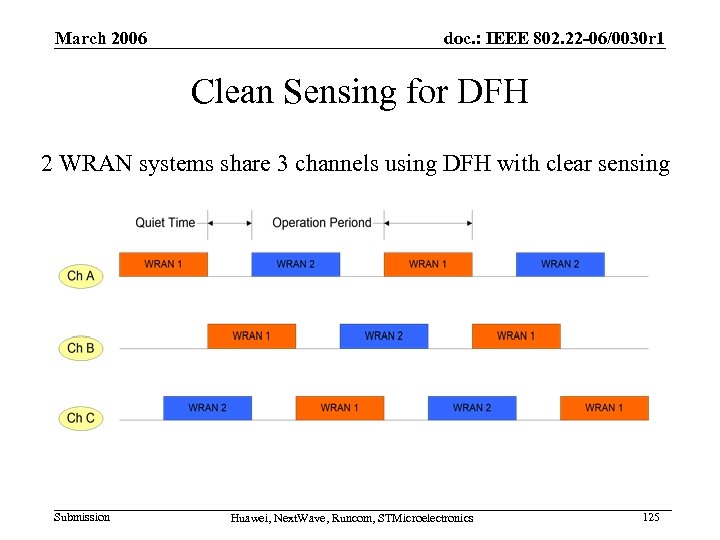 March 2006 doc. : IEEE 802. 22 -06/0030 r 1 Clean Sensing for DFH 2 WRAN systems share 3 channels using DFH with clear sensing Submission Huawei, Next. Wave, Runcom, STMicroelectronics 125
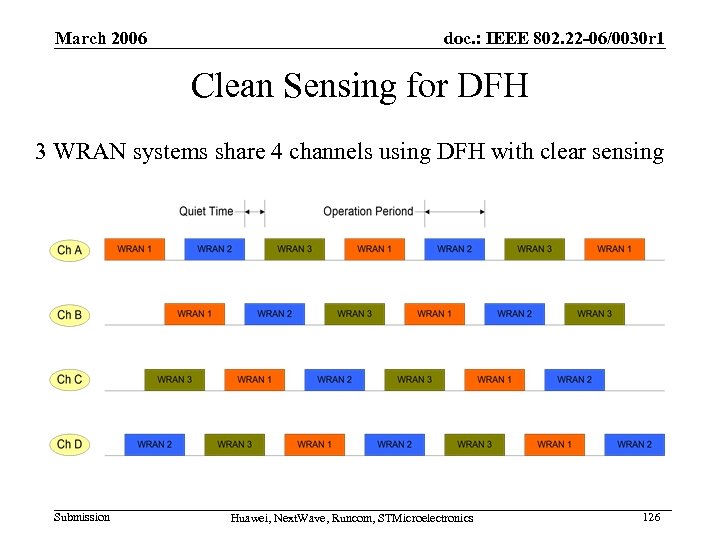 March 2006 doc. : IEEE 802. 22 -06/0030 r 1 Clean Sensing for DFH 3 WRAN systems share 4 channels using DFH with clear sensing Submission Huawei, Next. Wave, Runcom, STMicroelectronics 126
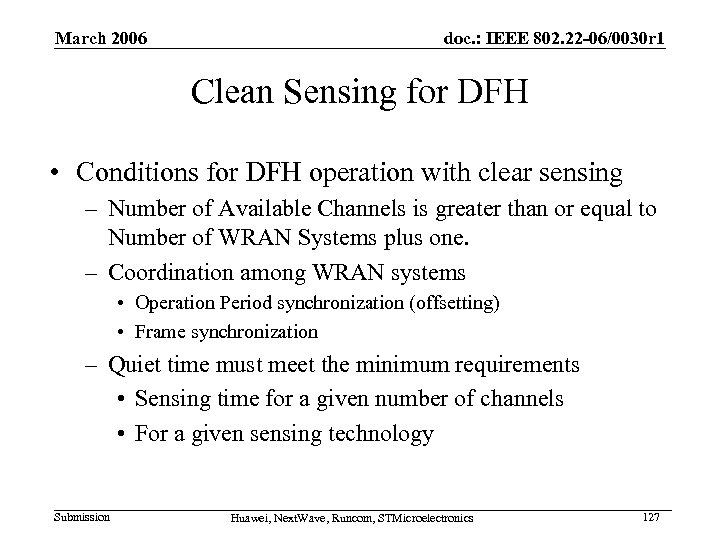 March 2006 doc. : IEEE 802. 22 -06/0030 r 1 Clean Sensing for DFH • Conditions for DFH operation with clear sensing – Number of Available Channels is greater than or equal to Number of WRAN Systems plus one. – Coordination among WRAN systems • Operation Period synchronization (offsetting) • Frame synchronization – Quiet time must meet the minimum requirements • Sensing time for a given number of channels • For a given sensing technology Submission Huawei, Next. Wave, Runcom, STMicroelectronics 127
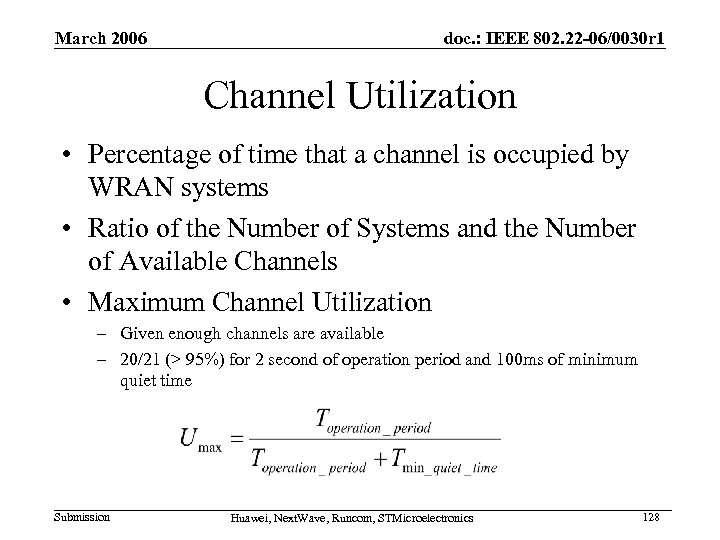 March 2006 doc. : IEEE 802. 22 -06/0030 r 1 Channel Utilization • Percentage of time that a channel is occupied by WRAN systems • Ratio of the Number of Systems and the Number of Available Channels • Maximum Channel Utilization – Given enough channels are available – 20/21 (> 95%) for 2 second of operation period and 100 ms of minimum quiet time Submission Huawei, Next. Wave, Runcom, STMicroelectronics 128
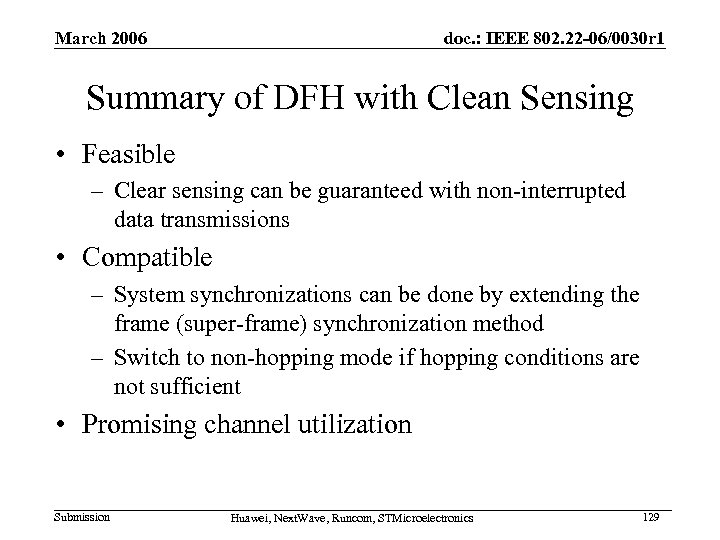 March 2006 doc. : IEEE 802. 22 -06/0030 r 1 Summary of DFH with Clean Sensing • Feasible – Clear sensing can be guaranteed with non-interrupted data transmissions • Compatible – System synchronizations can be done by extending the frame (super-frame) synchronization method – Switch to non-hopping mode if hopping conditions are not sufficient • Promising channel utilization Submission Huawei, Next. Wave, Runcom, STMicroelectronics 129
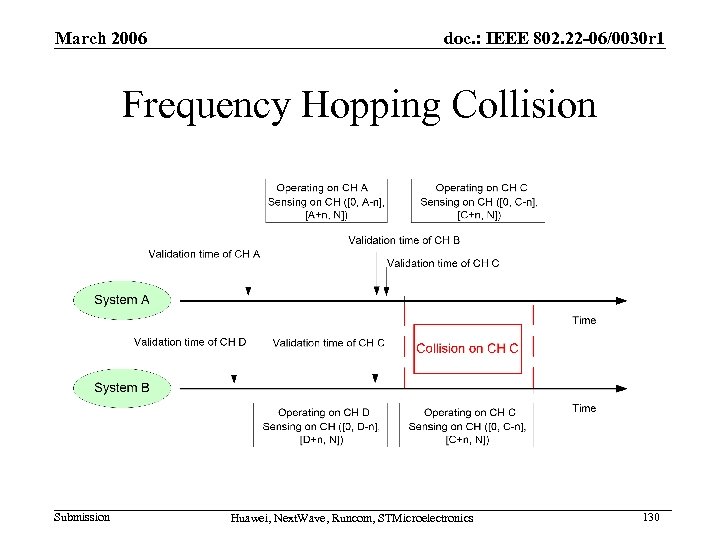 March 2006 doc. : IEEE 802. 22 -06/0030 r 1 Frequency Hopping Collision Submission Huawei, Next. Wave, Runcom, STMicroelectronics 130
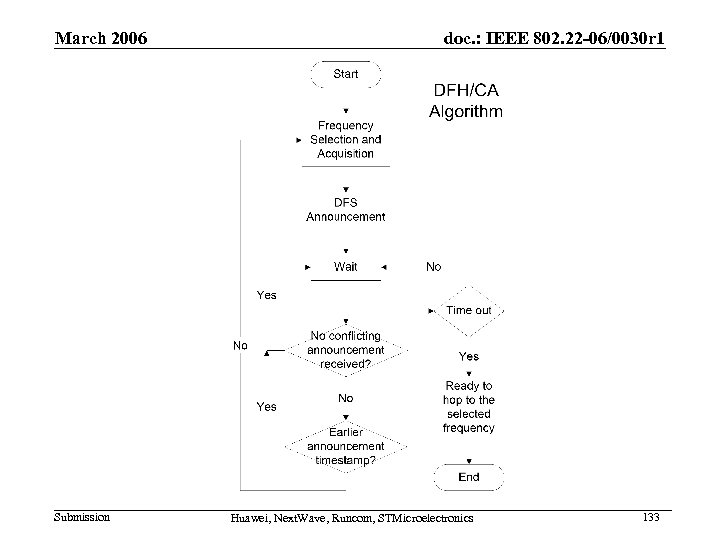
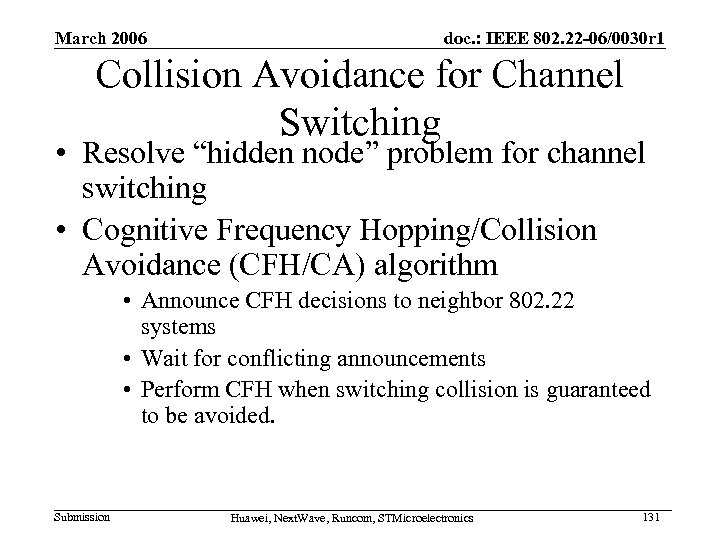 March 2006 doc. : IEEE 802. 22 -06/0030 r 1 Collision Avoidance for Channel Switching • Resolve “hidden node” problem for channel switching • Cognitive Frequency Hopping/Collision Avoidance (CFH/CA) algorithm • Announce CFH decisions to neighbor 802. 22 systems • Wait for conflicting announcements • Perform CFH when switching collision is guaranteed to be avoided. Submission Huawei, Next. Wave, Runcom, STMicroelectronics 131
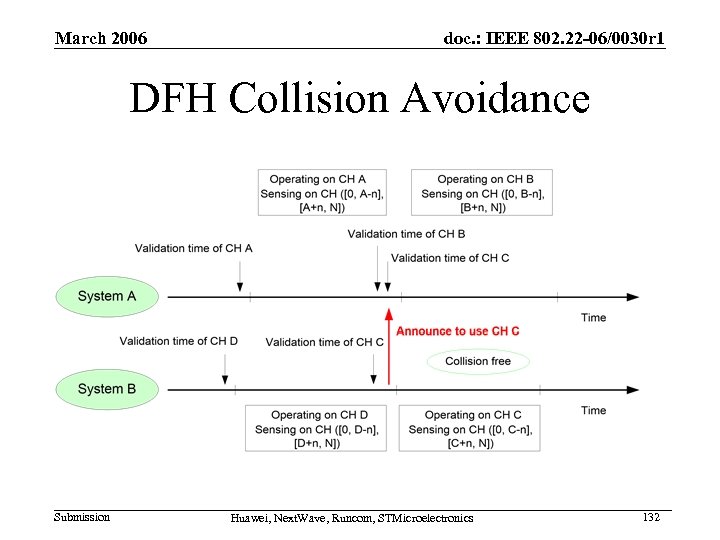 March 2006 doc. : IEEE 802. 22 -06/0030 r 1 DFH Collision Avoidance Submission Huawei, Next. Wave, Runcom, STMicroelectronics 132
 March 2006 Submission doc. : IEEE 802. 22 -06/0030 r 1 Huawei, Next. Wave, Runcom, STMicroelectronics 133
 March 2006 doc. : IEEE 802. 22 -06/0030 r 1 DFH/CA + Selective Sensing on Multiple Channels Submission Huawei, Next. Wave, Runcom, STMicroelectronics 134
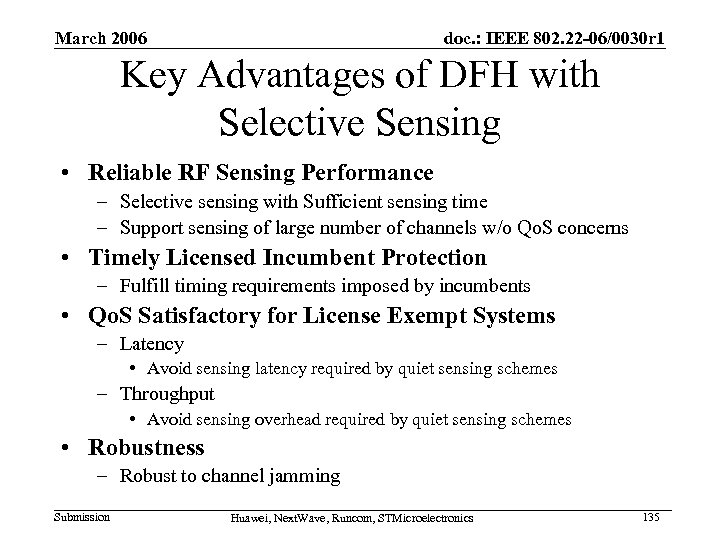 March 2006 doc. : IEEE 802. 22 -06/0030 r 1 Key Advantages of DFH with Selective Sensing • Reliable RF Sensing Performance – Selective sensing with Sufficient sensing time – Support sensing of large number of channels w/o Qo. S concerns • Timely Licensed Incumbent Protection – Fulfill timing requirements imposed by incumbents • Qo. S Satisfactory for License Exempt Systems – Latency • Avoid sensing latency required by quiet sensing schemes – Throughput • Avoid sensing overhead required by quiet sensing schemes • Robustness – Robust to channel jamming Submission Huawei, Next. Wave, Runcom, STMicroelectronics 135
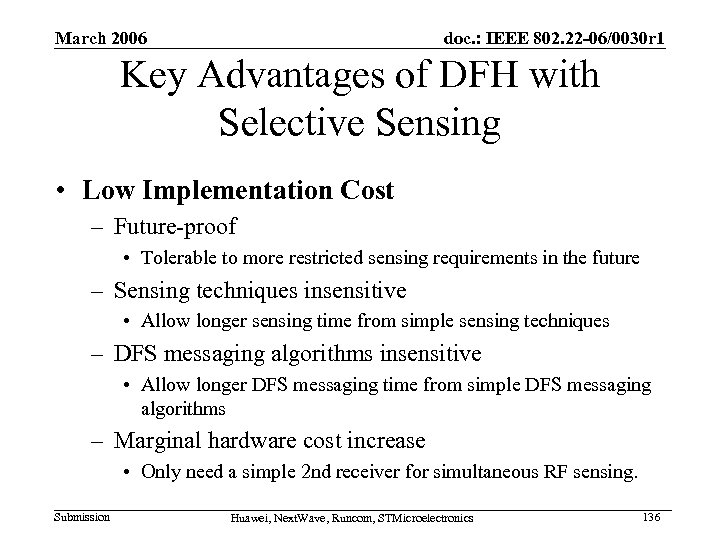 March 2006 doc. : IEEE 802. 22 -06/0030 r 1 Key Advantages of DFH with Selective Sensing • Low Implementation Cost – Future-proof • Tolerable to more restricted sensing requirements in the future – Sensing techniques insensitive • Allow longer sensing time from simple sensing techniques – DFS messaging algorithms insensitive • Allow longer DFS messaging time from simple DFS messaging algorithms – Marginal hardware cost increase • Only need a simple 2 nd receiver for simultaneous RF sensing. Submission Huawei, Next. Wave, Runcom, STMicroelectronics 136
 March 2006 doc. : IEEE 802. 22 -06/0030 r 1 Key Advantages of DFH with Selective Sensing • Flexible Framework for RF Sensing Control and DFS control – Cognitive Frequency Hopping Modes – Quiet Sensing Mode – Multiple-channel Operation Submission Huawei, Next. Wave, Runcom, STMicroelectronics 137
 March 2006 doc. : IEEE 802. 22 -06/0030 r 1 DFS Messaging Control Submission Huawei, Next. Wave, Runcom, STMicroelectronics 138
 March 2006 doc. : IEEE 802. 22 -06/0030 r 1 DFS Messaging Control • DFS Messaging Algorithm • DFS Messages • PHY Supports – 1 u. S resolution monitoring – Accurate threshold setting for detection – Sub-frame frequency agility (for monitoring) Submission Huawei, Next. Wave, Runcom, STMicroelectronics 139
 March 2006 doc. : IEEE 802. 22 -06/0030 r 1 DFS Messaging Control • Key Advantages – Reliable, efficient, and flexible mechanism for channel measurement reporting and DFS announcements – Sufficient messaging time guaranteed without affecting data transmission Qo. S such as latency and throughput • Simultaneously performed DFS messaging Algorithm Submission Huawei, Next. Wave, Runcom, STMicroelectronics 140
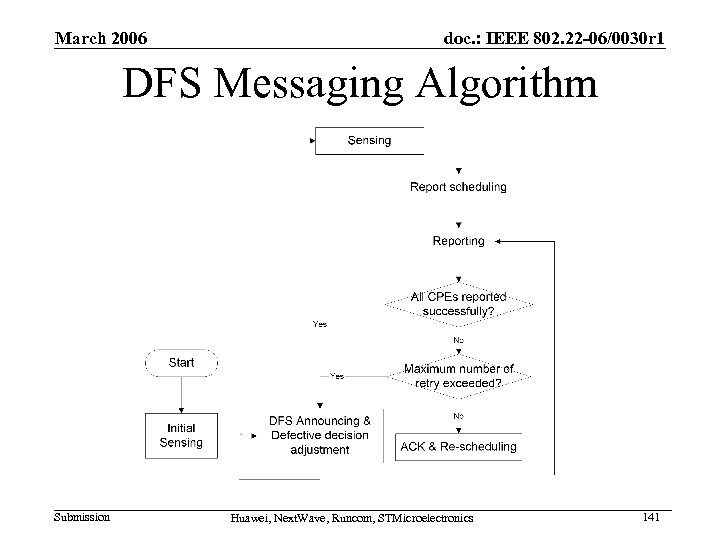 March 2006 doc. : IEEE 802. 22 -06/0030 r 1 DFS Messaging Algorithm Submission Huawei, Next. Wave, Runcom, STMicroelectronics 141
 March 2006 doc. : IEEE 802. 22 -06/0030 r 1 Contents of Spectrum Sensing Results • Detect at least 4 channel conditions: 1. 2. 3. 4. Licensed incumbent occupied Another 802. 22 system occupied Noisy Vacated/clean • Sensing reports – Bit-vector and on-request raw data – Balancing efficiency and accuracy of sensing reports • Validation time – For non-incumbent-occupied channels Submission Huawei, Next. Wave, Runcom, STMicroelectronics 142
 March 2006 doc. : IEEE 802. 22 -06/0030 r 1 Report Scheduling • Polling – BS polls CPEs to report through uplink (UL) MAP that schedules TX opportunities for CPE reporting – the UL MAP may provide redundant transmission opportunities for CPE’s reporting • Poll-me – CPE requests for reporting, 1 -bit flag in BW request PDU • Contention – CPE requests for reporting or sends report via contention opportunities (contention sub-channel/window) Submission Huawei, Next. Wave, Runcom, STMicroelectronics 143
 March 2006 doc. : IEEE 802. 22 -06/0030 r 1 Report ACK and Re-scheduling • Explicit report reschedule – The BS re-schedules those CPEs from which it failed to receive the sensing reports in a subsequent UL MAP • Implicit report acknowledgement – The BS ACKs the successful reports by not scheduling in a subsequent UL MAP those CPEs from which it received their sensing reports Submission Huawei, Next. Wave, Runcom, STMicroelectronics 144
 March 2006 doc. : IEEE 802. 22 -06/0030 r 1 DFS Decision • DFS decision-making – The BS decides the valid channels to be used for the whole system in the next DFH period by summarizing all measurement reports – Decisions could be made by as simple as logical ORs • DFS decision announcement – DFS decision shall be announced to all CPEs in the system, and to all neighbour BSs. • Adjustment to prevent defective decisions – BS adjusts DFS decisions according to feedbacks from CPEs and neighbour BSs Submission Huawei, Next. Wave, Runcom, STMicroelectronics 145
 March 2006 doc. : IEEE 802. 22 -06/0030 r 1 MAC Messages for DFS • MAC messages is already available in the 802. 16 • MAC message is in section: 6. 3. 2. 3. 33 Channel measurement Report Request/Response (REPREQ/RSP) (802. 16 -2004+cor 1) • TLVs (which form the content of the MAC message are at: 11. 12 REP-RSP management message encodings) – See the next slide Submission Huawei, Next. Wave, Runcom, STMicroelectronics 146
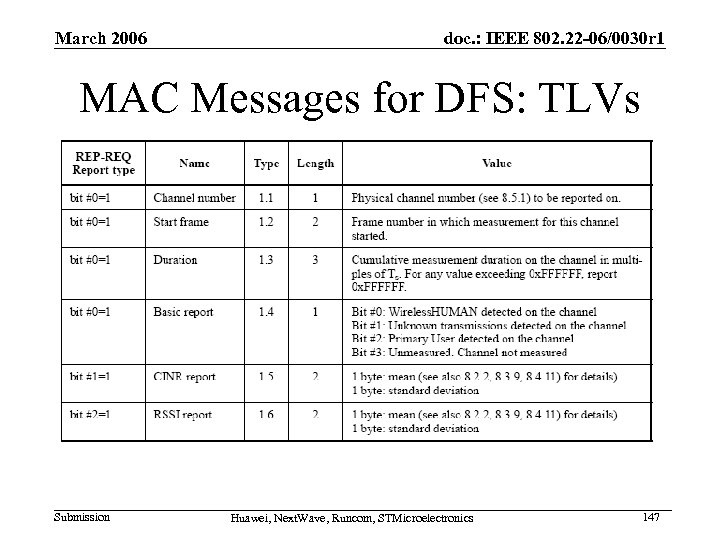 March 2006 doc. : IEEE 802. 22 -06/0030 r 1 MAC Messages for DFS: TLVs Submission Huawei, Next. Wave, Runcom, STMicroelectronics 147
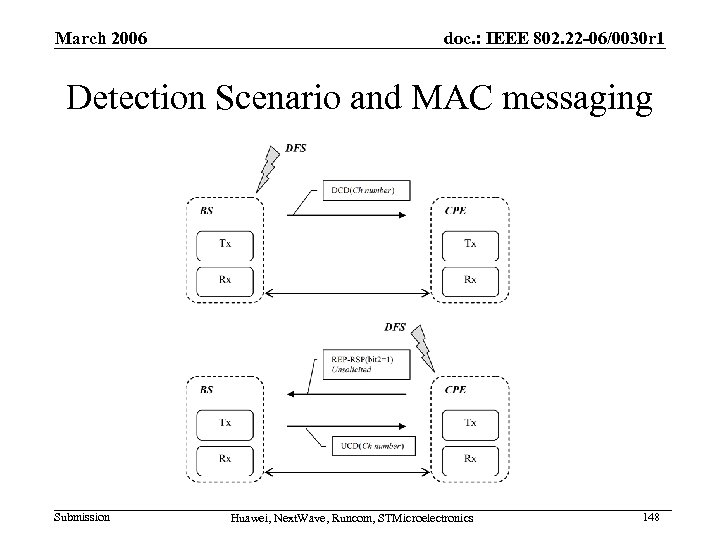 March 2006 doc. : IEEE 802. 22 -06/0030 r 1 Detection Scenario and MAC messaging Submission Huawei, Next. Wave, Runcom, STMicroelectronics 148
 March 2006 doc. : IEEE 802. 22 -06/0030 r 1 Support for Interference Mitigation and Coexistence • Protections of licensed incumbent services – RF Sensing Control – DFS Messaging Control • LE systems coexistence and sharing – Spectrum sharing mechanism – Inter-system communications Submission Huawei, Next. Wave, Runcom, STMicroelectronics 149
 March 2006 doc. : IEEE 802. 22 -06/0030 r 1 Co-existence of 802. 22 Systems Submission Huawei, Next. Wave, Runcom, STMicroelectronics 150
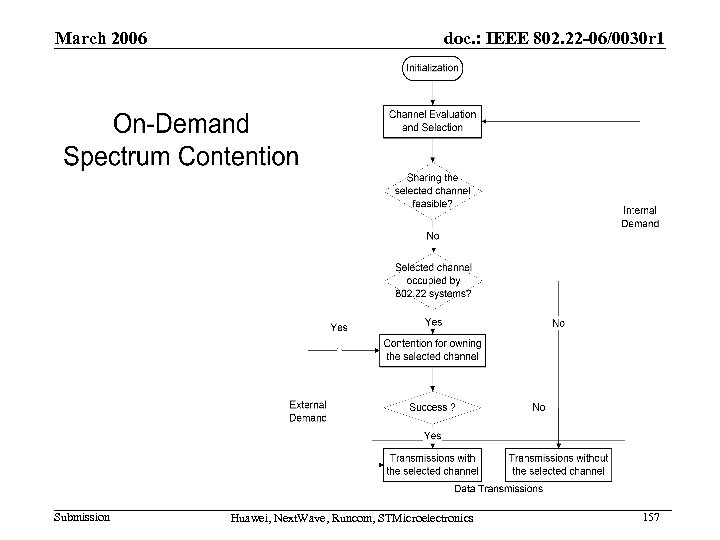
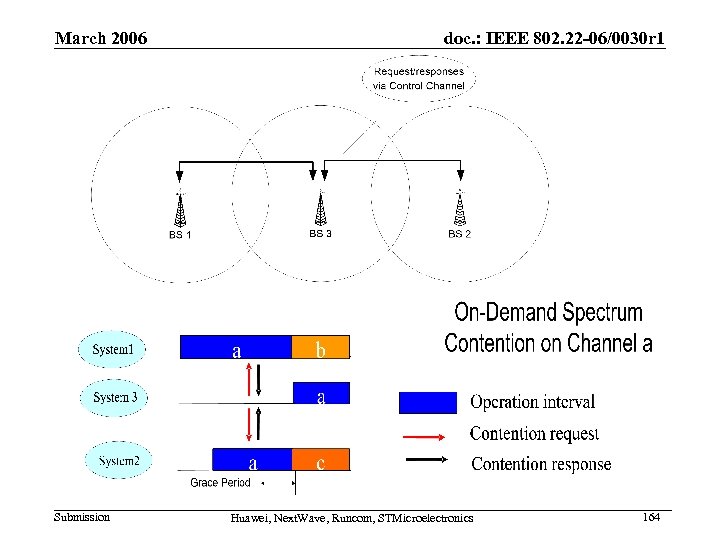
 March 2006 doc. : IEEE 802. 22 -06/0030 r 1 Co-existence of 802. 22 Systems • Objectives – Fair and efficient spectrum sharing mechanism – Efficient inter-system communications for collaborative coexistence • Proposed Techniques – On-demand Spectrum Contention • Spectrum contention mechanism with integration of DFS and TPC – Logical control connections • Over-the-air + over-the-backhaul Submission Huawei, Next. Wave, Runcom, STMicroelectronics 151
 March 2006 doc. : IEEE 802. 22 -06/0030 r 1 Spectrum Sharing Mechanism – On-Demand Spectrum Contention (ODSC) Submission Huawei, Next. Wave, Runcom, STMicroelectronics 152
 March 2006 doc. : IEEE 802. 22 -06/0030 r 1 Key Properties of ODSC • Integrate dynamic frequency selection (DFS) and transmission power control (TPC) with dynamic spectrum contentions • Provides fairness, efficiency and adaptivity of spectrum access using active inter-system coordination Submission Huawei, Next. Wave, Runcom, STMicroelectronics 153
 March 2006 doc. : IEEE 802. 22 -06/0030 r 1 Key Properties of ODSC • Efficiency – Low coexistence overhead • Coexistence overhead is only incurred on demand – No constant overhead • Low overhead inter-system communications that are overlapped with data transmissions – Low complexity • Simple contention mechanism – No complex coordination mechanism that is usually required for TDMA-based solutions • Distributed decision-making -- scalable Submission Huawei, Next. Wave, Runcom, STMicroelectronics 154
 March 2006 doc. : IEEE 802. 22 -06/0030 r 1 Key Properties of ODSC • Fairness – Contention based Solution • Fair spectrum access for every system at any moment • Local fairness – Iterative process • Long-term global (multi-system) fairness Submission Huawei, Next. Wave, Runcom, STMicroelectronics 155
 March 2006 doc. : IEEE 802. 22 -06/0030 r 1 Key Properties of ODSC • Adaptivity – Highly adaptive to operation demands • Internal demand: channel conditions and workload conditions • External demand: coexistence (spectrum contention) requests Submission Huawei, Next. Wave, Runcom, STMicroelectronics 156
 March 2006 Submission doc. : IEEE 802. 22 -06/0030 r 1 Huawei, Next. Wave, Runcom, STMicroelectronics 157
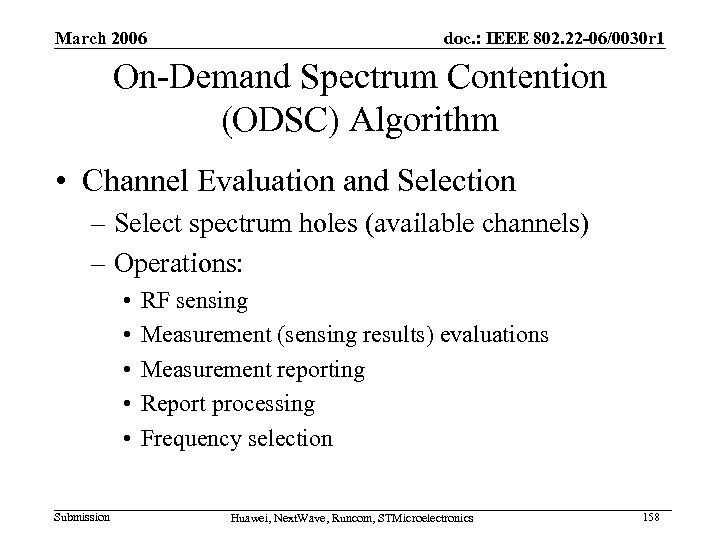 March 2006 doc. : IEEE 802. 22 -06/0030 r 1 On-Demand Spectrum Contention (ODSC) Algorithm • Channel Evaluation and Selection – Select spectrum holes (available channels) – Operations: • • • Submission RF sensing Measurement (sensing results) evaluations Measurement reporting Report processing Frequency selection Huawei, Next. Wave, Runcom, STMicroelectronics 158
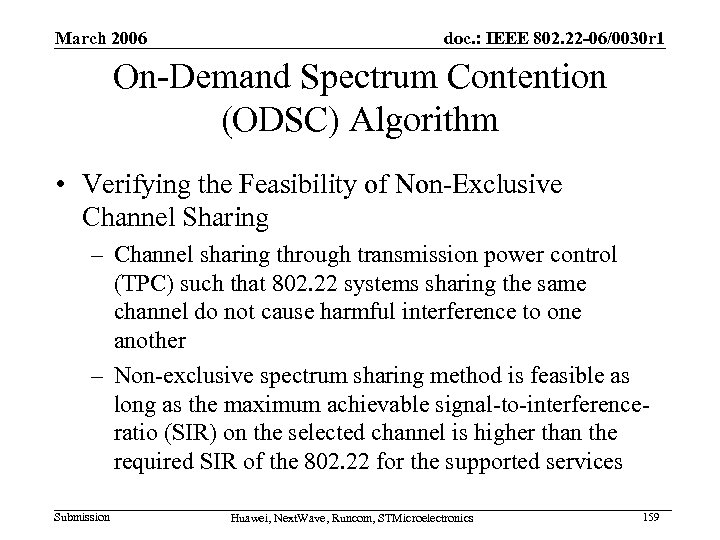 March 2006 doc. : IEEE 802. 22 -06/0030 r 1 On-Demand Spectrum Contention (ODSC) Algorithm • Verifying the Feasibility of Non-Exclusive Channel Sharing – Channel sharing through transmission power control (TPC) such that 802. 22 systems sharing the same channel do not cause harmful interference to one another – Non-exclusive spectrum sharing method is feasible as long as the maximum achievable signal-to-interferenceratio (SIR) on the selected channel is higher than the required SIR of the 802. 22 for the supported services Submission Huawei, Next. Wave, Runcom, STMicroelectronics 159
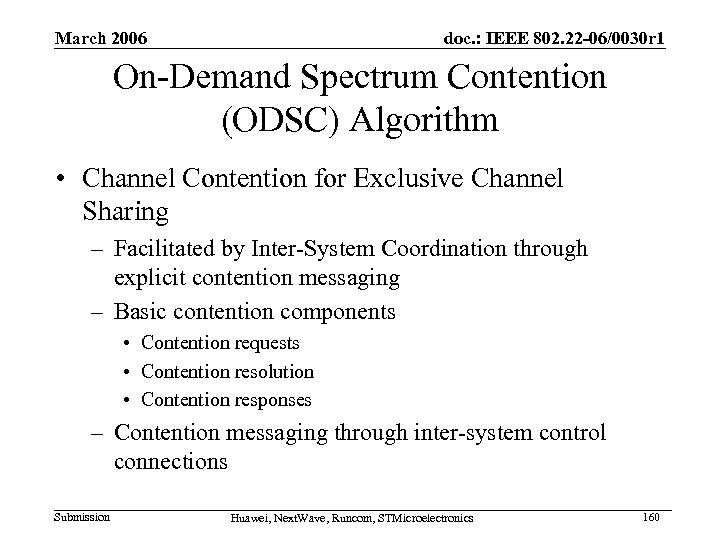 March 2006 doc. : IEEE 802. 22 -06/0030 r 1 On-Demand Spectrum Contention (ODSC) Algorithm • Channel Contention for Exclusive Channel Sharing – Facilitated by Inter-System Coordination through explicit contention messaging – Basic contention components • Contention requests • Contention resolution • Contention responses – Contention messaging through inter-system control connections Submission Huawei, Next. Wave, Runcom, STMicroelectronics 160
 March 2006 doc. : IEEE 802. 22 -06/0030 r 1 On-Demand Spectrum Contention (ODSC) Algorithm • Operations if Non-Exclusive Channel Sharing feasible – The 802. 22 system acquiring the channel schedules data transmissions on the channel with proper transmission parameters (such as transmission power) – Collision avoidance of channel switching shall be applied Submission Huawei, Next. Wave, Runcom, STMicroelectronics 161
 March 2006 doc. : IEEE 802. 22 -06/0030 r 1 On-Demand Spectrum Contention (ODSC) Algorithm • Operations after Channel Contentions for Exclusive Channel Sharing – The 802. 22 system acquiring the channel, if won, • Schedules data transmissions on the channel starting from the time agreed upon by both contending systems – After a Grace Period starting from the point of contention resolution • Collision avoidance of channel switching shall be applied – The 802. 22 system using the channel, if lost, • Releases the channel starting from the time agreed upon by both contending systems (after a Grace Period) Submission Huawei, Next. Wave, Runcom, STMicroelectronics 162
 March 2006 doc. : IEEE 802. 22 -06/0030 r 1 On-Demand Spectrum Contention (ODSC) Algorithm • Iterative Spectrum Sharing Processes Initiated On. Demands – Internal Demands • Initiated by a WRAN itself • To Fulfill the internal Qo. S requirements of a 802. 22 system • Based upon the following dynamic conditions – Channel condition – Workload condition – External Demands • Coexistence requests from other 802. 22 systems Submission Huawei, Next. Wave, Runcom, STMicroelectronics 163
 March 2006 Submission doc. : IEEE 802. 22 -06/0030 r 1 Huawei, Next. Wave, Runcom, STMicroelectronics 164
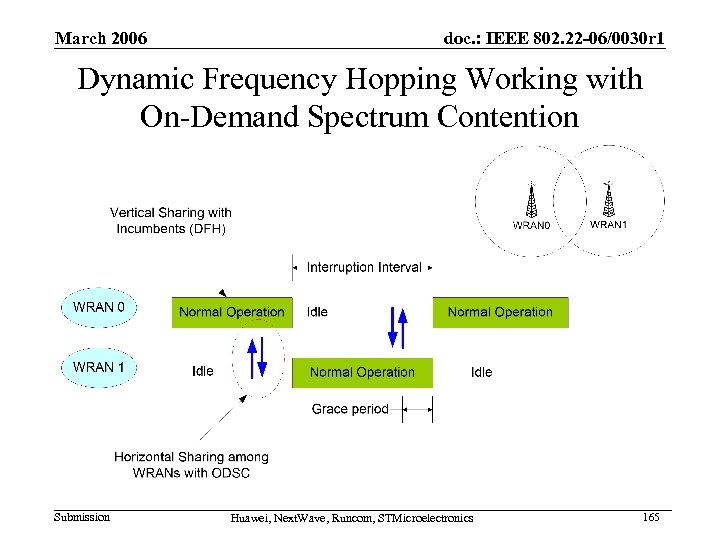 March 2006 doc. : IEEE 802. 22 -06/0030 r 1 Dynamic Frequency Hopping Working with On-Demand Spectrum Contention Submission Huawei, Next. Wave, Runcom, STMicroelectronics 165
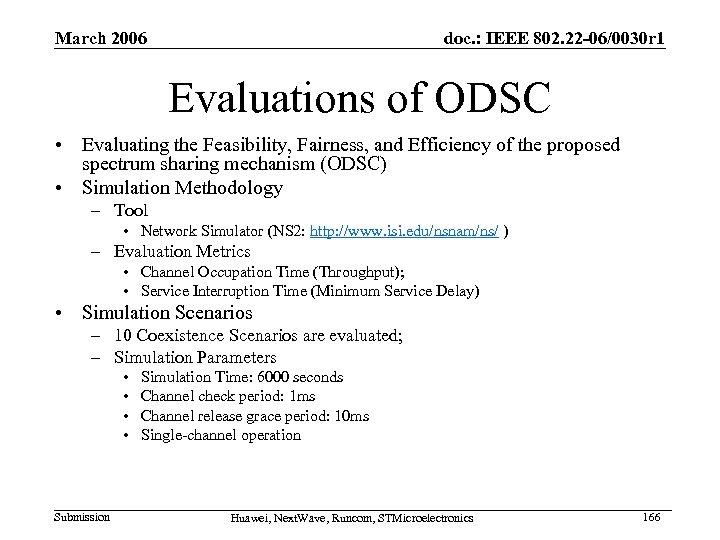 March 2006 doc. : IEEE 802. 22 -06/0030 r 1 Evaluations of ODSC • Evaluating the Feasibility, Fairness, and Efficiency of the proposed spectrum sharing mechanism (ODSC) • Simulation Methodology – Tool • Network Simulator (NS 2: http: //www. isi. edu/nsnam/ns/ ) – Evaluation Metrics • Channel Occupation Time (Throughput); • Service Interruption Time (Minimum Service Delay) • Simulation Scenarios – 10 Coexistence Scenarios are evaluated; – Simulation Parameters • • Submission Simulation Time: 6000 seconds Channel check period: 1 ms Channel release grace period: 10 ms Single-channel operation Huawei, Next. Wave, Runcom, STMicroelectronics 166
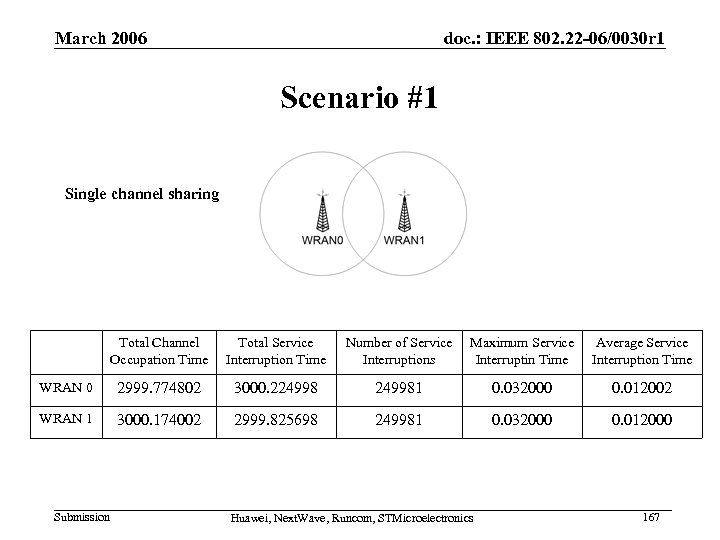 March 2006 doc. : IEEE 802. 22 -06/0030 r 1 Scenario #1 Single channel sharing Total Channel Occupation Time Total Service Interruption Time Number of Service Interruptions Maximum Service Interruptin Time Average Service Interruption Time WRAN 0 2999. 774802 3000. 2249981 0. 032000 0. 012002 WRAN 1 3000. 174002 2999. 825698 249981 0. 032000 0. 012000 Submission Huawei, Next. Wave, Runcom, STMicroelectronics 167
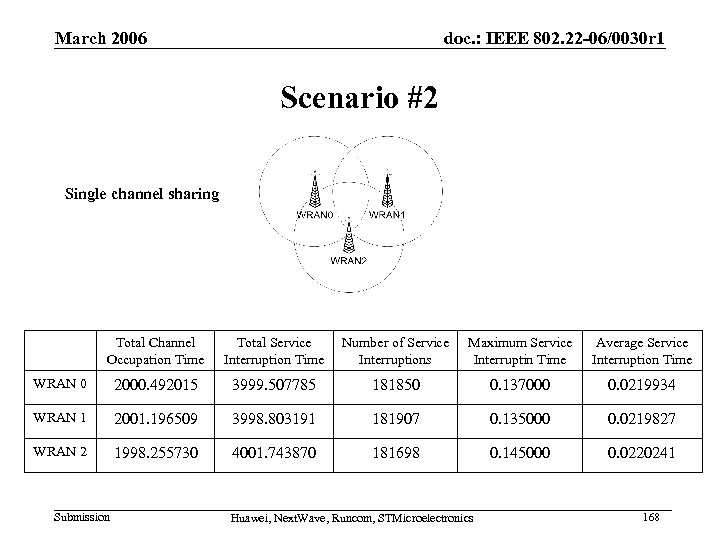 March 2006 doc. : IEEE 802. 22 -06/0030 r 1 Scenario #2 Single channel sharing Total Channel Occupation Time Total Service Interruption Time Number of Service Interruptions Maximum Service Interruptin Time Average Service Interruption Time WRAN 0 2000. 492015 3999. 507785 181850 0. 137000 0. 0219934 WRAN 1 2001. 196509 3998. 803191 181907 0. 135000 0. 0219827 WRAN 2 1998. 255730 4001. 743870 181698 0. 145000 0. 0220241 Submission Huawei, Next. Wave, Runcom, STMicroelectronics 168
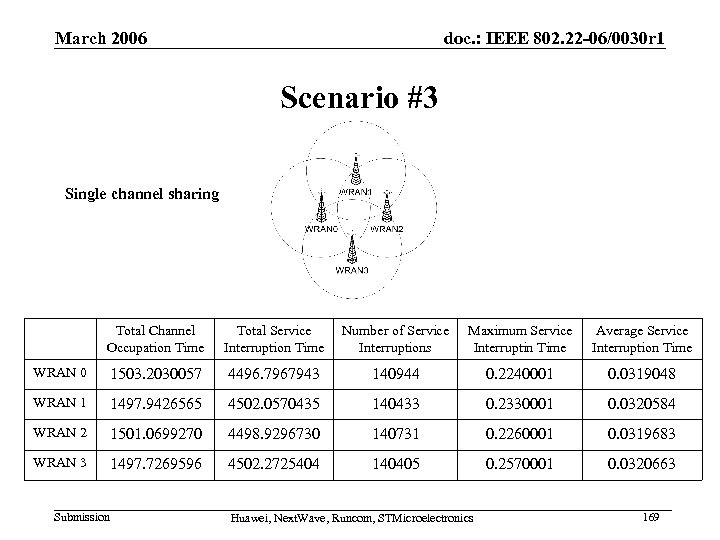 March 2006 doc. : IEEE 802. 22 -06/0030 r 1 Scenario #3 Single channel sharing Total Channel Occupation Time Total Service Interruption Time Number of Service Interruptions Maximum Service Interruptin Time Average Service Interruption Time WRAN 0 1503. 2030057 4496. 7967943 140944 0. 2240001 0. 0319048 WRAN 1 1497. 9426565 4502. 0570435 140433 0. 2330001 0. 0320584 WRAN 2 1501. 0699270 4498. 9296730 140731 0. 2260001 0. 0319683 WRAN 3 1497. 7269596 4502. 2725404 140405 0. 2570001 0. 0320663 Submission Huawei, Next. Wave, Runcom, STMicroelectronics 169
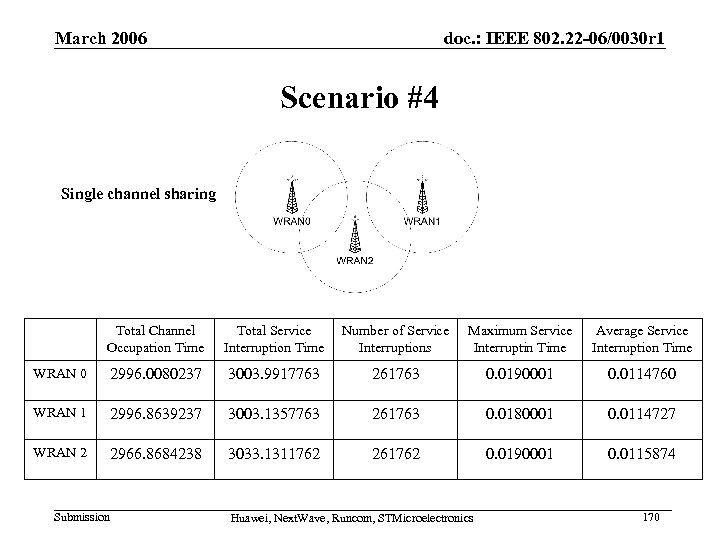 March 2006 doc. : IEEE 802. 22 -06/0030 r 1 Scenario #4 Single channel sharing Total Channel Occupation Time Total Service Interruption Time Number of Service Interruptions Maximum Service Interruptin Time Average Service Interruption Time WRAN 0 2996. 0080237 3003. 9917763 261763 0. 0190001 0. 0114760 WRAN 1 2996. 8639237 3003. 1357763 261763 0. 0180001 0. 0114727 WRAN 2 2966. 8684238 3033. 1311762 261762 0. 0190001 0. 0115874 Submission Huawei, Next. Wave, Runcom, STMicroelectronics 170
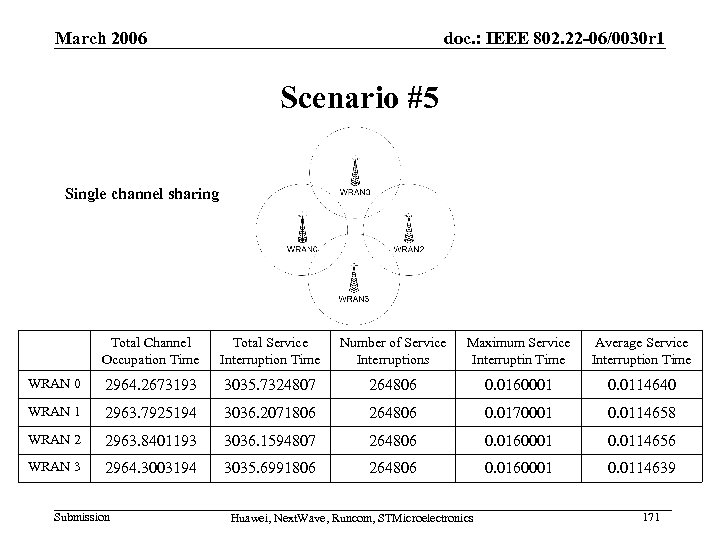 March 2006 doc. : IEEE 802. 22 -06/0030 r 1 Scenario #5 Single channel sharing Total Channel Occupation Time Total Service Interruption Time Number of Service Interruptions Maximum Service Interruptin Time Average Service Interruption Time WRAN 0 2964. 2673193 3035. 7324807 264806 0. 0160001 0. 0114640 WRAN 1 2963. 7925194 3036. 2071806 264806 0. 0170001 0. 0114658 WRAN 2 2963. 8401193 3036. 1594807 264806 0. 0160001 0. 0114656 WRAN 3 2964. 3003194 3035. 6991806 264806 0. 0160001 0. 0114639 Submission Huawei, Next. Wave, Runcom, STMicroelectronics 171
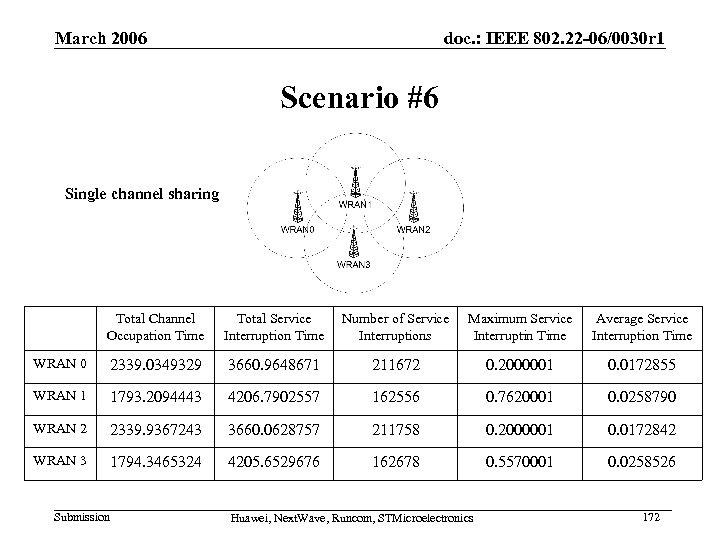 March 2006 doc. : IEEE 802. 22 -06/0030 r 1 Scenario #6 Single channel sharing Total Channel Occupation Time Total Service Interruption Time Number of Service Interruptions Maximum Service Interruptin Time Average Service Interruption Time WRAN 0 2339. 0349329 3660. 9648671 211672 0. 2000001 0. 0172855 WRAN 1 1793. 2094443 4206. 7902557 162556 0. 7620001 0. 0258790 WRAN 2 2339. 9367243 3660. 0628757 211758 0. 2000001 0. 0172842 WRAN 3 1794. 3465324 4205. 6529676 162678 0. 5570001 0. 0258526 Submission Huawei, Next. Wave, Runcom, STMicroelectronics 172
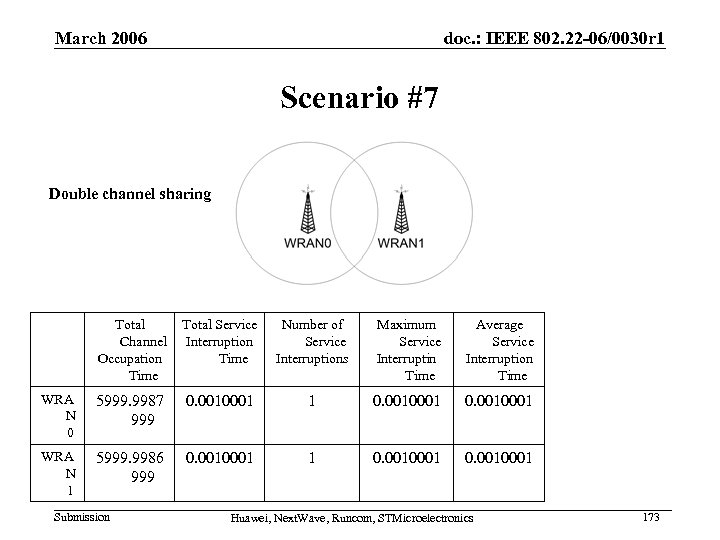 March 2006 doc. : IEEE 802. 22 -06/0030 r 1 Scenario #7 Double channel sharing Total Channel Occupation Time Total Service Interruption Time Number of Service Interruptions Maximum Service Interruptin Time Average Service Interruption Time WRA N 0 5999. 9987 999 0. 0010001 1 0. 0010001 WRA N 1 5999. 9986 999 0. 0010001 1 0. 0010001 Submission Huawei, Next. Wave, Runcom, STMicroelectronics 173
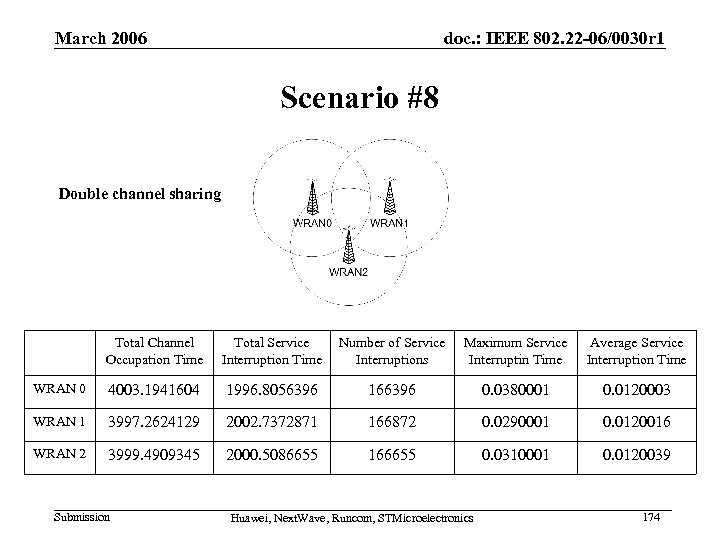 March 2006 doc. : IEEE 802. 22 -06/0030 r 1 Scenario #8 Double channel sharing Total Channel Occupation Time Total Service Interruption Time Number of Service Interruptions Maximum Service Interruptin Time Average Service Interruption Time WRAN 0 4003. 1941604 1996. 8056396 166396 0. 0380001 0. 0120003 WRAN 1 3997. 2624129 2002. 7372871 166872 0. 0290001 0. 0120016 WRAN 2 3999. 4909345 2000. 5086655 166655 0. 0310001 0. 0120039 Submission Huawei, Next. Wave, Runcom, STMicroelectronics 174
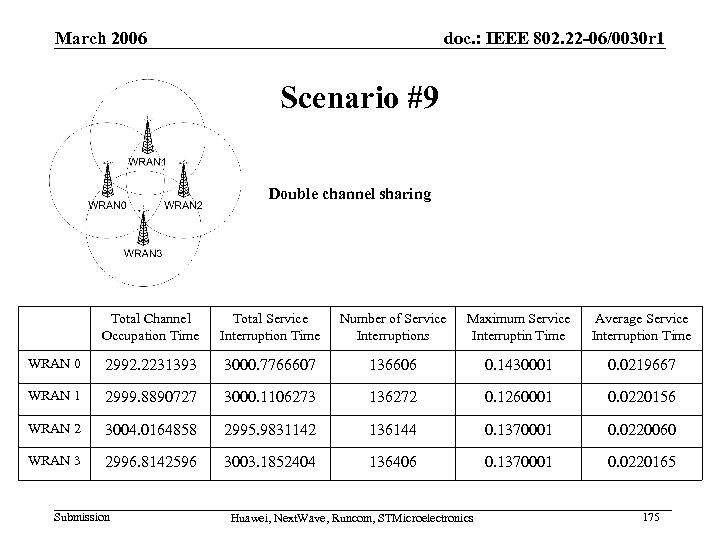 March 2006 doc. : IEEE 802. 22 -06/0030 r 1 Scenario #9 Double channel sharing Total Channel Occupation Time Total Service Interruption Time Number of Service Interruptions Maximum Service Interruptin Time Average Service Interruption Time WRAN 0 2992. 2231393 3000. 7766607 136606 0. 1430001 0. 0219667 WRAN 1 2999. 8890727 3000. 1106273 136272 0. 1260001 0. 0220156 WRAN 2 3004. 0164858 2995. 9831142 136144 0. 1370001 0. 0220060 WRAN 3 2996. 8142596 3003. 1852404 136406 0. 1370001 0. 0220165 Submission Huawei, Next. Wave, Runcom, STMicroelectronics 175
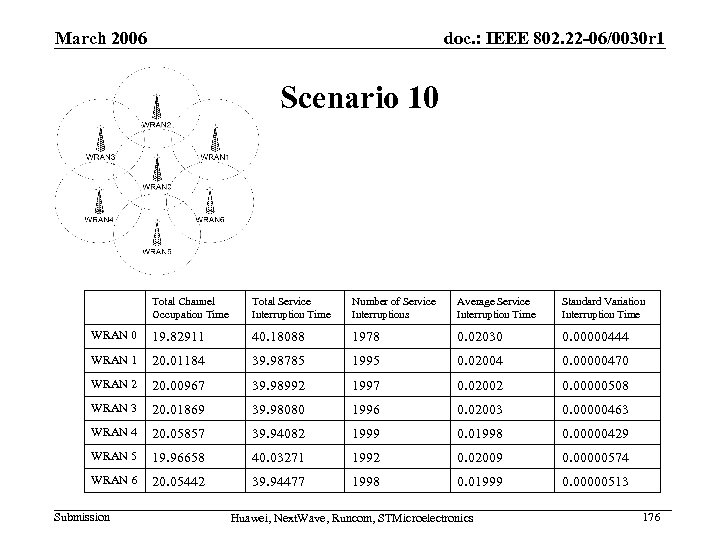 March 2006 doc. : IEEE 802. 22 -06/0030 r 1 Scenario 10 Total Channel Occupation Time Total Service Interruption Time Number of Service Interruptions Average Service Interruption Time Standard Variation Interruption Time WRAN 0 19. 82911 40. 18088 1978 0. 02030 0. 00000444 WRAN 1 20. 01184 39. 98785 1995 0. 02004 0. 00000470 WRAN 2 20. 00967 39. 98992 1997 0. 02002 0. 00000508 WRAN 3 20. 01869 39. 98080 1996 0. 02003 0. 00000463 WRAN 4 20. 05857 39. 94082 1999 0. 01998 0. 00000429 WRAN 5 19. 96658 40. 03271 1992 0. 02009 0. 00000574 WRAN 6 20. 05442 39. 94477 1998 0. 01999 0. 00000513 Submission Huawei, Next. Wave, Runcom, STMicroelectronics 176
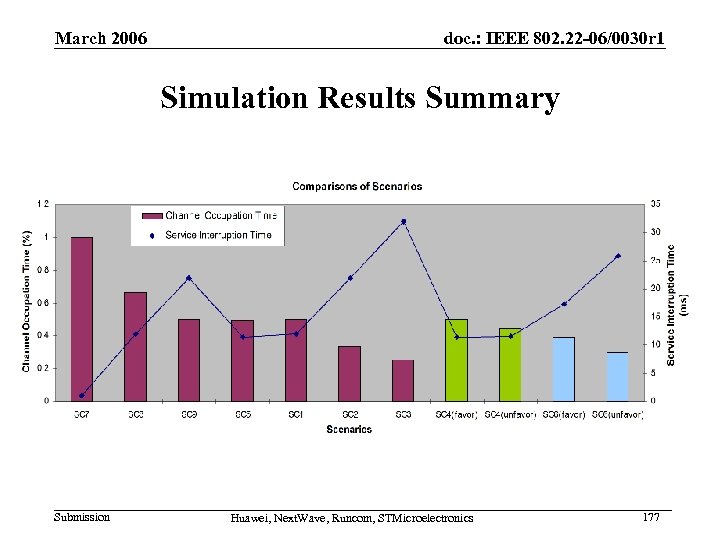 March 2006 doc. : IEEE 802. 22 -06/0030 r 1 Simulation Results Summary Submission Huawei, Next. Wave, Runcom, STMicroelectronics 177
 March 2006 doc. : IEEE 802. 22 -06/0030 r 1 Inter-System Communications – Logical Control Connections Submission Huawei, Next. Wave, Runcom, STMicroelectronics 178
 March 2006 doc. : IEEE 802. 22 -06/0030 r 1 Logical Control Connections (LCC) • Connection based inter-system communications – Reliable, efficient • Enable the feasibility and overall efficiency of the collaborative coexistence mechanism • Established and maintained both over the air and over the backhaul Submission Huawei, Next. Wave, Runcom, STMicroelectronics 179
 March 2006 doc. : IEEE 802. 22 -06/0030 r 1 Logical Control Connections (LCC) • Very low communications overhead incurred in terms of – Spectrum bandwidth – Messaging latency – Hardware/software complexities Submission Huawei, Next. Wave, Runcom, STMicroelectronics 180
 March 2006 doc. : IEEE 802. 22 -06/0030 r 1 Over-the-air Logical Control Connections • Key Concepts – Bridge-CPE – Co-existence Connection – Co-existence Association – Over-the-air control connection • Service connection + coexistence connection Submission Huawei, Next. Wave, Runcom, STMicroelectronics 181
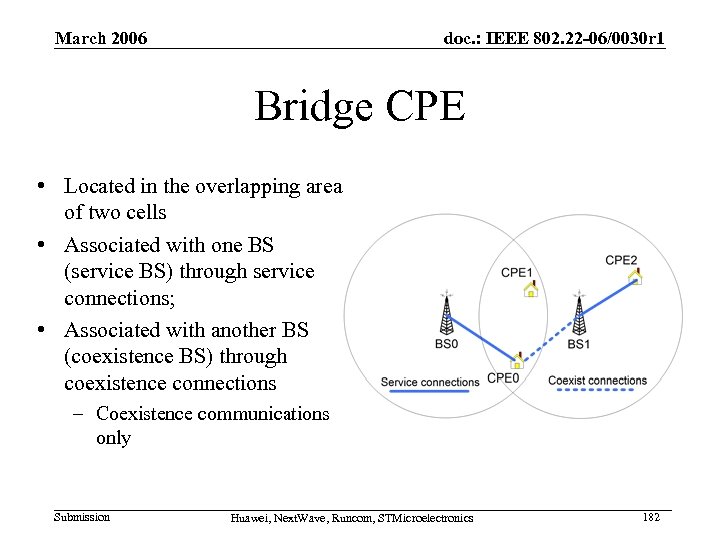 March 2006 doc. : IEEE 802. 22 -06/0030 r 1 Bridge CPE • Located in the overlapping area of two cells • Associated with one BS (service BS) through service connections; • Associated with another BS (coexistence BS) through coexistence connections – Coexistence communications only Submission Huawei, Next. Wave, Runcom, STMicroelectronics 182
 March 2006 doc. : IEEE 802. 22 -06/0030 r 1 Co-existence Connections • Regular connections – Carry co-existence communications only • Established and maintained – Between a bridge CPE and the coexistence BS (C-BS) on request by the service BS (S-BS) – Between two BSs • if S-BS is within the arrange of C-BS • S-BS behaves as a CPE of C-BS in such case) – On channels occupied by the coexistence BS Submission Huawei, Next. Wave, Runcom, STMicroelectronics 183
 March 2006 doc. : IEEE 802. 22 -06/0030 r 1 Co-existence Connections • Establishment/maintenance performed along with service data transmission – Ranging, connection acquisition – Controlled by S-BS and shall be guaranteed that they are not co-scheduled with service communications Submission Huawei, Next. Wave, Runcom, STMicroelectronics 184
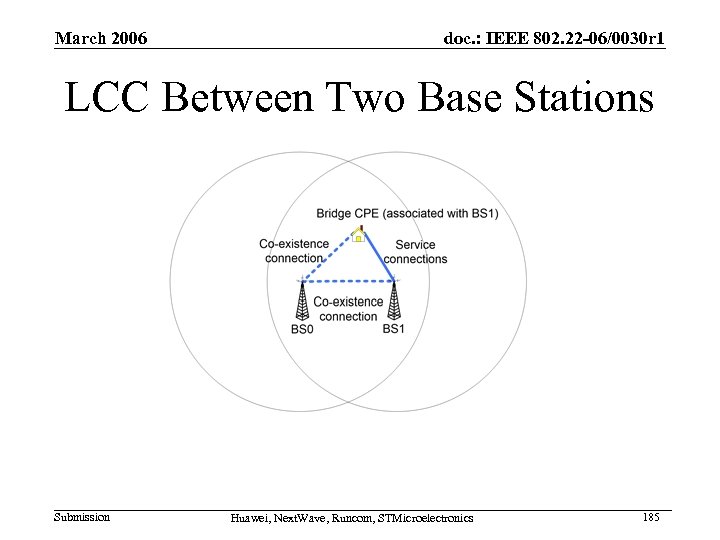 March 2006 doc. : IEEE 802. 22 -06/0030 r 1 LCC Between Two Base Stations Submission Huawei, Next. Wave, Runcom, STMicroelectronics 185
 March 2006 doc. : IEEE 802. 22 -06/0030 r 1 Over-the-Air Co-existence Communications • S-BS communicates with C-BS for co-existence via B-CPE as a relay – Communications via Service connection + coexistence connection – S-BS controls the coexistence operations between B-CPE and C-BS • Coexistence communications – Messaging for spectrum contention/negotiation, – Sensing measurement sharing, – Operation parameter (transmission power, channel in-use, etc. ) announcement Submission Huawei, Next. Wave, Runcom, STMicroelectronics 186
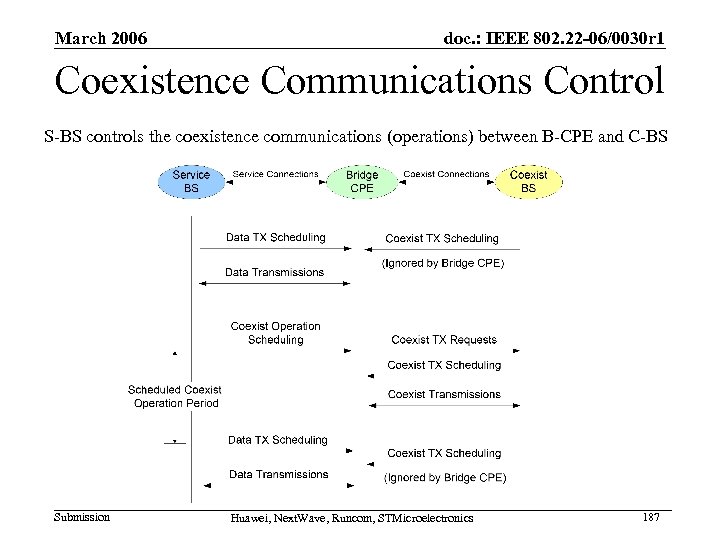 March 2006 doc. : IEEE 802. 22 -06/0030 r 1 Coexistence Communications Control S-BS controls the coexistence communications (operations) between B-CPE and C-BS Submission Huawei, Next. Wave, Runcom, STMicroelectronics 187
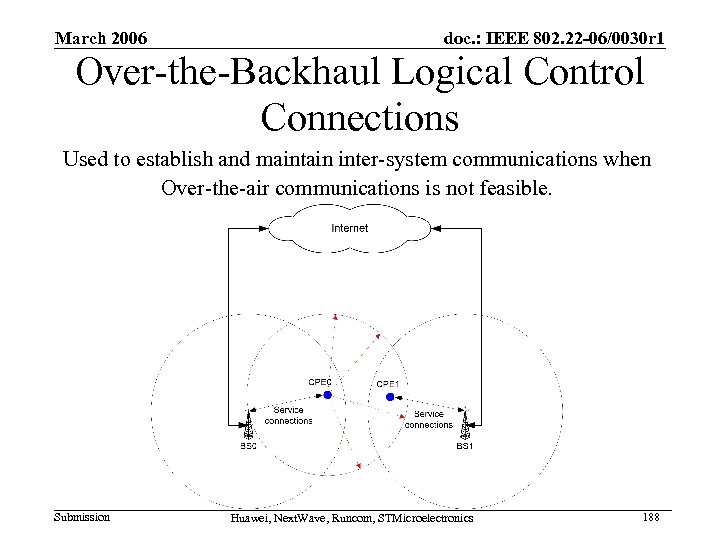 March 2006 doc. : IEEE 802. 22 -06/0030 r 1 Over-the-Backhaul Logical Control Connections Used to establish and maintain inter-system communications when Over-the-air communications is not feasible. Submission Huawei, Next. Wave, Runcom, STMicroelectronics 188
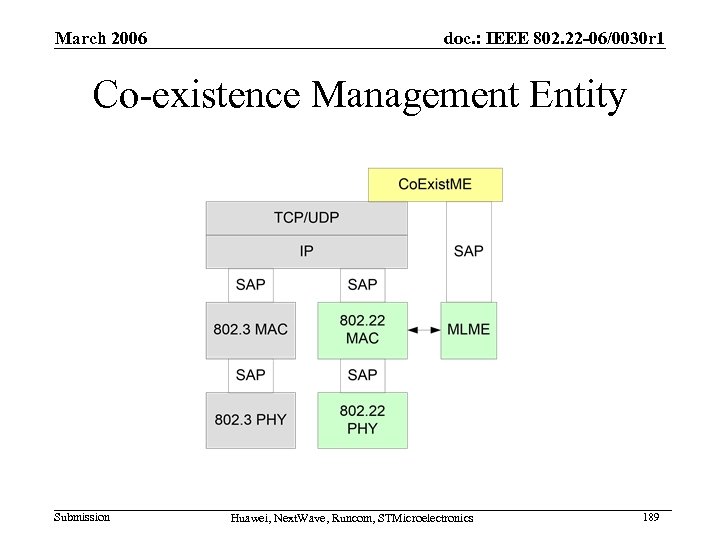 March 2006 doc. : IEEE 802. 22 -06/0030 r 1 Co-existence Management Entity Submission Huawei, Next. Wave, Runcom, STMicroelectronics 189
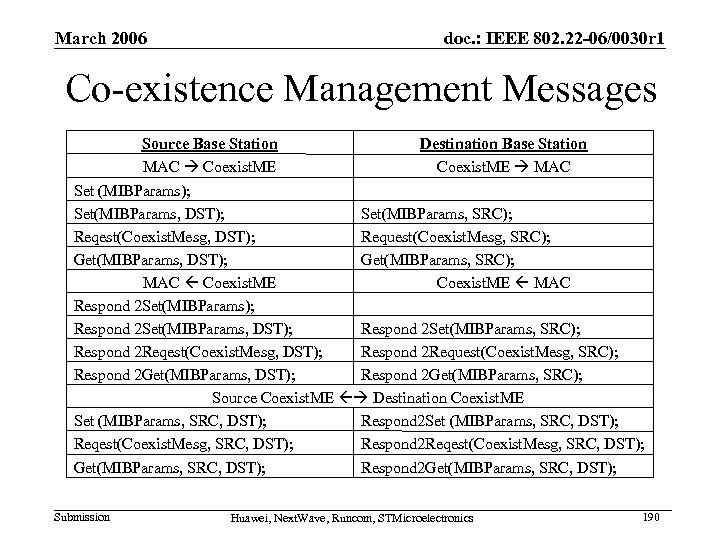 March 2006 doc. : IEEE 802. 22 -06/0030 r 1 Co-existence Management Messages Source Base Station Destination Base Station MAC Coexist. ME MAC Set (MIBParams); Set(MIBParams, DST); Set(MIBParams, SRC); Reqest(Coexist. Mesg, DST); Request(Coexist. Mesg, SRC); Get(MIBParams, DST); Get(MIBParams, SRC); MAC Coexist. ME MAC Respond 2 Set(MIBParams); Respond 2 Set(MIBParams, DST); Respond 2 Set(MIBParams, SRC); Respond 2 Reqest(Coexist. Mesg, DST); Respond 2 Request(Coexist. Mesg, SRC); Respond 2 Get(MIBParams, DST); Respond 2 Get(MIBParams, SRC); Source Coexist. ME Destination Coexist. ME Set (MIBParams, SRC, DST); Respond 2 Reqest(Coexist. Mesg, SRC, DST); Get(MIBParams, SRC, DST); Respond 2 Get(MIBParams, SRC, DST); Submission Huawei, Next. Wave, Runcom, STMicroelectronics 190
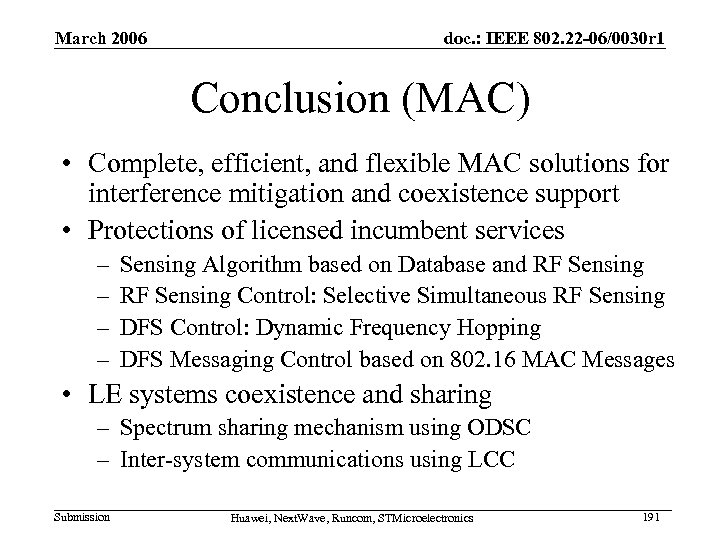 March 2006 doc. : IEEE 802. 22 -06/0030 r 1 Conclusion (MAC) • Complete, efficient, and flexible MAC solutions for interference mitigation and coexistence support • Protections of licensed incumbent services – – Sensing Algorithm based on Database and RF Sensing Control: Selective Simultaneous RF Sensing DFS Control: Dynamic Frequency Hopping DFS Messaging Control based on 802. 16 MAC Messages • LE systems coexistence and sharing – Spectrum sharing mechanism using ODSC – Inter-system communications using LCC Submission Huawei, Next. Wave, Runcom, STMicroelectronics 191
 March 2006 doc. : IEEE 802. 22 -06/0030 r 1 Questions and Answers Submission Huawei, Next. Wave, Runcom, STMicroelectronics 192