


 Скачать презентацию March 2003 doc IEEE 802 15 -03 151
12712c62a638eca354a84e93e106b14a.ppt
- Количество слайдов: 93
 March 2003 doc. : IEEE 802. 15 -03/151 r 0 Project: IEEE P 802. 15 Working Group for Wireless Personal Area Networks (WPANs) Submission Title: [TG 3 a-Wisair-CFP-Presentation] Date Submitted: [3 March, 2003] Source: [Gadi Shor] Company: [Wisair] Address: [24 Raoul Wallenberg st. Ramat Hachayal, Tel-Aviv, ISRAEL] Voice: [+972 -3 -7676605] FAX: [+972 -3 -6477608], E-Mail: [gadi. shor@wisair. com] Re: [802. 15. 3 a Call for proposal] Abstract: [Wisair’s presentation for the P 802. 15. 3 a PHY standard] Purpose: [Response to WPAN-802. 15. 3 a Call for Proposals] Notice: This document has been prepared to assist the IEEE P 802. 15. It is offered as a basis for discussion and is not binding on the contributing individual(s) or organization(s). The material in this document is subject to change in form and content after further study. The contributor(s) reserve(s) the right to add, amend or withdraw material contained herein. Release: The contributor acknowledges and accepts that this contribution becomes the property of IEEE and may be made publicly available by P 802. 15. Submission 1 Gadi Shor, Wisair
 March 2003 doc. : IEEE 802. 15 -03/151 r 0 Wisair’s Variable-Rate Multi-Band PHY layer Proposal for TG 3 a Gadi Shor, Yaron Knobel, David Yaish, Sorin Goldenberg, Amir Krause, Erez Wineberger, Rafi Zack, Benny Blumer, Zeev Rubin, David Meshulam, Amir Freund Wisair Submission 2 Gadi Shor, Wisair
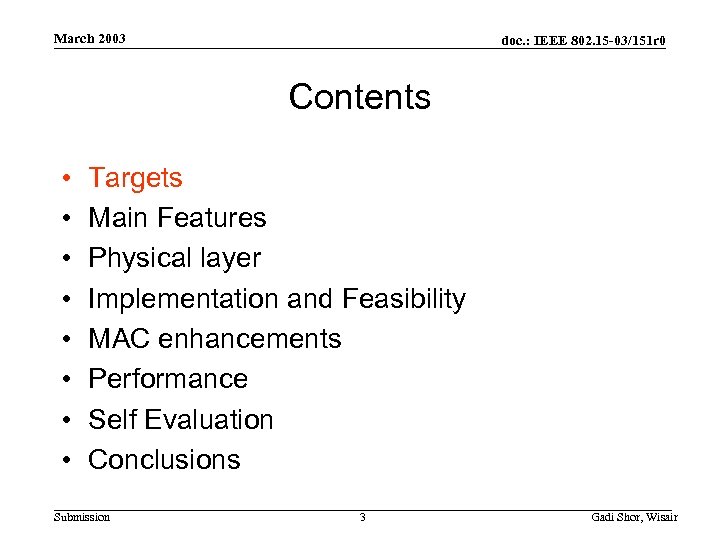 March 2003 doc. : IEEE 802. 15 -03/151 r 0 Contents • • Targets Main Features Physical layer Implementation and Feasibility MAC enhancements Performance Self Evaluation Conclusions Submission 3 Gadi Shor, Wisair
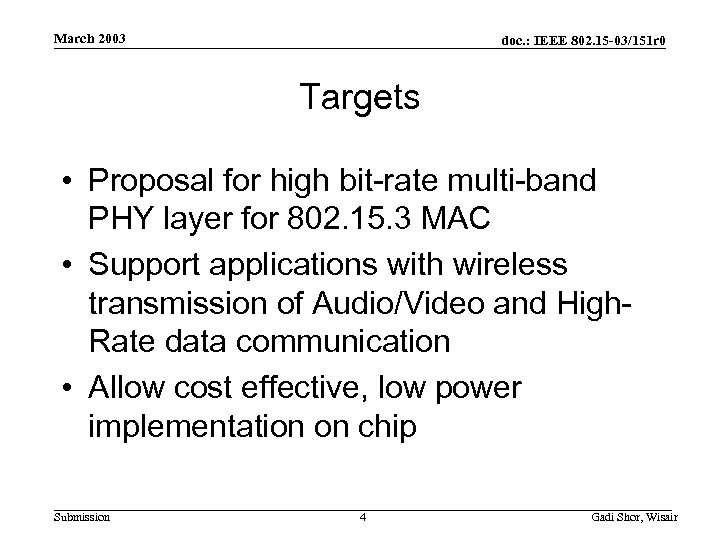 March 2003 doc. : IEEE 802. 15 -03/151 r 0 Targets • Proposal for high bit-rate multi-band PHY layer for 802. 15. 3 MAC • Support applications with wireless transmission of Audio/Video and High. Rate data communication • Allow cost effective, low power implementation on chip Submission 4 Gadi Shor, Wisair
 March 2003 doc. : IEEE 802. 15 -03/151 r 0 Contents • • Targets Main Features Physical layer Implementation and Feasibility MAC enhancements Performance Self Evaluation Conclusions Submission 5 Gadi Shor, Wisair
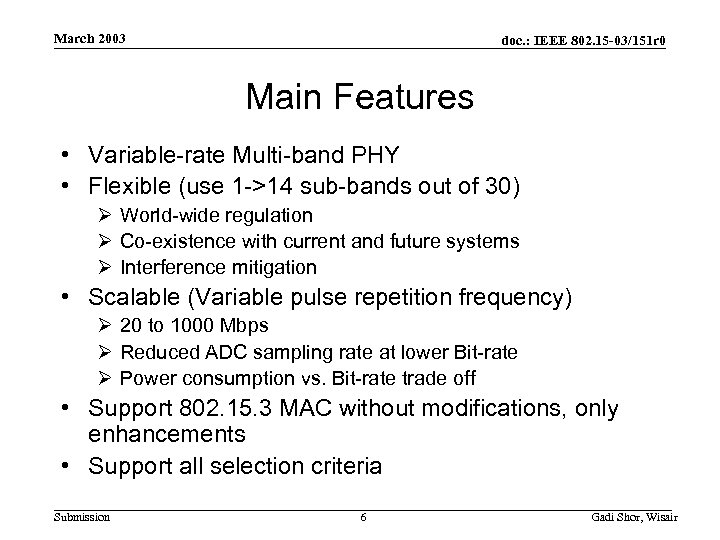 March 2003 doc. : IEEE 802. 15 -03/151 r 0 Main Features • Variable-rate Multi-band PHY • Flexible (use 1 ->14 sub-bands out of 30) Ø World-wide regulation Ø Co-existence with current and future systems Ø Interference mitigation • Scalable (Variable pulse repetition frequency) Ø 20 to 1000 Mbps Ø Reduced ADC sampling rate at lower Bit-rate Ø Power consumption vs. Bit-rate trade off • Support 802. 15. 3 MAC without modifications, only enhancements • Support all selection criteria Submission 6 Gadi Shor, Wisair
 March 2003 doc. : IEEE 802. 15 -03/151 r 0 Contents • • Targets Main Features Physical layer Implementation and Feasibility MAC enhancements Performance Self Evaluation Conclusions Submission 7 Gadi Shor, Wisair
 March 2003 doc. : IEEE 802. 15 -03/151 r 0 Variable-Rate Multi-Band PHY layer • • Sub-bands frequency plan Pulse shape Operation modes Variable-rate time-frequency interleaving sequences Submission 8 Gadi Shor, Wisair
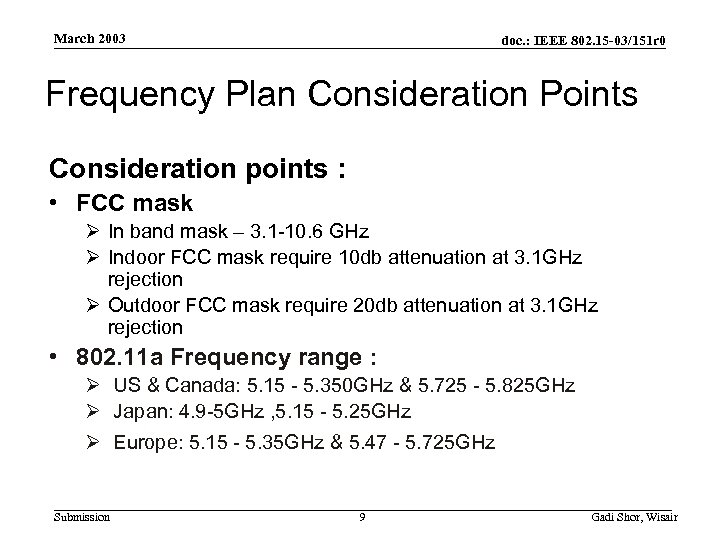 March 2003 doc. : IEEE 802. 15 -03/151 r 0 Frequency Plan Consideration Points Consideration points : • FCC mask Ø In band mask – 3. 1 -10. 6 GHz Ø Indoor FCC mask require 10 db attenuation at 3. 1 GHz rejection Ø Outdoor FCC mask require 20 db attenuation at 3. 1 GHz rejection • 802. 11 a Frequency range : Ø US & Canada: 5. 15 - 5. 350 GHz & 5. 725 - 5. 825 GHz Ø Japan: 4. 9 -5 GHz , 5. 15 - 5. 25 GHz Ø Europe: 5. 15 - 5. 35 GHz & 5. 47 - 5. 725 GHz Submission 9 Gadi Shor, Wisair
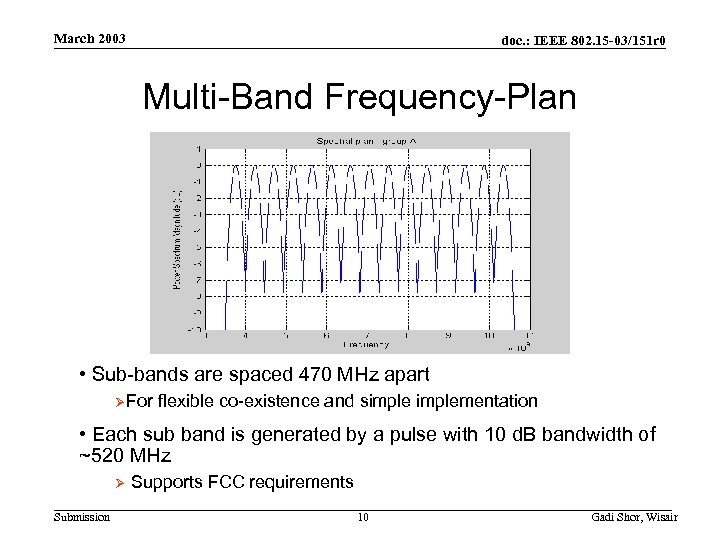 March 2003 doc. : IEEE 802. 15 -03/151 r 0 Multi-Band Frequency-Plan • Sub-bands are spaced 470 MHz apart ØFor flexible co-existence and simplementation • Each sub band is generated by a pulse with 10 d. B bandwidth of ~520 MHz Ø Submission Supports FCC requirements 10 Gadi Shor, Wisair
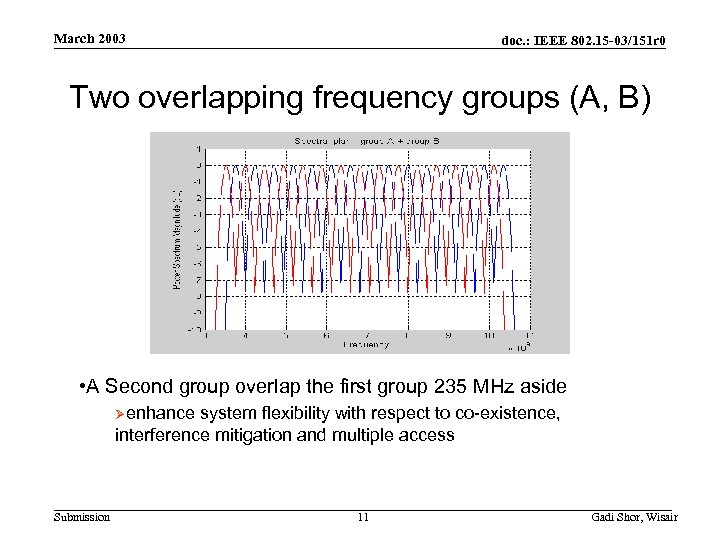 March 2003 doc. : IEEE 802. 15 -03/151 r 0 Two overlapping frequency groups (A, B) • A Second group overlap the first group 235 MHz aside Øenhance system flexibility with respect to co-existence, interference mitigation and multiple access Submission 11 Gadi Shor, Wisair
 March 2003 doc. : IEEE 802. 15 -03/151 r 0 Upper and Lower Sub-Band Sets • Each group is divided into lower (sub-bands 1 -8) and upper (sub-bands 9 -15) sets • Only 7 sub-bands are used in the lower set Ø One sub-band can be avoided • The upper set is used in parallel to the lower set to increase the bit-rate Ø First generation support lower set Ø Next generation devices has backward compatibility Submission 12 Gadi Shor, Wisair
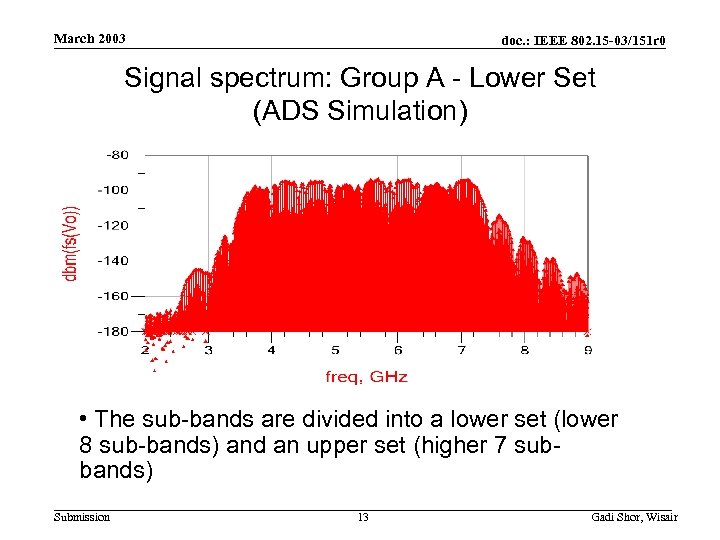 March 2003 doc. : IEEE 802. 15 -03/151 r 0 Signal spectrum: Group A - Lower Set (ADS Simulation) • The sub-bands are divided into a lower set (lower 8 sub-bands) and an upper set (higher 7 subbands) Submission 13 Gadi Shor, Wisair
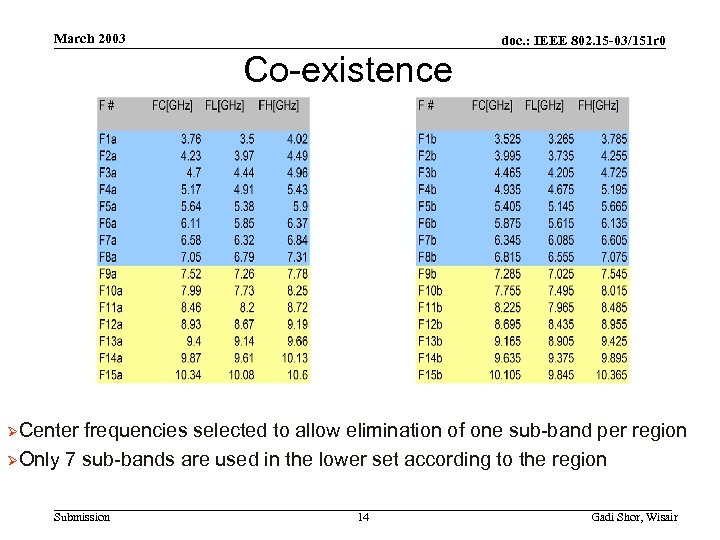 March 2003 doc. : IEEE 802. 15 -03/151 r 0 Co-existence ØCenter frequencies selected to allow elimination of one sub-band per region ØOnly 7 sub-bands are used in the lower set according to the region Submission 14 Gadi Shor, Wisair
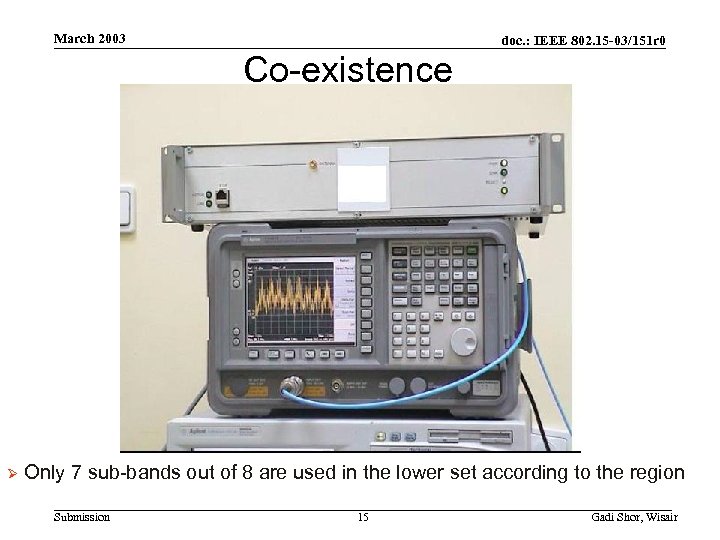 March 2003 doc. : IEEE 802. 15 -03/151 r 0 Co-existence Ø Only 7 sub-bands out of 8 are used in the lower set according to the region Submission 15 Gadi Shor, Wisair
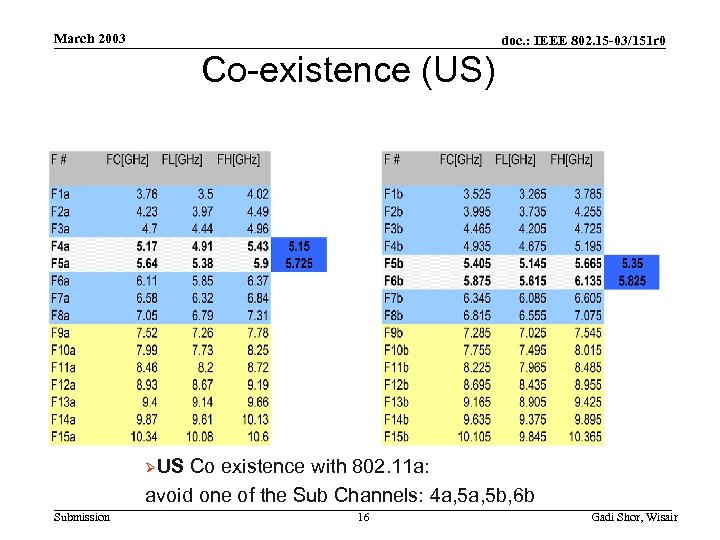 March 2003 doc. : IEEE 802. 15 -03/151 r 0 Co-existence (US) ØUS Co existence with 802. 11 a: avoid one of the Sub Channels: 4 a, 5 b, 6 b Submission 16 Gadi Shor, Wisair
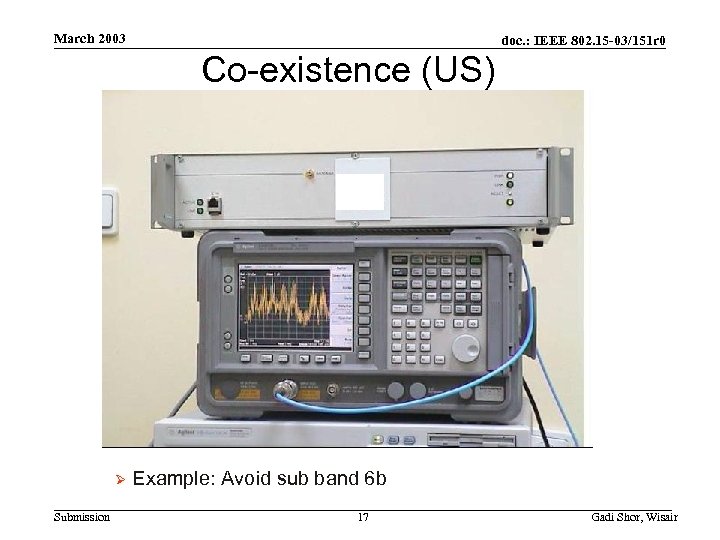 March 2003 doc. : IEEE 802. 15 -03/151 r 0 Co-existence (US) Ø Submission Example: Avoid sub band 6 b 17 Gadi Shor, Wisair
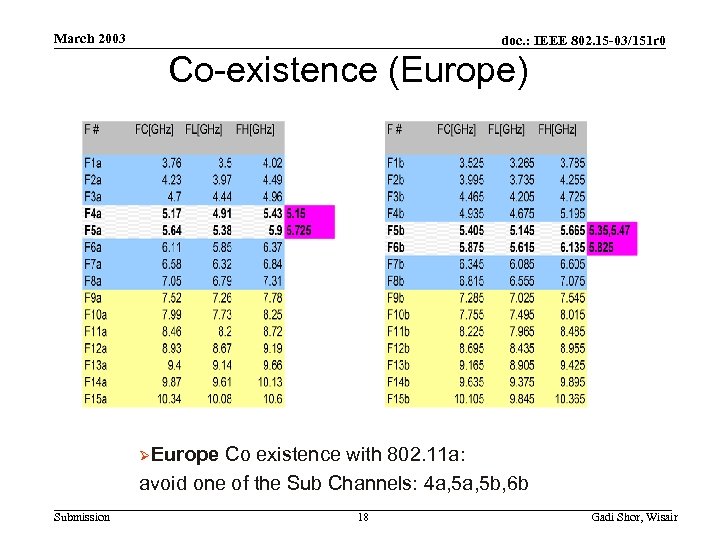 March 2003 doc. : IEEE 802. 15 -03/151 r 0 Co-existence (Europe) ØEurope Co existence with 802. 11 a: avoid one of the Sub Channels: 4 a, 5 b, 6 b Submission 18 Gadi Shor, Wisair
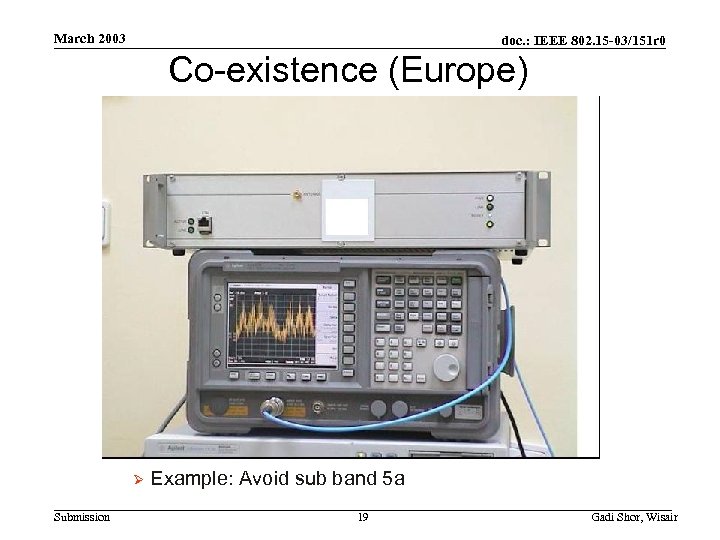 March 2003 doc. : IEEE 802. 15 -03/151 r 0 Co-existence (Europe) Ø Submission Example: Avoid sub band 5 a 19 Gadi Shor, Wisair
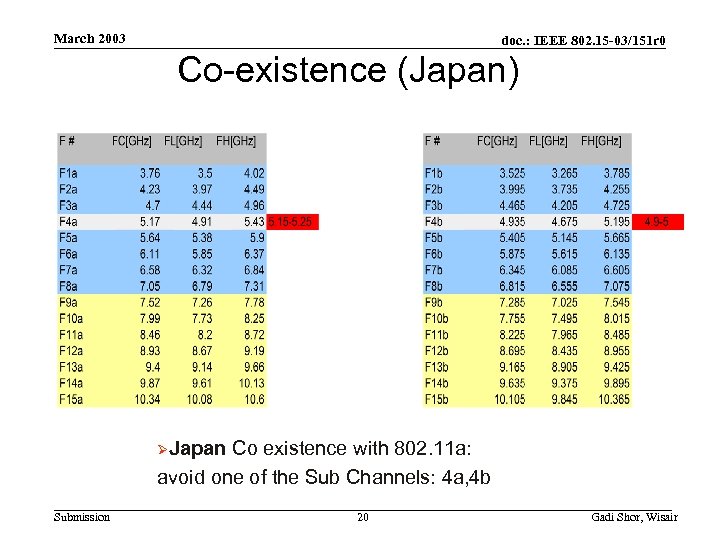 March 2003 doc. : IEEE 802. 15 -03/151 r 0 Co-existence (Japan) ØJapan Co existence with 802. 11 a: avoid one of the Sub Channels: 4 a, 4 b Submission 20 Gadi Shor, Wisair
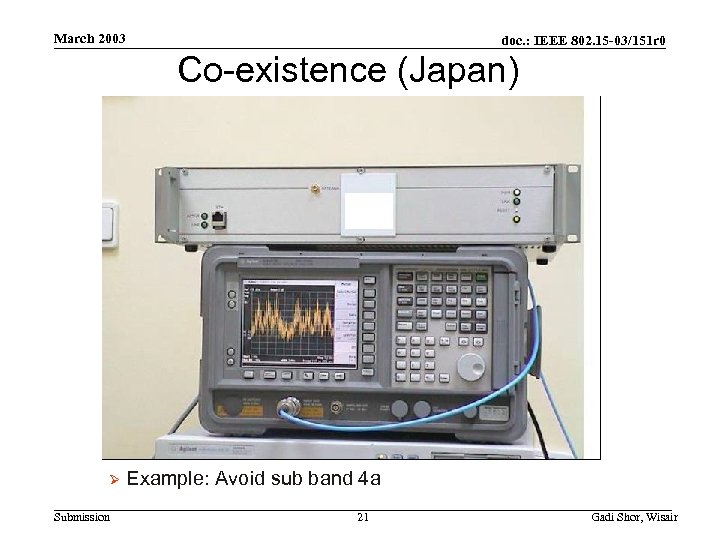 March 2003 doc. : IEEE 802. 15 -03/151 r 0 Co-existence (Japan) Ø Submission Example: Avoid sub band 4 a 21 Gadi Shor, Wisair
 March 2003 doc. : IEEE 802. 15 -03/151 r 0 Variable-Rate Multi-Band Modulation and Coding Scheme • The waveform is generated by time interleaving of pulses from different frequency sub-bands • Modulation schemes: QPSK and BPSK • Coding Schemes: Viterbi K=7, Rate ½, ¾ • Three frame lengths supported to allow Ø Reduced ADC sampling rate for improved power consumption Ø Improved multiple access Submission 22 Gadi Shor, Wisair
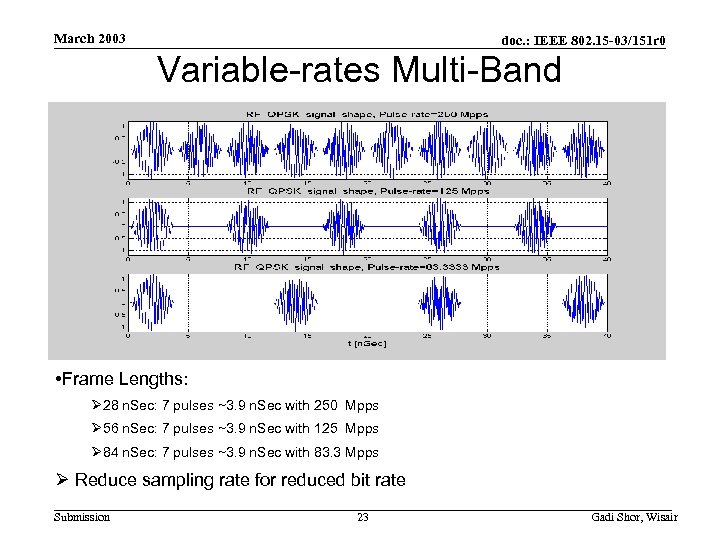 March 2003 doc. : IEEE 802. 15 -03/151 r 0 Variable-rates Multi-Band • Frame Lengths: Ø 28 n. Sec: 7 pulses ~3. 9 n. Sec with 250 Mpps Ø 56 n. Sec: 7 pulses ~3. 9 n. Sec with 125 Mpps Ø 84 n. Sec: 7 pulses ~3. 9 n. Sec with 83. 3 Mpps Ø Reduce sampling rate for reduced bit rate Submission 23 Gadi Shor, Wisair
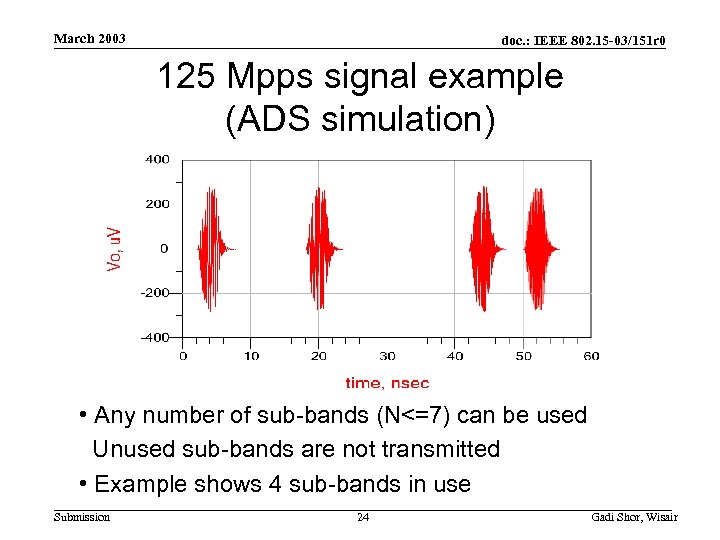 March 2003 doc. : IEEE 802. 15 -03/151 r 0 125 Mpps signal example (ADS simulation) • Any number of sub-bands (N<=7) can be used Unused sub-bands are not transmitted • Example shows 4 sub-bands in use Submission 24 Gadi Shor, Wisair
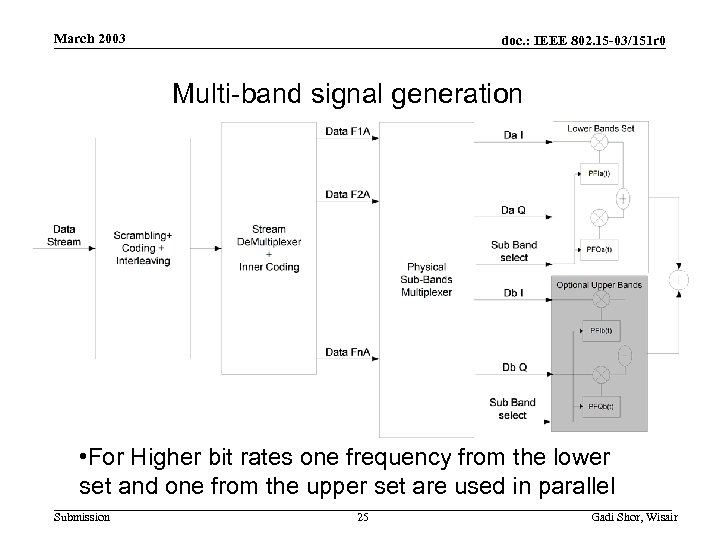 March 2003 doc. : IEEE 802. 15 -03/151 r 0 Multi-band signal generation • For Higher bit rates one frequency from the lower set and one from the upper set are used in parallel Submission 25 Gadi Shor, Wisair
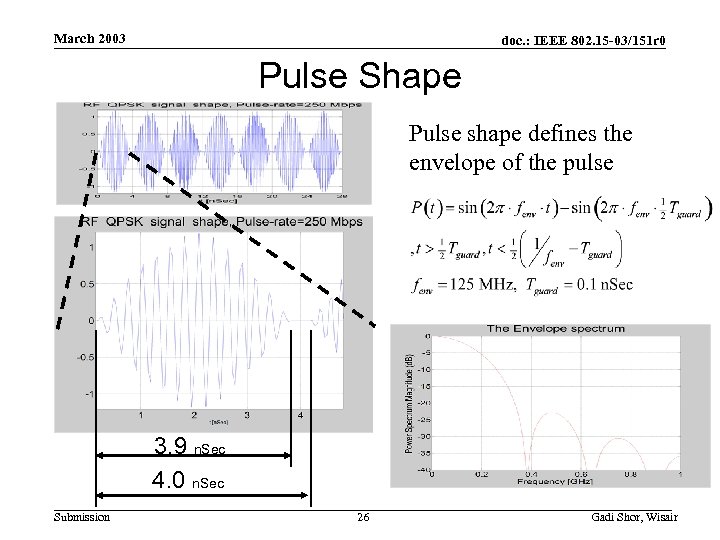 March 2003 doc. : IEEE 802. 15 -03/151 r 0 Pulse Shape Pulse shape defines the envelope of the pulse 3. 9 n. Sec 4. 0 n. Sec Submission 26 Gadi Shor, Wisair
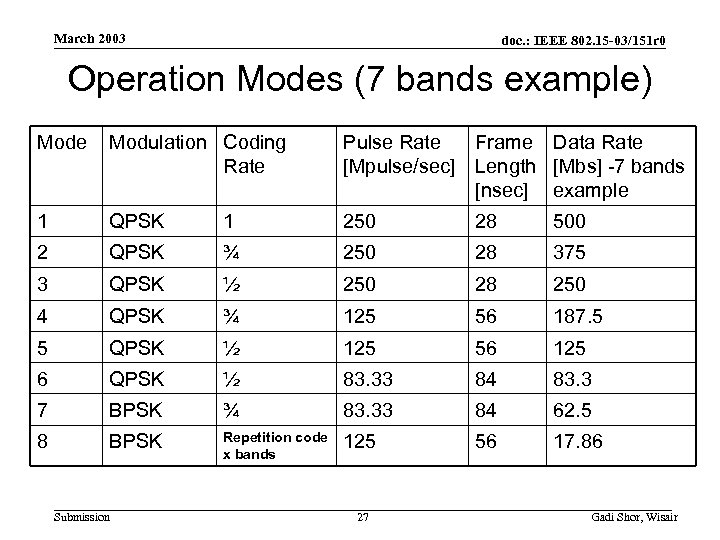 March 2003 doc. : IEEE 802. 15 -03/151 r 0 Operation Modes (7 bands example) Mode Modulation Coding Rate Pulse Rate Frame Data Rate [Mpulse/sec] Length [Mbs] -7 bands [nsec] example 1 QPSK 1 250 28 500 2 QPSK ¾ 250 28 375 3 QPSK ½ 250 28 250 4 QPSK ¾ 125 56 187. 5 5 QPSK ½ 125 56 125 6 QPSK ½ 83. 33 84 83. 3 7 BPSK ¾ 83. 33 84 62. 5 8 BPSK Repetition code x bands 125 56 17. 86 Submission 27 Gadi Shor, Wisair
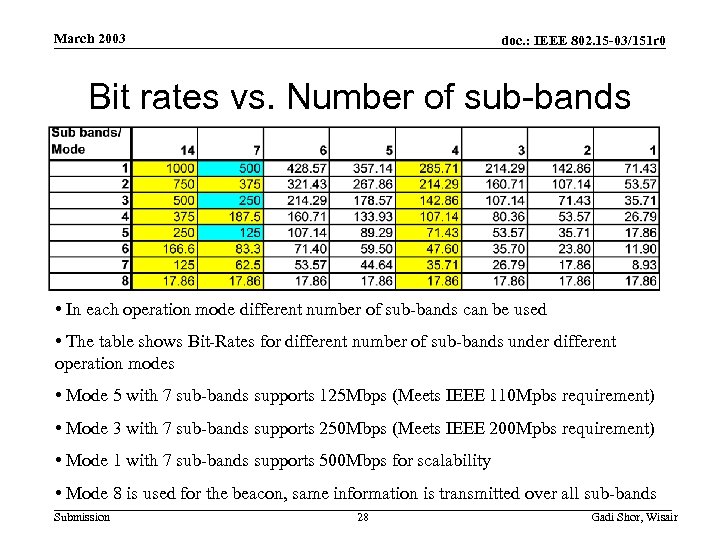 March 2003 doc. : IEEE 802. 15 -03/151 r 0 Bit rates vs. Number of sub-bands • In each operation mode different number of sub-bands can be used • The table shows Bit-Rates for different number of sub-bands under different operation modes • Mode 5 with 7 sub-bands supports 125 Mbps (Meets IEEE 110 Mpbs requirement) • Mode 3 with 7 sub-bands supports 250 Mbps (Meets IEEE 200 Mpbs requirement) • Mode 1 with 7 sub-bands supports 500 Mbps for scalability • Mode 8 is used for the beacon, same information is transmitted over all sub-bands Submission 28 Gadi Shor, Wisair
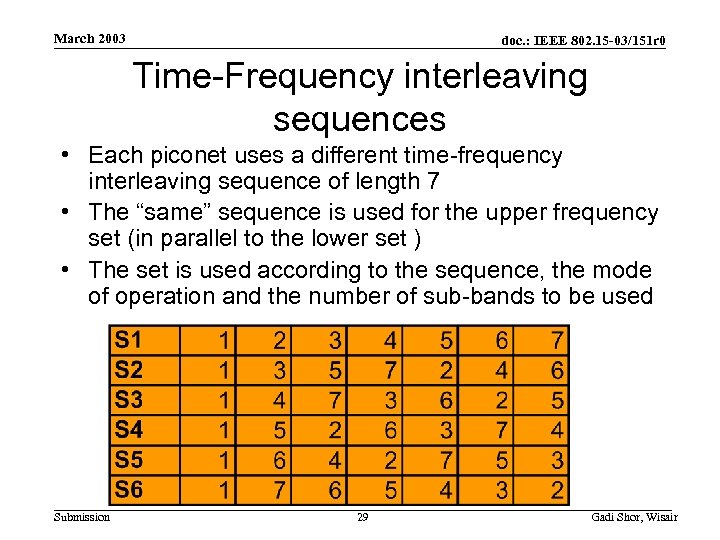 March 2003 doc. : IEEE 802. 15 -03/151 r 0 Time-Frequency interleaving sequences • Each piconet uses a different time-frequency interleaving sequence of length 7 • The “same” sequence is used for the upper frequency set (in parallel to the lower set ) • The set is used according to the sequence, the mode of operation and the number of sub-bands to be used Submission 29 Gadi Shor, Wisair
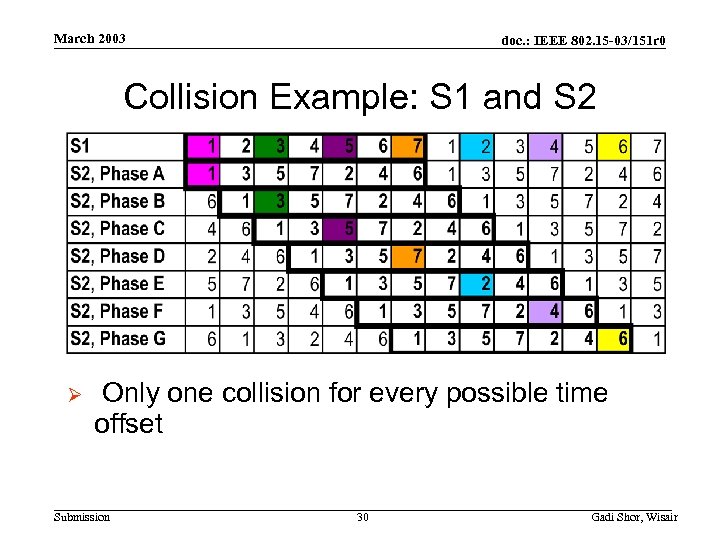 March 2003 doc. : IEEE 802. 15 -03/151 r 0 Collision Example: S 1 and S 2 Ø Only one collision for every possible time offset Submission 30 Gadi Shor, Wisair
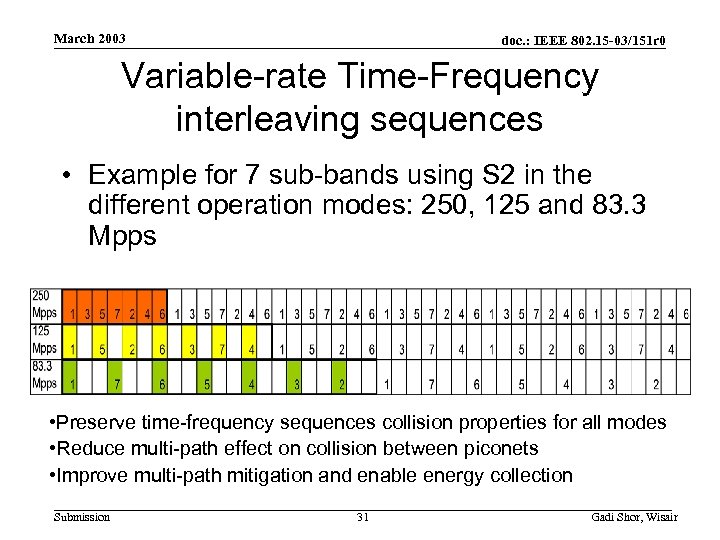 March 2003 doc. : IEEE 802. 15 -03/151 r 0 Variable-rate Time-Frequency interleaving sequences • Example for 7 sub-bands using S 2 in the different operation modes: 250, 125 and 83. 3 Mpps • Preserve time-frequency sequences collision properties for all modes • Reduce multi-path effect on collision between piconets • Improve multi-path mitigation and enable energy collection Submission 31 Gadi Shor, Wisair
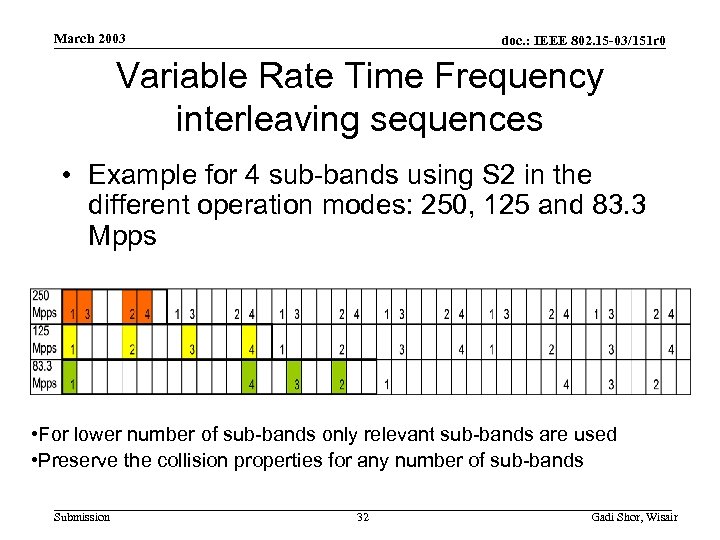 March 2003 doc. : IEEE 802. 15 -03/151 r 0 Variable Rate Time Frequency interleaving sequences • Example for 4 sub-bands using S 2 in the different operation modes: 250, 125 and 83. 3 Mpps • For lower number of sub-bands only relevant sub-bands are used • Preserve the collision properties for any number of sub-bands Submission 32 Gadi Shor, Wisair
 March 2003 doc. : IEEE 802. 15 -03/151 r 0 Multiple-Access • Use of different time-frequency interleaving sequences in different piconets to reduce collisions • Reduce number of channels in use, to reduce collisions (FDM alternative when link budget good enough) • Reduce pulse repetition frequency to reduce multi-path effects on Multiple access Submission 33 Gadi Shor, Wisair
 March 2003 doc. : IEEE 802. 15 -03/151 r 0 Preamble • Use CAZAC sequences over all subbands in use (Similar to mode 8) • Approximately 10 Micro Seconds • Achieve False-Alarm and Miss-Detect requirements under multi-path and multiple access interference • Use color code to improve piconet identification Submission 34 Gadi Shor, Wisair
 March 2003 doc. : IEEE 802. 15 -03/151 r 0 Contents • • Targets Main Features Physical layer Implementation and Feasibility MAC enhancements Performance Self Evaluation Conclusions Submission 35 Gadi Shor, Wisair
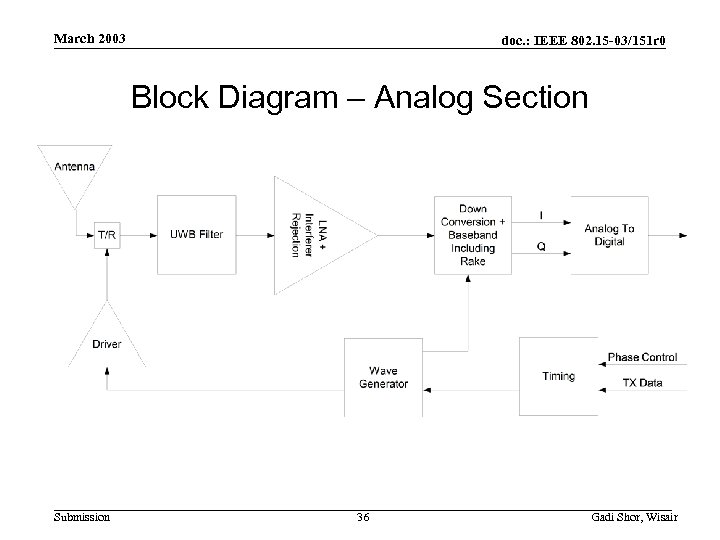 March 2003 doc. : IEEE 802. 15 -03/151 r 0 Block Diagram – Analog Section Submission 36 Gadi Shor, Wisair
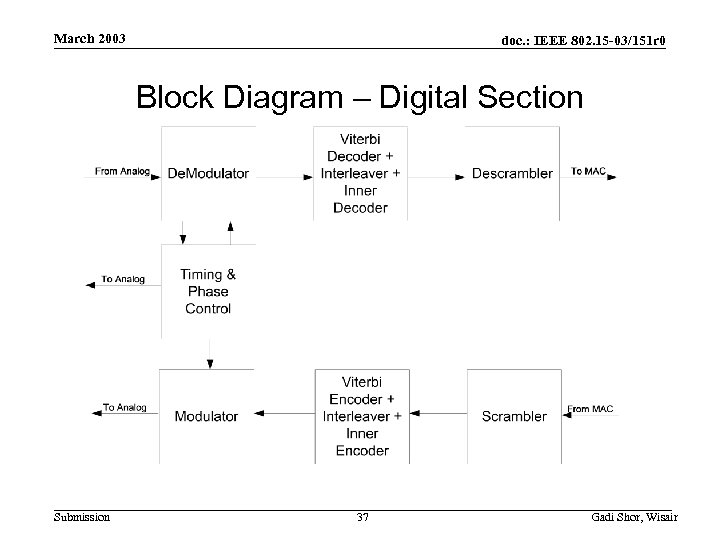 March 2003 doc. : IEEE 802. 15 -03/151 r 0 Block Diagram – Digital Section Submission 37 Gadi Shor, Wisair
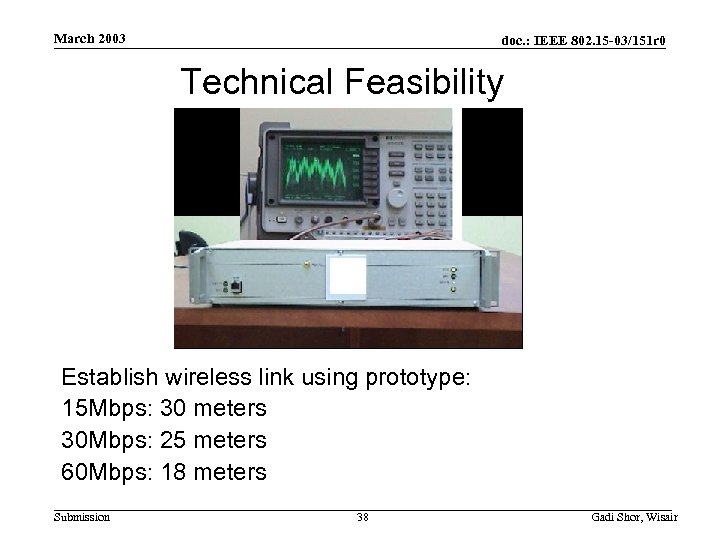 March 2003 doc. : IEEE 802. 15 -03/151 r 0 Technical Feasibility Establish wireless link using prototype: 15 Mbps: 30 meters 30 Mbps: 25 meters 60 Mbps: 18 meters Submission 38 Gadi Shor, Wisair
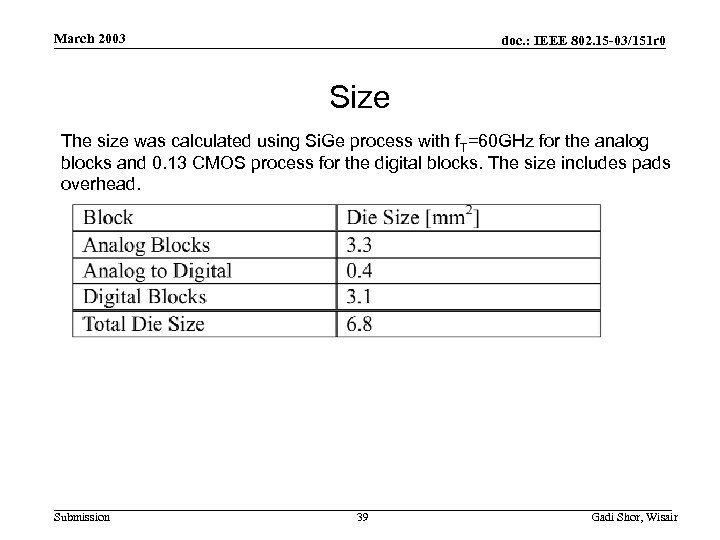 March 2003 doc. : IEEE 802. 15 -03/151 r 0 Size The size was calculated using Si. Ge process with f. T=60 GHz for the analog blocks and 0. 13 CMOS process for the digital blocks. The size includes pads overhead. Submission 39 Gadi Shor, Wisair
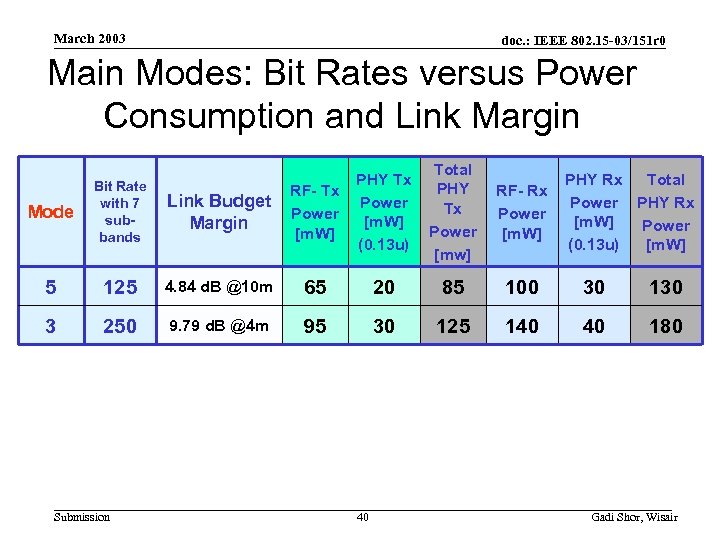 March 2003 doc. : IEEE 802. 15 -03/151 r 0 Main Modes: Bit Rates versus Power Consumption and Link Margin PHY Tx Power [m. W] (0. 13 u) Total PHY Tx Power [mw] RF- Rx Power [m. W] PHY Rx Total Power PHY Rx [m. W] Power (0. 13 u) [m. W] Mode Bit Rate with 7 subbands Link Budget Margin RF- Tx Power [m. W] 5 125 4. 84 d. B @10 m 65 20 85 100 30 130 3 250 9. 79 d. B @4 m 95 30 125 140 40 180 Submission 40 Gadi Shor, Wisair
 March 2003 doc. : IEEE 802. 15 -03/151 r 0 Contents • • Targets Main Features Physical layer Implementation and Feasibility MAC enhancements Performance Self Evaluation Conclusions Submission 41 Gadi Shor, Wisair
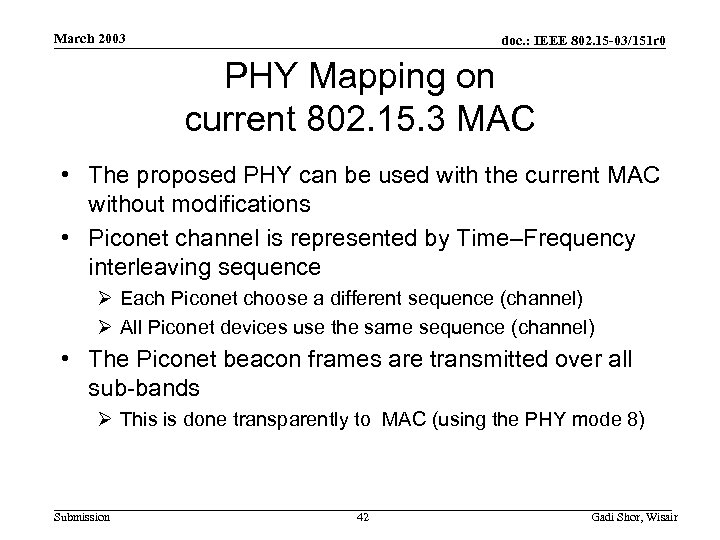 March 2003 doc. : IEEE 802. 15 -03/151 r 0 PHY Mapping on current 802. 15. 3 MAC • The proposed PHY can be used with the current MAC without modifications • Piconet channel is represented by Time–Frequency interleaving sequence Ø Each Piconet choose a different sequence (channel) Ø All Piconet devices use the same sequence (channel) • The Piconet beacon frames are transmitted over all sub-bands Ø This is done transparently to MAC (using the PHY mode 8) Submission 42 Gadi Shor, Wisair
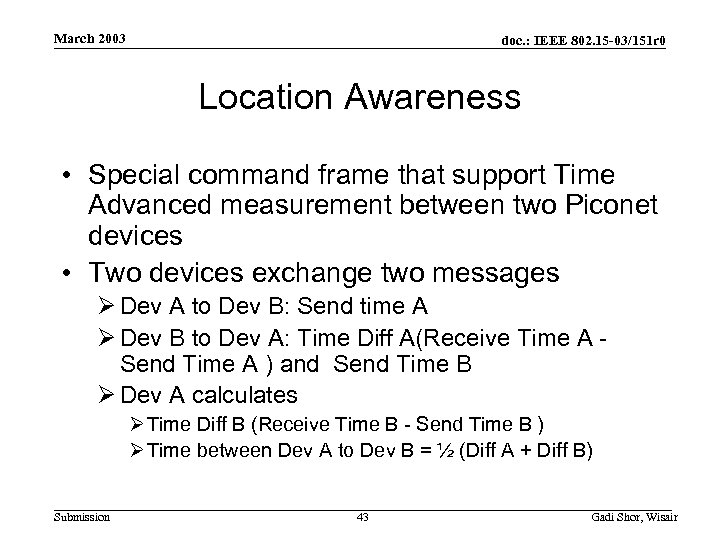 March 2003 doc. : IEEE 802. 15 -03/151 r 0 Location Awareness • Special command frame that support Time Advanced measurement between two Piconet devices • Two devices exchange two messages Ø Dev A to Dev B: Send time A Ø Dev B to Dev A: Time Diff A(Receive Time A Send Time A ) and Send Time B Ø Dev A calculates Ø Time Diff B (Receive Time B - Send Time B ) Ø Time between Dev A to Dev B = ½ (Diff A + Diff B) Submission 43 Gadi Shor, Wisair
 March 2003 doc. : IEEE 802. 15 -03/151 r 0 Contents • • Targets Main Features Physical layer Implementation and Feasibility MAC enhancements Performance Self Evaluation Conclusions Submission 44 Gadi Shor, Wisair
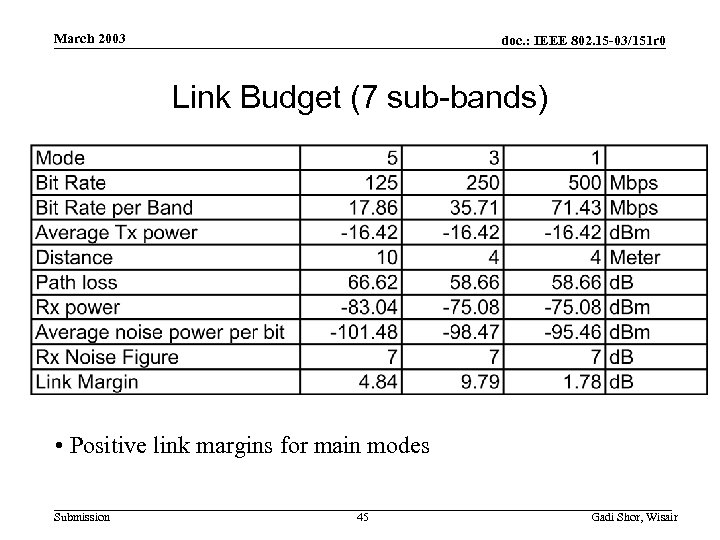 March 2003 doc. : IEEE 802. 15 -03/151 r 0 Link Budget (7 sub-bands) • Positive link margins for main modes Submission 45 Gadi Shor, Wisair
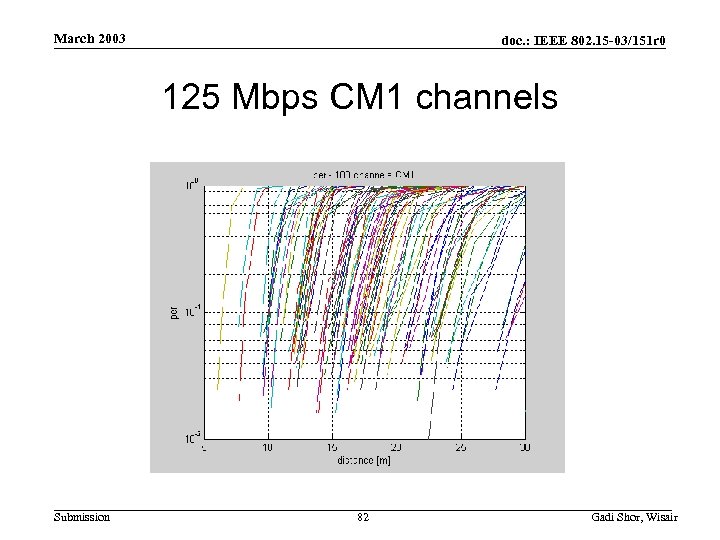
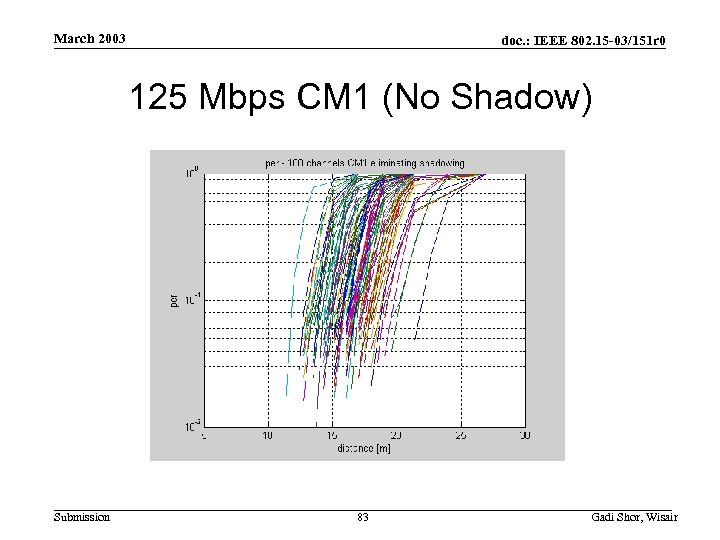
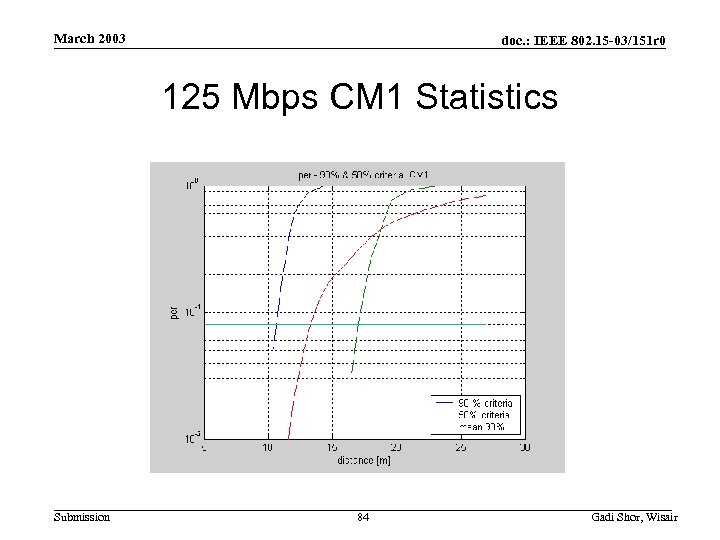
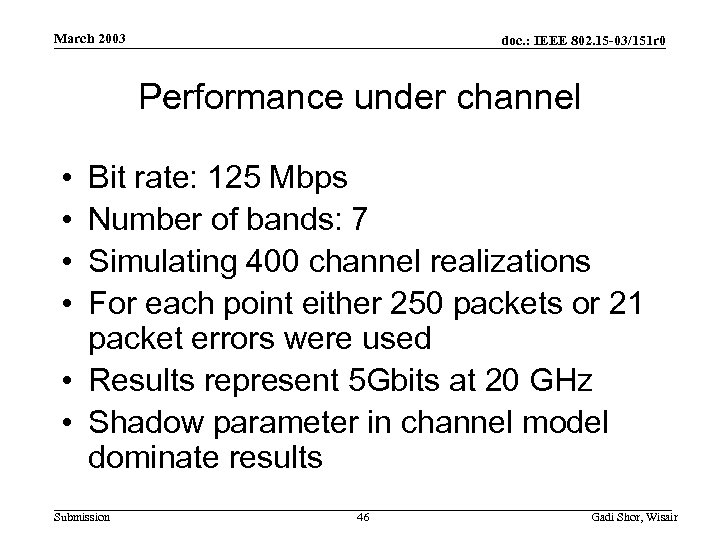 March 2003 doc. : IEEE 802. 15 -03/151 r 0 Performance under channel • • Bit rate: 125 Mbps Number of bands: 7 Simulating 400 channel realizations For each point either 250 packets or 21 packet errors were used • Results represent 5 Gbits at 20 GHz • Shadow parameter in channel model dominate results Submission 46 Gadi Shor, Wisair
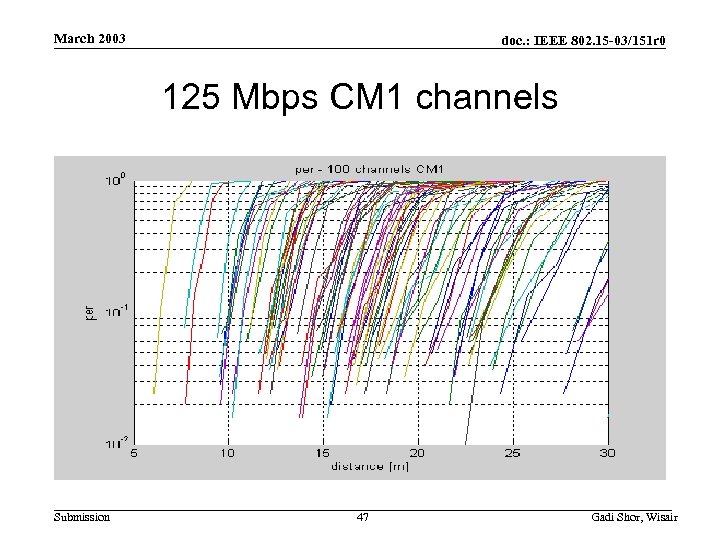 March 2003 doc. : IEEE 802. 15 -03/151 r 0 125 Mbps CM 1 channels Submission 47 Gadi Shor, Wisair
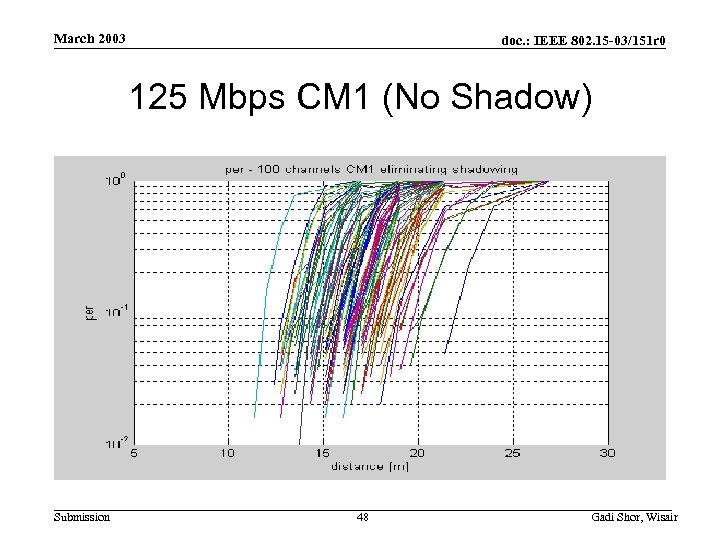 March 2003 doc. : IEEE 802. 15 -03/151 r 0 125 Mbps CM 1 (No Shadow) Submission 48 Gadi Shor, Wisair
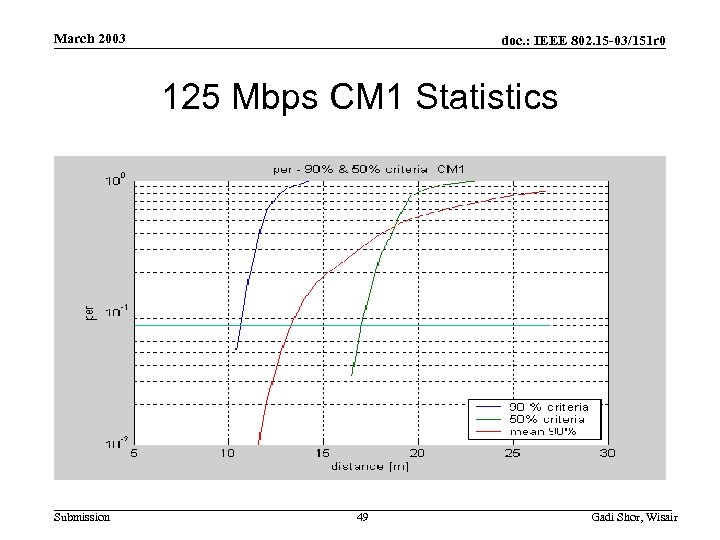 March 2003 doc. : IEEE 802. 15 -03/151 r 0 125 Mbps CM 1 Statistics Submission 49 Gadi Shor, Wisair
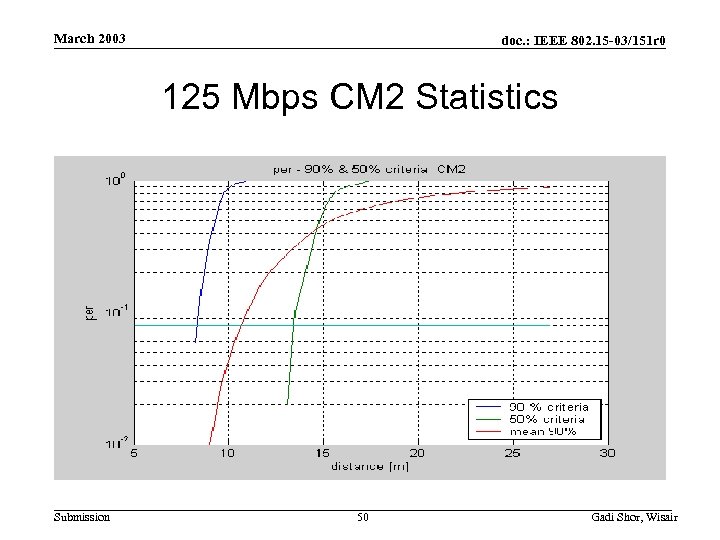 March 2003 doc. : IEEE 802. 15 -03/151 r 0 125 Mbps CM 2 Statistics Submission 50 Gadi Shor, Wisair
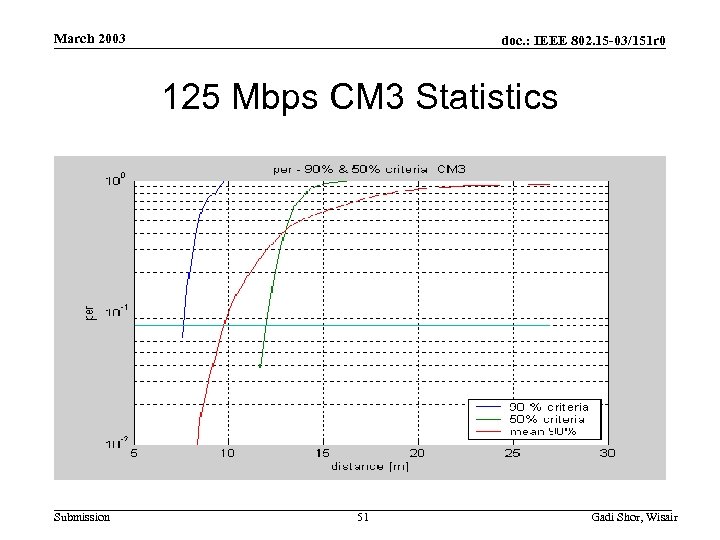 March 2003 doc. : IEEE 802. 15 -03/151 r 0 125 Mbps CM 3 Statistics Submission 51 Gadi Shor, Wisair
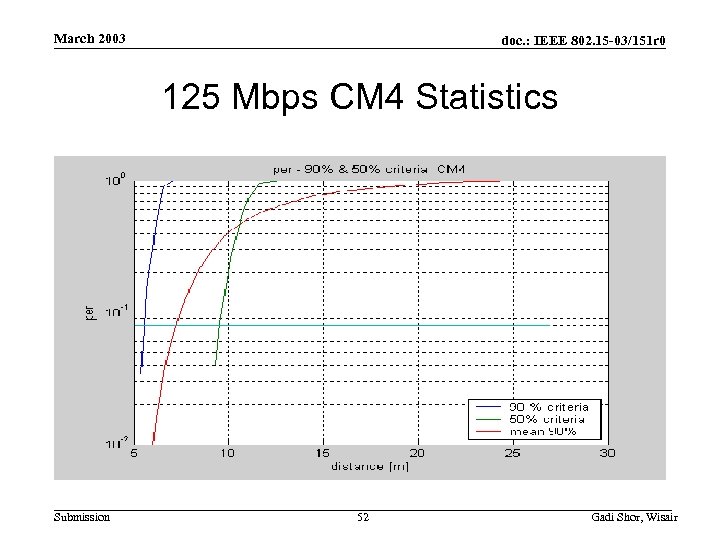 March 2003 doc. : IEEE 802. 15 -03/151 r 0 125 Mbps CM 4 Statistics Submission 52 Gadi Shor, Wisair
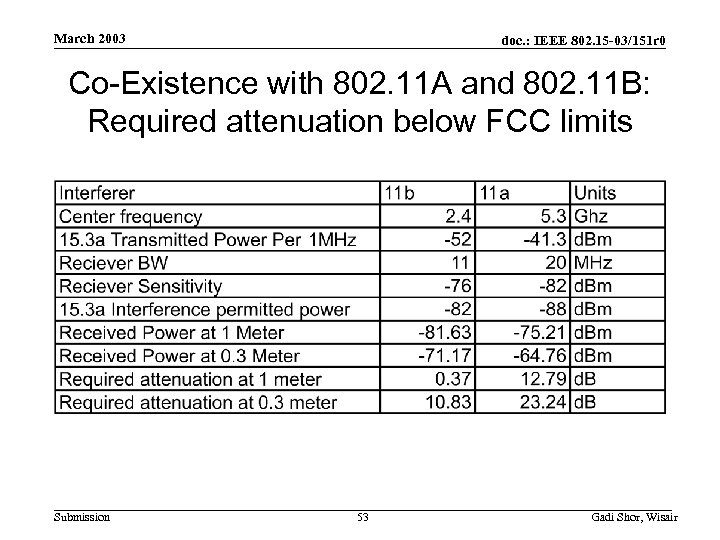 March 2003 doc. : IEEE 802. 15 -03/151 r 0 Co-Existence with 802. 11 A and 802. 11 B: Required attenuation below FCC limits Submission 53 Gadi Shor, Wisair
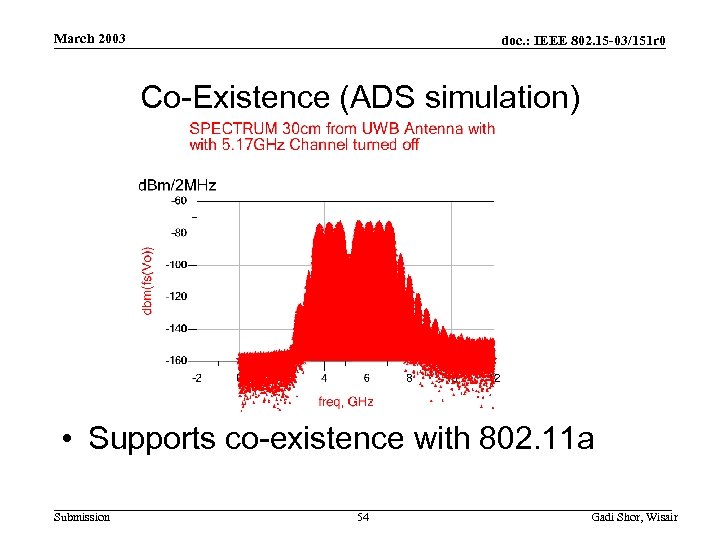 March 2003 doc. : IEEE 802. 15 -03/151 r 0 Co-Existence (ADS simulation) • Supports co-existence with 802. 11 a Submission 54 Gadi Shor, Wisair
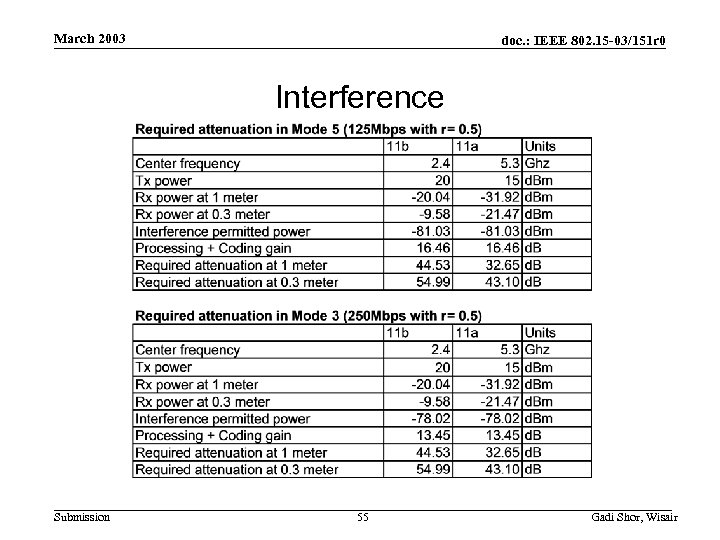 March 2003 doc. : IEEE 802. 15 -03/151 r 0 Interference Submission 55 Gadi Shor, Wisair
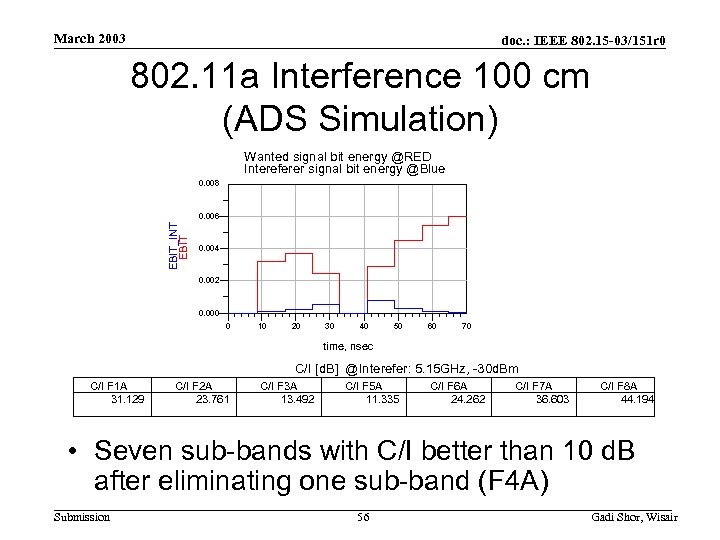 March 2003 doc. : IEEE 802. 15 -03/151 r 0 802. 11 a Interference 100 cm (ADS Simulation) Wanted signal bit energy @RED Intereferer signal bit energy @Blue 0. 008 EBIT_INT EBIT 0. 006 0. 004 0. 002 0. 000 0 10 20 30 40 50 60 70 time, nsec C/I [d. B] @Interefer: 5. 15 GHz, -30 d. Bm C/I F 1 A 31. 129 C/I F 2 A 23. 761 C/I F 3 A 13. 492 C/I F 5 A 11. 335 C/I F 6 A 24. 262 C/I F 7 A 36. 603 C/I F 8 A 44. 194 • Seven sub-bands with C/I better than 10 d. B after eliminating one sub-band (F 4 A) Submission 56 Gadi Shor, Wisair
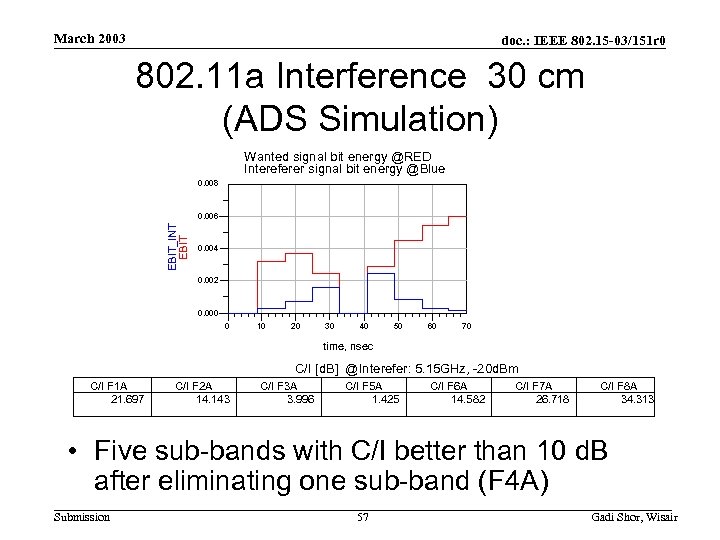 March 2003 doc. : IEEE 802. 15 -03/151 r 0 802. 11 a Interference 30 cm (ADS Simulation) Wanted signal bit energy @RED Intereferer signal bit energy @Blue 0. 008 EBIT_INT EBIT 0. 006 0. 004 0. 002 0. 000 0 10 20 30 40 50 60 70 time, nsec C/I [d. B] @Interefer: 5. 15 GHz, -20 d. Bm C/I F 1 A 21. 697 C/I F 2 A 14. 143 C/I F 3 A 3. 996 C/I F 5 A 1. 425 C/I F 6 A 14. 582 C/I F 7 A 26. 718 C/I F 8 A 34. 313 • Five sub-bands with C/I better than 10 d. B after eliminating one sub-band (F 4 A) Submission 57 Gadi Shor, Wisair
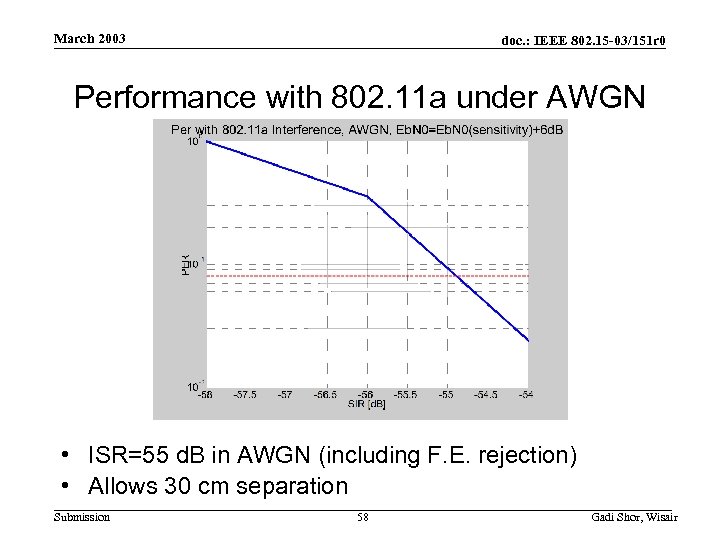 March 2003 doc. : IEEE 802. 15 -03/151 r 0 Performance with 802. 11 a under AWGN • ISR=55 d. B in AWGN (including F. E. rejection) • Allows 30 cm separation Submission 58 Gadi Shor, Wisair
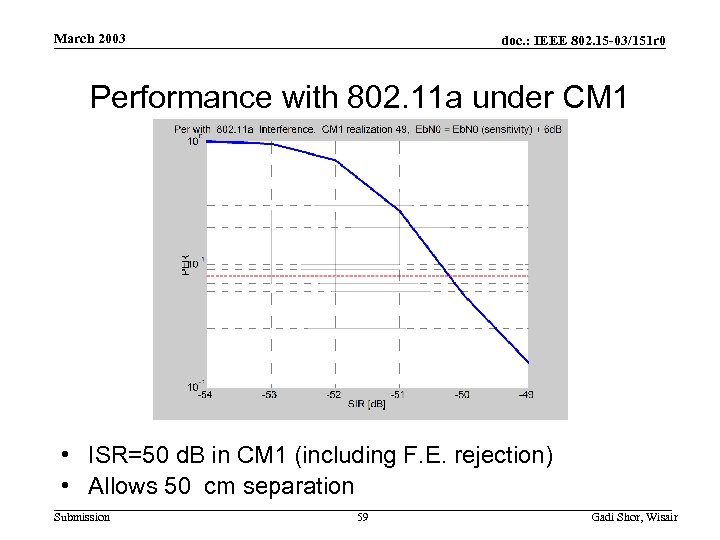 March 2003 doc. : IEEE 802. 15 -03/151 r 0 Performance with 802. 11 a under CM 1 • ISR=50 d. B in CM 1 (including F. E. rejection) • Allows 50 cm separation Submission 59 Gadi Shor, Wisair
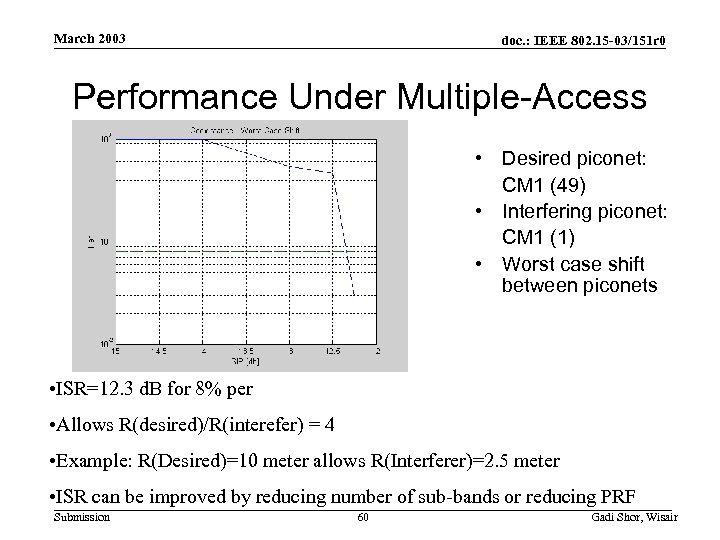 March 2003 doc. : IEEE 802. 15 -03/151 r 0 Performance Under Multiple-Access • Desired piconet: CM 1 (49) • Interfering piconet: CM 1 (1) • Worst case shift between piconets • ISR=12. 3 d. B for 8% per • Allows R(desired)/R(interefer) = 4 • Example: R(Desired)=10 meter allows R(Interferer)=2. 5 meter • ISR can be improved by reducing number of sub-bands or reducing PRF Submission 60 Gadi Shor, Wisair
 March 2003 doc. : IEEE 802. 15 -03/151 r 0 Contents • • Targets Main Features Physical layer Implementation and Feasibility MAC enhancements Performance Self Evaluation Conclusions Submission 61 Gadi Shor, Wisair
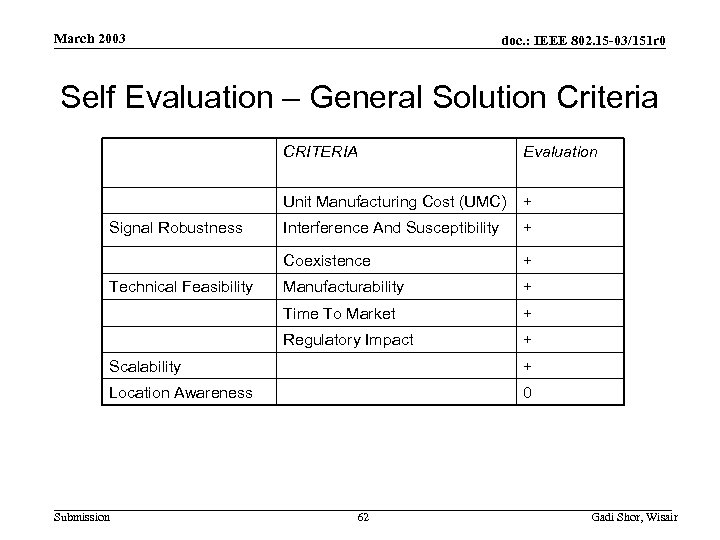 March 2003 doc. : IEEE 802. 15 -03/151 r 0 Self Evaluation – General Solution Criteria CRITERIA Unit Manufacturing Cost (UMC) Interference And Susceptibility + + Manufacturability + Time To Market + Regulatory Impact Technical Feasibility + Coexistence Signal Robustness Evaluation + Scalability + Location Awareness 0 Submission 62 Gadi Shor, Wisair
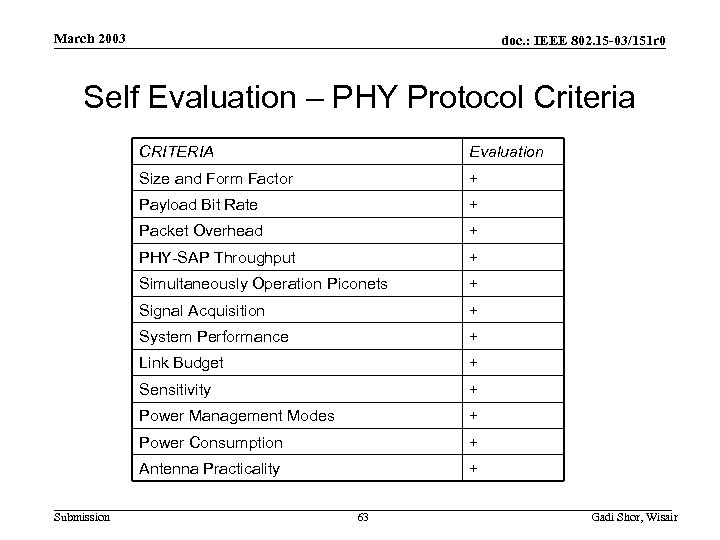 March 2003 doc. : IEEE 802. 15 -03/151 r 0 Self Evaluation – PHY Protocol Criteria CRITERIA Size and Form Factor + Payload Bit Rate + Packet Overhead + PHY-SAP Throughput + Simultaneously Operation Piconets + Signal Acquisition + System Performance + Link Budget + Sensitivity + Power Management Modes + Power Consumption + Antenna Practicality Submission Evaluation + 63 Gadi Shor, Wisair
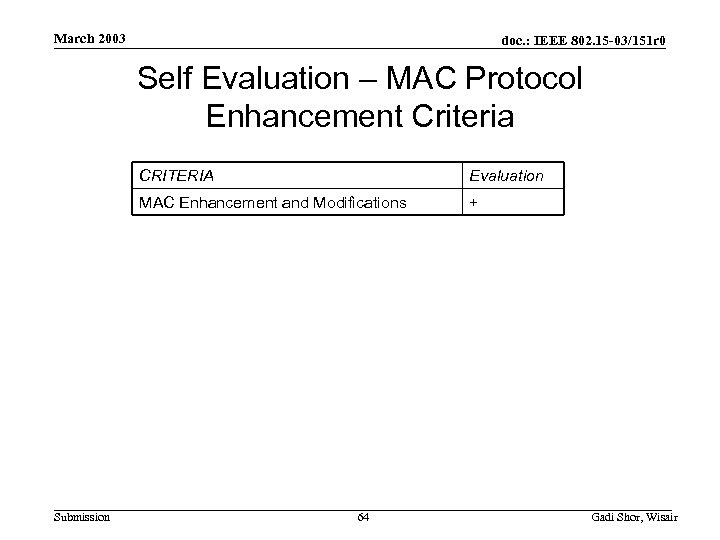 March 2003 doc. : IEEE 802. 15 -03/151 r 0 Self Evaluation – MAC Protocol Enhancement Criteria CRITERIA MAC Enhancement and Modifications Submission Evaluation + 64 Gadi Shor, Wisair
 March 2003 doc. : IEEE 802. 15 -03/151 r 0 Contents • • Targets Main Features Physical layer Implementation and Feasibility MAC enhancements Performance Self Evaluation Conclusions Submission 65 Gadi Shor, Wisair
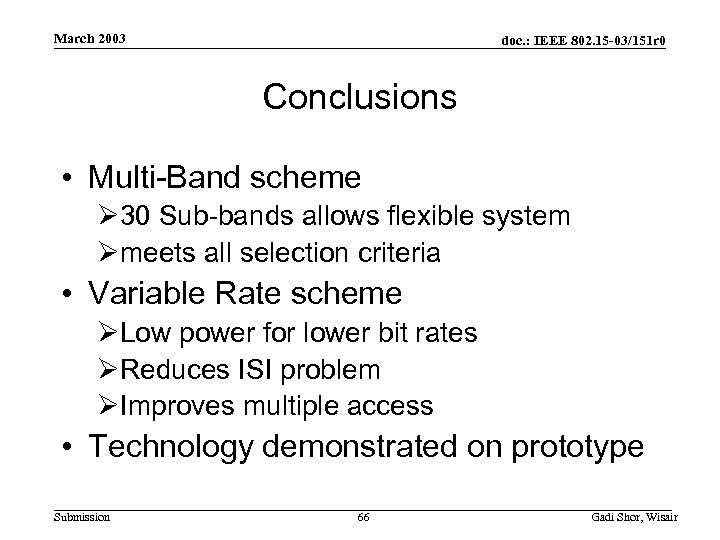 March 2003 doc. : IEEE 802. 15 -03/151 r 0 Conclusions • Multi-Band scheme Ø 30 Sub-bands allows flexible system Ømeets all selection criteria • Variable Rate scheme ØLow power for lower bit rates ØReduces ISI problem ØImproves multiple access • Technology demonstrated on prototype Submission 66 Gadi Shor, Wisair
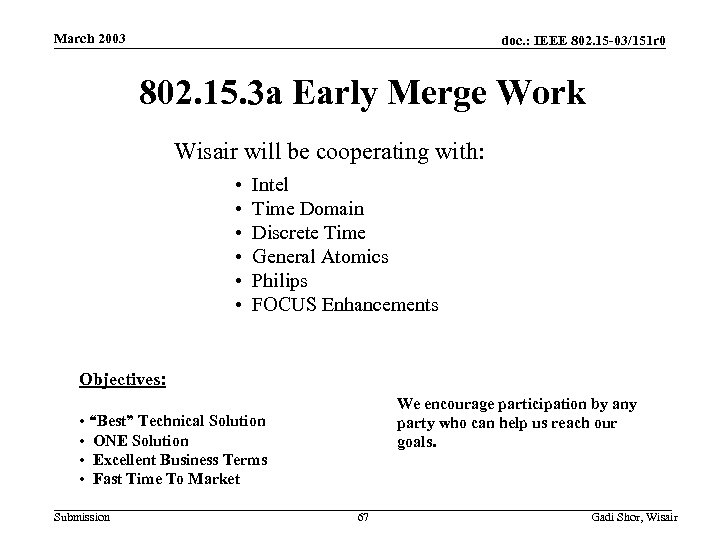 March 2003 doc. : IEEE 802. 15 -03/151 r 0 802. 15. 3 a Early Merge Work Wisair will be cooperating with: • • • Intel Time Domain Discrete Time General Atomics Philips FOCUS Enhancements Objectives: We encourage participation by any party who can help us reach our goals. • “Best” Technical Solution • ONE Solution • Excellent Business Terms • Fast Time To Market Submission 67 Gadi Shor, Wisair
 March 2003 doc. : IEEE 802. 15 -03/151 r 0 Backup Slides Submission 68 Gadi Shor, Wisair
 March 2003 doc. : IEEE 802. 15 -03/151 r 0 Contents • • Physical layer Implementation and Feasibility MAC enhancements Performance Submission 69 Gadi Shor, Wisair
 March 2003 doc. : IEEE 802. 15 -03/151 r 0 Contents • • Physical layer Implementation and Feasibility MAC enhancements Performance Submission 70 Gadi Shor, Wisair
 March 2003 doc. : IEEE 802. 15 -03/151 r 0 Contents • • Physical layer Implementation and Feasibility MAC enhancements Performance Submission 71 Gadi Shor, Wisair
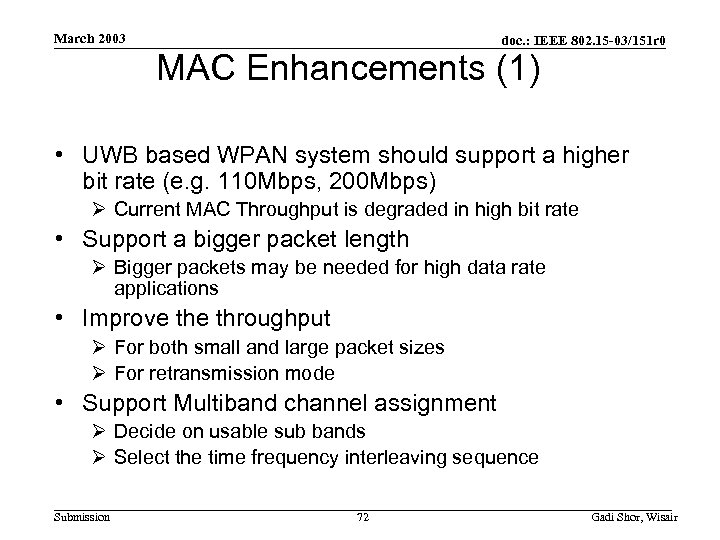 March 2003 doc. : IEEE 802. 15 -03/151 r 0 MAC Enhancements (1) • UWB based WPAN system should support a higher bit rate (e. g. 110 Mbps, 200 Mbps) Ø Current MAC Throughput is degraded in high bit rate • Support a bigger packet length Ø Bigger packets may be needed for high data rate applications • Improve throughput Ø For both small and large packet sizes Ø For retransmission mode • Support Multiband channel assignment Ø Decide on usable sub bands Ø Select the time frequency interleaving sequence Submission 72 Gadi Shor, Wisair
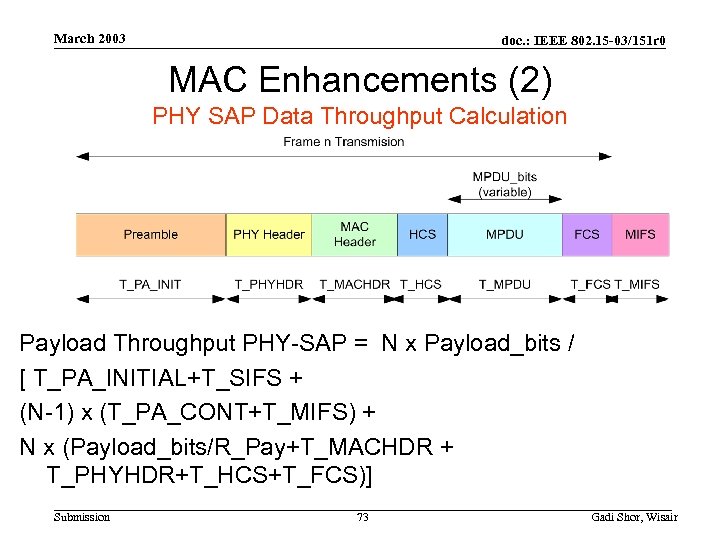 March 2003 doc. : IEEE 802. 15 -03/151 r 0 MAC Enhancements (2) PHY SAP Data Throughput Calculation Payload Throughput PHY-SAP = N x Payload_bits / [ T_PA_INITIAL+T_SIFS + (N-1) x (T_PA_CONT+T_MIFS) + N x (Payload_bits/R_Pay+T_MACHDR + T_PHYHDR+T_HCS+T_FCS)] Submission 73 Gadi Shor, Wisair
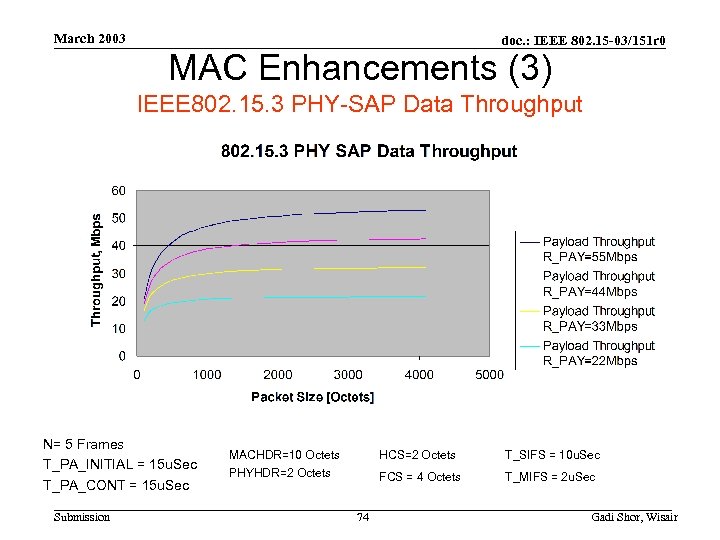 March 2003 doc. : IEEE 802. 15 -03/151 r 0 MAC Enhancements (3) IEEE 802. 15. 3 PHY-SAP Data Throughput N= 5 Frames T_PA_INITIAL = 15 u. Sec T_PA_CONT = 15 u. Sec Submission MACHDR=10 Octets PHYHDR=2 Octets HCS=2 Octets FCS = 4 Octets 74 T_SIFS = 10 u. Sec T_MIFS = 2 u. Sec Gadi Shor, Wisair
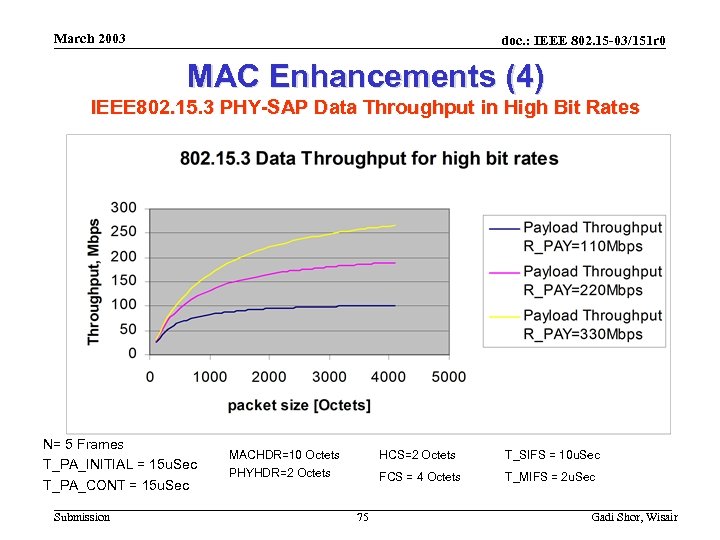 March 2003 doc. : IEEE 802. 15 -03/151 r 0 MAC Enhancements (4) IEEE 802. 15. 3 PHY-SAP Data Throughput in High Bit Rates N= 5 Frames T_PA_INITIAL = 15 u. Sec T_PA_CONT = 15 u. Sec Submission MACHDR=10 Octets PHYHDR=2 Octets HCS=2 Octets FCS = 4 Octets 75 T_SIFS = 10 u. Sec T_MIFS = 2 u. Sec Gadi Shor, Wisair
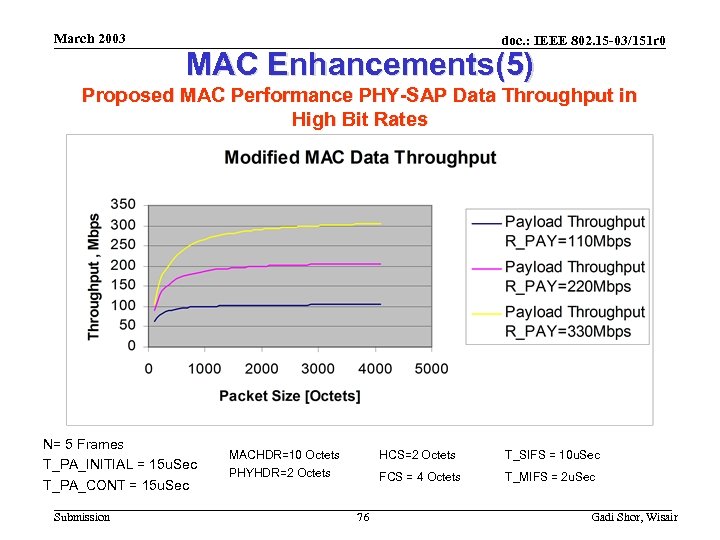 March 2003 doc. : IEEE 802. 15 -03/151 r 0 MAC Enhancements(5) Proposed MAC Performance PHY-SAP Data Throughput in High Bit Rates N= 5 Frames T_PA_INITIAL = 15 u. Sec T_PA_CONT = 15 u. Sec Submission MACHDR=10 Octets PHYHDR=2 Octets HCS=2 Octets FCS = 4 Octets 76 T_SIFS = 10 u. Sec T_MIFS = 2 u. Sec Gadi Shor, Wisair
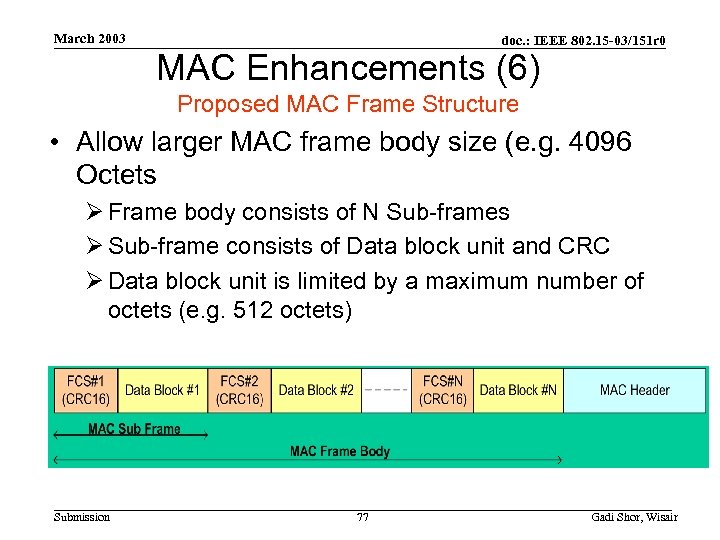 March 2003 doc. : IEEE 802. 15 -03/151 r 0 MAC Enhancements (6) Proposed MAC Frame Structure • Allow larger MAC frame body size (e. g. 4096 Octets Ø Frame body consists of N Sub-frames Ø Sub-frame consists of Data block unit and CRC Ø Data block unit is limited by a maximum number of octets (e. g. 512 octets) Submission 77 Gadi Shor, Wisair
 March 2003 doc. : IEEE 802. 15 -03/151 r 0 MAC Enhancements (7) • The proposed UWB PHY structure is based on multi-band UWB system Ø MAC logical channel is mapped to several frequency bands Ø Some bands might be interfered (useless) by other existing systems (I. e IEEE 802. 11 a – 5 GHz) Ø MAC should be able to drive a Bands Quality Assessment (BQA) that determines whether a specific band is usable or not Ø The Piconet Coordinator (PNC) should be able to distribute the usable bands to all its associated devices Submission 78 Gadi Shor, Wisair
 March 2003 doc. : IEEE 802. 15 -03/151 r 0 MAC Enhancements (8) • Provide BQA time slot at the Supperframe • Useful information is distributed as Information Element (IE) over PNC Beacon • Beacon will transmitted over the whole frequency bands Submission 79 Gadi Shor, Wisair
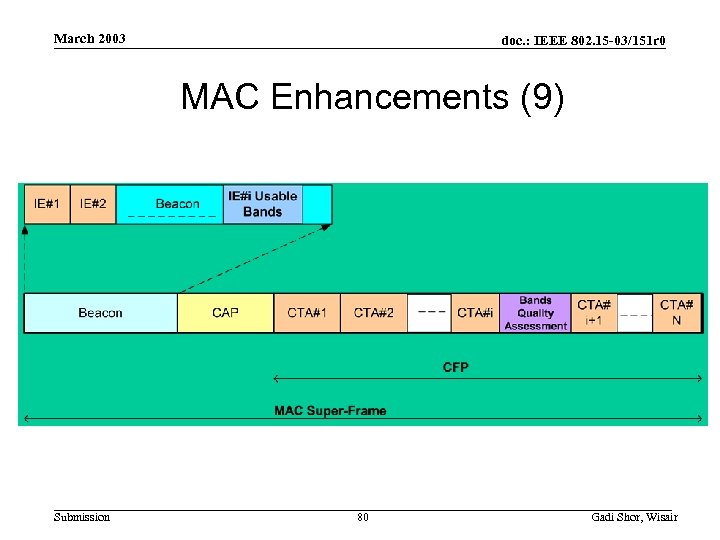 March 2003 doc. : IEEE 802. 15 -03/151 r 0 MAC Enhancements (9) Submission 80 Gadi Shor, Wisair
 March 2003 doc. : IEEE 802. 15 -03/151 r 0 Contents • • Physical layer Implementation and Feasibility MAC enhancements Performance Submission 81 Gadi Shor, Wisair
 March 2003 doc. : IEEE 802. 15 -03/151 r 0 125 Mbps CM 1 channels Submission 82 Gadi Shor, Wisair
 March 2003 doc. : IEEE 802. 15 -03/151 r 0 125 Mbps CM 1 (No Shadow) Submission 83 Gadi Shor, Wisair
 March 2003 doc. : IEEE 802. 15 -03/151 r 0 125 Mbps CM 1 Statistics Submission 84 Gadi Shor, Wisair
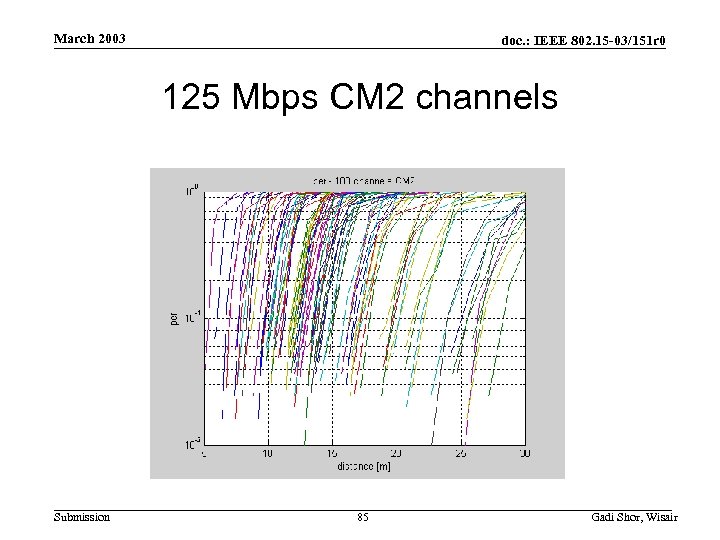 March 2003 doc. : IEEE 802. 15 -03/151 r 0 125 Mbps CM 2 channels Submission 85 Gadi Shor, Wisair
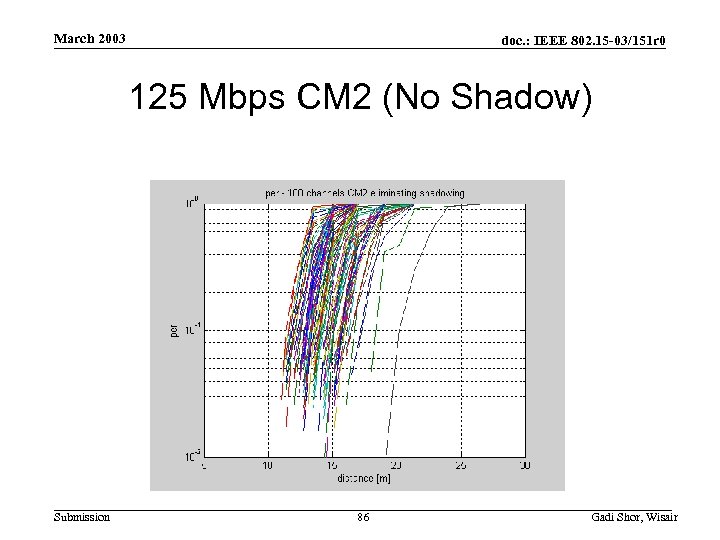 March 2003 doc. : IEEE 802. 15 -03/151 r 0 125 Mbps CM 2 (No Shadow) Submission 86 Gadi Shor, Wisair
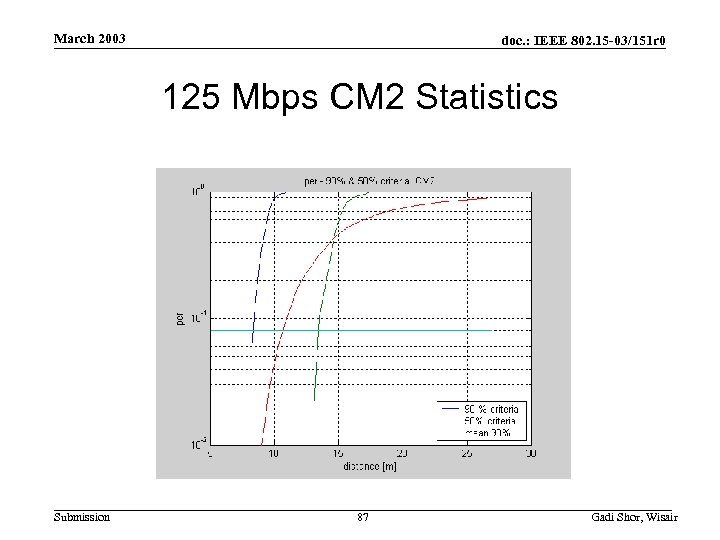 March 2003 doc. : IEEE 802. 15 -03/151 r 0 125 Mbps CM 2 Statistics Submission 87 Gadi Shor, Wisair
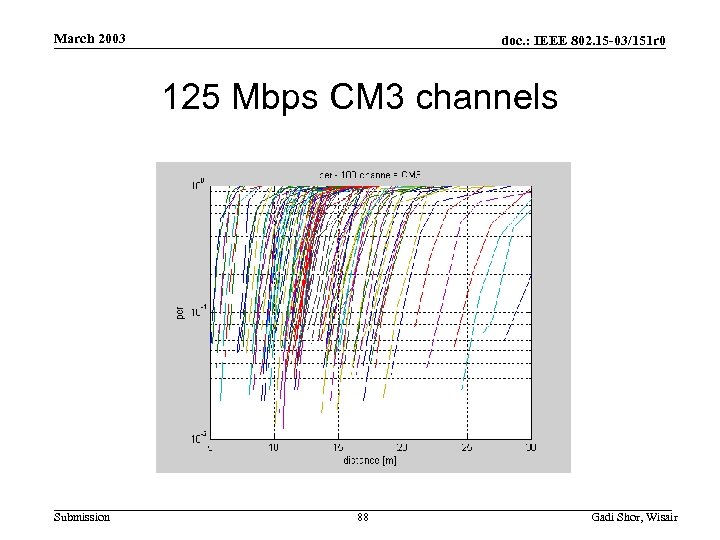 March 2003 doc. : IEEE 802. 15 -03/151 r 0 125 Mbps CM 3 channels Submission 88 Gadi Shor, Wisair
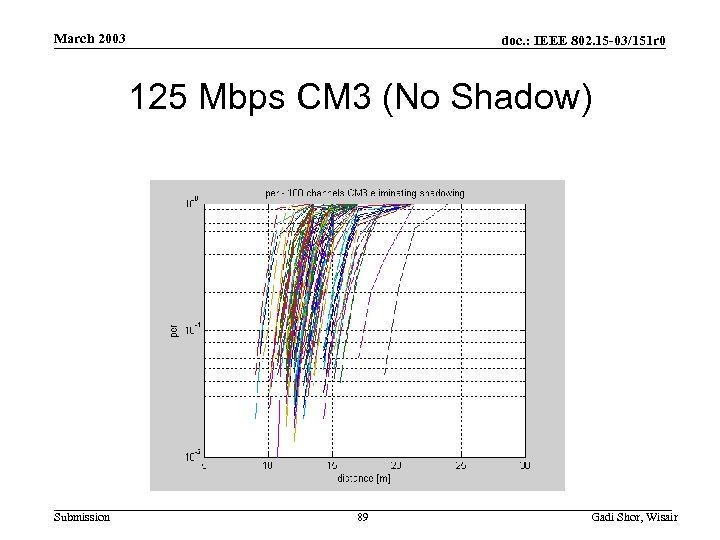 March 2003 doc. : IEEE 802. 15 -03/151 r 0 125 Mbps CM 3 (No Shadow) Submission 89 Gadi Shor, Wisair
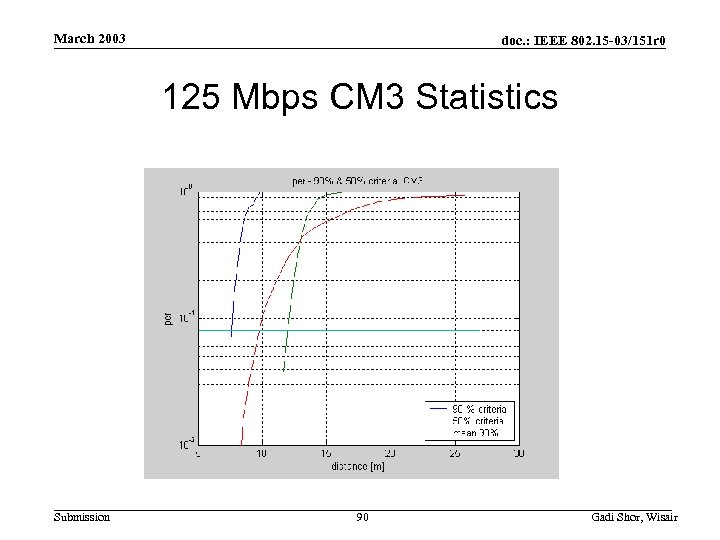 March 2003 doc. : IEEE 802. 15 -03/151 r 0 125 Mbps CM 3 Statistics Submission 90 Gadi Shor, Wisair
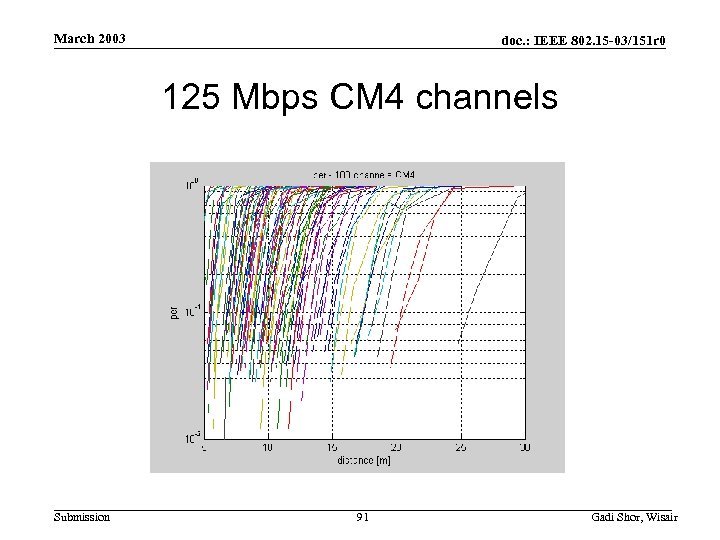 March 2003 doc. : IEEE 802. 15 -03/151 r 0 125 Mbps CM 4 channels Submission 91 Gadi Shor, Wisair
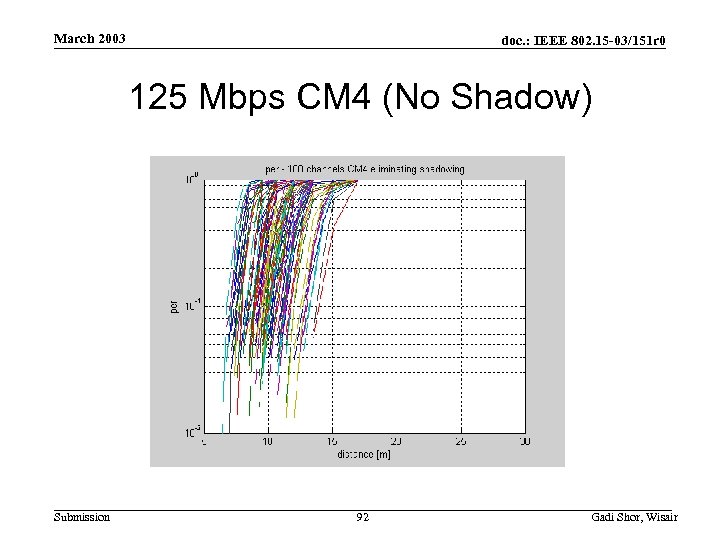 March 2003 doc. : IEEE 802. 15 -03/151 r 0 125 Mbps CM 4 (No Shadow) Submission 92 Gadi Shor, Wisair
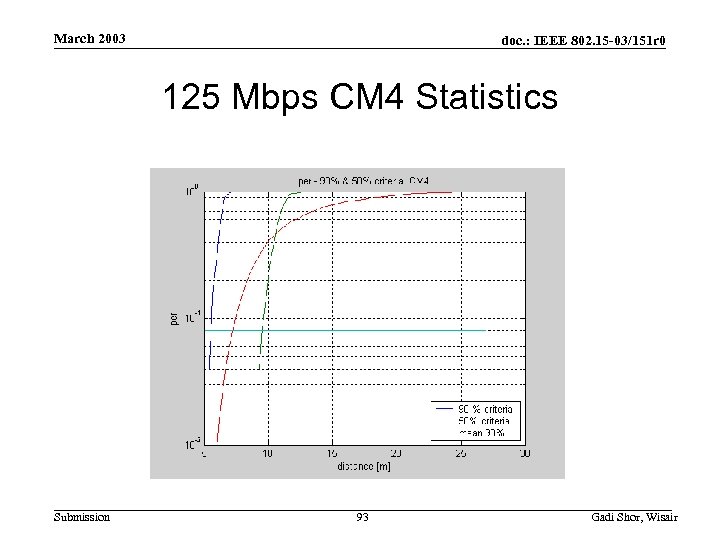 March 2003 doc. : IEEE 802. 15 -03/151 r 0 125 Mbps CM 4 Statistics Submission 93 Gadi Shor, Wisair