 Скачать презентацию MARC Machine Readable Cataloging MARC family Reference
632177d41d4bb77a49b459662748728d.ppt
- Количество слайдов: 30



MARC Machine Readable Cataloging & MARC family Reference: Rebecca Guenther (2004) New and traditional descriptive formats in the library environment
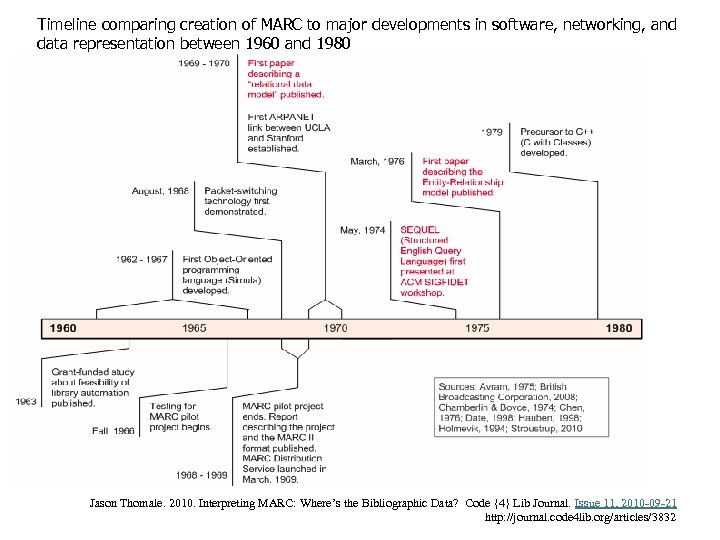
Timeline comparing creation of MARC to major developments in software, networking, and data representation between 1960 and 1980 Jason Thomale. 2010. Interpreting MARC: Where’s the Bibliographic Data? Code {4} Lib Journal. Issue 11, 2010 -09 -21 http: //journal. code 4 lib. org/articles/3832
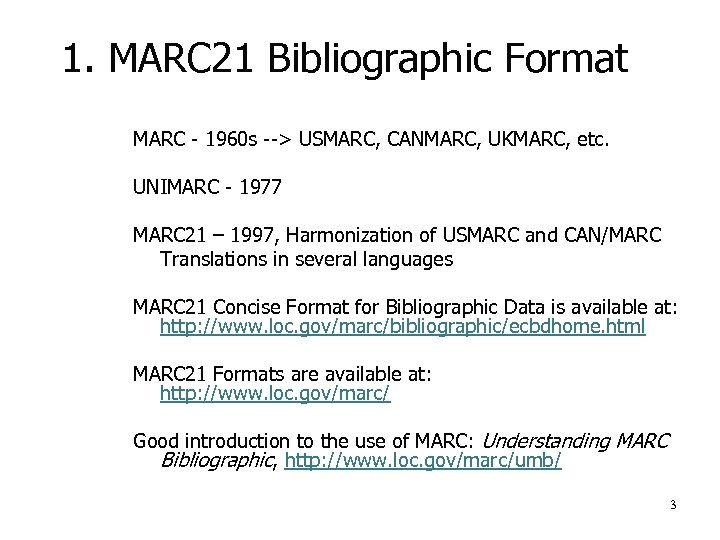
1. MARC 21 Bibliographic Format MARC - 1960 s --> USMARC, CANMARC, UKMARC, etc. UNIMARC - 1977 MARC 21 – 1997, Harmonization of USMARC and CAN/MARC Translations in several languages MARC 21 Concise Format for Bibliographic Data is available at: http: //www. loc. gov/marc/bibliographic/ecbdhome. html MARC 21 Formats are available at: http: //www. loc. gov/marc/ Good introduction to the use of MARC: Understanding MARC Bibliographic, http: //www. loc. gov/marc/umb/ 3
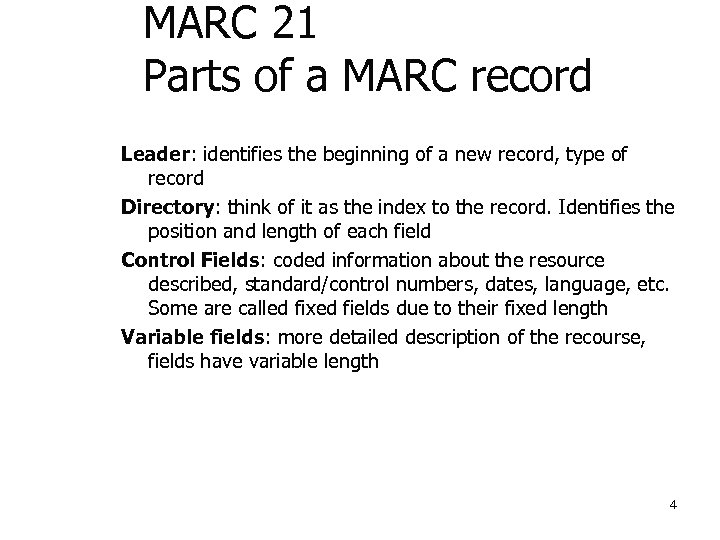
MARC 21 Parts of a MARC record Leader: identifies the beginning of a new record, type of record Directory: think of it as the index to the record. Identifies the position and length of each field Control Fields: coded information about the resource described, standard/control numbers, dates, language, etc. Some are called fixed fields due to their fixed length Variable fields: more detailed description of the recourse, fields have variable length 4
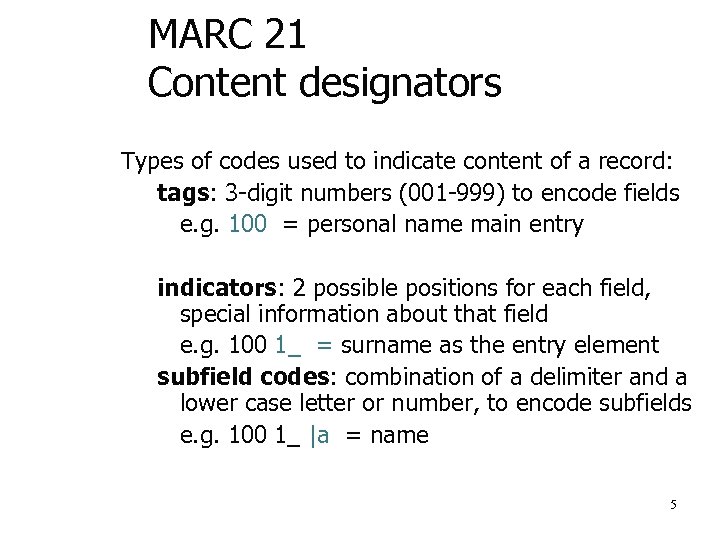
MARC 21 Content designators Types of codes used to indicate content of a record: tags: 3 -digit numbers (001 -999) to encode fields e. g. 100 = personal name main entry indicators: 2 possible positions for each field, special information about that field e. g. 100 1_ = surname as the entry element subfield codes: combination of a delimiter and a lower case letter or number, to encode subfields e. g. 100 1_ |a = name 5
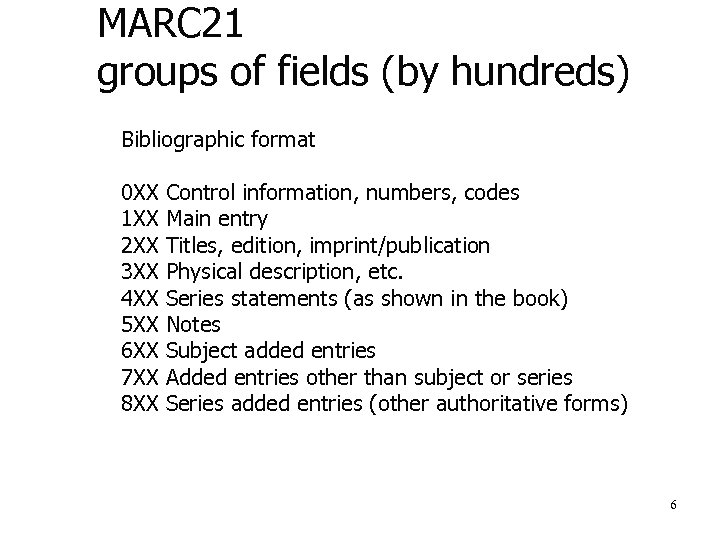
MARC 21 groups of fields (by hundreds) Bibliographic format 0 XX 1 XX 2 XX 3 XX 4 XX 5 XX 6 XX 7 XX 8 XX Control information, numbers, codes Main entry Titles, edition, imprint/publication Physical description, etc. Series statements (as shown in the book) Notes Subject added entries Added entries other than subject or series Series added entries (other authoritative forms) 6
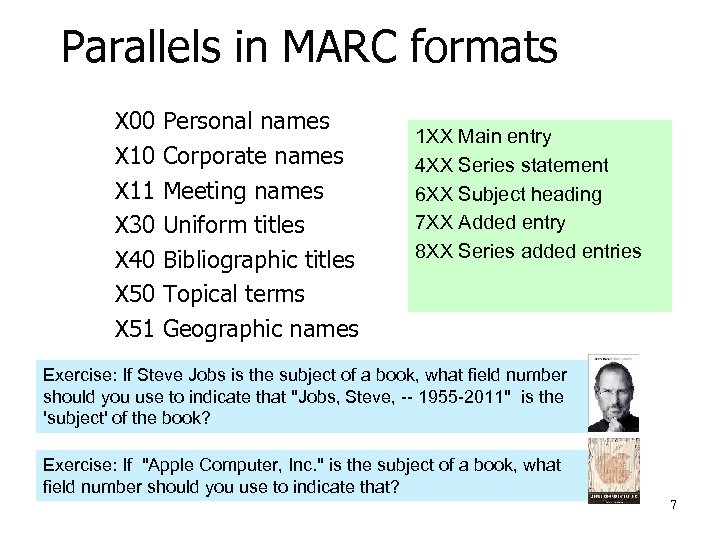
Parallels in MARC formats X 00 X 11 X 30 X 40 X 51 Personal names Corporate names Meeting names Uniform titles Bibliographic titles Topical terms Geographic names 1 XX Main entry 4 XX Series statement 6 XX Subject heading 7 XX Added entry 8 XX Series added entries Exercise: If Steve Jobs is the subject of a book, what field number should you use to indicate that "Jobs, Steve, -- 1955 -2011" is the 'subject' of the book? Exercise: If "Apple Computer, Inc. " is the subject of a book, what field number should you use to indicate that? 7
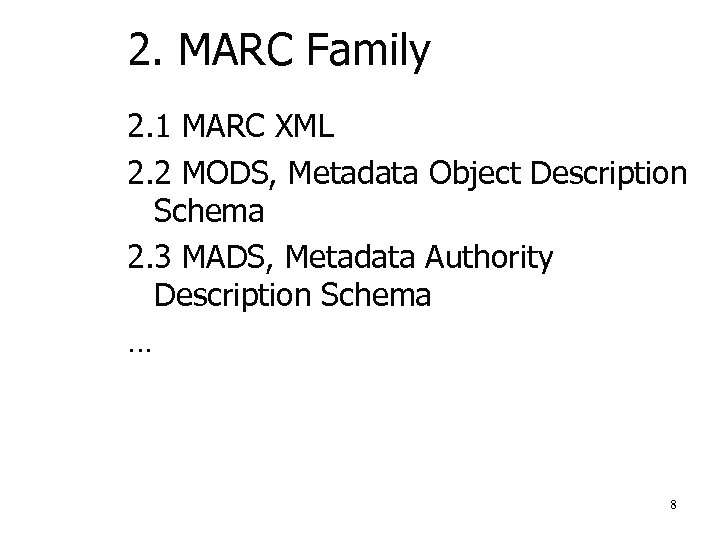
2. MARC Family 2. 1 MARC XML 2. 2 MODS, Metadata Object Description Schema 2. 3 MADS, Metadata Authority Description Schema … 8
New needs n n Need to take advantage of XML n Establish standard MARC 21 in an XML structure Need simpler (but compatible) alternatives n Development of MODS Need interoperability with different schemas n Assemble coordinated set of tools Need continuity with current data n Provide flexible transition options 9
10
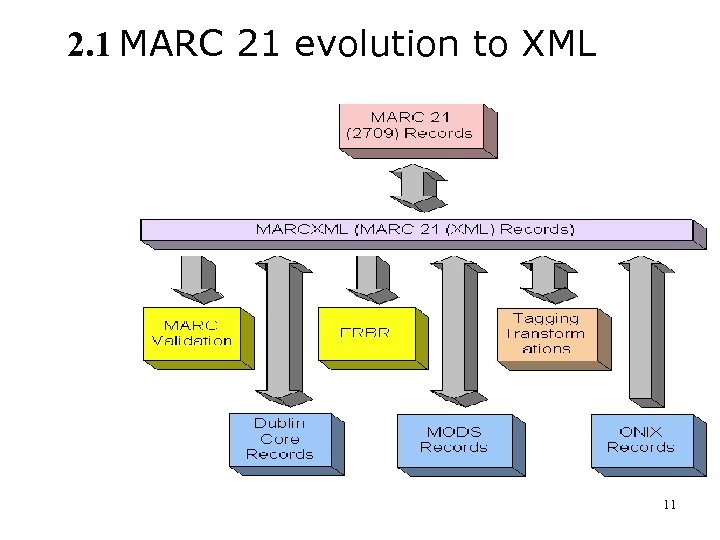
2. 1 MARC 21 evolution to XML 11
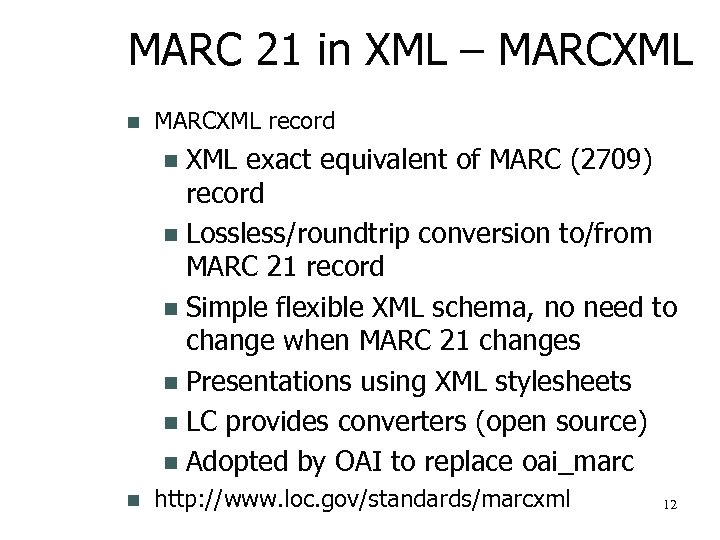
MARC 21 in XML – MARCXML n MARCXML record XML exact equivalent of MARC (2709) record n Lossless/roundtrip conversion to/from MARC 21 record n Simple flexible XML schema, no need to change when MARC 21 changes n Presentations using XML stylesheets n LC provides converters (open source) n Adopted by OAI to replace oai_marc n n http: //www. loc. gov/standards/marcxml 12
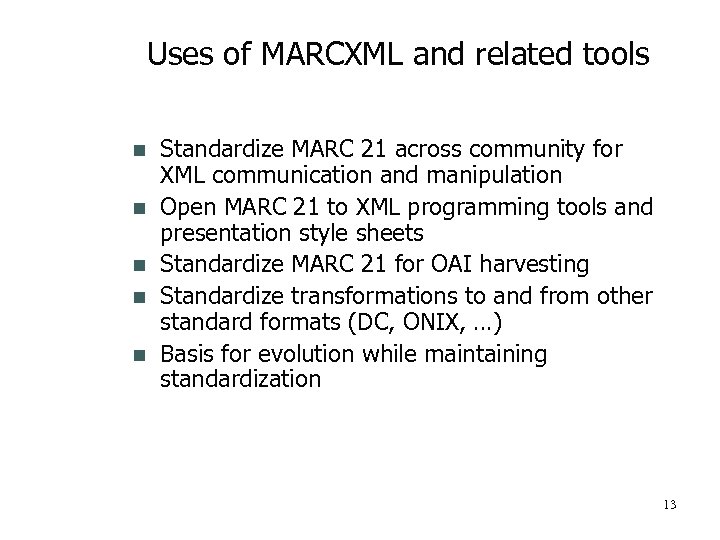
Uses of MARCXML and related tools n n n Standardize MARC 21 across community for XML communication and manipulation Open MARC 21 to XML programming tools and presentation style sheets Standardize MARC 21 for OAI harvesting Standardize transformations to and from other standard formats (DC, ONIX, …) Basis for evolution while maintaining standardization 13
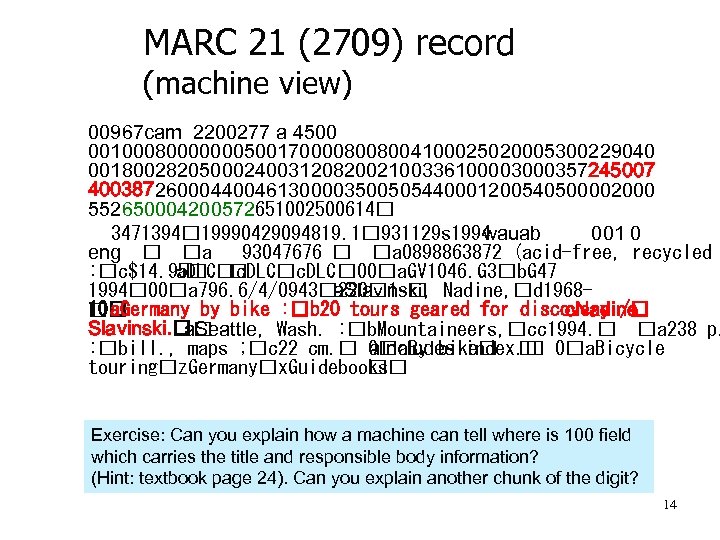
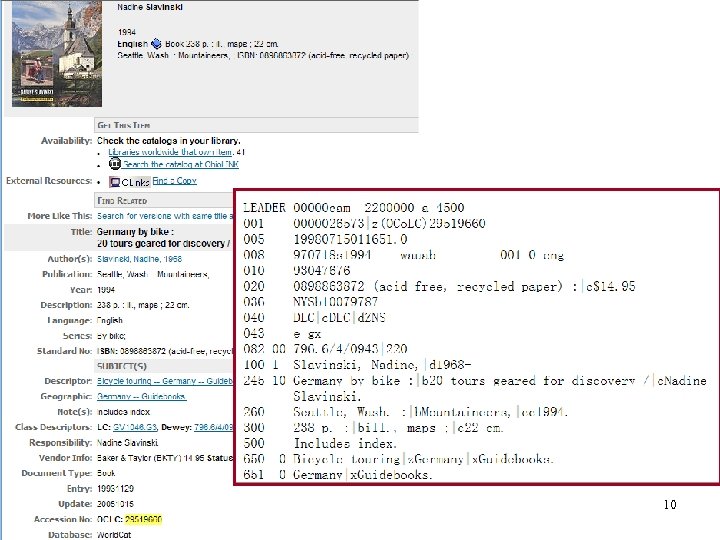
MARC 21 (2709) record (machine view) 00967 cam 2200277 a 4500 001000800000005001700008008004100025020005300229040 00180028205000240031208200210033610000357245007 400387260004400461300003500505440001200540500002000 552650004200572651002500614 3471394 19990429094819. 1 931129 s 1994 wauab 001 0 eng a 93047676 a 0898863872 (acid-free, recycled : c$14. 95 a. DLC c. DLC 00 a. GV 1046. G 3 b. G 47 1994 00 a 796. 6/4/0943 220 1 Nadine, d 1968 a. Slavinski, 10 a. Germany by bike : b 20 tours geared for discovery / c. Nadine Slavinski. a. Seattle, Wash. : b. Mountaineers, cc 1994. a 238 p. : bill. , maps ; c 22 cm. 0 a. By bike 0 a. Bicycle a. Includes index. touring z. Germany x. Guidebooks. Exercise: Can you explain how a machine can tell where is 100 field which carries the title and responsible body information? (Hint: textbook page 24). Can you explain another chunk of the digit? 14
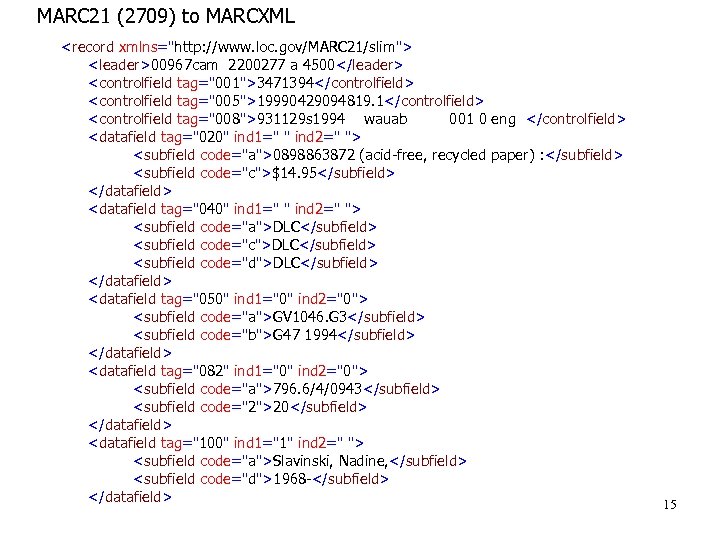
MARC 21 (2709) to MARCXML <record xmlns="http: //www. loc. gov/MARC 21/slim"> <leader>00967 cam 2200277 a 4500</leader> <controlfield tag="001">3471394</controlfield> <controlfield tag="005">19990429094819. 1</controlfield> <controlfield tag="008">931129 s 1994 wauab 001 0 eng </controlfield> <datafield tag="020" ind 1=" " ind 2=" "> <subfield code="a">0898863872 (acid-free, recycled paper) : </subfield> <subfield code="c">$14. 95</subfield> </datafield> <datafield tag="040" ind 1=" " ind 2=" "> <subfield code="a">DLC</subfield> <subfield code="c">DLC</subfield> <subfield code="d">DLC</subfield> </datafield> <datafield tag="050" ind 1="0" ind 2="0"> <subfield code="a">GV 1046. G 3</subfield> <subfield code="b">G 47 1994</subfield> </datafield> <datafield tag="082" ind 1="0" ind 2="0"> <subfield code="a">796. 6/4/0943</subfield> <subfield code="2">20</subfield> </datafield> <datafield tag="100" ind 1="1" ind 2=" "> <subfield code="a">Slavinski, Nadine, </subfield> <subfield code="d">1968 -</subfield> </datafield> 15
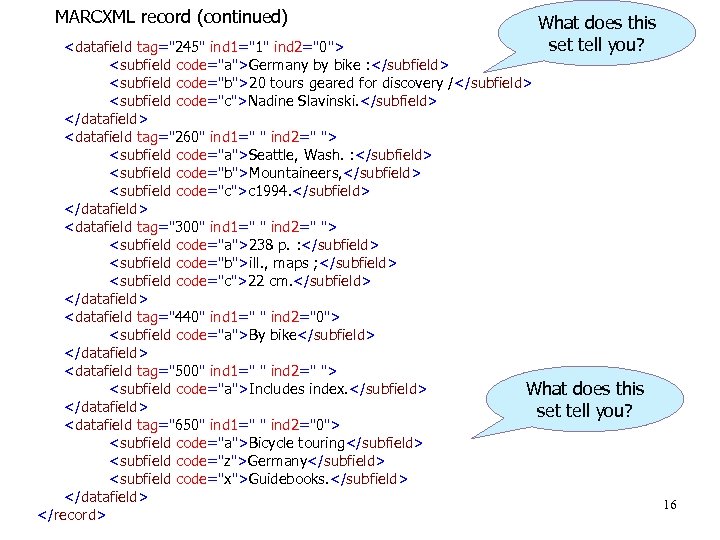
MARCXML record (continued) What does this set tell you? <datafield tag="245" ind 1="1" ind 2="0"> <subfield code="a">Germany by bike : </subfield> <subfield code="b">20 tours geared for discovery /</subfield> <subfield code="c">Nadine Slavinski. </subfield> </datafield> <datafield tag="260" ind 1=" " ind 2=" "> <subfield code="a">Seattle, Wash. : </subfield> <subfield code="b">Mountaineers, </subfield> <subfield code="c">c 1994. </subfield> </datafield> <datafield tag="300" ind 1=" " ind 2=" "> <subfield code="a">238 p. : </subfield> <subfield code="b">ill. , maps ; </subfield> <subfield code="c">22 cm. </subfield> </datafield> <datafield tag="440" ind 1=" " ind 2="0"> <subfield code="a">By bike</subfield> </datafield> <datafield tag="500" ind 1=" " ind 2=" "> <subfield code="a">Includes index. </subfield> What does this </datafield> set tell you? <datafield tag="650" ind 1=" " ind 2="0"> <subfield code="a">Bicycle touring</subfield> <subfield code="z">Germany</subfield> <subfield code="x">Guidebooks. </subfield> </datafield> </record> 16
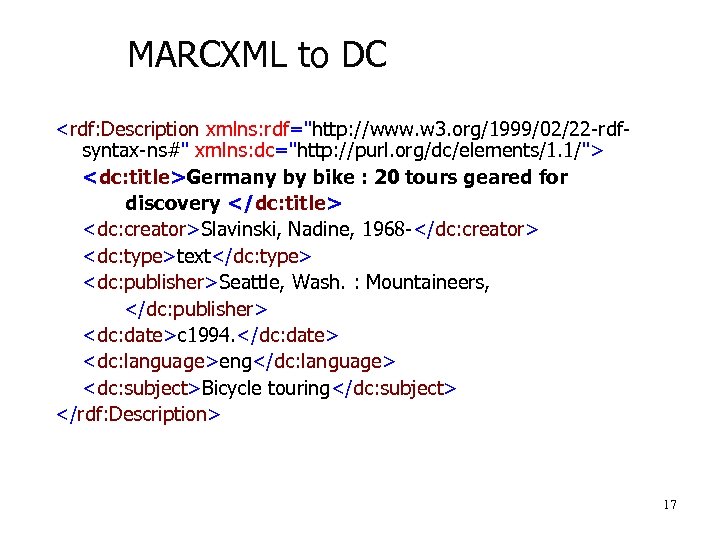
MARCXML to DC <rdf: Description xmlns: rdf="http: //www. w 3. org/1999/02/22 -rdfsyntax-ns#" xmlns: dc="http: //purl. org/dc/elements/1. 1/"> <dc: title>Germany by bike : 20 tours geared for discovery </dc: title> <dc: creator>Slavinski, Nadine, 1968 -</dc: creator> <dc: type>text</dc: type> <dc: publisher>Seattle, Wash. : Mountaineers, </dc: publisher> <dc: date>c 1994. </dc: date> <dc: language>eng</dc: language> <dc: subject>Bicycle touring</dc: subject> </rdf: Description> 17
2. 2 MODS Metadata Object Description Schema n n n Bibliographic element set Initiative of the Network Development and MARC Standards Office, Library of Congress Uses XML Schema Specifically for library applications, although could be used more widely A derivative (and subset) of MARC elements 18
Why MODS? n n n XML based, web friendly, transportable, processible, configurable, sufficiently descriptive without being too complex, extensible Benefits over MARC: MARC isn’t XML based and can’t easily be output from web forms. Requires special “cataloging” knowledge and systems to implement Investigating XML as a new more flexible syntax for MARC element set 19
Why MODS? (cont. ) n n n Need for rich hierarchical descriptive metadata in XML but simpler than full MARC, especially for complex digital library objects Benefits over Dublin Core: DC doesn’t have sufficient specificity. DC doesn’t specify a syntax and is inconsistently applied. DC isn’t extensible Need compatibility with existing library descriptions 20
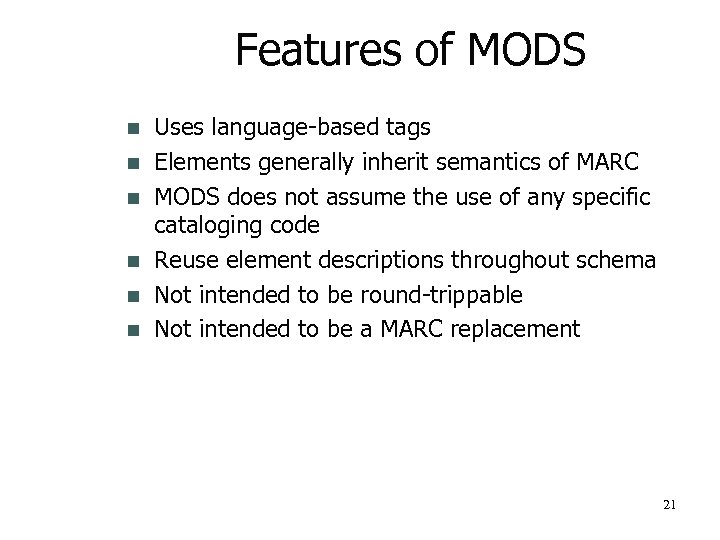
Features of MODS n n n Uses language-based tags Elements generally inherit semantics of MARC MODS does not assume the use of any specific cataloging code Reuse element descriptions throughout schema Not intended to be round-trippable Not intended to be a MARC replacement 21
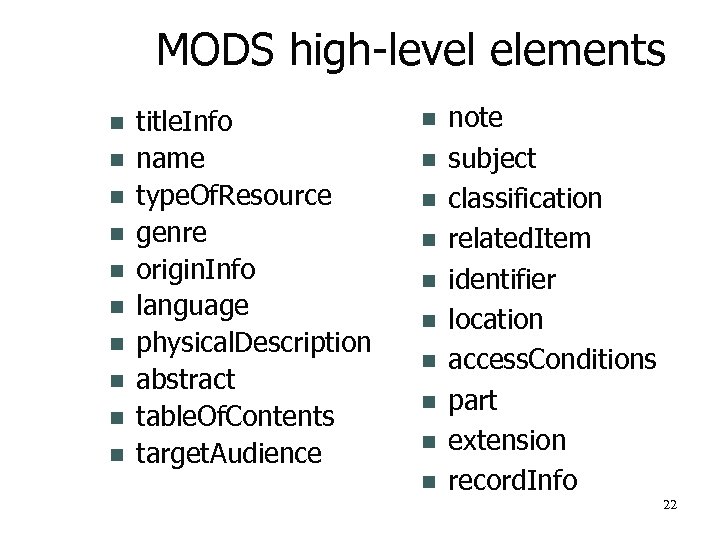
MODS high-level elements n n n n n title. Info name type. Of. Resource genre origin. Info language physical. Description abstract table. Of. Contents target. Audience n n note subject classification related. Item identifier location access. Conditions part extension record. Info 22
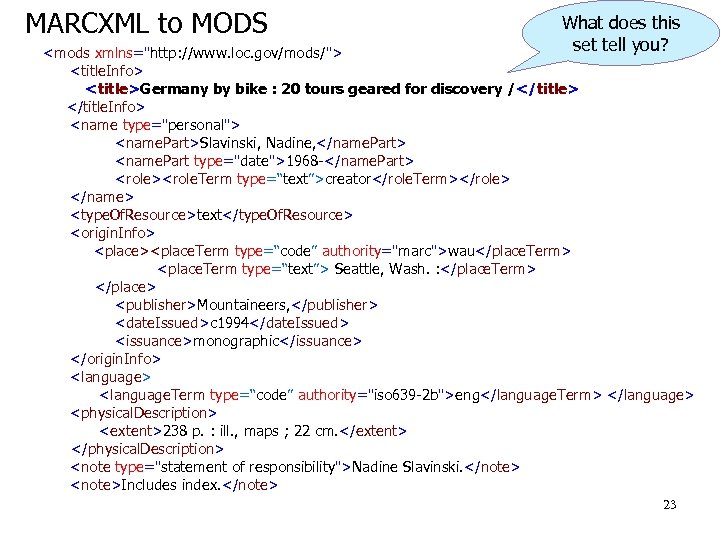
MARCXML to MODS What does this set tell you? <mods xmlns="http: //www. loc. gov/mods/"> <title. Info> <title>Germany by bike : 20 tours geared for discovery /</title> </title. Info> <name type="personal"> <name. Part>Slavinski, Nadine, </name. Part> <name. Part type="date">1968 -</name. Part> <role><role. Term type=“text”>creator</role. Term></role> </name> <type. Of. Resource>text</type. Of. Resource> <origin. Info> <place><place. Term type=“code” authority="marc">wau</place. Term> <place. Term type=“text”> Seattle, Wash. : </place. Term> </place> <publisher>Mountaineers, </publisher> <date. Issued>c 1994</date. Issued> <issuance>monographic</issuance> </origin. Info> <language. Term type=“code” authority="iso 639 -2 b">eng</language. Term> </language> <physical. Description> <extent>238 p. : ill. , maps ; 22 cm. </extent> </physical. Description> <note type="statement of responsibility">Nadine Slavinski. </note> <note>Includes index. </note> 23
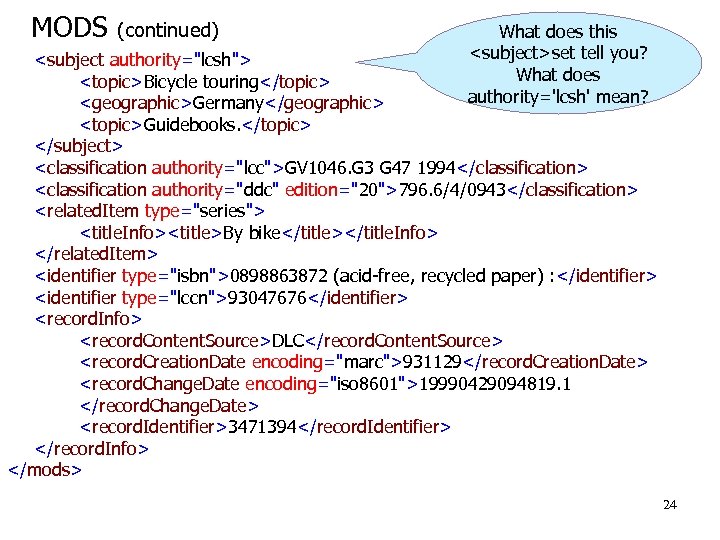
MODS (continued) What does this <subject>set tell you? What does authority='lcsh' mean? <subject authority="lcsh"> <topic>Bicycle touring</topic> <geographic>Germany</geographic> <topic>Guidebooks. </topic> </subject> <classification authority="lcc">GV 1046. G 3 G 47 1994</classification> <classification authority="ddc" edition="20">796. 6/4/0943</classification> <related. Item type="series"> <title. Info><title>By bike</title></title. Info> </related. Item> <identifier type="isbn">0898863872 (acid-free, recycled paper) : </identifier> <identifier type="lccn">93047676</identifier> <record. Info> <record. Content. Source>DLC</record. Content. Source> <record. Creation. Date encoding="marc">931129</record. Creation. Date> <record. Change. Date encoding="iso 8601">19990429094819. 1 </record. Change. Date> <record. Identifier>3471394</record. Identifier> </record. Info> </mods> 24
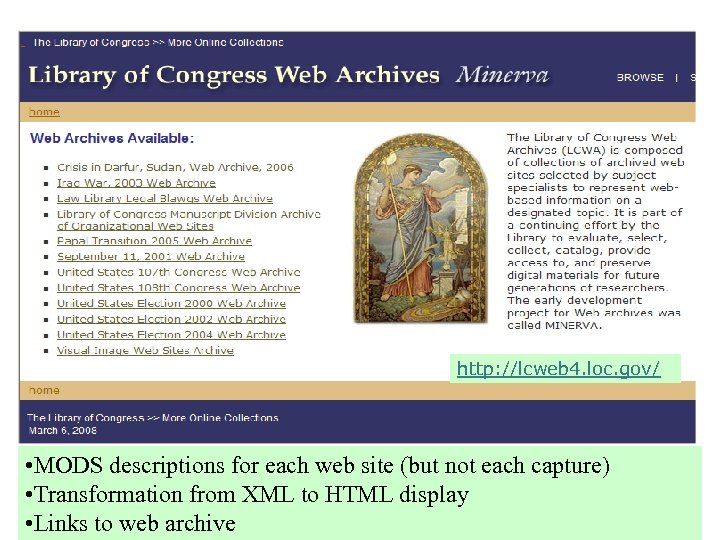
http: //lcweb 4. loc. gov/ • MODS descriptions for each web site (but not each capture) • Transformation from XML to HTML display • Links to web archive 25
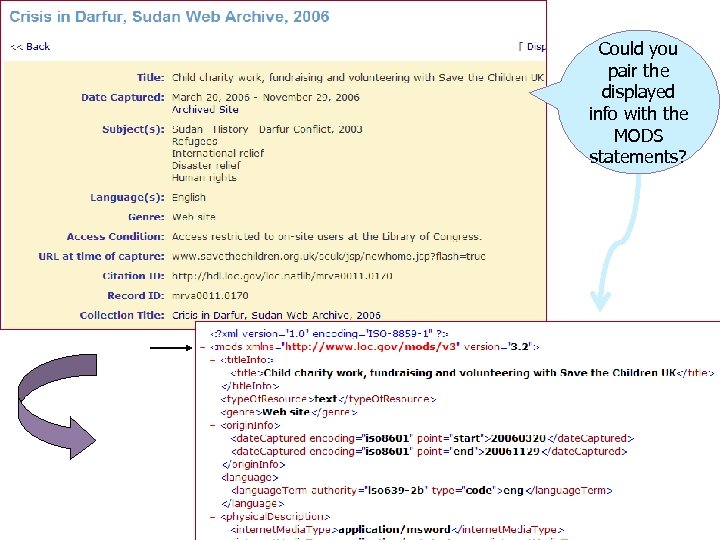
Could you pair the displayed info with the MODS statements? 26
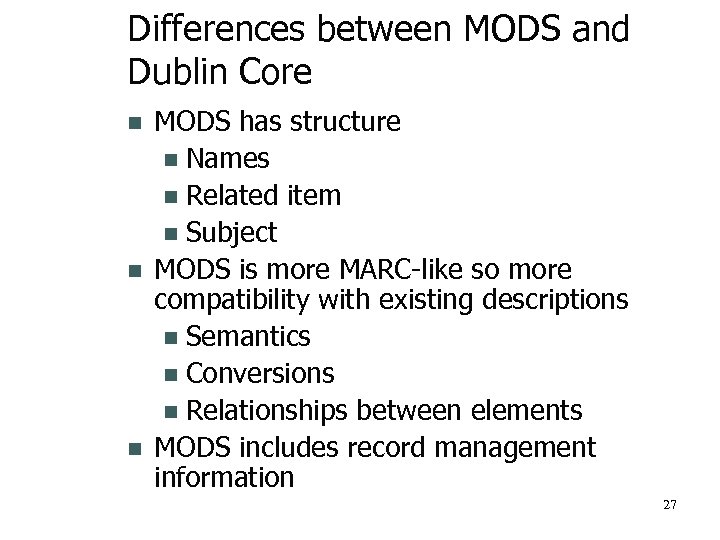
Differences between MODS and Dublin Core n n n MODS has structure n Names n Related item n Subject MODS is more MARC-like so more compatibility with existing descriptions n Semantics n Conversions n Relationships between elements MODS includes record management information 27
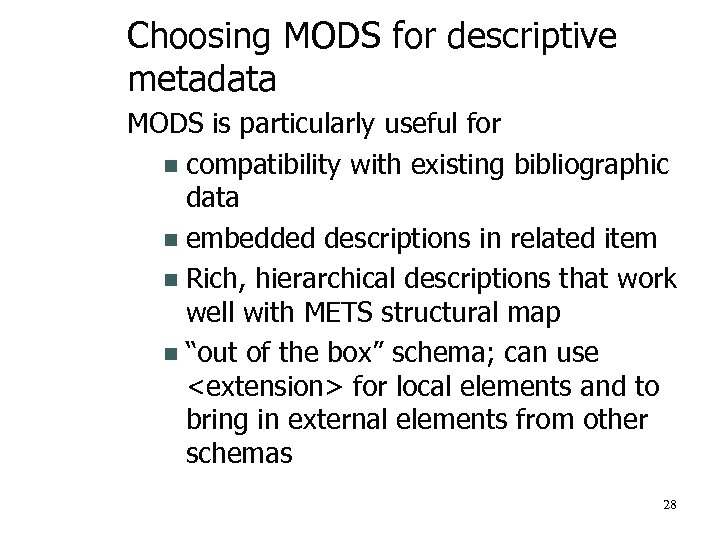
Choosing MODS for descriptive metadata MODS is particularly useful for n compatibility with existing bibliographic data n embedded descriptions in related item n Rich, hierarchical descriptions that work well with METS structural map n “out of the box” schema; can use <extension> for local elements and to bring in external elements from other schemas 28
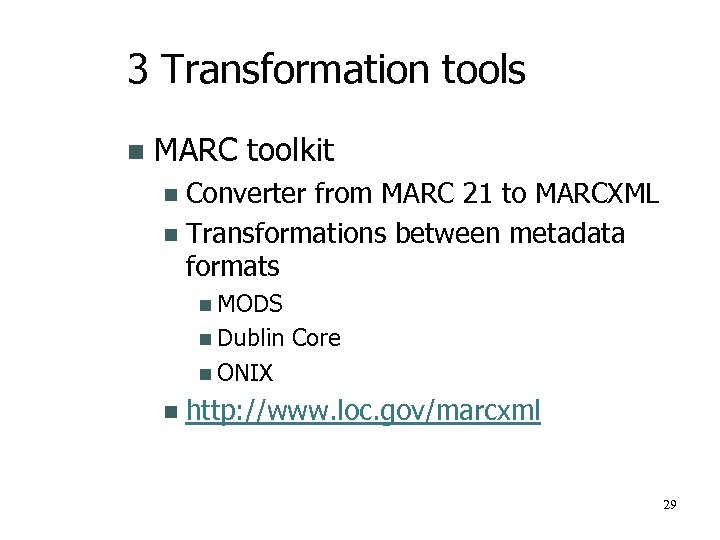
3 Transformation tools n MARC toolkit Converter from MARC 21 to MARCXML n Transformations between metadata formats n n MODS n Dublin Core n ONIX n http: //www. loc. gov/marcxml 29
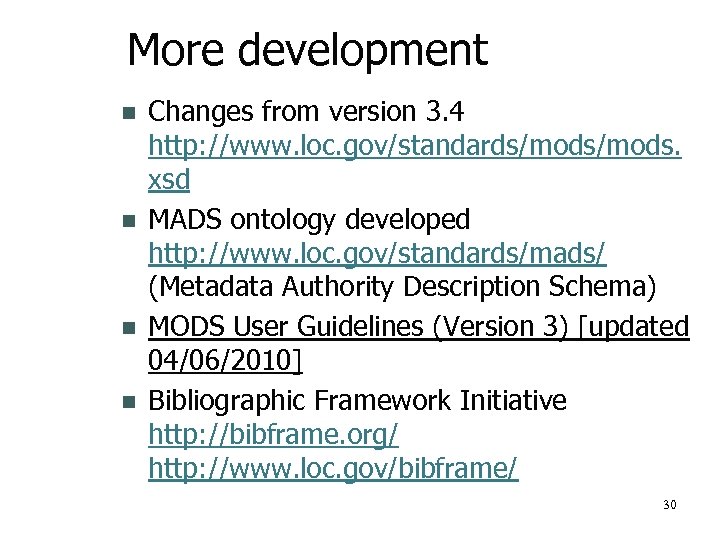
More development n n Changes from version 3. 4 http: //www. loc. gov/standards/mods. xsd MADS ontology developed http: //www. loc. gov/standards/mads/ (Metadata Authority Description Schema) MODS User Guidelines (Version 3) [updated 04/06/2010] Bibliographic Framework Initiative http: //bibframe. org/ http: //www. loc. gov/bibframe/ 30
Скачать презентацию MARC Machine Readable Cataloging MARC family Reference
632177d41d4bb77a49b459662748728d.ppt