 Скачать презентацию MAPS based vertex detector at STAR Vertex 2010
a0599de115065c371ea26dd0af8996bd.ppt
- Количество слайдов: 32



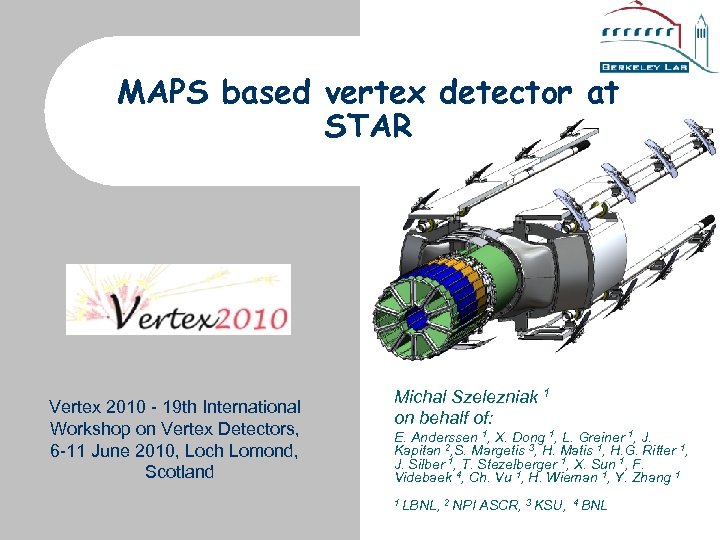
MAPS based vertex detector at STAR Vertex 2010 - 19 th International Workshop on Vertex Detectors, 6 -11 June 2010, Loch Lomond, Scotland Michal Szelezniak 1 on behalf of: E. Anderssen 1, X. Dong 1, L. Greiner 1, J. Kapitan 2, S. Margetis 3, H. Matis 1, H. G. Ritter 1, J. Silber 1, T. Stezelberger 1, X. Sun 1, F. Videbaek 4, Ch. Vu 1, H. Wieman 1, Y. Zhang 1 1 LBNL, 2 NPI ASCR, 3 KSU, 4 BNL
Michal Szelezniak Vertex 2010, 6 -11 June 2010, Loch Lomond, Scotland Outline l STAR HFT Upgrade l PIXEL (PXL) Requirements l PIXEL Geometry l PIXEL Development Path – – Summary and Outlook l 2 Sensors RDO electronics Mechanical support – cooling tests Readout cable development 2
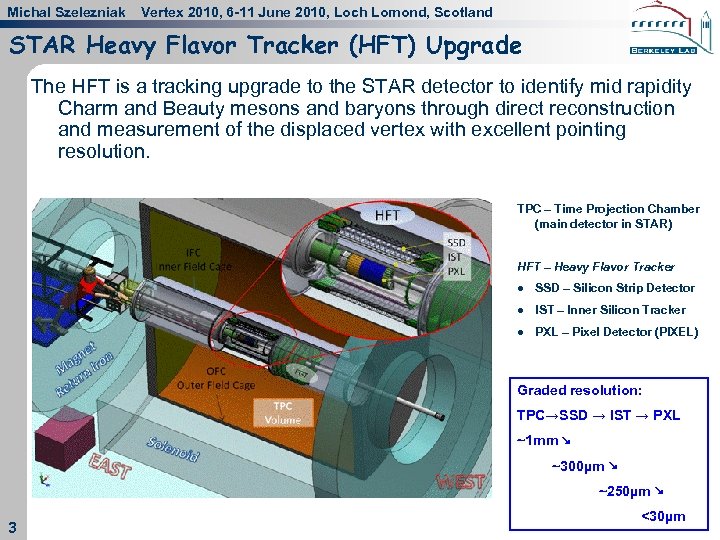
Michal Szelezniak Vertex 2010, 6 -11 June 2010, Loch Lomond, Scotland STAR Heavy Flavor Tracker (HFT) Upgrade The HFT is a tracking upgrade to the STAR detector to identify mid rapidity Charm and Beauty mesons and baryons through direct reconstruction and measurement of the displaced vertex with excellent pointing resolution. TPC – Time Projection Chamber (main detector in STAR) HFT – Heavy Flavor Tracker l SSD – Silicon Strip Detector l IST – Inner Silicon Tracker l PXL – Pixel Detector (PIXEL) Graded resolution: TPC→SSD → IST → PXL ~1 mm ↘ ~300µm ↘ ~250µm ↘ 3 3 <30µm
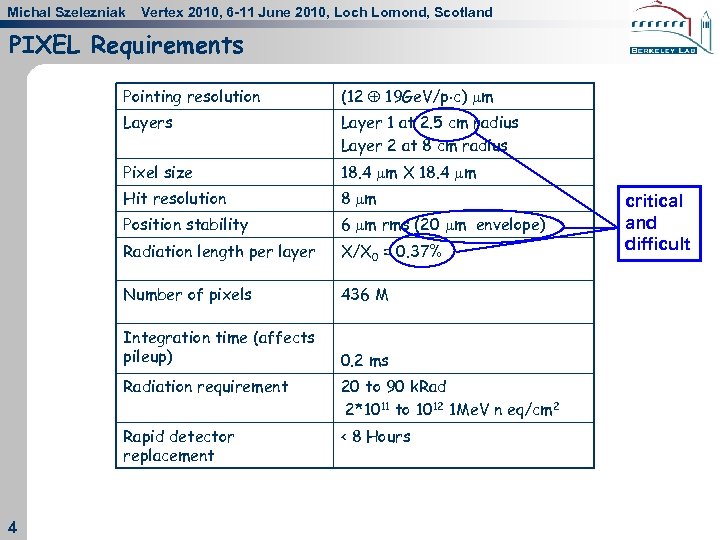
Michal Szelezniak Vertex 2010, 6 -11 June 2010, Loch Lomond, Scotland PIXEL Requirements Pointing resolution (12 19 Ge. V/p c) m Layers Layer 1 at 2. 5 cm radius Layer 2 at 8 cm radius Pixel size 18. 4 m X 18. 4 m Hit resolution 8 m Position stability 6 m rms (20 m envelope) Radiation length per layer X/X 0 = 0. 37% Number of pixels 436 M Integration time (affects pileup) 0. 2 ms Radiation requirement Rapid detector replacement 4 4 20 to 90 k. Rad 2*1011 to 1012 1 Me. V n eq/cm 2 < 8 Hours critical and difficult
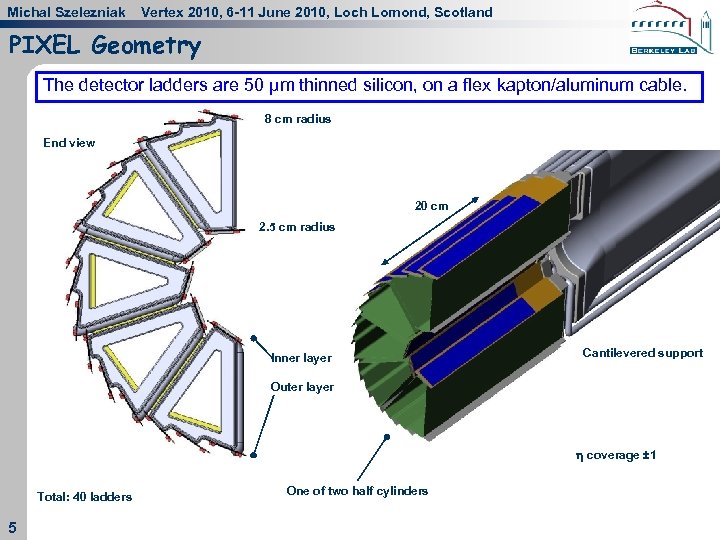
Michal Szelezniak Vertex 2010, 6 -11 June 2010, Loch Lomond, Scotland PIXEL Geometry The detector ladders are 50 µm thinned silicon, on a flex kapton/aluminum cable. 8 cm radius End view 20 cm 2. 5 cm radius Inner layer Cantilevered support Outer layer coverage ± 1 Total: 40 ladders 5 5 One of two half cylinders
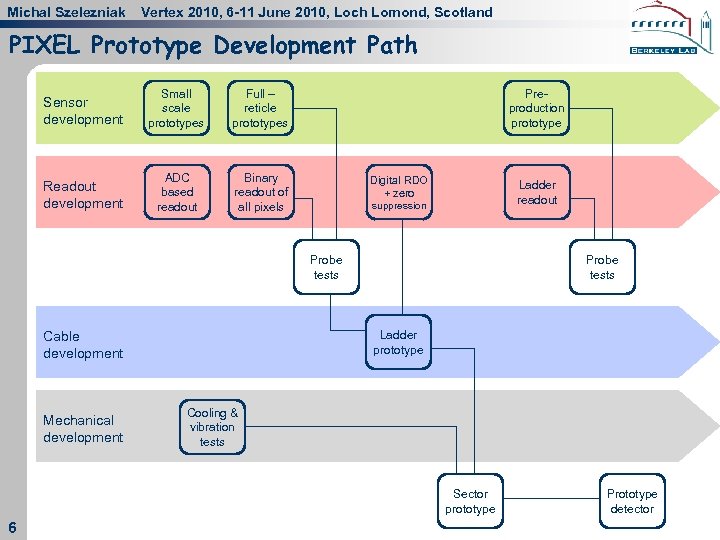
Michal Szelezniak Vertex 2010, 6 -11 June 2010, Loch Lomond, Scotland PIXEL Prototype Development Path Sensor development Small scale prototypes Full – reticle prototypes Readout development ADC based readout Preproduction prototype Binary readout of all pixels Digital RDO + zero Ladder readout suppression Probe tests Ladder prototype Cable development Mechanical development Probe tests Cooling & vibration tests Sector prototype 6 6 Prototype detector
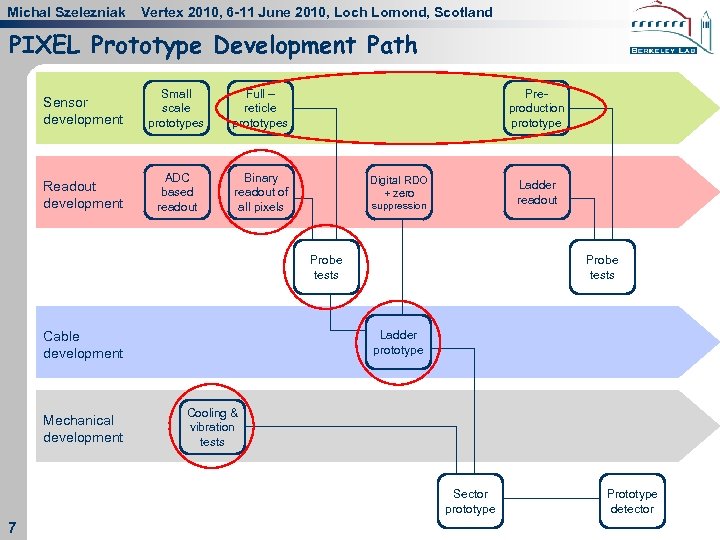
Michal Szelezniak Vertex 2010, 6 -11 June 2010, Loch Lomond, Scotland PIXEL Prototype Development Path Sensor development Small scale prototypes Full – reticle prototypes Readout development ADC based readout Preproduction prototype Binary readout of all pixels Digital RDO + zero Ladder readout suppression Probe tests Ladder prototype Cable development Mechanical development Probe tests Cooling & vibration tests Sector prototype 7 7 Prototype detector
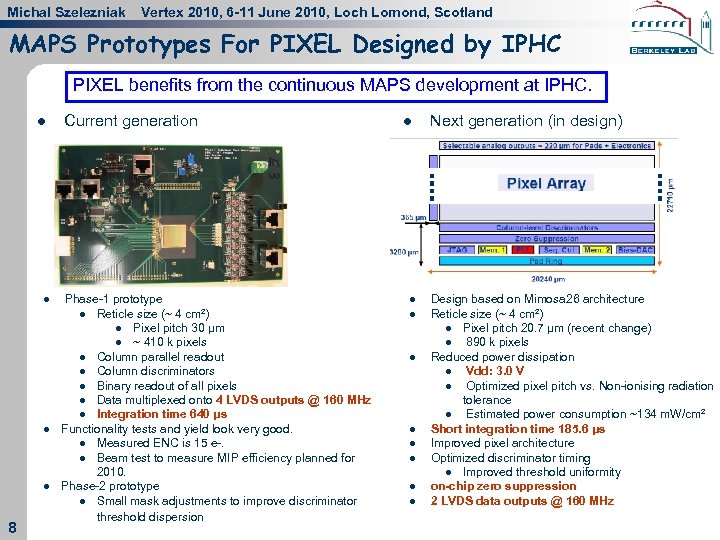
Michal Szelezniak Vertex 2010, 6 -11 June 2010, Loch Lomond, Scotland MAPS Prototypes For PIXEL Designed by IPHC PIXEL benefits from the continuous MAPS development at IPHC. l l 8 Current generation Phase-1 prototype l Reticle size (~ 4 cm²) l Pixel pitch 30 μm l ~ 410 k pixels l Column parallel readout l Column discriminators l Binary readout of all pixels l Data multiplexed onto 4 LVDS outputs @ 160 MHz l Integration time 640 μs Functionality tests and yield look very good. l Measured ENC is 15 e-. l Beam test to measure MIP efficiency planned for 2010. Phase-2 prototype l Small mask adjustments to improve discriminator threshold dispersion 8 l l l l l Next generation (in design) Design based on Mimosa 26 architecture Reticle size (~ 4 cm²) l Pixel pitch 20. 7 μm (recent change) l 890 k pixels Reduced power dissipation l Vdd: 3. 0 V l Optimized pixel pitch vs. Non-ionising radiation tolerance l Estimated power consumption ~134 m. W/cm² Short integration time 185. 6 μs Improved pixel architecture Optimized discriminator timing l Improved threshold uniformity on-chip zero suppression 2 LVDS data outputs @ 160 MHz
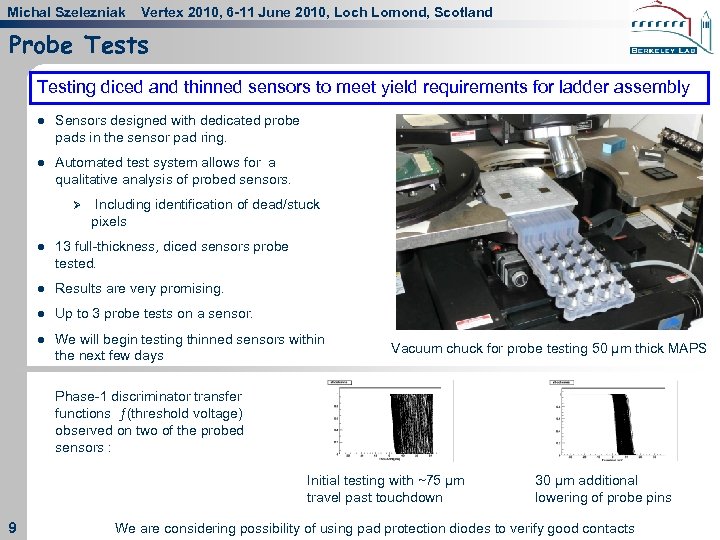
Michal Szelezniak Vertex 2010, 6 -11 June 2010, Loch Lomond, Scotland Probe Tests Testing diced and thinned sensors to meet yield requirements for ladder assembly l Sensors designed with dedicated probe pads in the sensor pad ring. l Automated test system allows for a qualitative analysis of probed sensors. Ø Including identification of dead/stuck pixels l 13 full-thickness, diced sensors probe tested. l Results are very promising. l Up to 3 probe tests on a sensor. l We will begin testing thinned sensors within the next few days Vacuum chuck for probe testing 50 μm thick MAPS Phase-1 discriminator transfer functions ƒ(threshold voltage) observed on two of the probed sensors : Initial testing with ~75 μm travel past touchdown 9 9 30 μm additional lowering of probe pins We are considering possibility of using pad protection diodes to verify good contacts
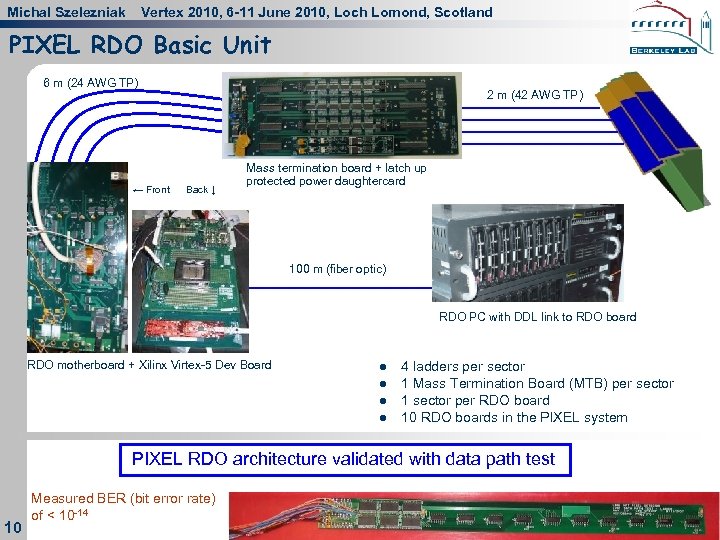
Michal Szelezniak Vertex 2010, 6 -11 June 2010, Loch Lomond, Scotland PIXEL RDO Basic Unit 6 m (24 AWG TP) ← Front 2 m (42 AWG TP) Back ↓ Mass termination board + latch up protected power daughtercard 100 m (fiber optic) RDO PC with DDL link to RDO board RDO motherboard + Xilinx Virtex-5 Dev Board l l 4 ladders per sector 1 Mass Termination Board (MTB) per sector 1 sector per RDO board 10 RDO boards in the PIXEL system PIXEL RDO architecture validated with data path test 10 Measured BER (bit error rate) of < 10 -14 10
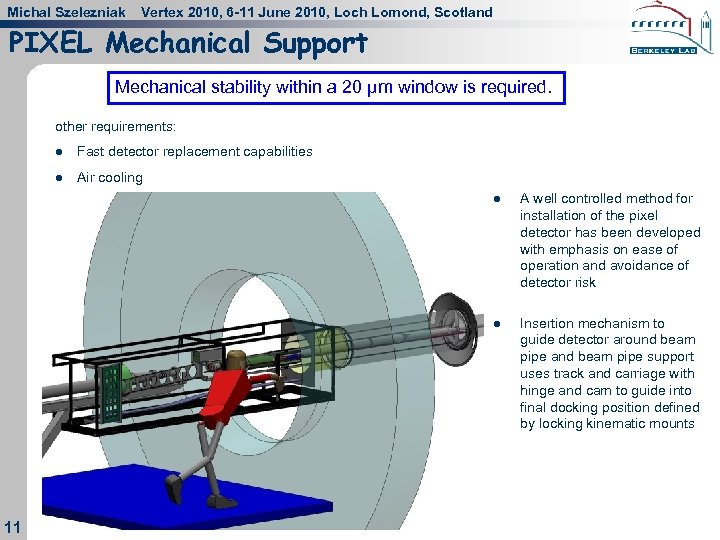
Michal Szelezniak Vertex 2010, 6 -11 June 2010, Loch Lomond, Scotland PIXEL Mechanical Support Mechanical stability within a 20 μm window is required. other requirements: l Fast detector replacement capabilities l Air cooling l l 11 11 A well controlled method for installation of the pixel detector has been developed with emphasis on ease of operation and avoidance of detector risk Insertion mechanism to guide detector around beam pipe and beam pipe support uses track and carriage with hinge and cam to guide into final docking position defined by locking kinematic mounts
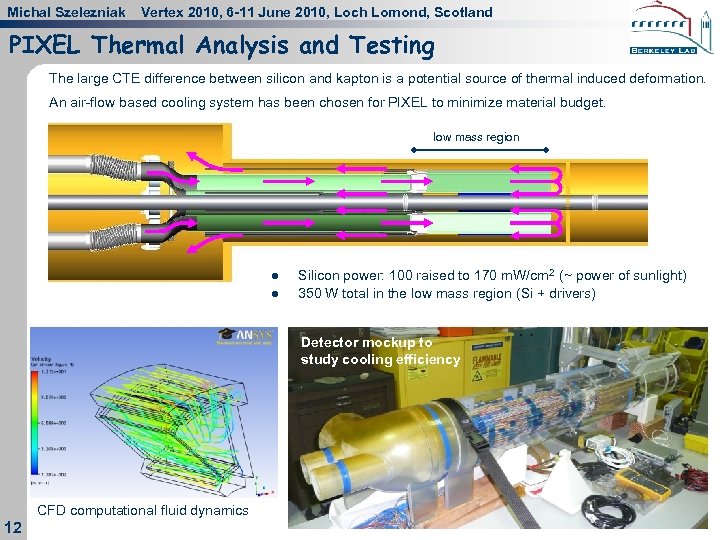
Michal Szelezniak Vertex 2010, 6 -11 June 2010, Loch Lomond, Scotland PIXEL Thermal Analysis and Testing The large CTE difference between silicon and kapton is a potential source of thermal induced deformation. An air-flow based cooling system has been chosen for PIXEL to minimize material budget. low mass region l l Silicon power: 100 raised to 170 m. W/cm 2 (~ power of sunlight) 350 W total in the low mass region (Si + drivers) Detector mockup to study cooling efficiency CFD computational fluid dynamics 12 12
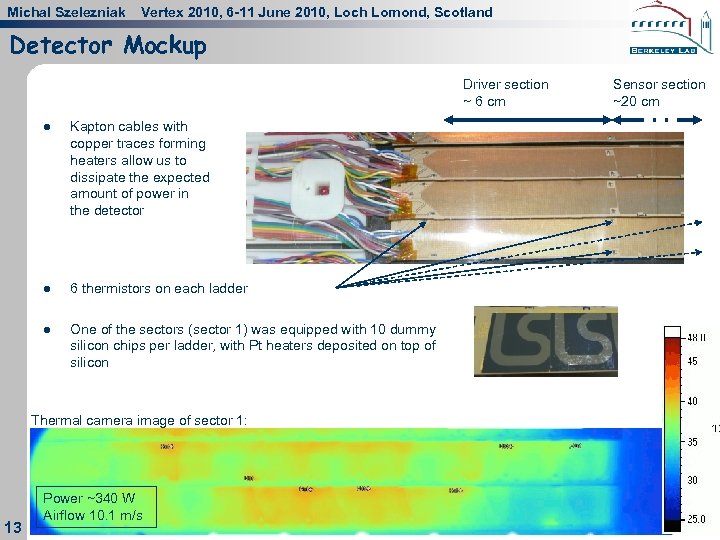
Michal Szelezniak Vertex 2010, 6 -11 June 2010, Loch Lomond, Scotland Detector Mockup Driver section ~ 6 cm l Kapton cables with copper traces forming heaters allow us to dissipate the expected amount of power in the detector l 6 thermistors on each ladder l One of the sectors (sector 1) was equipped with 10 dummy silicon chips per ladder, with Pt heaters deposited on top of silicon Thermal camera image of sector 1: 13 Power ~340 W Airflow 10. 1 m/s 13 Sensor section ~20 cm
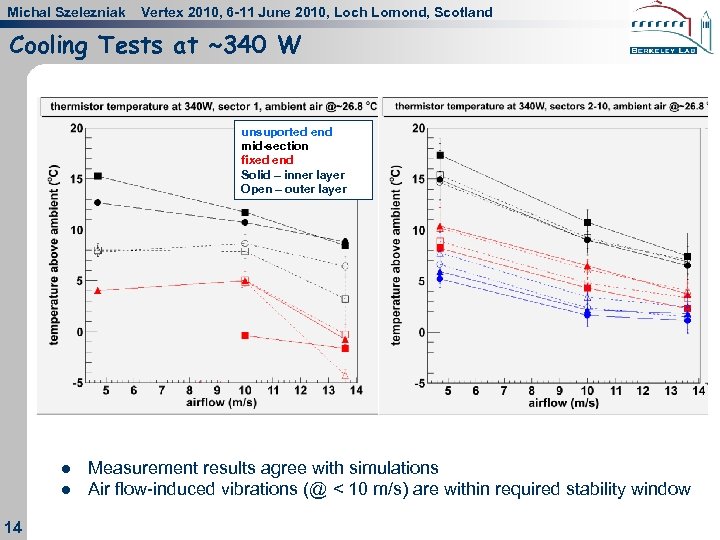
Michal Szelezniak Vertex 2010, 6 -11 June 2010, Loch Lomond, Scotland Cooling Tests at ~340 W unsuported end mid-section fixed end Solid – inner layer Open – outer layer l l 14 14 Measurement results agree with simulations Air flow-induced vibrations (@ < 10 m/s) are within required stability window
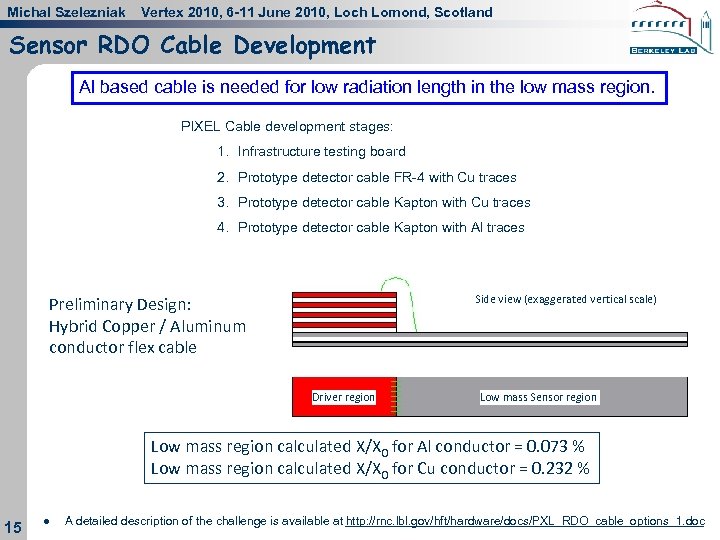
Michal Szelezniak Vertex 2010, 6 -11 June 2010, Loch Lomond, Scotland Sensor RDO Cable Development Al based cable is needed for low radiation length in the low mass region. PIXEL Cable development stages: 1. Infrastructure testing board 2. Prototype detector cable FR-4 with Cu traces 3. Prototype detector cable Kapton with Cu traces 4. Prototype detector cable Kapton with Al traces Side view (exaggerated vertical scale) Preliminary Design: Hybrid Copper / Aluminum conductor flex cable Driver region Low mass Sensor region Low mass region calculated X/X 0 for Al conductor = 0. 073 % Low mass region calculated X/X 0 for Cu conductor = 0. 232 % 15 l A 15 detailed description of the challenge is available at http: //rnc. lbl. gov/hft/hardware/docs/PXL_RDO_cable_options_1. doc
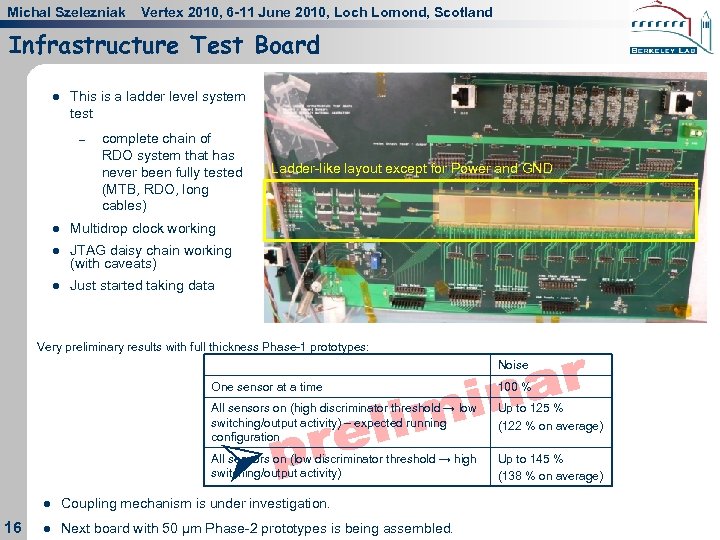
Michal Szelezniak Vertex 2010, 6 -11 June 2010, Loch Lomond, Scotland Infrastructure Test Board l This is a ladder level system test – complete chain of RDO system that has never been fully tested (MTB, RDO, long cables) l Multidrop clock working l JTAG daisy chain working (with caveats) l Ladder-like layout except for Power and GND Just started taking data Very preliminary results with full thickness Phase-1 prototypes: Noise One sensor at a time All sensors on (high discriminator threshold → low switching/output activity) – expected running configuration 16 l Up to 125 % (122 % on average) All sensors on (low discriminator threshold → high switching/output activity) l 100 % Up to 145 % (138 % on average) Coupling mechanism is under investigation. 16 board with 50 μm Phase-2 prototypes is being assembled. Next
Michal Szelezniak Vertex 2010, 6 -11 June 2010, Loch Lomond, Scotland Summary and Outlook l Development of the detector’s mechanical support is well advanced – Very low mass detector support designs have passed multiple analysis tests and prototype tests addressing cooling and position stability. – Prototype tooling is in place and tested for sector/ladder production. – Concept designs for installation and insertion are well advanced. l MAPS technology development at IPHC is well advanced and on schedule l The RDO data path architecture has been validated and hardware prototypes have been produced – – l Testing of individual sensors works well. We have just started reading out 10 sensor ladders. Test plans: – Beam test with Phase-2 @ Fermilab l l 17 HFT is headed for CD 2/3 in Q 4 FY 2010 HFT completion scheduled for Q 3 FY 2013 17

Michal Szelezniak Vertex 2010, 6 -11 June 2010, Loch Lomond, Scotland Thank you for your attention! 18 18

Michal Szelezniak l 19 Vertex 2010, 6 -11 June 2010, Loch Lomond, Scotland backup 19
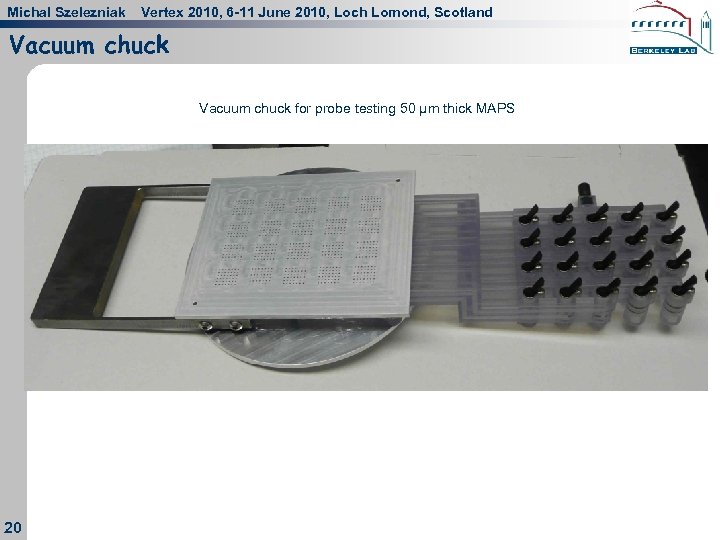
Michal Szelezniak Vertex 2010, 6 -11 June 2010, Loch Lomond, Scotland Vacuum chuck for probe testing 50 μm thick MAPS 20 20
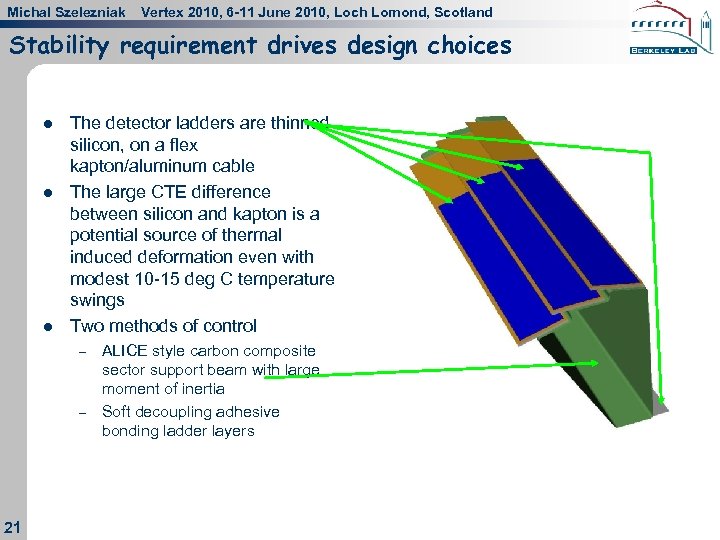
Michal Szelezniak Vertex 2010, 6 -11 June 2010, Loch Lomond, Scotland Stability requirement drives design choices l l l The detector ladders are thinned silicon, on a flex kapton/aluminum cable The large CTE difference between silicon and kapton is a potential source of thermal induced deformation even with modest 10 -15 deg C temperature swings Two methods of control – – 21 21 ALICE style carbon composite sector support beam with large moment of inertia Soft decoupling adhesive bonding ladder layers
Michal Szelezniak Vertex 2010, 6 -11 June 2010, Loch Lomond, Scotland RDO requirements • Triggered detector system fitting into existing STAR infrastructure (Trigger, DAQ, etc. ) • Deliver full frame events to STAR DAQ for event building at approximately the same rate as the TPC (1 k. Hz for DAQ 1000). • Have live time characteristics such that the Pixel detector is live whenever the TPC is live. • Reduce the total data rate of the PXL detector to a manageable level (< TPC rate of ~1 MB / event). • Contain additional functionality for full sensor characterization including production probe testing. 22 22
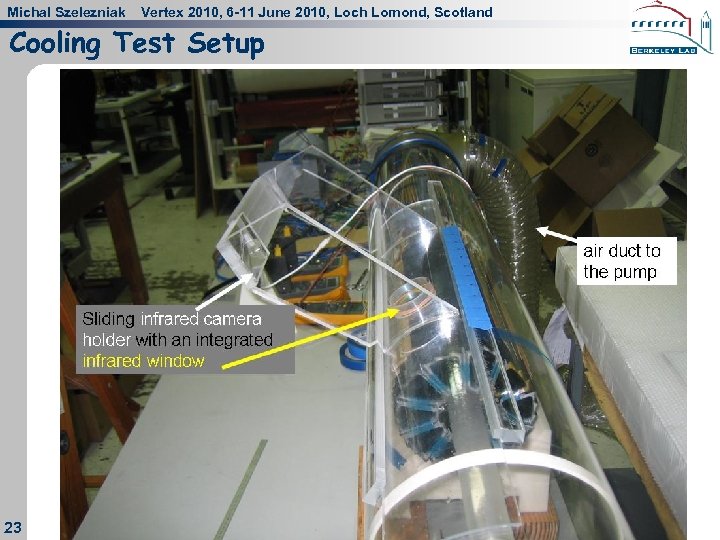
Michal Szelezniak Vertex 2010, 6 -11 June 2010, Loch Lomond, Scotland Cooling Test Setup 23 23
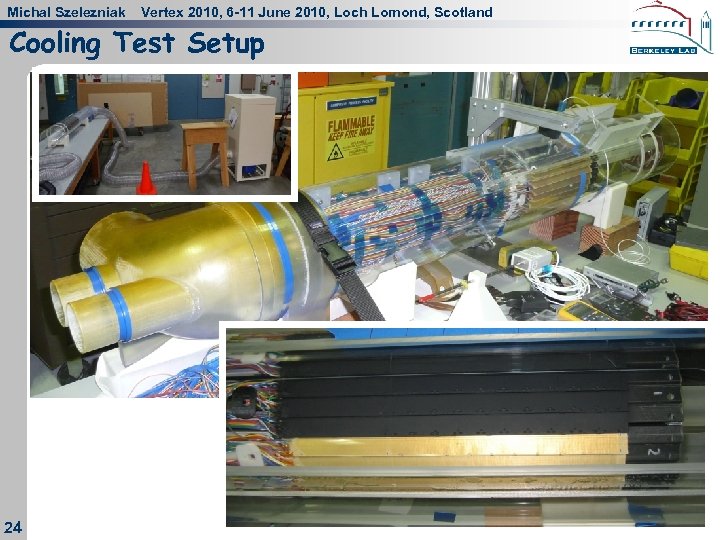
Michal Szelezniak Vertex 2010, 6 -11 June 2010, Loch Lomond, Scotland Cooling Test Setup 24 24
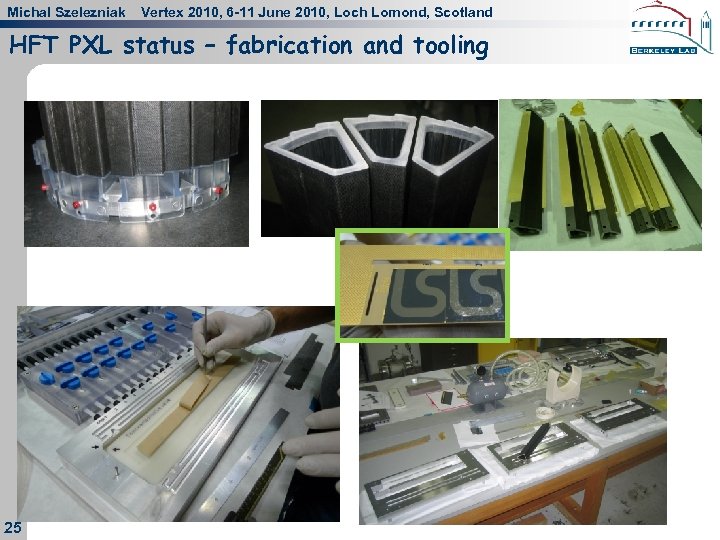
Michal Szelezniak Vertex 2010, 6 -11 June 2010, Loch Lomond, Scotland HFT PXL status – fabrication and tooling 25 25
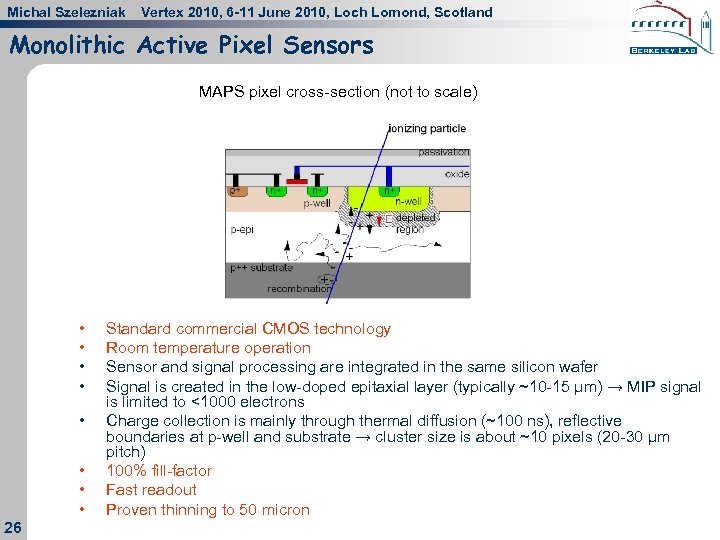
Michal Szelezniak Vertex 2010, 6 -11 June 2010, Loch Lomond, Scotland Monolithic Active Pixel Sensors MAPS pixel cross-section (not to scale) • • 26 26 Standard commercial CMOS technology Room temperature operation Sensor and signal processing are integrated in the same silicon wafer Signal is created in the low-doped epitaxial layer (typically ~10 -15 μm) → MIP signal is limited to <1000 electrons Charge collection is mainly through thermal diffusion (~100 ns), reflective boundaries at p-well and substrate → cluster size is about ~10 pixels (20 -30 μm pitch) 100% fill-factor Fast readout Proven thinning to 50 micron
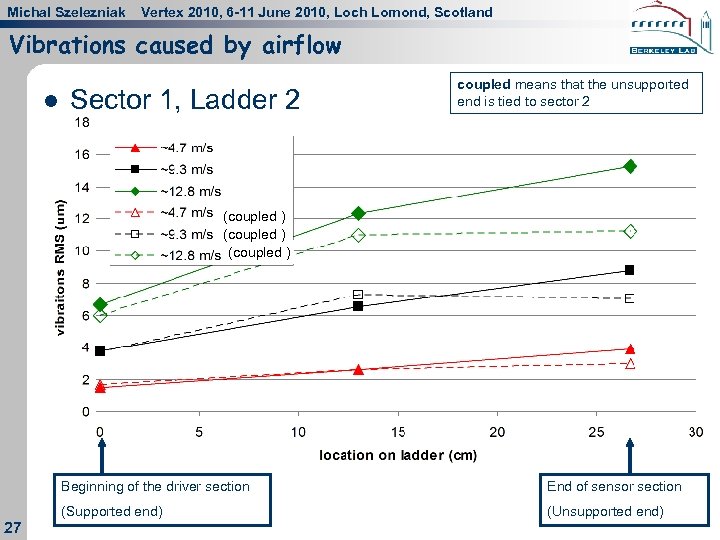
Michal Szelezniak Vertex 2010, 6 -11 June 2010, Loch Lomond, Scotland Vibrations caused by airflow l Sector 1, Ladder 2 coupled means that the unsupported end is tied to sector 2 (coupled ) Beginning of the driver section 27 End of sensor section (Supported end) (Unsupported end) 27
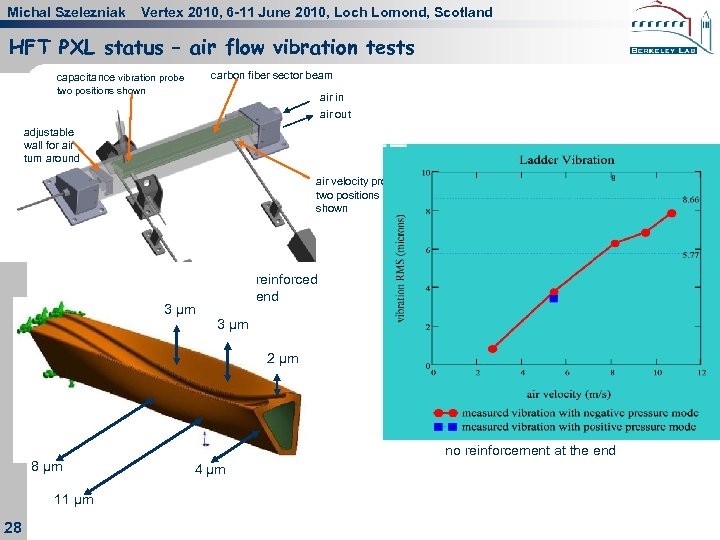
Michal Szelezniak Vertex 2010, 6 -11 June 2010, Loch Lomond, Scotland HFT PXL status – air flow vibration tests carbon fiber sector beam capacitance vibration probe two positions shown air in air out adjustable wall for air turn around air velocity probe two positions shown 3 µm reinforced end 3 µm 2 µm 8 µm 11 µm 28 28 no reinforcement at the end 4 µm
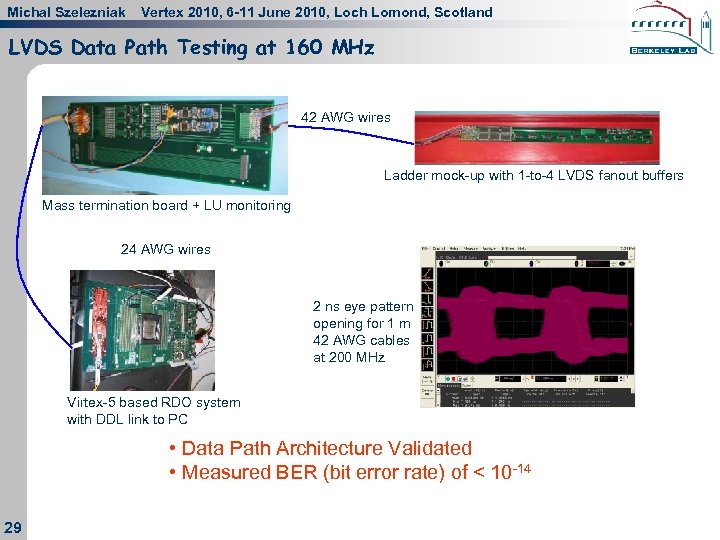
Michal Szelezniak Vertex 2010, 6 -11 June 2010, Loch Lomond, Scotland LVDS Data Path Testing at 160 MHz 42 AWG wires Ladder mock-up with 1 -to-4 LVDS fanout buffers Mass termination board + LU monitoring 24 AWG wires 2 ns eye pattern opening for 1 m 42 AWG cables at 200 MHz Virtex-5 based RDO system with DDL link to PC • Data Path Architecture Validated • Measured BER (bit error rate) of < 10 -14 29 29
Michal Szelezniak Vertex 2010, 6 -11 June 2010, Loch Lomond, Scotland Sensor RDO Cable Development • A detailed description of the challenge is available here http: //rnc. lbl. gov/hft/hardware/docs/PXL_RDO_cable_options_1. doc • A single sided test cable design has been produced for fabrication at Datex to assess capability and quality. • Some delay due to material issues. It is difficult to find anyone willing to fabricate kapton/Al. • We have located some 1 mil Al on 1 mil mylar and shipped it to Datex. They are evaluating the suitability. • Datex is about to start first attempt at fabrication. • Other vendors (SE SRTIIE, Kharkov, Ukraine and CERN? ) will be contacted. 30 30
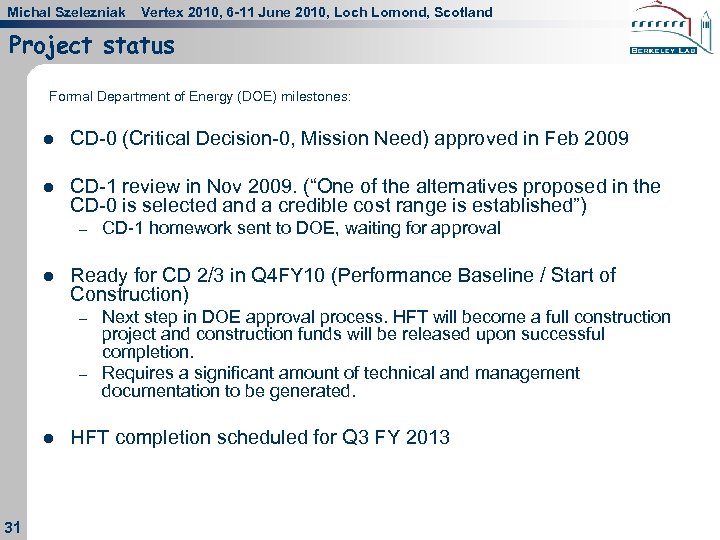
Michal Szelezniak Vertex 2010, 6 -11 June 2010, Loch Lomond, Scotland Project status Formal Department of Energy (DOE) milestones: l CD-0 (Critical Decision-0, Mission Need) approved in Feb 2009 l CD-1 review in Nov 2009. (“One of the alternatives proposed in the CD-0 is selected and a credible cost range is established”) – l Ready for CD 2/3 in Q 4 FY 10 (Performance Baseline / Start of Construction) – – l 31 CD-1 homework sent to DOE, waiting for approval Next step in DOE approval process. HFT will become a full construction project and construction funds will be released upon successful completion. Requires a significant amount of technical and management documentation to be generated. HFT completion scheduled for Q 3 FY 2013 31
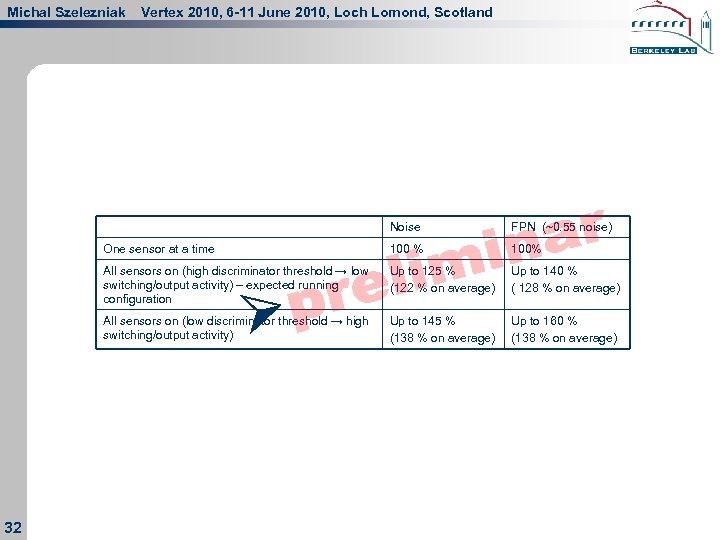
Michal Szelezniak Vertex 2010, 6 -11 June 2010, Loch Lomond, Scotland Noise One sensor at a time 100% Up to 125 % (122 % on average) Up to 140 % ( 128 % on average) All sensors on (low discriminator threshold → high switching/output activity) 32 100 % All sensors on (high discriminator threshold → low switching/output activity) – expected running configuration 32 FPN (~0. 55 noise) Up to 145 % (138 % on average) Up to 160 % (138 % on average)
Скачать презентацию MAPS based vertex detector at STAR Vertex 2010
a0599de115065c371ea26dd0af8996bd.ppt