


 Скачать презентацию Manufacturing Planning and Control MPC 6 th Edition
3c74324e48e1b3a7816dbd6c10ed7041.ppt
- Количество слайдов: 24
 Manufacturing Planning and Control MPC 6 th Edition Chapter 12 Mc. Graw-Hill/Irwin Copyright © 2011 by The Mc. Graw-Hill Companies, Inc. All rights reserved.
 Strategy and MPC System Design Two key issues arise in the design of Manufacturing Planning and Control (MPC) systems. First, linking MPC system design to the firm’s business strategy for competing in the marketplace. Second, many firms must also integrate MRP and JIT systems, either in new or existing MPC systems. 12 -2
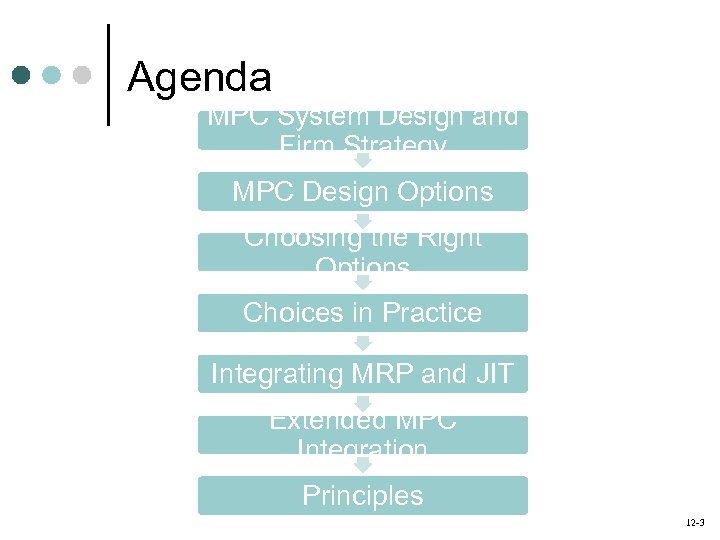 Agenda MPC System Design and Firm Strategy MPC Design Options Choosing the Right Options Choices in Practice Integrating MRP and JIT Extended MPC Integration Principles 12 -3
 Master Production Scheduling (MPS) Options ¢ Make-to-Order–MPC system includes preproduction engineering and design activities as well as manufacturing and supplier operations Used when the product is custom-built to individual specifications l Customer order is the unit of control in MPS l Order backlog is the critical measurement l Planning bills of material are used extensively l Major source of uncertainty is customer time requirements l 12 -4
 Master Production Scheduling (MPS) Options ¢ Assemble-to-Order–Component inventory is held (to reduce lead times) and assembled according to customer requirements l l Used when manufacturing lead time exceeds customer expectations, variety and cost of end products precludes holding finished items in inventory, and/or modules or options can be combined to satisfy unique customer requirements Key control point is final assembly schedule (FAS) Planning bills of material are used to represent “average” product Main source of uncertainty is product mix 12 -5
 Master Production Scheduling (MPS) Options ¢ Make-to-Stock–common when customers place short lead-time (or immediate) orders for standard products MPS is stated in end items, which are produced to forecast demand l Customer orders are filled directly from stock l Procedures for monitoring accuracy of demand forecasts are required l Main source of uncertainty is forecast errors l 12 -6
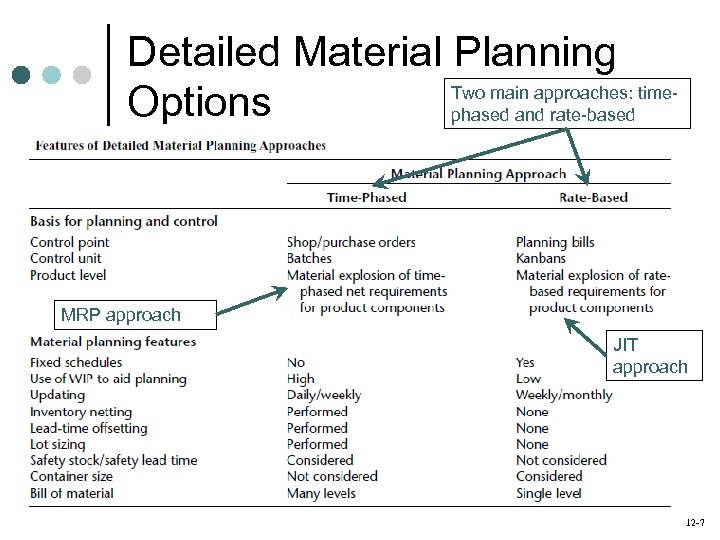 Detailed Material Planning Two main approaches: time. Options phased and rate-based MRP approach JIT approach 12 -7
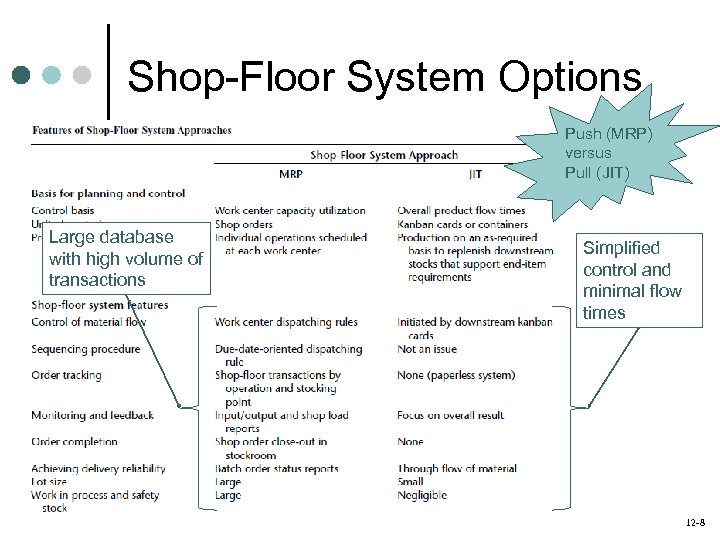 Shop-Floor System Options Push (MRP) versus Pull (JIT) Large database with high volume of transactions Simplified control and minimal flow times 12 -8
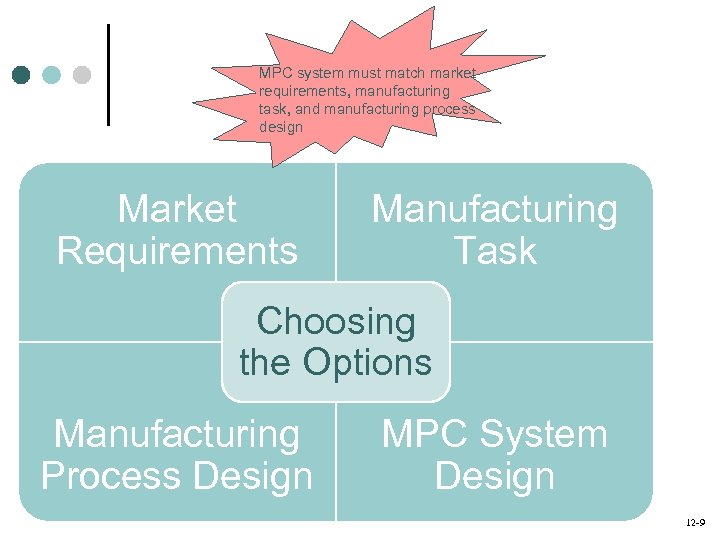 MPC system must match market requirements, manufacturing task, and manufacturing process design Market Requirements Manufacturing Task Choosing the Options Manufacturing Process Design MPC System Design 12 -9
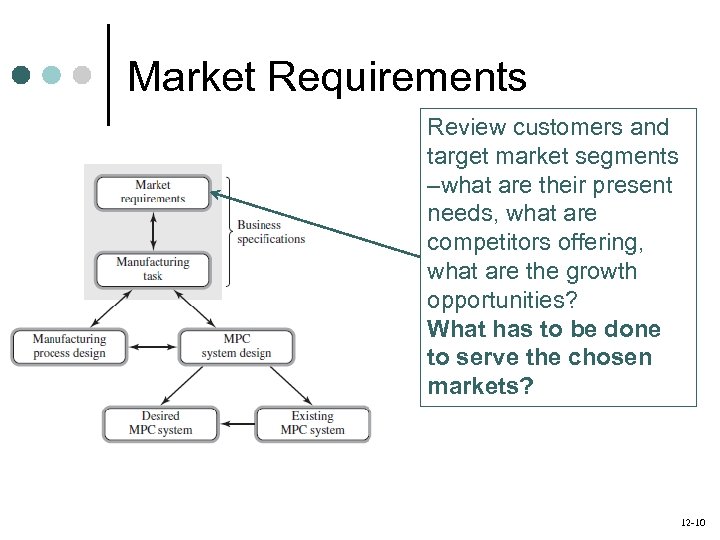 Market Requirements Review customers and target market segments –what are their present needs, what are competitors offering, what are the growth opportunities? What has to be done to serve the chosen markets? 12 -10
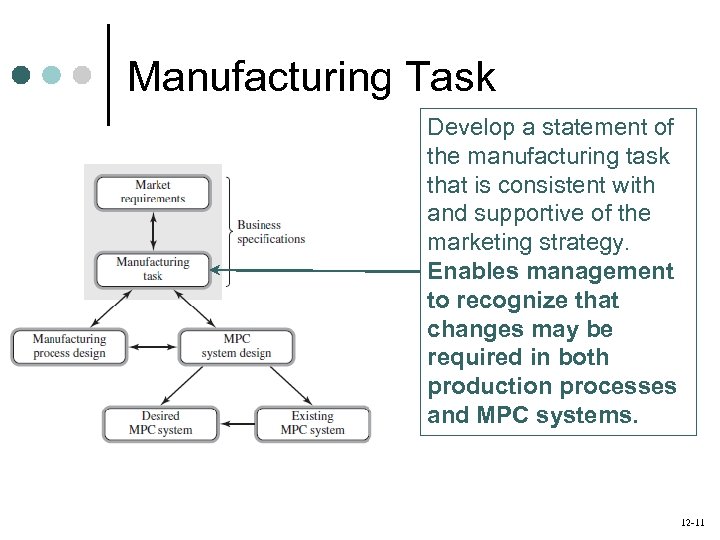 Manufacturing Task Develop a statement of the manufacturing task that is consistent with and supportive of the marketing strategy. Enables management to recognize that changes may be required in both production processes and MPC systems. 12 -11
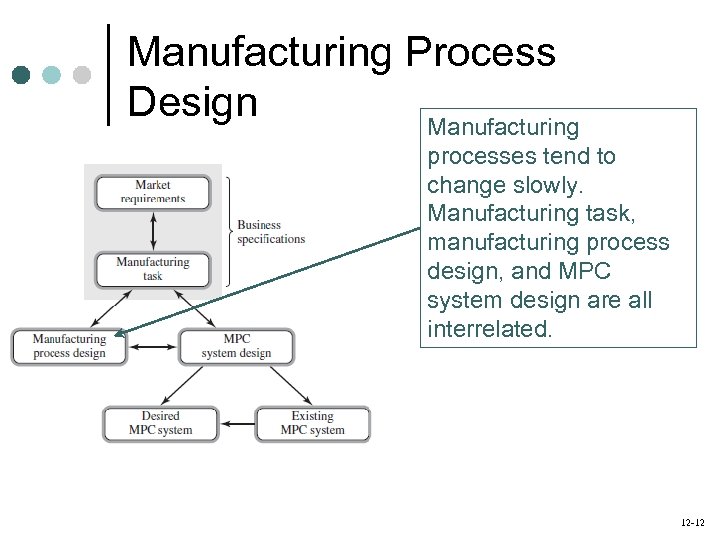 Manufacturing Process Design Manufacturing processes tend to change slowly. Manufacturing task, manufacturing process design, and MPC system design are all interrelated. 12 -12
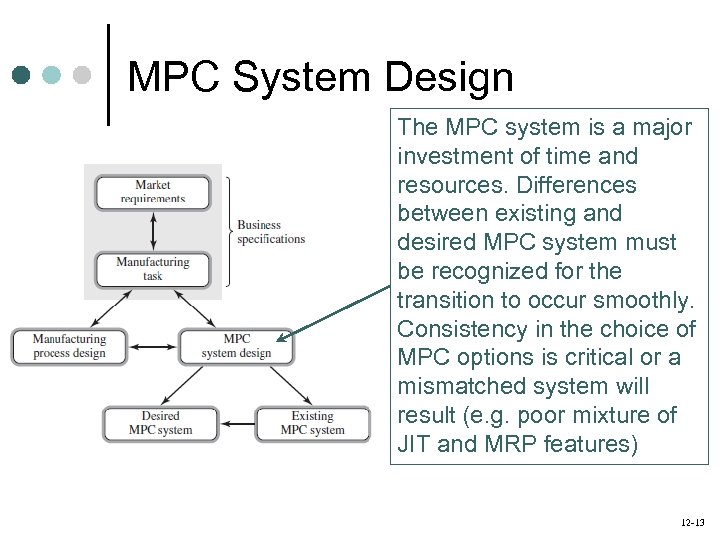 MPC System Design The MPC system is a major investment of time and resources. Differences between existing and desired MPC system must be recognized for the transition to occur smoothly. Consistency in the choice of MPC options is critical or a mismatched system will result (e. g. poor mixture of JIT and MRP features) 12 -13
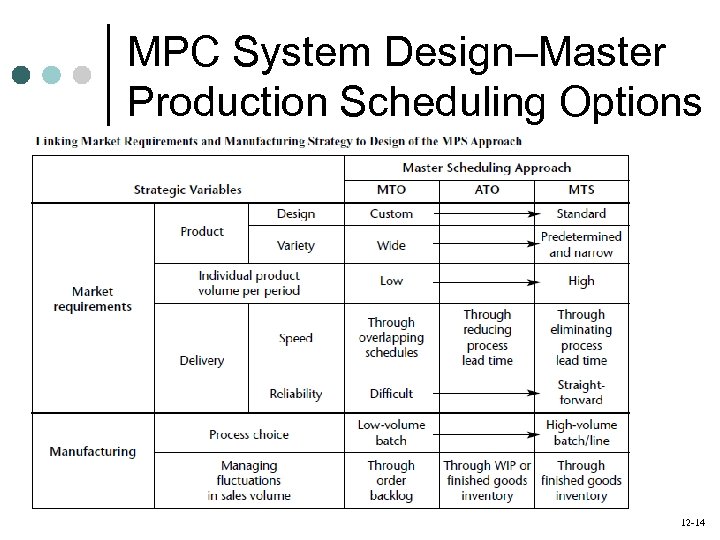 MPC System Design–Master Production Scheduling Options 12 -14
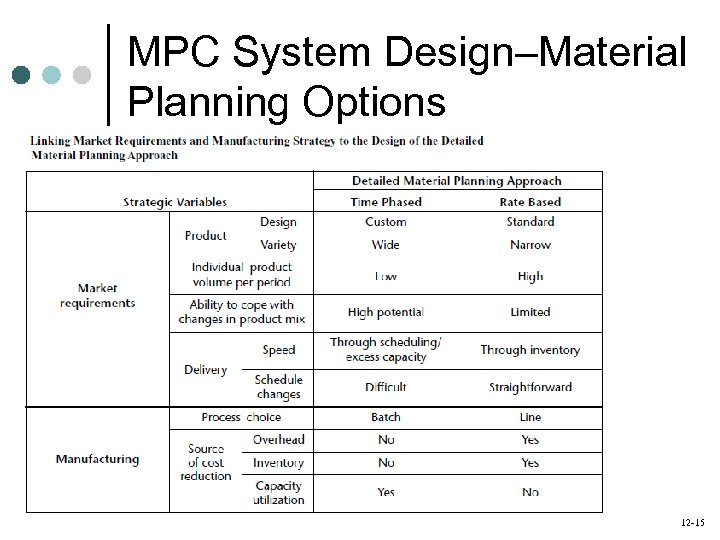 MPC System Design–Material Planning Options 12 -15
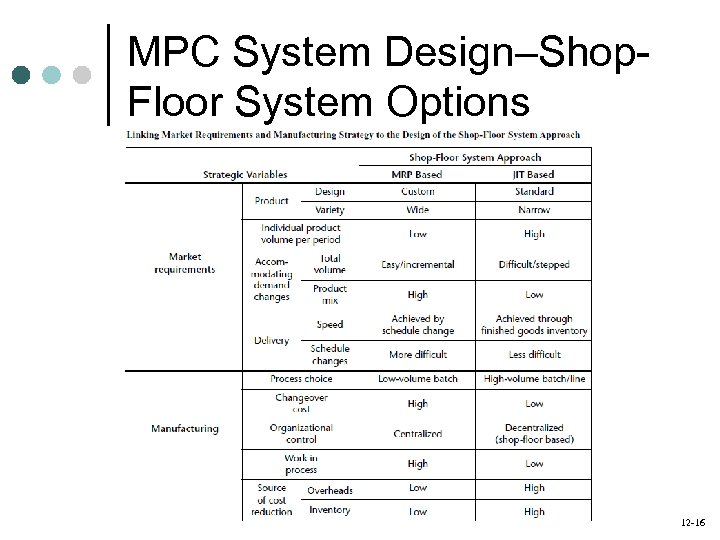 MPC System Design–Shop. Floor System Options 12 -16
 Kawasaki, USA ¢ ¢ ¢ ¢ Kawasaki produces six types of motorcycles in addition to jet skis at its U. S. plant Demand is highly seasonal Allowing finished-goods inventory stabilizes the workload Manufacturing task–produce standardized products in high volumes at low cost Make-to-stock master production scheduling process Rate-based material planning with a planning bill of materials JIT shop-floor scheduling with kanban containers 12 -17
 Integrating MRP and JIT ¢ The need to integrate Generally MRP firms trying to implement JIT aspects l JIT practices may seem to be in conflict with MRP practices l Factory floor changes may require MPC system adjustments l 12 -18
 Integrating MRP and JIT ¢ Supporting integration through physical changes JIT support requires reducing the volume of inventory transactions l Making changes in the flow of materials and production process (e. g. cellular manufacturing) l 12 -19
 Integrating MRP and JIT ¢ Integration techniques A combination of MRP and JIT requires a mechanism to allow moving back and forth l Phantom bills are a common approach l • Part numbers are carried on the bill of materials but are not actually tracked with inventory transactions 12 -20
 Integrating MPC Systems with Suppliers and Customers Expanded view of MPC which considers improvements to the system which includes both upstream suppliers and downstream customers ¢ Development of manufacturing strategy includes integrated MPC system across the entire supply chain ¢ 12 -21
 Principles ¢ ¢ Because investment in MPC systems is so large, their design must support the firm’s strategy. A wide range of options are available in designing MPC systems, and the choices must be governed by the firm’s competitive needs. Business and technical specifications need to be considered in designing an MPC system design should begin with an analysis of the market requirements to support the firm’s competitive strategy. 12 -22
 Principles ¢ ¢ Understanding the manufacturing task is critical in developing the production process design, the MPC system design, and the other elements of the manufacturing infrastructure. The manufacturing process’ particular features need to be considered in choosing among the options in MPC system design. MRP and JIT approaches can be effectively integrated in designing MPC systems. Performance of the company and supply chain can be improved by matching MPC system design to the firm’s competitive strategy. 12 -23
 Quiz – Chapter 12 ¢ ¢ ¢ In a situation where manufacturing lead time exceeds customer requirements and products can be assembled from modules, an _____-__-______ approach is most likely. Design of an MPC system begins with an analysis of _____ requirements. Which master scheduling approach requires a high level of attention to forecast accuracy? Which material planning approach is likely to utilize kanbans and level loaded production? Which shop-floor system is likely to carry higher levels of safety stock and work-in-process inventory? 12 -24