


 Скачать презентацию Manno January 9 2001 High Speed Networks
d15030d8b4060d0052e83aa0b950ba0b.ppt
- Количество слайдов: 54
 Manno, January 9, 2001 High Speed Networks – Technology and Applicatios – Prof. Dr. Bernhard Plattner, Prof. Dr. Burkhard Stiller Institut für Technische Informatik und Kommunikationsnetze Fachgruppe Kommunikationssysteme, ETH Zürich Gloriastrasse 35 CH-8092 Zürich, Switzerland Phone: +41 1 [632 7000 | 632 7016], FAX: +41 1 632 1035 E-Mail: [ plattner | stiller ]@tik. ee. ethz. ch in cooperation with Dr. Daniel Bauer IBM Research Division, Zürich Laboratories Säumerstrasse 4, CH-8803 Rüschlikon, Switzerland © 2000 B. Stiller, B. Plattner ETHZ-TIK, D. Bauer IBM Research CM I – 1 ETH Zürich
 Course Outline Part I: Part II: Part IV: Introduction, Quality-of-Service, Internet Basics and Routing in Networks LAN Technologies and Internetworking Overview of Networking Technologies, ATM, and IP Carrier Technologies, Traffic Management, and Trends © 2000 B. Stiller, B. Plattner ETHZ-TIK, D. Bauer IBM Research CM I – 2 ETH Zürich
 Part I: Introduction, Qo. S, and Routing • • • Introduction – Applications – Multimedia Systems Quality of Service (Qo. S) – Concept and Definitions – Example Routing – Internet Basics – Switching and Forwarding – Routers and the Big Picture – Routing Protocols © 2000 B. Stiller, B. Plattner ETHZ-TIK, D. Bauer IBM Research CM I – 3 ETH Zürich
 Introduction Why are High Speed Networks an issue? o Increasing dependency of business processes on availability of various computing resources (servers, distributed applications, interpersonal communication facilities). o Ever increasing processing speeds of PCs, workstations and servers. o Technology push: High Speed Network Technology is available. o User pull: New distributed multimedia applications need faster networks and new kinds of services. © 2000 B. Stiller, B. Plattner ETHZ-TIK, D. Bauer IBM Research CM I – 4 ETH Zürich
 Traditional Applications Client/server networking (e. g. , Novell, Windows 95/NT). o Document exchange (directly between users or with a server as an intermediary). o Electronic mail services (proprietary technologies, or vendor independent standards like X. 400 or Internet mail). o 10 Mbit/s LAN technologies have generally been sufficient for these applications © 2000 B. Stiller, B. Plattner ETHZ-TIK, D. Bauer IBM Research CM I – 5 ETH Zürich
 Changing Picture o Percentage of employees really using computers has increased (cf. visions of LAN use of the 70 s!) • 20/80% rule changes to 80/20% rule. Graphical user interfaces tend to cause more traffic (X-Window System, UI design trends). o Graphical visualization of information has become popular (World Wide Web, Internet -> Intranet). o High-speed backup systems. > Need for flexibility and extensibility of network infrastructure: o • • Universal cable plants, bridges, routers, LAN switches 100 Mbit/s LAN technology as a logical step © 2000 B. Stiller, B. Plattner ETHZ-TIK, D. Bauer IBM Research CM I – 6 ETH Zürich
 Emerging Applications o New types of applications: • Digitized analog applications: E. g. , video/audio broadcasting, picture phone, HDTV, conferencing, FAX • Digital applications per se: E. g. , network management, secure messaging, virtual reality. • Examples: Netmeeting or MBone tools (A/V conferencing) or Marimba (Software Updates) o Distributed applications: • Collaborative work (CSCW) • Support for virtual enterprises • New technolgies in education, tele-teaching for life-long learning • Entertainment (distributed games, Napster, Gnutella, . . . ) © 2000 B. Stiller, B. Plattner ETHZ-TIK, D. Bauer IBM Research CM I – 7 ETH Zürich
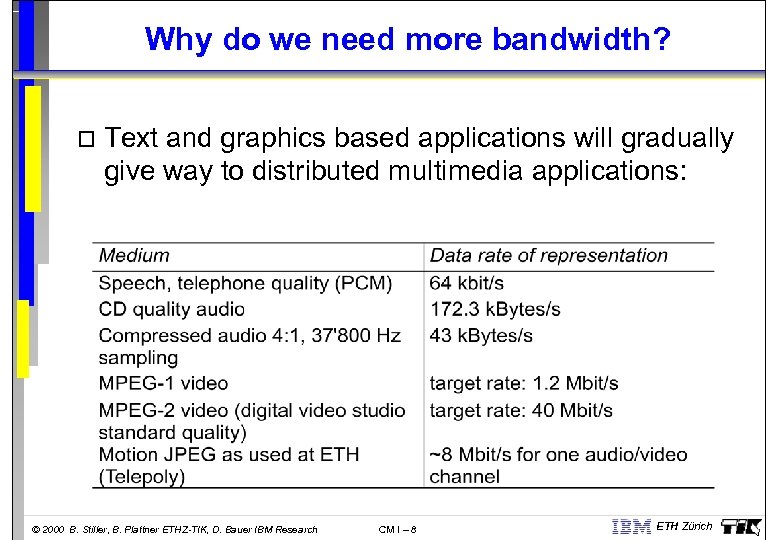 Why do we need more bandwidth? o Text and graphics based applications will gradually give way to distributed multimedia applications: © 2000 B. Stiller, B. Plattner ETHZ-TIK, D. Bauer IBM Research CM I – 8 ETH Zürich
 Future Developments Ubiquitous computers o Virtual reality o Distributed simulation systems: o • “World models” or • Battlefield simulation -> virtual reality Multiparty applications o Mobile (multimedia) systems o Active networks o © 2000 B. Stiller, B. Plattner ETHZ-TIK, D. Bauer IBM Research CM I – 9 ETH Zürich
 Definition of a “Multimedia System” Simple quantitative definition: A system supporting more than one medium (text, graphics, sound, video, tactile feelings, smell, . . . ). o Qualitative definition: A system supporting a combination of discrete and continuous media. o Additional properties: o • • o Independence of the various media and Computer-supported integration of media (programmability, controllable timing, synchronization). High speed networks should be capable of supporting distributed multimedia systems. © 2000 B. Stiller, B. Plattner ETHZ-TIK, D. Bauer IBM Research CM I – 10 ETH Zürich
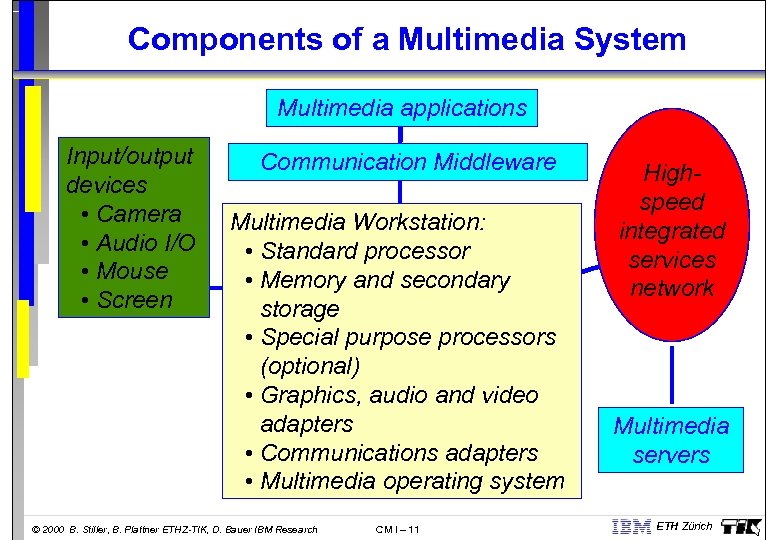 Components of a Multimedia System Multimedia applications Input/output devices • Camera • Audio I/O • Mouse • Screen Communication Middleware Multimedia Workstation: • Standard processor • Memory and secondary storage • Special purpose processors (optional) • Graphics, audio and video adapters • Communications adapters • Multimedia operating system © 2000 B. Stiller, B. Plattner ETHZ-TIK, D. Bauer IBM Research CM I – 11 Highspeed integrated services network Multimedia servers ETH Zürich
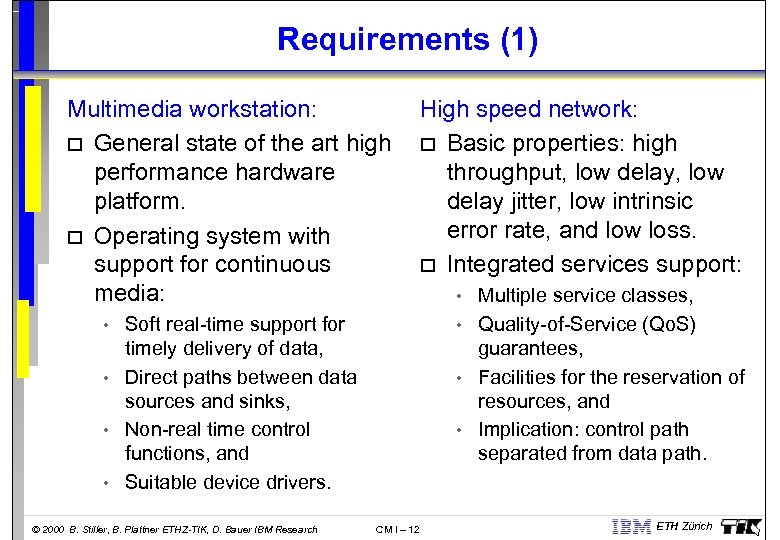 Requirements (1) Multimedia workstation: o General state of the art high performance hardware platform. o Operating system with support for continuous media: • • High speed network: o Basic properties: high throughput, low delay jitter, low intrinsic error rate, and low loss. o Integrated services support: Soft real-time support for timely delivery of data, Direct paths between data sources and sinks, Non-real time control functions, and Suitable device drivers. © 2000 B. Stiller, B. Plattner ETHZ-TIK, D. Bauer IBM Research • • CM I – 12 Multiple service classes, Quality-of-Service (Qo. S) guarantees, Facilities for the reservation of resources, and Implication: control path separated from data path. ETH Zürich
 Requirements (2) Multimedia applications: o User interface for controlling multimedia streams and applications semantics. o Accepts Quality-of-Service requests form the user. o Maps the user’s Qo. S wishes to lower level Qo. S requirements. o Capability for requesting the quality of service for continuous media streams. © 2000 B. Stiller, B. Plattner ETHZ-TIK, D. Bauer IBM Research CM I – 13 Communication middleware: o Offers an easy-to-use communication service as an application programmer’s interface (API). o Accepts Qo. S requirements from the application. o Maps Qo. S requirements to network Qo. S parameters and resource reservations. o Manages streams between sources and sinks. ETH Zürich
 Part I: Introduction, Qo. S, and Routing • • • Introduction – Applications – Multimedia Systems Quality of Service (Qo. S) – Concept and Definitions – Example Routing – Switching and Forwarding – Routers and the Big Picture – Routing Protocols © 2000 B. Stiller, B. Plattner ETHZ-TIK, D. Bauer IBM Research CM I – 14 ETH Zürich
 Quality-of-Service (Qo. S) o What does Qo. S stand for? • o What is Qo. S? • • o Quality-of-Service: the grade, excellence, or goodness of a service; in the considered case, communication services. A concept for qualitative and quantitative specification of service requirements and properties, Complemented with a set of rules and mechanisms for aquiring requested Qo. S Why Qo. S? • Basis of a „contract“ between a service user and a service provider (e. g. in a service level agreement) © 2000 B. Stiller, B. Plattner ETHZ-TIK, D. Bauer IBM Research CM I – 15 ETH Zürich
 Quality-of-Service o A concept to describe service requirements is needed. • Examples for service characteristics comprise: – Throughput, – Delay, – Jitter, – Error rates (reliability), – Ordered delivery, – Multicasting, and – Data unit size. © 2000 B. Stiller, B. Plattner ETHZ-TIK, D. Bauer IBM Research CM I – 16 ETH Zürich
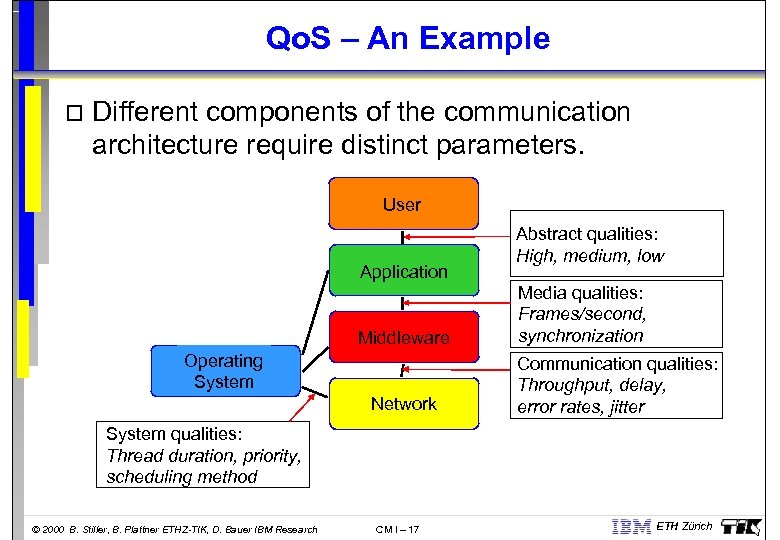 Qo. S – An Example o Different components of the communication architecture require distinct parameters. User Application Middleware Operating System Network Abstract qualities: High, medium, low Media qualities: Frames/second, synchronization Communication qualities: Throughput, delay, error rates, jitter System qualities: Thread duration, priority, scheduling method © 2000 B. Stiller, B. Plattner ETHZ-TIK, D. Bauer IBM Research CM I – 17 ETH Zürich
 Types of Service o There exist two basic types of service: • • o Best effort service and Guaranteed service. Best Effort Service: • • Service type that does not give any guarantees for Qo. S (no commitment). No reservation of resources within the end-system or the network. Often Qo. S cannot be monitored, as no monitoring mechanisms are defined; adaptive applications have to do their own monitoring. Specification of Qo. S parameters is not necessary. © 2000 B. Stiller, B. Plattner ETHZ-TIK, D. Bauer IBM Research CM I – 18 ETH Zürich
 Type-of-Service (2) o Two different guarantees are possible: • • o Statistical (stochastical) guarantees – weak: – Requested Qo. S is provided with some (high) probability – Utilization of network can be maximized (multiplexing). – Reserving resources for an “average” case necessary. Deterministic guarantees – strong: – Requested Qo. S is fully guaranteed. – Resource reservations are required for the worst case. To. S is sometimes called “Qo. S semantics” as well. © 2000 B. Stiller, B. Plattner ETHZ-TIK, D. Bauer IBM Research CM I – 19 ETH Zürich
 Examples o For a file transfer application: • • o Best effort service concerning timing and delay: – No values can be specified or reserved. Guaranteed service (deterministic) concerning reliability: – Bit error rate is zero for received data (retransmission). – However, service may be aborted due to slow links. For video transmission: • Statistically Guaranteed service concerning frame delay: – p percent of delayed frames may exceed the maximum bounded delay D. – “Flickering” pictures (black outs) may occur due to frames arriving late. © 2000 B. Stiller, B. Plattner ETHZ-TIK, D. Bauer IBM Research CM I – 20 ETH Zürich
 Part I: Introduction, Qo. S, and Routing • • • Introduction – Applications – Multimedia Systems Quality of Service (Qo. S) – Concept and Definitions – Example Routing – Internet Basics – Switching and Forwarding – Routers and the Big Picture – Routing Protocols © 2000 B. Stiller, B. Plattner ETHZ-TIK, D. Bauer IBM Research CM I – 21 ETH Zürich
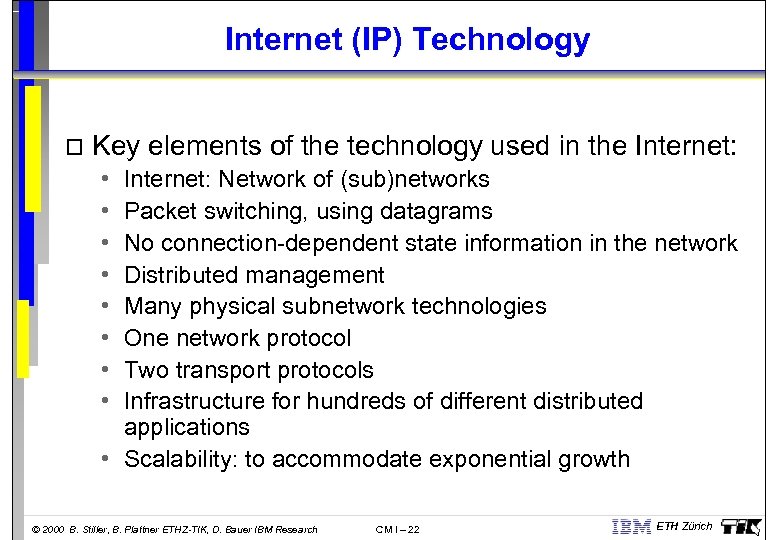 Internet (IP) Technology o Key elements of the technology used in the Internet: • • Internet: Network of (sub)networks Packet switching, using datagrams No connection-dependent state information in the network Distributed management Many physical subnetwork technologies One network protocol Two transport protocols Infrastructure for hundreds of different distributed applications • Scalability: to accommodate exponential growth © 2000 B. Stiller, B. Plattner ETHZ-TIK, D. Bauer IBM Research CM I – 22 ETH Zürich
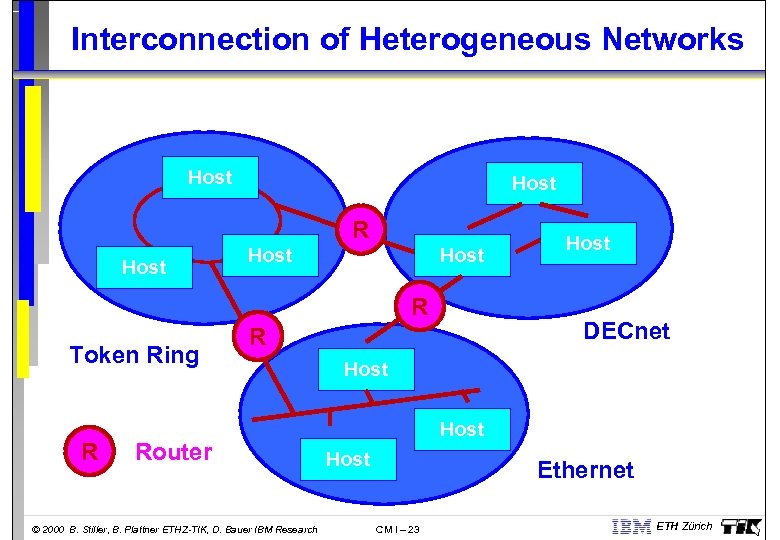 Interconnection of Heterogeneous Networks Host R Host R Token Ring R DECnet R Router © 2000 B. Stiller, B. Plattner ETHZ-TIK, D. Bauer IBM Research Host Ethernet CM I – 23 ETH Zürich
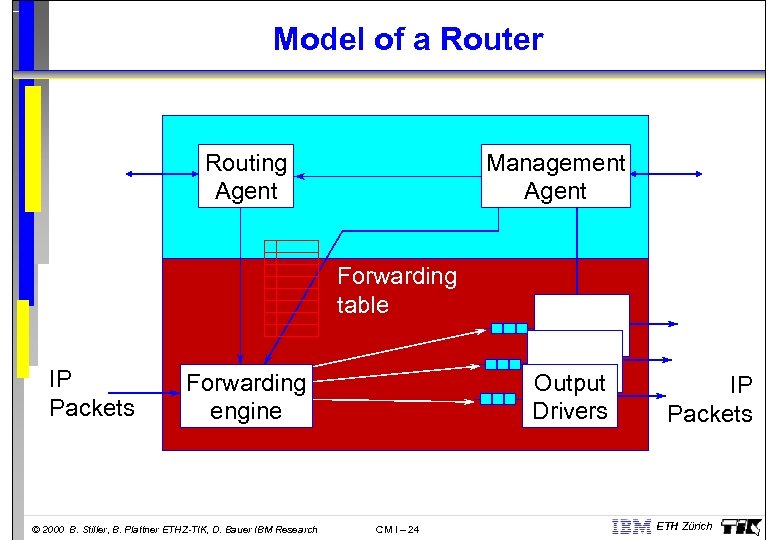 Model of a Router Routing Agent Management Agent Forwarding table IP Packets Forwarding engine © 2000 B. Stiller, B. Plattner ETHZ-TIK, D. Bauer IBM Research Output Drivers CM I – 24 IP Packets ETH Zürich
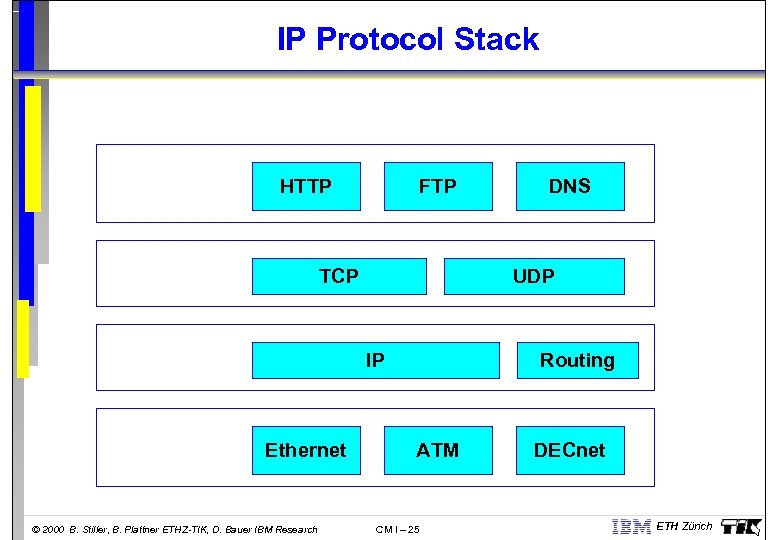 IP Protocol Stack Application layer HTTP Transport layer TCP Internet layer Phys. Network layer FTP UDP IP Ethernet © 2000 B. Stiller, B. Plattner ETHZ-TIK, D. Bauer IBM Research DNS Routing ATM CM I – 25 DECnet ETH Zürich
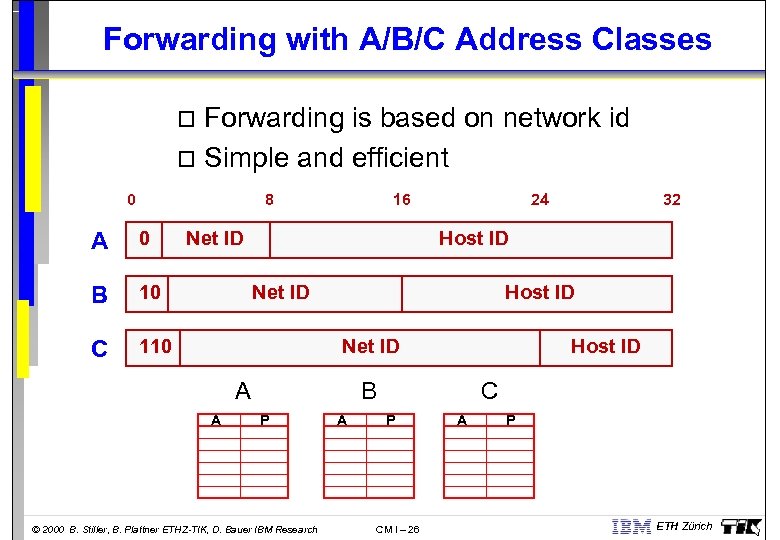 Forwarding with A/B/C Address Classes Forwarding is based on network id o Simple and efficient o 0 8 A 0 B 10 C 110 16 Net ID 24 Host ID Net ID A A 32 Host ID B P © 2000 B. Stiller, B. Plattner ETHZ-TIK, D. Bauer IBM Research A C P CM I – 26 A P ETH Zürich
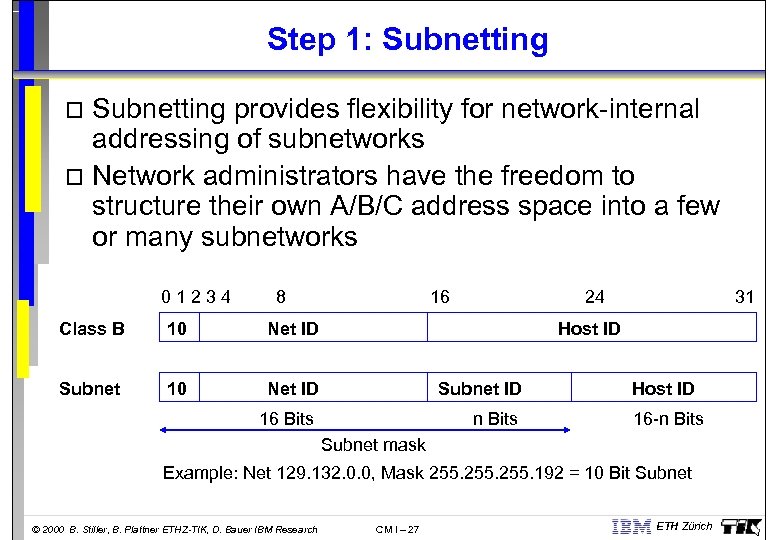 Step 1: Subnetting provides flexibility for network-internal addressing of subnetworks o Network administrators have the freedom to structure their own A/B/C address space into a few or many subnetworks o 01234 8 16 24 Class B 10 Net ID Subnet ID 16 Bits n Bits 31 Host ID 16 -n Bits Subnet mask Example: Net 129. 132. 0. 0, Mask 255. 192 = 10 Bit Subnet © 2000 B. Stiller, B. Plattner ETHZ-TIK, D. Bauer IBM Research CM I – 27 ETH Zürich
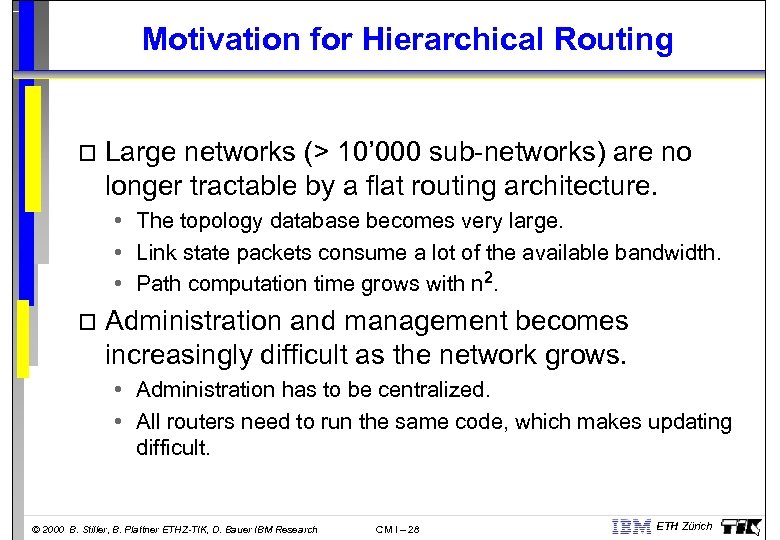 Motivation for Hierarchical Routing o Large networks (> 10’ 000 sub-networks) are no longer tractable by a flat routing architecture. • The topology database becomes very large. • Link state packets consume a lot of the available bandwidth. • Path computation time grows with n 2. o Administration and management becomes increasingly difficult as the network grows. • Administration has to be centralized. • All routers need to run the same code, which makes updating difficult. © 2000 B. Stiller, B. Plattner ETHZ-TIK, D. Bauer IBM Research CM I – 28 ETH Zürich
 Hierarchical routing © 2000 B. Stiller, B. Plattner ETHZ-TIK, D. Bauer IBM Research CM I – 29 ETH Zürich
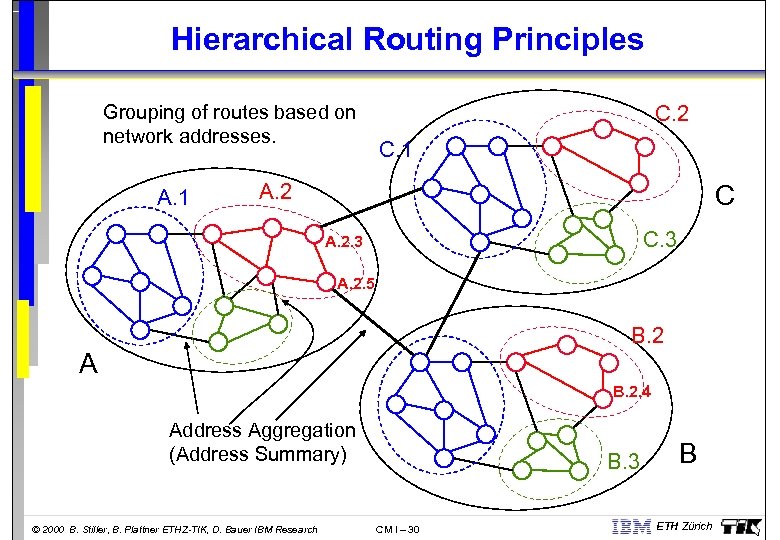 Hierarchical Routing Principles Grouping of routes based on network addresses. A. 1 C. 2 C. 1 A. 2 C C. 3 A. 2. 5 B. 2 A B. 2. 4 Address Aggregation (Address Summary) © 2000 B. Stiller, B. Plattner ETHZ-TIK, D. Bauer IBM Research B. 3 CM I – 30 B ETH Zürich
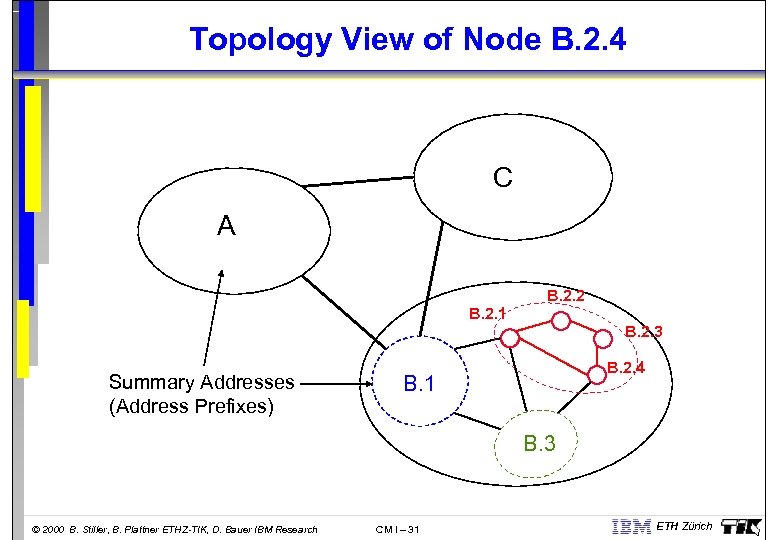 Topology View of Node B. 2. 4 C A B. 2. 2 B. 2. 1 B. 2. 3 Summary Addresses (Address Prefixes) B. 2. 4 B. 1 B. 3 © 2000 B. Stiller, B. Plattner ETHZ-TIK, D. Bauer IBM Research CM I – 31 ETH Zürich
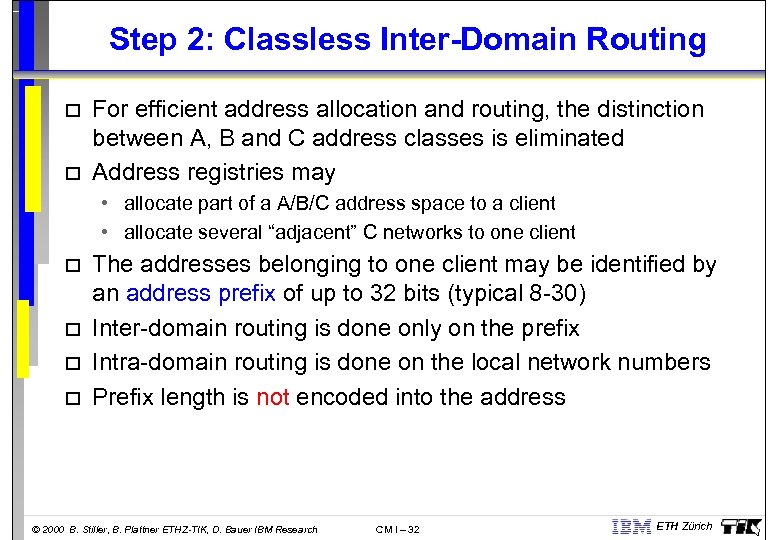 Step 2: Classless Inter-Domain Routing o o For efficient address allocation and routing, the distinction between A, B and C address classes is eliminated Address registries may • allocate part of a A/B/C address space to a client • allocate several “adjacent” C networks to one client o o The addresses belonging to one client may be identified by an address prefix of up to 32 bits (typical 8 -30) Inter-domain routing is done only on the prefix Intra-domain routing is done on the local network numbers Prefix length is not encoded into the address © 2000 B. Stiller, B. Plattner ETHZ-TIK, D. Bauer IBM Research CM I – 32 ETH Zürich
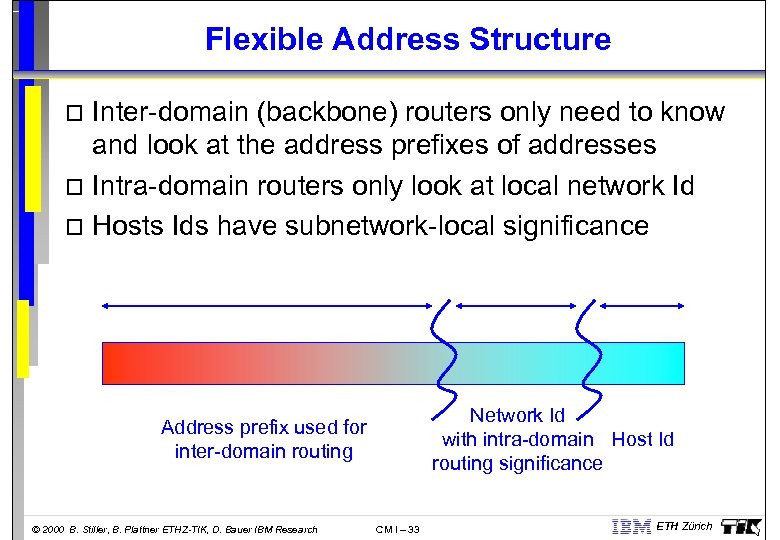 Flexible Address Structure Inter-domain (backbone) routers only need to know and look at the address prefixes of addresses o Intra-domain routers only look at local network Id o Hosts Ids have subnetwork-local significance o Network Id with intra-domain Host Id routing significance Address prefix used for inter-domain routing © 2000 B. Stiller, B. Plattner ETHZ-TIK, D. Bauer IBM Research CM I – 33 ETH Zürich
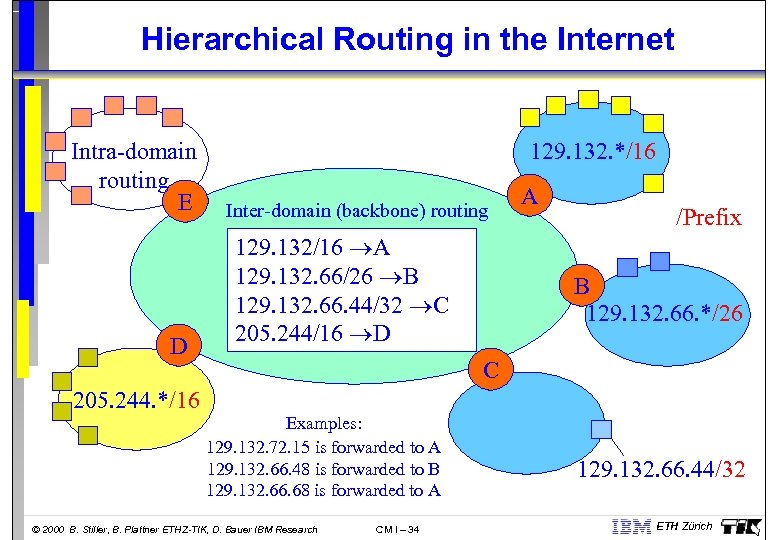 Hierarchical Routing in the Internet Intra-domain routing E D 129. 132. */16 Inter-domain (backbone) routing 129. 132/16 ®A 129. 132. 66/26 ®B 129. 132. 66. 44/32 ®C 205. 244/16 ®D A /Prefix B 129. 132. 66. */26 C 205. 244. */16 Examples: 129. 132. 72. 15 is forwarded to A 129. 132. 66. 48 is forwarded to B 129. 132. 66. 68 is forwarded to A © 2000 B. Stiller, B. Plattner ETHZ-TIK, D. Bauer IBM Research CM I – 34 129. 132. 66. 44/32 ETH Zürich
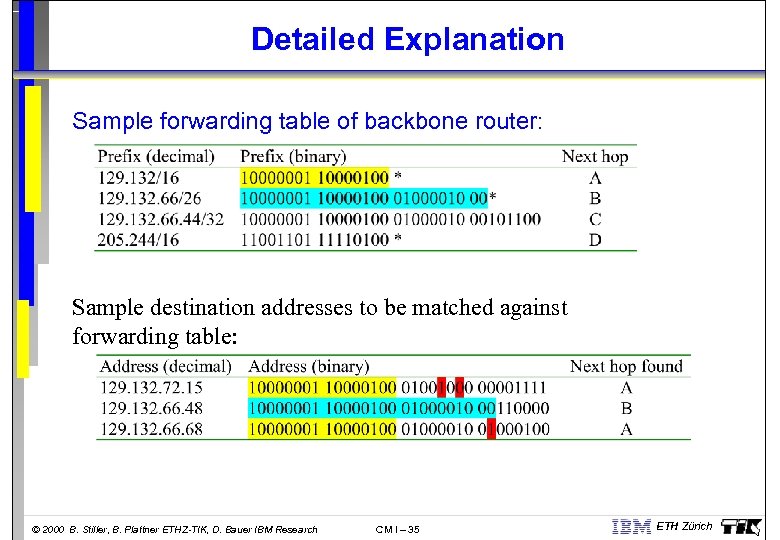 Detailed Explanation Sample forwarding table of backbone router: Sample destination addresses to be matched against forwarding table: © 2000 B. Stiller, B. Plattner ETHZ-TIK, D. Bauer IBM Research CM I – 35 ETH Zürich
 The State of the Art for Forwarding Lookups o Patricia tries © 2000 B. Stiller, B. Plattner ETHZ-TIK, D. Bauer IBM Research CM I – 37 ETH Zürich
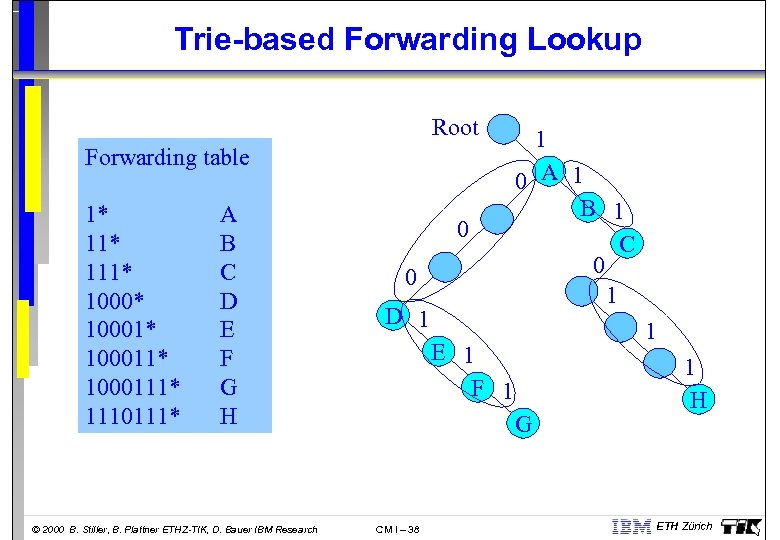 Trie-based Forwarding Lookup Root Forwarding table 1* 111* 10001* 1000111* 1110111* A B C D E F G H © 2000 B. Stiller, B. Plattner ETHZ-TIK, D. Bauer IBM Research 0 0 D 1 1 0 A 1 B 1 C 0 1 1 E 1 F 1 G CM I – 38 1 H ETH Zürich
 The State of the Art for Forwarding Lookups Patricia tries o Hardware solutions - Content Addressable Memories (CAM) o o Protocol based solutions (“label switching”) • small integer labels packets that take the same route • label may be used as an index into forwarding table • IP Switching, Tag Switching, . . . o Caching (using CAMs for fast operation) © 2000 B. Stiller, B. Plattner ETHZ-TIK, D. Bauer IBM Research CM I – 39 ETH Zürich
 Fast Forwarding is a Difficult Problem. . . o Performance • 10 Gbit/s throughput @ packet size 128 bytes -> 10 million packets/s -> 100 ns per packet • Trie lookups are too slow: O(W) memory accesses in the worst case; only a few memory lookups can be allowed o Scalability • Trie lookups have large memory requirements, worst case performance is linear to the prefix length o Cost • CAM solutions are expensive • Caching needs associative memory (CAMs) for good performance © 2000 B. Stiller, B. Plattner ETHZ-TIK, D. Bauer IBM Research CM I – 40 ETH Zürich
 … and was solved only recently o M. Waldvogel, G. Varghese, J. Turner, and B. Plattner: Scalable High Speed IP Routing Lookups Proc. ACM SIGCOMM '97 Conference (in: Computer Communication Review, Volume 27, Number 4, October 1997) Needs 2 -3 memory accesses for finding the best matching prefix o Achieved with a novel application of a binary search strategy with hash tables o © 2000 B. Stiller, B. Plattner ETHZ-TIK, D. Bauer IBM Research CM I – 41 ETH Zürich
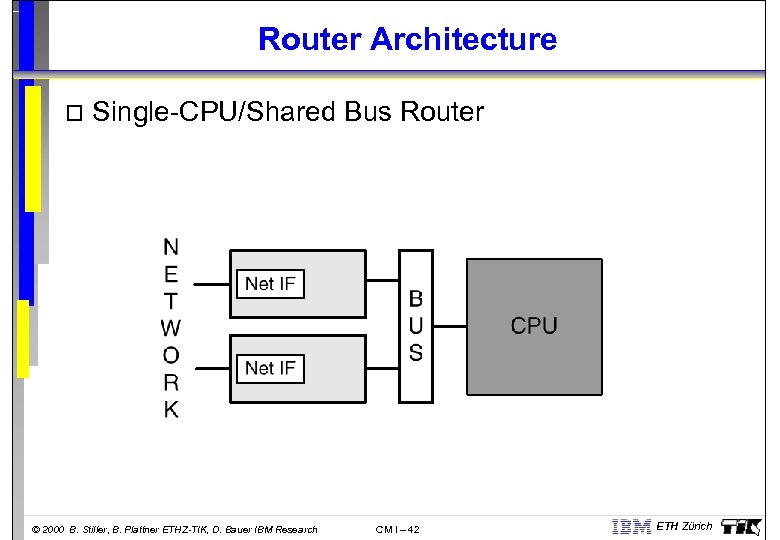 Router Architecture o Single-CPU/Shared Bus Router © 2000 B. Stiller, B. Plattner ETHZ-TIK, D. Bauer IBM Research CM I – 42 ETH Zürich
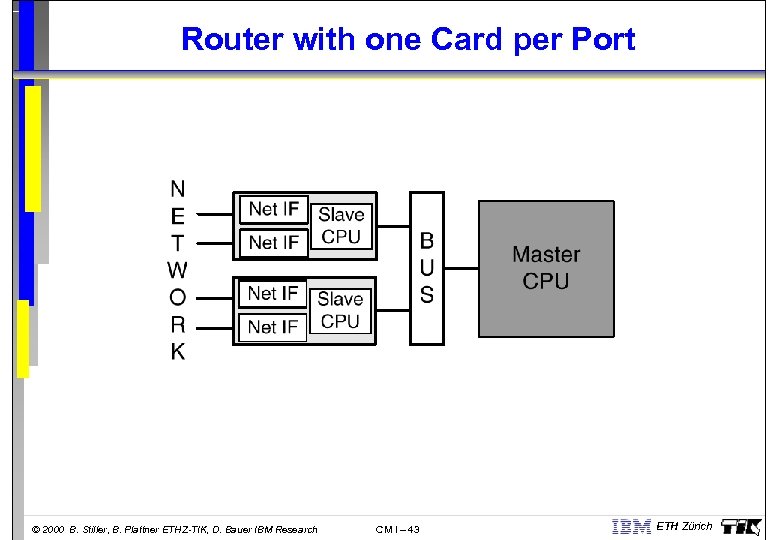 Router with one Card per Port © 2000 B. Stiller, B. Plattner ETHZ-TIK, D. Bauer IBM Research CM I – 43 ETH Zürich
 Today: Switch-based Router © 2000 B. Stiller, B. Plattner ETHZ-TIK, D. Bauer IBM Research CM I – 44 ETH Zürich
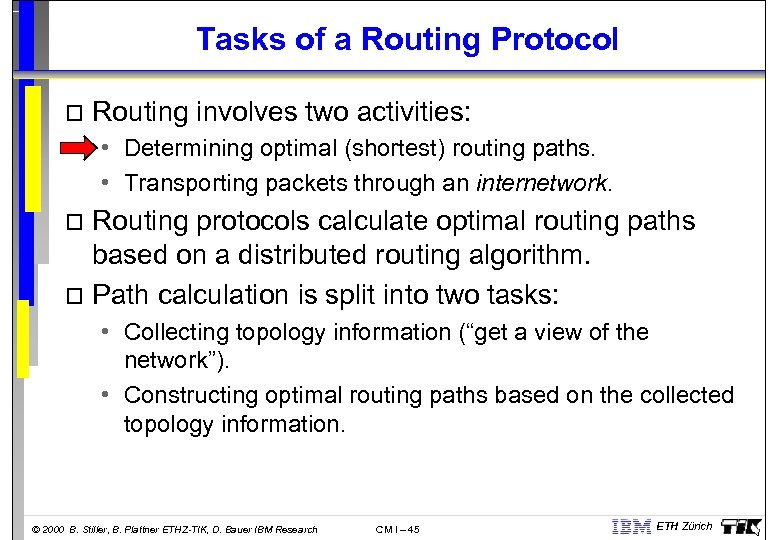 Tasks of a Routing Protocol o Routing involves two activities: • Determining optimal (shortest) routing paths. • Transporting packets through an internetwork. Routing protocols calculate optimal routing paths based on a distributed routing algorithm. o Path calculation is split into two tasks: o • Collecting topology information (“get a view of the network”). • Constructing optimal routing paths based on the collected topology information. © 2000 B. Stiller, B. Plattner ETHZ-TIK, D. Bauer IBM Research CM I – 45 ETH Zürich
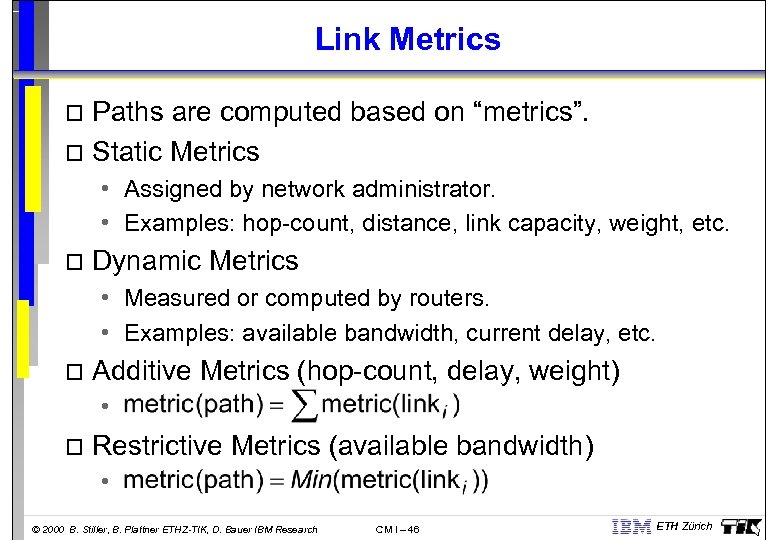 Link Metrics Paths are computed based on “metrics”. o Static Metrics o • Assigned by network administrator. • Examples: hop-count, distance, link capacity, weight, etc. o Dynamic Metrics • Measured or computed by routers. • Examples: available bandwidth, current delay, etc. o Additive Metrics (hop-count, delay, weight) • o Restrictive Metrics (available bandwidth) • © 2000 B. Stiller, B. Plattner ETHZ-TIK, D. Bauer IBM Research CM I – 46 ETH Zürich
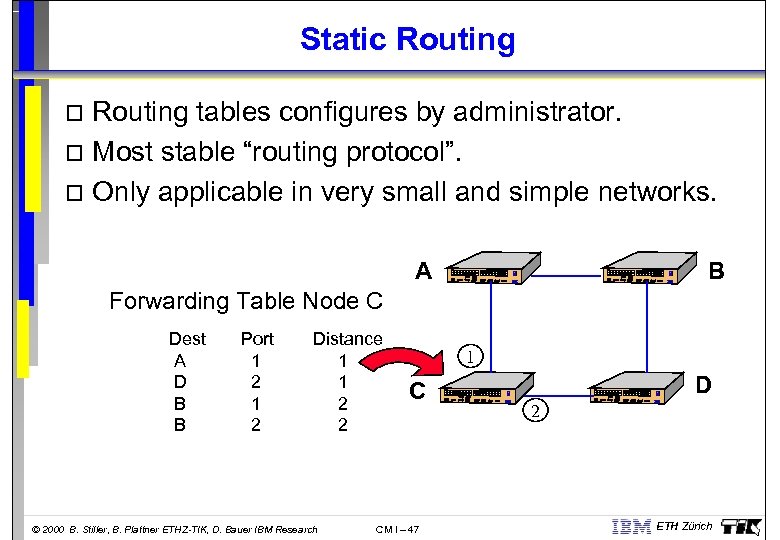 Static Routing tables configures by administrator. o Most stable “routing protocol”. o Only applicable in very small and simple networks. o A B Forwarding Table Node C Dest A D B B Port 1 2 Distance 1 1 2 2 © 2000 B. Stiller, B. Plattner ETHZ-TIK, D. Bauer IBM Research 1 C CM I – 47 D 2 ETH Zürich
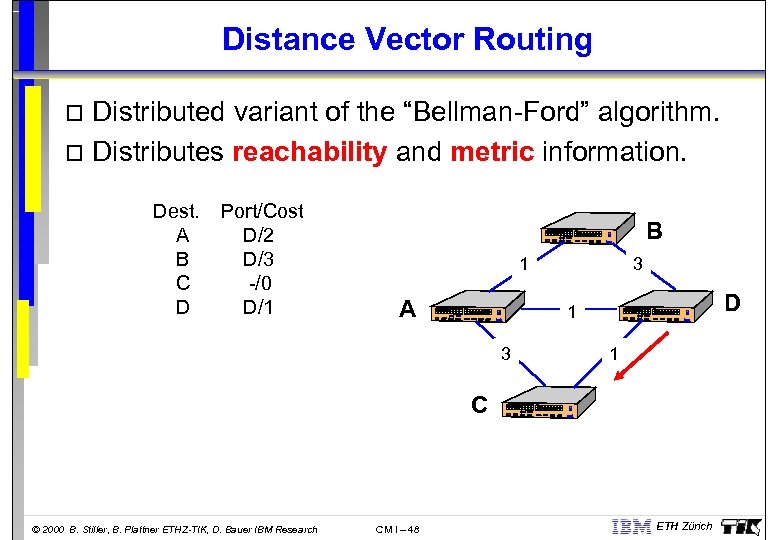 Distance Vector Routing Distributed variant of the “Bellman-Ford” algorithm. o Distributes reachability and metric information. o Dest. A B C C D A D B C C D D Port/Cost D/2 A/3 D/3 A/4 -/0 A/6 D/1 -/0 D/2 D/1 A/4 D/3 -/0 D/2 D/1 B 1 A 3 D 1 3 1 C © 2000 B. Stiller, B. Plattner ETHZ-TIK, D. Bauer IBM Research CM I – 48 ETH Zürich
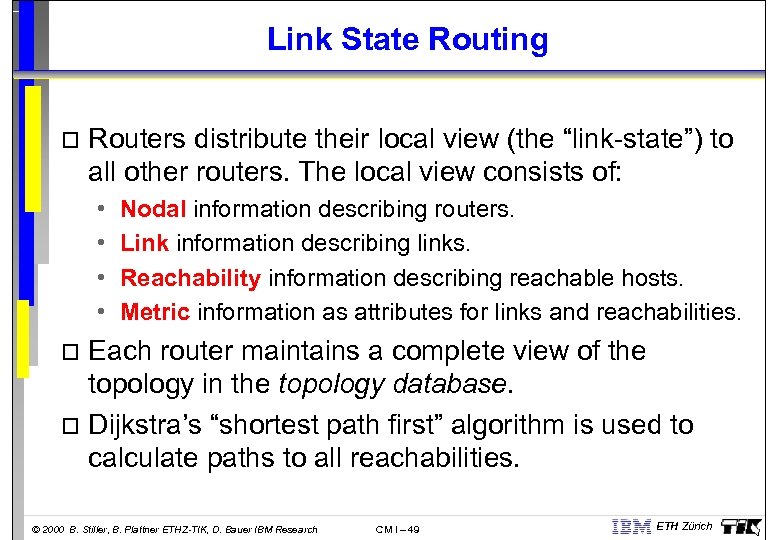 Link State Routing o Routers distribute their local view (the “link-state”) to all other routers. The local view consists of: • • Nodal information describing routers. Link information describing links. Reachability information describing reachable hosts. Metric information as attributes for links and reachabilities. Each router maintains a complete view of the topology in the topology database. o Dijkstra’s “shortest path first” algorithm is used to calculate paths to all reachabilities. o © 2000 B. Stiller, B. Plattner ETHZ-TIK, D. Bauer IBM Research CM I – 49 ETH Zürich
 Link State Routing: Pro and Con Link state routing converges faster than distance vector routing and thus is more scalable. o It provides more functionality: o • Each router knows the full topology, which makes it easier to debug. • Powerful source routing schemes can be implemented. Link state routing is more robust since the topology is described with some redundancy. o It is more complex to implement and requires more memory, CPU power and bandwidth. o © 2000 B. Stiller, B. Plattner ETHZ-TIK, D. Bauer IBM Research CM I – 50 ETH Zürich
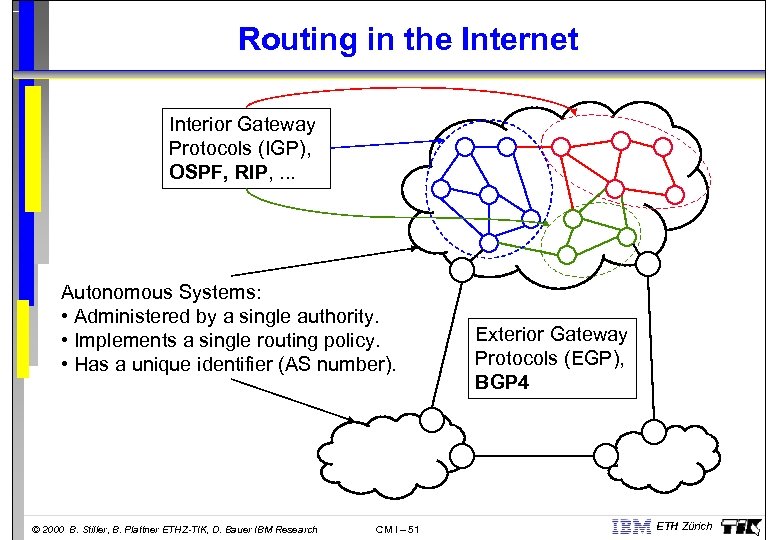 Routing in the Internet Interior Gateway Protocols (IGP), OSPF, RIP, . . . Autonomous Systems: • Administered by a single authority. • Implements a single routing policy. • Has a unique identifier (AS number). © 2000 B. Stiller, B. Plattner ETHZ-TIK, D. Bauer IBM Research CM I – 51 Exterior Gateway Protocols (EGP), BGP 4 ETH Zürich
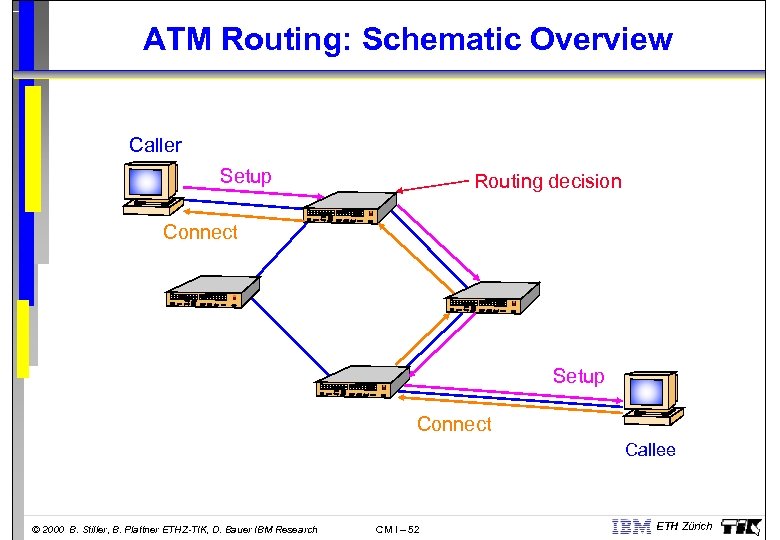 ATM Routing: Schematic Overview Caller Setup Routing decision Connect Setup Connect Callee © 2000 B. Stiller, B. Plattner ETHZ-TIK, D. Bauer IBM Research CM I – 52 ETH Zürich
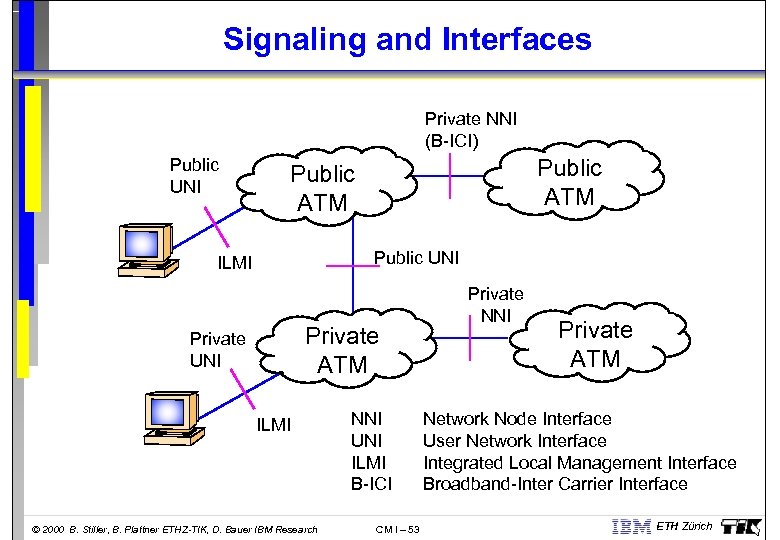 Signaling and Interfaces Private NNI (B-ICI) Public UNI Public ATM Public UNI ILMI Private ATM Private UNI ILMI © 2000 B. Stiller, B. Plattner ETHZ-TIK, D. Bauer IBM Research NNI UNI ILMI B-ICI CM I – 53 Private NNI Private ATM Network Node Interface User Network Interface Integrated Local Management Interface Broadband-Inter Carrier Interface ETH Zürich
 Summary Routing Protocols The Internet uses hierarchical routing based on interior and exterior gateway protocols. o OSPF, the recommended IGP, is a link state routing protocol that uses static metrics. o BGP is the EGP of choice. It is a path vector protocol supporting various routing policies. o The current IP routing protocols do not support dynamic metrics such as available bandwidth. o In ATM, PNNI provides hierarchical routing using link state routing. o PNNI supports dynamic metrics. o © 2000 B. Stiller, B. Plattner ETHZ-TIK, D. Bauer IBM Research CM I – 54 ETH Zürich
 References • • F. Fluckiger: Understanding Networked Multimedia; Prentice Hall, London, England, 1995, ISBN 3– 190992– 4. K. Nahrstedt, R. Steinmetz: Multimedia: Computing, Communications, and Applications; Prentice Hall, Upper Saddle River, New Jersey, U. S. A. , 1995, ISBN 0 -13 -324435 -0. B. Stiller: Quality-of-Service; International Thomson Publishing, Bonn, Germany, 1996, ISBN 3– 8266– 0171– 8. G. Malkin: RIP Version 2; RFC 2453, November 1998. J. Moy: OSPF Version 2, RFC 2328, April 1998 ATM Forum: Private Network-Network Interface Specification 1. 0 (PNNI 1. 0), af-pnni-0055. 000, March 1996 Y. Rekhter, T. Li: A Border Gateway Protocol 4, RFC 1771, March 1995 © 2000 B. Stiller, B. Plattner ETHZ-TIK, D. Bauer IBM Research CM I – 55 ETH Zürich