


 Скачать презентацию Mandarin-English Information MEI Investigating Translingual Speech Retrieval Johns
b489de54342e05b2ad3484eb392c3d85.ppt
- Количество слайдов: 20
 Mandarin-English Information (MEI): Investigating Translingual Speech Retrieval Johns Hopkins University Center of Language and Speech Processing Summer Workshop 2000 Opening Ceremony The MEI Team July 17, 2000
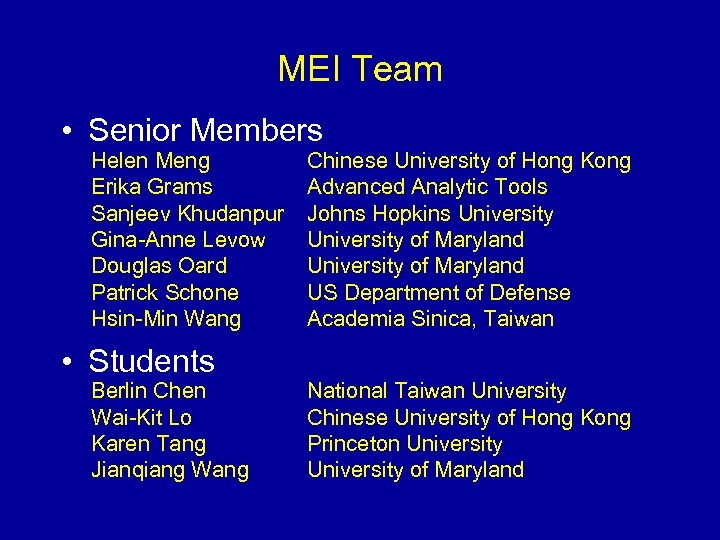 MEI Team • Senior Members Helen Meng Erika Grams Sanjeev Khudanpur Gina-Anne Levow Douglas Oard Patrick Schone Hsin-Min Wang • Students Berlin Chen Wai-Kit Lo Karen Tang Jianqiang Wang Chinese University of Hong Kong Advanced Analytic Tools Johns Hopkins University of Maryland US Department of Defense Academia Sinica, Taiwan National Taiwan University Chinese University of Hong Kong Princeton University of Maryland
 Outline • • Motivation MEI project overview Research challenges System architecture
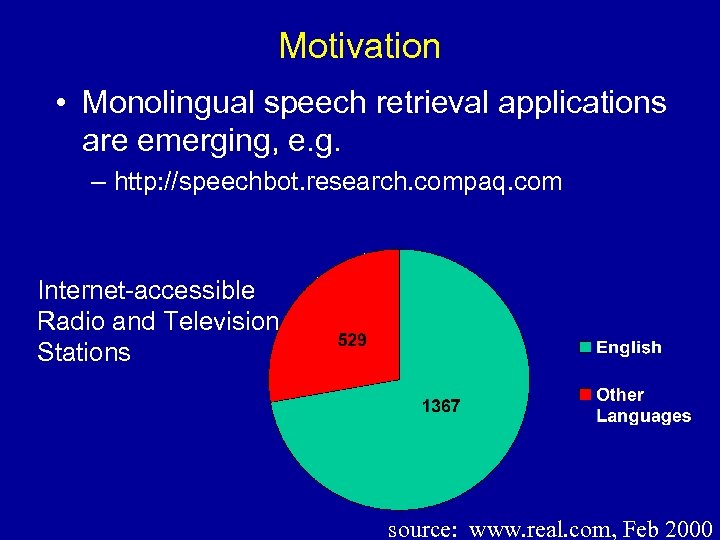 Motivation • Monolingual speech retrieval applications are emerging, e. g. – http: //speechbot. research. compaq. com Internet-accessible Radio and Television Stations source: www. real. com, Feb 2000
 Translingual Speech Retrieval • Allow anyone to find information that is expressed in any spoken language
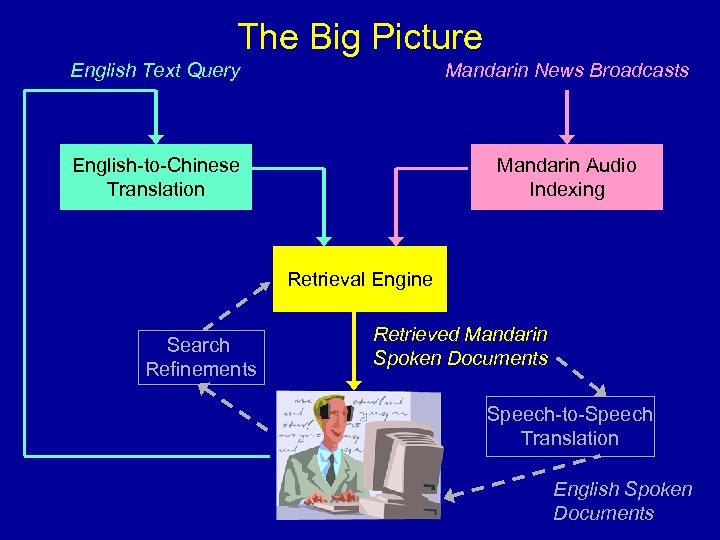 The Big Picture English Text Query Mandarin News Broadcasts English-to-Chinese Translation Mandarin Audio Indexing Retrieval Engine Search Refinements Retrieved Mandarin Spoken Documents Speech-to-Speech Translation English Spoken Documents
 Related Work • TREC Spoken Document Retrieval – Close coupling of recognition and retrieval • TREC Cross-Language Retrieval – Close coupling of translation and retrieval • TDT-3 Topic Tracking – Coupling recognition, translation and retrieval – Using speech recognition transcripts
 The MEI Project • Closely couple recognition and translation – for the purpose of retrieval Research Challenges • Multi-scale audio indexing – Multiple feature sets capture more information • Multi-scale translation – Lexicon and pronunciation are complementary • Multi-scale retrieval – Combination of evidence can add robustness
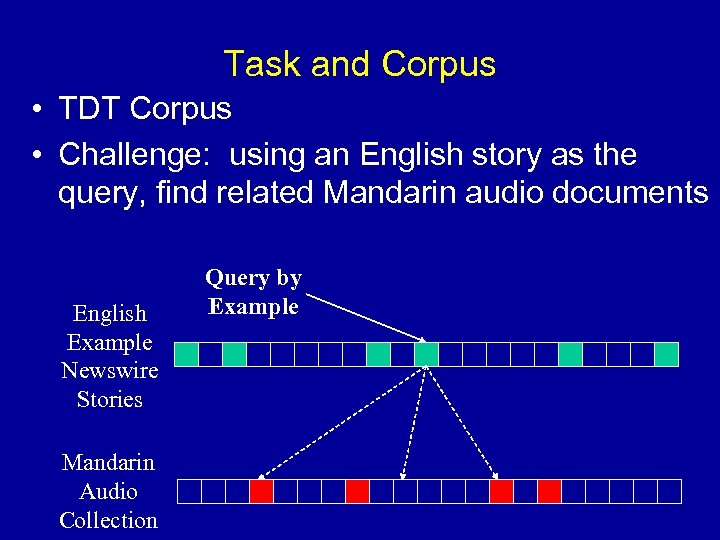 Task and Corpus • TDT Corpus • Challenge: using an English story as the query, find related Mandarin audio documents English Example Newswire Stories Mandarin Audio Collection Query by Example
 Multi-scale Mandarin Processing: Phonological Considerations • Chinese is a syllable-based language • Mandarin is the official Chinese dialect – ~400 base syllables, 4 lexical tones + light tone • Syllable structure (CG)V(X) – (CG): onset, optional, consonant+medial glide – V: nuclear vowel – X: coda, glide / alveolar nasal / velar nasal – ~ 21 initials, 39 finals • Circumvent the OOV problem
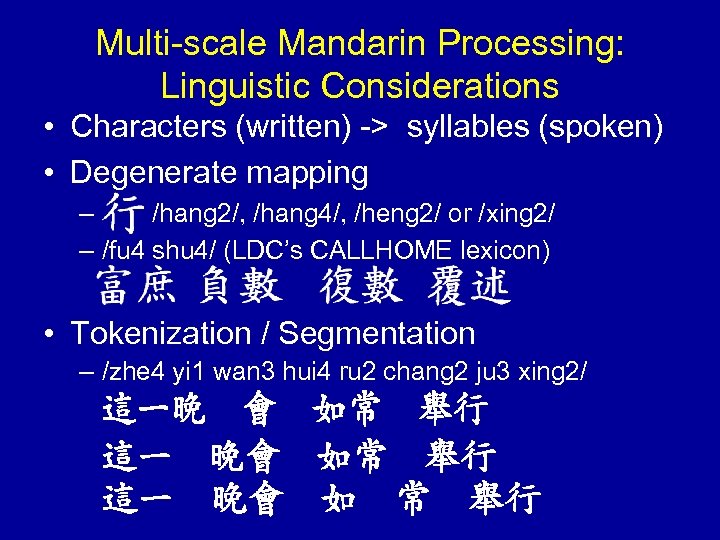 Multi-scale Mandarin Processing: Linguistic Considerations • Characters (written) -> syllables (spoken) • Degenerate mapping – /hang 2/, /hang 4/, /heng 2/ or /xing 2/ – /fu 4 shu 4/ (LDC’s CALLHOME lexicon) • Tokenization / Segmentation – /zhe 4 yi 1 wan 3 hui 4 ru 2 chang 2 ju 3 xing 2/
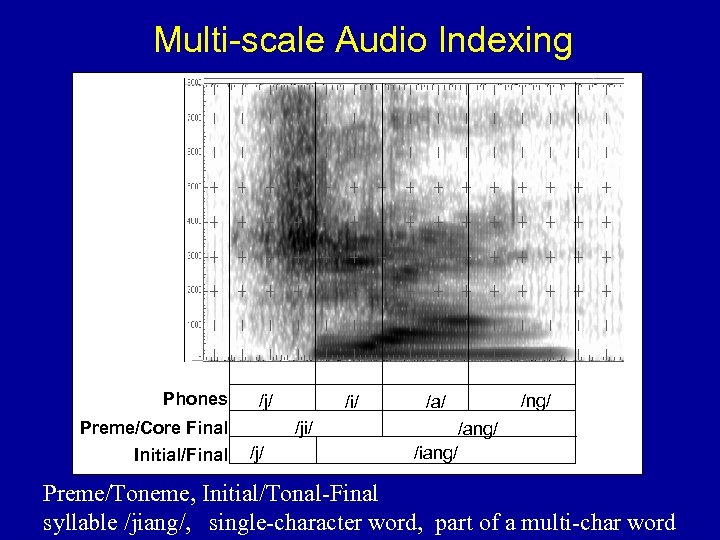 Multi-scale Audio Indexing Phones Preme/Core Final Initial/Final /j/ /i/ /j/ /ng/ /ang/ /iang/ Preme/Toneme, Initial/Tonal-Final syllable /jiang/, single-character word, part of a multi-char word
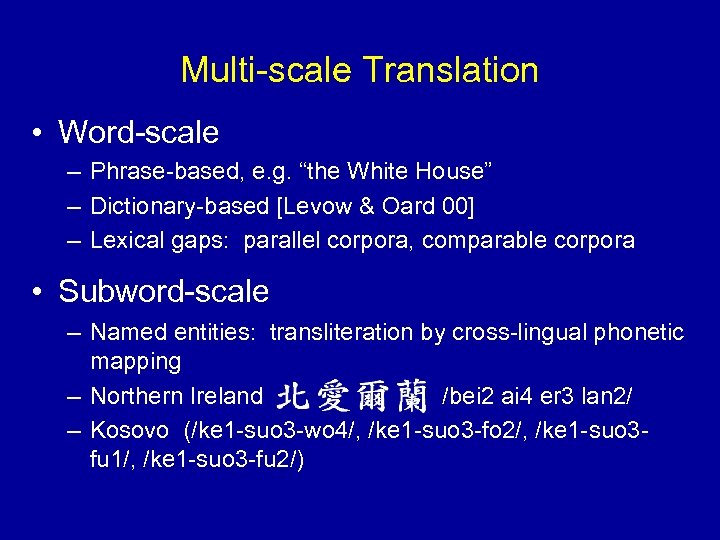 Multi-scale Translation • Word-scale – Phrase-based, e. g. “the White House” – Dictionary-based [Levow & Oard 00] – Lexical gaps: parallel corpora, comparable corpora • Subword-scale – Named entities: transliteration by cross-lingual phonetic mapping – Northern Ireland /bei 2 ai 4 er 3 lan 2/ – Kosovo (/ke 1 -suo 3 -wo 4/, /ke 1 -suo 3 -fo 2/, /ke 1 -suo 3 fu 1/, /ke 1 -suo 3 -fu 2/)
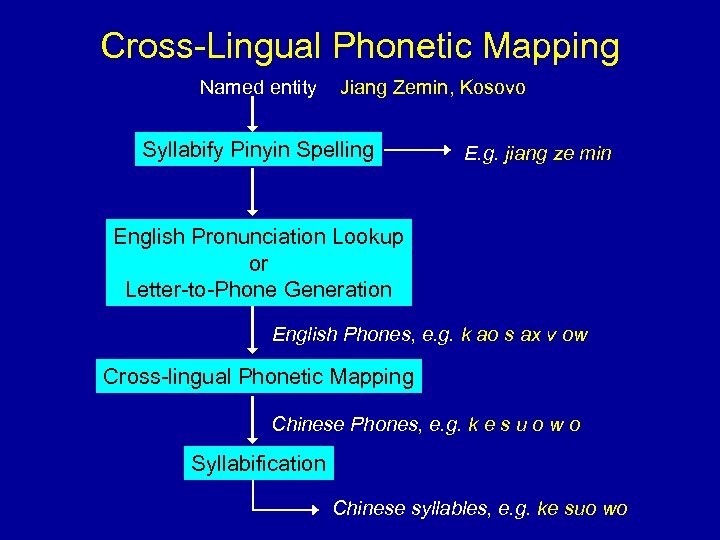 Cross-Lingual Phonetic Mapping Named entity Jiang Zemin, Kosovo Syllabify Pinyin Spelling E. g. jiang ze min English Pronunciation Lookup or Letter-to-Phone Generation English Phones, e. g. k ao s ax v ow Cross-lingual Phonetic Mapping Chinese Phones, e. g. k e s u o w o Syllabification Chinese syllables, e. g. ke suo wo
 Multi-scale Retrieval • Word-scale exploits lexical knowledge – Enhances precision • Subwords can achieve complete coverage – Enhances recall • Combination of evidence may be best – If a good merging strategy can be found
 Merging Strategies • Loose coupling – Separate retrieval runs – Merge ranked lists [Voorhees 1995] • Tight coupling – Unified indexing of words and subwords – Single ranked list – [Ng 2000]
![Multi-scale Retrieval Techniques • Subword-scale – Syllable lattice matching [Chen, Wang & Lee 2000]](https://present5.com/presentation/b489de54342e05b2ad3484eb392c3d85/image-17.jpg "Multi-scale Retrieval Techniques • Subword-scale – Syllable lattice matching [Chen, Wang & Lee 2000]") Multi-scale Retrieval Techniques • Subword-scale – Syllable lattice matching [Chen, Wang & Lee 2000] – Overlapping syllable n-grams [Meng et al. 1999] – Syllable confusion matrix [Meng et al. 1999] • Word-scale – Structured queries [Pirkola 1998] – Structured translation [Sperer & Oard 2000] • Robust Retrieval – speech recognition errors – translation / transliteration ambiguities
Multi-scale Retrieval Techniques • Subword-scale – Syllable lattice matching [Chen, Wang & Lee 2000] – Overlapping syllable n-grams [Meng et al. 1999] – Syllable confusion matrix [Meng et al. 1999] • Word-scale – Structured queries [Pirkola 1998] – Structured translation [Sperer & Oard 2000] • Robust Retrieval – speech recognition errors – translation / transliteration ambiguities
 Research Plan • “MEI: Mandarin-English Information”, Proceedings of the TDT Workshop, 2000. • “Mandarin-English Information (MEI): Investigating Translingual Retrieval” Proceedings of the NAACL Workshop on Embedded Machine Translation, 2000
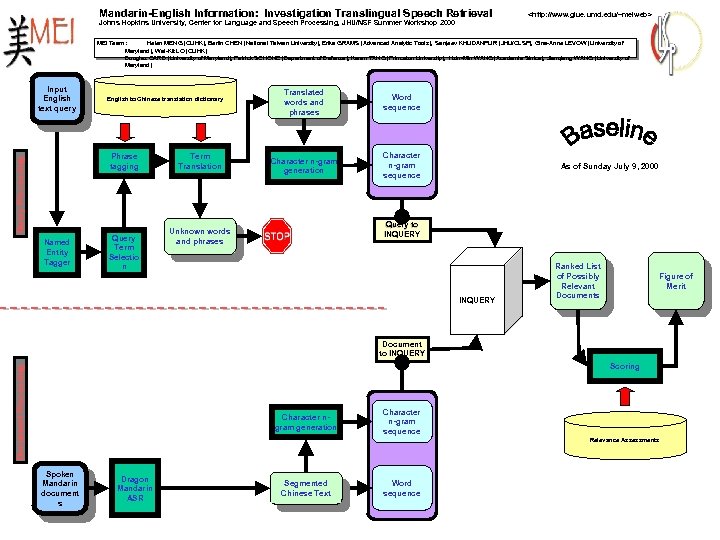 Mandarin-English Information: Investigation Translingual Speech Retrieval
 END
END