 Скачать презентацию Managing the University IP Office Nairobi the 31
974c34eb8cc6adbd9c80680f0bd4d285.ppt
- Количество слайдов: 45



Managing the University IP Office Nairobi, the 31 st March 2009 Regional Forum on the Role of Patents and the PCT in research in Developing Countries Marta Catarino Tec. Minho Universidade do Minho
Agenda n n n Different IP/TT Office Models Defining a model for a Tech Transfer Office Reaching the market through Entrepreneurship
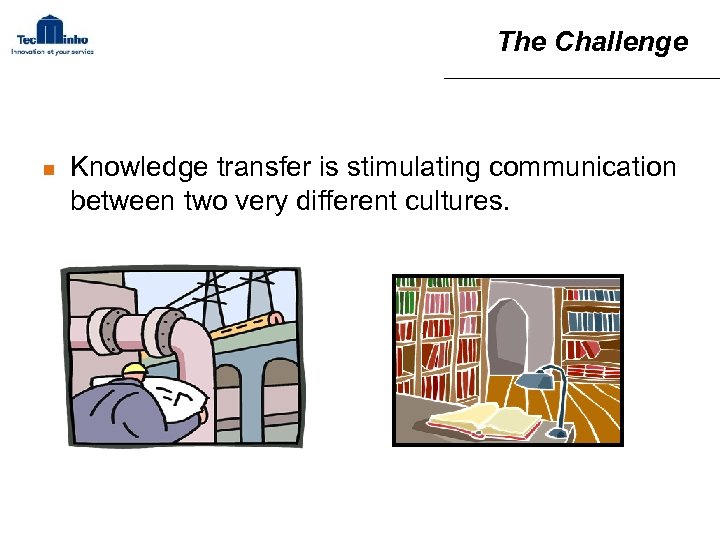
The Challenge n Knowledge transfer is stimulating communication between two very different cultures.
The Challenge n The Technology Transfer Office (IP Office, Knowledge Transfer Office) provides this much needed support.
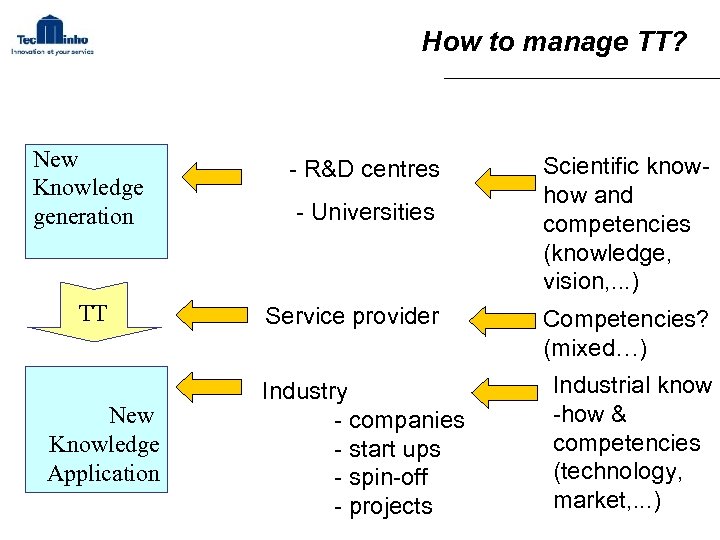
How to manage TT? New Knowledge generation TT New Knowledge Application - R&D centres - Universities Service provider Industry - companies - start ups - spin-off - projects Scientific knowhow and competencies (knowledge, vision, . . . ) Competencies? (mixed…) Industrial know -how & competencies (technology, market, . . . )
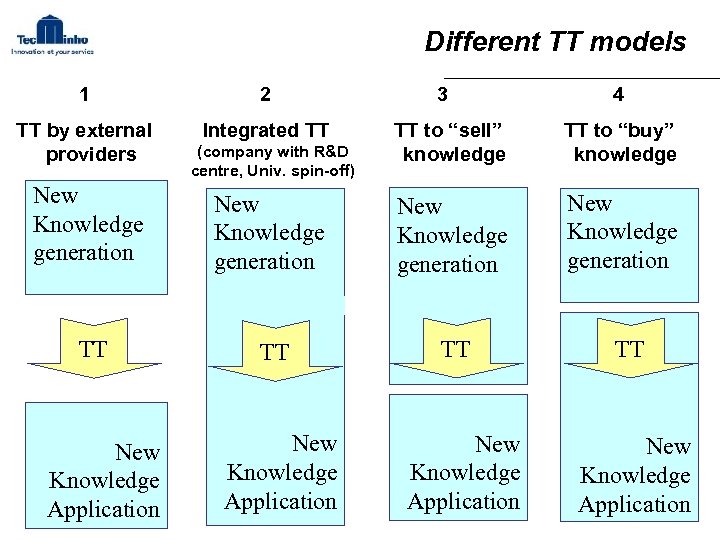
Different TT models 1 2 TT by external providers Integrated TT (company with R&D centre, Univ. spin-off) 3 TT to “sell” knowledge TT to “buy” knowledge New Knowledge generation TT TT TT New Knowledge Application 4 New Knowledge Application TT New Knowledge Application
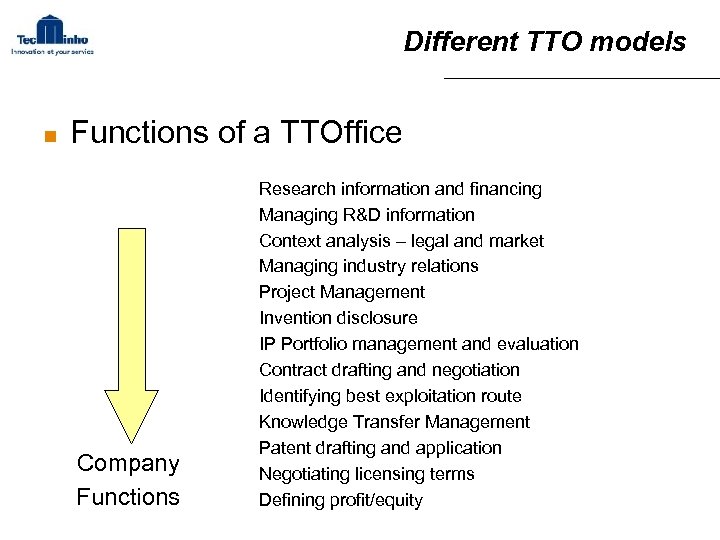
Different TTO models n Functions of a TTOffice Company Functions Research information and financing Managing R&D information Context analysis – legal and market Managing industry relations Project Management Invention disclosure IP Portfolio management and evaluation Contract drafting and negotiation Identifying best exploitation route Knowledge Transfer Management Patent drafting and application Negotiating licensing terms Defining profit/equity
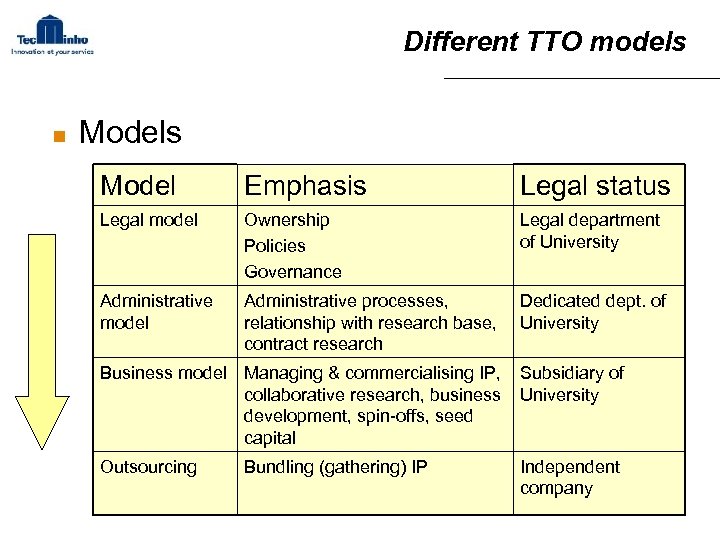
Different TTO models n Models Model Emphasis Legal status Legal model Ownership Policies Governance Legal department of University Administrative model Administrative processes, relationship with research base, contract research Dedicated dept. of University Business model Managing & commercialising IP, collaborative research, business development, spin-offs, seed capital Subsidiary of University Outsourcing Independent company Bundling (gathering) IP
Agenda n n n Different IP/TT Office Models Defining a model for a Tech Transfer Office Reaching the market through Entrepreneurship
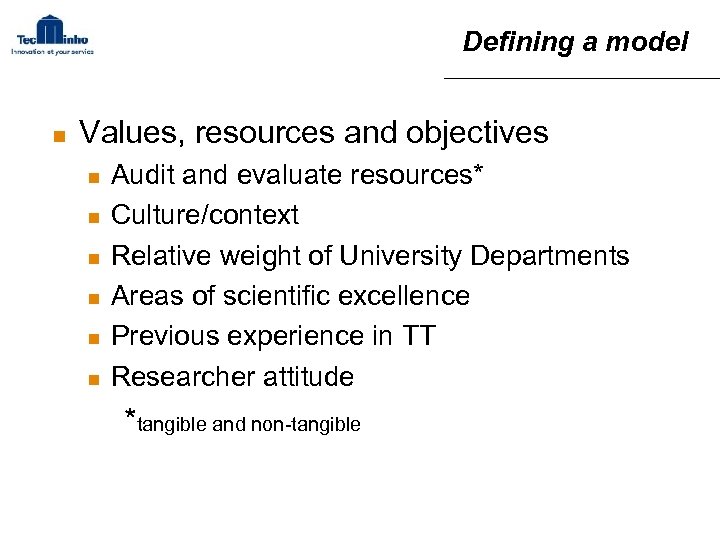
Defining a model n Values, resources and objectives n n n Audit and evaluate resources* Culture/context Relative weight of University Departments Areas of scientific excellence Previous experience in TT Researcher attitude *tangible and non-tangible
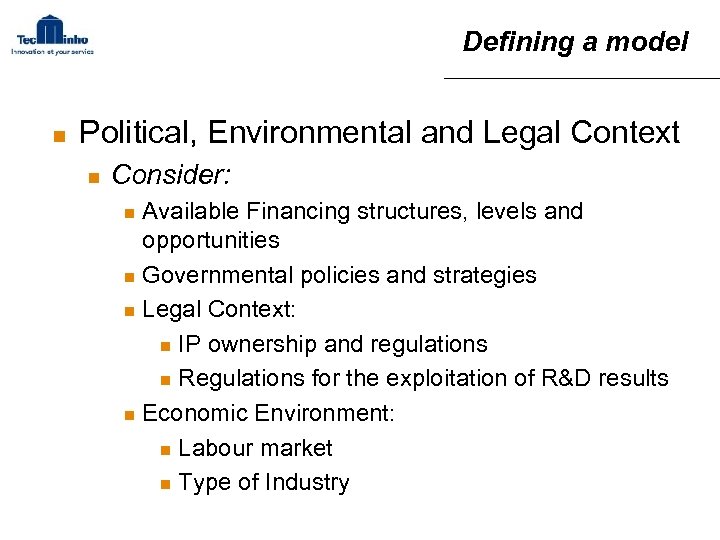
Defining a model n Political, Environmental and Legal Context n Consider: Available Financing structures, levels and opportunities n Governmental policies and strategies n Legal Context: n IP ownership and regulations n Regulations for the exploitation of R&D results n Economic Environment: n Labour market n Type of Industry n
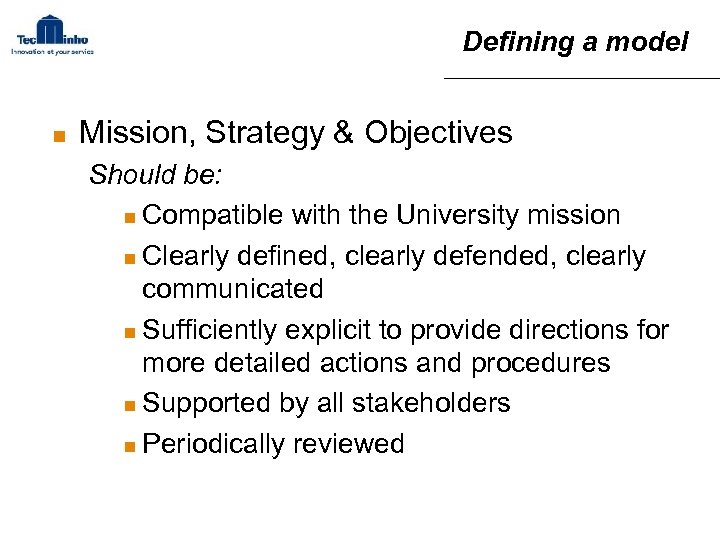
Defining a model n Mission, Strategy & Objectives Should be: n Compatible with the University mission n Clearly defined, clearly defended, clearly communicated n Sufficiently explicit to provide directions for more detailed actions and procedures n Supported by all stakeholders n Periodically reviewed
Defining a model n Internal Objectives What are the TTOffice objectives? n Generate research funding n Encourage innovation in faculty, researchers and students n Reward, retain & recruit faculty and students n Create employment opportunities in S&T areas for graduates n Facilitate the setting-up of spin-off companies
Aligning the Structures n n n n n What does the University expect from TT? Who is responsible for which objectives? What level of responsibility? How are TT processes structured and supported? What processes exist to identify and evaluate IP? What processes are in place for its exploitation? Who decides on how it should be exploited? Using which criteria? How are these processes controlled?
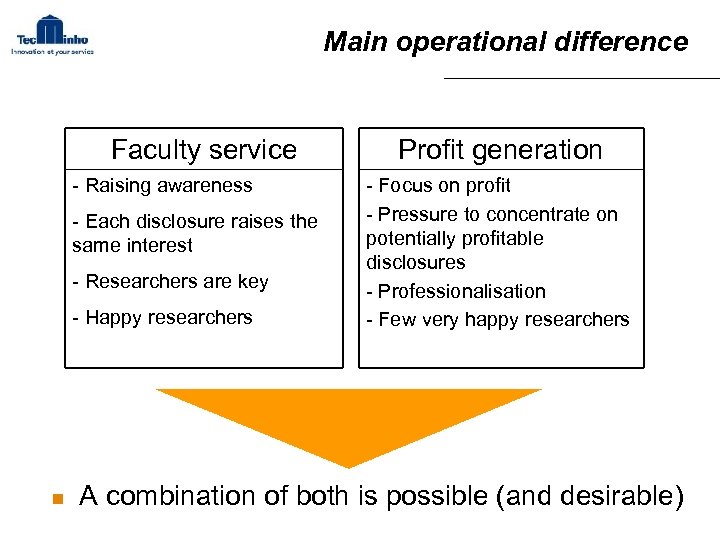
Main operational difference Faculty service - Raising awareness - Each disclosure raises the same interest - Researchers are key - Happy researchers n Profit generation - Focus on profit - Pressure to concentrate on potentially profitable disclosures - Professionalisation - Few very happy researchers A combination of both is possible (and desirable)
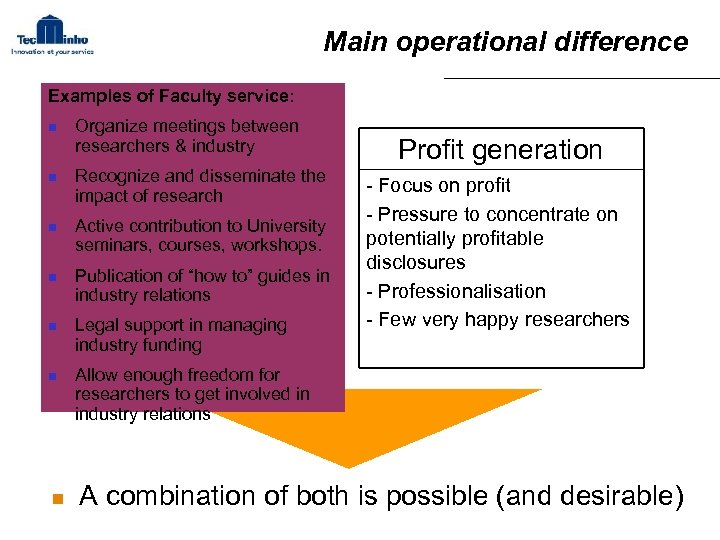
Main operational difference Examples of Faculty service: n n n n Organize meetings between researchers & industry Recognize and disseminate the impact of research Active contribution to University seminars, courses, workshops. Publication of “how to” guides in industry relations Legal support in managing industry funding Profit generation - Focus on profit - Pressure to concentrate on potentially profitable disclosures - Professionalisation - Few very happy researchers Allow enough freedom for researchers to get involved in industry relations A combination of both is possible (and desirable)
How to start? (the Research side) n Know the rules of the game: n n n internal context, external context, Mission, strategy and objectives n Know what you have to offer n Know who the clients are and what are their needs n Identify (and involve) who can support: financing schemes, governmental support, development funding, industrial associations, chambers of commerce, banks…
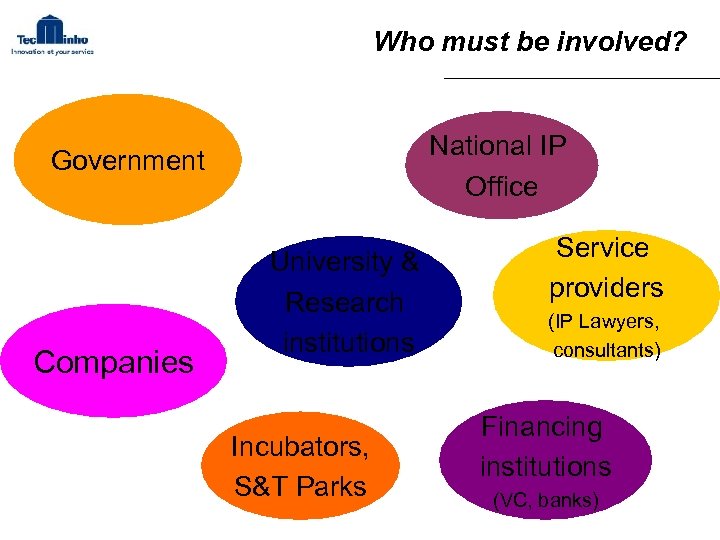
Who must be involved? National IP Office Government Companies University & Research institutions Incubators, S&T Parks Service providers (IP Lawyers, consultants) Financing institutions (VC, banks)
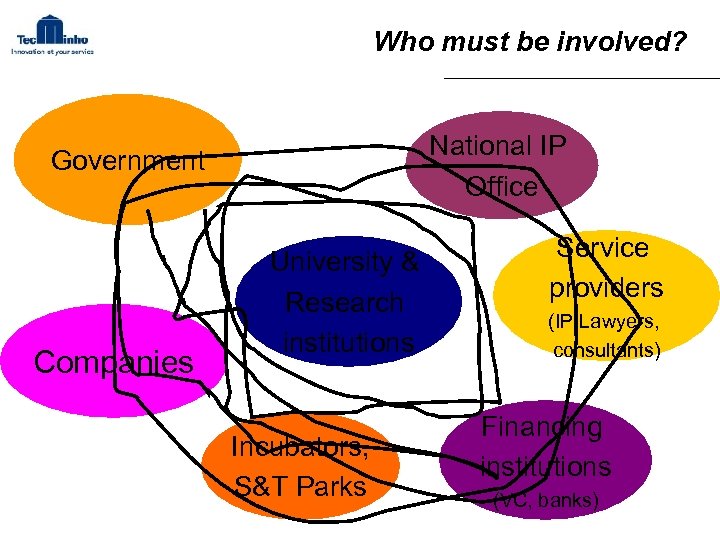
Who must be involved? National IP Office Government Companies University & Research institutions Incubators, S&T Parks Service providers (IP Lawyers, consultants) Financing institutions (VC, banks)
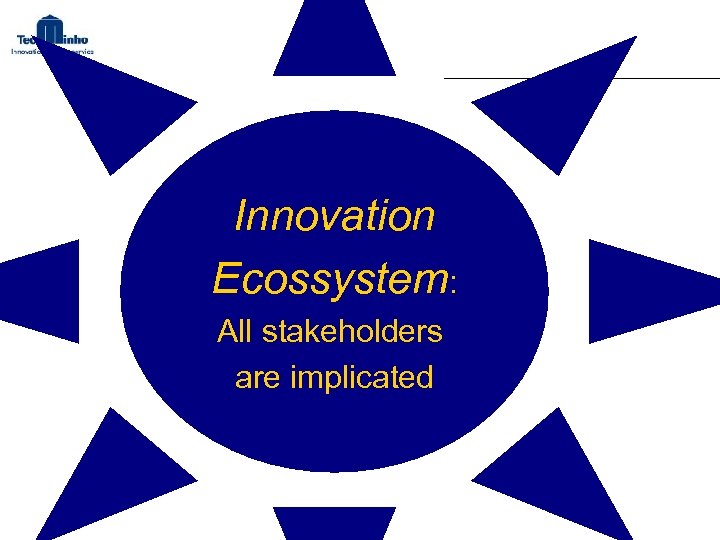
Innovation Ecossystem: All stakeholders are implicated
Remarks on the regional level Importance of structuring partnerships at regional level (top -down approach), as adequate framework for bottom-up long-term partnerships Importance of measuring outcomes of strategic partnerships in the regional context (cost-effectiveness) Design new partnerships or cooperation models inspired in the best practices available, but always addressing the specific regional situation (it is not possible to create “Silicon Valleys” everywhere!)
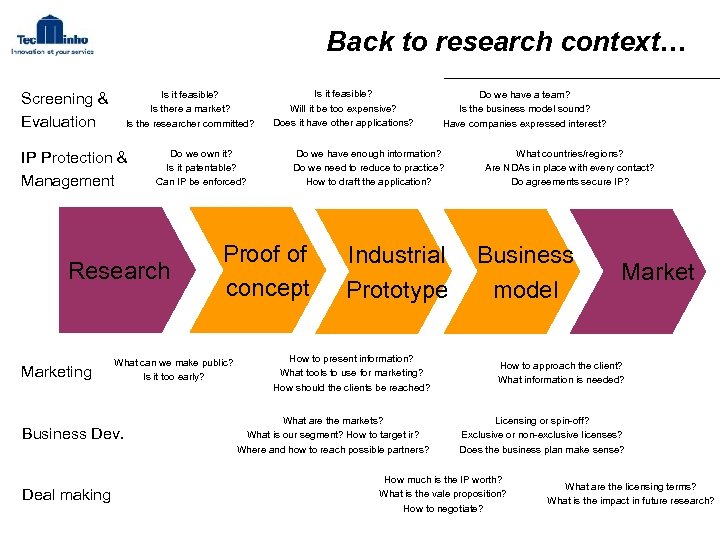
Back to research context… Is it feasible? Is there a market? Is the researcher committed? Screening & Evaluation IP Protection & Management Do we own it? Is it patentable? Can IP be enforced? Research Marketing Deal making Do we have a team? Is the business model sound? Have companies expressed interest? Do we have enough intormation? Do we need to reduce to practice? How to draft the application? Proof of concept What can we make public? Is it too early? Business Dev. Is it feasible? Will it be too expensive? Does it have other applications? Industrial Prototype What countries/regions? Are NDAs in place with every contact? Do agreements secure IP? Business model Market How to present information? What tools to use for marketing? How should the clients be reached? How to approach the client? What information is needed? What are the markets? What is our segment? How to target ir? Where and how to reach possible partners? Licensing or spin-off? Exclusive or non-exclusive licenses? Does the business plan make sense? How much is the IP worth? What is the vale proposition? How to negotiate? What are the licensing terms? What is the impact in future research?
Intellectual Property Policy n n A clear (and reasonable) IP Policy is vital to the establishment of an effective Tech Transfer activity within the University. It allows n n To define ownership (University? Researchers? What about students? ) To motivate researchers by providing incentives To clarify interinstitutional collaboration To facilitate understanding by industry of the ways of University…
Invention disclosure n n If the TTOffice is to manage the IP Portfolio, it must know what the University is doing. Is there a clear process for disclosing new inventions that might be patented? n n Is this information centralised? Meetings with Research Centre Directors? Visits to all researchers? Internal “call for papers”?
Invention disclosure n The disclosure has 2 objectives: n n Internal: Identify technologies/know-how from the University in order to know what can be transferred to industry External: comunicate to industry what the University has to offer – Technology Marketing
Invention disclosure n n Internal: Identify technologies/know-how from the University to transfer to industry – who is doing what? Is it new? Does it have advantages? Can it be applied and by whom? Can it be patented? External: communicate to industry what the University has to offer – who can be interested in this know-how? How can it be applied? What are the expected results? What is the roadmap to bring it to market?
Invention disclosure n n n If the previous questions can’t be answered (in some way), it’s not an invention disclosure The less resources you have, the earlier in the research process you have to work on Scientifically valuable and patentable results may not be commercially relevant n Lack of market kills the business n Industrial validation by companies asap! n Protect IP whenever possible
Some Best Practices n Invention pipeline n n n Identify most promising scientific areas Thorough and timely Disclosure to enable IP protection Clearly defined IP Policy n n Investment in support to research and TT n n Who owns the technology? Which rights? Professional team and professional management of processes Internal delimitation of responsibilities
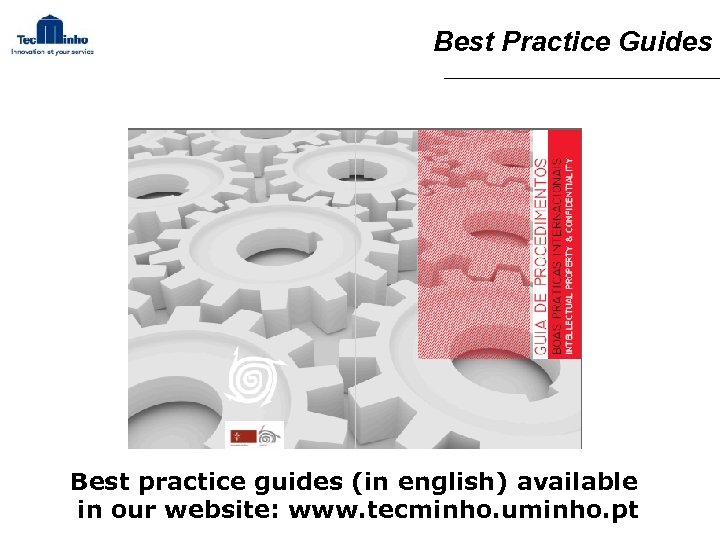
Best Practice Guides Best practice guides (in english) available in our website: www. tecminho. uminho. pt
Agenda n n n Different IP/TT Office Models Defining a model for a Tech Transfer Office Reaching the market through Entrepreneurship
Entrepreneurship at UMinho n 3 levels of Academic Entrepreneurship n n n Entrepreneurship - a subject itself Training and supporting entrepreneurship starting new businesses spin-offs The entrepreneurial university - creation and maintenance of an enterprising culture
Entrepreneurship at UMinho n Entrepreneurship activities are carried out following 3 axis: n n n Raising Awareness Training and Coaching Direct support
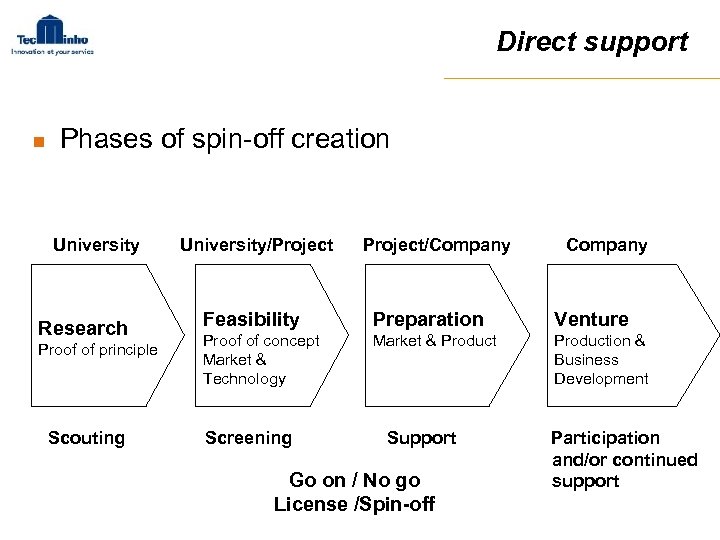
Direct support n Phases of spin-off creation University Research Proof of principle Scouting University/Project/Company Feasibility Preparation Venture Proof of concept Market & Technology Market & Production & Business Development Screening Support Go on / No go License /Spin-off Participation and/or continued support
Direct support Entrepreneurship is about people: Awareness and motivation is essential!
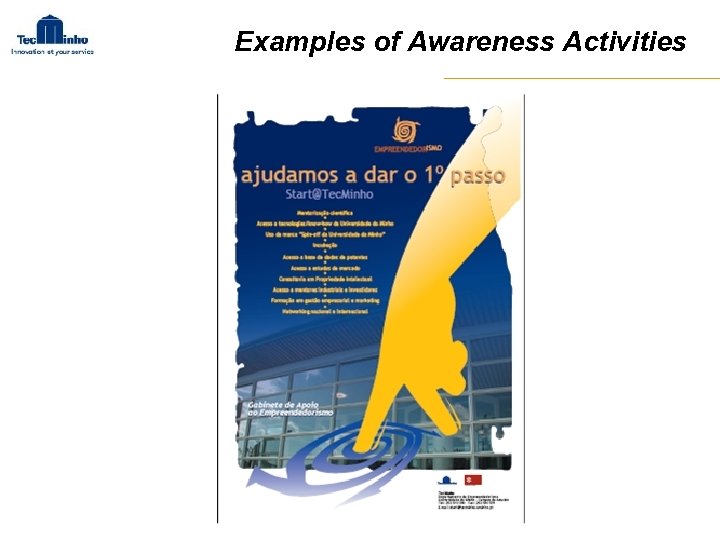
Examples of Awareness Activities
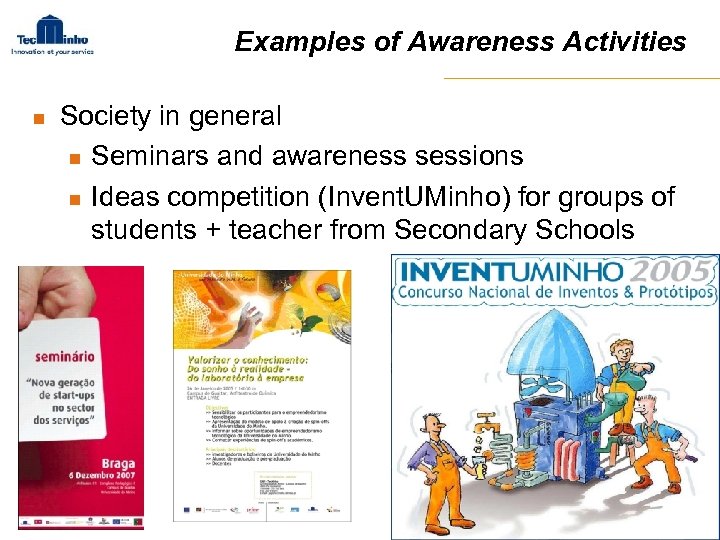
Examples of Awareness Activities n Society in general n Seminars and awareness sessions n Ideas competition (Invent. UMinho) for groups of students + teacher from Secondary Schools
Examples of Awareness Activities n Graduate students n Seminars and awareness sessions n Project Based Learning including evaluating market potential of technologies and pre. Business Plan to start companies n Campus companies
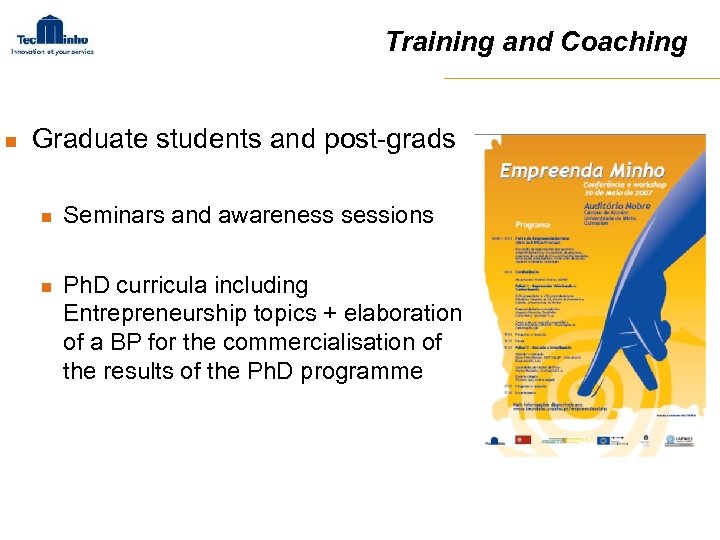
Training and Coaching n Graduate students and post-grads n n Seminars and awareness sessions Ph. D curricula including Entrepreneurship topics + elaboration of a BP for the commercialisation of the results of the Ph. D programme
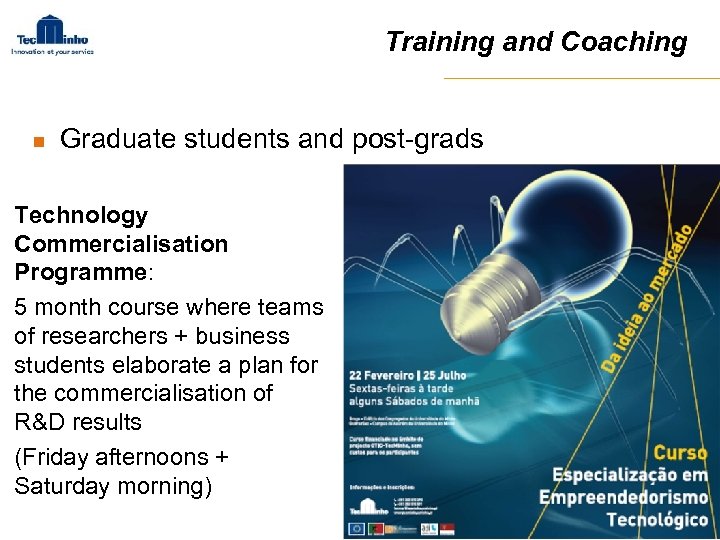
Training and Coaching n Graduate students and post-grads Technology Commercialisation Programme: 5 month course where teams of researchers + business students elaborate a plan for the commercialisation of R&D results (Friday afternoons + Saturday morning)
Spin-off creation n Entrepreneurs must have a link to the University of Minho: n n n teaching staff; researchers; under-graduation and post-graduation students; recent graduates; technical personnel.
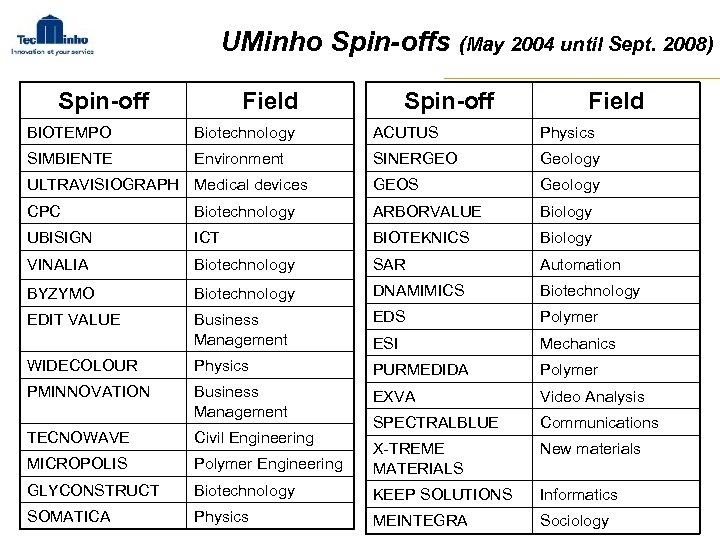
UMinho Spin-offs (May 2004 until Sept. 2008) Spin-off Field BIOTEMPO Biotechnology ACUTUS Physics SIMBIENTE Environment SINERGEO Geology ULTRAVISIOGRAPH Medical devices GEOS Geology CPC Biotechnology ARBORVALUE Biology UBISIGN ICT BIOTEKNICS Biology VINALIA Biotechnology SAR Automation BYZYMO Biotechnology DNAMIMICS Biotechnology EDIT VALUE Business Management EDS Polymer ESI Mechanics WIDECOLOUR Physics PURMEDIDA Polymer PMINNOVATION Business Management EXVA Video Analysis SPECTRALBLUE Communications New materials TECNOWAVE Civil Engineering MICROPOLIS Polymer Engineering X-TREME MATERIALS GLYCONSTRUCT Biotechnology KEEP SOLUTIONS Informatics SOMATICA Physics MEINTEGRA Sociology
UMinho Spin-offs
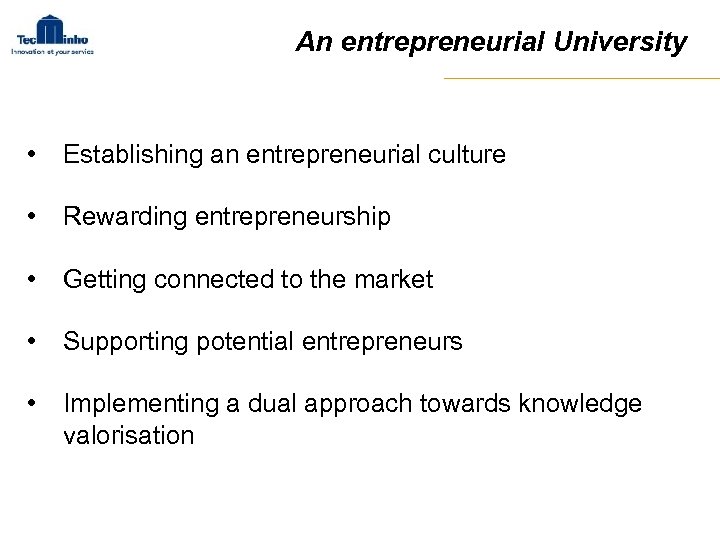
An entrepreneurial University • Establishing an entrepreneurial culture • Rewarding entrepreneurship • Getting connected to the market • Supporting potential entrepreneurs • Implementing a dual approach towards knowledge valorisation
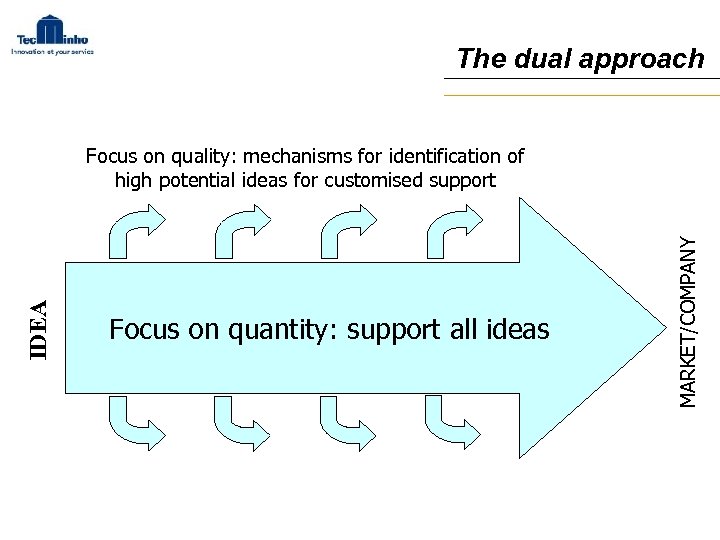
The dual approach Focus on quantity: support all ideas MARKET/COMPANY IDEA Focus on quality: mechanisms for identification of high potential ideas for customised support
n n Thank you very much for your attention! Je vous remercie de votre patience! Marta Catarino TECMINHO Universidade do Minho Portugal mcatarino@tecminho. uminho. pt
Скачать презентацию Managing the University IP Office Nairobi the 31
974c34eb8cc6adbd9c80680f0bd4d285.ppt