


 Скачать презентацию Managing the System PPT SOURCE Shari L
2c588bfe9dea8f3f3f3b85d0256dc10b.ppt
- Количество слайдов: 30
 Managing the System PPT SOURCE : Shari L. Pfleeger Joann M. Atlee
 11. 4 Measuring Maintenance Characteristics • Maintainability is not only restricted to code, but also including specification, design and test plan documentations • Maintainability can be viewed in two ways – External view of the software: users, person performing maintenance – Internal view of the software: measuring before delivery Pfleeger and Atlee, Software Engineering: Theory and Practice 2
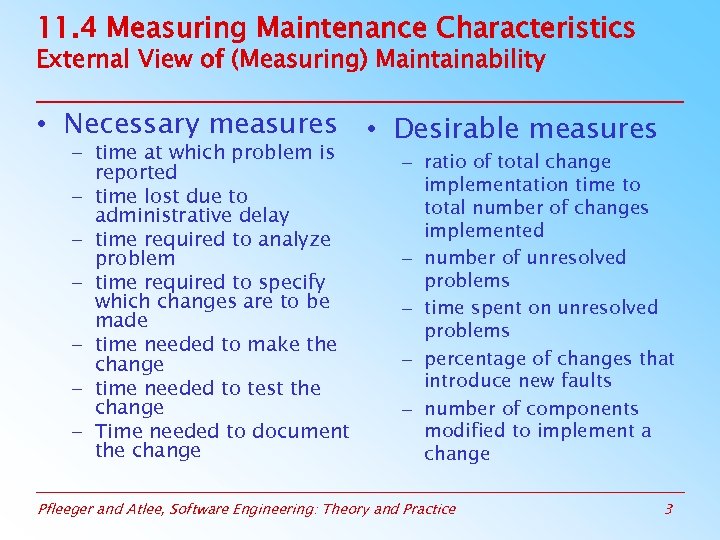 11. 4 Measuring Maintenance Characteristics External View of (Measuring) Maintainability • Necessary measures • Desirable measures – time at which problem is reported – time lost due to administrative delay – time required to analyze problem – time required to specify which changes are to be made – time needed to make the change – time needed to test the change – Time needed to document the change – ratio of total change implementation time to total number of changes implemented – number of unresolved problems – time spent on unresolved problems – percentage of changes that introduce new faults – number of components modified to implement a change Pfleeger and Atlee, Software Engineering: Theory and Practice 3
 11. 4 Measuring Maintenance Characteristics Internal Attributes Affecting Maintainability • Cyclomatic number (Mc. Cabe, 1976) – The structural complexity of the source code • linearly independent path – Based on graph theoretic concept Pfleeger and Atlee, Software Engineering: Theory and Practice 4
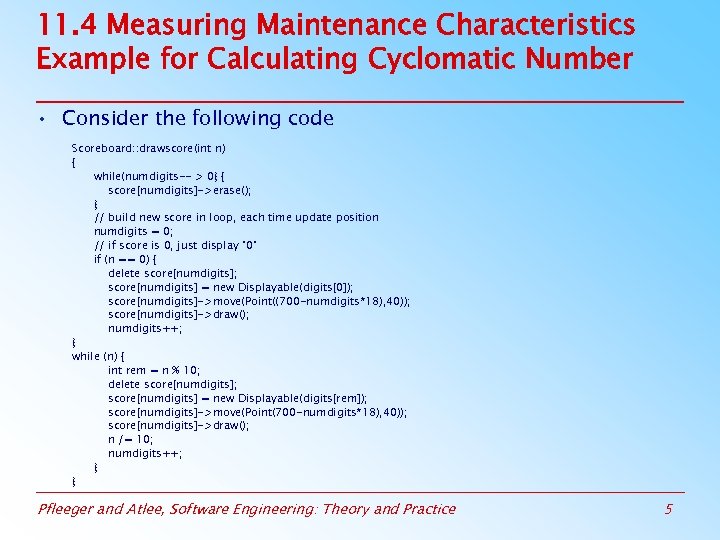 11. 4 Measuring Maintenance Characteristics Example for Calculating Cyclomatic Number • Consider the following code Scoreboard: : drawscore(int n) { while(numdigits-- > 0} { score[numdigits]->erase(); } // build new score in loop, each time update position numdigits = 0; // if score is 0, just display “ 0” if (n == 0) { delete score[numdigits]; score[numdigits] = new Displayable(digits[0]); score[numdigits]->move(Point((700 -numdigits*18), 40)); score[numdigits]->draw(); numdigits++; } while (n) { int rem = n % 10; delete score[numdigits]; score[numdigits] = new Displayable(digits[rem]); score[numdigits]->move(Point(700 -numdigits*18), 40)); score[numdigits]->draw(); n /= 10; numdigits++; } } Pfleeger and Atlee, Software Engineering: Theory and Practice 5
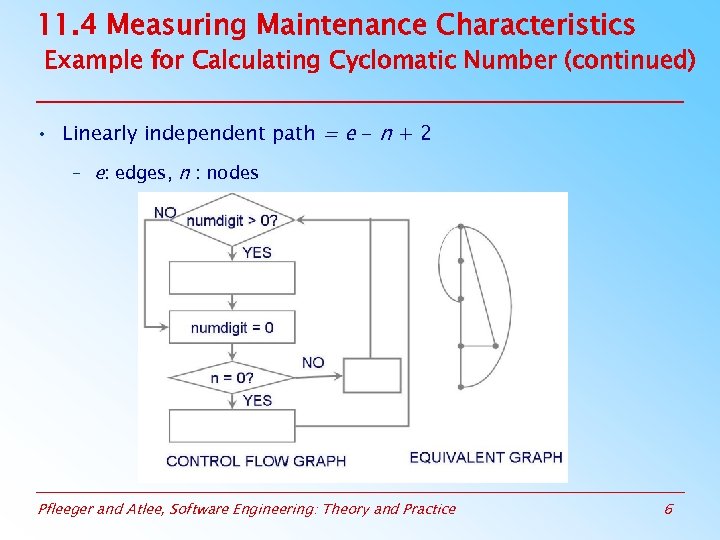 11. 4 Measuring Maintenance Characteristics Example for Calculating Cyclomatic Number (continued) • Linearly independent path = e - n + 2 – e: edges, n : nodes Pfleeger and Atlee, Software Engineering: Theory and Practice 6
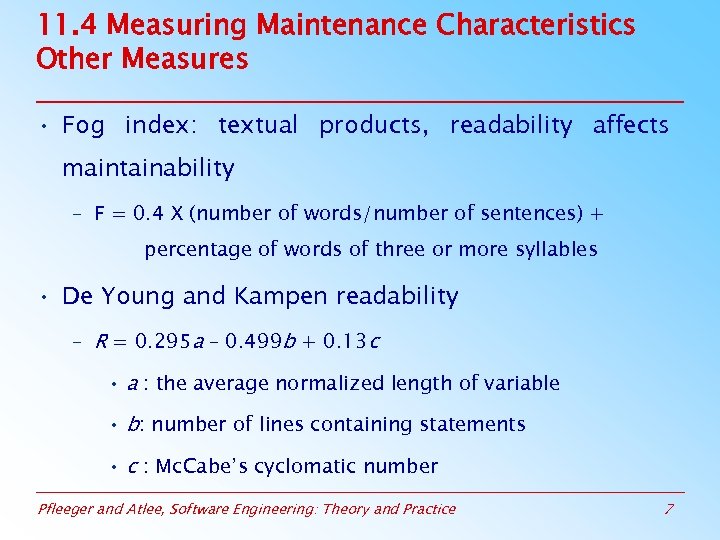 11. 4 Measuring Maintenance Characteristics Other Measures • Fog index: textual products, readability affects maintainability – F = 0. 4 X (number of words/number of sentences) + percentage of words of three or more syllables • De Young and Kampen readability – R = 0. 295 a – 0. 499 b + 0. 13 c • a : the average normalized length of variable • b: number of lines containing statements • c : Mc. Cabe’s cyclomatic number Pfleeger and Atlee, Software Engineering: Theory and Practice 7
 11. 4 Measuring Maintenance Characteristics Sidebar 11. 5 Maintenance Measures at Hewlett-Packard • Used maintainability index – Index was calibrated with a large number of metrics – A tailored polynomial index was calculated using extended cyclomatic number, lines of code, number of comments, and an effort measure – The polynomial was applied to 714 components containing 236, 000 lines of C code developed by third party Pfleeger and Atlee, Software Engineering: Theory and Practice 8
 11. 5 Maintenance Techniques and Tools • Configuration management – Configuration control board – Change control • Impact analysis • Automated maintenance tools Pfleeger and Atlee, Software Engineering: Theory and Practice 9
 11. 5 Maintenance Techniques and Tools Configuration Control Process • Problem discovered by or change requested by user/customer/developer, and recorded • Change reported to the configuration control board • CCB discusses problem: determines nature of change, who should pay • CCB discusses source of problem, scope of change, time to fix; they assign severity/priority and analyst to fix • Analyst makes change on test copy • Analyst works with librarian to control installation of change • Analyst files change report Pfleeger and Atlee, Software Engineering: Theory and Practice 10
 11. 5 Maintenance Techniques and Tools Change Control Issues • Synchronization: When was the change made? • Identification: Who made the change? • Naming: What components of the system were changed? • Authentication: Was the change made correctly? • Authorization: Who authorized that the change be made? • Routing: Who was notified of the change? • Cancellation: Who cancel the request for change? • Delegation: Who is responsible for the change? • Valuation: What is the priority of the change? Pfleeger and Atlee, Software Engineering: Theory and Practice 11
 11. 5 Maintenance Techniques and Tools Impact Analysis • The evaluation of many risks associated with the change, including estimates of effects on resources, effort, and schedule • Helps control maintenance cost Pfleeger and Atlee, Software Engineering: Theory and Practice 12
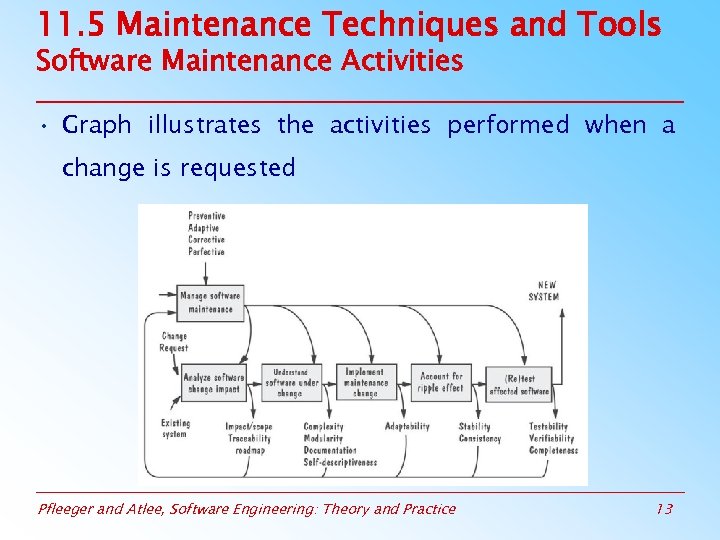 11. 5 Maintenance Techniques and Tools Software Maintenance Activities • Graph illustrates the activities performed when a change is requested Pfleeger and Atlee, Software Engineering: Theory and Practice 13
 11. 5 Maintenance Techniques and Tools Measuring Impact of Change • Workproduct: any development artifact whose change is significant • Horizontal traceability: relationships of components across collections of workproducts • Vertical traceability: relationships among parts of a workproduct Pfleeger and Atlee, Software Engineering: Theory and Practice 14
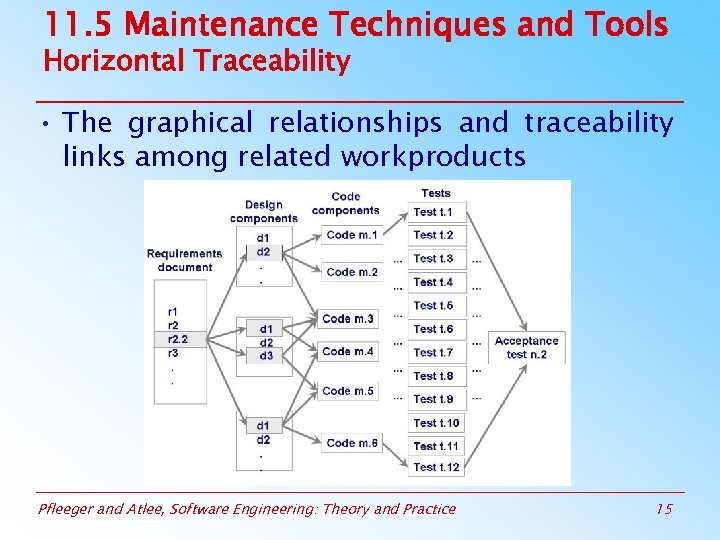 11. 5 Maintenance Techniques and Tools Horizontal Traceability • The graphical relationships and traceability links among related workproducts Pfleeger and Atlee, Software Engineering: Theory and Practice 15
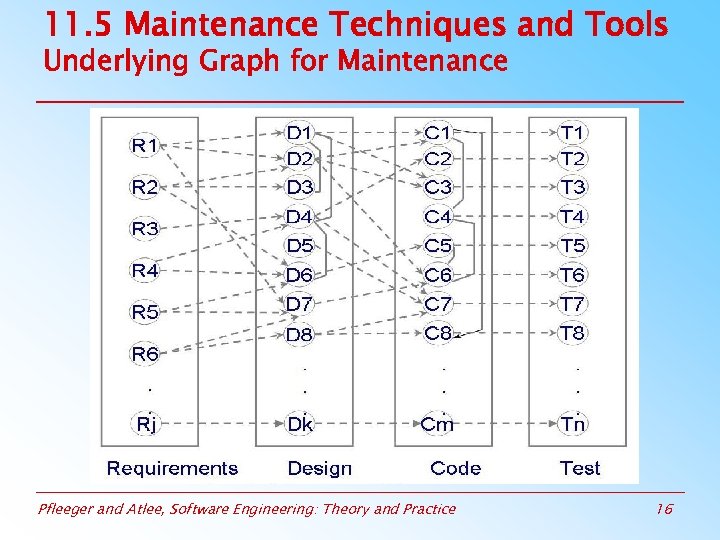 11. 5 Maintenance Techniques and Tools Underlying Graph for Maintenance Pfleeger and Atlee, Software Engineering: Theory and Practice 16
 11. 5 Maintenance Techniques and Tools Automated Maintenance Tools • Text editors • File comparators • Compilers and linkers • Debugging tools • Cross-reference generators • Static code analyzers • Configuration management repositories Pfleeger and Atlee, Software Engineering: Theory and Practice 17
 11. 6 Software Rejuvenation • Redocumentation: static analysis adds more information • Restructuring: transform to improve code structure • Reverse engineering: recreate design and specification information from the code • Reengineering: reverse engineer and then make changes to specification and design to complete the logical model; then generate new system from revised specification and design Pfleeger and Atlee, Software Engineering: Theory and Practice 18
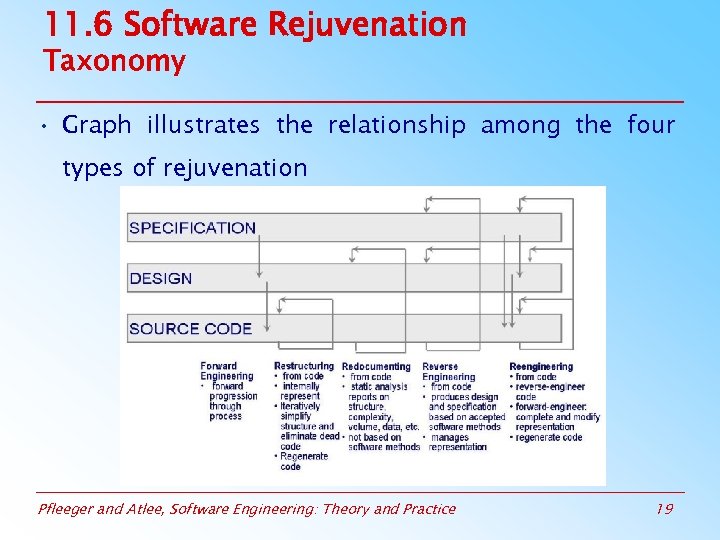 11. 6 Software Rejuvenation Taxonomy • Graph illustrates the relationship among the four types of rejuvenation Pfleeger and Atlee, Software Engineering: Theory and Practice 19
 11. 6 Software Rejuvenation Redocumentation • Begins by submitting the code to an analysis tool • Output may include: – component calling relationships – data-interface tables – data-dictionary information – data flow tables or diagrams – control flow tables or diagrams – pseudocode – test paths – component and variable cross-references Pfleeger and Atlee, Software Engineering: Theory and Practice 20
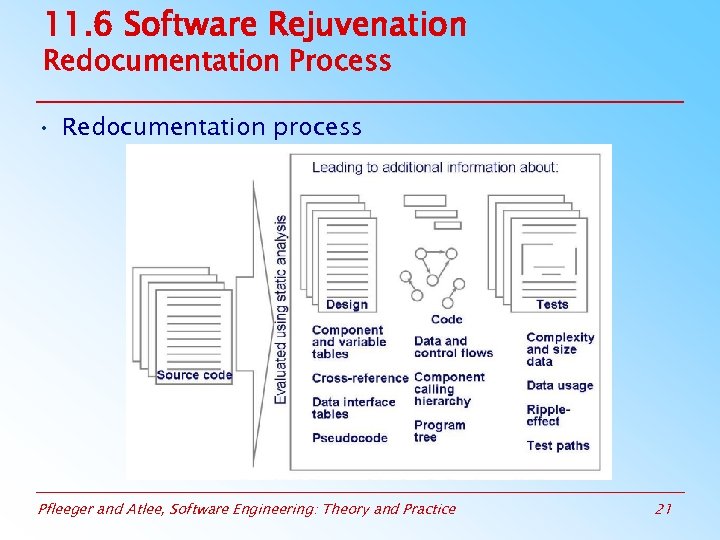 11. 6 Software Rejuvenation Redocumentation Process • Redocumentation process Pfleeger and Atlee, Software Engineering: Theory and Practice 21
 11. 6 Software Rejuvenation Restructuring Activities • Interpreting the source code and representing it internally • Simplifying the internal representation • Regenerating structured code Pfleeger and Atlee, Software Engineering: Theory and Practice 22
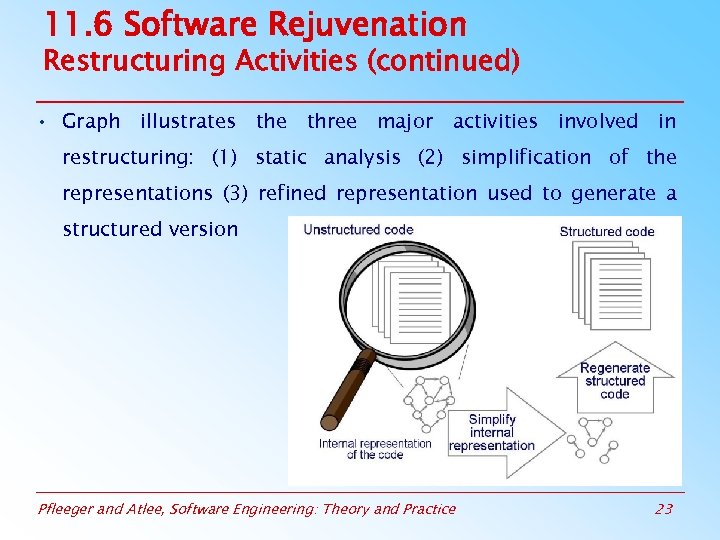 11. 6 Software Rejuvenation Restructuring Activities (continued) • Graph illustrates the three major activities involved in restructuring: (1) static analysis (2) simplification of the representations (3) refined representation used to generate a structured version Pfleeger and Atlee, Software Engineering: Theory and Practice 23
 11. 6 Software Rejuvenation Reverse Engineering • Attempting to recover engineering information based on software specification and design methods • Obstacles remain before reverse engineering can be used universally – Real time system problem – Extremely complex system Pfleeger and Atlee, Software Engineering: Theory and Practice 24
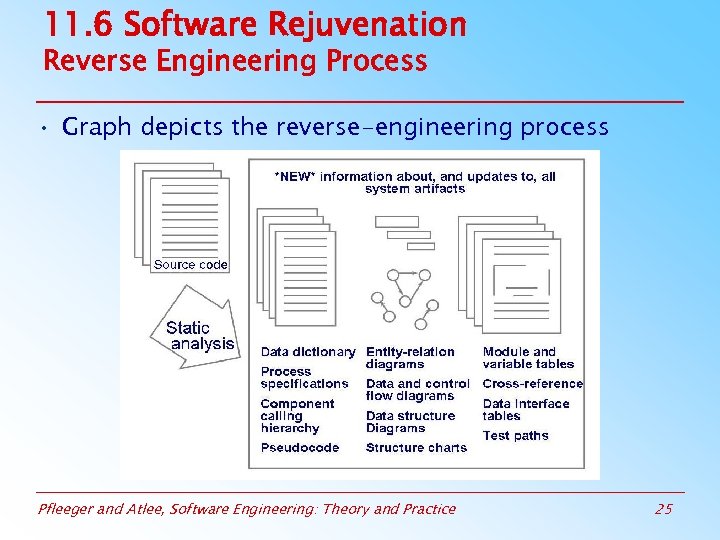 11. 6 Software Rejuvenation Reverse Engineering Process • Graph depicts the reverse-engineering process Pfleeger and Atlee, Software Engineering: Theory and Practice 25
 11. 6 Software Rejuvenation Reengineering • An extension of reverse engineering – produces new software code without changing the overall system function • Reengineering steps – The system is reverse-engineered – The software system is corrected or completed – The new system is generated Pfleeger and Atlee, Software Engineering: Theory and Practice 26
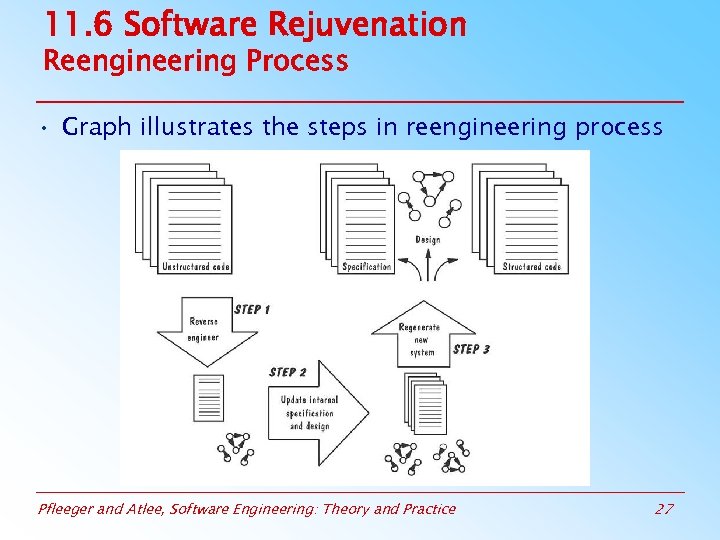 11. 6 Software Rejuvenation Reengineering Process • Graph illustrates the steps in reengineering process Pfleeger and Atlee, Software Engineering: Theory and Practice 27
 11. 8 Real-Time Example Ariane-5 • Developers focused on mitigating random failure – The inertial reference system failed because of a design fault, not a result of a random failure • Needs to change the failure strategy and implement a series of preventive enhancements Pfleeger and Atlee, Software Engineering: Theory and Practice 28
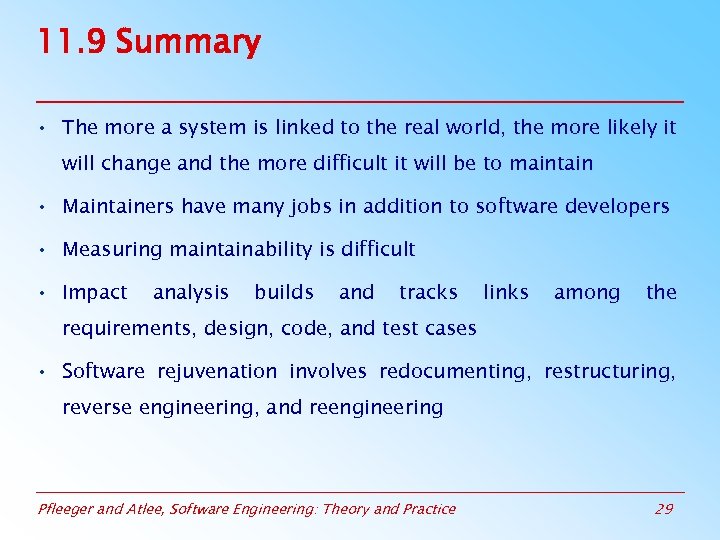 11. 9 Summary • The more a system is linked to the real world, the more likely it will change and the more difficult it will be to maintain • Maintainers have many jobs in addition to software developers • Measuring maintainability is difficult • Impact analysis builds and tracks links among the requirements, design, code, and test cases • Software rejuvenation involves redocumenting, restructuring, reverse engineering, and reengineering Pfleeger and Atlee, Software Engineering: Theory and Practice 29
 THANKS… Pfleeger and Atlee, Software Engineering: Theory and Practice 30