


 Скачать презентацию MANAGING THE INSTITUTIONAL AND POLITICAL DYNAMICS OF DECENTRALIZATION
473b438629b3e4726369072c18f49853.ppt
- Количество слайдов: 29
 MANAGING THE INSTITUTIONAL AND POLITICAL DYNAMICS OF DECENTRALIZATION IMPLEMENTATION
 OUTLINE • A. Introduction • B. Challenges of Fiscal Decentralization • C. Managing Fiscal Decentralization • D. Selected Cases 2
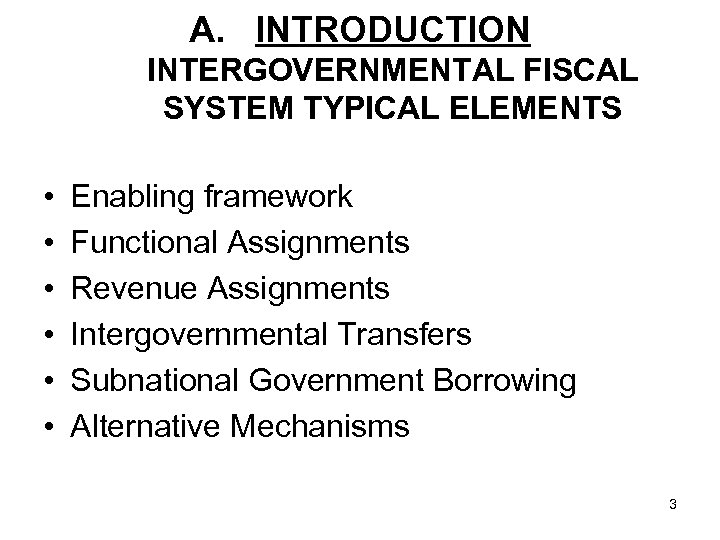 A. INTRODUCTION INTERGOVERNMENTAL FISCAL SYSTEM TYPICAL ELEMENTS • • • Enabling framework Functional Assignments Revenue Assignments Intergovernmental Transfers Subnational Government Borrowing Alternative Mechanisms 3
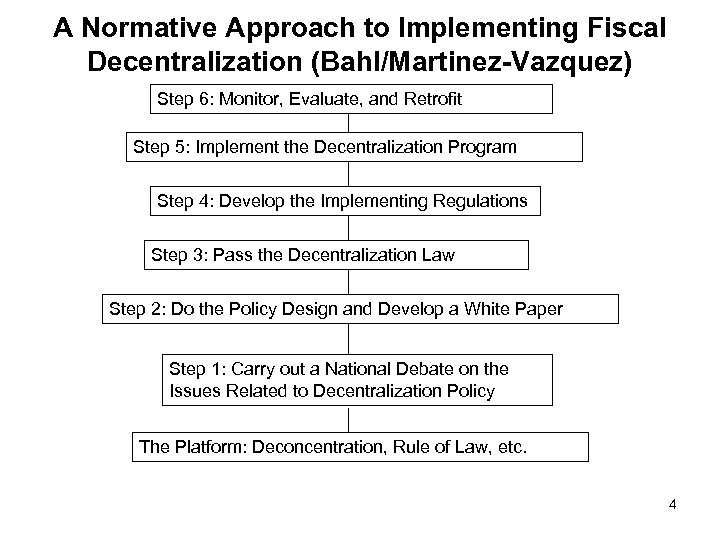 A Normative Approach to Implementing Fiscal Decentralization (Bahl/Martinez-Vazquez) Step 6: Monitor, Evaluate, and Retrofit Step 5: Implement the Decentralization Program Step 4: Develop the Implementing Regulations Step 3: Pass the Decentralization Law Step 2: Do the Policy Design and Develop a White Paper Step 1: Carry out a National Debate on the Issues Related to Decentralization Policy The Platform: Deconcentration, Rule of Law, etc. 4
 Elements (“Prerequisites”) of Fiscal Decentralization • • • Broad Enabling Framework “Political Will” Adequate Local Political System Adequate Fiscal System Institutional/Managerial System Implementation Capacity 5
 B. CHALLENGES Origins of Decentralization • Originated in response to crisis: rapid decision with inadequate political consensus • Imposed/influenced by international donors • Often too derivative of textbook solutions based on social science approaches, particularly the local finance/fiscal federalism literature • Some elements borrowed from other countries without adaptation 6
 Different Meaning in Different Contexts • Reinventing/strengthening elected subnational governments where they exist but have not been functioning well • Transforming local administrative units into elected levels of sub-national government • Creating sub-national units of administration and governance where they have not previously existed 7
 Integration Necessary but Complex • Fiscal decentralization without administrative and political: resources without institutional and governance capacity • Administrative decentralization without fiscal and political: local responsibilities/autonomy without resources and governance structures • Political decentralization without administrative and fiscal: decision making structures without institutional and fiscal structures 8
 Institutional Challenges • Decentralization involves many central actors: – Agencies with broad functions: Ministry of Finance (MOF)/Planning (MOP), Civil Service Commission – Agencies the “oversee” local government: Ministry of Local Government (MLG), Home Affairs or Interior – Agencies with sectoral functions: agriculture, education, health, water, etc. • These various central actors may resist decentralizing because they lose power. • They may pursue inconsistent decentralization policies simultaneously, potentially undermining the development of a coherent, well functioning LG system 9
 Institutional Challenges II • Sectoral ministries may have decentralization programs that use procedures not consistent with MOF regulations • MOF and MLG may issue inconsistent LG guidelines • MOF may use one mechanism for recurrent transfers while the MOP/ sectoral ministries use incompatible mechanisms for development transfers • In short: complex, fragmented, hierarchical central bureaucracies with little incentive to decentralize or coordinate; in addition: • Undeveloped/inappropriate procedures/incentives • Lack of technical and managerial capacity at all levels • Weak transparency/accountability to local constituencies 10
 Scope and Structure of Decentralization Reforms • Two broadly problematic reform types: unworkably comprehensive or limited (often technical)/uncoordinated with broader agenda • Often coordinated by single lead ministries perceived as rivals by other key players • Typically unbalanced focus on either supply or demand side • Typically treat all sub-national governments or classes (cities, municipalities, towns, etc. ) as if they have similar capacity 11
 Scope and Structure II: Relationships Beyond the Center • Relationships among different levels and forms of subnational government • Relationships among sub-national units at the same level • Horizontal local relationships between elected officials and staff • Sub-national government-community group relations • Private partner relationships for service delivery and management functions 12
 Role of International Donors • Not always strong incentives to support genuine decentralization, which is complex and delays projects and moving funds • Self-coordination of donors and sectors also slows progress and diffuses the credit for achievements • Often fundamental donor mistrust of even central capacity 13
 Role of International Donors II • Decentralization/coordination complexities and client capacity concerns influence decentralization design and outcomes • In some cases, different international donors support individual ministries for inconsistent reforms, reinforcing competitive behavior of central agencies • In some cases, special units or funds, institutionalize systems and procedures that are inconsistent with the emerging formal local government system 14
 C. MANAGING DECENTRALIZATION Basics • Clear division of supervisory, regulatory, and technical assistance functions among the central government agencies involved • Process for building national consensus on decentralization goals and systems • Coordination mechanism so that agencies develop consistent systems/procedures • Implementation strategy to ensure that the capacities of local governments are not too quickly overwhelmed and the existing powers of central agencies are not dramatically challenged 15
 Design/Coordination • An effective coordination body should involve all key stakeholders to an appropriate extent • May be separate coordination bodies for policy and implementation (often under officials at different levels) but there must then be coordination between them • The coordination body needs to be credible, which means seen by relevant stakeholders as: – Neutral (not competing for decentralization resources) – High level (in a coordinating ministry, special commission, or president/prime minister’s office rather than peer line ministry) 16
 Design/Coordination II • International experience suggests that the coordination body also needs to have: – Capacity to monitor and adjust as appropriate the implementation of decentralization activities – Sufficient authority and capacity to enforce decentralization activities that various reluctant central actors are supposed to undertake 17
 Implementation Strategy • Clearly defined starting point consistent with capacity/performance of local government (may be asymmetric if appropriate) • Starting point may be at least partially negotiated, placing some responsibility for reform steps on local governments • Reform aspects should be integrated (administrative, fiscal, political) at each step to the extent feasible--even if initially at a very basic level 18
 Implementation Strategy II • Further steps towards full set of desired responsibilities should build progressively on earlier steps • Strong positive and negative incentives for local governments (and staff) to achieve desired goals are an important part of overall strategy • Coordinating body should oversee and manage implementation strategy to ensure that all parties at all levels of government are meeting their assigned responsibilities 19
 Capacity Building Mechanisms • Two main types: – Technical: training local governments to meet their functional responsibilities – Governance: training citizens, elected officials and LG staff to work with each other • Two main approaches: – Supply driven: designed and provided by central agencies – Demand driven: LGs request what they need 20
 Capacity Building II • Some lessons on LG capacity building: – Central government will remain an important supplier, but an element of demand should emerge if incentive structure is right – Should focus on specific priority functions and procedures rather than comprehensive/broad – Capacity building should be directly related to the steps in implementation strategy – Follow-up is important: capacity building is not just classroom training; mobile TA teams 21
 D. EXAMPLES OF KEY INSTITUTIONS AND PROCESSES • There is no single “best practice” country in terms of successful decentralization coordination, strong implementation strategy and effective capacity building • Several countries, however, have elements of good practice in the various institutional mechanisms and strategies they have adopted for decentralization 22
 Coordination Bodies • Regional Autonomy Review Board (former Indonesia) • The Decentralization Secretariat (Uganda) • National Decentralization Committee (Thailand) • Decentralization Implementation Authority (proposed Cambodia) 23
 Implementation Strategy • Some countries have elements of a strategy: – South Africa and Vietnam to some extent use asymmetry in service assignment – Cambodia started decentralization very modestly, giving small resources and few responsibilities with a focus on building political credibility – Thailand has a highly developed and extremely detailed decentralization implementation strategy, but limited progress has been made to date – Indonesia is working out decentralization of services on a sectoral and local government basis 24
 Capacity Building Mechanisms • Some recent innovations: – Uganda and Bangladesh require LGs to meet prerequisites to receive development transfers, with capacity building grants available to LGs below the threshhold – Kenya piloted a program for developing capacity in which a package of reforms were negotiated with the MLG, which provided mobile technical assistance to train and follow up on LG skill implementation 25
 E. SELECTED CASES Cambodia: a very poor post-conflict country in early decentralization • Positive Features: elements of a reform strategy; pro-poor transfers; local elections; substantial efforts to develop pro-poor governance mechanisms (participatory planning, etc. ); strong donor support for consolidated local funding • Negative Features: weak local revenue system; generally low capacity; some evidence of local elite capture in certain areas; poor donor coordination of governance technical assistance 26
 Indonesia: a large country with areas of wealth/capacity that rapidly decentralized • Positive Features: redistributive transfers; strong alternative pro-poor finance mechanisms (CDD) and emerging nongovernmental partnerships; competitive local elections; capacity significant and debt potential in wealthier areas • Negative Features: decentralization rapid/nonstrategic; weak local revenues; low local government/CDD coordination; modest efforts to develop transparency and citizen engagement; donor coordination remains inadequate 27
 Kenya: long history of local government that declined and is being reformed • Positive Features: intergovernmental fiscal system reform relatively coordinated; strong local revenues; transfers linked to adoption of reforms, including participatory planning; competitive local elections; solid capacity in some areas • Negative Features: local government reform efforts slow and fragmented; poor coordination between districts and local governments; subnational lending mechanism dysfunctional 28
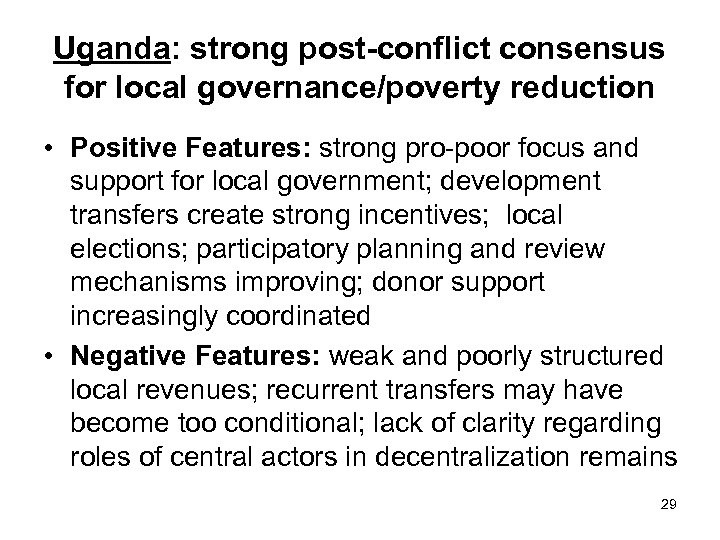 Uganda: strong post-conflict consensus for local governance/poverty reduction • Positive Features: strong pro-poor focus and support for local government; development transfers create strong incentives; local elections; participatory planning and review mechanisms improving; donor support increasingly coordinated • Negative Features: weak and poorly structured local revenues; recurrent transfers may have become too conditional; lack of clarity regarding roles of central actors in decentralization remains 29