 Скачать презентацию Managing the Adaptive Enterprise Business and IT Synchronized
519c76c4f9d38a957f293441bd888fbe.ppt
- Количество слайдов: 42



Managing the Adaptive Enterprise Business and IT Synchronized to Capitalize on Change Matt Anticevich ITSM Solution Architect 240 -744 -8109 © 2004 Hewlett-Packard Development Company, L. P. The information contained herein is subject to change without notice
Quote slide “I’m all for progress. It’s change I don’t like. ” Mark Twain 2
“It’s not the strongest of the species that survives, nor the most intelligent; but the one most responsive to change. ” Charles Darwin 3
Change is the only constant Change is constant • Everyday events that send ripples throughout the organization, and the IT that supports it Change is unexpected • A merger, a new partner, a sudden shift in the competitive landscape, a new market opportunity Change is disruptive • The goal is to minimize the impact of disruptions with an IT environment that is synchronized with the business Change presents opportunities • • The ability to adapt to change is a key advantage in business To survive, compete and win, enterprises must adapt 4
Government IT Trends • Transformation of organizations & agencies • Changing role of government/military personnel to fulfill oversight function • Increasing number of mandates, regulations, contracting requirements • Requiring contractors to adopt process standards – i. e. ITIL®, ISO 9000, CMM/CMMI, Six Sigma, etc. • Modernization of tool suites • Migration of contract types from T&M to PBSC 5
Situation facing our customers • Multiple systems that are not interoperable • Interagency requirements for shared knowledge, systems, and networks • Separate networks for DOD, IC, DHS, and State & Local law enforcement • Systems and users that have varying security requirements • Cumbersome systems because of lack of common standards 6
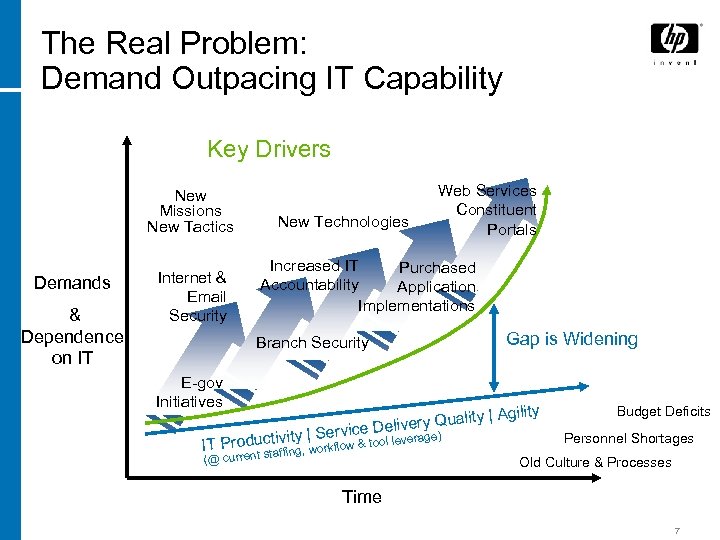
The Real Problem: Demand Outpacing IT Capability Key Drivers New Missions New Tactics Demands & Dependence on IT Internet & Email Security New Technologies Web Services Constituent Portals Increased IT Purchased Accountability Application Implementations Gap is Widening Branch Security E-gov Initiatives lity | Agility livery Qua Service De rage) tivity | IT Productaffing, workflow & tool leve s (@ current Budget Deficits Personnel Shortages Old Culture & Processes Time 7
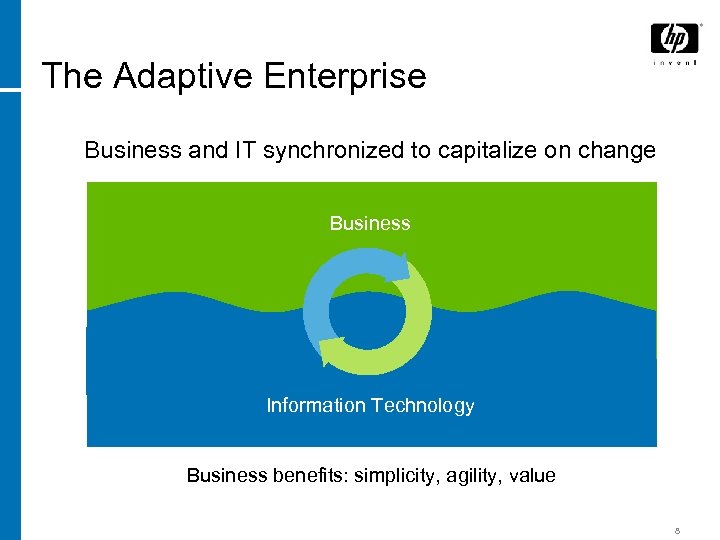
The Adaptive Enterprise Business and IT synchronized to capitalize on change Business Information Technology Business benefits: simplicity, agility, value 8
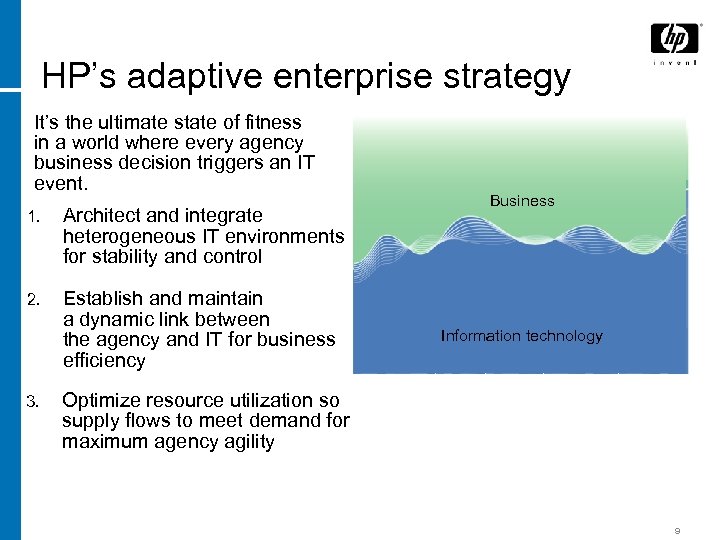
HP’s adaptive enterprise strategy It’s the ultimate state of fitness in a world where every agency business decision triggers an IT event. 1. Architect and integrate heterogeneous IT environments for stability and control 2. Establish and maintain a dynamic link between the agency and IT for business efficiency 3. Business Information technology Optimize resource utilization so supply flows to meet demand for maximum agency agility 9
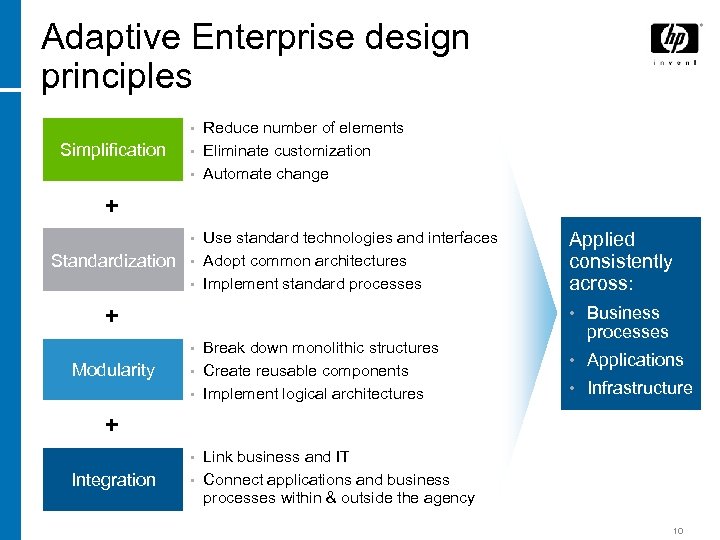
Adaptive Enterprise design principles • Reduce number of elements Simplification • Eliminate customization • Automate change + • Use standard technologies and interfaces Standardization • Adopt common architectures • Implement standard processes + • Business • Break down monolithic structures Modularity Applied consistently across: • Create reusable components • Implement logical architectures processes • Applications • Infrastructure + • Link business and IT Integration • Connect applications and business processes within & outside the agency 10
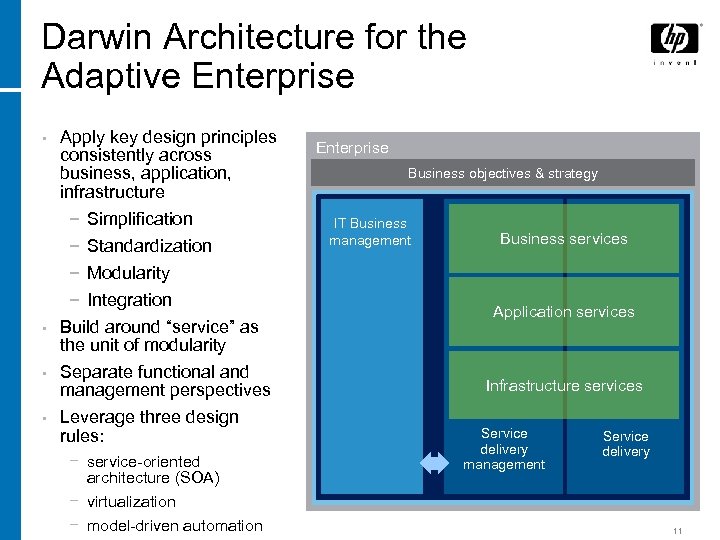
Darwin Architecture for the Adaptive Enterprise • • Apply key design principles consistently across business, application, infrastructure − Simplification − Standardization − Modularity − Integration Build around “service” as the unit of modularity Separate functional and management perspectives Leverage three design rules: − service-oriented architecture (SOA) − virtualization − model-driven automation Enterprise Business objectives & strategy IT Business management Business services Application services Infrastructure services Service delivery management Service delivery 11
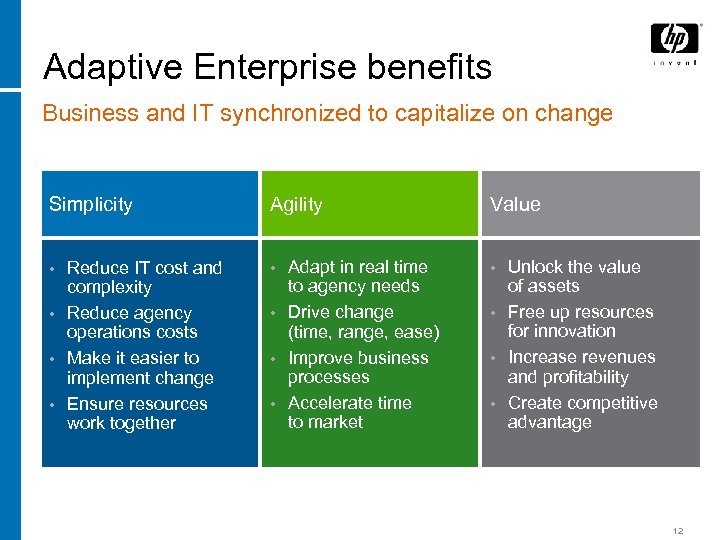
Adaptive Enterprise benefits Business and IT synchronized to capitalize on change Simplicity Agility Value Reduce IT cost and complexity • Reduce agency operations costs • Make it easier to implement change • Ensure resources work together • Adapt in real time to agency needs • Drive change (time, range, ease) • Improve business processes • Accelerate time to market • • Unlock the value of assets • Free up resources for innovation • Increase revenues and profitability • Create competitive advantage 12
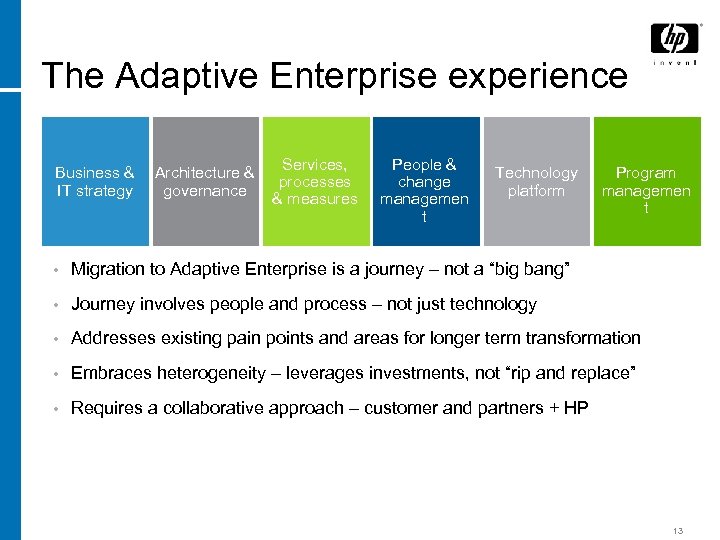
The Adaptive Enterprise experience Business & IT strategy Architecture & governance Services, processes & measures People & change managemen t Technology platform Program managemen t • Migration to Adaptive Enterprise is a journey – not a “big bang” • Journey involves people and process – not just technology • Addresses existing pain points and areas for longer term transformation • Embraces heterogeneity – leverages investments, not “rip and replace” • Requires a collaborative approach – customer and partners + HP 13
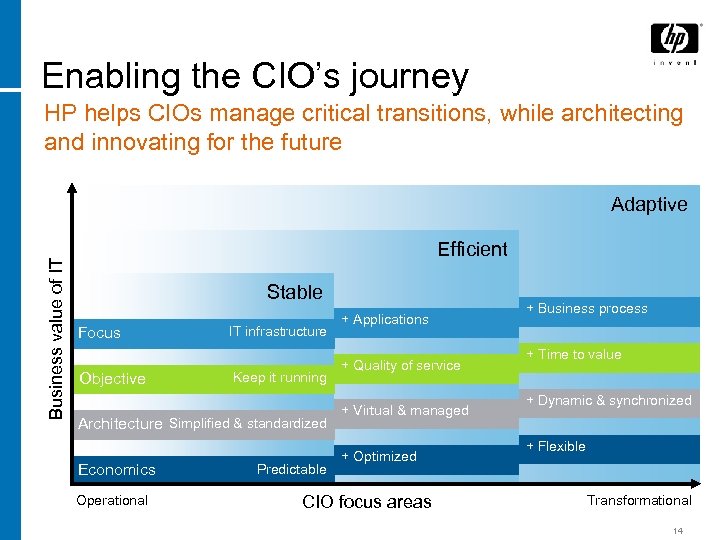
Enabling the CIO’s journey HP helps CIOs manage critical transitions, while architecting and innovating for the future Business value of IT Adaptive Efficient Stable Focus Objective IT infrastructure Keep it running Architecture Simplified & standardized Economics Operational Predictable + Applications + Quality of service + Virtual & managed + Optimized CIO focus areas + Business process + Time to value + Dynamic & synchronized + Flexible Transformational 14
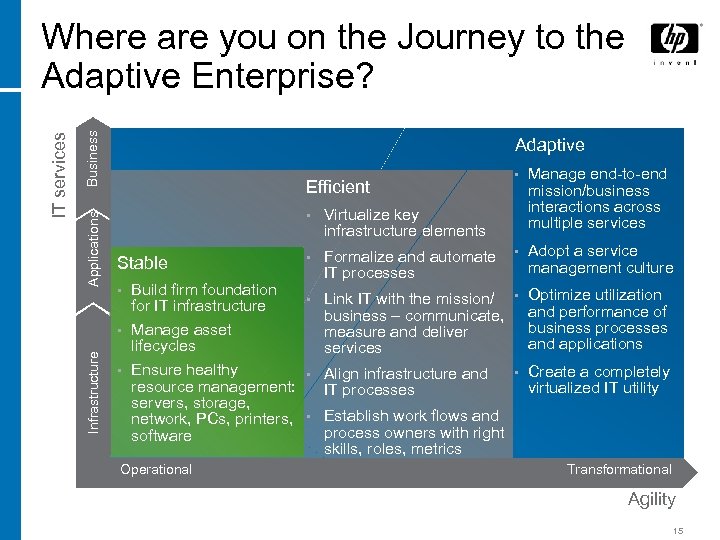
Business Applications Infrastructure IT services Where are you on the Journey to the Adaptive Enterprise? Adaptive Efficient • Stable Formalize and automate IT processes Manage end-to-end mission/business interactions across multiple services • Adopt a service management culture Virtualize key infrastructure elements • • Build firm foundation • Link IT with the mission/ • Optimize utilization for IT infrastructure business – communicate, and performance of business processes • Manage asset measure and deliver and applications lifecycles services • Ensure healthy • Create a completely • Align infrastructure and resource management: virtualized IT utility IT processes servers, storage, network, PCs, printers, • Establish work flows and process owners with right software skills, roles, metrics • Operational Transformational Agility 15
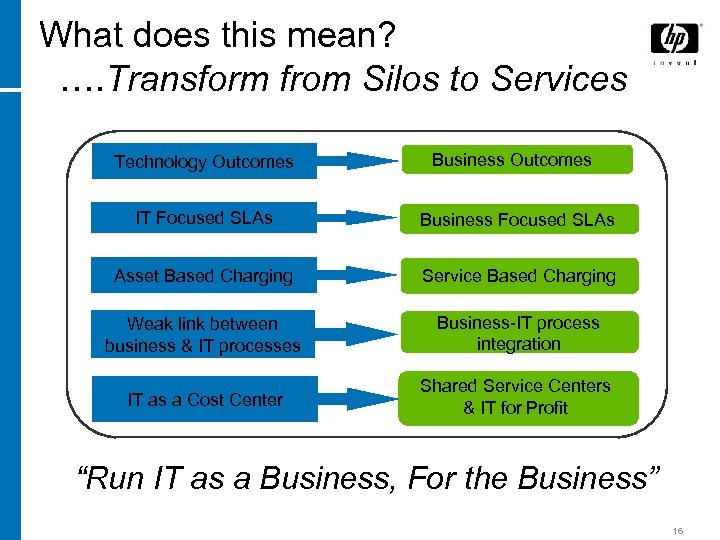
What does this mean? …. Transform from Silos to Services Technology Outcomes Business Outcomes IT Focused SLAs Business Focused SLAs Asset Based Charging Service Based Charging Weak link between business & IT processes Business-IT process integration IT as a Cost Center Shared Service Centers & IT for Profit “Run IT as a Business, For the Business” 16
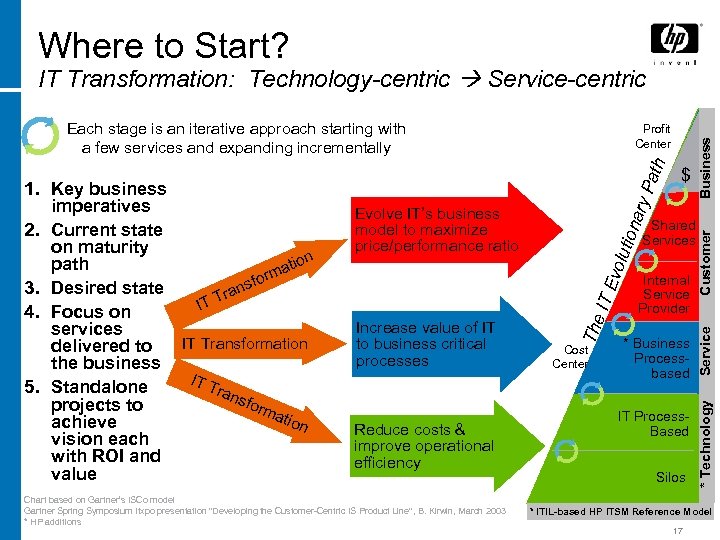
Where to Start? Reduce costs & improve operational efficiency Chart based on Gartner’s ISCo model Gartner Spring Symposium Itxpo presentation "Developing the Customer-Centric IS Product Line", B. Kirwin, March 2003 * HP additions Cost Center * Business Processbased IT Process. Based Silos Customer Internal Service Provider Service volu Shared Services IT E Increase value of IT to business critical processes $ tion ary Evolve IT’s business model to maximize price/performance ratio The 1. Key business imperatives 2. Current state on maturity n path atio rm sfo n 3. Desired state Tra IT 4. Focus on services IT Transformation delivered to the business IT T 5. Standalone ran sfo projects to rma tion achieve vision each with ROI and value Pat h Profit Center * Technology Each stage is an iterative approach starting with a few services and expanding incrementally Business IT Transformation: Technology-centric Service-centric * ITIL-based HP ITSM Reference Model 17
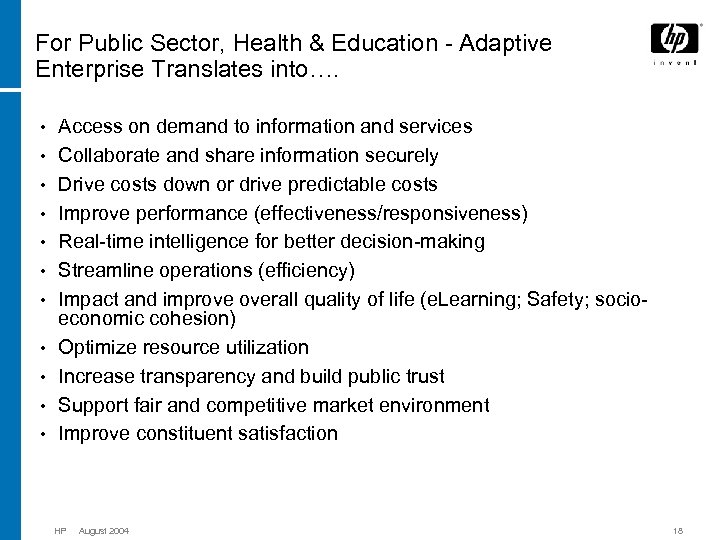
For Public Sector, Health & Education - Adaptive Enterprise Translates into…. • • • Access on demand to information and services Collaborate and share information securely Drive costs down or drive predictable costs Improve performance (effectiveness/responsiveness) Real-time intelligence for better decision-making Streamline operations (efficiency) Impact and improve overall quality of life (e. Learning; Safety; socioeconomic cohesion) Optimize resource utilization Increase transparency and build public trust Support fair and competitive market environment Improve constituent satisfaction HP August 2004 18
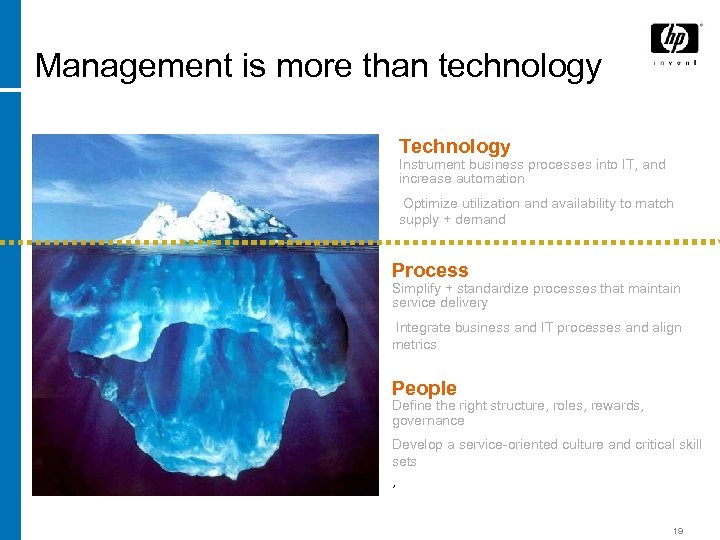
Management is more than technology Technology Instrument business processes into IT, and increase automation Optimize utilization and availability to match supply + demand Process Simplify + standardize processes that maintain service delivery Integrate business and IT processes and align metrics People Define the right structure, roles, rewards, governance Develop a service-oriented culture and critical skill sets , 19
What is the Information Technology Infrastructure Library (ITIL®)? • • Open, best practice for IT Service management Created through sponsorship by the UK Government Written by consultants, vendors and users Accredited Education and Examination scheme ISO 9000 compliant WWW. CCTA. GOV. UK Independently managed by the IT Service Management Forum - a global organization consisting of more than 12, 000 corporate and government members (25, 000 individual members) responsible for advancing IT best practices through the utilization of the IT Infrastructure Library (ITIL®). Used by over 10, 000 major corporations and governments, including Albertson's, British Airways, Barclays Bank, Proctor and Gamble, ABN AMRO, Shell, Chevron, Capital One, Philips, Eaton Corporation, Hewlett-Packard, US State Department, Internal Revenue Service, ITA-Pentagon, Census Bureau, USDA, various IC agencies HP August 2004 20
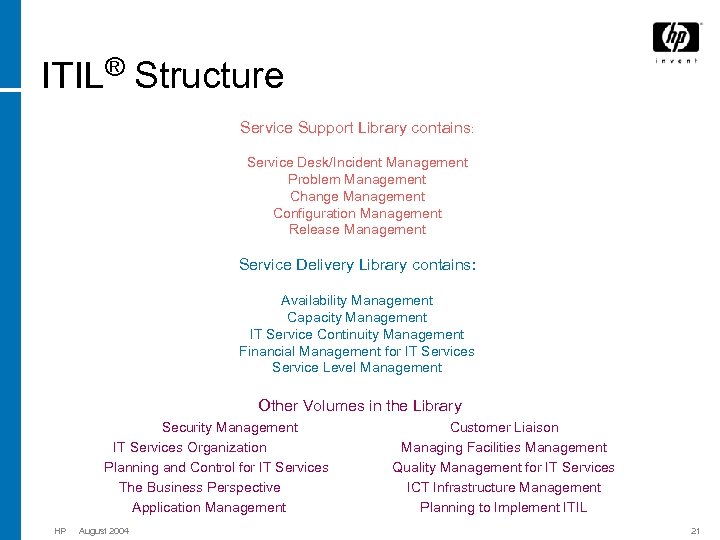
ITIL® Structure Service Support Library contains: Service Desk/Incident Management Problem Management Change Management Configuration Management Release Management Service Delivery Library contains: Availability Management Capacity Management IT Service Continuity Management Financial Management for IT Services Service Level Management Other Volumes in the Library Security Management IT Services Organization Planning and Control for IT Services The Business Perspective Application Management HP August 2004 Customer Liaison Managing Facilities Management Quality Management for IT Services ICT Infrastructure Management Planning to Implement ITIL 21
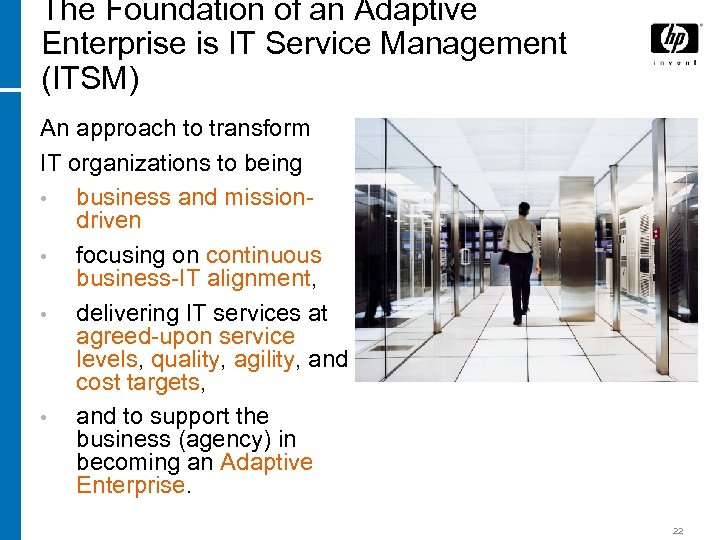
The Foundation of an Adaptive Enterprise is IT Service Management (ITSM) An approach to transform IT organizations to being • business and missiondriven • focusing on continuous business-IT alignment, • delivering IT services at agreed-upon service levels, quality, agility, and cost targets, • and to support the business (agency) in becoming an Adaptive Enterprise. 22
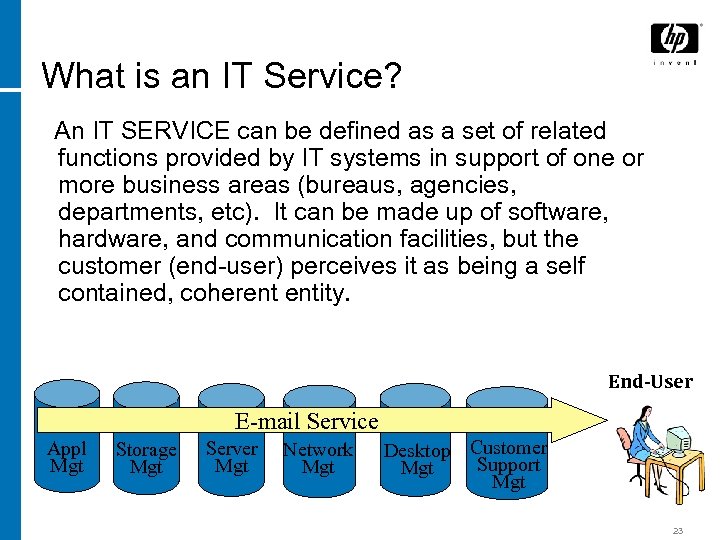
What is an IT Service? An IT SERVICE can be defined as a set of related functions provided by IT systems in support of one or more business areas (bureaus, agencies, departments, etc). It can be made up of software, hardware, and communication facilities, but the customer (end-user) perceives it as being a self contained, coherent entity. End-User E-mail Service Appl Mgt Storage Mgt Server Mgt Network Mgt Desktop Customer Support Mgt 23
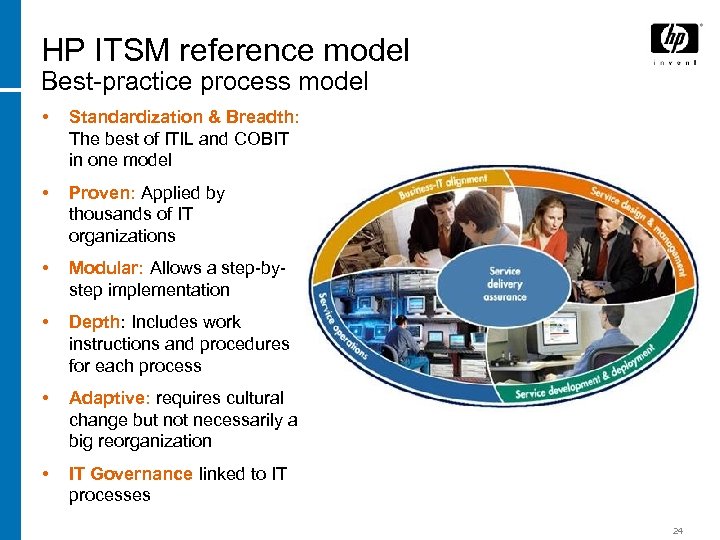
HP ITSM reference model Best-practice process model • Standardization & Breadth: The best of ITIL and COBIT in one model • Proven: Applied by thousands of IT organizations • Modular: Allows a step-bystep implementation • Depth: Includes work instructions and procedures for each process • Adaptive: requires cultural change but not necessarily a big reorganization • IT Governance linked to IT processes 24
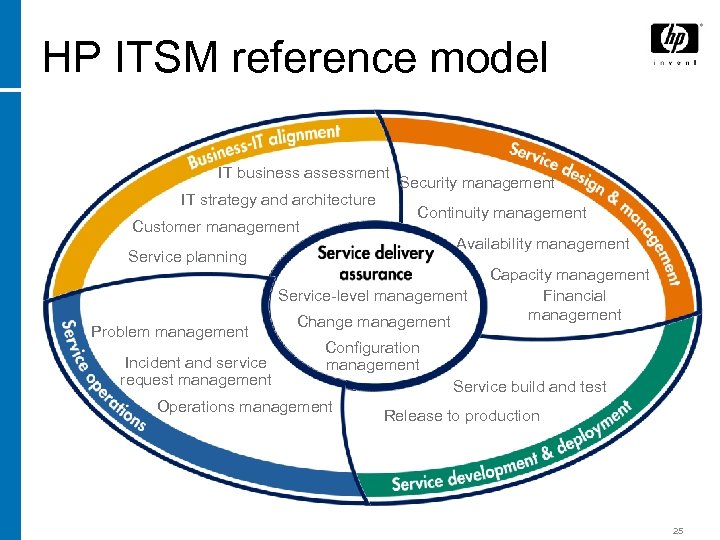
HP ITSM reference model IT business assessment IT strategy and architecture Customer management Security management Continuity management Availability management Service planning Service-level management Problem management Incident and service request management Change§management Configuration management Operations management Capacity management Financial management Service build and test Release to production 25
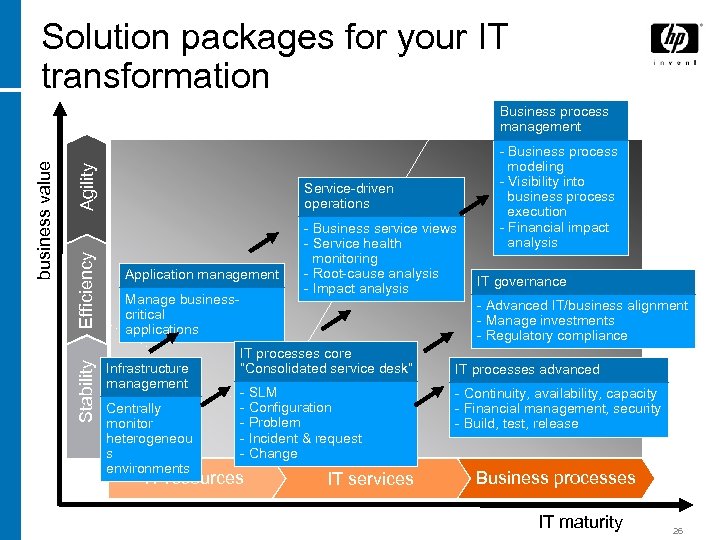
Solution packages for your IT transformation Agility Efficiency Stability business value Business process management Service-driven operations Application management Manage businesscritical applications Infrastructure management Centrally monitor heterogeneou s environments - Business service views - Service health monitoring - Root-cause analysis - Impact analysis - Business process modeling - Visibility into business process execution - Financial impact analysis IT governance - Advanced IT/business alignment - Manage investments - Regulatory compliance IT processes core “Consolidated service desk” - SLM - Configuration - Problem - Incident & request - Change IT resources IT services IT processes advanced - Continuity, availability, capacity - Financial management, security - Build, test, release Business processes IT maturity 26
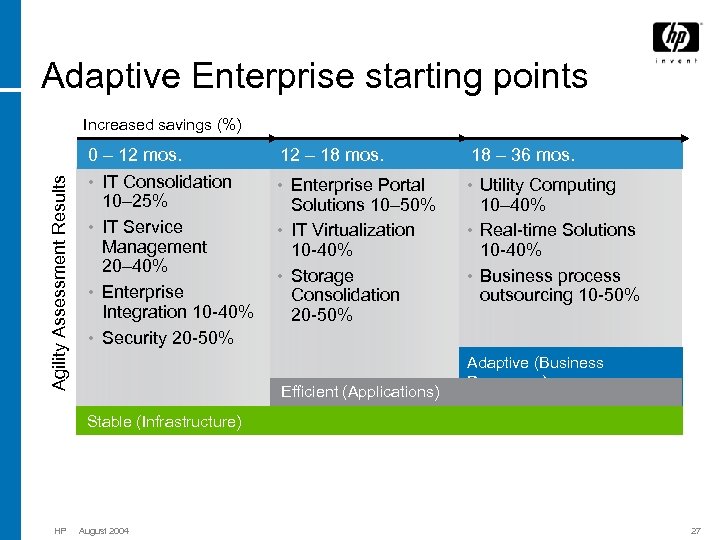
Adaptive Enterprise starting points Increased savings (%) Agility Assessment Results 0 – 12 mos. 12 – 18 mos. 18 – 36 mos. • IT Consolidation • Enterprise Portal • Utility Computing 10– 25% • IT Service Management 20– 40% • Enterprise Integration 10 -40% • Security 20 -50% Solutions 10– 50% • IT Virtualization 10 -40% • Storage Consolidation 20 -50% Efficient (Applications) 10– 40% • Real-time Solutions 10 -40% • Business process outsourcing 10 -50% Adaptive (Business Processes) Stable (Infrastructure) HP August 2004 27
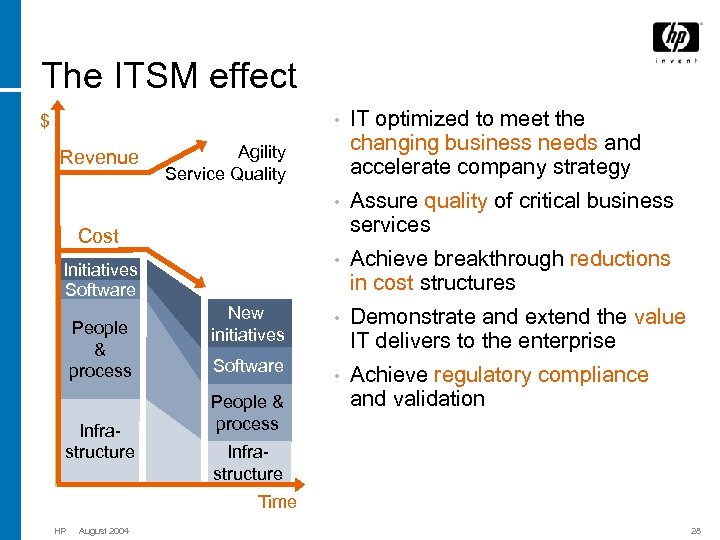
The ITSM effect • Revenue IT optimized to meet the changing business needs and accelerate company strategy • Assure quality of critical business services • $ Achieve breakthrough reductions in cost structures • Demonstrate and extend the value IT delivers to the enterprise • Achieve regulatory compliance and validation Agility Service Quality Cost Initiatives Software People & process Infrastructure New initiatives Software People & process Infrastructure Time HP August 2004 28
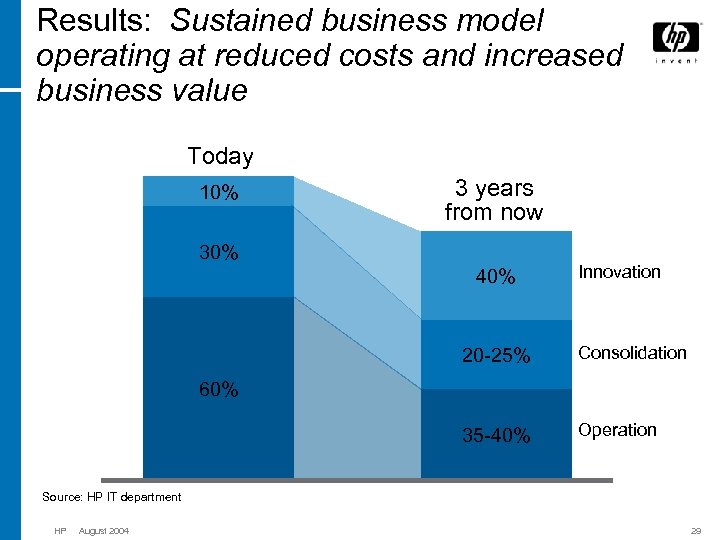
Results: Sustained business model operating at reduced costs and increased business value Today 10% 3 years from now 30% 40% Innovation 20 -25% Consolidation 35 -40% Operation 60% Source: HP IT department HP August 2004 29
ITIL® / ITSM Value Proposition • Improve the efficiency of the organization, IT staff and IT customers • Improve the effectiveness of the processes • Improve the ability of the technology to automate the processes • Enable better measurement and control of the IT environment - key to meeting contractual agreements HP August 2004 30
So how did HP approach IT Service Management? HP August 2004 31
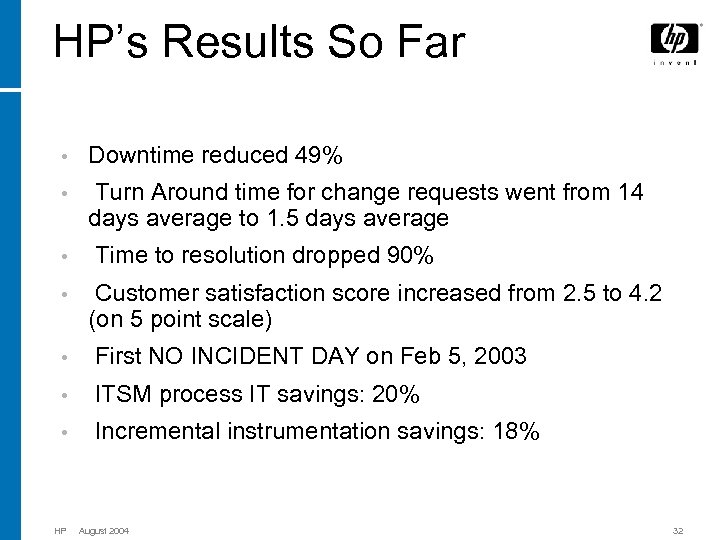
HP’s Results So Far • Downtime reduced 49% • Turn Around time for change requests went from 14 days average to 1. 5 days average • • Time to resolution dropped 90% Customer satisfaction score increased from 2. 5 to 4. 2 (on 5 point scale) • First NO INCIDENT DAY on Feb 5, 2003 • ITSM process IT savings: 20% • Incremental instrumentation savings: 18% HP August 2004 32
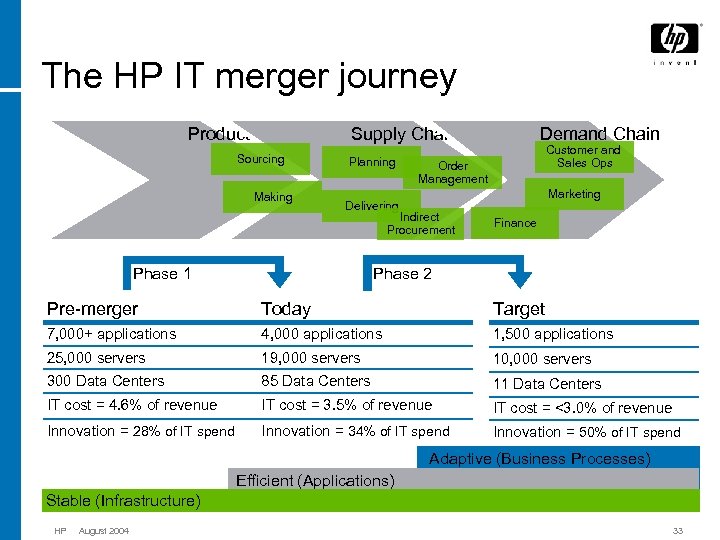
The HP IT merger journey Products Supply Chain Sourcing Making Planning Demand Chain Customer and Sales Ops Order Management Marketing Delivering Indirect Procurement Finance Phase 2 Phase 1 Pre-merger Today Target 7, 000+ applications 4, 000 applications 1, 500 applications 25, 000 servers 19, 000 servers 10, 000 servers 300 Data Centers 85 Data Centers 11 Data Centers IT cost = 4. 6% of revenue IT cost = 3. 5% of revenue IT cost = <3. 0% of revenue Innovation = 28% of IT spend Innovation = 34% of IT spend Innovation = 50% of IT spend Adaptive (Business Processes) Efficient (Applications) Stable (Infrastructure) HP August 2004 33
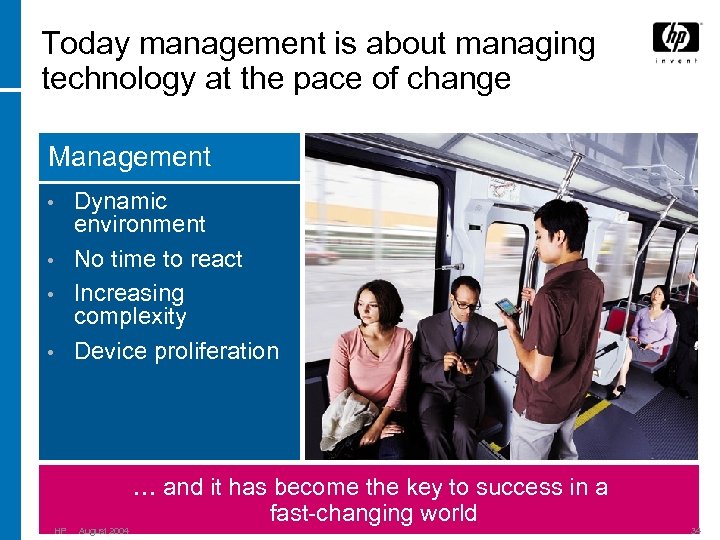
Today management is about managing technology at the pace of change Management Dynamic environment No time to react Increasing complexity Device proliferation • • HP August 2004 … and it has become the key to success in a fast-changing world 34
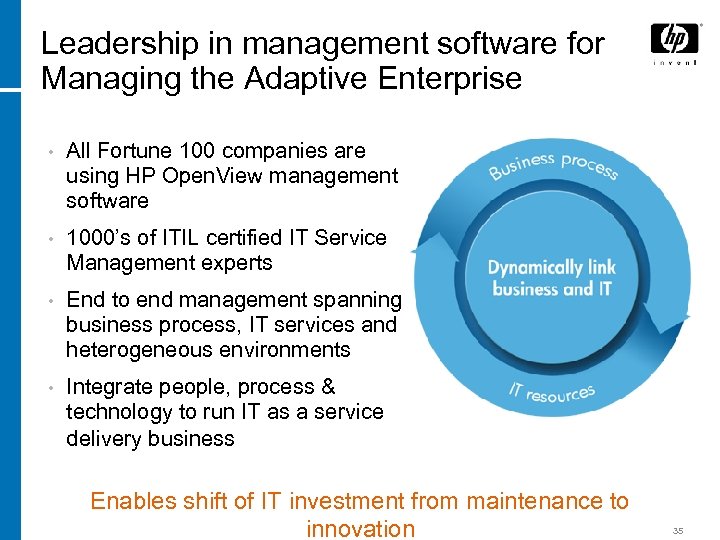
Leadership in management software for Managing the Adaptive Enterprise • All Fortune 100 companies are using HP Open. View management software • 1000’s of ITIL certified IT Service Management experts • End to end management spanning business process, IT services and heterogeneous environments • Integrate people, process & technology to run IT as a service delivery business Enables shift of IT investment from maintenance to innovation 35
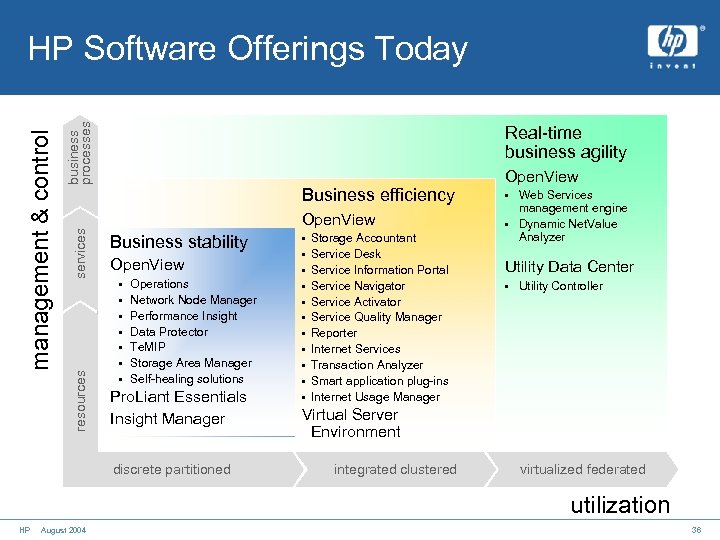
business processes Real-time business agility Open. View services Business efficiency • Web Services Open. View • Dynamic Net. Value management engine Analyzer Business stability • Storage Accountant Open. View • Service Information Portal Utility Data Center • Operations • Service Navigator • Utility Controller • Network Node Manager • Service Activator • Performance Insight • Service Quality Manager • Data Protector • Reporter • Te. MIP • Internet Services • Storage Area Manager resources management & control HP Software Offerings Today • Transaction Analyzer • Self-healing solutions • Smart application plug-ins Pro. Liant Essentials Insight Manager discrete partitioned • Service Desk • Internet Usage Manager Virtual Server Environment integrated clustered virtualized federated utilization HP August 2004 36
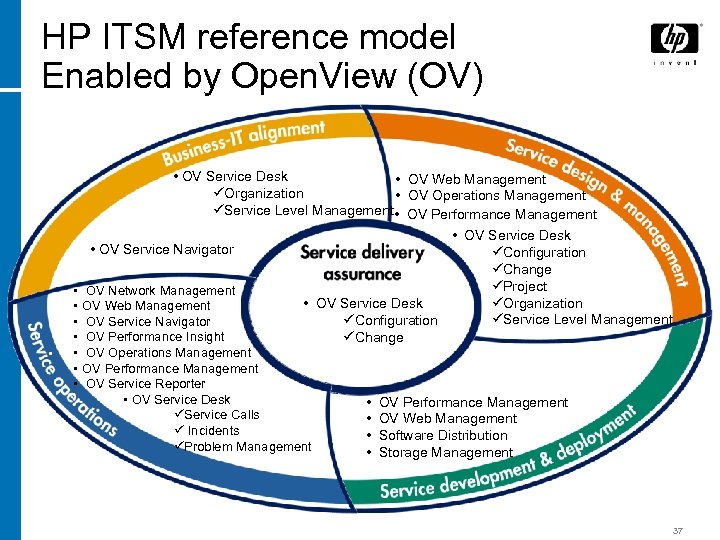
HP ITSM reference model Enabled by Open. View (OV) • OV Service Desk • OV Web Management üOrganization • OV Operations Management üService Level Management • OV Performance Management • OV Service Desk • OV Service Navigator üConfiguration üChange üProject • OV Network Management üOrganization • OV Service Desk • OV Web Management üService Level Management üConfiguration • OV Service Navigator • OV Performance Insight üChange • OV Operations Management • OV Performance Management • OV Service Reporter • OV Service Desk üService Calls ü Incidents üProblem Management • • OV Performance Management OV Web Management Software Distribution Storage Management 37
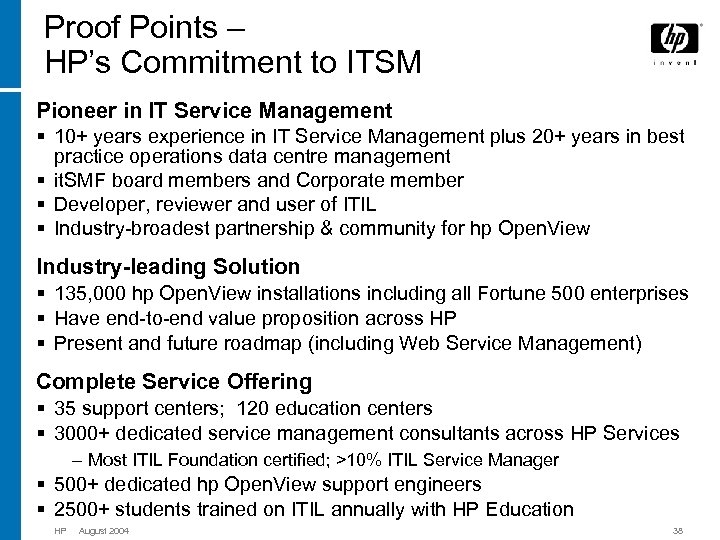
Proof Points – HP’s Commitment to ITSM Pioneer in IT Service Management § 10+ years experience in IT Service Management plus 20+ years in best practice operations data centre management § it. SMF board members and Corporate member § Developer, reviewer and user of ITIL § Industry-broadest partnership & community for hp Open. View Industry-leading Solution § 135, 000 hp Open. View installations including all Fortune 500 enterprises § Have end-to-end value proposition across HP § Present and future roadmap (including Web Service Management) Complete Service Offering § 35 support centers; 120 education centers § 3000+ dedicated service management consultants across HP Services – Most ITIL Foundation certified; >10% ITIL Service Manager § 500+ dedicated hp Open. View support engineers § 2500+ students trained on ITIL annually with HP Education HP August 2004 38
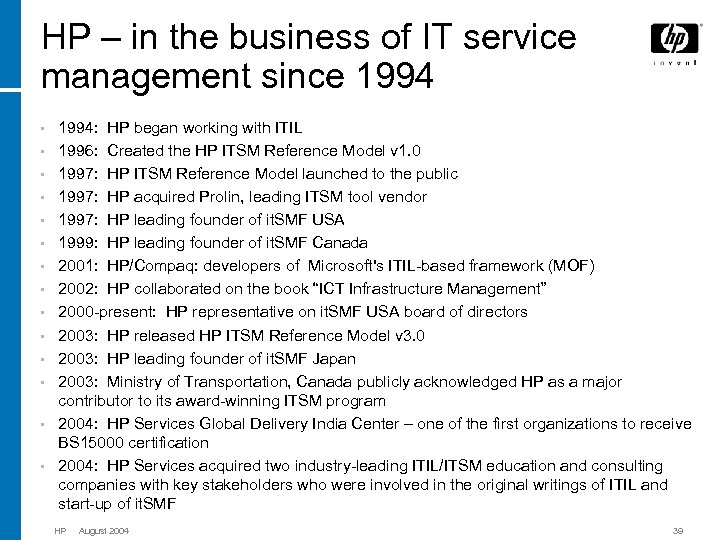
HP – in the business of IT service management since 1994 • • • • 1994: HP began working with ITIL 1996: Created the HP ITSM Reference Model v 1. 0 1997: HP ITSM Reference Model launched to the public 1997: HP acquired Prolin, leading ITSM tool vendor 1997: HP leading founder of it. SMF USA 1999: HP leading founder of it. SMF Canada 2001: HP/Compaq: developers of Microsoft's ITIL-based framework (MOF) 2002: HP collaborated on the book “ICT Infrastructure Management” 2000 -present: HP representative on it. SMF USA board of directors 2003: HP released HP ITSM Reference Model v 3. 0 2003: HP leading founder of it. SMF Japan 2003: Ministry of Transportation, Canada publicly acknowledged HP as a major contributor to its award-winning ITSM program 2004: HP Services Global Delivery India Center – one of the first organizations to receive BS 15000 certification 2004: HP Services acquired two industry-leading ITIL/ITSM education and consulting companies with key stakeholders who were involved in the original writings of ITIL and start-up of it. SMF HP August 2004 39
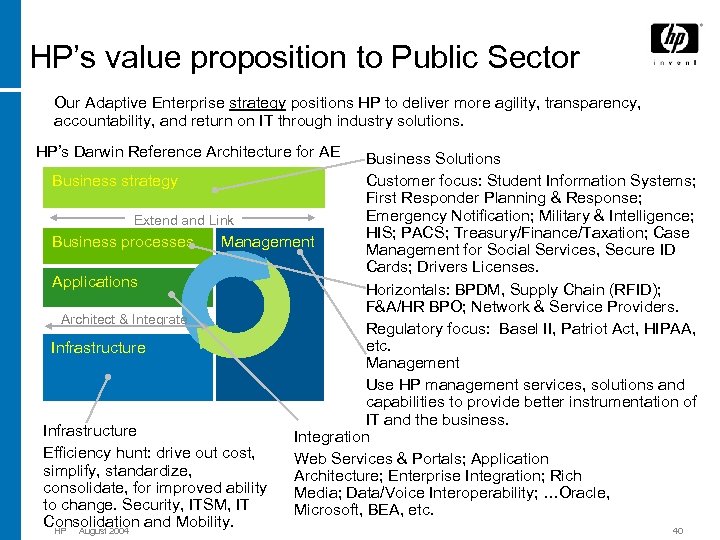
HP’s value proposition to Public Sector Our Adaptive Enterprise strategy positions HP to deliver more agility, transparency, accountability, and return on IT through industry solutions. HP’s Darwin Reference Architecture for AE Business Solutions Customer focus: Student Information Systems; Business strategy First Responder Planning & Response; Emergency Notification; Military & Intelligence; Extend and Link HIS; PACS; Treasury/Finance/Taxation; Case Business processes Management for Social Services, Secure ID Cards; Drivers Licenses. Applications Horizontals: BPDM, Supply Chain (RFID); F&A/HR BPO; Network & Service Providers. Architect & Integrate Regulatory focus: Basel II, Patriot Act, HIPAA, etc. Infrastructure Management Use HP management services, solutions and capabilities to provide better instrumentation of IT and the business. Infrastructure Integration Efficiency hunt: drive out cost, Web Services & Portals; Application simplify, standardize, Architecture; Enterprise Integration; Rich consolidate, for improved ability Media; Data/Voice Interoperability; …Oracle, to change. Security, ITSM, IT Microsoft, BEA, etc. Consolidation and Mobility. HP August 2004 40
HP ITSM Federal Customers Other agencies where HP has provided services on a variety of scales, either directly or via partnerships: • Office of Naval Intelligence • National Security Agency • National Security Coucncil • Langley HP August 2004 • • • SOCOM PACAF Army War College TVA Census US AF US Army US Navy USDA Senate 41
Questions?
Скачать презентацию Managing the Adaptive Enterprise Business and IT Synchronized
519c76c4f9d38a957f293441bd888fbe.ppt