


 Скачать презентацию Managing Telecommunications Telecom IS Organization n
6870f8cb30ce0ed90583eef5cd09c6e1.ppt
- Количество слайдов: 45
 Managing Telecommunications
 Telecom & IS Organization n IS departments have been responsible for designing, building, and maintaining the information q n Just as governments are responsible for building and maintaining streets, roads, and freeways Telecom provides infrastructure for moving information and messages q Internet opened up a new view of telecom of providing a cyberspace
 Telecom History n Circuit-switching network q q q n PSTN (POTS) Suitable for analog voice signals Overhead of establishing a temporary circuit (seconds) tolerable Packet-switching network q q q Aimed at transmitting data Messages are sent in packets Assume the intelligent user devices
 The Evolving Telecommunications Scene n The Internet can handle all kinds of intelligent user devices q n The Internet allows these device to handle different kinds of services q n PDAs, Vo. IP phones, gaming consoles, wireless devices, PCs. . . Voice, e-mails, graphics, gaming. . . The global telecom infrastructure is changing from a focus on voice to a focus on data
 Transformation of Telecom Industry (1) n n n The telecom structure of old was originally provided by (often Government owned) monopolies (e. g. AT&T) Gradually, the telecom industry has been deregulated Telecom industry is even more competitive than computer industry q Bandwidth on fiber is now doubling capacity every four months
 Transformation of Telecom Industry (2) n The last mile problem for RBOCs in 1990 s q q n A Fire-hose-to-straw gap tbps (1012) in backbones VS. 56 k or 1. 2 m in the last mile (Figure 6 -1) RBOCs then became ILECs, and there came new competitors CLECs (competitive LECS) q q ILECs bundled local phone access with Internet access CLECs came up with new connection options n Cable modems, optical fiber, wireless, satellite…
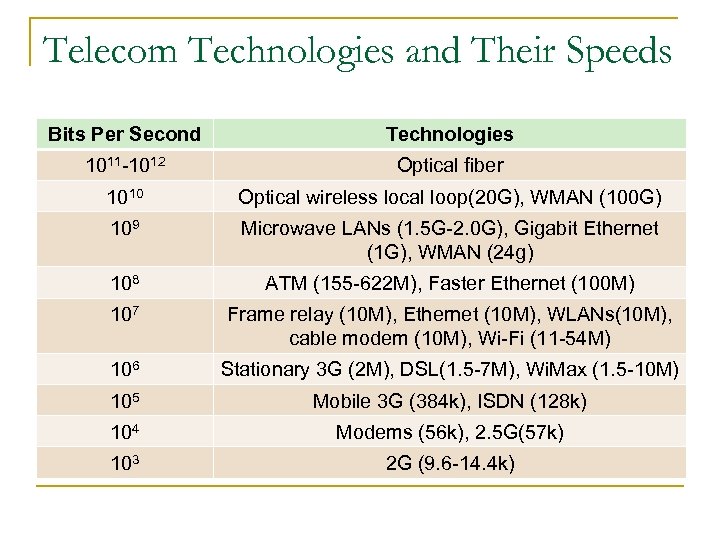 Telecom Technologies and Their Speeds Bits Per Second Technologies 1011 -1012 Optical fiber 1010 Optical wireless local loop(20 G), WMAN (100 G) 109 Microwave LANs (1. 5 G-2. 0 G), Gigabit Ethernet (1 G), WMAN (24 g) 108 ATM (155 -622 M), Faster Ethernet (100 M) 107 Frame relay (10 M), Ethernet (10 M), WLANs(10 M), cable modem (10 M), Wi-Fi (11 -54 M) 106 Stationary 3 G (2 M), DSL(1. 5 -7 M), Wi. Max (1. 5 -10 M) 105 Mobile 3 G (384 k), ISDN (128 k) 104 Modems (56 k), 2. 5 G(57 k) 103 2 G (9. 6 -14. 4 k)
 Case Example: ICG Communications n n n This CLEC provides voice and data services in 25 metropolitan areas in the United States It was formed in 1984 to provide local telephone service in Denver. It expanded to provide long distance, buying up companies with fiber routes It later focused on being an Internet backbone provider, serving ISPs When the dot-com bubble burst, ICG filed for bankruptcy, but moved out of bankruptcy in late 2002 Acquired by Level 3 Communication in 2006
 The Internet is the Network of Choice (1) n Internet and telecom surprised us by its fast rise and fall in the past one decade n History of the Internet q In 1960 s, APARNET developed by DOD for transferring scientific files n q Mainly used for email Until 1993, still an all-text world-wide network for scientists and academics n Email, FTP, Telnet, Gopher…
 The Internet is the Network of Choice (2) q In 1994, Tim Berners Lee invented World Wide Web n n n URL HTML Browser n The Internet has done for telecom what the IBM PC did for computing: brought it "to the masses" n Open architecture of Internet q Interconnectivity
 The Internet is the Network of Choice (3) n 3 important attributes of the Internet q Ubiquity n q Reliability n q Global reach Alternate routing, scale-free network Scalability n Easy extension of its reach, increasing performance of websites
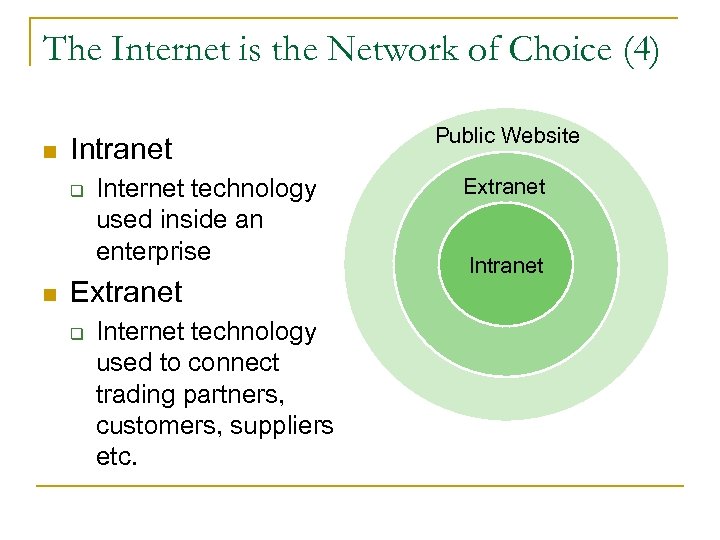 The Internet is the Network of Choice (4) n Intranet q n Internet technology used inside an enterprise Extranet q Internet technology used to connect trading partners, customers, suppliers etc. Public Website Extranet E Intranet
 Digital Convergence n Intertwining of various forms of media – voice, data and video n All forms of media can be digitized, put into packets and sent over an IP network q Media managed and manipulated digitally and integrated in highly imaginative ways
 IP Telephony (1) n The use of Internet to transmit voice to replace their telephone system q n A phone with an IP address, voice delivered in digital packets Previously conceived application of IP telephony q q q To another IP phone on the LAN Through the company's WAN to a distant IP phone on another of the company's LANs Through an IP voice gateway to the PSTN to a standard telephone
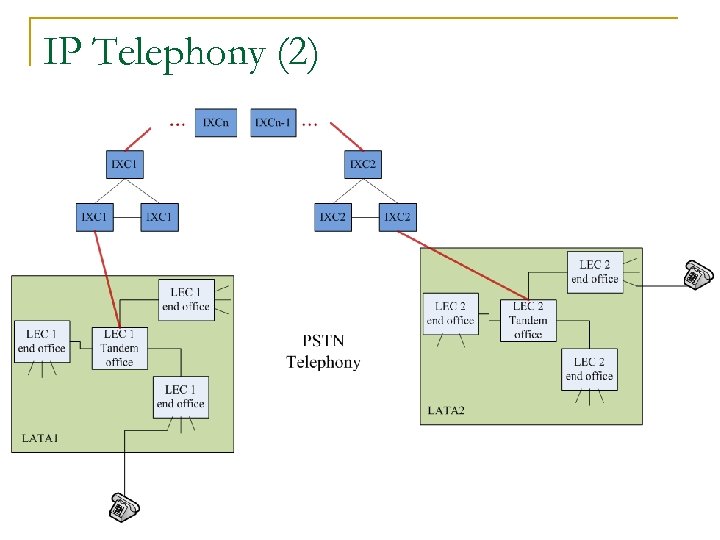 IP Telephony (2)
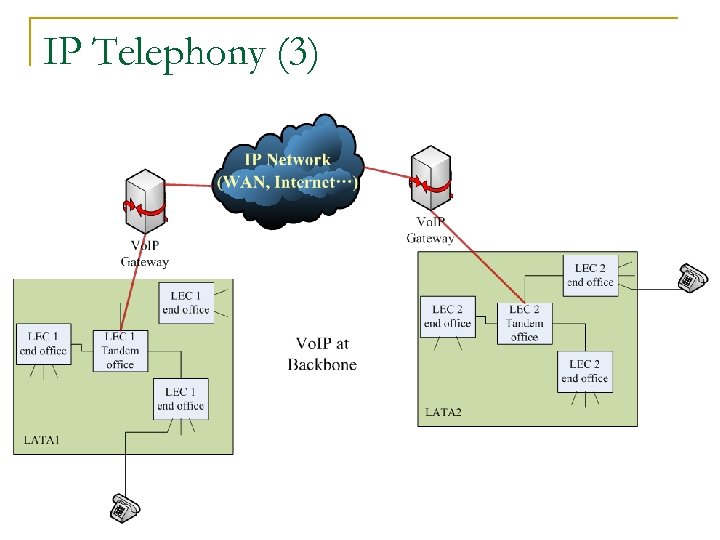 IP Telephony (3)
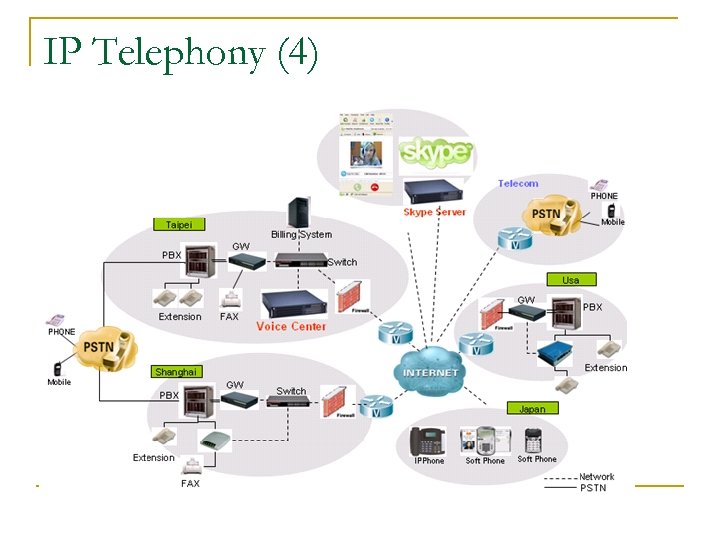 IP Telephony (4)
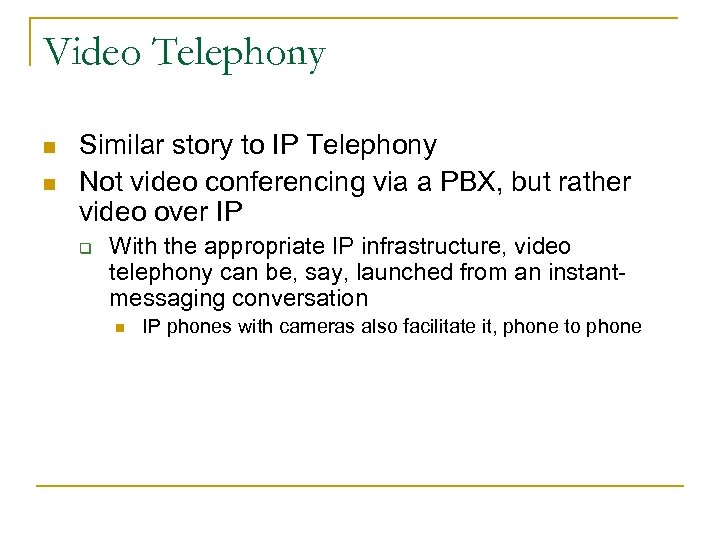 Video Telephony n n Similar story to IP Telephony Not video conferencing via a PBX, but rather video over IP q With the appropriate IP infrastructure, video telephony can be, say, launched from an instantmessaging conversation n IP phones with cameras also facilitate it, phone to phone
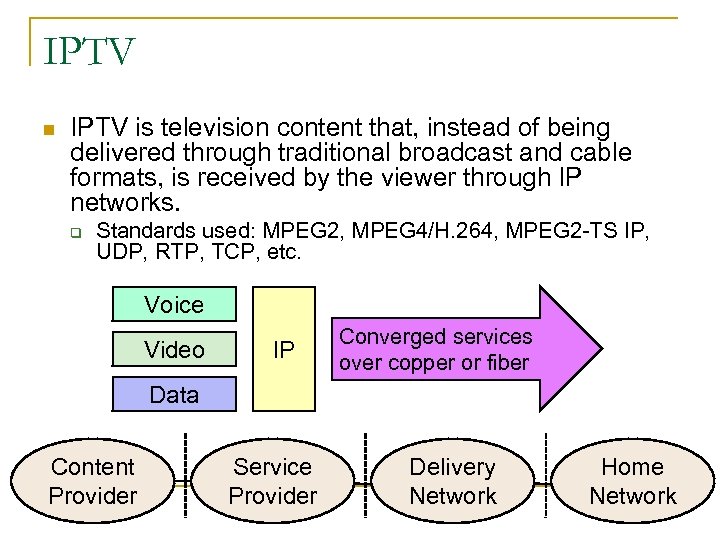 IPTV n IPTV is television content that, instead of being delivered through traditional broadcast and cable formats, is received by the viewer through IP networks. q Standards used: MPEG 2, MPEG 4/H. 264, MPEG 2 -TS IP, UDP, RTP, TCP, etc. Voice Video IP Converged services over copper or fiber Data Content Provider Service Provider Delivery Network Home Network
 OSI Reference Model n Closed VS. open network q q n Closed network: using proprietary networking technology Open network: based on national or international standards What is a reference model? q q A division of functionality together with data flow between the pieces No detailed standards specified for each layer
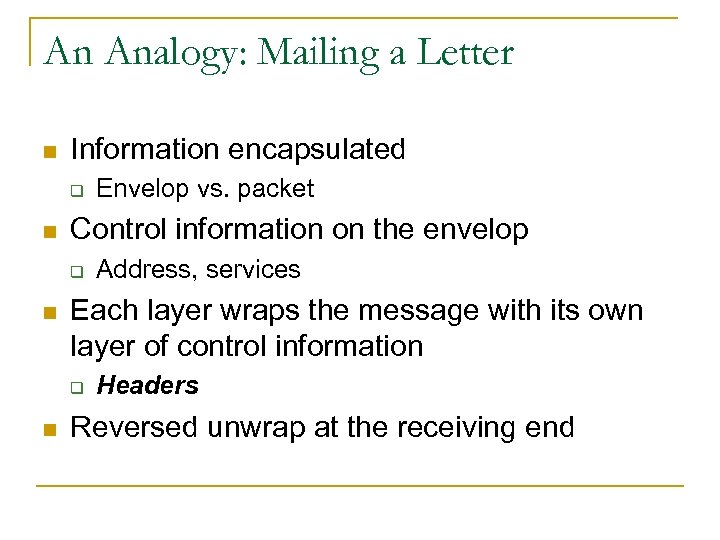 An Analogy: Mailing a Letter n Information encapsulated q n Control information on the envelop q n Address, services Each layer wraps the message with its own layer of control information q n Envelop vs. packet Headers Reversed unwrap at the receiving end
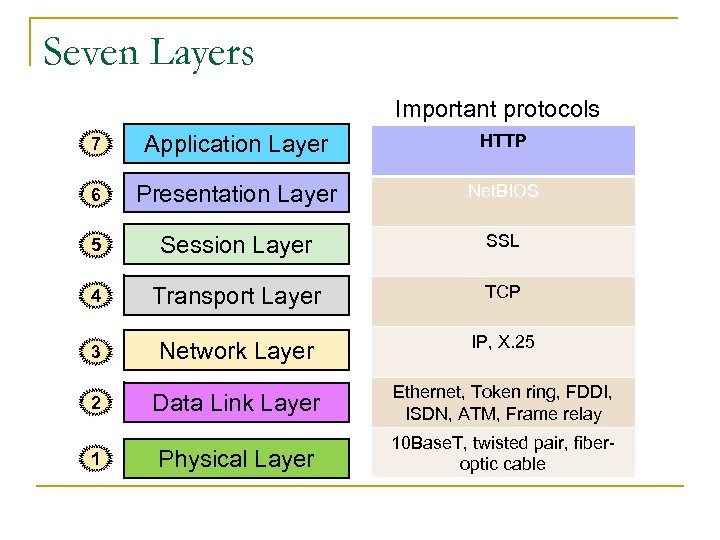 Seven Layers Important protocols 7 Application Layer HTTP 6 Presentation Layer Net. BIOS 5 Session Layer SSL 4 Transport Layer TCP 3 Network Layer IP, X. 25 2 Data Link Layer Ethernet, Token ring, FDDI, ISDN, ATM, Frame relay Physical Layer 10 Base. T, twisted pair, fiberoptic cable 1
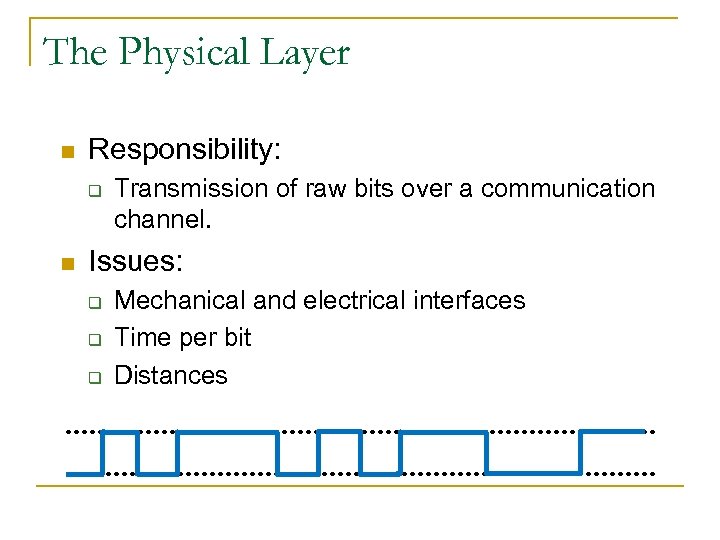 The Physical Layer n Responsibility: q n Transmission of raw bits over a communication channel. Issues: q q q Mechanical and electrical interfaces Time per bit Distances
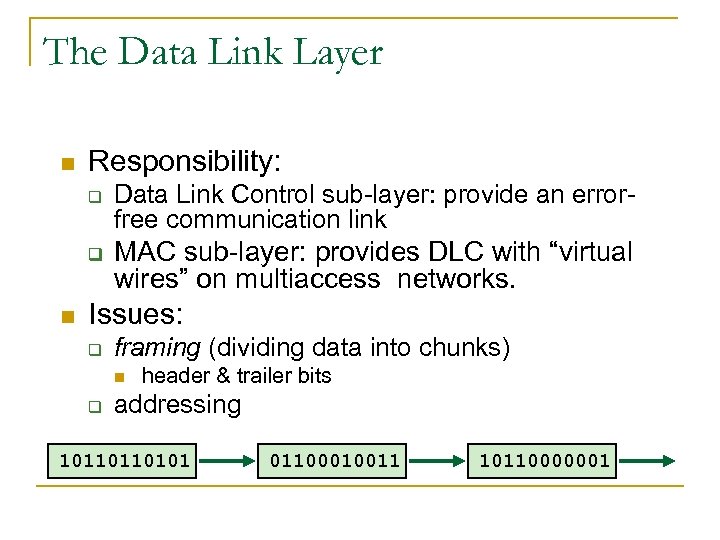 The Data Link Layer n Responsibility: q q n Data Link Control sub-layer: provide an errorfree communication link MAC sub-layer: provides DLC with “virtual wires” on multiaccess networks. Issues: q framing (dividing data into chunks) n q header & trailer bits addressing 10110110101 01100010011 10110000001
 The Network Layer n Responsibilities: q q n Path selection between end-systems (routing). Subnet flow control. Fragmentation & reassembly Translation between different network types. Issues: q q Packet headers Virtual circuits
 The Transport Layer n Responsibilities: q q n Provides virtual end-to-end links between peer processes. End-to-end flow control Issues: q q q Headers Error detection Reliable communication
 n The Session Layer q n The Presentation Layer q n Establishes, manages, and terminates sessions between applications. Data encryption, data compression, data conversion The Application Layer q Anything not provided by any of the other layers
 Connecting Network n Repeater: physical layer n Bridge: data link layer n Router: network layer n Gateway: network layer and above.
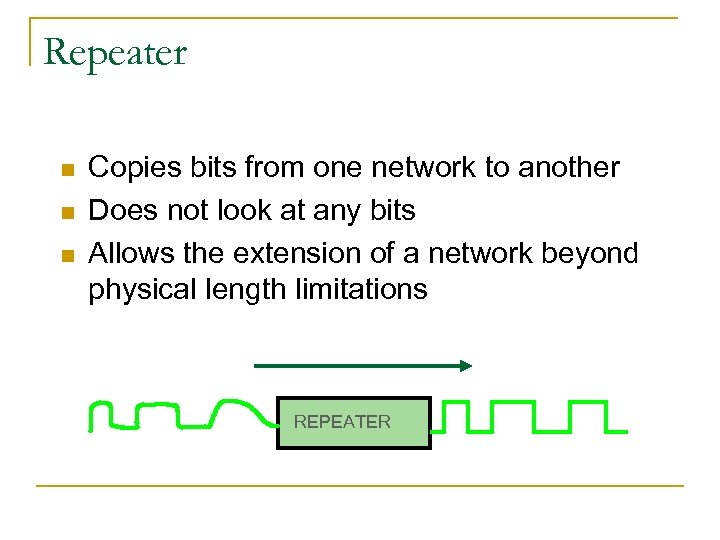 Repeater n n n Copies bits from one network to another Does not look at any bits Allows the extension of a network beyond physical length limitations REPEATER
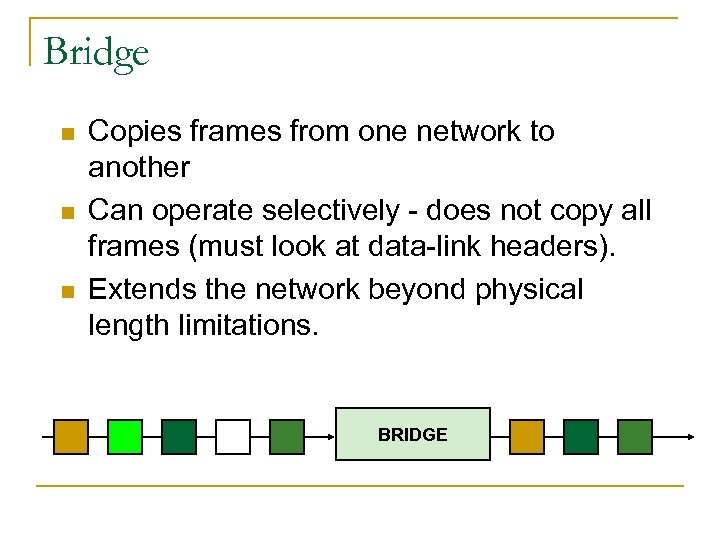 Bridge n n n Copies frames from one network to another Can operate selectively - does not copy all frames (must look at data-link headers). Extends the network beyond physical length limitations. BRIDGE
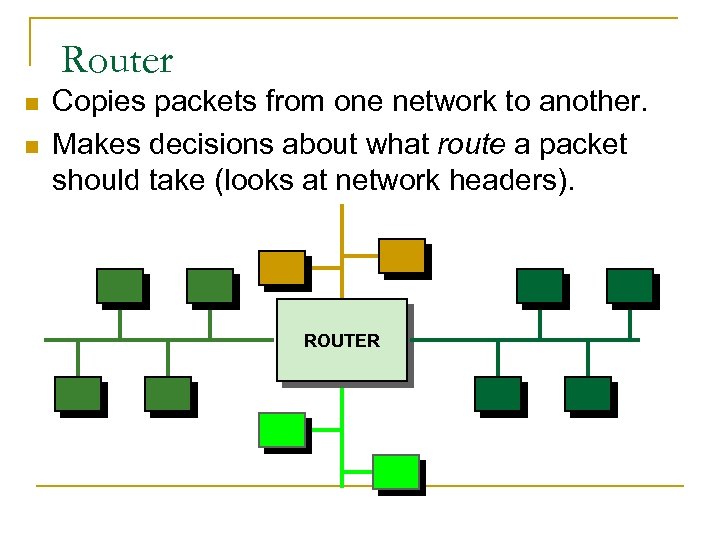 Router n n Copies packets from one network to another. Makes decisions about what route a packet should take (looks at network headers). ROUTER
 Gateway n n n Operates as a router Data conversions above the network layer. Conversions: encapsulation - use an intermediate network translation - connect different application protocols encrpyption - could be done by a gateway
 The Optical Era Will Provide Bandwidth Abundance n Decline in cost of key factors q q q n During the industrial era: horsepower Since the 1960 s: semiconductors Now: bandwidth 40 million miles of fiber optic cable have been laid around the world, in the USA at a rate of 4, 000 miles per day q q Half of the cable is dark, that is, it is not used. And the other half is used to just one-millionth of its potential Over the next decade, bandwidth will expand ten times as fast as computer power and completely transform the economy
 The Wireless Century Begins n The goal of wireless is to do everything we can do on wired networks, but without the wire n Wireless communications have been with us for some time q q n Mobile (cell) phones, pagers, VSATs, infrared networks, wireless LANs etc. Radio waves are none-deterministic The 20 th century was the Wire-line Century, the 21 st will be the Wireless Century
 Licensed VS. Unlicensed Frequencies n Some frequencies of the radio spectrum are licensed by governments for specific purposes; others are not n Devices that tap unlicensed frequencies are cheaper q q q No big licensing fees Greater competition, more innovation and faster changes Possibility of collision between signals
 "Telecoms Crash" n Auctions of the 3 g radio spectrum in Germany and Britain at the beginning of 2000. q q n The nature of the auctions, was to offer a limited number of licenses q n n n Although one similar auction in the USA had failed disastrously the year before. 3 G also requires an infrastructure development measured in billions of dollars This put the telephone operators in a difficult position, as diabetics being forced to bid for insulin. The stock market lost confidence (dot-com crash), influencing the credit rating of the operators Within a year 100, 000 jobs were lost in telecoms in Europe (30, 000 in UK) Subsequent government auctions of the 3 g spectrum were met with low bids
 Wireless Networks (1) n Wireless Personal Area Networks (WPANs) q n Wireless Local Area Networks (WLANs) q n Provide access to corporate computers in office buildings, retail stores, or hospitals or access to Internet "hot spots" where people congregate Wireless Metropolitan Area Networks (WMANs) q n Provide high-speed connections between devices that are up to 30 feet apart Provide connections in cities and campuses at distances up to 30 miles Wireless Wide Area Networks (WWANs) q Provide broadband wireless connections over thousands of miles
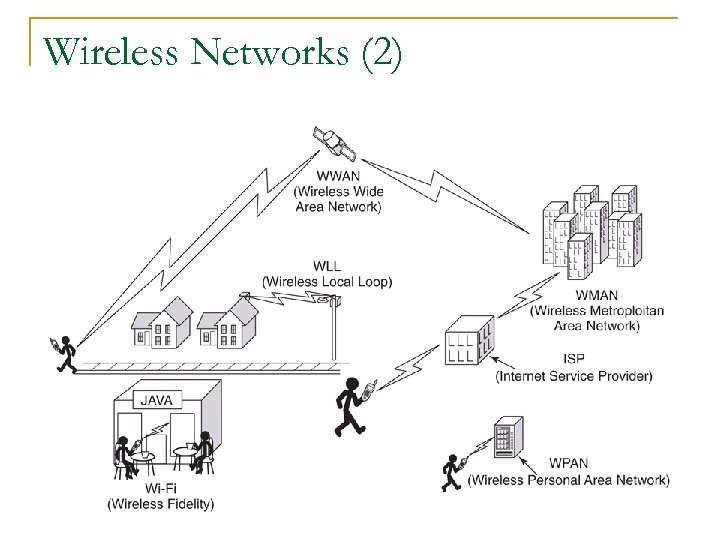 Wireless Networks (2)
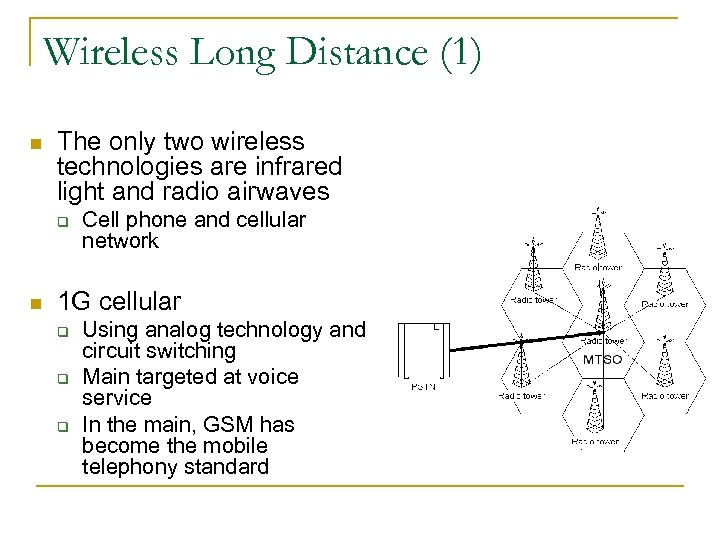 Wireless Long Distance (1) n The only two wireless technologies are infrared light and radio airwaves q n Cell phone and cellular network 1 G cellular q q q Using analog technology and circuit switching Main targeted at voice service In the main, GSM has become the mobile telephony standard
 Wireless Long Distance (2) n 2 G cellular q q Predominant today, uses digital technology, but still circuit switched 2 G can carry SMS service It aims at digital telephony, but with certain ability to carry data 2. 5 G (e. g. GPRS)---2. 75 G (e. g. CDMA) n n Adds data capacity to a 2 G network The problem with adoption has been pricing
 Wireless Long Distance (3) n 3 G q Services include wide-area wireless voice telephony and broadband wireless data, all in a mobile environment. n q q q 802. 11 networks are short range 384 k-2 M Costs to deploy not seen as tenable in many circumstances It faces the same pricing issues at 2. 5 G – perhaps worse Killer apps still not clear Battery and input
 Wireless Long Distance (4) n 4 G q q A comprehensive IP solution where voice, data and streamed multimedia can be given to users on an "Anytime, Anywhere" basis Features n n n q higher data rates than previous generations: 100 M-1 G (any two points in the world) premium quality and high security Fully IP-based Supporting a greater number of wireless devices that are directly addressable and routable (IPv 6) Spectrally efficient and high network capacity Pre-4 G technologies n Wi. Max, LTE, UMB. . .
 Coming: An Internet of Things n Wireless communications like promised by 4 G will enable machine-to-machine Internet q q q n Sensor network RFID tag Devices are all connected to the Internet, with a mix of wired and wireless technologies A new business environment
 The Role of the IS Department n Three roles of IS department q Create the telecom architecture n n q q Connectivity Interoperability Operate the network Stay current with the technology
 Conclusion n The telecom world is complex, and getting more complex every day n The business world is becoming increasingly dependent on telecom q q n n In the past, electronic data exchange The Internet unleashed email Web sites were then used to get noticed globally Now it is used for transaction and business The first generation of the Internet economy has been wired. The second is unwired