


 Скачать презентацию Managing Stormwater Utilities for Results Chapel Hill
0e4960a7a4c3469a431d811d67825046.ppt
- Количество слайдов: 44
 Managing Stormwater Utilities for Results Chapel Hill – June 23, 2005 Scott Bryant, PE – JEWELL Engineering Consultants
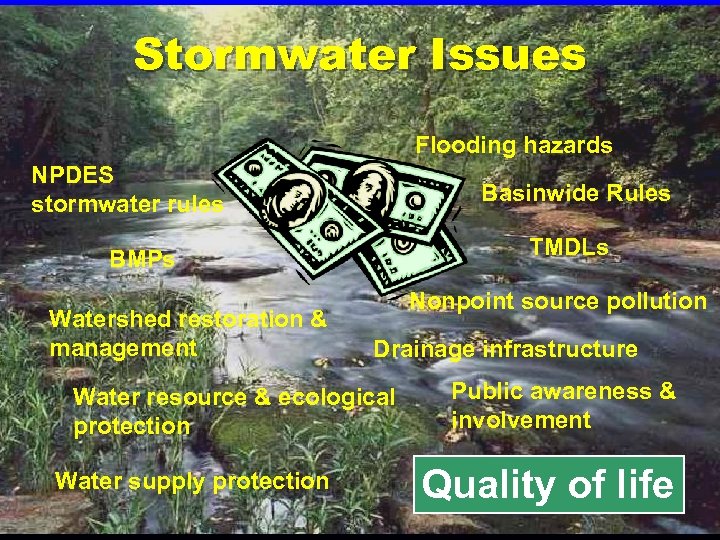 Stormwater Issues Flooding hazards NPDES stormwater rules Basinwide Rules TMDLs BMPs Watershed restoration & management Nonpoint source pollution Drainage infrastructure Water resource & ecological protection Water supply protection Public awareness & involvement Quality of life
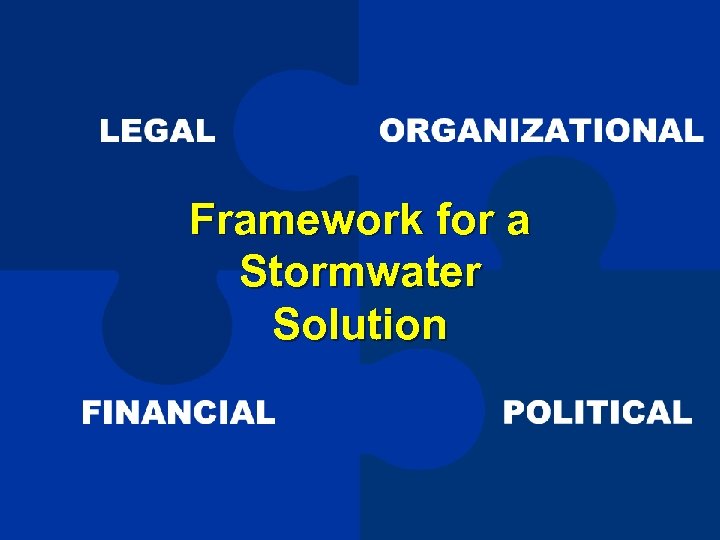 Framework for a Stormwater Solution
 Overview * Utility 101 * NC Utilities * Management Lessons Learned
 Basic Options for Funding the Stormwater Program • 2 key primary funding methods – General funding (tax based) – Utility funding (user fee based) • Supplemental funding can come from… – – Plan review fees Site inspection fees Interest earned on idle funds A few others
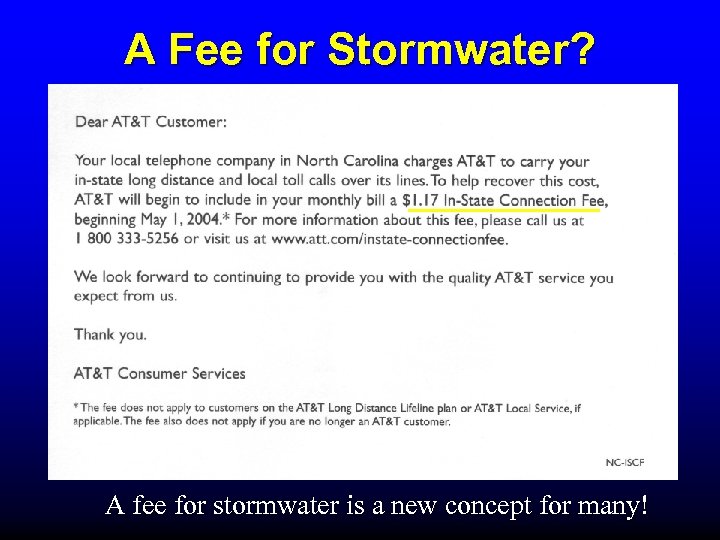 A Fee for Stormwater? A fee for stormwater is a new concept for many!
 Stormwater Utility must be… > Allowed by state law, > Desired by local decision makers, & > Accepted by community ratepayers.
 The Stormwater Reality Recently in the news regarding proposed utilities: “It’s nothing but a tax increase, and I can’t go along with that. We have to live within our means. ” “We’re going to pay for it one way or the other. It’s either establish the fees or take money out of the (city’s) general fund. ” “If I vote against this resolution will the EPA come down and arrest me? ” “It’s going to move (our city) into the next level of stormwater management. ”
 Willingness to Pay? • Citizen perception of free services in past • How much would the typical citizen in your community be willing to pay for the “new” stormwater services? • Utility fee raises level of service expectations
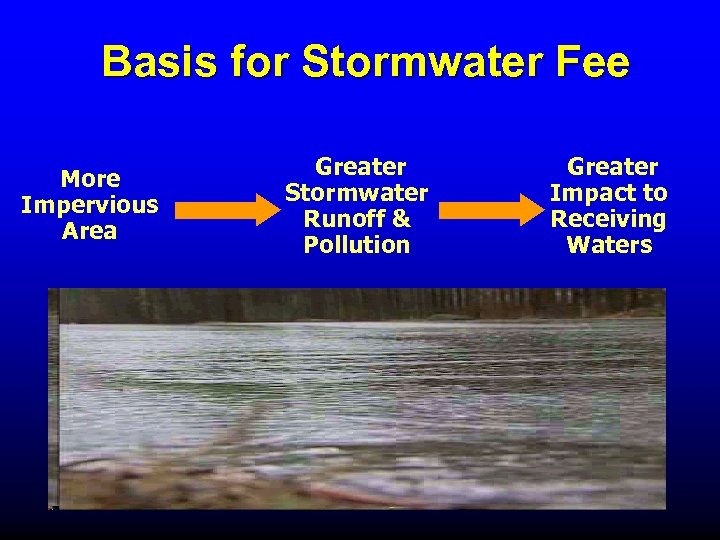 Basis for Stormwater Fee More Impervious Area Greater Stormwater Runoff & Pollution Greater Impact to Receiving Waters
 Basis for Stormwater Fee Two customer billing classifications typical – Single-family residential (SFR) – Non-single-family residential • Fairness and equity in fee structure to cover public program cost of service • Majority of revenue often from Non-SFR class – Commercial/industrial – Public streets and roads (to bill or not to bill? )
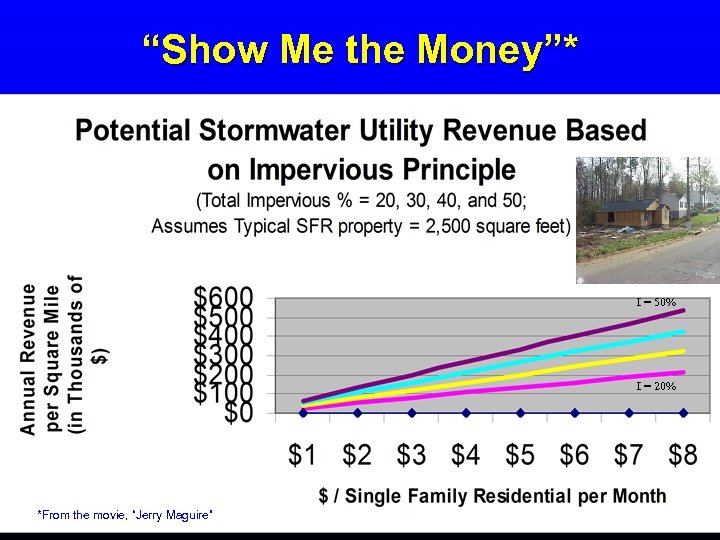 “Show Me the Money”* I = 50% I = 20% *From the movie, “Jerry Maguire”
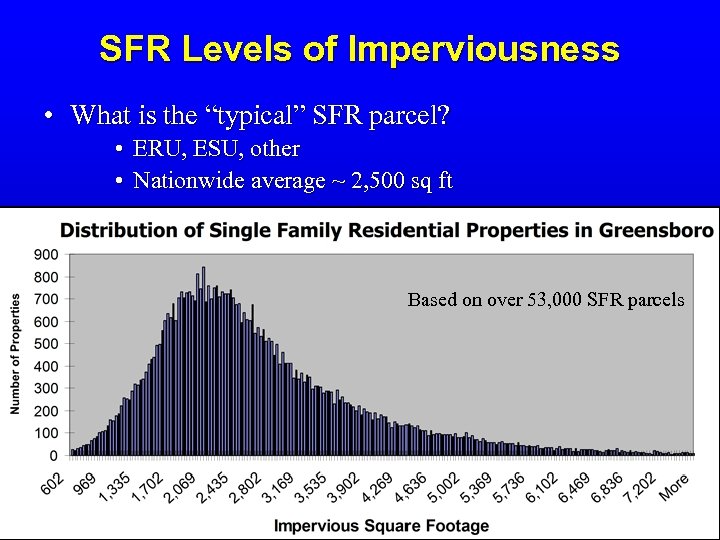 SFR Levels of Imperviousness • What is the “typical” SFR parcel? • ERU, ESU, other • Nationwide average ~ 2, 500 sq ft Based on over 53, 000 SFR parcels
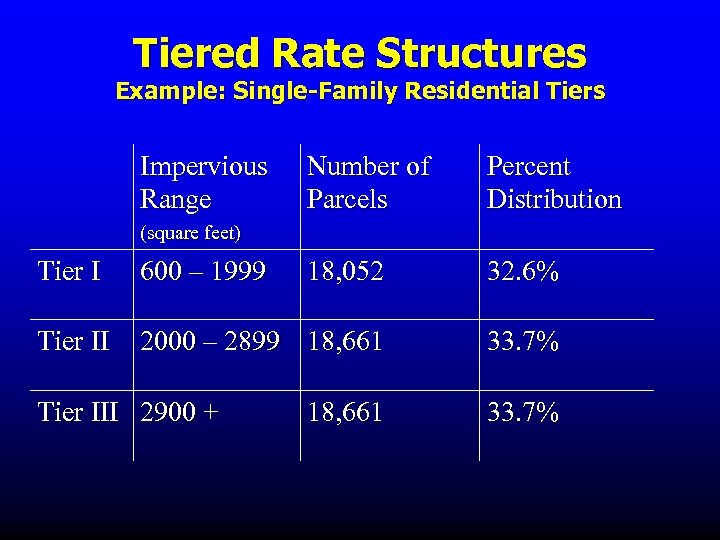 Tiered Rate Structures Example: Single-Family Residential Tiers Impervious Range Number of Parcels Percent Distribution (square feet) Tier I 600 – 1999 18, 052 32. 6% Tier II 2000 – 2899 18, 661 33. 7% Tier III 2900 + 18, 661 33. 7%
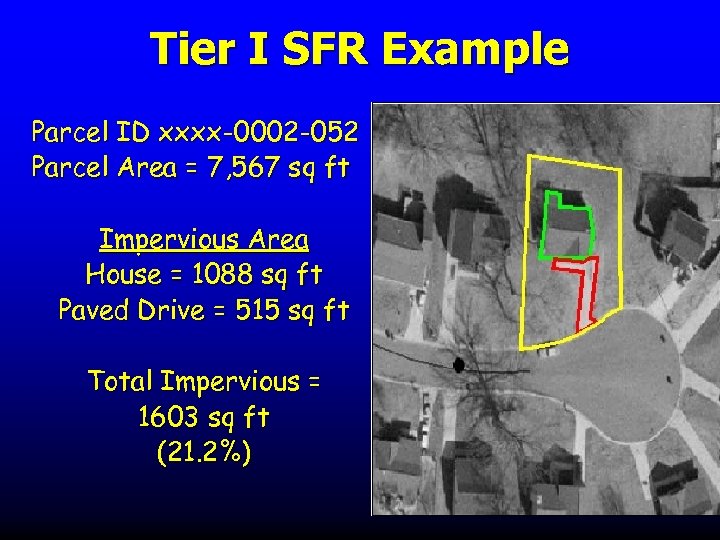 Tier I SFR Example Parcel ID xxxx-0002 -052 Parcel Area = 7, 567 sq ft Impervious Area House = 1088 sq ft Paved Drive = 515 sq ft Total Impervious = 1603 sq ft (21. 2%)
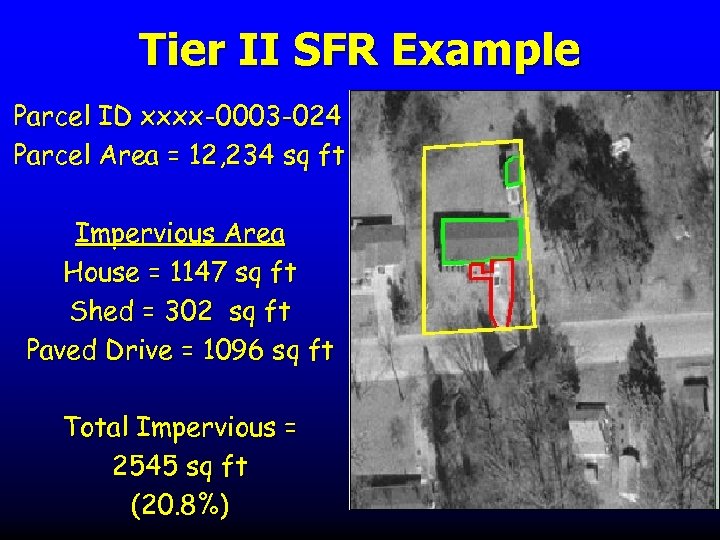 Tier II SFR Example Parcel ID xxxx-0003 -024 Parcel Area = 12, 234 sq ft Impervious Area House = 1147 sq ft Shed = 302 sq ft Paved Drive = 1096 sq ft Total Impervious = 2545 sq ft (20. 8%)
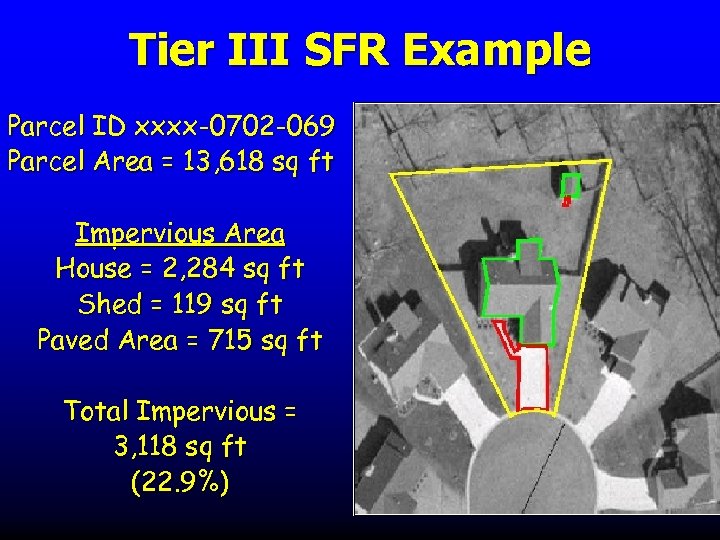 Tier III SFR Example Parcel ID xxxx-0702 -069 Parcel Area = 13, 618 sq ft Impervious Area House = 2, 284 sq ft Shed = 119 sq ft Paved Area = 715 sq ft Total Impervious = 3, 118 sq ft (22. 9%)
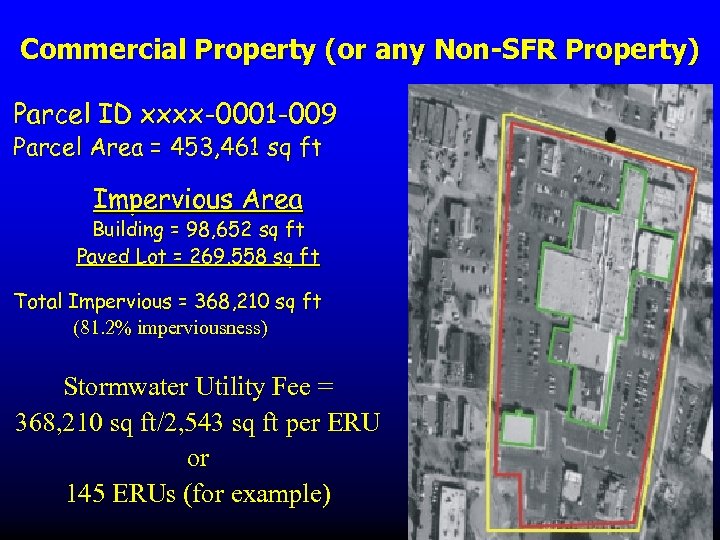 Commercial Property (or any Non-SFR Property) Parcel ID xxxx-0001 -009 Parcel Area = 453, 461 sq ft Impervious Area Building = 98, 652 sq ft Paved Lot = 269, 558 sq ft Total Impervious = 368, 210 sq ft (81. 2% imperviousness) Stormwater Utility Fee = 368, 210 sq ft/2, 543 sq ft per ERU or 145 ERUs (for example)
 Stormwater Program Cost Centers • Administration – Program mgt, utility (if applicable) customer service, billing, indirect costs, etc • Water Quality – Monitoring programs, BMP inspections, illicit discharge program, NPDES MS 4 permit compliance, TMDL programs, etc. • Planning & Engineering – Plan review, master planning, floodplain mgt, GIS, system inventory, technical guidance, capital project design, consultant management, etc. • Public Education – Education, outreach, and involvement programs • System Operation & Maintenance – Sweeping, infrastructure maintenance, open channel maintenance, litter collection, drainage complaint response • Capital Improvement Program (CIP) • Debt Service, if applicable • Fund Balance/Retained Earnings – Use should mesh with program strategy
 Utility 101 NC Utilities Management Lessons Learned
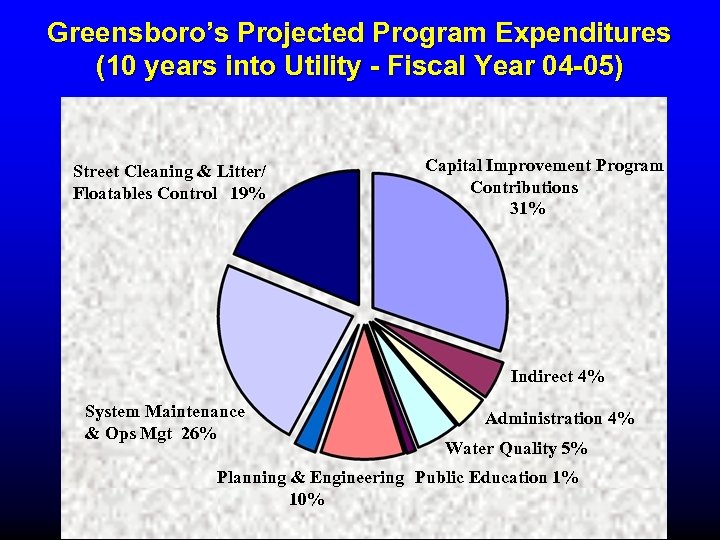 Greensboro’s Projected Program Expenditures (10 years into Utility - Fiscal Year 04 -05) Street Cleaning & Litter/ Floatables Control 19% Capital Improvement Program Contributions 31% Indirect 4% System Maintenance & Ops Mgt 26% Administration 4% Water Quality 5% Planning & Engineering Public Education 1% 10%
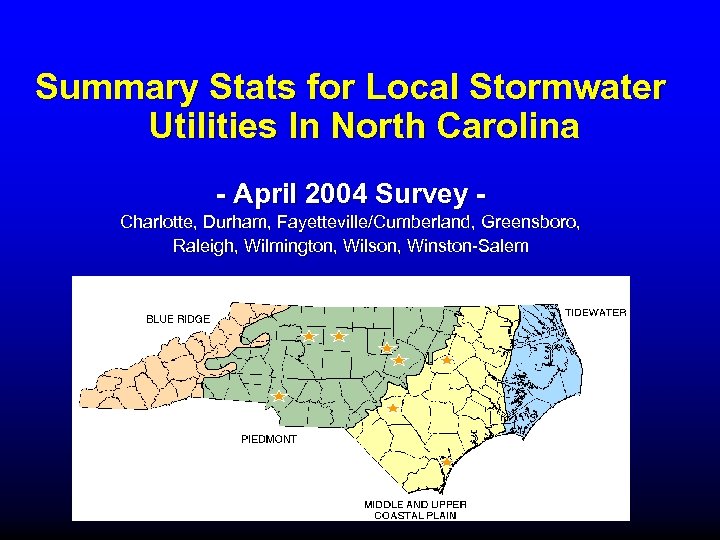 Summary Stats for Local Stormwater Utilities In North Carolina - April 2004 Survey Charlotte, Durham, Fayetteville/Cumberland, Greensboro, Raleigh, Wilmington, Wilson, Winston-Salem
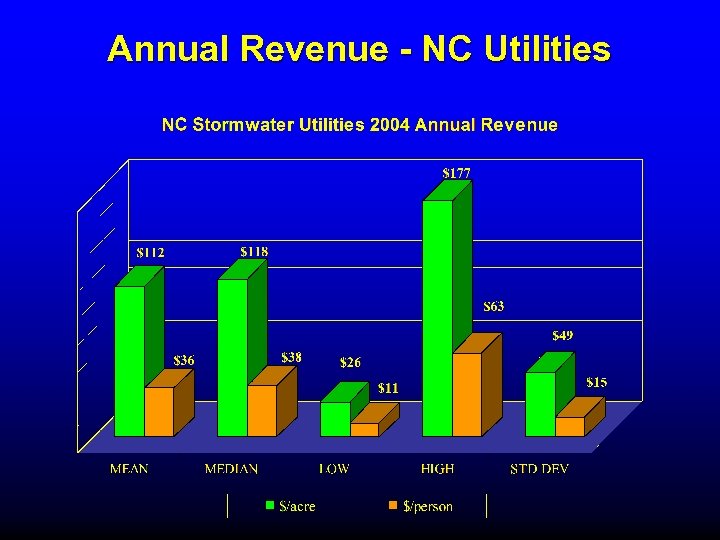 Annual Revenue - NC Utilities
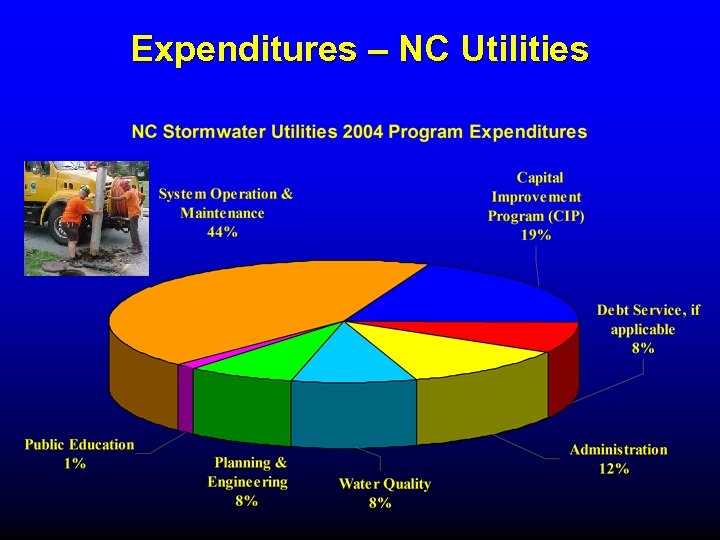 Expenditures – NC Utilities
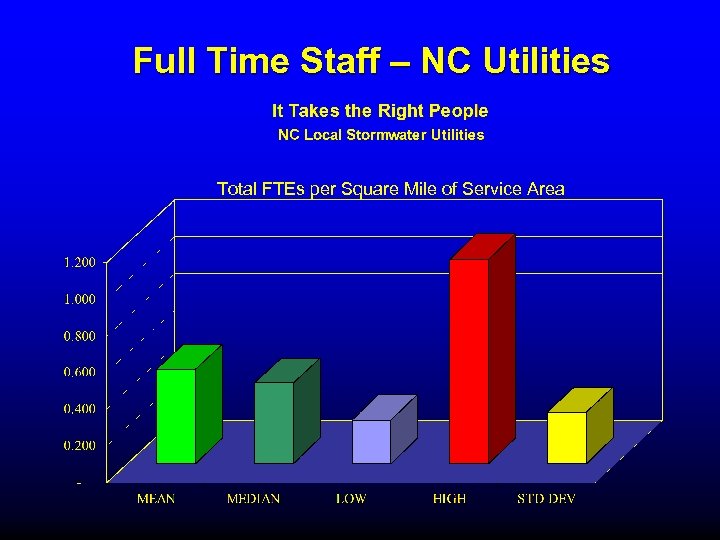 Full Time Staff – NC Utilities Total FTEs per Square Mile of Service Area
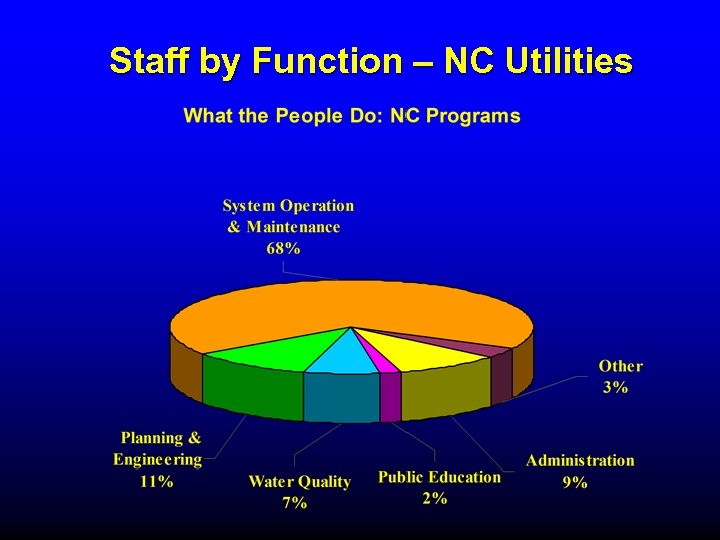 Staff by Function – NC Utilities
 Utility 101 NC Utilities Management Lessons Learned
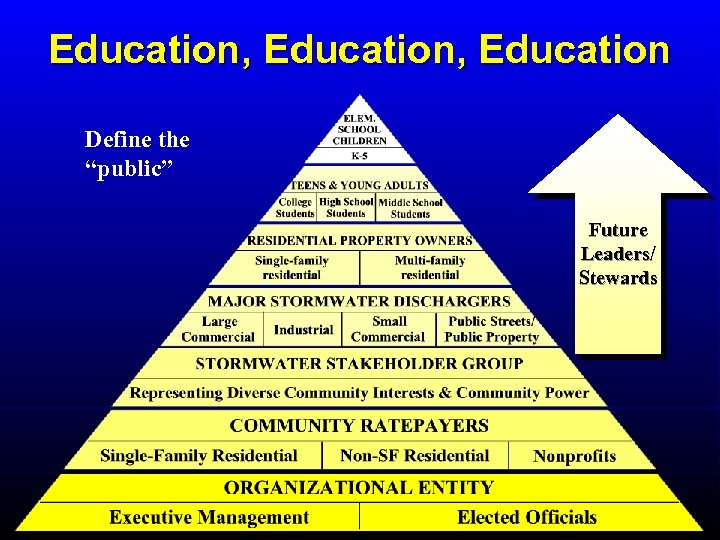 Education, Education Define the “public” Future Leaders/ Stewards
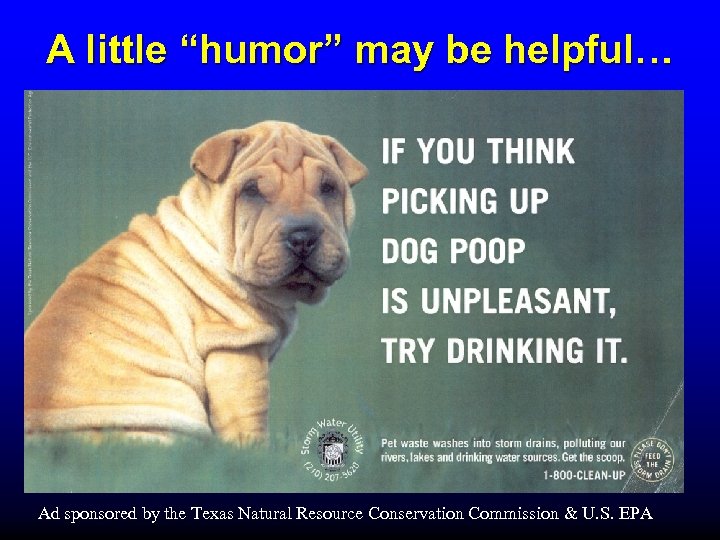 A little “humor” may be helpful… Ad sponsored by the Texas Natural Resource Conservation Commission & U. S. EPA
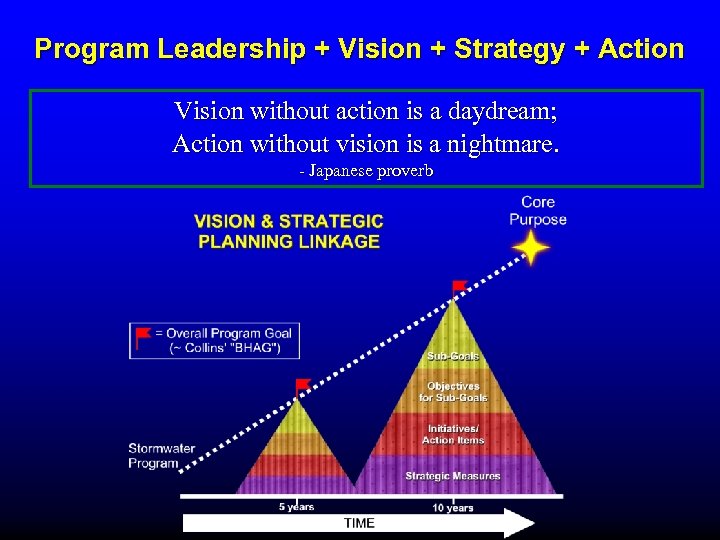 Program Leadership + Vision + Strategy + Action Vision without action is a daydream; Action without vision is a nightmare. - Japanese proverb
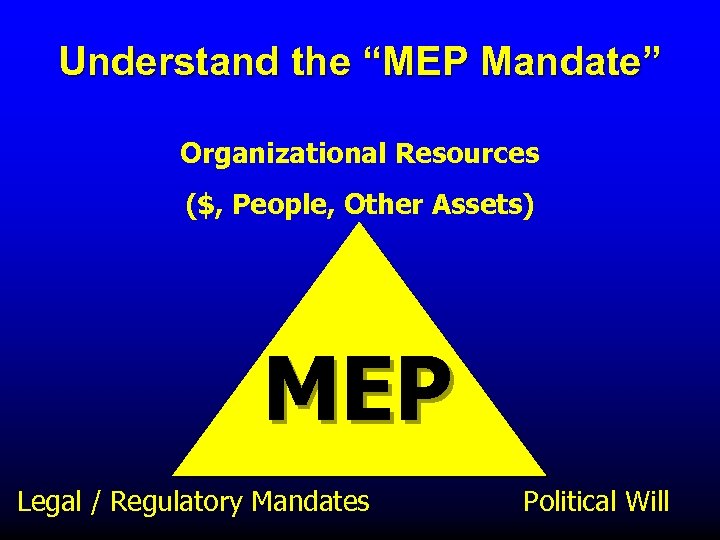 Understand the “MEP Mandate” Organizational Resources ($, People, Other Assets) MEP Legal / Regulatory Mandates Political Will
 Get a Good Lawyer • Place utility on a solid legal foundation from day one. – Hard lessons will be learned through a lawsuit – Greensboro & Durham Cases • liability could have exceeded $28 MM in Greensboro – Legal action is distraction for program, staff, and community
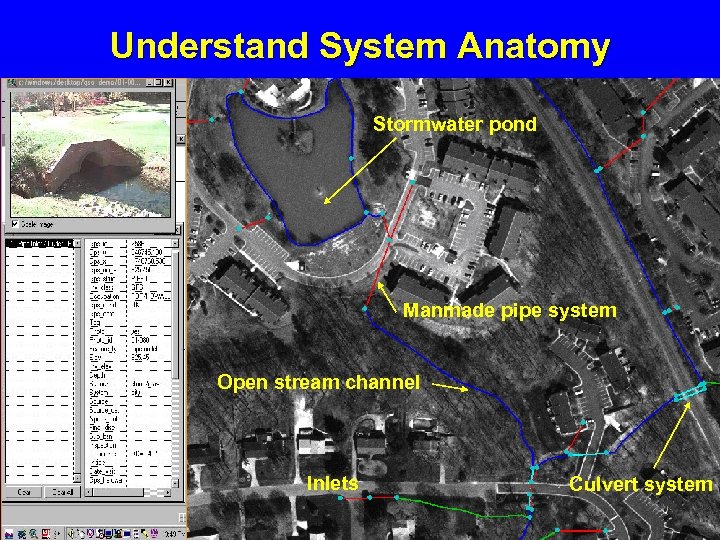 Understand System Anatomy Stormwater pond Manmade pipe system Open stream channel Inlets Culvert system
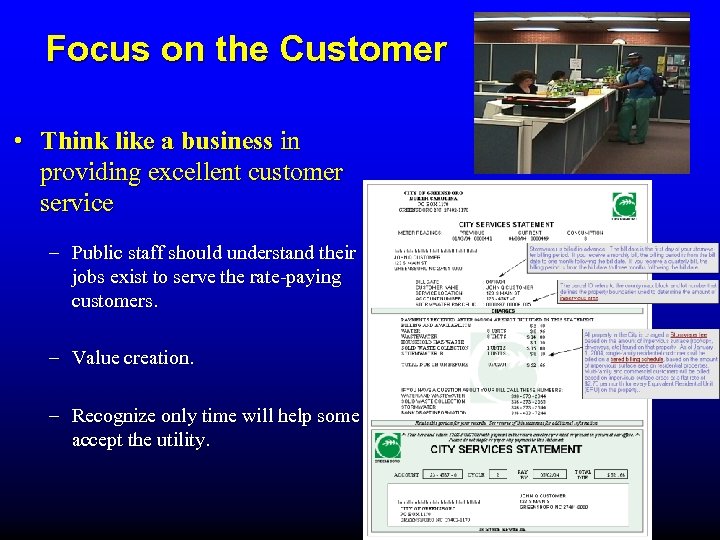 Focus on the Customer • Think like a business in providing excellent customer service – Public staff should understand their jobs exist to serve the rate-paying customers. – Value creation. – Recognize only time will help some accept the utility.
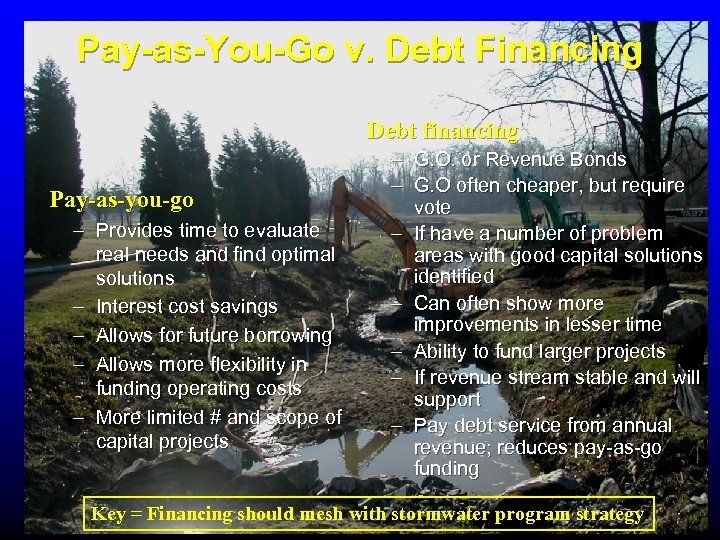 Pay-as-You-Go v. Debt Financing Debt financing Pay-as-you-go – Provides time to evaluate real needs and find optimal solutions – Interest cost savings – Allows for future borrowing – Allows more flexibility in funding operating costs – More limited # and scope of capital projects – G. O. or Revenue Bonds – G. O often cheaper, but require vote – If have a number of problem areas with good capital solutions identified – Can often show more improvements in lesser time – Ability to fund larger projects – If revenue stream stable and will support – Pay debt service from annual revenue; reduces pay-as-go funding Key = Financing should mesh with stormwater program strategy
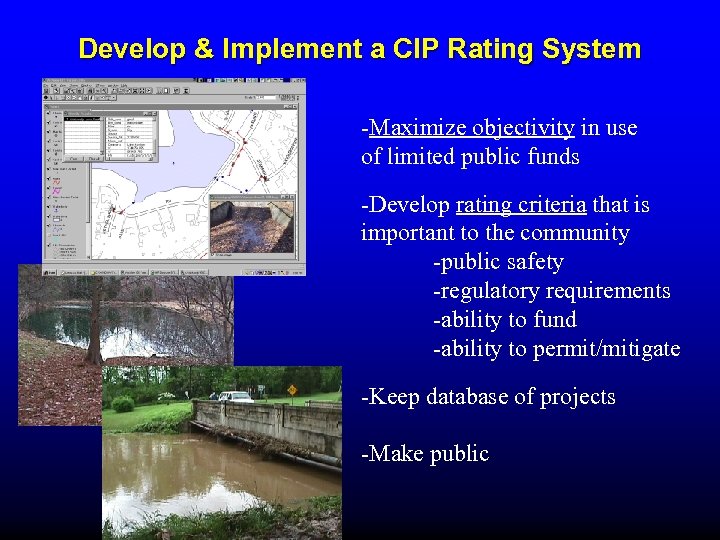 Develop & Implement a CIP Rating System -Maximize objectivity in use of limited public funds -Develop rating criteria that is important to the community -public safety -regulatory requirements -ability to fund -ability to permit/mitigate -Keep database of projects -Make public
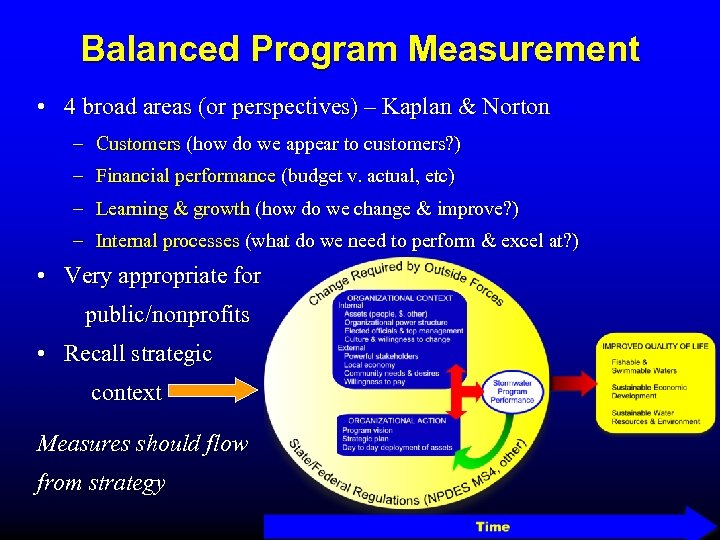 Balanced Program Measurement • 4 broad areas (or perspectives) – Kaplan & Norton – Customers (how do we appear to customers? ) – Financial performance (budget v. actual, etc) – Learning & growth (how do we change & improve? ) – Internal processes (what do we need to perform & excel at? ) • Very appropriate for public/nonprofits • Recall strategic context Measures should flow from strategy
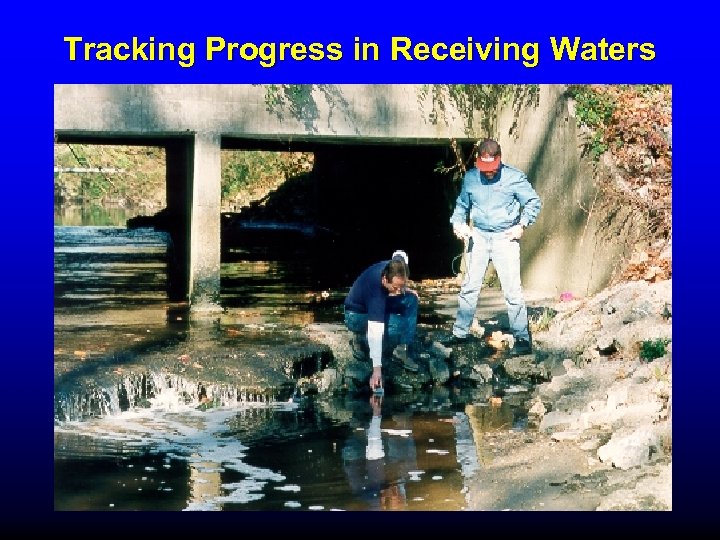 Tracking Progress in Receiving Waters
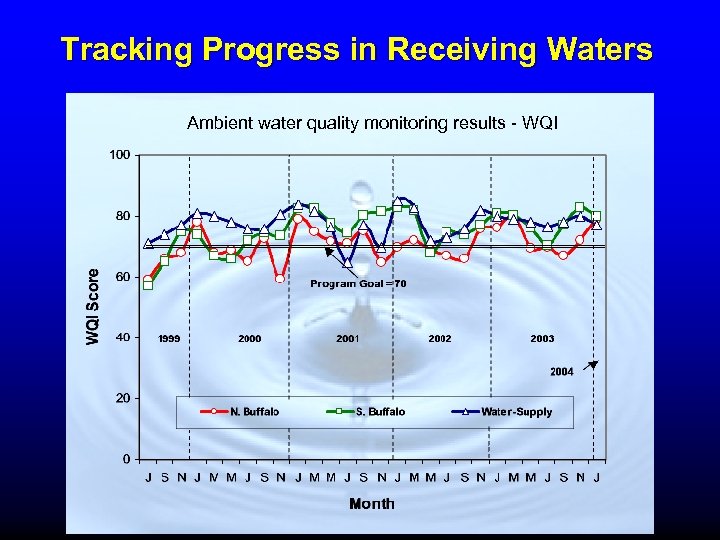 Tracking Progress in Receiving Waters Ambient water quality monitoring results - WQI
 Sound Utility Fee Crediting Policy *Understand major revenue and cost (expenditure) centers for the public stormwater program *Structure policy ensuring financial solvency to satisfy ongoing public operational and capital needs *Provide fair and reasonable incentives for ratepayers that adopt proper controls *Provide awareness of the fee-crediting program
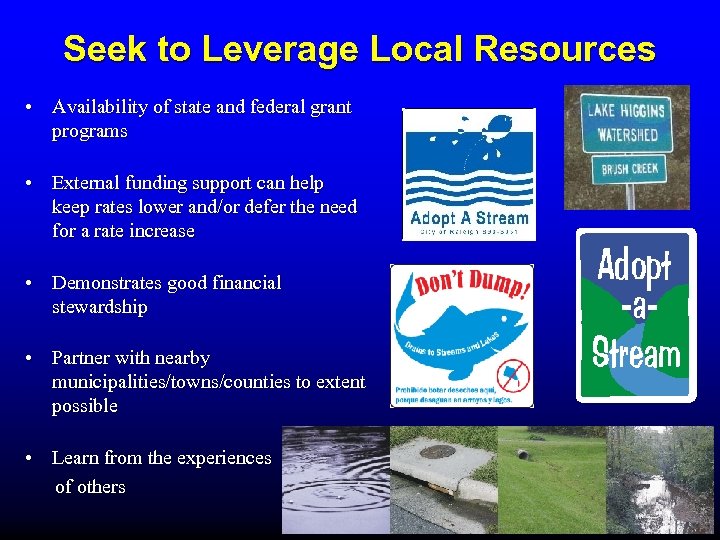 Seek to Leverage Local Resources • Availability of state and federal grant programs • External funding support can help keep rates lower and/or defer the need for a rate increase • Demonstrates good financial stewardship • Partner with nearby municipalities/towns/counties to extent possible • Learn from the experiences of others
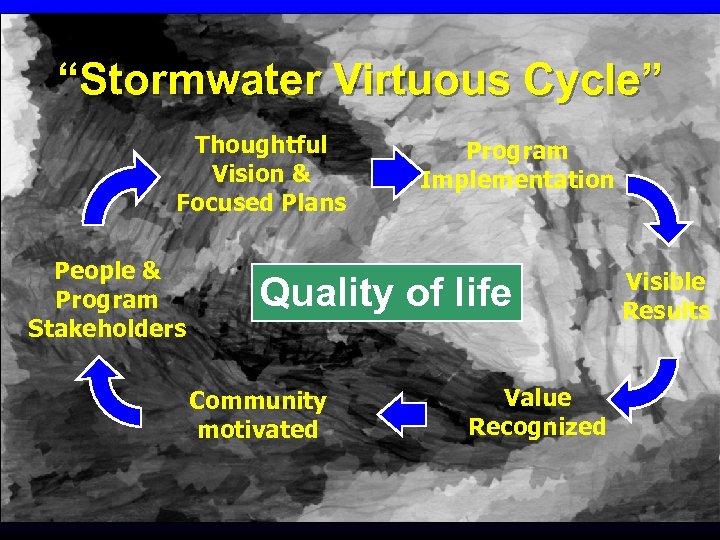 “Stormwater Virtuous Cycle” Thoughtful Vision & Focused Plans People & Program Stakeholders Program Implementation Quality of life Community motivated Value Recognized Visible Results
 Q&A The ultimate test of management is performance. -Peter F. Drucker Scott Bryant, PE – JEWELL Engineering Consultants Office Tel 336. 9974 Email sbryant@jewellengr. com