 Скачать презентацию Managing Software Quality Main issues Quality cannot be
ead3495bccfdd73b2fedd241b803f0e2.ppt
- Количество слайдов: 22



Managing Software Quality Main issues: §Quality cannot be added as an afterthought §To measure is to know §Product quality vs process quality
Commitment to quality pays off SE, Quality, Hans van Vliet, © 2008 2
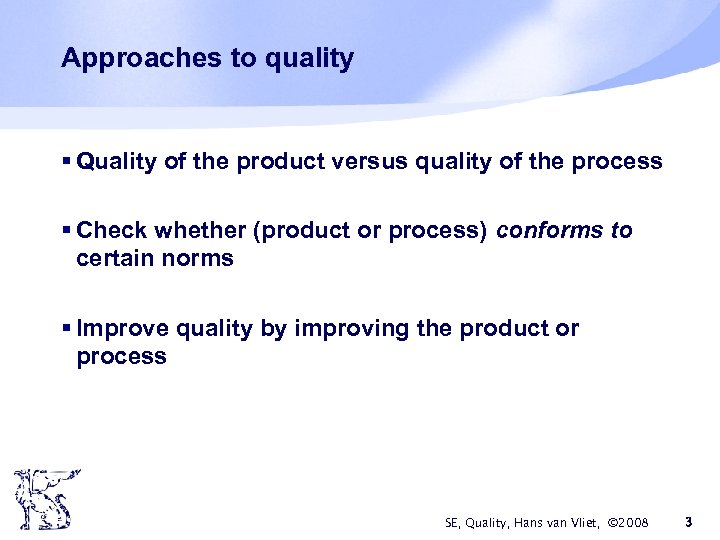
Approaches to quality § Quality of the product versus quality of the process § Check whether (product or process) conforms to certain norms § Improve quality by improving the product or process SE, Quality, Hans van Vliet, © 2008 3
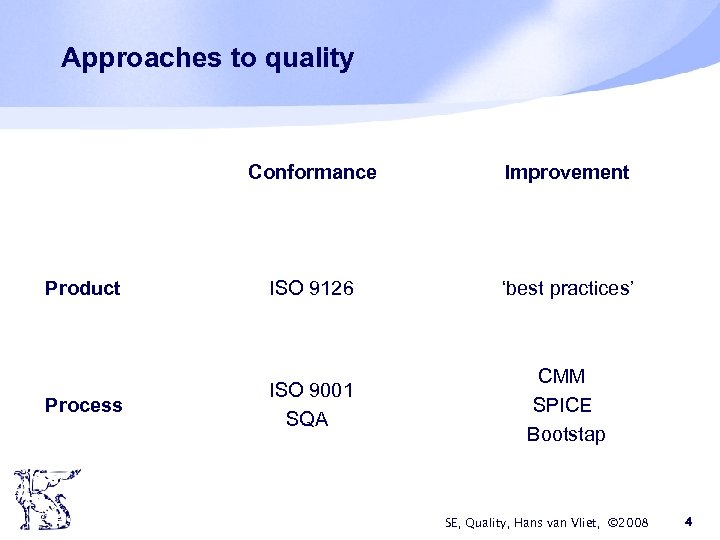
Approaches to quality Conformance Product Process Improvement ISO 9126 ‘best practices’ ISO 9001 SQA CMM SPICE Bootstap SE, Quality, Hans van Vliet, © 2008 4
What is quality? + software measures SE, Quality, Hans van Vliet, © 2008 5
How to measure “complexity”? § § § The length of the program? The number of goto’s? The number of if-statements? The sum of these numbers? Yet something else? SE, Quality, Hans van Vliet, © 2008 6
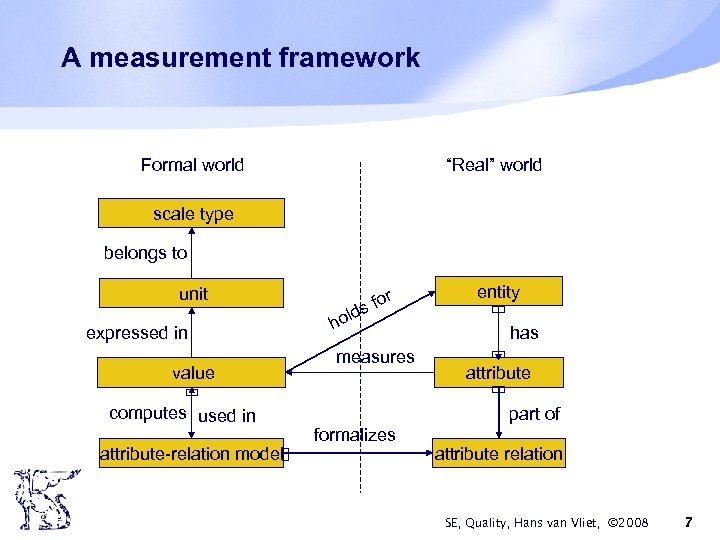
A measurement framework Formal world “Real” world scale type belongs to unit expressed in value computes used in attribute-relation model d hol r s fo measures entity has attribute part of formalizes attribute relation SE, Quality, Hans van Vliet, © 2008 7
Scale types § Nominal: just classification § Ordinal: linear ordering (>) § Interval: like ordinal, but interval between values is the same (so average has a meaning) § Ratio: like interval, but there is a 0 (zero) (so A can be twice B) § Absolute: counting number of occurrences SE, Quality, Hans van Vliet, © 2008 8
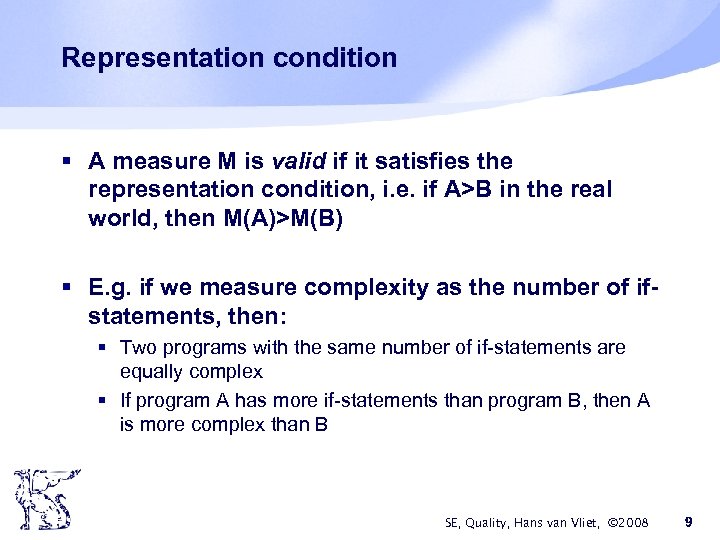
Representation condition § A measure M is valid if it satisfies the representation condition, i. e. if A>B in the real world, then M(A)>M(B) § E. g. if we measure complexity as the number of ifstatements, then: § Two programs with the same number of if-statements are equally complex § If program A has more if-statements than program B, then A is more complex than B SE, Quality, Hans van Vliet, © 2008 9
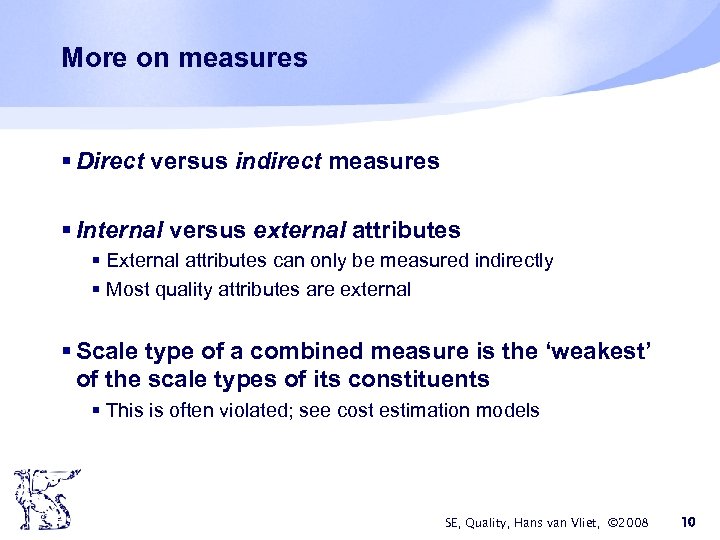
More on measures § Direct versus indirect measures § Internal versus external attributes § External attributes can only be measured indirectly § Most quality attributes are external § Scale type of a combined measure is the ‘weakest’ of the scale types of its constituents § This is often violated; see cost estimation models SE, Quality, Hans van Vliet, © 2008 10
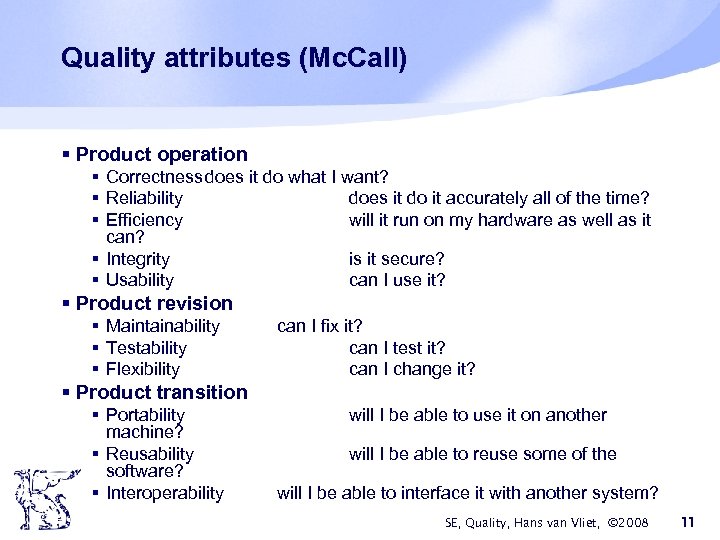
Quality attributes (Mc. Call) § Product operation § Correctness does it do what I want? § Reliability does it do it accurately all of the time? § Efficiency will it run on my hardware as well as it can? § Integrity is it secure? § Usability can I use it? § Product revision § Maintainability § Testability § Flexibility can I fix it? can I test it? can I change it? § Product transition § Portability machine? § Reusability software? § Interoperability will I be able to use it on another will I be able to reuse some of the will I be able to interface it with another system? SE, Quality, Hans van Vliet, © 2008 11
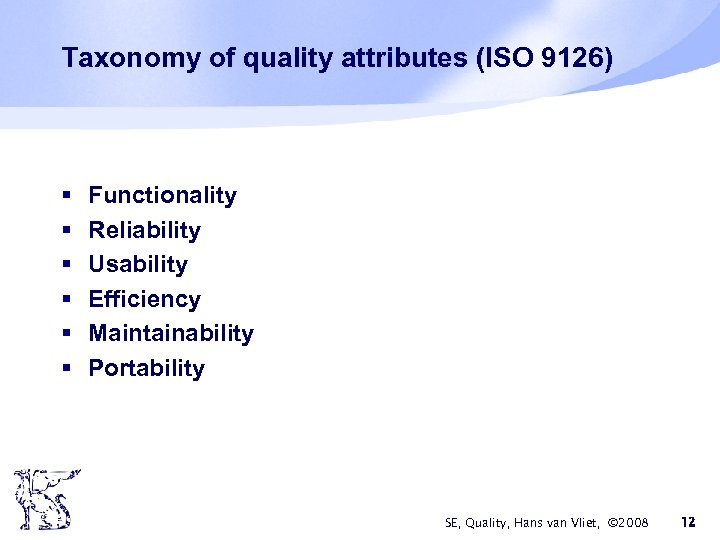
Taxonomy of quality attributes (ISO 9126) § § § Functionality Reliability Usability Efficiency Maintainability Portability SE, Quality, Hans van Vliet, © 2008 12
ISO 9126 (cnt’d) § ISO 9126 measures ‘quality in use’: the extent to which users can achieve their goal § Quality in use is modeled in four characteristics: § Effectiveness § Productivity § Safety § Satisfaction SE, Quality, Hans van Vliet, © 2008 13
Perspectives on quality § Transcendent (“I really like this program”) § User-based (“fitness for use”) § Product-based (based on attributes of the software) § Manufacturing-based (conformance to specs) § Value-based (balancing time and cost vs profits) SE, Quality, Hans van Vliet, © 2008 14
ISO 9001 § Model for quality assurance in design, development, production, installation and servicing § Basic premise: confidence in product conformance can be obtained by adequate demonstration of supplier’s capabilities in processes (design, development, …) § ISO registration by an officially accredited body, re-registration every three years SE, Quality, Hans van Vliet, © 2008 15
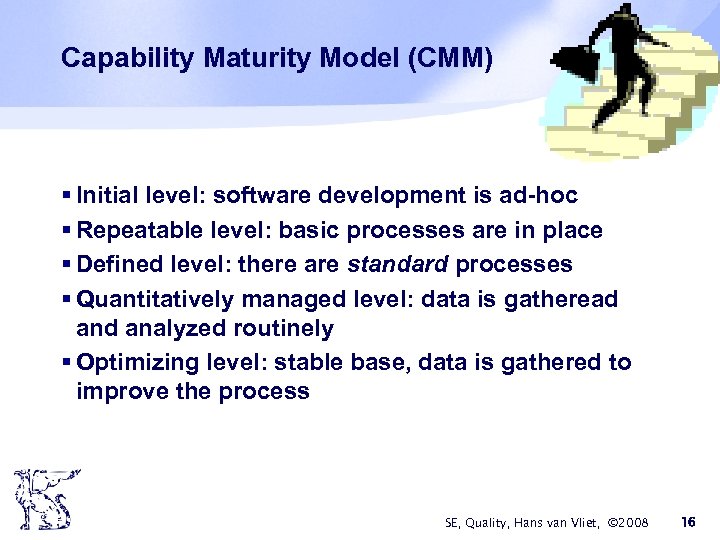
Capability Maturity Model (CMM) § Initial level: software development is ad-hoc § Repeatable level: basic processes are in place § Defined level: there are standard processes § Quantitatively managed level: data is gatheread analyzed routinely § Optimizing level: stable base, data is gathered to improve the process SE, Quality, Hans van Vliet, © 2008 16
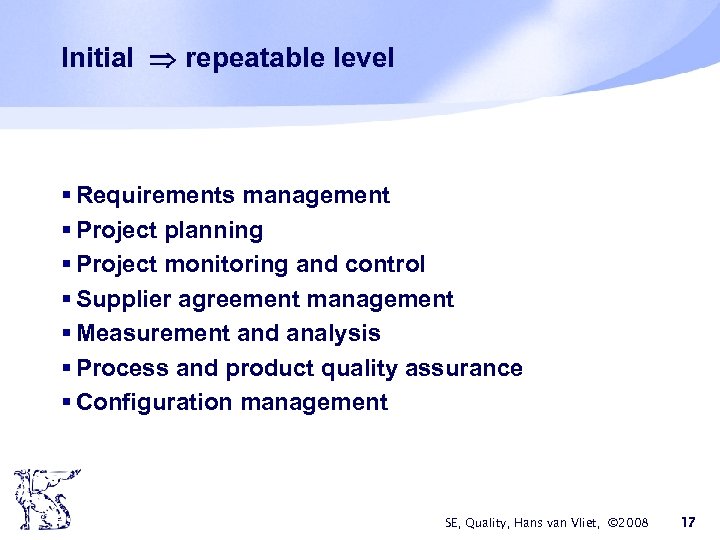
Initial repeatable level § Requirements management § Project planning § Project monitoring and control § Supplier agreement management § Measurement and analysis § Process and product quality assurance § Configuration management SE, Quality, Hans van Vliet, © 2008 17
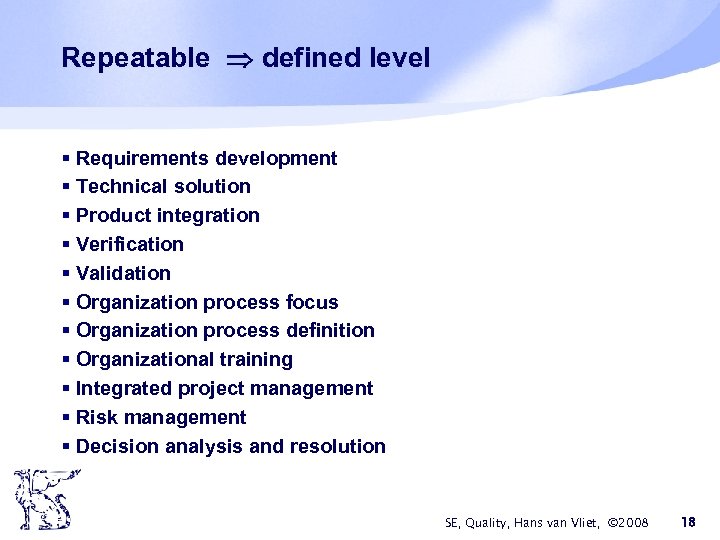
Repeatable defined level § Requirements development § Technical solution § Product integration § Verification § Validation § Organization process focus § Organization process definition § Organizational training § Integrated project management § Risk management § Decision analysis and resolution SE, Quality, Hans van Vliet, © 2008 18
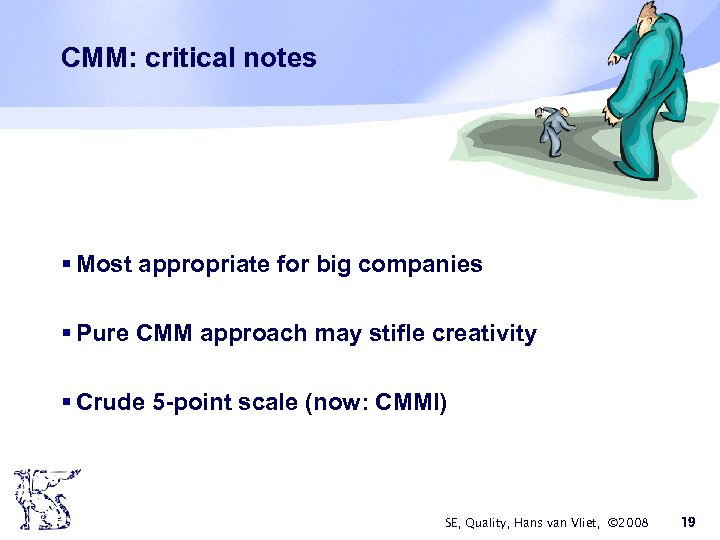
CMM: critical notes § Most appropriate for big companies § Pure CMM approach may stifle creativity § Crude 5 -point scale (now: CMMI) SE, Quality, Hans van Vliet, © 2008 19
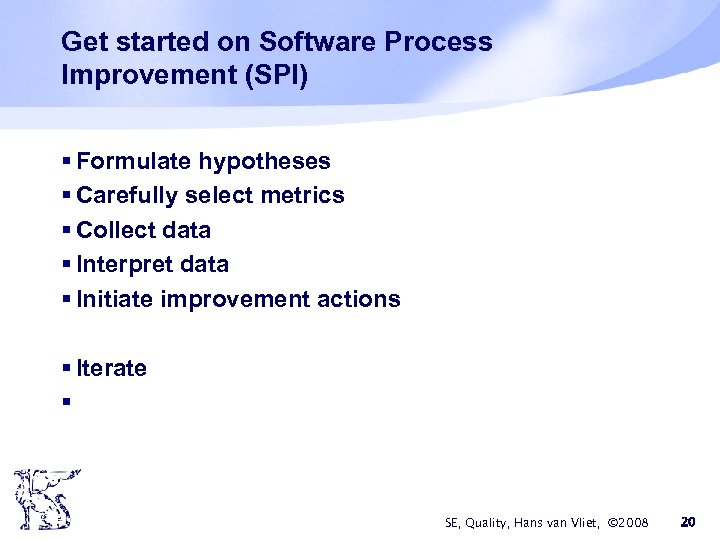
Get started on Software Process Improvement (SPI) § Formulate hypotheses § Carefully select metrics § Collect data § Interpret data § Initiate improvement actions § Iterate § SE, Quality, Hans van Vliet, © 2008 20
Lessons w. r. t. data collection § Closed loop principle: result of data analysis must be useful to supplier of data § Do not use data collected for other purposes § Focus on continuous improvement § Only collect data you really need SE, Quality, Hans van Vliet, © 2008 21
Summary § Product quality versus process quality § Quality conformance versus quality improvement § Quality has to be actively pursued § There are different notions of quality § Quality has many aspects § Quality is hard to measure SE, Quality, Hans van Vliet, © 2008 22
Скачать презентацию Managing Software Quality Main issues Quality cannot be
ead3495bccfdd73b2fedd241b803f0e2.ppt