


 Скачать презентацию Managing Risks The Common Interests of Emerging Market
1d7edd1791f8ab02364ba8bdec24ed94.ppt
- Количество слайдов: 32
 Managing Risks: The Common Interests of Emerging Market Countries and Investors Eliot Kalter International Capital Markets Department International Monetary Fund June 15, 2006 1
 OVERVIEW Managing Risks: The Common Interests of Emerging Market Countries and Investors I. Growing underlying strength of emerging market (EM) countries II. Improvements in EM sovereign debt structure III. Broadening investor base for EM issues IV. EM local issues as an investor class V. The portfolio application of local markets VI. Individual EM country valuation still matters VII. Implications for International Financial Institutions 2
 I. Underlying Strength of Emerging Market Countries Cyclical factors underlying strength of asset class • Increased risk aversion reflecting investors’ assessments of global liquidity and changes risk aversion • Nevertheless, search for yield and credit spread compression 3
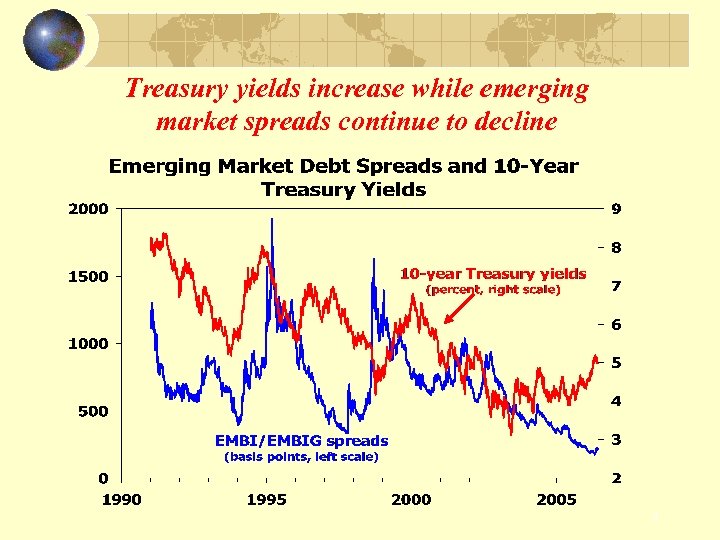 Treasury yields increase while emerging market spreads continue to decline 4
 Fundamental factors underlying strength of asset class • Global financial position of EM Countries has dramatically improved in recent years • Strong growth of international reserves through capital inflows and current account surpluses 5
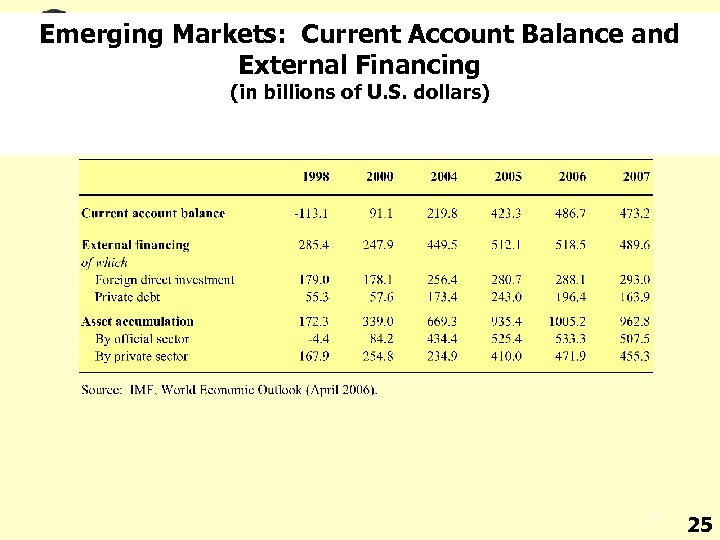 Emerging Markets: Current Account Balance and External Financing (in billions of U. S. dollars) 6 25
 Improved debt structure underlying strength of asset class Improvements in debt management operations • • • Significant improvement in EM macroeconomic fundamentals has enabled public debt managers to be active in markets Many EM sovereigns have made major strides in improving debt management capacity Focus on reducing exchange rate risk, interest rate risk, and rollover risk 7
 Recent liability management activity • • • Buy-backs of international bonds through early repayments to IFIs and the Paris Club, and retiring other foreign currency liabilities In addition, market is seeing exchange warrants, pre-funding of fiscal operations, and the exchange of foreign- for local-currency denominated debt These operations are transforming the market for emerging market assets 8
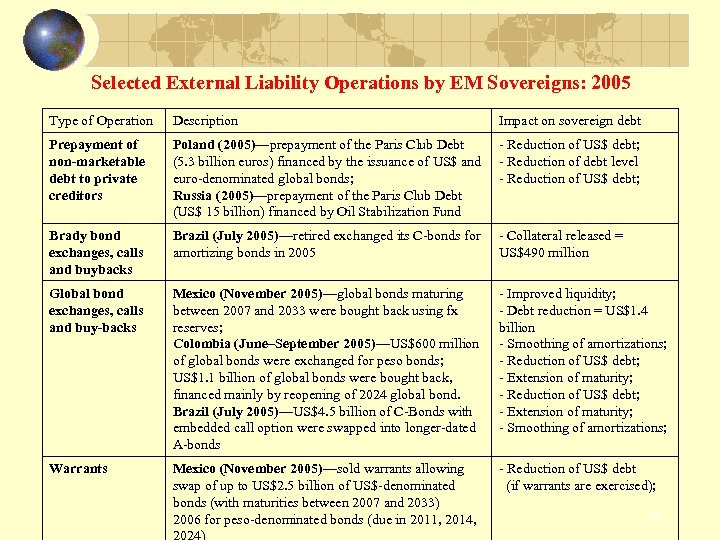 Selected External Liability Operations by EM Sovereigns: 2005 Type of Operation Description Impact on sovereign debt Prepayment of non-marketable debt to private creditors Poland (2005)––prepayment of the Paris Club Debt (5. 3 billion euros) financed by the issuance of US$ and euro-denominated global bonds; Russia (2005)––prepayment of the Paris Club Debt (US$ 15 billion) financed by Oil Stabilization Fund - Reduction of US$ debt; - Reduction of debt level - Reduction of US$ debt; Brady bond exchanges, calls and buybacks Brazil (July 2005)––retired exchanged its C-bonds for amortizing bonds in 2005 - Collateral released = US$490 million Global bond exchanges, calls and buy-backs Mexico (November 2005)––global bonds maturing between 2007 and 2033 were bought back using fx reserves; Colombia (June–September 2005)––US$600 million of global bonds were exchanged for peso bonds; US$1. 1 billion of global bonds were bought back, financed mainly by reopening of 2024 global bond. Brazil (July 2005)––US$4. 5 billion of C-Bonds with embedded call option were swapped into longer-dated A‑bonds - Improved liquidity; - Debt reduction = US$1. 4 billion - Smoothing of amortizations; - Reduction of US$ debt; - Extension of maturity; - Reduction of US$ debt; - Extension of maturity; - Smoothing of amortizations; Warrants Mexico (November 2005)––sold warrants allowing swap of up to US$2. 5 billion of US$-denominated bonds (with maturities between 2007 and 2033) 2006 for peso-denominated bonds (due in 2011, 2014, - Reduction of US$ debt (if warrants are exercised); 9
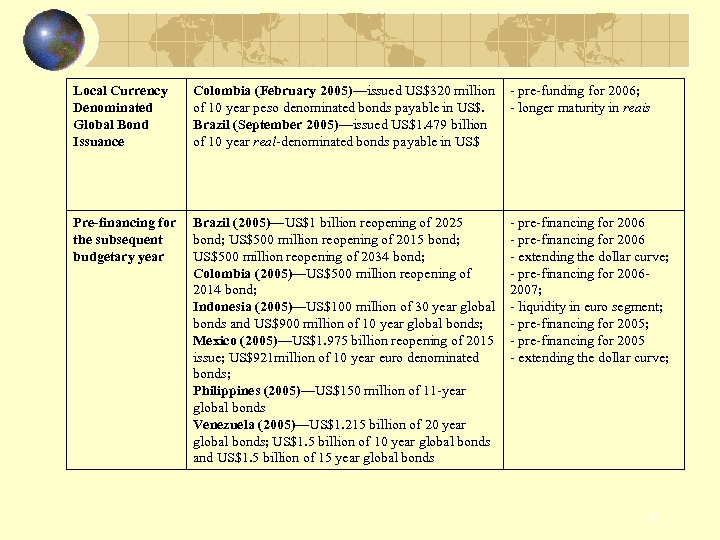 Local Currency Denominated Global Bond Issuance Colombia (February 2005)––issued US$320 million - pre-funding for 2006; of 10 year peso denominated bonds payable in US$. - longer maturity in reais Brazil (September 2005)––issued US$1. 479 billion of 10 year real-denominated bonds payable in US$ Pre-financing for the subsequent budgetary year Brazil (2005)––US$1 billion reopening of 2025 bond; US$500 million reopening of 2015 bond; US$500 million reopening of 2034 bond; Colombia (2005)––US$500 million reopening of 2014 bond; Indonesia (2005)––US$100 million of 30 year global bonds and US$900 million of 10 year global bonds; Mexico (2005)––US$1. 975 billion reopening of 2015 issue; US$921 million of 10 year euro denominated bonds; Philippines (2005)––US$150 million of 11 -year global bonds Venezuela (2005)––US$1. 215 billion of 20 year global bonds; US$1. 5 billion of 10 year global bonds and US$1. 5 billion of 15 year global bonds - pre-financing for 2006 - extending the dollar curve; - pre-financing for 20062007; - liquidity in euro segment; - pre-financing for 2005 - extending the dollar curve; 10
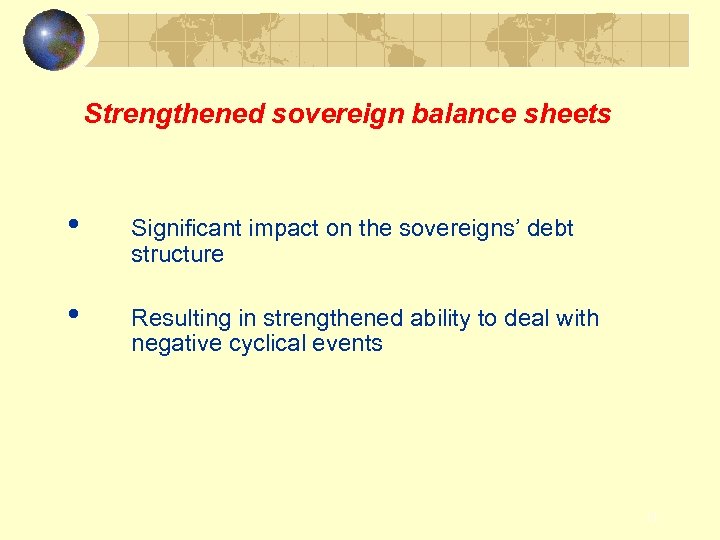 Strengthened sovereign balance sheets • Significant impact on the sovereigns’ debt structure • Resulting in strengthened ability to deal with negative cyclical events 11
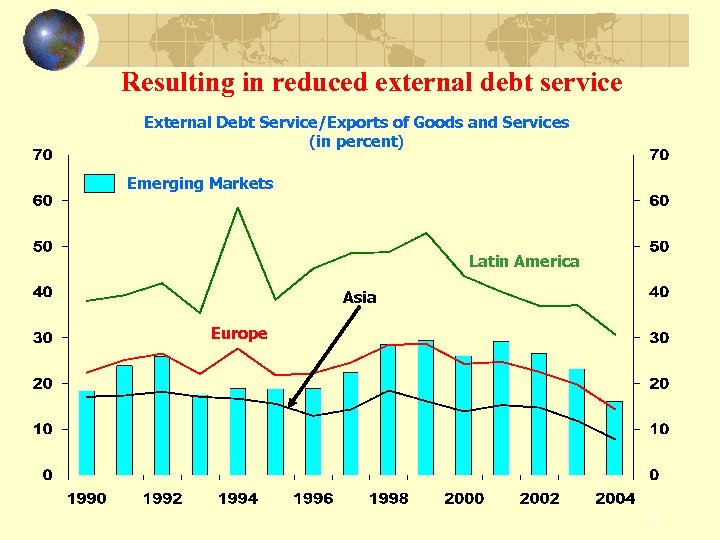 Resulting in reduced external debt service External Debt Service/Exports of Goods and Services (in percent) Emerging Markets Latin America Asia Europe 12
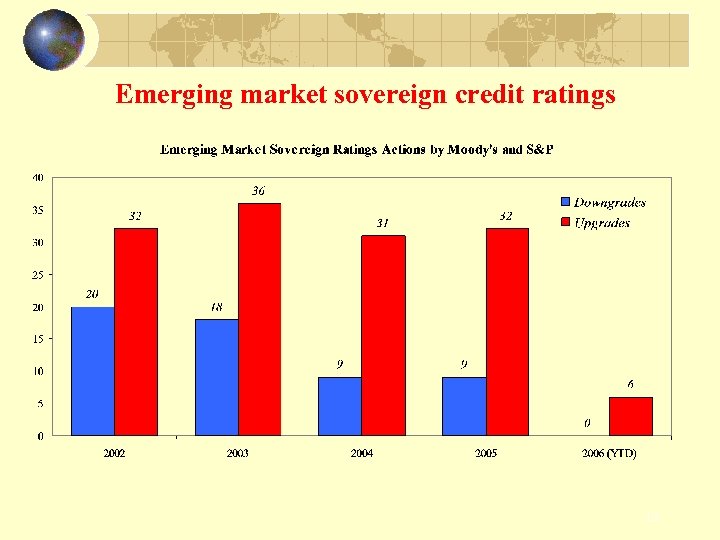 Emerging market sovereign credit ratings 13
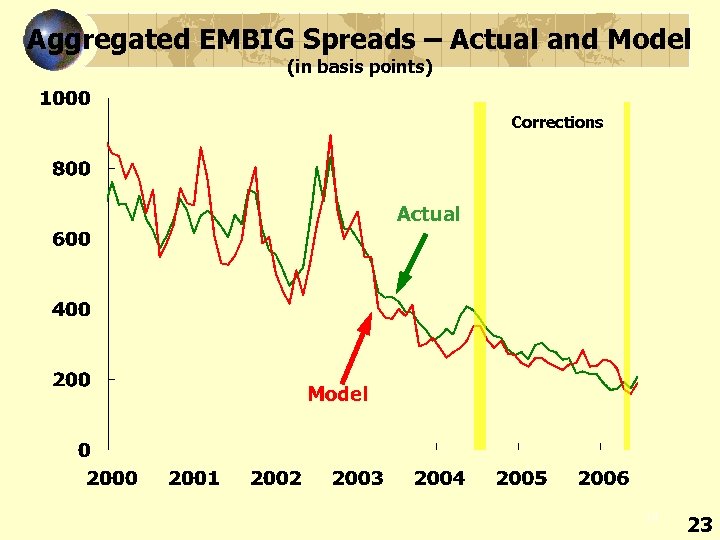 Aggregated EMBIG Spreads – Actual and Model (in basis points) Corrections Actual Model 14 23
 II. Broader EM Investor Base Foreign investors attracted to asset class • Ratings outlook positive and moves toward investment quality • Improved fundamentals driving asset class and opening door for broadened investor base • Tide of foreign investor inflows into emerging market assets • Technical factors also attract investors 15
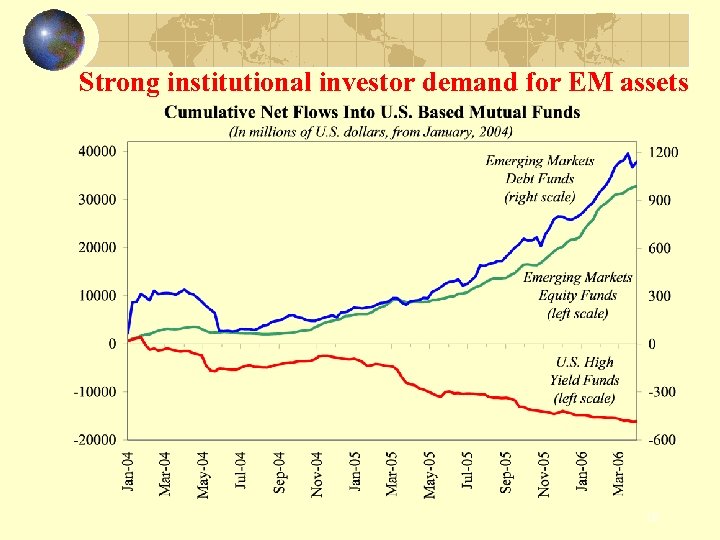 Strong institutional investor demand for EM assets 16
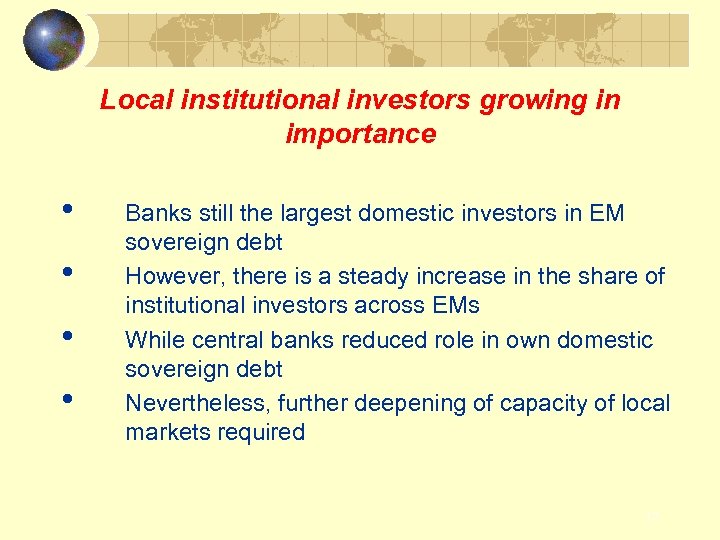 Local institutional investors growing in importance • • Banks still the largest domestic investors in EM sovereign debt However, there is a steady increase in the share of institutional investors across EMs While central banks reduced role in own domestic sovereign debt Nevertheless, further deepening of capacity of local markets required 17
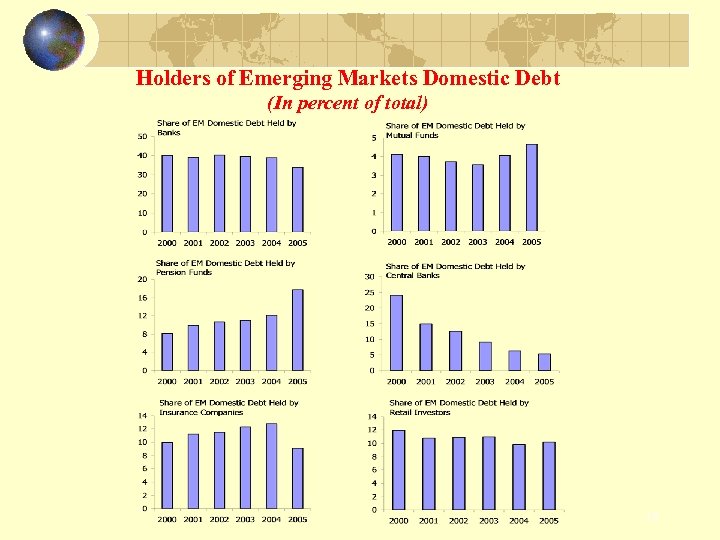 Holders of Emerging Markets Domestic Debt (In percent of total) 18
 III. EM local issues as an investor class International investors moving towards local-currency instruments • • Sizable demand for external-currency debt while supply from EMCs is declining due to large external reserve build-up and policy to reduce “original sin” and develop local markets The search for yield and declining returns on external debt has extended increasingly into local-currency instruments Search for “alpha” likely to accelerate investor interest in local-currency instruments. Limited supply of liquid local instruments relative to investor interest 19
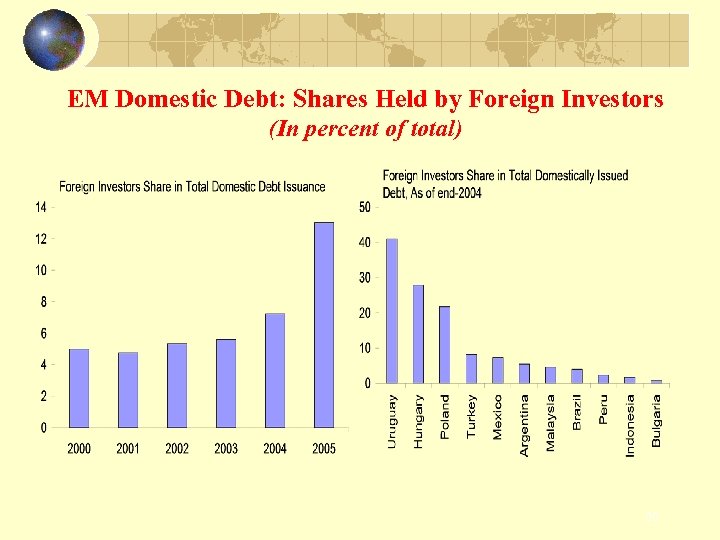 EM Domestic Debt: Shares Held by Foreign Investors (In percent of total) 20
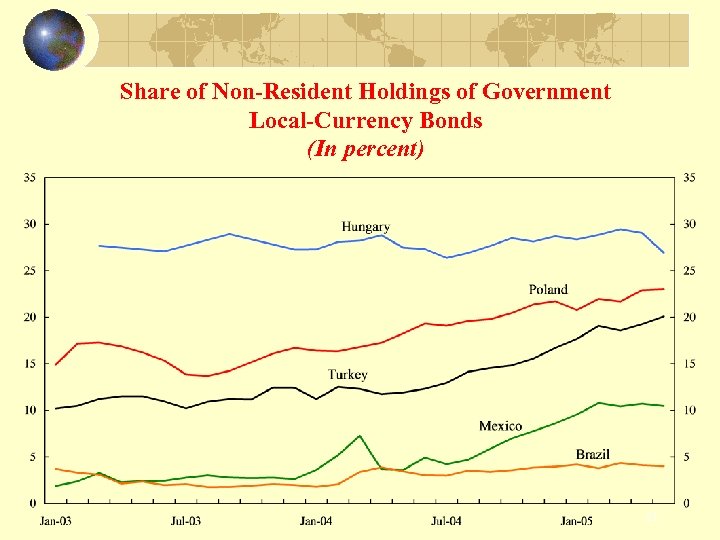 Share of Non-Resident Holdings of Government Local-Currency Bonds (In percent) 21
 Institutional investors contributing to strengthened local capital markets • • Growing MM institutional investor participation shifting from highly active short-term traders towards more strategic and buy-and-hold investors The investor base is also diversifying geographically Increasing role of MM strategic investors has contributed to improved quality and stability of external financial markets for EM debt Moreover, growing prominence of institutional investors critical component of strengthen local capital markets 22
 • • • EM debt managers have set objective of deepening local capital markets EM debt managers are taking advantage of investor interest in local-currency issues to deepen local markets Action taken, despite favorable terms in external markets, as insurance against “original sin” Mention actions being taken by EMs…. Debt Managers Forum 23
 Mutual benefits for EM countries and institutional investors • • • Virtuous cycle of deepening local capital markets and broadening investor base is taking place Broader investor base enabling EM debt managers to use increasingly sophisticated portfolio management techniques to a better manage risks Investors have new opportunities for hedging financial and exchange rate risks (with local derivatives markets) Both investors and EM’s gain from ore stable markets less likely to sell-off in reaction to country-specific or creditor-specific shock Both investors and EMs better able to reduce the currency and maturity mismatches associated with cross-border transactions Nevertheless, caution is required on overly relying on foreign participation until capacity of local markets is enhanced 24
 V. Portfolio application for local markets Benefit to institutional investors • Institutional investors search for risk-adjusted returns has driven the sizable foreign demand for localcurrency EM debt • Investment in local-currency debt provides investors with assets that have different sensitivities to movements in interest rates and exchange rates than EM external debt • Lower duration of local debt provides some hedge against rising global rates 25
 • Details on reduced risk 26
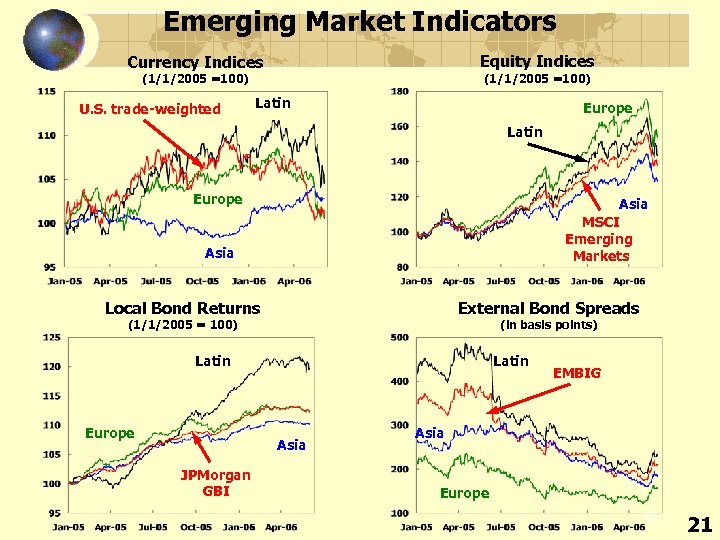 Emerging Market Indicators Equity Indices Currency Indices (1/1/2005 =100) U. S. trade-weighted Latin Europe Asia MSCI Emerging Markets Asia Local Bond Returns External Bond Spreads (1/1/2005 = 100) (in basis points) Latin Europe Latin Asia JPMorgan GBI EMBIG Asia Europe 27 21
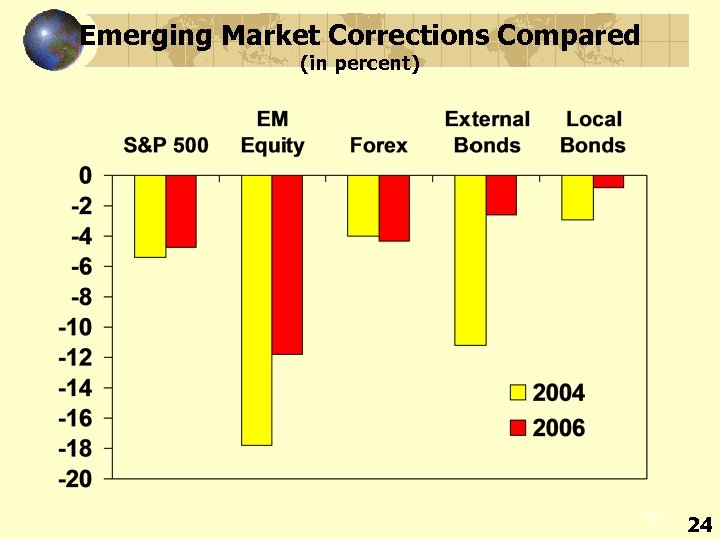 Emerging Market Corrections Compared (in percent) 28 24
 VI. Individual EM country valuation still matters Implications for portfolio approach to local currencies • • Market discriminating across asset class rewarding EM countries with stronger fundamentals Important to look for structural achievements, taking advantage of current favorable environment Bottom line • Countries included in portfolio of local currencies matter 29
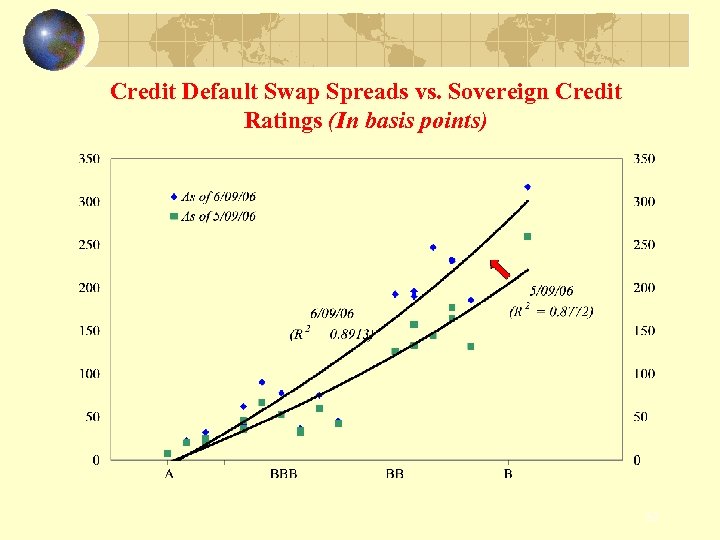 Credit Default Swap Spreads vs. Sovereign Credit Ratings (In basis points) 30
 VII. Broad Implications for International Financial Organizations • • Underpinning of good macroeconomic and financial policies still required Strong fiscal policy and debt management required Help new market participants, principally lower income countries, to ensure their initial access to international capital markets is prudent Help ensure that EMCs raise resources in sustainable manner and balance sheet risks remain within macro prudential limits, in the context of increased access to capital markets 31
 Implications for International Financial Organizations (continued) • • Widening the local investor base and broaden local market instruments, to make these markets more resilient to capital flow reversals Encouraging debt managers to issue into this market with the objective of developing benchmark yield curves via a transparent and regular issuance policy Government should be prepared to pay initial higher costs associated with domestic issuance for the insurance benefit gained from these markets Investing in a program that disseminates information to and gains a good understanding of the needs of a countries investor base 32