


 Скачать презентацию Managing Morphologically Complex Languages in Information Retrieval Kal
4e6e905759faf79dcc3449da68136d96.ppt
- Количество слайдов: 78
 Managing Morphologically Complex Languages in Information Retrieval Kal Järvelin & Many Others University of Tampere
 1. Introduction n Morphologically complex languages unlike English, Chinese n rich inflectional and derivational morphology n rich compound formation n n U. Tampere experiences 1998 - 2008 monolingual IR n cross-language IR n focus: Finnish, Germanic languages, English n
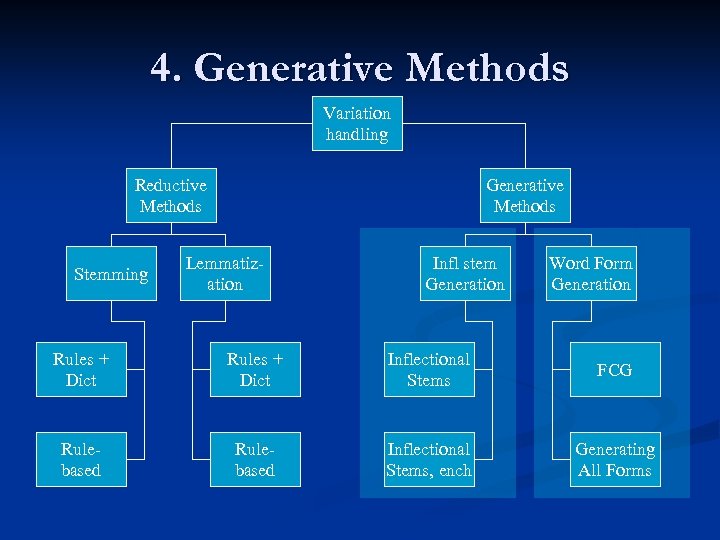
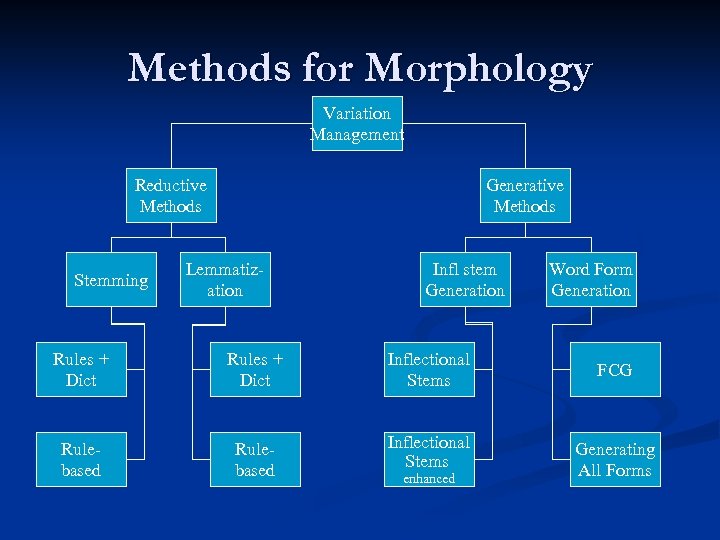 Methods for Morphology Variation Management Reductive Methods Stemming Generative Methods Lemmatization Infl stem Generation Word Form Generation Rules + Dict Inflectional Stems FCG Rulebased Inflectional Stems Generating All Forms enhanced
 Agenda 1. Introduction n 2. Reductive Methods n 3. Compounds n 4. Generative Methods n 5. Query Structures n 6. OOV Words n 7. Conclusion n
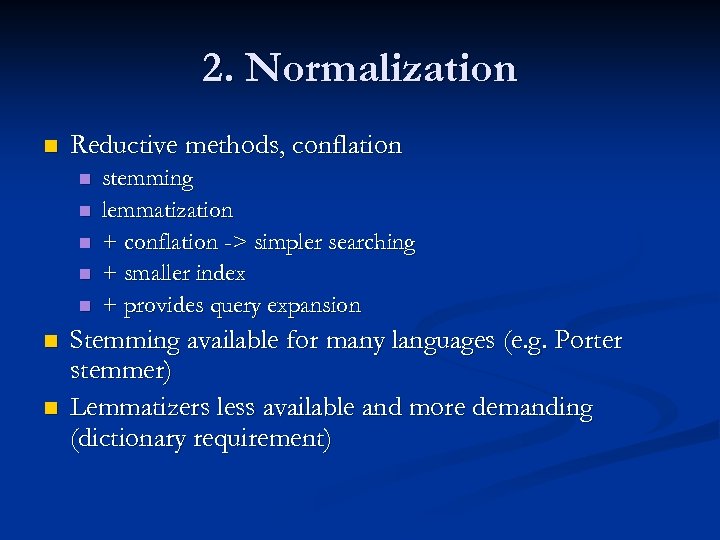 2. Normalization n Reductive methods, conflation n n n stemming lemmatization + conflation -> simpler searching + smaller index + provides query expansion Stemming available for many languages (e. g. Porter stemmer) Lemmatizers less available and more demanding (dictionary requirement)
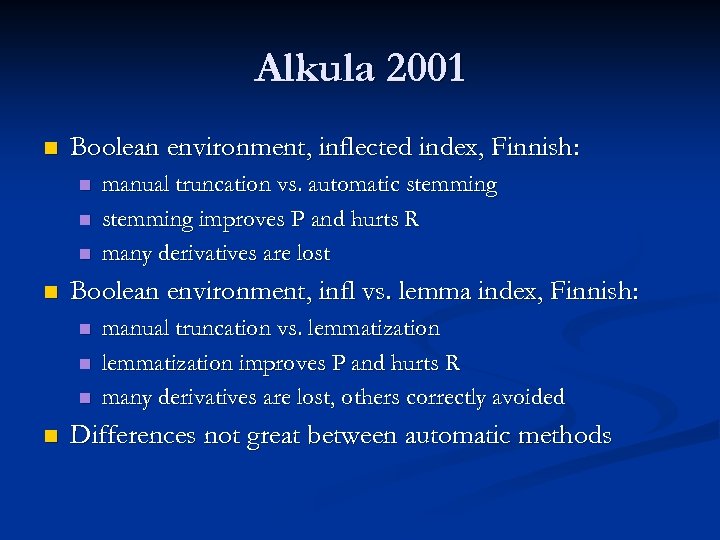 Alkula 2001 n Boolean environment, inflected index, Finnish: n n Boolean environment, infl vs. lemma index, Finnish: n n manual truncation vs. automatic stemming improves P and hurts R many derivatives are lost manual truncation vs. lemmatization improves P and hurts R many derivatives are lost, others correctly avoided Differences not great between automatic methods
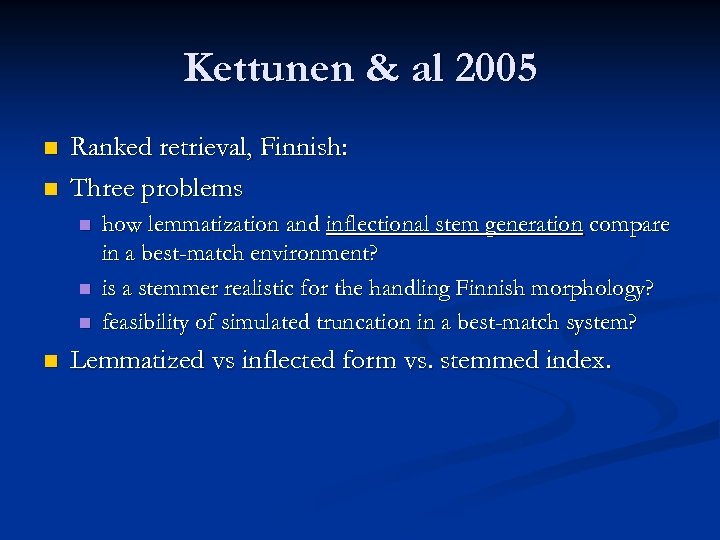 Kettunen & al 2005 n n Ranked retrieval, Finnish: Three problems n n how lemmatization and inflectional stem generation compare in a best-match environment? is a stemmer realistic for the handling Finnish morphology? feasibility of simulated truncation in a best-match system? Lemmatized vs inflected form vs. stemmed index.
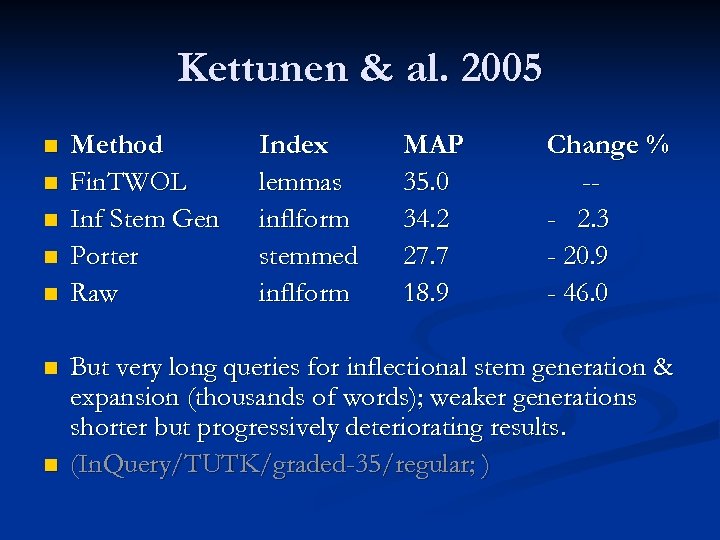 Kettunen & al. 2005 n n n n Method Fin. TWOL Inf Stem Gen Porter Raw Index lemmas inflform stemmed inflform MAP 35. 0 34. 2 27. 7 18. 9 Change % -- 2. 3 - 20. 9 - 46. 0 But very long queries for inflectional stem generation & expansion (thousands of words); weaker generations shorter but progressively deteriorating results. (In. Query/TUTK/graded-35/regular; )
 Kettunen & al. 2005
 Mono. IR: Airio 2006 In. Query/CLEF/TD/TWOL&Porter&Raw
 CLIR: Inflectional Morphology n n NL queries contain inflected form source keys Dictionary headwords are in basic form (lemmas) Problem significance varies by language Stemming n stem both the dictionary and the query words n n but may cause all too many translations Stemming in dictionary translation best applied after translation.
 Lemmatization in CLIR n Lemmatization easy to access dictionaries n but tokens may be ambiguous n dictionary translations not always in basic form n lemmatizer’s dictionary coverage n n insufficient -> non-lemmatized source keys, OOVs n too broad coverage -> too many senses provided
 CLIR Findings: Airio 2006 English -> X In. Query/UTAClir/CLEF/Global. Dix/TWOL&Porter
 Agenda 1. Introduction n 2. Reductive Methods n 3. Compounds n 4. Generative Methods n 5. Query Structures n 6. OOV Words n 7. Conclusion n
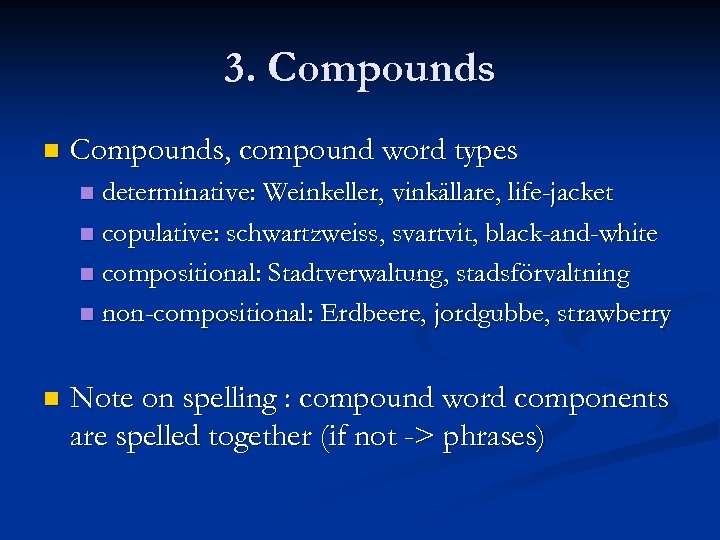 3. Compounds n Compounds, compound word types determinative: Weinkeller, vinkällare, life-jacket n copulative: schwartzweiss, svartvit, black-and-white n compositional: Stadtverwaltung, stadsförvaltning n non-compositional: Erdbeere, jordgubbe, strawberry n n Note on spelling : compound word components are spelled together (if not -> phrases)
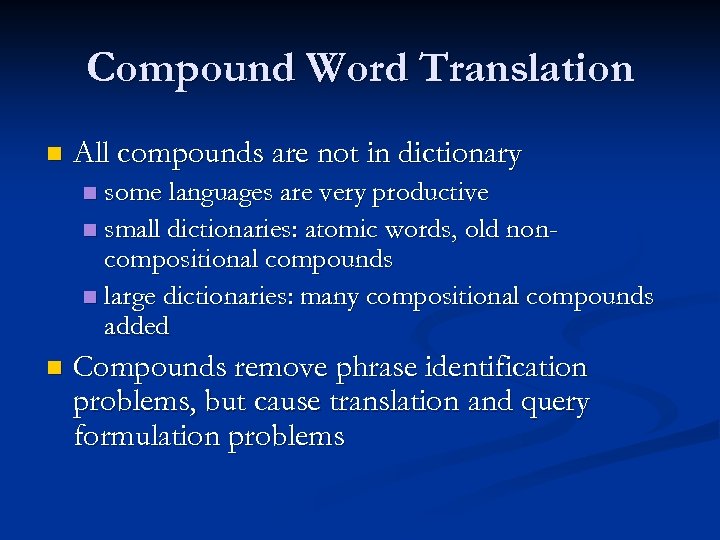 Compound Word Translation n All compounds are not in dictionary some languages are very productive n small dictionaries: atomic words, old noncompositional compounds n large dictionaries: many compositional compounds added n n Compounds remove phrase identification problems, but cause translation and query formulation problems
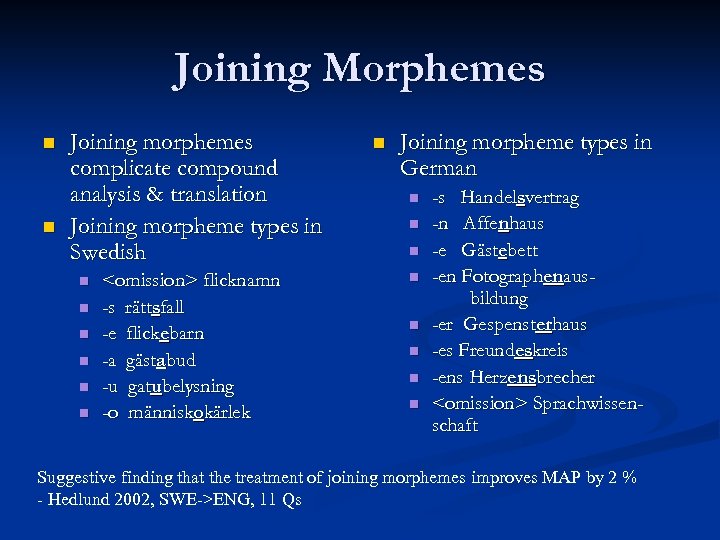 Joining Morphemes n n Joining morphemes complicate compound analysis & translation Joining morpheme types in Swedish n n n
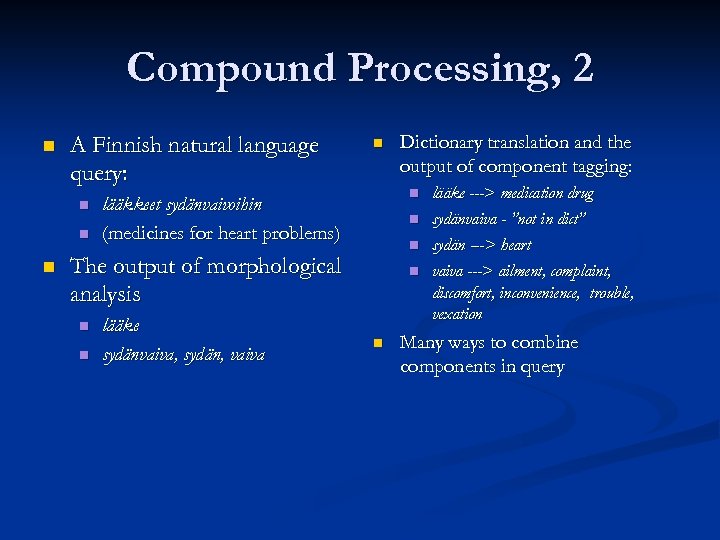 Compound Processing, 2 n A Finnish natural language query: n n n lääkkeet sydänvaivoihin (medicines for heart problems) n n The output of morphological analysis n n lääke sydänvaiva, sydän, vaiva Dictionary translation and the output of component tagging: n n lääke ---> medication drug sydänvaiva - ”not in dict” sydän ---> heart vaiva ---> ailment, complaint, discomfort, inconvenience, trouble, vexation Many ways to combine components in query
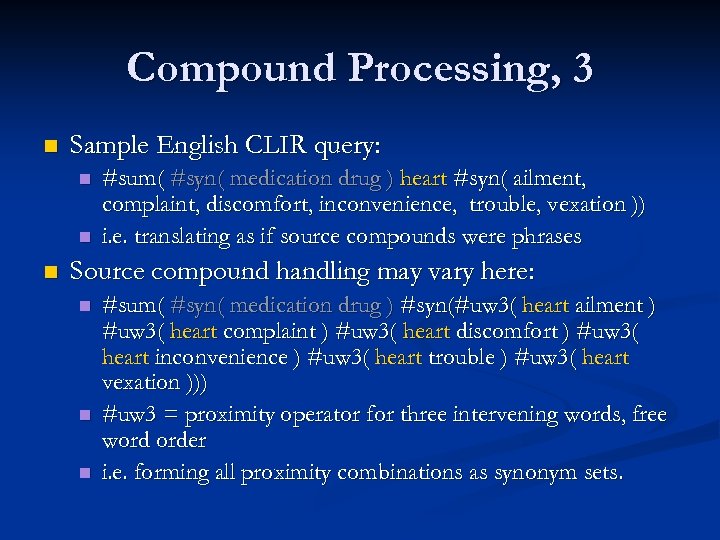 Compound Processing, 3 n Sample English CLIR query: n n n #sum( #syn( medication drug ) heart #syn( ailment, complaint, discomfort, inconvenience, trouble, vexation )) i. e. translating as if source compounds were phrases Source compound handling may vary here: n n n #sum( #syn( medication drug ) #syn(#uw 3( heart ailment ) #uw 3( heart complaint ) #uw 3( heart discomfort ) #uw 3( heart inconvenience ) #uw 3( heart trouble ) #uw 3( heart vexation ))) #uw 3 = proximity operator for three intervening words, free word order i. e. forming all proximity combinations as synonym sets.
 Compound Processing, 4 No clear benefits seen from using proximity combinations. n We did neither observe a great effect in changing the proximity operator (OD vs. UW) n n Some monolingual results follow (Airio 2006)
 In. Query/CLEF/Raw&TWOL&Porter
 English Swedish Mo rph Finnish olo gic al co mp lex ity inc rea ses
 Hedlund 2002 n Compound translation as compounds: 47 German CLEF 2001 topics, English docs collection. n comprehensive dictionary (many compounds) vs. small dict (no compounds) n mean AP 34. 7% vs. 30. 4% n dictionary matters. . . n n Alternative approach: if not translatable, split and translate components
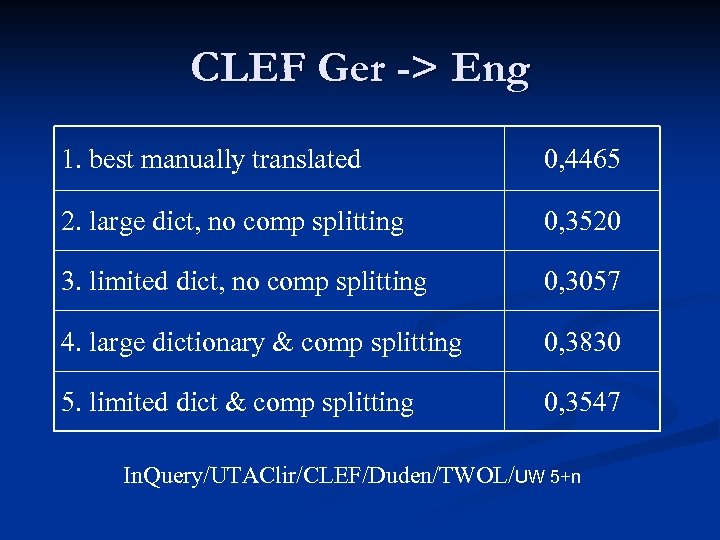 CLEF Ger -> Eng 1. best manually translated 0, 4465 2. large dict, no comp splitting 0, 3520 3. limited dict, no comp splitting 0, 3057 4. large dictionary & comp splitting 0, 3830 5. limited dict & comp splitting 0, 3547 In. Query/UTAClir/CLEF/Duden/TWOL/UW 5+n
 CLIR Findings: Airio 2006 English -> In. Query/UTAClir/CLEF/Global. Dix/TWOL&Porter
 Eng->Fin Eng->Ger Eng->Swe
 Agenda 1. Introduction n 2. Reductive Methods n 3. Compounds n 4. Generative Methods n 5. Query Structures n 6. OOV Words n 7. Conclusion n
 4. Generative Methods Variation handling Reductive Methods Stemming Generative Methods Lemmatization Infl stem Generation Word Form Generation Rules + Dict Inflectional Stems FCG Rulebased Inflectional Stems, ench Generating All Forms
 Generative Methods: inf stems n Instead of normalization, generate inflectional stems for an inflectional index. then using stems harvest full forms from the index n long queries. . . n
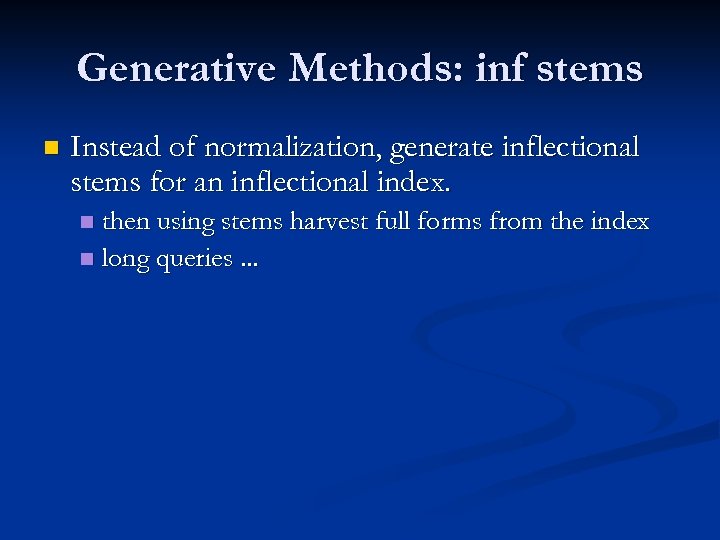
 . . . OR. . . n Instead of normalization, generate full inflectional forms for an inflectional index. Long queries? Sure! n Sounds absolutely crazy. . . n
 . . . BUT! Are morphologically complex languages that complex in IR in practice? n Instead of full form generation, only generate sufficient forms -> FCG n In Finnish, 9 -12 forms cover 85% of all occurrences of nouns n
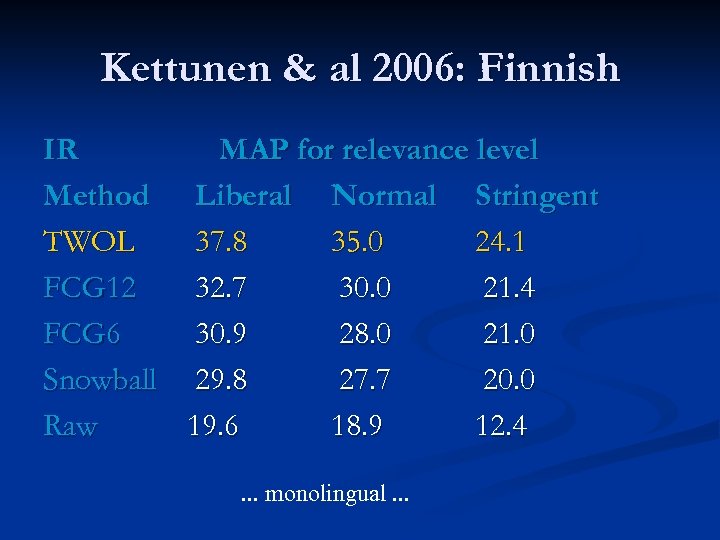 Kettunen & al 2006: Finnish IR MAP for relevance level Method Liberal Normal Stringent TWOL 37. 8 35. 0 24. 1 FCG 12 32. 7 30. 0 21. 4 FCG 6 30. 9 28. 0 21. 0 Snowball 29. 8 27. 7 20. 0 Raw 19. 6 18. 9 12. 4. . . monolingual. . .
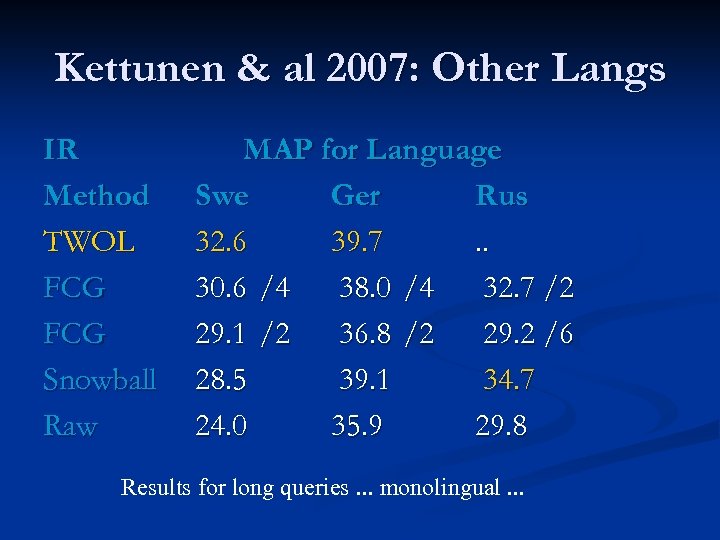 Kettunen & al 2007: Other Langs IR Method TWOL FCG Snowball Raw MAP for Language Swe Ger Rus 32. 6 39. 7. . 30. 6 /4 38. 0 /4 32. 7 /2 29. 1 /2 36. 8 /2 29. 2 /6 28. 5 39. 1 34. 7 24. 0 35. 9 29. 8 Results for long queries. . . monolingual. . .
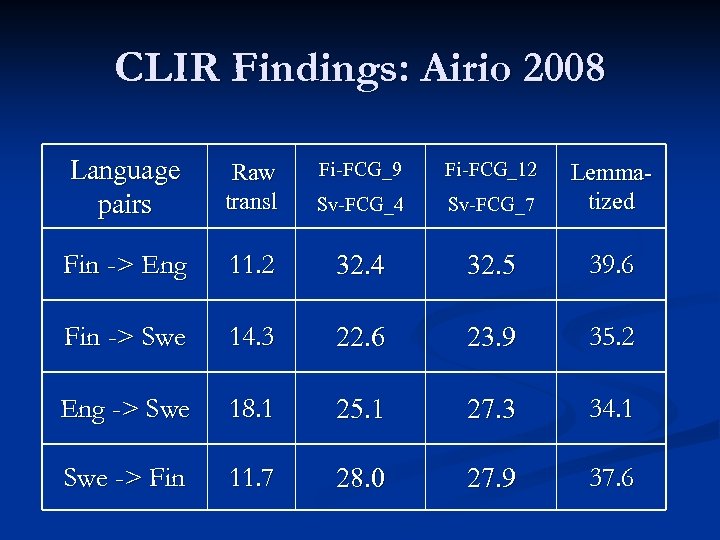 CLIR Findings: Airio 2008 Language pairs Raw Fi-FCG_9 Fi-FCG_12 transl Sv-FCG_4 Sv-FCG_7 Lemmatized Fin -> Eng 11. 2 32. 4 32. 5 39. 6 Fin -> Swe 14. 3 22. 6 23. 9 35. 2 Eng -> Swe 18. 1 25. 1 27. 3 34. 1 Swe -> Fin 11. 7 28. 0 27. 9 37. 6
 Agenda 1. Introduction n 2. Reductive Methods n 3. Compounds n 4. Generative Methods n 5. Query Structures n 6. OOV Words n 7. Conclusion n
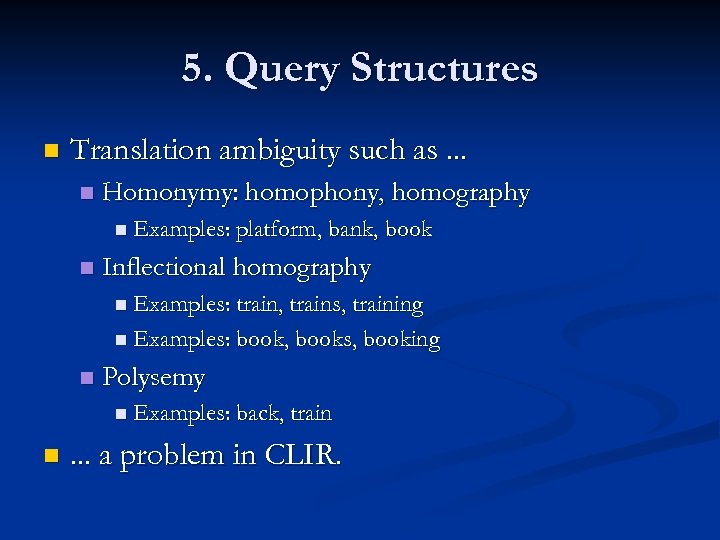 5. Query Structures n Translation ambiguity such as. . . n Homonymy: homophony, homography n Examples: platform, bank, book n Inflectional homography n Examples: train, trains, training n Examples: book, books, booking n Polysemy n Examples: back, train n . . . a problem in CLIR.
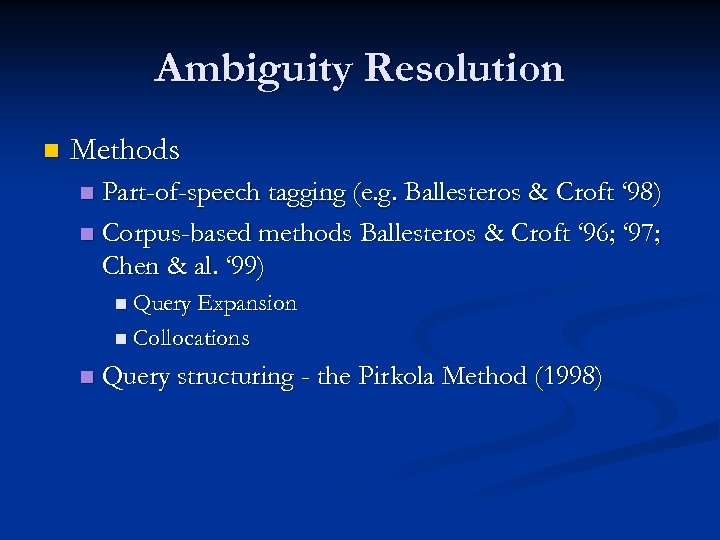 Ambiguity Resolution n Methods Part-of-speech tagging (e. g. Ballesteros & Croft ‘ 98) n Corpus-based methods Ballesteros & Croft ‘ 96; ‘ 97; Chen & al. ‘ 99) n n Query Expansion n Collocations n Query structuring - the Pirkola Method (1998)
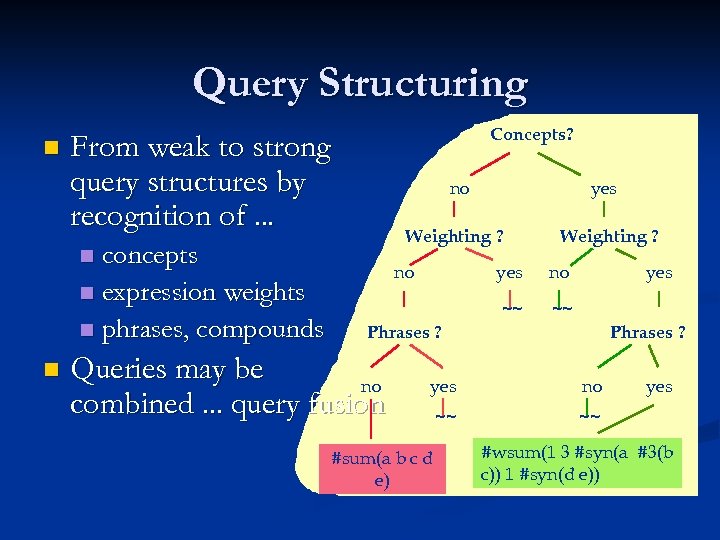 Query Structuring n Concepts? From weak to strong query structures by recognition of. . . concepts n expression weights n phrases, compounds no Weighting ? n n yes no Weighting ? yes no ~~ yes ~~ Phrases ? Queries may be no combined. . . query fusion Phrases ? yes no ~~ ~~ #sum(a b c d e) yes #wsum(1 3 #syn(a #3(b c)) 1 #syn(d e))
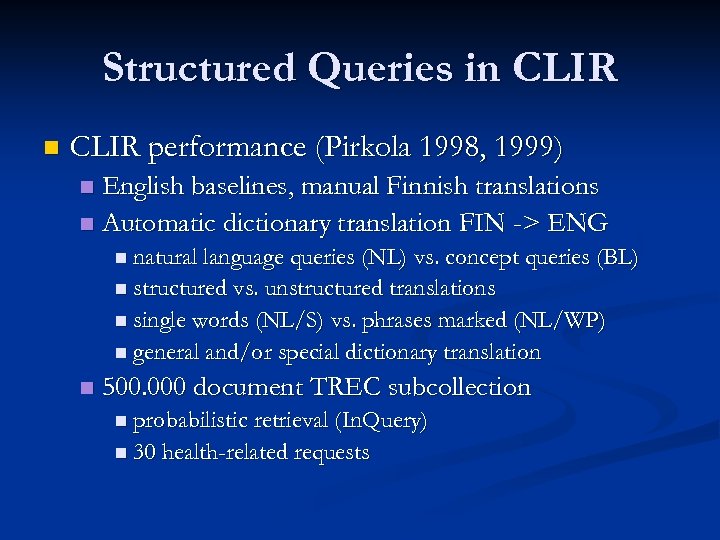 Structured Queries in CLIR performance (Pirkola 1998, 1999) English baselines, manual Finnish translations n Automatic dictionary translation FIN -> ENG n n natural language queries (NL) vs. concept queries (BL) n structured vs. unstructured translations n single words (NL/S) vs. phrases marked (NL/WP) n general and/or special dictionary translation n 500. 000 document TREC subcollection n probabilistic retrieval (In. Query) n 30 health-related requests
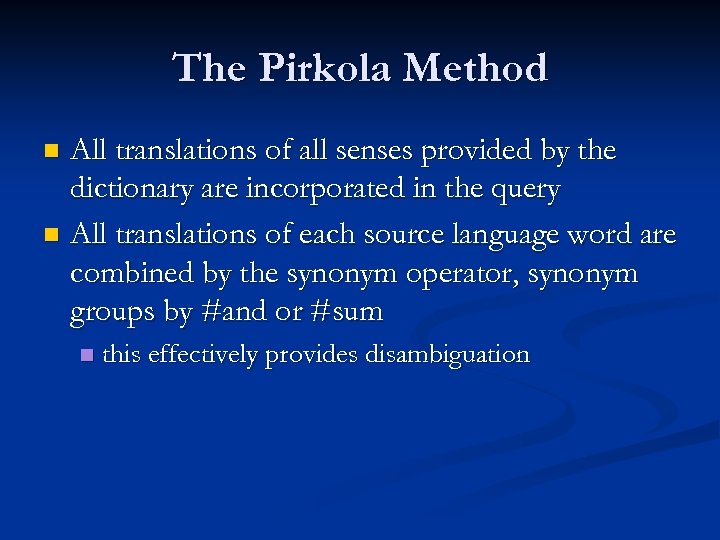 The Pirkola Method All translations of all senses provided by the dictionary are incorporated in the query n All translations of each source language word are combined by the synonym operator, synonym groups by #and or #sum n n this effectively provides disambiguation
![An Example n Consider the Finnish natural language query: lääke sydänvaiva [= medicine heart_problem]](https://present5.com/presentation/4e6e905759faf79dcc3449da68136d96/image-41.jpg "An Example n Consider the Finnish natural language query: lääke sydänvaiva [= medicine heart_problem]") An Example n Consider the Finnish natural language query: lääke sydänvaiva [= medicine heart_problem] Sample English CLIR query: n #sum( #syn( medication drug ) heart #syn( ailment, complaint, discomfort, inconvenience, trouble, vexation ) ) n n n Each source word forming a synonym set
An Example n Consider the Finnish natural language query: lääke sydänvaiva [= medicine heart_problem] Sample English CLIR query: n #sum( #syn( medication drug ) heart #syn( ailment, complaint, discomfort, inconvenience, trouble, vexation ) ) n n n Each source word forming a synonym set
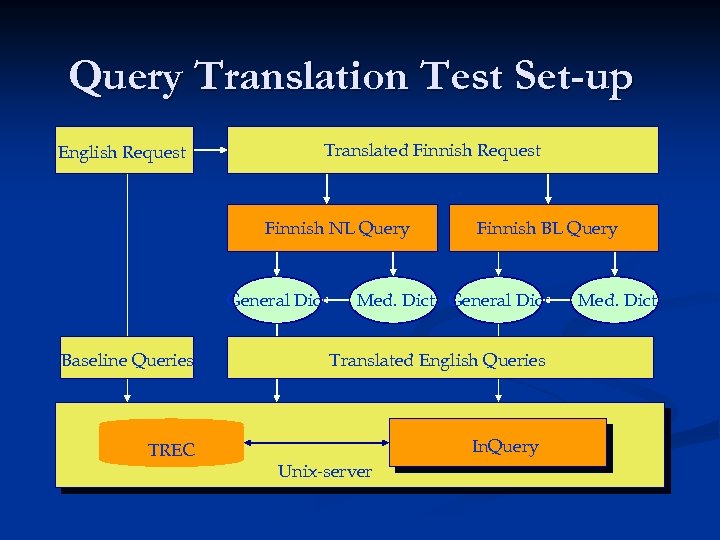 Query Translation Test Set-up English Request Translated Finnish Request Finnish NL Query General Dict Baseline Queries TREC Finnish BL Query Med. Dict. General Dict Translated English Queries In. Query Unix-server Med. Dict.
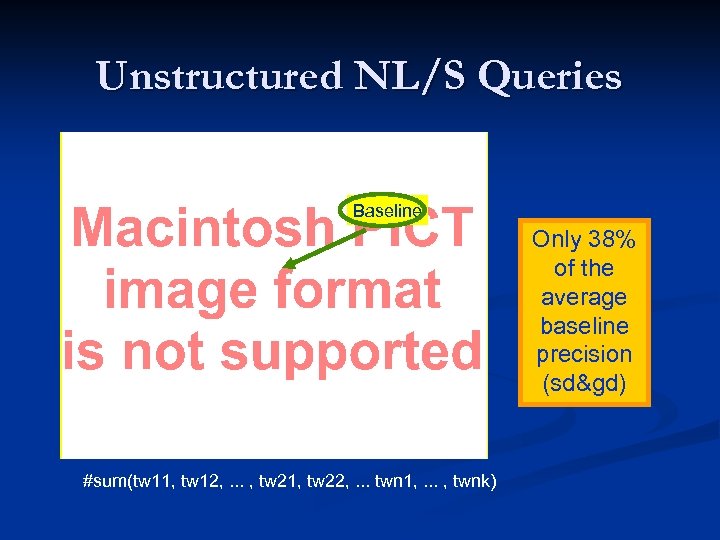 Unstructured NL/S Queries Baseline Only 38% of the average baseline precision (sd&gd) #sum(tw 11, tw 12, . . . , tw 21, tw 22, . . . twn 1, . . . , twnk)
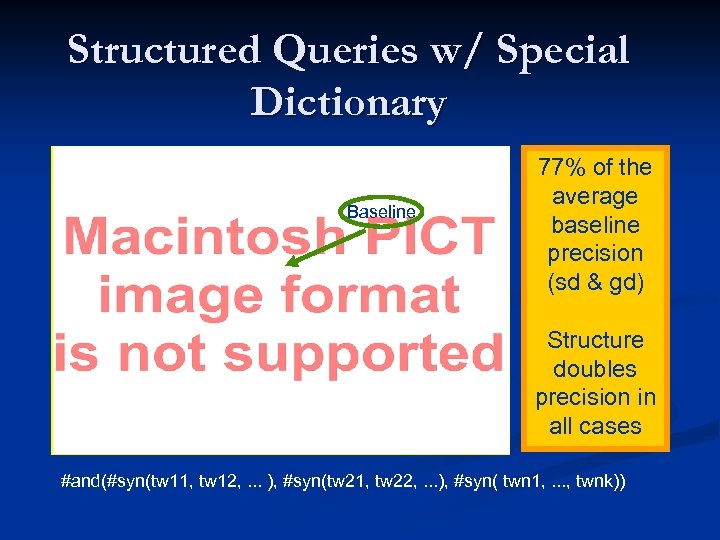 Structured Queries w/ Special Dictionary Baseline 77% of the average baseline precision (sd & gd) Structure doubles precision in all cases #and(#syn(tw 11, tw 12, . . . ), #syn(tw 21, tw 22, . . . ), #syn( twn 1, . . . , twnk))
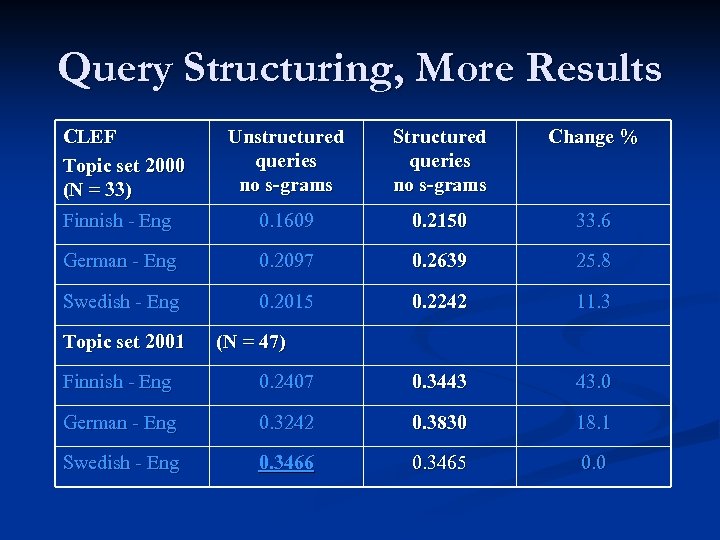 Query Structuring, More Results CLEF Topic set 2000 (N = 33) Unstructured queries no s-grams Structured queries no s-grams Change % Finnish - Eng 0. 1609 0. 2150 33. 6 German - Eng 0. 2097 0. 2639 25. 8 Swedish - Eng 0. 2015 0. 2242 11. 3 Topic set 2001 (N = 47) Finnish - Eng 0. 2407 0. 3443 43. 0 German - Eng 0. 3242 0. 3830 18. 1 Swedish - Eng 0. 3466 0. 3465 0. 0
 Transit CLIR – Query Structures Average precision for the transitive, bilingual and monolingual runs of CLEF 2001 topics (N = 50)
 Transitive CLIR Results, 2
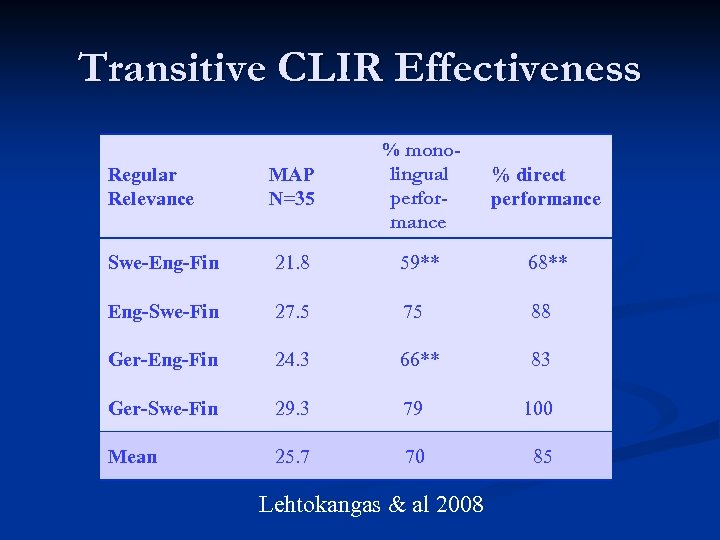 Transitive CLIR Effectiveness Regular Relevance MAP N=35 % monolingual performance Swe-Eng-Fin 21. 8 59** 68** Eng-Swe-Fin 27. 5 75 88 Ger-Eng-Fin 24. 3 66** 83 Ger-Swe-Fin 29. 3 79 100 Mean 25. 7 70 85 Lehtokangas & al 2008 % direct performance
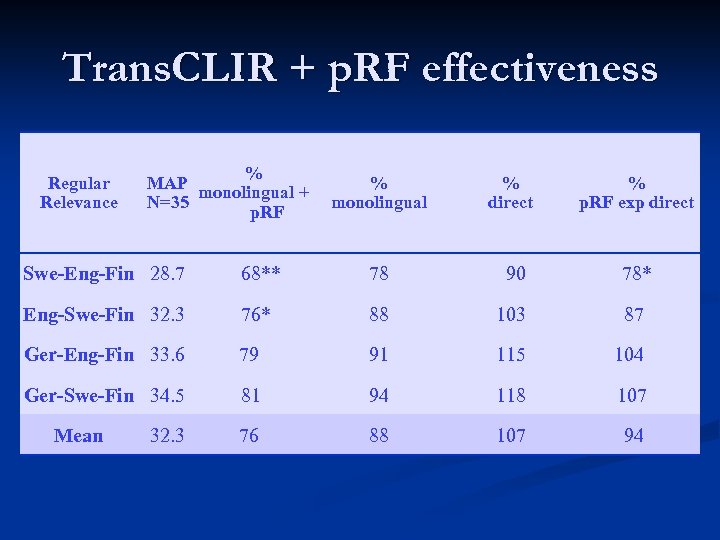 Trans. CLIR + p. RF effectiveness Regular Relevance % MAP monolingual + N=35 p. RF % monolingual % direct % p. RF exp direct Swe-Eng-Fin 28. 7 68** 78 90 78* Eng-Swe-Fin 32. 3 76* 88 103 87 Ger-Eng-Fin 33. 6 79 91 115 104 Ger-Swe-Fin 34. 5 81 94 118 107 76 88 107 94 Mean 32. 3
 Agenda 1. Introduction n 2. Reductive Methods n 3. Compounds n 4. Generative Methods n 5. Query Structures n 6. OOV Words n 7. Conclusion n
 6. OOV Words n Low coverage -- non-translated words n Domain-specific terms in general dictionaries n n n e. g. dystrophy Covered in domain-specific dictionaries Compound words Proper names: persons, geographical names, … Often central for query effectiveness Large dictionaries solution? BUT: n n n Excessive number of senses and words for each Increases ambiguity problems and still many words remain OOVs
 OOV Processing n Proper names are often spelled differently between languages n n Transliteration variation Brussels, Bryssel; Chernobyl, Tshernobyl; Chechnya, Tsetsenia Non-translated keys are often used as such in CLIR queries -- simplistic approach, not optimal In some languages, proper names may inflect n In Finnish ”in Cairo” = Kairossa
 Approximate String Matching n Means for correcting spelling errors n matching variant word forms (e. g. proper names between languages) n n Methods edit-distance, n-grams, skip-grams n soundex, phonix, based of phone similarity n transliteration n
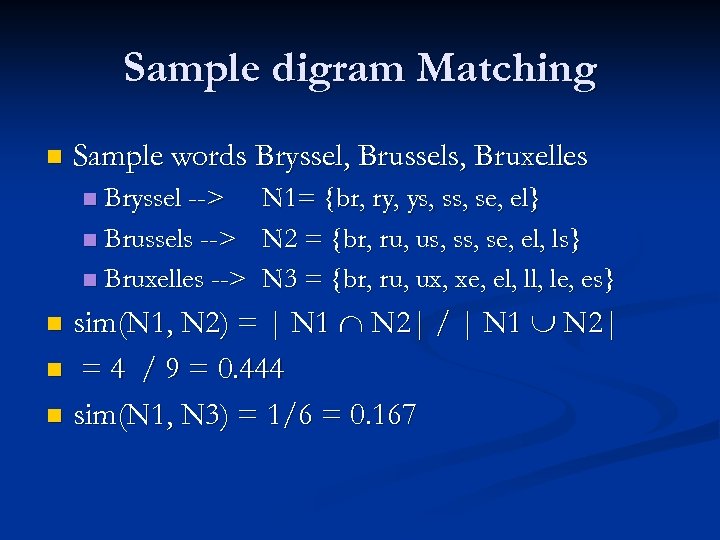 Sample digram Matching n Sample words Bryssel, Brussels, Bruxelles Bryssel --> n Brussels --> n Bruxelles --> n N 1= {br, ry, ys, se, el} N 2 = {br, ru, us, se, el, ls} N 3 = {br, ru, ux, xe, el, le, es} sim(N 1, N 2) = | N 1 N 2| / | N 1 N 2| n = 4 / 9 = 0. 444 n sim(N 1, N 3) = 1/6 = 0. 167 n
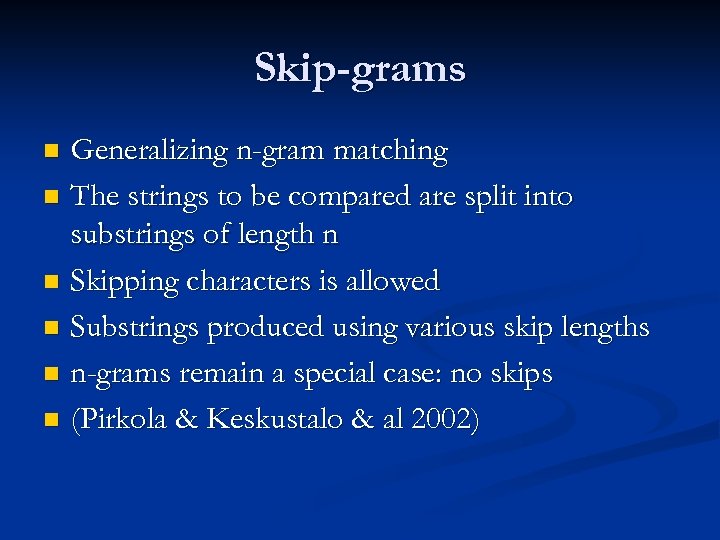 Skip-grams Generalizing n-gram matching n The strings to be compared are split into substrings of length n n Skipping characters is allowed n Substrings produced using various skip lengths n n-grams remain a special case: no skips n (Pirkola & Keskustalo & al 2002) n
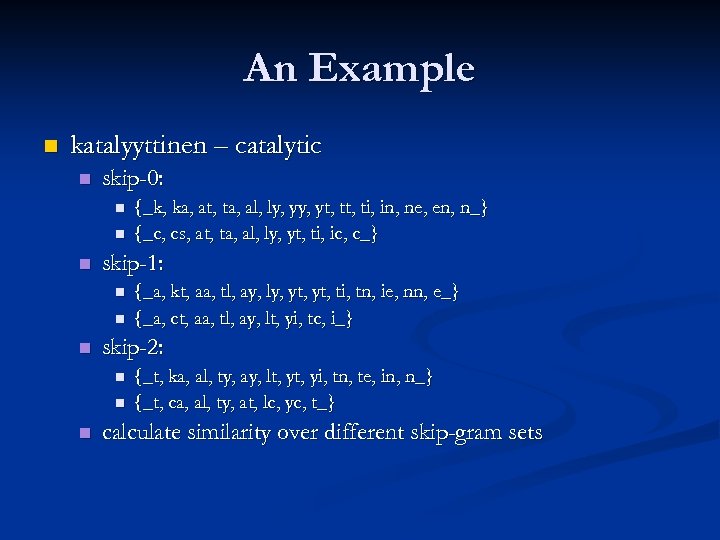 An Example n katalyyttinen – catalytic n skip-0: n n n skip-1: n n n {_a, kt, aa, tl, ay, ly, yt, ti, tn, ie, nn, e_} {_a, ct, aa, tl, ay, lt, yi, tc, i_} skip-2: n n n {_k, ka, at, ta, al, ly, yt, ti, in, ne, en, n_} {_c, cs, at, ta, al, ly, yt, ti, ic, c_} {_t, ka, al, ty, ay, lt, yi, tn, te, in, n_} {_t, ca, al, ty, at, lc, yc, t_} calculate similarity over different skip-gram sets
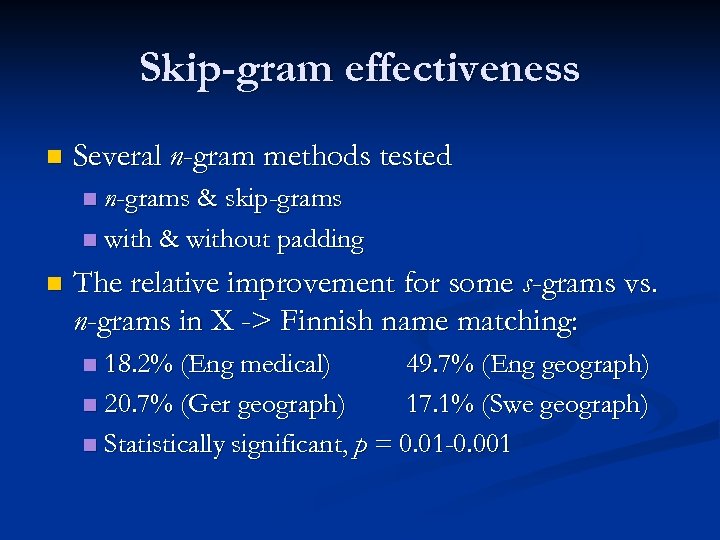 Skip-gram effectiveness n Several n-gram methods tested n-grams & skip-grams n with & without padding n n The relative improvement for some s-grams vs. n-grams in X -> Finnish name matching: 18. 2% (Eng medical) 49. 7% (Eng geograph) n 20. 7% (Ger geograph) 17. 1% (Swe geograph) n Statistically significant, p = 0. 01 -0. 001 n
 CLIR Findings: Järvelin & al 2008 n Closely related languages n n Norwegian and Swedish Translation by string matching alone no dictionary at all, no other vocabulary source n encouraging results n
 CLIR Findings: Järvelin & al 2008
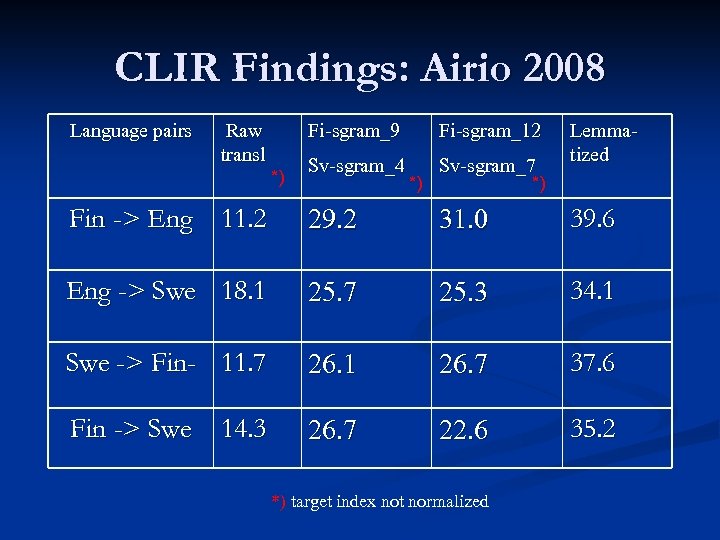 CLIR Findings: Airio 2008 Language pairs Raw transl Fi-sgram_9 *) Fi-sgram_12 Sv-sgram_4 Sv-sgram_7 *) Lemmatized *) Fin -> Eng 11. 2 29. 2 31. 0 39. 6 Eng -> Swe 18. 1 25. 7 25. 3 34. 1 Swe -> Fin- 11. 7 26. 1 26. 7 37. 6 Fin -> Swe 26. 7 22. 6 35. 2 14. 3 *) target index not normalized
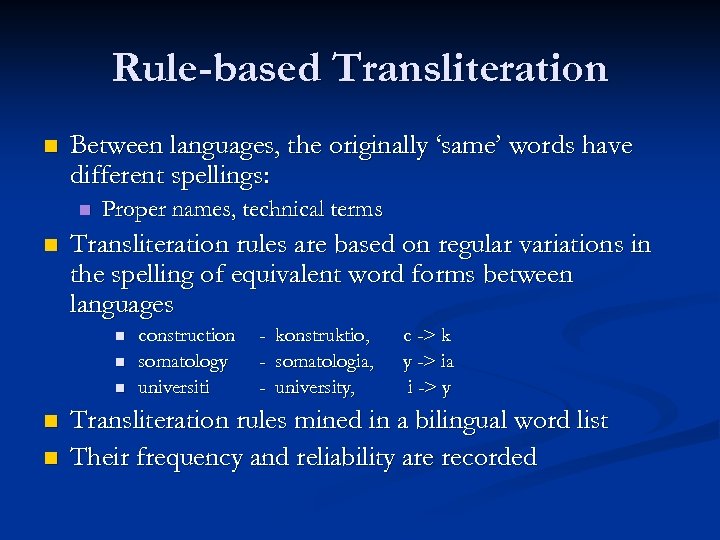 Rule-based Transliteration n Between languages, the originally ‘same’ words have different spellings: n n Proper names, technical terms Transliteration rules are based on regular variations in the spelling of equivalent word forms between languages n n n construction somatology universiti - konstruktio, - somatologia, - university, c -> k y -> ia i -> y Transliteration rules mined in a bilingual word list Their frequency and reliability are recorded
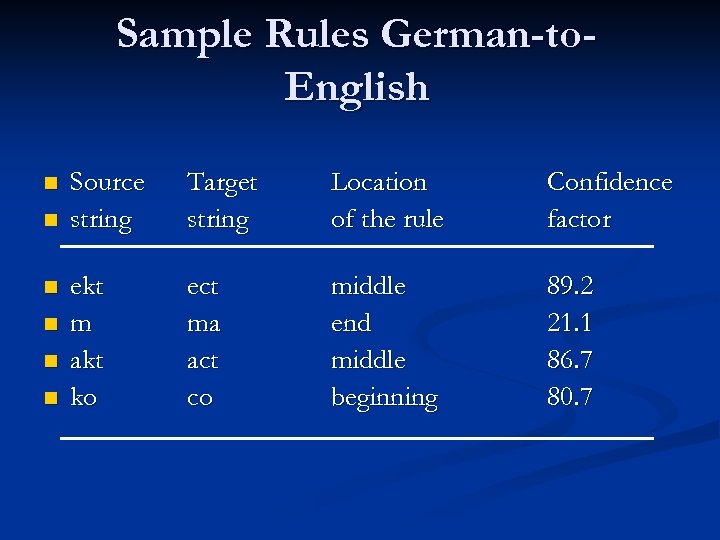 Sample Rules German-to. English n n n Source string Target string Location of the rule Confidence factor ekt m akt ko ect ma act co middle end middle beginning 89. 2 21. 1 86. 7 80. 7
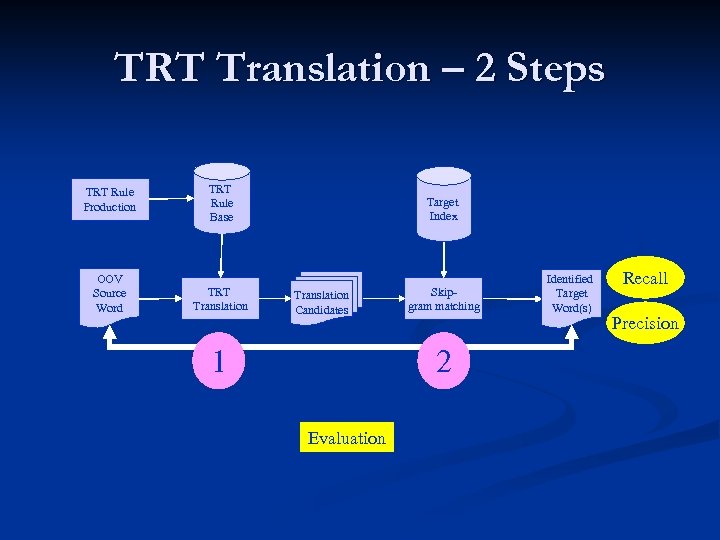 TRT Translation – 2 Steps TRT Rule Production TRT Rule Base Target Index OOV Source Word TRT Translation Skipgram matching Translation Candidates 1 2 Evaluation Identified Target Word(s) Recall Precision
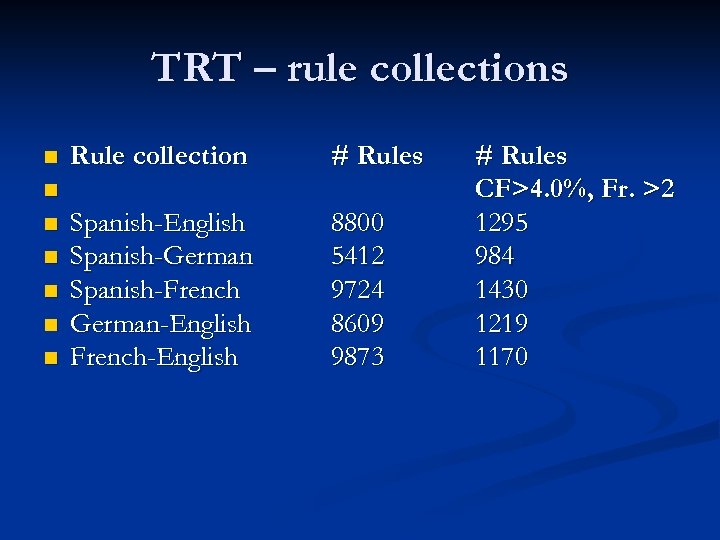 TRT – rule collections n Rule collection # Rules Spanish-English Spanish-German Spanish-French German-English French-English 8800 5412 9724 8609 9873 n n n # Rules CF>4. 0%, Fr. >2 1295 984 1430 1219 1170
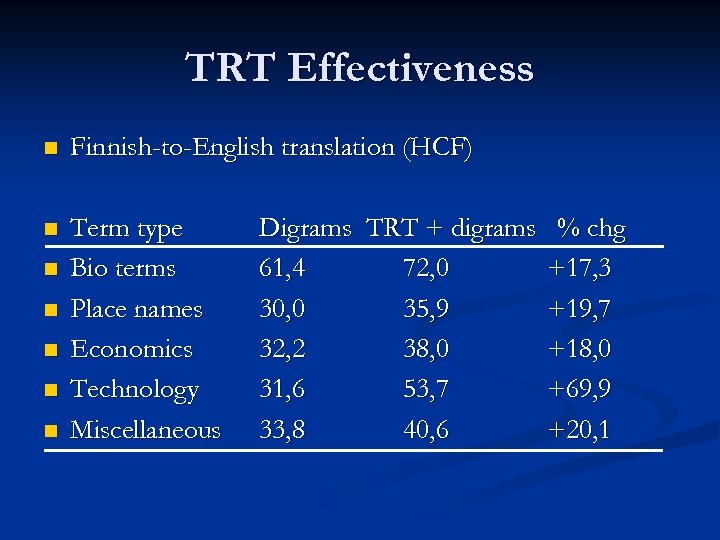 TRT Effectiveness n Finnish-to-English translation (HCF) n Term type Bio terms Place names Economics Technology Miscellaneous n n n Digrams TRT + digrams 61, 4 72, 0 30, 0 35, 9 32, 2 38, 0 31, 6 53, 7 33, 8 40, 6 % chg +17, 3 +19, 7 +18, 0 +69, 9 +20, 1
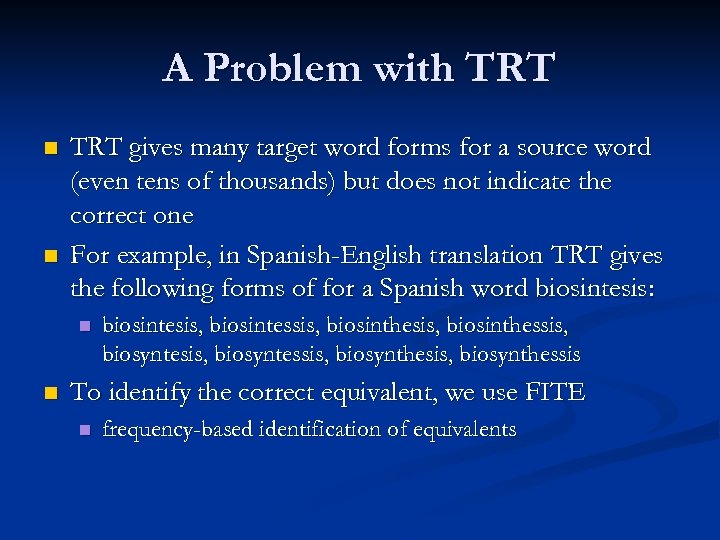 A Problem with TRT n n TRT gives many target word forms for a source word (even tens of thousands) but does not indicate the correct one For example, in Spanish-English translation TRT gives the following forms of for a Spanish word biosintesis: n n biosintesis, biosintessis, biosinthessis, biosyntessis, biosynthessis To identify the correct equivalent, we use FITE n frequency-based identification of equivalents
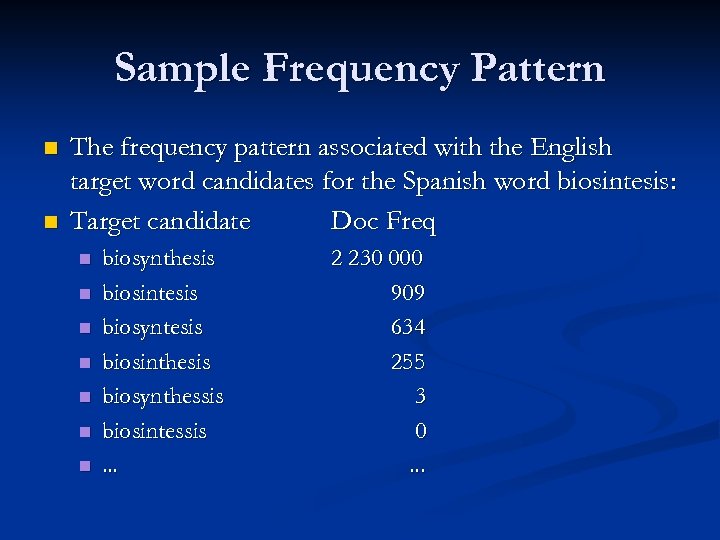 Sample Frequency Pattern n n The frequency pattern associated with the English target word candidates for the Spanish word biosintesis: Target candidate Doc Freq n n n n biosynthesis biosintesis biosyntesis biosinthesis biosynthessis biosintessis. . . 2 230 000 909 634 255 3 0. . .
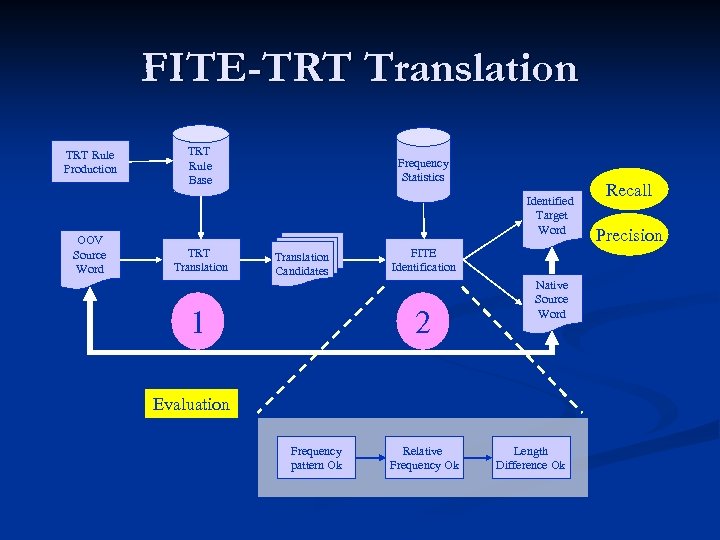 FITE-TRT Translation TRT Rule Production OOV Source Word TRT Rule Base Frequency Statistics Identified Target Word TRT Translation Candidates 1 FITE Identification 2 Native Source Word Evaluation Frequency pattern Ok Relative Frequency Ok Length Difference Ok Recall Precision
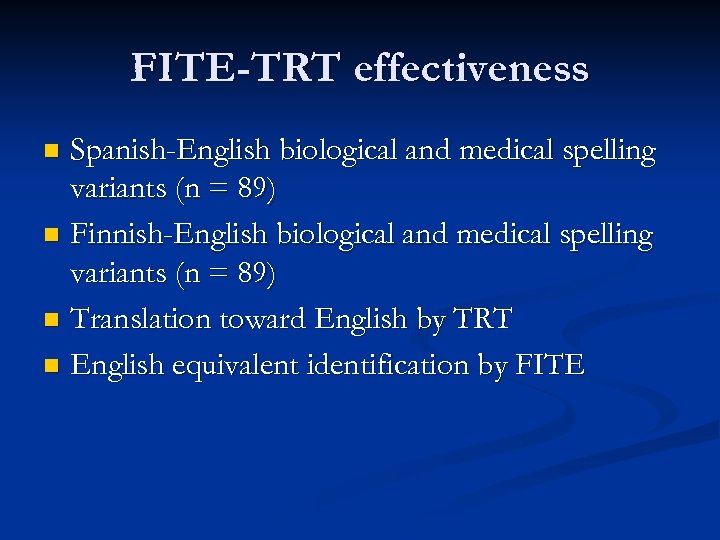 FITE-TRT effectiveness Spanish-English biological and medical spelling variants (n = 89) n Finnish-English biological and medical spelling variants (n = 89) n Translation toward English by TRT n English equivalent identification by FITE n
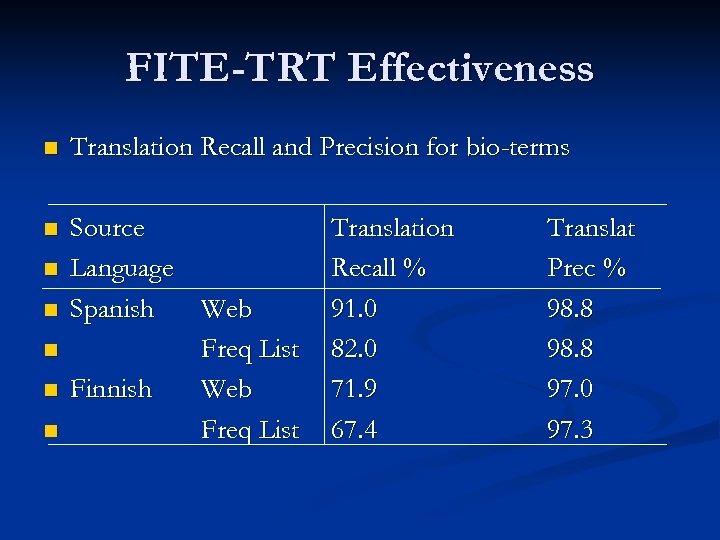 FITE-TRT Effectiveness n Translation Recall and Precision for bio-terms n Source Language Spanish Web Freq List Finnish Web Freq List n n n Translation Recall % 91. 0 82. 0 71. 9 67. 4 Translat Prec % 98. 8 97. 0 97. 3
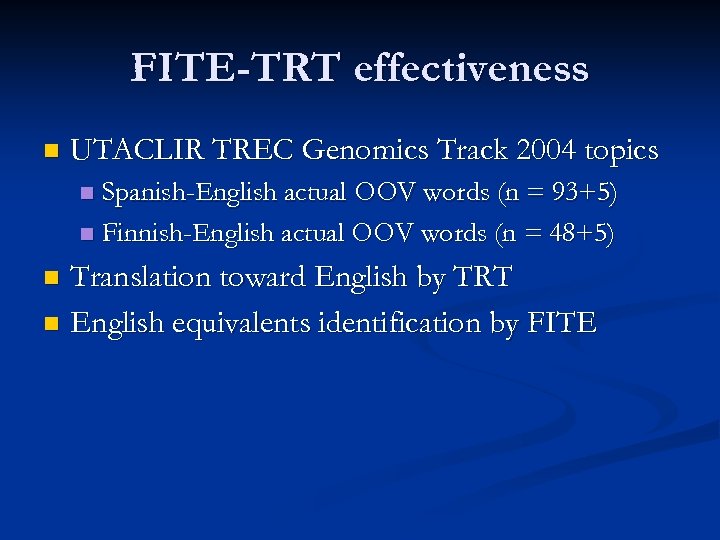 FITE-TRT effectiveness n UTACLIR TREC Genomics Track 2004 topics Spanish-English actual OOV words (n = 93+5) n Finnish-English actual OOV words (n = 48+5) n Translation toward English by TRT n English equivalents identification by FITE n
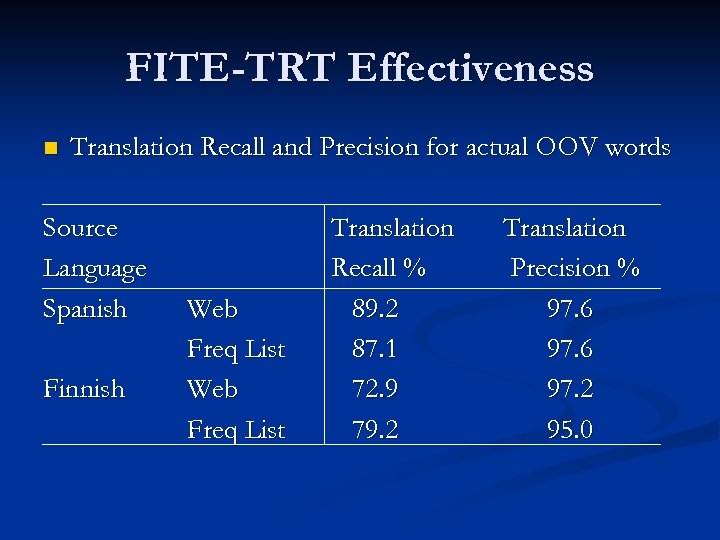 FITE-TRT Effectiveness n Translation Recall and Precision for actual OOV words Source Language Spanish Finnish Web Freq List Translation Recall % 89. 2 87. 1 72. 9 79. 2 Translation Precision % 97. 6 97. 2 95. 0
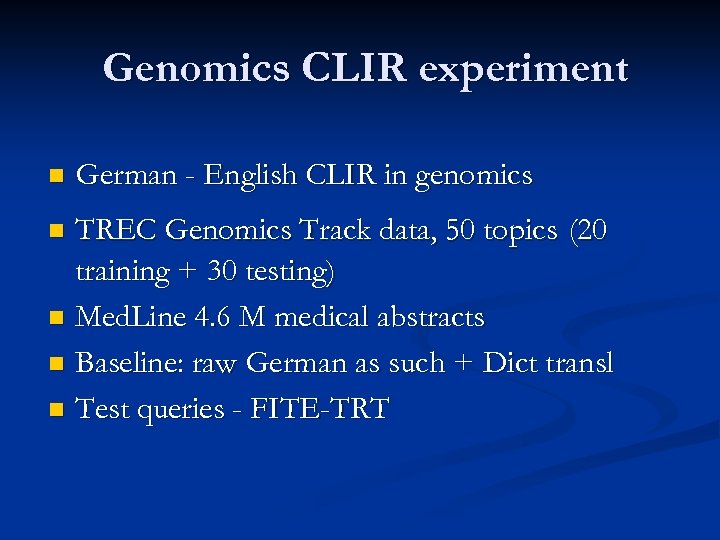 Genomics CLIR experiment n German - English CLIR in genomics TREC Genomics Track data, 50 topics (20 training + 30 testing) n Med. Line 4. 6 M medical abstracts n Baseline: raw German as such + Dict transl n Test queries - FITE-TRT n
 Genomics CLIR experiment
 Agenda 1. Introduction n 2. Reductive Methods n 3. Compounds n 4. Generative Methods n 5. Query Structures n 6. OOV Words n 7. Conclusion n
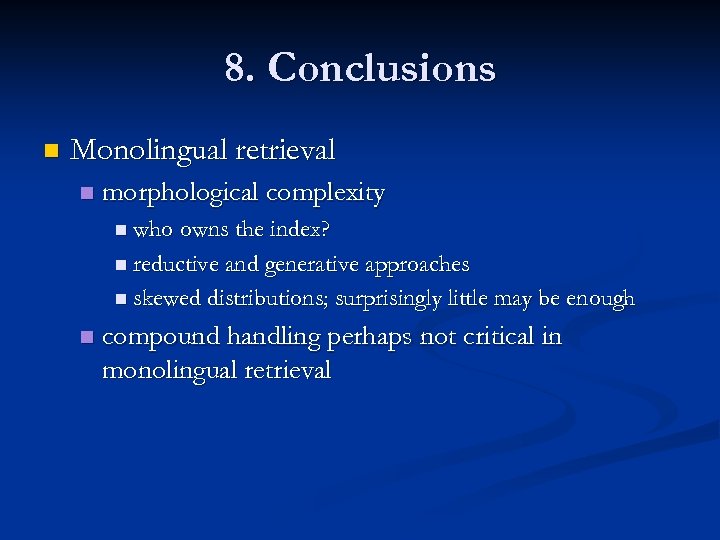 8. Conclusions n Monolingual retrieval n morphological complexity n who owns the index? n reductive and generative approaches n skewed distributions; surprisingly little may be enough n compound handling perhaps not critical in monolingual retrieval
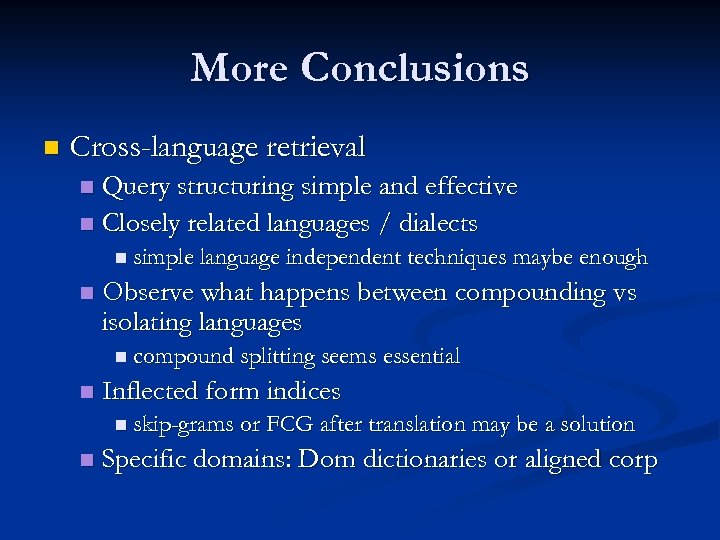 More Conclusions n Cross-language retrieval Query structuring simple and effective n Closely related languages / dialects n n simple language independent techniques n maybe enough Observe what happens between compounding vs isolating languages n compound splitting seems essential n Inflected form indices n skip-grams or n FCG after translation may be a solution Specific domains: Dom dictionaries or aligned corp
 Thanks!