


 Скачать презентацию Managing Iterative Development Using Scrum control the
1eb6761db034ecae7af156274f75cd89.ppt
- Количество слайдов: 42
 Managing Iterative Development Using Scrum § control the chaos © 2001 -2005 Craig Murphy
 Does this look familiar? Most software projects fail in some way Most software is buggy Most software is hard to use Dr. . Neil Roodyn, International Developer, October 2004 Managing Iterative Development Using Scrum 2
![Iterative Development…[and Scrum!] Can reduce the failure rate Can reduce the number of bugs](https://present5.com/presentation/1eb6761db034ecae7af156274f75cd89/image-3.jpg "Iterative Development…[and Scrum!] Can reduce the failure rate Can reduce the number of bugs") Iterative Development…[and Scrum!] Can reduce the failure rate Can reduce the number of bugs Can make software easier to use Closer interaction with the customer Managing Iterative Development Using Scrum 3
Iterative Development…[and Scrum!] Can reduce the failure rate Can reduce the number of bugs Can make software easier to use Closer interaction with the customer Managing Iterative Development Using Scrum 3
 Disclaimer § One person’s view… § What works for me, might not work for you… § Not intended to be a “my method’s better than your method” session § Not a “nitty-gritty” project management session § I will be talking about: § § Why I have not adopted Scrum in its entirety Why I adopted the parts of Scrum that I did Why I adapted Scrum to suit my needs How I am using Scrum, yet still “appearing” to use traditional heavyweight methods § Like Scrum, this is a lightweight session § More of a Case Study perhaps… Managing Iterative Development Using Scrum 4
 Agenda § § § § Motivation Why Focus on Iterative Development? Setting the Scene What is Scrum? Scrum’s Artifacts Why Scrum Works…For Me (Adopting Scrum) Summary Managing Iterative Development Using Scrum 5
 Motivation § To put my Scrum research and training to good use § To adopt Scrum, albeit incrementally § No “big bang” adoption § To develop a façade that [initially] looks like we’re practicing traditional project management § Traditional project management seems to revolve around the creation of often unnecessary artifacts that deliver little or no value to the project § Annoyingly, management seem to want these artifacts sooner rather than later…BDUF, “fixed” or complete project plans… Managing Iterative Development Using Scrum 6
 Agenda § § § § Motivation Why Focus on Iterative Development? Setting the Scene What is Scrum? Scrum’s Artifacts Why Scrum Works…For Me (Adopting Scrum) Summary Managing Iterative Development Using Scrum 7
 Why focus on Iterative Development? § Iterative Development § § § Lots of small “product releases” over the project’s lifetime As opposed to one major product release at the end Bugs / Problems are found early Products are usable earlier in the process Involves the customer during each iteration § Iterative Development lends itself to the Scrum modus operandi § Scrum’s artifacts promote customer involvement § They allow the customer to re-prioritise the order in which “development” work is done Managing Iterative Development Using Scrum 8
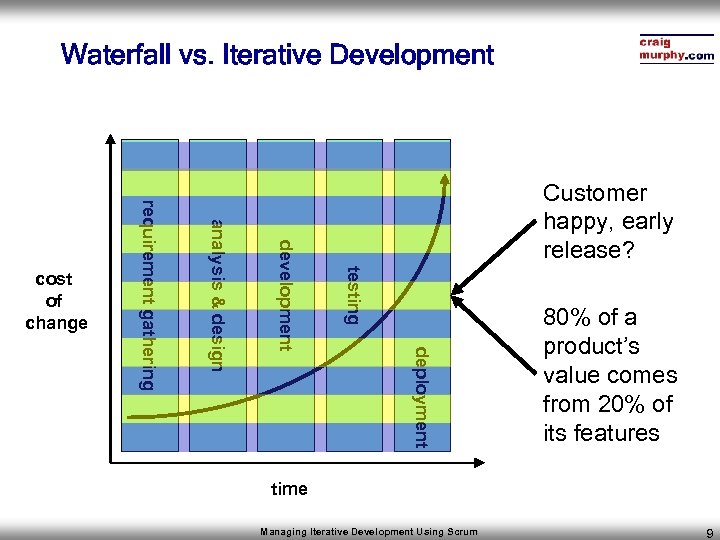 Waterfall vs. Iterative Development testing deployment development analysis & design requirement gathering cost of change Customer happy, early release? 80% of a product’s value comes from 20% of its features time Managing Iterative Development Using Scrum 9
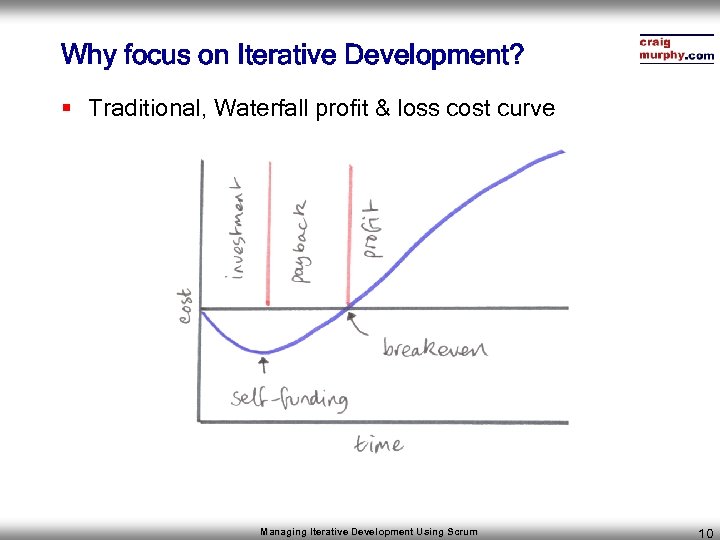 Why focus on Iterative Development? § Traditional, Waterfall profit & loss cost curve Managing Iterative Development Using Scrum 10
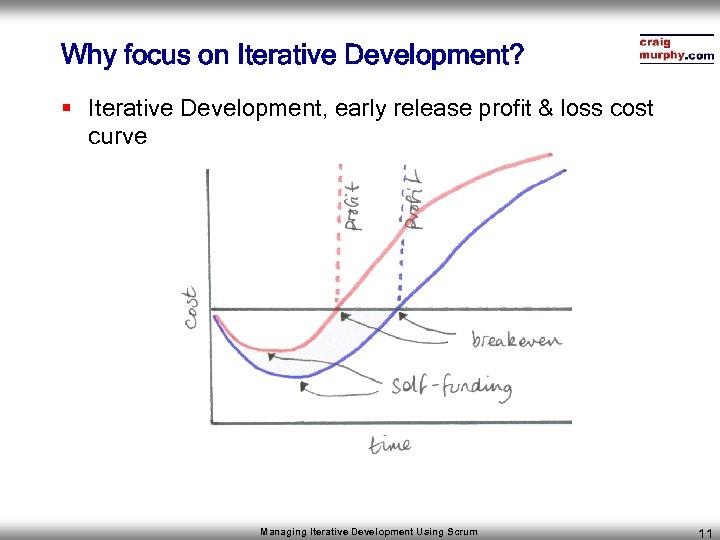 Why focus on Iterative Development? § Iterative Development, early release profit & loss cost curve Managing Iterative Development Using Scrum 11
 Agenda § § § § Motivation Why Focus on Iterative Development? Setting the Scene What is Scrum? Scrum’s Artifacts Why Scrum Works…For Me (Adopting Scrum) Summary Managing Iterative Development Using Scrum 12
 Setting the Scene § I use Scrum to manage development projects § Typically internal systems, licensed to our clients § Borland Delphi / Inter. Base / SQL Server or PHP / My. SQL § Pushing. NET as our recommended base platform § Rarely “new” greenfield systems, typically improvements to existing brownfield systems § Development used to by a group of three internal developers § External developers (contractors) § Moderate amount of “developer on site” § as opposed to XP’s “customer on site” Managing Iterative Development Using Scrum 13
 Setting the Scene § I also use Scrum to manage § User Group/Community activities § Seemingly endless personal “to do list” § Writing / Presentation schedule Managing Iterative Development Using Scrum 14
 Agenda § § § § Motivation Why Focus on Iterative Development? Setting the Scene What is Scrum? Scrum’s Artifacts Why Scrum Works…For Me (Adopting Scrum) Summary Managing Iterative Development Using Scrum 15
 What is Scrum? § Scrum: § § § § It’s about common sense Is an agile, lightweight process Can manage and control software and product development Uses iterative, incremental practices Has a simplementation Increases productivity Reduces time to benefits Embraces adaptive, empirical systems development Is not restricted to software development projects § Embraces the opposite of the waterfall approach… Managing Iterative Development Using Scrum 16
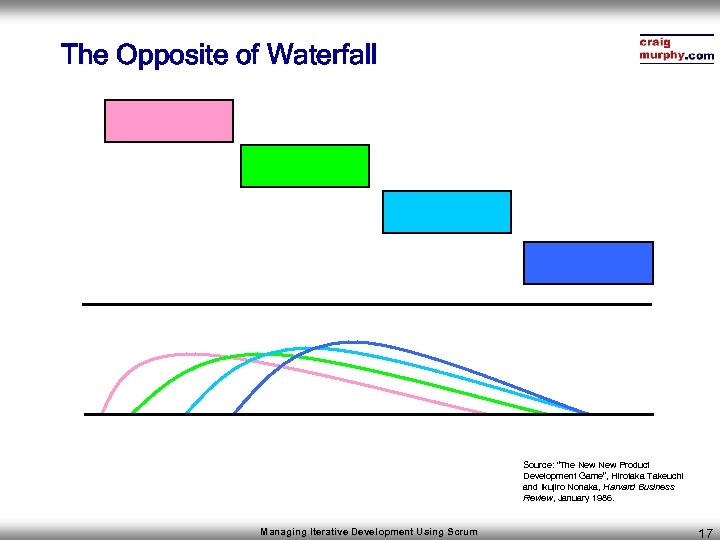 The Opposite of Waterfall Source: “The New Product Development Game”, Hirotaka Takeuchi and Ikujiro Nonaka, Harvard Business Review, January 1986. Managing Iterative Development Using Scrum 17
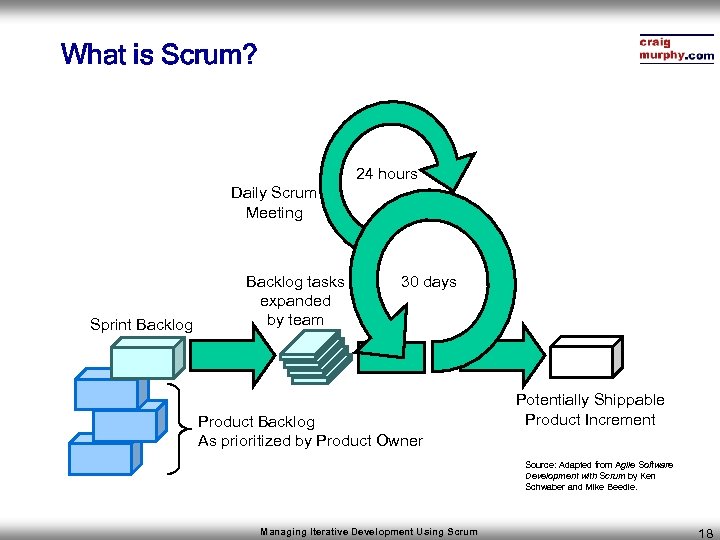 What is Scrum? 24 hours Daily Scrum Meeting Sprint Backlog tasks expanded by team 30 days Product Backlog As prioritized by Product Owner Potentially Shippable Product Increment Source: Adapted from Agile Software Development with Scrum by Ken Schwaber and Mike Beedle. Managing Iterative Development Using Scrum 18
 What is Scrum? § Scrum revolves around the ethos of simplicity, resulting in delivery of something that moves the project forward: 1. What have you done during the last 24 hours? 2. What do you plan to do in the next 24 hours? 3. What’s stopping you getting on with the work of the next 24 hours? § This is useful because: 1. This is progress, it’s work completed to date 2. This is forward planning, it is work you are about to do 3. These are your impediments or obstructions, it might be things you need in order to work…more forward planning. It’s also identification of immediate risks. Managing Iterative Development Using Scrum 19
 What is Scrum? § Roles § Product Owner § § Possibly a Product Manager or Project Sponsor Marketing Internal Customer etc. § Scrum. Master § § Represents management to the project Typically filled by a Project Manager or Team Leader Responsible for enacting Scrum values and practices Main job is to remove impediments and remove any politics § Project Team § 5 -10 members § Cross-functional: QA, Programmers, UI Designers, etc. Managing Iterative Development Using Scrum 20
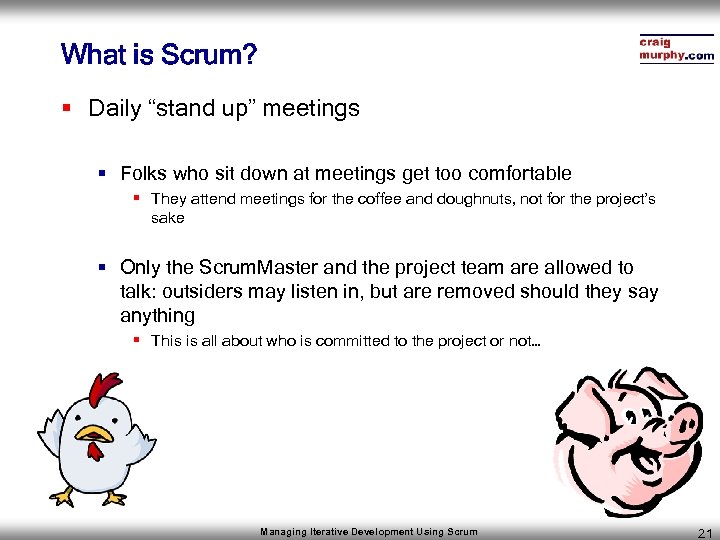 What is Scrum? § Daily “stand up” meetings § Folks who sit down at meetings get too comfortable § They attend meetings for the coffee and doughnuts, not for the project’s sake § Only the Scrum. Master and the project team are allowed to talk: outsiders may listen in, but are removed should they say anything § This is all about who is committed to the project or not… Managing Iterative Development Using Scrum 21
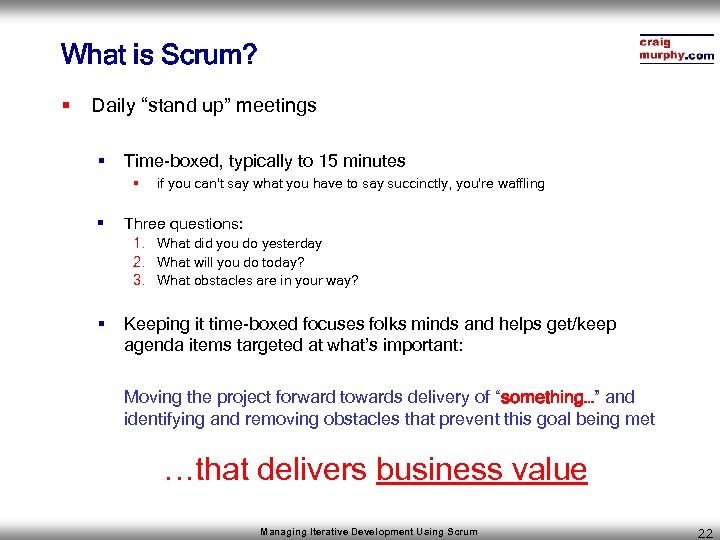 What is Scrum? § Daily “stand up” meetings § Time-boxed, typically to 15 minutes § § if you can’t say what you have to say succinctly, you’re waffling Three questions: 1. What did you do yesterday 2. What will you do today? 3. What obstacles are in your way? § Keeping it time-boxed focuses folks minds and helps get/keep agenda items targeted at what’s important: Moving the project forward towards delivery of “something…” and identifying and removing obstacles that prevent this goal being met …that delivers business value Managing Iterative Development Using Scrum 22
 Agenda § § § Motivation Setting the Scene What is Scrum? Scrum’s Artifacts Why Scrum Works…For Me (Adopting Scrum) Summary Managing Iterative Development Using Scrum 23
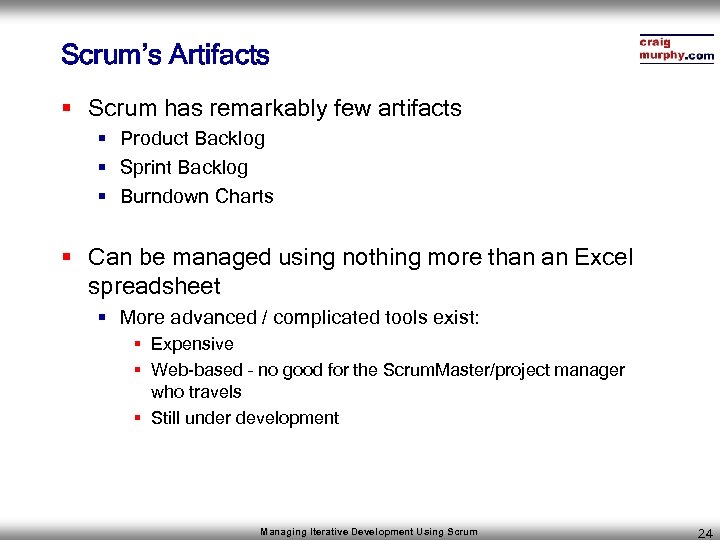 Scrum’s Artifacts § Scrum has remarkably few artifacts § Product Backlog § Sprint Backlog § Burndown Charts § Can be managed using nothing more than an Excel spreadsheet § More advanced / complicated tools exist: § Expensive § Web-based – no good for the Scrum. Master/project manager who travels § Still under development Managing Iterative Development Using Scrum 24
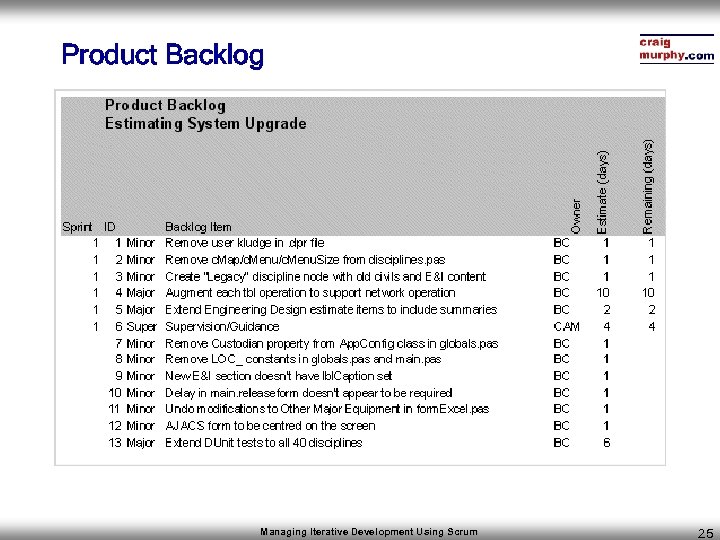 Product Backlog Managing Iterative Development Using Scrum 25
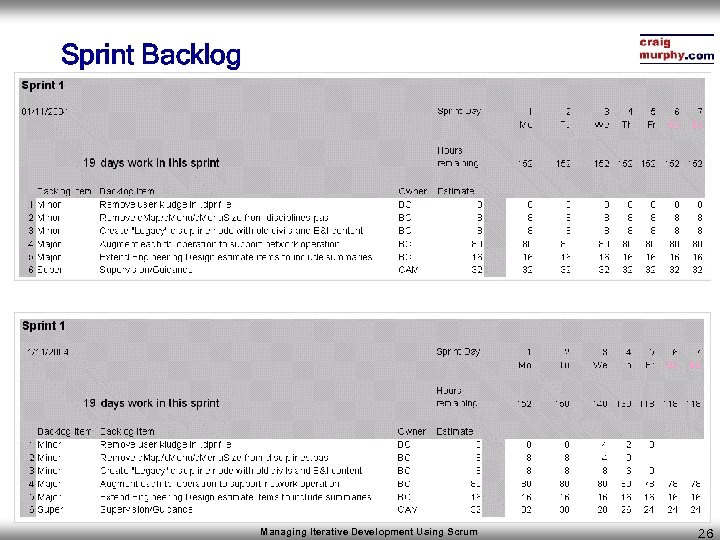 Sprint Backlog Managing Iterative Development Using Scrum 26
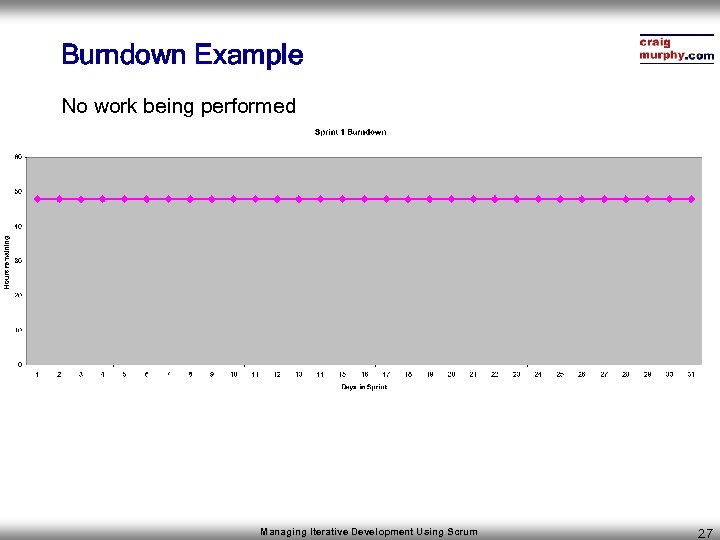 Burndown Example No work being performed Managing Iterative Development Using Scrum 27
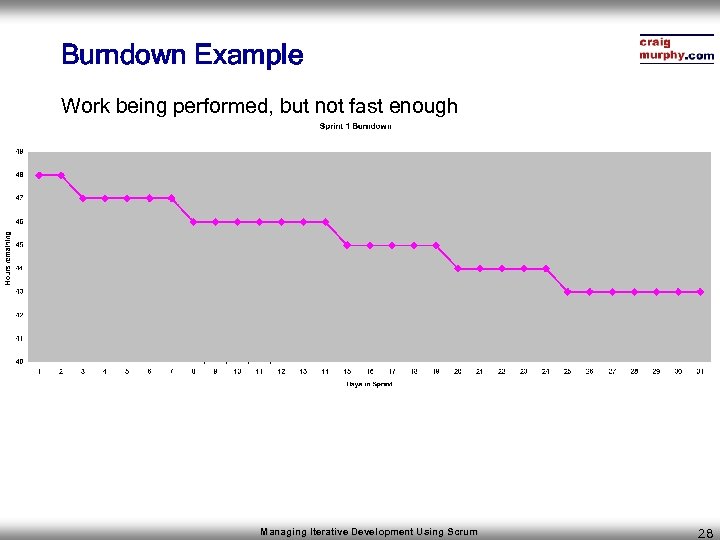 Burndown Example Work being performed, but not fast enough Managing Iterative Development Using Scrum 28
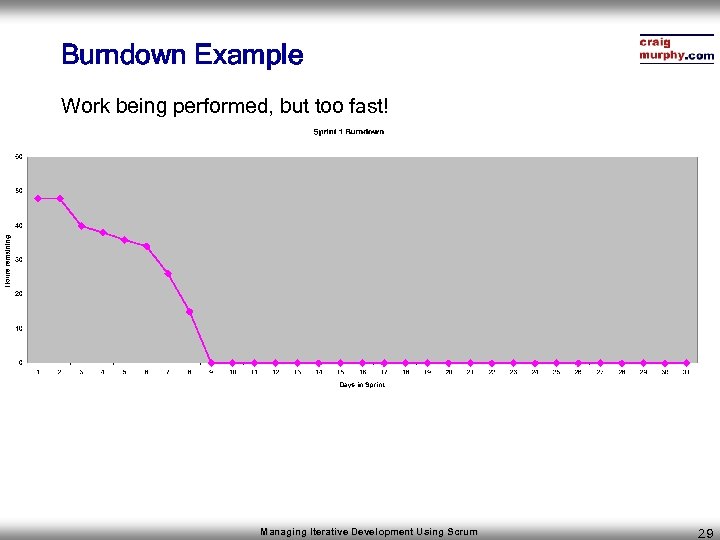 Burndown Example Work being performed, but too fast! Managing Iterative Development Using Scrum 29
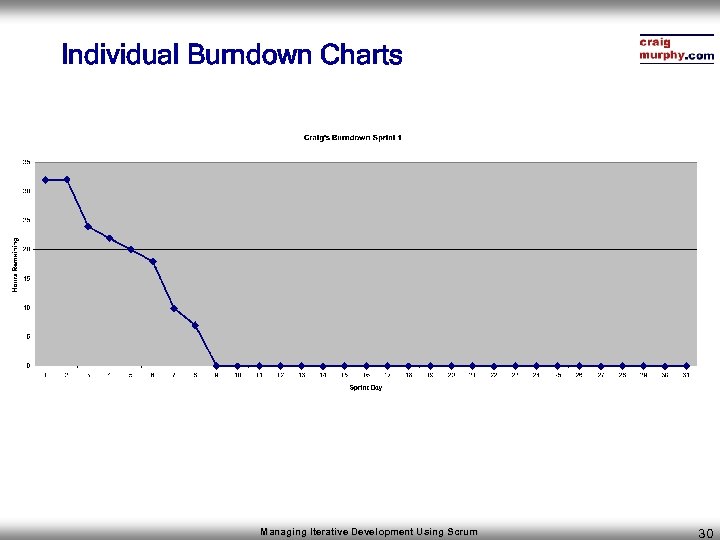 Individual Burndown Charts Managing Iterative Development Using Scrum 30
 Agenda § § § Motivation Setting the Scene What is Scrum? Scrum’s Artifacts Why Scrum Works…For Me (Adopting Scrum) Summary Managing Iterative Development Using Scrum 31
 Why Scrum Works…For Me § It’s simple, Scrum’s three questions: § Summary of work completed to date or § Summary of work complete in the last 14 days (1) § Plan of work for the next 14 days (2) § Project Issues requiring action from the Product Owner (3) § I first used these three key elements of Scrum early in 2004, the [small] audience loved the simplicity Managing Iterative Development Using Scrum 32
 Why Scrum Works…For Me § It’s fairly easy to convert a Sprint Backlog in to a Microsoft Project “plan” § Despite the cost of Microsoft Project licenses, upper management seem to like “charts” § Sprint Backlogs and Burndown Charts are early warning indicators § Lack of progress, very visible § Not enough work or work too easy, very visible § Assumes that everybody is committed to keeping the Sprint Backlog up to date Managing Iterative Development Using Scrum 33
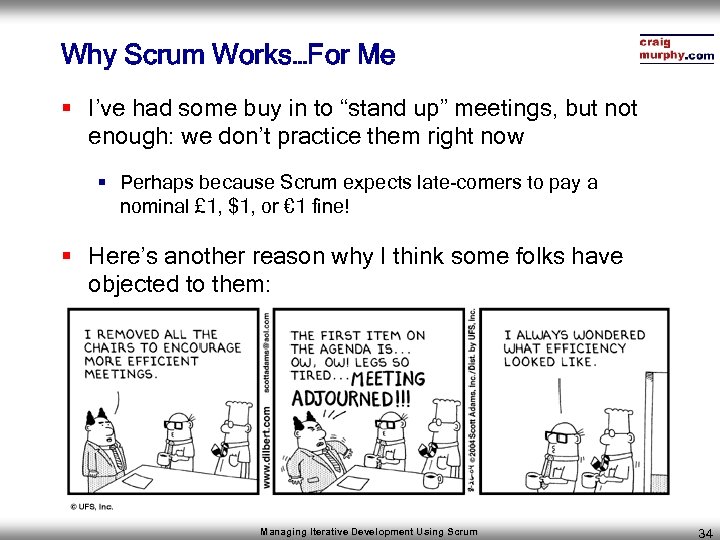 Why Scrum Works…For Me § I’ve had some buy in to “stand up” meetings, but not enough: we don’t practice them right now § Perhaps because Scrum expects late-comers to pay a nominal £ 1, $1, or € 1 fine! § Here’s another reason why I think some folks have objected to them: Managing Iterative Development Using Scrum 34
 Agenda § § § Motivation Setting the Scene What is Scrum? Scrum’s Artifacts Why Scrum Works…For Me (Adopting Scrum) Summary Managing Iterative Development Using Scrum 35
 Summary § Keep asking these questions: § What is the simplest thing that can move the project forward? § Does what I am doing right now move the project forward at all? § Are there any impediments that are preventing progress? § “Don’t procrastinate, do something, no matter how small…” – Ken Schwaber, Vienna, April 2004 Managing Iterative Development Using Scrum 36
 Summary § Keep the team small and tight: § Avoid folks with Teflon shoulders – “hangers on” TM § On a recent project, our core team comprised of: § § 1 * business expert, with authority 1 * IT expert, with internal Time & Expense experience 1 * consultant with specific MIS implementation experience 2 * business analysts § Any larger and decisions become committee-driven: § They won’t be made in a timely fashion § Sadly, this project became committee-driven Managing Iterative Development Using Scrum 37
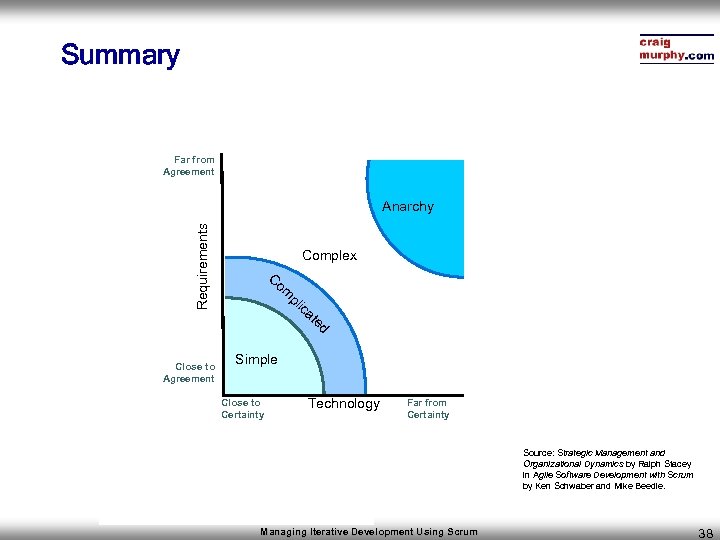 Summary Far from Agreement Requirements Anarchy Close to Agreement Complex C om pl ic at ed Simple Close to Certainty Technology Far from Certainty Source: Strategic Management and Organizational Dynamics by Ralph Stacey in Agile Software Development with Scrum by Ken Schwaber and Mike Beedle. Managing Iterative Development Using Scrum 38
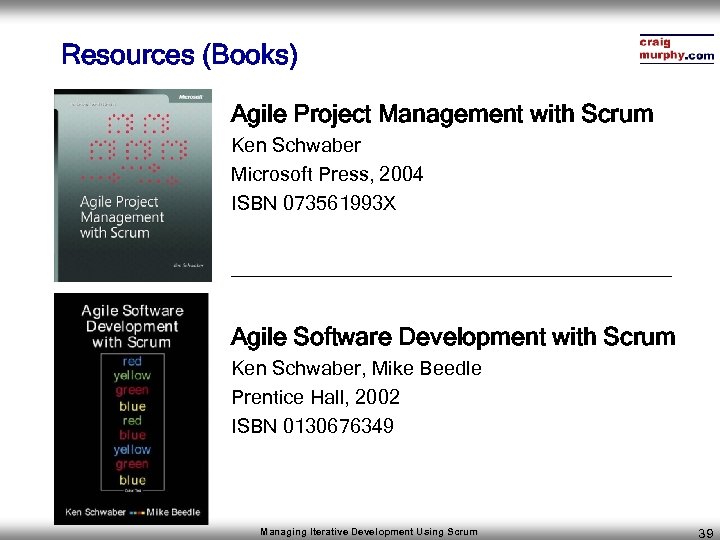 Resources (Books) Agile Project Management with Scrum Ken Schwaber Microsoft Press, 2004 ISBN 073561993 X ________________ Agile Software Development with Scrum Ken Schwaber, Mike Beedle Prentice Hall, 2002 ISBN 0130676349 Managing Iterative Development Using Scrum 39
 Resources (web-sites) § Scrum: It’s About Common Sense § § http: //www. controlchaos. com Pay your £ 1, $1, € 1 late-comer fee via this site! http: //www. scrumalliance. org http: //www. mountaingoatsoftware. com § Home of Mike Cohn’s “User Stories” § Methods & Tools - Articles § Improving Application Quality Using Test-Driven Development http: //www. methodsandtools. com/archive. php? id=20 § Adaptive Project Management Using Scrum http: //www. methodsandtools. com/archive. php? id=18 Managing Iterative Development Using Scrum 40
 Contact and Update Information Craig Murphy Updated slides, notes and source code: http: //www. Craig. Murphy. com http: //www. developerday. co. uk Managing Iterative Development Using Scrum 41
 Questions? Managing Iterative Development Using Scrum 42