 Скачать презентацию MANAGING INFORMAL RURAL LAND ARRANGEMENTS FOR SUSTAINABLE DEVELOPMENT
aeb1f5e08093f50585a296520cd08a8f.ppt
- Количество слайдов: 1



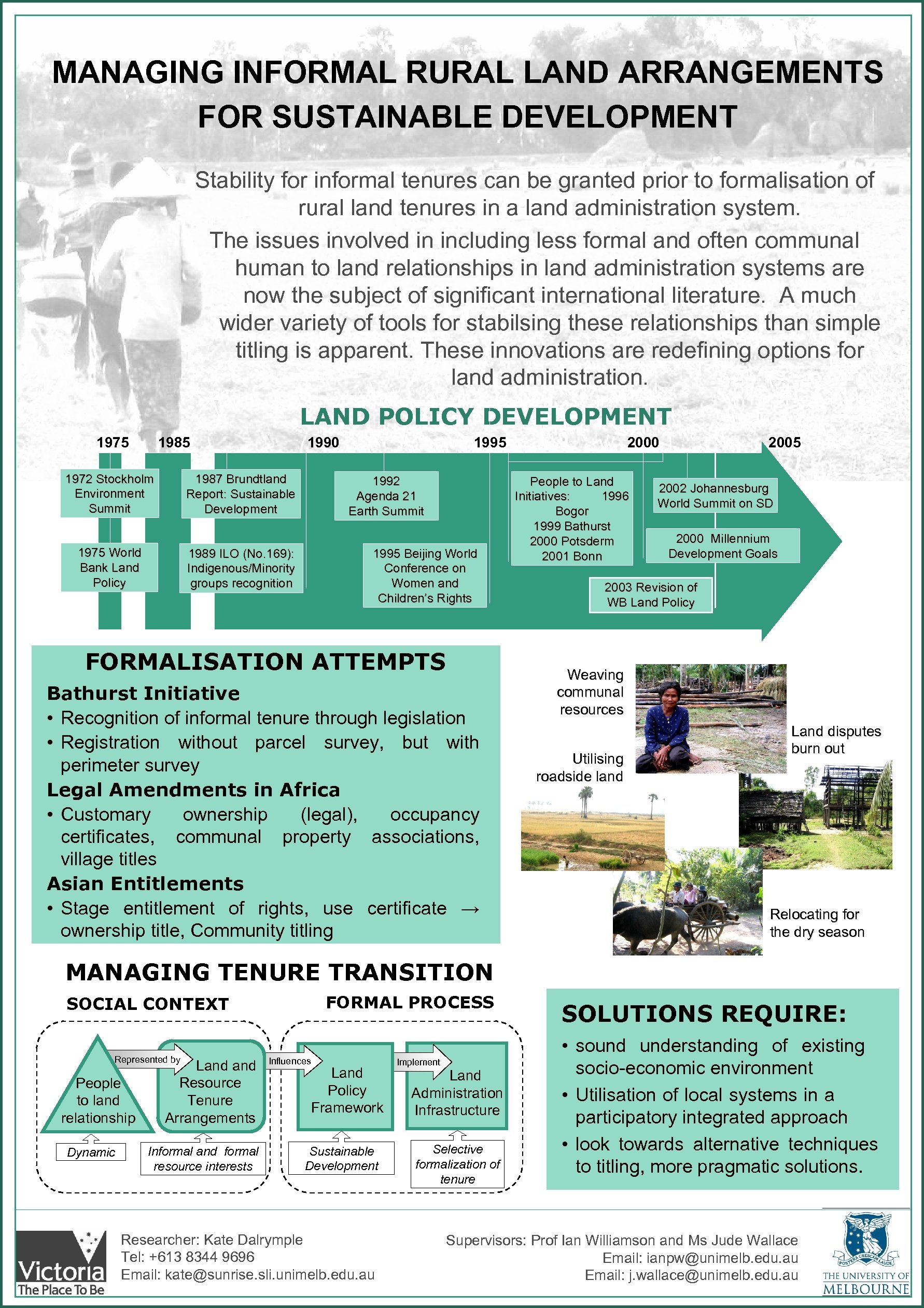
MANAGING INFORMAL RURAL LAND ARRANGEMENTS FOR SUSTAINABLE DEVELOPMENT Stability for informal tenures can be granted prior to formalisation of rural land tenures in a land administration system. The issues involved in including less formal and often communal human to land relationships in land administration systems are now the subject of significant international literature. A much wider variety of tools for stabilsing these relationships than simple titling is apparent. These innovations are redefining options for land administration. LAND POLICY DEVELOPMENT 1975 1985 1972 Stockholm Environment Summit 1990 1987 Brundtland Report: Sustainable Development 1975 World Bank Land Policy 1995 1992 Agenda 21 Earth Summit 1989 ILO (No. 169): Indigenous/Minority groups recognition 1995 Beijing World Conference on Women and Children’s Rights FORMALISATION ATTEMPTS Bathurst Initiative • Recognition of informal tenure through legislation • Registration without parcel survey, but with perimeter survey Legal Amendments in Africa • Customary ownership (legal), occupancy certificates, communal property associations, village titles Asian Entitlements • Stage entitlement of rights, use certificate → ownership title, Community titling 2000 People to Land Initiatives: 1996 Bogor 1999 Bathurst 2000 Potsderm 2001 Bonn 2005 2002 Johannesburg World Summit on SD 2000 Millennium Development Goals 2003 Revision of WB Land Policy Weaving communal resources Utilising roadside land Land disputes burn out Relocating for the dry season MANAGING TENURE TRANSITION FORMAL PROCESS SOCIAL CONTEXT Represented by People to land relationship Dynamic Land Resource Tenure Arrangements Informal and formal resource interests Influences Land Policy Framework Sustainable Development Researcher: Kate Dalrymple Tel: +613 8344 9696 Email: kate@sunrise. sli. unimelb. edu. au Implement Land Administration Infrastructure Selective formalization of tenure SOLUTIONS REQUIRE: • sound understanding of existing socio-economic environment • Utilisation of local systems in a participatory integrated approach • look towards alternative techniques to titling, more pragmatic solutions. Supervisors: Prof Ian Williamson and Ms Jude Wallace Email: ianpw@unimelb. edu. au Email: j. wallace@unimelb. edu. au
Скачать презентацию MANAGING INFORMAL RURAL LAND ARRANGEMENTS FOR SUSTAINABLE DEVELOPMENT
aeb1f5e08093f50585a296520cd08a8f.ppt