


 Скачать презентацию Managing Customers for Profit V Kumar Chapter
2c551957c56142985460efa0be824490.ppt
- Количество слайдов: 16
 Managing Customers for Profit V. Kumar Chapter – 8 Pitching the Right Product, to the Right Customer, at the Right Time Instructor’s Presentation Slides ©Dr. V. Kumar http: //www. drvkumar. com/books/book_mcp. html 1
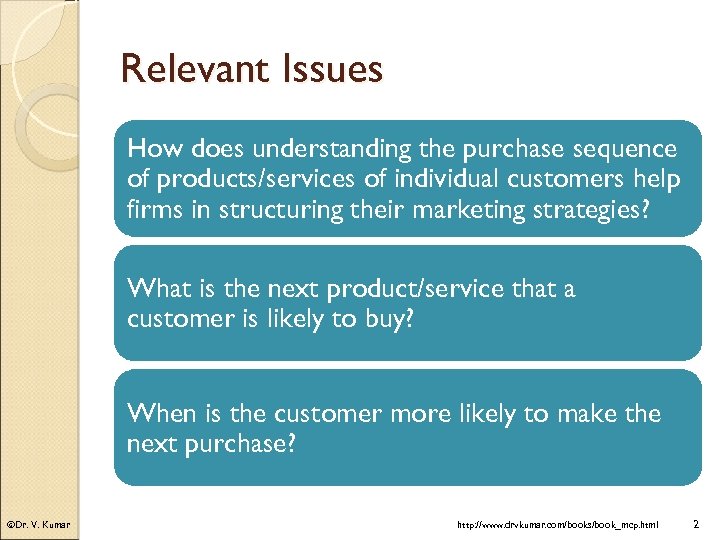 Relevant Issues How does understanding the purchase sequence of products/services of individual customers help firms in structuring their marketing strategies? What is the next product/service that a customer is likely to buy? When is the customer more likely to make the next purchase? ©Dr. V. Kumar http: //www. drvkumar. com/books/book_mcp. html 2
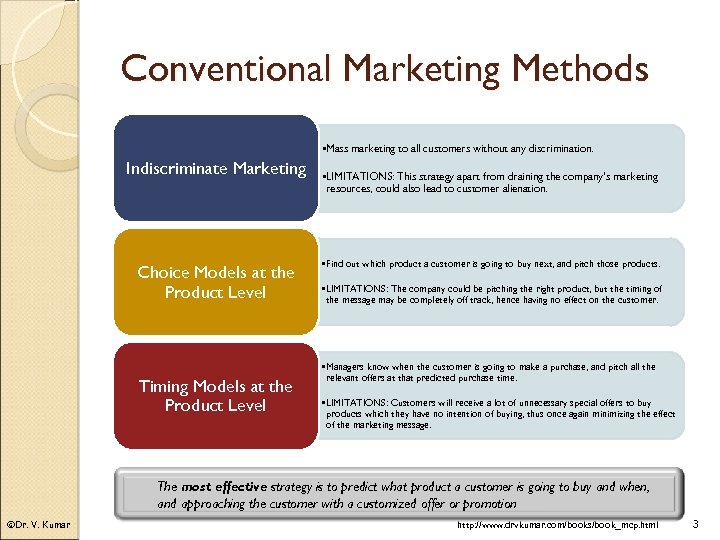 Conventional Marketing Methods • Mass marketing to all customers without any discrimination. Indiscriminate Marketing Choice Models at the Product Level Timing Models at the Product Level • LIMITATIONS: This strategy apart from draining the company’s marketing resources, could also lead to customer alienation. • Find out which product a customer is going to buy next, and pitch those products. • LIMITATIONS: The company could be pitching the right product, but the timing of the message may be completely off track, hence having no effect on the customer. • Managers know when the customer is going to make a purchase, and pitch all the relevant offers at that predicted purchase time. • LIMITATIONS: Customers will receive a lot of unnecessary special offers to buy products which they have no intention of buying, thus once again minimizing the effect of the marketing message. The most effective strategy is to predict what product a customer is going to buy and when, and approaching the customer with a customized offer or promotion ©Dr. V. Kumar http: //www. drvkumar. com/books/book_mcp. html 3
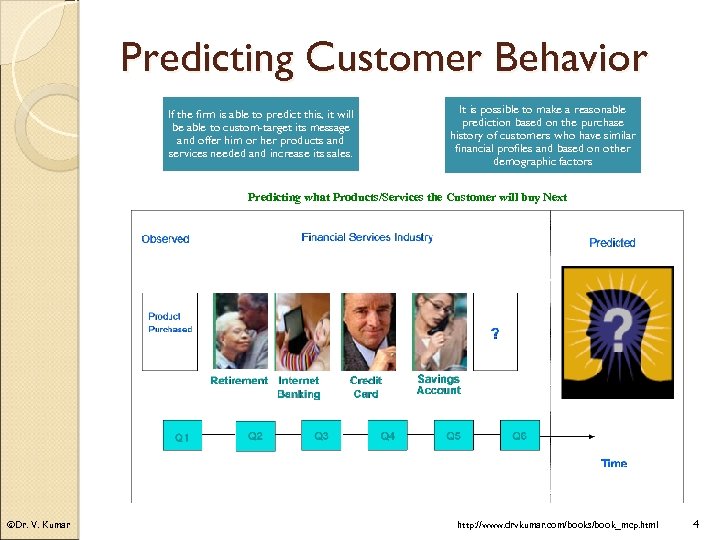 Predicting Customer Behavior If the firm is able to predict this, it will be able to custom-target its message and offer him or her products and services needed and increase its sales. It is possible to make a reasonable prediction based on the purchase history of customers who have similar financial profiles and based on other demographic factors Predicting what Products/Services the Customer will buy Next ©Dr. V. Kumar http: //www. drvkumar. com/books/book_mcp. html 4
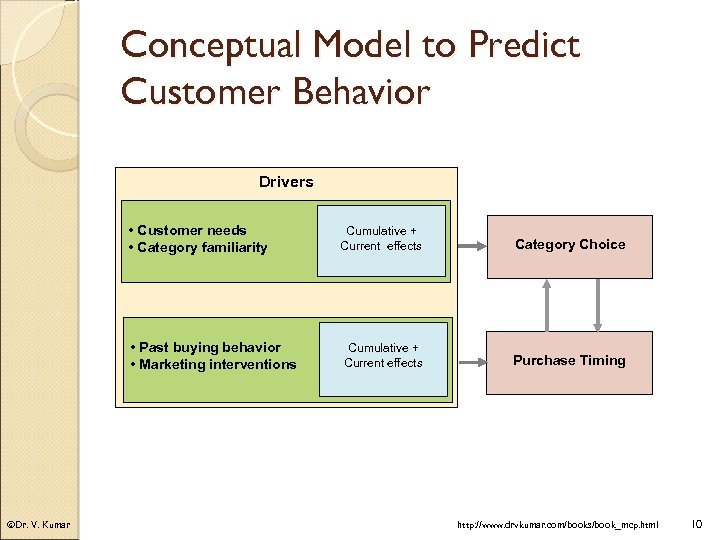
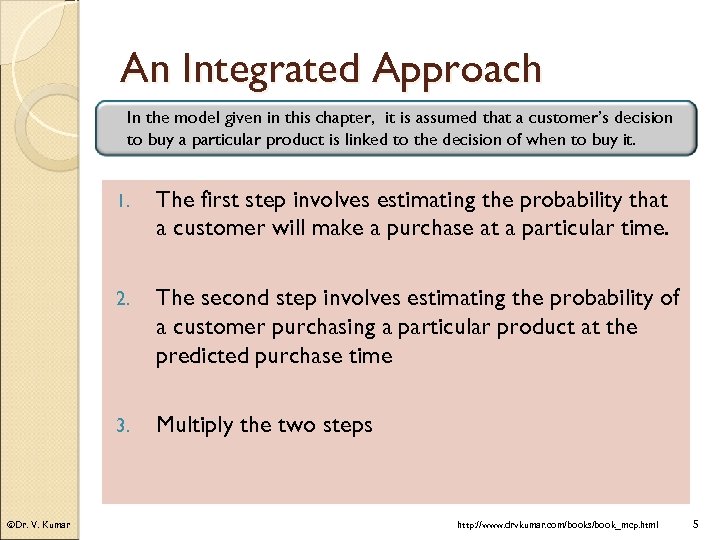 An Integrated Approach In the model given in this chapter, it is assumed that a customer’s decision to buy a particular product is linked to the decision of when to buy it. 1. 2. The second step involves estimating the probability of a customer purchasing a particular product at the predicted purchase time 3. ©Dr. V. Kumar The first step involves estimating the probability that a customer will make a purchase at a particular time. Multiply the two steps http: //www. drvkumar. com/books/book_mcp. html 5
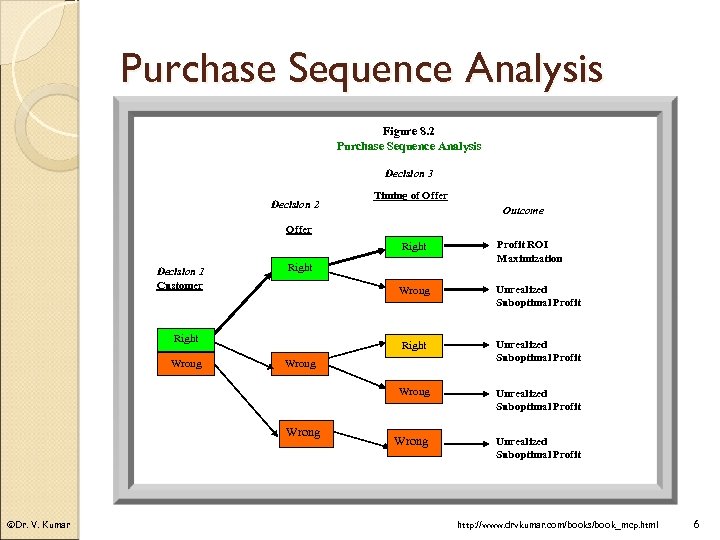 Purchase Sequence Analysis Figure 8. 2 Purchase Sequence Analysis Decision 3 Decision 2 Timing of Offer Outcome Offer Right Wrong Right Unrealized Suboptimal Profit Wrong ©Dr. V. Kumar Unrealized Suboptimal Profit Right Wrong Unrealized Suboptimal Profit Wrong Decision 1 Customer Profit ROI Maximization http: //www. drvkumar. com/books/book_mcp. html 6
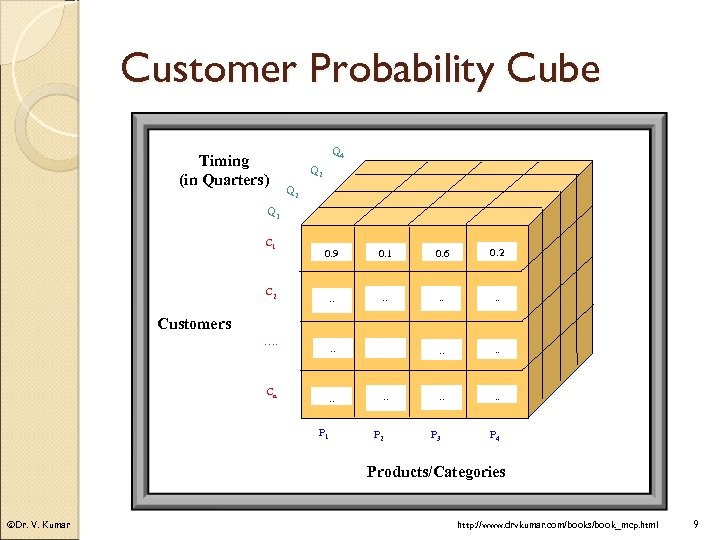
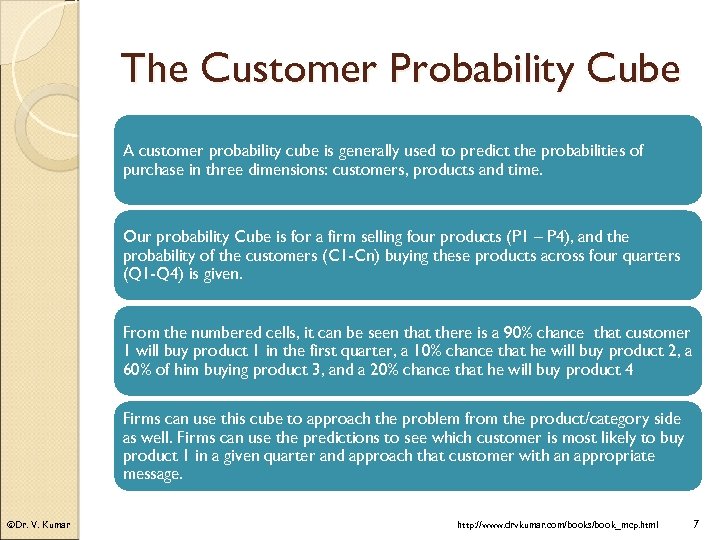 The Customer Probability Cube A customer probability cube is generally used to predict the probabilities of purchase in three dimensions: customers, products and time. Our probability Cube is for a firm selling four products (P 1 – P 4), and the probability of the customers (C 1 -Cn) buying these products across four quarters (Q 1 -Q 4) is given. From the numbered cells, it can be seen that there is a 90% chance that customer 1 will buy product 1 in the first quarter, a 10% chance that he will buy product 2, a 60% of him buying product 3, and a 20% chance that he will buy product 4 Firms can use this cube to approach the problem from the product/category side as well. Firms can use the predictions to see which customer is most likely to buy product 1 in a given quarter and approach that customer with an appropriate message. ©Dr. V. Kumar http: //www. drvkumar. com/books/book_mcp. html 7
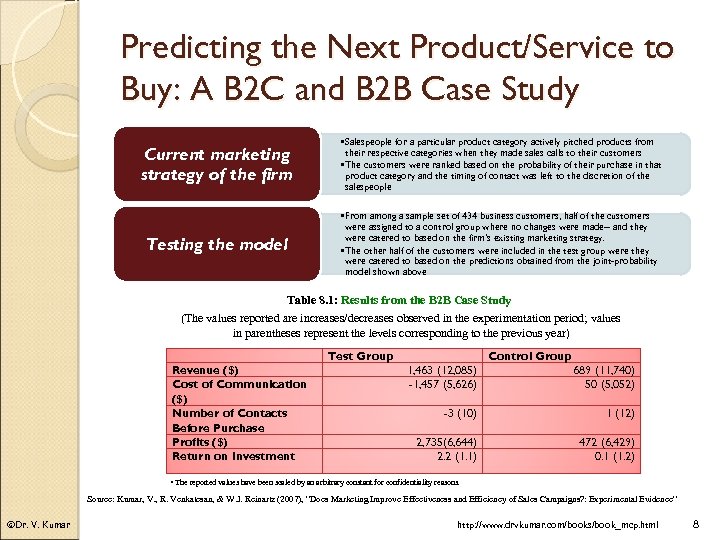 Predicting the Next Product/Service to Buy: A B 2 C and B 2 B Case Study Current marketing strategy of the firm • Salespeople for a particular product category actively pitched products from their respective categories when they made sales calls to their customers • The customers were ranked based on the probability of their purchase in that product category and the timing of contact was left to the discretion of the salespeople Testing the model • From among a sample set of 434 business customers, half of the customers were assigned to a control group where no changes were made-- and they were catered to based on the firm’s existing marketing strategy. • The other half of the customers were included in the test group were they were catered to based on the predictions obtained from the joint-probability model shown above Table 8. 1: Results from the B 2 B Case Study (The values reported are increases/decreases observed in the experimentation period; values in parentheses represent the levels corresponding to the previous year) Test Group Revenue ($) Cost of Communication ($) Number of Contacts Before Purchase Profits ($) Return on Investment a The Control Group 1, 463 (12, 085) -1, 457 (5, 626) 689 (11, 740) 50 (5, 052) -3 (10) 1 (12) 2, 735(6, 644) 2. 2 (1. 1) 472 (6, 429) 0. 1 (1. 2) reported values have been scaled by an arbitrary constant for confidentiality reasons. Source: Kumar, V. , R. Venkatesan, & W. J. Reinartz (2007), “Does Marketing Improve Effectiveness and Efficiency of Sales Campaigns? : Experimental Evidence” ©Dr. V. Kumar http: //www. drvkumar. com/books/book_mcp. html 8
 Customer Probability Cube Timing (in Quarters) Q 4 . . . . Q 2 Q 1 C 1 . . Q 2 . . . . 0. 9 0. 1 0. 6 . . 0. 2. . C 2 . . . Customers . . …. . . . Cn . . P 1 . . P 2 . . P 3 . . P 4 Products/Categories ©Dr. V. Kumar http: //www. drvkumar. com/books/book_mcp. html 9
 Conceptual Model to Predict Customer Behavior Drivers • Customer needs • Category familiarity Category Choice • Past buying behavior • Marketing interventions ©Dr. V. Kumar Cumulative + Current effects Purchase Timing http: //www. drvkumar. com/books/book_mcp. html 10
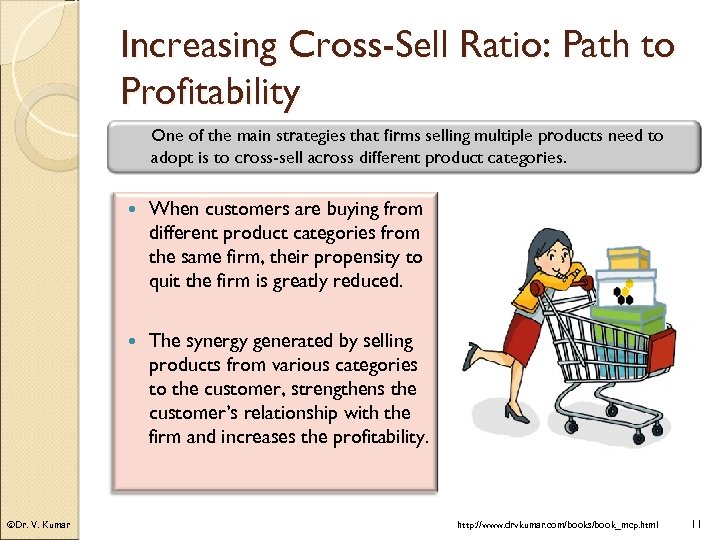 Increasing Cross-Sell Ratio: Path to Profitability One of the main strategies that firms selling multiple products need to adopt is to cross-sell across different product categories. ©Dr. V. Kumar When customers are buying from different product categories from the same firm, their propensity to quit the firm is greatly reduced. The synergy generated by selling products from various categories to the customer, strengthens the customer’s relationship with the firm and increases the profitability. http: //www. drvkumar. com/books/book_mcp. html 11
 Contact Strategy B 2 C Optimal Contact Strategy in a B 2 C setting: Customer* Ranking based on their Likelihood to Purchase Figure 8. 5 Highest Very Likely Madonna Nelson Mandela Madonna Michael Jordan Bill Cosby Willie Nelson Bill Cosby Madonna Michael Jordan Oprah Winfrey Michael Jordan Bill Cosby Likely Savings Account Oprah Winfrey Not-likely Internet Banking Martha Stewart Likelihood to Purchase Credit Card Tom Hanks Jennifer Aniston Martha Stewart Jennifer Aniston Nelson Mandela Martha Stewart Oprah Winfrey Lowest ©Dr. V. Kumar *All names are fictitious and used hypothetically in this figure. It bears no resemblance to any living person by the same name http: //www. drvkumar. com/books/book_mcp. html 12
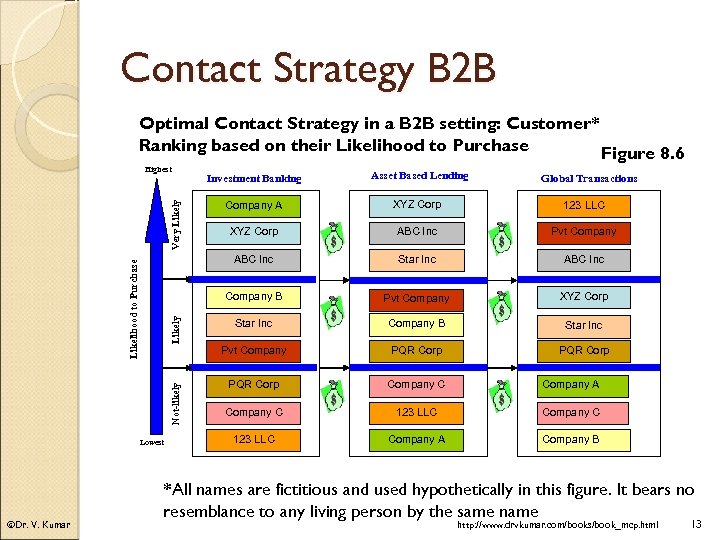 Contact Strategy B 2 B Optimal Contact Strategy in a B 2 B setting: Customer* Ranking based on their Likelihood to Purchase Figure 8. 6 Highest Very Likely XYZ Corp 123 LLC XYZ Corp ABC Inc Pvt Company Star Inc ABC Inc Pvt Company XYZ Corp Star Inc Company B Star Inc Pvt Company Not-likely Company A Company B Likelihood to Purchase ©Dr. V. Kumar Asset Based Lending ABC Inc Lowest Investment Banking PQR Corp Company C Company A Company C 123 LLC Company A Company B Global Transactions *All names are fictitious and used hypothetically in this figure. It bears no resemblance to any living person by the same name http: //www. drvkumar. com/books/book_mcp. html 13
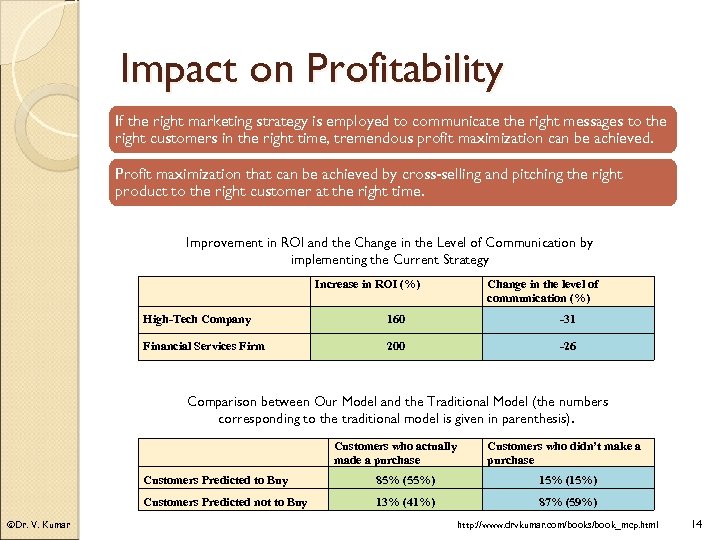 Impact on Profitability If the right marketing strategy is employed to communicate the right messages to the right customers in the right time, tremendous profit maximization can be achieved. Profit maximization that can be achieved by cross-selling and pitching the right product to the right customer at the right time. Improvement in ROI and the Change in the Level of Communication by implementing the Current Strategy Increase in ROI (%) Change in the level of communication (%) High-Tech Company 160 -31 Financial Services Firm 200 -26 Comparison between Our Model and the Traditional Model (the numbers corresponding to the traditional model is given in parenthesis). Customers who actually made a purchase Customers who didn’t make a purchase Customers Predicted to Buy 15% (15%) Customers Predicted not to Buy ©Dr. V. Kumar 85% (55%) 13% (41%) 87% (59%) http: //www. drvkumar. com/books/book_mcp. html 14
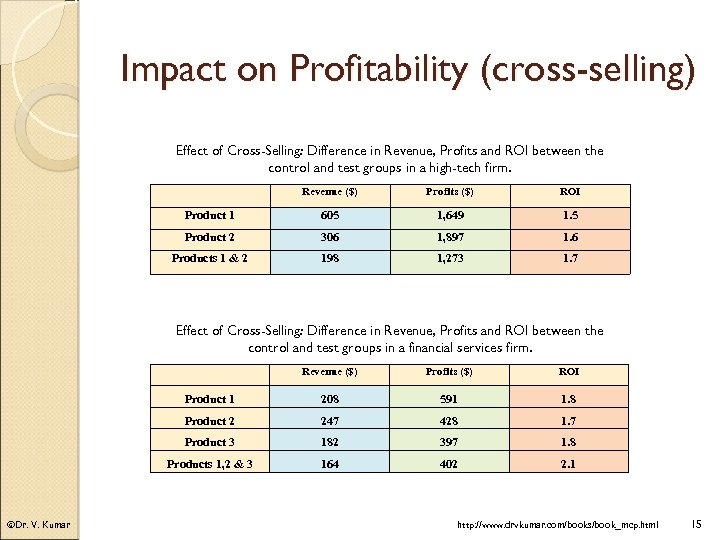 Impact on Profitability (cross-selling) Effect of Cross-Selling: Difference in Revenue, Profits and ROI between the control and test groups in a high-tech firm. Revenue ($) Profits ($) ROI Product 1 605 1, 649 1. 5 Product 2 306 1, 897 1. 6 Products 1 & 2 198 1, 273 1. 7 Effect of Cross-Selling: Difference in Revenue, Profits and ROI between the control and test groups in a financial services firm. Revenue ($) ROI Product 1 208 591 1. 8 Product 2 247 428 1. 7 Product 3 182 397 1. 8 Products 1, 2 & 3 ©Dr. V. Kumar Profits ($) 164 402 2. 1 http: //www. drvkumar. com/books/book_mcp. html 15
 End of Chapter 8 ©Dr. V. Kumar 16 http: //www. drvkumar. com/books/book_mcp. html 16