


 Скачать презентацию Managing complexity in large development programmes Presenter Dr
2e3523e8ac33214ec0a0b347ba8baadc.ppt
- Количество слайдов: 68
 Managing complexity in large development programmes Presenter: Dr Steve Rivkin, Acando UK University of Manchester 11 October 2012 1
 Topics to be Covered • • • • • Common problems Requirements management Requirements-driven Design Project Support processes Benefits of Process Integration Managing Commercial and Legal Requirements Operation, Maintenance and System Disposal Benefits of Requirements-driven Design Example of graphical navigation Conformance to International Standards Safety Case Life Cycle Multiple Life Cycles Profiling Requirements to Industry Sectors – Nuclear Safety Case Example – Pharmaceutical drug Development Example Multiple Contractors Information Requirements for Key Decision Makers Decision Process Integration and Information Flow Challenges Slide No. 2
 Common Problems • Stakeholder & Programme/System Requirements inadequate • Contractor(s) have previous experience and ‘know’ what is needed • Even if more detailed requirements produced, not linked to Stakeholders’ Requirements • Designs not linked formally to Stakeholders’ Requirements or System Requirements Slide No. 3
 Common Problems Legal advice => only award contracts against well specified sets of requirements • Still no linkage between Stakeholders’ Requirements and System requirements • No auditable traceability from Stakeholders’ Requirements to System Requirements & Design • Can’t prove design meets Stakeholders’ & System Requirements • When Client’s specialists study completed designs, some aspects may fail to meet System and/or Stakeholder Reqs Slide No. 4
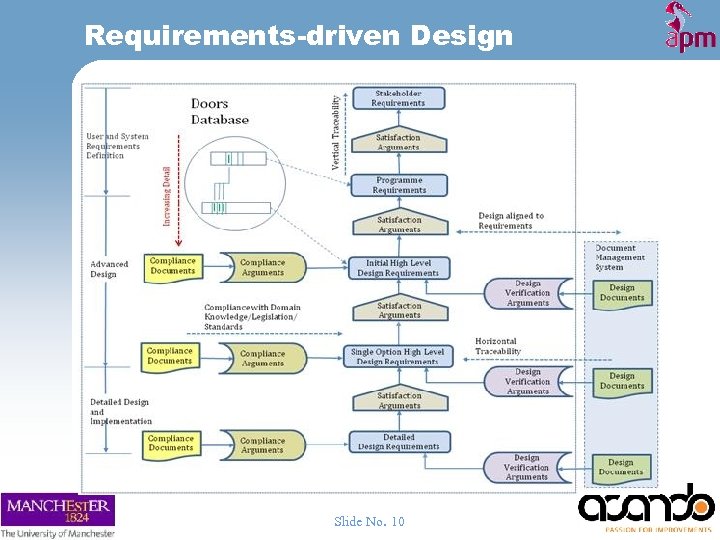
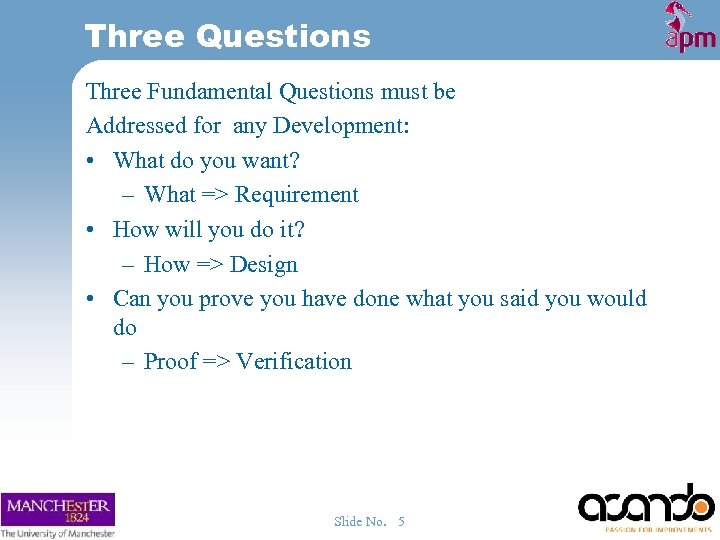 Three Questions Three Fundamental Questions must be Addressed for any Development: • What do you want? – What => Requirement • How will you do it? – How => Design • Can you prove you have done what you said you would do – Proof => Verification Slide No. 5
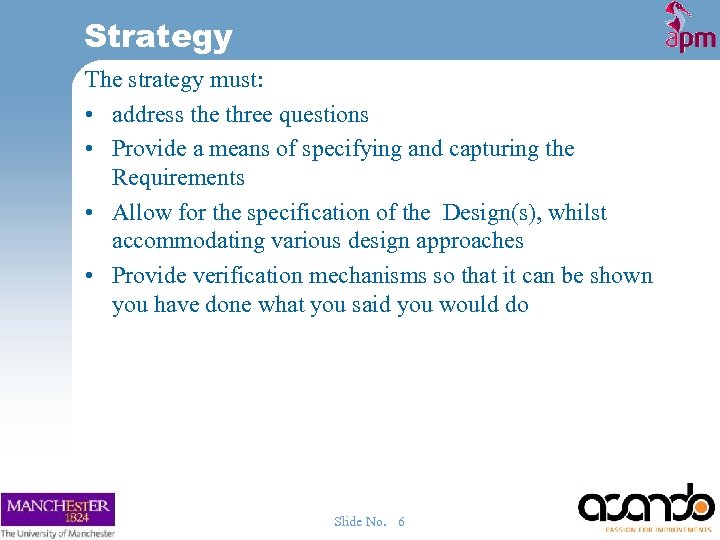 Strategy The strategy must: • address the three questions • Provide a means of specifying and capturing the Requirements • Allow for the specification of the Design(s), whilst accommodating various design approaches • Provide verification mechanisms so that it can be shown you have done what you said you would do Slide No. 6
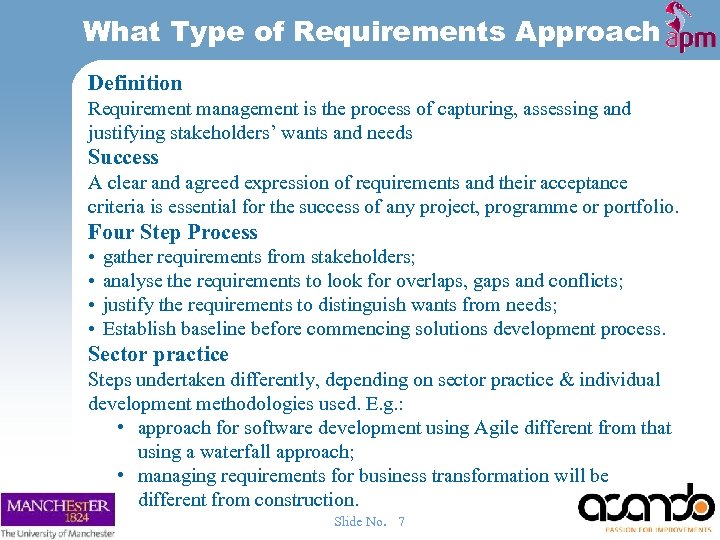 What Type of Requirements Approach Definition Requirement management is the process of capturing, assessing and justifying stakeholders’ wants and needs Success A clear and agreed expression of requirements and their acceptance criteria is essential for the success of any project, programme or portfolio. Four Step Process • • gather requirements from stakeholders; analyse the requirements to look for overlaps, gaps and conflicts; justify the requirements to distinguish wants from needs; Establish baseline before commencing solutions development process. Sector practice Steps undertaken differently, depending on sector practice & individual development methodologies used. E. g. : • approach for software development using Agile different from that using a waterfall approach; • managing requirements for business transformation will be different from construction. Slide No. 7
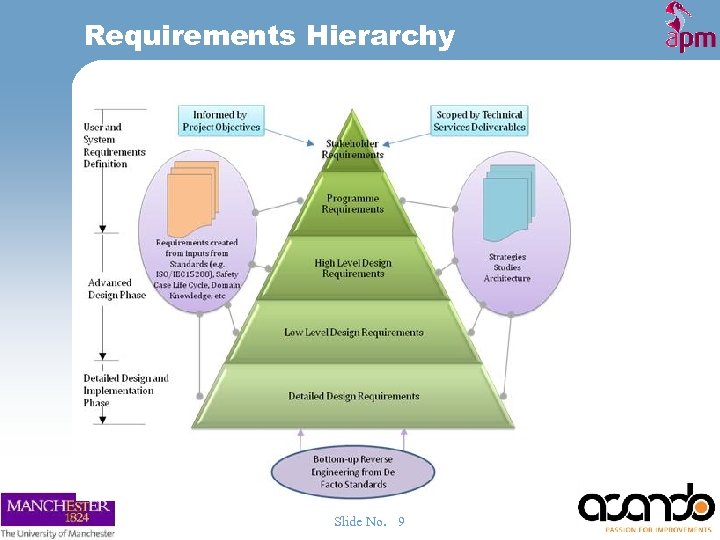
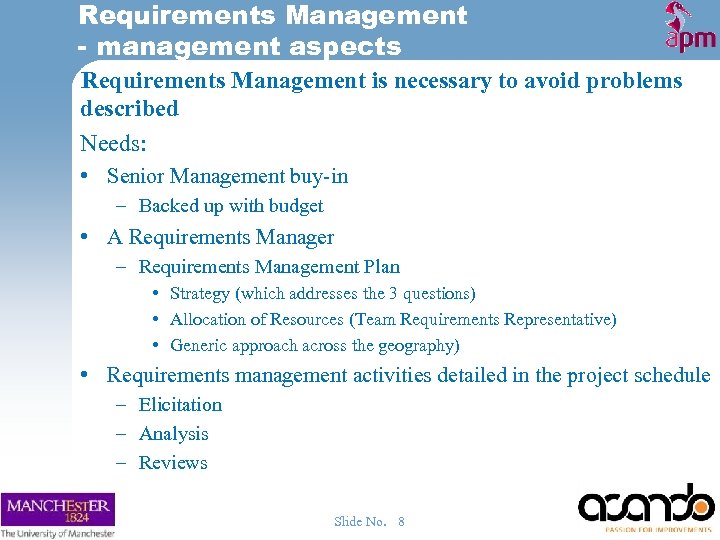 Requirements Management - management aspects Requirements Management is necessary to avoid problems described Needs: • Senior Management buy-in – Backed up with budget • A Requirements Manager – Requirements Management Plan • Strategy (which addresses the 3 questions) • Allocation of Resources (Team Requirements Representative) • Generic approach across the geography) • Requirements management activities detailed in the project schedule – Elicitation – Analysis – Reviews Slide No. 8
 Requirements Hierarchy Slide No. 9
 Requirements-driven Design Slide No. 10
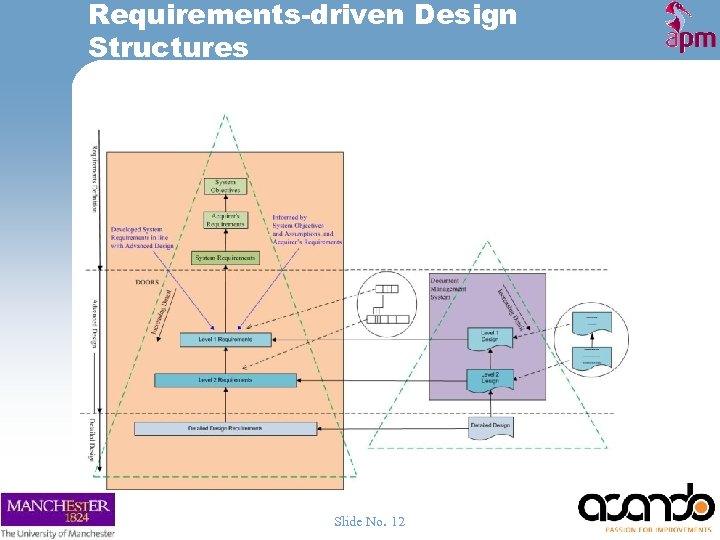
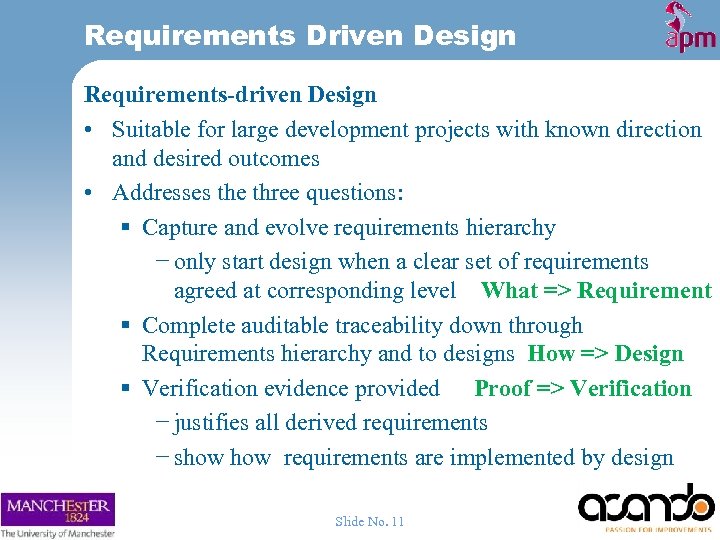 Requirements Driven Design Requirements-driven Design • Suitable for large development projects with known direction and desired outcomes • Addresses the three questions: § Capture and evolve requirements hierarchy − only start design when a clear set of requirements agreed at corresponding level What => Requirement § Complete auditable traceability down through Requirements hierarchy and to designs How => Design § Verification evidence provided Proof => Verification − justifies all derived requirements − show requirements are implemented by design Slide No. 11
 Requirements-driven Design Structures Slide No. 12
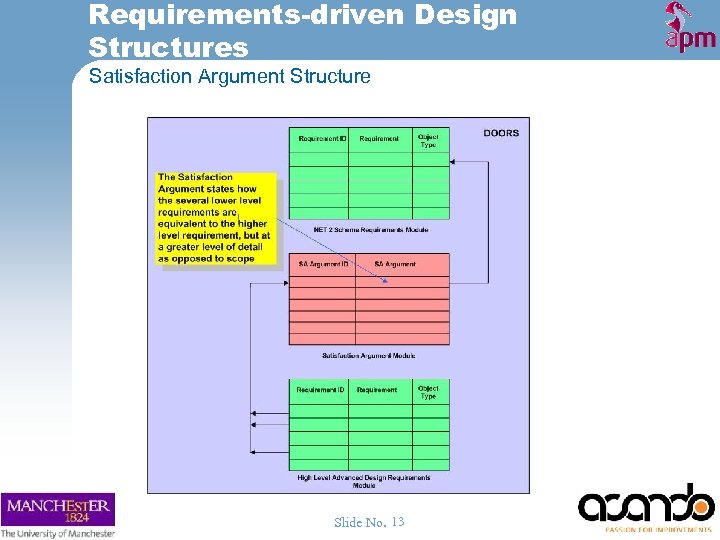 Requirements-driven Design Structures Satisfaction Argument Structure Slide No. 13
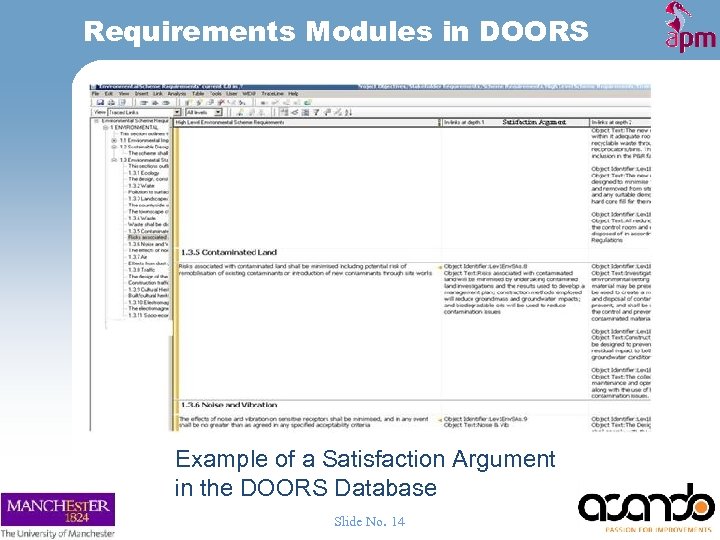 Requirements Modules in DOORS Example of a Satisfaction Argument in the DOORS Database Slide No. 14
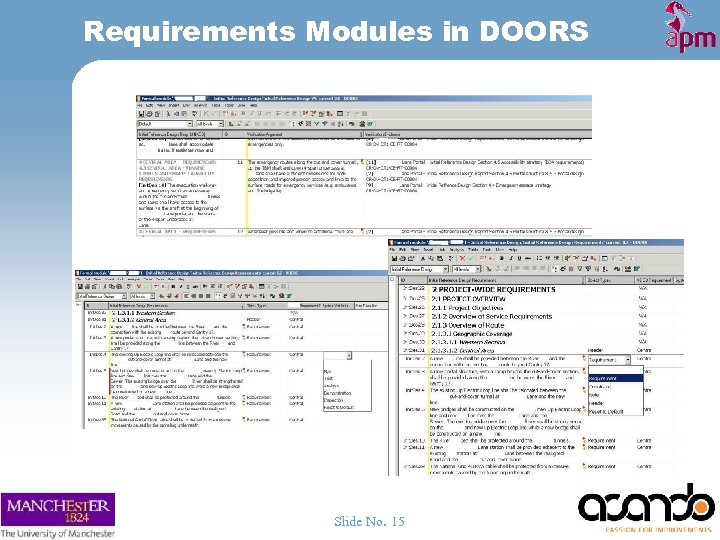 Requirements Modules in DOORS Slide No. 15
 Requirements-driven Design Strategy Overall Requirements Strategy ● Create Requirements Management Plan - Defines the overall strategy ● Requirements-driven Design Processes Implemented in 2 iterations per stage for each level of Requirements/Design 1. Requirements Definition – Requirements Elicitation & Capture – Requirements Analysis – Requirements Review – Requirements Verification – Requirements baselining => Delivers a set of Requirements 2. Design Specification – Create designs – Design and DVA Reviews => delivering Design elements linked to corresponding Requirements Slide No. 16
 Requirements Capture & Elicitation (Style & Formulation) What makes a ‘robust’ requirement? • Each requirement must: – Stand alone – Specify clearly and unambiguously what is wanted – Must be verifiable – Must be necessary – Must be achievable – Must be traceable • Must be at the right level • Must be well-formed – Each requirement must be written in a formal style e. g. The combined level of risk due to all the hazards under the direct control of the Infrastructure Controller shall not exceed 0. 01 equivalent fatalities per year. Slide No. 17
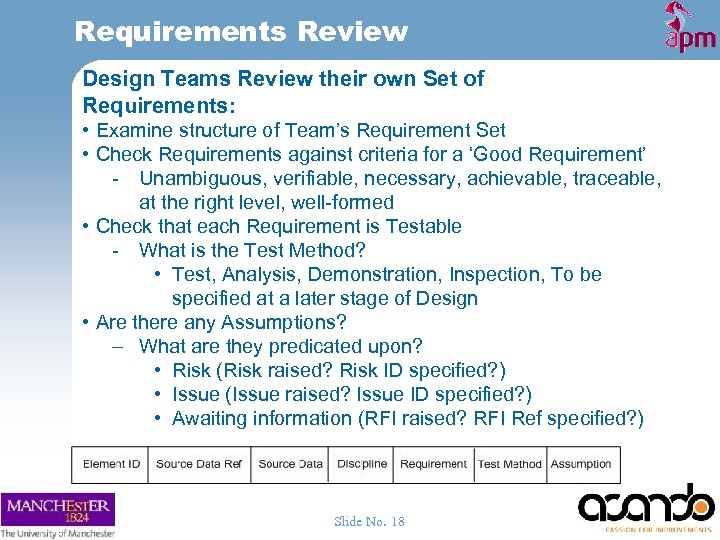 Requirements Review Design Teams Review their own Set of Requirements: • Examine structure of Team’s Requirement Set • Check Requirements against criteria for a ‘Good Requirement’ - Unambiguous, verifiable, necessary, achievable, traceable, at the right level, well-formed • Check that each Requirement is Testable - What is the Test Method? • Test, Analysis, Demonstration, Inspection, To be specified at a later stage of Design • Are there any Assumptions? – What are they predicated upon? • Risk (Risk raised? Risk ID specified? ) • Issue (Issue raised? Issue ID specified? ) • Awaiting information (RFI raised? RFI Ref specified? ) Slide No. 18
 Design and Verification Argument Review Disciplinary, Inter-Disciplinary, and Stakeholder Requirements and Satisfaction Argument • Perform Reviews: – – Disciplinary => Requirements + Satisfaction Arguments Inter-Disciplinary => Requirements Promoter Review Stakeholder => Requirements Review the Design Verification Arguments (DVAs) + the Design • Perform Reviews: – Discipline Reviews – Inter-Disciplinary Reviews – Promoter Review – Stakeholder Review of Requirements – Create a System Baseline Set of Requirements Update the DVAs and/or Requirements and the Design according to comments Slide No. 19
 Requirements Management - System engineering and management System Engineering Structures and processes Important for Requirements Manager to work with other process managers to: • Understand how other processes interact with Requirements Management process − Liaison with managers of key areas (Risk, Change Control) − Integration of processes − Determine data required to manage other processes − Establish specific data to be managed in DOORS • Structures – Schema • Organisation of Requirements • Attributes of Requirements Slide No. 20
 Key Project Support Processes • • Requirements Management Assumptions Management Change Control Risk Management Issue Management Legal Process Environmental Management process Slide No. 21
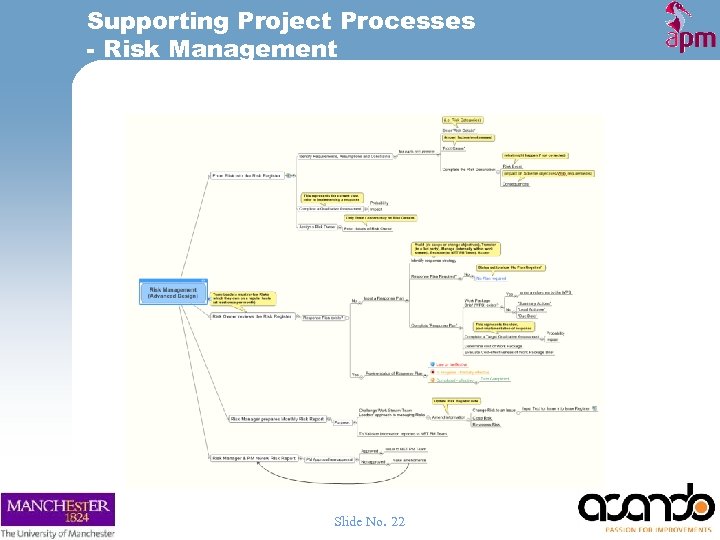 Supporting Project Processes - Risk Management Slide No. 22
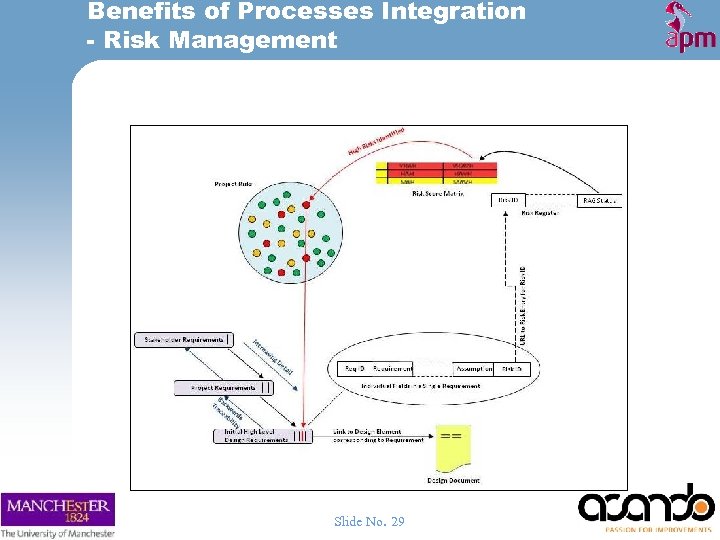
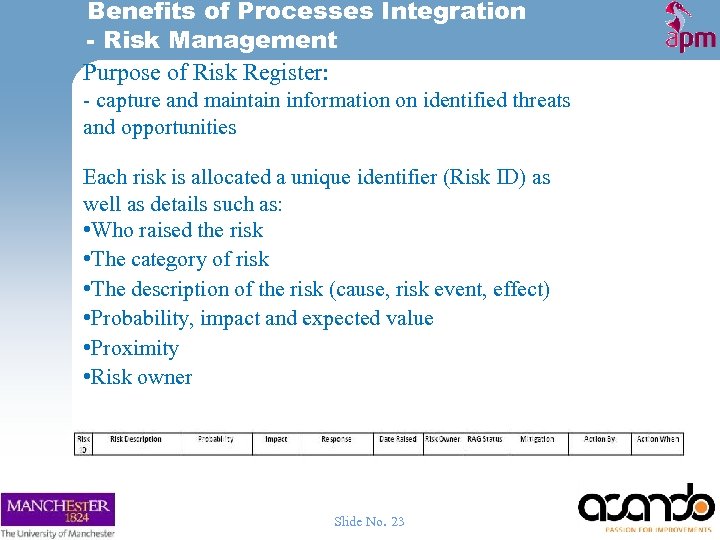 Benefits of Processes Integration - Risk Management Purpose of Risk Register: - capture and maintain information on identified threats and opportunities Each risk is allocated a unique identifier (Risk ID) as well as details such as: • Who raised the risk • The category of risk • The description of the risk (cause, risk event, effect) • Probability, impact and expected value • Proximity • Risk owner Slide No. 23
 Changing Requirements A Requirement may need to be changed if: • An Assumption proves to have been incorrect • Design details indicate that the Requirement: – – cannot be implemented as original thought Alternative design needs a modification to the Requirement Change Control process used to: • Manage changes to Design and/or Requirements – – If Requirement part of set that has not yet been baselined, then manage change locally within Project Team If Requirement part of Baselined set, then refer ‘Change Request’ to Project Review Board for decision about change Slide No. 24
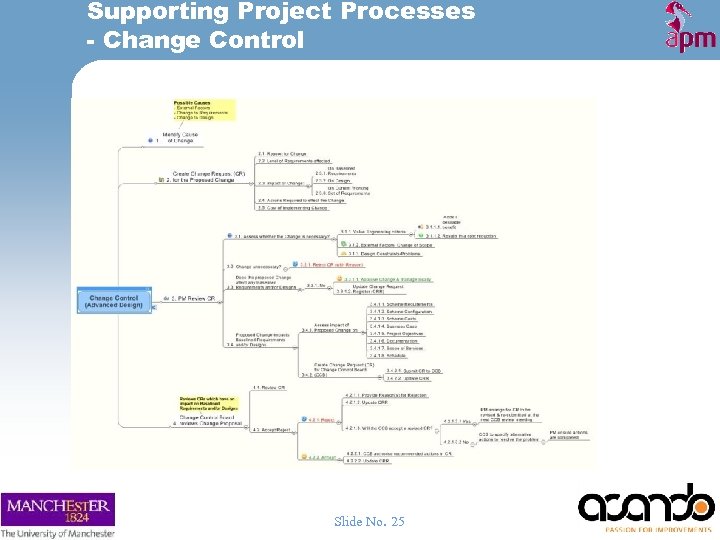 Supporting Project Processes - Change Control Slide No. 25
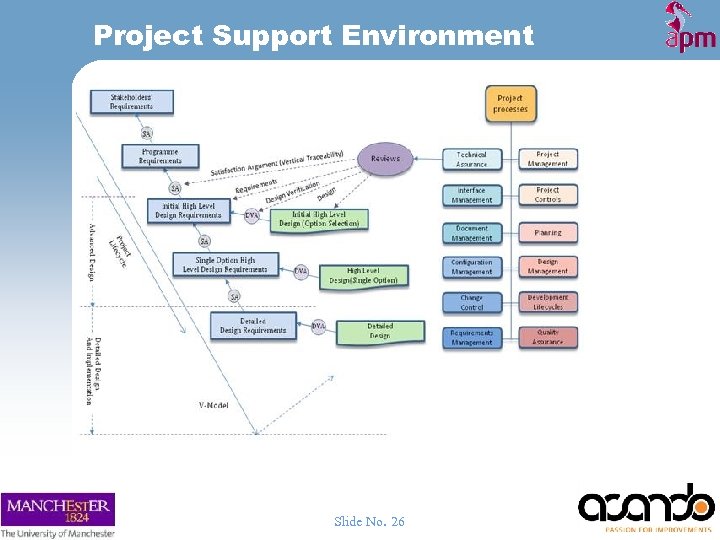 Project Support Environment Slide No. 26
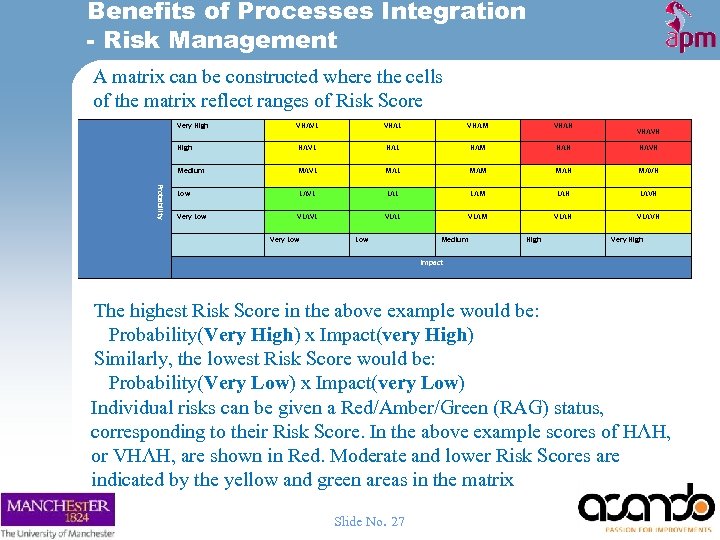 Benefits of Processes Integration - Risk Management A matrix can be constructed where the cells of the matrix reflect ranges of Risk Score VHΛVL VHΛM VHΛH High HΛVL HΛM HΛH HΛVH Medium Probability Very High MΛVL MΛM MΛH MΛVH Low LΛVL LΛM LΛH LΛVH Very Low VLΛVL VLΛM VLΛH VLΛVH Very Low Medium High VHΛVH Very High Impact The highest Risk Score in the above example would be: Probability(Very High) x Impact(very High) Similarly, the lowest Risk Score would be: Probability(Very Low) x Impact(very Low) Individual risks can be given a Red/Amber/Green (RAG) status, corresponding to their Risk Score. In the above example scores of HΛH, or VHΛH, are shown in Red. Moderate and lower Risk Scores are indicated by the yellow and green areas in the matrix Slide No. 27
 Benefits of Processes Integration - Risk Management Enter new risk into the Risk Register Requirements Manager check if any of the existing requirements (in DOORS) are impacted by the risk. • If so, update ‘Risk ID’ attributes of the requirement(s) • Link to the new risk’s Risk ID in the Risk Register A risk can also be identified when a new requirement is created. Initially, some aspects of a new requirement may not be known completely: • An Assumption is raised which is linked to a new (or existing) Risk • The Risk ID attribute in DOORS is linked to the new (or existing) Risk in the Risk Register Slide No. 28
 Benefits of Processes Integration - Risk Management Slide No. 29
 Managing Commercial and Legal Requirements Slide No. 30
 Whole Life Cycle Considerations Slide No. 31
 Benefits of Reqs-driven Design Benefits of the Requirements Driven Approach: • The Design evolves thoroughly from the Stakeholder Requirements • The Design Brief will be clear, and the Design will require no iteration • Large teams of Engineers will not be tied into the Design Phase for extended periods • There is full, auditable traceability through the requirements hierarchy and to every element of each level of design • Early Acquirer/Stakeholder visibility of the requirements enables changes to be made at that time, rather than later, after months of design reviews, when design changes would require much re-work with corresponding high cost • Project-wide visibility, and use of natural language, promotes better understanding for engineers across all disciplines • Verification evidence at each stage contributes incrementally to the Safety Case Slide No. 32
 Example: Guide to Railway Investment Projects (GRIP) One of key elements for success is good communication • consider using graphical applications (e. g. Mind. Manager) to document processes and process interactions • include contextual help (including DOORS help) • Link through to DOORS and carry out operations directly in DOORS Example of processes integration: • Guide to Railway Investment Projects (GRIP) • Approach is based upon best practice within Network Rail and other industries that undertake major infrastructure projects • Also best practice recommended by major professional bodies including: - the Office of Government Commerce (OGC) - the Association of Project Management • Covers the investment lifecycle from inception through to the postimplementation realisation of benefits Dynamic Map Examples Slide No. 33
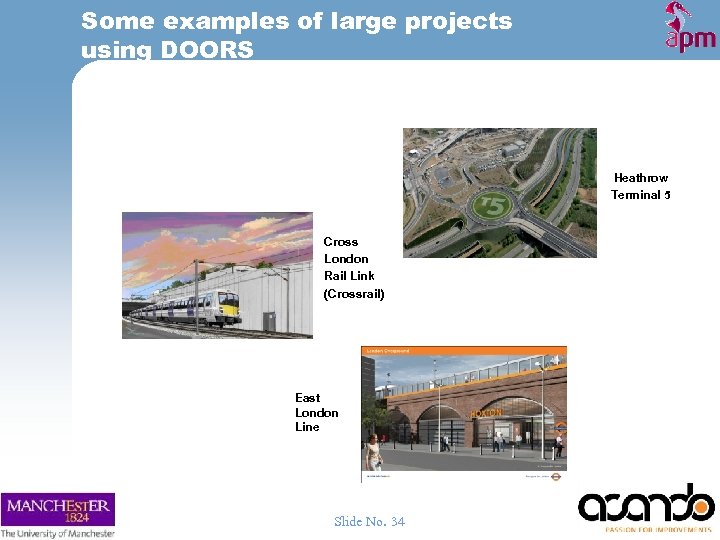 Some examples of large projects using DOORS Heathrow Terminal 5 Cross London Rail Link (Crossrail) East London Line Slide No. 34
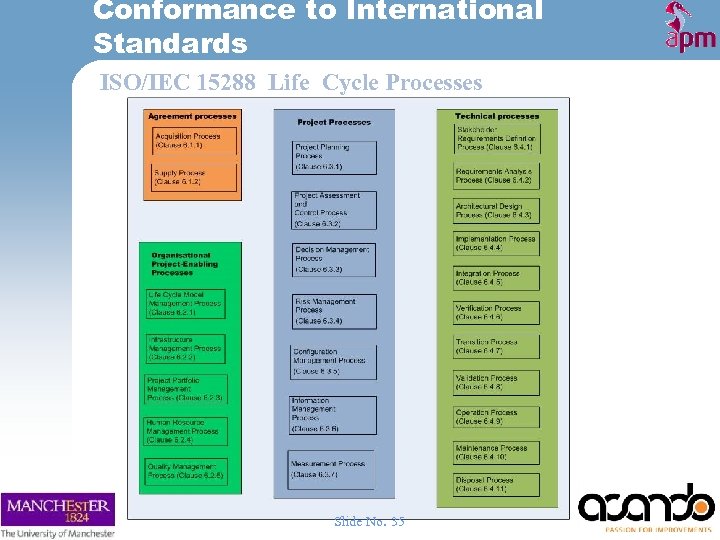 Conformance to International Standards ISO/IEC 15288 Life Cycle Processes Slide No. 35
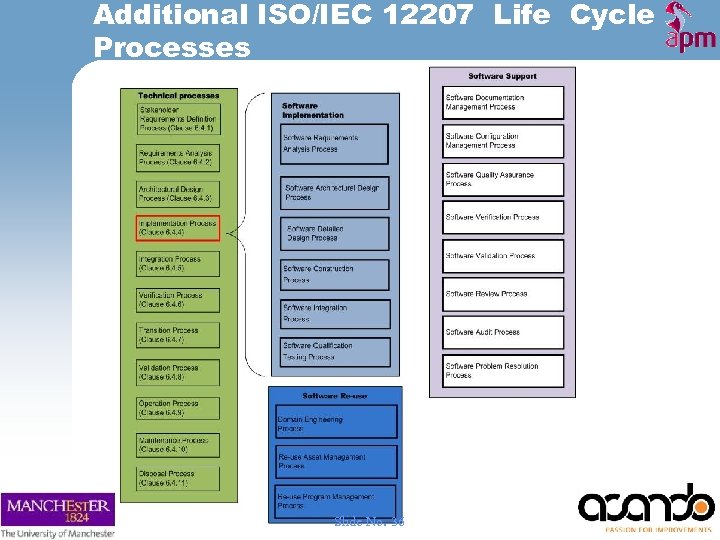 Additional ISO/IEC 12207 Life Cycle Processes Slide No. 36
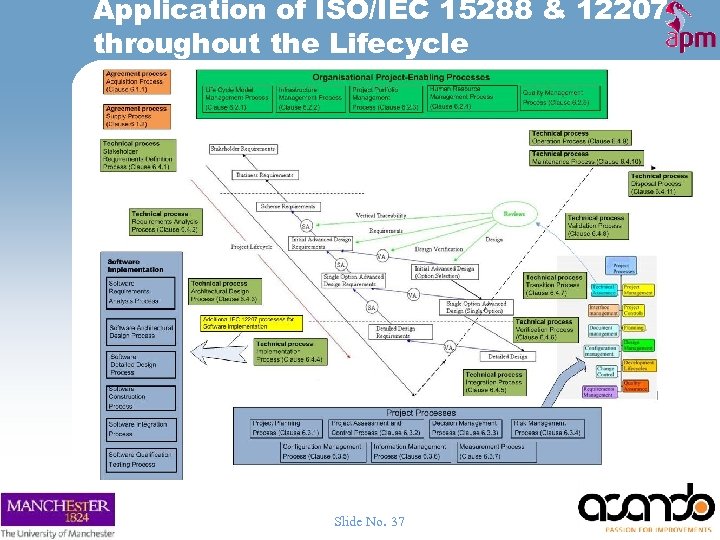 Application of ISO/IEC 15288 & 12207 throughout the Lifecycle Slide No. 37
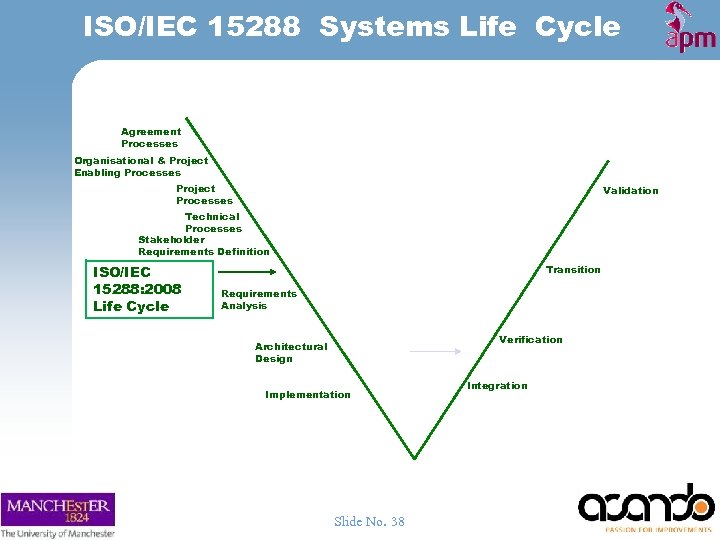 ISO/IEC 15288 Systems Life Cycle Agreement Processes Organisational & Project Enabling Processes Project Processes Validation Technical Processes Stakeholder Requirements Definition ISO/IEC 15288: 2008 Life Cycle Transition Requirements Analysis Verification Architectural Design Implementation Slide No. 38 Integration
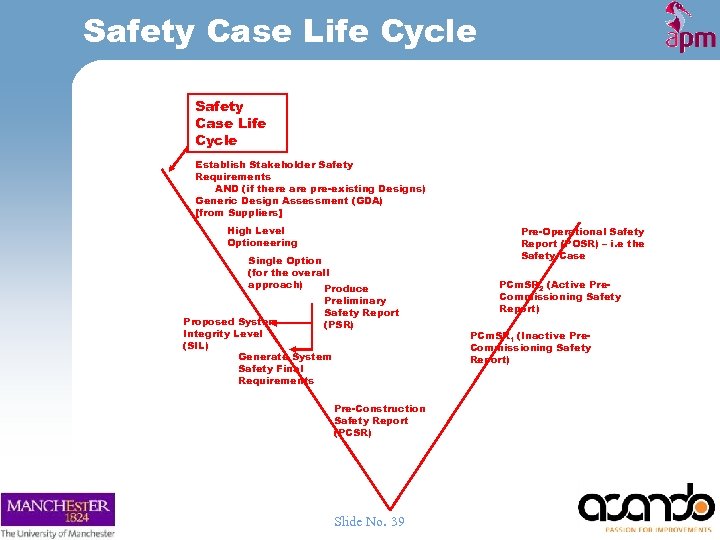 Safety Case Life Cycle Establish Stakeholder Safety Requirements AND (if there are pre-existing Designs) Generic Design Assessment (GDA) [from Suppliers] High Level Optioneering Single Option (for the overall approach) Produce Preliminary Safety Report (PSR) Proposed System Integrity Level (SIL) Generate System Safety Final Requirements Pre-Construction Safety Report (PCSR) Slide No. 39 Pre-Operational Safety Report (POSR) – i. e the Safety Case PCm. SR 2 (Active Pre. Commissioning Safety Report) PCm. SR 1 (Inactive Pre. Commissioning Safety Report)
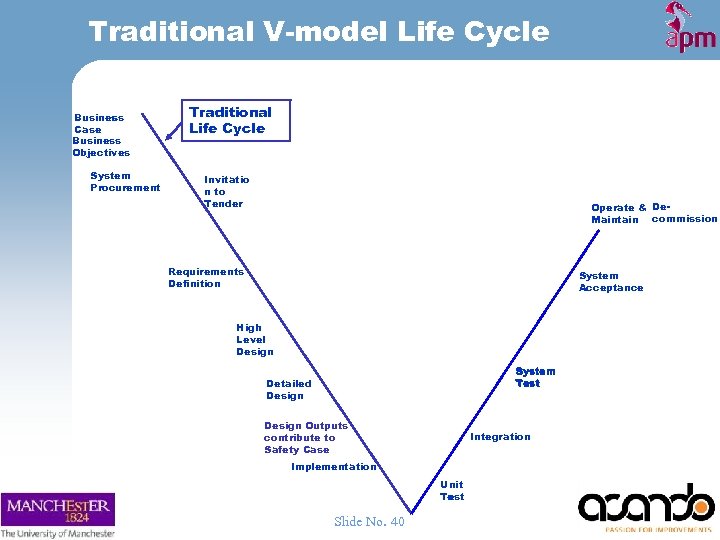 Traditional V-model Life Cycle Business Case Business Objectives System Procurement Traditional Life Cycle Invitatio n to Tender Operate & De. Maintain commission Requirements Definition System Acceptance High Level Design System Test Detailed Design Outputs contribute to Safety Case Integration Implementation Slide No. 40 Unit Test
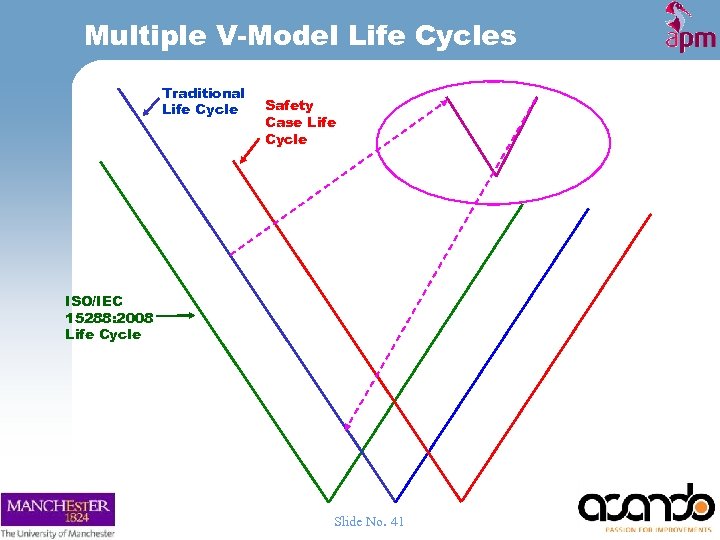 Multiple V-Model Life Cycles Traditional Life Cycle Safety Case Life Cycle ISO/IEC 15288: 2008 Life Cycle Slide No. 41
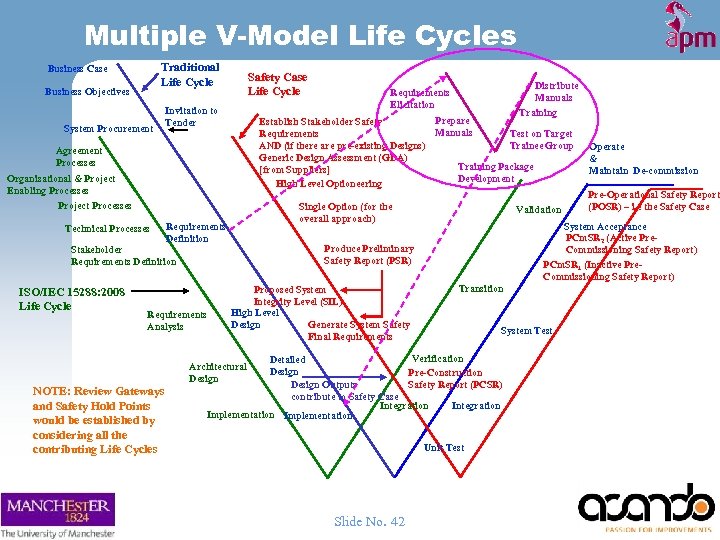 Multiple V-Model Life Cycles Traditional Life Cycle Business Case Business Objectives System Procurement Safety Case Life Cycle Invitation to Tender Prepare Establish Stakeholder Safety Manuals Requirements Test on Target AND (if there are pre-existing Designs) Trainee Group Generic Design Assessment (GDA) Training Package [from Suppliers] Development High Level Optioneering Agreement Processes Organisational & Project Enabling Processes Project Processes Technical Processes Single Option (for the overall approach) Requirements Definition Requirements Analysis Validation Proposed System Integrity Level (SIL) High Level Design Generate System Safety Final Requirements Transition System Test Verification Detailed Design Pre-Construction Design Outputs Safety Report (PCSR) contribute to Safety Case Integration Implementation Architectural Design NOTE: Review Gateways and Safety Hold Points would be established by considering all the contributing Life Cycles Unit Test Slide No. 42 Operate & Maintain De-commission Pre-Operational Safety Report (POSR) – i. e the Safety Case System Acceptance PCm. SR 2 (Active Pre. Commissioning Safety Report) PCm. SR 1 (Inactive Pre. Commissioning Safety Report) Produce Preliminary Safety Report (PSR) Stakeholder Requirements Definition ISO/IEC 15288: 2008 Life Cycle Distribute Manuals Training Requirements Elicitation
 Mechanics of Conformance • Map major deliverables and Gateways onto traditional V-model • Use CAs to merge in the requirements of a standard into the requirements sets at appropriate stages of the development life cycle • Each CA links to clause in standard that has caused the need for a requirement • CA argument states why requirement is necessary, and how it addresses the clause in the standard Slide No. 43
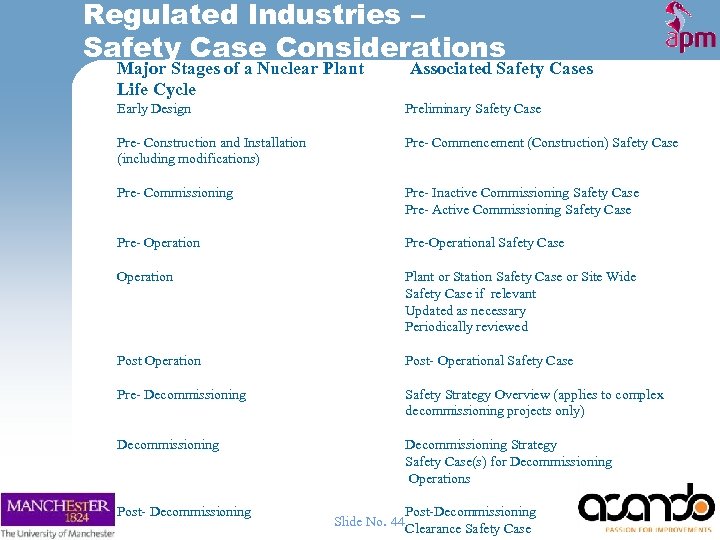 Regulated Industries – Safety Case Considerations Major Stages of a Nuclear Plant Life Cycle Early Design Pre- Construction and Installation (including modifications) Pre- Commissioning Pre- Operation Post Operation Pre- Decommissioning Post- Decommissioning Associated Safety Cases Preliminary Safety Case Pre- Commencement (Construction) Safety Case Pre- Inactive Commissioning Safety Case Pre- Active Commissioning Safety Case Pre-Operational Safety Case Plant or Station Safety Case or Site Wide Safety Case if relevant Updated as necessary Periodically reviewed Post- Operational Safety Case Safety Strategy Overview (applies to complex decommissioning projects only) Decommissioning Strategy Safety Case(s) for Decommissioning Operations Post-Decommissioning Slide No. 44 Clearance Safety Case
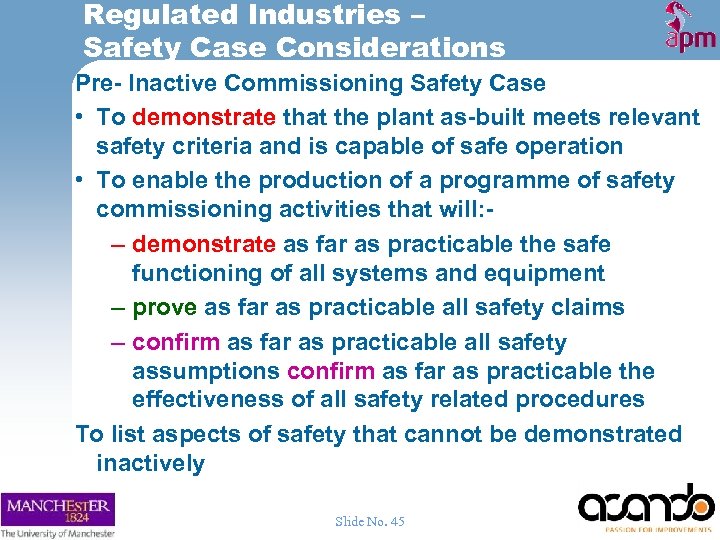 Regulated Industries – Safety Case Considerations Pre- Inactive Commissioning Safety Case • To demonstrate that the plant as-built meets relevant safety criteria and is capable of safe operation • To enable the production of a programme of safety commissioning activities that will: – demonstrate as far as practicable the safe functioning of all systems and equipment – prove as far as practicable all safety claims – confirm as far as practicable all safety assumptions confirm as far as practicable the effectiveness of all safety related procedures To list aspects of safety that cannot be demonstrated inactively Slide No. 45
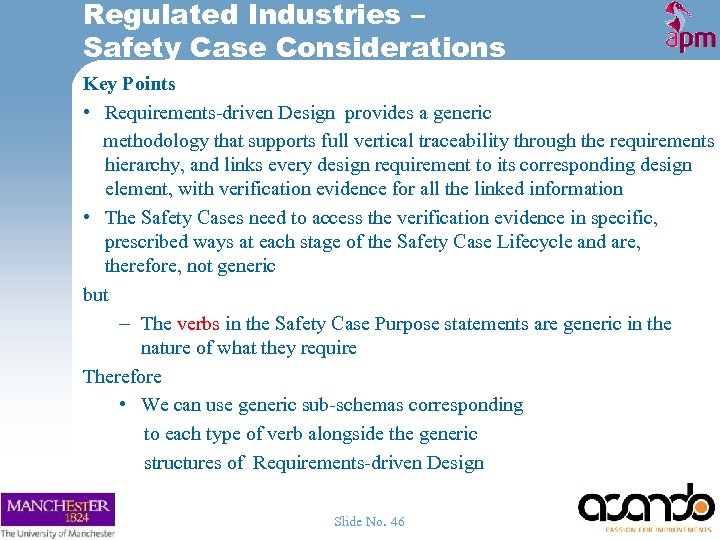 Regulated Industries – Safety Case Considerations Key Points • Requirements-driven Design provides a generic methodology that supports full vertical traceability through the requirements hierarchy, and links every design requirement to its corresponding design element, with verification evidence for all the linked information • The Safety Cases need to access the verification evidence in specific, prescribed ways at each stage of the Safety Case Lifecycle and are, therefore, not generic but – The verbs in the Safety Case Purpose statements are generic in the nature of what they require Therefore • We can use generic sub-schemas corresponding to each type of verb alongside the generic structures of Requirements-driven Design Slide No. 46
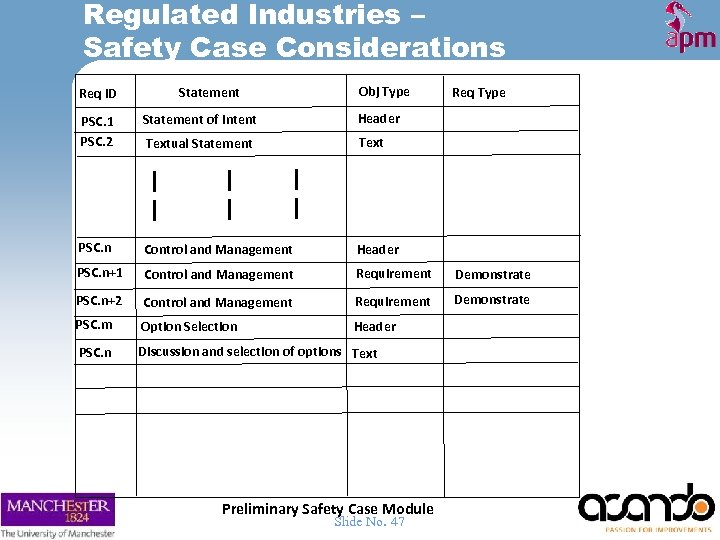 Regulated Industries – Safety Case Considerations PSC. 1 PSC. 2 Obj Type Statement Req ID Statement of Intent Header Textual Statement Req Type Text | | | PSC. n Control and Management Header PSC. n+1 Control and Management Requirement Demonstrate PSC. n+2 Control and Management Requirement Demonstrate PSC. m Option Selection Header PSC. n Discussion and selection of options Text Preliminary Safety Case Module Slide No. 47
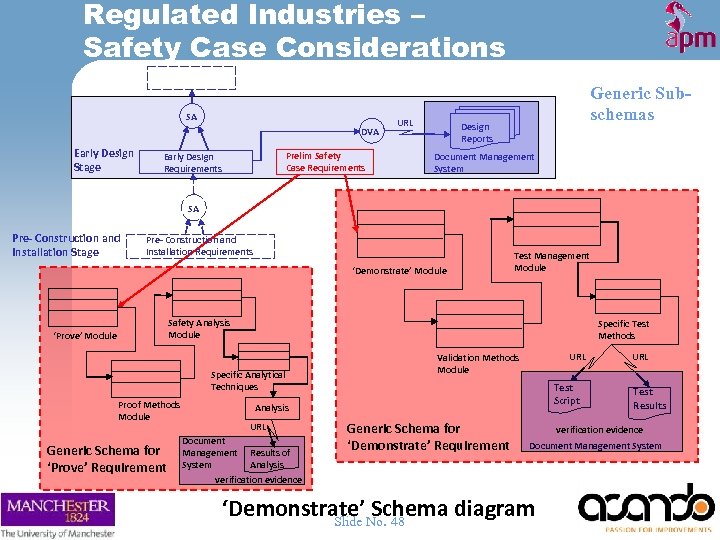 Regulated Industries – Safety Case Considerations SA DVA Early Design Stage Prelim Safety Case Requirements Early Design Requirements URL Generic Subschemas Design Reports Document Management System SA Pre- Construction and Installation Stage Pre- Construction and Installation Requirements ‘Demonstrate’ Module Test Management Module Safety Analysis Module ‘Prove’ Module Specific Test Methods Specific Analytical Techniques Proof Methods Module Generic Schema for ‘Prove’ Requirement URL Validation Methods Module Test Script Analysis URL Document Management System Results of Analysis Generic Schema for ‘Demonstrate’ Requirement URL Test Results verification evidence Document Management System verification evidence ‘Demonstrate’ Schema diagram Slide No. 48
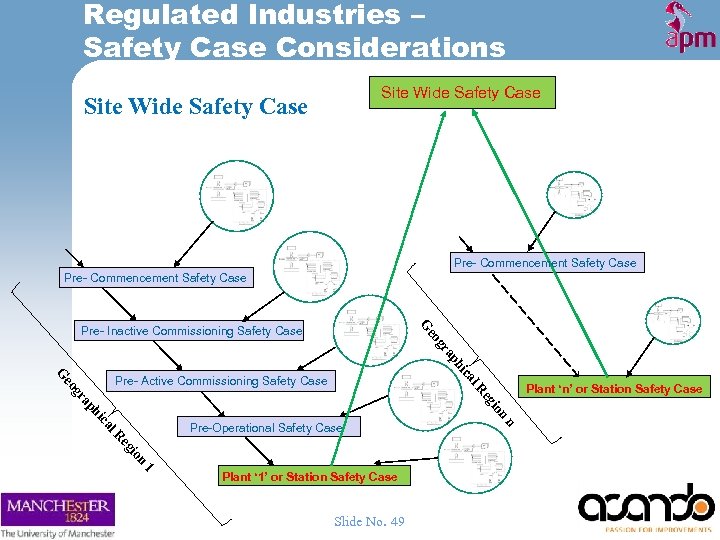 Regulated Industries – Safety Case Considerations Site Wide Safety Case Pre- Commencement Safety Case G Pre- Inactive Commissioning Safety Case l. R ica ph a gr eo G Plant ‘n’ or Station Safety Case n hi ap io eg gr eo Pre- Active Commissioning Safety Case on gi Re 1 Plant ‘ 1’ or Station Safety Case Slide No. 49 n l ca Pre-Operational Safety Case
 Example: Pharma Development Life Cycle Management for the Life Science and Medical Devices Industries Compliance with the Quality System Inspections Technique used by US Food and Drugs Administration (FDA) field inspectors. Inspector usually: • examines the compliance of a single project. • needs confirmation that design inputs were established. • needs to verify that the design elements that are essential to the proper functioning of the device have been identified. • needs to determine if risk analysis was performed. • needs to ensure that changes to requirements were controlled Slide No. 50
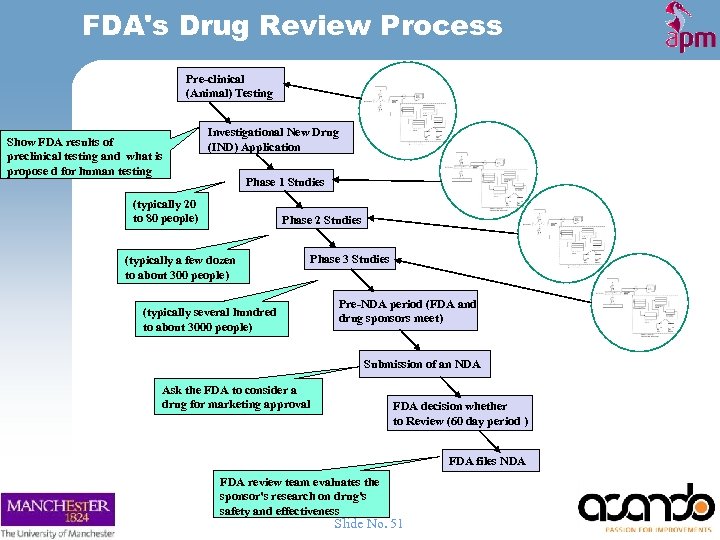 FDA's Drug Review Process Pre-clinical (Animal) Testing Show FDA results of preclinical testing and what is propose d for human testing Investigational New Drug (IND) Application Phase 1 Studies (typically 20 to 80 people) Phase 2 Studies (typically a few dozen to about 300 people) (typically several hundred to about 3000 people) Phase 3 Studies Pre-NDA period (FDA and drug sponsors meet) Submission of an NDA Ask the FDA to consider a drug for marketing approval FDA decision whether to Review (60 day period ) FDA files NDA FDA review team evaluates the sponsor's research on drug's safety and effectiveness Slide No. 51
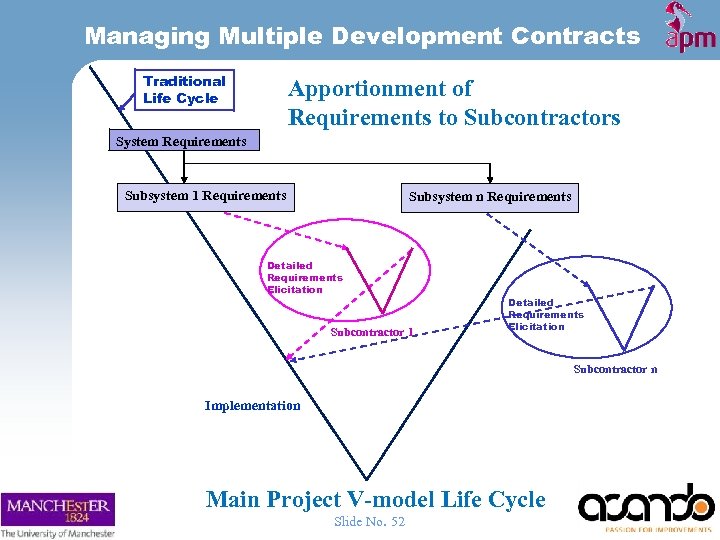 Managing Multiple Development Contracts Traditional Life Cycle Apportionment of Requirements to Subcontractors System Requirements Subsystem 1 Requirements Subsystem n Requirements Detailed Requirements Elicitation Subcontractor 1 Detailed Requirements Elicitation Subcontractor n Implementation Main Project V-model Life Cycle Slide No. 52
 Managing Multiple Development Contracts Access control & remote working capabilities of DOORS can support management of multiple contracts • Sets of requirements can be allocated to, or produced by, various contractors • Sets can be linked to Project Teams’ requirements via SAs • Contractors only given Read Access to Project Teams’ requirements • Subsystems developed & implemented, then tested by Contractors against contracted set of requirements, and test results reviewed by Client • Completed subsystems can be integrated into overall system during the subsystem and system integration phases of life cycle Slide No. 53
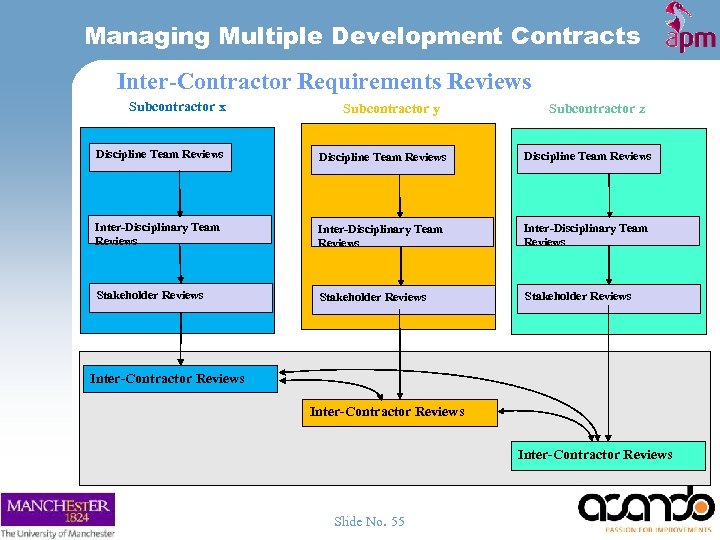 Managing Multiple Development Contracts Inter-Contractor Requirements Reviews Subcontractor x Subcontractor y Subcontractor z Discipline Team Reviews v Discipline Team Reviews Inter-Disciplinary Team Reviews Stakeholder Reviews Inter-Contractor Reviews Slide No. 55
 Information Requirements for Key Decisionmaking Delivering the Desired Benefits • Create the Business Plan – Establish the Desired Benefits – Set the Objectives for delivering the Desired Benefits • Establish the Stakeholder Requirements – Consult with Key Stakeholders and produce the Stakeholder Requirements – Formulate the Benefits-related Business Requirements derived from the Objectives and merge them into the Stakeholders Requirements • Use a Requirements-driven Design approach to produce the desired outcomes and benefits Slide No. 56
 Information Requirements for Key Decisionmaking Providing information for key decision making • Use of Requirements-driven design alone is not sufficient • Internal and external events impact projects and programmes • Need to provide information to key decision-makers which will support the decision-making process – Requires integration of project and programme processes (e. g. Risk Management, Change Control) – Appropriate attendance of key people at reviews – Timely delivery of essential information to key people Slide No. 57
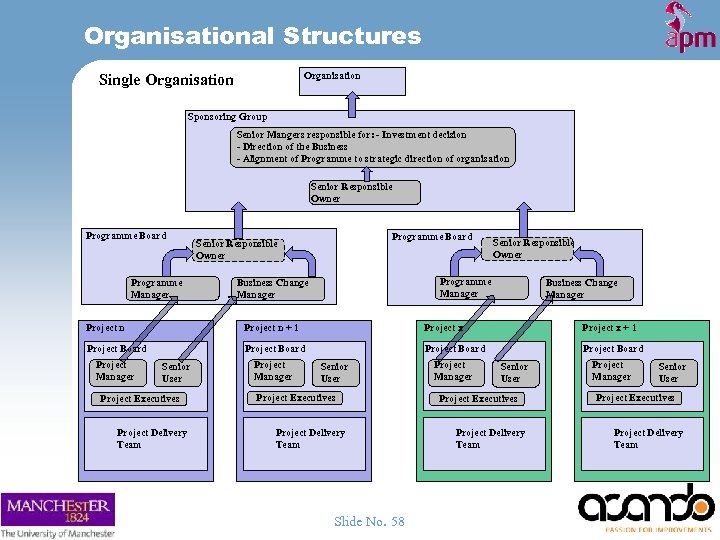 Organisational Structures Single Organisation Sponsoring Group Senior Mangers responsible for: - Investment decision - Direction of the Business - Alignment of Programme to strategic direction of organisation Senior Responsible Owner Programme Board Programme Manager Programme Board Senior Responsible Owner Programme Manager Business Change Manager Project n + 1 Project x + 1 Project Board Project Manager Senior User Project Executives Project Delivery Team Slide No. 58 Project Manager Senior User Project Executives Project Delivery Team
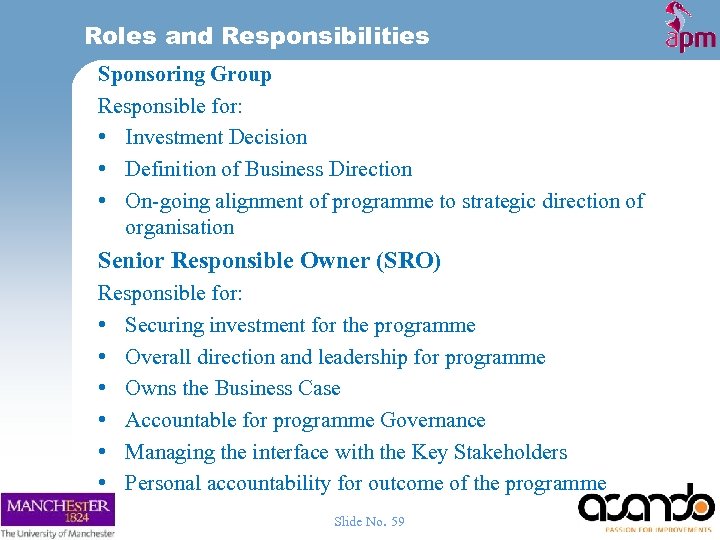 Roles and Responsibilities Sponsoring Group Responsible for: • Investment Decision • Definition of Business Direction • On-going alignment of programme to strategic direction of organisation Senior Responsible Owner (SRO) Responsible for: • Securing investment for the programme • Overall direction and leadership for programme • Owns the Business Case • Accountable for programme Governance • Managing the interface with the Key Stakeholders • Personal accountability for outcome of the programme Slide No. 59
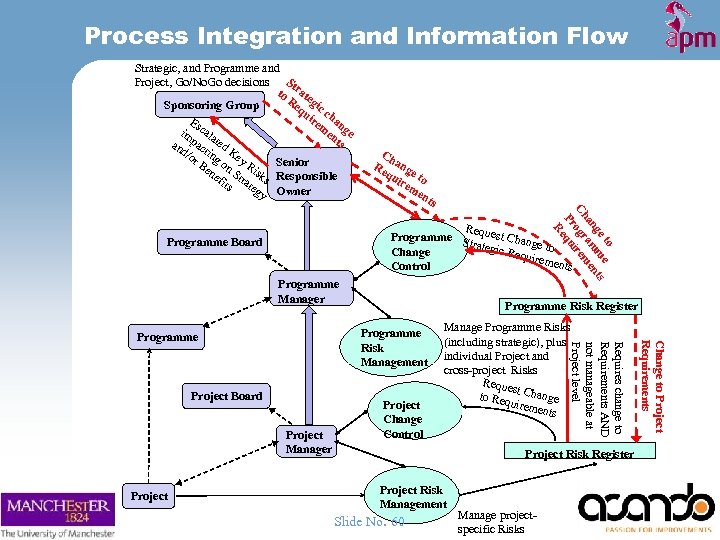 Process Integration and Information Flow Strategic, and Programme and Project, Go/No. Go decisions Str to ate Re gi Sponsoring Group qu c c ire ha Es m nge ca im la en ts an pac ted d/o tin Ke r B g o y R Senior en n S isk efi tra s Responsible ts teg y Owner Ch Re ange qu ire to me nts to e ge m ts an am en Ch ogr irem Pr equ R Req Programme St uest Chang rategi e c Req to Change uirem ents Control Programme Board Programme Manager Project Change Control Project Risk Register Project Risk Management Slide No. 60 Manage projectspecific Risks Change to Project Requirements Project Board Manage Programme Risks (including strategic), plus individual Project and cross-project Risks Reque st to Req Change uirem ents Requires change to Requirements AND not manageable at Project level Programme Risk Management Programme Project Programme Risk Register
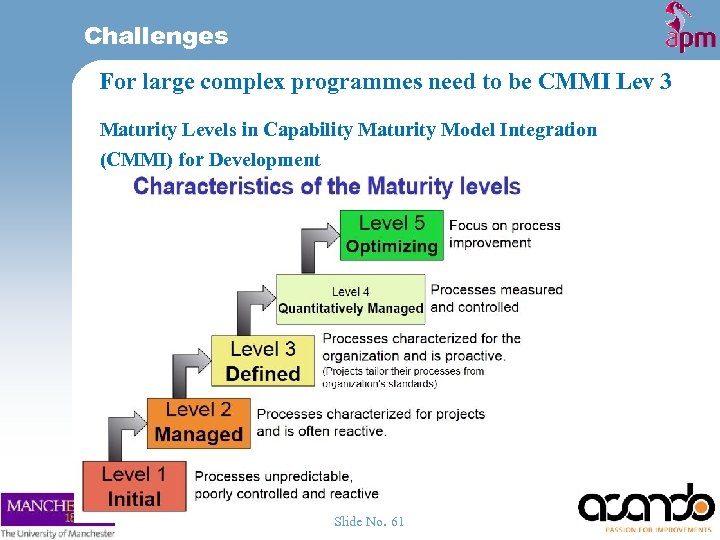 Challenges For large complex programmes need to be CMMI Lev 3 Maturity Levels in Capability Maturity Model Integration (CMMI) for Development Slide No. 61
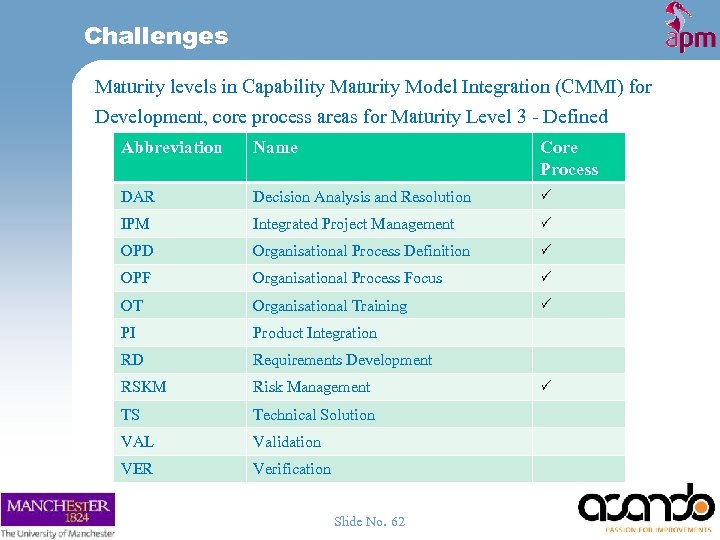 Challenges Maturity levels in Capability Maturity Model Integration (CMMI) for Development, core process areas for Maturity Level 3 - Defined Abbreviation Name Core Process DAR Decision Analysis and Resolution IPM Integrated Project Management OPD Organisational Process Definition OPF Organisational Process Focus OT Organisational Training PI Product Integration RD Requirements Development RSKM Risk Management TS Technical Solution VAL Validation VER Verification Slide No. 62
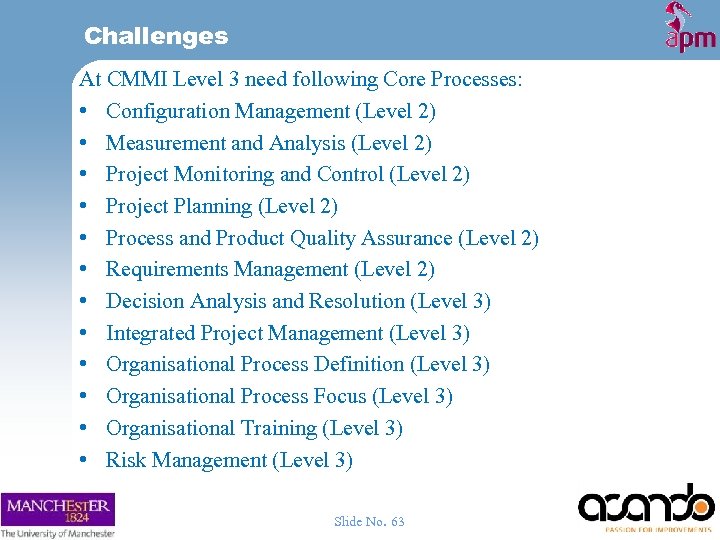 Challenges At CMMI Level 3 need following Core Processes: • Configuration Management (Level 2) • Measurement and Analysis (Level 2) • Project Monitoring and Control (Level 2) • Project Planning (Level 2) • Process and Product Quality Assurance (Level 2) • Requirements Management (Level 2) • Decision Analysis and Resolution (Level 3) • Integrated Project Management (Level 3) • Organisational Process Definition (Level 3) • Organisational Process Focus (Level 3) • Organisational Training (Level 3) • Risk Management (Level 3) Slide No. 63
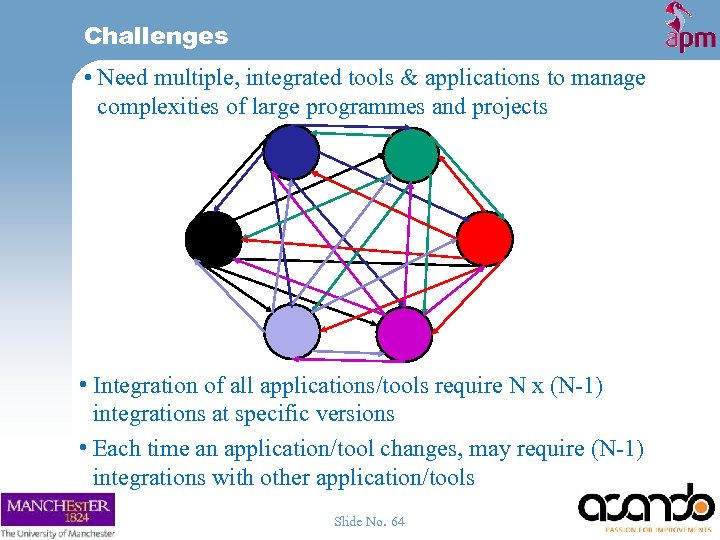 Challenges • Need multiple, integrated tools & applications to manage complexities of large programmes and projects • Integration of all applications/tools require N x (N-1) integrations at specific versions • Each time an application/tool changes, may require (N-1) integrations with other application/tools Slide No. 64
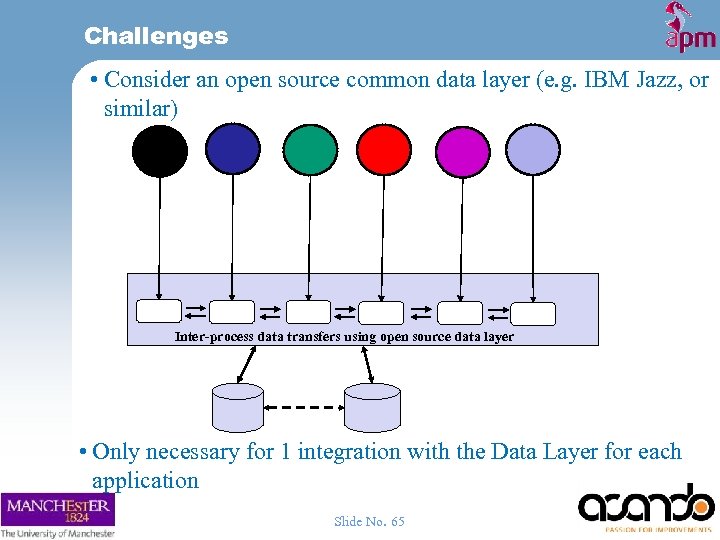 Challenges • Consider an open source common data layer (e. g. IBM Jazz, or similar) Inter-process data transfers using open source data layer • Only necessary for 1 integration with the Data Layer for each application Slide No. 65
 Summary (i) Summary To manage the complexity • A Requirements-driven approach has been described, which provides – A structured, top-down decomposition of the complexity into manageable sizes – Full traceability from the lowest elements of the Design/Implementation, back to the Requirements, and through to compliance documents (standards, etc. ) – Verification mechanisms are an integral part of the mechanisms used in the approach – The Requirements-driven approach is supported by an integrated set of Project processes, which are also tightly coupled to bespoke modules and attributes in the DOORS Database Slide No. 66
 Summary (ii) Three simple principles operate at the heart of this approach: • Specify what you require of the system • Show you will implement it • Provide the evidence to prove that you have produced the system that was required These principles address the initial three questions, are valid for any development, and can be used across all business sectors The Requirements-driven approach is one that attempts to ensure that ‘the right thing is built in the right way’ Slide No. 67
 Summary (iii) Requirements-driven Design alone is not sufficient to ensure the desired outcomes and delver the required benefits Also need: • A robust governance structure • Core processes appropriate for organisations operating at a level > CMMI Level 3 • Integration of Key Processes • Sound delivery mechanisms to ensure that the necessary information reaches the Key Decision Makers in a timely fashion to support strategic decision making • An adequate set of tools and applications to support the management of the complexity of large programmes and projects Slide No. 68
 Summary (iii) The Requirements-driven approach is one that attempts to ensure that ‘the right thing is built in the right way’ ‘Managing Complexity in Large Development Programmes’, series of three articles published in Project Manager Today (March – May 2010) ‘Linking Key Risks to Requirements to Reduce Design Effort’, article published in Project Manager Today (December 2011) APM Bo. K, section 3. 2. 5 Requirements management Rivkin, S, (2010) Managing Complexity in Large Development Programmes, BCS Requirements Engineering Specialist Group Requirements Quarterly: RQ 54: http: //www. resg. org. uk/images/0/0 b/RQ 54. pdf RQ 55: http: //www. resg. org. uk/images/3/35/RQ 55. pdf RQ 56: http: //www. resg. org. uk/images/3/35/RQ 56. pdf Slide No. 69