 Скачать презентацию Managing Client Bandwidth in the Presence of Both
3046751067af70c3d92b0ef9db3e3a3b.ppt
- Количество слайдов: 25



Managing Client Bandwidth in the Presence of Both Real-Time and non Real-Time Network Traffic Maarten Wijnants Wim Lamotte
Outline • Introduction – Need for Bandwidth Management – Real-time vs non real-time network traffic • NIProxy – System Overview – Objectives & Mode of Operation • Client Bandwidth Management • Evaluation – Experimental Setup & Results • Conclusions & Future Work 08/01/2008 COMSWARE 2008 2
Introduction • Increasing incorporation of multimedia content into networked applications – E. g. evolution textual chat to more immersive forms of user communication – Will normally provide user with better experience – However: considerable bandwidth is required to exchange multimedia data over a network • Bandwidth consumption of networked applications has risen substantially – Clients do not always dispose of sufficient downstream bandwidth 08/01/2008 COMSWARE 2008 3
Introduction • Need for client bandwidth management – Should occur both intelligently and effectively – Goal = maximize user experience/satisfaction • Possible approaches – Implement unique solution for each application – Develop reusable solution • Economically more favorable • “Communication middleware” • NIProxy: network intermediary supporting client bandwidth management – Example of communication middleware 08/01/2008 COMSWARE 2008 4
Introduction • Real-time network traffic – Content/media with real-time characteristics – Very sensitive to delay – Needs to be delivered to destination “in time” – Typically continuous, long-lived streams that are transmitted using e. g. UDP • Non real-time network traffic – E. g. file or P 2 P data – Less stringent constraints on its delivery time – Requires reliable and error-free delivery (TCP) – Often bursty and relatively short-lived 08/01/2008 COMSWARE 2008 5
NIProxy • The NIProxy – Network intermediary (a “proxy server”) – Objective = enhance the experience and satisfaction of users of networked applications • Quality of Experience (Qo. E) – Approach = introduce additional awareness or context in the transportation network – Abbreviation for Network Intelligence Proxy 08/01/2008 COMSWARE 2008 6
NIProxy • NIProxy is network- and application aware – Network awareness: knowledge of the current state of the transportation network • Acquired through active network probing • Network-related measurements (e. g. current throughput, latency, packet loss rate, …) – Application awareness: knowledge of the networked application(s) the client is running • Provided by client software – Facilitated by reusable auxiliary library called NILayer • Depends on application’s requirements and its type – Example: relative stream importance 08/01/2008 COMSWARE 2008 7
NIProxy • NIProxy performs Qo. E-optimization through – Automatic and dynamic client downstream bandwidth management – Multimedia service provisioning – Both can exploit NIProxy’s dual awareness • Supported Qo. E-improving mechanisms are complementary & interoperable 08/01/2008 COMSWARE 2008 8
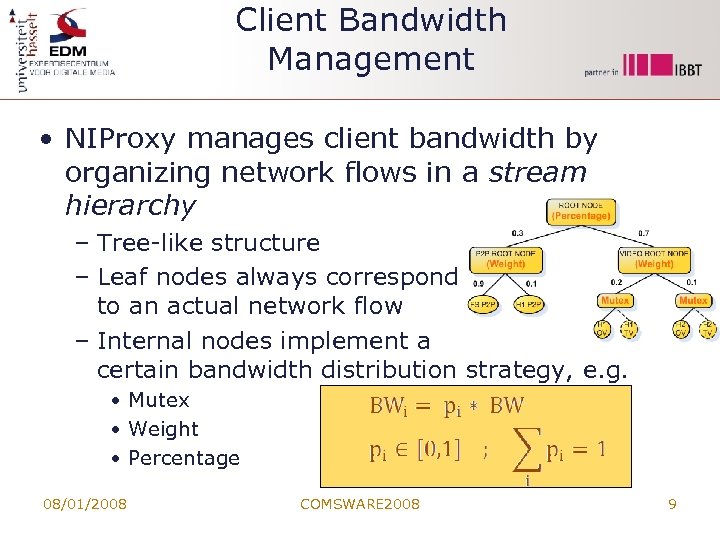
Client Bandwidth Management • NIProxy manages client bandwidth by organizing network flows in a stream hierarchy – Tree-like structure – Leaf nodes always correspond to an actual network flow – Internal nodes implement a certain bandwidth distribution strategy, e. g. • Mutex • Weight • Percentage 08/01/2008 COMSWARE 2008 9
Client Bandwidth Management • Real-time network traffic – Stringent reception delay constraints – Only limited operations are possible • E. g. no mid-stream buffering or reduced-rate transmission • Management by NIProxy through discrete stream hierarchy leaf nodes – Sets the flow's bandwidth consumption to a discrete number of values – Simplest approach: turn network stream on/off – More complex: e. g. scalable network streams 08/01/2008 COMSWARE 2008 10
Client Bandwidth Management • Non real-time network traffic – Less stringent reception delay constraints – Bit more management latitude • Management by NIProxy through continuous stream hierarchy leaf nodes – Capable of setting a flow's transmission rate to a continuous range of values – Operation resembles that of leaky bucket: • Local buffering of content transported by flow • Rate-controlled transmission of buffered data to client 08/01/2008 COMSWARE 2008 11
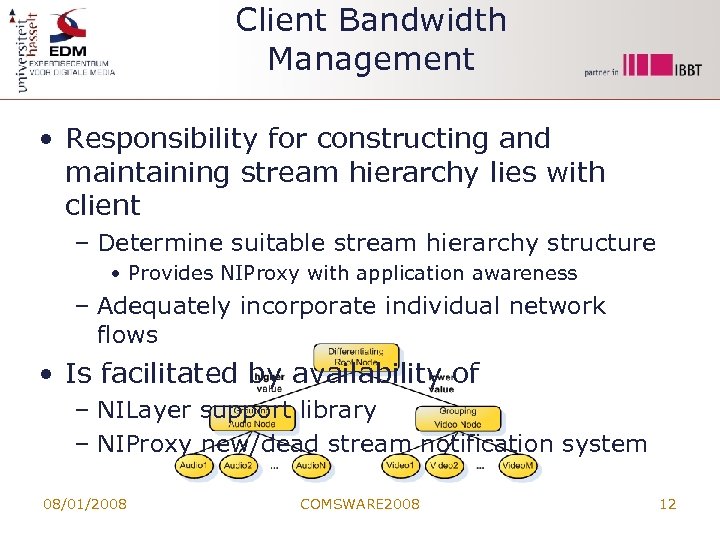
Client Bandwidth Management • Responsibility for constructing and maintaining stream hierarchy lies with client – Determine suitable stream hierarchy structure • Provides NIProxy with application awareness – Adequately incorporate individual network flows • Is facilitated by availability of – NILayer support library – NIProxy new/dead stream notification system 08/01/2008 COMSWARE 2008 12
Client Bandwidth Management • Once stream hierarchy has been constructed, managing client downstream bandwidth = assigning correct amount of bandwidth to hierarchy root node – Internal nodes apportion bandwidth according to their bandwidth distribution technique – Discrete leaf nodes switch to the highest possible discrete bandwidth consumption level – Continuous leaf nodes adjust their tx rate • Process is repeated periodically 08/01/2008 COMSWARE 2008 13
Implementation • At which granularity should the NIProxy manage non real-time network traffic? – Fine-grained: incorporate each individual non real-time content object in stream hierarchy + Allows high & subtle level of control - Frequent updates of stream hierarchy necessary - Calculating client's bandwidth distribution consumes more time due to the increased stream hierarchy size – Coarse: provide support at the level of non real -time network flows • Treat all non real-time data transferred over same flow identically 08/01/2008 COMSWARE 2008 14
Evaluation: Experimental Setup • Networked application allowing user to set up real-time and non real-time network streams with remote hosts – Real-time traffic: video streaming • Most demanding in terms of bandwidth • Transmitted using RTP – Non real-time traffic: P 2 P file sharing • Transmitted using TCP • File sources transmit files sequentially in order of file request reception 08/01/2008 COMSWARE 2008 15
Evaluation: Experimental Results • Validate if NIProxy is capable of managing client bandwidth in presence of both realtime and non real-time network traffic • Approach – Real-time video connection between local client and two remote hosts H 1 and H 2 – Non real-time communication channel between local client and H 1 as well as another remote host representing a dedicated file server (FS) • geom. 3 ds: 484652 bytes; requested from FS • img. png: 23419 bytes; requested from host H 1 08/01/2008 COMSWARE 2008 16
Evaluation: Experimental Results • Additional constraints and requirements – Significance video stream H 1 > H 2 – Priority non real-time connection FS > H 1 – Non real-time communication should receive “fair” amount of the total downstream bandwidth available to the client (i. e. at least 30 percent) • Allows comprehensive demonstration of the capabilities of NIProxy's bandwidth distribution mechanism 08/01/2008 COMSWARE 2008 17
Evaluation: Experimental Results • Experiment was repeated three times – Without including NIProxy – With NIProxy (no video transcoding service) – With NIProxy (with video transcoding service) • Video transcoding service allows NIProxy to reduce bandwidth requirements of video flows • Experiment objectives – Investigate MM experience provided to client – Introduction of NIProxy improves user’s Qo. E? 08/01/2008 COMSWARE 2008 18
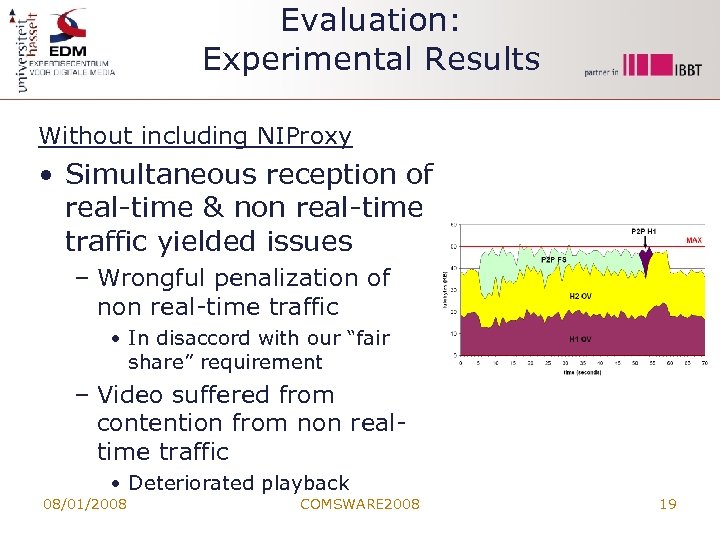
Evaluation: Experimental Results Without including NIProxy • Simultaneous reception of real-time & non real-time traffic yielded issues – Wrongful penalization of non real-time traffic • In disaccord with our “fair share” requirement – Video suffered from contention from non realtime traffic • Deteriorated playback 08/01/2008 COMSWARE 2008 19
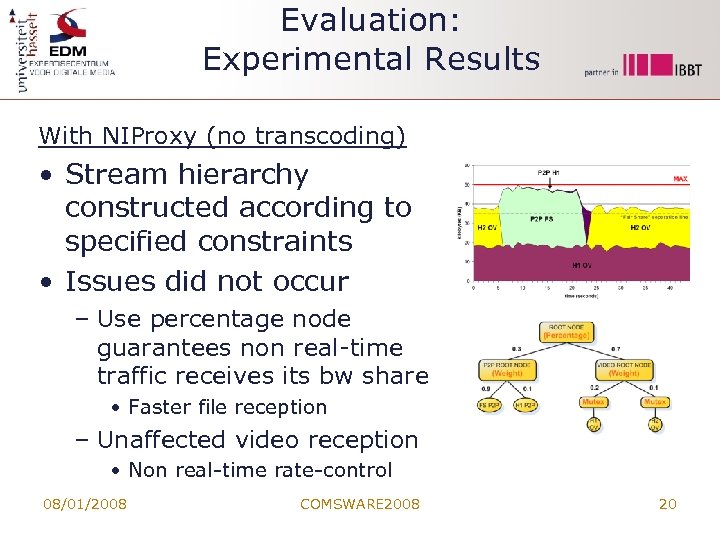
Evaluation: Experimental Results With NIProxy (no transcoding) • Stream hierarchy constructed according to specified constraints • Issues did not occur – Use percentage node guarantees non real-time traffic receives its bw share • Faster file reception – Unaffected video reception • Non real-time rate-control 08/01/2008 COMSWARE 2008 20
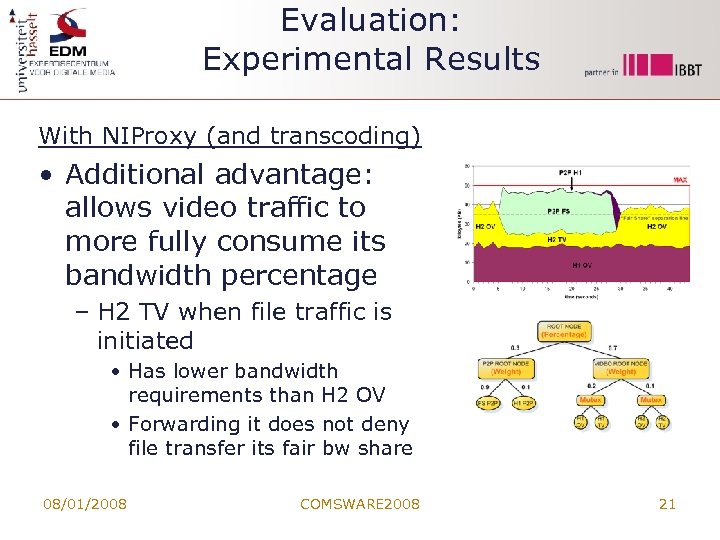
Evaluation: Experimental Results With NIProxy (and transcoding) • Additional advantage: allows video traffic to more fully consume its bandwidth percentage – H 2 TV when file traffic is initiated • Has lower bandwidth requirements than H 2 OV • Forwarding it does not deny file transfer its fair bw share 08/01/2008 COMSWARE 2008 21
Evaluation: Experimental Results • Principal findings – Client bandwidth was distributed correctly over real-time and non real-time network traffic – Allowed fulfillment of postulated requirements with minimal effort • No substantial modifications to client software Incorporation of NIProxy in experiment had positive influence on user's Qo. E • Experiment also illustrates added value of allowing interoperation between NIProxy’s two Qo. E-increasing mechanisms 08/01/2008 COMSWARE 2008 22
Conclusions • Networked applications are increasingly exploiting multimedia content – Client bw management gains in importance • NIProxy: network intermediary aiming to improve user Qo. E – Through incorporating awareness in network – Client bw management & MM service provision • NIProxy is capable of managing client downstream bw in presence of real-time as well as non real-time network traffic 08/01/2008 COMSWARE 2008 23
Future Work • Extend NIProxy’s awareness with knowledge of client terminal and the enduser's preferences • Investigate impact of employing NIProxy to manage client downstream bandwidth in a more realistic networked application – In-house developed NVE application • Supports real-time voice and video chat • Uses non real-time network communication to exchange different types of geometry information (IBR data, 3 D models, textures, …) 08/01/2008 COMSWARE 2008 24
Thank you for your attention! Any questions?
Скачать презентацию Managing Client Bandwidth in the Presence of Both
3046751067af70c3d92b0ef9db3e3a3b.ppt