


 Скачать презентацию Managerial Economics ninth edition Thomas Maurice Chapter 12
7fb163cecd187186b21570323b63cf4d.ppt
- Количество слайдов: 48
 Managerial Economics ninth edition Thomas Maurice Chapter 12 Managerial Decisions for Firms with Market Power Mc. Graw-Hill/Irwin Managerial Economics, 9 e Copyright © 2008 by the Mc. Graw-Hill Companies, Inc. All rights reserved.
 Managerial Economics Market Power • Ability of a firm to raise price without losing all its sales • Any firm that faces downward sloping demand has market power • Gives firm ability to raise price above average cost & earn economic profit (if demand & cost conditions permit) 2
 Managerial Economics Monopoly • Single firm • Produces & sells a good or service for which there are no good substitutes • New firms are prevented from entering market because of a barrier to entry 3
 Managerial Economics Measurement of Market Power • Degree of market power inversely related to price elasticity of demand • The less elastic the firm’s demand, the greater its degree of market power • The fewer close substitutes for a firm’s product, the smaller the elasticity of demand (in absolute value) & the greater the firm’s market power • When demand is perfectly elastic (demand is horizontal), the firm has no market power 4
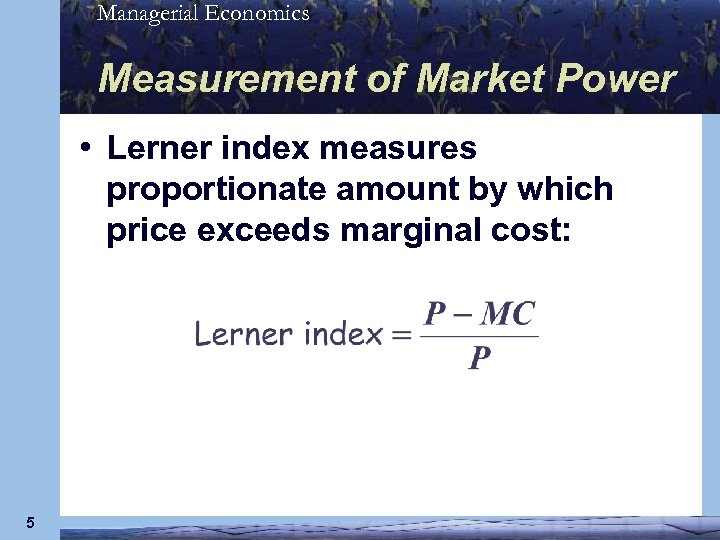 Managerial Economics Measurement of Market Power • Lerner index measures proportionate amount by which price exceeds marginal cost: 5
 Managerial Economics Measurement of Market Power • Lerner index • Equals zero under perfect competition • Increases as market power increases • Also equals – 1/E, which shows that the index (& market power), vary inversely with elasticity • The lower the elasticity of demand (absolute value), the greater the index & the degree of market power 6
 Managerial Economics Measurement of Market Power • If consumers view two goods as substitutes, cross-price elasticity of demand (EXY) is positive • The higher the positive cross-price elasticity, the greater the substitutability between two goods, & the smaller the degree of market power for the two firms 7
 Managerial Economics Determinants of Market Power • Entry of new firms into a market erodes market power of existing firms by increasing the number of substitutes • A firm can possess a high degree of market power only when strong barriers to entry exist • Conditions that make it difficult for new firms to enter a market in which economic profits are being earned 8
 Managerial Economics Common Entry Barriers • Economies of scale • When long-run average cost declines over a wide range of output relative to demand for the product, there may not be room for another large producer to enter market • Barriers created by government • Licenses, exclusive franchises 9
 Managerial Economics Common Entry Barriers • Input barriers • One firm controls a crucial input in the production process • Brand loyalties • Strong customer allegiance to existing firms may keep new firms from finding enough buyers to make entry worthwhile 10
 Managerial Economics Common Entry Barriers • Consumer lock-in • Potential entrants can be deterred if they believe high switching costs will keep them from inducing many consumers to change brands • Network externalities • Occur when value of a product increases as more consumers buy & use it • Make it difficult for new firms to enter markets where firms have established a large network of buyers 11
 Managerial Economics Demand & Marginal Revenue for a Monopolist • Market demand curve is the firm’s demand curve • Monopolist must lower price to sell additional units of output • Marginal revenue is less than price for all but the first unit sold • When MR is positive (negative), demand is elastic (inelastic) • For linear demand, MR is also linear, has the same vertical intercept as demand, & is twice as steep 12
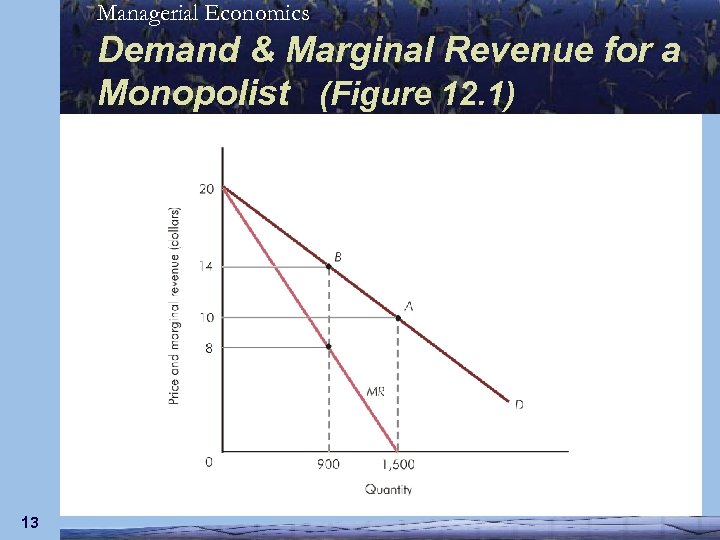 Managerial Economics Demand & Marginal Revenue for a Monopolist (Figure 12. 1) 13
 Managerial Economics Short-Run Profit Maximization for Monopoly • Monopolist will produce a positive output if some price on the demand curve exceeds average variable cost • Profit maximization or loss minimization occurs by producing quantity for which MR = MC 14
 Managerial Economics Short-Run Profit Maximization for Monopoly • If P > ATC, firm makes economic profit • If ATC > P > AVC, firm incurs loss, but continues to produce in short run • If demand falls below AVC at every level of output, firm shuts down & loses only fixed costs 15
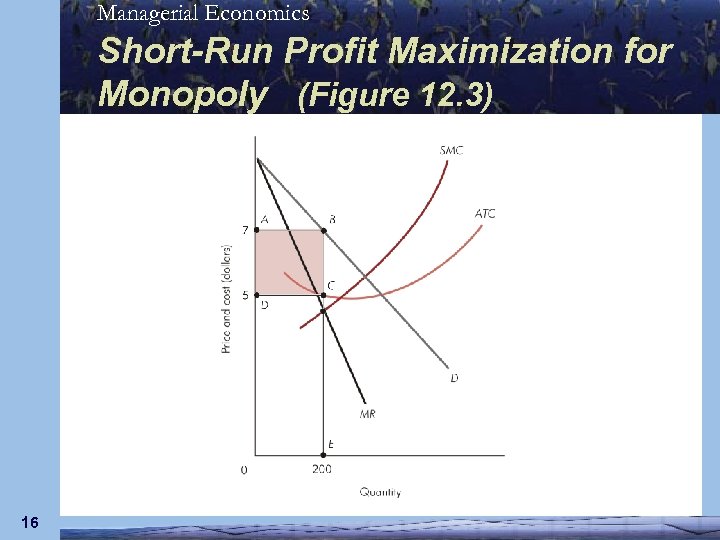 Managerial Economics Short-Run Profit Maximization for Monopoly (Figure 12. 3) 16
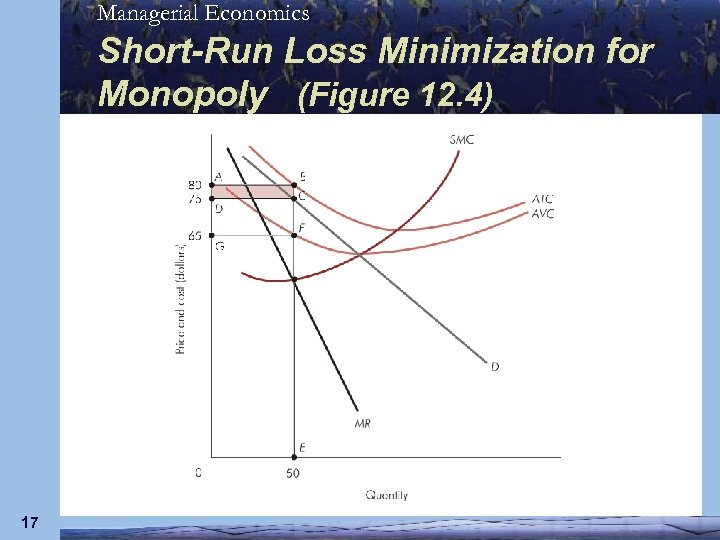 Managerial Economics Short-Run Loss Minimization for Monopoly (Figure 12. 4) 17
 Managerial Economics Long-Run Profit Maximization for Monopoly • Monopolist maximizes profit by choosing to produce output where MR = LMC, as long as P LAC • Will exit industry if P < LAC • Monopolist will adjust plant size to the optimal level • Optimal plant is where the short-run average cost curve is tangent to the longrun average cost at the profit-maximizing output level 18
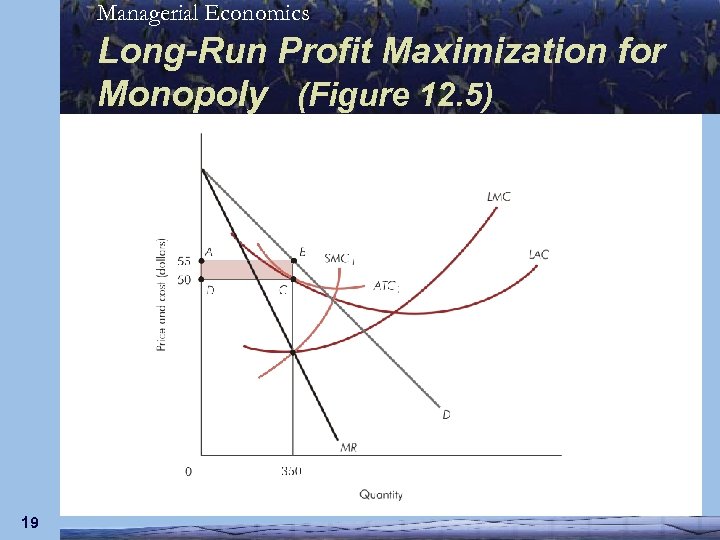 Managerial Economics Long-Run Profit Maximization for Monopoly (Figure 12. 5) 19
 Managerial Economics Profit-Maximizing Input Usage • Profit-maximizing level of input usage produces exactly that level of output that maximizes profit 20
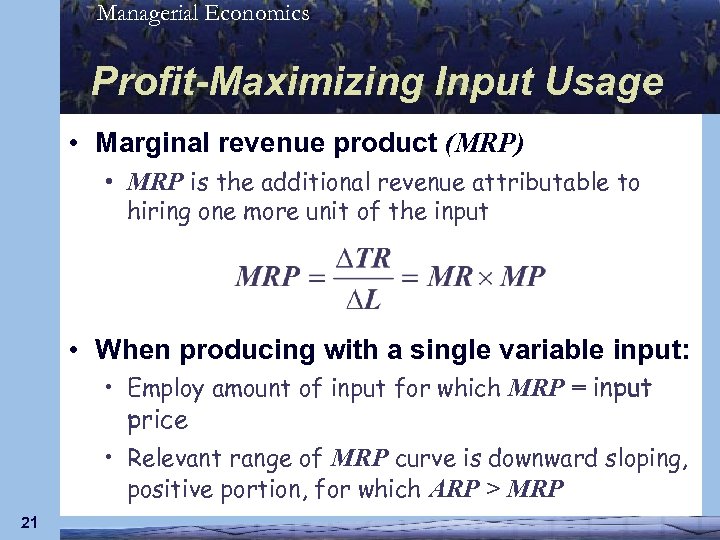 Managerial Economics Profit-Maximizing Input Usage • Marginal revenue product (MRP) • MRP is the additional revenue attributable to hiring one more unit of the input • When producing with a single variable input: • Employ amount of input for which MRP = input price • Relevant range of MRP curve is downward sloping, positive portion, for which ARP > MRP 21
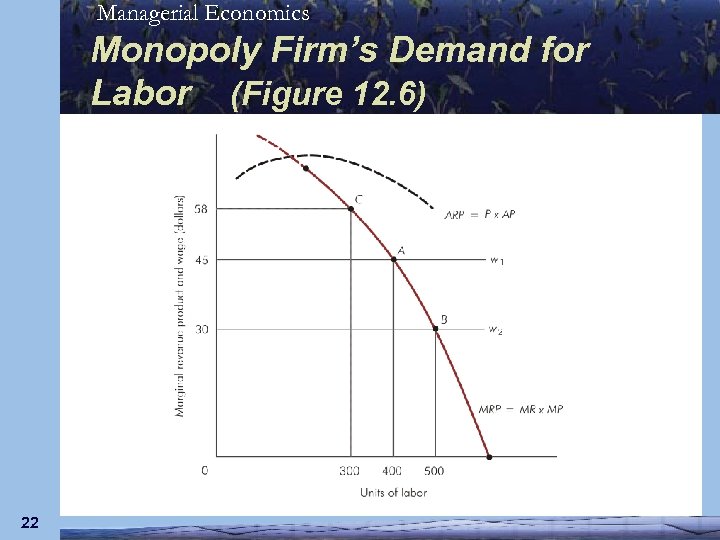 Managerial Economics Monopoly Firm’s Demand for Labor (Figure 12. 6) 22
 Managerial Economics Profit-Maximizing Input Usage • For a firm with market power, profit -maximizing conditions MRP = w and MR = MC are equivalent • Whether Q or L is chosen to maximize profit, resulting levels of input usage, output, price, & profit are the same 23
 Managerial Economics Monopolistic Competition • Large number of firms sell a differentiated product • Products are close (not perfect) substitutes • Market is monopolistic • Product differentiation creates a degree of market power • Market is competitive • Large number of firms, easy entry 24
 Managerial Economics Monopolistic Competition • Short-run equilibrium is identical to monopoly • Unrestricted entry/exit leads to long-run equilibrium • Attained when demand curve for each producer is tangent to LAC • At equilibrium output, P = LAC and MR = LMC 25
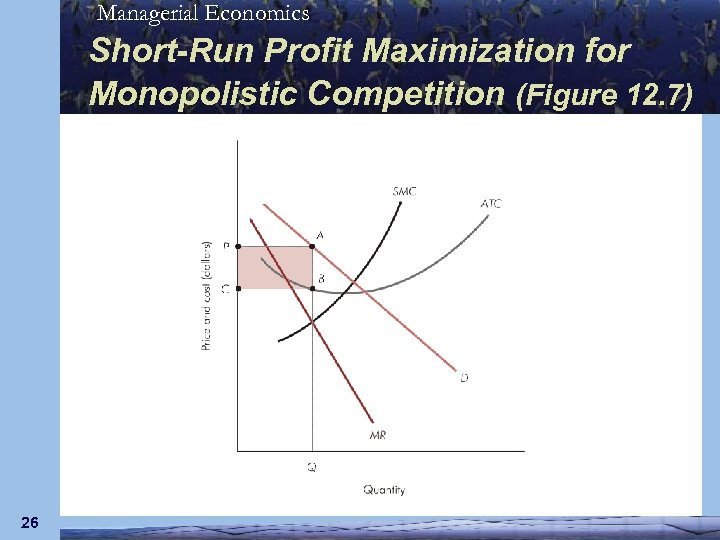 Managerial Economics Short-Run Profit Maximization for Monopolistic Competition (Figure 12. 7) 26
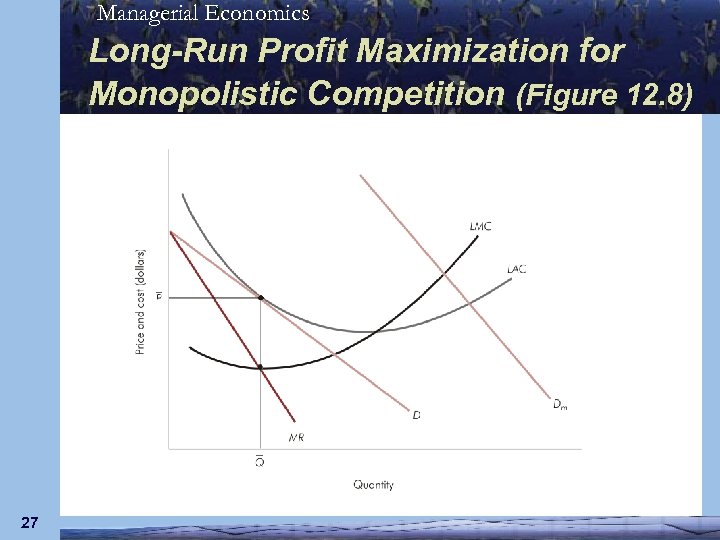 Managerial Economics Long-Run Profit Maximization for Monopolistic Competition (Figure 12. 8) 27
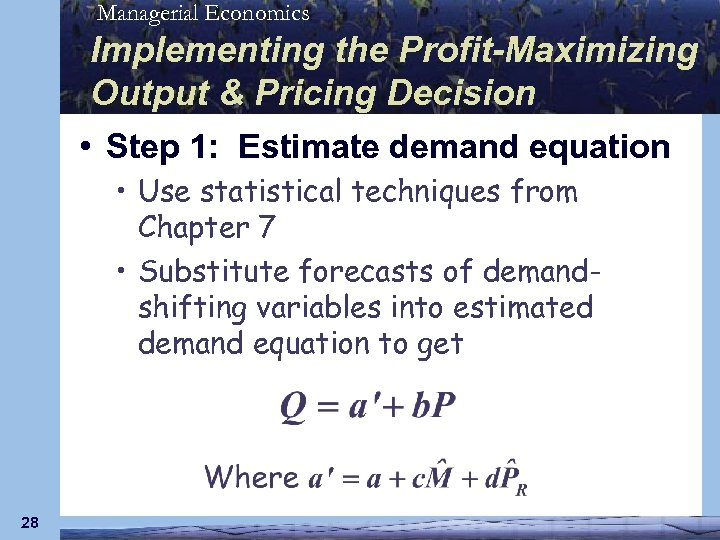 Managerial Economics Implementing the Profit-Maximizing Output & Pricing Decision • Step 1: Estimate demand equation • Use statistical techniques from Chapter 7 • Substitute forecasts of demandshifting variables into estimated demand equation to get 28
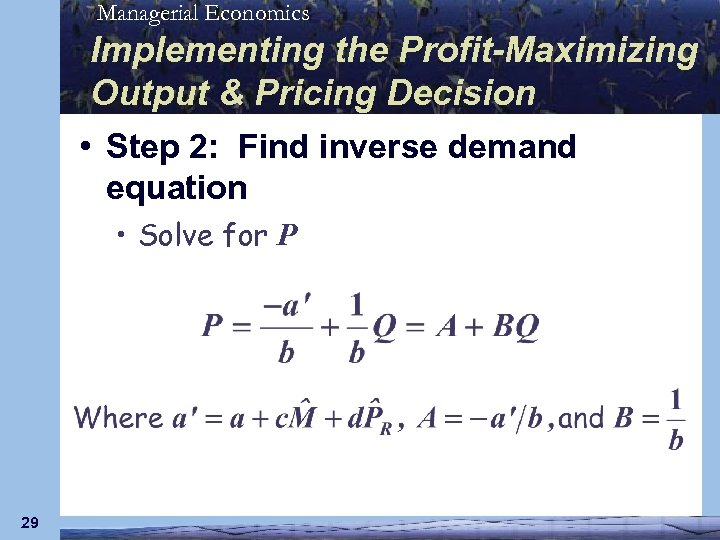 Managerial Economics Implementing the Profit-Maximizing Output & Pricing Decision • Step 2: Find inverse demand equation • Solve for P 29
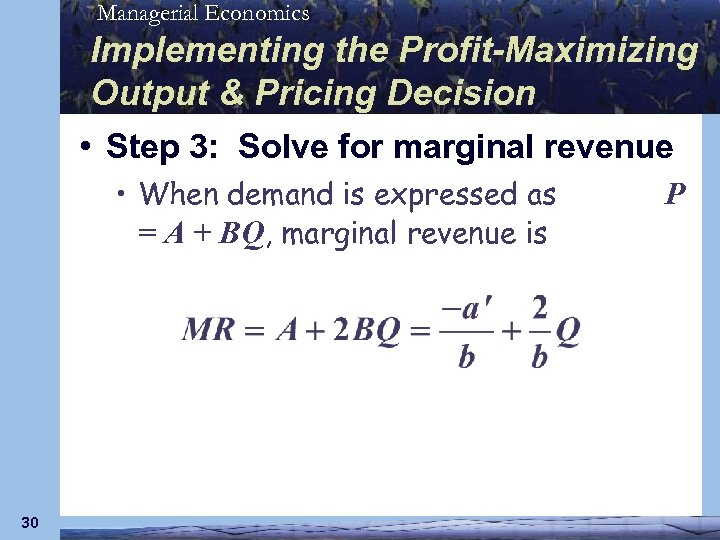 Managerial Economics Implementing the Profit-Maximizing Output & Pricing Decision • Step 3: Solve for marginal revenue • When demand is expressed as = A + BQ, marginal revenue is 30 P
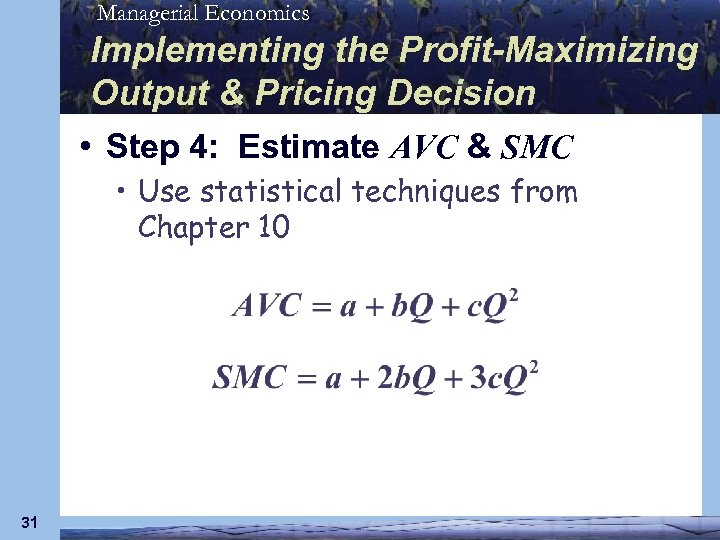 Managerial Economics Implementing the Profit-Maximizing Output & Pricing Decision • Step 4: Estimate AVC & SMC • Use statistical techniques from Chapter 10 31
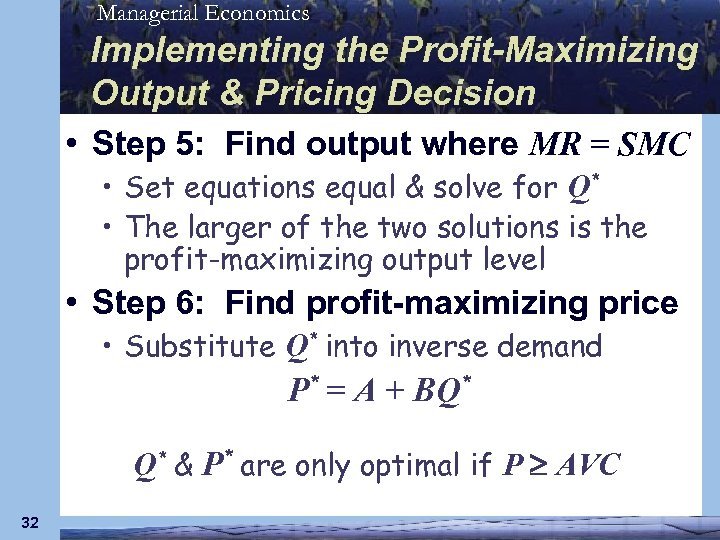 Managerial Economics Implementing the Profit-Maximizing Output & Pricing Decision • Step 5: Find output where MR = SMC • Set equations equal & solve for Q* • The larger of the two solutions is the profit-maximizing output level • Step 6: Find profit-maximizing price • Substitute Q* into inverse demand P* = A + BQ* Q* & P* are only optimal if P AVC 32
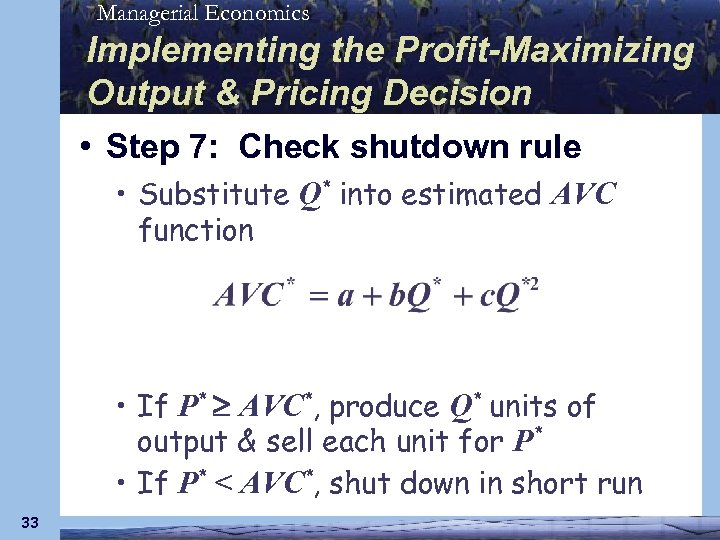 Managerial Economics Implementing the Profit-Maximizing Output & Pricing Decision • Step 7: Check shutdown rule • Substitute Q* into estimated AVC function • If P* AVC*, produce Q* units of output & sell each unit for P* • If P* < AVC*, shut down in short run 33
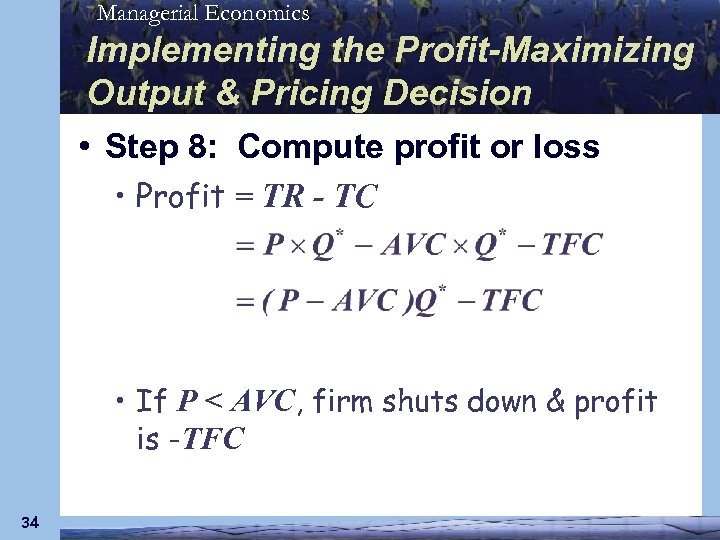 Managerial Economics Implementing the Profit-Maximizing Output & Pricing Decision • Step 8: Compute profit or loss • Profit = TR - TC • If P < AVC, firm shuts down & profit is -TFC 34
 Managerial Economics Maximizing Profit at Aztec Electronics: An Example • Aztec possesses market power via patents • Sells advanced wireless stereo headphones 35
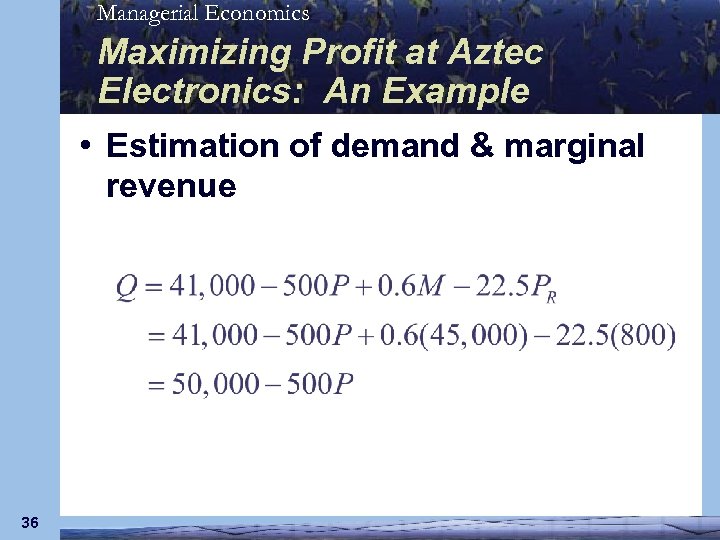 Managerial Economics Maximizing Profit at Aztec Electronics: An Example • Estimation of demand & marginal revenue 36
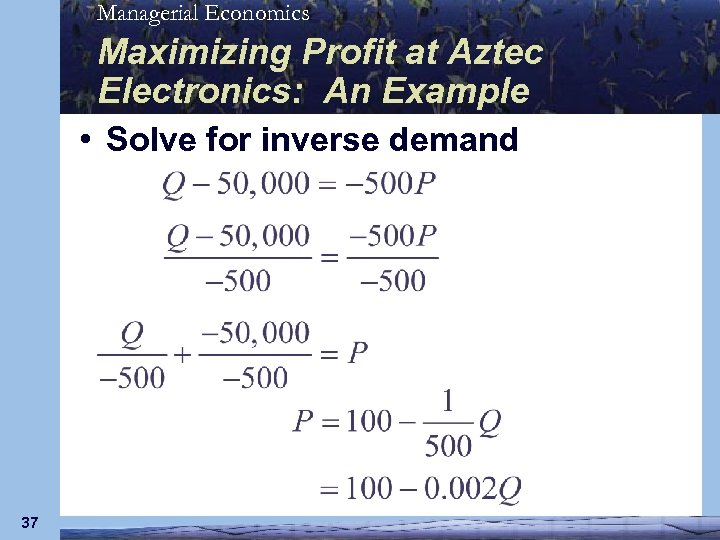 Managerial Economics Maximizing Profit at Aztec Electronics: An Example • Solve for inverse demand 37
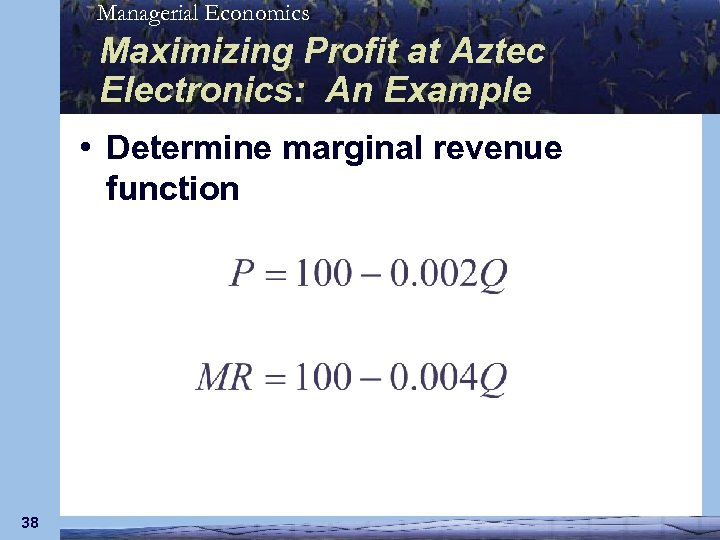 Managerial Economics Maximizing Profit at Aztec Electronics: An Example • Determine marginal revenue function 38
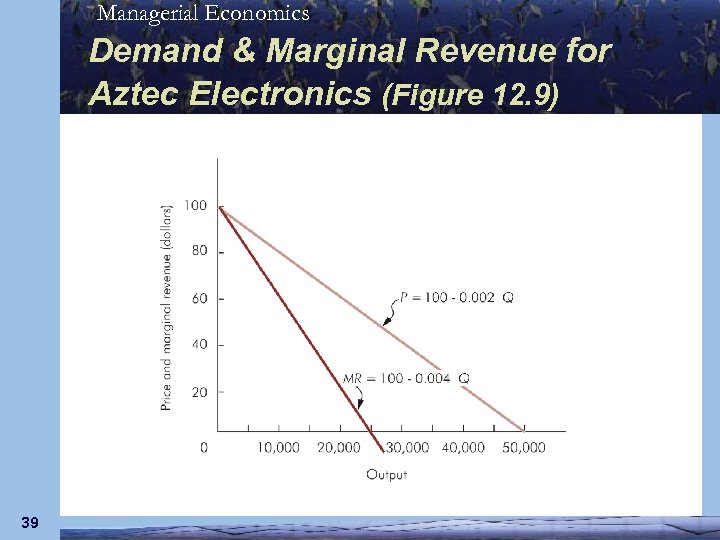 Managerial Economics Demand & Marginal Revenue for Aztec Electronics (Figure 12. 9) 39
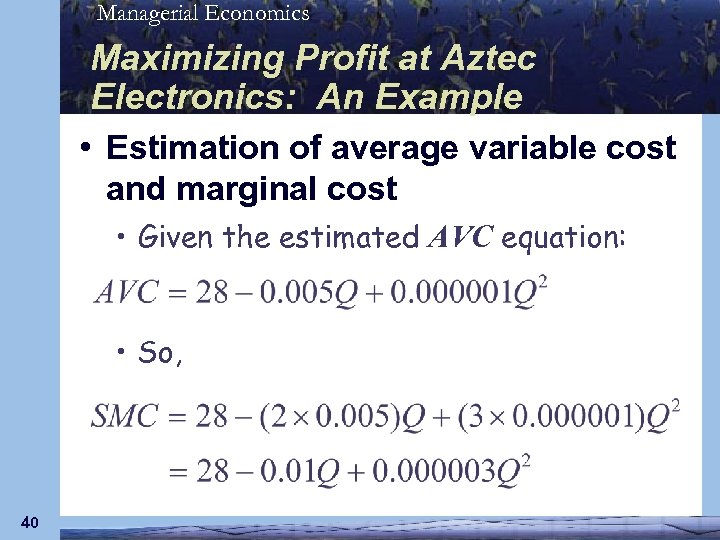 Managerial Economics Maximizing Profit at Aztec Electronics: An Example • Estimation of average variable cost and marginal cost • Given the estimated AVC equation: • So, 40
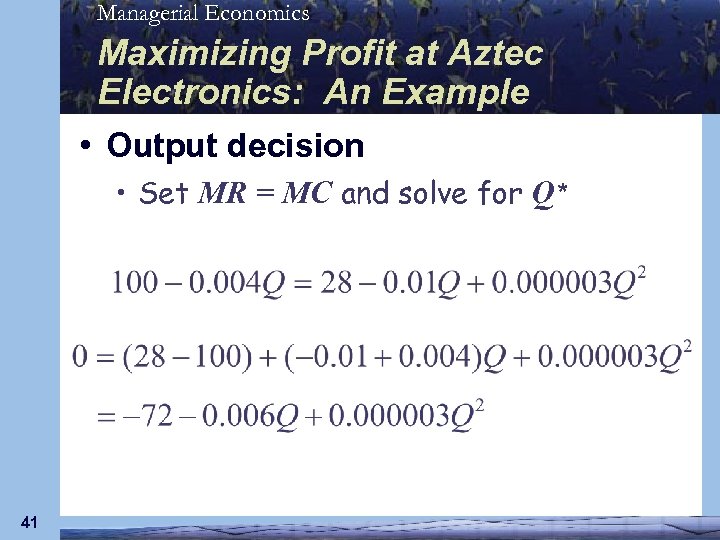 Managerial Economics Maximizing Profit at Aztec Electronics: An Example • Output decision • Set MR = MC and solve for Q* 41
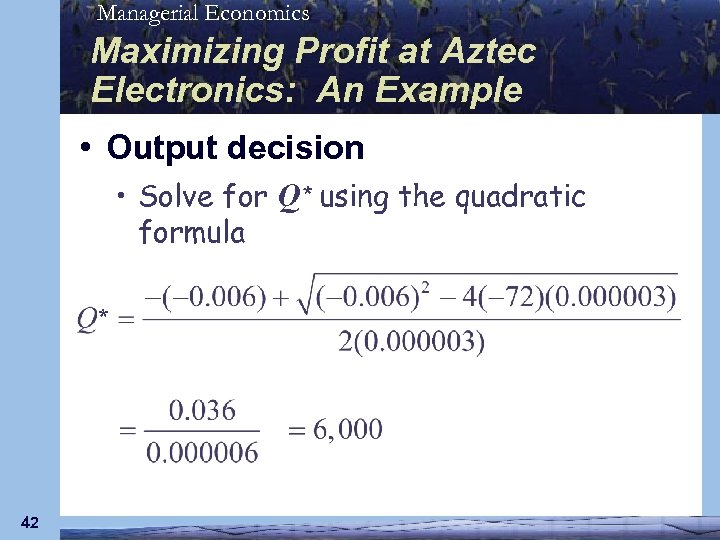 Managerial Economics Maximizing Profit at Aztec Electronics: An Example • Output decision • Solve for Q* using the quadratic formula * 42
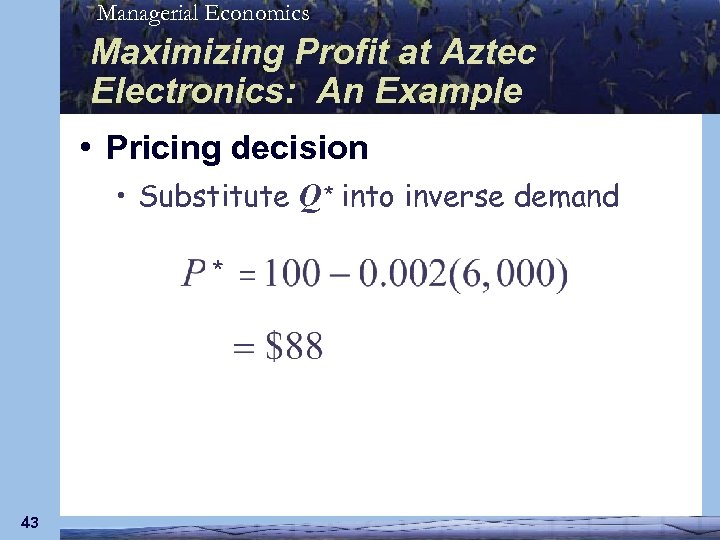 Managerial Economics Maximizing Profit at Aztec Electronics: An Example • Pricing decision • Substitute Q* into inverse demand * 43
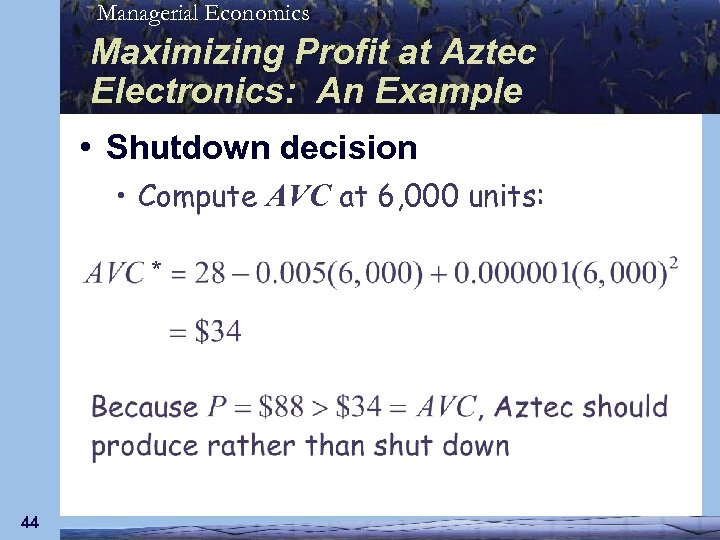 Managerial Economics Maximizing Profit at Aztec Electronics: An Example • Shutdown decision • Compute AVC at 6, 000 units: * 44
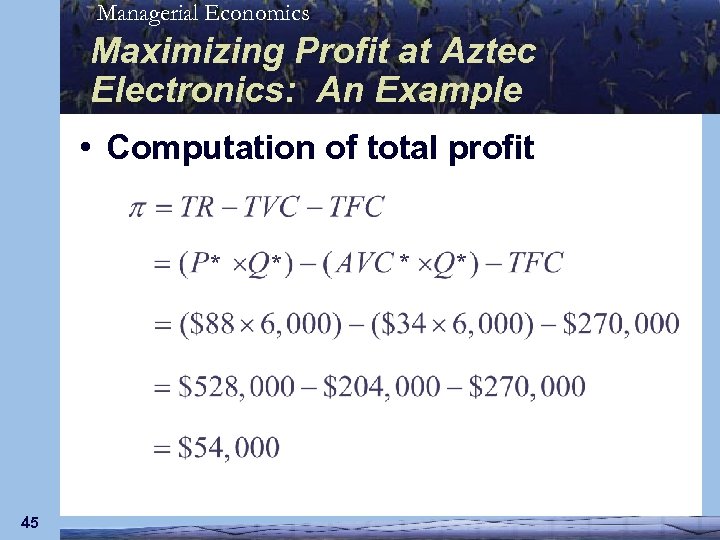 Managerial Economics Maximizing Profit at Aztec Electronics: An Example • Computation of total profit * 45 * * *
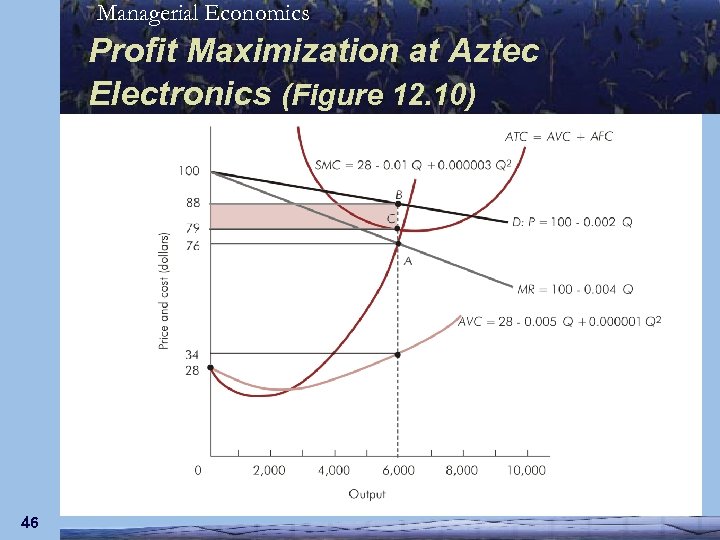 Managerial Economics Profit Maximization at Aztec Electronics (Figure 12. 10) 46
 Managerial Economics Multiple Plants • If a firm produces in 2 plants, A & B • Allocate production so MCA = MCB • Optimal total output is that for which MR = MCT • For profit-maximization, allocate total output so that MR = MCT = MCA = MCB 47
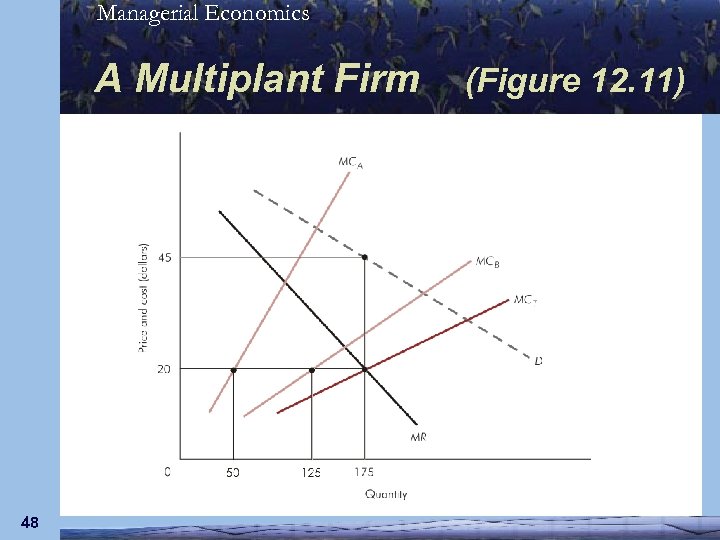 Managerial Economics A Multiplant Firm 48 (Figure 12. 11)