


 Скачать презентацию Managerial Economics Lecture 2 The Market System Mc
c3698710d657b8b666e69fa91640ae1d.ppt
- Количество слайдов: 71
 Managerial Economics Lecture 2: The Market System Mc. Graw-Hill/Irwin Copyright © 2010 by the Mc. Graw-Hill Companies, Inc. All rights reserved.
 Learning Objectives § Demand Supply § The Market Forces of Supply and Demand § Markets and Competition § Market Equilibrium § Price Control § Comparative Static Analysis 1 -2
 Demand Supply 1 -3
 Market Forces of Supply and Demand § A market is made up of two parties- the buyer and the seller. § The buyer represents demand the seller supply. § Supply and Demand are the two words that economists use often. § Supply and Demand are the forces that make market economies work. § They are referred as forces because they act in different ways and cause prices to change. § They determine the quantity of each good produced and the price at which it is sold. 1 -4
 Markets and Competition § Market is a group of sellers and buyers of a particular good or service. § The sellers as a group determine the supply of the product and the buyers as a group that determine the demand for the product. § Markets take many forms. – Sometimes markets are highly organized such as, the markets for auctioning many commodities. – More often markets are less organized such as, the market for perfumes. • Firms manufacturing and selling perfume are varied and seek to offer different products for sale which they hope will be distinctive. 1 -5
 Markets and Competition • The market for perfume, like most market in the economy, is competitive. § Competition exist when two or more firms are rivals. Each firm strives to gain the attention and custom of buyers in the market. § A competitive market is a market in which they are many buyers and many sellers so that each has a negligible impact on the market price. § In the perfume market, sellers may have some limited control over price because of the way they can differentiate their product from competitors. 1 -6
 Markets and Competition § Basically, there are four main types of markets. – Perfect competitive market: In this market, • the goods being offered for sale are all the same (homogenous) • many buyers and sellers and as a result no single buyer or seller can influence the market price. – Monopoly: in this market, there is only one seller and this seller sets the price. – Oligopoly: in this market, there are few sellers that do not always compete aggressively. – Monopolistic competition: it contains many sellers but each offers slightly different product. For example: mobile telephony market. 1 -7
 Demand . 1 -8
 Demand § Demand is the amount of goods and services that a consumer is willing and able to buy at alternative prices at a given period of time. § The quantity demanded of any good is the amount of the good that buyers are willing and able to purchase. § Consumers are willing to buy more when the prices of products and services are low and vice versa. § This relationship between price and quantity demanded is called the law of demand : – All other things being equal, when the price of a good falls the quantity consumers are willing to buy (quantity demanded) rises and the reverse is true. 1 -9
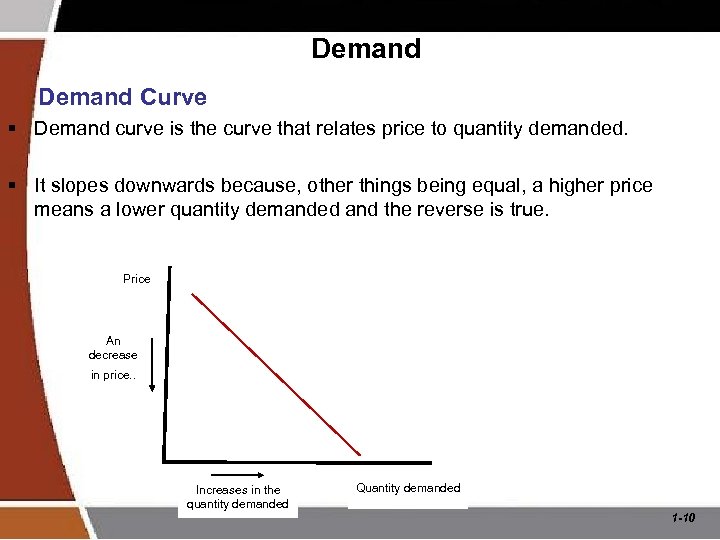 Demand Curve § Demand curve is the curve that relates price to quantity demanded. § It slopes downwards because, other things being equal, a higher price means a lower quantity demanded and the reverse is true. Price An decrease in price. . Increases in the quantity demanded Quantity demanded 1 -10
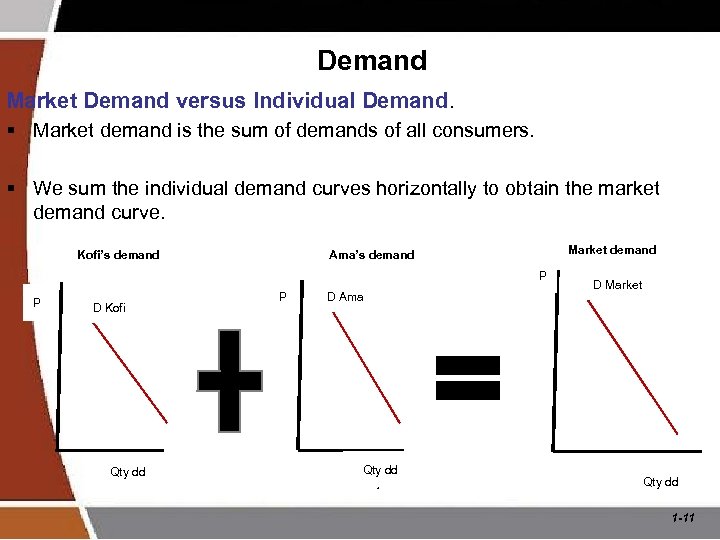 Demand Market Demand versus Individual Demand. § Market demand is the sum of demands of all consumers. § We sum the individual demand curves horizontally to obtain the market demand curve. Market demand Ama’s demand Kofi’s demand P P D Kofi Qty dd P D Ama Qty dd Qty ss D Market Qty dd 1 -11
 Demand Determinants of Demand (Shift In The Demand Curve) § Income – lower incomes mean that people have less to spend in total, so they are likely to spend less on some- and probably most – goods. – if the demand for a good falls when income falls and vice versa, the good is called a normal good. – If the demand for a good rises when income falls and vice versa, the good is called an inferior good. § Prices of related goods- prices of related goods such as substitutes and complements – When a fall in the price of one good reduces the demand for the other and vice versa, the two goods are called substitutes. Example Pepsi and Coca- Cola. 1 -12
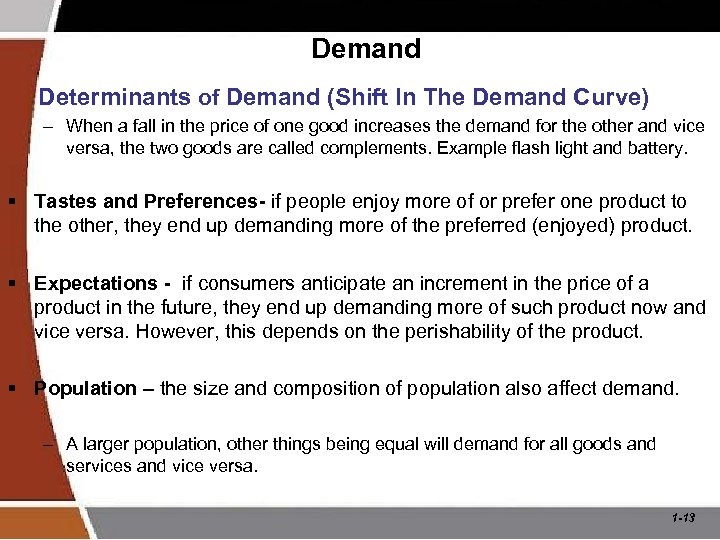 Demand Determinants of Demand (Shift In The Demand Curve) – When a fall in the price of one good increases the demand for the other and vice versa, the two goods are called complements. Example flash light and battery. § Tastes and Preferences- if people enjoy more of or prefer one product to the other, they end up demanding more of the preferred (enjoyed) product. § Expectations - if consumers anticipate an increment in the price of a product in the future, they end up demanding more of such product now and vice versa. However, this depends on the perishability of the product. § Population – the size and composition of population also affect demand. – A larger population, other things being equal will demand for all goods and services and vice versa. 1 -13
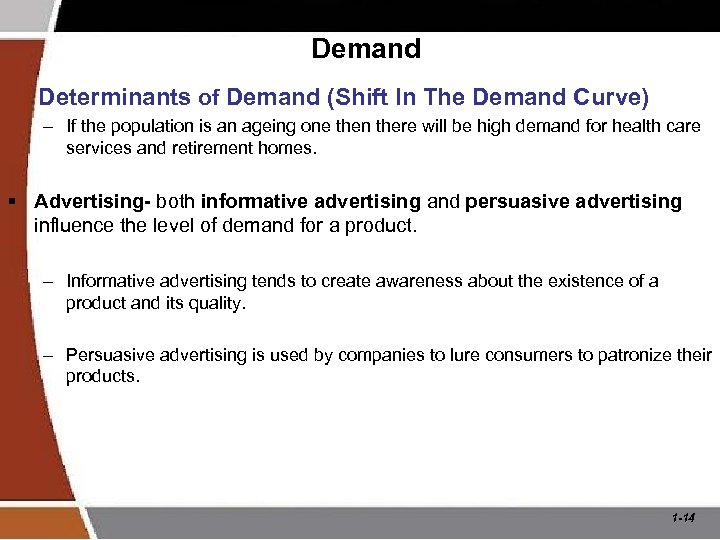 Demand Determinants of Demand (Shift In The Demand Curve) – If the population is an ageing one then there will be high demand for health care services and retirement homes. § Advertising- both informative advertising and persuasive advertising influence the level of demand for a product. – Informative advertising tends to create awareness about the existence of a product and its quality. – Persuasive advertising is used by companies to lure consumers to patronize their products. 1 -14
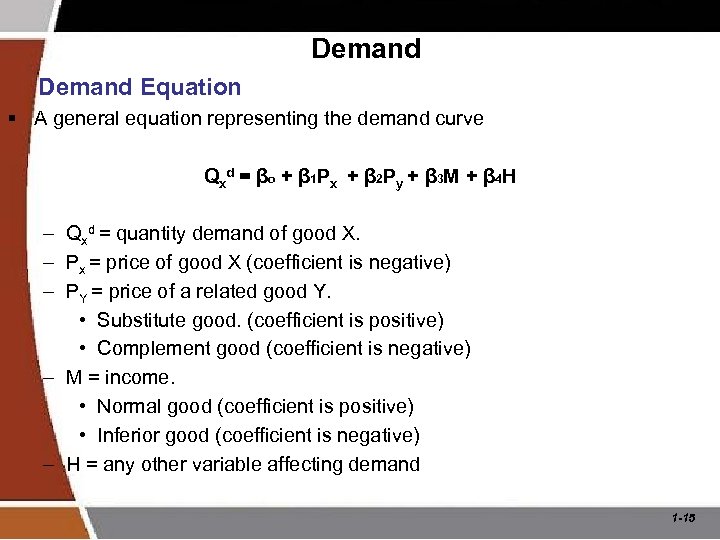 Demand Equation § A general equation representing the demand curve Qxd = βo + β 1 Px + β 2 Py + β 3 M + β 4 H – Qxd = quantity demand of good X. – Px = price of good X (coefficient is negative) – PY = price of a related good Y. • Substitute good. (coefficient is positive) • Complement good (coefficient is negative) – M = income. • Normal good (coefficient is positive) • Inferior good (coefficient is negative) – H = any other variable affecting demand 1 -15
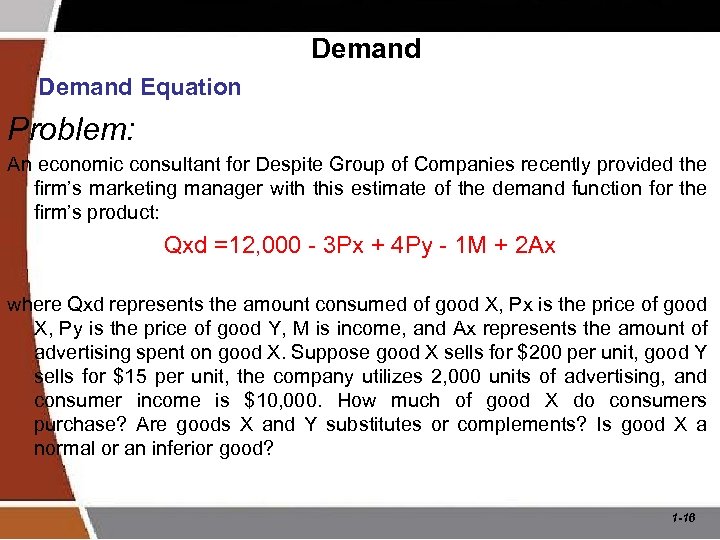 Demand Equation Problem: An economic consultant for Despite Group of Companies recently provided the firm’s marketing manager with this estimate of the demand function for the firm’s product: Qxd =12, 000 - 3 Px + 4 Py - 1 M + 2 Ax where Qxd represents the amount consumed of good X, Px is the price of good X, Py is the price of good Y, M is income, and Ax represents the amount of advertising spent on good X. Suppose good X sells for $200 per unit, good Y sells for $15 per unit, the company utilizes 2, 000 units of advertising, and consumer income is $10, 000. How much of good X do consumers purchase? Are goods X and Y substitutes or complements? Is good X a normal or an inferior good? 1 -16
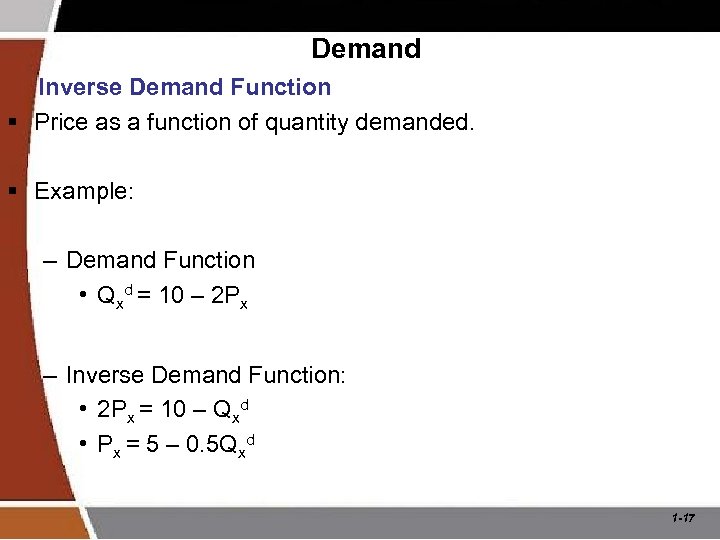 Demand Inverse Demand Function § Price as a function of quantity demanded. § Example: – Demand Function • Qxd = 10 – 2 Px – Inverse Demand Function: • 2 Px = 10 – Qxd • Px = 5 – 0. 5 Qxd 1 -17
 Demand Shifts vs Movements along the Demand Curve 1 -18
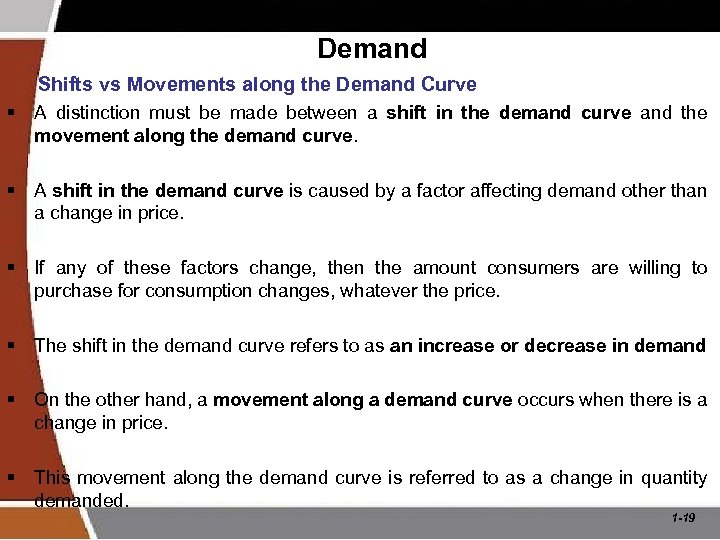 Demand Shifts vs Movements along the Demand Curve § A distinction must be made between a shift in the demand curve and the movement along the demand curve. § A shift in the demand curve is caused by a factor affecting demand other than a change in price. § If any of these factors change, then the amount consumers are willing to purchase for consumption changes, whatever the price. § The shift in the demand curve refers to as an increase or decrease in demand § On the other hand, a movement along a demand curve occurs when there is a change in price. § This movement along the demand curve is referred to as a change in quantity demanded. 1 -19
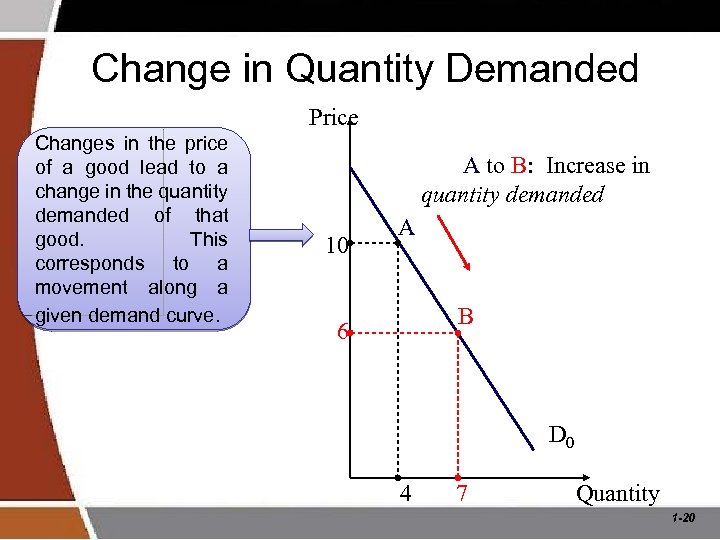 Change in Quantity Demanded Price Changes in the price of a good lead to a change in the quantity demanded of that good. This corresponds to a movement along a given demand curve. A to B: Increase in quantity demanded 10 A B 6 D 0 4 7 Quantity 1 -20
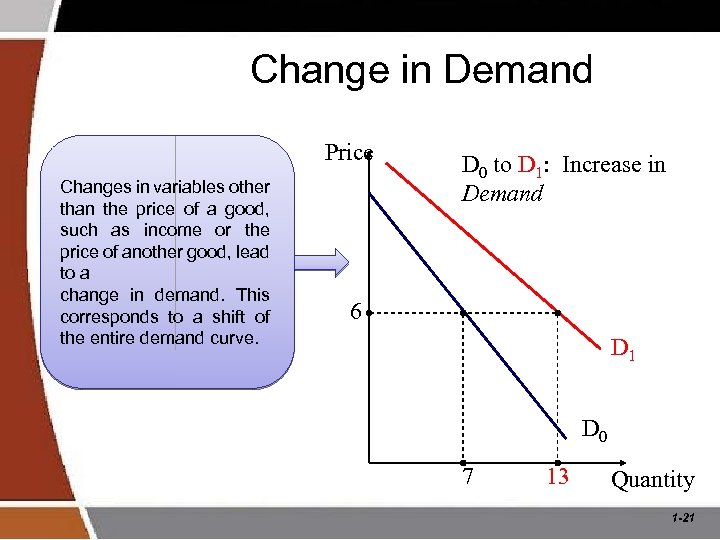 Change in Demand Price Changes in variables other than the price of a good, such as income or the price of another good, lead to a change in demand. This corresponds to a shift of the entire demand curve. D 0 to D 1: Increase in Demand 6 D 1 D 0 7 13 Quantity 1 -21
 Supply . 1 -22
 Supply § Supply is the amount of goods and services a producer is willing and capable to offer/produce at alternative prices at a given time period. § The quantity supplied of any good or service is the amount that sellers are willing and able to sell. § Suppliers are willing to supply more when prices of their products and services are high and vice versa. § This relationship between price and quantity supplied is called the law of supply : – All other things being equal, when the price of a good rises the quantity producers are willing to supply rises and the reverse is true. 1 -23
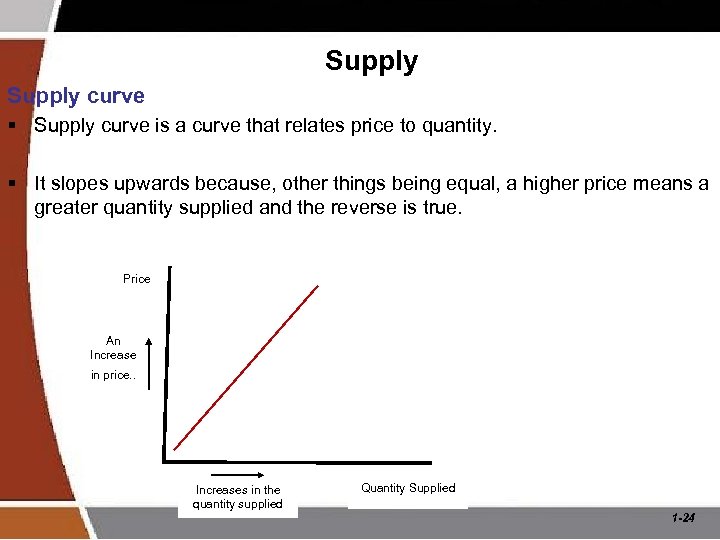 Supply curve § Supply curve is a curve that relates price to quantity. § It slopes upwards because, other things being equal, a higher price means a greater quantity supplied and the reverse is true. Price An Increase in price. . Increases in the quantity supplied Quantity Supplied 1 -24
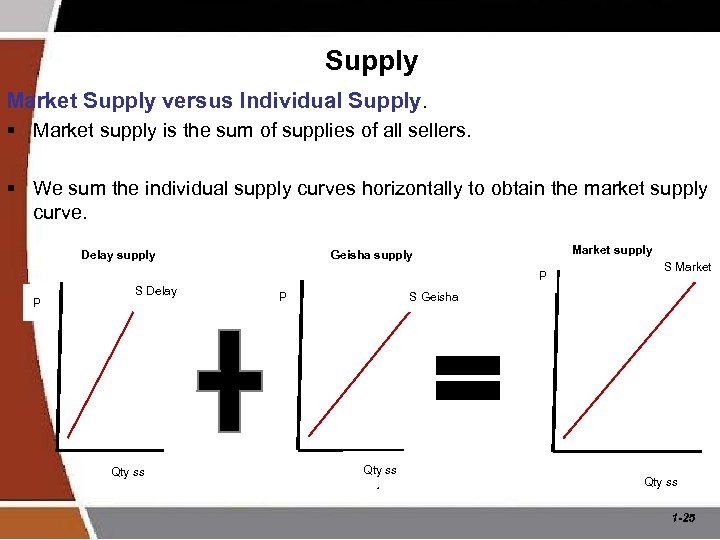 Supply Market Supply versus Individual Supply. § Market supply is the sum of supplies of all sellers. § We sum the individual supply curves horizontally to obtain the market supply curve. Market supply Geisha supply Delay supply P P S Delay Qty ss S Market S Geisha P Qty ss 1 -25
 Supply Determinants of Supply (Shift In The Supply Curve) § There are many variables that can shift the supply curve. Some of which are: – Input prices- if input prices rise substantially, some firms might shut down or cut down on supply and the reverse is true. – Technology- advances in technology increase productivity allowing more to be produced using fewer factor input. As a result costs, both total and unit, may fall and supply increases. – Expectations – if producers expect the price of their goods to rise in the future, they may put some of their current stock into storage and supply less to the market today. – The number of sellers- if there are more producers of a product, then the amount of that product would be likely to rise. 1 -26
 Supply Determinants of Supply (Shift In The Supply Curve) – Natural/ social factors- there are often many natural or social factors that affect supply. These include such things as • The weather affecting crops • Natural disasters • Pestilence and disease • Changing attitudes and social expectations ( eg. reducing carbon emissions) • Christmas, Valentine’s day, Eid and so on. 1 -27
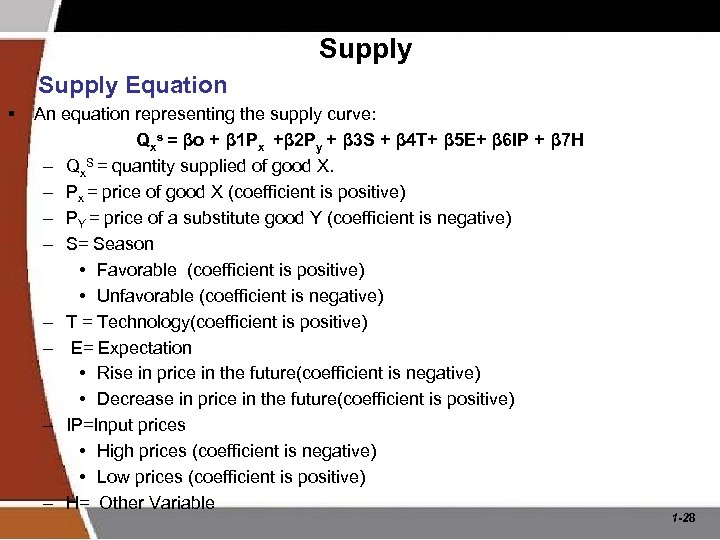 Supply Equation § An equation representing the supply curve: Qxs = βo + β 1 Px +β 2 Py + β 3 S + β 4 T+ β 5 E+ β 6 IP + β 7 H – Qx. S = quantity supplied of good X. – Px = price of good X (coefficient is positive) – PY = price of a substitute good Y (coefficient is negative) – S= Season • Favorable (coefficient is positive) • Unfavorable (coefficient is negative) – T = Technology(coefficient is positive) – E= Expectation • Rise in price in the future(coefficient is negative) • Decrease in price in the future(coefficient is positive) – IP=Input prices • High prices (coefficient is negative) • Low prices (coefficient is positive) – H= Other Variable 1 -28
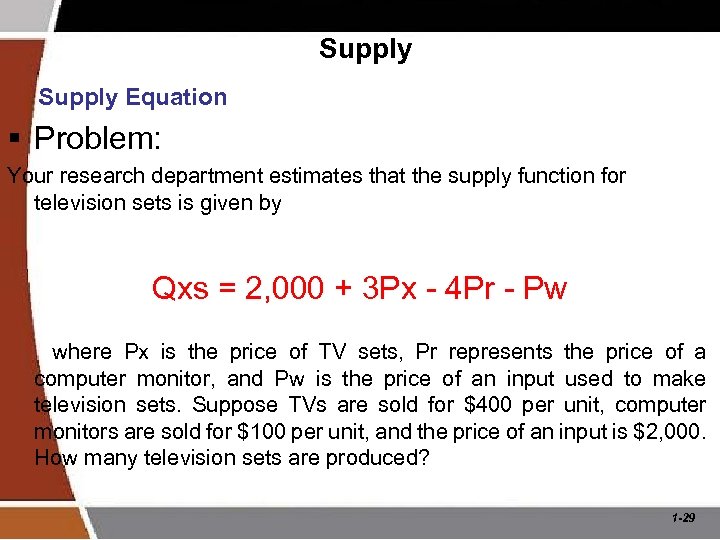 Supply Equation § Problem: Your research department estimates that the supply function for television sets is given by Qxs = 2, 000 + 3 Px - 4 Pr - Pw where Px is the price of TV sets, Pr represents the price of a computer monitor, and Pw is the price of an input used to make television sets. Suppose TVs are sold for $400 per unit, computer monitors are sold for $100 per unit, and the price of an input is $2, 000. How many television sets are produced? 1 -29
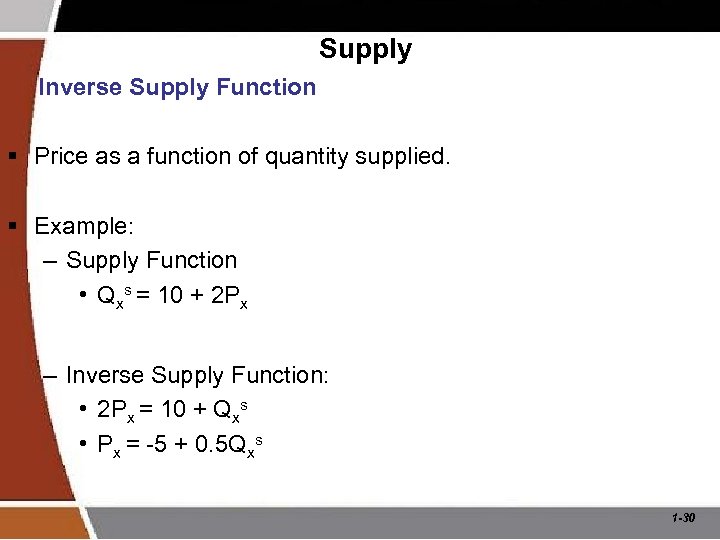 Supply Inverse Supply Function § Price as a function of quantity supplied. § Example: – Supply Function • Qxs = 10 + 2 Px – Inverse Supply Function: • 2 Px = 10 + Qxs • Px = -5 + 0. 5 Qxs 1 -30
 Supply Shifts vs Movements along the Supply Curve 1 -31
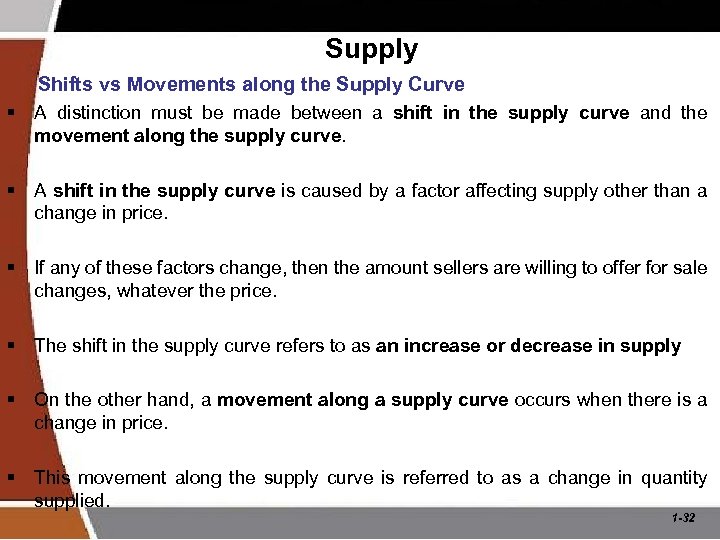 Supply Shifts vs Movements along the Supply Curve § A distinction must be made between a shift in the supply curve and the movement along the supply curve. § A shift in the supply curve is caused by a factor affecting supply other than a change in price. § If any of these factors change, then the amount sellers are willing to offer for sale changes, whatever the price. § The shift in the supply curve refers to as an increase or decrease in supply § On the other hand, a movement along a supply curve occurs when there is a change in price. § This movement along the supply curve is referred to as a change in quantity supplied. 1 -32
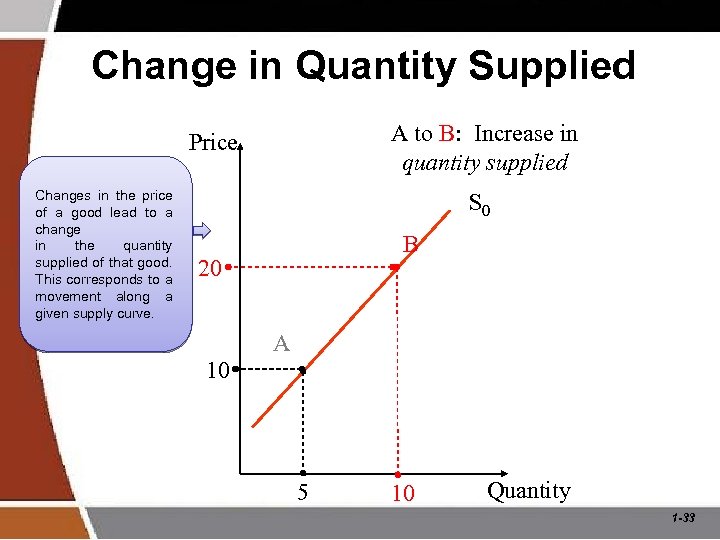 Change in Quantity Supplied A to B: Increase in quantity supplied Price Changes in the price of a good lead to a change in the quantity supplied of that good. This corresponds to a movement along a given supply curve. S 0 B 20 A 10 5 10 Quantity 1 -33
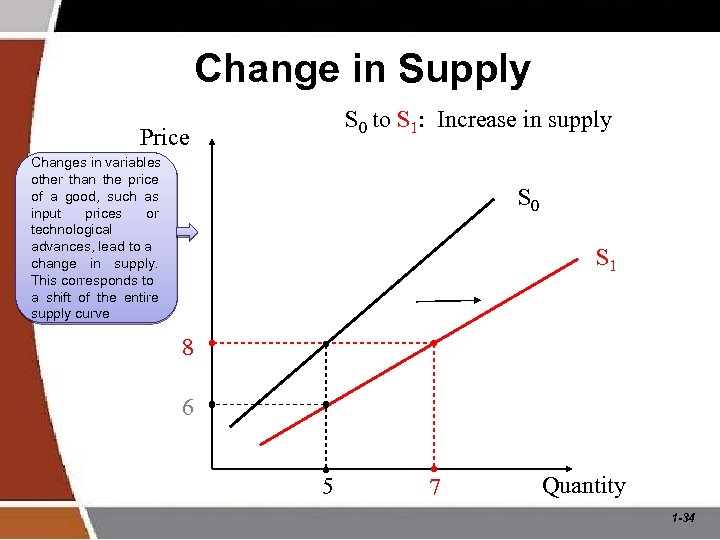 Change in Supply S 0 to S 1: Increase in supply Price Changes in variables other than the price of a good, such as input prices or technological advances, lead to a change in supply. This corresponds to a shift of the entire supply curve S 0 S 1 8 6 5 7 Quantity 1 -34
 Market Equilibrium . 1 -35
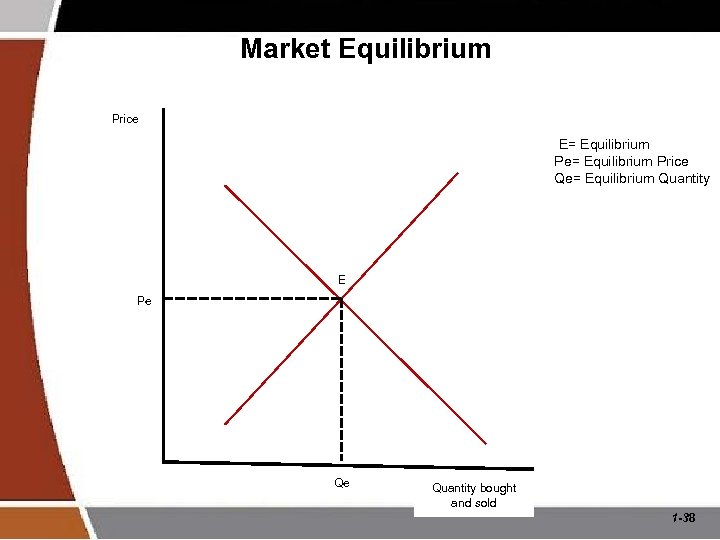
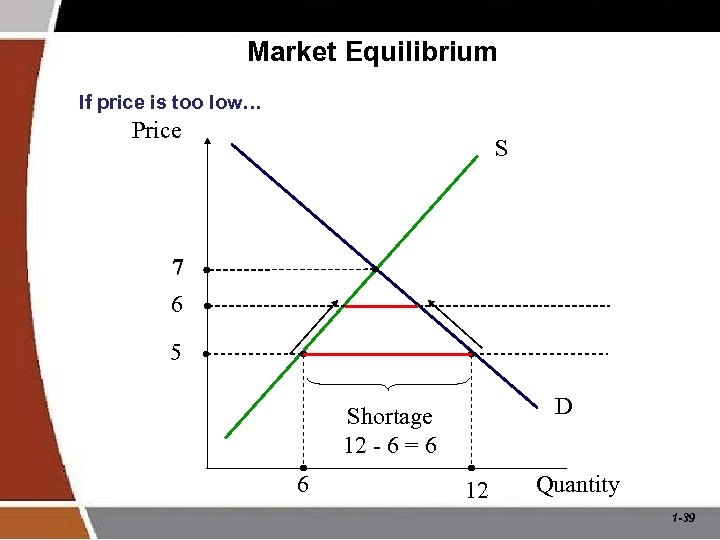
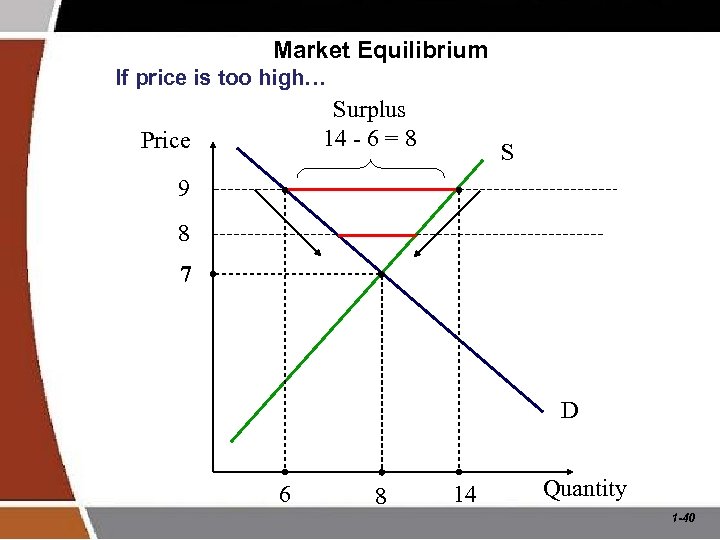
 Market Equilibrium § Market equilibrium is a situation in which the price has reached the level where quantity supplied equals quantity demanded. § The price at this intersection (where quantity supplied equals quantity demanded) is called the equilibrium price and the quantity is called the equilibrium quantity. § At the equilibrium price, the quantity of the good that buyers are willing and able to buy exactly balances the quantity that sellers are willing and able to sell. § The equilibrium price is sometimes called the market-clearing price, because at this price, everyone in the market has been satisfied. – Buyers have bought all they want to buy – Sellers have sold all they want to sell – There is neither a shortage nor a surplus 1 -36
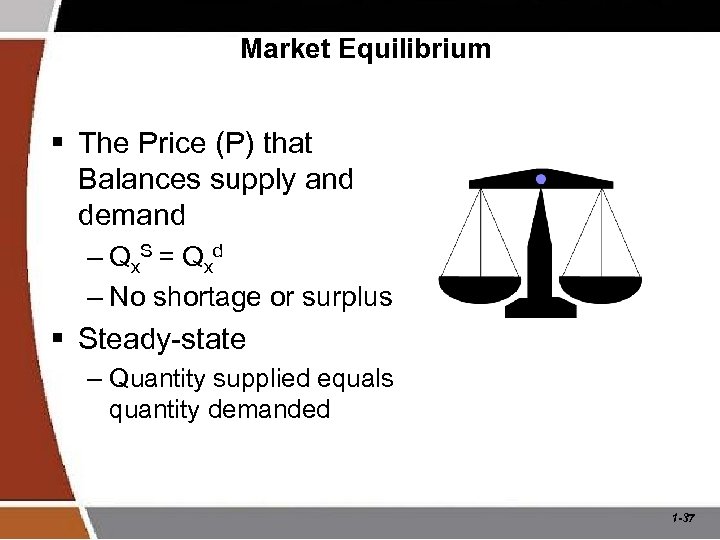 Market Equilibrium § The Price (P) that Balances supply and demand – Qx. S = Qxd – No shortage or surplus § Steady-state – Quantity supplied equals quantity demanded 1 -37
 Market Equilibrium Price E= Equilibrium Pe= Equilibrium Price Qe= Equilibrium Quantity E Pe Qe Quantity bought and sold 1 -38
 Market Equilibrium If price is too low… Price S 7 6 5 D Shortage 12 - 6 = 6 6 12 Quantity 1 -39
 Market Equilibrium If price is too high… Surplus 14 - 6 = 8 Price S 9 8 7 D 6 8 14 Quantity 1 -40
 Market Equilibrium Problem According to an article in Daily Graphic, Ghana recently accelerated its plan to privatize certain state-owned firms. Imagine that you are a business economist, and you have been asked to help the committee to determine the price and quantity that will prevail when competitive forces are allowed to equilibrate the market. The best estimates of the market demand supply for the good (in U. S. dollar equivalent prices) are given by Qd =10 - 2 P and Qs = 2 + 2 P, respectively. Determine the competitive equilibrium price and quantity. 1 -41
 Price Control/Restrictions Government’s intervention in the free market 1 -42
 Price Control Price Ceiling § The economic doctrine of scarcity is that there are not enough goods to satisfy the desires of all consumers at a price of zero. § Corollary to this, some method must be used to determine who gets to consume goods and who does not. § People who do not get to consume goods are essentially discriminated against. § One way to determine who gets a good and who does not is to allocate the goods based on the following: – If you are left-handed, you get the good; if you are not left-handed, you don’t get the good. 1 -43
 Price Control Price Ceiling § Often persons who are discriminated against by the price system attempt to lure the government to intervene in the market by requiring producers to sell the good at a lower price. § This is only natural, for if we were unable to own a house because we are right-handed, then the government has to step in to allow us own a house. § But then there would be too few houses to go around, and some other means would have to be used to allocate houses to people. § That brings in the price ceiling- maximum legal price of a product in the market. 1 -44
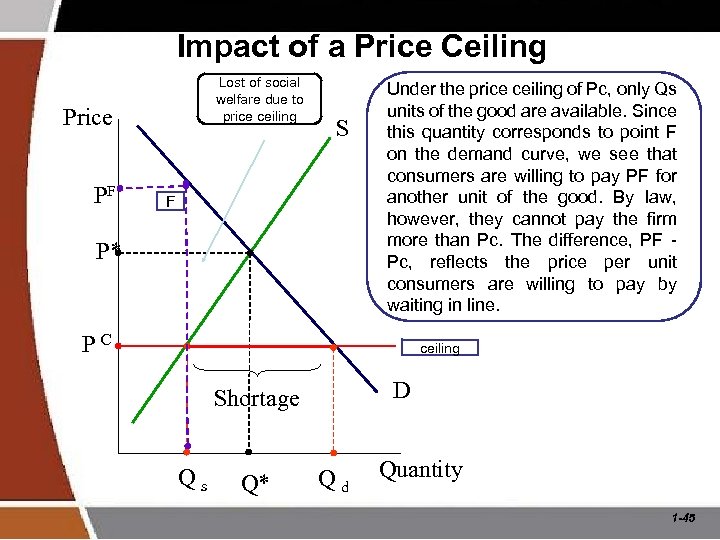 Impact of a Price Ceiling Lost of social welfare due to price ceiling Price PF S F P* Under the price ceiling of Pc, only Qs units of the good are available. Since this quantity corresponds to point F on the demand curve, we see that consumers are willing to pay PF for another unit of the good. By law, however, they cannot pay the firm more than Pc. The difference, PF Pc, reflects the price per unit consumers are willing to pay by waiting in line. PC ceiling D Shortage Qs Q* Qd Quantity 1 -45
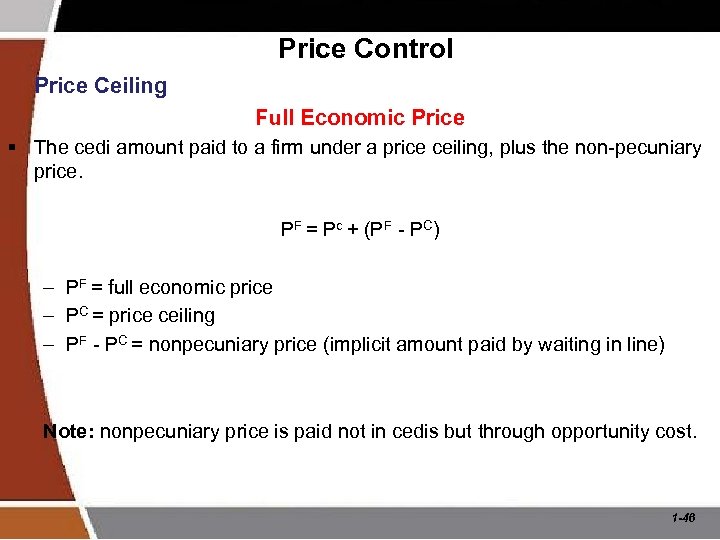 Price Control Price Ceiling Full Economic Price § The cedi amount paid to a firm under a price ceiling, plus the non-pecuniary price. PF = Pc + (PF - PC) – PF = full economic price – PC = price ceiling – PF - PC = nonpecuniary price (implicit amount paid by waiting in line) Note: nonpecuniary price is paid not in cedis but through opportunity cost. 1 -46
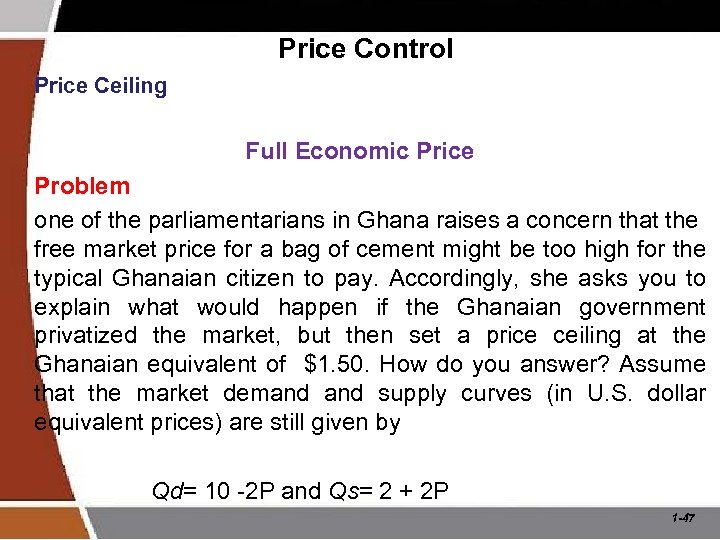 Price Control Price Ceiling Full Economic Price Problem one of the parliamentarians in Ghana raises a concern that the free market price for a bag of cement might be too high for the typical Ghanaian citizen to pay. Accordingly, she asks you to explain what would happen if the Ghanaian government privatized the market, but then set a price ceiling at the Ghanaian equivalent of $1. 50. How do you answer? Assume that the market demand supply curves (in U. S. dollar equivalent prices) are still given by Qd= 10 -2 P and Qs= 2 + 2 P 1 -47
 Price Control Price Ceiling Reasons and consequences for price ceiling Reasons § It helps to ensure fairness (equity). Consequences § It results in long lines such as those created in 1983 due to price ceiling. ü price ceilings discriminate against people who have a high opportunity cost of time and do not like to wait in lines. 1 -48
 Price Control Price Ceiling Lessons to Managers § First come, first serve § Sell products to loyal customers § Bank managers may allocate money only to consumers who are relatively well-to-do. 1 -49
 Price Control Price Ceiling Problem Consider the following demand supply equations for the product of a perfectly competitive industry. QD = 300 -3 P Qs = 100 + 5 P Where Q is quantity and P is price. a. Determine the market equilibrium price and quantity algebraically. b. Suppose that an increase in consumer income resulted in the new demand equation QD = 420 -3 P What are the new equilibrium price and quantity? c. Suppose the government enacts legislation that imposes a price ceiling equivalent to the original equilibrium price. What is the result of this legislation? 1 -50
 Price Control Price Floor § Sometimes the equilibrium competitive price may be considered too low for producers. § Individuals may lobby for the government to legislate a minimum legal price for a good. § Such a price is called a price floor. For instance, the minimum wage. 1 -51
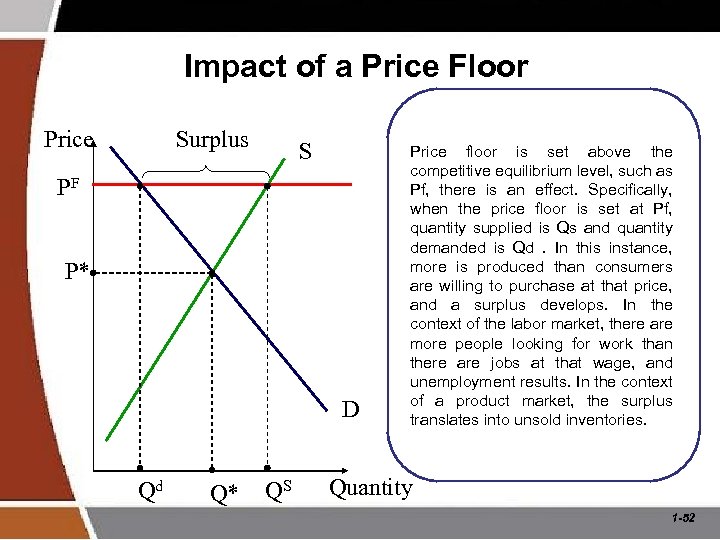 Impact of a Price Floor Price Surplus S PF P* D Qd Q* QS Price floor is set above the competitive equilibrium level, such as Pf, there is an effect. Specifically, when the price floor is set at Pf, quantity supplied is Qs and quantity demanded is Qd. In this instance, more is produced than consumers are willing to purchase at that price, and a surplus develops. In the context of the labor market, there are more people looking for work than there are jobs at that wage, and unemployment results. In the context of a product market, the surplus translates into unsold inventories. Quantity 1 -52
 Price Control Price Floor Problem Consider the following demand supply equations for a product QD = 25 -3 P Qs = 10 + 2 P a. Determine the market equilibrium price and quantity. b. Suppose that government regulatory authorities imposed a ‘price floor’ on this product of P = Ȼ 4. What would be the quantity supplied and quantity demanded of this product? How would you characterize the situation in this market? 1 -53
 Comparative Static Analysis 1 -54
 Comparative Static Analysis § How do the equilibrium price and quantity change when a determinant of supply and/or demand change? 1 -55
 Comparative Static Analysis Three Steps to Analyzing Changes in Equilibrium § Decide whether the event shifts the supply or demand curve (or perhaps both). § Decide in which direction the curve shifts. § Use the supply and demand diagram to see how the shift changes the equilibrium price and quantity. 1 -56
 Comparative Static Analysis Example: A Change in Demand § Suppose that a government-sponsored research projects finds that using soymilk helps reduce the risk of heart disease and strokes. – How does this event affect the market for soymilk? 1 -57
 Comparative Static Analysis Answer § This news has a direct effect on the demand curve, by changing people’s taste for soymilk. – That is, the report changes the amount of soymilk that people want to buy at any given price. 1 -58
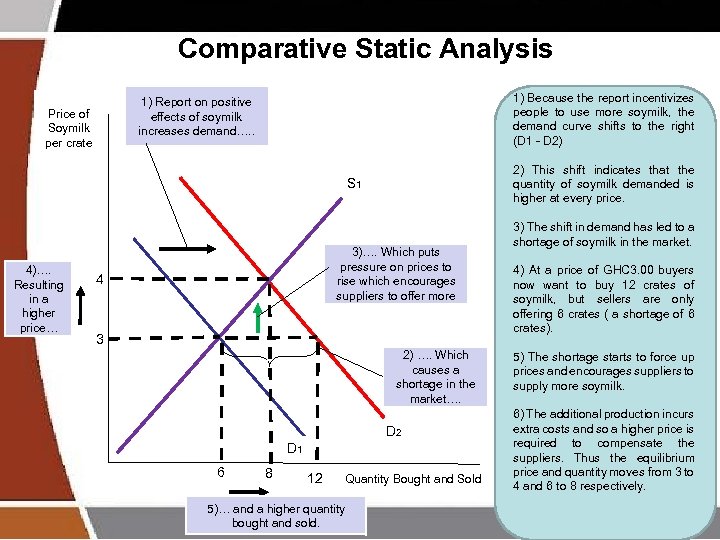 Comparative Static Analysis 1) Because the report incentivizes people to use more soymilk, the demand curve shifts to the right (D 1 - D 2) 1) Report on positive effects of soymilk increases demand…. . Price of Soymilk per crate 2) This shift indicates that the quantity of soymilk demanded is higher at every price. S 1 4)…. Resulting in a higher price… 3)…. Which puts pressure on prices to rise which encourages suppliers to offer more 4 3 2) …. Which causes a shortage in the market…. D 2 D 1 6 8 12 Quantity Bought and Sold 5)… and a higher quantity bought and sold. 3) The shift in demand has led to a shortage of soymilk in the market. 4) At a price of GHC 3. 00 buyers now want to buy 12 crates of soymilk, but sellers are only offering 6 crates ( a shortage of 6 crates). 5) The shortage starts to force up prices and encourages suppliers to supply more soymilk. 6) The additional production incurs extra costs and so a higher price is required to compensate the suppliers. Thus the equilibrium price and quantity moves from 3 to 4 and 6 to 8 respectively. 1 -59
 Comparative Static Analysis Example: A Change in Supply § Suppose that, during another dry season, bad weather destroys soybeans and drives up the world price of soybeans. § How does this event affect the market for soymilk ? 1 -60
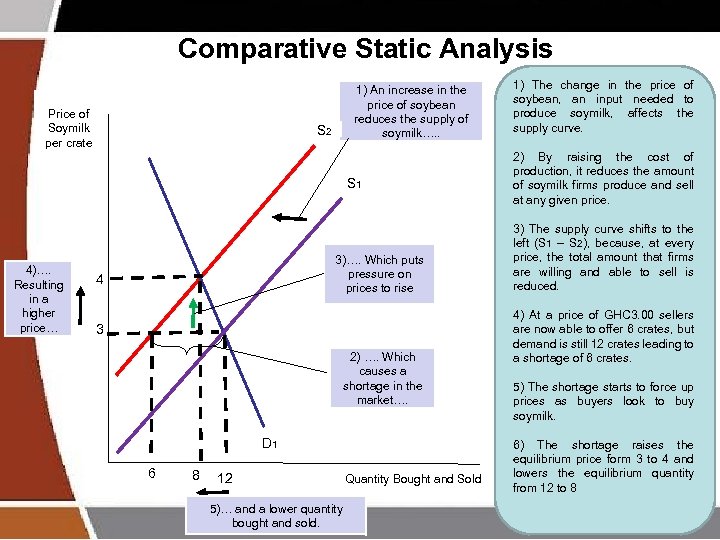 Comparative Static Analysis Price of Soymilk per crate 1) An increase in the price of soybean reduces the supply of soymilk…. . S 2 S 1 4)…. Resulting in a higher price… 3)…. Which puts pressure on prices to rise 4 3 2) …. Which causes a shortage in the market…. D 1 6 8 12 5)… and a lower quantity bought and sold. Quantity Bought and Sold 1) The change in the price of soybean, an input needed to produce soymilk, affects the supply curve. 2) By raising the cost of production, it reduces the amount of soymilk firms produce and sell at any given price. 3) The supply curve shifts to the left (S 1 – S 2), because, at every price, the total amount that firms are willing and able to sell is reduced. 4) At a price of GHC 3. 00 sellers are now able to offer 6 crates, but demand is still 12 crates leading to a shortage of 6 crates. 5) The shortage starts to force up prices as buyers look to buy soymilk. 6) The shortage raises the equilibrium price form 3 to 4 and lowers the equilibrium quantity from 12 to 8 1 -61
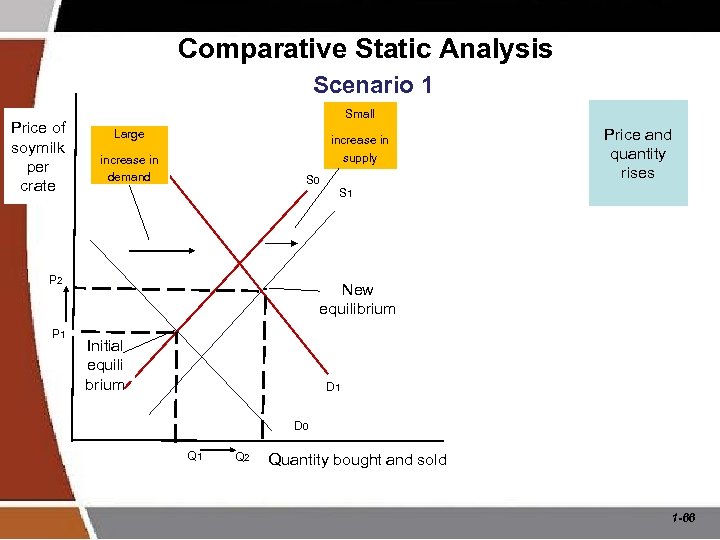
 Comparative Static Analysis Example: A Change in both Supply and Demand § Now suppose that the report and the bad weather occur during the same dry season. § How does it affect the equilibrium price and quantity? § Answer – There will be two scenarios Scenario 1: If the increment in demand for soymilk is more than the decrement in the supply for soymilk, then both equilibrium price and equilibrium quantity bought and sold will rise. Scenario 2: If the increment in demand for soymilk is less than the decrement in supply for soymilk, then the equilibrium price rises whiles the equilibrium quantity sold and bought falls. 1 -62
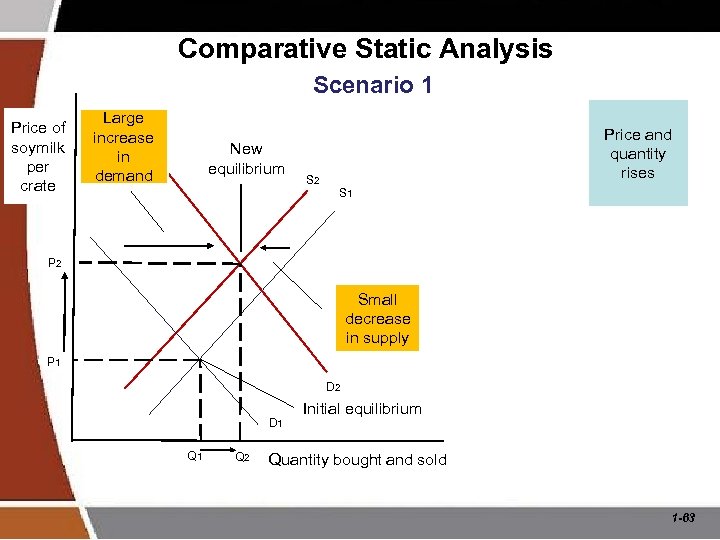 Comparative Static Analysis Scenario 1 Price of soymilk per crate Large increase in demand New equilibrium S 2 Price and quantity rises S 1 P 2 Small decrease in supply P 1 D 2 D 1 Q 2 Initial equilibrium Quantity bought and sold 1 -63
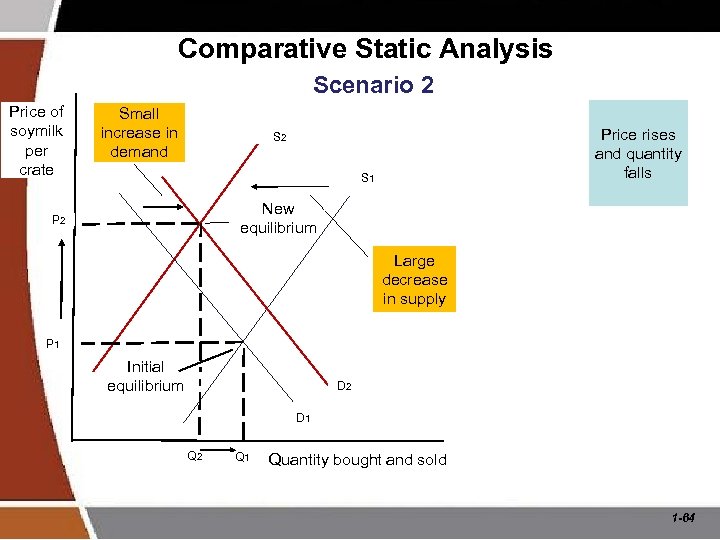 Comparative Static Analysis Scenario 2 Price of soymilk per crate Small increase in demand Price rises and quantity falls S 2 S 1 New equilibrium P 2 Large decrease in supply P 1 Initial equilibrium D 2 D 1 Q 2 Q 1 Quantity bought and sold 1 -64
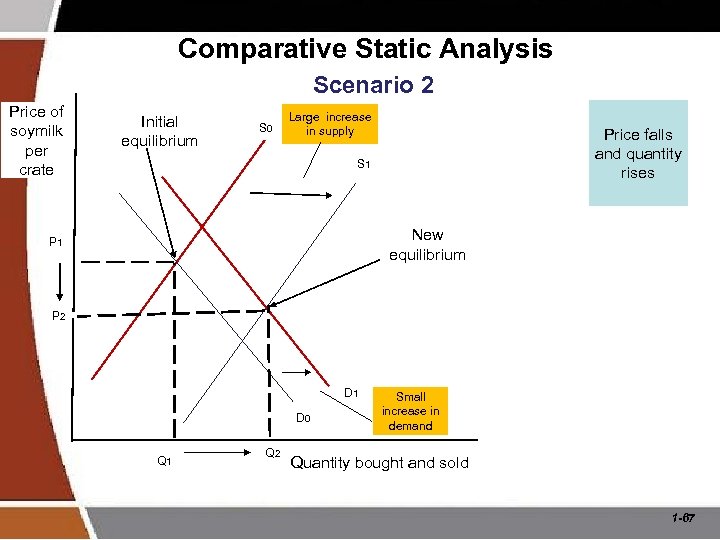
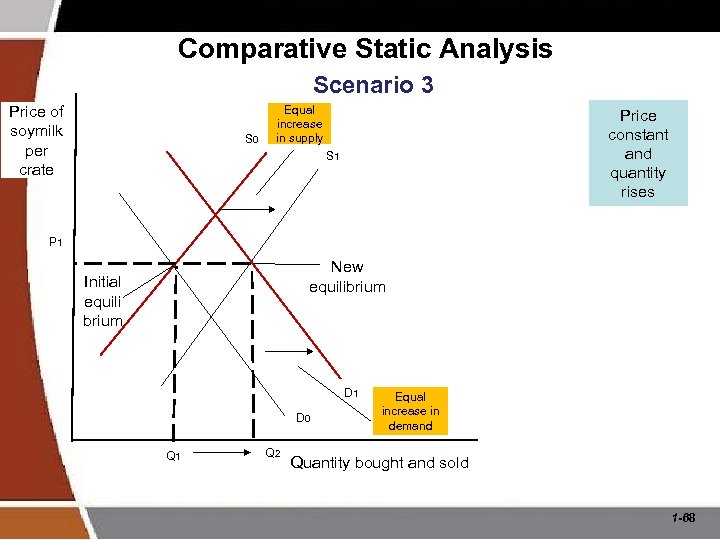
 Comparative Static Analysis Example: A Change in both Supply and Demand § Now suppose that the report and the good weather occur during the same season. § How does it affect the equilibrium price and quantity? § Answer – There will be two scenarios Scenario 1: If the increment in demand for soymilk is more than the increment in the supply for soymilk, then both equilibrium price and equilibrium quantity bought and sold will rise. Scenario 2: If the increment in demand for soymilk is less than the increment in supply for soymilk, then the equilibrium price falls whiles the equilibrium quantity sold and bought rises. Scenario 3: If the increment in demand for soymilk is equal to the increment in supply for soymilk, then the equilibrium price remains constant whiles the equilibrium quantity sold and bought rises. 1 -65
 Comparative Static Analysis Scenario 1 Price of soymilk per crate Small Large increase in supply increase in demand S 0 P 2 P 1 Price and quantity rises S 1 New equilibrium Initial equili brium D 1 D 0 Q 1 Q 2 Quantity bought and sold 1 -66
 Comparative Static Analysis Scenario 2 Price of soymilk per crate Initial equilibrium S 0 Large increase in supply Price falls and quantity rises S 1 New equilibrium P 1 P 2 D 1 D 0 Q 1 Q 2 Small increase in demand Quantity bought and sold 1 -67
 Comparative Static Analysis Scenario 3 Price of soymilk per crate S 0 Equal increase in supply Price constant and quantity rises S 1 P 1 New equilibrium Initial equili brium D 1 D 0 Q 1 Q 2 Equal increase in demand Quantity bought and sold 1 -68
 Comparative Static Analysis Problem: Suppose you are the manager of a chain of computer stores. For obvious reasons you have been closely following developments in the computer industry, and you have just learned that Parliament has passed a twopronged program designed to further enhance the Ghanaian computer industry’s position in the global economy. The legislation provides increased funding for computer education in primary and secondary schools, as well as tax breaks for firms that develop computer software. As a result of this legislation, what do you predict will happen to the equilibrium price and quantity of software? Quick Quiz … Analyse what happens to the market for ‘Gari and Beans’ if the price of beans rises. Analyse what happens to the market for ‘Fufu’ if the price of cassava falls. 1 -69
 Conclusion § Use supply and demand analysis to – clarify the “big picture” (the general impact of a current event on equilibrium prices and quantities). – organize an action plan (needed changes in production, inventories, raw materials, human resources, marketing plans, etc. ). 1 -70
 End of Lecture 2 1 -71