


 Скачать презентацию Managerial Economics A Definition The application of
1eac467409612e14a960366fd9f9618e.ppt
- Количество слайдов: 70
 Managerial Economics
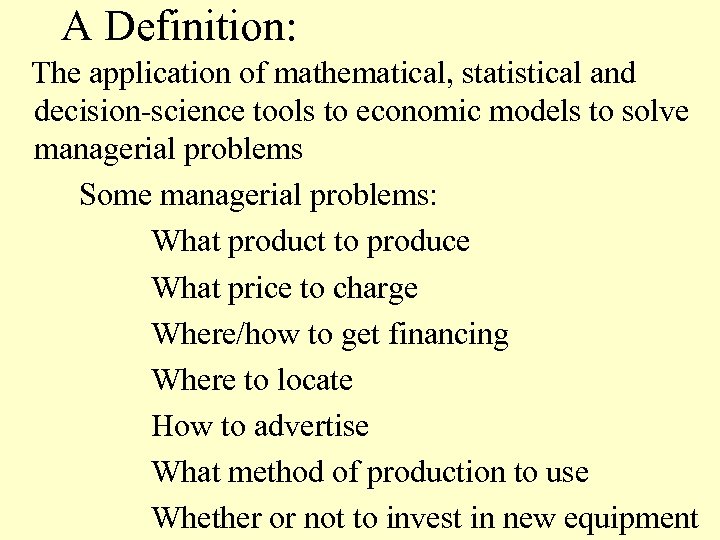 A Definition: The application of mathematical, statistical and decision-science tools to economic models to solve managerial problems Some managerial problems: What product to produce What price to charge Where/how to get financing Where to locate How to advertise What method of production to use Whether or not to invest in new equipment
 Managers’ Objectives • Maximizing the value of the firm (Through profit maximization) • Alternative objectives: =>Market share maximization =>Growth Maximization =>Maximizing their own benefits =>Stisfice vs. optimize
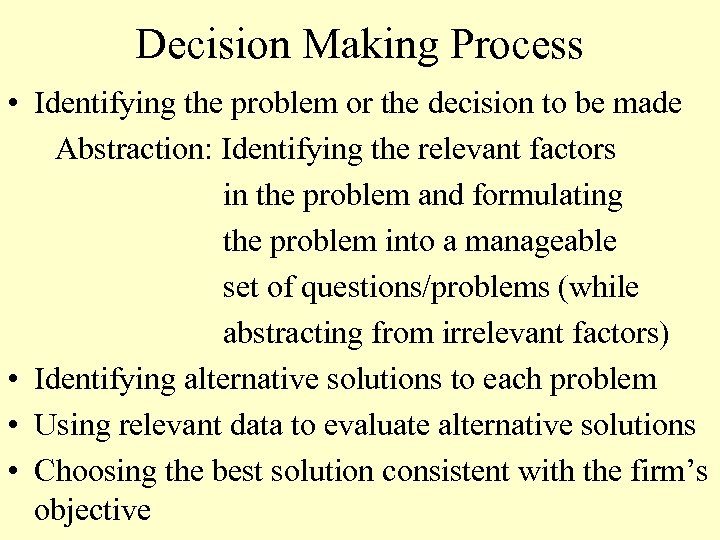 Decision Making Process • Identifying the problem or the decision to be made Abstraction: Identifying the relevant factors in the problem and formulating the problem into a manageable set of questions/problems (while abstracting from irrelevant factors) • Identifying alternative solutions to each problem • Using relevant data to evaluate alternative solutions • Choosing the best solution consistent with the firm’s objective
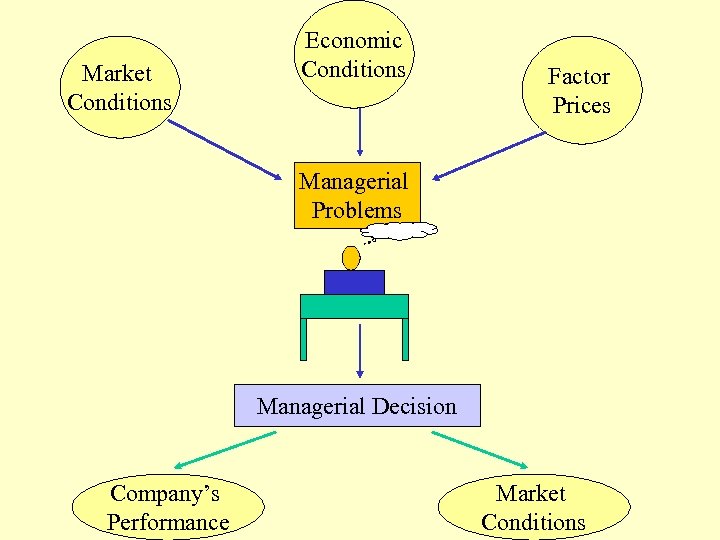 Market Conditions Economic Conditions Factor Prices Managerial Problems Managerial Decision Company’s Performance Market Conditions
 Consider the following news headlines: • Gateway cuts jobs: PC maker to trim 15 percent of staff, expects shortfall in third quarter. • U. S. consumers lost confidence in August. • The International Monetary Fund will cut its global economic growth forecast for this year to 2. 8 percent. • Coca-Cola Co. , facing a stiff challenge from its arch rival Pepsi. Co Inc. in the fast-growing alternative drinks market, may be preparing to acquire the Nantucket Nectars line of juice and tea products, analysts said Tuesday.
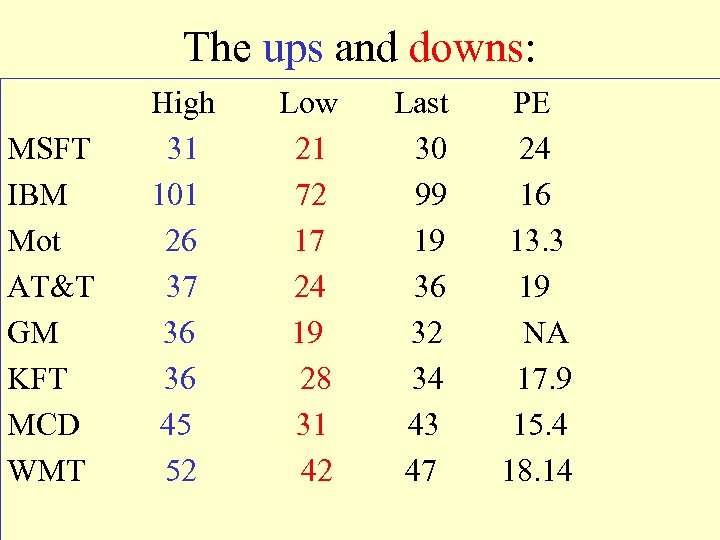 The ups and downs: MSFT IBM Mot AT&T GM KFT MCD WMT High 31 101 26 37 36 36 45 52 Low 21 72 17 24 19 28 31 42 Last 30 99 19 36 32 34 43 47 PE 24 16 13. 3 19 NA 17. 9 15. 4 18. 14
 Macroeconomics, Microeconomics and Managerial Decision Making
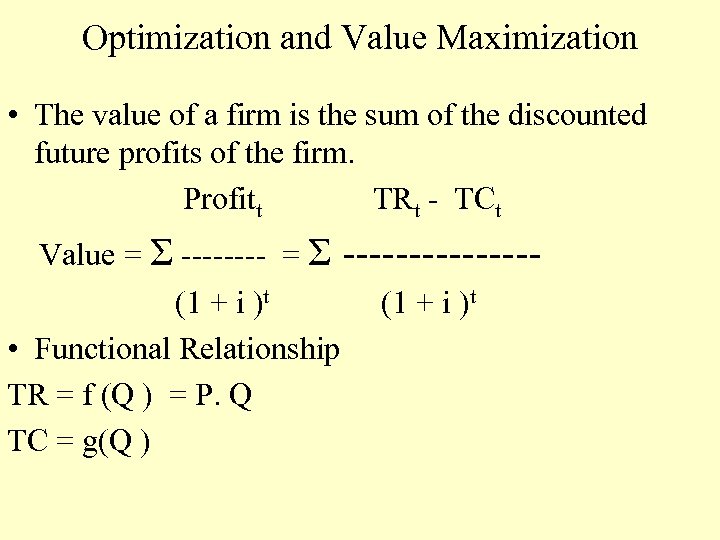 Optimization and Value Maximization • The value of a firm is the sum of the discounted future profits of the firm. Profitt TRt - TCt Value = Σ --------------(1 + i )t • Functional Relationship TR = f (Q ) = P. Q TC = g(Q )
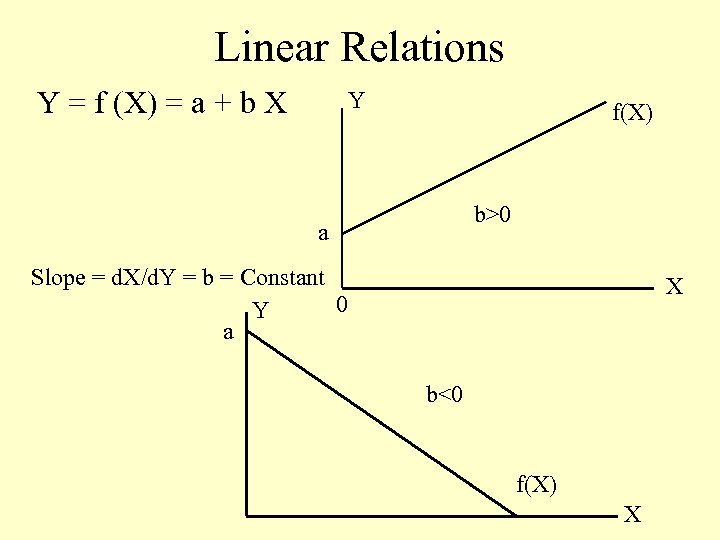 Linear Relations Y = f (X) = a + b X Y f(X) b>0 a Slope = d. X/d. Y = b = Constant 0 Y a X b<0 f(X) X
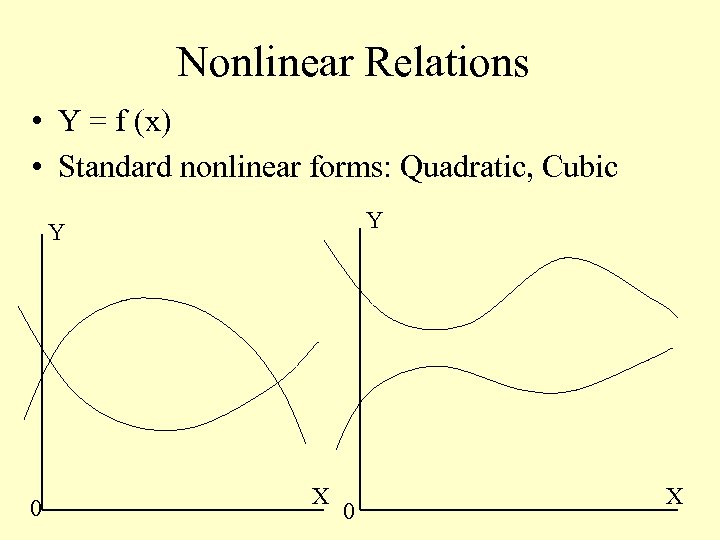 Nonlinear Relations • Y = f (x) • Standard nonlinear forms: Quadratic, Cubic Y Y 0 X
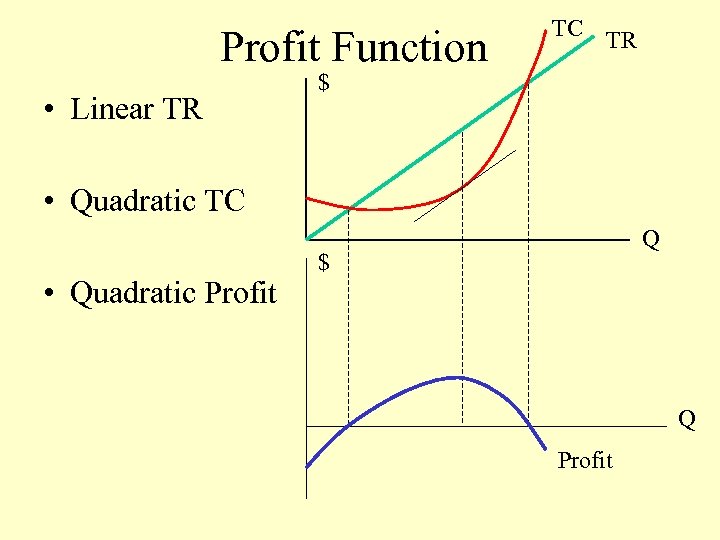 Profit Function • Linear TR TC TR $ • Quadratic TC • Quadratic Profit Q $ Q Profit
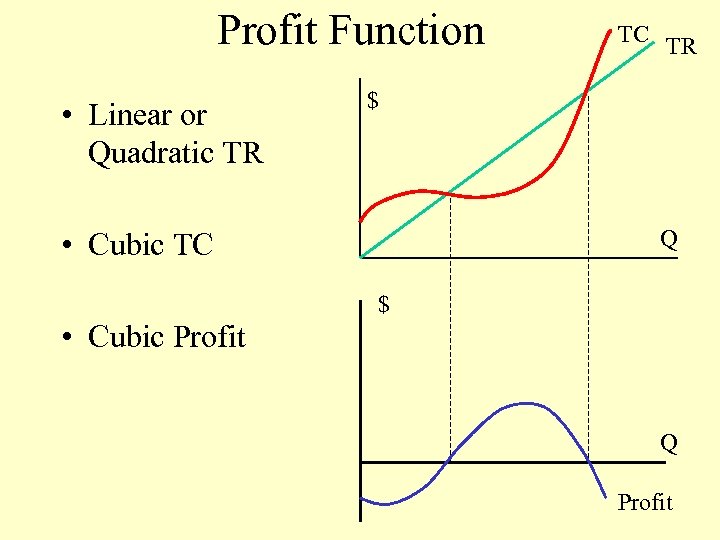 Profit Function • Linear or Quadratic TR TC TR $ Q • Cubic TC $ • Cubic Profit Q Profit
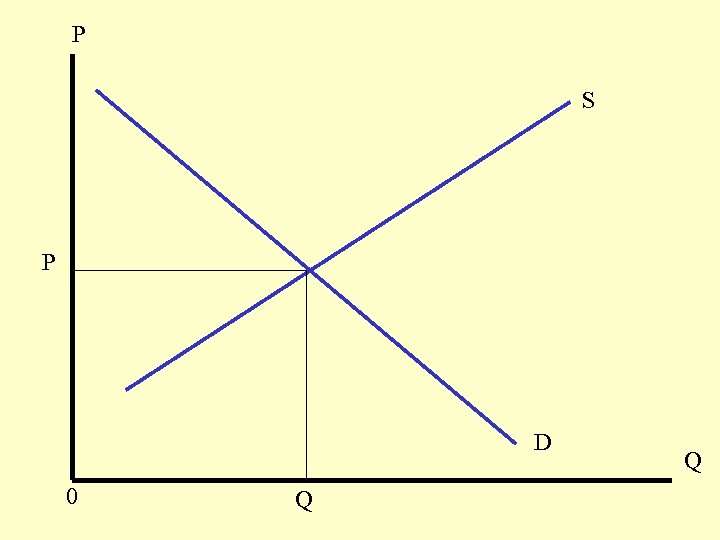 P S P D 0 Q Q
 Demand : A definition • Demand: A quantity of a good or service a buyer (or buyers) would buy under a certain set of conditions • Demand curve is a curve showing the quantities of a good or service a buyer (or buyers) would buy at various prices, ceteris paribus • Quantity demanded: The quantity of a good a buyer (or buyers) would be willing and able to buy at a specific price, ceteris paribus
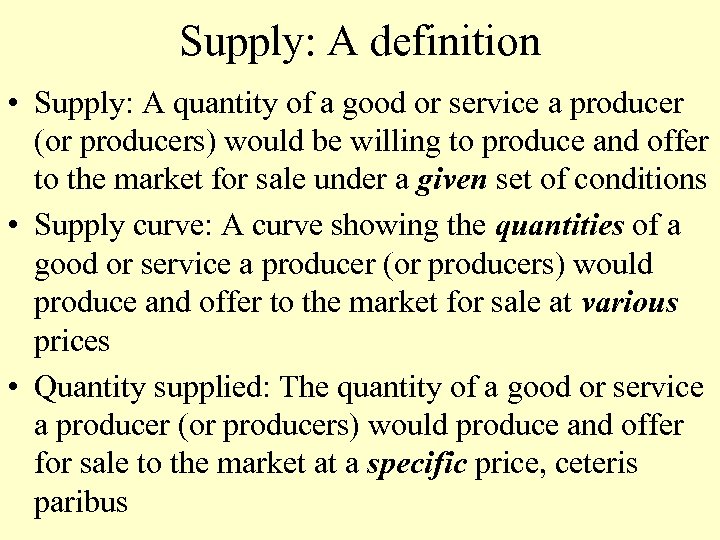 Supply: A definition • Supply: A quantity of a good or service a producer (or producers) would be willing to produce and offer to the market for sale under a given set of conditions • Supply curve: A curve showing the quantities of a good or service a producer (or producers) would produce and offer to the market for sale at various prices • Quantity supplied: The quantity of a good or service a producer (or producers) would produce and offer for sale to the market at a specific price, ceteris paribus
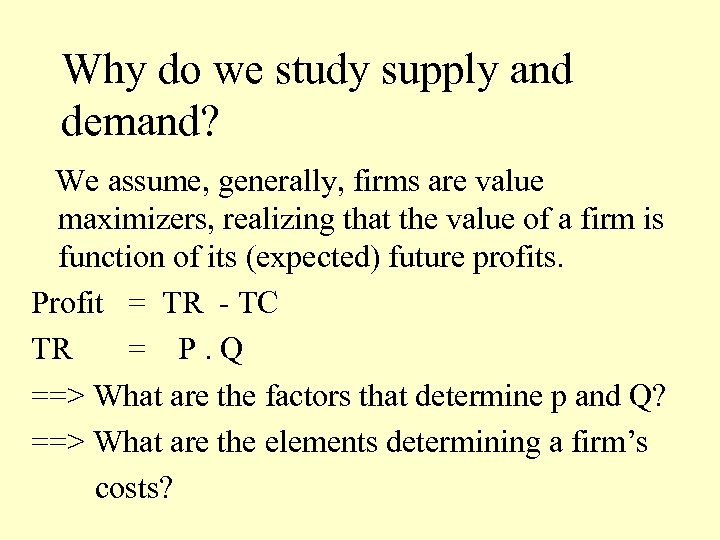 Why do we study supply and demand? We assume, generally, firms are value maximizers, realizing that the value of a firm is function of its (expected) future profits. Profit = TR - TC TR = P. Q ==> What are the factors that determine p and Q? ==> What are the elements determining a firm’s costs?
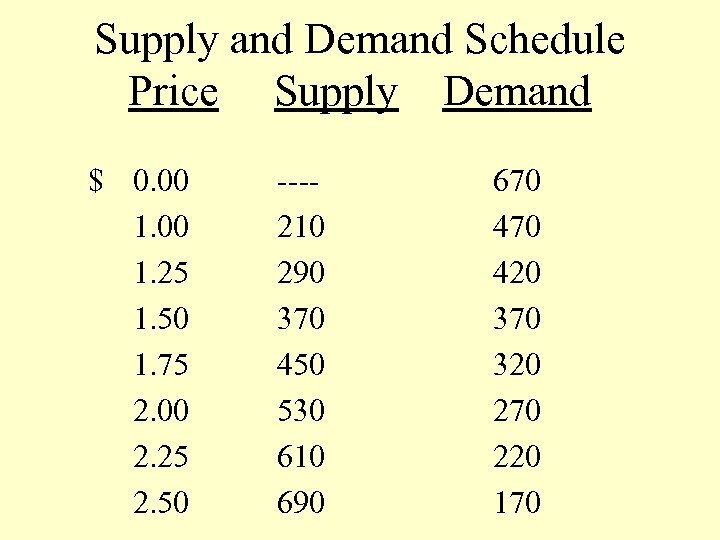 Supply and Demand Schedule Price Supply Demand $ 0. 00 1. 25 1. 50 1. 75 2. 00 2. 25 2. 50 ---210 290 370 450 530 610 690 670 420 370 320 270 220 170
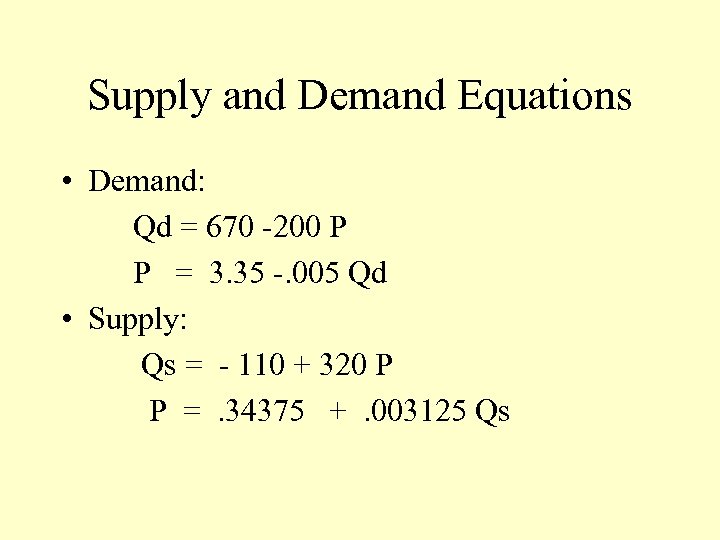 Supply and Demand Equations • Demand: Qd = 670 -200 P P = 3. 35 -. 005 Qd • Supply: Qs = - 110 + 320 P P =. 34375 +. 003125 Qs
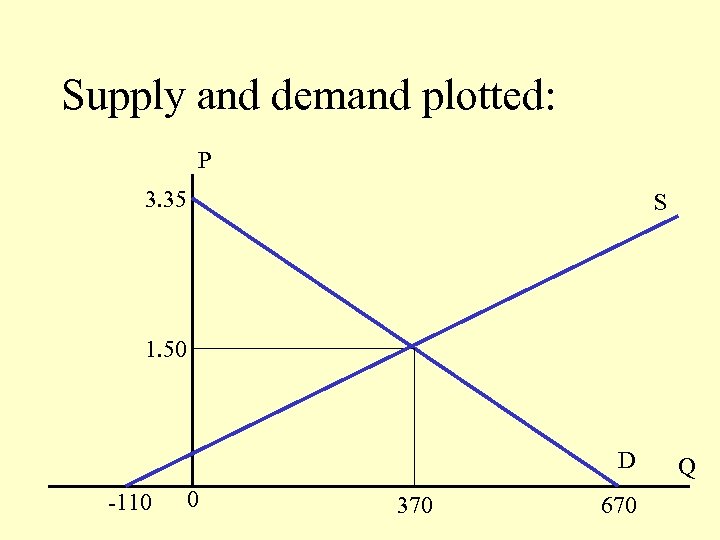 Supply and demand plotted: P 3. 35 S 1. 50 D -110 0 370 670 Q
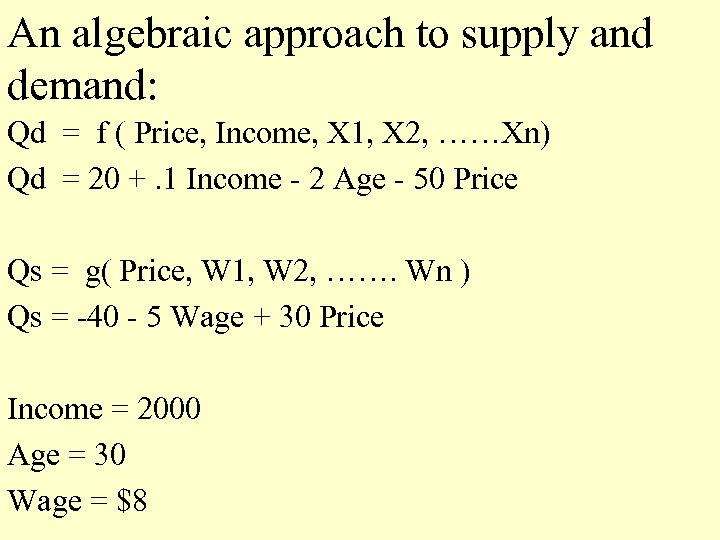 An algebraic approach to supply and demand: Qd = f ( Price, Income, X 1, X 2, ……Xn) Qd = 20 +. 1 Income - 2 Age - 50 Price Qs = g( Price, W 1, W 2, ……. Wn ) Qs = -40 - 5 Wage + 30 Price Income = 2000 Age = 30 Wage = $8
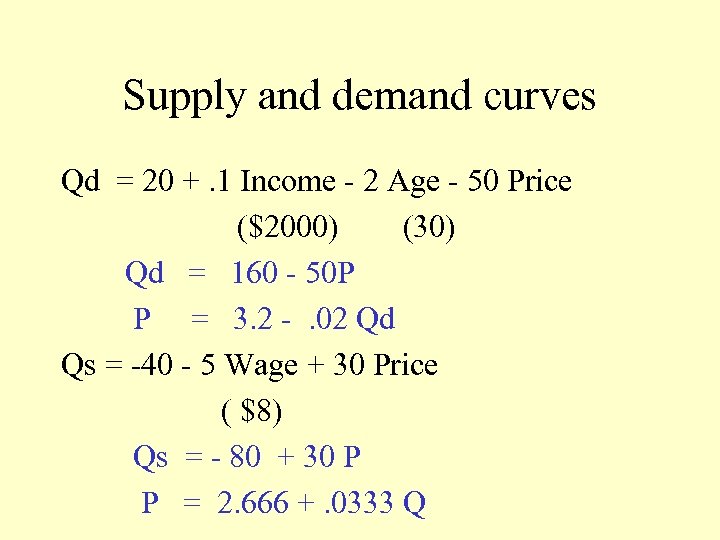 Supply and demand curves Qd = 20 +. 1 Income - 2 Age - 50 Price ($2000) (30) Qd = 160 - 50 P P = 3. 2 -. 02 Qd Qs = -40 - 5 Wage + 30 Price ( $8) Qs = - 80 + 30 P P = 2. 666 +. 0333 Q
 Shifts in supply and demand curve: • A change in any non-price factor in the demand function would result in a shift in the curve: changes in the intercepts. • A change in any non-price factor in the supply function would result in a shift in the curve: changes in the intercepts.
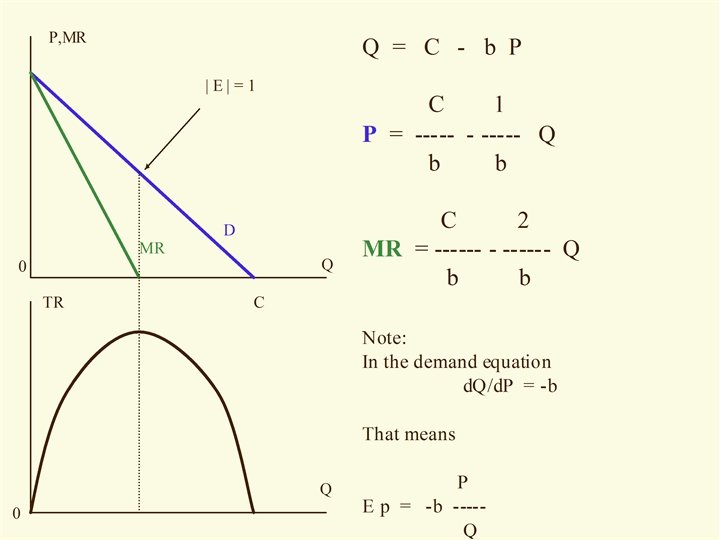
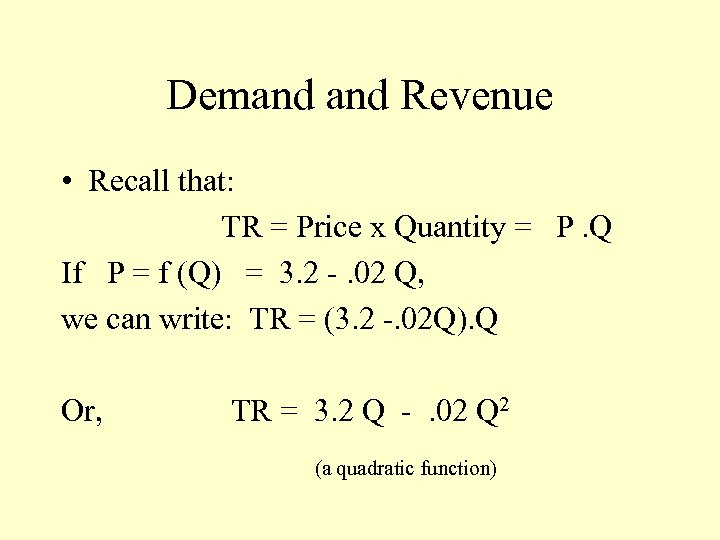 Demand Revenue • Recall that: TR = Price x Quantity = P. Q If P = f (Q) = 3. 2 -. 02 Q, we can write: TR = (3. 2 -. 02 Q). Q Or, TR = 3. 2 Q -. 02 Q 2 (a quadratic function)
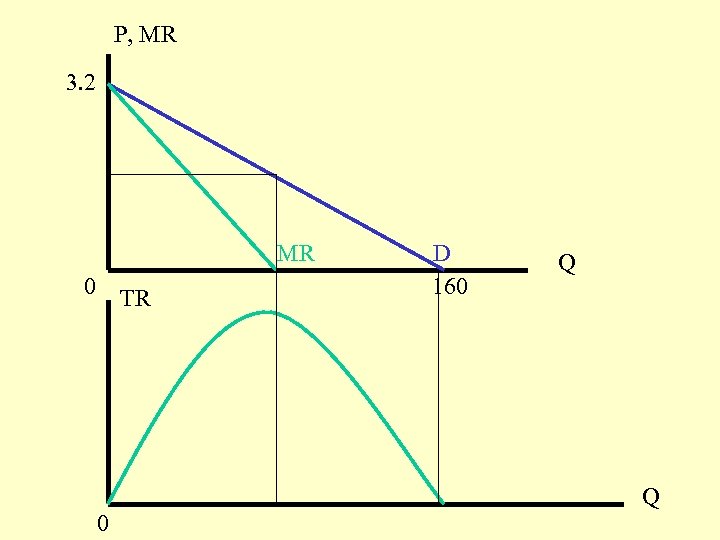 P, MR 3. 2 MR 0 TR D 160 Q Q 0
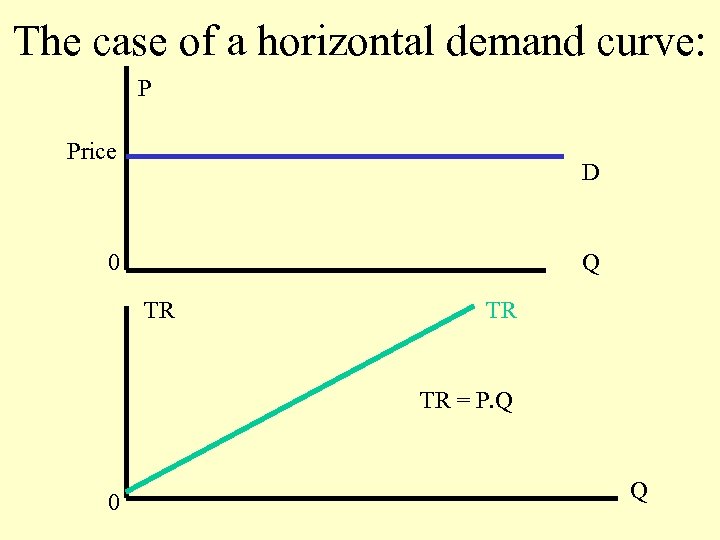 The case of a horizontal demand curve: P Price D 0 Q TR TR TR = P. Q 0 Q
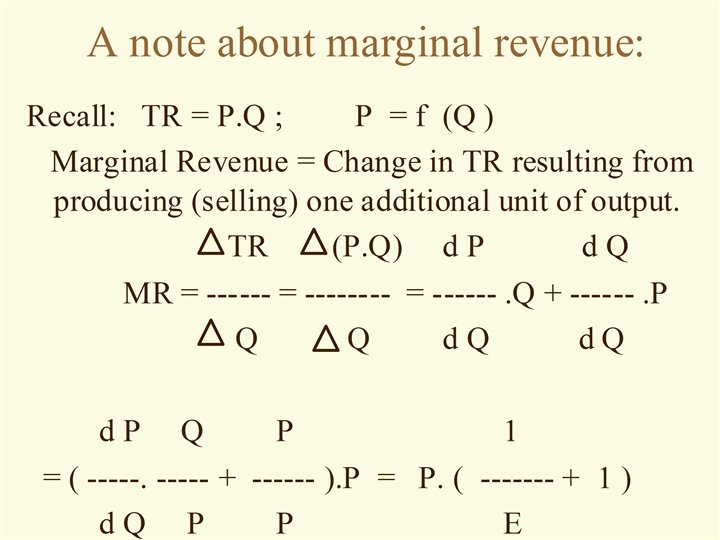
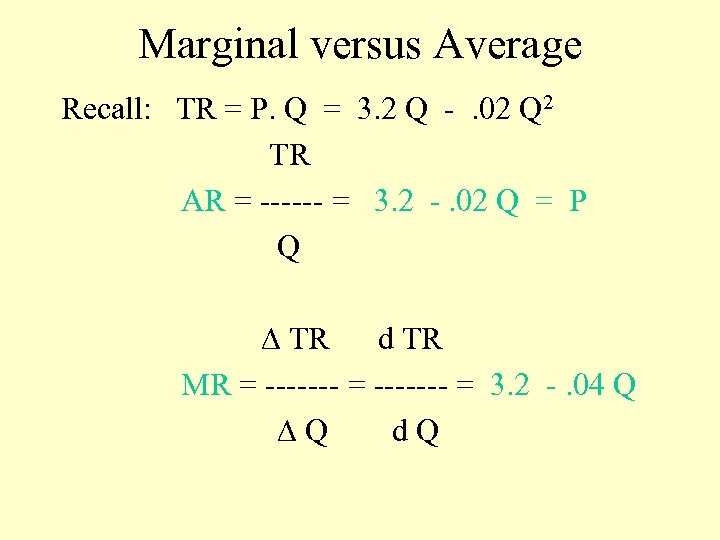 Marginal versus Average Recall: TR = P. Q = 3. 2 Q -. 02 Q 2 TR AR = ------ = 3. 2 -. 02 Q = P Q TR d TR MR = ------- = 3. 2 -. 04 Q Q d. Q
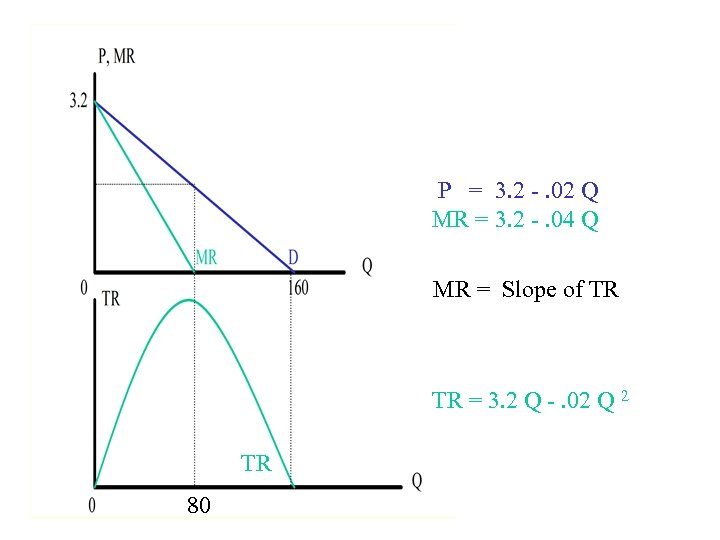 P = 3. 2 -. 02 Q MR = 3. 2 -. 04 Q MR = Slope of TR TR = 3. 2 Q -. 02 Q 2 TR 80
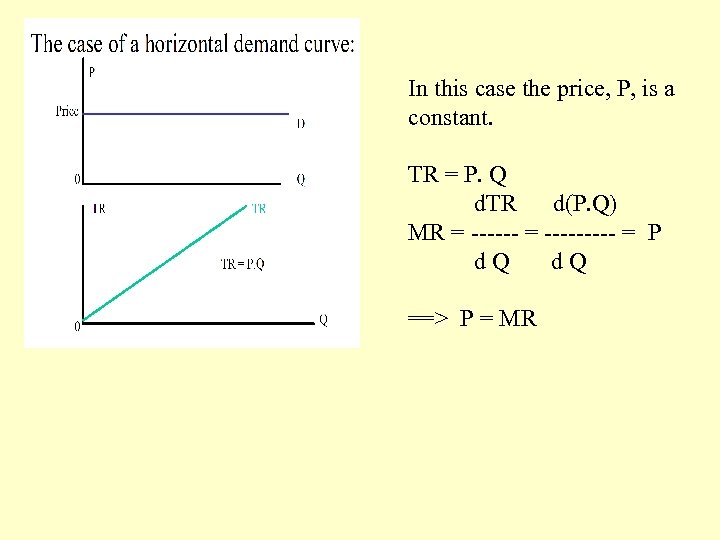 In this case the price, P, is a constant. TR = P. Q d. TR d(P. Q) MR = --------- = P d. Q ==> P = MR
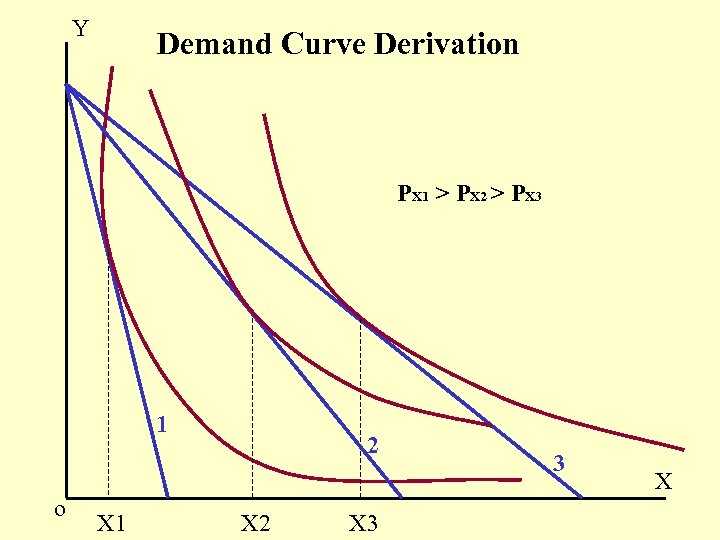
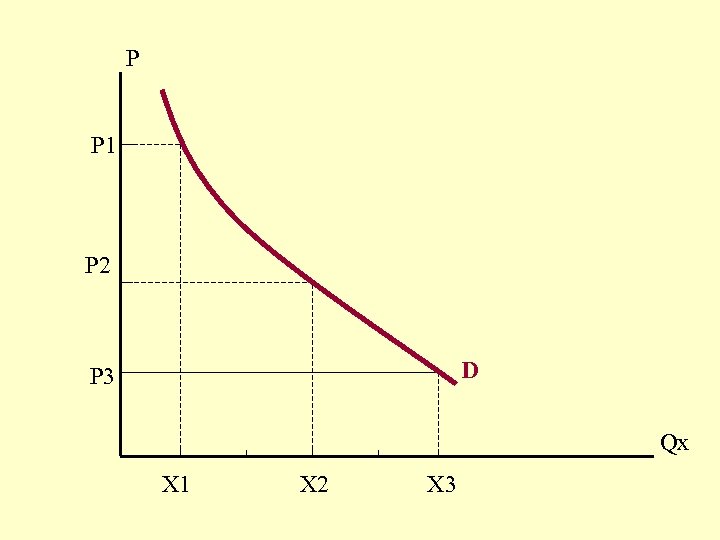
 Why is the demand curve generally downward-sloping? The Consumer theory : • The indifference curve • The Budget line
 The Consumer Theory • • The concept of “utility” Cardinal measurement of utility Ordinal measurement of utility Marginal utility The principle of diminishing marginal utility Marginal utility and consumer choice Consumers’ optimizing behavior The Consumer’s optimizing rule >> the cardinal approach >> the ordinal approach
 Utility The satisfaction or pleasure a consumer derives from the consumption or possession of a good (or service) or an activity (or lack thereof), over a certain span of time. Note: An economic “bad” is an object, a condition, or an activity that brings on harm or displeasure to a consumer. A consumer derives utility from having an economic “bad” reduced or eliminated.
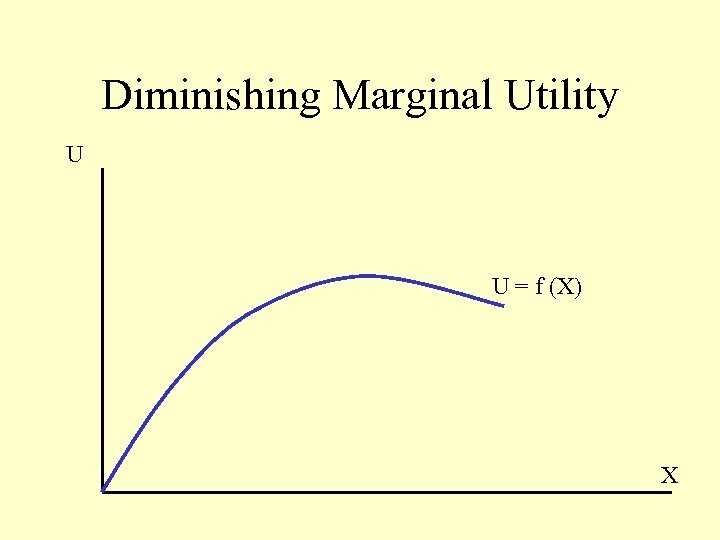 Diminishing Marginal Utility U U = f (X) X
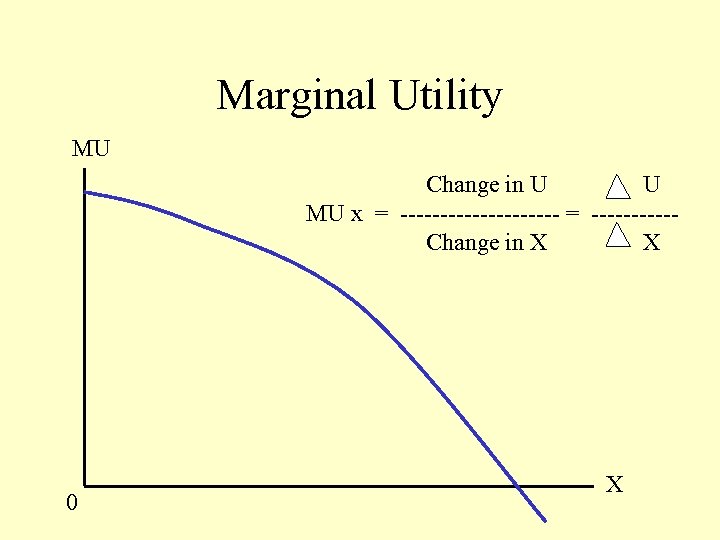 Marginal Utility MU Change in U U MU x = ---------- = -----Change in X X 0 X
 Consumer Choice Constrained by her income, to maximize her total utility a consumer allocates her income among different goods in such a way that the utility derived from the last dollar spent on each good would be equal to that each of the other goods.
 The principle of diminishing marginal utility: • As a consumer consumes more and more of a good, beyond a certain level, the utility of each additional unit of it (marginal utility) begins to decrease. • As a consumer consumes more and more of a good, beyond a certain level, each additional unit of that good becomes less dear to him/her
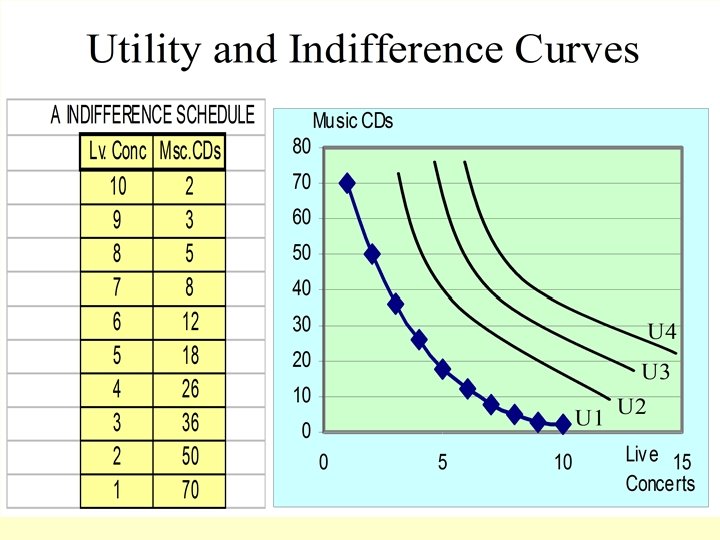
 Properties of an indifference curve • Generally, negatively sloped, reflecting marginal rate of substitution • Convex to the origin, reflecting diminishing marginal utility • Two indifference curves cannot cross • Special case: a positively sloped indifference curve
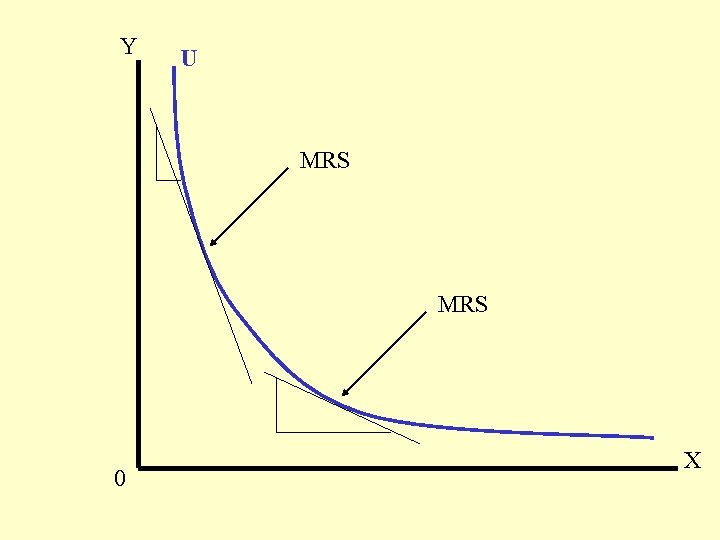
 Marginal Rate of Substitution • Definition: The rate at which a consumer is willing to substitute one good for another good while remaining at the same level of satisfaction. That is the amount of good X needed to replace one unit of (lost) good Y to keep the consumer’s level of satisfaction (utility) unchanged. • MRS = Slope of the indifference curve
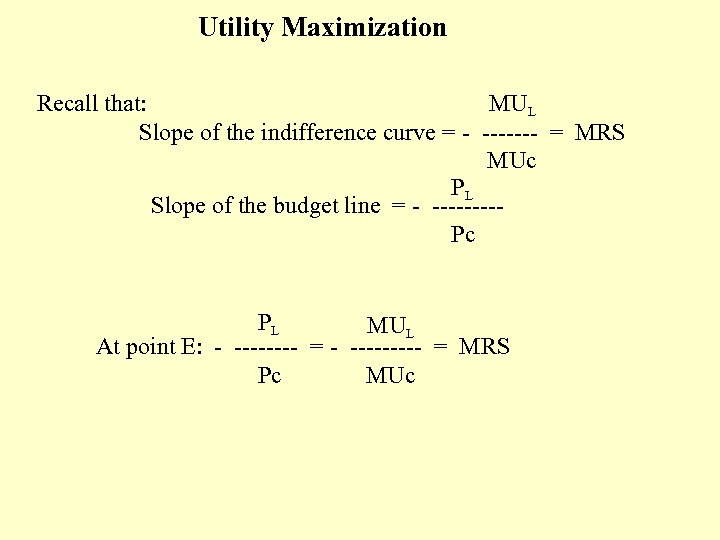
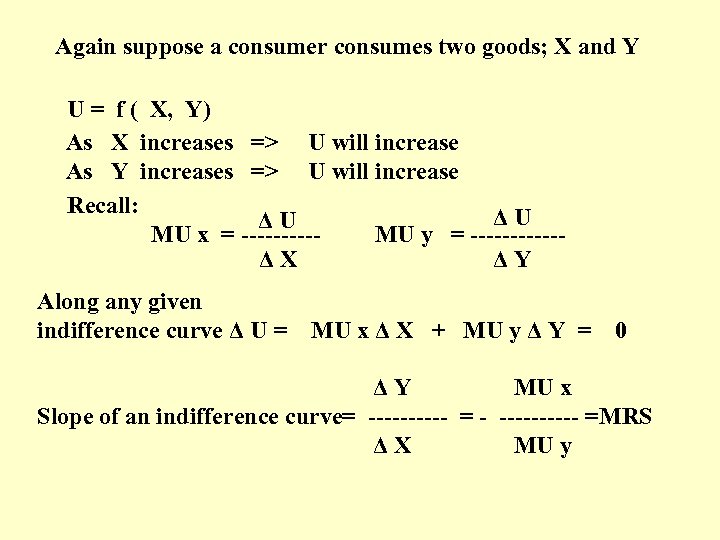 Again suppose a consumer consumes two goods; X and Y U = f ( X, Y) As X increases => U will increase As Y increases => U will increase Recall: ΔU ΔU MU x = -----MU y = ------ΔX ΔY Along any given indifference curve Δ U = MU x Δ X + MU y Δ Y = 0 ΔY MU x Slope of an indifference curve= ----- = - ----- =MRS ΔX MU y
 Y U MRS 0 X
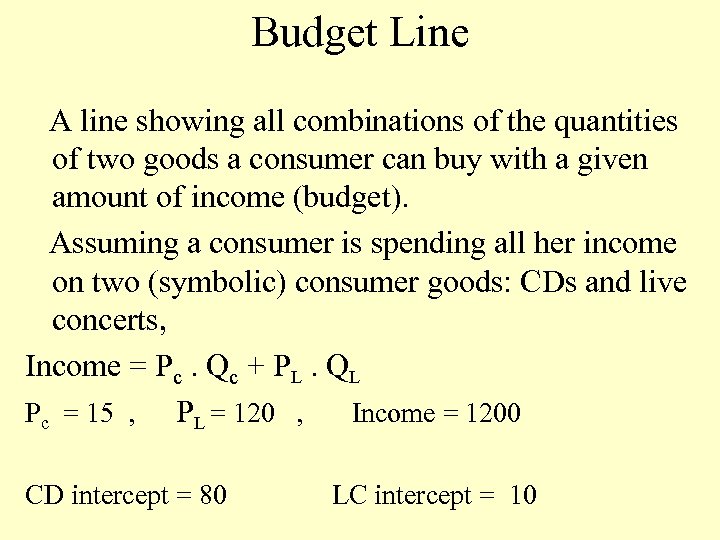 Budget Line A line showing all combinations of the quantities of two goods a consumer can buy with a given amount of income (budget). Assuming a consumer is spending all her income on two (symbolic) consumer goods: CDs and live concerts, Income = Pc. Qc + PL. QL Pc = 15 , PL = 120 , Income = 1200 CD intercept = 80 LC intercept = 10
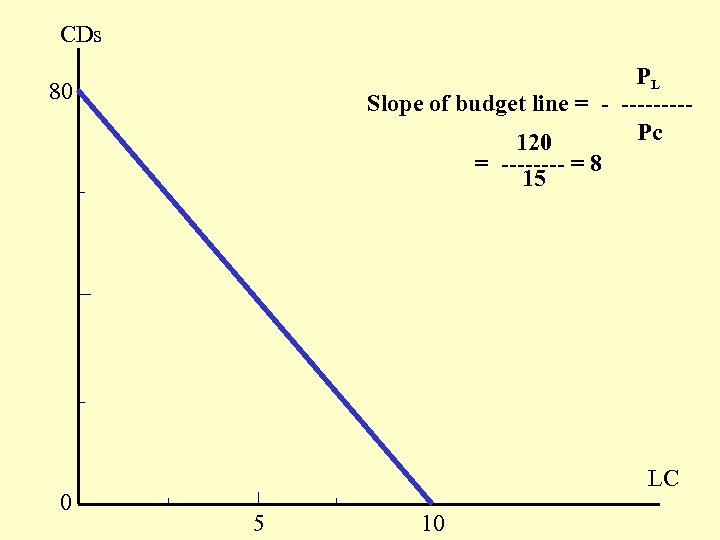 CDs PL Slope of budget line = - ----Pc 120 = ---- = 8 15 80 0 LC 5 10
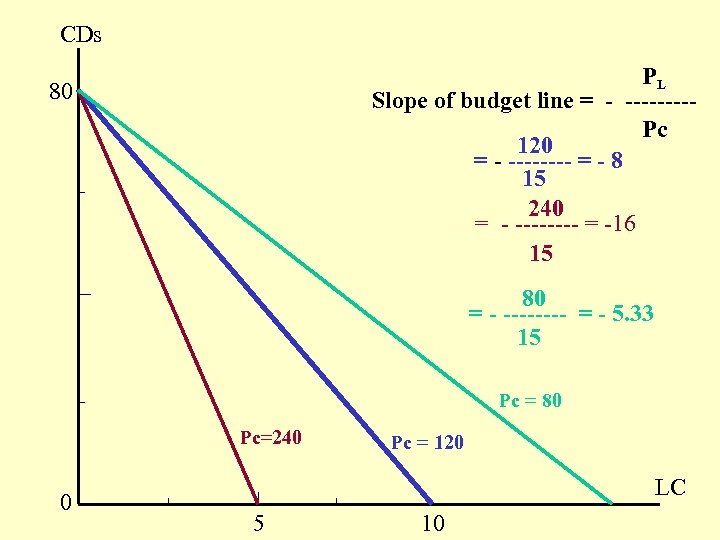 CDs PL Slope of budget line = - ----Pc 120 = - ---- = - 8 15 240 = - ---- = -16 15 80 80 = - ---- = - 5. 33 15 Pc = 80 Pc=240 0 Pc = 120 LC 5 10
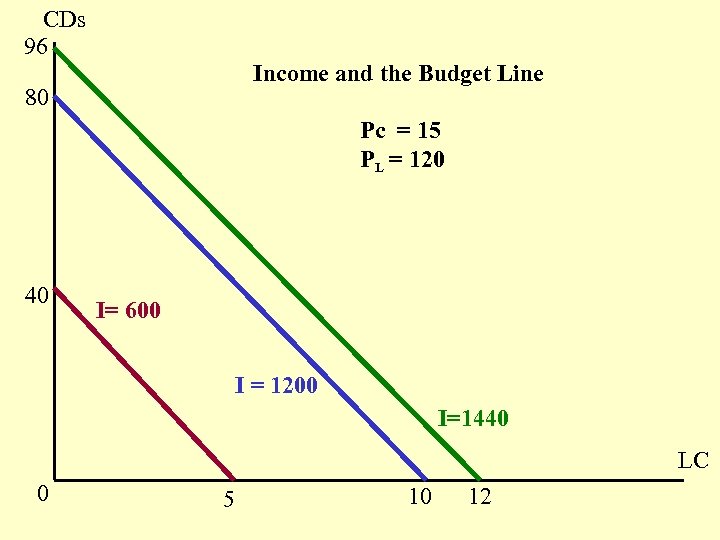 CDs 96 Income and the Budget Line 80 Pc = 15 PL = 120 40 I= 600 I = 1200 I=1440 LC 0 5 10 12
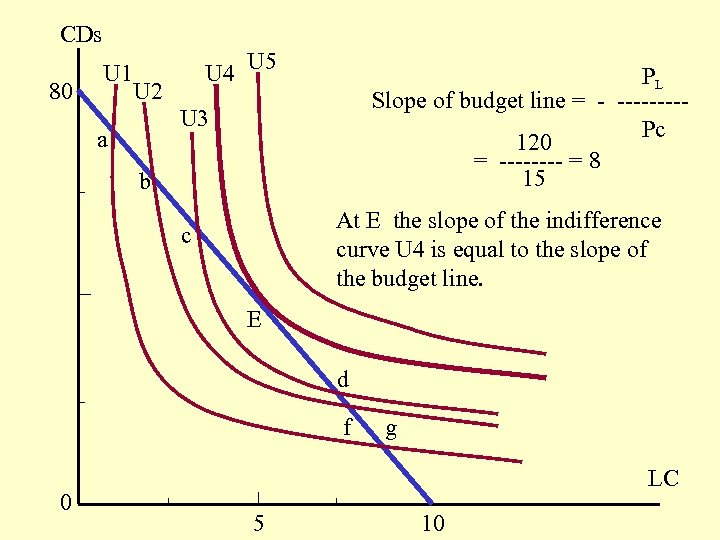 CDs 80 U 1 U 4 U 5 U 2 PL Slope of budget line = - ----Pc 120 = ---- = 8 15 U 3 a b At E the slope of the indifference curve U 4 is equal to the slope of the budget line. c E d f 0 g LC 5 10
 Utility Maximization Recall that: MUL Slope of the indifference curve = - ------- = MRS MUc PL Slope of the budget line = - ----Pc PL MUL At point E: - ---- = - ----- = MRS Pc MUc
 Y Demand Curve Derivation PX 1 > PX 2 > PX 3 1 o X 1 2 X 3 3 X
 P P 1 P 2 D P 3 Qx X 1 X 2 X 3
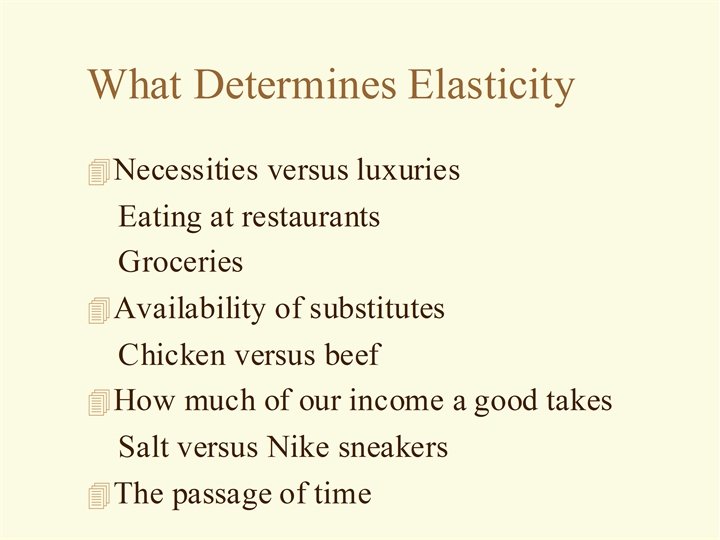
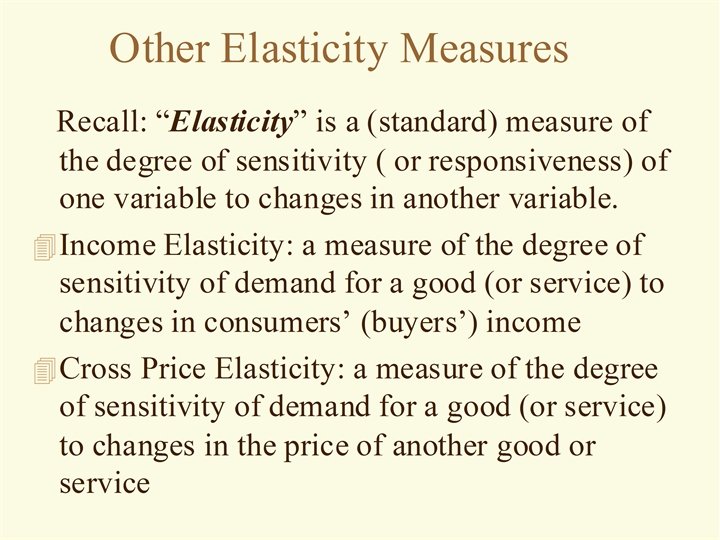
 Elasticity A general definition: Elasticity is a standardized measure of the sensitivity of one (dependent) variable to changes in another variable. Price elasticity of demand: A measure of the sensitivity of the quantity demanded a good to changes in the price of that good.
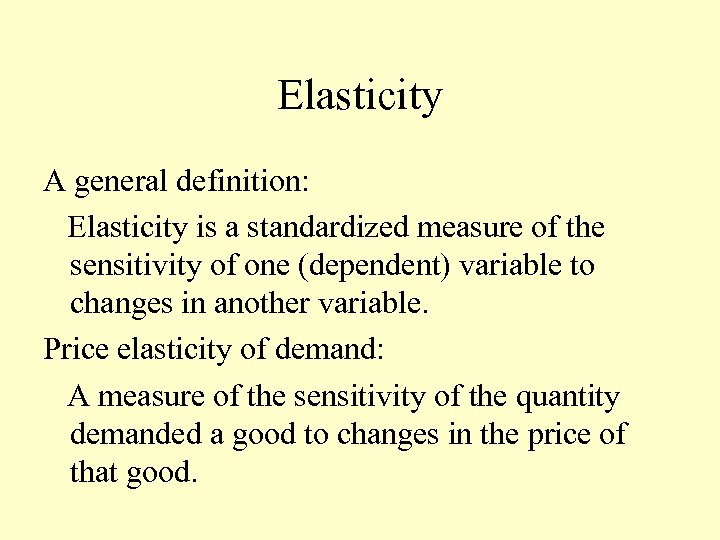
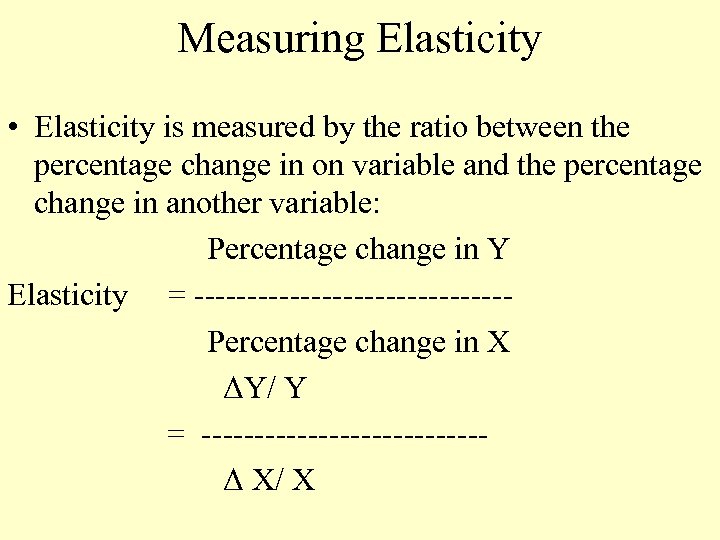 Measuring Elasticity • Elasticity is measured by the ratio between the percentage change in on variable and the percentage change in another variable: Percentage change in Y Elasticity = ---------------Percentage change in X ΔY/ Y = -------------Δ X/ X
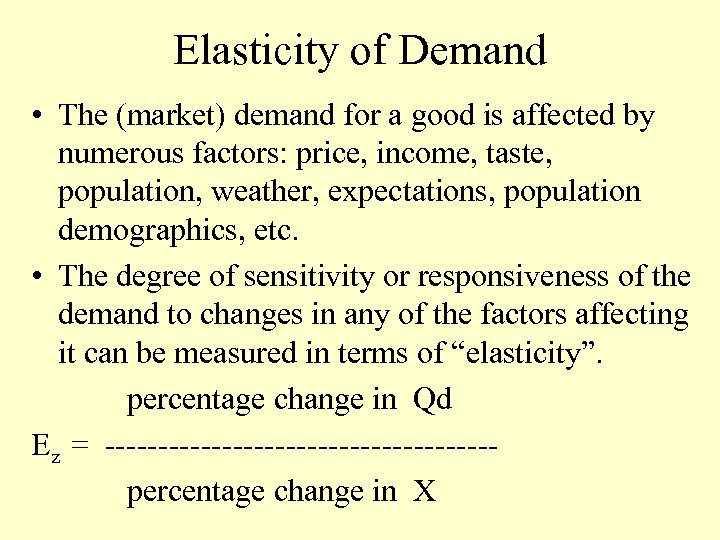 Elasticity of Demand • The (market) demand for a good is affected by numerous factors: price, income, taste, population, weather, expectations, population demographics, etc. • The degree of sensitivity or responsiveness of the demand to changes in any of the factors affecting it can be measured in terms of “elasticity”. percentage change in Qd Ez = ------------------percentage change in X
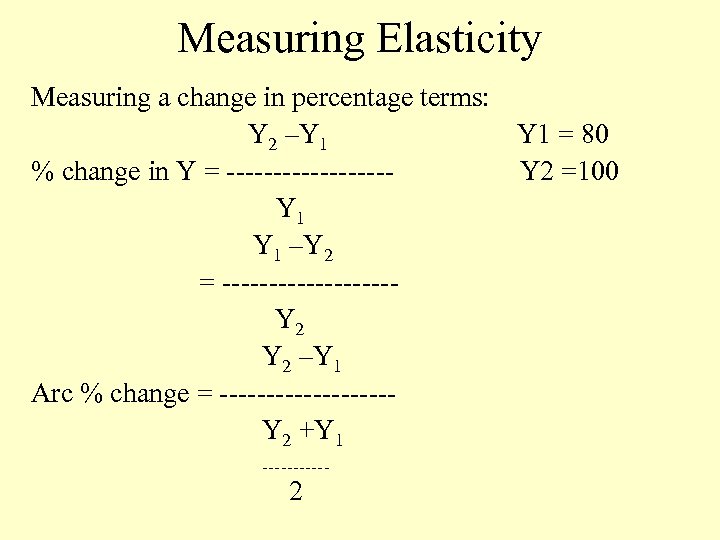 Measuring Elasticity Measuring a change in percentage terms: Y 2 –Y 1 = 80 % change in Y = ---------Y 2 =100 Y 1 –Y 2 = ---------Y 2 –Y 1 Arc % change = ---------Y 2 +Y 1 ------ 2
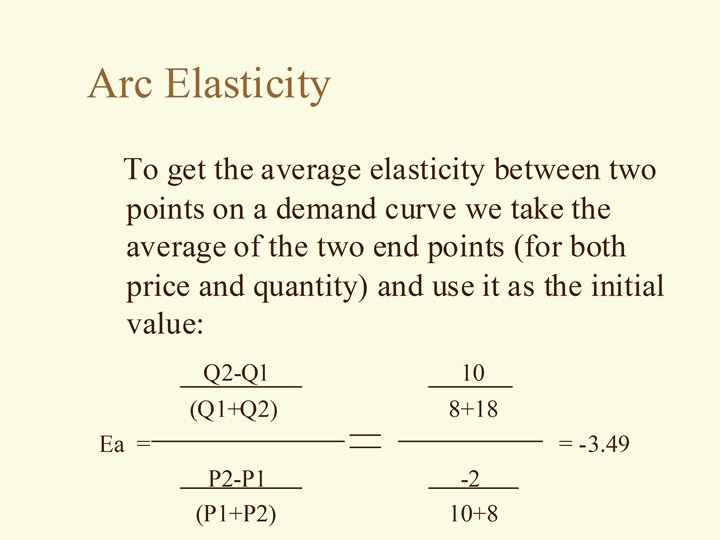
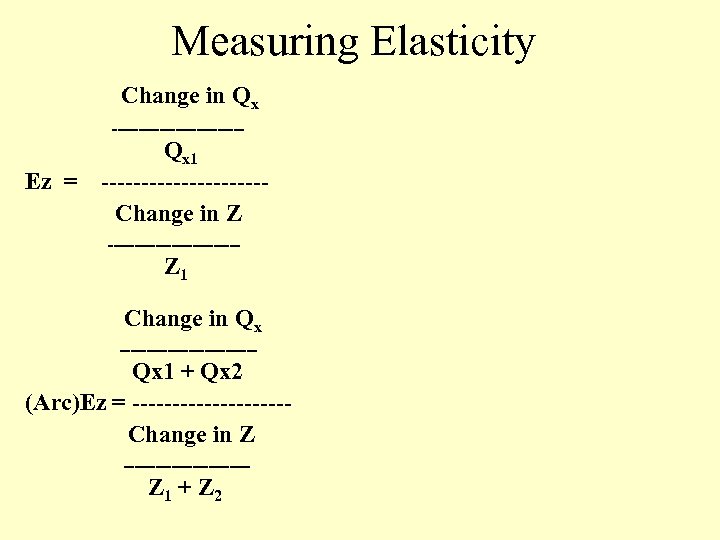 Measuring Elasticity Change in Qx ------------- Ez = Qx 1 ----------Change in Z ------------- Z 1 Change in Qx ------------- Qx 1 + Qx 2 (Arc)Ez = ----------Change in Z ------------ Z 1 + Z 2
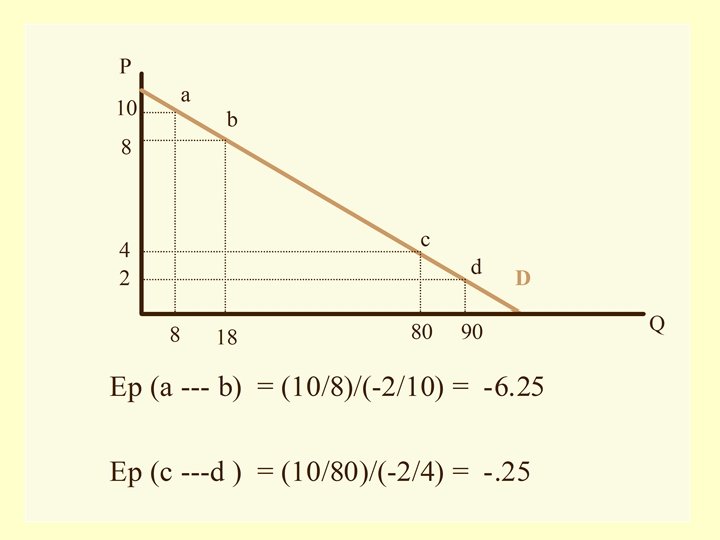
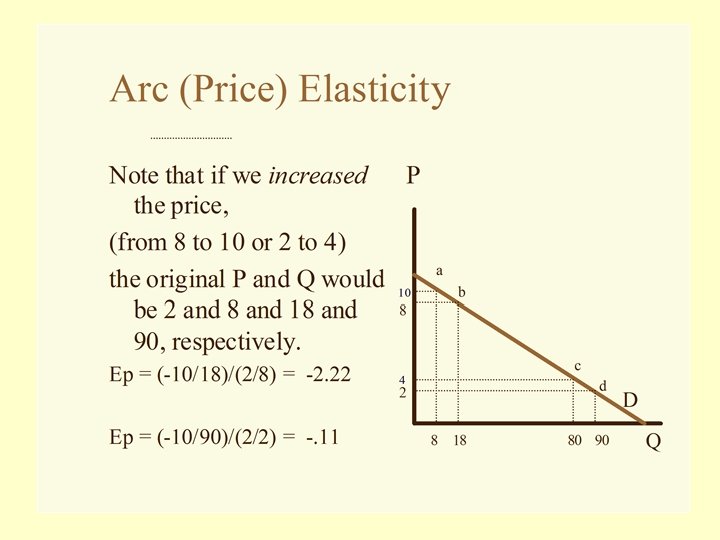
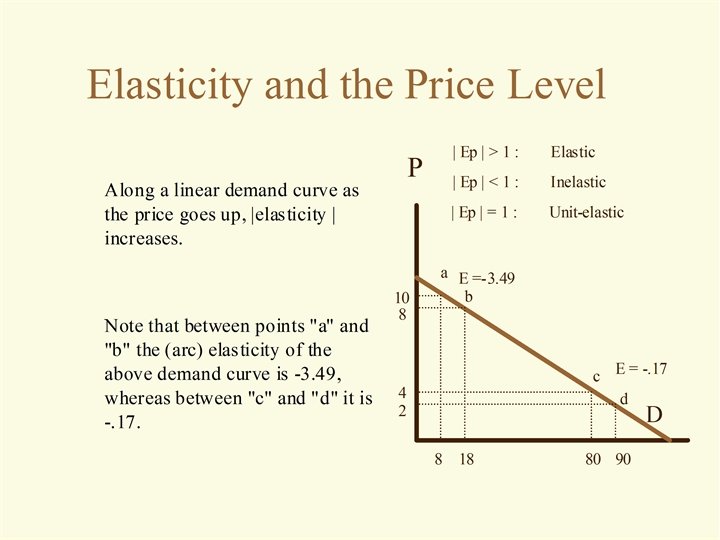
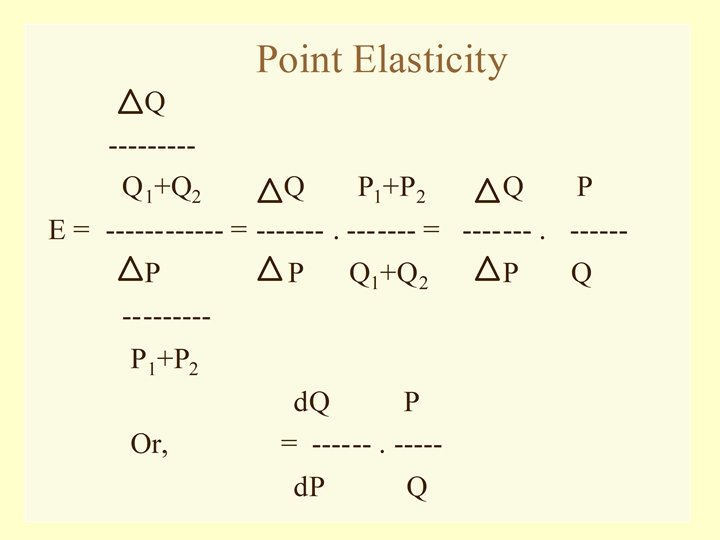
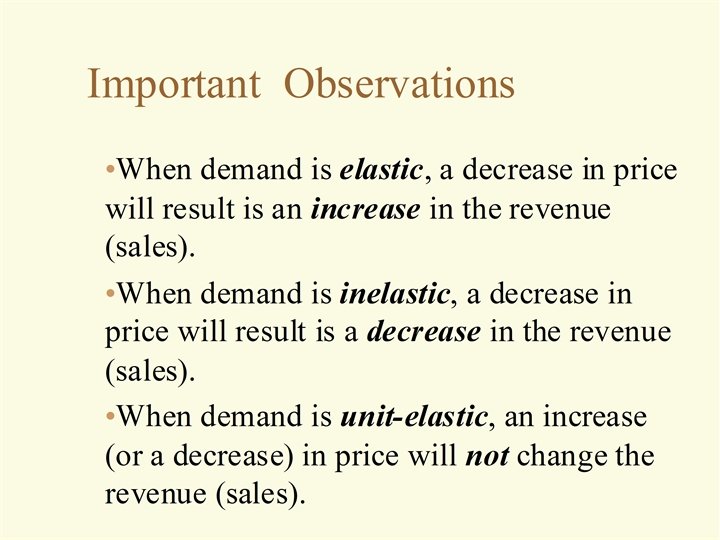
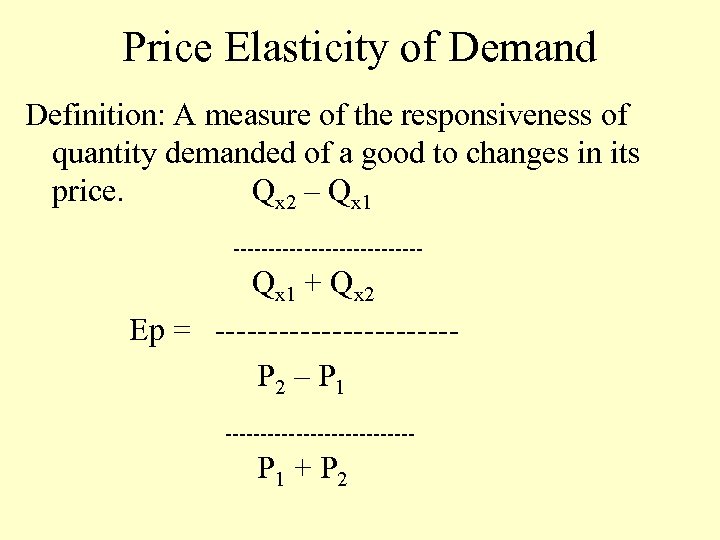 Price Elasticity of Demand Definition: A measure of the responsiveness of quantity demanded of a good to changes in its price. Qx 2 – Qx 1 -------------- Qx 1 + Qx 2 Ep = -----------P 2 – P 1 -------------- P 1 + P 2
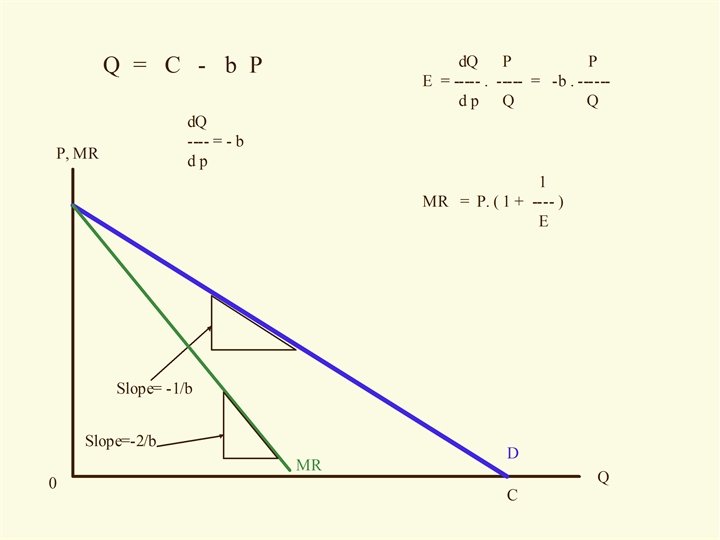
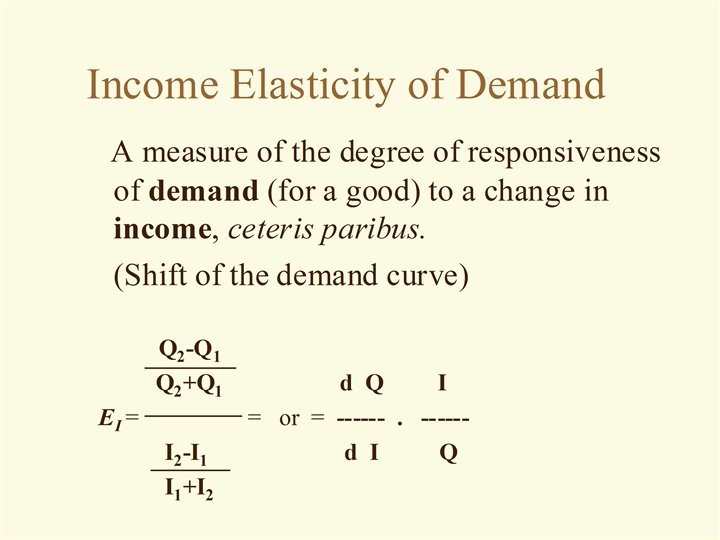
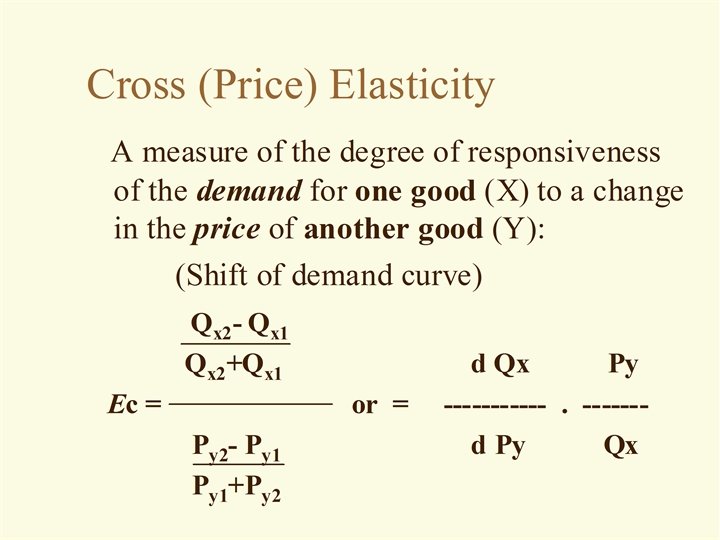
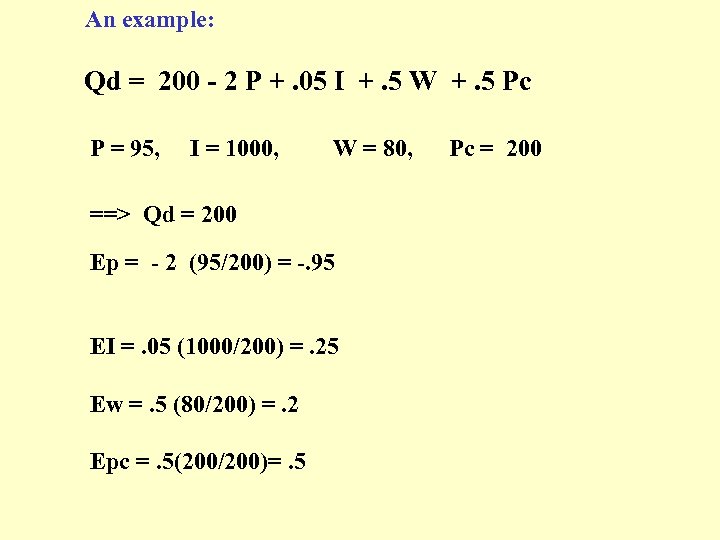 An example: Qd = 200 - 2 P +. 05 I +. 5 W +. 5 Pc P = 95, I = 1000, W = 80, ==> Qd = 200 Ep = - 2 (95/200) = -. 95 EI =. 05 (1000/200) =. 25 Ew =. 5 (80/200) =. 2 Epc =. 5(200/200)=. 5 Pc = 200