


 Скачать презентацию Managerial Competency Appraisal A Crosscultural Study of American
43103439ce2485cb36da911b9e11a97e.ppt
- Количество слайдов: 21
 Managerial Competency Appraisal: A Crosscultural Study of American and East Asian Managers Journal of Business Research 61 (2008) P 191 -200 Eric Chong
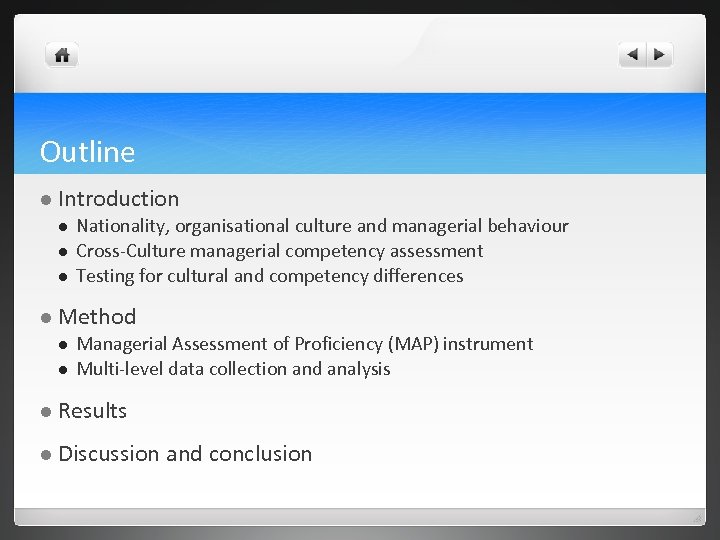 Outline l Introduction l l l Nationality, organisational culture and managerial behaviour Cross-Culture managerial competency assessment Testing for cultural and competency differences l Method l l Managerial Assessment of Proficiency (MAP) instrument Multi-level data collection and analysis l Results l Discussion and conclusion
 Purpose l What extent to then can the managerial competencies acquires in one cultural environment be applied to in a different environment?
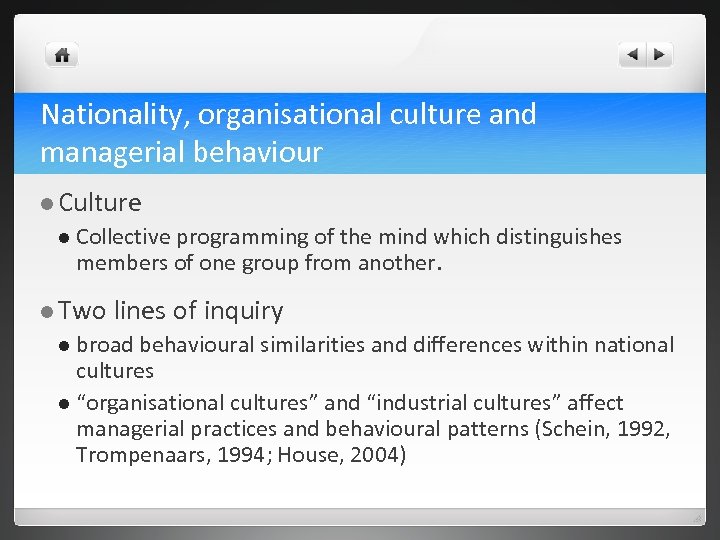 Nationality, organisational culture and managerial behaviour l Culture l Collective programming of the mind which distinguishes members of one group from another. l Two lines of inquiry l broad behavioural similarities and differences within national cultures l “organisational cultures” and “industrial cultures” affect managerial practices and behavioural patterns (Schein, 1992, Trompenaars, 1994; House, 2004)
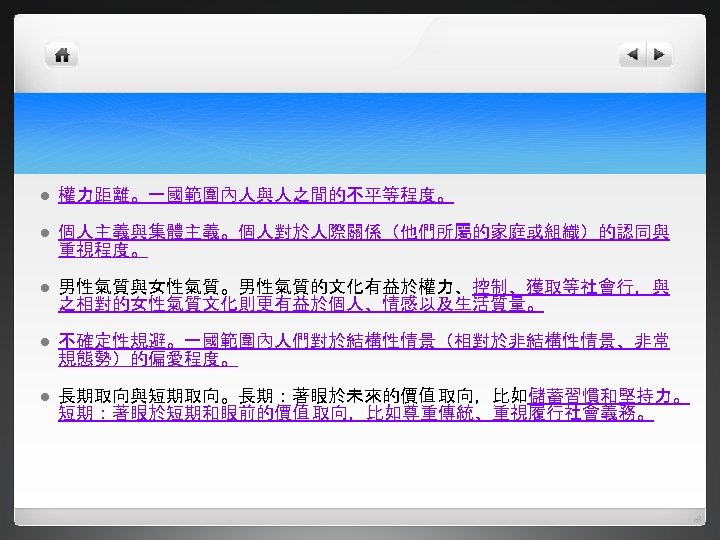 l 權力距離。一國範圍內人與人之間的不平等程度。 l 個人主義與集體主義。個人對於人際關係(他們所屬的家庭或組織)的認同與 重視程度。 l 男性氣質與女性氣質。男性氣質的文化有益於權力、控制、獲取等社會行,與 之相對的女性氣質文化則更有益於個人、情感以及生活質量。 l 不確定性規避。一國範圍內人們對於結構性情景(相對於非結構性情景、非常 規態勢)的偏愛程度。 l 長期取向與短期取向。長期:著眼於未來的價值 取向,比如儲蓄習慣和堅持力。 短期:著眼於短期和眼前的價值 取向,比如尊重傳統、重視履行社會義務。
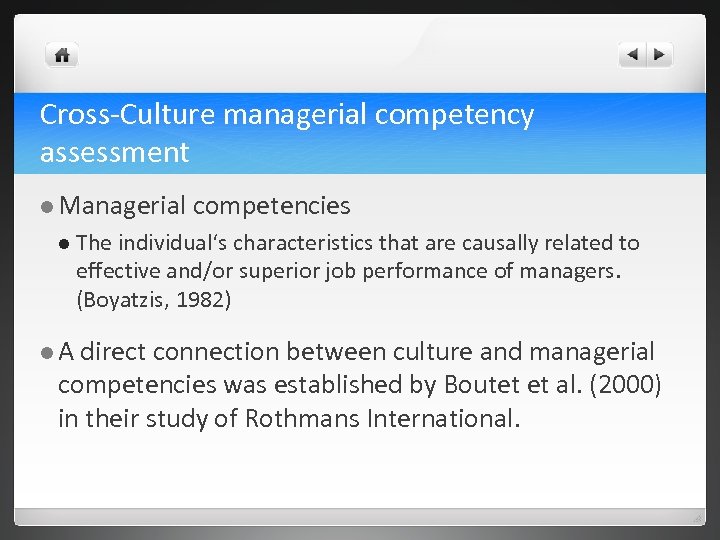 Cross-Culture managerial competency assessment l Managerial competencies l The individual‘s characteristics that are causally related to effective and/or superior job performance of managers. (Boyatzis, 1982) l. A direct connection between culture and managerial competencies was established by Boutet et al. (2000) in their study of Rothmans International.
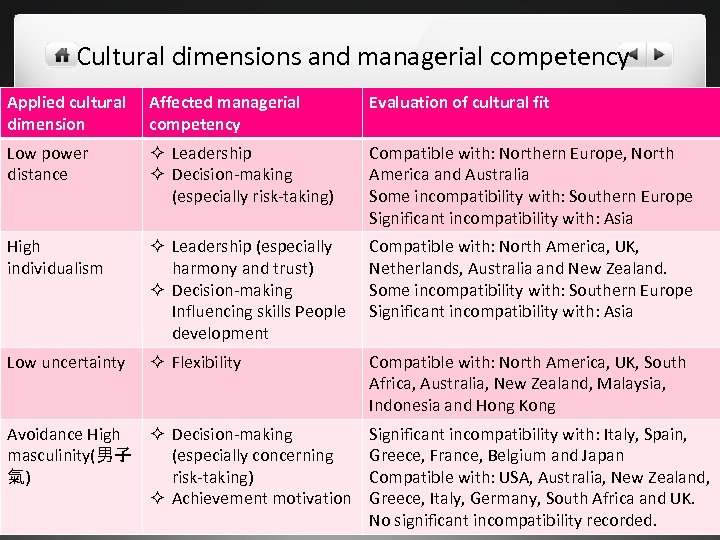 Cultural dimensions and managerial competency Applied cultural dimension Affected managerial competency Evaluation of cultural fit Low power distance ² Leadership ² Decision-making (especially risk-taking) Compatible with: Northern Europe, North America and Australia Some incompatibility with: Southern Europe Significant incompatibility with: Asia High individualism ² Leadership (especially harmony and trust) ² Decision-making Influencing skills People development Compatible with: North America, UK, Netherlands, Australia and New Zealand. Some incompatibility with: Southern Europe Significant incompatibility with: Asia Low uncertainty ² Flexibility Compatible with: North America, UK, South Africa, Australia, New Zealand, Malaysia, Indonesia and Hong Kong Avoidance High ² Decision-making masculinity(男子 (especially concerning 氣) risk-taking) ² Achievement motivation Significant incompatibility with: Italy, Spain, Greece, France, Belgium and Japan Compatible with: USA, Australia, New Zealand, Greece, Italy, Germany, South Africa and UK. No significant incompatibility recorded.
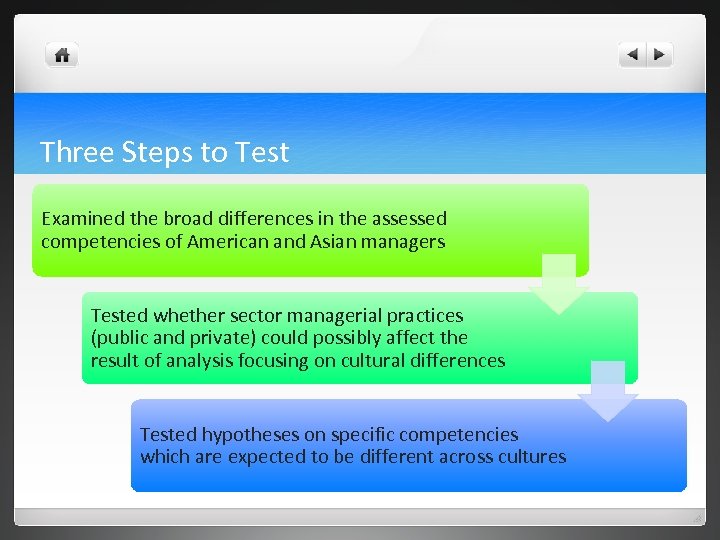 Three Steps to Test Examined the broad differences in the assessed competencies of American and Asian managers Tested whether sector managerial practices (public and private) could possibly affect the result of analysis focusing on cultural differences Tested hypotheses on specific competencies which are expected to be different across cultures
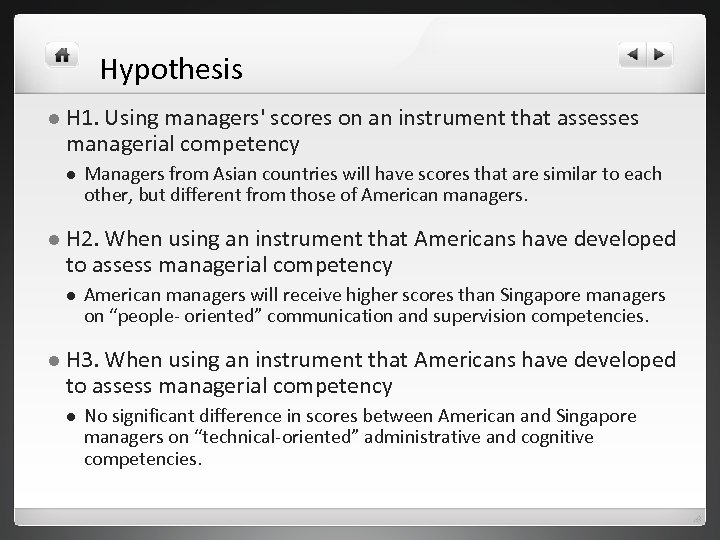 Hypothesis l H 1. Using managers' scores on an instrument that assesses managerial competency l Managers from Asian countries will have scores that are similar to each other, but different from those of American managers. l H 2. When using an instrument that Americans have developed to assess managerial competency l American managers will receive higher scores than Singapore managers on “people- oriented” communication and supervision competencies. l H 3. When using an instrument that Americans have developed to assess managerial competency l No significant difference in scores between American and Singapore managers on “technical-oriented” administrative and cognitive competencies.
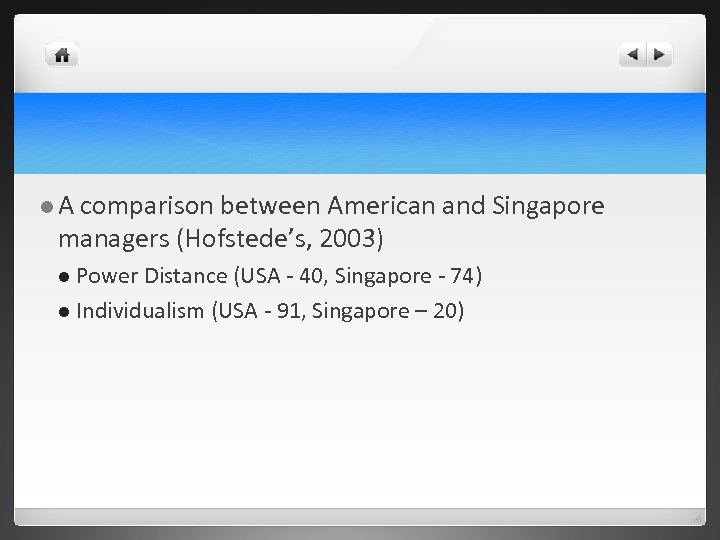 l. A comparison between American and Singapore managers (Hofstede’s, 2003) l Power Distance (USA - 40, Singapore - 74) l Individualism (USA - 91, Singapore – 20)
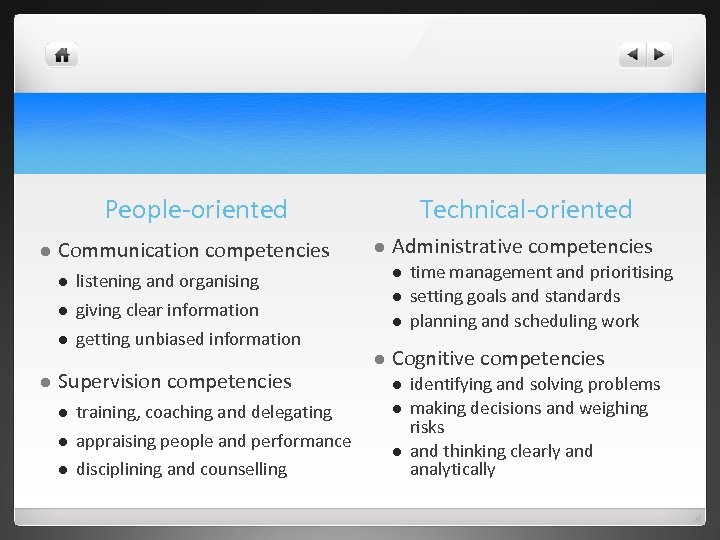 People-oriented l Communication competencies l l getting unbiased information Supervision competencies l training, coaching and delegating l appraising people and performance l disciplining and counselling Administrative competencies l giving clear information l l listening and organising l Technical-oriented l l l time management and prioritising setting goals and standards planning and scheduling work Cognitive competencies l l l identifying and solving problems making decisions and weighing risks and thinking clearly and analytically
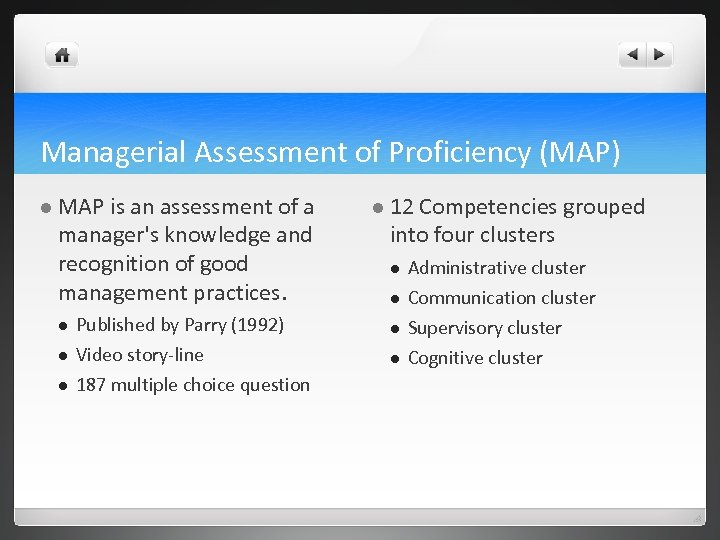 Managerial Assessment of Proficiency (MAP) l MAP is an assessment of a manager's knowledge and recognition of good management practices. l l l Published by Parry (1992) Video story-line 187 multiple choice question l 12 Competencies grouped into four clusters l l Administrative cluster Communication cluster Supervisory cluster Cognitive cluster
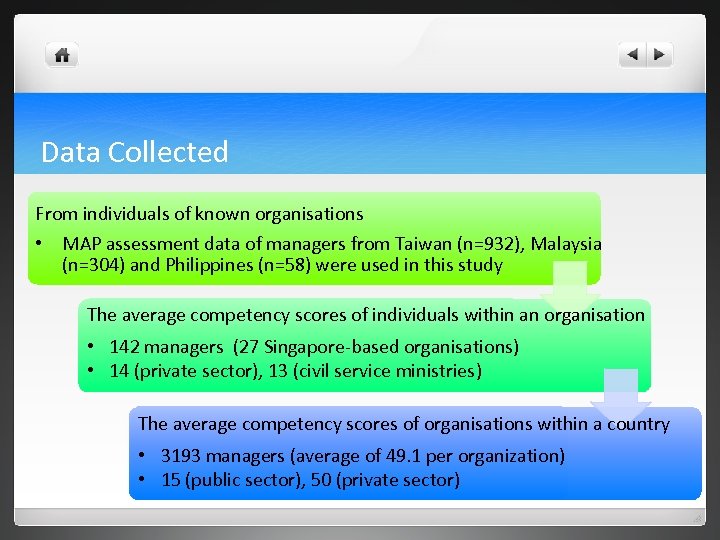 Data Collected From individuals of known organisations Examined the broad differences in the assessed • MAP assessment. American and Asian managers competencies of data of managers from Taiwan (n=932), Malaysia (n=304) and Philippines (n=58) were used in this study Tested whether sector managerial practices The average competency scores of individuals within an organisation (public and private) could possibly affect the • 142 managers (27 Singapore-based organisations) result of analysis focusing on cultural • 14 (private sector), 13 (civil service ministries) differences The average competency scores of competencies Tested hypotheses on specific organisations within a country which managers (average of 49. 1 per across • 3193 are expected to be differentorganization) cultures • 15 (public sector), 50 (private sector)
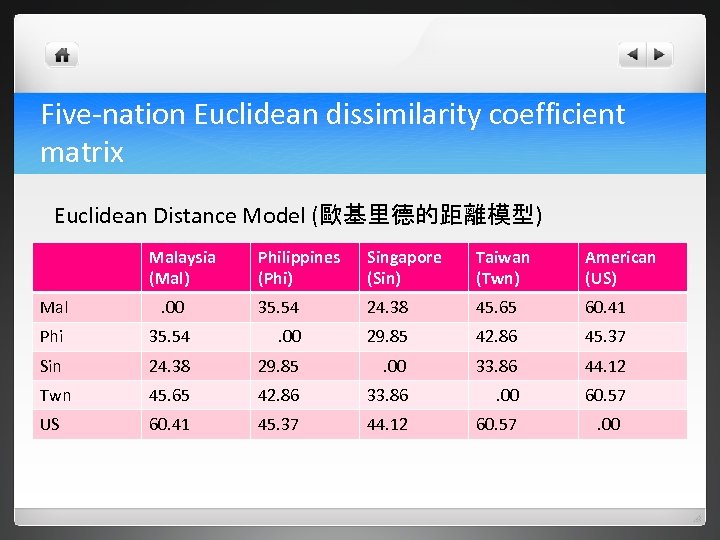 Five-nation Euclidean dissimilarity coefficient matrix Euclidean Distance Model (歐基里德的距離模型) Malaysia (Mal) Philippines (Phi) Singapore (Sin) Taiwan (Twn) American (US) 35. 54 24. 38 45. 65 60. 41 Mal . 00 Phi 35. 54 . 00 29. 85 42. 86 45. 37 Sin 24. 38 29. 85 . 00 33. 86 44. 12 Twn 45. 65 42. 86 33. 86 . 00 60. 57 US 60. 41 45. 37 44. 12 60. 57 . 00
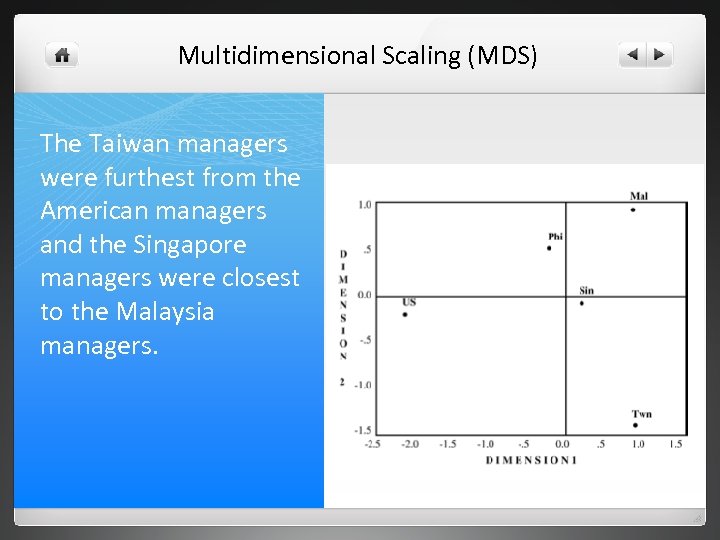 Multidimensional Scaling (MDS) The Taiwan managers were furthest from the American managers and the Singapore managers were closest to the Malaysia managers.
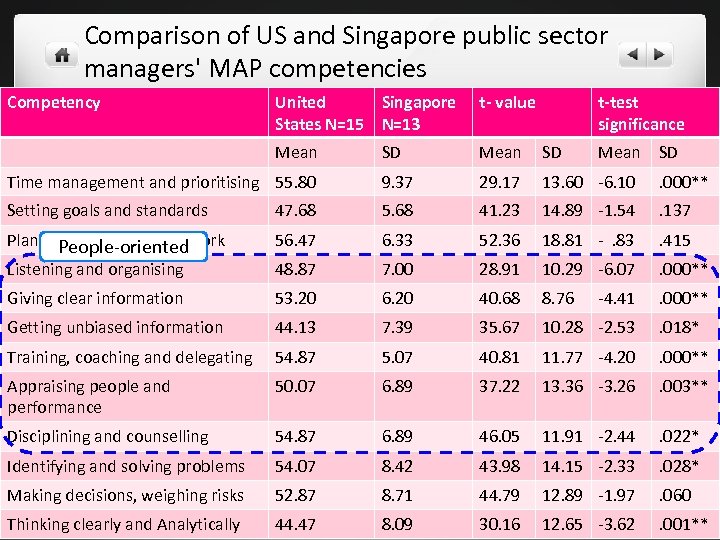 Comparison of US and Singapore public sector managers' MAP competencies Competency United Singapore States N=15 N=13 t- value t-test significance Mean SD Time management and prioritising 55. 80 9. 37 29. 17 13. 60 -6. 10 . 000** Setting goals and standards 47. 68 5. 68 41. 23 14. 89 -1. 54 . 137 Planning and scheduling work People-oriented 56. 47 6. 33 52. 36 18. 81 -. 83 . 415 Listening and organising 48. 87 7. 00 28. 91 10. 29 -6. 07 . 000** Giving clear information 53. 20 6. 20 40. 68 8. 76 . 000** Getting unbiased information 44. 13 7. 39 35. 67 10. 28 -2. 53 . 018* Training, coaching and delegating 54. 87 5. 07 40. 81 11. 77 -4. 20 . 000** Appraising people and performance 50. 07 6. 89 37. 22 13. 36 -3. 26 . 003** Disciplining and counselling 54. 87 6. 89 46. 05 11. 91 -2. 44 . 022* Identifying and solving problems 54. 07 8. 42 43. 98 14. 15 -2. 33 . 028* Making decisions, weighing risks 52. 87 8. 71 44. 79 12. 89 -1. 97 . 060 Thinking clearly and Analytically 44. 47 8. 09 30. 16 12. 65 -3. 62 . 001** Mean -4. 41 SD
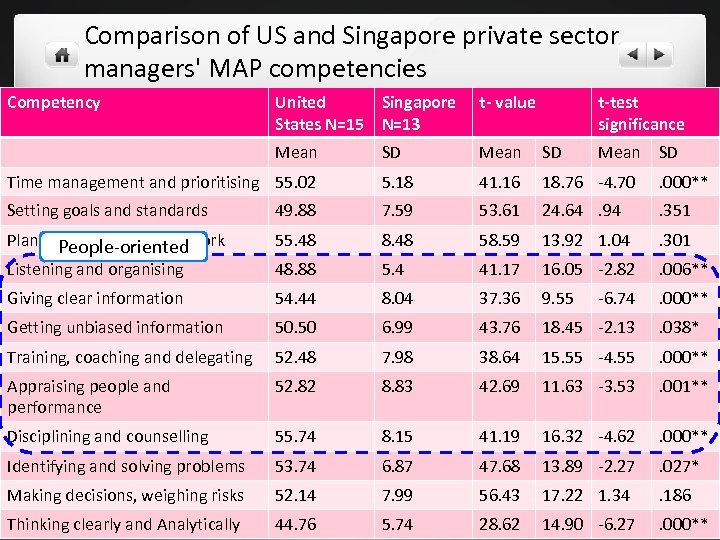 Comparison of US and Singapore private sector managers' MAP competencies Competency United Singapore States N=15 N=13 t- value t-test significance Mean SD Time management and prioritising 55. 02 5. 18 41. 16 18. 76 -4. 70 . 000** Setting goals and standards 49. 88 7. 59 53. 61 24. 64. 94 . 351 Planning and scheduling work People-oriented 55. 48 8. 48 58. 59 13. 92 1. 04 . 301 Listening and organising 48. 88 5. 4 41. 17 16. 05 -2. 82 . 006** Giving clear information 54. 44 8. 04 37. 36 9. 55 . 000** Getting unbiased information 50. 50 6. 99 43. 76 18. 45 -2. 13 . 038* Training, coaching and delegating 52. 48 7. 98 38. 64 15. 55 -4. 55 . 000** Appraising people and performance 52. 82 8. 83 42. 69 11. 63 -3. 53 . 001** Disciplining and counselling 55. 74 8. 15 41. 19 16. 32 -4. 62 . 000** Identifying and solving problems 53. 74 6. 87 47. 68 13. 89 -2. 27 . 027* Making decisions, weighing risks 52. 14 7. 99 56. 43 17. 22 1. 34 . 186 Thinking clearly and Analytically 44. 76 5. 74 28. 62 14. 90 -6. 27 . 000** Mean -6. 74 SD
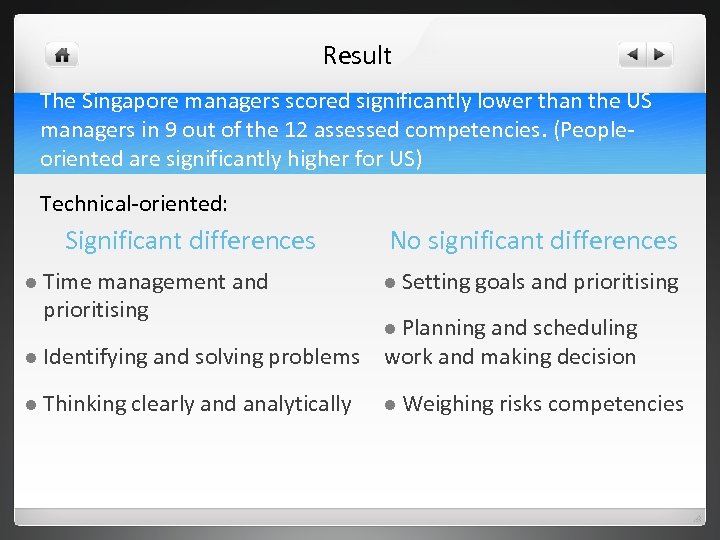 Result The Singapore managers scored significantly lower than the US managers in 9 out of the 12 assessed competencies. (Peopleoriented are significantly higher for US) Technical-oriented: Significant differences l Time management and prioritising No significant differences l Setting goals and prioritising and scheduling l Identifying and solving problems work and making decision l Thinking clearly and analytically l Planning l Weighing risks competencies
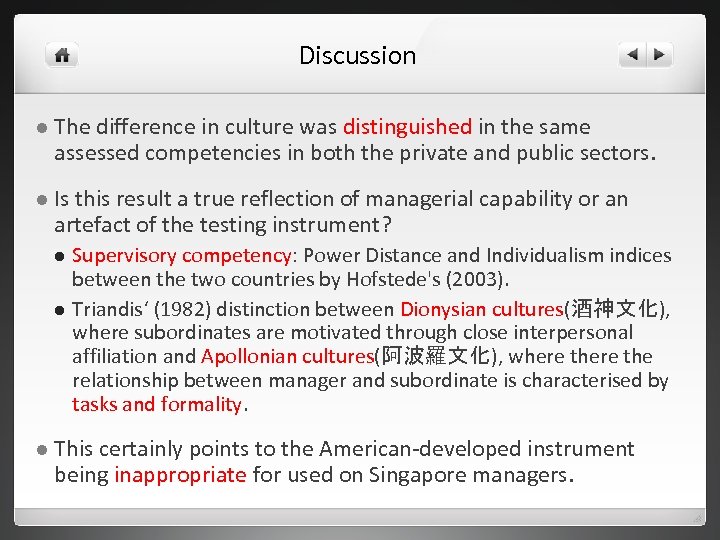 Discussion l The difference in culture was distinguished in the same assessed competencies in both the private and public sectors. l Is this result a true reflection of managerial capability or an artefact of the testing instrument? Supervisory competency: Power Distance and Individualism indices between the two countries by Hofstede's (2003). l Triandis‘ (1982) distinction between Dionysian cultures(酒神文化), where subordinates are motivated through close interpersonal affiliation and Apollonian cultures(阿波羅文化), where the relationship between manager and subordinate is characterised by tasks and formality. l l This certainly points to the American-developed instrument being inappropriate for used on Singapore managers.
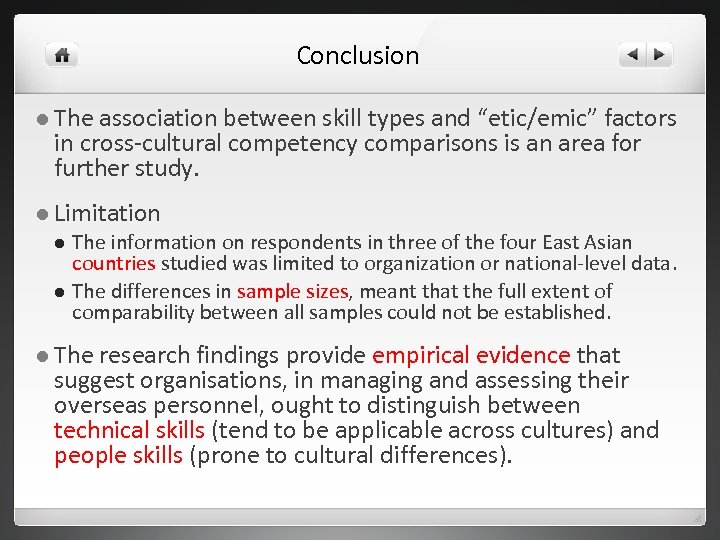 Conclusion l The association between skill types and “etic/emic” factors in cross-cultural competency comparisons is an area for further study. l Limitation The information on respondents in three of the four East Asian countries studied was limited to organization or national-level data. l The differences in sample sizes, meant that the full extent of comparability between all samples could not be established. l l The research findings provide empirical evidence that suggest organisations, in managing and assessing their overseas personnel, ought to distinguish between technical skills (tend to be applicable across cultures) and people skills (prone to cultural differences).
 Thanks for your listening.