


 Скачать презентацию Managerial Accounting Weygandt Kieso Kimmel CHAPTER
c5d619612e539a415103be87dd5a71eb.ppt
- Количество слайдов: 45
 Managerial Accounting Weygandt • Kieso • Kimmel CHAPTER 6 INCREMENTAL ANALYSIS Prepared by Dan R. Ward Suzanne P. Ward University of Louisiana at Lafayette John Wiley & Sons, Inc. © 2005
 CHAPTER 6 INCREMENTAL ANALYSIS Study Objectives Identify the steps in management’s decisionmaking process. Describe the concept of incremental analysis. Identify the relevant costs in accepting an order at a special price. Identify the relevant costs in a make-or-buy decision. Identify the relevant costs in determining whether to sell or process further.
 Study Objectives: Continued Identify the relevant costs to be considered in retaining or replacing equipment. Identify the relevant costs in deciding whether to eliminate an unprofitable segment. Determine sales mix when a company has limited resources.
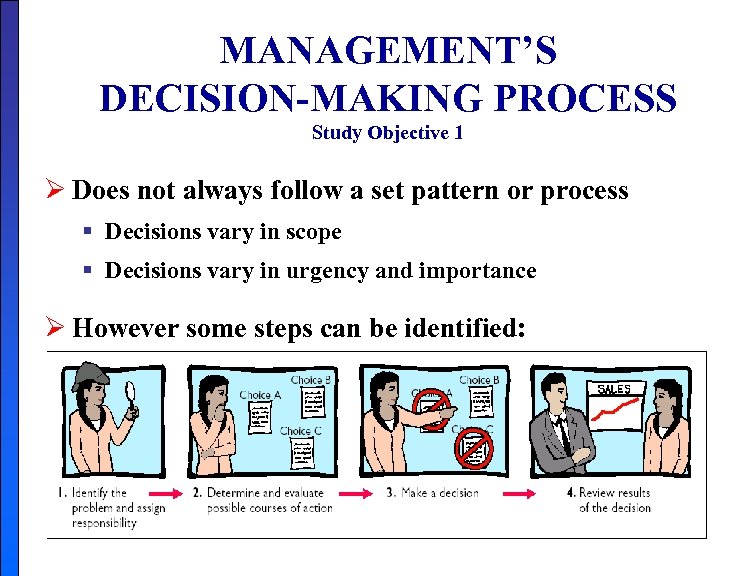 MANAGEMENT’S DECISION-MAKING PROCESS Study Objective 1 Ø Does not always follow a set pattern or process § Decisions vary in scope § Decisions vary in urgency and importance Ø However some steps can be identified:
 MANAGEMENT’S DECISION MAKING PROCESS Ø Considers both financial and nonfinancial information § Financial information • Revenues and costs • Overall profitability § Nonfinancial information • Effect of decision on employee turnover • Environment • Overall image of company
 MANAGEMENT’S DECISION-MAKING Incremental Analysis Approach Study Objective 2 Ø Decisions involve a choice among alternative actions Ø Financial data relevant to a decision are the data that vary in the future among alternatives § Both costs and revenues may vary or § Only costs may vary Ø Incremental Analysis: Process to identify financial data that change under alternative actions § Identifies probable effects of decisions on future earnings
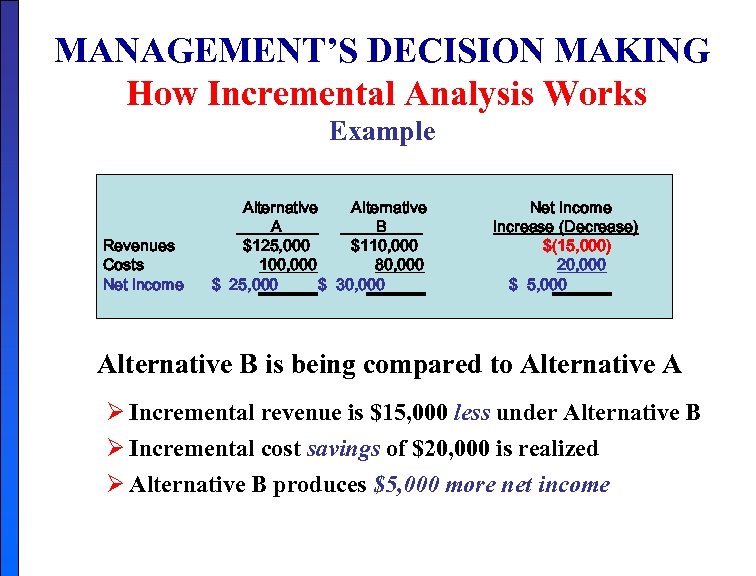 MANAGEMENT’S DECISION MAKING How Incremental Analysis Works Example Revenues Costs Net income Alternative A B $125, 000 $110, 000 100, 000 80, 000 $ 25, 000 $ 30, 000 Net Income Increase (Decrease) $(15, 000) 20, 000 $ 5, 000 Alternative B is being compared to Alternative A Ø Incremental revenue is $15, 000 less under Alternative B Ø Incremental cost savings of $20, 000 is realized Ø Alternative B produces $5, 000 more net income
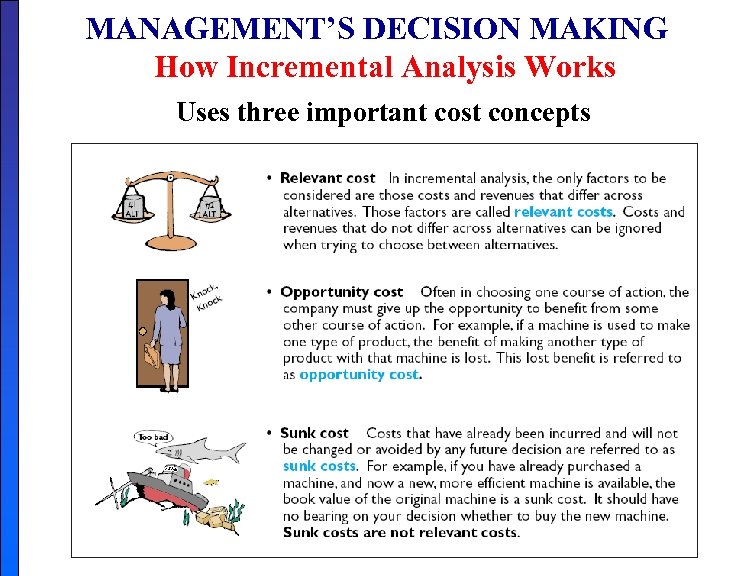 MANAGEMENT’S DECISION MAKING How Incremental Analysis Works Uses three important cost concepts
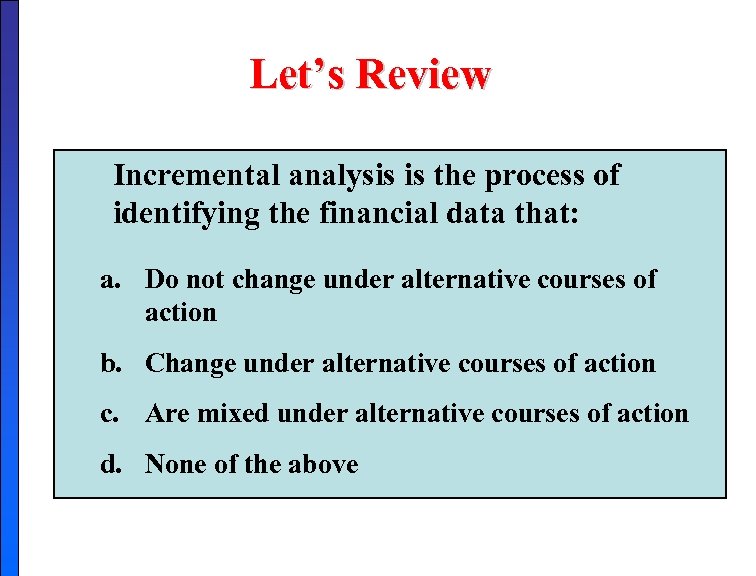 Let’s Review Incremental analysis is the process of identifying the financial data that: a. Do not change under alternative courses of action b. Change under alternative courses of action c. Are mixed under alternative courses of action d. None of the above
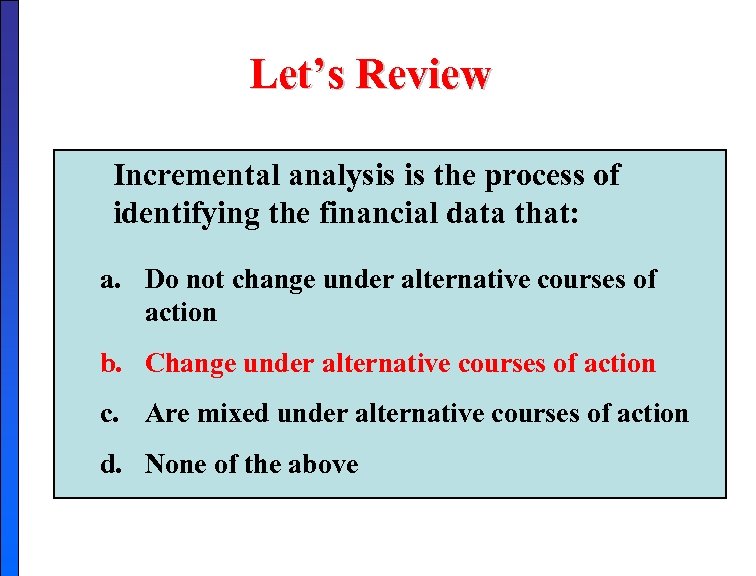 Let’s Review Incremental analysis is the process of identifying the financial data that: a. Do not change under alternative courses of action b. Change under alternative courses of action c. Are mixed under alternative courses of action d. None of the above
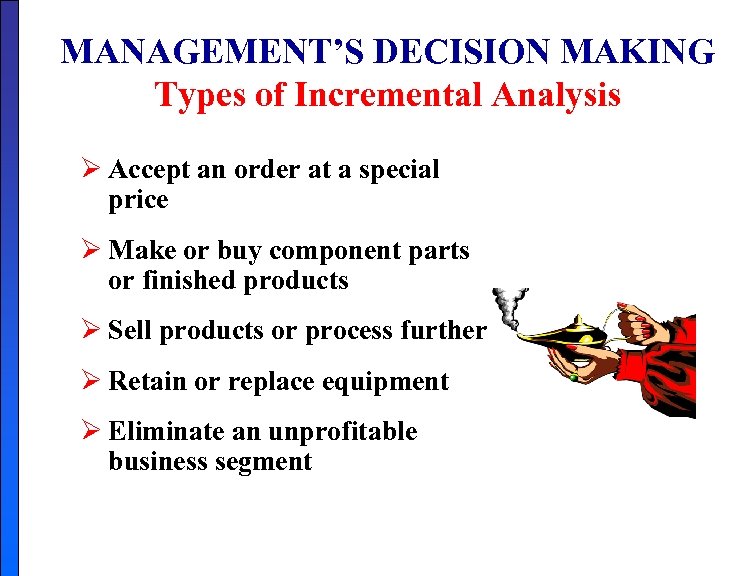 MANAGEMENT’S DECISION MAKING Types of Incremental Analysis Ø Accept an order at a special price Ø Make or buy component parts or finished products Ø Sell products or process further Ø Retain or replace equipment Ø Eliminate an unprofitable business segment
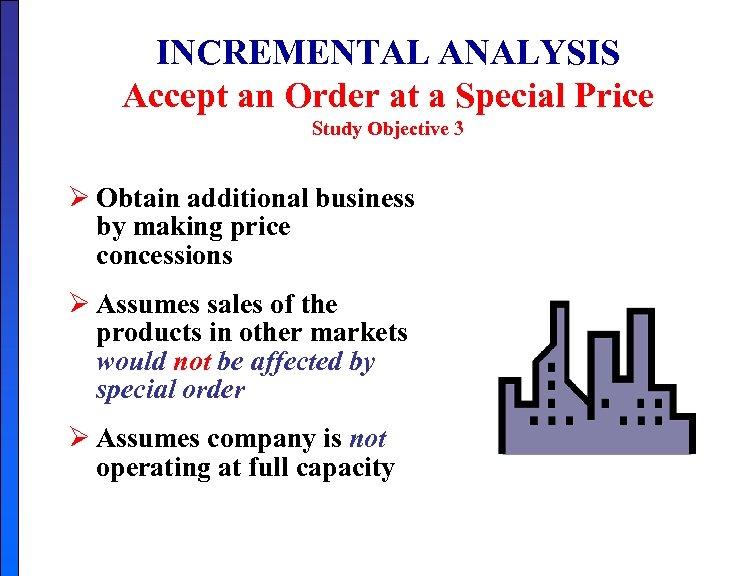 INCREMENTAL ANALYSIS Accept an Order at a Special Price Study Objective 3 Ø Obtain additional business by making price concessions Ø Assumes sales of the products in other markets would not be affected by special order Ø Assumes company is not operating at full capacity
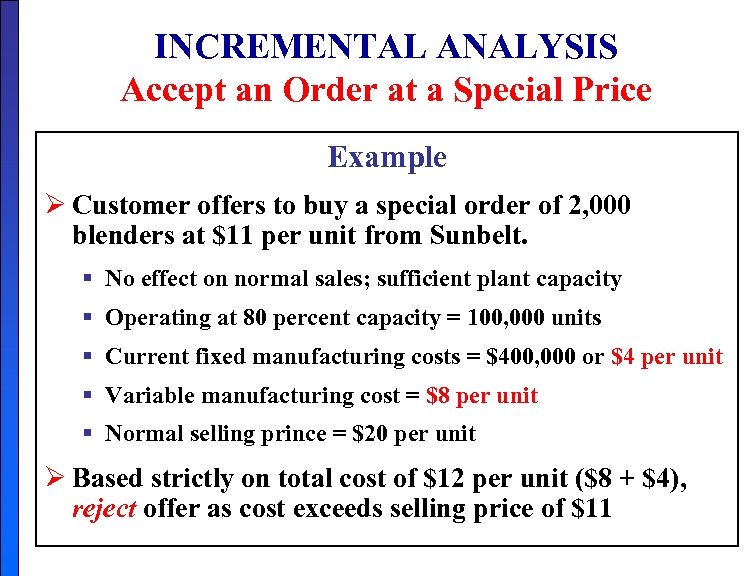 INCREMENTAL ANALYSIS Accept an Order at a Special Price Example Ø Customer offers to buy a special order of 2, 000 blenders at $11 per unit from Sunbelt. § No effect on normal sales; sufficient plant capacity § Operating at 80 percent capacity = 100, 000 units § Current fixed manufacturing costs = $400, 000 or $4 per unit § Variable manufacturing cost = $8 per unit § Normal selling prince = $20 per unit Ø Based strictly on total cost of $12 per unit ($8 + $4), reject offer as cost exceeds selling price of $11
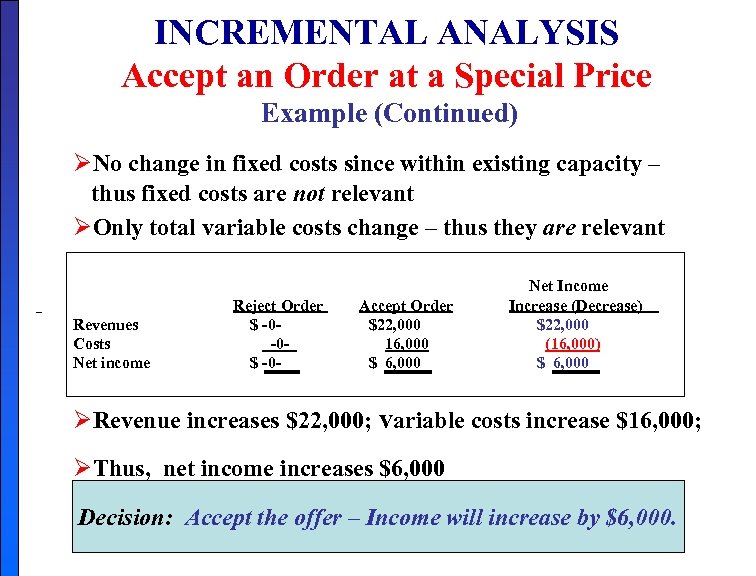 INCREMENTAL ANALYSIS Accept an Order at a Special Price Example (Continued) ØNo change in fixed costs since within existing capacity – thus fixed costs are not relevant ØOnly total variable costs change – thus they are relevant Revenues Costs Net income Reject Order $ -0 -0$ -0 - Accept Order $22, 000 16, 000 $ 6, 000 Net Income Increase (Decrease) $22, 000 (16, 000) $ 6, 000 ØRevenue increases $22, 000; variable costs increase $16, 000; ØThus, net income increases $6, 000 Decision: Accept the offer – Income will increase by $6, 000.
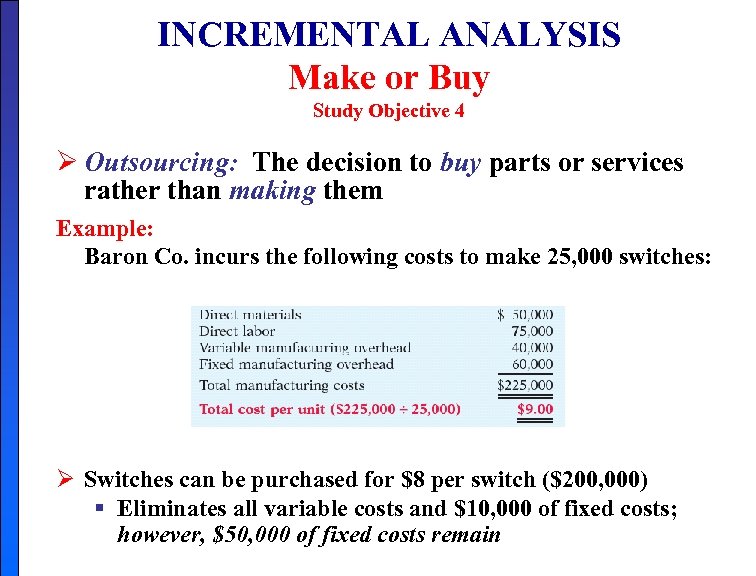 INCREMENTAL ANALYSIS Make or Buy Study Objective 4 Ø Outsourcing: The decision to buy parts or services rather than making them Example: Baron Co. incurs the following costs to make 25, 000 switches: Ø Switches can be purchased for $8 per switch ($200, 000) § Eliminates all variable costs and $10, 000 of fixed costs; however, $50, 000 of fixed costs remain
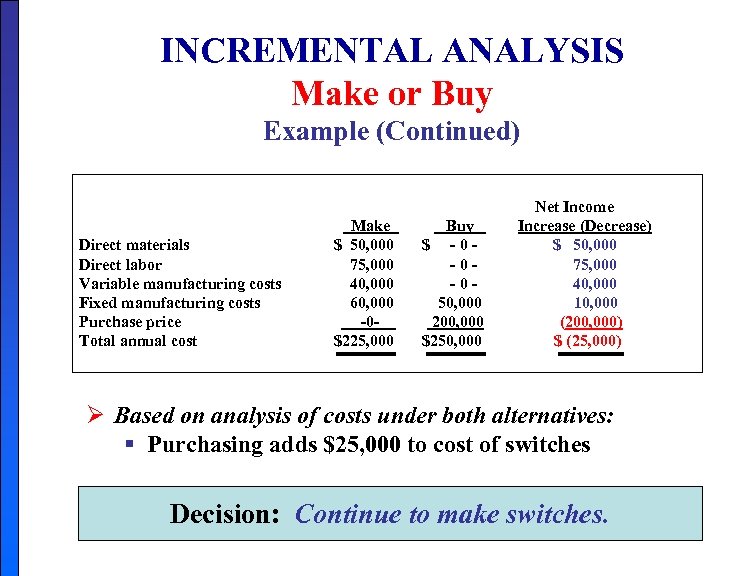 INCREMENTAL ANALYSIS Make or Buy Example (Continued) Direct materials Direct labor Variable manufacturing costs Fixed manufacturing costs Purchase price Total annual cost Make $ 50, 000 75, 000 40, 000 60, 000 -0$225, 000 Buy $ -0 -0 -050, 000 200, 000 $250, 000 Net Income Increase (Decrease) $ 50, 000 75, 000 40, 000 10, 000 (200, 000) $ (25, 000) Ø Based on analysis of costs under both alternatives: § Purchasing adds $25, 000 to cost of switches Decision: Continue to make switches.
 INCREMENTAL ANALYSIS Opportunity Costs The potential benefit that may be obtained from following an alternative course of action
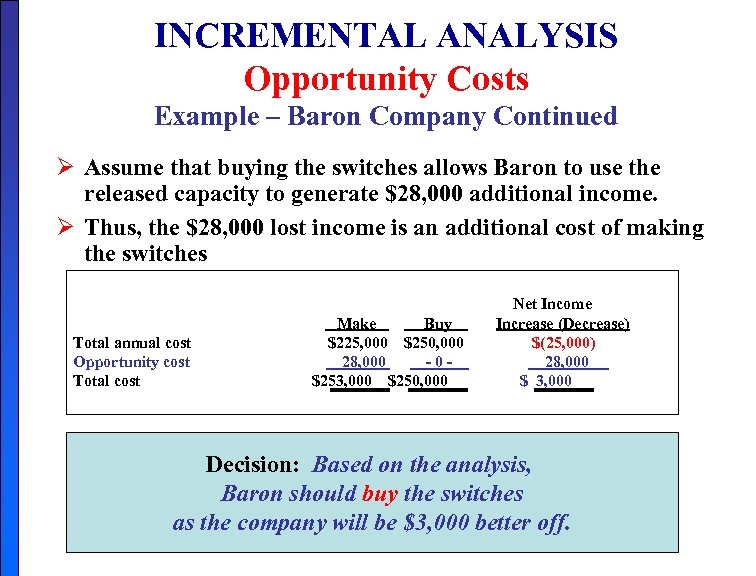 INCREMENTAL ANALYSIS Opportunity Costs Example – Baron Company Continued Ø Assume that buying the switches allows Baron to use the released capacity to generate $28, 000 additional income. Ø Thus, the $28, 000 lost income is an additional cost of making the switches Total annual cost Opportunity cost Total cost Make Buy $225, 000 $250, 000 28, 000 -0$253, 000 $250, 000 Net Income Increase (Decrease) $(25, 000) 28, 000 $ 3, 000 Decision: Based on the analysis, Baron should buy the switches as the company will be $3, 000 better off.
 INCREMENTAL ANALYSIS Sell or Process Further Study Objective 5 1. Manufacturers may have to decide, at a given point in production, whether to sell now or to process further and sell at a higher price later. 2. Decision Rule: Process further as long as the incremental revenue from such processing exceeds the incremental processing costs
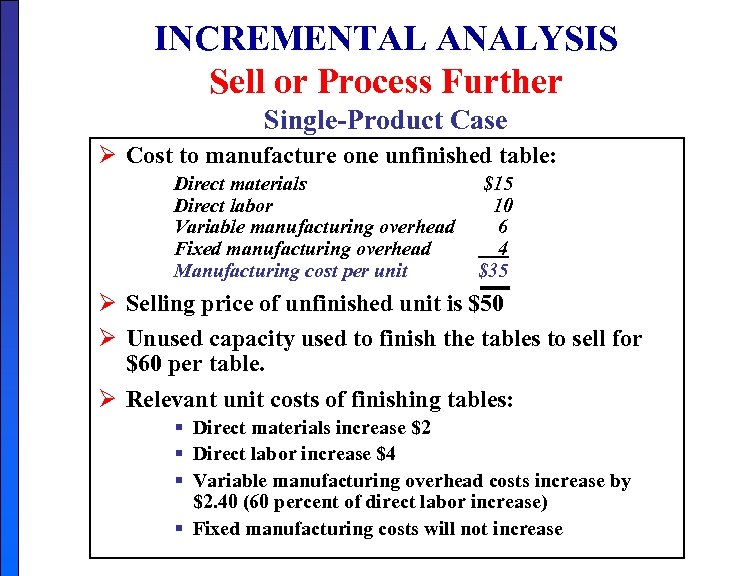 INCREMENTAL ANALYSIS Sell or Process Further Single-Product Case Ø Cost to manufacture one unfinished table: Direct materials Direct labor Variable manufacturing overhead Fixed manufacturing overhead Manufacturing cost per unit $15 10 6 4 $35 Ø Selling price of unfinished unit is $50 Ø Unused capacity used to finish the tables to sell for $60 per table. Ø Relevant unit costs of finishing tables: § Direct materials increase $2 § Direct labor increase $4 § Variable manufacturing overhead costs increase by $2. 40 (60 percent of direct labor increase) § Fixed manufacturing costs will not increase
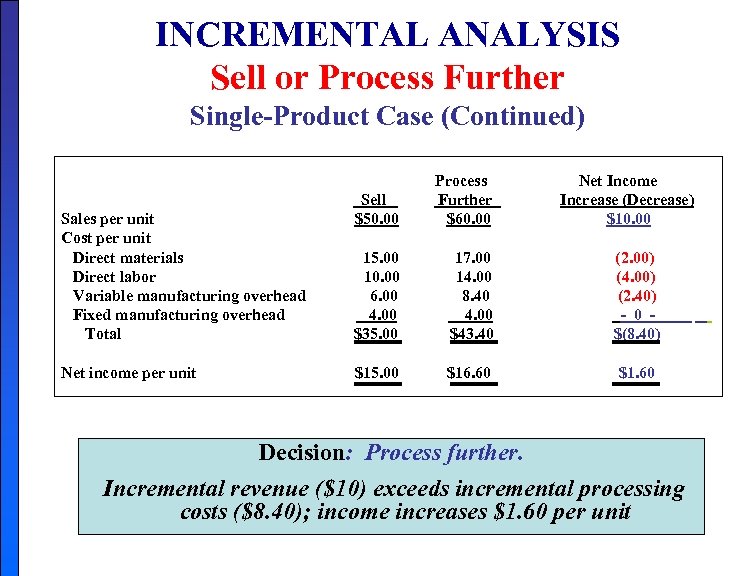 INCREMENTAL ANALYSIS Sell or Process Further Single-Product Case (Continued) Sales per unit Cost per unit Direct materials Direct labor Variable manufacturing overhead Fixed manufacturing overhead Total Sell $50. 00 Process Further $60. 00 Net Income Increase (Decrease) $10. 00 15. 00 10. 00 6. 00 4. 00 $35. 00 17. 00 14. 00 8. 40 4. 00 $43. 40 (2. 00) (4. 00) (2. 40) - 0 $(8. 40) Net income per unit $15. 00 $16. 60 $1. 60 Decision: Process further. Incremental revenue ($10) exceeds incremental processing costs ($8. 40); income increases $1. 60 per unit
 INCREMENTAL ANALYSIS Sell or Process Further Multiple-Product Case 1. Especially appropriate when multiple products are produced simultaneously 2. Many end-products are produced from a single raw material and a common production process 3. Joint products - multiple end products 1. Petroleum – gasoline, lubricating oil, kerosene 2. Meat Packing – meat, hides, bones
 INCREMENTAL ANALYSIS Sell or Process Further Multiple-Product Case 1. Joint costs 1. all costs incurred prior to split-off point 2. allocate to individual products based on relative sales value 2. Sunk costs 1. already incurred and cannot be changed 2. irrelevant for sell or process further decisions Joint costs are sunk costs for sell or process further decisions.
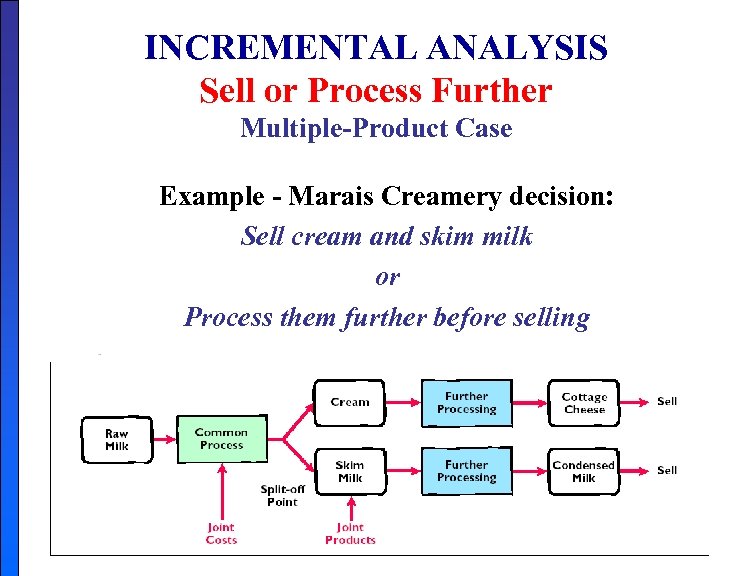 INCREMENTAL ANALYSIS Sell or Process Further Multiple-Product Case Example - Marais Creamery decision: Sell cream and skim milk or Process them further before selling
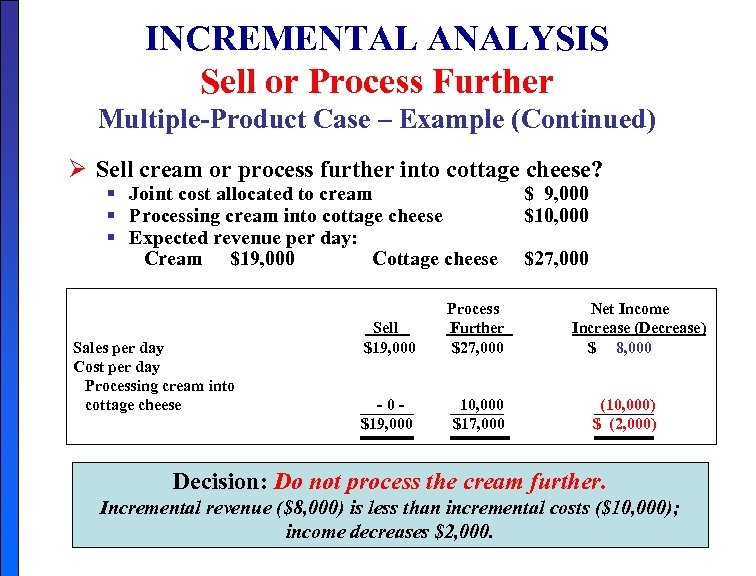 INCREMENTAL ANALYSIS Sell or Process Further Multiple-Product Case – Example (Continued) Ø Sell cream or process further into cottage cheese? § Joint cost allocated to cream § Processing cream into cottage cheese § Expected revenue per day: Cream $19, 000 Cottage cheese Sales per day Cost per day Processing cream into cottage cheese Sell $19, 000 Process Further $27, 000 -0$19, 000 10, 000 $17, 000 $ 9, 000 $10, 000 $27, 000 Net Income Increase (Decrease) $ 8, 000 (10, 000) $ (2, 000) Decision: Do not process the cream further. Incremental revenue ($8, 000) is less than incremental costs ($10, 000); income decreases $2, 000.
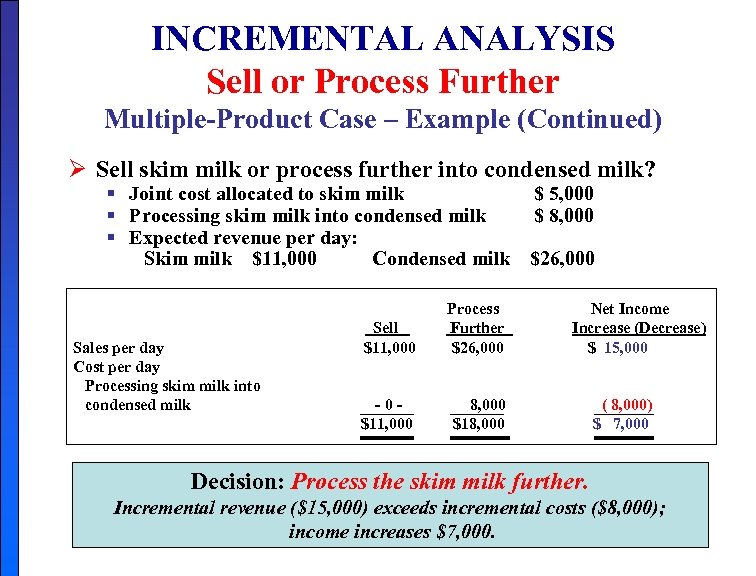 INCREMENTAL ANALYSIS Sell or Process Further Multiple-Product Case – Example (Continued) Ø Sell skim milk or process further into condensed milk? § Joint cost allocated to skim milk $ 5, 000 § Processing skim milk into condensed milk $ 8, 000 § Expected revenue per day: Skim milk $11, 000 Condensed milk $26, 000 Sales per day Cost per day Processing skim milk into condensed milk Sell $11, 000 Process Further $26, 000 -0$11, 000 Net Income Increase (Decrease) $ 15, 000 8, 000 $18, 000 ( 8, 000) $ 7, 000 Decision: Process the skim milk further. Incremental revenue ($15, 000) exceeds incremental costs ($8, 000); income increases $7, 000.
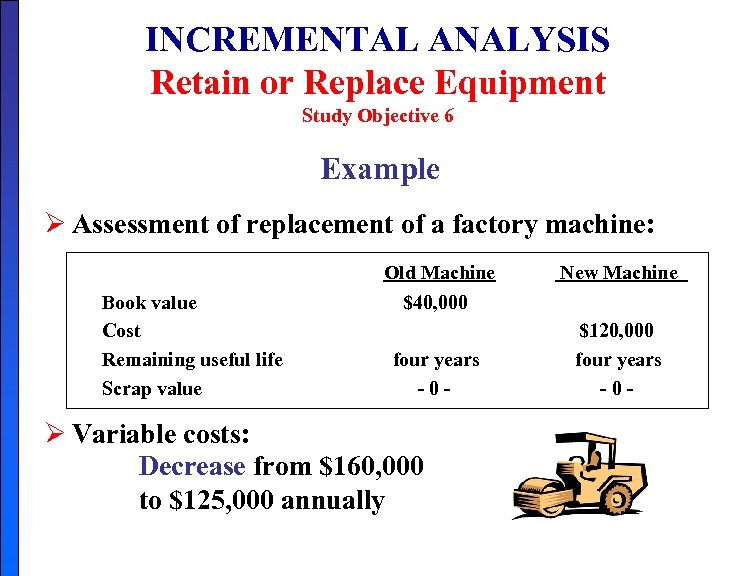 INCREMENTAL ANALYSIS Retain or Replace Equipment Study Objective 6 Example Ø Assessment of replacement of a factory machine: Book value Cost Remaining useful life Scrap value Old Machine $40, 000 four years -0 - Ø Variable costs: Decrease from $160, 000 to $125, 000 annually New Machine $120, 000 four years -0 -
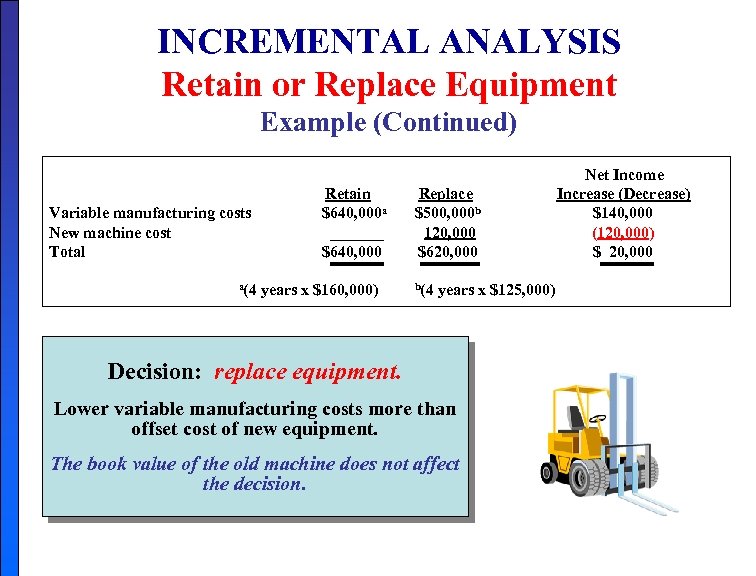 INCREMENTAL ANALYSIS Retain or Replace Equipment Example (Continued) Variable manufacturing costs New machine cost Total a(4 Retain $640, 000 a $640, 000 years x $160, 000) Replace $500, 000 b 120, 000 $620, 000 b(4 years x $125, 000) Decision: replace equipment. Lower variable manufacturing costs more than offset cost of new equipment. The book value of the old machine does not affect the decision. Net Income Increase (Decrease) $140, 000 (120, 000) $ 20, 000
 INCREMENTAL ANALYSIS Eliminate an Unprofitable Segment Study Objective 7 Ø Key: Focus on relevant costs Ø Consider effect on related product lines Ø Fixed costs allocated to the unprofitable segment must be absorbed by the other segments Ø Net income may decrease when an unprofitable segment is eliminated Ø Decision Rule: Ø Retain the segment unless fixed costs eliminated exceed the contribution margin lost
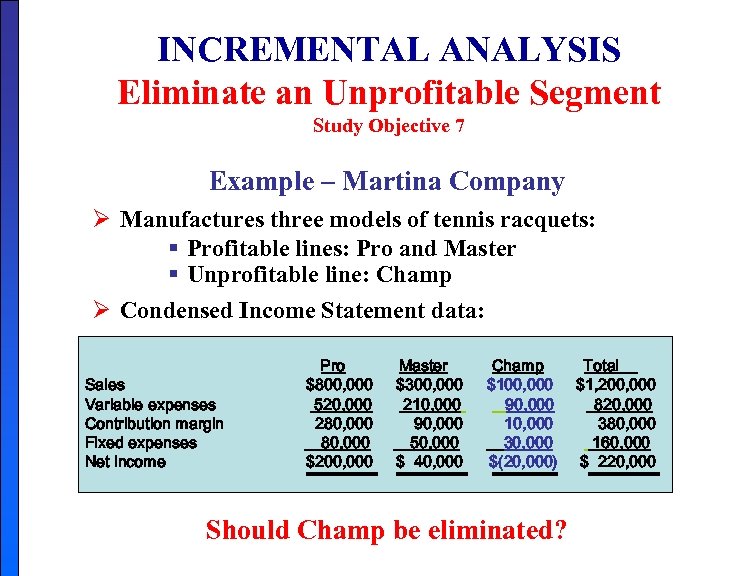 INCREMENTAL ANALYSIS Eliminate an Unprofitable Segment Study Objective 7 Example – Martina Company Ø Manufactures three models of tennis racquets: § Profitable lines: Pro and Master § Unprofitable line: Champ Ø Condensed Income Statement data: Sales Variable expenses Contribution margin Fixed expenses Net income Pro $800, 000 520, 000 280, 000 $200, 000 Master $300, 000 210, 000 90, 000 50, 000 $ 40, 000 Champ $100, 000 90, 000 10, 000 30, 000 $(20, 000) Should Champ be eliminated? Total $1, 200, 000 820, 000 380, 000 160, 000 $ 220, 000
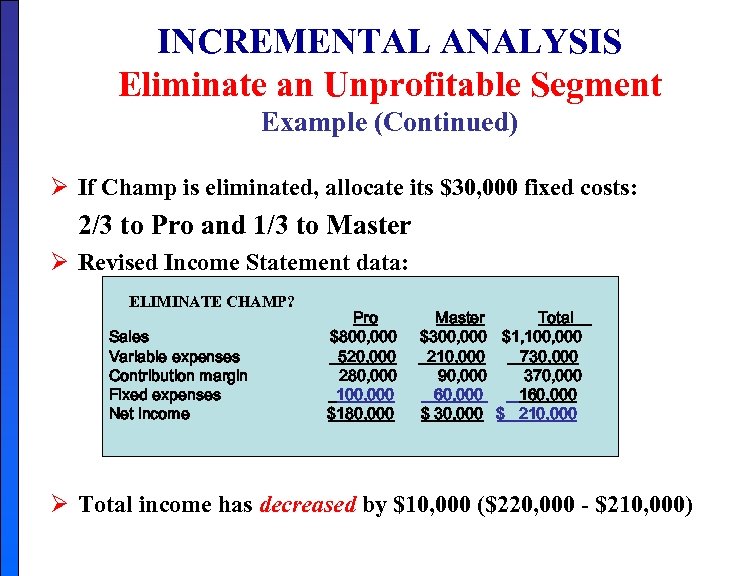 INCREMENTAL ANALYSIS Eliminate an Unprofitable Segment Example (Continued) Ø If Champ is eliminated, allocate its $30, 000 fixed costs: 2/3 to Pro and 1/3 to Master Ø Revised Income Statement data: ELIMINATE CHAMP? Sales Variable expenses Contribution margin Fixed expenses Net income Pro $800, 000 520, 000 280, 000 100, 000 $180, 000 Master Total $300, 000 $1, 100, 000 210, 000 730, 000 90, 000 370, 000 60, 000 160, 000 $ 30, 000 $ 210, 000 Ø Total income has decreased by $10, 000 ($220, 000 - $210, 000)
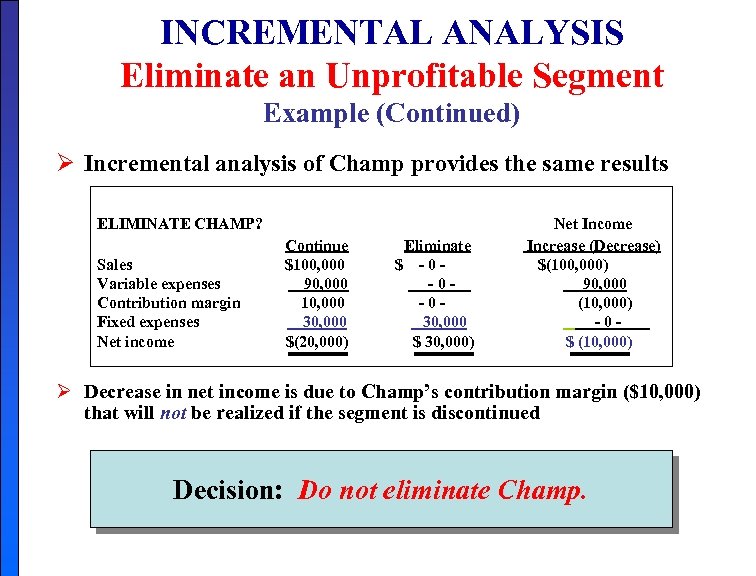 INCREMENTAL ANALYSIS Eliminate an Unprofitable Segment Example (Continued) Ø Incremental analysis of Champ provides the same results ELIMINATE CHAMP? Sales Variable expenses Contribution margin Fixed expenses Net income Continue $100, 000 90, 000 10, 000 30, 000 $(20, 000) Eliminate $ -0 -0 -030, 000 $ 30, 000) Net Income Increase (Decrease) $(100, 000) 90, 000 (10, 000) -0$ (10, 000) Ø Decrease in net income is due to Champ’s contribution margin ($10, 000) that will not be realized if the segment is discontinued Decision: Do not eliminate Champ.
 INCREMENTAL ANALYSIS Allocate Limited Resources Study Objective 8 Ø Resources are always limited § floor space for a retail firm § raw material, direct labor hours, or machine capacity for a manufacturing firm Ø Management must decide which products to make and sell to maximize net income
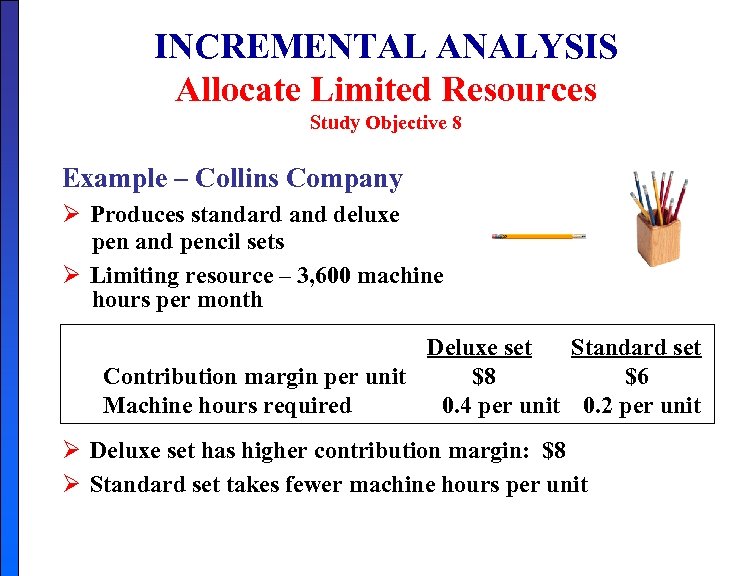 INCREMENTAL ANALYSIS Allocate Limited Resources Study Objective 8 Example – Collins Company Ø Produces standard and deluxe pen and pencil sets Ø Limiting resource – 3, 600 machine hours per month Deluxe set Standard set Contribution margin per unit $8 $6 Machine hours required 0. 4 per unit 0. 2 per unit Ø Deluxe set has higher contribution margin: $8 Ø Standard set takes fewer machine hours per unit
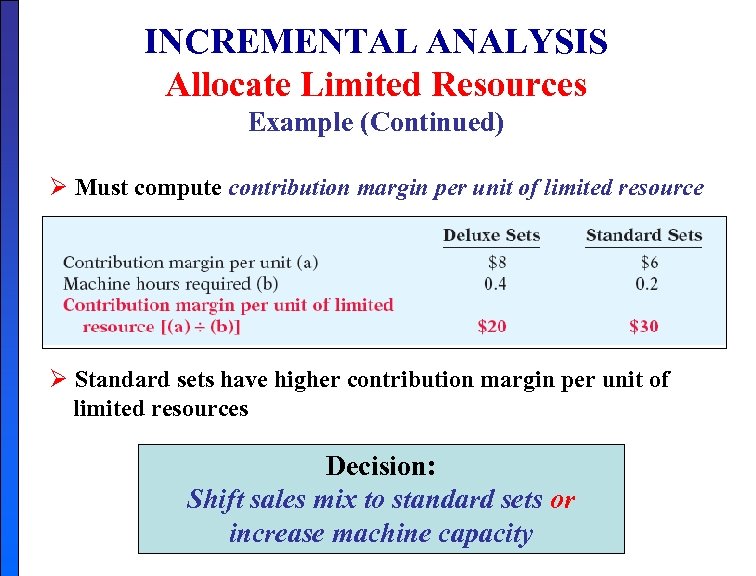 INCREMENTAL ANALYSIS Allocate Limited Resources Example (Continued) Ø Must compute contribution margin per unit of limited resource Ø Standard sets have higher contribution margin per unit of limited resources Decision: Shift sales mix to standard sets or increase machine capacity
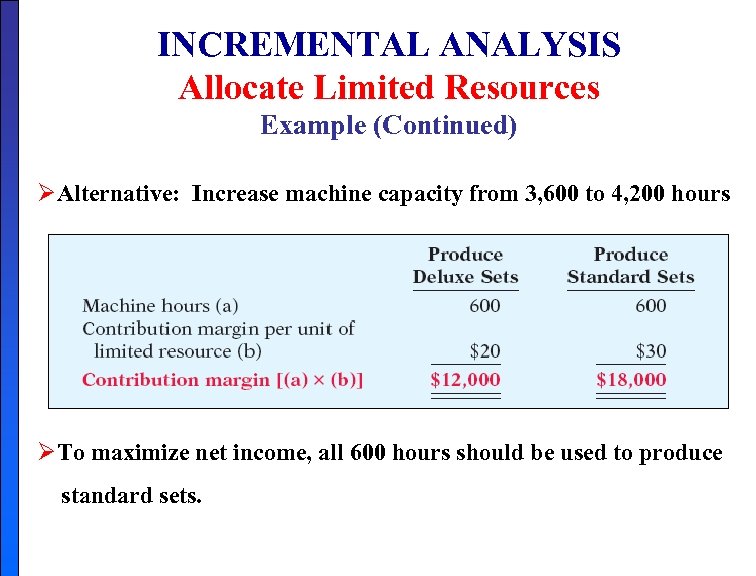 INCREMENTAL ANALYSIS Allocate Limited Resources Example (Continued) ØAlternative: Increase machine capacity from 3, 600 to 4, 200 hours ØTo maximize net income, all 600 hours should be used to produce standard sets.
 INCREMENTAL ANALYSIS Theory of Constraints Ø Approach used to identify and manage constraints so as to achieve company goals Ø Requires identification of constraints Ø Continual attempts to reduce or eliminate constraints
 MANAGEMENT’S DECISION MAKING Other Considerations Ø Qualitative factors § Potential effects of decision on employees and community § Low morale § Employee turnover Ø Incremental Analysis and Activity-Based Costing § Completely consistent with each other § ABC better identifies relevant costs resulting in better incremental analysis
 Let’s Review In a decision to retain or replace equipment, the book value of the old equipment is a (an): a. Opportunity costs b. Incremental cost c. Sunk cost d. Marginal cost
 Let’s Review In a decision to retain or replace equipment, the book value of the old equipment is a (an): a. Opportunity costs b. Incremental cost c. Sunk cost d. Marginal cost
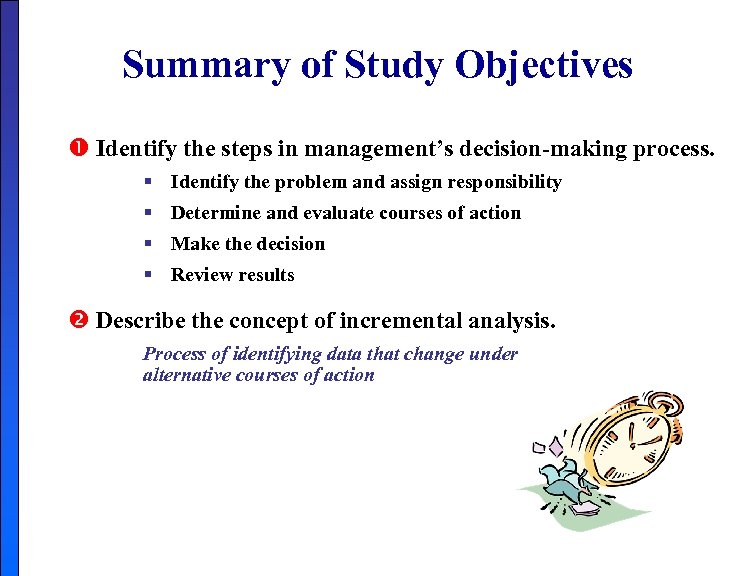 Summary of Study Objectives Identify the steps in management’s decision-making process. § Identify the problem and assign responsibility § Determine and evaluate courses of action § Make the decision § Review results Describe the concept of incremental analysis. Process of identifying data that change under alternative courses of action
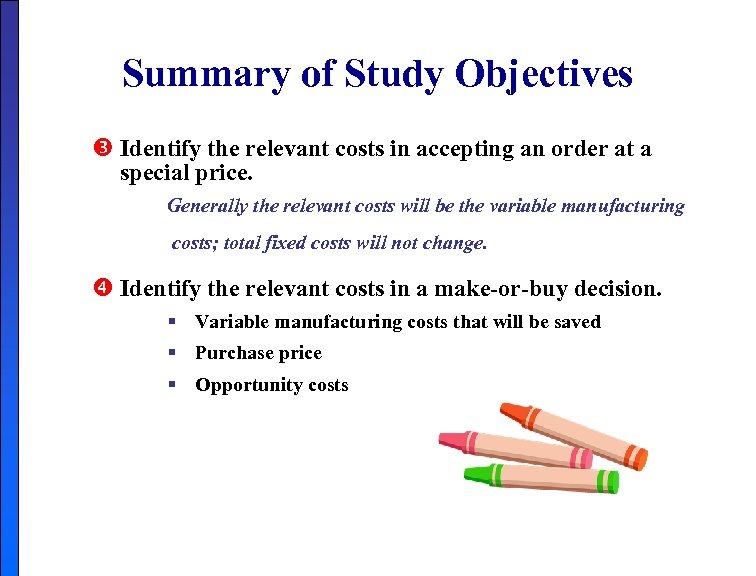 Summary of Study Objectives Identify the relevant costs in accepting an order at a special price. Generally the relevant costs will be the variable manufacturing costs; total fixed costs will not change. Identify the relevant costs in a make-or-buy decision. § Variable manufacturing costs that will be saved § Purchase price § Opportunity costs
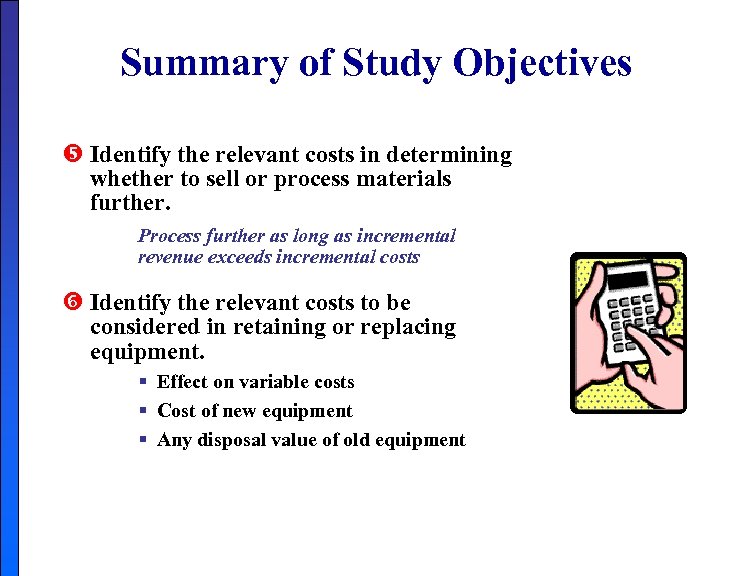 Summary of Study Objectives Identify the relevant costs in determining whether to sell or process materials further. Process further as long as incremental revenue exceeds incremental costs Identify the relevant costs to be considered in retaining or replacing equipment. § Effect on variable costs § Cost of new equipment § Any disposal value of old equipment
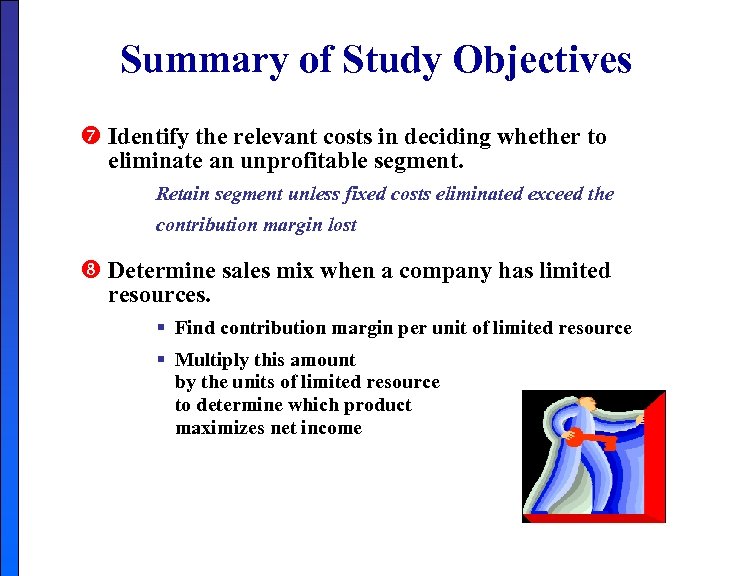 Summary of Study Objectives Identify the relevant costs in deciding whether to eliminate an unprofitable segment. Retain segment unless fixed costs eliminated exceed the contribution margin lost Determine sales mix when a company has limited resources. § Find contribution margin per unit of limited resource § Multiply this amount by the units of limited resource to determine which product maximizes net income
 COPYRIGHT Copyright © 2005 John Wiley & Sons, Inc. All rights reserved. Reproduction or translation of this work beyond that permitted in Section 117 of the 1976 United States Copyright Act without the express written consent of the copyright owner is unlawful. Request for further information should be addressed to the Permissions Department, John Wiley & Sons, Inc. The purchaser may make back-up copies for his/her own use only and not for distribution or resale. The Publisher assumes no responsibility for errors, omissions, or damages, caused by the use of these programs or from the use of the information contained herein.