


 Скачать презентацию Managerial Accounting Management accounting or managerial accounting
MANAGERIAL ACCOUNTING.ppt
- Количество слайдов: 65
 Managerial Accounting
 Management accounting or managerial accounting is concerned with the provisions and use of accounting information to managers within organizations, to provide them with the basis to make informed business decisions that will allow them to be better equipped in their management and control functions.
 Management Accounting is "the process of identification, measurement, accumulation, analysis, preparation, interpretation and communication of information used by management to plan, evaluate and control within an entity and to assure appropriate use of and accountability for its resources. Management accounting also comprises the preparation of financial reports for nonmanagement groups such as shareholders, creditors, regulatory agencies and tax authorities".
 Management accounting as practice extends to the following three areas: • Strategic Management—Advancing the role of the management accountant as a strategic partner in the organization. • Performance Management—Developing the practice of business decision-making and managing the performance of the organization. • Risk Management—Contributing to frameworks and practices for identifying, measuring, managing and reporting risks to the achievement of the objectives of the organization.
 The Differences Between Managerial and Financial Accounting
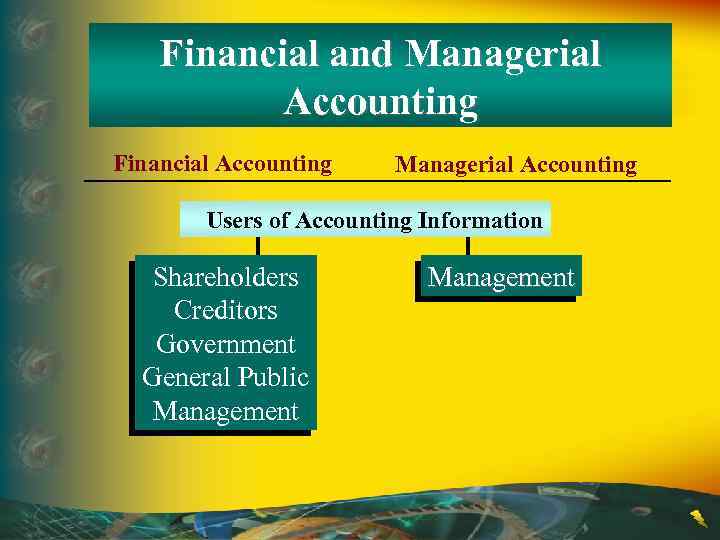 Financial and Managerial Accounting Financial Accounting Managerial Accounting Users of Accounting Information Shareholders Creditors Government General Public Management
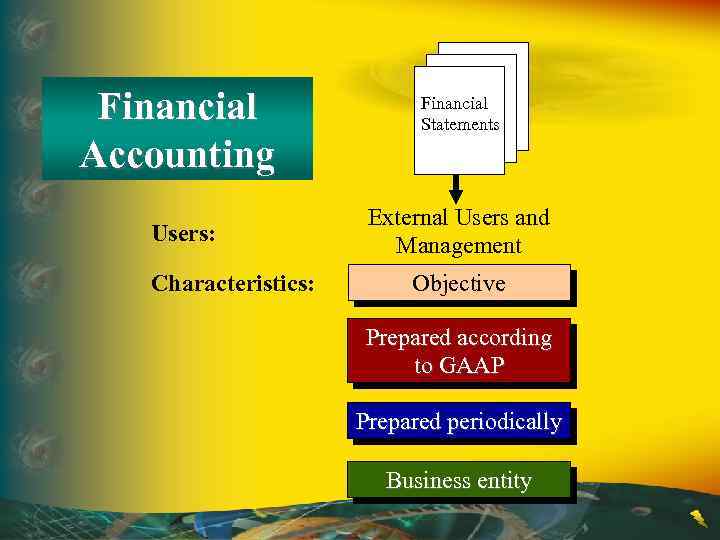 Financial Accounting Users: Characteristics: Financial Statements External Users and Management Objective Prepared according to GAAP Prepared periodically Business entity
 Managerial Accounting Users: Characteristics: Management Reports Management Objective and subjective Prepared according to management needs Prepared periodically or as needed Business entity or segment
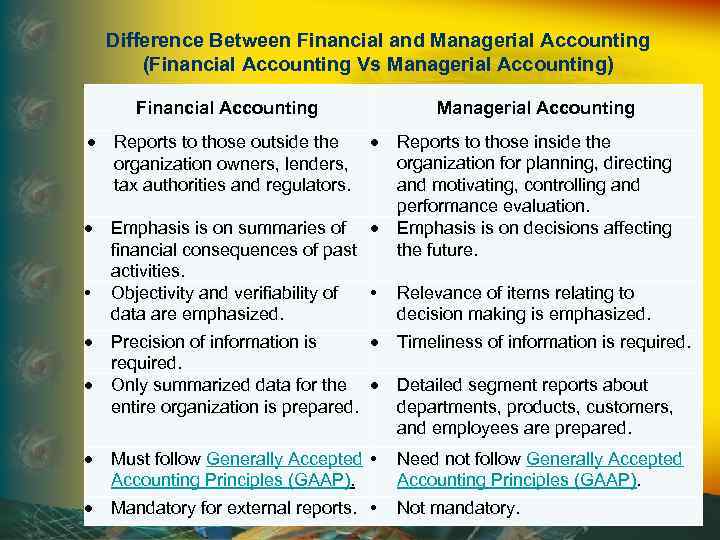 Difference Between Financial and Managerial Accounting (Financial Accounting Vs Managerial Accounting) Financial Accounting Reports to those outside the organization owners, lenders, tax authorities and regulators. Emphasis is on summaries of financial consequences of past activities. Objectivity and verifiability of • data are emphasized. • Managerial Accounting Reports to those inside the organization for planning, directing and motivating, controlling and performance evaluation. Emphasis is on decisions affecting the future. Relevance of items relating to decision making is emphasized. Precision of information is required. Only summarized data for the entire organization is prepared. Timeliness of information is required. Must follow Generally Accepted • Accounting Principles (GAAP). Need not follow Generally Accepted Accounting Principles (GAAP). Mandatory for external reports. • Not mandatory. Detailed segment reports about departments, products, customers, and employees are prepared.
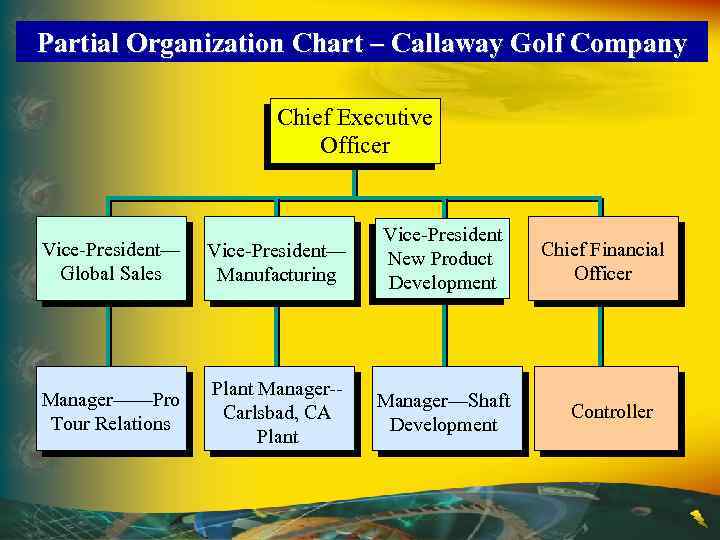 Partial Organization Chart – Callaway Golf Company Chief Executive Officer Vice-President— Global Sales Vice-President— Manufacturing Vice-President New Product Development Manager——Pro Tour Relations Plant Manager-Carlsbad, CA Plant Manager—Shaft Development Chief Financial Officer Controller
 Manufacturing Cost Terms
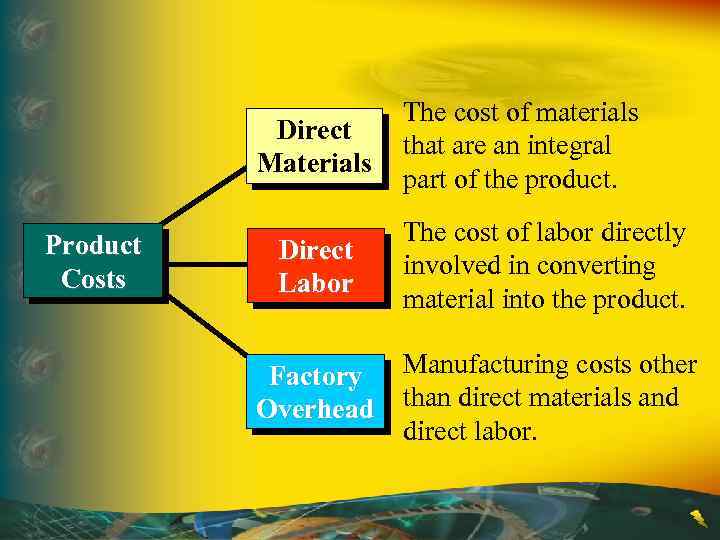 Direct Materials Product Costs Direct Labor The cost of materials that are an integral part of the product. The cost of labor directly involved in converting material into the product. Factory Manufacturing costs other Overhead than direct materials and direct labor.
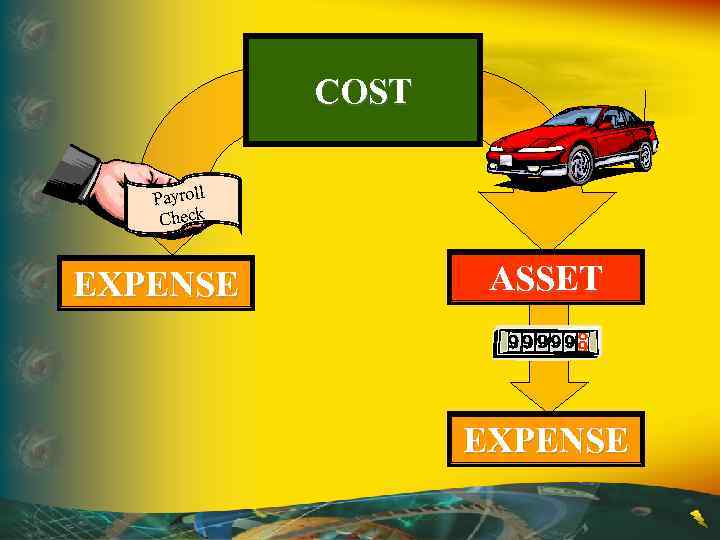 COST Payroll Check EXPENSE ASSET EXPENSE
 Standard Costing • Standard costing is the practice of substituting an expected cost for an actual cost in the accounting records, and then periodically recording variances that are the difference between the expected and actual costs. Standard costing appeared in the early twentieth century, when transaction volumes were overwhelming the record keeping systems in use at that time. Since then, the prevalent use of computer systems and automated data entry systems have reduced the need for standard costing, though not entirely eliminated it.
 Marginal Costing and Absorption Costing
 Absorption Costing • A managerial accounting cost method of expensing all costs associated with manufacturing a particular product. Absorption costing uses the total direct costs and overhead costs associated with manufacturing a product as the cost base. Generally accepted accounting principles (GAAP) require absorption costing for external reporting. Absorption costing is also known as "full absorption costing".
 Marginal costing distinguishes between fixed costs and variable costs as conventionally classified. The marginal cost of a product –“ is its variable cost”. This is normally taken to be; direct labour, direct material, direct expenses and the variable part of overheads.
 Marginal costing is formally defined as: ‘the accounting system in which variable costs are charged to cost units and the fixed costs of the period are written-off in full against the aggregate contribution. Its special value is in decision making’
 The term ‘contribution’ mentioned in the formal definition is the term given to the difference between Sales and Marginal cost. MARGINAL COST = VARIABLE COST DIRECT LABOUR +DIRECT MATERIAL + DIRECT EXPENSE + VARIABLE OVERHEADS CONTRIBUTION SALES - MARGINAL COST
 Alternative names for marginal costing are the contribution approach and direct costing
 The marginal cost varies directly with the volume of production and marginal cost per unit remains the same. It consists of prime cost, i. e. cost of direct materials, direct labor and all variable overheads. It does not contain any element of fixed cost which is kept separate under marginal cost technique.
 • Marginal costing may be defined as the technique of presenting cost data wherein variable costs and fixed costs are shown separately for managerial decision-making. It should be clearly understood that marginal costing is not a method of costing like process costing or job costing. Rather it is simply a method or technique of the analysis of cost information for the guidance of management which tries to find out an effect on profit due to changes in the volume of output.
 There are different phrases being used for this technique of costing. In UK, marginal costing is a popular phrase whereas in US, it is known as direct costing and is used in place of marginal costing. Variable costing is another name of marginal costing.
 • Marginal costing technique has given birth to a very useful concept of contribution where contribution is given by: Sales revenue less variable cost (marginal cost) • Contribution may be defined as the profit before the recovery of fixed costs. Thus, contribution goes toward the recovery of fixed cost and profit, and is equal to fixed cost plus profit (C = F + P). • In case a firm neither makes profit nor suffers loss, contribution will be just equal to fixed cost (C = F). this is known as break even point. • The concept of contribution is very useful in marginal costing. It has a fixed relation with sales. The proportion of contribution to sales is known as P/V ratio which remains the same under given conditions of production and sales.
 The principles of marginal costing 1. For any given period of time, fixed costs will be the same, for any volume of sales and production (provided that the level of activity is within the ‘relevant range’). Therefore, by selling an extra item of product or service the following will happen. – Revenue will increase by the sales value of the item sold. – Costs will increase by the variable cost per unit. – Profit will increase by the amount of contribution earned from the extra item.
 The principles of marginal costing 2. Similarly, if the volume of sales falls by one item, the profit will fall by the amount of contribution earned from the item. 3. Profit measurement should therefore be based on an analysis of total contribution. Since fixed costs relate to a period of time, and do not change with increases or decreases in sales volume, it is misleading to charge units of sale with a share of fixed costs.
 The principles of marginal costing 4. When a unit of product is made, the extra costs incurred in its manufacture are the variable production costs. Fixed costs are unaffected, and no extra fixed costs are incurred when output is increased.
 • Marginal Contribution Marginal costing technique makes use of marginal contribution for marking various decisions. Marginal contribution is the difference between sales and marginal cost. It forms the basis for judging the profitability of different products or departments.
 Advantages and Disadvantages of Marginal Costing Technique
 Advantages • Marginal costing is simple to understand. • By not charging fixed overhead to cost of production, the effect of varying charges per unit is avoided. • It prevents the illogical carry forward in stock valuation of some proportion of current year’s fixed overhead.
 Advantages • The effects of alternative sales or production policies can be more readily available and assessed, and decisions taken would yield the maximum return to business. • It eliminates large balances left in overhead control accounts which indicate the difficulty of ascertaining an accurate overhead recovery rate.
 Advantages • Practical cost control is greatly facilitated. By avoiding arbitrary allocation of fixed overhead, efforts can be concentrated on maintaining a uniform and consistent marginal cost. It is useful to various levels of management.
 Advantages • It helps in short-term profit planning by breakeven and profitability analysis, both in terms of quantity and graphs. Comparative profitability and performance between two or more products and divisions can easily be assessed and brought to the notice of management for decision making.
 Disadvantages • The separation of costs into fixed and variable is difficult and sometimes gives misleading results. • Normal costing systems also apply overhead under normal operating volume and this shows that no advantage is gained by marginal costing. • Under marginal costing, stocks and work in progress are understated. The exclusion of fixed costs from inventories affect profit, and true and fair view of financial affairs of an organization may not be clearly transparent.
 Disadvantages • Volume variance in standard costing also discloses the effect of fluctuating output on fixed overhead. Marginal cost data becomes unrealistic in case of highly fluctuating levels of production, e. g. , in case of seasonal factories. • Application of fixed overhead depends on estimates and not on the actuals and as such there may be under or over absorption of the same.
 Disadvantages • Control affected by means of budgetary control is also accepted by many. In order to know the net profit, we should not be satisfied with contribution and hence, fixed overhead is also a valuable item. A system which ignores fixed costs is less effective since a major portion of fixed cost is not taken care of under marginal costing. • In practice, sales price, fixed cost and variable cost per unit may vary. Thus, the assumptions underlying theory of marginal costing sometimes becomes unrealistic. For long term profit planning, absorption costing is the only answer.
 Marginal costing is not a method of costing but a technique of presentation of sales and cost data with a view to guide management in decision-making. The traditional technique popularly known as total cost or absorption costing technique does not make any difference between variable and fixed cost in the calculation of profits. But marginal cost statement very clearly indicates this difference in arriving at the net operational results of a firm.
 CONCLUSION: • Marginal cost is the cost management technique for the analysis of cost and revenue information and for the guidance of management. The presentation of information through marginal costing statement is easily understood by all managers, even those who do not have preliminary knowledge and implications of the subjects of cost and management accounting.
 • Absorption costing and marginal costing are two different techniques of cost accounting. Absorption costing is widely used for cost control purpose whereas marginal costing is used for managerial decision-making and control.
 Activity Based Costing • Traditionally cost accountants had arbitrarily added a percentage of expenses into the direct costs to include overheads. This method is quite satisfactory when the overhead costs are a small percentage compared to direct labor component in actual making of products. However as the percentages of overhead costs had risen, this technique became increasingly inaccurate because the indirect costs were not caused equally by all the products.
 Activity Based Costing • For example, one product might take more time in one machine than another product, but since the amount of direct labor and materials might be the same, the additional cost for the use of the machine would not be recognized when the same broad ‘on-cost’ percentage is added to all products. Consequently, when multiple products share common costs, there is a danger of one product subsidizing another
 Activity Based Costing • Therefore, using an arbitrary percentage leads to distortion of costs resulting in the following problems: • a) Fixation of wrong selling prices (By pricing low profitable opportunities may be missed or by pricing high customers may be lost) • b) Taking wrong decisions (product sales mix decisions etc)
 Activity Based Costing • Instead of using broad arbitrary percentages to allocate costs, ABC seeks to identify cause and effect relationships to objectively assign costs. Once costs of the activities have been identified, the cost of each activity is attributed to each product to the extent that the product uses the activity. • Cost drivers are used to measure the use of activities by different products / services. • For example the cost of the activity ‘purchasing’ is measured by the number of purchase orders placed.
 Overhead Cost Accumulation And Allocation
 Direct material and direct labor are easily traced to a product or service. Overhead, on the other hand, must be accumulated over a period and allocated to the products manufactured or services rendered during that time. Cost allocation refers to the assignment of an indirect cost to one or more cost objects using some reasonable basis.
 Why Overhead Costs Are Allocated • Many accounting procedures are based on allocations. Cost allocations can be made over several time periods or within a single time period. For example: in financial accounting, a building’s cost is allocated through depreciation charges over its useful or service life. This process is necessary to fulfill the matching principle. In cost accounting, production overhead costs are allocated within a period through the use of predictors or cost drivers to products or services. This process reflects application of the cost principle, which requires that all production or acquisition costs attach to the units produced, services rendered, or units purchased.
 Overhead costs are allocated to cost objects for three reasons: • (1) to determine a full cost of the cost object. • (2) to motivate the manager in charge of the cost object to manage it efficiently. • (3) to compare alternative courses of action for management planning, controlling, and decision making.
 Traditionally overhead apportionment to products was made in the following three step approach • I) Primary Distribution (Allocation & Apportionment) • II) Secondary Distribution (Reapportionment) • III) Absorption
 To calculate a predetermined OH rate, divide the total budgeted overhead cost at a specific activity level by the related activity level for a specific period: Predetermined OH Rate = Total Budgeted OH Cost at a Specified Activity Level [divide] Volume of Specified Activity Level
 A company should use an activity base that is logically related to overhead cost incurrence. The activity base that may first be considered is production volume, but this base is reasonable if the company manufactures only one type of product or renders only one type of service. If multiple products or services exist, a summation of production volumes cannot be made to determine “activity” because of the heterogeneous nature of the items.
 To most effectively allocate overhead to heterogeneous products, a measure of activity must be determined that is common to all output. The activity base should be a cost driver that directly causes the incurrence of overhead costs. Direct labor hours and direct labor dollars have been commonly used measures of activity; however, the deficiencies caused by using these bases are becoming more apparent as companies become increasingly automated. Using direct labor to allocate overhead costs in automated plants results in extremely high overhead rates because the costs are applied over a smaller number of labor hours (or dollars).
 In automated plants, machine hours may be more appropriate for allocating overhead than either direct labor base. Other traditional measures include number of purchase orders and productrelated physical characteristics such as tons. Additionally, innovative new measures for overhead allocation include number or time of machine setups, number of parts, quantity of material handling time, and number of product defects.
 • Cost accounting information is designed for managers. Since managers are taking decisions only for their own organization, there is no need for the information to be comparable to similar information from other organizations. Instead, the important criterion is that the information must be relevant for decisions that managers operating in a particular environment of business including strategy make.
 • Cost accounting information is commonly used in financial accounting information, but first we are concentrating in its use by managers to take decisions. The accountants who handle the cost accounting information generate add value by providing good information to managers who are taking decisions. Among the better decisions, the better performance of your organization, regardless if it is a manufacturing company, a bank, a non-profit organization, a government agency, a school club or even a business school. The cost-accounting system is the result of decisions made by managers of an organization and the environment in which they make them.
 • The organizations and managers are most of the times interested in and worried for the costs. The control of the costs of the past, present and future is part of the job of all the managers in a company. In the companies that try to have profits, the control of costs affects directly to them. Knowing the costs of the products is essential for decisionmaking regarding price and mix assignation of products and services.
 • The cost accounting systems can be important sources of information for the managers of a company. For this reason, the managers understand the forces and weaknesses of the cost accounting systems, and participate in the evaluation and evolution of the cost measurement and administration systems. Unlike the accounting systems that help in the preparation of financial reports periodically, the cost accounting systems and reports are not subject to rules and standards like the Generally Accepted Accounting Principles. As a result, there is a wide variety in the cost accounting systems of the different companies and sometimes even in different parts of the same company or organization.
 COST ACCOUNTING SYSTEMS
 The objective of a cost system or costing system is accumulate the costs of goods or services. The information on the cost of a product or service is used by managers to set the prices of the product, control operations, and develop financial statements. Also, the cost system improves control by providing information on the costs incurred by each department or manufacturing process.
 ! COST SYSTEMS DEPENDING ON HOW COSTS OF PRODUCTION ARE ACCUMULATED
 Job order cost system
 • A job order cost system provides a separate record for the cost of each quantity of product passing through the factory. A quantity of each particular product is called order. A job order cost system fits better in the industries that develop products with that have different specifications most of the time or that have a wide variety of products in stock. Many service companies use this type of system for costing orders by accumulating the costs associated with providing services to their customers.
 Some characteristics of the job order cost systems are listed below: • - They accumulate in batches • - Production under specific orders • - Normally does not produces the same article • Examples: Accounting firm, construction company, law practice, apparel manufacturing, movie studio
 Process cost system
 • In a process cost system, costs are accumulated for each department or process in the factory. A process cost system fits more in companies manufacturing products which are not distinguishable with each other during a process of continuous production.
 Some characteristics of process cost systems are listed below: • - They accumulate costs by department • - Production continuous and homogeneous • Examples: Oil Refinery, food processing, paper processing, soft drinks, medicines, buckets, toys, pants.