


 Скачать презентацию Management of the Citizen s Digital Identity and Access
8c114058f3cafa88f5ba30d957a3e860.ppt
- Количество слайдов: 22
 Management of the Citizen's Digital Identity and Access to Multi-version Norm Texts on the Semantic Web Fabio Grandi, Maria Rita Scalas, University of Bologna, Italy Federica Mandreoli, Paolo Tiberio, University of Modena e Reggio Emilia, Italy
 The Semantic Web n "The Semantic Web is an extension of the current web in which information is given well-defined meaning, better enabling computers and people to work in cooperation. " -- T. Berners-Lee, J. Hendler, O. Lassila, Scientific American, May 2001
 E-Government and Digital Identity n E-Government uses improved Internet-based technology to make it easy for citizens to interact with Public Administration services. n The “digital identity” of citizens is the collection of information concerning them stored in PA information systems and available online
 Access to Norm Texts n Large collections of norm texts are becoming available online (e. g. in “official” XML repositories) n Access to norm texts provided by PA websites is a useful service for E-Gov (e. g. to improve citizens’ knowledge and involvement)
 The Research Aim n To improve the citizens’ access to norm texts via personalization of the service n Personalization is based on the diverse applicability of norm portions to different citizens or citizen classes n Personalization relies on D-Id and is implemented via Sem-Web techniques
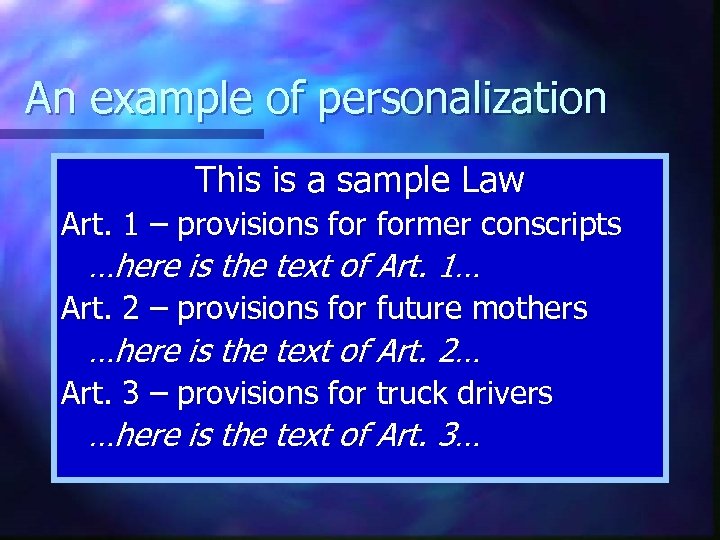 An example of personalization This is a sample Law Art. 1 – provisions former conscripts …here is the text of Art. 1… Art. 2 – provisions for future mothers …here is the text of Art. 2… Art. 3 – provisions for truck drivers …here is the text of Art. 3…
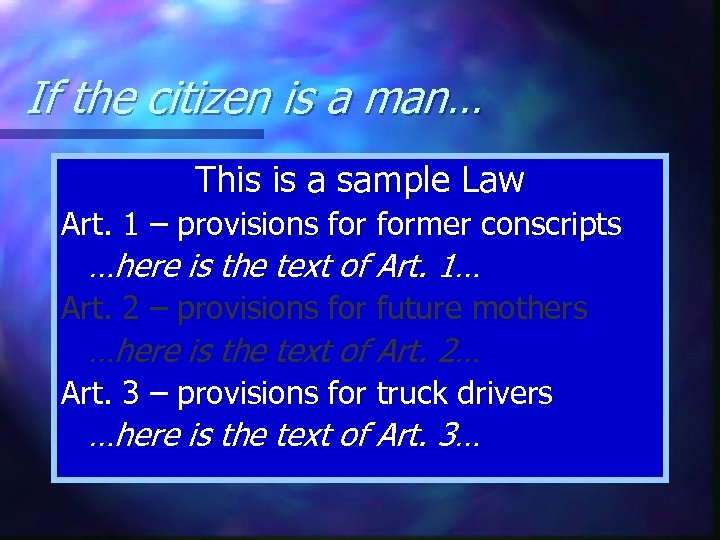 If the citizen is a man… This is a sample Law Art. 1 – provisions former conscripts …here is the text of Art. 1… Art. 2 – provisions for future mothers …here is the text of Art. 2… Art. 3 – provisions for truck drivers …here is the text of Art. 3…
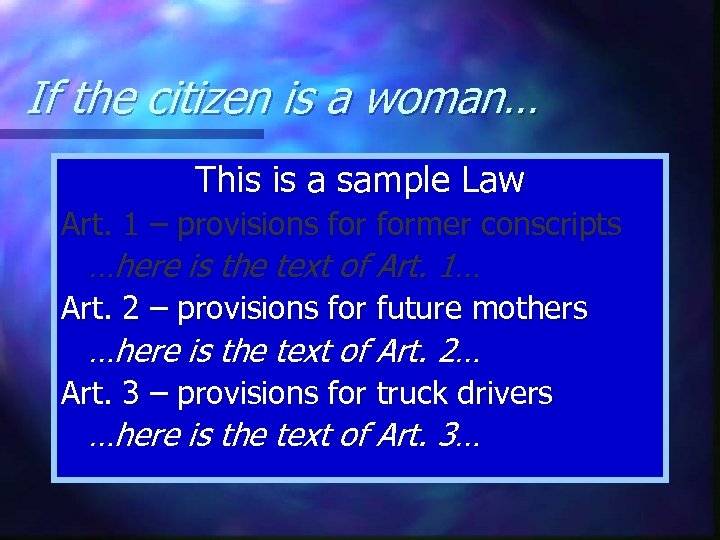 If the citizen is a woman… This is a sample Law Art. 1 – provisions former conscripts …here is the text of Art. 1… Art. 2 – provisions for future mothers …here is the text of Art. 2… Art. 3 – provisions for truck drivers …here is the text of Art. 3…
 The Route to Implementation n Definition of a Civic Ontology to provide a common reference for automatic classification of citizens n Semantic Markup of Norm Documents to insert annotations concerning applicability wrt the ontology classes n Implementation of Web Services for identification and personalized access
 The Civic Ontology n Is a legal ontology describing citizens considered as passive subjects of norms n The classification is based on definitions introduced by norms (founding acts) stating limitations in their applicability n The class definitions need “official validation” by human experts (for liability reasons)
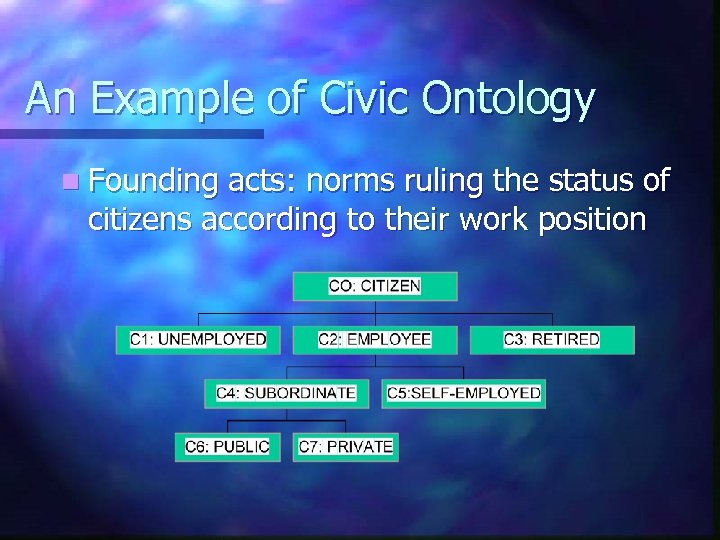 An Example of Civic Ontology n Founding acts: norms ruling the status of citizens according to their work position
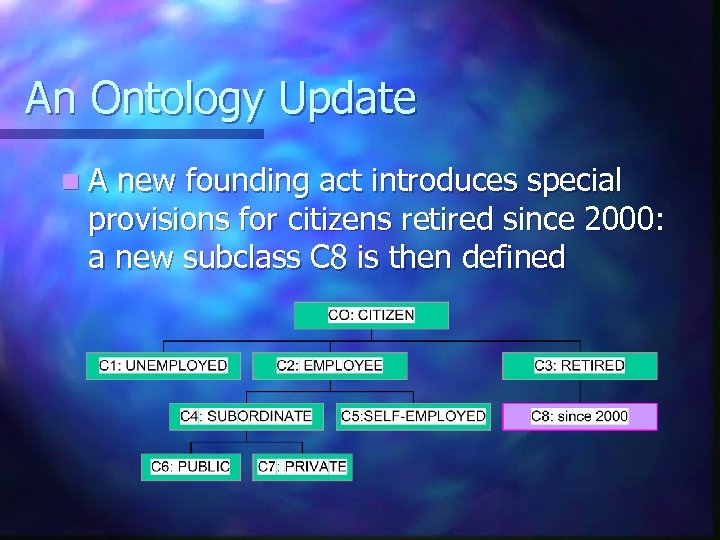 An Ontology Update n. A new founding act introduces special provisions for citizens retired since 2000: a new subclass C 8 is then defined
 Implementation of the Ontology Two sample Civic Ontologies are being implemented using the OWL language (W 3 C standard) n A graphic editor is being used for development (Protégé 2. 1 - OWL Plugin 1. 1) n Norms involving the Italian university system and the regional public kindergarten system have been chosen as reference norm corpora n
 Semantic Annotation of Norms The research group previously developed a data model and system architecture for the management of multiversion norm texts in XML format (WIDM 03, D&KE forthcoming) n Temporal dimensions were used for versioning n Reference to ontology classes is included in the norm document markup as a new versioning dimension representing applicability to citizen classes n
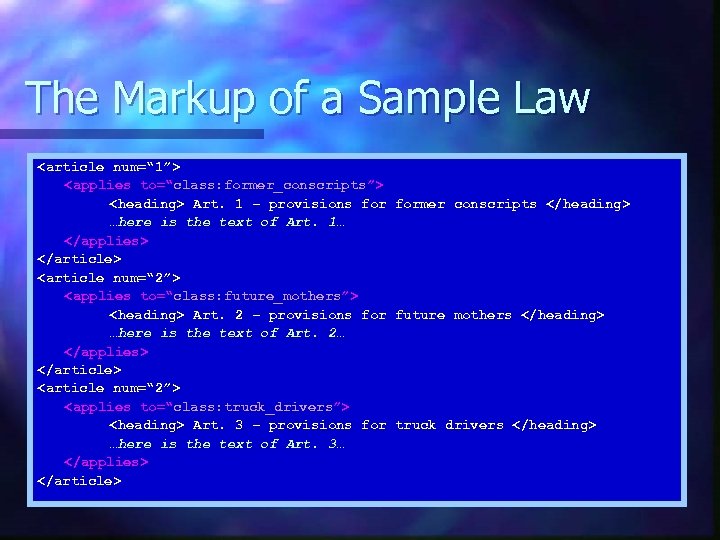 The Markup of a Sample Law
 Implementation of Norm Repositories n Extensions of temporal data models (based on XML-Schema, DTDs) have been developed to include the new versioning dimension (applicability) n A prototype repository is being implemented on top of Oracle DBMS n Query facilities for personalized access to norms are being developed
 Implementation of Web Services (Future Work) n The 2 nd phase of the project requires the definition and implementation of specific Web Services: n n Identification services Citizen classification service Personalized access service Standard formalisms based on XML/SOAP will be used (e. g. WSDL, DAML-S, BPEL 4 WS)
 Identification Services n n n Are needed to reconstruct the digital identity of a citizen connected to the system Must act by querying PA information systems to collect pieces of information concerning the citizen (trustworthy logged-on, e. g. by means of E-Authentication methods) Their specification must be semi-automated (a new identification service is needed every time the civic ontology is updated, in order to decide membership of citizens to new classes)
 Classification Service n Is needed to classify the citizen wrt the civic ontology (e. g. finding the most specific membership class) n A DL-reasoner (e. g. Racer) must solve an ontology-entailment task between the citizen’s digital identity and the ontology class definitions
 Personalized Access Service n Is needed to encapsulate the query facilities of the XML norm repository and to support the user interaction n Must invoke in a transparent way the identification and classification services
 Conclusions (1) n n The two-year research project is so far in the middle of the first year Part of the research work builds upon previous results (XML multiversion data model and prototype management system) Brand new work involves the Civic Ontology specification and construction The Ontology and the Norm Repository are the expected deliverables at the end of 2004
 Conclusions (2) The second year activity (2005) will be focused on specification and implementation of Web Services n Experimental evaluation and final assessment of prototypes will complete the project n The expected bottleneck is represented by the upgrade of PA information systems which must supply remote query facilities for building digital identities n