 Скачать презентацию Management of Ruptured Cerebral Aneurysms with Poor Grade
40a638338e23cee879b3e150c167b45c.ppt
- Количество слайдов: 15



Management of Ruptured Cerebral Aneurysms with Poor Grade SAH (Grade IV and V) Prof. Dr. Leónidas M. Quintana Department of Neurosurgery – School of Medicine Valparaíso University - Chile
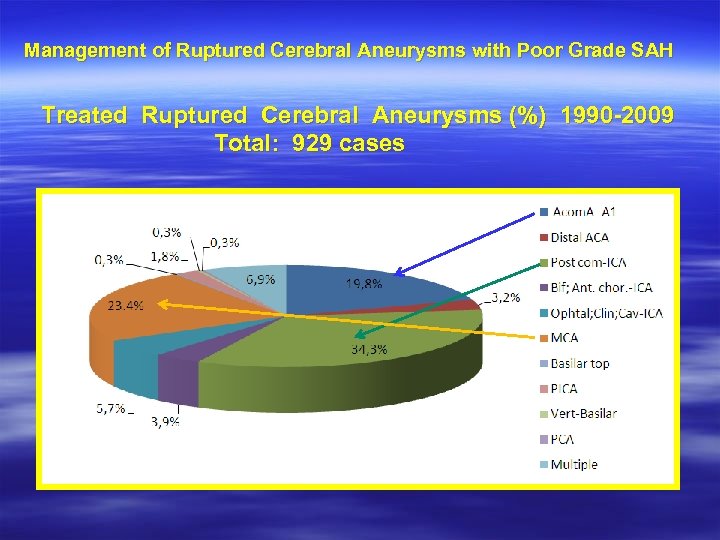
Management of Ruptured Cerebral Aneurysms with Poor Grade SAH Treated Ruptured Cerebral Aneurysms (%) 1990 -2009 Total: 929 cases
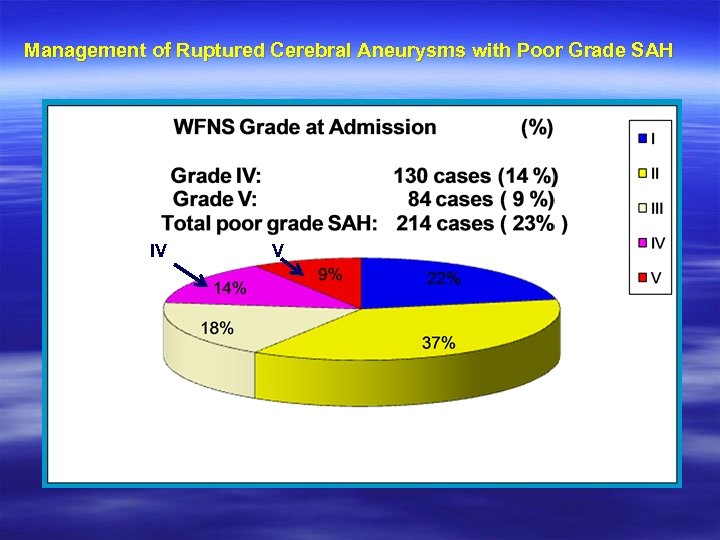
Management of Ruptured Cerebral Aneurysms with Poor Grade SAH IV V
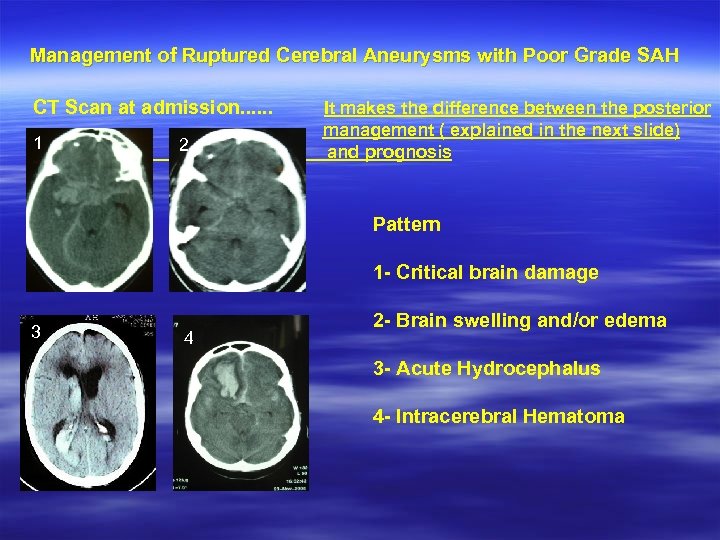
Management of Ruptured Cerebral Aneurysms with Poor Grade SAH CT Scan at admission. . . 1 2 It makes the difference between the posterior management ( explained in the next slide) and prognosis Pattern 1 - Critical brain damage 3 4 2 - Brain swelling and/or edema 3 - Acute Hydrocephalus 4 - Intracerebral Hematoma
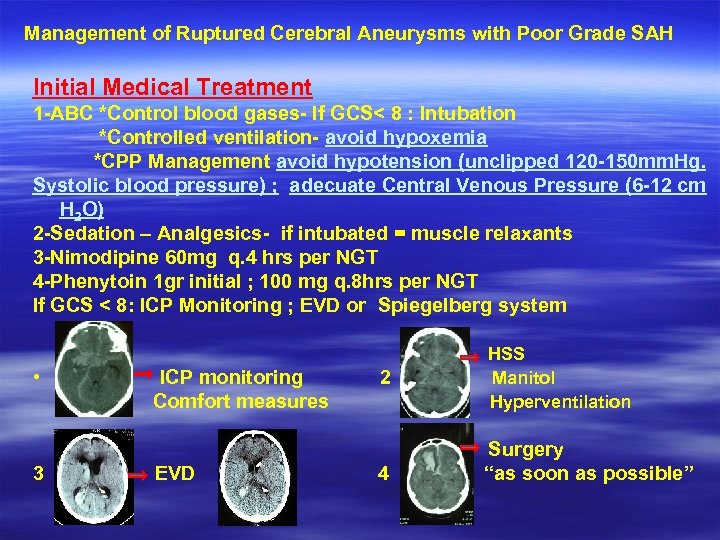
Management of Ruptured Cerebral Aneurysms with Poor Grade SAH Initial Medical Treatment 1 -ABC *Control blood gases- If GCS< 8 : Intubation *Controlled ventilation- avoid hypoxemia *CPP Management avoid hypotension (unclipped 120 -150 mm. Hg. Systolic blood pressure) ; adecuate Central Venous Pressure (6 -12 cm H 2 O) 2 -Sedation – Analgesics- if intubated = muscle relaxants 3 -Nimodipine 60 mg q. 4 hrs per NGT 4 -Phenytoin 1 gr initial ; 100 mg q. 8 hrs per NGT If GCS < 8: ICP Monitoring ; EVD or Spiegelberg system • 3 ICP monitoring Comfort measures EVD 2 4 HSS Manitol Hyperventilation Surgery “as soon as possible”
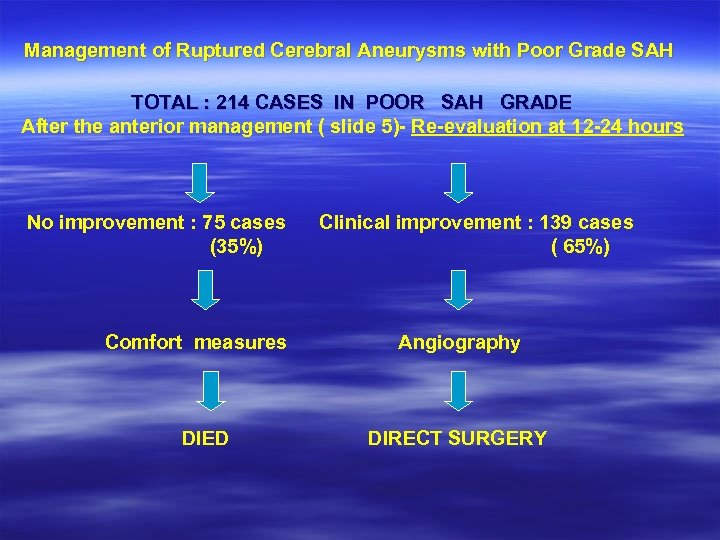
Management of Ruptured Cerebral Aneurysms with Poor Grade SAH TOTAL : 214 CASES IN POOR SAH GRADE After the anterior management ( slide 5)- Re-evaluation at 12 -24 hours No improvement : 75 cases (35%) Comfort measures DIED Clinical improvement : 139 cases ( 65%) Angiography DIRECT SURGERY
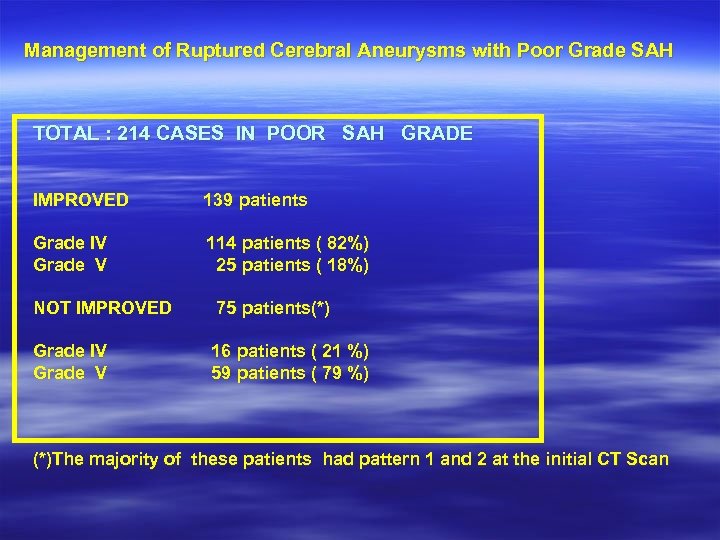
Management of Ruptured Cerebral Aneurysms with Poor Grade SAH TOTAL : 214 CASES IN POOR SAH GRADE IMPROVED 139 patients Grade IV Grade V 114 patients ( 82%) 25 patients ( 18%) NOT IMPROVED 75 patients(*) Grade IV Grade V 16 patients ( 21 %) 59 patients ( 79 %) (*)The majority of these patients had pattern 1 and 2 at the initial CT Scan
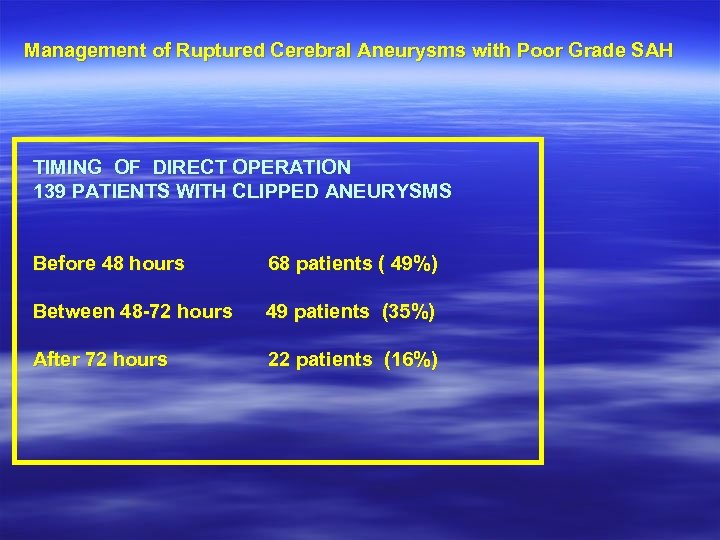
Management of Ruptured Cerebral Aneurysms with Poor Grade SAH TIMING OF DIRECT OPERATION 139 PATIENTS WITH CLIPPED ANEURYSMS Before 48 hours 68 patients ( 49%) Between 48 -72 hours 49 patients (35%) After 72 hours 22 patients (16%)
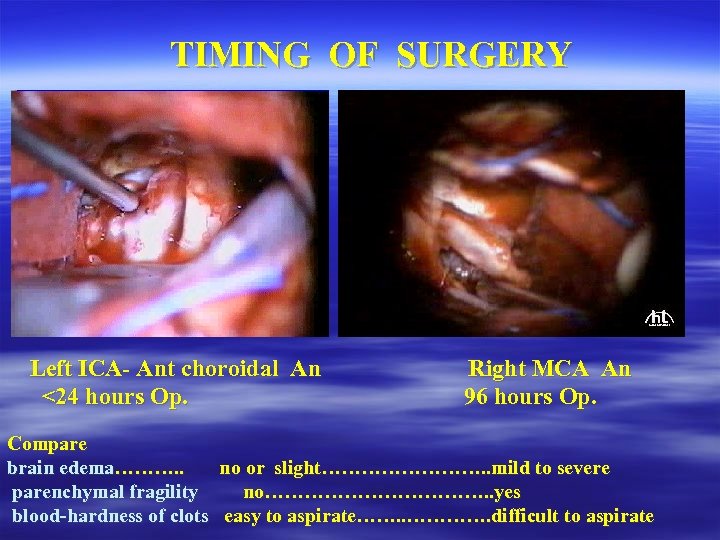
TIMING OF SURGERY Left ICA- Ant choroidal An <24 hours Op. Right MCA An 96 hours Op. Compare brain edema………. . no or slight…………. . mild to severe parenchymal fragility no………………. . yes blood-hardness of clots easy to aspirate……. . …………. difficult to aspirate
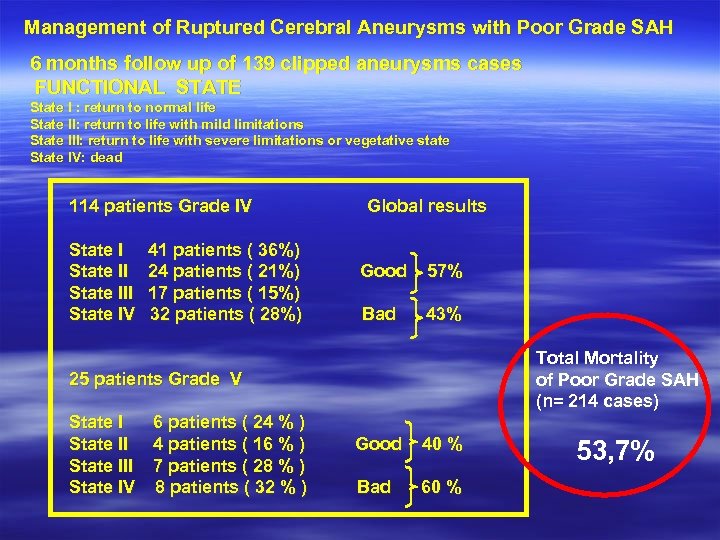
Management of Ruptured Cerebral Aneurysms with Poor Grade SAH 6 months follow up of 139 clipped aneurysms cases FUNCTIONAL STATE State I : return to normal life State II: return to life with mild limitations State III: return to life with severe limitations or vegetative state State IV: dead 114 patients Grade IV State III State IV 41 patients ( 36%) 24 patients ( 21%) 17 patients ( 15%) 32 patients ( 28%) Global results Good 57% Bad 43% Total Mortality of Poor Grade SAH (n= 214 cases) 25 patients Grade V State III State IV 6 patients ( 24 % ) 4 patients ( 16 % ) 7 patients ( 28 % ) 8 patients ( 32 % ) Good 40 % Bad 60 % 53, 7%
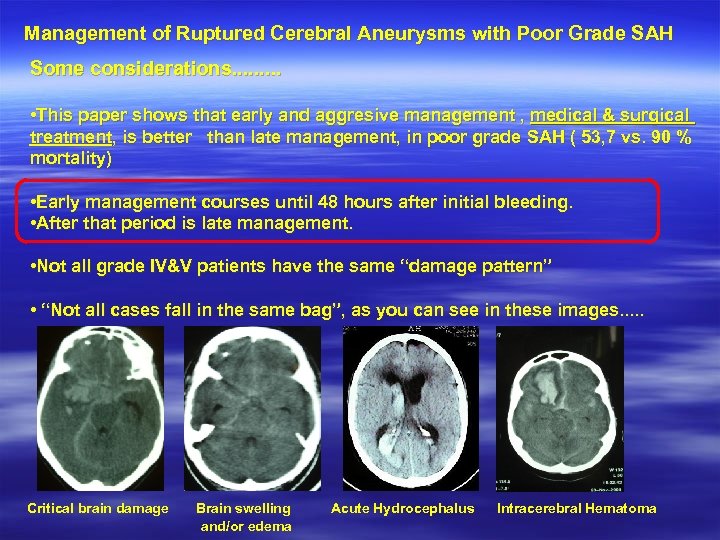
Management of Ruptured Cerebral Aneurysms with Poor Grade SAH Some considerations. . • This paper shows that early and aggresive management , medical & surgical treatment, is better than late management, in poor grade SAH ( 53, 7 vs. 90 % mortality) • Early management courses until 48 hours after initial bleeding. • After that period is late management. • Not all grade IV&V patients have the same “damage pattern” • “Not all cases fall in the same bag”, as you can see in these images. . . Critical brain damage Brain swelling and/or edema Acute Hydrocephalus Intracerebral Hematoma
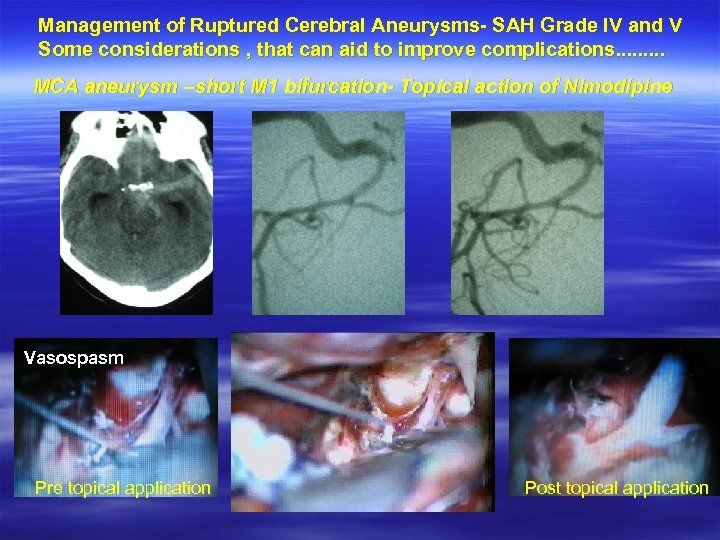
Management of Ruptured Cerebral Aneurysms- SAH Grade IV and V Some considerations , that can aid to improve complications. . MCA aneurysm –short M 1 bifurcation- Topical action of Nimodipine Vasospasm Pre topical application Post topical application
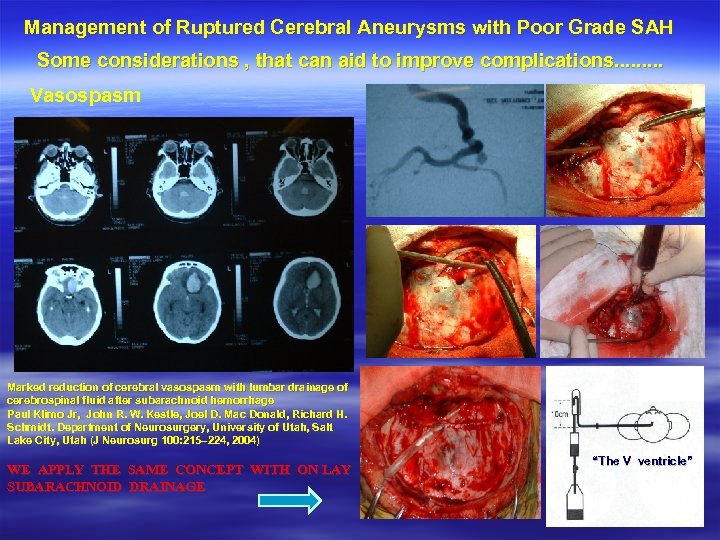
Management of Ruptured Cerebral Aneurysms with Poor Grade SAH Some considerations , that can aid to improve complications. . Vasospasm Marked reduction of cerebral vasospasm with lumbar drainage of cerebrospinal fluid after subarachnoid hemorrhage Paul Klimo Jr, John R. W. Kestle, Joel D. Mac Donald, Richard H. Jr, Kestle, Schmidt. Department of Neurosurgery, University of Utah, Salt Neurosurgery, Lake City, Utah (J Neurosurg 100: 215– 224, 2004) WE APPLY THE SAME CONCEPT WITH ON LAY SUBARACHNOID DRAINAGE “The V ventricle”
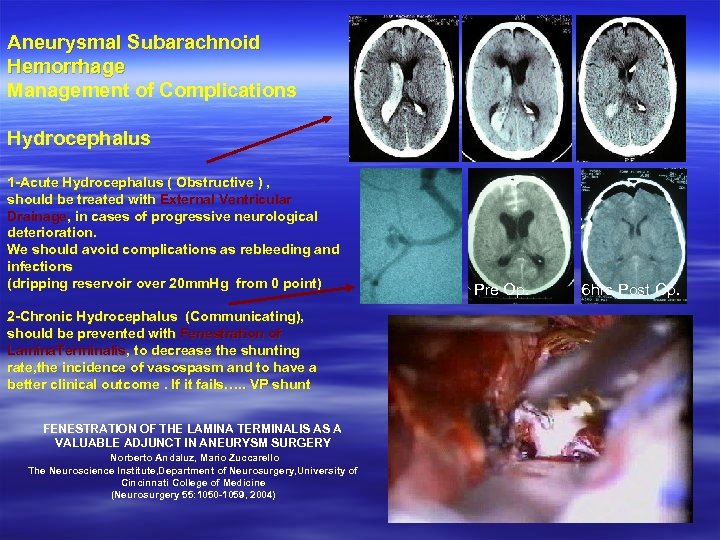
Aneurysmal Subarachnoid Hemorrhage Management of Complications Hydrocephalus 1 -Acute Hydrocephalus ( Obstructive ) , should be treated with External Ventricular Drainage, in cases of progressive neurological deterioration. We should avoid complications as rebleeding and infections (dripping reservoir over 20 mm. Hg from 0 point) 2 -Chronic Hydrocephalus (Communicating), should be prevented with Fenestration of Lamina. Terminalis, to decrease the shunting rate, the incidence of vasospasm and to have a better clinical outcome. If it fails…. . VP shunt FENESTRATION OF THE LAMINA TERMINALIS AS A VALUABLE ADJUNCT IN ANEURYSM SURGERY Norberto Andaluz, Mario Zuccarello The Neuroscience Institute, Department of Neurosurgery, University of Cincinnati College of Medicine (Neurosurgery 55: 1050 -1059, 2004) Pre Op. 6 hrs Post Op.

THANK YOU VERY MUCH !!! Prof. Dr. Leonidas M. Quintana Department of Neurosurgery – School of Medicine Valparaíso University - Chile
Скачать презентацию Management of Ruptured Cerebral Aneurysms with Poor Grade
40a638338e23cee879b3e150c167b45c.ppt