 Скачать презентацию Management of MPLS-based VPNs 2003 10 1 Youngtak
3547ed490f383093ba093987d78336e6.ppt
- Количество слайдов: 126



Management of MPLS-based VPNs 2003. 10. 1. Youngtak Kim Advanced Networking Technology Lab. (ANTL) Dept. of Information & Communication Engineering, Yeungnam University, Korea (ytkim@yu. ac. kr) APNOMS 2003 Tutorial, Youngtak Kim, Advanced Networking Technology Lab. (ANT Lab. ), Yeung. Nam Univ. 1
Outline This tutorial goes through … l Framework of MPLS-based VPNs: L 3 VPN, L 2 VPN, VPLS l Traffic Engineering based on Diff. Serv-aware-(G)MPLS l Management Framework of MPLS Network, MPLS MIBs l MPLS OAM for the Management of MPLS-based VPNs l Commercial MPLS-VPN Management Systems: Cisco VPN Solution, Sheer. BOS, Wandl’s IP/MPLSview l Experiences in the design and implementation of a Management System for Diff. Serv-aware-MPLS (Doumi. Man) l Conclusions and Discussions APNOMS 2003 Tutorial, Youngtak Kim, Advanced Networking Technology Lab. (ANT Lab. ), Yeung. Nam Univ. 2
Framework of MPLS-based VPNs APNOMS 2003 Tutorial, Youngtak Kim, Advanced Networking Technology Lab. (ANT Lab. ), Yeung. Nam Univ. 3
VPN (Virtual Private Network) What is VPN (Virtual Private Network) ? l Definition of VPN in RFC 2764 (A Framework for IP Based Virtual Private Networks) : “VPN is an Emulation of a private wide area network (WAN) facility using IP facilities (including the public Internet or private IP backbones). ” l CPE-based VPN l Network-based VPN General Requirements of VPNs l Opaque packet transport l Data Security l Quality of Service Guarantees l Tunneling Mechanism APNOMS 2003 Tutorial, Youngtak Kim, Advanced Networking Technology Lab. (ANT Lab. ), Yeung. Nam Univ. 4
VPN Types of IP based Virtual Private Networks (RFC 2764) l Virtual Leased Lines (VLL) l Virtual Private Dial Network (VPDN) l Virtual Private Routed Network (VPRN) l Virtual Private LAN Segment (VPLS) APNOMS 2003 Tutorial, Youngtak Kim, Advanced Networking Technology Lab. (ANT Lab. ), Yeung. Nam Univ. 5
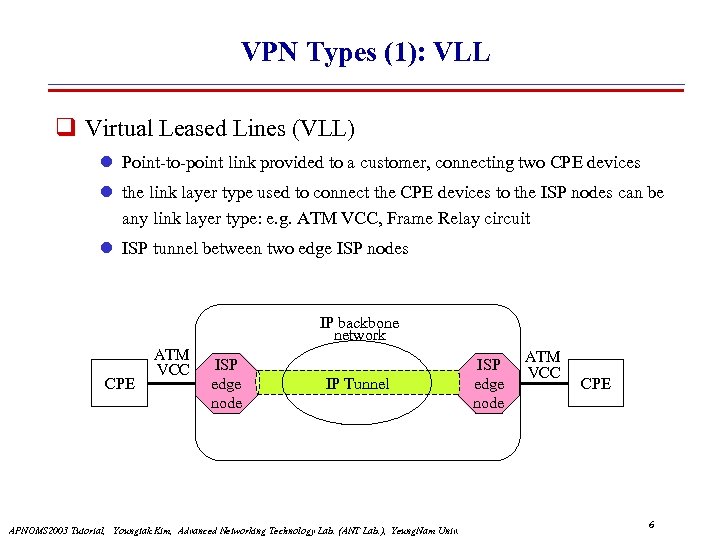
VPN Types (1): VLL Virtual Leased Lines (VLL) l Point-to-point link provided to a customer, connecting two CPE devices l the link layer type used to connect the CPE devices to the ISP nodes can be any link layer type: e. g. ATM VCC, Frame Relay circuit l ISP tunnel between two edge ISP nodes IP backbone network CPE ATM VCC ISP edge node IP Tunnel APNOMS 2003 Tutorial, Youngtak Kim, Advanced Networking Technology Lab. (ANT Lab. ), Yeung. Nam Univ. ISP edge node ATM VCC CPE 6
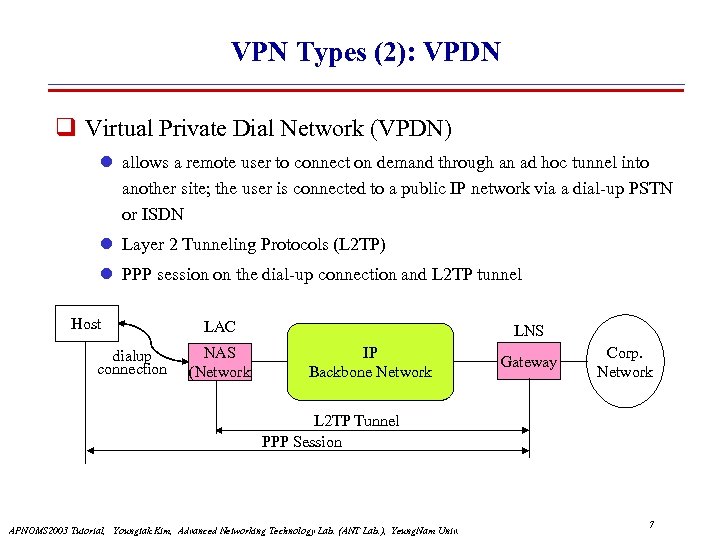
VPN Types (2): VPDN Virtual Private Dial Network (VPDN) l allows a remote user to connect on demand through an ad hoc tunnel into another site; the user is connected to a public IP network via a dial-up PSTN or ISDN l Layer 2 Tunneling Protocols (L 2 TP) l PPP session on the dial-up connection and L 2 TP tunnel Host dialup connection LAC NAS (Network LNS IP Backbone Network Gateway Corp. Network L 2 TP Tunnel PPP Session APNOMS 2003 Tutorial, Youngtak Kim, Advanced Networking Technology Lab. (ANT Lab. ), Yeung. Nam Univ. 7
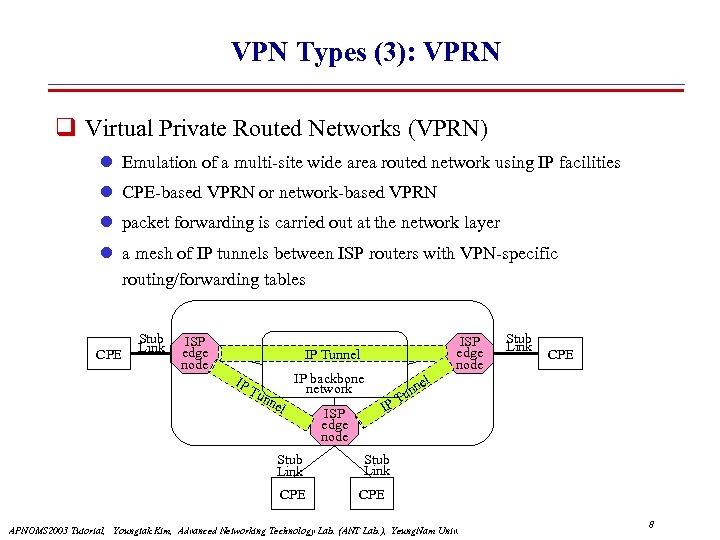
VPN Types (3): VPRN Virtual Private Routed Networks (VPRN) l Emulation of a multi-site wide area routed network using IP facilities l CPE-based VPRN or network-based VPRN l packet forwarding is carried out at the network layer l a mesh of IP tunnels between ISP routers with VPN-specific routing/forwarding tables CPE Stub Link ISP edge node IP Tunnel IP Tu nn IP backbone network el Stub Link CPE ISP edge node l ISP edge node Stub Link CPE ne n Tu IP Stub Link CPE APNOMS 2003 Tutorial, Youngtak Kim, Advanced Networking Technology Lab. (ANT Lab. ), Yeung. Nam Univ. 8
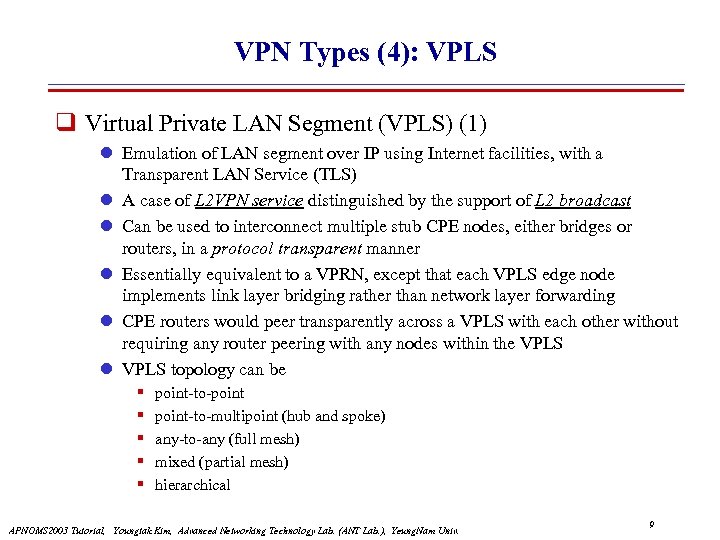
VPN Types (4): VPLS Virtual Private LAN Segment (VPLS) (1) l Emulation of LAN segment over IP using Internet facilities, with a Transparent LAN Service (TLS) l A case of L 2 VPN service distinguished by the support of L 2 broadcast l Can be used to interconnect multiple stub CPE nodes, either bridges or routers, in a protocol transparent manner l Essentially equivalent to a VPRN, except that each VPLS edge node implements link layer bridging rather than network layer forwarding l CPE routers would peer transparently across a VPLS with each other without requiring any router peering with any nodes within the VPLS l VPLS topology can be § § § point-to-point-to-multipoint (hub and spoke) any-to-any (full mesh) mixed (partial mesh) hierarchical APNOMS 2003 Tutorial, Youngtak Kim, Advanced Networking Technology Lab. (ANT Lab. ), Yeung. Nam Univ. 9
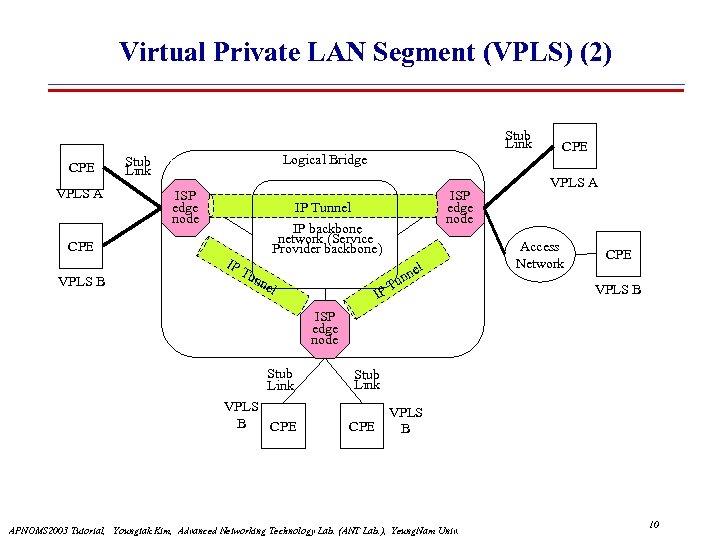
Virtual Private LAN Segment (VPLS) (2) CPE VPLS A Logical Bridge Stub Link ISP edge node IP Tunnel IP backbone network (Service Provider backbone) CPE VPLS B Stub Link IP Tu el nn nn u P T el I CPE VPLS A Access Network CPE VPLS B ISP edge node Stub Link VPLS B CPE Stub Link CPE VPLS B APNOMS 2003 Tutorial, Youngtak Kim, Advanced Networking Technology Lab. (ANT Lab. ), Yeung. Nam Univ. 10
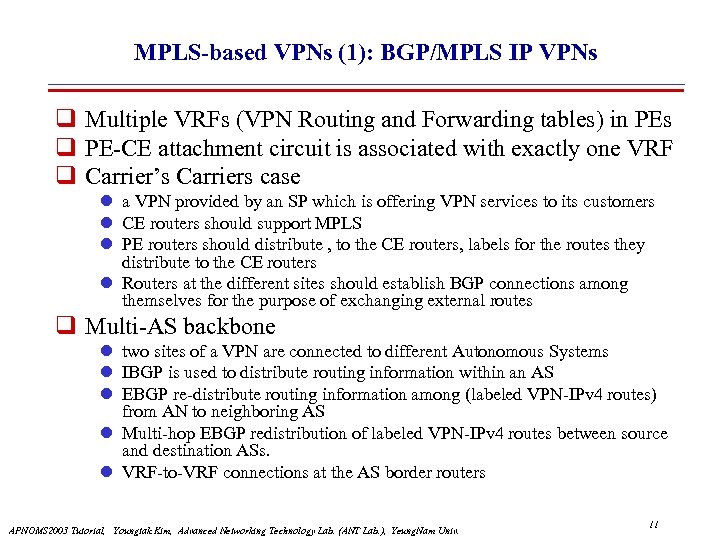
MPLS-based VPNs (1): BGP/MPLS IP VPNs Multiple VRFs (VPN Routing and Forwarding tables) in PEs PE-CE attachment circuit is associated with exactly one VRF Carrier’s Carriers case l a VPN provided by an SP which is offering VPN services to its customers l CE routers should support MPLS l PE routers should distribute , to the CE routers, labels for the routes they distribute to the CE routers l Routers at the different sites should establish BGP connections among themselves for the purpose of exchanging external routes Multi-AS backbone l two sites of a VPN are connected to different Autonomous Systems l IBGP is used to distribute routing information within an AS l EBGP re-distribute routing information among (labeled VPN-IPv 4 routes) from AN to neighboring AS l Multi-hop EBGP redistribution of labeled VPN-IPv 4 routes between source and destination ASs. l VRF-to-VRF connections at the AS border routers APNOMS 2003 Tutorial, Youngtak Kim, Advanced Networking Technology Lab. (ANT Lab. ), Yeung. Nam Univ. 11
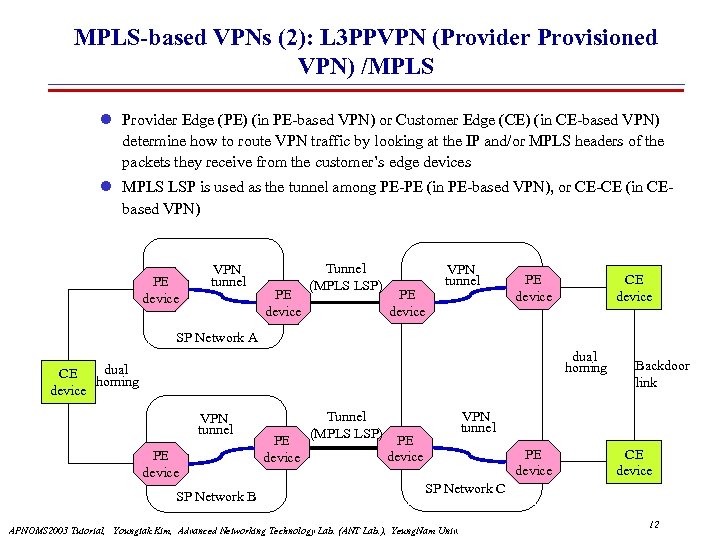
MPLS-based VPNs (2): L 3 PPVPN (Provider Provisioned VPN) /MPLS l Provider Edge (PE) (in PE-based VPN) or Customer Edge (CE) (in CE-based VPN) determine how to route VPN traffic by looking at the IP and/or MPLS headers of the packets they receive from the customer’s edge devices l MPLS LSP is used as the tunnel among PE-PE (in PE-based VPN), or CE-CE (in CEbased VPN) PE device VPN tunnel PE device Tunnel (MPLS LSP) PE device VPN tunnel CE device PE device SP Network A CE device dual homing VPN tunnel PE device SP Network B Backdoor link VPN tunnel Tunnel PE (MPLS LSP) PE device CE device SP Network C APNOMS 2003 Tutorial, Youngtak Kim, Advanced Networking Technology Lab. (ANT Lab. ), Yeung. Nam Univ. 12
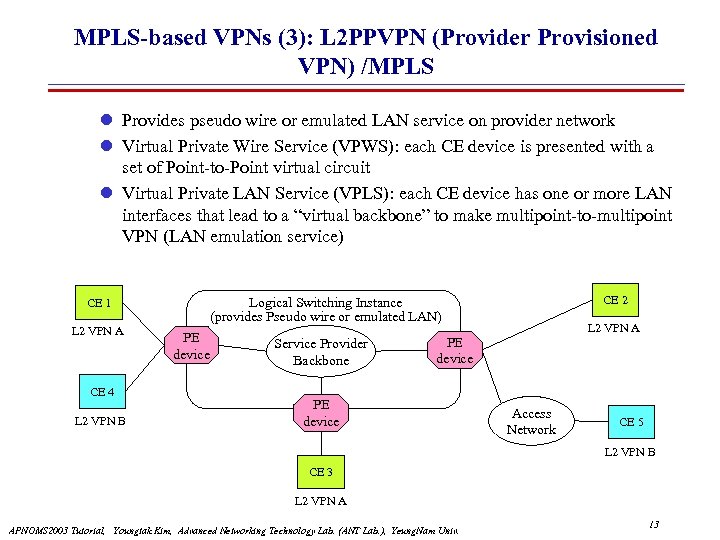
MPLS-based VPNs (3): L 2 PPVPN (Provider Provisioned VPN) /MPLS l Provides pseudo wire or emulated LAN service on provider network l Virtual Private Wire Service (VPWS): each CE device is presented with a set of Point-to-Point virtual circuit l Virtual Private LAN Service (VPLS): each CE device has one or more LAN interfaces that lead to a “virtual backbone” to make multipoint-to-multipoint VPN (LAN emulation service) L 2 VPN A CE 4 L 2 VPN B CE 2 Logical Switching Instance (provides Pseudo wire or emulated LAN) CE 1 PE device Service Provider Backbone L 2 VPN A PE device Access Network CE 5 L 2 VPN B CE 3 L 2 VPN A APNOMS 2003 Tutorial, Youngtak Kim, Advanced Networking Technology Lab. (ANT Lab. ), Yeung. Nam Univ. 13
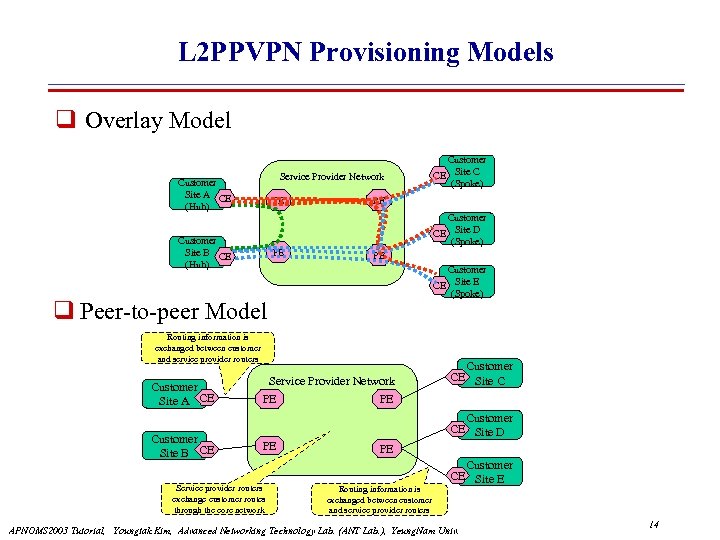
L 2 PPVPN Provisioning Models Overlay Model Service Provider Network Customer Site A CE (Hub) PE Customer CE Site C (Spoke) PE Customer CE Site D (Spoke) Customer Site B CE (Hub) PE PE Customer CE Site E (Spoke) Peer-to-peer Model Routing information is exchanged between customer and service provider routers Customer Site A CE Customer Site B CE Service Provider Network PE Customer CE Site C PE Customer CE Site D PE Service provider routers exchange customer routes through the core network PE Routing information is exchanged between customer and service provider routers Customer CE Site E APNOMS 2003 Tutorial, Youngtak Kim, Advanced Networking Technology Lab. (ANT Lab. ), Yeung. Nam Univ. 14
Traffic Engineerings based on Diff. Serv-aware-(G)MPLS Network APNOMS 2003 Tutorial, Youngtak Kim, Advanced Networking Technology Lab. (ANT Lab. ), Yeung. Nam Univ. 15
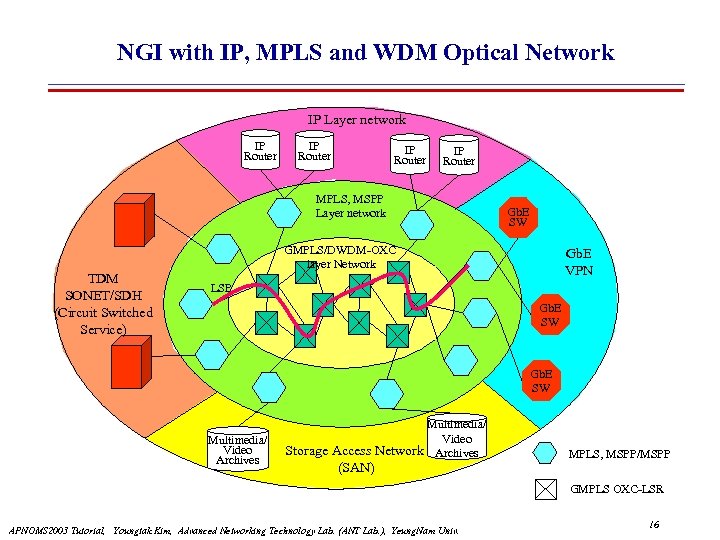
NGI with IP, MPLS and WDM Optical Network IP Layer network IP Router MPLS, MSPP Layer network TDM SONET/SDH (Circuit Switched Service) Gb. E SW GMPLS/DWDM-OXC layer Network Gb. E VPN LSP Gb. E SW Multimedia/ Video Archives Multimedia/ Video Storage Access Network Archives (SAN) MPLS, MSPP/MSPP GMPLS OXC-LSR APNOMS 2003 Tutorial, Youngtak Kim, Advanced Networking Technology Lab. (ANT Lab. ), Yeung. Nam Univ. 16
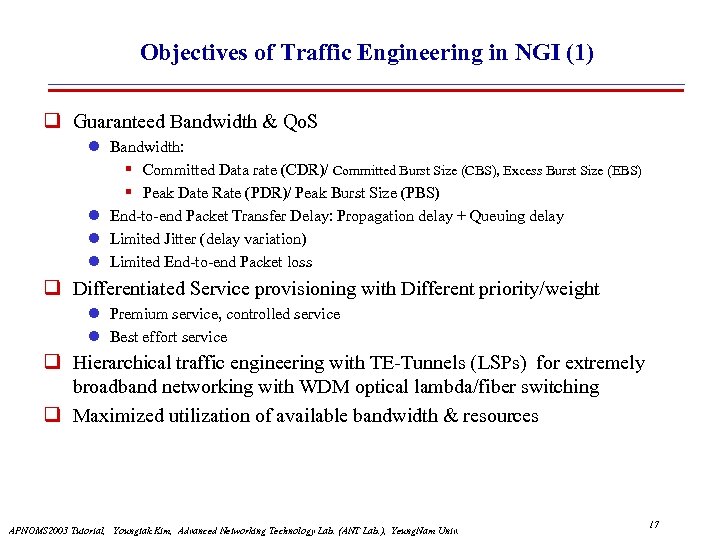
Objectives of Traffic Engineering in NGI (1) Guaranteed Bandwidth & Qo. S l Bandwidth: § Committed Data rate (CDR)/ Committed Burst Size (CBS), Excess Burst Size (EBS) § Peak Date Rate (PDR)/ Peak Burst Size (PBS) l End-to-end Packet Transfer Delay: Propagation delay + Queuing delay l Limited Jitter (delay variation) l Limited End-to-end Packet loss Differentiated Service provisioning with Different priority/weight l Premium service, controlled service l Best effort service Hierarchical traffic engineering with TE-Tunnels (LSPs) for extremely broadband networking with WDM optical lambda/fiber switching Maximized utilization of available bandwidth & resources APNOMS 2003 Tutorial, Youngtak Kim, Advanced Networking Technology Lab. (ANT Lab. ), Yeung. Nam Univ. 17
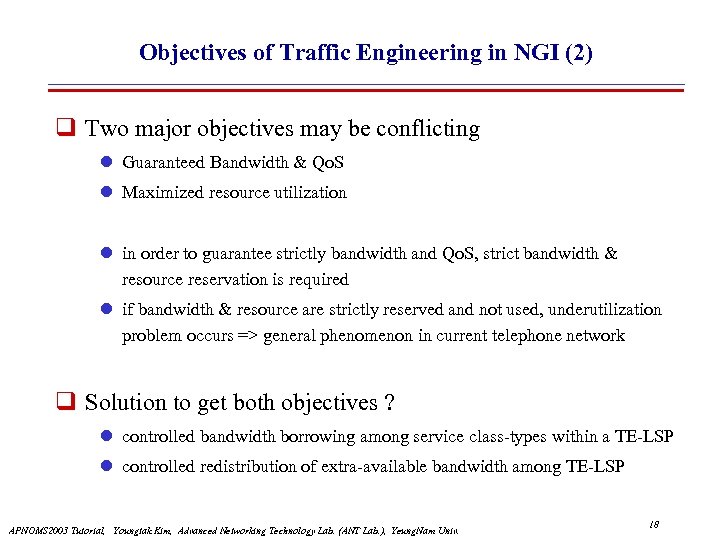
Objectives of Traffic Engineering in NGI (2) Two major objectives may be conflicting l Guaranteed Bandwidth & Qo. S l Maximized resource utilization l in order to guarantee strictly bandwidth and Qo. S, strict bandwidth & resource reservation is required l if bandwidth & resource are strictly reserved and not used, underutilization problem occurs => general phenomenon in current telephone network Solution to get both objectives ? l controlled bandwidth borrowing among service class-types within a TE-LSP l controlled redistribution of extra-available bandwidth among TE-LSP APNOMS 2003 Tutorial, Youngtak Kim, Advanced Networking Technology Lab. (ANT Lab. ), Yeung. Nam Univ. 18
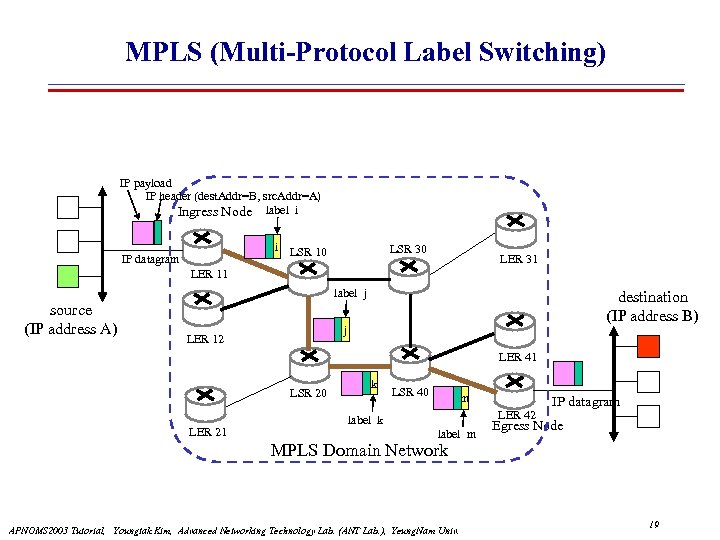
MPLS (Multi-Protocol Label Switching) IP payload IP header (dest. Addr=B, src. Addr=A) Ingress Node label i i LSR 10 IP datagram LSR 30 LER 31 LER 11 label j source (IP address A) destination (IP address B) j LER 12 LER 41 LSR 20 LER 21 k LSR 40 m LER 42 label k label m IP datagram Egress Node MPLS Domain Network APNOMS 2003 Tutorial, Youngtak Kim, Advanced Networking Technology Lab. (ANT Lab. ), Yeung. Nam Univ. 19
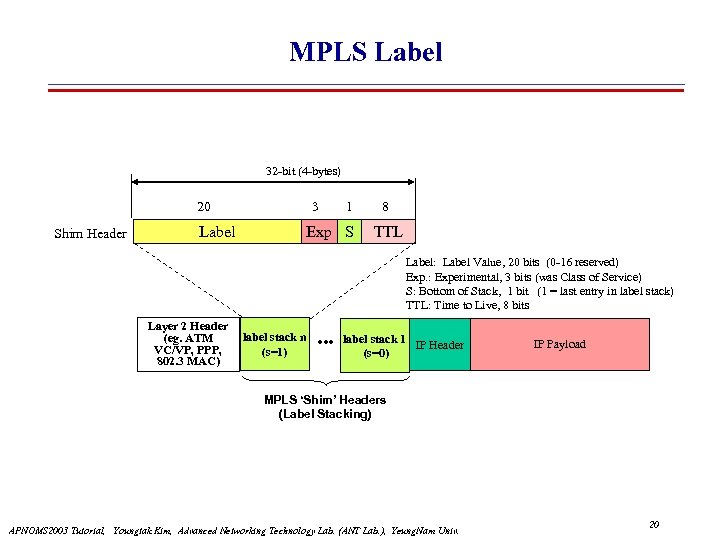
MPLS Label 32 -bit (4 -bytes) 20 Shim Header Label 3 1 Exp S 8 TTL Label: Label Value, 20 bits (0 -16 reserved) Exp. : Experimental, 3 bits (was Class of Service) S: Bottom of Stack, 1 bit (1 = last entry in label stack) TTL: Time to Live, 8 bits Layer 2 Header (eg. ATM VC/VP, PPP, 802. 3 MAC) label stack n (s=1) • • • label stack 1 IP Header (s=0) IP Payload MPLS ‘Shim’ Headers (Label Stacking) APNOMS 2003 Tutorial, Youngtak Kim, Advanced Networking Technology Lab. (ANT Lab. ), Yeung. Nam Univ. 20
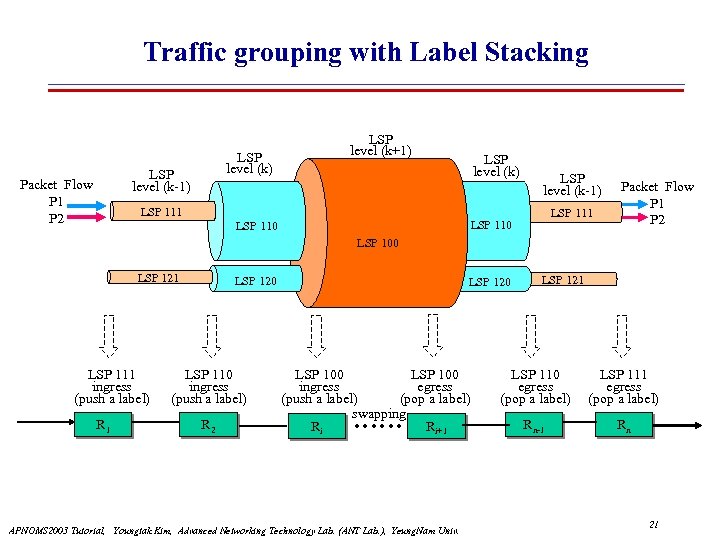
Traffic grouping with Label Stacking LSP level (k) LSP level (k-1) Packet Flow P 1 P 2 LSP level (k+1) LSP level (k) LSP 111 LSP level (k-1) LSP 111 LSP 110 Packet Flow P 1 P 2 LSP 100 LSP 121 LSP 111 ingress (push a label) R 1 LSP 120 LSP 110 ingress (push a label) R 2 LSP 120 LSP 100 ingress egress (push a label) (pop a label) swapping Ri Ri+1 APNOMS 2003 Tutorial, Youngtak Kim, Advanced Networking Technology Lab. (ANT Lab. ), Yeung. Nam Univ. LSP 121 LSP 110 egress (pop a label) LSP 111 egress (pop a label) Rn-1 Rn 21
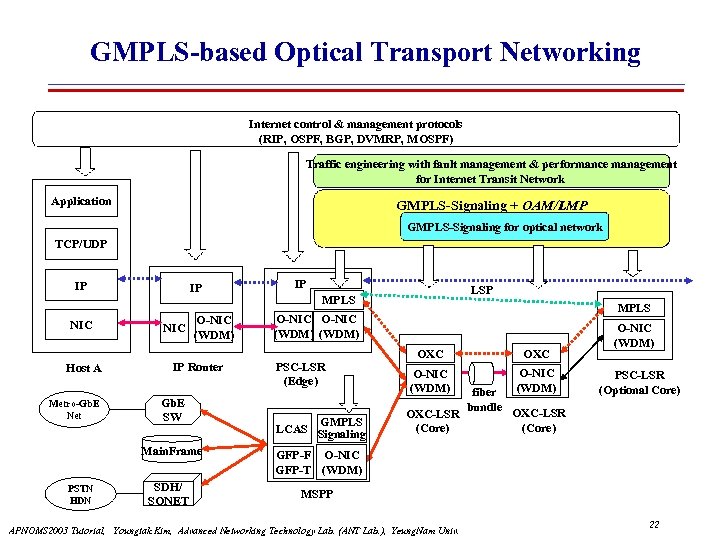
GMPLS-based Optical Transport Networking Internet control & management protocols (RIP, OSPF, BGP, DVMRP, MOSPF) Traffic engineering with fault management & performance management for Internet Transit Network Application GMPLS-Signaling + OAM/LMP GMPLS-Signaling for optical network TCP/UDP IP IP NIC O-NIC (WDM) Host A IP Router Metro-Gb. E Net Gb. E SW Main. Frame PSTN HDN SDH/ SONET IP LSP MPLS O-NIC (WDM) PSC-LSR (Edge) GMPLS LCAS Signaling OXC O-NIC (WDM) OXC-LSR (Core) fiber bundle O-NIC (WDM) PSC-LSR (Optional Core) OXC-LSR (Core) GFP-F O-NIC GFP-T (WDM) MSPP APNOMS 2003 Tutorial, Youngtak Kim, Advanced Networking Technology Lab. (ANT Lab. ), Yeung. Nam Univ. 22
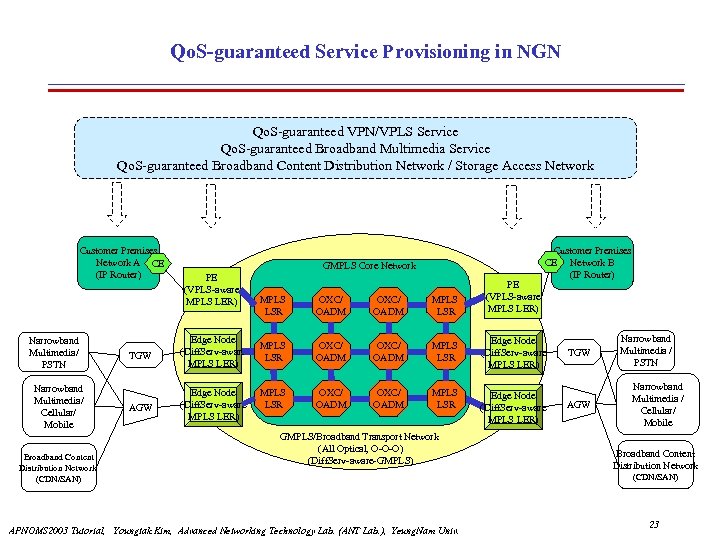
Qo. S-guaranteed Service Provisioning in NGN Qo. S-guaranteed VPN/VPLS Service Qo. S-guaranteed Broadband Multimedia Service Qo. S-guaranteed Broadband Content Distribution Network / Storage Access Network Customer Premises Network A CE (IP Router) Narrowband Multimedia/ PSTN Narrowband Multimedia/ Cellular/ Mobile Broadband Content Distribution Network (CDN/SAN) GMPLS Core Network PE (VPLS-aware MPLS LER) TGW Edge Node (Diff. Serv-aware MPLS LER) AGW Edge Node (Diff. Serv-aware MPLS LER) MPLS LSR OXC/ OADM MPLS LSR OXC/ OADM MPLS LSR GMPLS/Broadband Transport Network (All Optical, O-O-O) (Diff. Serv-aware-GMPLS) APNOMS 2003 Tutorial, Youngtak Kim, Advanced Networking Technology Lab. (ANT Lab. ), Yeung. Nam Univ. PE (VPLS-aware MPLS LER) Customer Premises CE Network B (IP Router) Edge Node (Diff. Serv-aware MPLS LER) TGW AGW Narrowband Multimedia / PSTN Narrowband Multimedia / Cellular/ Mobile Broadband Content Distribution Network (CDN/SAN) 23
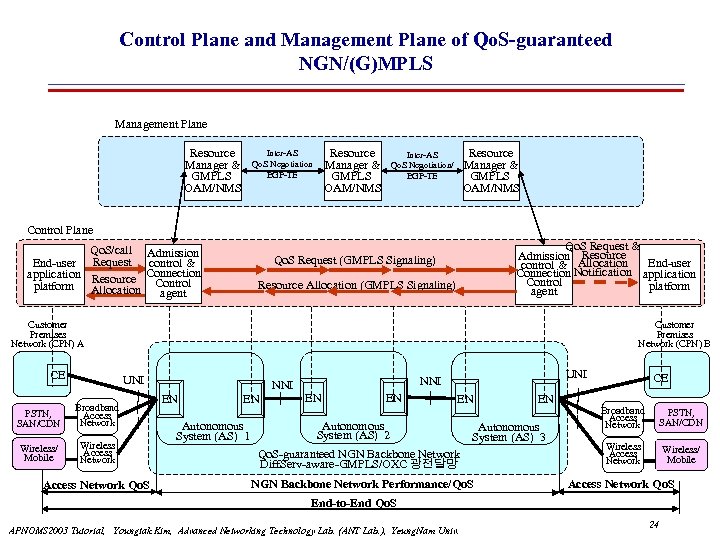
Control Plane and Management Plane of Qo. S-guaranteed NGN/(G)MPLS Management Plane Resource Manager & GMPLS OAM/NMS Inter-AS Qo. S Negotiation BGP-TE Resource Manager & GMPLS OAM/NMS Inter-AS Qo. S Negotiation/ BGP-TE Control Plane Qo. S/call Admission End-user Request control & application Resource Connection platform Allocation Control agent Qo. S Request & Admission Resource End-user control & Allocation Connection Notification application Control platform agent Qo. S Request (GMPLS Signaling) Resource Allocation (GMPLS Signaling) Customer Premises Network (CPN) A CE Customer Premises Network (CPN) B UNI PSTN, SAN/CDN Broadband Access Network Wireless/ Mobile Wireless Access Network Qo. S NNI EN EN Autonomous System (AS) 1 UNI NNI EN EN EN Autonomous System (AS) 2 EN Autonomous System (AS) 3 Qo. S-guaranteed NGN Backbone Network Diff. Serv-aware-GMPLS/OXC 광전달망 NGN Backbone Network Performance/Qo. S CE Broadband Access Network PSTN, SAN/CDN Wireless Access Network Wireless/ Mobile Access Network Qo. S End-to-End Qo. S APNOMS 2003 Tutorial, Youngtak Kim, Advanced Networking Technology Lab. (ANT Lab. ), Yeung. Nam Univ. 24
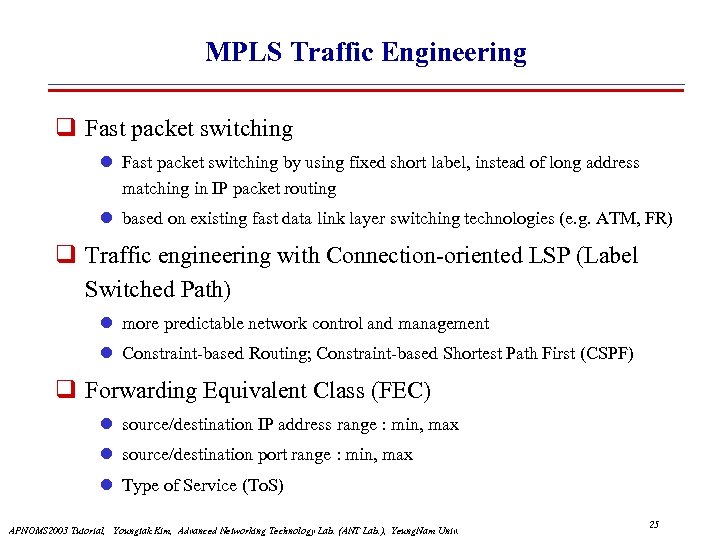
MPLS Traffic Engineering Fast packet switching l Fast packet switching by using fixed short label, instead of long address matching in IP packet routing l based on existing fast data link layer switching technologies (e. g. ATM, FR) Traffic engineering with Connection-oriented LSP (Label Switched Path) l more predictable network control and management l Constraint-based Routing; Constraint-based Shortest Path First (CSPF) Forwarding Equivalent Class (FEC) l source/destination IP address range : min, max l source/destination port range : min, max l Type of Service (To. S) APNOMS 2003 Tutorial, Youngtak Kim, Advanced Networking Technology Lab. (ANT Lab. ), Yeung. Nam Univ. 25
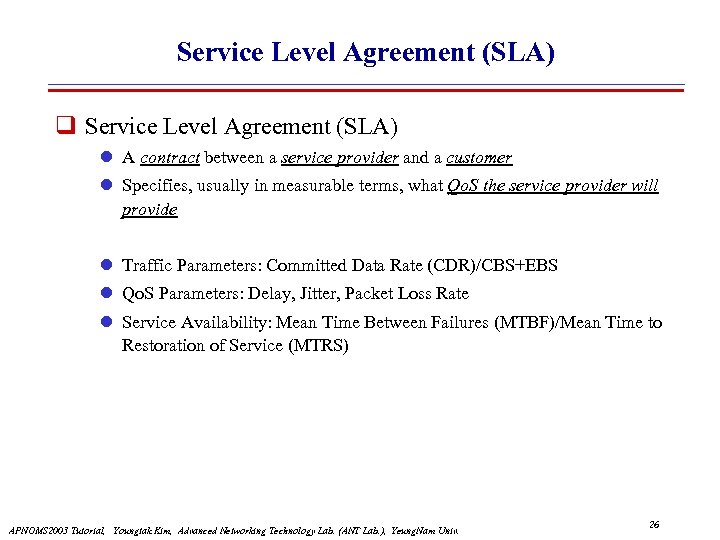
Service Level Agreement (SLA) l A contract between a service provider and a customer l Specifies, usually in measurable terms, what Qo. S the service provider will provide l Traffic Parameters: Committed Data Rate (CDR)/CBS+EBS l Qo. S Parameters: Delay, Jitter, Packet Loss Rate l Service Availability: Mean Time Between Failures (MTBF)/Mean Time to Restoration of Service (MTRS) APNOMS 2003 Tutorial, Youngtak Kim, Advanced Networking Technology Lab. (ANT Lab. ), Yeung. Nam Univ. 26
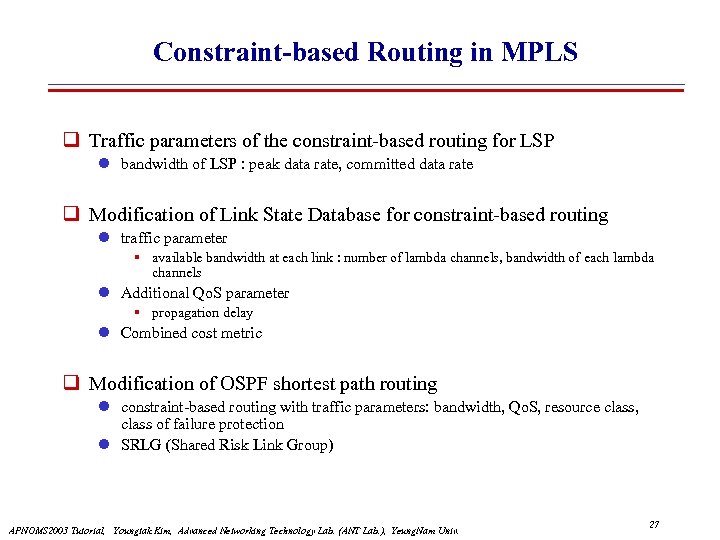
Constraint-based Routing in MPLS Traffic parameters of the constraint-based routing for LSP l bandwidth of LSP : peak data rate, committed data rate Modification of Link State Database for constraint-based routing l traffic parameter § available bandwidth at each link : number of lambda channels, bandwidth of each lambda channels l Additional Qo. S parameter § propagation delay l Combined cost metric Modification of OSPF shortest path routing l constraint-based routing with traffic parameters: bandwidth, Qo. S, resource class, class of failure protection l SRLG (Shared Risk Link Group) APNOMS 2003 Tutorial, Youngtak Kim, Advanced Networking Technology Lab. (ANT Lab. ), Yeung. Nam Univ. 27
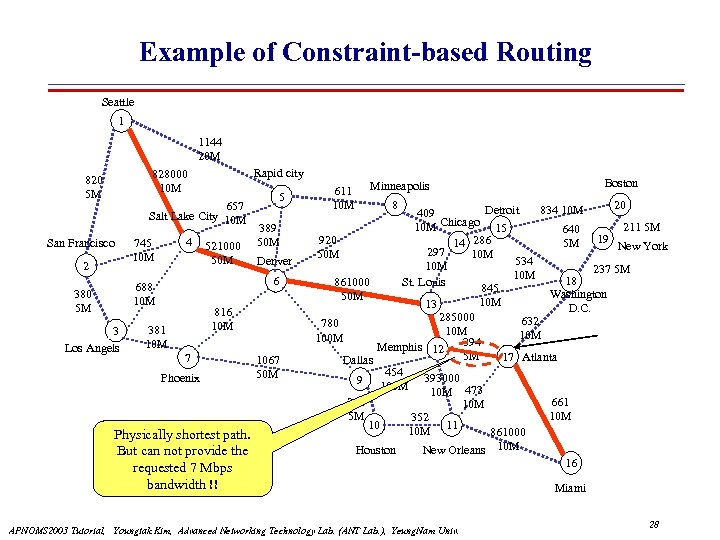
Example of Constraint-based Routing Seattle 1 1144 20 M Rapid city 828000 10 M 820 5 M 657 Salt Lake City 10 M San Francisco 2 4 745 10 M 3 Los Angels 389 50 M Denver 6 688 10 M 380 5 M 521000 50 M 5 816 10 M 381 10 M 7 Phoenix Physically shortest path. But can not provide the requested 7 Mbps bandwidth !! 1067 50 M 611 10 M Boston Minneapolis 8 20 Detroit 834 10 M 409 211 5 M 10 M Chicago 15 640 19 920 286 14 5 M New York 297 50 M 10 M 534 10 M 237 5 M 10 M 18 861000 St. Louis 845 Washington 50 M 13 D. C. 285000 632 780 10 M 100 M 394 Memphis 12 5 M 17 Atlanta Dallas 454 393000 9 100 M 10 M 473 246 661 10 M 5 M 10 M 352 10 11 10 M 861000 Houston New Orleans 10 M 16 APNOMS 2003 Tutorial, Youngtak Kim, Advanced Networking Technology Lab. (ANT Lab. ), Yeung. Nam Univ. Miami 28
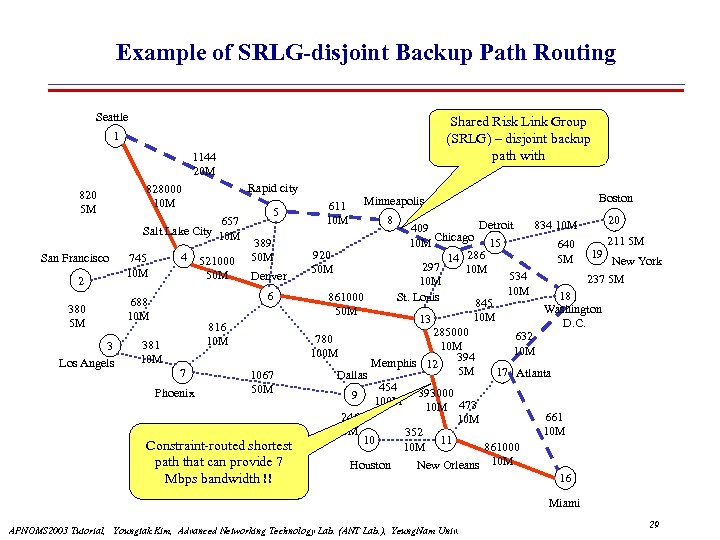
Example of SRLG-disjoint Backup Path Routing Seattle Shared Risk Link Group (SRLG) – disjoint backup path with 1 1144 20 M 820 5 M San Francisco 2 380 5 M 3 Los Angels Rapid city 828000 10 M 657 Salt Lake City 10 M 4 745 10 M 521000 50 M 5 389 50 M Denver 6 688 10 M 816 10 M 381 10 M 7 Phoenix 1067 50 M Constraint-routed shortest path that can provide 7 Mbps bandwidth !! 611 10 M Boston Minneapolis 8 20 Detroit 834 10 M 409 211 5 M 10 M Chicago 15 640 19 920 286 14 5 M New York 297 50 M 10 M 534 237 5 M 10 M 18 861000 St. Louis 845 Washington 50 M 13 D. C. 285000 632 780 10 M 100 M 394 Memphis 12 5 M 17 Atlanta Dallas 454 393000 9 100 M 10 M 473 246 661 10 M 5 M 10 M 352 10 11 10 M 861000 Houston New Orleans 10 M 16 Miami APNOMS 2003 Tutorial, Youngtak Kim, Advanced Networking Technology Lab. (ANT Lab. ), Yeung. Nam Univ. 29
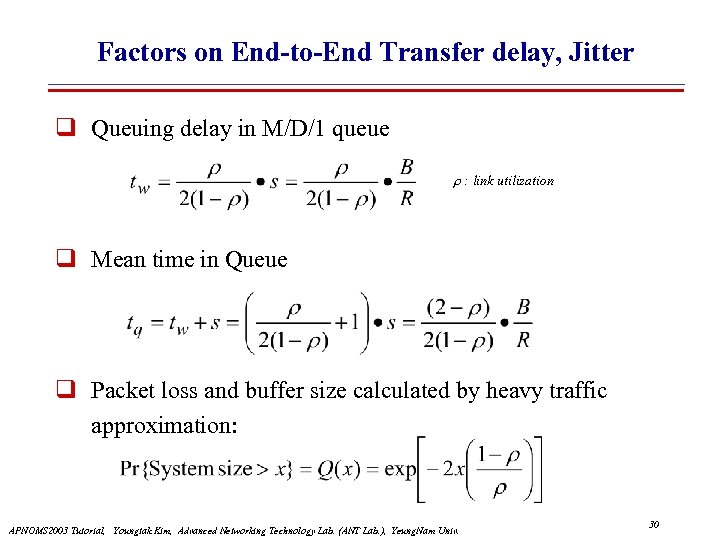
Factors on End-to-End Transfer delay, Jitter Queuing delay in M/D/1 queue : link utilization Mean time in Queue Packet loss and buffer size calculated by heavy traffic approximation: APNOMS 2003 Tutorial, Youngtak Kim, Advanced Networking Technology Lab. (ANT Lab. ), Yeung. Nam Univ. 30
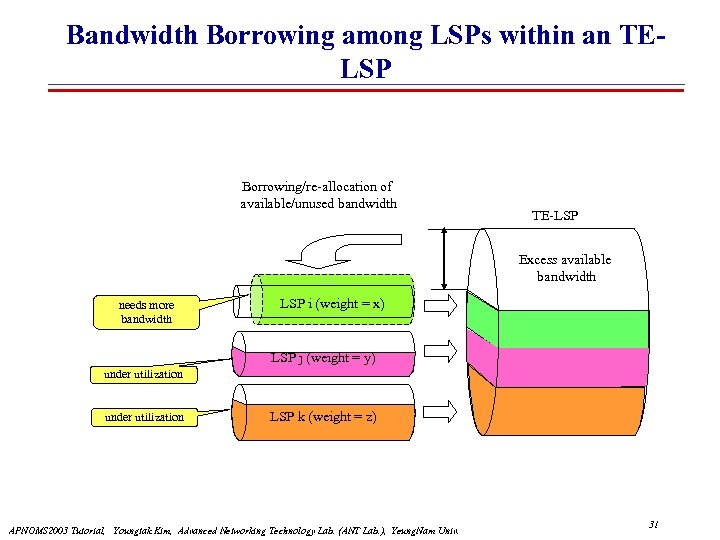
Bandwidth Borrowing among LSPs within an TELSP Borrowing/re-allocation of available/unused bandwidth TE-LSP Excess available bandwidth needs more bandwidth LSP i (weight = x) LSP j (weight = y) under utilization LSP k (weight = z) APNOMS 2003 Tutorial, Youngtak Kim, Advanced Networking Technology Lab. (ANT Lab. ), Yeung. Nam Univ. 31
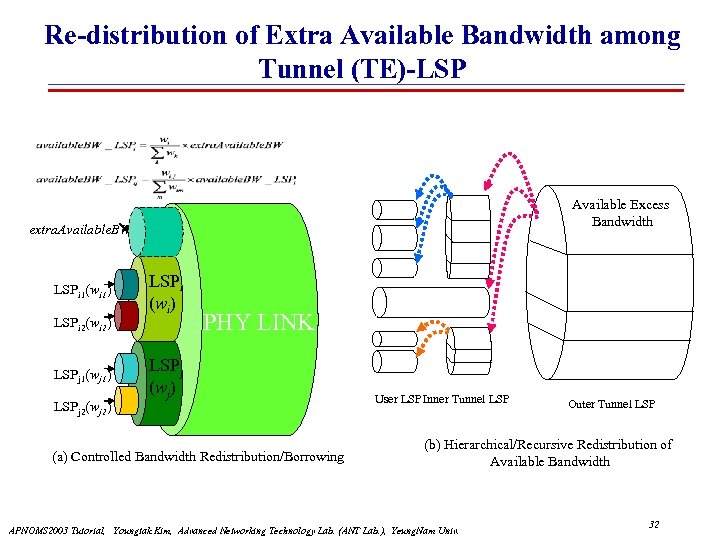
Re-distribution of Extra Available Bandwidth among Tunnel (TE)-LSP Available Excess Bandwidth extra. Available. BW LSPi 1(wi 1) LSPi 2(wi 2) LSPj 1(wj 1) LSPj 2(wj 2) LSPi (wi) PHY LINK LSPj (wj) (a) Controlled Bandwidth Redistribution/Borrowing User LSP Inner Tunnel LSP Outer Tunnel LSP (b) Hierarchical/Recursive Redistribution of Available Bandwidth APNOMS 2003 Tutorial, Youngtak Kim, Advanced Networking Technology Lab. (ANT Lab. ), Yeung. Nam Univ. 32
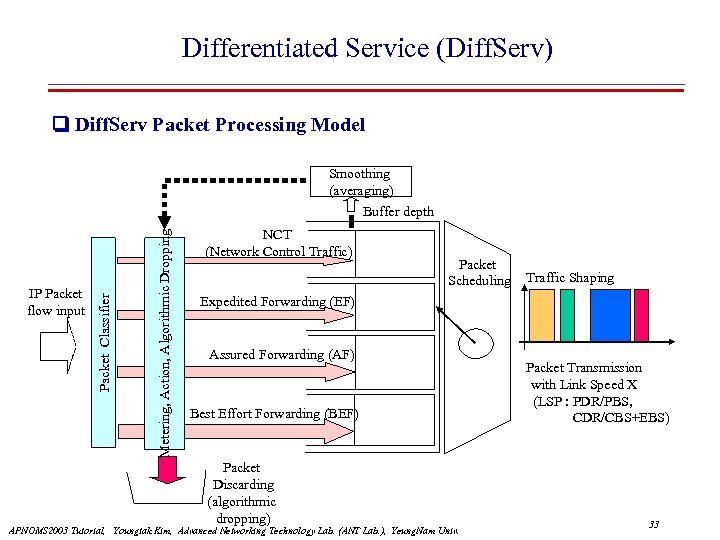
Differentiated Service (Diff. Serv) Diff. Serv Packet Processing Model Smoothing (averaging) Metering, Action, Algorithmic Dropping IP Packet flow input Packet Classifier Buffer depth NCT (Network Control Traffic) Packet Scheduling Traffic Shaping Expedited Forwarding (EF) Assured Forwarding (AF) Best Effort Forwarding (BEF) Packet Discarding (algorithmic dropping) APNOMS 2003 Tutorial, Youngtak Kim, Advanced Networking Technology Lab. (ANT Lab. ), Yeung. Nam Univ. Packet Transmission with Link Speed X (LSP : PDR/PBS, CDR/CBS+EBS) 33
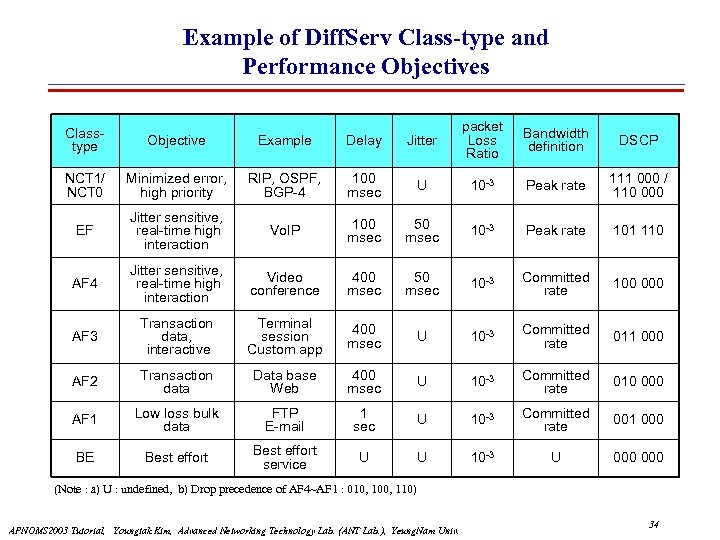
Example of Diff. Serv Class-type and Performance Objectives Delay Jitter packet Loss Ratio Minimized error, RIP, OSPF, high priority BGP-4 100 msec U 10 -3 Peak rate 111 000 / 110 000 EF Jitter sensitive, real-time high interaction Vo. IP 100 msec 50 msec 10 -3 Peak rate 101 110 AF 4 Jitter sensitive, real-time high interaction Video conference 400 msec 50 msec 10 -3 Committed rate 100 000 AF 3 Transaction data, interactive Terminal session Custom app 400 msec U 10 -3 Committed rate 011 000 AF 2 Transaction data Data base Web 400 msec U 10 -3 Committed rate 010 000 AF 1 Low loss bulk data FTP E-mail 1 sec U 10 -3 Committed rate 001 000 BE Best effort service U U 10 -3 U 000 Classtype NCT 1/ NCT 0 Objective Example Bandwidth definition DSCP (Note : a) U : undefined, b) Drop precedence of AF 4~AF 1 : 010, 100, 110) APNOMS 2003 Tutorial, Youngtak Kim, Advanced Networking Technology Lab. (ANT Lab. ), Yeung. Nam Univ. 34
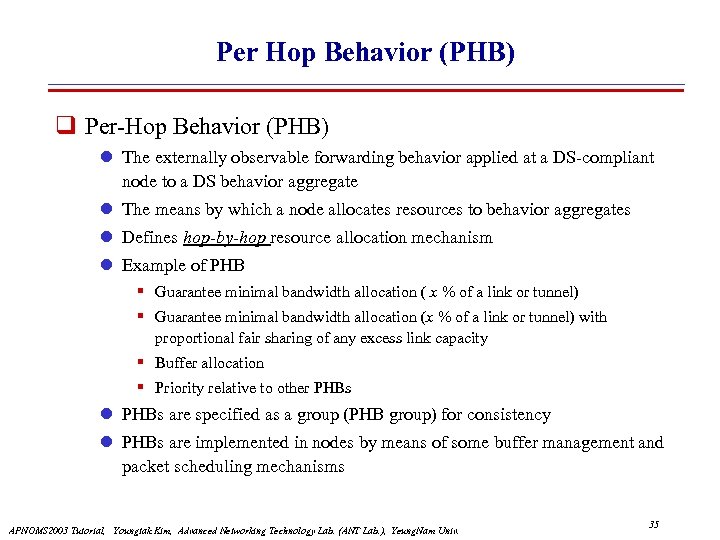
Per Hop Behavior (PHB) Per-Hop Behavior (PHB) l The externally observable forwarding behavior applied at a DS-compliant node to a DS behavior aggregate l The means by which a node allocates resources to behavior aggregates l Defines hop-by-hop resource allocation mechanism l Example of PHB § Guarantee minimal bandwidth allocation ( x % of a link or tunnel) § Guarantee minimal bandwidth allocation (x % of a link or tunnel) with proportional fair sharing of any excess link capacity § Buffer allocation § Priority relative to other PHBs l PHBs are specified as a group (PHB group) for consistency l PHBs are implemented in nodes by means of some buffer management and packet scheduling mechanisms APNOMS 2003 Tutorial, Youngtak Kim, Advanced Networking Technology Lab. (ANT Lab. ), Yeung. Nam Univ. 35
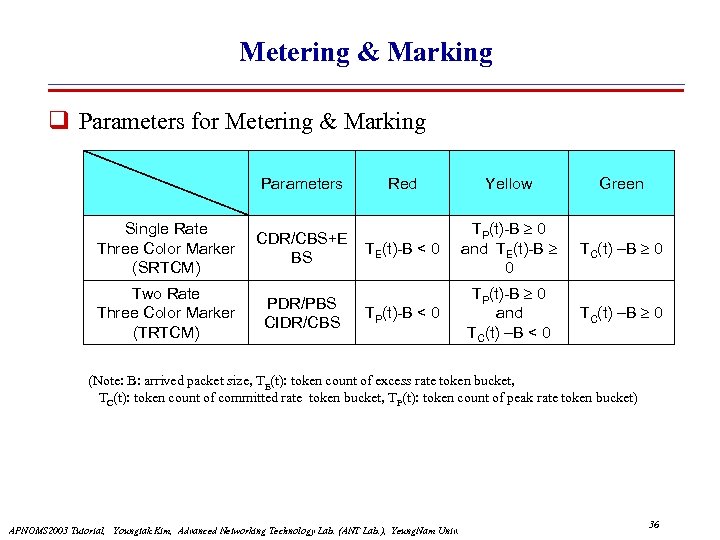
Metering & Marking Parameters for Metering & Marking Parameters Single Rate Three Color Marker (SRTCM) CDR/CBS+E BS Two Rate Three Color Marker (TRTCM) PDR/PBS CIDR/CBS Red Yellow Green TE(t)-B < 0 TP(t)-B 0 and TE(t)-B 0 TC(t) –B 0 TP(t)-B < 0 TP(t)-B 0 and TC(t) –B < 0 TC(t) –B 0 (Note: B: arrived packet size, TE(t): token count of excess rate token bucket, TC(t): token count of committed rate token bucket, TP(t): token count of peak rate token bucket) APNOMS 2003 Tutorial, Youngtak Kim, Advanced Networking Technology Lab. (ANT Lab. ), Yeung. Nam Univ. 36
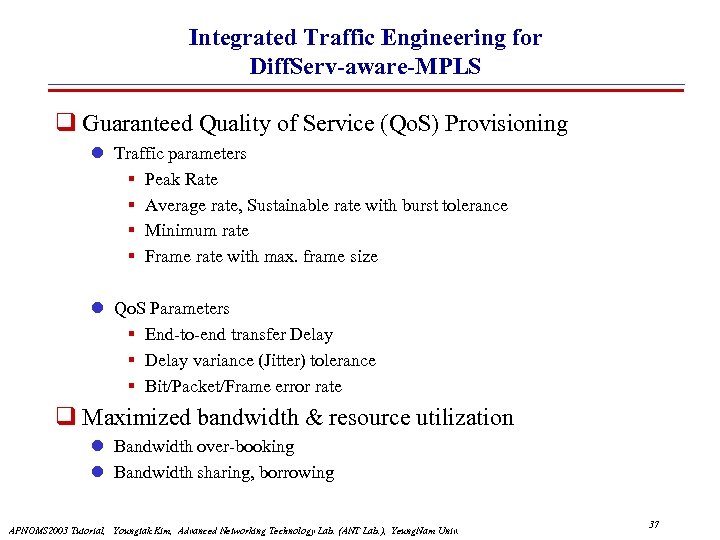
Integrated Traffic Engineering for Diff. Serv-aware-MPLS Guaranteed Quality of Service (Qo. S) Provisioning l Traffic parameters § Peak Rate § Average rate, Sustainable rate with burst tolerance § Minimum rate § Frame rate with max. frame size l Qo. S Parameters § End-to-end transfer Delay § Delay variance (Jitter) tolerance § Bit/Packet/Frame error rate Maximized bandwidth & resource utilization l Bandwidth over-booking l Bandwidth sharing, borrowing APNOMS 2003 Tutorial, Youngtak Kim, Advanced Networking Technology Lab. (ANT Lab. ), Yeung. Nam Univ. 37
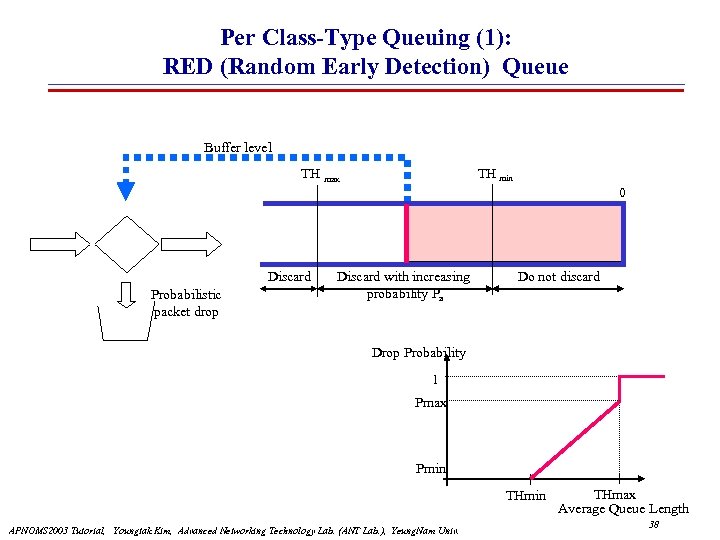
Per Class-Type Queuing (1): RED (Random Early Detection) Queue Buffer level TH min TH max 0 Discard Probabilistic packet drop Discard with increasing probability Pa Do not discard Drop Probability 1 Pmax Pmin THmin APNOMS 2003 Tutorial, Youngtak Kim, Advanced Networking Technology Lab. (ANT Lab. ), Yeung. Nam Univ. THmax Average Queue Length 38
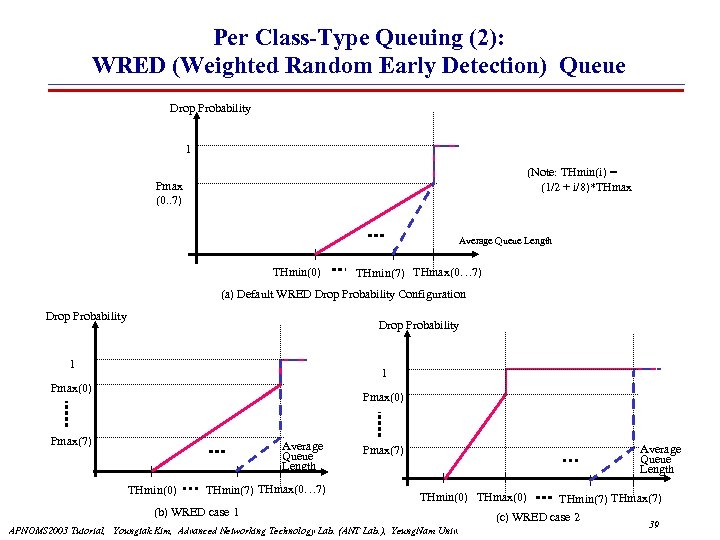
Per Class-Type Queuing (2): WRED (Weighted Random Early Detection) Queue Drop Probability 1 (Note: THmin(i) = (1/2 + i/8)*THmax Pmax (0. . 7) Average Queue Length THmin(0) THmin(7) THmax(0… 7) (a) Default WRED Drop Probability Configuration Drop Probability 1 1 Pmax(0) Pmax(7) Average Queue Length THmin(0) THmin(7) THmax(0… 7) Average Queue Length Pmax(7) THmin(0) THmax(0) (b) WRED case 1 APNOMS 2003 Tutorial, Youngtak Kim, Advanced Networking Technology Lab. (ANT Lab. ), Yeung. Nam Univ. THmin(7) THmax(7) (c) WRED case 2 39
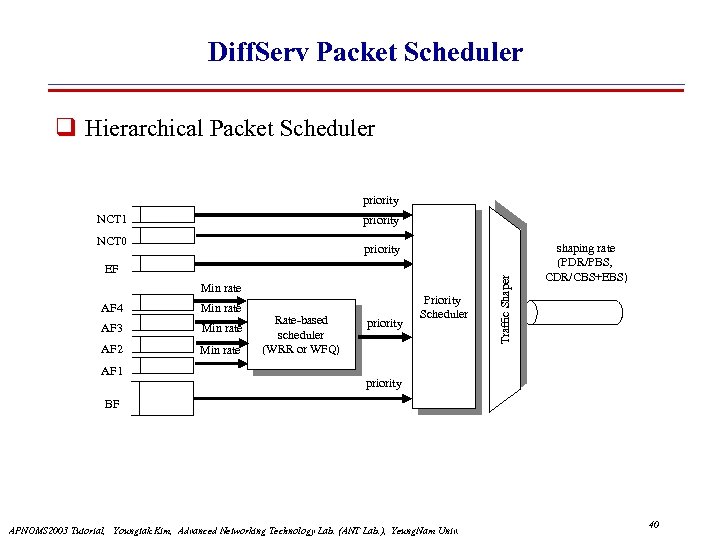
Diff. Serv Packet Scheduler Hierarchical Packet Scheduler priority NCT 1 priority NCT 0 EF Min rate AF 4 Min rate AF 3 Min rate AF 2 Min rate AF 1 Rate-based scheduler (WRR or WFQ) priority Priority Scheduler Traffic Shaper priority shaping rate (PDR/PBS, CDR/CBS+EBS) priority BF APNOMS 2003 Tutorial, Youngtak Kim, Advanced Networking Technology Lab. (ANT Lab. ), Yeung. Nam Univ. 40
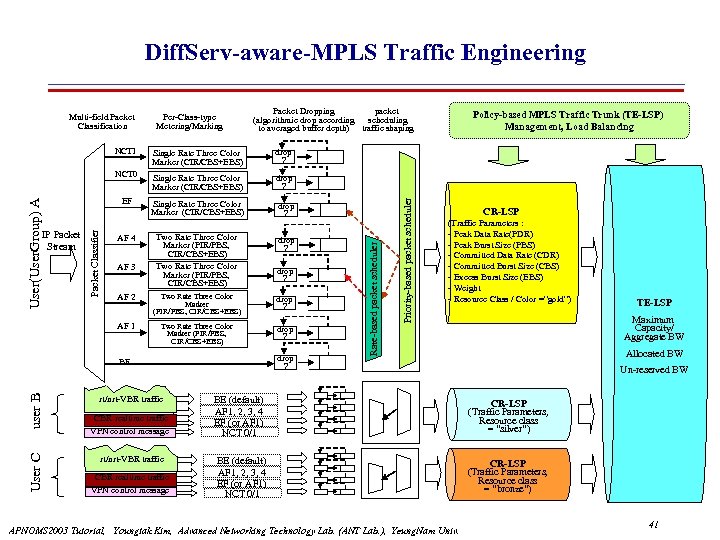
Diff. Serv-aware-MPLS Traffic Engineering Multi-field Packet Classification Per-Class-type Metering/Marking Packet Dropping packet (algorithmic drop according scheduling to averaged buffer depth) traffic shaping drop ? Single Rate Three Color Marker (CIR/CBS+EBS) drop ? AF 4 AF 3 Two Rate Three Color Marker (PIR/PBS, CIR/CBS+EBS) drop ? AF 2 Two Rate Three Color Marker (PIR/PBS, CIR/CBS+EBS) drop ? AF 1 Two Rate Three Color Marker (PIR/PBS, CIR/CBS+EBS) drop ? User C user B BF rt/nrt-VBR traffic CBR realtime traffic VPN control message Priority-based packet scheduler Single Rate Three Color Marker (CIR/CBS+EBS) Rate-based packet scheduler Packet Classifier drop ? EF IP Packet Stream Single Rate Three Color Marker (CIR/CBS+EBS) NCT 0 User(User. Group) A NCT 1 Policy-based MPLS Traffic Trunk (TE-LSP) Management, Load Balancing CR-LSP (Traffic Parameters : - Peak Data Rate(PDR) - Peak Burst Size (PBS) - Committed Data Rate (CDR) - Committed Burst Size (CBS) - Excess Burst Size (EBS) - Weight - Resource Class / Color =“gold”) TE-LSP Maximum Capacity/ Aggregate BW Allocated BW Un-reserved BW BE (default) AF 1, 2, 3, 4 EF (or AF 1) NCT 0/1 CR-LSP (Traffic Parameters, Resource class = “silver”) BE (default) AF 1, 2, 3, 4 EF (or AF 1) NCT 0/1 CR-LSP (Traffic Parameters, Resource class = “bronze”) APNOMS 2003 Tutorial, Youngtak Kim, Advanced Networking Technology Lab. (ANT Lab. ), Yeung. Nam Univ. 41
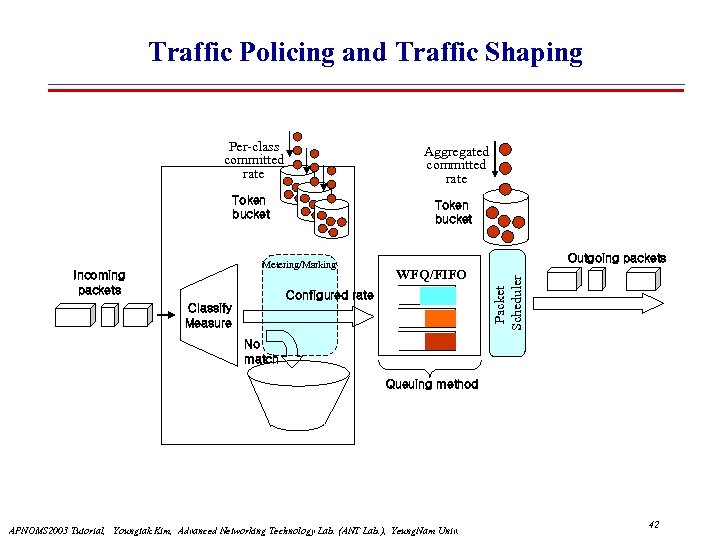
Traffic Policing and Traffic Shaping Per-class committed rate Aggregated committed rate Token bucket Incoming packets Outgoing packets WFQ/FIFO Configured rate Classify Measure Packet Scheduler Metering/Marking No match Queuing method APNOMS 2003 Tutorial, Youngtak Kim, Advanced Networking Technology Lab. (ANT Lab. ), Yeung. Nam Univ. 42
Management Framework of MPLS Network APNOMS 2003 Tutorial, Youngtak Kim, Advanced Networking Technology Lab. (ANT Lab. ), Yeung. Nam Univ. 43
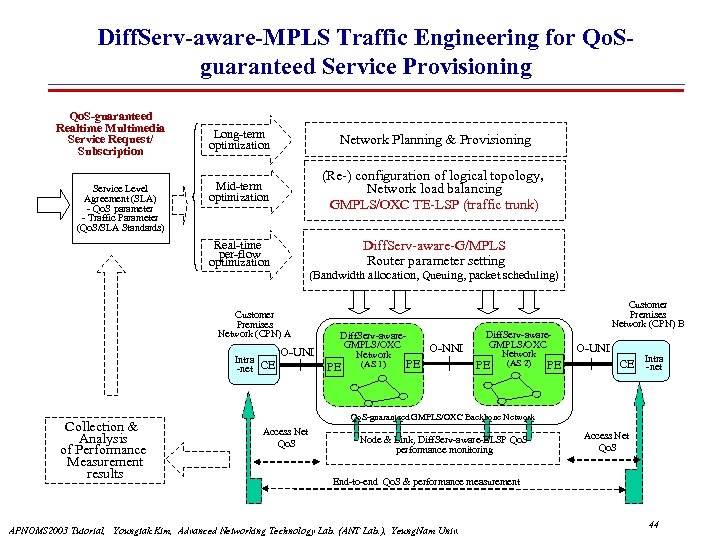
Diff. Serv-aware-MPLS Traffic Engineering for Qo. Sguaranteed Service Provisioning Qo. S-guaranteed Realtime Multimedia Service Request/ Subscription Network Planning & Provisioning Mid-term optimization (Re-) configuration of logical topology, Network load balancing GMPLS/OXC TE-LSP (traffic trunk) Real-time per-flow optimization Service Level Agreement (SLA) - Qo. S parameter - Traffic Parameter (Qo. S/SLA Standards) Long-term optimization Diff. Serv-aware-G/MPLS Router parameter setting (Bandwidth allocation, Queuing, packet scheduling) Customer Premises Network (CPN) A Intra -net Collection & Analysis of Performance Measurement results O-UNI CE Diff. Serv-aware. GMPLS/OXC Network PE (AS 1) O-NNI PE Diff. Serv-aware. GMPLS/OXC Network PE (AS 2) PE Customer Premises Network (CPN) B O-UNI CE Intra -net Qo. S-guaranteed GMPLS/OXC Backbone Network Access Net Qo. S Node & Link, Diff. Serv-aware-ELSP Qo. S performance monitoring Access Net Qo. S End-to-end Qo. S & performance measurement APNOMS 2003 Tutorial, Youngtak Kim, Advanced Networking Technology Lab. (ANT Lab. ), Yeung. Nam Univ. 44
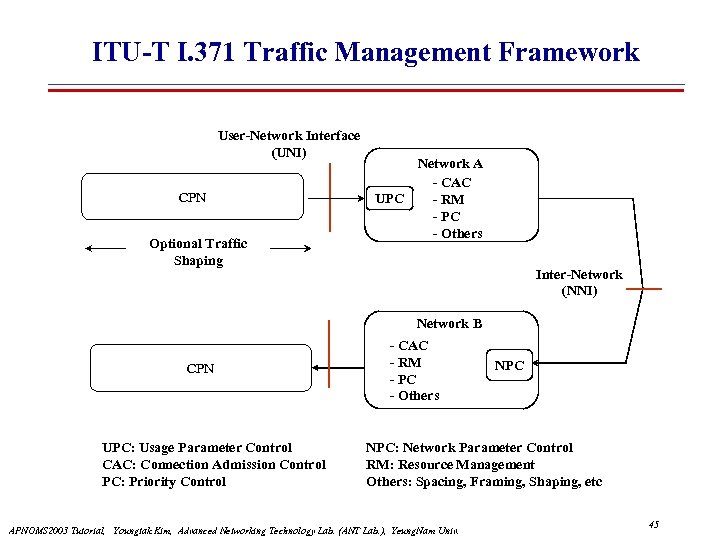
ITU-T I. 371 Traffic Management Framework User-Network Interface (UNI) CPN Optional Traffic Shaping Network A - CAC UPC - RM - PC - Others Inter-Network (NNI) Network B CPN UPC: Usage Parameter Control CAC: Connection Admission Control PC: Priority Control - CAC - RM - PC - Others NPC: Network Parameter Control RM: Resource Management Others: Spacing, Framing, Shaping, etc APNOMS 2003 Tutorial, Youngtak Kim, Advanced Networking Technology Lab. (ANT Lab. ), Yeung. Nam Univ. 45
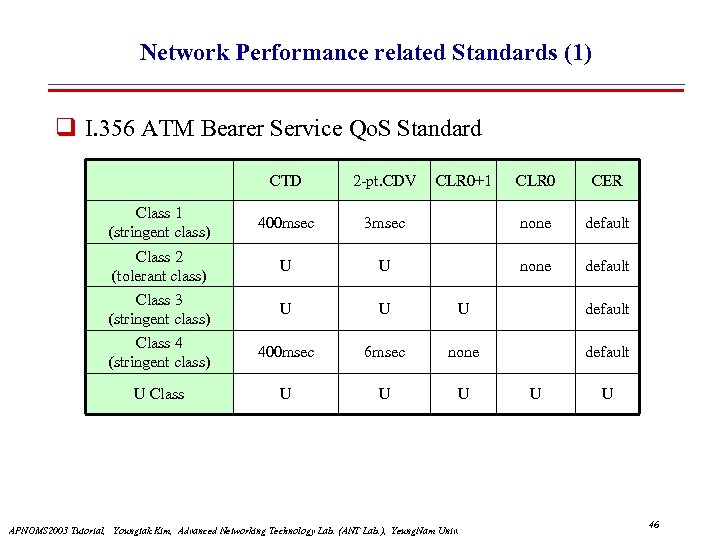
Network Performance related Standards (1) I. 356 ATM Bearer Service Qo. S Standard CTD 2 -pt. CDV Class 1 (stringent class) 400 msec Class 2 (tolerant class) Class 3 (stringent class) Class 4 (stringent class) U Class CLR 0+1 CLR 0 CER 3 msec none default U U U default 400 msec 6 msec none default U U U APNOMS 2003 Tutorial, Youngtak Kim, Advanced Networking Technology Lab. (ANT Lab. ), Yeung. Nam Univ. U U 46
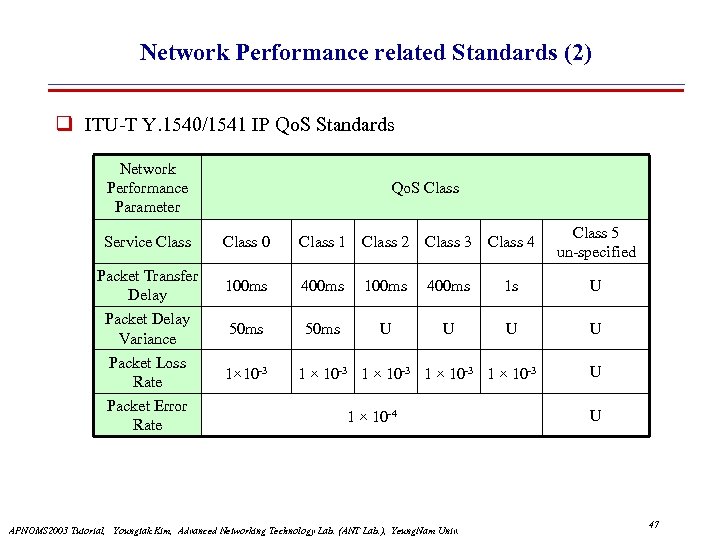
Network Performance related Standards (2) ITU-T Y. 1540/1541 IP Qo. S Standards Network Performance Parameter Qo. S Class Service Class 0 Class 1 Class 2 Class 3 Class 4 Class 5 un-specified Packet Transfer Delay 100 ms 400 ms 1 s U Packet Delay Variance 50 ms U U Packet Loss Rate 1× 10 -3 Packet Error Rate 1 × 10 -3 1 × 10 -4 APNOMS 2003 Tutorial, Youngtak Kim, Advanced Networking Technology Lab. (ANT Lab. ), Yeung. Nam Univ. U U 47
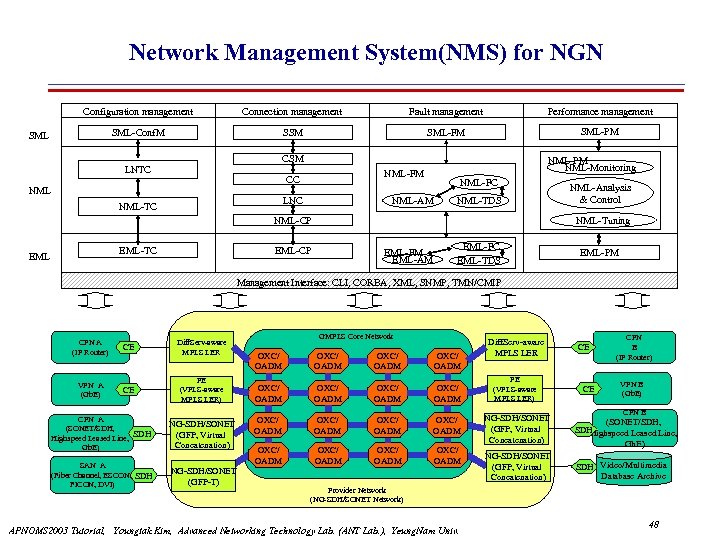
Network Management System(NMS) for NGN Configuration management Connection management Fault management Performance management SML-Conf. M SSM SML-FM SML-PM SML CSM LNTC NML-FM CC NML LNC NML-TC NML-PM NML-Monitoring NML-FC NML-AM NML-TDS NML-Tuning NML-CP EML-TC EML NML-Analysis & Control EML-CP EML-FM EML-AM EML-FC EML-TDS EML-PM Management Interface: CLI, CORBA, XML, SNMP, TMN/CMIP CPN A (IP Router) CE Diff. Serv-aware MPLS LER VPN A (Gb. E) CE PE (VPLS-aware MPLS LER) CPN A (SONET/SDH, Highspeed Leased Line, SDH Gb. E) NG-SDH/SONET (GFP, Virtual Concatenation) SAN A (Fiber Channel, ESCON, SDH FICON, DVI) NG-SDH/SONET (GFP-T) GMPLS Core Network OXC/ OADM OXC/ OADM OXC/ OADM OXC/ OADM Diff. Serv-aware MPLS LER PE (VPLS-aware MPLS LER) CE CE CPN B (IP Router) VPN B (Gb. E) CPN B NG-SDH/SONET (GFP, Virtual Concatenation) (SONET/SDH, SDH Highspeed Leased Line, Gb. E) NG-SDH/SONET (GFP, Virtual Concatenation) SDH Video/Multimedia Database Archive Provider Network (NG-SDH/SONET Network) APNOMS 2003 Tutorial, Youngtak Kim, Advanced Networking Technology Lab. (ANT Lab. ), Yeung. Nam Univ. 48
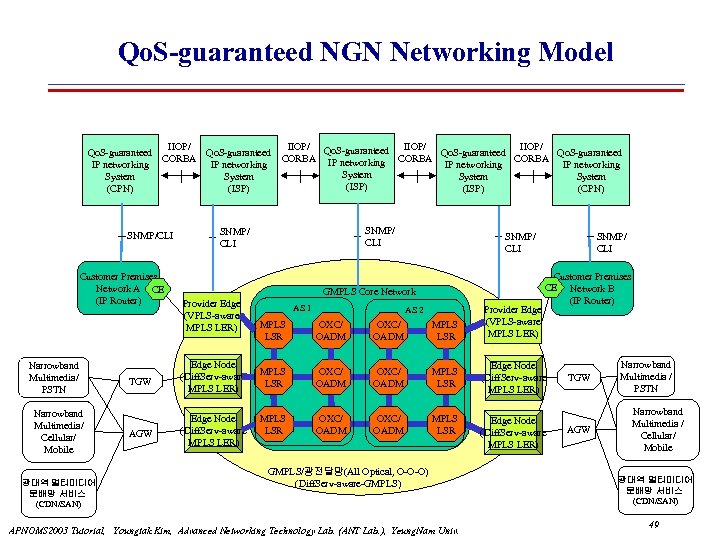
Qo. S-guaranteed NGN Networking Model IIOP/ Qo. S-guaranteed CORBA IP networking System (CPN) (ISP) SNMP/CLI Customer Premises Network A CE (IP Router) Narrowband Multimedia/ PSTN Narrowband Multimedia/ Cellular/ Mobile 광대역 멀티미디어 분배망 서비스 (CDN/SAN) IIOP/ Qo. S-guaranteed CORBA IP networking System (ISP) (CPN) SNMP/ CLI GMPLS Core Network Provider Edge (VPLS-aware MPLS LER) TGW Edge Node (Diff. Serv-aware MPLS LER) AS 1 AS 2 MPLS LSR OXC/ OADM MPLS LSR OXC/ OADM MPLS LSR GMPLS/광전달망(All Optical, O-O-O) (Diff. Serv-aware-GMPLS) APNOMS 2003 Tutorial, Youngtak Kim, Advanced Networking Technology Lab. (ANT Lab. ), Yeung. Nam Univ. Provider Edge (VPLS-aware MPLS LER) SNMP/ CLI Customer Premises CE Network B (IP Router) Edge Node (Diff. Serv-aware MPLS LER) TGW AGW Narrowband Multimedia / PSTN Narrowband Multimedia / Cellular/ Mobile 광대역 멀티미디어 분배망 서비스 (CDN/SAN) 49
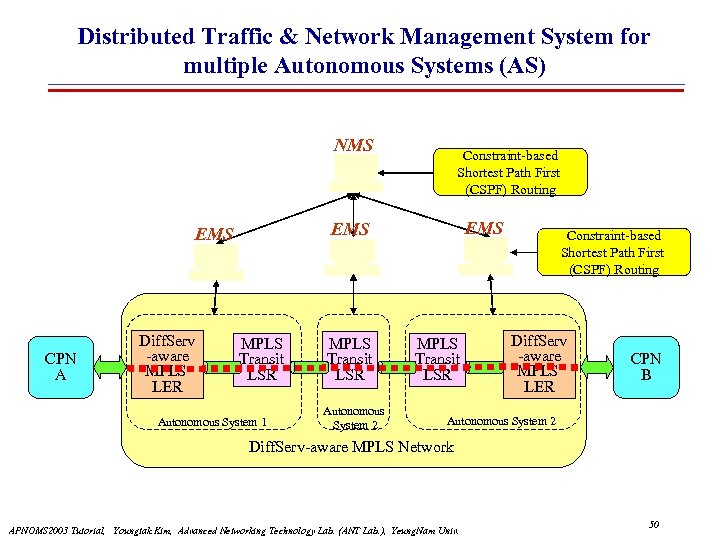
Distributed Traffic & Network Management System for multiple Autonomous Systems (AS) NMS CPN A EMS EMS Diff. Serv -aware MPLS LER Constraint-based Shortest Path First (CSPF) Routing MPLS Transit LSR Autonomous System 1 MPLS Transit LSR Autonomous System 2 MPLS Transit LSR Constraint-based Shortest Path First (CSPF) Routing Diff. Serv -aware MPLS LER CPN B Autonomous System 2 Diff. Serv-aware MPLS Network APNOMS 2003 Tutorial, Youngtak Kim, Advanced Networking Technology Lab. (ANT Lab. ), Yeung. Nam Univ. 50
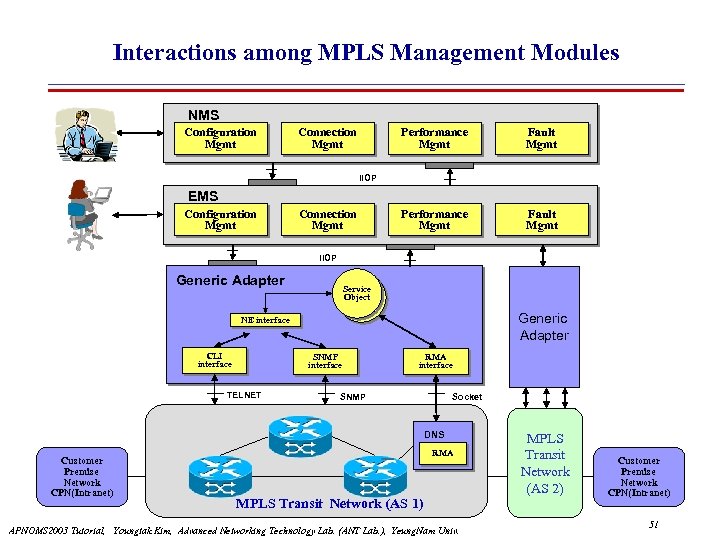
Interactions among MPLS Management Modules NMS Configuration Mgmt Connection Mgmt Performance Mgmt Fault Mgmt IIOP EMS Configuration Mgmt Connection Mgmt IIOP Generic Adapter Service Object Generic Adapter NE interface CLI interface SNMP interface TELNET RMA interface SNMP Socket DNS Customer Premise Network CPN(Intranet) RMA MPLS Transit Network (AS 1) APNOMS 2003 Tutorial, Youngtak Kim, Advanced Networking Technology Lab. (ANT Lab. ), Yeung. Nam Univ. MPLS Transit Network (AS 2) Customer Premise Network CPN(Intranet) 51
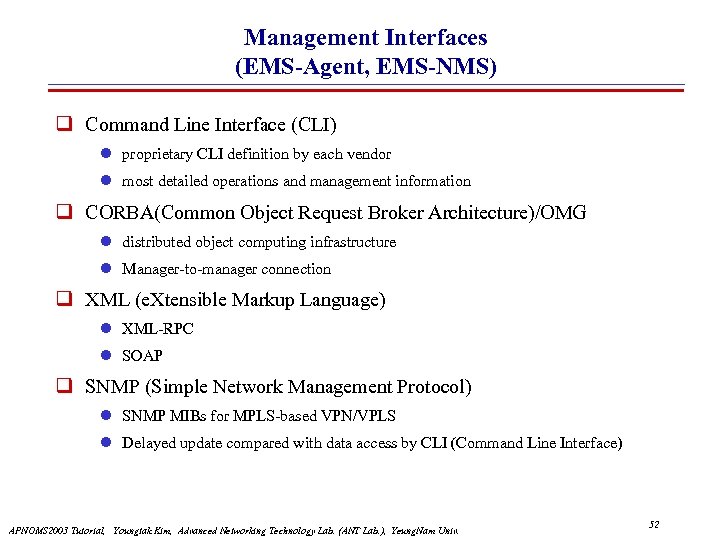
Management Interfaces (EMS-Agent, EMS-NMS) Command Line Interface (CLI) l proprietary CLI definition by each vendor l most detailed operations and management information CORBA(Common Object Request Broker Architecture)/OMG l distributed object computing infrastructure l Manager-to-manager connection XML (e. Xtensible Markup Language) l XML-RPC l SOAP SNMP (Simple Network Management Protocol) l SNMP MIBs for MPLS-based VPN/VPLS l Delayed update compared with data access by CLI (Command Line Interface) APNOMS 2003 Tutorial, Youngtak Kim, Advanced Networking Technology Lab. (ANT Lab. ), Yeung. Nam Univ. 52
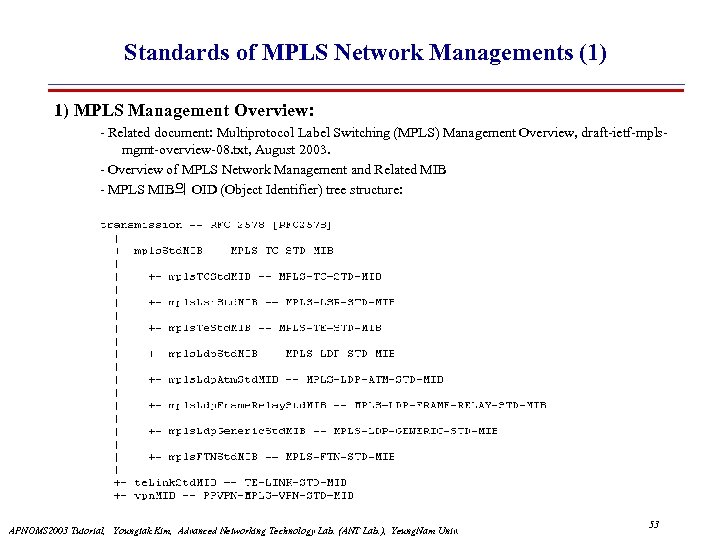
Standards of MPLS Network Managements (1) 1) MPLS Management Overview: - Related document: Multiprotocol Label Switching (MPLS) Management Overview, draft-ietf-mplsmgmt-overview-08. txt, August 2003. - Overview of MPLS Network Management and Related MIB - MPLS MIB의 OID (Object Identifier) tree structure: APNOMS 2003 Tutorial, Youngtak Kim, Advanced Networking Technology Lab. (ANT Lab. ), Yeung. Nam Univ. 53
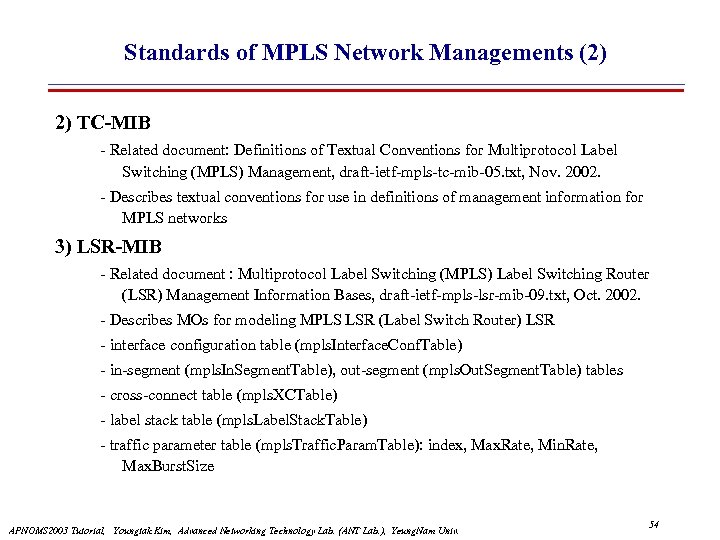
Standards of MPLS Network Managements (2) 2) TC-MIB - Related document: Definitions of Textual Conventions for Multiprotocol Label Switching (MPLS) Management, draft-ietf-mpls-tc-mib-05. txt, Nov. 2002. - Describes textual conventions for use in definitions of management information for MPLS networks 3) LSR-MIB - Related document : Multiprotocol Label Switching (MPLS) Label Switching Router (LSR) Management Information Bases, draft-ietf-mpls-lsr-mib-09. txt, Oct. 2002. - Describes MOs for modeling MPLS LSR (Label Switch Router) LSR - interface configuration table (mpls. Interface. Conf. Table) - in-segment (mpls. In. Segment. Table), out-segment (mpls. Out. Segment. Table) tables - cross-connect table (mpls. XCTable) - label stack table (mpls. Label. Stack. Table) - traffic parameter table (mpls. Traffic. Param. Table): index, Max. Rate, Min. Rate, Max. Burst. Size APNOMS 2003 Tutorial, Youngtak Kim, Advanced Networking Technology Lab. (ANT Lab. ), Yeung. Nam Univ. 54
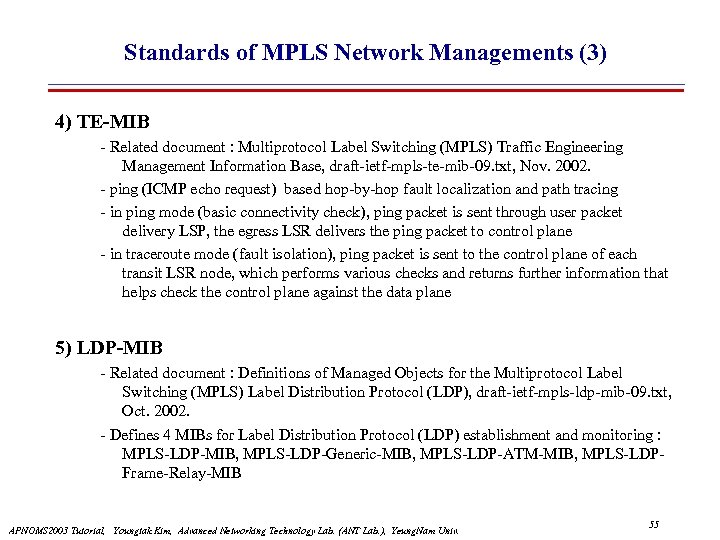
Standards of MPLS Network Managements (3) 4) TE-MIB - Related document : Multiprotocol Label Switching (MPLS) Traffic Engineering Management Information Base, draft-ietf-mpls-te-mib-09. txt, Nov. 2002. - ping (ICMP echo request) based hop-by-hop fault localization and path tracing - in ping mode (basic connectivity check), ping packet is sent through user packet delivery LSP, the egress LSR delivers the ping packet to control plane - in traceroute mode (fault isolation), ping packet is sent to the control plane of each transit LSR node, which performs various checks and returns further information that helps check the control plane against the data plane 5) LDP-MIB - Related document : Definitions of Managed Objects for the Multiprotocol Label Switching (MPLS) Label Distribution Protocol (LDP), draft-ietf-mpls-ldp-mib-09. txt, Oct. 2002. - Defines 4 MIBs for Label Distribution Protocol (LDP) establishment and monitoring : MPLS-LDP-MIB, MPLS-LDP-Generic-MIB, MPLS-LDP-ATM-MIB, MPLS-LDPFrame-Relay-MIB APNOMS 2003 Tutorial, Youngtak Kim, Advanced Networking Technology Lab. (ANT Lab. ), Yeung. Nam Univ. 55
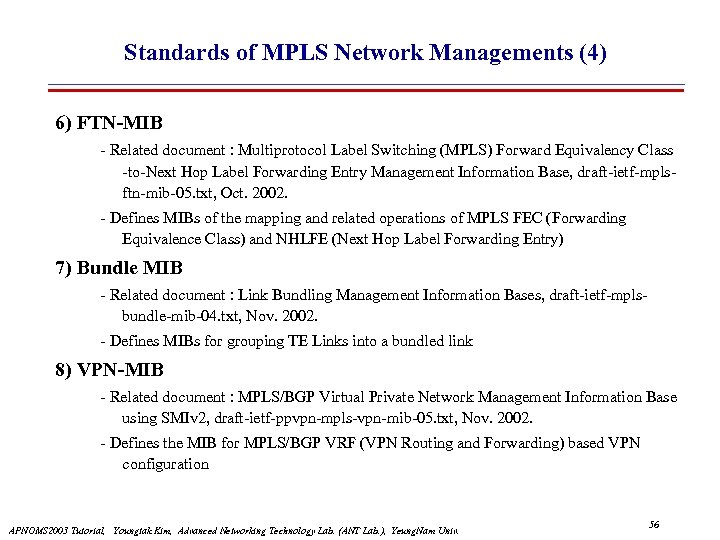
Standards of MPLS Network Managements (4) 6) FTN-MIB - Related document : Multiprotocol Label Switching (MPLS) Forward Equivalency Class -to-Next Hop Label Forwarding Entry Management Information Base, draft-ietf-mplsftn-mib-05. txt, Oct. 2002. - Defines MIBs of the mapping and related operations of MPLS FEC (Forwarding Equivalence Class) and NHLFE (Next Hop Label Forwarding Entry) 7) Bundle MIB - Related document : Link Bundling Management Information Bases, draft-ietf-mplsbundle-mib-04. txt, Nov. 2002. - Defines MIBs for grouping TE Links into a bundled link 8) VPN-MIB - Related document : MPLS/BGP Virtual Private Network Management Information Base using SMIv 2, draft-ietf-ppvpn-mpls-vpn-mib-05. txt, Nov. 2002. - Defines the MIB for MPLS/BGP VRF (VPN Routing and Forwarding) based VPN configuration APNOMS 2003 Tutorial, Youngtak Kim, Advanced Networking Technology Lab. (ANT Lab. ), Yeung. Nam Univ. 56
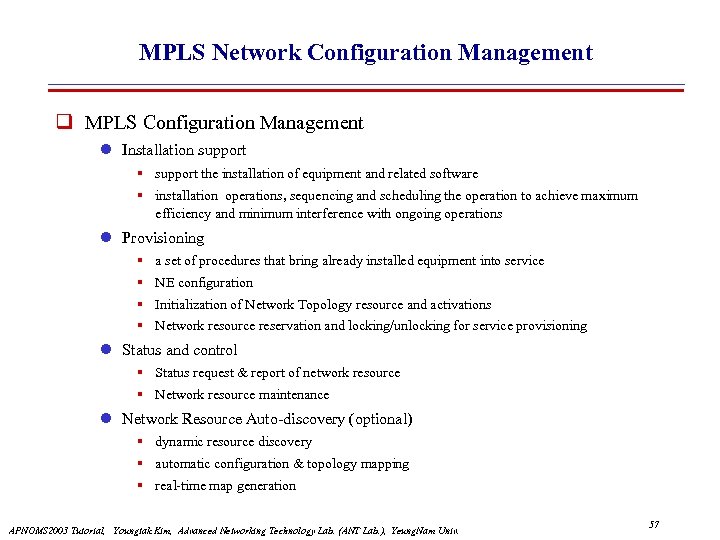
MPLS Network Configuration Management MPLS Configuration Management l Installation support § support the installation of equipment and related software § installation operations, sequencing and scheduling the operation to achieve maximum efficiency and minimum interference with ongoing operations l Provisioning § a set of procedures that bring already installed equipment into service § NE configuration § Initialization of Network Topology resource and activations § Network resource reservation and locking/unlocking for service provisioning l Status and control § Status request & report of network resource § Network resource maintenance l Network Resource Auto-discovery (optional) § dynamic resource discovery § automatic configuration & topology mapping § real-time map generation APNOMS 2003 Tutorial, Youngtak Kim, Advanced Networking Technology Lab. (ANT Lab. ), Yeung. Nam Univ. 57
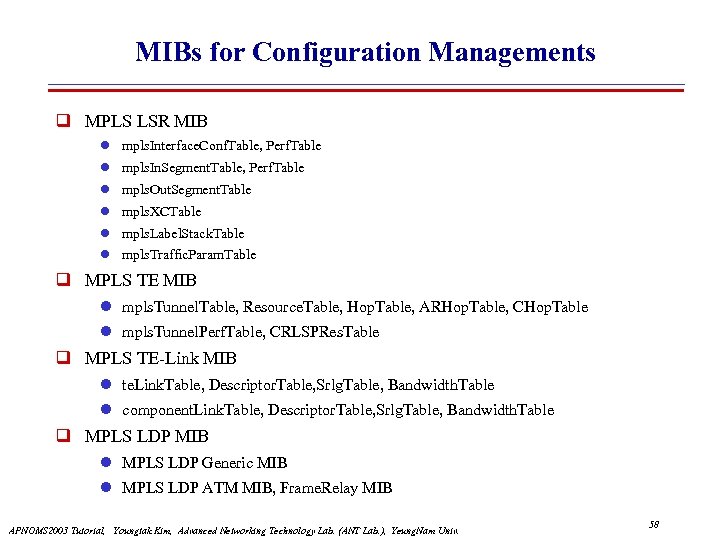
MIBs for Configuration Managements MPLS LSR MIB l mpls. Interface. Conf. Table, Perf. Table l mpls. In. Segment. Table, Perf. Table l mpls. Out. Segment. Table l mpls. XCTable l mpls. Label. Stack. Table l mpls. Traffic. Param. Table MPLS TE MIB l mpls. Tunnel. Table, Resource. Table, Hop. Table, ARHop. Table, CHop. Table l mpls. Tunnel. Perf. Table, CRLSPRes. Table MPLS TE-Link MIB l te. Link. Table, Descriptor. Table, Srlg. Table, Bandwidth. Table l component. Link. Table, Descriptor. Table, Srlg. Table, Bandwidth. Table MPLS LDP MIB l MPLS LDP Generic MIB l MPLS LDP ATM MIB, Frame. Relay MIB APNOMS 2003 Tutorial, Youngtak Kim, Advanced Networking Technology Lab. (ANT Lab. ), Yeung. Nam Univ. 58
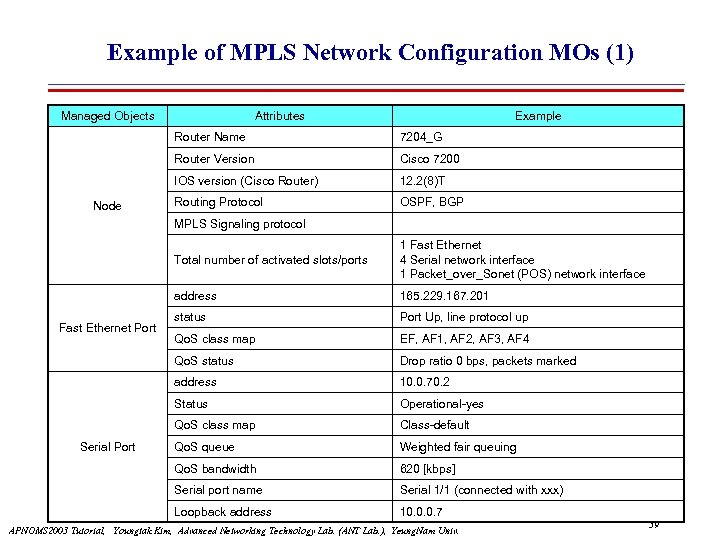
Example of MPLS Network Configuration MOs (1) Managed Objects Attributes Example Router Name Router Version Cisco 7200 IOS version (Cisco Router) Node 7204_G 12. 2(8)T Routing Protocol OSPF, BGP MPLS Signaling protocol Total number of activated slots/ports address status Port Up, line protocol up Qo. S class map EF, AF 1, AF 2, AF 3, AF 4 Drop ratio 0 bps, packets marked address 10. 0. 70. 2 Status Operational-yes Qo. S class map Class-default Qo. S queue Weighted fair queuing Qo. S bandwidth 620 [kbps] Serial port name Serial 1/1 (connected with xxx) Loopback address Serial Port 165. 229. 167. 201 Qo. S status Fast Ethernet Port 1 Fast Ethernet 4 Serial network interface 1 Packet_over_Sonet (POS) network interface 10. 0. 0. 7 APNOMS 2003 Tutorial, Youngtak Kim, Advanced Networking Technology Lab. (ANT Lab. ), Yeung. Nam Univ. 59

Example of MPLS Network Configuration MOs (2) Managed Objects Attributes Example address Status Qo. S class map Class-default Qo. S queue Weighted fair queue Qo. S bandwidth 55000[kbps] Pos 4/0 Loopback address 10. 0. 0. 6 Neighbor equipment Router, bridge_switch Neighbor router name 3620_B Neighbor router serial port name / address Serial 0/0 (3620_B port) / 10. 0. 30. 1 Neighbor loopback address (TDP id) Neighbors Shutdown Serial port name Po. S port (Packet over SONET) 10. 2. 2 10. 0. 0. 2 (3620_B의 loopback address) APNOMS 2003 Tutorial, Youngtak Kim, Advanced Networking Technology Lab. (ANT Lab. ), Yeung. Nam Univ. 60

MPLS Connection Managements MPLS Tunnel LSP (TE-LSP) Connection Managements l MPLS Tunnel LSP Establishments and Maintenance § Constraint-based Shortest Path First (CSPF) routing for Constraint-based LSP Setup § Request MPLS LER/LSR to set up LSP: Automatic routing mode or explicit routing mode § Set up LSP traffic parameter and Qo. S parameter l Update of Traffic parameter and Qo. S parameter of MPLS Tunnel LSP § Modification of traffic parameter and Qo. S parameter of tunnel LSP l Establishment of backup LSP for MPLS Fault Management § SRLG-disjoint backup path routing § Establishment of working LSP for backup LSP: explicit routing mode APNOMS 2003 Tutorial, Youngtak Kim, Advanced Networking Technology Lab. (ANT Lab. ), Yeung. Nam Univ. 61

Connection Management for Diff. Serv-over/aware-MPLS on Optical Internet NMS Configuration Mgmt Connection Mgmt Performance Mgmt Fault Mgmt IIOP EMS Configuration Mgmt Connection Mgmt IIOP Diff. Servaware. LER OXC fiber link LSR traffic trunk (tunnel LSP) fiber link OXC fiber link optical path (lambda channels) OXC fiber link LSR fiber link Diff. Servaware. LER LSR fiber link Diff. Servaware. LER fiber link OXC fiber link WDM Optical Domain Network MPLS Domain network APNOMS 2003 Tutorial, Youngtak Kim, Advanced Networking Technology Lab. (ANT Lab. ), Yeung. Nam Univ. LSR Diff. Servaware. LER 62

Example of MPLS LSP MOs (1) MO Attribute Example Tunnel name Tunnel_0104_1 Source address 10. 0. 0. 2 Destination address 10. 0. 0. 4 Next addresses (explicit route) 10. 0. 30. 2, 10. 0. 40. 1 Traffic param - priority Setup priority 1 Holding priority 1 Traffic param – bandwidth 9 [kbps] Traffic param – MTU 1514 bytes Traffic param - delay 500, 000 usec (default) – modifiable Affinity 0 x 0 ~ 0 x. FFFF Auto-bandwidth (optional) Freq, Min [kbps], Max [kbps] LSP APNOMS 2003 Tutorial, Youngtak Kim, Advanced Networking Technology Lab. (ANT Lab. ), Yeung. Nam Univ. 63

Example of MPLS LSP MOs (2) MO Attribute Example LSR ID (Transmitter) Link/Port ID Interface address LSR and Port Neighbor LSR ID (Receiver) Link type Administration status Active Operational status Operational-yes Total capacity Link total capacity in [Mbps] Available bandwidth in [Mbps] Reserved bandwidth Allocated bandwidth in [Mbps] Propagation & processing delay Propagation delay according to the physical distance, and packet processing delay including MPLS packet switching, port buffering at LSR Jitter at LSR with MPLS packet switching Residual bit error rate Bit error rate at Physical link SRLG_ID Shared risk link group ID Physical backup type Link State Fast Ethernet, Serial Port, POS Protection functions provided at Physical Layer APNOMS 2003 Tutorial, Youngtak Kim, Advanced Networking Technology Lab. (ANT Lab. ), Yeung. Nam Univ. 64

Parameters for Constraint-based LSP Establishment MO Attribute Example Jitter bound Allowable jitter boundary Allowable packet loss ratio Service class Platinum, gold, silver, bronze Priority Setup priority, holding priority Weight for Weighted Fair Scheduler Backup_type 1+1, 1: 1, M: N, 1: N, on-demand SRLG Service Category End-to-end delay Packet loss ratio Qo. S Parameter Bandwidth Peak data rate(PDR)/Peak Burst Size (PBS) Committed Data Rate(CDR)/Committed Burst Size (CBS), Excess Burst Size (EBS) End-to-end delay Traffic Parameter SRLG-disjoint backup LSP APNOMS 2003 Tutorial, Youngtak Kim, Advanced Networking Technology Lab. (ANT Lab. ), Yeung. Nam Univ. 65

MPLS Network Performance Management Performance monitoring of MPLS Tunnel LSP l Measurement of Throughput at End-to-End LSP and Boundary of Autonomous System (AS) l Measurement of delay, jitter at End-to-End LSP and Boundary of Autonomous System (AS) l Measurement of packet loss at End-to-End LSP and Boundary of Autonomous System (AS) Performance analysis of MPLS Tunnel LSP l Compare and analyze LSP’s SLA (service level agreement) performance parameters and the monitored results l Determine any seriously deteriorated performance control & tuning of MPLS Tunnel LSP l Update/Reallocation of operational Parameters (Bandwidth, Link Utilization) to maintain the performance of End-to-end LSP and LSP segments of Autonomous System (AS) : Adjustment of allocated bandwidth, Queue buffer size or scheduler parameter l Rerouting of LSP route l Overall Network Load Balancing MPLS VPN Performance Management l Measurements of Aggregated Throughput, Packet Transfer Delay, Packet Loss Rate at MPLS VPN Interfaces (CE-PE, PE-PE) l Measurements of Packet Mis-delivery Ratio among MPLS VPN APNOMS 2003 Tutorial, Youngtak Kim, Advanced Networking Technology Lab. (ANT Lab. ), Yeung. Nam Univ. 66

MPLS Network Fault Management (1) Establishment of Backup LSP for MPLS working tunnel LSP l SRLG disjoint back LSP routing and LSP setup l Allocation of Backup LSP resource for 1+1, 1: 1, M: N, 1: N mode Fault Detection and Notification l Fault detection ad notification at Physical Layer Link, port or Node l Fault detection ad notification by MPLS signaling and packet forwarding module l Notification of Seriously deteriorated MPLS LSP Performance Analysis and Localization of Faults l Fault correlation and localization l Find Root Cause of the Faults l Find the location of root cause l Determine the Affected tunnel LSP and VPN Fault Recovery l Fault Recovery by Protection switching or restoration l Protection Switching of User Traffic using Backup LSP l Establish a new back LSP l Redefine the function and the route of working LSP and backup LSP at Fault restoration APNOMS 2003 Tutorial, Youngtak Kim, Advanced Networking Technology Lab. (ANT Lab. ), Yeung. Nam Univ. 67

MPLS Fault Management (2) Differentiated Backup Path Reservations (Example) MPLS Service Class Bandwidth Reservation Setup Priority Preemption Priority Application Platinum 100%, 1+1 Highest High Priority VPN Gold 100%, 1: 1 Higher VPN Silver 100%, M: N Normal Premium service Bronze 100%, 1: N Lower Controlled traffic Best effort 0 Lowest Best Effort Backup Path Utilization l Reservation with NO Traffic l Reservation with Lower Priority Traffic of possible preemption Fault Restoration l Use Span(segment) Protection l Restoration is based on the Subnetwork(Segment) APNOMS 2003 Tutorial, Youngtak Kim, Advanced Networking Technology Lab. (ANT Lab. ), Yeung. Nam Univ. 68

Example of Seriously Deteriorated Performance Traffic / Qo. S parameter Available bandwidth End-to-end delay Jitter Packet loss Threshold of severe degradation Remarks Less than 80% of CDR (committed data rate) More than 120% of agreed end-to-end delay limit More than 200% of agreed jitter limit More than 10% of transmitted data APNOMS 2003 Tutorial, Youngtak Kim, Advanced Networking Technology Lab. (ANT Lab. ), Yeung. Nam Univ. 69

Fault Detection Functions of LSR Node Module MPLS Switching Module Port/Link Node failure Fault Type Fault Detection (Example) Faults in Switching Elements Faults in packet/ label processing MPLS signaling module (CR-LDP, RSVP)의 hello message Packet mis-delivery Loss of Light Fiber cut Lambda channel fault Network Interface Card (NIC) fault monitoring Power degradation Switching capability loss Malfunctioning components Excessive temperature MPLS signaling module hello message Degraded packet throughput, increased packet loss rate APNOMS 2003 Tutorial, Youngtak Kim, Advanced Networking Technology Lab. (ANT Lab. ), Yeung. Nam Univ. 70

MPLS Fault Recovery Objectives (Example) Function Fault Recovery Parameter Target Values Fault Detection at Physical Layer Fault Detection at LSP Fault Detection at LSR Physical Layer: 50 ns MPLS LSP: 150 ms MPLS LSR: 3 sec Fault Notification Fault notification to ingress LER / egress LER 50 ms Protection Switching to Backup LSP Protection Switching of user traffic from faulty working LSP to Backup LSP 50 ms Fault Detection Total Fault Restoration Time Total allowable time from fault occurrence to complete fault restoration APNOMS 2003 Tutorial, Youngtak Kim, Advanced Networking Technology Lab. (ANT Lab. ), Yeung. Nam Univ. 250 ms 71

Standards related to MPLS Fault Management IETF Draft MPLS-based fast reroute IETF Draft MPLS recovery framework IETF Draft MPLS RSVP-LSP Fast reroute MPLS OAM Requirements RFC 2925, Remote Ping, Trace Route, Lookup RFC 3479, Fault Tolerance for the LSP APNOMS 2003 Tutorial, Youngtak Kim, Advanced Networking Technology Lab. (ANT Lab. ), Yeung. Nam Univ. 72

MPLS OAM for the Management of MPLS -based VPNs APNOMS 2003 Tutorial, Youngtak Kim, Advanced Networking Technology Lab. (ANT Lab. ), Yeung. Nam Univ. 73

MPLS OAM (Operation, Administration, Maintenance) l Layer Management Protocol for Network Layer, Data Link Layer, Physical Layer: e. g. ATM VP/VC Layer OAM, Physical Layer OAM, SONET OAM l Fault OAM for fault monitoring, fault notification § § alarm indication signal remote defect indication (RDI) continuity check (CC) loopback test l Performance OAM for performance monitoring, performance analysis § Forward monitoring § Backward monitoring l Configuration OAM for administrative configuration of links, operational status monitoring § link configuration and status management § neighbor discovery § e. g Layer Management Protocol (LMP) of WDM Optical Link APNOMS 2003 Tutorial, Youngtak Kim, Advanced Networking Technology Lab. (ANT Lab. ), Yeung. Nam Univ. 74

Related Works on MPLS OAM Current Standardization Status of MPLS OAM l General framework l Major considerations l No detailed implementation methods IETF Internet Draft, “A Framework for MPLS User Plane OAM, ” David Allen (ed. ), February 2003. l Implications for fault management: connectivity verification, etc. l Implications for performance management: line quality monitoring, etc. IETF Internet Draft, “OAM Requirements for MPLS Networks, ” Thomas Nadeau et. al. , February 2003. l l service level agreement (SLA) measurement: availability, latency, packet loss, jitter alarm suppression and layer coordination support for OAM interworking for fault notification error detection and recovery IETF Internet Draft, “Detecting Data Plane Liveness in RSVP-TE”, Oct. 2001. l LSP Ping APNOMS 2003 Tutorial, Youngtak Kim, Advanced Networking Technology Lab. (ANT Lab. ), Yeung. Nam Univ. 75

Requirements of MPLS OAM Functions Basic Requirements of MPLS OAM functions l Fault management OAM should be able to provide fault detection, ondemand verification, fault localization, notification of LSP failure information l Performance management OAM should be able to provide performance monitoring to check the provisioning of traffic throughput & Qo. S (end-toend delay, jitter, packet loss rate) that is defined in service level agreement Interactions of MPLS signaling and User-plane OAM l User plane OAM: based on in-band OAM packets to monitor real status of user plane connections l MPLS signaling: out-of-band signaling, separated connections from the user plane connections APNOMS 2003 Tutorial, Youngtak Kim, Advanced Networking Technology Lab. (ANT Lab. ), Yeung. Nam Univ. 76

Design of MPLS Performance Management OAM Functions Performance Monitoring OAM of User Plane Data Path l Throughput § total delivered data size / unit time interval l Delay § d(n) = Tarrival(n) – Tdeparture(n) l Jitter (variance of transfer delay) § j(n) = |d(n) – d(n-1)| l Packet loss rate § (total transmitted packets – total delivered packets) / total transmitted packets Severely degraded performance l e. g. excessive delay at realtime interactive communication, excessive packet loss, excessive jitter l should be handled in the same manner of fault APNOMS 2003 Tutorial, Youngtak Kim, Advanced Networking Technology Lab. (ANT Lab. ), Yeung. Nam Univ. 77

Proposed Format of Performance Monitoring OAM Packet 1 2 3 0 0123456789012345678901 OAM Type OAM Function PDU Length Ingress LSR Identifier Egress LSR Identifier LSP Identifier Sequence Number Time Stamp Number of Total Transmitted Packets Total Transmitted Data Size [Byte] Optional Information (LSR: Label Switched Router; LSP: Label Switched Path) APNOMS 2003 Tutorial, Youngtak Kim, Advanced Networking Technology Lab. (ANT Lab. ), Yeung. Nam Univ. 78

Design of MPLS Fault Management OAM Functions Fault Detection l by fault management OAM packet: continuity check l by lower protocol layer: e. g. loss of light (LOL), loss of signal (LOS) Fault Notification by MPLS OAM packet l Forward Defect Indication (FDI) l Backward Defect Indication (BDI) l Egress LER(Label Edge Router) -to-Ingress LER notification Fault Notification by MPLS Signaling l RSVP-TE notify message l CR-LDP notification message l Fault notification by intermediate LSR that detected link fault by network interface card (NIC); Note) in Wavelength Division Multiplexing (WDM) network, it is very hard to insert OAM packets by intermediate node APNOMS 2003 Tutorial, Youngtak Kim, Advanced Networking Technology Lab. (ANT Lab. ), Yeung. Nam Univ. 79

Scenario of Fault Notification by MPLS signaling TCP/UDP IP MPLS PHY LSR 120 LSR 121 working LSP backup LSP TCP/UDP IP MPLS PHY LSR 220 TE Agent OSPF-TE/ BGP CR-LDP link failure detection OSPF-TE/ BGP CR-LDP TCP/UDP IP MPLS PHY LSR 221 APNOMS 2003 Tutorial, Youngtak Kim, Advanced Networking Technology Lab. (ANT Lab. ), Yeung. Nam Univ. OSPF-TE/ BGP CR-LDP TCP/UDP IP MPLS PHY TE Agent LER 110 (ingress node) TCP/UDP IP MPLS PHY link failure notification TE Agent TE agent controls the rerouting OSPF-TE/ BGP CR-LDP TE Agent TCP/UDP IP MPLS PHY TE Agent OSPF-TE/ BGP CR-LDP LER 211 (egress node) 80

Loopback Test OAM LSR 120 LSR 130 LSR 140 LER 110 LER 150 timeout (a) Node-by-node sequential loop-back test timeout (b) Roll-call loop-back test APNOMS 2003 Tutorial, Youngtak Kim, Advanced Networking Technology Lab. (ANT Lab. ), Yeung. Nam Univ. 81

Proposed Format of Loopback Test OAM Packet 1 2 3 0 0123456789012345678901 OAM Type OAM Function PDU Length Loop-back start LSR Identifier Loop-back end LSR Identifier LSP Identifier Loop-back operation mode (sequential or roll-call) Optional data Note) Loopback test operation mode: 0: node-by-node sequential loop-back test 1: roll-call loopback test mode APNOMS 2003 Tutorial, Youngtak Kim, Advanced Networking Technology Lab. (ANT Lab. ), Yeung. Nam Univ. 82

Implementations and Experiments Network Simulation Environment: l NIST (National Institute of Standard and Technology) GMPLS Simulator (GLASS: Gmpls Lightpath Agile Switching Simulator): http: //dns. antd. nist. gov/glass/ l Networking Simulator for Generalized Multi-Protocol Label Switching (GMPLS) § § Diff. Serv-over-MPLS Networking WDM Optical Switching General Internet Applications over TCP/UDP, IP l Included MPLS OAM functions to monitor, analysis network operational status APNOMS 2003 Tutorial, Youngtak Kim, Advanced Networking Technology Lab. (ANT Lab. ), Yeung. Nam Univ. 83

Network Simulation for Diff. Serv-over-MPLS Network Configuration Server Client 100 152 154 LER 150 200 LER 210 202 LER 212 6. 6 M bps LSR 120 LSR 121 ps Mb (WFQ Sched). 6 6 6. 6 M bps LSR 221 17. 6 Mbps LER 111 (Priority Sched) 6. 6 M (WFQ Sched) bps LSR 220 s bp 6 M (WFQ Sched) 6. bps M 6. 6 13. 2 Mbps 150 LER 110 13. 2 Mbps 102 104 101 (EF, 1 Mbps) 103 (AF, 2 Mbps) 105 (BF, 3 mbps) LER 151 (EF, 1 Mbps) 153 (AF, 2 Mbps) 155 (BF, 3 Mbps) (WFQ Sched) bps 6. 6 M 6. 6 Mb ps (WFQ Sched) LER 211 201 (AF, 4 Mbps) LER 213 203 (AF, 4 Mbps) Note : the transit link between LSR 220 and LSR 221 has been designed to be bottleneck !! APNOMS 2003 Tutorial, Youngtak Kim, Advanced Networking Technology Lab. (ANT Lab. ), Yeung. Nam Univ. 84

Traffic Generation Src - Dest Traffic type 100 – 101 EF 102 – 103 AF 104 – 105 BE 150 - 151 EF 152 – 153 AF 154 – 155 BE 200 – 201 AF 202 - 203 AF Traffic Parameters (LSP) [kbps] PDR = 1, 500 CDR = 1, 000 PDR = 3, 000 CDR = 2, 000 PDR = 4, 500 CDR = 3, 000 PDR = 6, 000 CDR = 4, 000 Priority/Weight (Diff. Serv) Packet Scheduling (Diff. Serv) Traffic Generation duration [simulation time in sec] P=5 Priority 50 ~ 500 P=3 Priority 50 ~ 500 P=1 Priority 50 ~ 500 W=1 WFQ 100 ~ 450 W=2 WFQ 100 ~ 450 W=3 WFQ 100 ~ 450 W=4 WFQ 100 ~ 400 W=4 WFQ 200 ~ 350 (EF: Expedited Forwarding, AF: Assured Forwarding, BE: Best Effort Forwarding) APNOMS 2003 Tutorial, Youngtak Kim, Advanced Networking Technology Lab. (ANT Lab. ), Yeung. Nam Univ. 85

Bandwidth Monitoring of Diff. Serv Traffic (a) Priority Scheduling (b) WFQ scheduling APNOMS 2003 Tutorial, Youngtak Kim, Advanced Networking Technology Lab. (ANT Lab. ), Yeung. Nam Univ. 86

End-to-end delay, Jitter (a) E-to-E Delay, Priority Scheduling (a) Jitter, Priority Scheduling (b) E-to-E Delay, WFQ scheduling (b) Jitter, WFQ scheduling APNOMS 2003 Tutorial, Youngtak Kim, Advanced Networking Technology Lab. (ANT Lab. ), Yeung. Nam Univ. 87

Notifications on Severe Performance Degradation APNOMS 2003 Tutorial, Youngtak Kim, Advanced Networking Technology Lab. (ANT Lab. ), Yeung. Nam Univ. 88

Link Failure Detection and Notification Simulation scenario LSR 120 LSR 130 LSR 140 LER 110 LER 150 Physical link error at 250 sec Failure detection by NIC, Continuity check OAM (a) Failure Detection by NIC (b) Failure Detection by Continuity Check APNOMS 2003 Tutorial, Youngtak Kim, Advanced Networking Technology Lab. (ANT Lab. ), Yeung. Nam Univ. 89

Loop-back Test 5 ms 10 ms 15 ms Link Error at 250 sec APNOMS 2003 Tutorial, Youngtak Kim, Advanced Networking Technology Lab. (ANT Lab. ), Yeung. Nam Univ. 90

MPLS-VPN Performance Management Intranet Management (EMS/NMS) PE PE PE VLAN/Ethernet TE Agent Tunneled LSP Penultimate Hop LSR SPN’s MPLS Backbone TE Agent LSR Penultimate Hop LSR CE TE Agent CE Intranet Management (EMS/NMS) TE Agent CE SPN(Backbone) Management (EMS/NMS) PE CE VC(Virtual Circuit) LSP APNOMS 2003 Tutorial, Youngtak Kim, Advanced Networking Technology Lab. (ANT Lab. ), Yeung. Nam Univ. 91

MPLS-VPN PM Examples Customer A Customer B Customer C (a) Throughput Customer A Customer B Customer C (b) Delay Customer A Customer B Customer C (c) Jitter (d) Packet Loss Ratio APNOMS 2003 Tutorial, Youngtak Kim, Advanced Networking Technology Lab. (ANT Lab. ), Yeung. Nam Univ. 92

Test Network Configuration for Controlled Bandwidth Borrowing Bottleneck link LER A LSP 1 LSR X 20 M LER B LSR Y 10 M LSP 3 20 M LSP 7 20 M LER C LSP 5 LER D LSP between A and B (4 Mbps) LSP between A and D (4 Mbps) LSP between C and B (4 Mbps) LSP between C and D (2 Mbps) LSR-LSR : 20 Mbps LSR-LSR : 10 Mbps APNOMS 2003 Tutorial, Youngtak Kim, Advanced Networking Technology Lab. (ANT Lab. ), Yeung. Nam Univ. Host-LSR : 5 Mbps 93

Dynamic Bandwidth Re-distribution Scenario l Trigger bandwidth redistribution after 170 sec l Trigger bandwidth rollback at 400 sec l Bandwidth is not allocated to LSP 1, 5 because of bottleneck link l However, LSP 3, 7 are allowed to get extra-bandwidth. (a) Throughput of LSP 1, 3 (a) Throughput of LSP 5, 7 APNOMS 2003 Tutorial, Youngtak Kim, Advanced Networking Technology Lab. (ANT Lab. ), Yeung. Nam Univ. 94

Commercial MPLS-VPN Management Systems: Cisco VPN Solution, Sheer. BOS, Wandl’s IP/MPLSview APNOMS 2003 Tutorial, Youngtak Kim, Advanced Networking Technology Lab. (ANT Lab. ), Yeung. Nam Univ. 95

Cisco VPN Solution (1) Cisco VPN Solution Center Architecture API and Life-cycle Management APNOMS 2003 Tutorial, Youngtak Kim, Advanced Networking Technology Lab. (ANT Lab. ), Yeung. Nam Univ. 96

Cisco VPN Solution Center (2) Cisco VPN Solution Center 2. 2: MPLS Solution (1) l provides management of IP VPN services throughout the service life cycle including service provisioning and activation on customer-edge and provider -edge routers, service auditing and service-level agreement (SLA) l provides external operations support systems (OSSs) access to the full capabilities of the Cisco VPN Solution Center using well-defined CORBA APIs l Operators and upstream systems can add, delete, or modify customer MPLS VPNs and define associated VPN service topology (hub-and-spoke, fullmesh and extranet) l Major functions: § Fault – Cisco Info Center § Configuration – Cisco Provisioning Center § Performance – Concord Network Health Monitor APNOMS 2003 Tutorial, Youngtak Kim, Advanced Networking Technology Lab. (ANT Lab. ), Yeung. Nam Univ. 97

Cisco VPN Solution Center (3) Cisco VPN Solution Center 2. 2: MPLS Solution (2) APNOMS 2003 Tutorial, Youngtak Kim, Advanced Networking Technology Lab. (ANT Lab. ), Yeung. Nam Univ. 98

Cisco VPN Solution Center (4) Key features of Cisco VPN Solution Center l Realtime provisioning § flexibly service activation § high-performance service auditing § service quality assurance § SLA monitoring and reporting § Qo. S provisioning and measurement for service differentiation § Templates for streamlined provisioning l Application integration and flow-through provisioning § OSS interface – CORBA APIs, TIBCO event bus, Java and XML § fault management § performance and other extended management functionality APNOMS 2003 Tutorial, Youngtak Kim, Advanced Networking Technology Lab. (ANT Lab. ), Yeung. Nam Univ. 99

Sheer. TMBOS (1) Sheer. TM Broadband Operating Supervisor (Sheer. TMBOS) APNOMS 2003 Tutorial, Youngtak Kim, Advanced Networking Technology Lab. (ANT Lab. ), Yeung. Nam Univ. 100

Sheer. TMBOS (2) Sheer. TMBOS Solutions for Network Services l DSL over ATM l ATM over Optical l IP over ATM l IP Services over Optical l L 2 TP and MPLS VPN over Optical core over ATM l L 2 TP and MPLS IPVPN l VLAN and MPLS/L 2 TP/IP APNOMS 2003 Tutorial, Youngtak Kim, Advanced Networking Technology Lab. (ANT Lab. ), Yeung. Nam Univ. 101

Sheer. TMBOS (3) Sheer. TMBOS Supported NEs Manufacturer Alcatel Cisco Copper Mountain ECL Lucent Network Element (NE) 36170(Newbridge) ATM Switch, ASAM DSLAM, Mini. Ram DSLAM 6400 SSG, UBR 7200 CMTS, 7 x 00 Router, GSR 1200 Router, Catalyst, Tdsoft Hunt 8200 Router, BPX ATM Switch, 6100 DSLAM, 6160 DSLAM CE 150 DSLAM, CE 200 DSLAM Hi. Focus DSLAM CBX 500 ATM Switch, GX 550 ATM Switch Marconi 200 ATM Switch, 1000/4000 ATM Switch Motorola 2000 CMTS Nortel Shasta SSG, IMAS DSLAM, Passport ATM Switch Nokia D 50 DSLAM Redback SMS 500 SSG, SMS 1800 SSG Siemens Unisphere SSG APNOMS 2003 Tutorial, Youngtak Kim, Advanced Networking Technology Lab. (ANT Lab. ), Yeung. Nam Univ. 102

Sheer. TMBOS (4) Sheer. TMBOS Auto Discovery of Topology, Inventory and Services l Discovery of the network elements and the corresponding layered entities that exist within them (e. g. interfaces, forwarding components) § § § Existing modules, ports/interfaces Existing logical entities MPLS labels Contexts/Virtual Routers Routing Tables, Forwarding Tables, VRF Tables, Label Swapping Tables l Discovery of the relationships that exist between the entities in each layer § § (VC, VP, Ethernet MAC, PPPo. A, 1483, 1 Q tag) => Port (IP interface) => (1483 R, Ethernet, . 1 Q, PPPo. A, PPPo. E) (Vbridge) => (Group of Interfaces) (VRF/Virtual Router) => (Group of Interfaces) l Discovery of the multi-layer network topology § § § Physical Topology ATM (PVC, SPVC) Topology Ethernet, VLANs Topology IP Topology MPLS Topology VPN Topology APNOMS 2003 Tutorial, Youngtak Kim, Advanced Networking Technology Lab. (ANT Lab. ), Yeung. Nam Univ. 103

Sheer. TMBOS (5) Sheer. TMBOS – Managing IP-VPN Services over Broadband Networks l Network Inventory Auto-discovery l MPLS IP-VPN logical inventory § § P and PE Global Label Forwarding Table PE Interface Specific Label Forwarding Table List of VPNs (PE) VPN Properties (PE) – – VPN VRF Table VPN Route Target: Import/Export VPN Router Distinguisher VPN Site list & Properties for each VPN Site l Network Topology Auto-discovery l Service Activation Operations § Create/Delete VPN § Add/Remove Site to VPN § Required identification parameters: VPN identifiers, connection point, site subnets (in case of static route is used between CE-to-PE) APNOMS 2003 Tutorial, Youngtak Kim, Advanced Networking Technology Lab. (ANT Lab. ), Yeung. Nam Univ. 104

Wandl’s IP/MPLSview (1) Features of Wandl’s IP/MPLSview l Hardware Device Models Supported: Cisco, Juniper, Riverstone, Foundry, and generic router types. l IP/MPLS-Configuration/Performance Management l IP/MPLS-Network Planning l VPN l BGP l MPLS-FRR l Extensive Report Generation - Aids all aspects of planning, designing, and troubleshooting IP/MPLS Core Backbones. l Flexible and friendly Graphical User Interface l Fully web-enabled User Interface APNOMS 2003 Tutorial, Youngtak Kim, Advanced Networking Technology Lab. (ANT Lab. ), Yeung. Nam Univ. 105

Wandl’s IP/MPLSview (2) IP/MPLS Network Planning with Wandl’s IP/MPLSview l l l l IP network configuration, LSP tunnel and traffic collection Delta configuration generation for MPLS TE provisioning Multi-layer, Multi-protocol modeling according to exact equipment details LSP tunnel path placement and provisioning Fast reroute (FRR) End-to-end path protection MPLS LSP path generation/network grooming Multi-period traffic load analysis Basic design from scratch Incremental design Diversity/Resiliency design Bottleneck analysis Capacity planning / traffic growth Multi-layered failure simulation and analysis What-if simulation Standard or customizable tariff databased APNOMS 2003 Tutorial, Youngtak Kim, Advanced Networking Technology Lab. (ANT Lab. ), Yeung. Nam Univ. 106

Wandl’s IP/MPLSview (3) IP/MPLS Configuration and Performance Management l l l l Network centric operation of the MPLS traffic network Automated data collection – automatic discovery and incremental discovery Automatic discovery of network topology Web-accessible event browser tracks changes in network status Intelligent multi-vendor IP/MPLS parsing Physical and logical topology views Dynamic reconfiguration of MPLS tunnels Near real-time network monitoring: resource utilization, global network topology and traffic information display, interface/tunnel statistics, data collection via SNMP Network performance management and diagnostics History reports and historical traffic data replay Configuration and version control and archiving Configuration conformance validation Network inventory reports from SNMP polling Integrity checking APNOMS 2003 Tutorial, Youngtak Kim, Advanced Networking Technology Lab. (ANT Lab. ), Yeung. Nam Univ. 107

Wandl’s IP/MPLSview (3) Additional Features l Border Gateway Protocol (BGP) model l Differentiated Services l VPN Model l State-of-Art Network Graphics l Fully Web-enabled User Interface l Wep reports l Extensive report generations APNOMS 2003 Tutorial, Youngtak Kim, Advanced Networking Technology Lab. (ANT Lab. ), Yeung. Nam Univ. 108

Experiences in the Design and Implementation of Management System for Diff. Serv-aware-MPLS l Doumi. Man (Diff. Serv-over-universal mpls internet Manager) APNOMS 2003 Tutorial, Youngtak Kim, Advanced Networking Technology Lab. (ANT Lab. ), Yeung. Nam Univ. 109

Layered Network Management in Doumi. Man (Diff. Serv-overuniversal mpls internet Manager) IP Subnetwork & VPN Network MPLS Layer Network Physical Layer Network APNOMS 2003 Tutorial, Youngtak Kim, Advanced Networking Technology Lab. (ANT Lab. ), Yeung. Nam Univ. 110

O-O Design & Implementation for Extensibility APNOMS 2003 Tutorial, Youngtak Kim, Advanced Networking Technology Lab. (ANT Lab. ), Yeung. Nam Univ. 111

Auto-discovery of Physical Topology Information through Telnet CLI (Command Line Interface) Pivot router NMS ① show ip vrf 7204_H 7204_F ② no VRF related information ③ show cdp entry*, show cdp neighbors, show tag-switching tdp discovery ④ Information about Neighbors ⑤ show ip vrf ⑥ Information of VRF table ⑦ show ip route vrf-name show ip protocols vrf-name ⑧ Detailed information of VRF table (IP routing table on VRF, routing protocol on VRF) APNOMS 2003 Tutorial, Youngtak Kim, Advanced Networking Technology Lab. (ANT Lab. ), Yeung. Nam Univ. 112

Configuration Management GUI APNOMS 2003 Tutorial, Youngtak Kim, Advanced Networking Technology Lab. (ANT Lab. ), Yeung. Nam Univ. 113

Diff. Serv-aware-ELSP Connection Management APNOMS 2003 Tutorial, Youngtak Kim, Advanced Networking Technology Lab. (ANT Lab. ), Yeung. Nam Univ. 114

Diff. Serv-aware-ELSP Performance Management APNOMS 2003 Tutorial, Youngtak Kim, Advanced Networking Technology Lab. (ANT Lab. ), Yeung. Nam Univ. 115

MPLS Fault Managements with NMS/EMS CE (Customer Edge) Establish Backup LSP (Rerouting) AS: 200 CE (Customer Edge) Fault Notification (notification) Link Failure PE (Provider Edge) AS: 500 Service Provider Backbone (AS: 100) APNOMS 2003 Tutorial, Youngtak Kim, Advanced Networking Technology Lab. (ANT Lab. ), Yeung. Nam Univ. AS: 300 CE (Customer Edge) AS: 400 116

Example of Fast Reroute in Cisco Routers APNOMS 2003 Tutorial, Youngtak Kim, Advanced Networking Technology Lab. (ANT Lab. ), Yeung. Nam Univ. 117

VPN GUIs APNOMS 2003 Tutorial, Youngtak Kim, Advanced Networking Technology Lab. (ANT Lab. ), Yeung. Nam Univ. 118

Diff. Serv-aware-MPLS VPN GUIs APNOMS 2003 Tutorial, Youngtak Kim, Advanced Networking Technology Lab. (ANT Lab. ), Yeung. Nam Univ. 119

Concluding Remarks We discussed l Framework of MPLS-based VPNs: L 3 VPN, L 2 VPN, VPLS l Traffic Engineering based on Diff. Serv-aware-(G)MPLS l Management Framework of MPLS Network, MPLS MIBs l MPLS OAM for the Management of MPLS-based VPNs l Commercial MPLS-VPN Management Systems: Cisco VPN Solution, Sheer. BOS, Wandl’s IP/MPLSview l Experiences in the Management of Diff. Serv-aware-MPLS VPN APNOMS 2003 Tutorial, Youngtak Kim, Advanced Networking Technology Lab. (ANT Lab. ), Yeung. Nam Univ. 120
![References [1] RFC 2764, A Framework for IP based Virtual Private Networks, February 2000.](https://present5.com/presentation/3547ed490f383093ba093987d78336e6/image-121.jpg "References [1] RFC 2764, A Framework for IP based Virtual Private Networks, February 2000.")
References [1] RFC 2764, A Framework for IP based Virtual Private Networks, February 2000. [2] IETF Internet Draft, draft-ietf-l 3 vpn-rfc 2547 bis-00. txt, BGP/MPLS IP VPNs, May 2003. [3] IETF Internet Draft, draft-ietf-l 3 vpn-framework-00. txt, A Framework for Layer 3 Provider Provisioned Virtual Private Networks (PPVPNs), March 2003. [4] IETF Internet Draft, draft-ietf-l 3 vpn-vr-00. txt, Network based IP VPN Architecture using Virtual Routers, May 2003. [5] IETF Internet Draft, draft-ietf-l 2 vpn-l 2 -framework-00. txt, L 2 VPN Framework, Feb. 2003. [6] IETF Internet Draft, draft-ietf-l 2 vpn-requirements-00. txt, Service Requirements for Layer 2 Provider Provisioned Virtual Private Networks, Jan. 2004. [7] IETF Internet Draft, draft-ietf-l 2 vpn-vpls-requirements-00. txt, Requirements for Virtual Private LAN Service (VPLS), Oct. 2002. [8] IETF Draft, draft-lasserre-vkompella-ppvpn-vpls-02. txt, Virtual Private LAN Services over MPLS, June 2002. [9] RFC 3272, Overview and Principles of Internet Traffic Engineering, May 2002. [10] RFC 3564, Requirements for Support of Differentiated Services-aware MPLS Traffic Engineering, July 2003. [11] IETF Internet Draft, draft-ietf-mpls-mgmt-overview-08. txt, Multiprotocol Label Switching (MPLS) Management Overview, August 2003. [12] IETF Internet Draft, draft-ietf-mpls-te-mib-12. txt , Multiprotocol Label Switching (MPLS) Traffic Engineering Management Information Base, August 2003. [13] IETF Internet Draft, draft-ietf-mpls-tc-mib-09. txt, Definitions of Textual Conventions for Multiprotocol Label Switching (MPLS) Management, August 2003. [14] IETF Internet Draft, draft-ietf-mpls-oam-requirements-01. txt, OAM Requirements for MPLS Networks, June 2003. APNOMS 2003 Tutorial, Youngtak Kim, Advanced Networking Technology Lab. (ANT Lab. ), Yeung. Nam Univ. 121
![[15] ITU-T Rec. Y. 1710, Requirements for MPLS OAM. [16] ITU-T Rec. Y. 1711,](https://present5.com/presentation/3547ed490f383093ba093987d78336e6/image-122.jpg "[15] ITU-T Rec. Y. 1710, Requirements for MPLS OAM. [16] ITU-T Rec. Y. 1711,")
[15] ITU-T Rec. Y. 1710, Requirements for MPLS OAM. [16] ITU-T Rec. Y. 1711, OAM Mechanisms for MPLS Network. [17] ITU-T Rec. Y. 1720, Protection Switching for MPLS Networks. [18] ITU-T Draft Rec. Y. mplsperf, MPLS Performance. [19] IETF RFC 3289, Differentiated Services MIB module [20] IETF draft-ietf-snmpconf-diffpolicy-07. txt, Differentiated Services Configuration MIB. [21] IETF RFC 3512, Configuring Networks and Devices With SNMP. [22] IETF RFC 3410, "Introduction and Applicability Statements for Internet- Standard Management Framework ", [23] IETF RFC 3289 Management Information Base for the Differentiated Services Architecture", , May 2002. [24] IETF RFC 3411, "An Architecture for Describing Simple Network Management Protocol (SNMP) Management Frameworks", Harrington, D. , Presuhn, R. and B. Wijnen, December 2002. [25] IETF draft-ietf-snmpconf-pm-13. txt, "Policy-based Management MIB", Work in Progress, Waldbusser, S. , J. Saperia, and T. Hongal, March 2003. [26] IETF draft-ietf-psamp-framework-03. txt, A Framework for Passive Packet Measurement, June 2003. [27] IETF draft-ietf-psamp-sample-tech-02. txt, Sampling and Filtering Techniques for IP Packet Selection, June 2003. [28] Tanja Zseby, “Deployment of Sampling Methods for SLA Validation with Non-Intrusive Measurements, ” Proceedings of Passive and Active Measurement Workshop (PAM 2002), Fort Collins, CO, USA, March 25 -26, 2002. [29] IETF draft-ietf-psamp-mib-00. txt, Definitions of Managed Objects for Packet Sampling, [30] IETF draft-ietf-mpls-telink-mib-02. txt, Traffic Engineering Link Management Information Base, May 2003. [31] IETF RFC 3209, RSVP-TE: Extensions to RSVP for LSP Tunnels, December 2001. APNOMS 2003 Tutorial, Youngtak Kim, Advanced Networking Technology Lab. (ANT Lab. ), Yeung. Nam Univ. 122
![[32] IETF RFC 3469, Framework for Multi-Protocol Label Switching (MPLS)-based Recovery, February 2003. [33]](https://present5.com/presentation/3547ed490f383093ba093987d78336e6/image-123.jpg "[32] IETF RFC 3469, Framework for Multi-Protocol Label Switching (MPLS)-based Recovery, February 2003. [33]")
[32] IETF RFC 3469, Framework for Multi-Protocol Label Switching (MPLS)-based Recovery, February 2003. [33] IETF draft-ietf-mpls-rsvp-lsp-fastreroute-03. txt, Fast Reroute Extensions to RSVP-TE for LSP Tunnels, [34] IETF draft-ietf-mpls-lsp-ping-03. txt, Detecting MPLS Data Plane Failures. [35] IETF draft-ietf-mpls-fastreroute-mib-01. txt, Multiprotocol Label Switching (MPLS) Traffic Engineering Management Information Base for Fast Reroute, November 2002. [36] IETF RFC 3479, Fault Tolerance for the Label Distribution Protocol (LDP), February 2003. [37] IETF RFC 2702, Requirements for Traffic Engineering Over MPLS, September 1999. [38] IETF draft-ietf-mpls-oam-requirements-01. txt, OAM Requirements for MPLS Networks, June 2003. [39] IETF RFC draft-ietf-mpls-bgp-mpls-restart-02. txt, Graceful Restart Mechanism for BGP with MPLS, October 2002. [40] IETF draft-ietf-policy-qos-device-info-model-10. txt, Information Model for Describing Network Device Qo. S Datapath Mechanisms, May 2003. [41] IETF draft-ietf-policy-core-schema-16. txt, Policy Core LDAP Schema, October 2002. [42] IETF RFC 3060, Policy Core Information Model -- Version 1 Specification, [43] IETC RFC 3198, Terminology for Policy-Based Management, November 2001. [44] IETF RFC 3460, Policy Core Information Model (PCIM) Extensions, January 2003. [45] IETF draft-ietf-netconf-prot-00, NETCONF Configuration Protocol, August 11, 2003. [46] IETF RFC 2925, Definitions of Managed Objects for Remote Ping, Traceroute, and Lookup Operations, September 2000. [47] IETF draft-ietf-disman-alarm-mib-14. txt, Alarm MIB, June 2003. [48] IETF draft-ietf-disman-event-mib-v 2 -02. txt, Event MIB, June 2003. [49] IETF draft-ietf-rmonmib-raqmon-framework-02. txt , Real-time Application Quality of Service Monitoring (RAQMON) Framework, June 2003. APNOMS 2003 Tutorial, Youngtak Kim, Advanced Networking Technology Lab. (ANT Lab. ), Yeung. Nam Univ. 123
![[50] IETF draft-ietf-rmonmib-raqmon-pdu-02. txt, Real-time Application Quality of Service Monitoring (RAQMON) Protocol Data Unit](https://present5.com/presentation/3547ed490f383093ba093987d78336e6/image-124.jpg "[50] IETF draft-ietf-rmonmib-raqmon-pdu-02. txt, Real-time Application Quality of Service Monitoring (RAQMON) Protocol Data Unit")
[50] IETF draft-ietf-rmonmib-raqmon-pdu-02. txt, Real-time Application Quality of Service Monitoring (RAQMON) Protocol Data Unit (PDU), June 2003. [51] IETF draft-ietf-rmonmib-raqmon-mib-01. txt, Real-time Application Quality of Service Monitoring (RAQMON) MIB, June 2003. [52] IETF draft, Application Performance Measurement MIB draft-ietf-rmonmib-apm-mib-10. txt, August 6, 2003. [53] IETF draft-ietf-rmonmib-tpm-mib-09. txt, Transport Performance Metrics MIB, June 26, 2003. [54] IETF draft-ietf-rmonmib-sspm-mib-07. txt, Definition of Managed Objects for Synthetic Sources for Performance Monitoring Algorithms, June 2003. [55] Thomas D. Naeau, MPLS Network Management – MIBs, Tools and Techniques, Morgan Kaufmann Publishing Co. , 2003. [56] NIST GMPLS Simulator – A Scalable Discrete Event Simulator for the GMPLS-based Next Generation Optical Internet, http: //dns. antd. nist. gov/glass/. [57] MPLS Forum Super Demo 2002 – Test Plan & Results. [58] Petri Aukia et al. , “RATES: A Server for MPLS Traffic Engineering, ” IEEE Network Magazine, Mar. /Apr. 2000. [59] Wandal IP/MPLSView, http: //www. wandl. com/html/mplsview/MPLSview_new. cfm. [60] Differentiated Services – Network Configuration and Management (DISCMAN), EURESCOM, 2000. [61] Sheer Broadband Operating Supervisor (BOS), Sheer Networks, http: //www. sheernetworks. com/solutions/overview. shtml. [62] TS Choi, SH Yoon, HS Chung, CH Kim, JS Park, BJ Lee, TS Jeong, “Wise<TE>: Traffic Engineering Server for a Large-scale MPLS-based IP Networks, ” NOMS 2002, April 2002. pp. 251 ~ 264. APNOMS 2003 Tutorial, Youngtak Kim, Advanced Networking Technology Lab. (ANT Lab. ), Yeung. Nam Univ. 124
![[63] Cisco MPLS Tunnel Builder Pro, http: //www. cisco. com/en/US/products/sw/netmgtsw/ps 4731/prod_technical_reference 09186 a 0080107](https://present5.com/presentation/3547ed490f383093ba093987d78336e6/image-125.jpg "[63] Cisco MPLS Tunnel Builder Pro, http: //www. cisco. com/en/US/products/sw/netmgtsw/ps 4731/prod_technical_reference 09186 a 0080107")
[63] Cisco MPLS Tunnel Builder Pro, http: //www. cisco. com/en/US/products/sw/netmgtsw/ps 4731/prod_technical_reference 09186 a 0080107 b 3 a. html. [64] Cisco VPN Solution Center 2. 2, http: //www. cisco. com/en/US/products/sw/netmgtsw/ps 2327/. [65] Youngtak Kim, “Doumi. Man (Diff. Serv-over-universal-MPLS Internet Manager) for Guaranteed Qo. S Provisioning in Next Generation Internet, ” ITRC Forum 2003, June 4, 2003. APNOMS 2003 Tutorial, Youngtak Kim, Advanced Networking Technology Lab. (ANT Lab. ), Yeung. Nam Univ. 125

Thank You !!! Youngtak Kim, Ph. D. , Associate Professor Dept. of Information and Communication Engineering, College of Engineering, Yeungnam University (Tel: +82 -53 -810 -2497, Fax: +82 -53 -814 -5713, E-mail: ytkim@yu. ac. kr) APNOMS 2003 Tutorial, Youngtak Kim, Advanced Networking Technology Lab. (ANT Lab. ), Yeung. Nam Univ. 126
Скачать презентацию Management of MPLS-based VPNs 2003 10 1 Youngtak
3547ed490f383093ba093987d78336e6.ppt