


 Скачать презентацию Management n n The act manner or practice
chapter2-theevolutionofmanagementtheory-090411125419-phpapp02.ppt
- Количество слайдов: 69
 Management n n The act, manner, or practice of managing; handling, supervision, or control The person or persons who control or dire ct a business or other enterprise.
 Manager 1. One who handles, controls, or directs, especially: n a. One who directs a business or other enter prise. n b. One who controls resources and expenditu res, as of a household. n
 Manager 2. One who is in charge of the business affairs o f an entertainer. 3. Sports n a. One who is in charge of the training and per formance of an athlete or team. n b. A student who is in charge of the equipmen t and records of a school or college team.
 General/operations managers are n n responsible for maintaining a business. They work in tandem with location personnel and upper management to ensure the functions of the business and service delivery. A general manager oversees everything from the cleanliness of a location to the inventory that comes in, is sold or delivered. They are responsible for cash deposits and safe maintenance.
 n n General managers typically have some level of higher education or experience; a bachelor's degree in business management is typically the minimum. Many positions require experience supervising other employees or experience in the industry they'll be managing. Though some companies may have different needs, most general managers work within normal business operating hours.
 The Evolution of Management Theory Chapter 2
 The driving force behind the evolution of management theory is the search for better ways to utilize organizational resources.
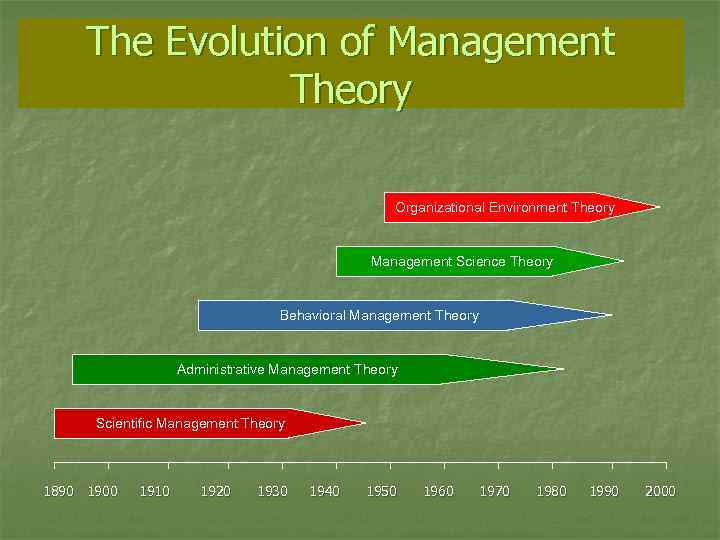 The Evolution of Management Theory Organizational Environment Theory Management Science Theory Behavioral Management Theory Administrative Management Theory Scientific Management Theory 1890 1900 1910 1920 1930 1940 1950 1960 1970 1980 1990 2000
 Evolution of modern management began in the late nineteenth century, after the industrial revolution. Economic, technical and cultural changes
 Job specialization and the Division of Labor Famous economist, Adam Smith, journeyed around England in 1700’s studying the effects of industrial revolution.
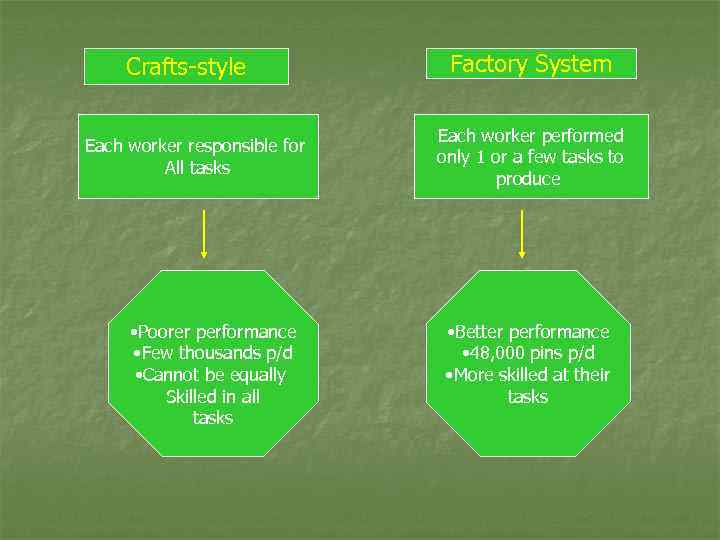 Crafts-style Each worker responsible for All tasks • Poorer performance • Few thousands p/d • Cannot be equally Skilled in all tasks Factory System Each worker performed only 1 or a few tasks to produce • Better performance • 48, 000 pins p/d • More skilled at their tasks
 With insights gained from Adam Smith’s observations, other managers and researchers began to investigate how to improve job specialization to increase performance. They focused on how to organize and control the work process.
 F. W. Taylor (1856 -1915) Scientific Management The systematic study of relationships between people and tasks for the purpose of redesigning the work process to increase efficiency.
 Taylor believed that if the amount of time and effort that each worker expends to produce a unit of output can be reduced by increasing specialization and division of labor, the production process will become more efficient.
 Taylor’s Principles 1. Study the way workers perform their tasks, gather all informational job knowledge that workers possess, and experiment with ways of improving how tasks are performed
 2. Codify the new methods of performing tasks into written rules and standard operating procedures. 3. Carefully select workers who possess skills and abilities that match the needs of the task, and train them to perform the task according to the established rules and procedures.
 4. Establish a fair or acceptable level of performance for a task, and then develop a pay system that provides a reward for performance above the acceptable level.
 This scientific management became nationally known, but the selective implementation of the principles created more harm than good.
 n n Workers felt that as their performance increased, managers required them to do more work for the same pay. Increases in performance meant fewer jobs and greater threat of layoffs Monotonous and repetitive Dissatisfaction
 Ford n n Achieving the right mix of worker-task specialization Linking people and tasks by the speed of the production line
 Franklin Motor Company Redesigned the work process using the scientific management principles. Production increased from 100 cars a month to 45 cars a day.
 The Gilbreths n Frank Gilbreth (1868 -1924) n Lilian Gilbreth (1878 -1972)
 Time and Motion Study 1. 2. 3. Break and analyze every individual action necessary to perform a particular task into each of its component actions Find better ways to perform each component action Reorganize each component action so that it is more efficient-less cost of time and effort
 Their goal was to maximize the efficiency with which each individual task was performed.
 Administrative Management Theory n Theory of Bureaucracy n Fayol’s Principles of Management
 Administrative Management The study of how to create an organizational structure that leads to high efficiency and effectiveness.
 Theory of Bureaucracy Max Weber (1864 -1920) Developed the principles of bureaucracy-a formal system of organization and administration designed to ensure efficiency and effectiveness.
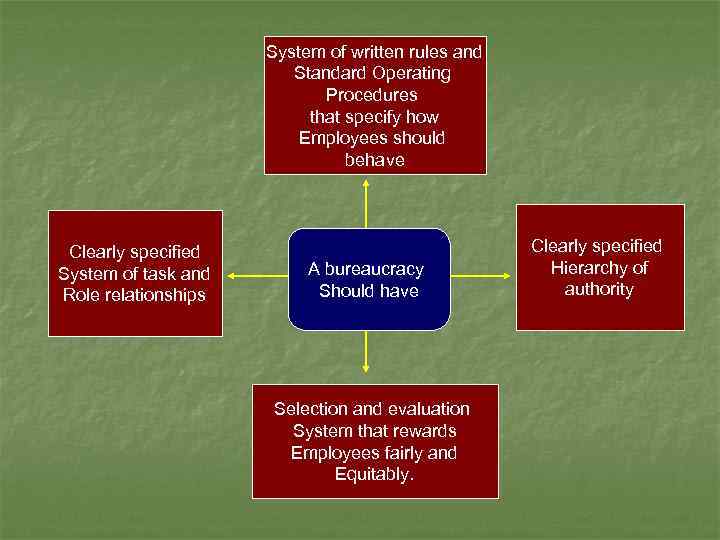 System of written rules and Standard Operating Procedures that specify how Employees should behave Clearly specified System of task and Role relationships A bureaucracy Should have Selection and evaluation System that rewards Employees fairly and Equitably. Clearly specified Hierarchy of authority
 5 Principles: n n A Manager’s formal authority derives from the position he or she holds in the organization People should occupy positions because of their performance, not because of their social standing or personal contacts.
 n n The extent of each position’s formal authority and task responsibilities and its relationship to other positions in an organization, should be clearly specified. Authority can be exercised effectively in an organization when positions are arranged hierarchically, so employees know whom to report to and who reports to them.
 n Managers must create a well-defined system of rules, standard operating procedures and norms so that they can effectively control behavior within an organization.
 Rules Formal written instructions that specify actions to be taken under different circumstances to achieve specific goals. Rule: At the end of the day employees are to leave their machines in good order.
 Standard Operating Procedures Specific sets of written instructions about how to perform a certain aspect of a task. SOP: Specifies exactly how they should do so, which machine parts should be oiled or replaced.
 Norms are unwritten, informal codes of conduct that prescribe how people should act in particular situations. E. g. : An organizational norm in a restaurant might be that waiters should help each other if time permits.
 Fayol’s Principles of Management Henri Fayol (1841 -1925)
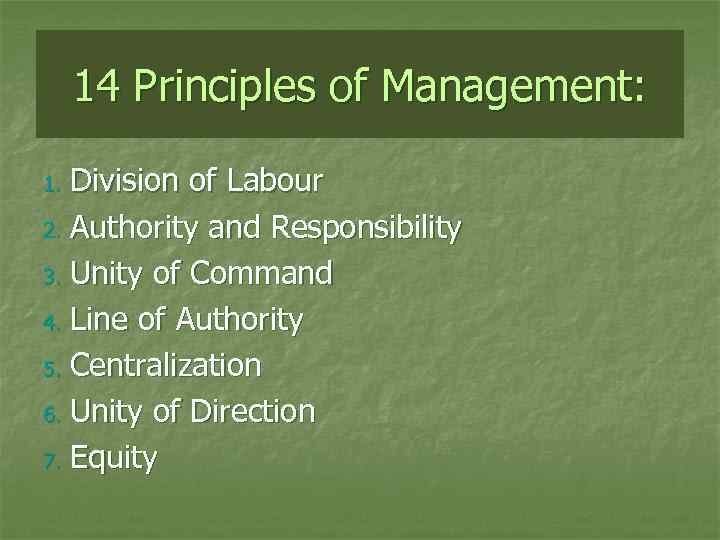 14 Principles of Management: Division of Labour 2. Authority and Responsibility 3. Unity of Command 4. Line of Authority 5. Centralization 6. Unity of Direction 7. Equity 1.
 8. Order 9. Initiative 10. Discipline 11. Remuneration of Personnel 12. Stability of tenure of Personnel 13. Subordination of Individual Interests to the Common Interest 14. Esprit de Corps
 1. Division of Labour Job specialization and the division of labour should increase efficiency. Pointed out the downside of too much specialization; so workers should be given more duties to perform.
 2. Authority and Responsibility Managers have the right to give orders and the power to exhort subordinates for obedience.
 3. Unity of Command An employee should receive orders from only one superior.
 4. Line of Authority The length of the chain of command that extends from the top to the bottom of an organization should be limited.
 5. Centralization Authority should not be concentrated at the top of the chain of command.
 6. Unity of Direction Those operations within the organization that have the same objective should be directed by only one manager using one plan. For example the personnel department in a company should not have two directors each with a different hiring policy.
 7. Equity Managers should be both friendly and fair to their subordinates.
 8. Order Materials and people should be in the right place at the right time. People should be in the jobs that they are most suited to.
 9. Initiative Subordinates should be given the freedom to conceive and carry out their plans, even though some mistakes may result.
 10. Discipline Members in an organization need to respect the rules and agreement that govern the organization. To Fayol, discipline results from good leadership, fair agreements and judiciously enforced penalties for infractions.
 11. Remuneration of Personnel Compensation for work done should be fair to both employees and employers.
 12. Stability of Tenure of Personnel A high employee turnover rate undermines the efficient functioning of an organization.
 13. Subordination of Individual Interests to the Common Interests of employees should not take precedence over the interests of the organization as a whole.
 14. Esprit de Corps Promoting team spirit will give the organization a sense of unity. To Fayol, even a small factors should help to develop the spirit. He suggested, for example, the use of verbal communication instead of formal, written communication whenever possible.
 Behavioral Management Theory n n n The Work of Mary Parker Follet The Hawthorn Studies and Human Relations Theory X and Y
 Behavioral Management The study of how managers should behave to motivate employees and encourage them to perform at high levels and be committed to the achievement of organizational goals.
 Mary Parker Follet n n n Mary Parker Follett advocated for a human relations emphasis. Her work contrasted with the "scientific management" of Frederick W. Taylor. Mary Parker Follett stressed the interactions of management and workers.
 n n Follett was one of the first to integrate the idea of organizational conflict into management theory, and is sometimes considered the "mother of conflict resolution. “ She coined the words "power-over" and "power-with" to differentiate coercive power from participative decision-making.
 n n She was of the view that authority should go with knowledge. Advocated involvement of workers in job analysis and work development process. Managers of different departments should communicate with each other directly. Cross-functioning
 The Hawthorne Studies Hawthorn effect is the finding that a manager’s behavior or leadership approach can affect worker’s level of performance.
 Human Relations Movement Advocates of the idea that supervisors receive behavioral training to manage subordinates in ways that elicit their cooperation and increase their productivity.
 Informal Organization The system of behavioral rules and norms that emerge in a group.
 Organization Behavior The study of the factors that have an impact on how individuals and groups respond to and act in organizations.
 Theory X and Theory Y Douglas Mc. Gregor proposed that two sets of assumptions about how work attitudes and behaviors not only dominate the way managers think but also affect how they behave in organizations. He named these two assumptions Theory X and Theory Y.
 Theory X Assumptions: n Average worker is lazy n Dislikes work n Will try to do as little as possible n Have little ambition and avoid responsibility
 Managers Who Accept Theory X To keep performance high, workers must be supervised closely and their behaviors be controlled by means of “the carrot and stick”-rewards and punishments.
 n n n Design and shape work setting to maximize control over workers’ behaviors. Minimize the workers’ control over the pace of work. Focus is on development of rules, SOPs and a well-defined system of reward and punishment to control behavior. Managers see little point in giving autonomy to solve their own problems. Managers see their role as closely monitoring workers.
 Theory Y Assumptions: n Workers are not inherently lazy n Do not naturally dislike work n If given the opportunity, will do what is good for the organization.
 n n n Characteristics of the work setting determine whether workers consider work to be a source of satisfaction or punishment. Managers do not need to closely control workers’ behavior. They exercise self-control
 Management Science Theory An approach to management that uses rigorous quantitative techniques to help managers make maximum use of organizational resources.
 n Quantitative Techniques n Operations Management n Total Quality Management n Management Information Systems
 Organizational Environment Theory The set of forces and conditions that operate beyond an organization’s boundaries but affect a managers ability to acquire and utilize resources.