


 Скачать презентацию Management is an art of knowing what to
Презентация 312.pptx
- Количество слайдов: 14

 Management is an art of knowing what to do. When to do and see that it is done in the best and cheapest way.
 Management as an activity includes 1. Informational activities 2. Decisional activities 3. Interpersonal activities
 Management as an activity includes Informational activities - involve handling, sharing, and analyzing information. In the functioning of business enterprise, the manager constantly has to receive and give information orally or in written. Decisional activities – require decision-making Therefore, managers are continuously involved in decisions of different kinds since the decision made by one manager becomes the basis of action to be taken by other managers. Interpersonal activities - involve coordination and interaction with employees. Management involves achieving goals through people. Therefore, managers have to interact with superiors as well as the subordinates. They must maintain good relations with them.
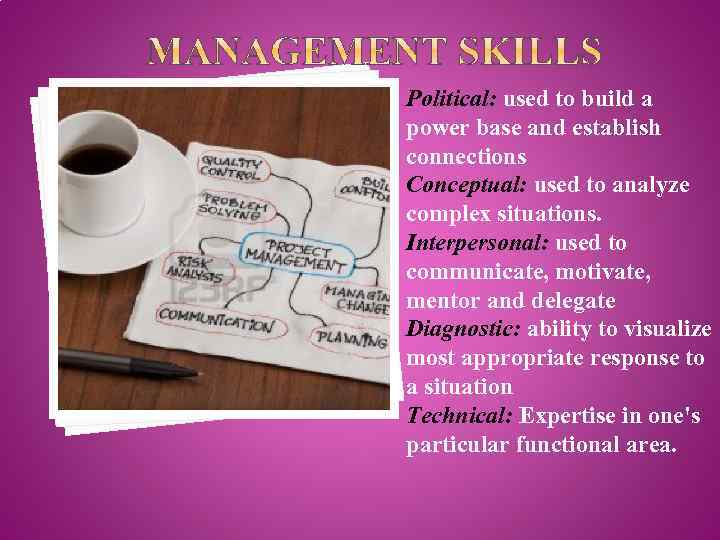 Political: used to build a power base and establish connections Conceptual: used to analyze complex situations. Interpersonal: used to communicate, motivate, mentor and delegate Diagnostic: ability to visualize most appropriate response to a situation Technical: Expertise in one's particular functional area.
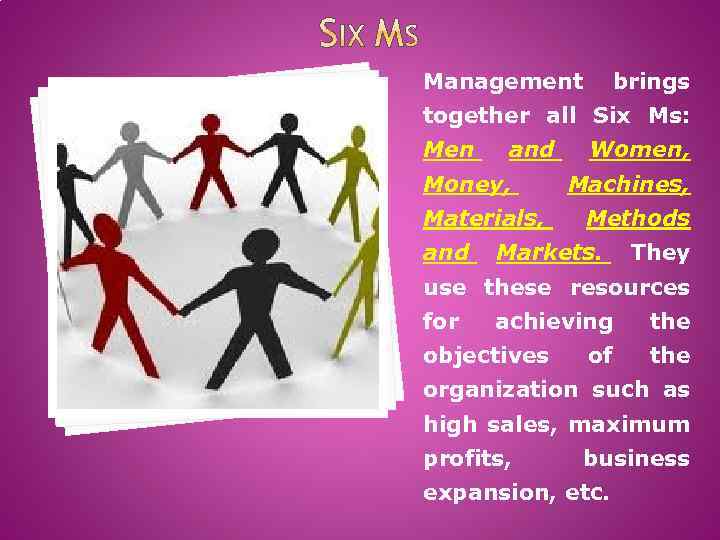 Management brings together all Six Ms: Men and Money, Materials, and Women, Machines, Methods Markets. They use these resources for achieving objectives of the organization such as high sales, maximum profits, business expansion, etc.
 Manager - is a member of the organization, which provides administrative activities and solves management problems. An organization can not exist without managers. There are several reasons why manager is needed.
 mines nager deter ision: ma zation, )Making dec 1 f the organi no the directio urces. locates reso al collects le: manager on ro nal and 2) Informati ut the inter abo information larifies ironment, c v f the external en main goals o he policy and t. eader: organization the role of l erforms ) Manager p 3 s in the relationship forming , ation organization s of organiz member nation otivation of m oals, coordi he g to achieve t aff. efforts of st of
 IMPORTANCE OF MANAGERS 1)managers provide performance the main tasks of organization; 2) managers develop strategies of behavior of the organization in the changing environment; 3)Manager – is the main information link of connection with the environment; 4) manager presents the organization in different events; 5) manager oversees the work.
 Purpose - is desirable state of controlling object, the expected result of its activities. The goal always has a quantitative characterization. Goals oriented manager in choosing solutions to drive the activity of a certain type. Main types: 1) addressed to the external environment (official); 2) operational (internal); 3) operational - goals of individual employees, managers and owners of professional growth, material welfare.
 Purpose should be established in the following areas: competition and participation in the market; profit growth ; offer products to customers and target markets; marketing and sales; production and employment; income distribution; research and development and the results of production; finance and control.
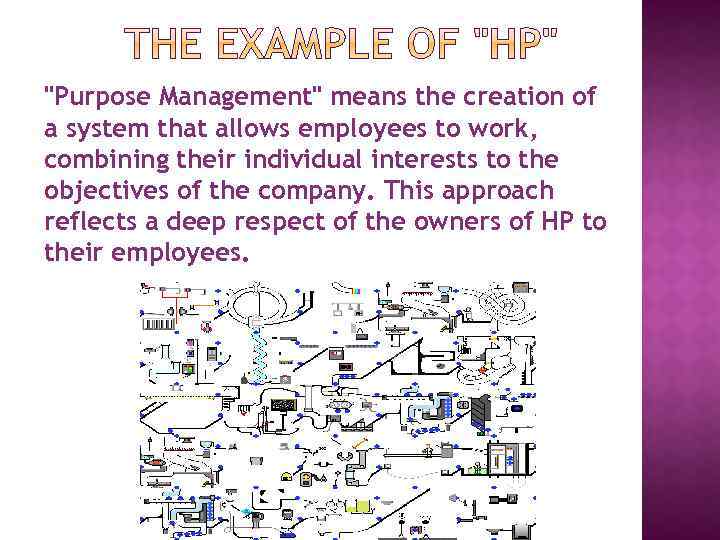 "Purpose Management" means the creation of a system that allows employees to work, combining their individual interests to the objectives of the company. This approach reflects a deep respect of the owners of HP to their employees.
 "Manage, walking " include walking through the departments of enterprise, which gives the opportunity to meet and talk informally with employees and look at them in their case. "Open door policy". This policy aims to build trust and understanding and to create an environment in which people are free to express their ideas and opinions, can share problems.